Máster en Docencia Universitaria Presentaciones avanzadas para las aulas  Rocío Arteaga Sánchez Jesús Iglesias Garrido  Concepción Román Dr. D. Francisco Pavón Rabasco
Dependent Self-employment as a way to evade Employment Protection Legislation  SERG  -Spanish Entrepreneurship Research Group- Universidad de Huelva XI Reunión de Economía Mundial
Outline  MOTIVATION OBJECTIVES HYPOTHESES DATA ECONOMETRIC FRAMEWORK RESULTS CONCLUSIONS
Motivation  Relationship between self-employment and EPL strictness is a matter of controversy (Parker 2007; Audretsch et al. 2007).  Arguments suggesting the existence of a negative relationship: EPL imposes higher sunk costs for self-employed workers who decide to take on employees.  EPL alters the relative valuation between salaried-work and self-employment. But also, a positive relationship may be considered: EPL and schemes oriented to encourage people to start business  Mutual agreements between employers and employees  “ Dependent” self-employment transitions
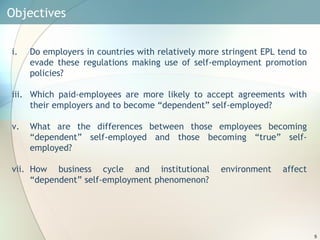
Objectives  Do employers in countries with relatively more stringent EPL tend to evade these regulations making use of self-employment promotion policies? Which paid-employees are more likely to accept agreements with their employers and to become “dependent” self-employed? What are the differences between those employees becoming “dependent” self-employed and those becoming “true” self-employed? How business cycle and institutional environment affect “dependent” self-employment phenomenon?
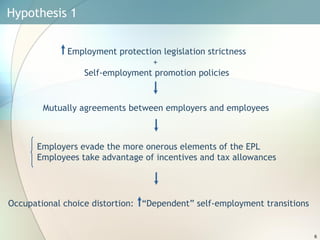
Hypothesis 1  Mutually agreements between employers and employees Employment protection legislation strictness + Self-employment promotion policies Occupational choice distortion:  “Dependent” self-employment transitions Employers evade the more onerous elements of the EPL Employees take advantage of incentives and tax allowances
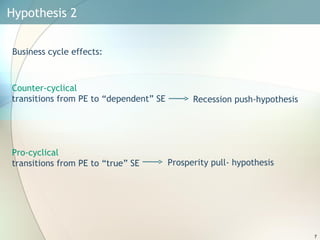
Hypothesis 2  Counter-cyclical transitions from PE to “dependent” SE Pro-cyclical  transitions from PE to “true” SE  Business cycle effects: Recession push-hypothesis Prosperity pull- hypothesis
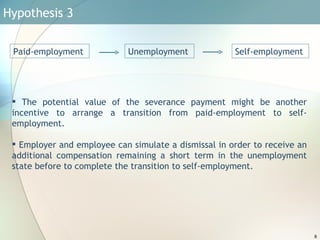
Hypothesis 3  The potential value of the severance payment might be another incentive to arrange a transition from paid-employment to self-employment.  Employer and employee can simulate a dismissal in order to receive an additional compensation remaining a short term in the unemployment state before to complete the transition to self-employment. Self-employment  Unemployment  Paid-employment
Data  European Community Household Panel 1994-2001 period Information directly comparable Men and women aged 21 to 59 Workers in the agricultural sector are excluded Full-time workers Incomes are corrected by: Purchasing Power Parity (across countries)  Harmonised Consumer Price Index (across time) Standardised  unemployment rates
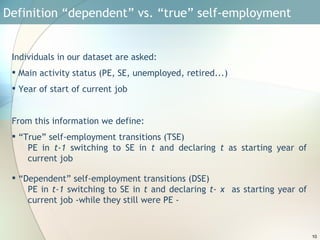
Definition “dependent” vs. “true” self-employment  Individuals in our dataset are asked: Main activity status (PE, SE, unemployed, retired...)  Year of start of current job From this information we define: “ True” self-employment transitions (TSE) PE in  t-1  switching to SE in  t  and declaring  t  as starting year of current job “ Dependent” self-employment transitions (DSE) PE in  t-1  switching to SE in  t  and declaring  t- x  as starting year of current job -while they still were PE -
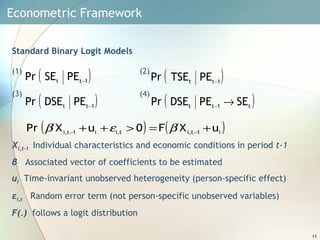
Standard Binary Logit Models (1)  (2)  (3)  (4) X i,t-1  Individual characteristics and economic conditions in period  t-1 β   Associated vector of coefficients to be estimated u i   Time-invariant unobserved heterogeneity (person-specific effect) ε i,t   Random error term (not person-specific unobserved variables) F(.)  follows a logit distribution Econometric Framework
Results (III)  EXERCISE (1) EXERCISE (2) EXERCISE (3) EXERCISE (4) Prob [SE  t  | PE  t-1 ] Prob [TSE  t  | PE  t-1 ] Prob [DSE  t  | PE  t-1 ] Prob [DSE  t  (vs. TSE  t )] Variables Marg. eff. t-stat. Marg. eff. t-stat. Marg. eff. t-stat. Marg. eff. t-stat. Incomes Dwelling owner 1.93% 0.3 -7.73% -0.89 16.05% 1.68* 12.21% 1.62* Capital & property incomes (1 lag)(x e-3) 2.71% 3.58*** 1.92% 1.58 3.07% 3.23*** 2.15% 1.62* Work incomes (x e-2) 0.1% 0.29 0.33% 0.74 0.01% 0.01 -0.53% -0.88 Business cycle Unemployment rate 1.33% 0.8 -4.42% -1.82* 7.63% 3.12*** 6.75% 3.13*** Country Austria (5) -31.54% -1.74* -41.11% -1.84* -33.44% -1.16 20.6% 0.66 Belgium  (5) -52.81% -4.72*** -37.28% -2.04** -79.21% -5.75*** -38.18% -1.7* Denmark  (5) -16.48% -0.87 -24.61% -1.05 -11.12% -0.35 12.46% 0.44 Finland  (5) 27.34% 1.61 -1.02% -0.05 67.53% 2.2** 38.18% 2.47*** Germany  (5) -56.4% -5.08*** -43.68% -2.45*** -78.92% -5.26*** -19.79% -0.99 Italy  (5) 63.65% 3.45*** 27.6% 1.22 127.22% 3.54*** 44.95% 3.37*** Netherlands  (5) -44.98% -2.96*** -69.32% -3.52*** 1.45% 0.04 59.54% 2.41** Portugal  (5) 24.95% 1.09 3.55% 0.13 70.22% 1.61 41.57% 1.81* United Kingdom  (5) -36.95% -2.69*** -3.9% -0.16 -115.3% -9.47*** -85.31% -6.88*** Reference categories : (5) Spain Log likelihood -7442.81 -4798.64 -3446.73 -815.72
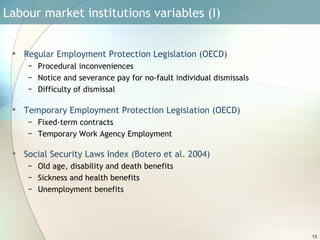
Labour market institutions variables (I)  Regular Employment Protection Legislation (OECD ) Procedural inconveniences Notice and severance pay for no-fault individual dismissals  Difficulty of dismissal Temporary Employment Protection Legislation (OECD) Fixed-term contracts Temporary Work Agency Employment  Social Security Laws Index (Botero et al. 2004) Old age, disability and death benefits Sickness and health benefits  Unemployment benefits  
Labour market institutions variables (II) Expenditure on Active Labour Market Policies as % of GDP(OECD) Public Employment Services and administration Labour market training Youth measures Subsidised employment Measures for the disable Potential Severance Payment (OECD Employment Outlook 1999, ch. 2) Severance pay for individual dismissal of a regular employee with tenure beyond any trial period Personal grounds or economic redundancy but without fault Information based on legal regulation, but also on averages found in collective agreements or individual employment contracts. Employment duration, salary, type of contract, age.
Results (IV)  EXERCISE (1) EXERCISE (2) EXERCISE (3) EXERCISE (4) Prob [SE  t  | PE  t-1 ] Prob [TSE  t  | PE  t-1 ] Prob [DSE  t  | PE  t-1 ] Prob [DSE  t  (vs. TSE  t )] # observations 157016 156293 156195 1544 # transitions 1544 821 723 723 vs. 821 Predicted probability 0.00463 0.00257 0.00129 0.45965 Variables Marg. eff. t-stat. Marg. eff. t-stat. Marg. eff. t-stat. Marg. eff. t-stat. Business cycle Unemployment rate -0.36% -0.43 -4.43% -3.09*** 6.11% 4.9*** 5.32% 3.99*** Labour Market Institutions EPL  index for regular  employment 0.86% 0.26 -8.09% -1.79* 32.56% 5.55*** 21.48% 4.17*** EPL  index for temporary  employment 11.94% 4.52*** 6.95% 1.75* 26.21% 6.78*** 10.57% 3.01*** Social Security Laws index 573.93% 9.06*** 362.46% 3.42*** 973.91% 9.18*** 344.93% 3.49*** Expenditure on ALMP  as % of GDP -7.67% -1 -32.15% -2.9*** 74.04% 4.97*** 57.28% 4.45*** Log likelihood -7472.76 -4810.06 -3486.88 -832.45
Results (V)  EXERCISE (1) EXERCISE (2) EXERCISE (3) EXERCISE (4) Prob [SE  t  | PE  t-1 ] Prob [TSE  t  | PE  t-1 ] Prob [DSE  t  | PE  t-1 ] Prob [DSE  t  (vs. TSE  t )] # observations 157016 156293 156195 1544 # transitions 1544 821 723 723 vs. 821 Predicted probability 0.00462 0.00261 0.00140 0.46854 Variables Marg. eff. t-stat. Marg. eff. t-stat. Marg. eff. t-stat. Marg. eff. t-stat. Business cycle Unemployment rate -0.44% -0.56 -4.01% -3.02*** 4.12% 3.41*** 3.89% 3.35*** Labour Market Institutions EPL  index for temporary  employment 12.53% 4.81*** 7.27% 1.88* 24.01% 6.34*** 9.25% 2.57*** Social Security Laws index 574.59% 9.08*** 370.47% 3.47*** 888.7% 8.57*** 326.70% 3.36*** Expenditure on ALMP as %  of GDP -8.49% -1.15 -30.56% -2.81*** 35.4% 2.82*** 40.03% 3.64*** Potential severance  payment (x e-3) -0.21% -0.64 -1.99% -2.85*** 0.89% 2.83*** 1.68% 3.36*** Log likelihood -7472.58 -4804.81 -3498.80 -838.04
Conclusions  WHAT WE OBSERVE … EPL strictness and ALMP increase transitions PE -> DSE Two opposite business cycle effects on transitions to TSE and DSE  Severance payment increases the opportunity cost of SE OPEN QUESTIONS Are policies aimed to encourage SE well designed? Should effective measures to detect and combat DSE be designed?
Dependent Self-employment as a way to evade Employment Protection Legislation  Thanks for your attention!

Tarea

  • 1.
    Máster en DocenciaUniversitaria Presentaciones avanzadas para las aulas Rocío Arteaga Sánchez Jesús Iglesias Garrido Concepción Román Dr. D. Francisco Pavón Rabasco
  • 2.
    Dependent Self-employment asa way to evade Employment Protection Legislation SERG -Spanish Entrepreneurship Research Group- Universidad de Huelva XI Reunión de Economía Mundial
  • 3.
    Outline MOTIVATIONOBJECTIVES HYPOTHESES DATA ECONOMETRIC FRAMEWORK RESULTS CONCLUSIONS
  • 4.
    Motivation Relationshipbetween self-employment and EPL strictness is a matter of controversy (Parker 2007; Audretsch et al. 2007). Arguments suggesting the existence of a negative relationship: EPL imposes higher sunk costs for self-employed workers who decide to take on employees. EPL alters the relative valuation between salaried-work and self-employment. But also, a positive relationship may be considered: EPL and schemes oriented to encourage people to start business Mutual agreements between employers and employees “ Dependent” self-employment transitions
  • 5.
    Objectives Doemployers in countries with relatively more stringent EPL tend to evade these regulations making use of self-employment promotion policies? Which paid-employees are more likely to accept agreements with their employers and to become “dependent” self-employed? What are the differences between those employees becoming “dependent” self-employed and those becoming “true” self-employed? How business cycle and institutional environment affect “dependent” self-employment phenomenon?
  • 6.
    Hypothesis 1 Mutually agreements between employers and employees Employment protection legislation strictness + Self-employment promotion policies Occupational choice distortion: “Dependent” self-employment transitions Employers evade the more onerous elements of the EPL Employees take advantage of incentives and tax allowances
  • 7.
    Hypothesis 2 Counter-cyclical transitions from PE to “dependent” SE Pro-cyclical transitions from PE to “true” SE Business cycle effects: Recession push-hypothesis Prosperity pull- hypothesis
  • 8.
    Hypothesis 3 The potential value of the severance payment might be another incentive to arrange a transition from paid-employment to self-employment. Employer and employee can simulate a dismissal in order to receive an additional compensation remaining a short term in the unemployment state before to complete the transition to self-employment. Self-employment Unemployment Paid-employment
  • 9.
    Data EuropeanCommunity Household Panel 1994-2001 period Information directly comparable Men and women aged 21 to 59 Workers in the agricultural sector are excluded Full-time workers Incomes are corrected by: Purchasing Power Parity (across countries) Harmonised Consumer Price Index (across time) Standardised unemployment rates
  • 10.
    Definition “dependent” vs.“true” self-employment Individuals in our dataset are asked: Main activity status (PE, SE, unemployed, retired...) Year of start of current job From this information we define: “ True” self-employment transitions (TSE) PE in t-1 switching to SE in t and declaring t as starting year of current job “ Dependent” self-employment transitions (DSE) PE in t-1 switching to SE in t and declaring t- x as starting year of current job -while they still were PE -
  • 11.
    Standard Binary LogitModels (1) (2) (3) (4) X i,t-1 Individual characteristics and economic conditions in period t-1 β Associated vector of coefficients to be estimated u i Time-invariant unobserved heterogeneity (person-specific effect) ε i,t Random error term (not person-specific unobserved variables) F(.) follows a logit distribution Econometric Framework
  • 12.
    Results (III) EXERCISE (1) EXERCISE (2) EXERCISE (3) EXERCISE (4) Prob [SE t | PE t-1 ] Prob [TSE t | PE t-1 ] Prob [DSE t | PE t-1 ] Prob [DSE t (vs. TSE t )] Variables Marg. eff. t-stat. Marg. eff. t-stat. Marg. eff. t-stat. Marg. eff. t-stat. Incomes Dwelling owner 1.93% 0.3 -7.73% -0.89 16.05% 1.68* 12.21% 1.62* Capital & property incomes (1 lag)(x e-3) 2.71% 3.58*** 1.92% 1.58 3.07% 3.23*** 2.15% 1.62* Work incomes (x e-2) 0.1% 0.29 0.33% 0.74 0.01% 0.01 -0.53% -0.88 Business cycle Unemployment rate 1.33% 0.8 -4.42% -1.82* 7.63% 3.12*** 6.75% 3.13*** Country Austria (5) -31.54% -1.74* -41.11% -1.84* -33.44% -1.16 20.6% 0.66 Belgium (5) -52.81% -4.72*** -37.28% -2.04** -79.21% -5.75*** -38.18% -1.7* Denmark (5) -16.48% -0.87 -24.61% -1.05 -11.12% -0.35 12.46% 0.44 Finland (5) 27.34% 1.61 -1.02% -0.05 67.53% 2.2** 38.18% 2.47*** Germany (5) -56.4% -5.08*** -43.68% -2.45*** -78.92% -5.26*** -19.79% -0.99 Italy (5) 63.65% 3.45*** 27.6% 1.22 127.22% 3.54*** 44.95% 3.37*** Netherlands (5) -44.98% -2.96*** -69.32% -3.52*** 1.45% 0.04 59.54% 2.41** Portugal (5) 24.95% 1.09 3.55% 0.13 70.22% 1.61 41.57% 1.81* United Kingdom (5) -36.95% -2.69*** -3.9% -0.16 -115.3% -9.47*** -85.31% -6.88*** Reference categories : (5) Spain Log likelihood -7442.81 -4798.64 -3446.73 -815.72
  • 13.
    Labour market institutionsvariables (I) Regular Employment Protection Legislation (OECD ) Procedural inconveniences Notice and severance pay for no-fault individual dismissals  Difficulty of dismissal Temporary Employment Protection Legislation (OECD) Fixed-term contracts Temporary Work Agency Employment Social Security Laws Index (Botero et al. 2004) Old age, disability and death benefits Sickness and health benefits  Unemployment benefits  
  • 14.
    Labour market institutionsvariables (II) Expenditure on Active Labour Market Policies as % of GDP(OECD) Public Employment Services and administration Labour market training Youth measures Subsidised employment Measures for the disable Potential Severance Payment (OECD Employment Outlook 1999, ch. 2) Severance pay for individual dismissal of a regular employee with tenure beyond any trial period Personal grounds or economic redundancy but without fault Information based on legal regulation, but also on averages found in collective agreements or individual employment contracts. Employment duration, salary, type of contract, age.
  • 15.
    Results (IV) EXERCISE (1) EXERCISE (2) EXERCISE (3) EXERCISE (4) Prob [SE t | PE t-1 ] Prob [TSE t | PE t-1 ] Prob [DSE t | PE t-1 ] Prob [DSE t (vs. TSE t )] # observations 157016 156293 156195 1544 # transitions 1544 821 723 723 vs. 821 Predicted probability 0.00463 0.00257 0.00129 0.45965 Variables Marg. eff. t-stat. Marg. eff. t-stat. Marg. eff. t-stat. Marg. eff. t-stat. Business cycle Unemployment rate -0.36% -0.43 -4.43% -3.09*** 6.11% 4.9*** 5.32% 3.99*** Labour Market Institutions EPL index for regular employment 0.86% 0.26 -8.09% -1.79* 32.56% 5.55*** 21.48% 4.17*** EPL index for temporary employment 11.94% 4.52*** 6.95% 1.75* 26.21% 6.78*** 10.57% 3.01*** Social Security Laws index 573.93% 9.06*** 362.46% 3.42*** 973.91% 9.18*** 344.93% 3.49*** Expenditure on ALMP as % of GDP -7.67% -1 -32.15% -2.9*** 74.04% 4.97*** 57.28% 4.45*** Log likelihood -7472.76 -4810.06 -3486.88 -832.45
  • 16.
    Results (V) EXERCISE (1) EXERCISE (2) EXERCISE (3) EXERCISE (4) Prob [SE t | PE t-1 ] Prob [TSE t | PE t-1 ] Prob [DSE t | PE t-1 ] Prob [DSE t (vs. TSE t )] # observations 157016 156293 156195 1544 # transitions 1544 821 723 723 vs. 821 Predicted probability 0.00462 0.00261 0.00140 0.46854 Variables Marg. eff. t-stat. Marg. eff. t-stat. Marg. eff. t-stat. Marg. eff. t-stat. Business cycle Unemployment rate -0.44% -0.56 -4.01% -3.02*** 4.12% 3.41*** 3.89% 3.35*** Labour Market Institutions EPL index for temporary employment 12.53% 4.81*** 7.27% 1.88* 24.01% 6.34*** 9.25% 2.57*** Social Security Laws index 574.59% 9.08*** 370.47% 3.47*** 888.7% 8.57*** 326.70% 3.36*** Expenditure on ALMP as % of GDP -8.49% -1.15 -30.56% -2.81*** 35.4% 2.82*** 40.03% 3.64*** Potential severance payment (x e-3) -0.21% -0.64 -1.99% -2.85*** 0.89% 2.83*** 1.68% 3.36*** Log likelihood -7472.58 -4804.81 -3498.80 -838.04
  • 17.
    Conclusions WHATWE OBSERVE … EPL strictness and ALMP increase transitions PE -> DSE Two opposite business cycle effects on transitions to TSE and DSE Severance payment increases the opportunity cost of SE OPEN QUESTIONS Are policies aimed to encourage SE well designed? Should effective measures to detect and combat DSE be designed?
  • 18.
    Dependent Self-employment asa way to evade Employment Protection Legislation Thanks for your attention!

Editor's Notes

  • #4 The outline of the presentation is as follows: I will start with the motivation of the paper. Then, I will present the objectives and our main hypothesis. After data and econometric framework, I will present the results of our estimations and finally we can discuss the conclusions.
  • #5 The relationship between SE and the strictness of EPL is a matter of controversy in the Economics of Entrepreneurship (Parker, 2007a; Audrestch et al., 2007). On the one hand, a stricter EPL imposes higher sunk costs for self-employed workers who decide to take on employees and alters the relative valuation between salaried-work and self-employment in favour of the former. Therefore, these arguments suggest the existence of a negative relationship between self-employment and EPL. On the other hand, an opposite interpretation of this relationship is also plausible: the combination of a strict EPL together with schemes oriented to encourage people to start business might give rise to the establishment of mutual agreements between employers and employees by means of which the employee switch to self-employment, just to evade the most onerous elements of employment legislation. In fact, a topic of public discussion is whether traditional work done by employees is being outsourced to self-employed worker, just to omit payments for the social security or any adjustment cost due to the EPL, giving rise to the so-called phenomenon of “quasi” self-employment, “dependent” self-employment or “false” self-employment. Thus, these employees are “pushed” to self-employment, although doing the same activity, taking advantage of incentives schemes and reducing tax liabilities. As a result, a positive relationship between self-employment and EPL is suggested.
  • #6 In this context, the aim of this paper is to provide some new empirical evidence about these workers who are outsourced in order to evade the more onerous elements of the EPL in contrast with workers who decide to switch to self-employment to capture a new profit opportunity. In order to shed new light on the previous discussion, the paper provides evidence to address these main questions Do employers in countries with relatively more stringent EPL tend to evade these regulations making use of self-employment promotion policies? Which are the characteristics of the employees that are more likely to accept agreements with their employers and to become “false” self-employed? What are the differences between those employees who become “false” self-employed and those ones who become “true” self-employed? How business cycle and institutional environment affect “false” self-employment phenomenon
  • #7 In particular, we test three hypothesis. The first one is that the combination of an strict Employment Protection Legislation and self-employment promotion policy may generate distortions in the occupational choice problem, increasing transitions from paid-employment to self-employment, by the formula of “dependent” self-employment. In that sense, when the work is outsourced as a result of mutually agreements between employers and employees, employers are allowed to evade the more onerous elements of the EPL and employees may take advantage of SE incentives and tax allowances. However, for “true” self-employed, a stricter EPL reduces the probability to become entrepreneur.
  • #8 The second hypothesis refers to business cycle effects. In this sense, we expect that when unemployment rates increases the bargaining power of employees decreases with respect to their employer’s counterpart. In this framework the EPL gives employers an extra-incentive to outsource certain works. Hence, transitions from paid-employment to “false” or “dependent” self-employment are expected to be counter-cyclical. So that in this case, the recession push-hypothesis should be appropriated. On the other hand and by contrast, workers who switch to “true” self-employment are searching for new profit opportunities, so that these type of transitions are more likely to appear during expansion periods. That is, in that case it is the prosperity pull- hypothesis what apply.
  • #9 And finally, we expect that the potential value of the severance payment that the paid-employed would receive in case of dismissal should be another incentive to arrange a transition from paid-employment to self-employment. In fact, employer and employee can simulate a dismissal in order to receive an additional compensation, remaining a short term in the unemployment state before to complete the transition to self-employment. Hence the effect of this variable on transitions into “true” and “dependent” self-employment might be of opposite sign.
  • #10 The data that we used come from the European Community Household Panel (ECHP). The ECHP is a panel of households referring to the EU-15, covering the period 1994-2001. Every year all members of the selected households in each country are interviewed about issues relating to demographics, labour market, income and living conditions. The fact that a relatively long period of data is available allows us to study the influence of, not just personal and demographic characteristics, but also changes in the business cycle. The same questionnaire is used for all countries, which makes the information directly comparable. Despite the fact that women have lower self-employment rates, our samples include men and women aged 21 to 59. Workers in the agricultural sector are also excluded because this sector is structurally different from the rest of the economy. Moreover, all self-employed individuals which are not full-time workers, that is, working under 30 hours per week, are also excluded from our final sample. Regarding wealth variables, incomes are corrected by Purchasing Power Parity (what gives us comparability across countries) and Harmonised Consumer Price Index (that allows as to compare across time). Finally, as national unemployment rates are tested as determining factors of the entrants to self-employment, standardised unemployment rates for Europe need to be used to avoid comparability problems.
  • #11 I would like to highlight how we distinguish between “true” and “dependent” or “false” self-employment transitions. The individuals in our dataset are asked which is his/her main activity status -variable PE001- (paid-employed, self-employed, unemployed, retired, in education...) and the year of start of current job -variable PE011-. From this information, we can identify those paid-employed individuals switching to self-employment from period t-1 to period t , and declaring either t is their year of start of current job –which we associate to “true” self-employment- or declaring they started their current job while they still was paid-employed –which we associate to “dependent” self-employment-.
  • #12 The econometric framework is standard, as we use binary logit models. Thus, the probability of switching from a starting status (paid employment) to a final status (self-employment, true or false self-employment) is assumed to depend on a set of observed individual characteristics and economic variables at t-1. Furthermore, also by means of a standard binary logit model, we compare individuals switching to false SE with those switching to true SE.
  • #13 The first result we highlight is related to business cycle effect, which we have called before “Hypothesis 2”. We observe that individuals entering TSE are more likely to switch when economic conditions are good (prosperity pull). On the other hand, individuals entering FSE are more likely to switch when economic situation worsens (recession push). When focusing on country specific effects, the fact that some of these dummies are significant might be interpreted as a sign of the presence of specific regional factors affecting the probability of entering self-employment. To capture these specific regional factors affecting the probability of self-employment, we perform another binary logit analysis where we substitute the country dummies by several measures of labour market institutions.
  • #14 In particular, as aggregated measures we introduce in our analysis the measure of employment protection developed by the OECD that refers to the protection of regular employment and the regulation of temporary work and is intended to measure the strictness of EPL. Moreover, we also consider the Social Security Laws Index by Botero et al., that measures the social security benefits as the average of: Old age, disability and death benefits. Sickness and health benefits. Unemployment benefits.
  • #15 And the expenditure on Active Labour Market Policies as a percentage of GDP, that includes these categories: Public Employment Services and administration Labour market training   Youth measures   Subsidised employment Measures for the disabled And also, we have constructed a potential severance payment for the paid-employed . It is an individual measure of the potential severance payment that the worker would receive in case of dismissal.  Following the OECD (1999) Employment Outlook, chapter 2, this individual measure of severance payment is calculated using severance pay for individual dismissal of a regular employee with tenure beyond any trial period dismissed on personal grounds or economic redundancy but without fault. Information it is base mainly on legal regulation, but also, where relevant, on averages found in collective agreements or individual employment contracts.   To construct it we take into account individual employment duration, salary, type of contract and when it is necessary, age.
  • #16 First we replace the country dummies with the aggregate measures of labour market institutions we have mentioned. We observe as both “regular EPL” and “ALMP” are distorting the occupational choice by increasing transitions to DSE and decreasing transitions to TSE. That is, our first hypothesis is confirmed
  • #17 And finally, the last specification replace the aggregate measure of EPL for regular employment with the individual measure of the potential severance payment that an employee would receive in case of dismissal. And we can conclude that the “potential severance payment” increases the oportunity cost of self-employment, making transitions to TSE less likely. But also it distorts the occupational choice, increasing the probability of transitions to DSE.
  • #18 Just to conclude, our empirical results suggest as stricter EPL is distorting the occupational choice by increasing transitions to “dependent” self-employment and decreasing transitions to “true” self-employment, and these opposite relationships can be behind the previous ambiguous results on the relationship between EPL and self-employment.   Also, the finding of two opposite business cycle effects between “true” and “false” self-employment transitions reaffirms our second hypothesis. We observe that individuals entering “true” self-employment more likely to switch when economic conditions are good (prosperity pull hypothesis). And, on the other hand, individuals entering “dependent” self-employment are more likely to switch when economic situation worsens (recession push hypothesis).   Finally, our results also show that the potential severance payment makes transitions to “true” self-employment less likely. Higher severance payments increase the opportunity cost of self-employment and, as a consequence, if some transitions happen, they occur in agreement with the employer. In a sense, we should wonder if these policies aimed to encourage self-employment are well-designed or if they are simply distorting the occupational choice decision of workers and therefore favoring the development of self-employed businesses with relatively low levels of resources that are just a way to evade EPL. In this last case, and taking into account that the employment status under which a person carries out her work matters, because the access to employment rights depends on that, governments should design measures to effectively detect and combat this “dependent” self-employment.