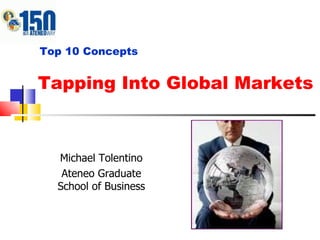
Tapping Into Global Markets Top 10 Concepts Michael Tolentino Ateneo Graduate School of Business
Outline: Tapping Into Global Market 1. Is expected in companies (why?) 2. Are based on factors that draws companies into the international arena (how?) 3. Should be rated into three criteria (how?)  4. Must first define (what?) 5. Has two typical entry strategies (what?)
Outline: Tapping Into Global Market 6. Have distinctions between (what?) 7. Should have the best mode of entry (what?) 8. Makes companies decide on a marketing program (how?) 9. Can affect consumers and business alike (how?) by country of origin perceptions. 10. makes companies manage their international marketing activity in three ways (how)?
Concpet 1: Tapping Into Global Market Is Expected in Companies   As products and services developed in one country are finding enthusiastic acceptance  in other countries.  Companies cannot simply stay domestic and expect to maintain their markets.
Concept 2: Factors that Draws Companies to the International Arena Presents higher profits. Larger customer base. Independence from one market. Competition with global competitors. International service is required
Concept 3: Company’s Marketing Objectives and Policies   Marketing objectives and policies should be defined in deciding to go global. To market into few or many countries? Which countries to market?
Concept 4: Entering Global Market is Rated into Three Criteria Market attractiveness Risk Competitive advantage
Concept 5: Two Typical Entry Strategy Waterfall Approach Gradually entering countries in sequence. Sprinkler Approach Entering countries simultaneously.
Concept 6: Distinctions in Tapping Global Market Developed Market  High purchasing powers. Developing Market Low purchasing powers.
Indirect Exporting – exports that are not handled directly by the manufacturer or producer but through an export agent. Direct Exporting – international sales in which a producer or supplier controls all activities and collects all drawbacks. Concept 7: Mode of Entry into the Market
Licensing – right given to a foreign company to use a manufacturing process, trademark, patent, trade secret or other item of value for a fee or royalty. Joint Ventures – foreign investors joins local investors to create a company in which they share ownership and control. Concept 7: Mode of Entry into the Market
Concept 7: Mode of Entry into the Market Direct Investment – direct ownership of foreign-based assembly or manufacturing facility.
Product Level Straight extension – introduces the product in the foreign market without any change. Product adaptation – alters the product to meet local conditions and preferences. Product invention – creating new product that are well adapted to a foreign country’s needs. Concept 8: Decide On Marketing Program
Concept 8: Decide On Marketing Program Communication Level Communication adaptation – companies run the same marketing communications programs used in the home market. Dual adaptation – adapts both the product and communications in foreign country.
Concept 8: Decide On Marketing Program Price Level Price escalation – prices can be set uniformly in every country, set a market-based price for each country or set a cost-based price in each country. Dumping - Exporting goods at prices lower than the home-market prices.
Concept 8: Decide On Marketing Program Price Level Gray Market – Goods sold outside of an authorized sale-territory at prices lower than being charged in the authorized sales area. Counterfeit Products – Imitation goods sold made to pass off as a genuine item.
Concept 8: Decide On Marketing Program Distribution Level – companies needs to know how the product moves within the foreign country and take a whole-channel view of distributing products to its final users.
Country of origin perceptions are the mental associations and beliefs triggered by a country. Mental associations and beliefs affects consumers and business alike. Concept 9: Country of Origin Effects
Concept 10: Marketing Organization Export department – a local department that handles the shipping out of its goods. International division – handles all international activities which is usually headed by a division president. Global organization – Has executives doing global operations, has management from different countries, purchases least cost of supplies and makes investments with anticipated returns.

Tapping Global Market

  • 1.
    Tapping Into GlobalMarkets Top 10 Concepts Michael Tolentino Ateneo Graduate School of Business
  • 2.
    Outline: Tapping IntoGlobal Market 1. Is expected in companies (why?) 2. Are based on factors that draws companies into the international arena (how?) 3. Should be rated into three criteria (how?) 4. Must first define (what?) 5. Has two typical entry strategies (what?)
  • 3.
    Outline: Tapping IntoGlobal Market 6. Have distinctions between (what?) 7. Should have the best mode of entry (what?) 8. Makes companies decide on a marketing program (how?) 9. Can affect consumers and business alike (how?) by country of origin perceptions. 10. makes companies manage their international marketing activity in three ways (how)?
  • 4.
    Concpet 1: TappingInto Global Market Is Expected in Companies As products and services developed in one country are finding enthusiastic acceptance in other countries. Companies cannot simply stay domestic and expect to maintain their markets.
  • 5.
    Concept 2: Factorsthat Draws Companies to the International Arena Presents higher profits. Larger customer base. Independence from one market. Competition with global competitors. International service is required
  • 6.
    Concept 3: Company’sMarketing Objectives and Policies Marketing objectives and policies should be defined in deciding to go global. To market into few or many countries? Which countries to market?
  • 7.
    Concept 4: EnteringGlobal Market is Rated into Three Criteria Market attractiveness Risk Competitive advantage
  • 8.
    Concept 5: TwoTypical Entry Strategy Waterfall Approach Gradually entering countries in sequence. Sprinkler Approach Entering countries simultaneously.
  • 9.
    Concept 6: Distinctionsin Tapping Global Market Developed Market High purchasing powers. Developing Market Low purchasing powers.
  • 10.
    Indirect Exporting –exports that are not handled directly by the manufacturer or producer but through an export agent. Direct Exporting – international sales in which a producer or supplier controls all activities and collects all drawbacks. Concept 7: Mode of Entry into the Market
  • 11.
    Licensing – rightgiven to a foreign company to use a manufacturing process, trademark, patent, trade secret or other item of value for a fee or royalty. Joint Ventures – foreign investors joins local investors to create a company in which they share ownership and control. Concept 7: Mode of Entry into the Market
  • 12.
    Concept 7: Modeof Entry into the Market Direct Investment – direct ownership of foreign-based assembly or manufacturing facility.
  • 13.
    Product Level Straightextension – introduces the product in the foreign market without any change. Product adaptation – alters the product to meet local conditions and preferences. Product invention – creating new product that are well adapted to a foreign country’s needs. Concept 8: Decide On Marketing Program
  • 14.
    Concept 8: DecideOn Marketing Program Communication Level Communication adaptation – companies run the same marketing communications programs used in the home market. Dual adaptation – adapts both the product and communications in foreign country.
  • 15.
    Concept 8: DecideOn Marketing Program Price Level Price escalation – prices can be set uniformly in every country, set a market-based price for each country or set a cost-based price in each country. Dumping - Exporting goods at prices lower than the home-market prices.
  • 16.
    Concept 8: DecideOn Marketing Program Price Level Gray Market – Goods sold outside of an authorized sale-territory at prices lower than being charged in the authorized sales area. Counterfeit Products – Imitation goods sold made to pass off as a genuine item.
  • 17.
    Concept 8: DecideOn Marketing Program Distribution Level – companies needs to know how the product moves within the foreign country and take a whole-channel view of distributing products to its final users.
  • 18.
    Country of originperceptions are the mental associations and beliefs triggered by a country. Mental associations and beliefs affects consumers and business alike. Concept 9: Country of Origin Effects
  • 19.
    Concept 10: MarketingOrganization Export department – a local department that handles the shipping out of its goods. International division – handles all international activities which is usually headed by a division president. Global organization – Has executives doing global operations, has management from different countries, purchases least cost of supplies and makes investments with anticipated returns.