Minimum Intervention Strategies for
Inspection
Martin van den Heuvel
Shell Projects & Technology
Team Lead Inspection Technology Amsterdam
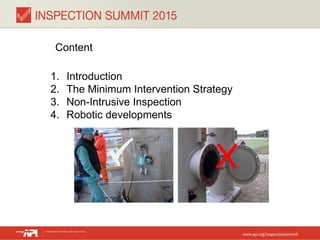
1. Introduction
2. The Minimum Intervention Strategy
3. Non-Intrusive Inspection
4. Robotic developments
Content
 X
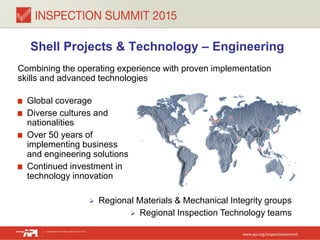
Shell Projects & Technology – Engineering
Combining the operating experience with proven implementation
skills and advanced technologies
Global coverage
Diverse cultures and
nationalities
Over 50 years of
implementing business
and engineering solutions
Continued investment in
technology innovation
 Regional Materials & Mechanical Integrity groups
 Regional Inspection Technology teams
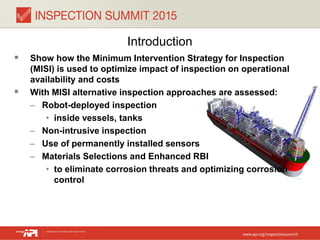
Introduction
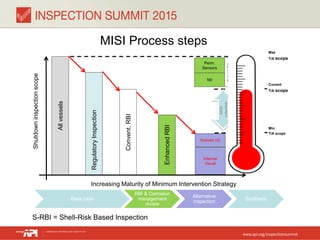
 Show how the Minimum Intervention Strategy for Inspection
(MISI) is used to optimize impact of inspection on operational
availability and costs
 With MISI alternative inspection approaches are assessed:
– Robot-deployed inspection
• inside vessels, tanks
– Non-intrusive inspection
– Use of permanently installed sensors
– Materials Selections and Enhanced RBI
• to eliminate corrosion threats and optimizing corrosion
control
Allvessels
Increasing Maturity of Minimum Intervention Strategy
Shutdowninspectionscope
RegulatoryInspection
Convent.RBI
EnhancedRBI
OutsideT/A
MISI
potential
Max
T/A scope
Current
T/A scope
Min
T/A scope
Internal
Visual
NII
Robotic IVI
Perm.
Sensors
Base case
RBI & Corrosion
management
review
Alternative
inspection
Synthesis
MISI Process steps
S-RBI = Shell-Risk Based Inspection
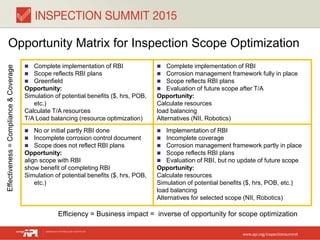
Opportunity Matrix for Inspection Scope Optimization
 Complete implementation of RBI
 Scope reflects RBI plans
 Greenfield
Opportunity:
Simulation of potential benefits ($, hrs, POB,
etc.)
Calculate T/A resources
T/A Load balancing (resource optimization)
 Complete implementation of RBI
 Corrosion management framework fully in place
 Scope reflects RBI plans
 Evaluation of future scope after T/A
Opportunity:
Calculate resources
load balancing
Alternatives (NII, Robotics)
 No or initial partly RBI done
 Incomplete corrosion control document
 Scope does not reflect RBI plans
Opportunity:
align scope with RBI
show benefit of completing RBI
Simulation of potential benefits ($, hrs, POB,
etc.)
 Implementation of RBI
 Incomplete coverage
 Corrosion management framework partly in place
 Scope reflects RBI plans
 Evaluation of RBI, but no update of future scope
Opportunity:
Calculate resources
Simulation of potential benefits ($, hrs, POB, etc.)
load balancing
Alternatives for selected scope (NII, Robotics)
Effectiveness=Compliance&Coverage
Efficiency = Business impact = inverse of opportunity for scope optimization
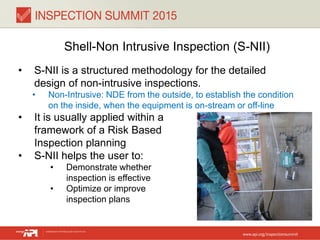
Shell-Non Intrusive Inspection (S-NII)
• S-NII is a structured methodology for the detailed
design of non-intrusive inspections.
• Non-Intrusive: NDE from the outside, to establish the condition
on the inside, when the equipment is on-stream or off-line
• It is usually applied within a
framework of a Risk Based
Inspection planning
• S-NII helps the user to:
• Demonstrate whether
inspection is effective
• Optimize or improve
inspection plans
Key features of S-NII
• S-NII builds on results of a S-RBI analysis
• Fully compatible with S-RBI
• S-RBI due dates are leading; NII may dictate shorter intervals
• S-NII uses quantitative modeling
• Qualitative S-RBI parameters are converted into quantitative data
• This produces probability data, that is used for statistical sampling
and interval calculation
• NII recognizes three Types of Inspection: A, B and C
• The Types of Inspection are governed by the sampling statistics on
which each Type of Inspection is based
• S-NII is compatible with DNV RP-G103 (= HOIS RP on NII).
DNV = Det Norske Veritas
HOIS = joint industry project focused on upstream inspection
(http://www.esrtechnology.com/centres/hois/Pages/default.aspx)
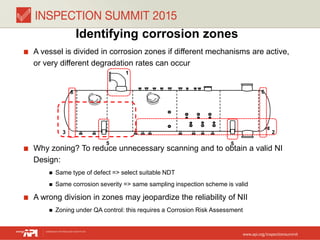
A vessel is divided in corrosion zones if different mechanisms are active,
or very different degradation rates can occur
Why zoning? To reduce unnecessary scanning and to obtain a valid NI
Design:
 Same type of defect => select suitable NDT
 Same corrosion severity => same sampling inspection scheme is valid
A wrong division in zones may jeopardize the reliability of NII
 Zoning under QA control: this requires a Corrosion Risk Assessment
......
......
.....
..... ......
......
.....
.....
1
3 2
6
5 5
6
Identifying corrosion zones
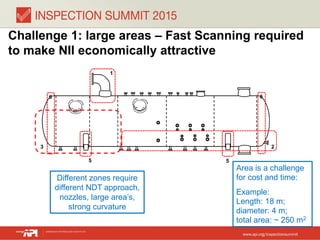
Challenge 1: large areas – Fast Scanning required
to make NII economically attractive
Area is a challenge
for cost and time:
Example:
Length: 18 m;
diameter: 4 m;
total area: ~ 250 m2
Different zones require
different NDT approach,
nozzles, large area’s,
strong curvature
......
......
.....
.....
......
......
.....
.....
1
3 2
6
5 5
6
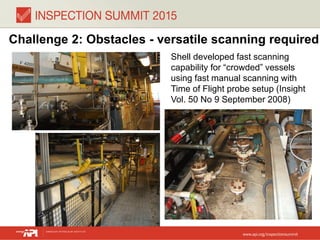
Challenge 2: Obstacles - versatile scanning required
Shell developed fast scanning
capability for “crowded” vessels
using fast manual scanning with
Time of Flight probe setup (Insight
Vol. 50 No 9 September 2008)
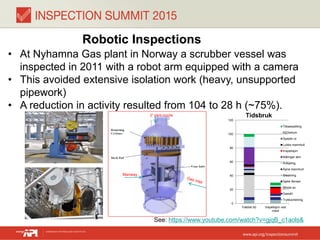
Robotic Inspections
• At Nyhamna Gas plant in Norway a scrubber vessel was
inspected in 2011 with a robot arm equipped with a camera
• This avoided extensive isolation work (heavy, unsupported
pipework)
• A reduction in activity resulted from 104 to 28 h (~75%).
Manway
2” Vent nozzle
0
20
40
60
80
100
120
Faktisk tid Inspeksjon ved
robot
Tilbakestilling
N2/helium
Spader ut
Lukke mannhull
Inspeksjon
Målinger atm
Avkjøling
Åpne mannhull
Steaming
Sjekk flenser
Blinde av
Gassfri
Trykkavlstning
Tidsbruk
See: https://www.youtube.com/watch?v=gjqB_c1aols&
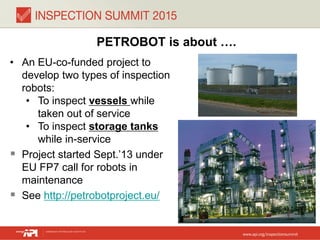
PETROBOT is about ….
• An EU-co-funded project to
develop two types of inspection
robots:
• To inspect vessels while
taken out of service
• To inspect storage tanks
while in-service
 Project started Sept.’13 under
EU FP7 call for robots in
maintenance
 See http://petrobotproject.eu/
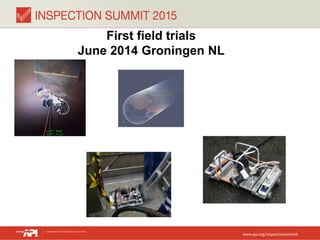
First field trials
June 2014 Groningen NL
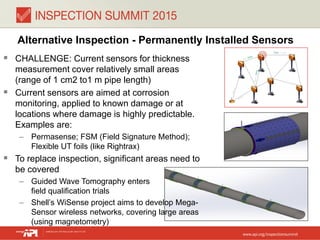
Alternative Inspection - Permanently Installed Sensors
 CHALLENGE: Current sensors for thickness
measurement cover relatively small areas
(range of 1 cm2 to1 m pipe length)
 Current sensors are aimed at corrosion
monitoring, applied to known damage or at
locations where damage is highly predictable.
Examples are:
– Permasense; FSM (Field Signature Method);
Flexible UT foils (like Rightrax)
 To replace inspection, significant areas need to
be covered
– Guided Wave Tomography enters
field qualification trials
– Shell’s WiSense project aims to develop Mega-
Sensor wireless networks, covering large areas
(using magnetometry)
NII in Design – A “FIRST” –Chemicals project, Qatar
• Requirements for NII were built into project specification in
early stage
• Fluor, the Engineering Contractor, developed the “NII
Specification” with support of P&T
• Workshops were held recently, to optimize plant/operation
design to optimize NII during
Operations
Q&A
Minimum Intervention Strategy for Inspection  API Jan 2015 presentation MH rev 19-01-2015

Minimum Intervention Strategy for Inspection API Jan 2015 presentation MH rev 19-01-2015

  • 1.
    Minimum Intervention Strategiesfor Inspection Martin van den Heuvel Shell Projects & Technology Team Lead Inspection Technology Amsterdam
  • 2.
    1. Introduction 2. TheMinimum Intervention Strategy 3. Non-Intrusive Inspection 4. Robotic developments Content  X
  • 3.
    Shell Projects &Technology – Engineering Combining the operating experience with proven implementation skills and advanced technologies Global coverage Diverse cultures and nationalities Over 50 years of implementing business and engineering solutions Continued investment in technology innovation  Regional Materials & Mechanical Integrity groups  Regional Inspection Technology teams
  • 4.
    Introduction  Show howthe Minimum Intervention Strategy for Inspection (MISI) is used to optimize impact of inspection on operational availability and costs  With MISI alternative inspection approaches are assessed: – Robot-deployed inspection • inside vessels, tanks – Non-intrusive inspection – Use of permanently installed sensors – Materials Selections and Enhanced RBI • to eliminate corrosion threats and optimizing corrosion control
  • 5.
    Allvessels Increasing Maturity ofMinimum Intervention Strategy Shutdowninspectionscope RegulatoryInspection Convent.RBI EnhancedRBI OutsideT/A MISI potential Max T/A scope Current T/A scope Min T/A scope Internal Visual NII Robotic IVI Perm. Sensors Base case RBI & Corrosion management review Alternative inspection Synthesis MISI Process steps S-RBI = Shell-Risk Based Inspection
  • 6.
    Opportunity Matrix forInspection Scope Optimization  Complete implementation of RBI  Scope reflects RBI plans  Greenfield Opportunity: Simulation of potential benefits ($, hrs, POB, etc.) Calculate T/A resources T/A Load balancing (resource optimization)  Complete implementation of RBI  Corrosion management framework fully in place  Scope reflects RBI plans  Evaluation of future scope after T/A Opportunity: Calculate resources load balancing Alternatives (NII, Robotics)  No or initial partly RBI done  Incomplete corrosion control document  Scope does not reflect RBI plans Opportunity: align scope with RBI show benefit of completing RBI Simulation of potential benefits ($, hrs, POB, etc.)  Implementation of RBI  Incomplete coverage  Corrosion management framework partly in place  Scope reflects RBI plans  Evaluation of RBI, but no update of future scope Opportunity: Calculate resources Simulation of potential benefits ($, hrs, POB, etc.) load balancing Alternatives for selected scope (NII, Robotics) Effectiveness=Compliance&Coverage Efficiency = Business impact = inverse of opportunity for scope optimization
  • 7.
    Shell-Non Intrusive Inspection(S-NII) • S-NII is a structured methodology for the detailed design of non-intrusive inspections. • Non-Intrusive: NDE from the outside, to establish the condition on the inside, when the equipment is on-stream or off-line • It is usually applied within a framework of a Risk Based Inspection planning • S-NII helps the user to: • Demonstrate whether inspection is effective • Optimize or improve inspection plans
  • 8.
    Key features ofS-NII • S-NII builds on results of a S-RBI analysis • Fully compatible with S-RBI • S-RBI due dates are leading; NII may dictate shorter intervals • S-NII uses quantitative modeling • Qualitative S-RBI parameters are converted into quantitative data • This produces probability data, that is used for statistical sampling and interval calculation • NII recognizes three Types of Inspection: A, B and C • The Types of Inspection are governed by the sampling statistics on which each Type of Inspection is based • S-NII is compatible with DNV RP-G103 (= HOIS RP on NII). DNV = Det Norske Veritas HOIS = joint industry project focused on upstream inspection (http://www.esrtechnology.com/centres/hois/Pages/default.aspx)
  • 9.
    A vessel isdivided in corrosion zones if different mechanisms are active, or very different degradation rates can occur Why zoning? To reduce unnecessary scanning and to obtain a valid NI Design:  Same type of defect => select suitable NDT  Same corrosion severity => same sampling inspection scheme is valid A wrong division in zones may jeopardize the reliability of NII  Zoning under QA control: this requires a Corrosion Risk Assessment ...... ...... ..... ..... ...... ...... ..... ..... 1 3 2 6 5 5 6 Identifying corrosion zones
  • 10.
    Challenge 1: largeareas – Fast Scanning required to make NII economically attractive Area is a challenge for cost and time: Example: Length: 18 m; diameter: 4 m; total area: ~ 250 m2 Different zones require different NDT approach, nozzles, large area’s, strong curvature ...... ...... ..... ..... ...... ...... ..... ..... 1 3 2 6 5 5 6
  • 11.
    Challenge 2: Obstacles- versatile scanning required Shell developed fast scanning capability for “crowded” vessels using fast manual scanning with Time of Flight probe setup (Insight Vol. 50 No 9 September 2008)
  • 12.
    Robotic Inspections • AtNyhamna Gas plant in Norway a scrubber vessel was inspected in 2011 with a robot arm equipped with a camera • This avoided extensive isolation work (heavy, unsupported pipework) • A reduction in activity resulted from 104 to 28 h (~75%). Manway 2” Vent nozzle 0 20 40 60 80 100 120 Faktisk tid Inspeksjon ved robot Tilbakestilling N2/helium Spader ut Lukke mannhull Inspeksjon Målinger atm Avkjøling Åpne mannhull Steaming Sjekk flenser Blinde av Gassfri Trykkavlstning Tidsbruk See: https://www.youtube.com/watch?v=gjqB_c1aols&
  • 13.
    PETROBOT is about…. • An EU-co-funded project to develop two types of inspection robots: • To inspect vessels while taken out of service • To inspect storage tanks while in-service  Project started Sept.’13 under EU FP7 call for robots in maintenance  See http://petrobotproject.eu/
  • 14.
    First field trials June2014 Groningen NL
  • 15.
    Alternative Inspection -Permanently Installed Sensors  CHALLENGE: Current sensors for thickness measurement cover relatively small areas (range of 1 cm2 to1 m pipe length)  Current sensors are aimed at corrosion monitoring, applied to known damage or at locations where damage is highly predictable. Examples are: – Permasense; FSM (Field Signature Method); Flexible UT foils (like Rightrax)  To replace inspection, significant areas need to be covered – Guided Wave Tomography enters field qualification trials – Shell’s WiSense project aims to develop Mega- Sensor wireless networks, covering large areas (using magnetometry)
  • 16.
    NII in Design– A “FIRST” –Chemicals project, Qatar • Requirements for NII were built into project specification in early stage • Fluor, the Engineering Contractor, developed the “NII Specification” with support of P&T • Workshops were held recently, to optimize plant/operation design to optimize NII during Operations
  • 17.