Roy Remick
Carlie Pierson
Trisha Sanders
HR 320
Prepared for Professor
Joy DesMarais-Lanz
06/8/2013
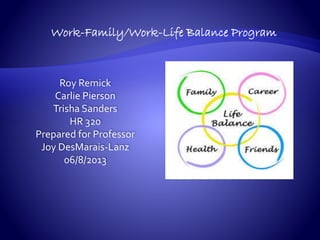
Work-Family/Work-Life Balance Program
Work /home life can be extremely demanding.
Many people play different roles in their lives.
Work demands may keep them from being able to
participate or commit to personal or family
demands.
Employers who manage conflicts through compromise
that can successfully balance work and home life for
employees.
AWork-Life Balance Program is an employer-sponsored
benefit or working condition that helps employees to
balance work and non-work demands.
The typicalAmerican middle-income family works an average of 11 more
hours a week today than they did 30 years ago.
Back 1979 the median amount earned on average for
Lower income families was $26,709 per year
Middle class families was $74,244 per year
Professionals earned $137,547 per year
In 2008 the median amount earned on average for
Lower income families was $19,011 per year
Middle class families earned $64,465 per year
Professionals earning $147,742 per year.
Work Profession- the type of work an individual does
has different amounts of stress
Income- being able to afford childcare and health
insurance
Education and Experience-being able to handle work
stress
Family responsibilities- caring for children, spouses
or the elderly
Culture/Religion- may require different responsibilities
Age- younger families have typically have higher
demands
Gender- generally women assume more home/family
responsibilities which may or may not include childcare
Partner Support- a lack of support, understanding, time,
and communication are factors that can add stress
Personality- a person’s perspective, reaction, and
attitude on situations
Health- we can offer health insurance or on-site
health center
Transfers- offer support for relocations, through
housing and cultural training
Communication- offer open communication with
any issues that may arise
Flextime- Choosing hours worked
PaidTime Off
Job Sharing-Two people split one full-time job
Telecommuting-Work from home
Child or Elderly Care Services
Maternity/Paternity and Medical Leave
Sabbatical/Extended Leave
Concierge Services
Floating holiday’s – Allows diverse employees observe
their most important religious traditions
Onsite fitness facilities or paid health club
memberships
“American Stress Institute estimates that job stress
cost U.S. business over $300 billion annually due to
increased absenteeism, employee turnover,
diminished productivity, medical, legal and
insurance expenses, and workers compensation
payments” (Cummings, & Worley, 2009).
Establishment Stage (ages 21-26) Millenials
Advancement Stage (ages 26-40) Gen Xer’s
Maintenance Stage (ages 40-60) Baby Boomers
Withdrawal Stage (age 60 and up)Traditionalists
Creates a work environment that reflects the
life-stage needs and values the diversity of its
employees
Develops a culture that is diverse and healthy
Produces organizational citizens
Increase productivity and moral
Increase organizational commitment
Recruit and retain top talent
Decrease turnover
Employee job satisfaction
Reduces stress
Improves relationships
Reduces guilt
Increases ability to focus on tasks
An organization’s mission statement is meant to
attract people that can utilize their work beliefs,
values, and ways of thinking to meet short and
long-term goals.
Its intent is to align the principles of the
organization, and guide the actions of its
employees.
Learning organization’s continuously identify
the needs of staff.
They take appropriate actions by giving
employees the tools and knowledge they
need to overcome obstacles.
Flatter organization’s- believe in improving
communication amongst its members, so that it
can react quickly to the needs of the business
and it’s employees.
Organizational competitive strategy
Change can be more easily accepted
company-wide when it needs to happen
Improves public image and employees speak
well of the employer
Set Goals- have individuals set important goals
in their lives
Time Management- have individuals balance
their time between work and home life
Positive Attitudes- think positive about
achievements and situations
Work-life conflicts are issues from employees
having a difficult time balancing their demanding
work and home lives.These conflicts can affect
an employee’s performance, attitude, and stress
levels which affect the company’s productivity
and profits. It would be prudent to engage in a
program where we can overcome work-life
issues. If we can work together we can reduce
these issues and have a better company overall.
Boushey, J. C. (2010, 01 25).TheThree Faces ofWork-Family Conflict. Retrieved 05 22,
2013,from americanprogress.org: http://www.americanprogress.org/issues
/labor/report/2010/01/25/7194/the-three-faces-of-work-family-conflict/
Cascio,W. F. (2010). Managing Human Resources. Retrieved 05 22, 2013, from
highered.mcgraw-hill.com: http://highered.mcgraw-hill.com/sites/
0073530263/ student_view0/glossary.html
Cummings,T., &Worley, C. (2009). Organizational Development & Change (9th ed.).
Mason, OH: South-Western, Cengage Learning.
Henderson, R. (2006). Compensation Management in a Knowledge-Based World (10th
ed.). Upper Saddle River, New Jersey: Pretense Hall
Khatih, J. (2009, 10).Term PaperWork-Life conflict. Retrieved 05 22, 2013, from
oocities.org: http://www.oocities.org/siliconvalley/pines/6639/docs/ob/Work-
life_conflict.html
Mondy, R.W. (2010). Human Resource Management (11th ed.). Upper Saddle River,
New Jersey: Pretense Hall

Unit 10 Group Project Final Draft

  • 1.
    Roy Remick Carlie Pierson TrishaSanders HR 320 Prepared for Professor Joy DesMarais-Lanz 06/8/2013 Work-Family/Work-Life Balance Program
  • 2.
    Work /home lifecan be extremely demanding. Many people play different roles in their lives. Work demands may keep them from being able to participate or commit to personal or family demands.
  • 3.
    Employers who manageconflicts through compromise that can successfully balance work and home life for employees. AWork-Life Balance Program is an employer-sponsored benefit or working condition that helps employees to balance work and non-work demands.
  • 4.
    The typicalAmerican middle-incomefamily works an average of 11 more hours a week today than they did 30 years ago. Back 1979 the median amount earned on average for Lower income families was $26,709 per year Middle class families was $74,244 per year Professionals earned $137,547 per year In 2008 the median amount earned on average for Lower income families was $19,011 per year Middle class families earned $64,465 per year Professionals earning $147,742 per year.
  • 5.
    Work Profession- thetype of work an individual does has different amounts of stress Income- being able to afford childcare and health insurance Education and Experience-being able to handle work stress Family responsibilities- caring for children, spouses or the elderly
  • 6.
    Culture/Religion- may requiredifferent responsibilities Age- younger families have typically have higher demands Gender- generally women assume more home/family responsibilities which may or may not include childcare Partner Support- a lack of support, understanding, time, and communication are factors that can add stress Personality- a person’s perspective, reaction, and attitude on situations
  • 7.
    Health- we canoffer health insurance or on-site health center Transfers- offer support for relocations, through housing and cultural training Communication- offer open communication with any issues that may arise
  • 8.
    Flextime- Choosing hoursworked PaidTime Off Job Sharing-Two people split one full-time job Telecommuting-Work from home Child or Elderly Care Services Maternity/Paternity and Medical Leave Sabbatical/Extended Leave Concierge Services Floating holiday’s – Allows diverse employees observe their most important religious traditions
  • 9.
    Onsite fitness facilitiesor paid health club memberships “American Stress Institute estimates that job stress cost U.S. business over $300 billion annually due to increased absenteeism, employee turnover, diminished productivity, medical, legal and insurance expenses, and workers compensation payments” (Cummings, & Worley, 2009).
  • 10.
    Establishment Stage (ages21-26) Millenials Advancement Stage (ages 26-40) Gen Xer’s Maintenance Stage (ages 40-60) Baby Boomers Withdrawal Stage (age 60 and up)Traditionalists
  • 11.
    Creates a workenvironment that reflects the life-stage needs and values the diversity of its employees Develops a culture that is diverse and healthy Produces organizational citizens
  • 12.
    Increase productivity andmoral Increase organizational commitment Recruit and retain top talent Decrease turnover Employee job satisfaction
  • 13.
    Reduces stress Improves relationships Reducesguilt Increases ability to focus on tasks
  • 14.
    An organization’s missionstatement is meant to attract people that can utilize their work beliefs, values, and ways of thinking to meet short and long-term goals. Its intent is to align the principles of the organization, and guide the actions of its employees.
  • 15.
    Learning organization’s continuouslyidentify the needs of staff. They take appropriate actions by giving employees the tools and knowledge they need to overcome obstacles.
  • 16.
    Flatter organization’s- believein improving communication amongst its members, so that it can react quickly to the needs of the business and it’s employees.
  • 17.
    Organizational competitive strategy Changecan be more easily accepted company-wide when it needs to happen Improves public image and employees speak well of the employer
  • 18.
    Set Goals- haveindividuals set important goals in their lives Time Management- have individuals balance their time between work and home life Positive Attitudes- think positive about achievements and situations
  • 19.
    Work-life conflicts areissues from employees having a difficult time balancing their demanding work and home lives.These conflicts can affect an employee’s performance, attitude, and stress levels which affect the company’s productivity and profits. It would be prudent to engage in a program where we can overcome work-life issues. If we can work together we can reduce these issues and have a better company overall.
  • 20.
    Boushey, J. C.(2010, 01 25).TheThree Faces ofWork-Family Conflict. Retrieved 05 22, 2013,from americanprogress.org: http://www.americanprogress.org/issues /labor/report/2010/01/25/7194/the-three-faces-of-work-family-conflict/ Cascio,W. F. (2010). Managing Human Resources. Retrieved 05 22, 2013, from highered.mcgraw-hill.com: http://highered.mcgraw-hill.com/sites/ 0073530263/ student_view0/glossary.html Cummings,T., &Worley, C. (2009). Organizational Development & Change (9th ed.). Mason, OH: South-Western, Cengage Learning. Henderson, R. (2006). Compensation Management in a Knowledge-Based World (10th ed.). Upper Saddle River, New Jersey: Pretense Hall Khatih, J. (2009, 10).Term PaperWork-Life conflict. Retrieved 05 22, 2013, from oocities.org: http://www.oocities.org/siliconvalley/pines/6639/docs/ob/Work- life_conflict.html Mondy, R.W. (2010). Human Resource Management (11th ed.). Upper Saddle River, New Jersey: Pretense Hall