CITY DISASTER RISK REDUCTION AND MANAGEMENT COUNCIL
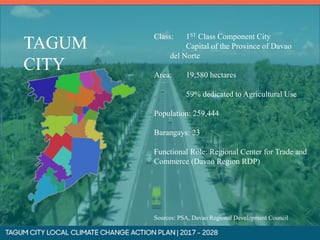
Class: 1ST Class Component City
Capital of the Province of Davao
del Norte
Area: 19,580 hectares
59% dedicated to Agricultural Use
Population: 259,444
Barangays: 23
Functional Role: Regional Center for Trade and
Commerce (Davao Region RDP)
Sources: PSA, Davao Regional Development Council
TAGUM
CITY
LOCATION
AND
GEOPHYSICAL FEATURES
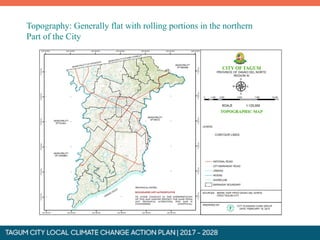
Topography: Generally flat with rolling portions in the northern
Part of the City
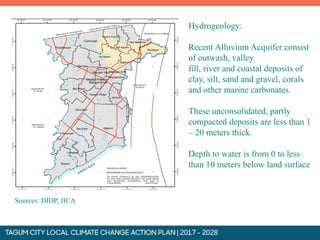
Hydrogeology:
Recent Alluvium Acquifer consist
of outwash, valley
fill, river and coastal deposits of
clay, silt, sand and gravel, corals
and other marine carbonates.
These unconsolidated, partly
compacted deposits are less than 1
– 20 meters thick.
Depth to water is from 0 to less
than 10 meters below land surface
Sources: DIDP, JICA
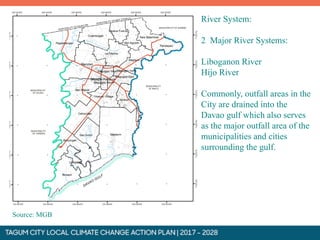
River System:
2 Major River Systems:
Liboganon River
Hijo River
Commonly, outfall areas in the
City are drained into the
Davao gulf which also serves
as the major outfall area of the
municipalities and cities
surrounding the gulf.
Source: MGB
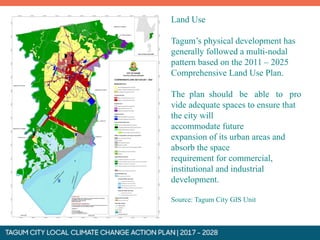
Land Use
Tagum’s physical development has
generally followed a multi-nodal
pattern based on the 2011 – 2025
Comprehensive Land Use Plan.
The plan should be able to pro
vide adequate spaces to ensure that
the city will
accommodate future
expansion of its urban areas and
absorb the space
requirement for commercial,
institutional and industrial
development.
Source: Tagum City GIS Unit
Level IV - rainfall is more or less evenly distributed
throughout the year.
2020 Projection - Rainfall: reduction of rainfall during summer and habagat
seasons and a slight increase during amihan season
2020 Projection – Temperature: increase will range from 0.9 ⁰C to 1.20 ⁰C and by
2050, from 1.90 ⁰C to 2.5 ⁰C.
Source: PAGASA
Climate
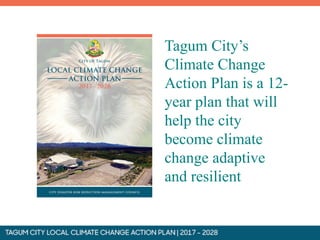
Tagum City’s
Climate Change
Action Plan is a 12-
year plan that will
help the city
become climate
change adaptive
and resilient
Goals:
1. building the adaptive capacities of men and women in their
communities;
2. increasing the resilience of vulnerable sectors and natural
ecosystems to climate change; and
3. optimizing mitigation opportunities towards gender-
responsive and rights-based sustainable development.
Objectives:
1. to ensure availability, stability, accessibility and affordability
of safe and healthy food amidst climate change;
2. to ensure the resilience of water resources, manage supply
and demand, manage water quality and promote
conservation;
3. to protect and rehabilitate critical ecosystems and restore
ecological services;
4. to reduce the risks of women and men to climate
change and disasters;
Objectives Con’t:
5. to create green and eco-jobs and sustainable consumption and
production;
6. to promote and expand energy efficiency and conservation
and develop sustainable and renewable energy,
environmentally sustainable transport; and
7. to enhance the knowledge on climate change, capacity for
climate change adaptation, mitigation and disaster risk reduction
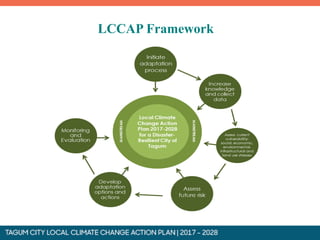
LCCAP Framework
Situational Analyses
Hazards and Disasters
• Flood
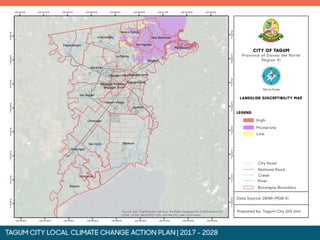
• Landslide (Rain induced)
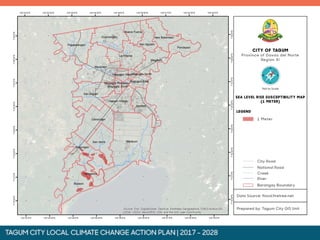
• Sea-level Rise
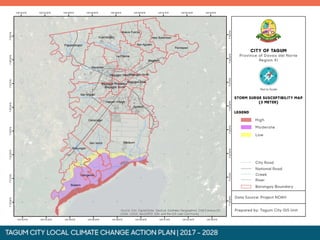
• Storm Surge
• Earthquake Related Hazards
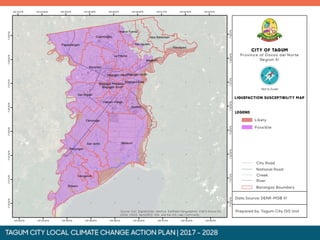
• Liquefaction
• Tsunami
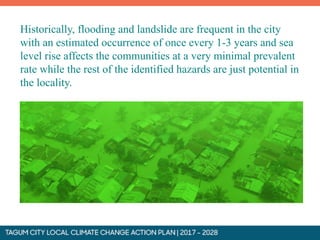
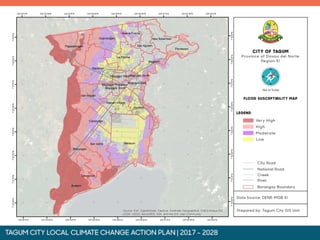
Historically, flooding and landslide are frequent in the city
with an estimated occurrence of once every 1-3 years and sea
level rise affects the communities at a very minimal prevalent
rate while the rest of the identified hazards are just potential in
the locality.
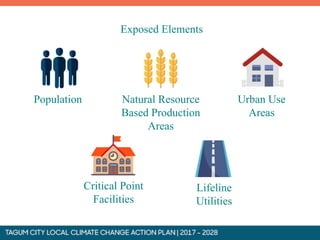
Exposed Elements
Population Natural Resource
Based Production
Areas
Urban Use
Areas
Critical Point
Facilities
Lifeline
Utilities
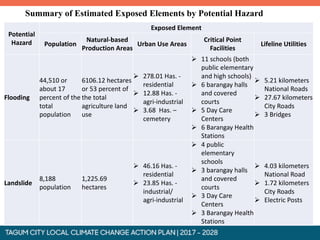
Summary of Estimated Exposed Elements by Potential Hazard
Potential
Hazard
Exposed Element
Population
Natural-based
Production Areas
Urban Use Areas
Critical Point
Facilities
Lifeline Utilities
Flooding
44,510 or
about 17
percent of the
total
population
6106.12 hectares
or 53 percent of
the total
agriculture land
use
Ø 278.01 Has. -
residential
Ø 12.88 Has. -
agri-industrial
Ø 3.68 Has. –
cemetery
Ø 11 schools (both
public elementary
and high schools)
Ø 6 barangay halls
and covered
courts
Ø 5 Day Care
Centers
Ø 6 Barangay Health
Stations
Ø 5.21 kilometers
National Roads
Ø 27.67 kilometers
City Roads
Ø 3 Bridges
Landslide
8,188
population
1,225.69
hectares
Ø 46.16 Has. -
residential
Ø 23.85 Has. -
industrial/
agri-industrial
Ø 4 public
elementary
schools
Ø 3 barangay halls
and covered
courts
Ø 3 Day Care
Centers
Ø 3 Barangay Health
Stations
Ø 4.03 kilometers
National Road
Ø 1.72 kilometers
City Roads
Ø Electric Posts
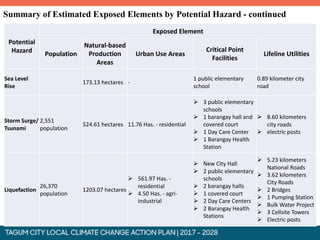
Summary of Estimated Exposed Elements by Potential Hazard - continued
Potential
Hazard
Exposed Element
Population
Natural-based
Production
Areas
Urban Use Areas
Critical Point
Facilities
Lifeline Utilities
Sea Level
Rise
173.13 hectares -
1 public elementary
school
0.89 kilometer city
road
Storm Surge/
Tsunami
2,551
population
524.61 hectares 11.76 Has. - residential
Ø 3 public elementary
schools
Ø 1 barangay hall and
covered court
Ø 1 Day Care Center
Ø 1 Barangay Health
Station
Ø 8.60 kilometers
city roads
Ø electric posts
Liquefaction
26,370
population
1203.07 hectares
Ø 561.97 Has. -
residential
Ø 4.50 Has. - agri-
industrial
Ø New City Hall
Ø 2 public elementary
schools
Ø 2 barangay halls
Ø 1 covered court
Ø 2 Day Care Centers
Ø 2 Barangay Health
Stations
Ø 5.23 kilometers
National Roads
Ø 3.62 kilometers
City Roads
Ø 2 Bridges
Ø 1 Pumping Station
Ø Bulk Water Project
Ø 3 Cellsite Towers
Ø Electric posts
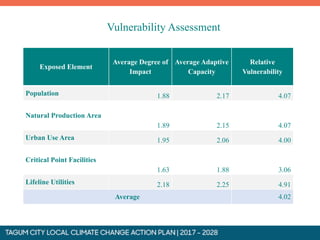
Exposed Element
Average Degree of
Impact
Average Adaptive
Capacity
Relative
Vulnerability
Population 1.88 2.17 4.07
Natural Production Area
1.89 2.15 4.07
Urban Use Area 1.95 2.06 4.00
Critical Point Facilities
1.63 1.88 3.06
Lifeline Utilities 2.18 2.25 4.91
Average 4.02
Vulnerability Assessment
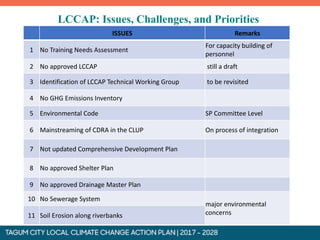
LCCAP: Issues, Challenges, and Priorities
ISSUES Remarks
1 No Training Needs Assessment
For capacity building of
personnel
2 No approved LCCAP still a draft
3 Identification of LCCAP Technical Working Group to be revisited
4 No GHG Emissions Inventory
5 Environmental Code SP Committee Level
6 Mainstreaming of CDRA in the CLUP On process of integration
7 Not updated Comprehensive Development Plan
8 No approved Shelter Plan
9 No approved Drainage Master Plan
10 No Sewerage System
major environmental
concerns
11 Soil Erosion along riverbanks

Tagum-Workshop-Presentation-02_Tagum-City-LCCAP.pdf

  • 1.
    CITY DISASTER RISKREDUCTION AND MANAGEMENT COUNCIL
  • 2.
    Class: 1ST ClassComponent City Capital of the Province of Davao del Norte Area: 19,580 hectares 59% dedicated to Agricultural Use Population: 259,444 Barangays: 23 Functional Role: Regional Center for Trade and Commerce (Davao Region RDP) Sources: PSA, Davao Regional Development Council TAGUM CITY
  • 3.
  • 4.
    Topography: Generally flatwith rolling portions in the northern Part of the City
  • 5.
    Hydrogeology: Recent Alluvium Acquiferconsist of outwash, valley fill, river and coastal deposits of clay, silt, sand and gravel, corals and other marine carbonates. These unconsolidated, partly compacted deposits are less than 1 – 20 meters thick. Depth to water is from 0 to less than 10 meters below land surface Sources: DIDP, JICA
  • 6.
    River System: 2 MajorRiver Systems: Liboganon River Hijo River Commonly, outfall areas in the City are drained into the Davao gulf which also serves as the major outfall area of the municipalities and cities surrounding the gulf. Source: MGB
  • 7.
    Land Use Tagum’s physicaldevelopment has generally followed a multi-nodal pattern based on the 2011 – 2025 Comprehensive Land Use Plan. The plan should be able to pro vide adequate spaces to ensure that the city will accommodate future expansion of its urban areas and absorb the space requirement for commercial, institutional and industrial development. Source: Tagum City GIS Unit
  • 8.
    Level IV -rainfall is more or less evenly distributed throughout the year. 2020 Projection - Rainfall: reduction of rainfall during summer and habagat seasons and a slight increase during amihan season 2020 Projection – Temperature: increase will range from 0.9 ⁰C to 1.20 ⁰C and by 2050, from 1.90 ⁰C to 2.5 ⁰C. Source: PAGASA Climate
  • 9.
    Tagum City’s Climate Change ActionPlan is a 12- year plan that will help the city become climate change adaptive and resilient
  • 10.
    Goals: 1. building theadaptive capacities of men and women in their communities; 2. increasing the resilience of vulnerable sectors and natural ecosystems to climate change; and 3. optimizing mitigation opportunities towards gender- responsive and rights-based sustainable development.
  • 11.
    Objectives: 1. to ensureavailability, stability, accessibility and affordability of safe and healthy food amidst climate change; 2. to ensure the resilience of water resources, manage supply and demand, manage water quality and promote conservation; 3. to protect and rehabilitate critical ecosystems and restore ecological services; 4. to reduce the risks of women and men to climate change and disasters;
  • 12.
    Objectives Con’t: 5. tocreate green and eco-jobs and sustainable consumption and production; 6. to promote and expand energy efficiency and conservation and develop sustainable and renewable energy, environmentally sustainable transport; and 7. to enhance the knowledge on climate change, capacity for climate change adaptation, mitigation and disaster risk reduction
  • 13.
  • 14.
    Situational Analyses Hazards andDisasters • Flood • Landslide (Rain induced) • Sea-level Rise • Storm Surge • Earthquake Related Hazards • Liquefaction • Tsunami
  • 15.
    Historically, flooding andlandslide are frequent in the city with an estimated occurrence of once every 1-3 years and sea level rise affects the communities at a very minimal prevalent rate while the rest of the identified hazards are just potential in the locality.
  • 21.
    Exposed Elements Population NaturalResource Based Production Areas Urban Use Areas Critical Point Facilities Lifeline Utilities
  • 22.
    Summary of EstimatedExposed Elements by Potential Hazard Potential Hazard Exposed Element Population Natural-based Production Areas Urban Use Areas Critical Point Facilities Lifeline Utilities Flooding 44,510 or about 17 percent of the total population 6106.12 hectares or 53 percent of the total agriculture land use Ø 278.01 Has. - residential Ø 12.88 Has. - agri-industrial Ø 3.68 Has. – cemetery Ø 11 schools (both public elementary and high schools) Ø 6 barangay halls and covered courts Ø 5 Day Care Centers Ø 6 Barangay Health Stations Ø 5.21 kilometers National Roads Ø 27.67 kilometers City Roads Ø 3 Bridges Landslide 8,188 population 1,225.69 hectares Ø 46.16 Has. - residential Ø 23.85 Has. - industrial/ agri-industrial Ø 4 public elementary schools Ø 3 barangay halls and covered courts Ø 3 Day Care Centers Ø 3 Barangay Health Stations Ø 4.03 kilometers National Road Ø 1.72 kilometers City Roads Ø Electric Posts
  • 23.
    Summary of EstimatedExposed Elements by Potential Hazard - continued Potential Hazard Exposed Element Population Natural-based Production Areas Urban Use Areas Critical Point Facilities Lifeline Utilities Sea Level Rise 173.13 hectares - 1 public elementary school 0.89 kilometer city road Storm Surge/ Tsunami 2,551 population 524.61 hectares 11.76 Has. - residential Ø 3 public elementary schools Ø 1 barangay hall and covered court Ø 1 Day Care Center Ø 1 Barangay Health Station Ø 8.60 kilometers city roads Ø electric posts Liquefaction 26,370 population 1203.07 hectares Ø 561.97 Has. - residential Ø 4.50 Has. - agri- industrial Ø New City Hall Ø 2 public elementary schools Ø 2 barangay halls Ø 1 covered court Ø 2 Day Care Centers Ø 2 Barangay Health Stations Ø 5.23 kilometers National Roads Ø 3.62 kilometers City Roads Ø 2 Bridges Ø 1 Pumping Station Ø Bulk Water Project Ø 3 Cellsite Towers Ø Electric posts
  • 24.
    Exposed Element Average Degreeof Impact Average Adaptive Capacity Relative Vulnerability Population 1.88 2.17 4.07 Natural Production Area 1.89 2.15 4.07 Urban Use Area 1.95 2.06 4.00 Critical Point Facilities 1.63 1.88 3.06 Lifeline Utilities 2.18 2.25 4.91 Average 4.02 Vulnerability Assessment
  • 25.
    LCCAP: Issues, Challenges,and Priorities ISSUES Remarks 1 No Training Needs Assessment For capacity building of personnel 2 No approved LCCAP still a draft 3 Identification of LCCAP Technical Working Group to be revisited 4 No GHG Emissions Inventory 5 Environmental Code SP Committee Level 6 Mainstreaming of CDRA in the CLUP On process of integration 7 Not updated Comprehensive Development Plan 8 No approved Shelter Plan 9 No approved Drainage Master Plan 10 No Sewerage System major environmental concerns 11 Soil Erosion along riverbanks