TABLOID
NEWSPAPER
CONVENTIONS
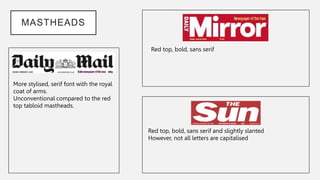
MASTHEADS
Red top, bold, sans serif
More stylised, serif font with the royal
coat of arms.
Unconventional compared to the red
top tabloid mastheads.
Red top, bold, sans serif and slightly slanted
However, not all letters are capitalised
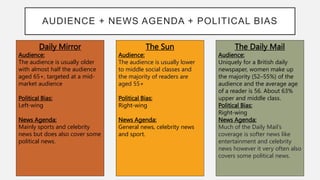
AUDIENCE + NEWS AGENDA + POLITICAL BIAS
Daily Mirror
Audience:
The audience is usually older
with almost half the audience
aged 65+, targeted at a mid-
market audience
Political Bias:
Left-wing
News Agenda:
Mainly sports and celebrity
news but does also cover some
political news.
The Daily Mail
Audience:
Uniquely for a British daily
newspaper, women make up
the majority (52–55%) of the
audience and the average age
of a reader is 56. About 63%
upper and middle class.
Political Bias:
Right-wing
News Agenda:
Much of the Daily Mail’s
coverage is softer news like
entertainment and celebrity
news however it very often also
covers some political news.
The Sun
Audience:
The audience is usually lower
to middle social classes and
the majority of readers are
aged 55+
Political Bias:
Right-wing
News Agenda:
General news, celebrity news
and sport.
NEWS PRESENTATION + REGISTER
The Sun:
News is presented as entertainment in an informal register, direct address is less common.
The Daily Mail:
News is presented as entertainment in an informal register, direct address is less common but there are a lot of
exclamatory of rhetorical phrases used for emphasis.
Daily Mirror:
News is presented as entertainment in an informal register, very commonly using a direct mode of address.
Language is highly sensationalised (commonly using alliteration or rhyme) and attention grabbing.
IMAGE +
HEADLINES
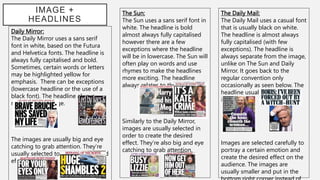
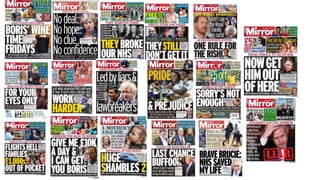
Daily Mirror:
The Daily Mirror uses a sans serif
font in white, based on the Futura
and Helvetica fonts. The headline is
always fully capitalised and bold.
Sometimes, certain words or letters
may be highlighted yellow for
emphasis. There can be exceptions
(lowercase headline or the use of a
black font). The headline always
relates to the image.
The images are usually big and eye
catching to grab attention. They’re
usually selected to create the desired
effect.
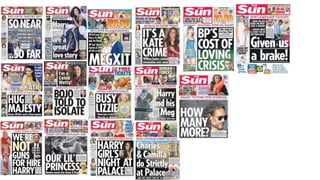
The Sun:
The Sun uses a sans serif font in
white. The headline is bold
almost always fully capitalised
however there are a few
exceptions where the headline
will be in lowercase. The Sun will
often play on words and use
rhymes to make the headlines
more exciting. The headline
always relates to the image.
Similarly to the Daily Mirror,
images are usually selected in
order to create the desired
effect. They’re also big and eye
catching to grab attention.
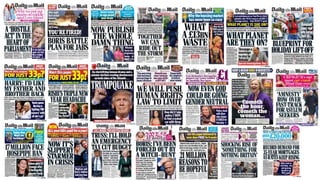
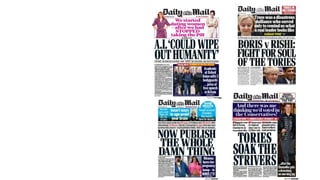
The Daily Mail:
The Daily Mail uses a casual font
that is usually black on white.
The headline is almost always
fully capitalised (with few
exceptions). The headline is
always separate from the image,
unlike on The Sun and Daily
Mirror. It goes back to the
regular convention only
occasionally as seen below. The
headline usually relates to the
image.
Images are selected carefully to
portray a certain emotion and
create the desired effect on the
audience. The images are
usually smaller and put in the
LAYOUT
Tabloid Newspaper Conventions.pptx

Tabloid Newspaper Conventions.pptx

  • 1.
  • 2.
    MASTHEADS Red top, bold,sans serif More stylised, serif font with the royal coat of arms. Unconventional compared to the red top tabloid mastheads. Red top, bold, sans serif and slightly slanted However, not all letters are capitalised
  • 3.
    AUDIENCE + NEWSAGENDA + POLITICAL BIAS Daily Mirror Audience: The audience is usually older with almost half the audience aged 65+, targeted at a mid- market audience Political Bias: Left-wing News Agenda: Mainly sports and celebrity news but does also cover some political news. The Daily Mail Audience: Uniquely for a British daily newspaper, women make up the majority (52–55%) of the audience and the average age of a reader is 56. About 63% upper and middle class. Political Bias: Right-wing News Agenda: Much of the Daily Mail’s coverage is softer news like entertainment and celebrity news however it very often also covers some political news. The Sun Audience: The audience is usually lower to middle social classes and the majority of readers are aged 55+ Political Bias: Right-wing News Agenda: General news, celebrity news and sport.
  • 4.
    NEWS PRESENTATION +REGISTER The Sun: News is presented as entertainment in an informal register, direct address is less common. The Daily Mail: News is presented as entertainment in an informal register, direct address is less common but there are a lot of exclamatory of rhetorical phrases used for emphasis. Daily Mirror: News is presented as entertainment in an informal register, very commonly using a direct mode of address. Language is highly sensationalised (commonly using alliteration or rhyme) and attention grabbing.
  • 5.
    IMAGE + HEADLINES Daily Mirror: TheDaily Mirror uses a sans serif font in white, based on the Futura and Helvetica fonts. The headline is always fully capitalised and bold. Sometimes, certain words or letters may be highlighted yellow for emphasis. There can be exceptions (lowercase headline or the use of a black font). The headline always relates to the image. The images are usually big and eye catching to grab attention. They’re usually selected to create the desired effect. The Sun: The Sun uses a sans serif font in white. The headline is bold almost always fully capitalised however there are a few exceptions where the headline will be in lowercase. The Sun will often play on words and use rhymes to make the headlines more exciting. The headline always relates to the image. Similarly to the Daily Mirror, images are usually selected in order to create the desired effect. They’re also big and eye catching to grab attention. The Daily Mail: The Daily Mail uses a casual font that is usually black on white. The headline is almost always fully capitalised (with few exceptions). The headline is always separate from the image, unlike on The Sun and Daily Mirror. It goes back to the regular convention only occasionally as seen below. The headline usually relates to the image. Images are selected carefully to portray a certain emotion and create the desired effect on the audience. The images are usually smaller and put in the
  • 6.