Chromatography for
Hemoglobinopathies
Made by Members of Table 5
• Deepak Choudhary. Saurav Dahiya. Krish Savaliya
• Shashank Sharma Shaurya. Shubhajit Das
• Shubham Soni Ekta. Devesh Joshi
• Garima Saxena. Chetan
• Chand Mallik. Divyansh Sangwan
• Divya Singh Shovan Jyoti Paul
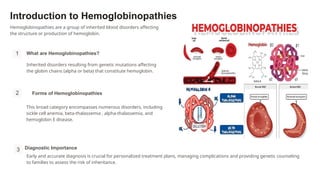
Introduction to Hemoglobinopathies
Hemoglobinopathies are a group of inherited blood disorders affecting
the structure or production of hemoglobin.
1 What are Hemoglobinopathies?
Inherited disorders resulting from genetic mutations affecting
the globin chains (alpha or beta) that constitute hemoglobin.
2
Diagnostic Importance
Early and accurate diagnosis is crucial for personalized treatment plans, managing complications and providing genetic counseling
to families to assess the risk of inheritance.
3
Forms of Hemoglobinopathies
This broad category encompasses numerous disorders, including
sickle cell anemia, beta-thalassemia , alpha-thalassemia, and
hemoglobin E disease.
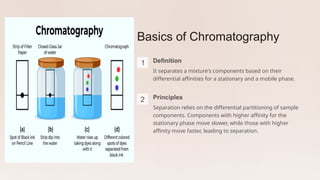
Basics of Chromatography
1 Definition
It separates a mixture's components based on their
differential affinities for a stationary and a mobile phase.
2 Principles
Separation relies on the differential partitioning of sample
components. Components with higher affinity for the
stationary phase move slower, while those with higher
affinity move faster, leading to separation.
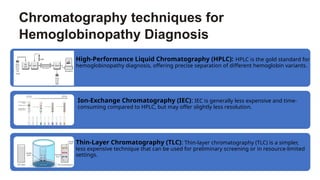
Chromatography techniques for
Hemoglobinopathy Diagnosis
High-Performance Liquid Chromatography (HPLC): HPLC is the gold standard for
hemoglobinopathy diagnosis, offering precise separation of different hemoglobin variants.
Ion-Exchange Chromatography (IEC): IEC is generally less expensive and time-
consuming compared to HPLC, but may offer slightly less resolution.
Thin-Layer Chromatography (TLC): Thin-layer chromatography (TLC) is a simpler,
less expensive technique that can be used for preliminary screening or in resource-limited
settings.
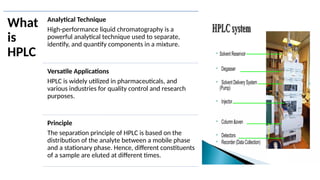
What
is
HPLC
Analytical Technique
High-performance liquid chromatography is a
powerful analytical technique used to separate,
identify, and quantify components in a mixture.
Versatile Applications
HPLC is widely utilized in pharmaceuticals, and
various industries for quality control and research
purposes.
Principle
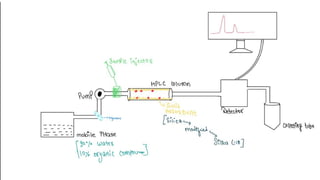
The separation principle of HPLC is based on the
distribution of the analyte between a mobile phase
and a stationary phase. Hence, different constituents
of a sample are eluted at different times.
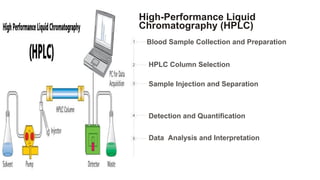
High-Performance Liquid
Chromatography (HPLC)
1 Blood Sample Collection and Preparation
2 HPLC Column Selection
3 Sample Injection and Separation
4 Detection and Quantification
5 Data Analysis and Interpretation
Case Studies: HPLC Analysis
Hemoglobin Variant Chromatographic Findings &
Interpretation
HbS (Sickle Cell
Hemoglobin)
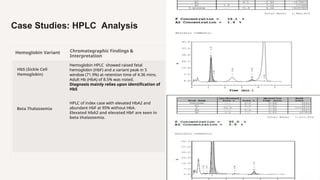
Hemoglobin HPLC showed raised fetal
hemoglobin (HbF) and a variant peak in S
window (71.9%) at retention time of 4.36 mins.
Adult Hb (HbA) of 8.5% was noted.
Diagnosis mainly relies upon identification of
HbS
Beta Thalassemia
HPLC of index case with elevated HbA2 and
abundant HbF at 95% without HbA.
Elevated HbA2 and elevated HbF are seen in
beta thalassemia.
Ion Exchange Chromatography
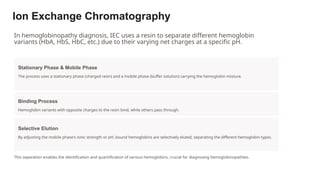
In hemoglobinopathy diagnosis, IEC uses a resin to separate different hemoglobin
variants (HbA, HbS, HbC, etc.) due to their varying net charges at a specific pH.
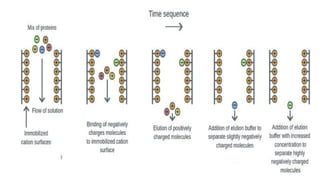
Stationary Phase & Mobile Phase
The process uses a stationary phase (charged resin) and a mobile phase (buffer solution) carrying the hemoglobin mixture.
Binding Process
Hemoglobin variants with opposite charges to the resin bind, while others pass through.
Selective Elution
By adjusting the mobile phase's ionic strength or pH, bound hemoglobins are selectively eluted, separating the different hemoglobin types.
This separation enables the identification and quantification of various hemoglobins, crucial for diagnosing hemoglobinopathies.
Advantages of Chromatography
1 High Sensitivity
Detects even minuscule
amounts of abnormal
hemoglobin, crucial for early
diagnosis
2 High Specificity
Accurately identifies specific
hemoglobin variants,
differentiating between various
types of abnormal
hemoglobins
3 Rapid Results
Offers a significantly faster
turnaround time compared to
older methods,
4 Quantitative Analysis
Not only identifies the presence of different hemoglobins but also precisely quantifies their proportions.
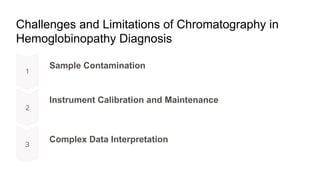
Challenges and Limitations of Chromatography in
Hemoglobinopathy Diagnosis
Sample Contamination
Instrument Calibration and Maintenance
Complex Data Interpretation
Table no 5.pptx of biochemistry practical

Table no 5.pptx of biochemistry practical

  • 1.
    Chromatography for Hemoglobinopathies Made byMembers of Table 5 • Deepak Choudhary. Saurav Dahiya. Krish Savaliya • Shashank Sharma Shaurya. Shubhajit Das • Shubham Soni Ekta. Devesh Joshi • Garima Saxena. Chetan • Chand Mallik. Divyansh Sangwan • Divya Singh Shovan Jyoti Paul
  • 2.
    Introduction to Hemoglobinopathies Hemoglobinopathiesare a group of inherited blood disorders affecting the structure or production of hemoglobin. 1 What are Hemoglobinopathies? Inherited disorders resulting from genetic mutations affecting the globin chains (alpha or beta) that constitute hemoglobin. 2 Diagnostic Importance Early and accurate diagnosis is crucial for personalized treatment plans, managing complications and providing genetic counseling to families to assess the risk of inheritance. 3 Forms of Hemoglobinopathies This broad category encompasses numerous disorders, including sickle cell anemia, beta-thalassemia , alpha-thalassemia, and hemoglobin E disease.
  • 3.
    Basics of Chromatography 1Definition It separates a mixture's components based on their differential affinities for a stationary and a mobile phase. 2 Principles Separation relies on the differential partitioning of sample components. Components with higher affinity for the stationary phase move slower, while those with higher affinity move faster, leading to separation.
  • 4.
    Chromatography techniques for HemoglobinopathyDiagnosis High-Performance Liquid Chromatography (HPLC): HPLC is the gold standard for hemoglobinopathy diagnosis, offering precise separation of different hemoglobin variants. Ion-Exchange Chromatography (IEC): IEC is generally less expensive and time- consuming compared to HPLC, but may offer slightly less resolution. Thin-Layer Chromatography (TLC): Thin-layer chromatography (TLC) is a simpler, less expensive technique that can be used for preliminary screening or in resource-limited settings.
  • 5.
    What is HPLC Analytical Technique High-performance liquidchromatography is a powerful analytical technique used to separate, identify, and quantify components in a mixture. Versatile Applications HPLC is widely utilized in pharmaceuticals, and various industries for quality control and research purposes. Principle The separation principle of HPLC is based on the distribution of the analyte between a mobile phase and a stationary phase. Hence, different constituents of a sample are eluted at different times.
  • 6.
    High-Performance Liquid Chromatography (HPLC) 1Blood Sample Collection and Preparation 2 HPLC Column Selection 3 Sample Injection and Separation 4 Detection and Quantification 5 Data Analysis and Interpretation
  • 9.
    Case Studies: HPLCAnalysis Hemoglobin Variant Chromatographic Findings & Interpretation HbS (Sickle Cell Hemoglobin) Hemoglobin HPLC showed raised fetal hemoglobin (HbF) and a variant peak in S window (71.9%) at retention time of 4.36 mins. Adult Hb (HbA) of 8.5% was noted. Diagnosis mainly relies upon identification of HbS Beta Thalassemia HPLC of index case with elevated HbA2 and abundant HbF at 95% without HbA. Elevated HbA2 and elevated HbF are seen in beta thalassemia.
  • 10.
    Ion Exchange Chromatography Inhemoglobinopathy diagnosis, IEC uses a resin to separate different hemoglobin variants (HbA, HbS, HbC, etc.) due to their varying net charges at a specific pH. Stationary Phase & Mobile Phase The process uses a stationary phase (charged resin) and a mobile phase (buffer solution) carrying the hemoglobin mixture. Binding Process Hemoglobin variants with opposite charges to the resin bind, while others pass through. Selective Elution By adjusting the mobile phase's ionic strength or pH, bound hemoglobins are selectively eluted, separating the different hemoglobin types. This separation enables the identification and quantification of various hemoglobins, crucial for diagnosing hemoglobinopathies.
  • 12.
    Advantages of Chromatography 1High Sensitivity Detects even minuscule amounts of abnormal hemoglobin, crucial for early diagnosis 2 High Specificity Accurately identifies specific hemoglobin variants, differentiating between various types of abnormal hemoglobins 3 Rapid Results Offers a significantly faster turnaround time compared to older methods, 4 Quantitative Analysis Not only identifies the presence of different hemoglobins but also precisely quantifies their proportions.
  • 13.
    Challenges and Limitationsof Chromatography in Hemoglobinopathy Diagnosis Sample Contamination Instrument Calibration and Maintenance Complex Data Interpretation