T15
Test Automation
5/2/2013 1:30:00 PM

Innovations in Test Automation: It's
Not All about Regression
Presented by:
John Fodeh
Cognizant

Brought to you by:

340 Corporate Way, Suite 300, Orange Park, FL 32073
888-268-8770 ∙ 904-278-0524 ∙ sqeinfo@sqe.com ∙ www.sqe.com
John Fodeh
Managing Cognizant's testing services in the Nordics, John Fodeh has more than fifteen years of
experience in software testing with extensive expertise in quality management, process improvement,
testing tools, and strategy. John has helped organizations throughout Europe deal with issues in the areas
of banking, insurance, retail, life sciences, and government. He has written a number of articles and
contributed to books, including Experiences of Test Automation. John is an active member of special
interest groups in software testing, chairman of the Danish Software Testing Board, and speaker at
international testing conferences including STAREAST, STARWEST, and EuroSTAR. Contact John at
john.fodeh@cognizant.com.
4/16/2013

Innovations in Test
Automation
It’s Not All about Regression
John Fodeh
Cognizant Technology Solutions
john.fodeh@cognizant.com

Outline
•
•
•
•
•
•

Innovation and testing
The promise of automation
Going beyond regression testing
Automated Test Monkeys
Model-Based and Behaviour-Driven approaches
The human factor in automation

| ©2012, Cognizant

2

1
4/16/2013

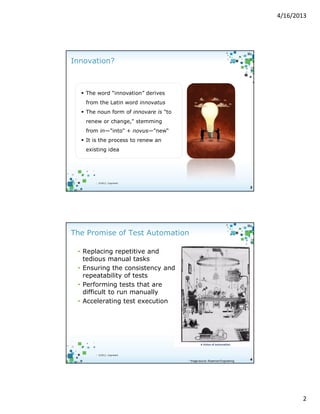
Innovation?

The word “innovation” derives
from the Latin word innovatus
The noun form of innovare is "to
renew or change," stemming
from in—"into" + novus—"new“
It is the process to renew an
existing idea

3

| ©2012, Cognizant

3

The Promise of Test Automation
• Replacing repetitive and
tedious manual tasks
• Ensuring the consistency and
repeatability of tests
• Performing tests that are
difficult to run manually
• Accelerating test execution

| ©2012, Cognizant

* Image source: Rosemont Engineering

4

2
4/16/2013

“Insanity is doing the same thing over and
over again and expecting different results”

| ©2012, Cognizant

5

Traditional Test Automation
Typically
Automation of regression tests
Purpose
Testing of a previously tested program following
modification to ensure that defects have not been
introduced or uncovered in unchanged areas of the
software, as a result of the changes made. It is performed
when the software or its environment is changed.
[ISTQB Glossary, v2.1]

| ©2012, Cognizant

6

3
4/16/2013

Characteristics of Traditional Test Automation

•
•
•
•

Static
Simple
Synchronized
Vulnerable

| ©2012, Cognizant

7

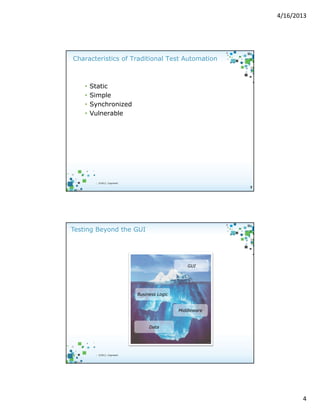
Testing Beyond the GUI

GUI

Business Logic

Middleware

Data

8

| ©2012, Cognizant

4
4/16/2013

Monkey Testing

Monkey Testing refers to the
process of randomly exercising a
software program by means of an
automated test tool

| ©2012, Cognizant

9

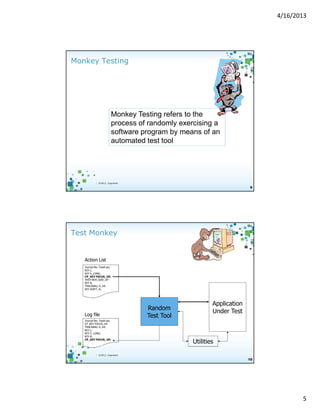
Test Monkey

Action List
#script file: Test4.asc
KEY L;
KEY 5, LONG;
CP_KEY FOCUS_UP;
CP_KEY FOCUS_UP;
#KEY BOX_SIZE_UP
KEY 8;
TRACKBALL 0, 64;
KEY SHIFT, R;

Log file
#script file: Test4.asc
CP_KEY FOCUS_UP;
TRACKBALL 0, 64;
KEY L;
KEY 5, LONG;
KEY 8;
CP_KEY FOCUS_UP;

Random
Test Tool

Application
Under Test

Utilities

| ©2012, Cognizant

10

5
4/16/2013

Basic Features
A test monkey should:
• Select randomly from input range
• Enter input to AUT through the user interface
• Detect “life signs” of AUT
• Have robust logging facility
• (Re-) start and initialize AUT
• Have limited application knowledge but general
environment awareness

| ©2012, Cognizant

11

Mean number of random operations between
Failures

Metrics – Application Reliability
100000

Release
Criterion
80000

60000

40000

Entry
Criterion
20000

0
1

2

3

4

5

6

7

8

9

10 11 12 13 14 15 16 17 18 19 20 21

Build no.
| ©2012, Cognizant

12

6
4/16/2013

Added Value
•
•
•
•
•

Early testing
Cost effective
Negative testing
Long and complex test runs
Reliability indicator

| ©2012, Cognizant

13

Limitations
•
•
•
•

Misses obvious defects
Does not emulate real use situations
Long tests runs can be difficult to debug
For a reliable statistical basis, long and multiple test
runs are needed

Monkey Testing is a supplement
to your manual and automated
testing - not a replacement!
| ©2012, Cognizant

14

7
4/16/2013

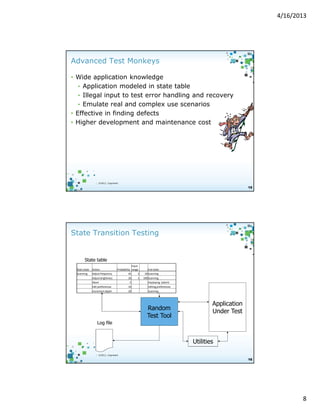
Advanced Test Monkeys
• Wide application knowledge
• Application modeled in state table
• Illegal input to test error handling and recovery
• Emulate real and complex use scenarios
• Effective in finding defects
• Higher development and maintenance cost

| ©2012, Cognizant

15

State Transition Testing

State table
Start
Start state
State
Scanning

Action
Action
Adjust frequency

Input

End
Probability range
State 45
3

Adjust brightness
Abort

20
5

1

Script

End state
20 Scanning

100 Scanning
Displaying (abort)

Edit preferences

10

Editing preferences

Increment depth

20

Scanning

Random
Test Tool

Application
Under Test

Log file

Utilities
| ©2012, Cognizant

16

8
4/16/2013

Intelligent Randomness
• Probability Tables
• Focus on selected areas
• Weight on specific use
scenarios
• Continuous expansion and
improvement
• Possibility to exclude
certain parts

Action

25%
10%

Enter Text
Select Text

5%

Delete
5%

Copy

5%

Cut

…
Task n
* source: Whitmill, Kelly
| ©2012, Cognizant

17

Model-Based Automation

Model table
State
Start
State

Action

Script
End
State

Test Tool

Application
Under Test

Log file

Utilities
| ©2012, Cognizant

18

9
4/16/2013

Behavior-Driven approach
Based on Behavioral specifications
User Stories defined using ubiquitous language
Principles of Test Driven Development
Collaborative approach for business analysts,
Software development & testing
• Shared tools and process
•
•
•
•

| ©2012, Cognizant

19

People Issues

• Test automation depends on the competence,
creativity and motivation of your team
• Dedicated resources are required
• Management support is essential
| ©2012, Cognizant

20

10
4/16/2013

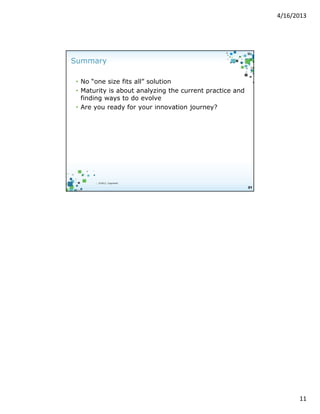
Summary
• No “one size fits all” solution
• Maturity is about analyzing the current practice and
finding ways to do evolve
• Are you ready for your innovation journey?

| ©2012, Cognizant

21

11

Innovations in Test Automation: It’s Not All about Regression

  • 1.
    T15 Test Automation 5/2/2013 1:30:00PM Innovations in Test Automation: It's Not All about Regression Presented by: John Fodeh Cognizant Brought to you by: 340 Corporate Way, Suite 300, Orange Park, FL 32073 888-268-8770 ∙ 904-278-0524 ∙ sqeinfo@sqe.com ∙ www.sqe.com
  • 2.
    John Fodeh Managing Cognizant'stesting services in the Nordics, John Fodeh has more than fifteen years of experience in software testing with extensive expertise in quality management, process improvement, testing tools, and strategy. John has helped organizations throughout Europe deal with issues in the areas of banking, insurance, retail, life sciences, and government. He has written a number of articles and contributed to books, including Experiences of Test Automation. John is an active member of special interest groups in software testing, chairman of the Danish Software Testing Board, and speaker at international testing conferences including STAREAST, STARWEST, and EuroSTAR. Contact John at john.fodeh@cognizant.com.
  • 3.
    4/16/2013 Innovations in Test Automation It’sNot All about Regression John Fodeh Cognizant Technology Solutions john.fodeh@cognizant.com Outline • • • • • • Innovation and testing The promise of automation Going beyond regression testing Automated Test Monkeys Model-Based and Behaviour-Driven approaches The human factor in automation | ©2012, Cognizant 2 1
  • 4.
    4/16/2013 Innovation? The word “innovation”derives from the Latin word innovatus The noun form of innovare is "to renew or change," stemming from in—"into" + novus—"new“ It is the process to renew an existing idea 3 | ©2012, Cognizant 3 The Promise of Test Automation • Replacing repetitive and tedious manual tasks • Ensuring the consistency and repeatability of tests • Performing tests that are difficult to run manually • Accelerating test execution | ©2012, Cognizant * Image source: Rosemont Engineering 4 2
  • 5.
    4/16/2013 “Insanity is doingthe same thing over and over again and expecting different results” | ©2012, Cognizant 5 Traditional Test Automation Typically Automation of regression tests Purpose Testing of a previously tested program following modification to ensure that defects have not been introduced or uncovered in unchanged areas of the software, as a result of the changes made. It is performed when the software or its environment is changed. [ISTQB Glossary, v2.1] | ©2012, Cognizant 6 3
  • 6.
    4/16/2013 Characteristics of TraditionalTest Automation • • • • Static Simple Synchronized Vulnerable | ©2012, Cognizant 7 Testing Beyond the GUI GUI Business Logic Middleware Data 8 | ©2012, Cognizant 4
  • 7.
    4/16/2013 Monkey Testing Monkey Testingrefers to the process of randomly exercising a software program by means of an automated test tool | ©2012, Cognizant 9 Test Monkey Action List #script file: Test4.asc KEY L; KEY 5, LONG; CP_KEY FOCUS_UP; CP_KEY FOCUS_UP; #KEY BOX_SIZE_UP KEY 8; TRACKBALL 0, 64; KEY SHIFT, R; Log file #script file: Test4.asc CP_KEY FOCUS_UP; TRACKBALL 0, 64; KEY L; KEY 5, LONG; KEY 8; CP_KEY FOCUS_UP; Random Test Tool Application Under Test Utilities | ©2012, Cognizant 10 5
  • 8.
    4/16/2013 Basic Features A testmonkey should: • Select randomly from input range • Enter input to AUT through the user interface • Detect “life signs” of AUT • Have robust logging facility • (Re-) start and initialize AUT • Have limited application knowledge but general environment awareness | ©2012, Cognizant 11 Mean number of random operations between Failures Metrics – Application Reliability 100000 Release Criterion 80000 60000 40000 Entry Criterion 20000 0 1 2 3 4 5 6 7 8 9 10 11 12 13 14 15 16 17 18 19 20 21 Build no. | ©2012, Cognizant 12 6
  • 9.
    4/16/2013 Added Value • • • • • Early testing Costeffective Negative testing Long and complex test runs Reliability indicator | ©2012, Cognizant 13 Limitations • • • • Misses obvious defects Does not emulate real use situations Long tests runs can be difficult to debug For a reliable statistical basis, long and multiple test runs are needed Monkey Testing is a supplement to your manual and automated testing - not a replacement! | ©2012, Cognizant 14 7
  • 10.
    4/16/2013 Advanced Test Monkeys •Wide application knowledge • Application modeled in state table • Illegal input to test error handling and recovery • Emulate real and complex use scenarios • Effective in finding defects • Higher development and maintenance cost | ©2012, Cognizant 15 State Transition Testing State table Start Start state State Scanning Action Action Adjust frequency Input End Probability range State 45 3 Adjust brightness Abort 20 5 1 Script End state 20 Scanning 100 Scanning Displaying (abort) Edit preferences 10 Editing preferences Increment depth 20 Scanning Random Test Tool Application Under Test Log file Utilities | ©2012, Cognizant 16 8
  • 11.
    4/16/2013 Intelligent Randomness • ProbabilityTables • Focus on selected areas • Weight on specific use scenarios • Continuous expansion and improvement • Possibility to exclude certain parts Action 25% 10% Enter Text Select Text 5% Delete 5% Copy 5% Cut … Task n * source: Whitmill, Kelly | ©2012, Cognizant 17 Model-Based Automation Model table State Start State Action Script End State Test Tool Application Under Test Log file Utilities | ©2012, Cognizant 18 9
  • 12.
    4/16/2013 Behavior-Driven approach Based onBehavioral specifications User Stories defined using ubiquitous language Principles of Test Driven Development Collaborative approach for business analysts, Software development & testing • Shared tools and process • • • • | ©2012, Cognizant 19 People Issues • Test automation depends on the competence, creativity and motivation of your team • Dedicated resources are required • Management support is essential | ©2012, Cognizant 20 10
  • 13.
    4/16/2013 Summary • No “onesize fits all” solution • Maturity is about analyzing the current practice and finding ways to do evolve • Are you ready for your innovation journey? | ©2012, Cognizant 21 11