T CELL RECEPTOR
By: Dr Sadaf Moeez
 is a protein complex found on the surface of T cells, or T
lymphocytes.
 Responsible for recognizing fragments of antigen as peptides
bound to major histocompatibility complex (MHC) molecules.
 The TCR is a member of the immunoglobulin superfamily, a
large group of proteins involved in binding, recognition, and
adhesion
T CELL RECEPTOR
 The TCR is a disulfide-linked membrane-anchored
heterodimeric protein normally consisting of the highly variable
alpha (α) and beta (β) chains expressed as part of a complex
with the invariant CD3 chain molecules.
STRUCTURE OF T CELL RECEPTOR
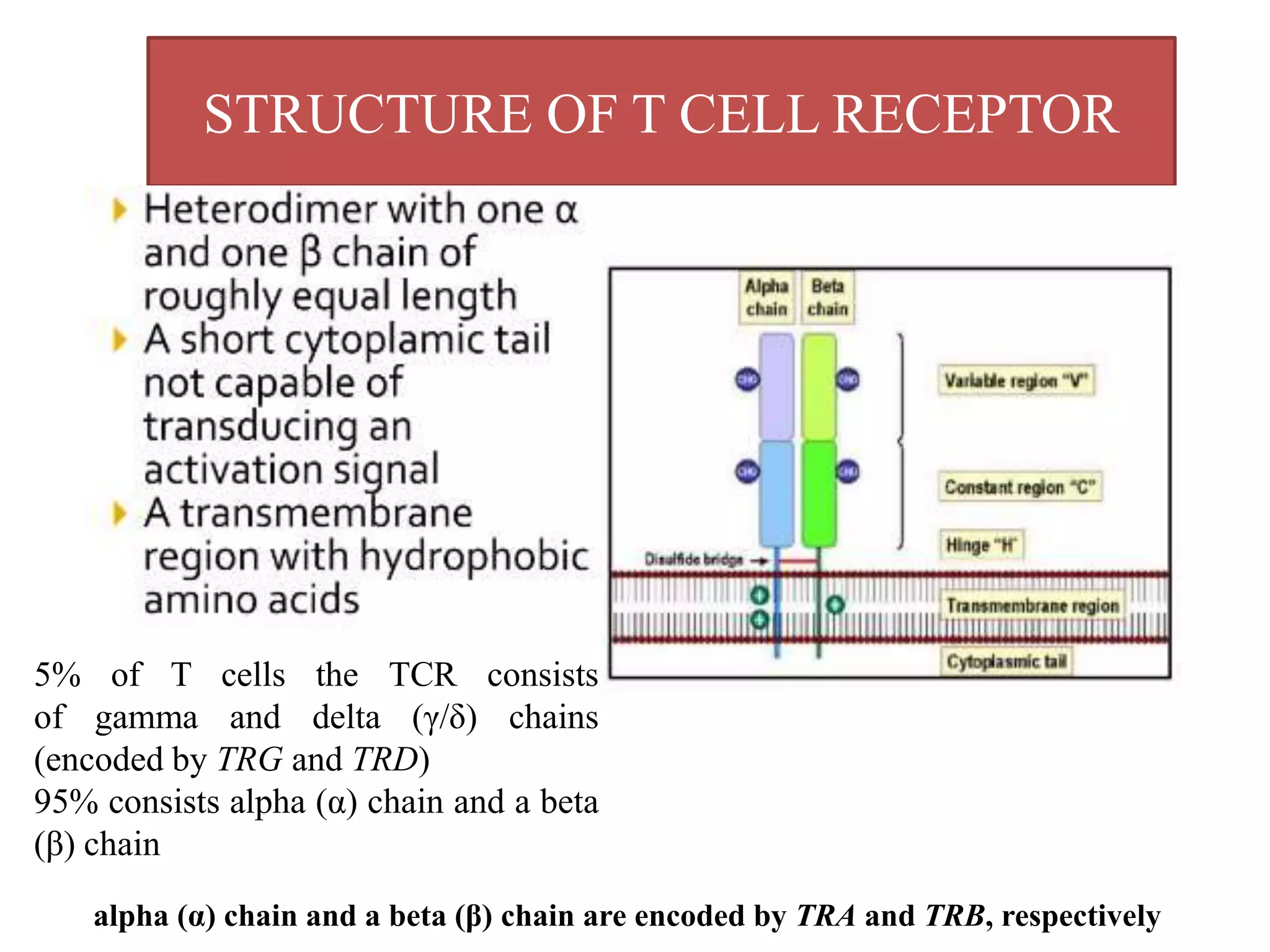
alpha (α) chain and a beta (β) chain are encoded by TRA and TRB, respectively
5% of T cells the TCR consists
of gamma and delta (γ/δ) chains
(encoded by TRG and TRD)
95% consists alpha (α) chain and a beta
(β) chain
STRUCTURE OF T CELL RECEPTOR
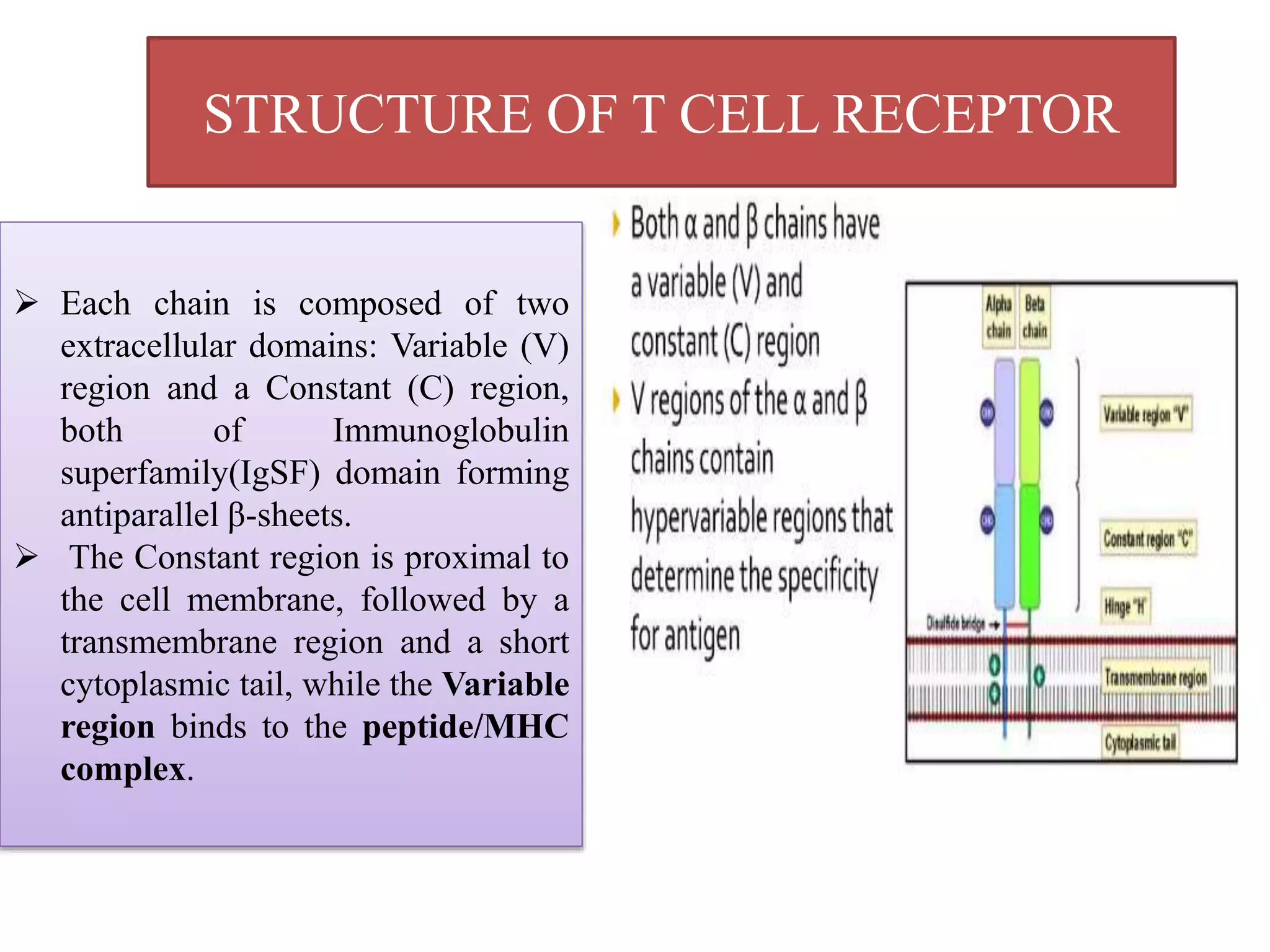
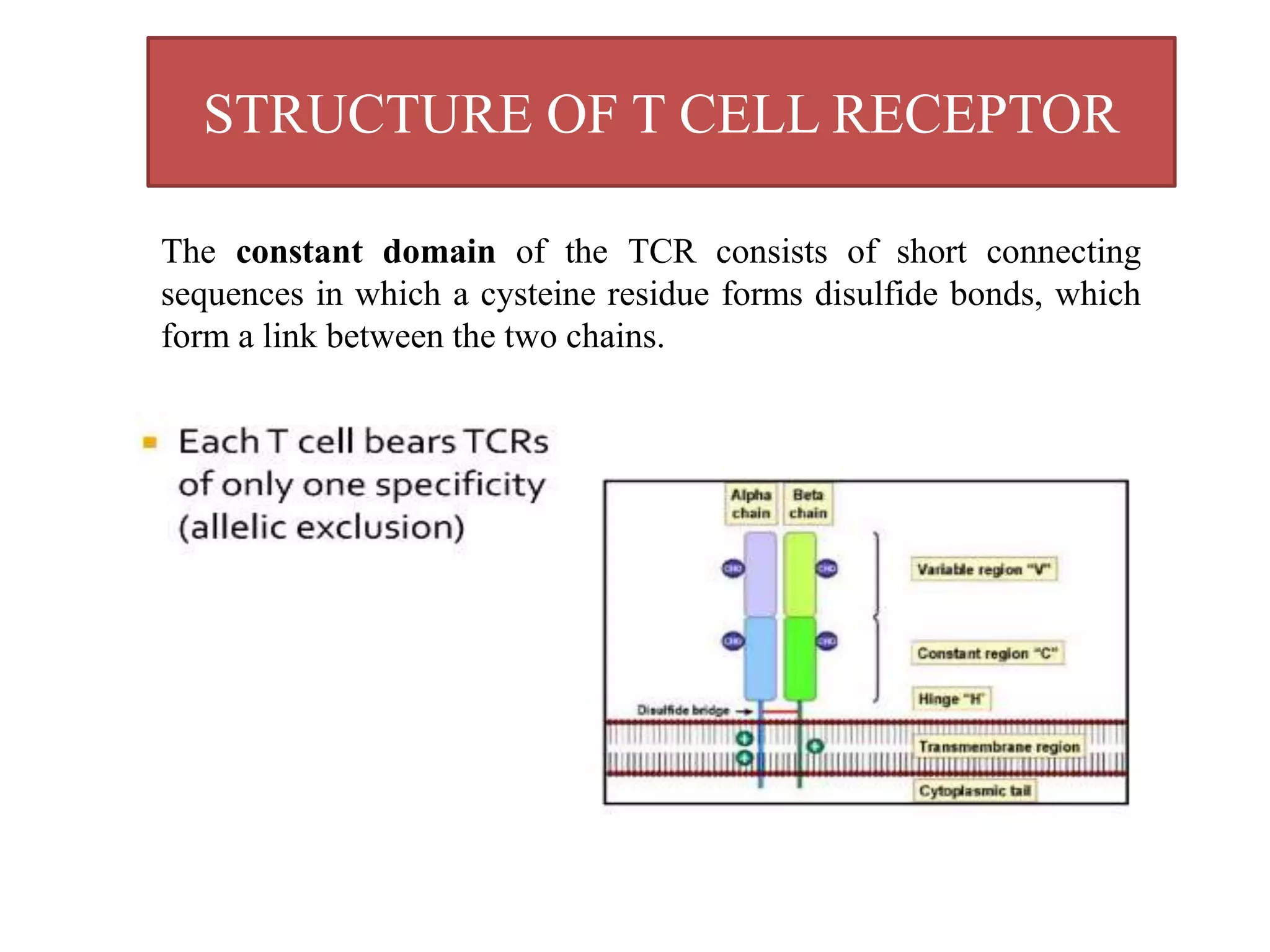
 Each chain is composed of two
extracellular domains: Variable (V)
region and a Constant (C) region,
both of Immunoglobulin
superfamily(IgSF) domain forming
antiparallel β-sheets.
 The Constant region is proximal to
the cell membrane, followed by a
transmembrane region and a short
cytoplasmic tail, while the Variable
region binds to the peptide/MHC
complex.
 The variable domain of both the TCR α-chain and β-chain each
have three hypervariable or complementarity-determining
regions (CDRs).
 CDR3 is the main CDR responsible for recognizing processed
antigen
Complementarity-Determining Regions (CDRs)
Complementarity-determining regions (CDRs) are part of the variable chains
in immunoglobulins (antibodies) and T cell receptors, generated by B-cells and
T-cells respectively
STRUCTURE OF T CELL RECEPTOR
The constant domain of the TCR consists of short connecting
sequences in which a cysteine residue forms disulfide bonds, which
form a link between the two chains.
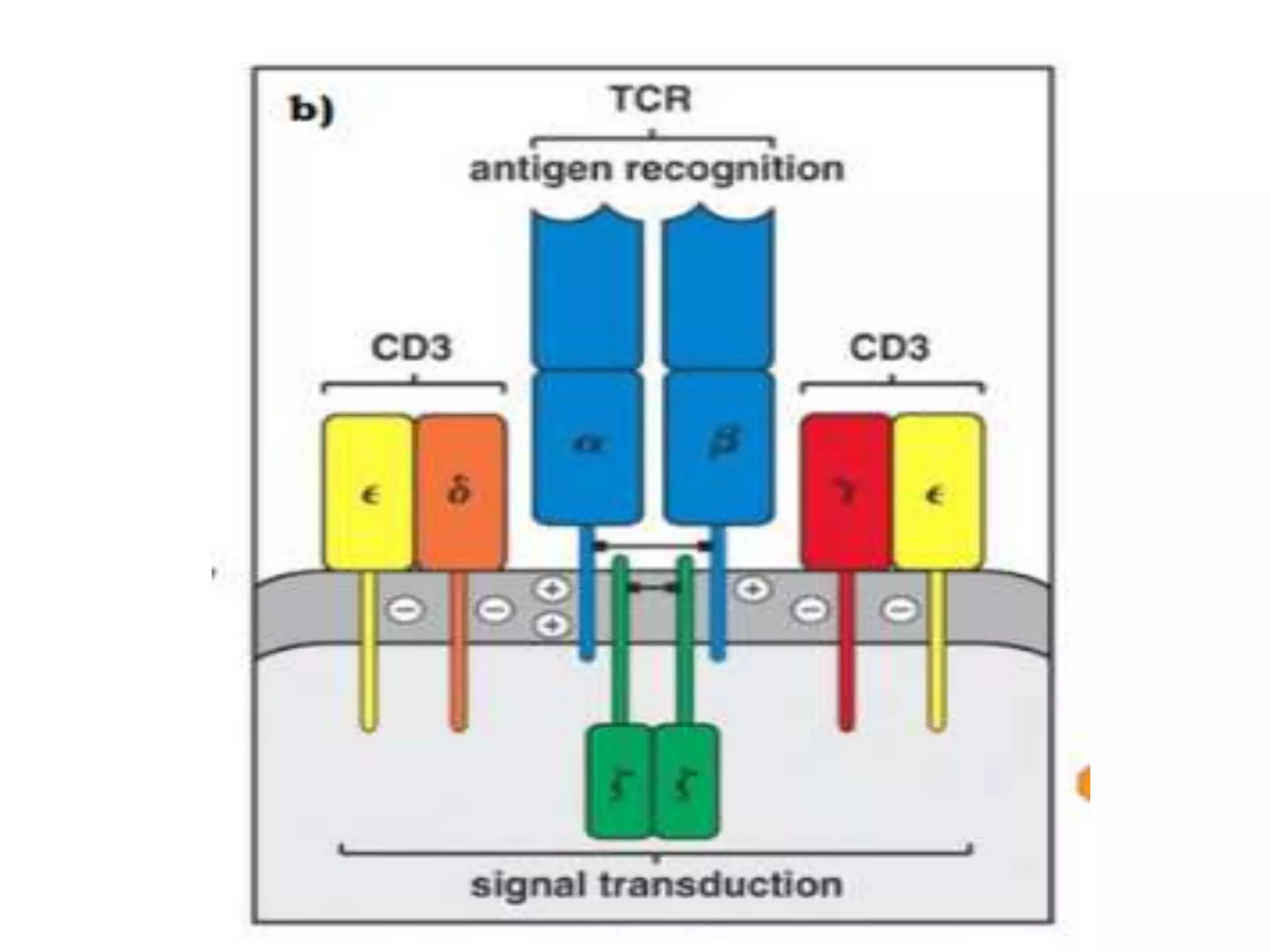
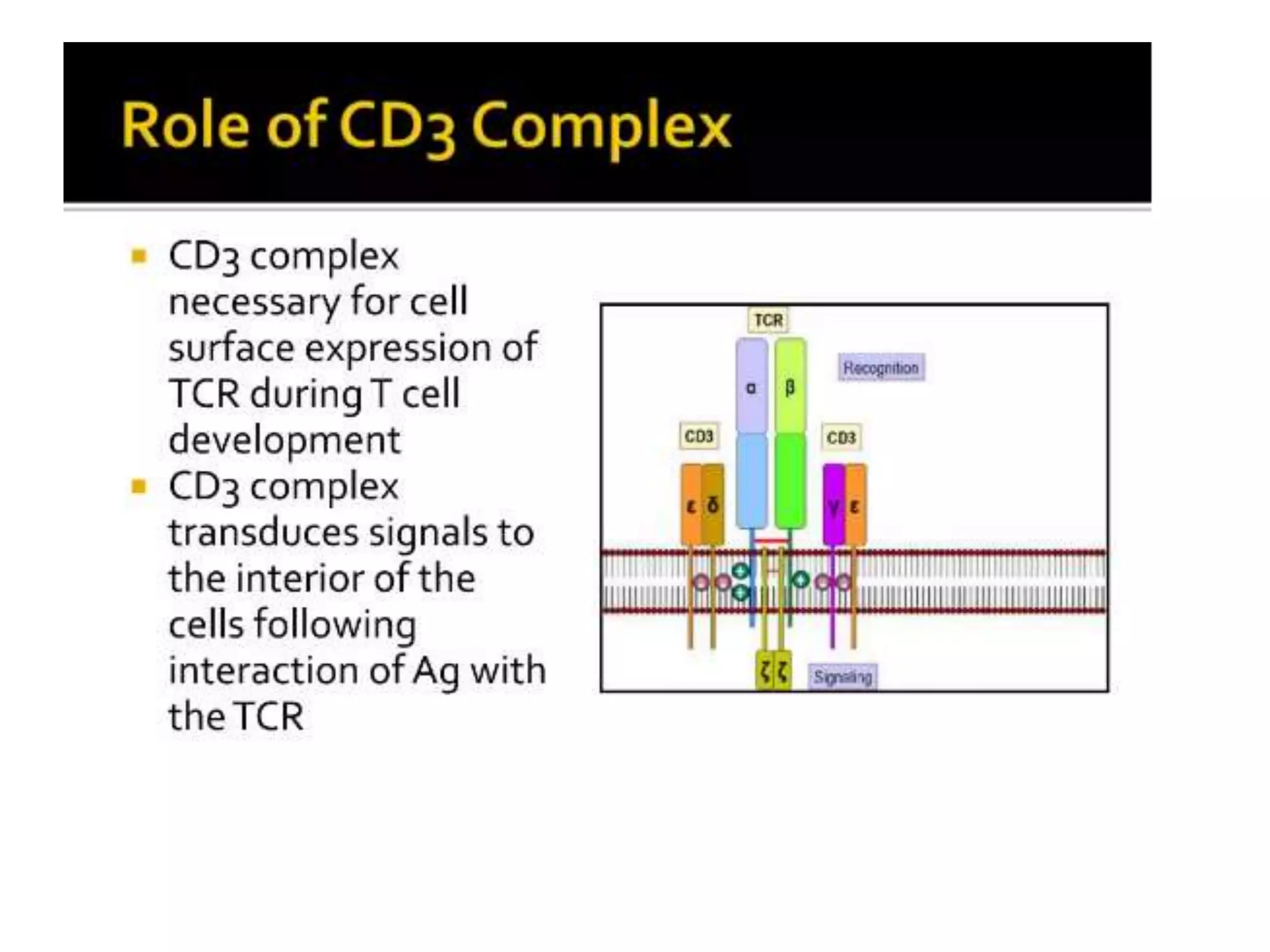
 TCR is closely associated with the group of adaptor proteins
collectively called TCR COMPLEX (octameric complex)
The complex consists of
 both α and β chains, forming the ligand-binding site
 The signaling modules:
a CD3 γ chain
a CD3 δ chain
two CD3 ε chains.
These chains are associated with the ζ chain (zeta chain).
Together those are considered relevant for the transmission of the
activation signals for T lymphocytes after peptide binding
TCR AND CD3 COMPLEX
Generation of the TCR diversity
It arises mainly from genetic recombination of the DNA-encoded
segments in individual somatic T cells by somatic V(D)J
recombination using RAG1 and RAG2 recombinases.
 The TCR alpha chain is generated by VJ recombination
 The beta chain is generated by VDJ recombination
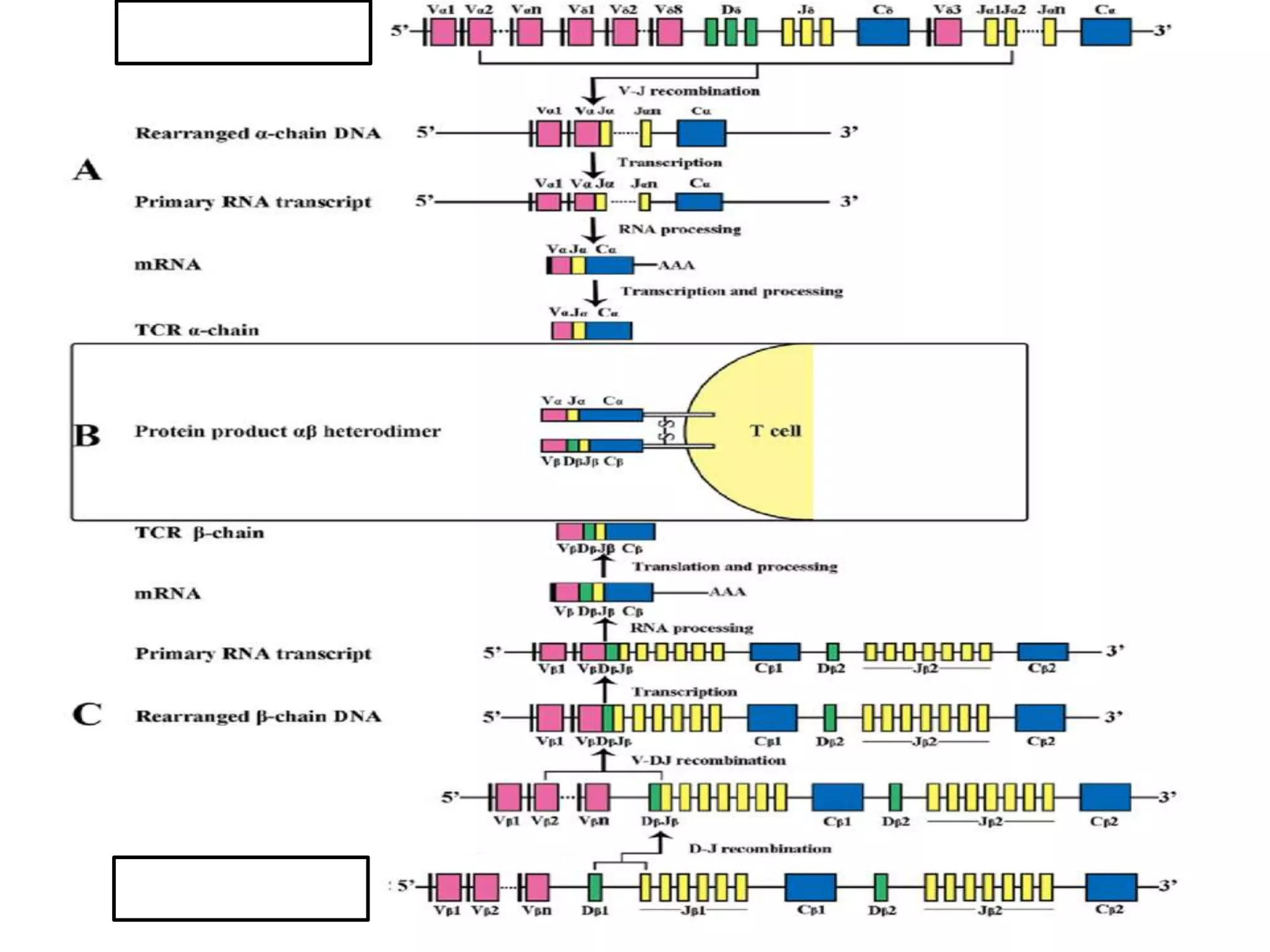
• During thymocyte development, the T cell receptor (TCR) chains undergo
essentially the same sequence of ordered recombination events as that
described for immunoglobulins.
• D-to-J recombination occurs first in the β-chain of the TCR. This process
can involve either the joining of the Dβ1 gene segment to one of six Jβ1
segments or the joining of the Dβ2 gene segment to one of six Jβ2 segments.
• DJ recombination is followed (as above) with Vβ-to-DβJβ rearrangements.
All gene segments between the Vβ-Dβ-Jβ gene segments in the newly
formed complex are deleted and the primary transcript is synthesized that
incorporates the constant domain gene (Vβ-Dβ-Jβ-Cβ). mRNA transcription
splices out any intervening sequence and allows translation of the full
length protein for the TCR β-chain.
• The rearrangement of the alpha (α) chain of the TCR follows β chain
rearrangement, and resembles V-to-J rearrangement described for Ig light
chains (see above). The assembly of the β- and α- chains results in
formation of the αβ-TCR that is expressed on a majority of T cells.
T CELL RECEPTOR.pptx

T CELL RECEPTOR.pptx

  • 1.
    T CELL RECEPTOR By:Dr Sadaf Moeez
  • 2.
     is aprotein complex found on the surface of T cells, or T lymphocytes.  Responsible for recognizing fragments of antigen as peptides bound to major histocompatibility complex (MHC) molecules.  The TCR is a member of the immunoglobulin superfamily, a large group of proteins involved in binding, recognition, and adhesion T CELL RECEPTOR  The TCR is a disulfide-linked membrane-anchored heterodimeric protein normally consisting of the highly variable alpha (α) and beta (β) chains expressed as part of a complex with the invariant CD3 chain molecules.
  • 3.
    STRUCTURE OF TCELL RECEPTOR alpha (α) chain and a beta (β) chain are encoded by TRA and TRB, respectively 5% of T cells the TCR consists of gamma and delta (γ/δ) chains (encoded by TRG and TRD) 95% consists alpha (α) chain and a beta (β) chain
  • 4.
    STRUCTURE OF TCELL RECEPTOR  Each chain is composed of two extracellular domains: Variable (V) region and a Constant (C) region, both of Immunoglobulin superfamily(IgSF) domain forming antiparallel β-sheets.  The Constant region is proximal to the cell membrane, followed by a transmembrane region and a short cytoplasmic tail, while the Variable region binds to the peptide/MHC complex.
  • 5.
     The variabledomain of both the TCR α-chain and β-chain each have three hypervariable or complementarity-determining regions (CDRs).
  • 6.
     CDR3 isthe main CDR responsible for recognizing processed antigen Complementarity-Determining Regions (CDRs) Complementarity-determining regions (CDRs) are part of the variable chains in immunoglobulins (antibodies) and T cell receptors, generated by B-cells and T-cells respectively
  • 7.
    STRUCTURE OF TCELL RECEPTOR The constant domain of the TCR consists of short connecting sequences in which a cysteine residue forms disulfide bonds, which form a link between the two chains.
  • 8.
     TCR isclosely associated with the group of adaptor proteins collectively called TCR COMPLEX (octameric complex) The complex consists of  both α and β chains, forming the ligand-binding site  The signaling modules: a CD3 γ chain a CD3 δ chain two CD3 ε chains. These chains are associated with the ζ chain (zeta chain). Together those are considered relevant for the transmission of the activation signals for T lymphocytes after peptide binding TCR AND CD3 COMPLEX
  • 11.
    Generation of theTCR diversity It arises mainly from genetic recombination of the DNA-encoded segments in individual somatic T cells by somatic V(D)J recombination using RAG1 and RAG2 recombinases.  The TCR alpha chain is generated by VJ recombination  The beta chain is generated by VDJ recombination
  • 12.
    • During thymocytedevelopment, the T cell receptor (TCR) chains undergo essentially the same sequence of ordered recombination events as that described for immunoglobulins. • D-to-J recombination occurs first in the β-chain of the TCR. This process can involve either the joining of the Dβ1 gene segment to one of six Jβ1 segments or the joining of the Dβ2 gene segment to one of six Jβ2 segments. • DJ recombination is followed (as above) with Vβ-to-DβJβ rearrangements. All gene segments between the Vβ-Dβ-Jβ gene segments in the newly formed complex are deleted and the primary transcript is synthesized that incorporates the constant domain gene (Vβ-Dβ-Jβ-Cβ). mRNA transcription splices out any intervening sequence and allows translation of the full length protein for the TCR β-chain. • The rearrangement of the alpha (α) chain of the TCR follows β chain rearrangement, and resembles V-to-J rearrangement described for Ig light chains (see above). The assembly of the β- and α- chains results in formation of the αβ-TCR that is expressed on a majority of T cells.