Major histocompatibility complex
(MHC) and T cell receptors
Subham Preetam, Master in biotechnology
Bhubaneswar, India,
sspritamrath93@gmail.com
Teaching objectives
• To give an overview of role of MHC in immune
response
• To describe structure & function of MHC
• To describe structure & function of TCR
• To discuss the genetic basis for generation of
diversity in TCR
• To describe the nature of immunological synapse
and requirements for T cell activation
Role of MHC in immune response
• TCR recognizes Ag presented in MHC
– Context is important
– Binding of Ag peptides in non-covalent
• Two types of MHC (class I and class II) are
recognized by different subsets of T cells
– CTL recognizes Ag peptide in MHC class I
– T-helper recognizes Ag peptide in MHC class II
Structure of MHC class I
• Two polypeptide
chains
– Long α chain and
short β
Structure of MHC class I
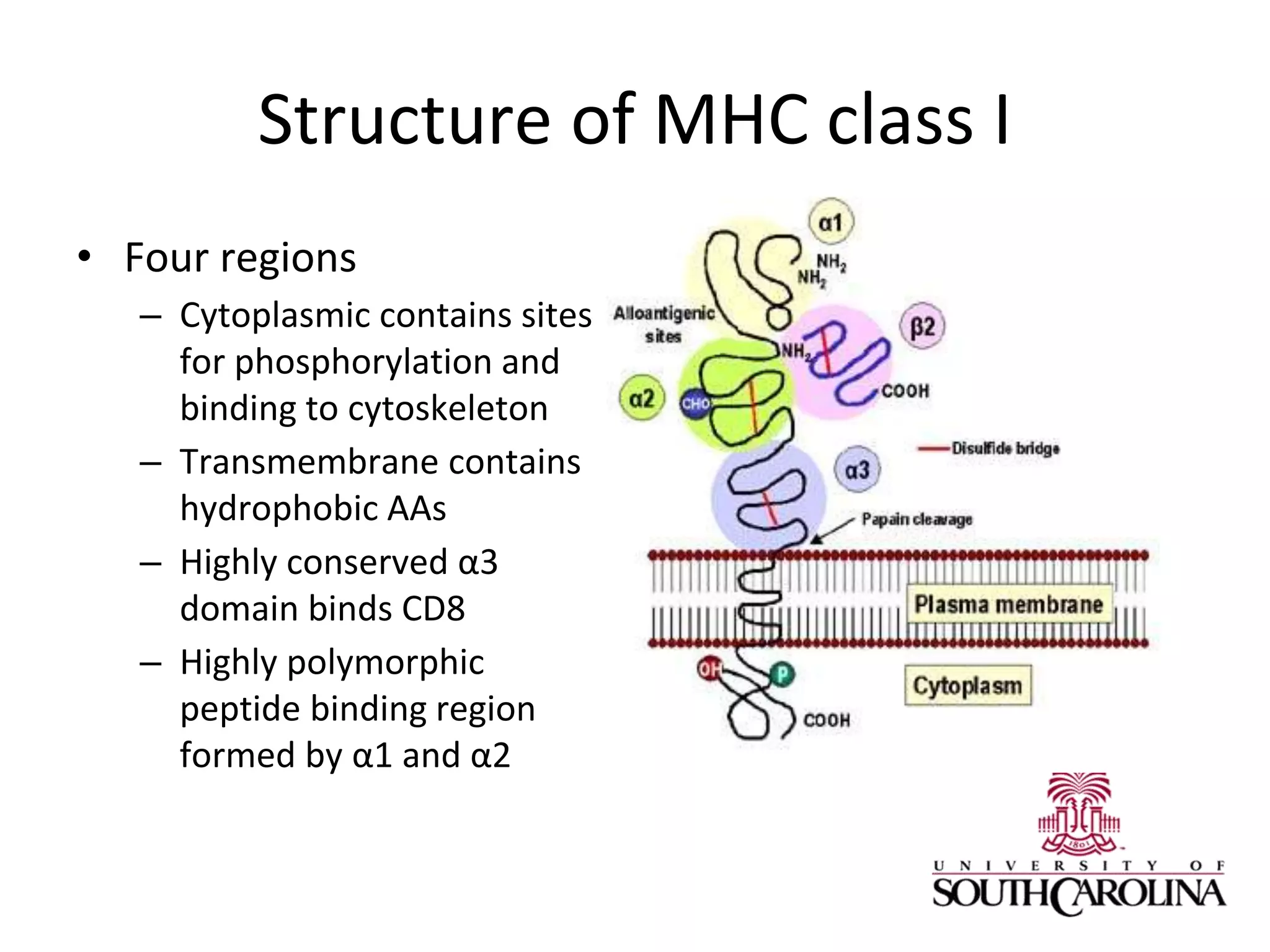
• Four regions
– Cytoplasmic contains sites
for phosphorylation and
binding to cytoskeleton
– Transmembrane contains
hydrophobic AAs
– Highly conserved α3
domain binds CD8
– Highly polymorphic
peptide binding region
formed by α1 and α2
Structure of MHC class I
Ag-binding groove
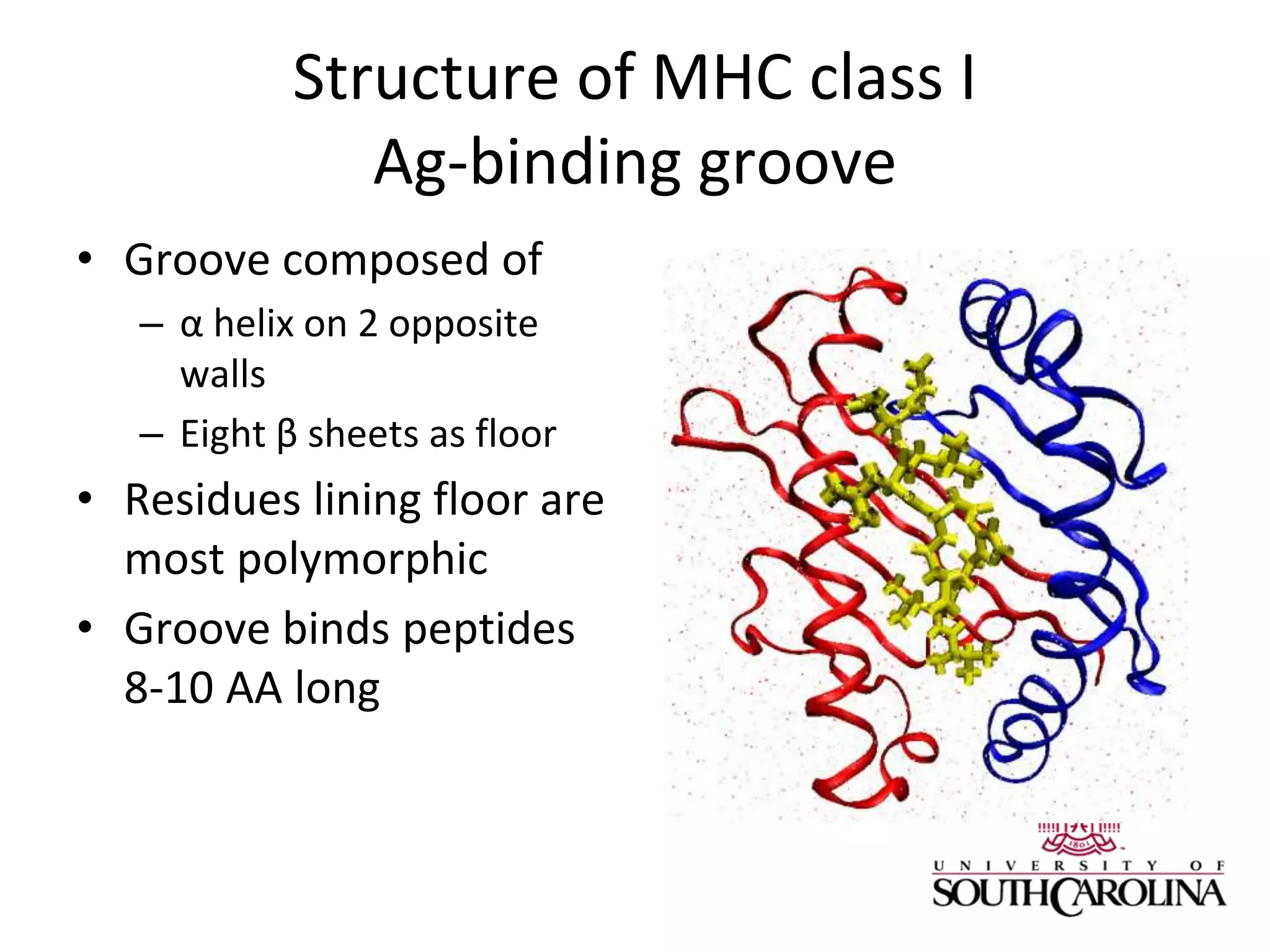
• Groove composed of
– α helix on 2 opposite
walls
– Eight β sheets as floor
• Residues lining floor are
most polymorphic
• Groove binds peptides
8-10 AA long
Structure of MHC class I
Ag-binding groove
• Specific amino acids on peptide are required
for “anchor site” in the groove
– Many peptides can bind
– Interactions at N and C-terminus are critical and
“lock” peptide in grove
– Center of peptide bulges out for presentation
– Consideration in vaccine development
Structure of MHC class II
• Two polypeptide chains
– α and β
– approx equal length
Structure of MHC class II
• Four regions
– Cytoplasmic contains sites
for phosphorylation and
binding to cytoskeleton
– Transmembrane contains
hydrophobic AAs
– Highly conserved α2 and
β2 domains binds CD4
– Highly polymorphic
peptide binding region
formed by α1 and β1
Structure of MHC class II
Ag-binding groove
• Groove composed of
– α helix on 2 opposite
walls
– Eight β sheets as floor
– Both α1 and β1 make up
groove
• Residues lining floor are
most polymorphic
• Groove binds peptides
13-25 AA long (some
outside groove)
Important aspects of MHC
• Individuals have a limited number of MHC
alleles for each class
• High polymorphism in MHC for a species
• Alleles for MHC genes are co-dominant
– Each MHC gene product is expressed on surface of
individual cell
Important aspects of MHC
• Each MHC has ONE peptide binding site
– But each MHC can bind many different peptides
– Only one at a time
– Peptide binding is “degenerate”
• MHC polymorphism is determined in germline
– NO recombination mechanisms for creating
diversity in MHC
• Peptide must bind with individual’s MHC to
induce immune response
Important aspects of MHC
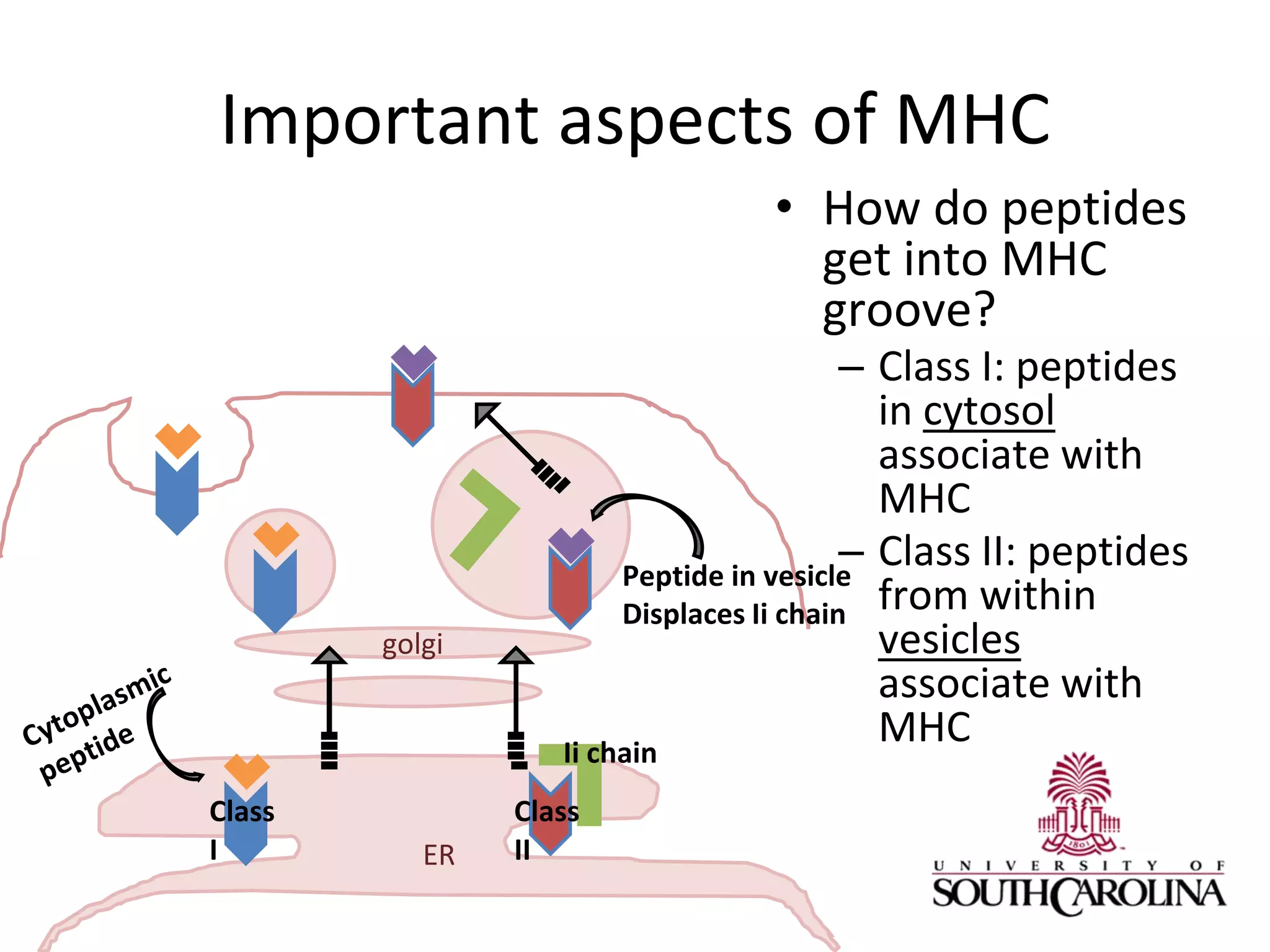
• How do peptides
get into MHC
groove?
– Class I: peptides
in cytosol
associate with
MHC
– Class II: peptides
from within
vesicles
associate with
MHC
golgi
ER
Class
I
Class
II
Ii chain
Peptide in vesicle
Displaces Ii chain
Important aspects of MHC
• MHC molecules are membrane-bound
– Recognition by Ts requires cell-cell contact
• Mature Ts must have TCR that recognizes
particular MHC
• Cytokines (especially IFN-γ) increase
expression of MHC
T cell receptor (TCR)
Role of TCR in immune response
• Surface molecule on Ts
• Recognize Ag presented in MHC context
• Similar to Immunoglobulin
• Two types of TCR
– α β: predominant in lymphoid tissues
– γ δ: enriched at mucosal surfaces
Structure of the TCR (αβ)
• Heterodimer
– α and β chains
– approx equal length
Structure of the TCR (αβ)
• Regions
– Short cytoplasmic tail-
cannot transduce
activation signal
– Transmembrane with
hydrophobic AAs
– Both α and β have a
variable (V) and constant
(C) region
– V region is hypervariable,
determines Ag specificity
Important aspects of TCR
• Each T cell has TCR of only ONE specificity
– Allelic exclusion
• αβ TCR recognizes Ag only in the context of
cell-cell interaction and in correct MHC
context
• γδ TCR recognizes Ag in MHC-independent
manner
– Response to certain viral and bacterial Ag
Genetic basis for receptor generation
• Accomplished by recombination of V, D and J
gene segments
– TCR β chain genes have V, D, and J
– TCR α chain genes have V and J
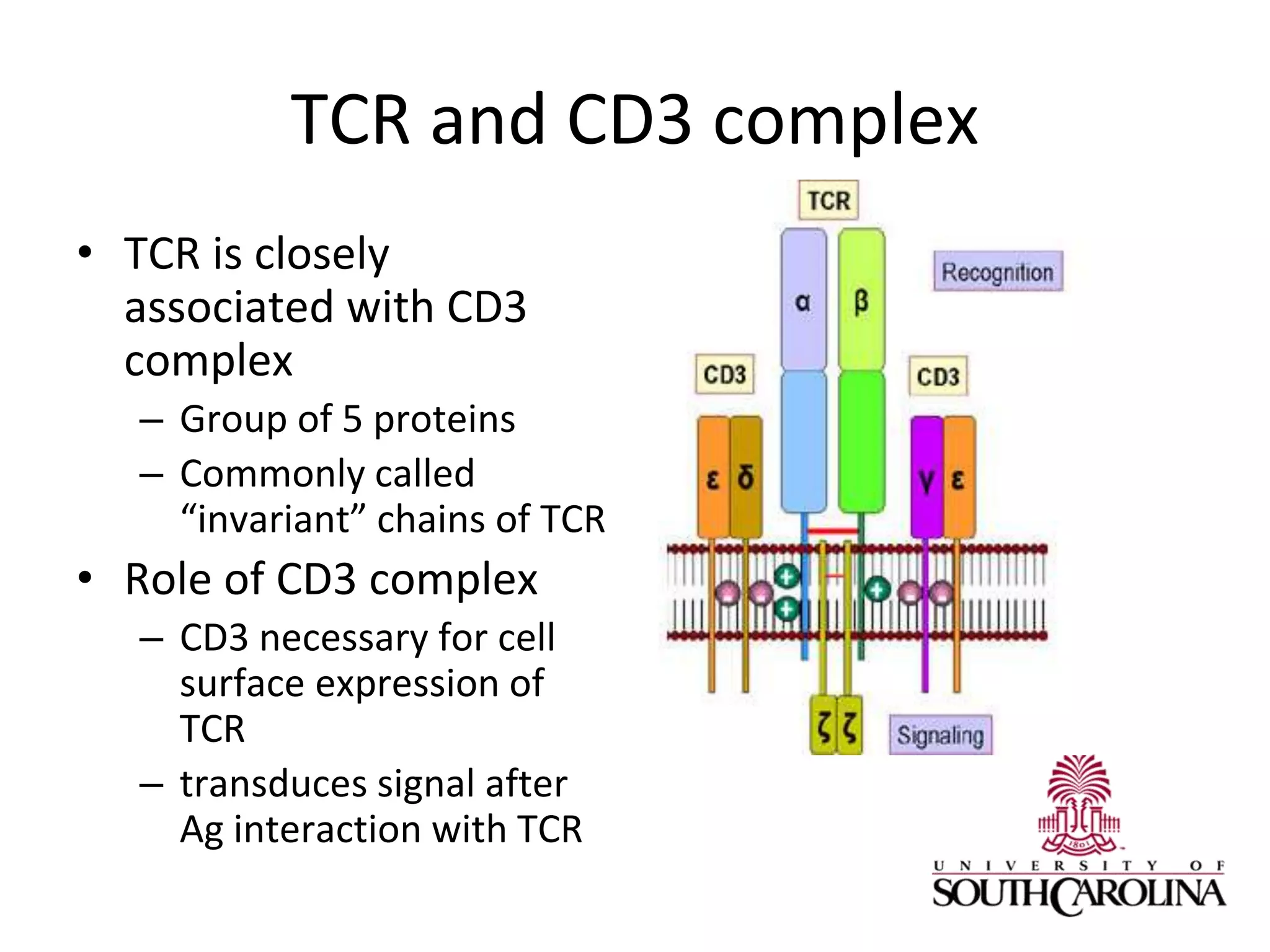
TCR and CD3 complex
• TCR is closely
associated with CD3
complex
– Group of 5 proteins
– Commonly called
“invariant” chains of TCR
• Role of CD3 complex
– CD3 necessary for cell
surface expression of
TCR
– transduces signal after
Ag interaction with TCR
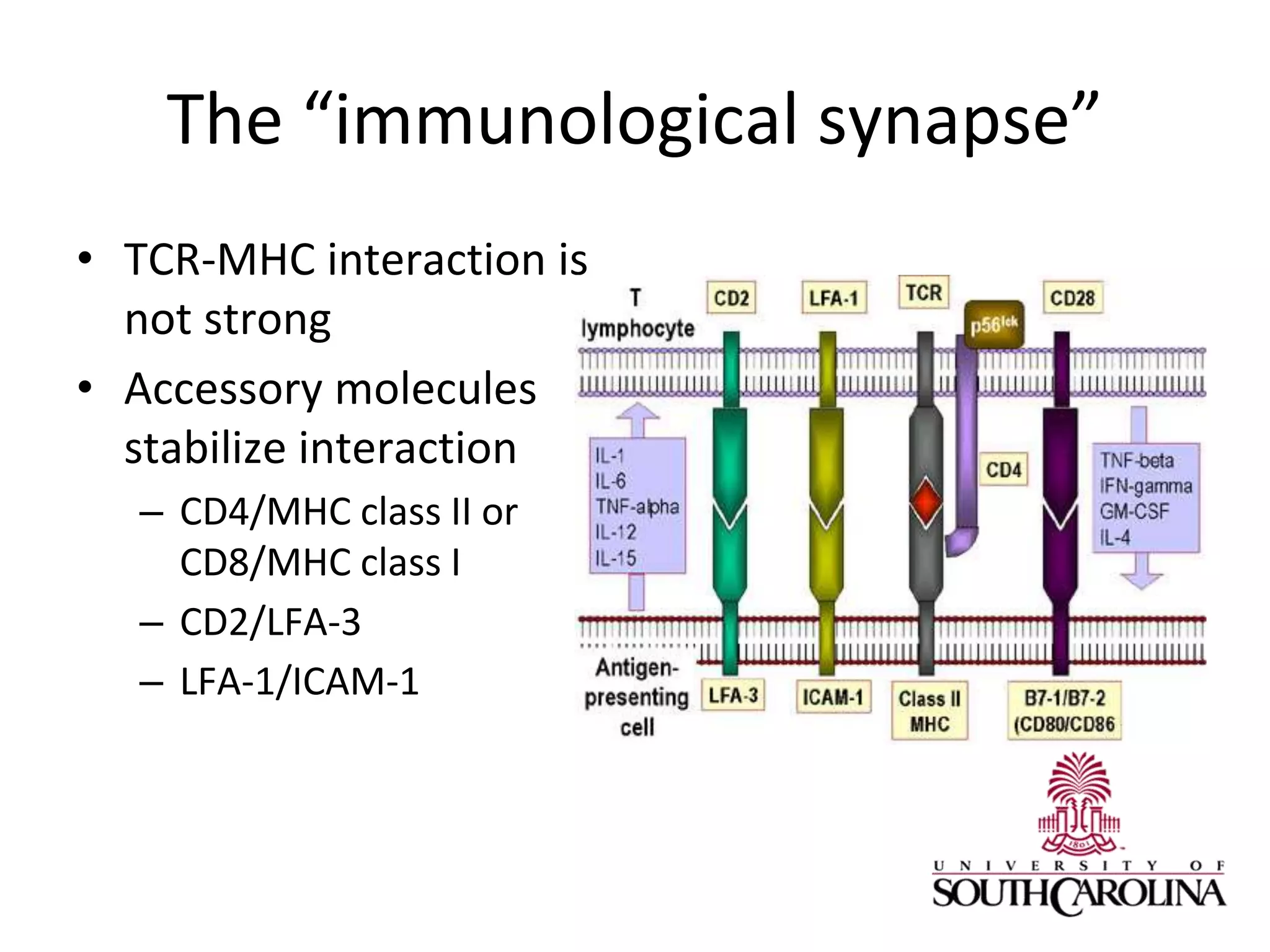
The “immunological synapse”
• TCR-MHC interaction is
not strong
• Accessory molecules
stabilize interaction
– CD4/MHC class II or
CD8/MHC class I
– CD2/LFA-3
– LFA-1/ICAM-1
The “immunological synapse”
• Specificity for Ag is
solely in TCR
• Accessory molecules
are invariant
• Cytokines change
expression levels
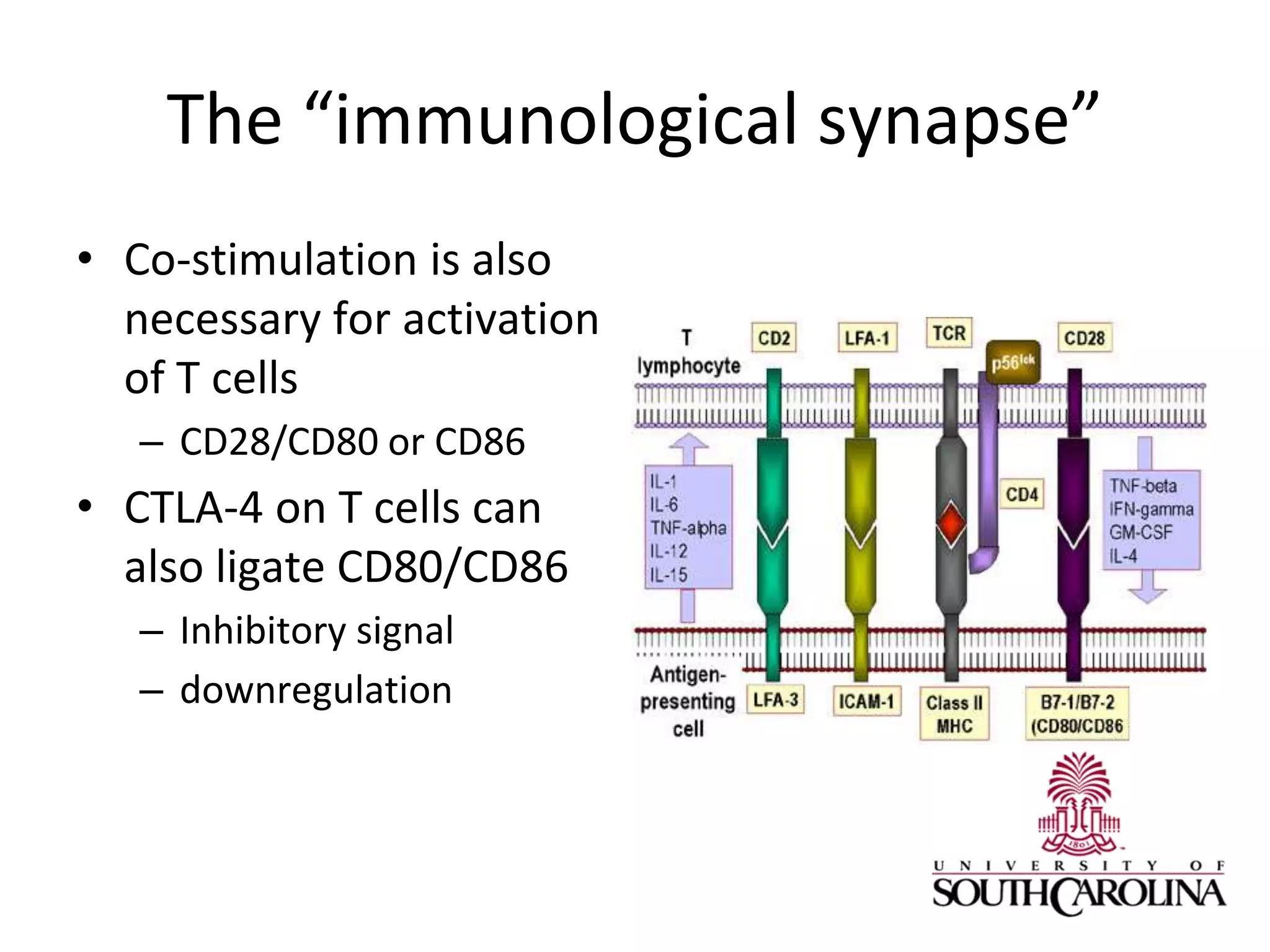
The “immunological synapse”
• Co-stimulation is also
necessary for activation
of T cells
– CD28/CD80 or CD86
• CTLA-4 on T cells can
also ligate CD80/CD86
– Inhibitory signal
– downregulation
Key steps in T cell activation
• APC must process and present peptides to Ts
• Ts must receive co-stimulatory signal
• Accessory adhesion molecules stabilize
binding of TCR and MHC
• Signal from cell surface is transmitted to
nucleus
• Cytokines produced help drive cell
proliferation

MHC description

  • 1.
    Major histocompatibility complex (MHC)and T cell receptors Subham Preetam, Master in biotechnology Bhubaneswar, India, sspritamrath93@gmail.com
  • 2.
    Teaching objectives • Togive an overview of role of MHC in immune response • To describe structure & function of MHC • To describe structure & function of TCR • To discuss the genetic basis for generation of diversity in TCR • To describe the nature of immunological synapse and requirements for T cell activation
  • 3.
    Role of MHCin immune response • TCR recognizes Ag presented in MHC – Context is important – Binding of Ag peptides in non-covalent • Two types of MHC (class I and class II) are recognized by different subsets of T cells – CTL recognizes Ag peptide in MHC class I – T-helper recognizes Ag peptide in MHC class II
  • 4.
    Structure of MHCclass I • Two polypeptide chains – Long α chain and short β
  • 5.
    Structure of MHCclass I • Four regions – Cytoplasmic contains sites for phosphorylation and binding to cytoskeleton – Transmembrane contains hydrophobic AAs – Highly conserved α3 domain binds CD8 – Highly polymorphic peptide binding region formed by α1 and α2
  • 6.
    Structure of MHCclass I Ag-binding groove • Groove composed of – α helix on 2 opposite walls – Eight β sheets as floor • Residues lining floor are most polymorphic • Groove binds peptides 8-10 AA long
  • 7.
    Structure of MHCclass I Ag-binding groove • Specific amino acids on peptide are required for “anchor site” in the groove – Many peptides can bind – Interactions at N and C-terminus are critical and “lock” peptide in grove – Center of peptide bulges out for presentation – Consideration in vaccine development
  • 8.
    Structure of MHCclass II • Two polypeptide chains – α and β – approx equal length
  • 9.
    Structure of MHCclass II • Four regions – Cytoplasmic contains sites for phosphorylation and binding to cytoskeleton – Transmembrane contains hydrophobic AAs – Highly conserved α2 and β2 domains binds CD4 – Highly polymorphic peptide binding region formed by α1 and β1
  • 10.
    Structure of MHCclass II Ag-binding groove • Groove composed of – α helix on 2 opposite walls – Eight β sheets as floor – Both α1 and β1 make up groove • Residues lining floor are most polymorphic • Groove binds peptides 13-25 AA long (some outside groove)
  • 11.
    Important aspects ofMHC • Individuals have a limited number of MHC alleles for each class • High polymorphism in MHC for a species • Alleles for MHC genes are co-dominant – Each MHC gene product is expressed on surface of individual cell
  • 12.
    Important aspects ofMHC • Each MHC has ONE peptide binding site – But each MHC can bind many different peptides – Only one at a time – Peptide binding is “degenerate” • MHC polymorphism is determined in germline – NO recombination mechanisms for creating diversity in MHC • Peptide must bind with individual’s MHC to induce immune response
  • 13.
    Important aspects ofMHC • How do peptides get into MHC groove? – Class I: peptides in cytosol associate with MHC – Class II: peptides from within vesicles associate with MHC golgi ER Class I Class II Ii chain Peptide in vesicle Displaces Ii chain
  • 14.
    Important aspects ofMHC • MHC molecules are membrane-bound – Recognition by Ts requires cell-cell contact • Mature Ts must have TCR that recognizes particular MHC • Cytokines (especially IFN-γ) increase expression of MHC
  • 15.
  • 16.
    Role of TCRin immune response • Surface molecule on Ts • Recognize Ag presented in MHC context • Similar to Immunoglobulin • Two types of TCR – α β: predominant in lymphoid tissues – γ δ: enriched at mucosal surfaces
  • 17.
    Structure of theTCR (αβ) • Heterodimer – α and β chains – approx equal length
  • 18.
    Structure of theTCR (αβ) • Regions – Short cytoplasmic tail- cannot transduce activation signal – Transmembrane with hydrophobic AAs – Both α and β have a variable (V) and constant (C) region – V region is hypervariable, determines Ag specificity
  • 19.
    Important aspects ofTCR • Each T cell has TCR of only ONE specificity – Allelic exclusion • αβ TCR recognizes Ag only in the context of cell-cell interaction and in correct MHC context • γδ TCR recognizes Ag in MHC-independent manner – Response to certain viral and bacterial Ag
  • 20.
    Genetic basis forreceptor generation • Accomplished by recombination of V, D and J gene segments – TCR β chain genes have V, D, and J – TCR α chain genes have V and J
  • 21.
    TCR and CD3complex • TCR is closely associated with CD3 complex – Group of 5 proteins – Commonly called “invariant” chains of TCR • Role of CD3 complex – CD3 necessary for cell surface expression of TCR – transduces signal after Ag interaction with TCR
  • 22.
    The “immunological synapse” •TCR-MHC interaction is not strong • Accessory molecules stabilize interaction – CD4/MHC class II or CD8/MHC class I – CD2/LFA-3 – LFA-1/ICAM-1
  • 23.
    The “immunological synapse” •Specificity for Ag is solely in TCR • Accessory molecules are invariant • Cytokines change expression levels
  • 24.
    The “immunological synapse” •Co-stimulation is also necessary for activation of T cells – CD28/CD80 or CD86 • CTLA-4 on T cells can also ligate CD80/CD86 – Inhibitory signal – downregulation
  • 25.
    Key steps inT cell activation • APC must process and present peptides to Ts • Ts must receive co-stimulatory signal • Accessory adhesion molecules stabilize binding of TCR and MHC • Signal from cell surface is transmitted to nucleus • Cytokines produced help drive cell proliferation