Antigen
Presented by:
Samir abo zyd.
Mohamed Ibrahim.
Reham gamal.
Mohamed ahmed Mansour.
Ahmed attia.
Outlines:
I. Antigen receptors.
II. Antigen recognition by lymphocytes.
III. The role of MHC in antigen recognition.
Antigen receptors.
• The antigen receptors on B cells (the B-cell receptor or BCR)
and T cells (the T-cell receptor or TCR) are multiprotein
complexes made up of clonally variable antigen-binding
chains.
• The B-cell receptor or BCR is a transmembrane receptor
protein located on the outer surface of B-cells.
• The T cell receptor or TCR is a molecule found on the surface
of T lymphocytes (or T cells) that is responsible for recognizing
antigens bound to major histocompatibility complex (MHC)
molecules
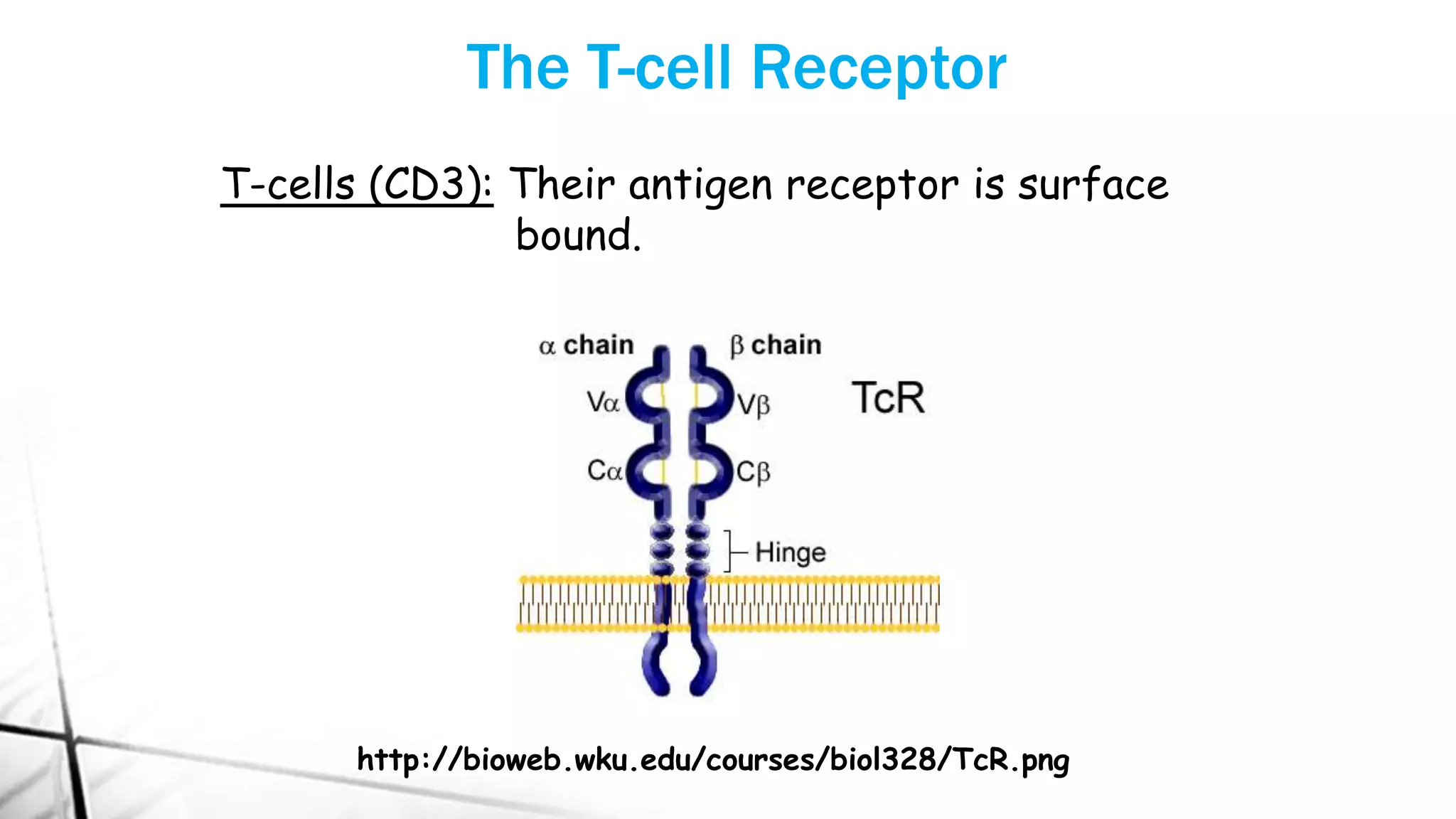
The T-cell Receptor
http://bioweb.wku.edu/courses/biol328/TcR.png
T-cells (CD3): Their antigen receptor is surface
bound.
The T-cell Receptor
• The T cell receptor or TCR is a molecule found on the surface
of Tlymphocytes (or T cells) that is responsible for
recognizingantigens bound to major histocompatibility complex (MHC)
molecules.
• The binding between TCR and antigen is of relatively low affinity and
is degenerate: that is, many TCR recognize the same antigen and many
antigens are recognized by the same TCR.
• The TCR is composed of two different protein chains (that is, it is
a heterodimer). In 95% of T cells, this consists of an alpha (α) and beta (β)
chain, whereas in 5% of T cells this consists of gamma and delta (γ/δ)
chains. This ratio changes during ontogeny and in diseased states.
The T-cell Receptor
• The TCR is composed of two different protein chains (that is, it
is a heterodimer).
• In 95% of T cells, this consists of an alpha (α) and beta (β)
chain.
• In 5% of T cells this consists of gamma and delta (γ/δ) chains.
This ratio changes during ontogeny and in diseased states.
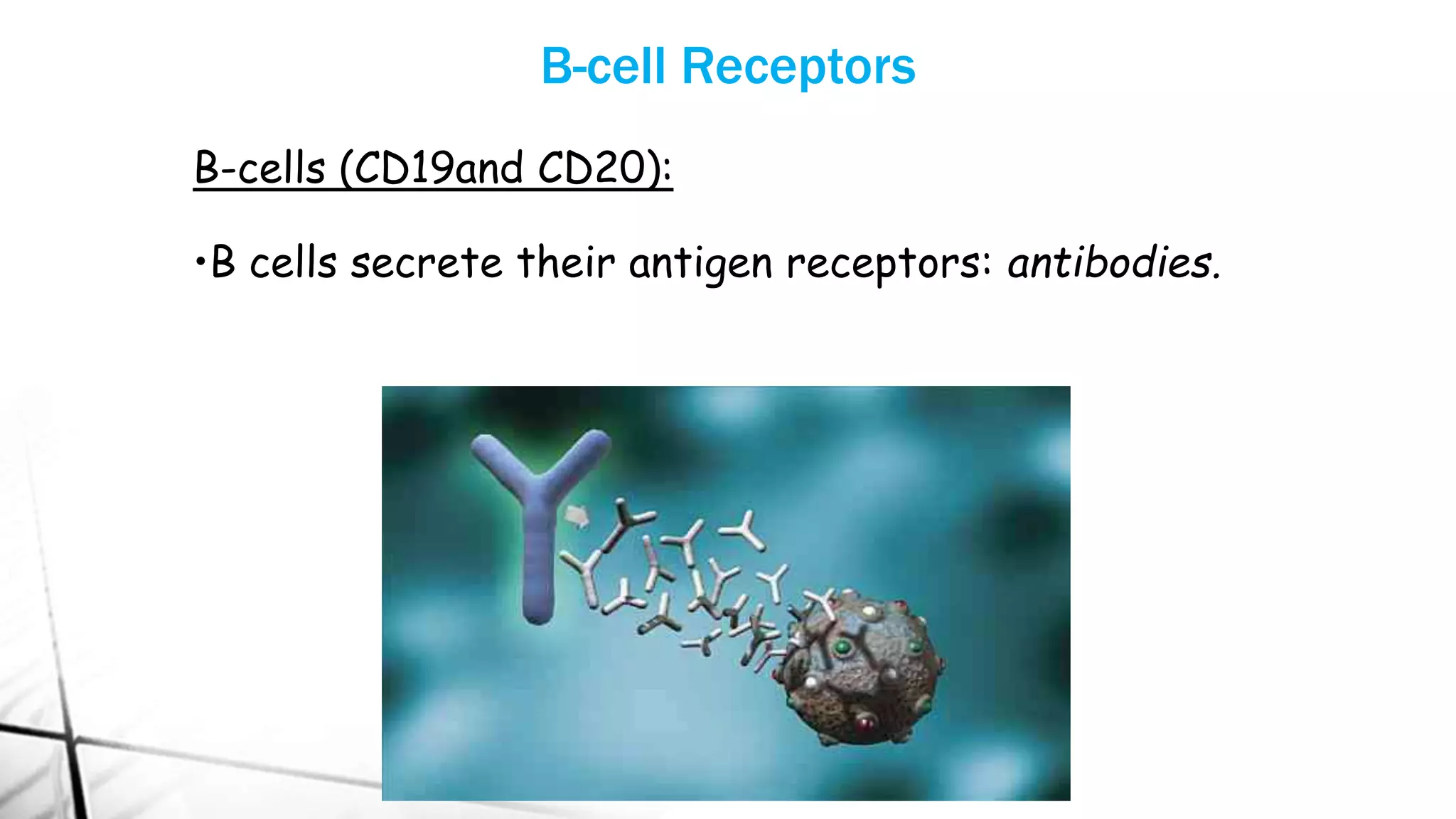
B-cell Receptors
B-cells (CD19and CD20):
•B cells secrete their antigen receptors: antibodies.
B-cell Receptors
• The B-cell receptor or BCR is a transmembrane receptor
protein located on the outer surface of B-cells.
• The receptor's binding moiety is composed of a membrane-
bound antibody that, like all antibodies, has a unique and
randomly determined antigen-binding site.
• When a B-cell is activated by its first encounter with an antigen
that binds to its receptor (its "cognate antigen"), the cell
proliferates and differentiates to generate a population of
antibody-secreting plasma B cells and memory B cells.
B-cell Receptors
• The B cell receptor (BCR) has two crucial functions
upon interaction with Ag. One function is signal
transduction, involving changes in receptor
oligomerization.
• The second function is to mediate internalization for
subsequent processing of Ag and presentation of
peptides to helper T cells.
Antigen Recognition by Lymphocytes
• An antigen is any foreign molecule to which a
lymphocyte responds
• A single B cell or T cell has about 100,000 identical
antigen receptors
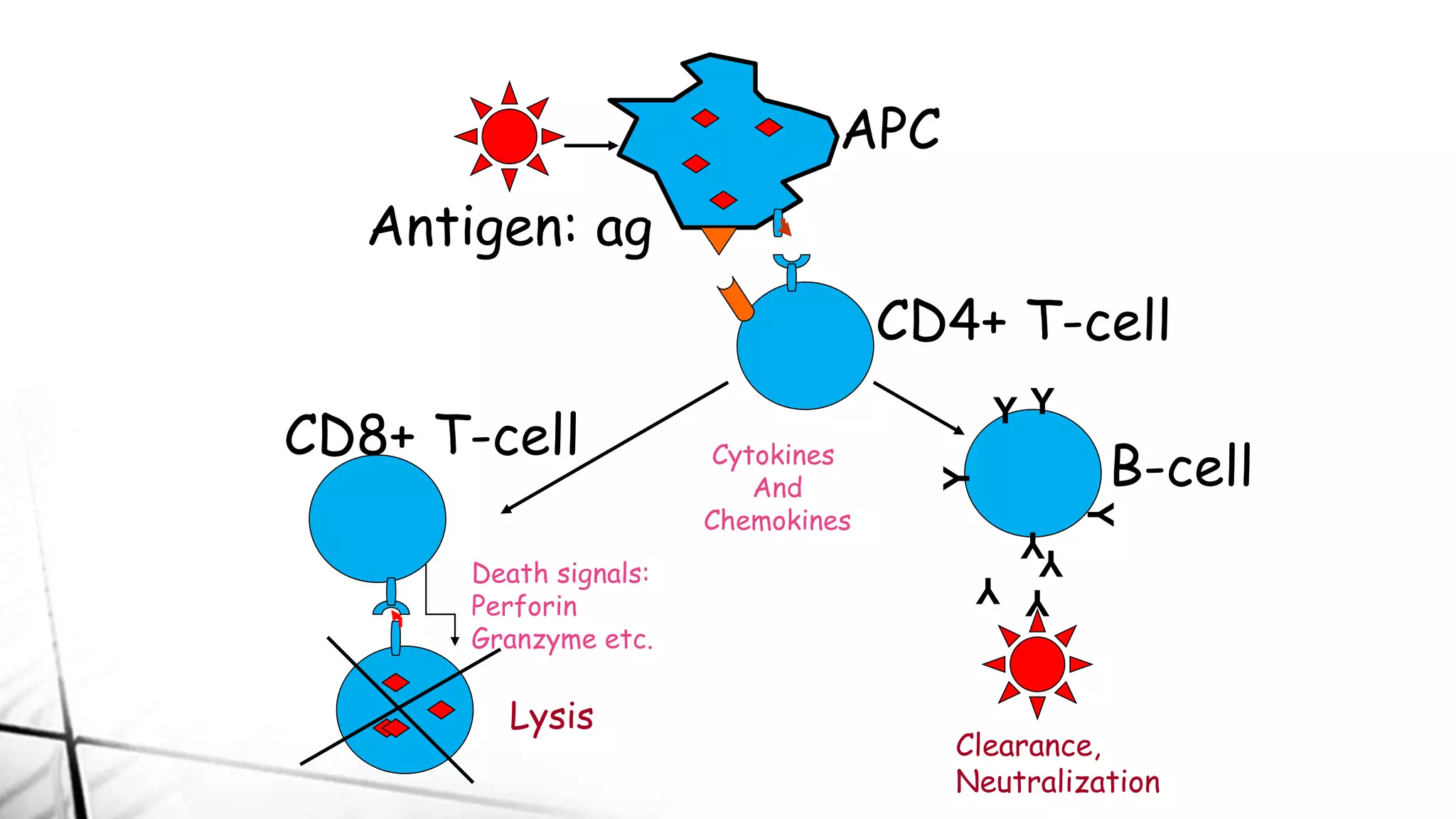
Antigen: ag
APC
CD4+ T-cell
CD8+ T-cell
Death signals:
Perforin
Granzyme etc.
Cytokines
And
Chemokines
B-cell
Y
Y
Y
Y Y
Y
Y Y
Lysis
Clearance,
Neutralization
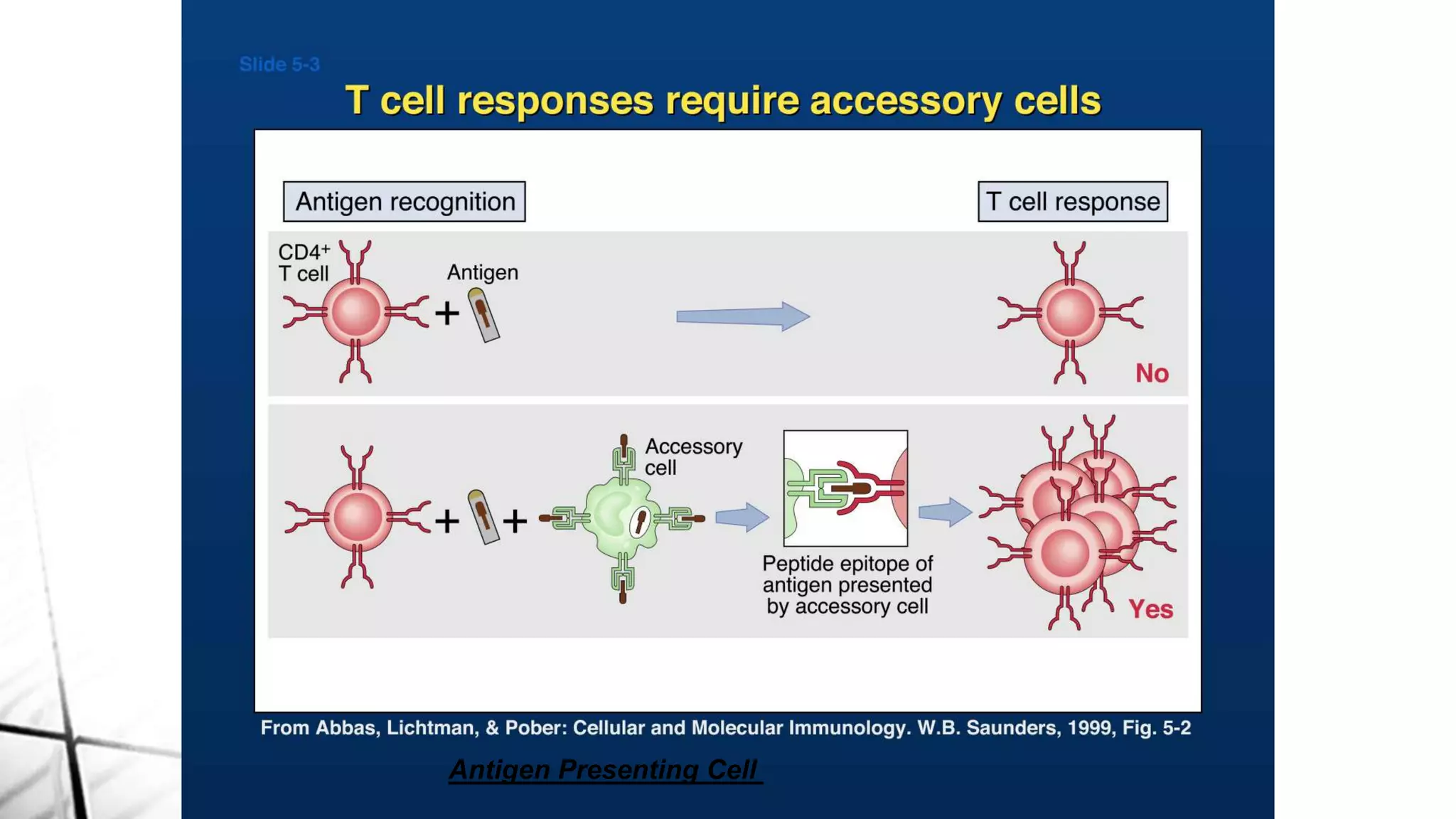
Antigen Presenting Cell
MHC role in antigen recognition
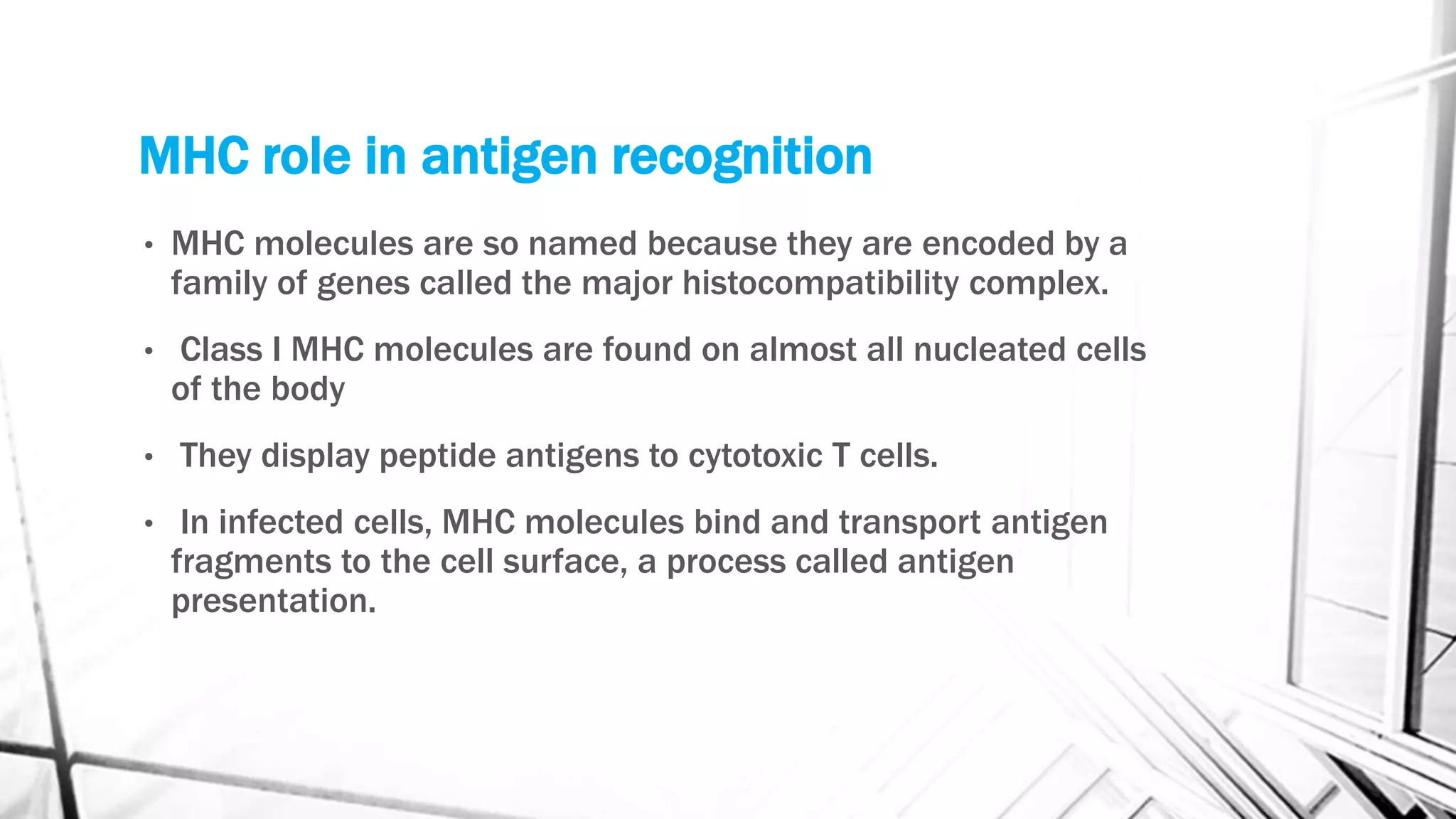
• MHC molecules are so named because they are encoded by a
family of genes called the major histocompatibility complex.
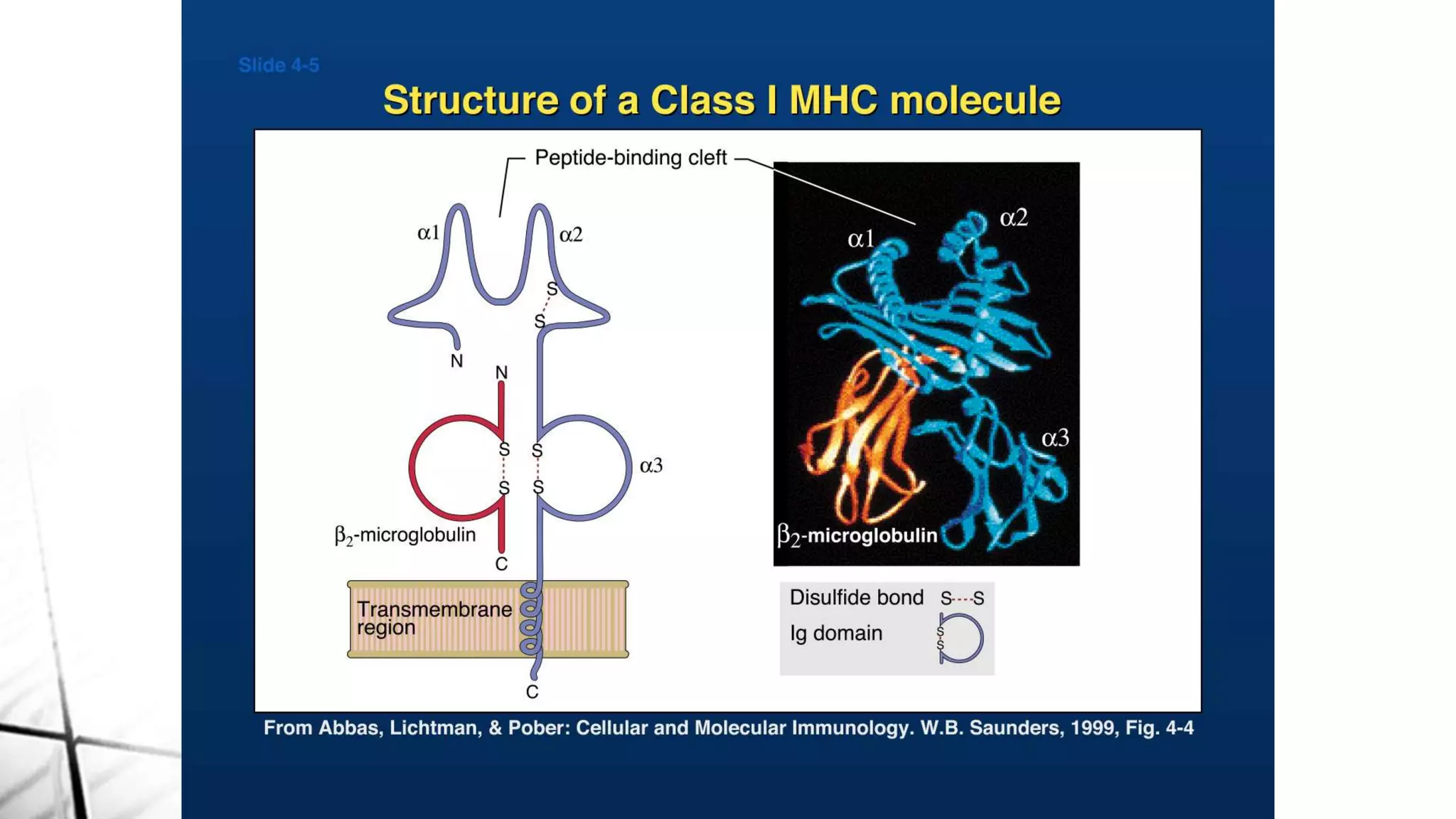
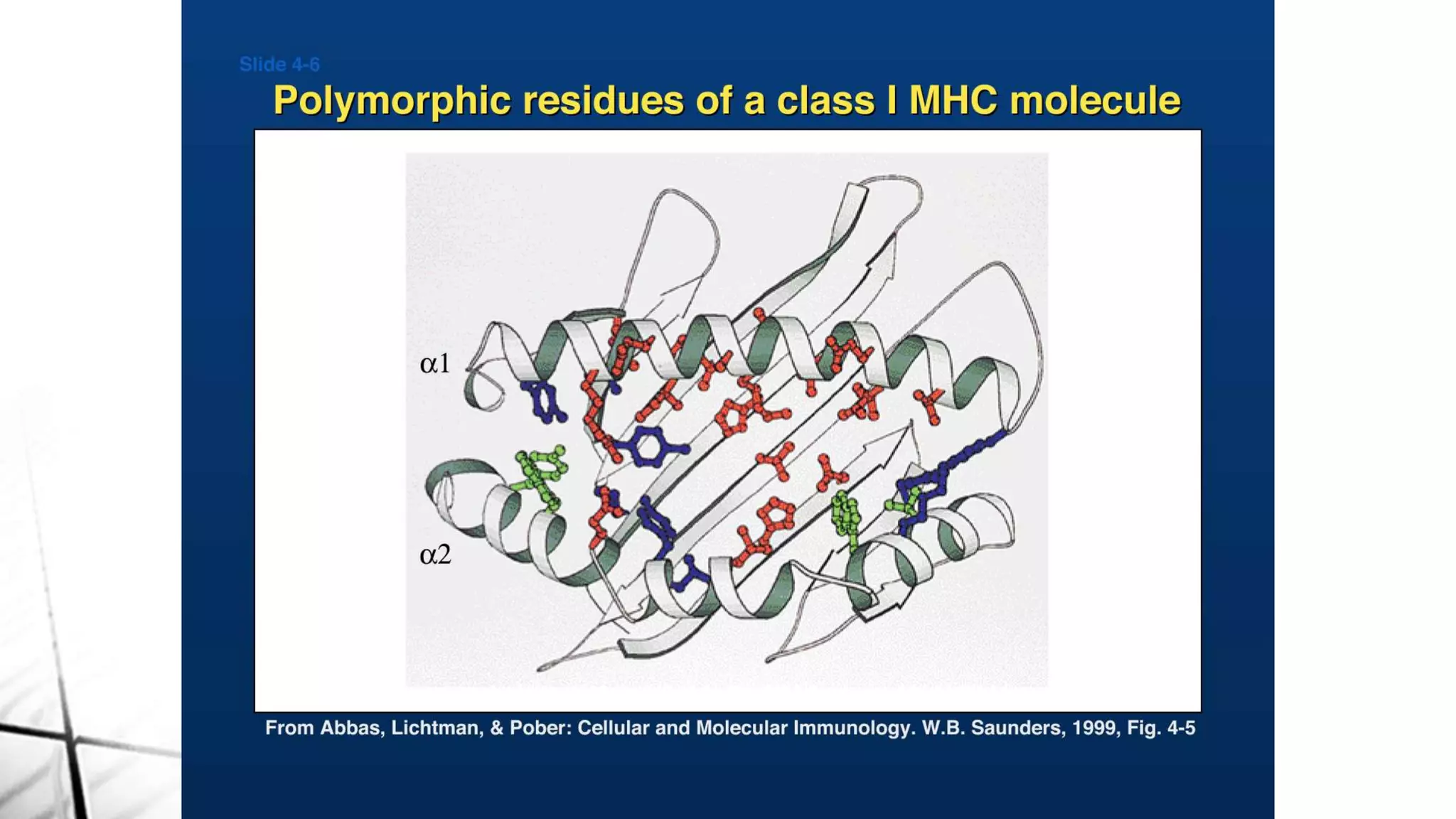
• Class I MHC molecules are found on almost all nucleated cells
of the body
• They display peptide antigens to cytotoxic T cells.
• In infected cells, MHC molecules bind and transport antigen
fragments to the cell surface, a process called antigen
presentation.
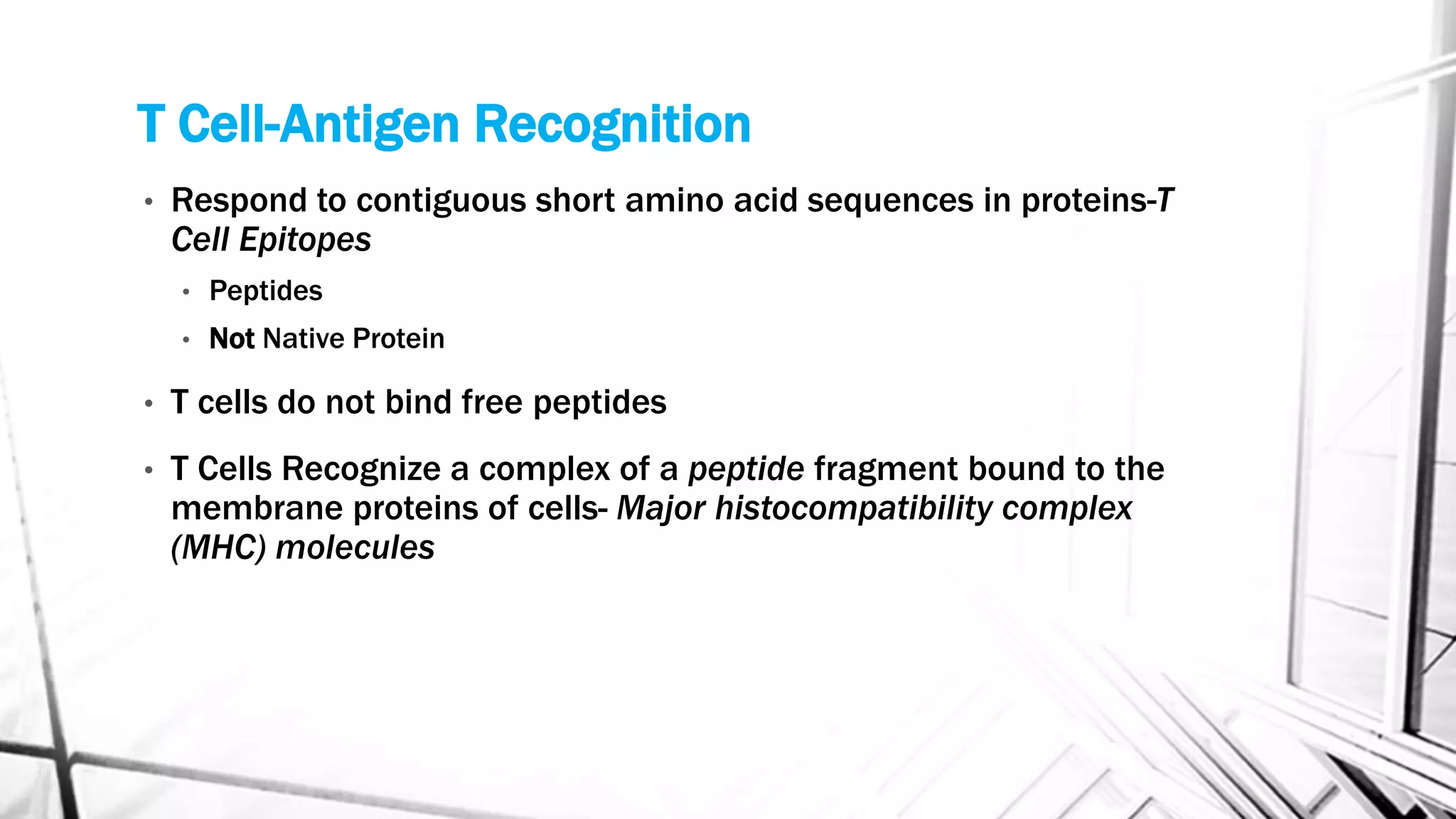
T Cell-Antigen Recognition
• Respond to contiguous short amino acid sequences in proteins-T
Cell Epitopes
• Peptides
• Not Native Protein
• T cells do not bind free peptides
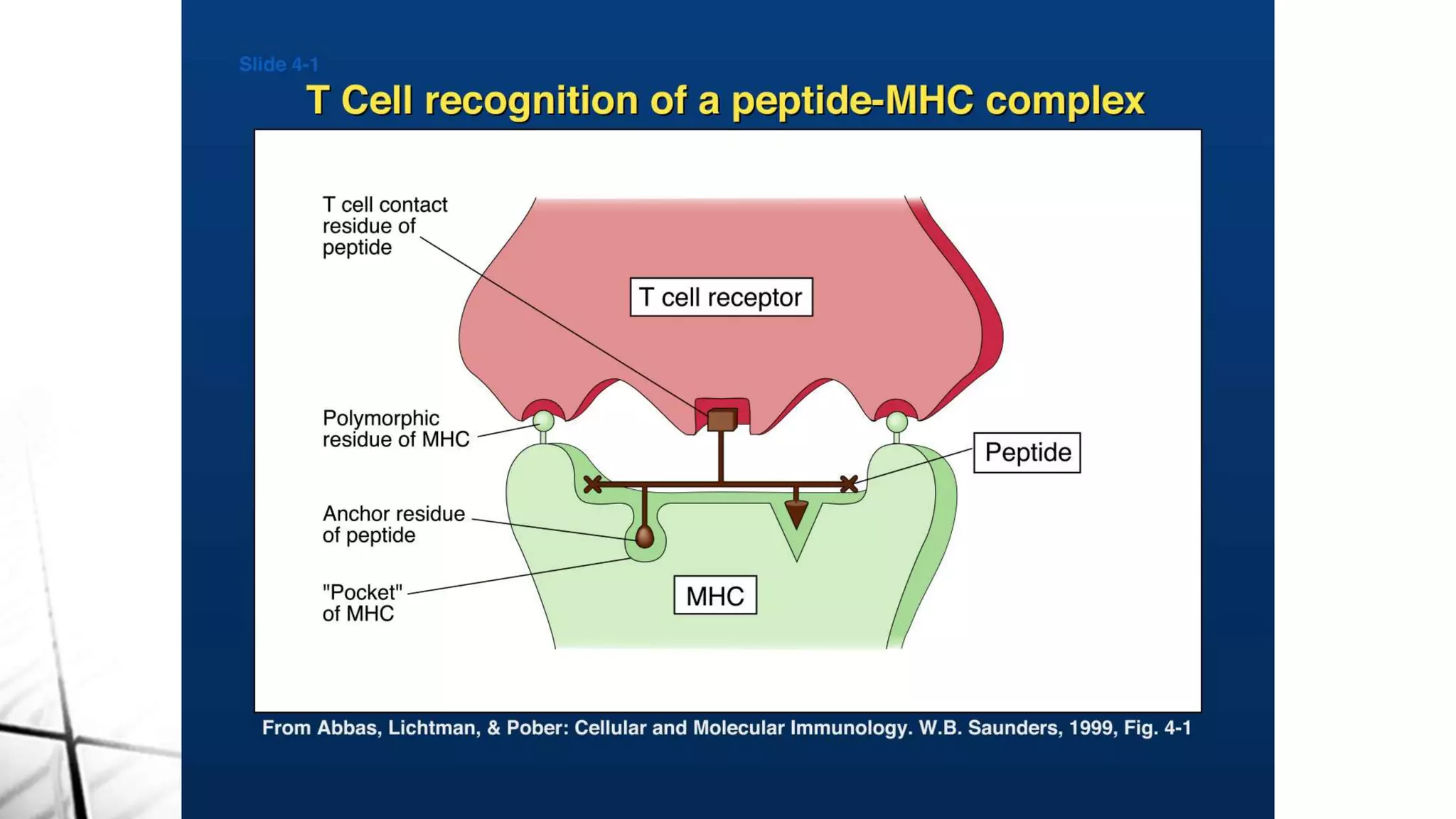
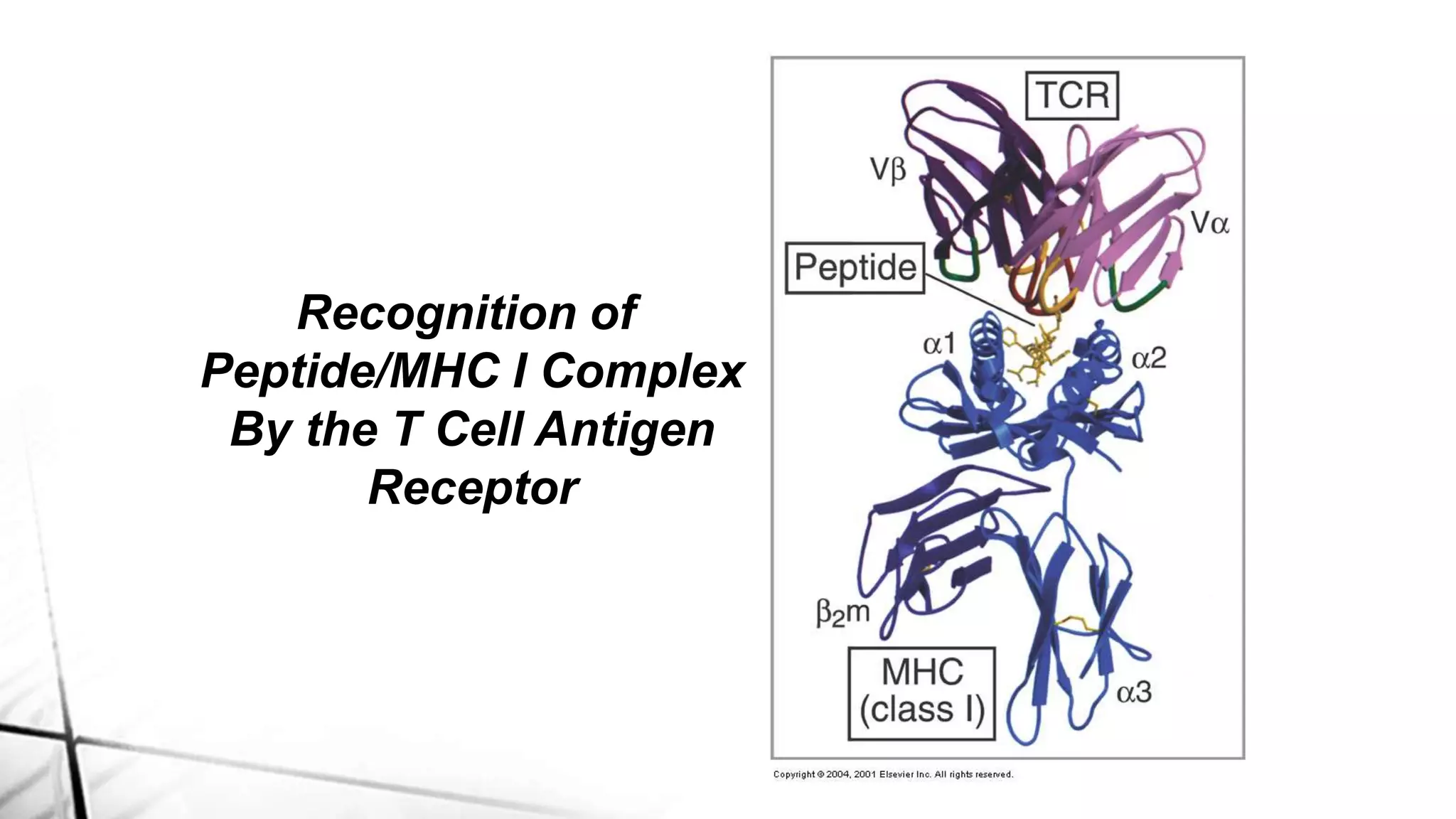
• T Cells Recognize a complex of a peptide fragment bound to the
membrane proteins of cells- Major histocompatibility complex
(MHC) molecules
MHC Molecules
• MHC I
• MHC II
• Physiological function is to present peptides to T cells
Major Histocompatibility Complex Proteins
• Human-HLA (human leukocyte antigen)
• Mouse: H-2
• Bovines: BoLA
• Equines: ELA
• Swine: SLA
• OLA, CLA, DLA, FLA
MHC Class I Molecules
• Present Peptides to CD8+ T Cells
• Expressed on ALL Nucleated Cells of the Body
Recognition of
Peptide/MHC I Complex
By the T Cell Antigen
Receptor
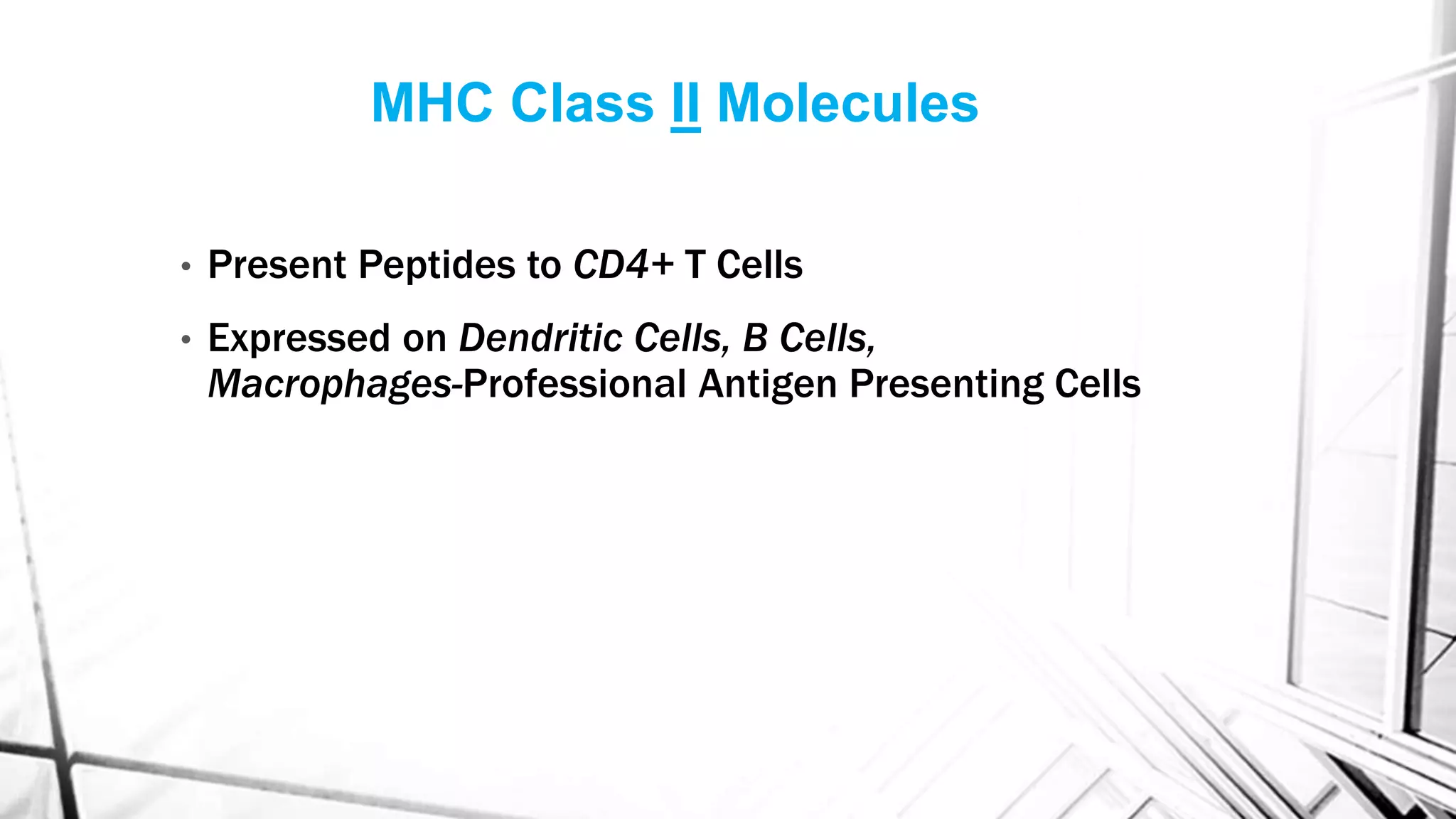
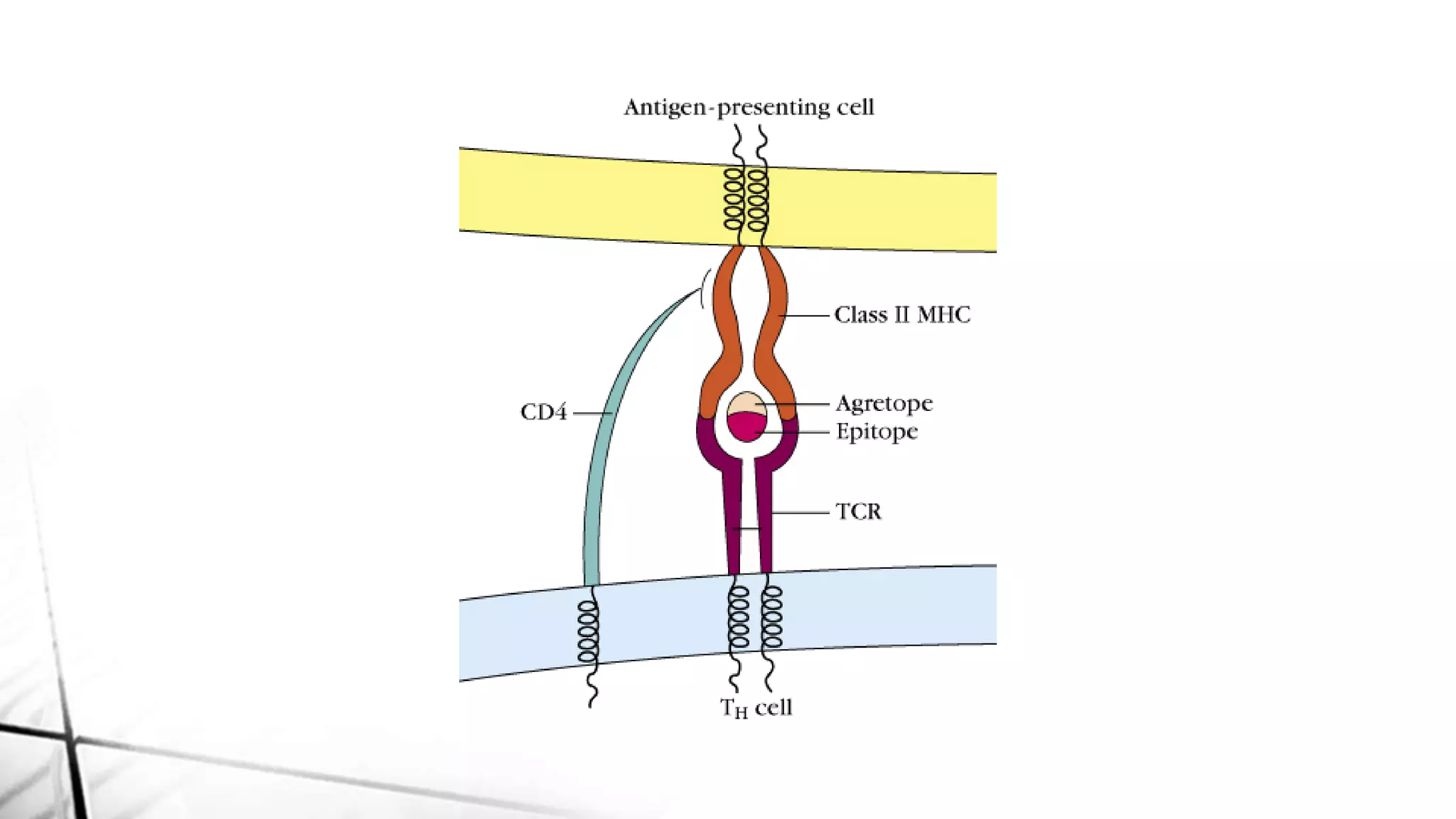
MHC Class II Molecules
• Present Peptides to CD4+ T Cells
• Expressed on Dendritic Cells, B Cells,
Macrophages-Professional Antigen Presenting Cells
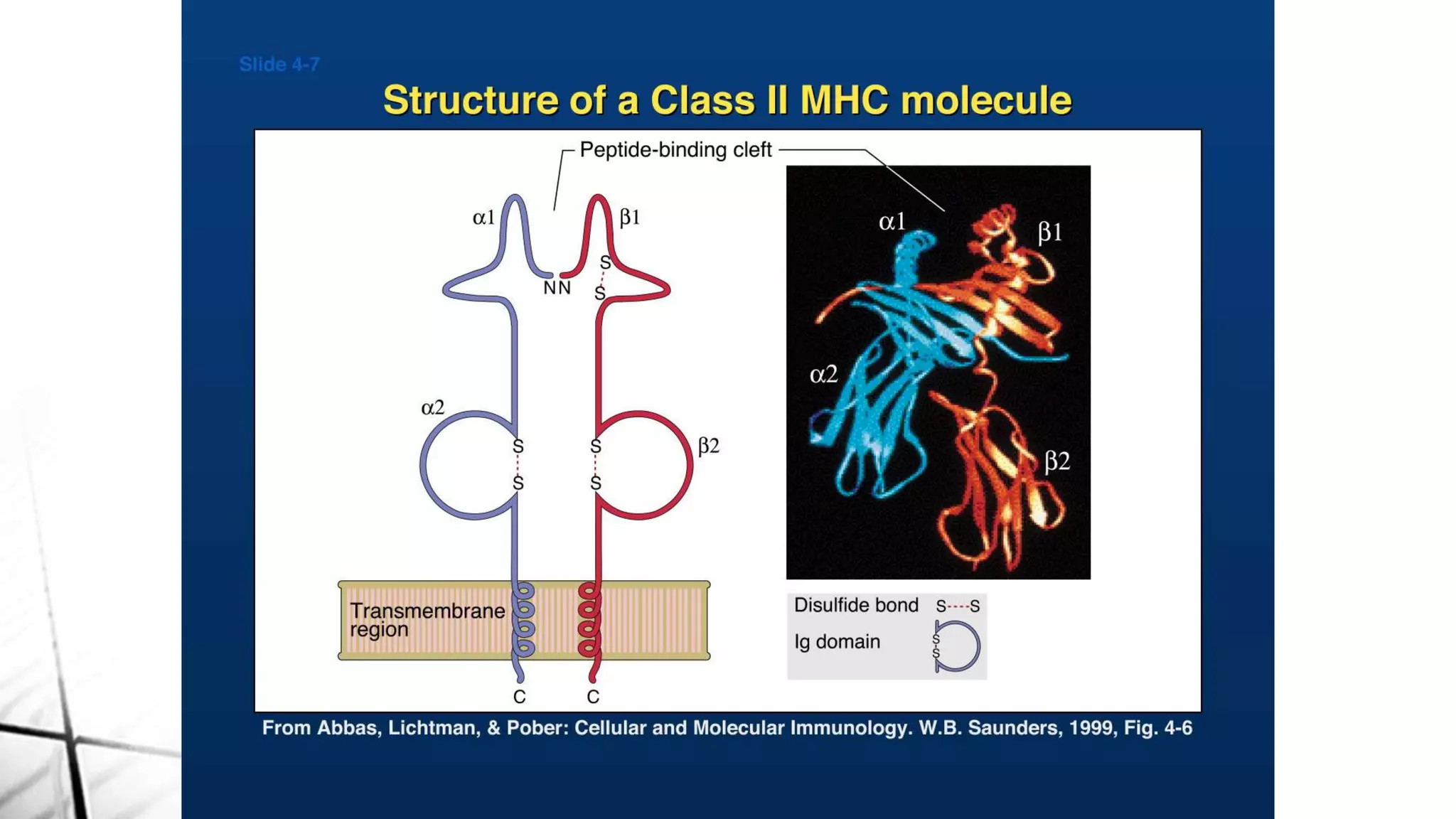
Crystal Structure of MHC
Class II Molecules
Peptide
References:
• http://www.ncbi.nlm.nih.gov/books/NBK27130/.
• http://users.rcn.com/jkimball.ma.ultranet/BiologyPages/A/AntigenRecept
ors.html.
• http://www.britannica.com/EBchecked/topic/702522/antigen-receptor.
Antigen

Antigen

  • 1.
    Antigen Presented by: Samir abozyd. Mohamed Ibrahim. Reham gamal. Mohamed ahmed Mansour. Ahmed attia.
  • 2.
    Outlines: I. Antigen receptors. II.Antigen recognition by lymphocytes. III. The role of MHC in antigen recognition.
  • 3.
    Antigen receptors. • Theantigen receptors on B cells (the B-cell receptor or BCR) and T cells (the T-cell receptor or TCR) are multiprotein complexes made up of clonally variable antigen-binding chains. • The B-cell receptor or BCR is a transmembrane receptor protein located on the outer surface of B-cells. • The T cell receptor or TCR is a molecule found on the surface of T lymphocytes (or T cells) that is responsible for recognizing antigens bound to major histocompatibility complex (MHC) molecules
  • 4.
  • 5.
    The T-cell Receptor •The T cell receptor or TCR is a molecule found on the surface of Tlymphocytes (or T cells) that is responsible for recognizingantigens bound to major histocompatibility complex (MHC) molecules. • The binding between TCR and antigen is of relatively low affinity and is degenerate: that is, many TCR recognize the same antigen and many antigens are recognized by the same TCR. • The TCR is composed of two different protein chains (that is, it is a heterodimer). In 95% of T cells, this consists of an alpha (α) and beta (β) chain, whereas in 5% of T cells this consists of gamma and delta (γ/δ) chains. This ratio changes during ontogeny and in diseased states.
  • 6.
    The T-cell Receptor •The TCR is composed of two different protein chains (that is, it is a heterodimer). • In 95% of T cells, this consists of an alpha (α) and beta (β) chain. • In 5% of T cells this consists of gamma and delta (γ/δ) chains. This ratio changes during ontogeny and in diseased states.
  • 7.
    B-cell Receptors B-cells (CD19andCD20): •B cells secrete their antigen receptors: antibodies.
  • 8.
    B-cell Receptors • TheB-cell receptor or BCR is a transmembrane receptor protein located on the outer surface of B-cells. • The receptor's binding moiety is composed of a membrane- bound antibody that, like all antibodies, has a unique and randomly determined antigen-binding site. • When a B-cell is activated by its first encounter with an antigen that binds to its receptor (its "cognate antigen"), the cell proliferates and differentiates to generate a population of antibody-secreting plasma B cells and memory B cells.
  • 9.
    B-cell Receptors • TheB cell receptor (BCR) has two crucial functions upon interaction with Ag. One function is signal transduction, involving changes in receptor oligomerization. • The second function is to mediate internalization for subsequent processing of Ag and presentation of peptides to helper T cells.
  • 10.
    Antigen Recognition byLymphocytes • An antigen is any foreign molecule to which a lymphocyte responds • A single B cell or T cell has about 100,000 identical antigen receptors
  • 11.
    Antigen: ag APC CD4+ T-cell CD8+T-cell Death signals: Perforin Granzyme etc. Cytokines And Chemokines B-cell Y Y Y Y Y Y Y Y Lysis Clearance, Neutralization
  • 13.
  • 14.
    MHC role inantigen recognition • MHC molecules are so named because they are encoded by a family of genes called the major histocompatibility complex. • Class I MHC molecules are found on almost all nucleated cells of the body • They display peptide antigens to cytotoxic T cells. • In infected cells, MHC molecules bind and transport antigen fragments to the cell surface, a process called antigen presentation.
  • 15.
    T Cell-Antigen Recognition •Respond to contiguous short amino acid sequences in proteins-T Cell Epitopes • Peptides • Not Native Protein • T cells do not bind free peptides • T Cells Recognize a complex of a peptide fragment bound to the membrane proteins of cells- Major histocompatibility complex (MHC) molecules
  • 17.
    MHC Molecules • MHCI • MHC II • Physiological function is to present peptides to T cells
  • 18.
    Major Histocompatibility ComplexProteins • Human-HLA (human leukocyte antigen) • Mouse: H-2 • Bovines: BoLA • Equines: ELA • Swine: SLA • OLA, CLA, DLA, FLA
  • 19.
    MHC Class IMolecules • Present Peptides to CD8+ T Cells • Expressed on ALL Nucleated Cells of the Body
  • 22.
    Recognition of Peptide/MHC IComplex By the T Cell Antigen Receptor
  • 23.
    MHC Class IIMolecules • Present Peptides to CD4+ T Cells • Expressed on Dendritic Cells, B Cells, Macrophages-Professional Antigen Presenting Cells
  • 25.
    Crystal Structure ofMHC Class II Molecules Peptide
  • 27.