T-cell Maturation, Activation, &
Differentiation
BT6602
Unit 2
Dr K.Geetha
Associate Professor
Department of Biotechnology
Kamaraj College of Engg & Tech
Madurai
Overview
• Early Development
• T-Cell Repertoire Selection Processes
• Late Development
• Activation
• Differentiation
• Cell Death
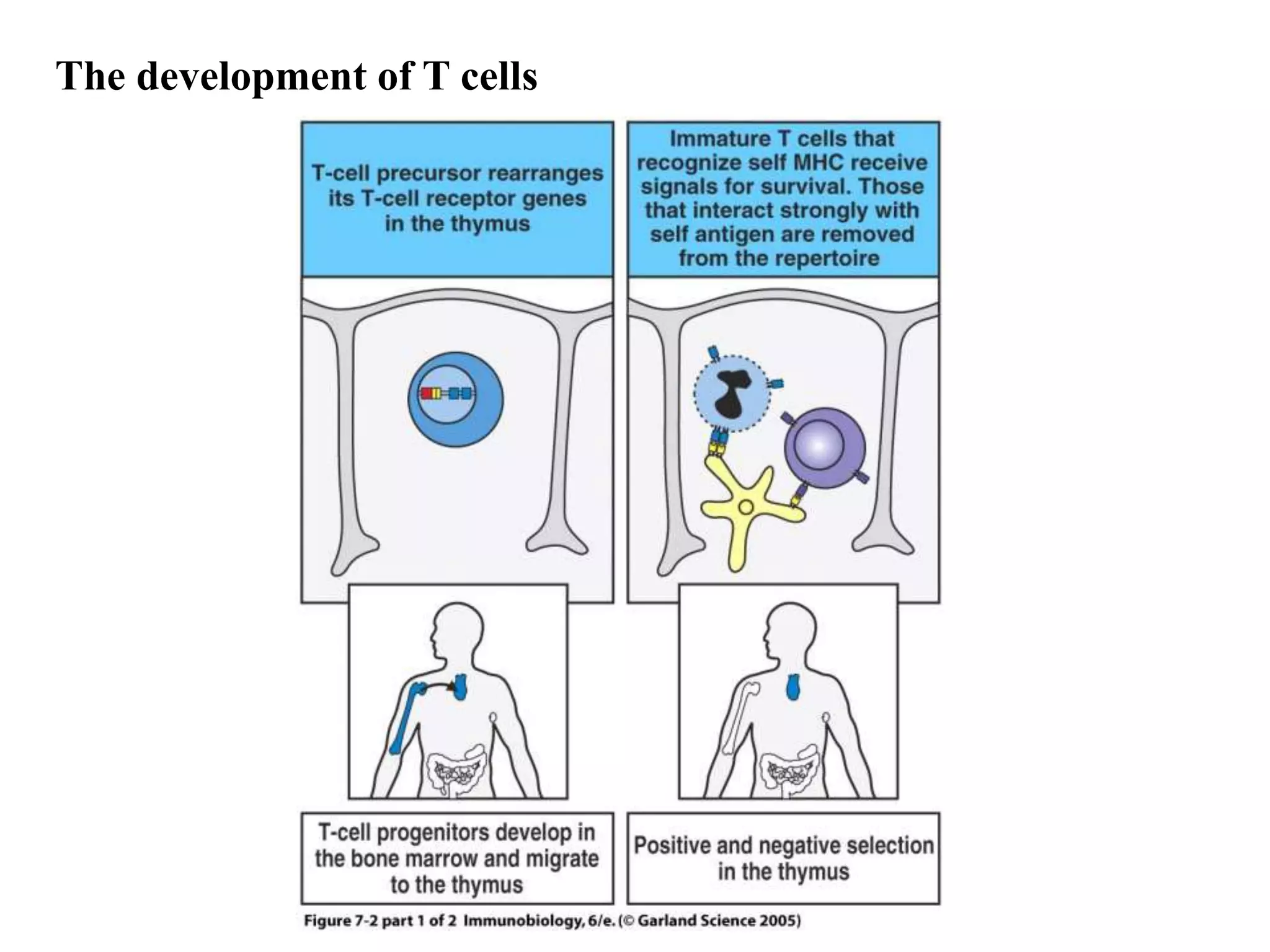
• Progenitor T cells migrate to thymus
• At about 8th or 9th week of gestation in humans
• T cell maturation involves rearrangements
of the germ-line TCR genes
• In thymus, thymocytes proliferate and
differentiate
The development of T cells
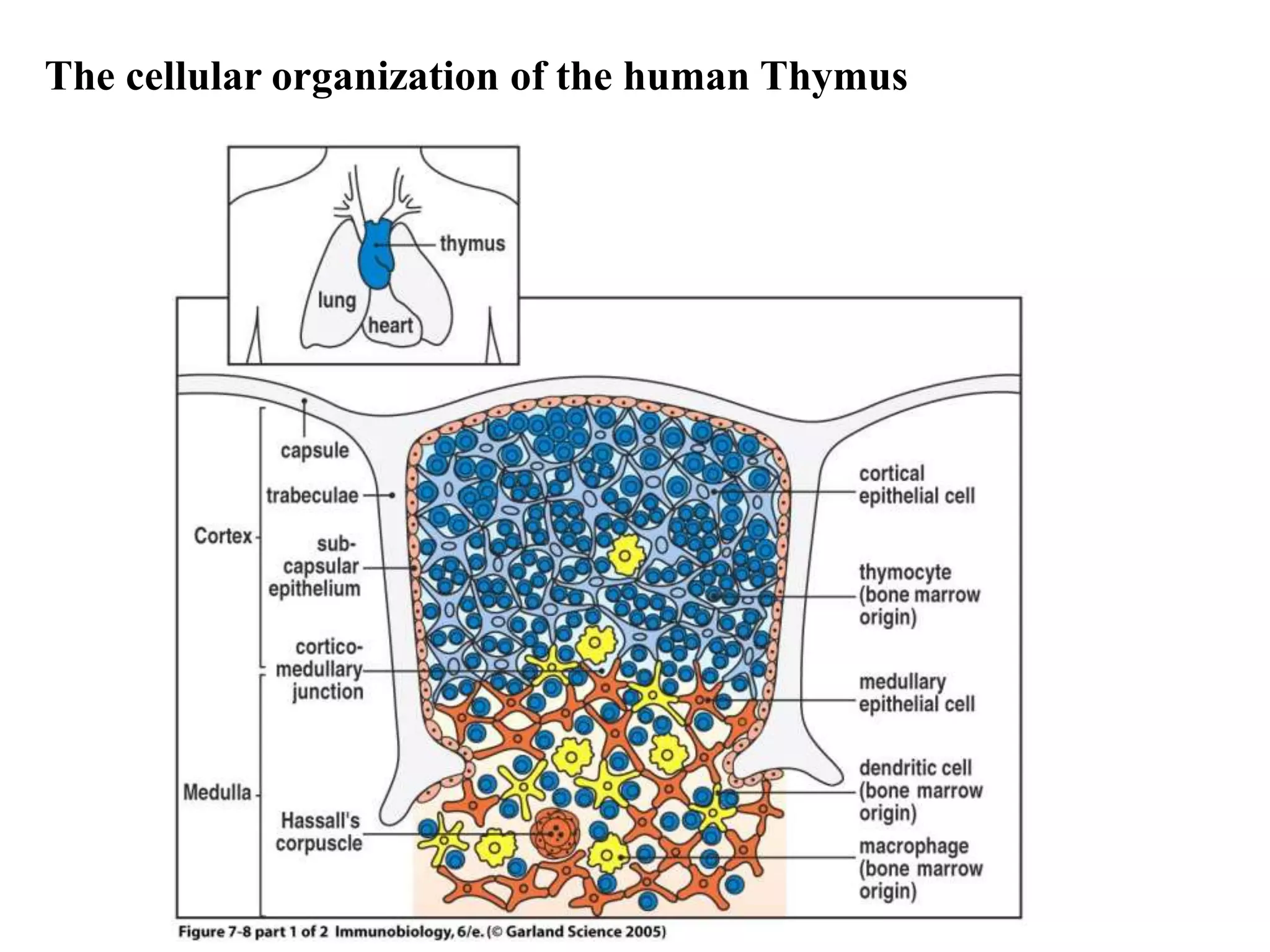
Figure 7-8 part 1 of 2
The cellular organization of the human Thymus
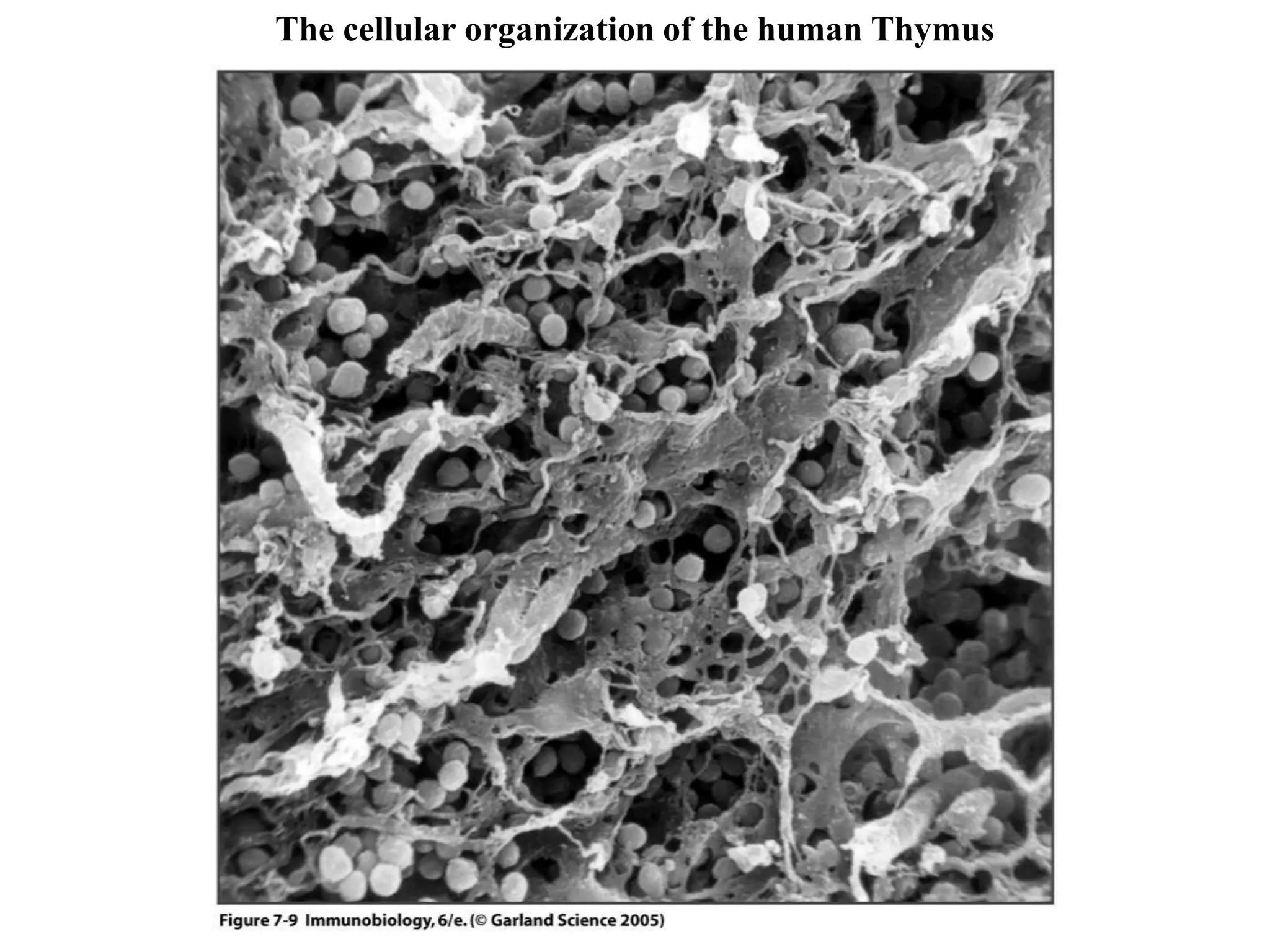
Figure 7-9
The cellular organization of the human Thymus
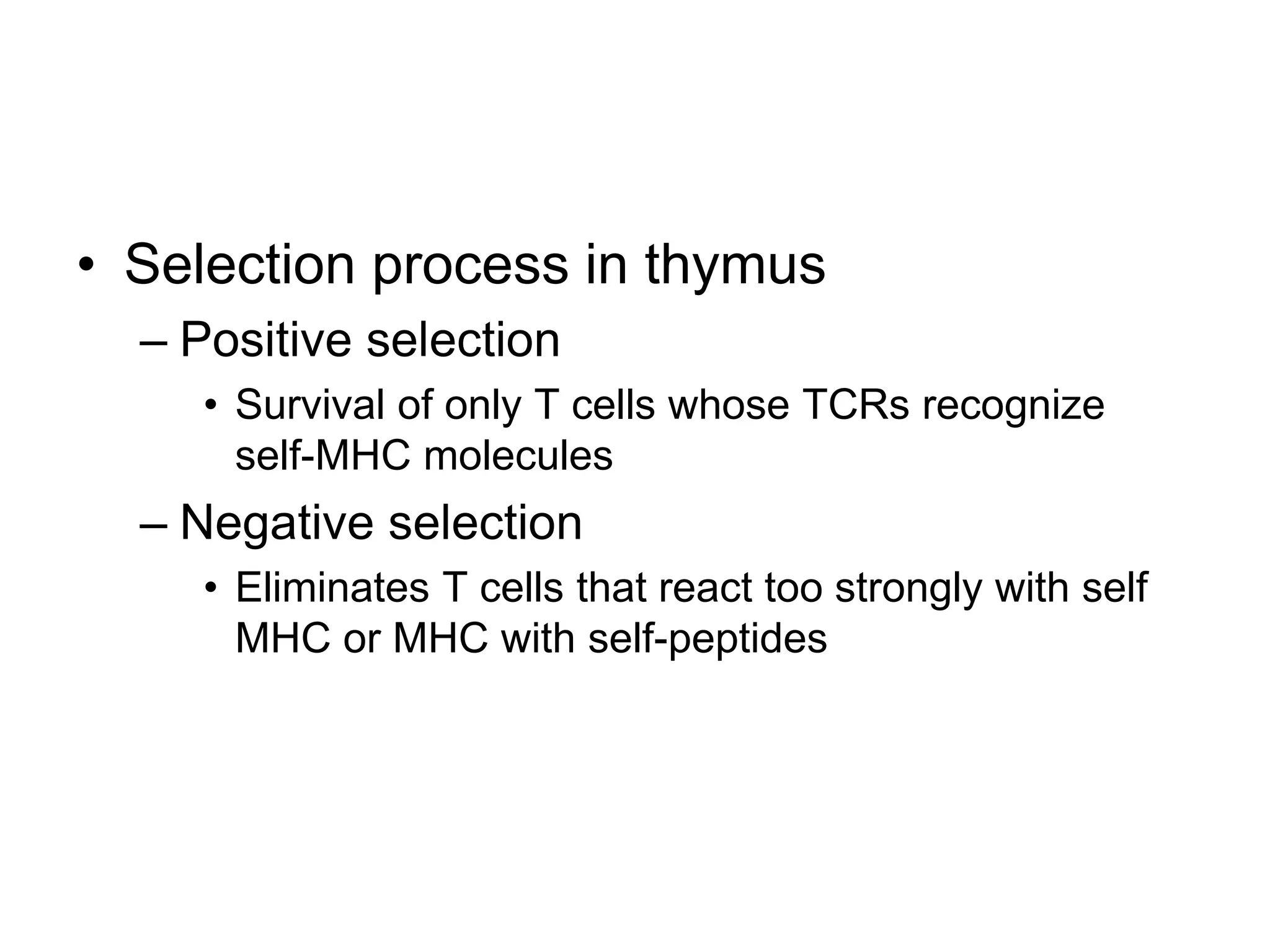
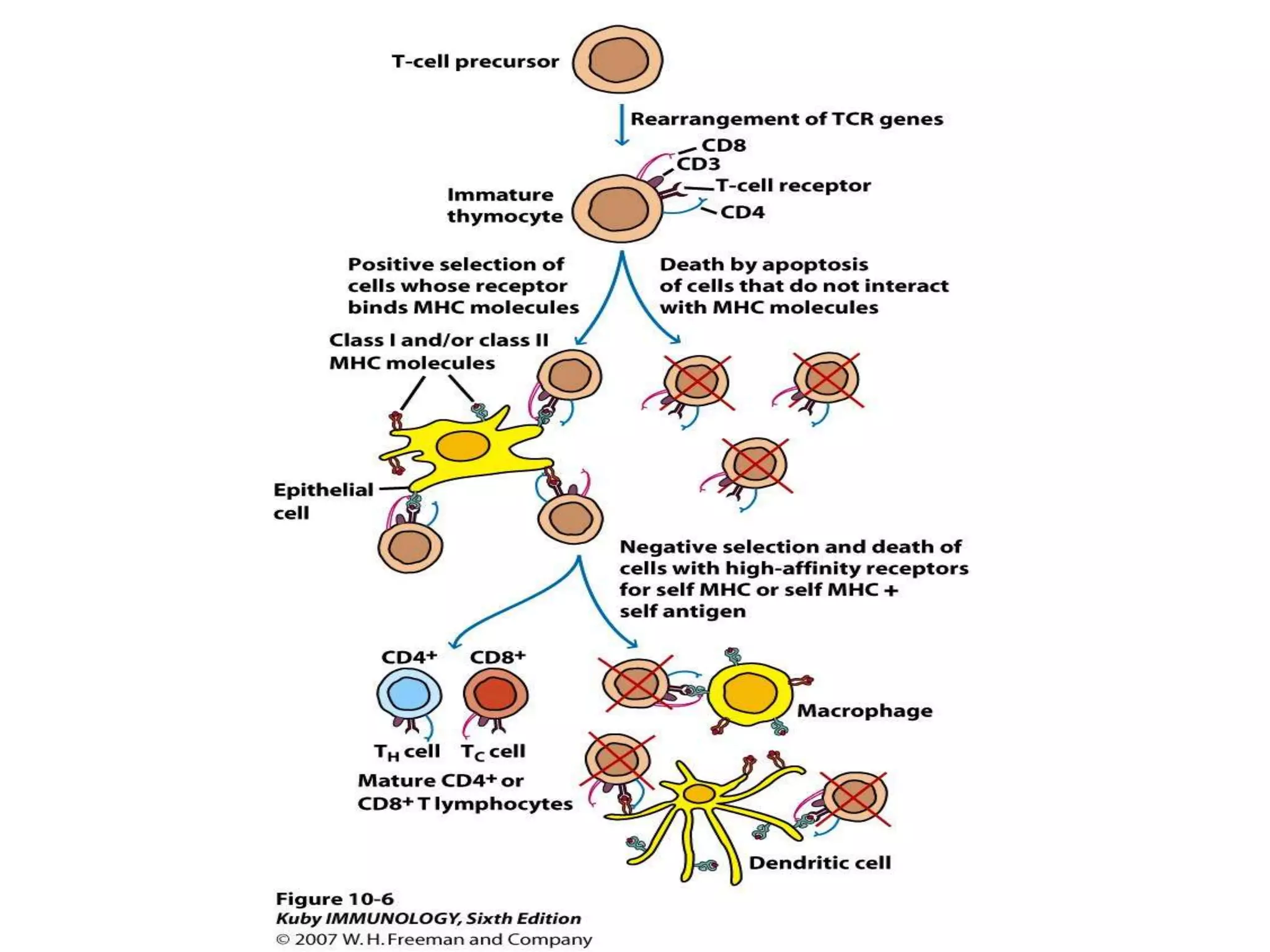
• Selection process in thymus
– Positive selection
• Survival of only T cells whose TCRs recognize
self-MHC molecules
– Negative selection
• Eliminates T cells that react too strongly with self
MHC or MHC with self-peptides
T-cell Development
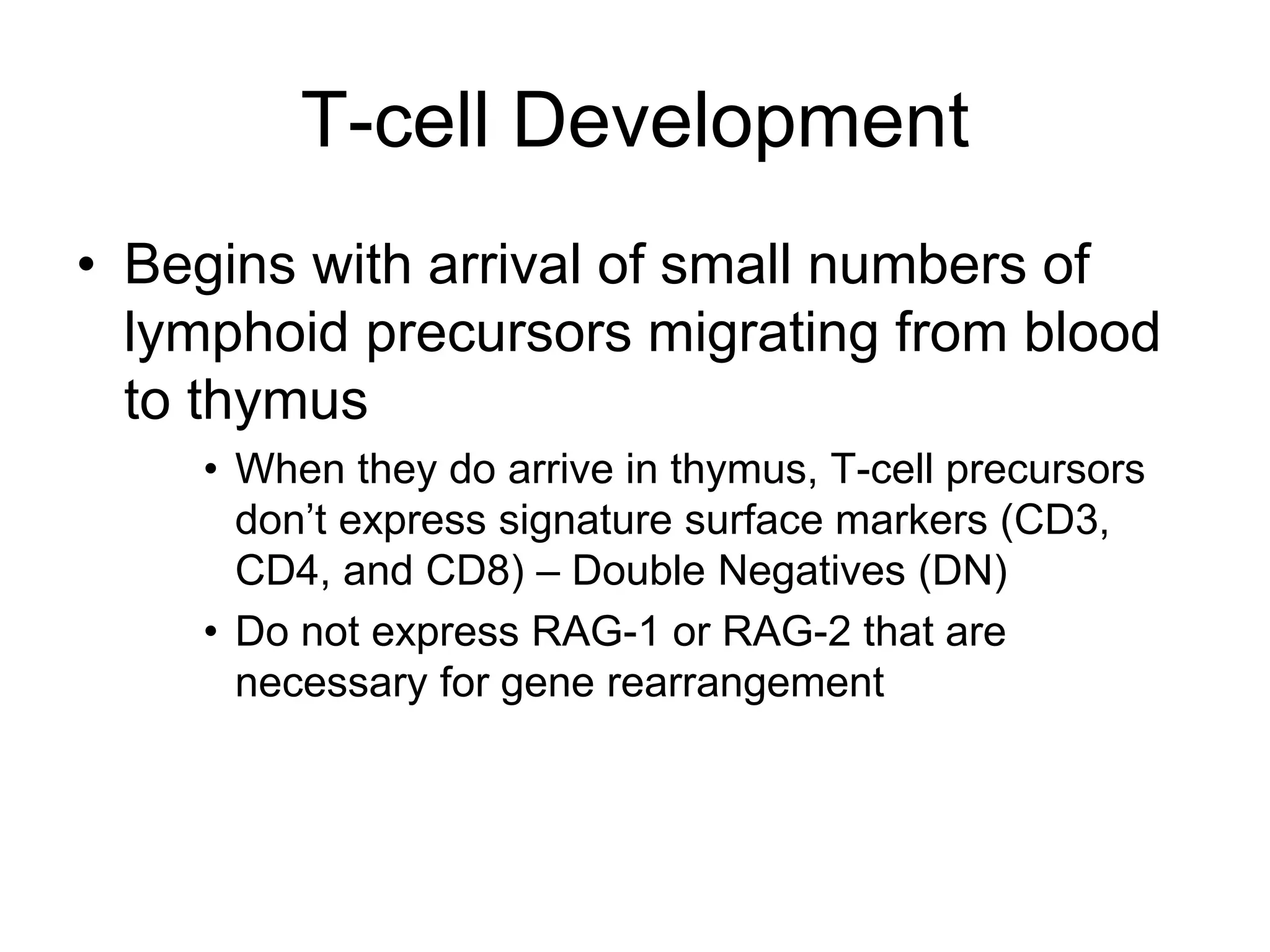
• Begins with arrival of small numbers of
lymphoid precursors migrating from blood
to thymus
• When they do arrive in thymus, T-cell precursors
don’t express signature surface markers (CD3,
CD4, and CD8) – Double Negatives (DN)
• Do not express RAG-1 or RAG-2 that are
necessary for gene rearrangement
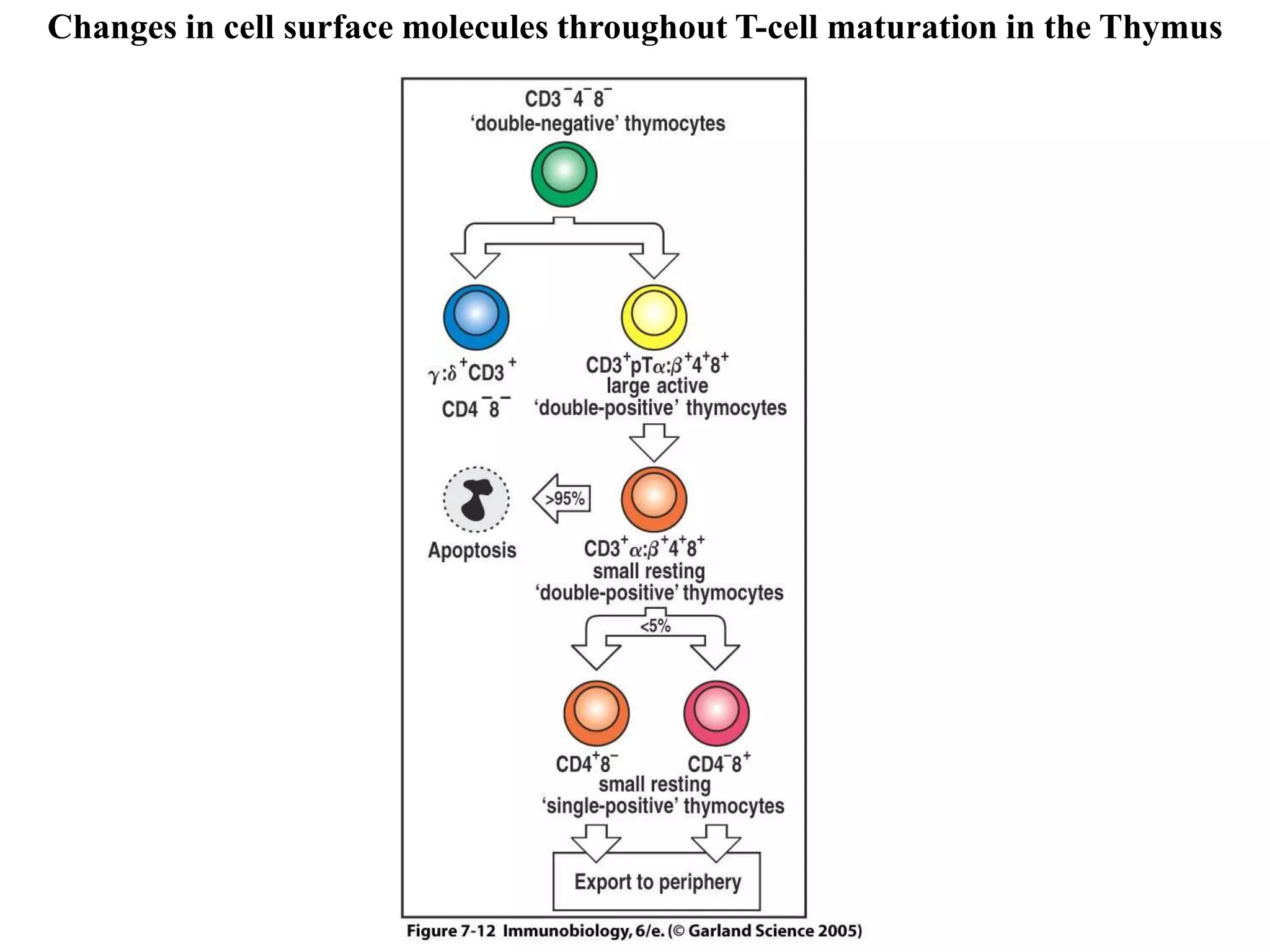
Figure 7-12
Changes in cell surface molecules throughout T-cell maturation in the Thymus
T-cell Development
• During 3 week development, differentiating
T cells pass through stages of
development based on surface
phenotypes
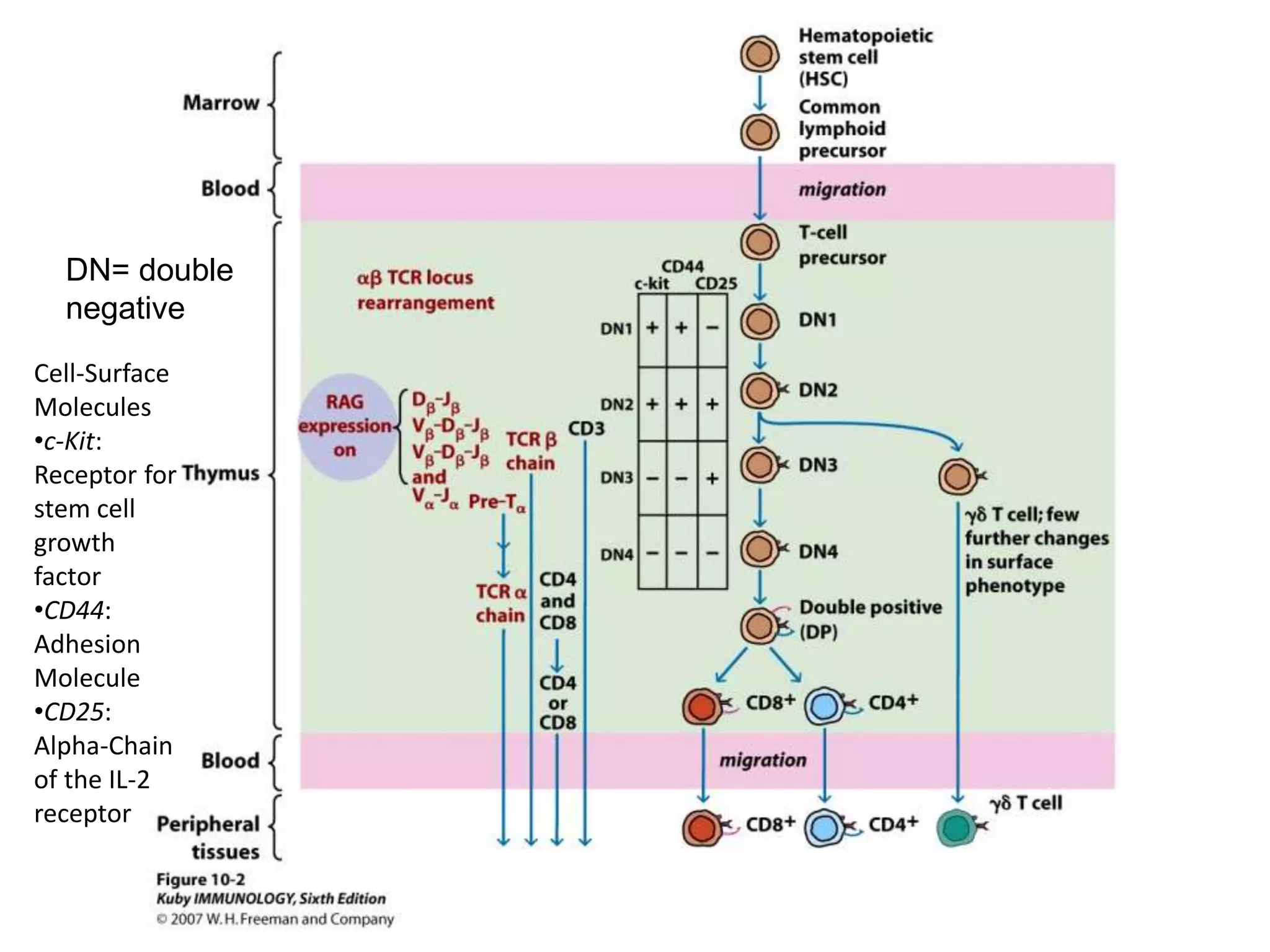
DN= double
negative
Cell-Surface
Molecules
•c-Kit:
Receptor for
stem cell
growth
factor
•CD44:
Adhesion
Molecule
•CD25:
Alpha-Chain
of the IL-2
receptor
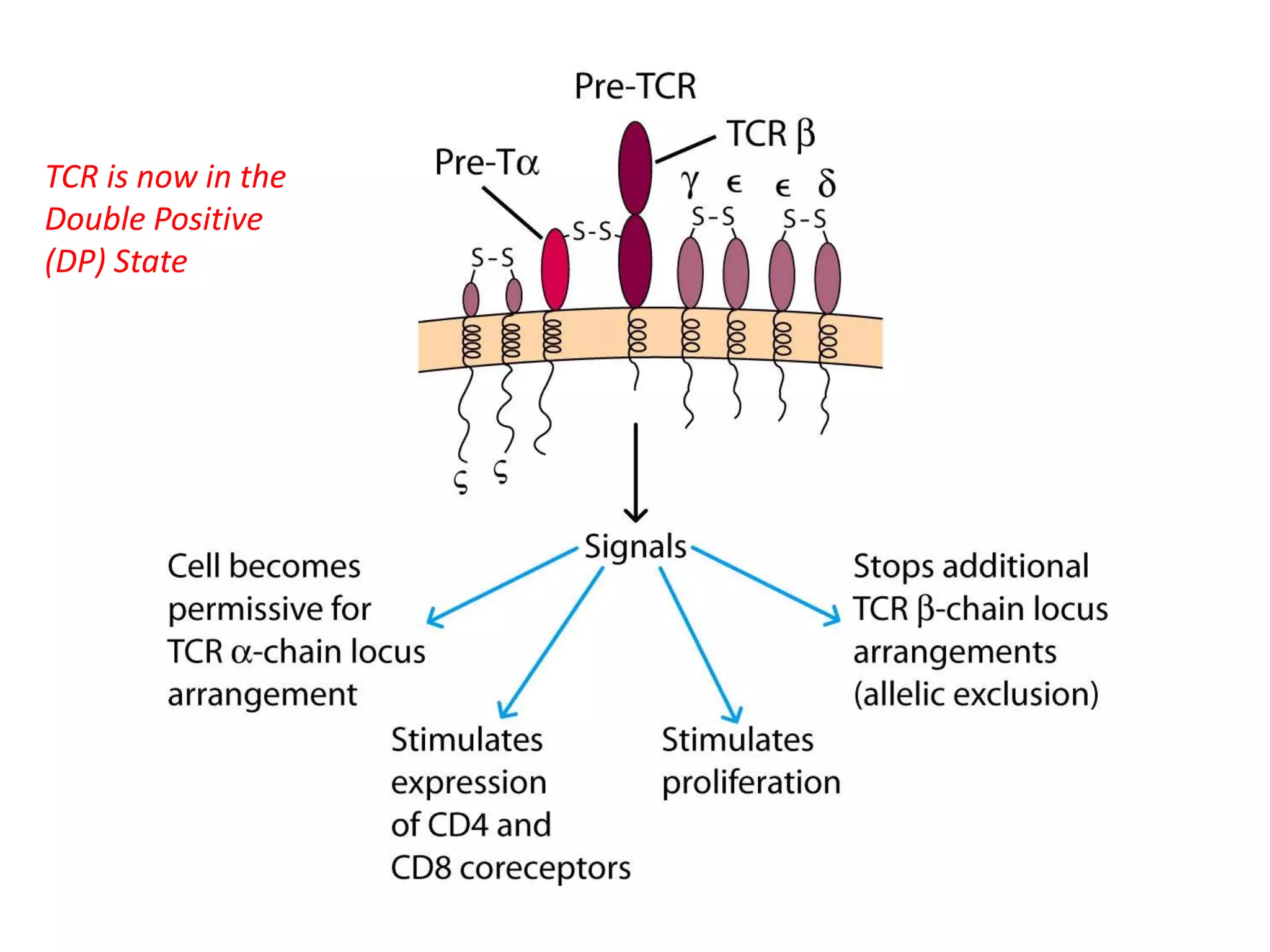
TCR is now in the
Double Positive
(DP) State
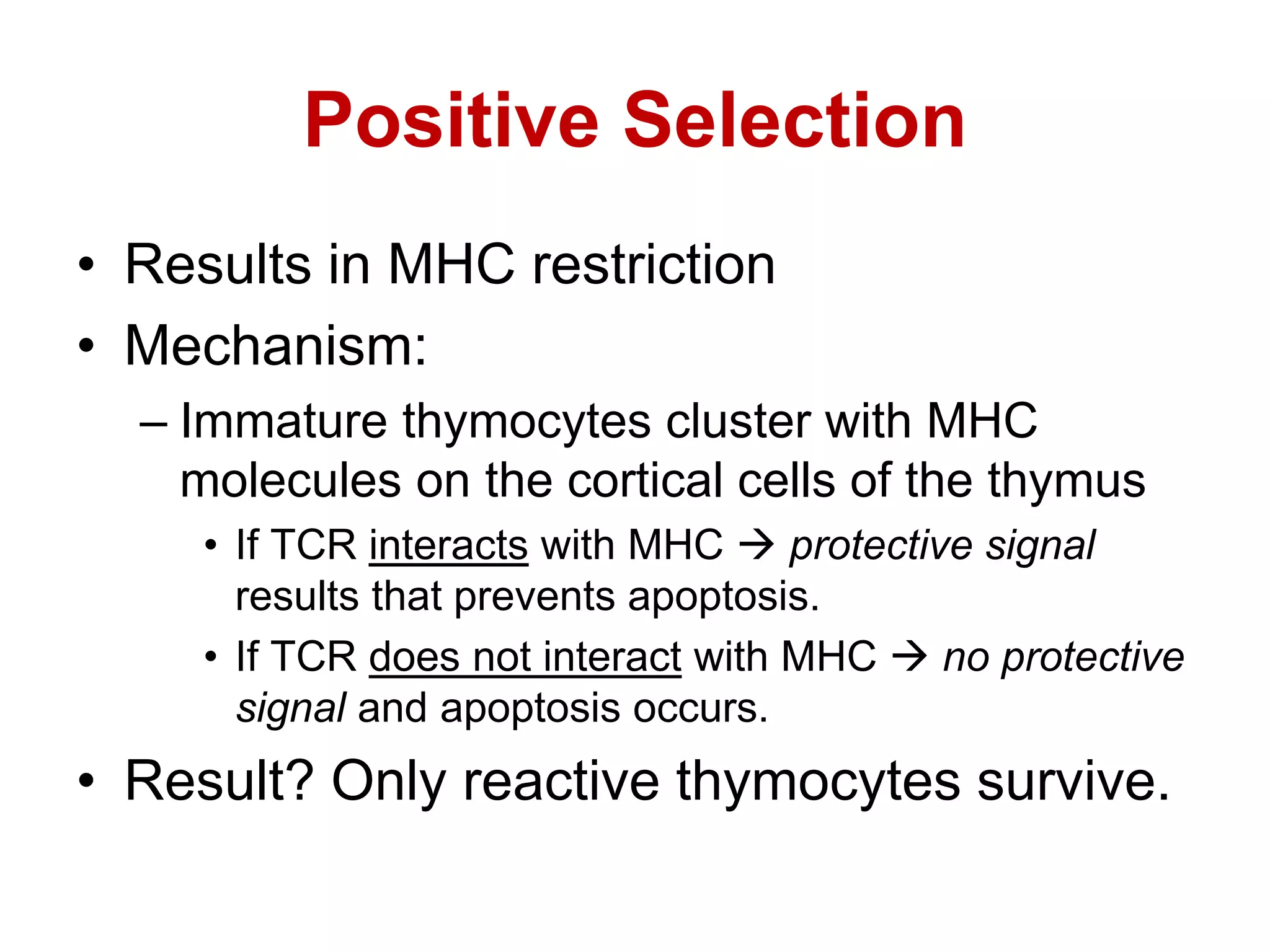
Positive Selection
• Results in MHC restriction
• Mechanism:
– Immature thymocytes cluster with MHC
molecules on the cortical cells of the thymus
• If TCR interacts with MHC  protective signal
results that prevents apoptosis.
• If TCR does not interact with MHC  no protective
signal and apoptosis occurs.
• Result? Only reactive thymocytes survive.
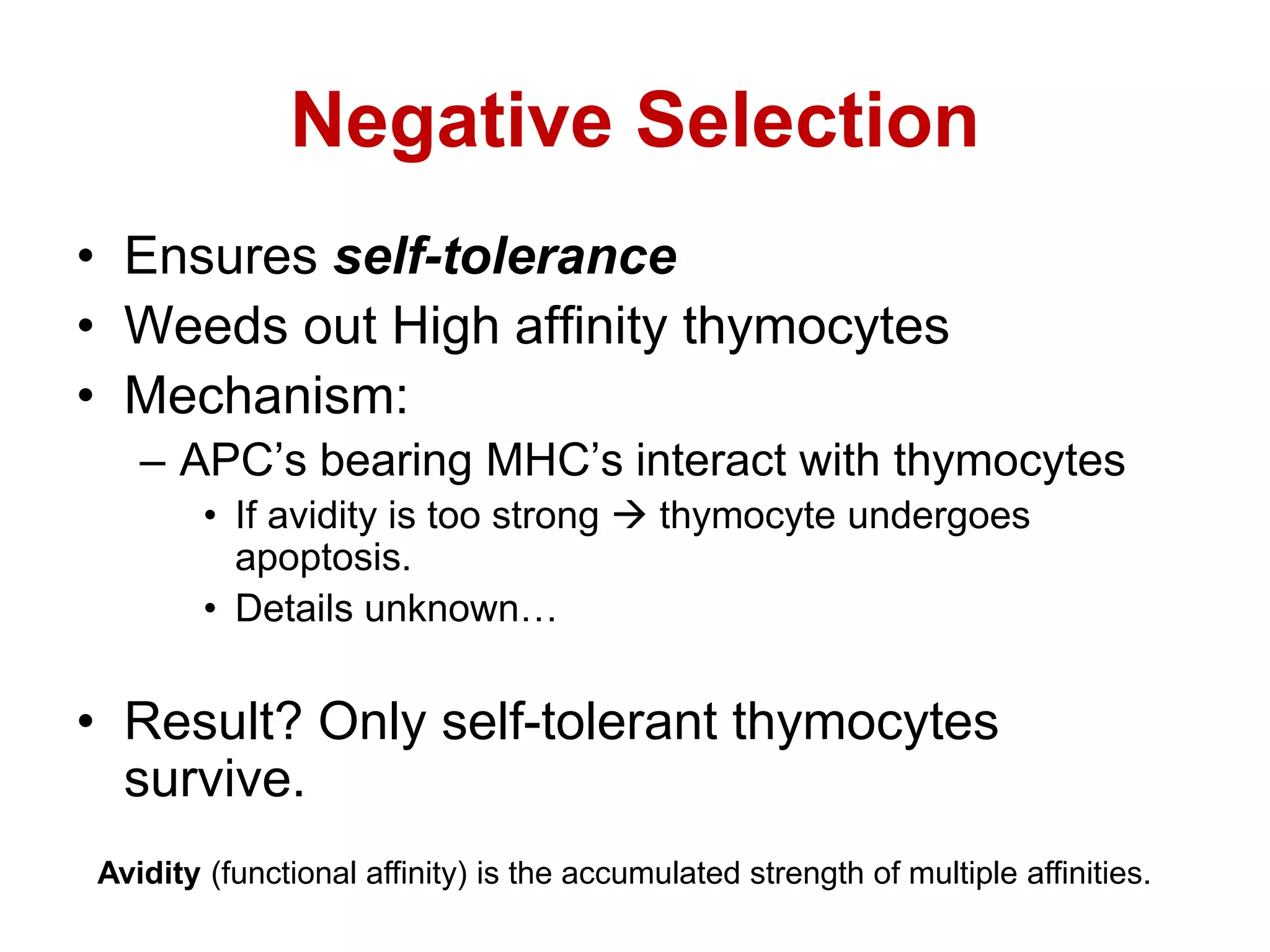
Negative Selection
• Ensures self-tolerance
• Weeds out High affinity thymocytes
• Mechanism:
– APC’s bearing MHC’s interact with thymocytes
• If avidity is too strong  thymocyte undergoes
apoptosis.
• Details unknown…
• Result? Only self-tolerant thymocytes
survive.
Avidity (functional affinity) is the accumulated strength of multiple affinities.
• T cell development is expensive for host
• 98% of all thymocytes do not mature, die by
apoptosis within thymus
T cell Activation
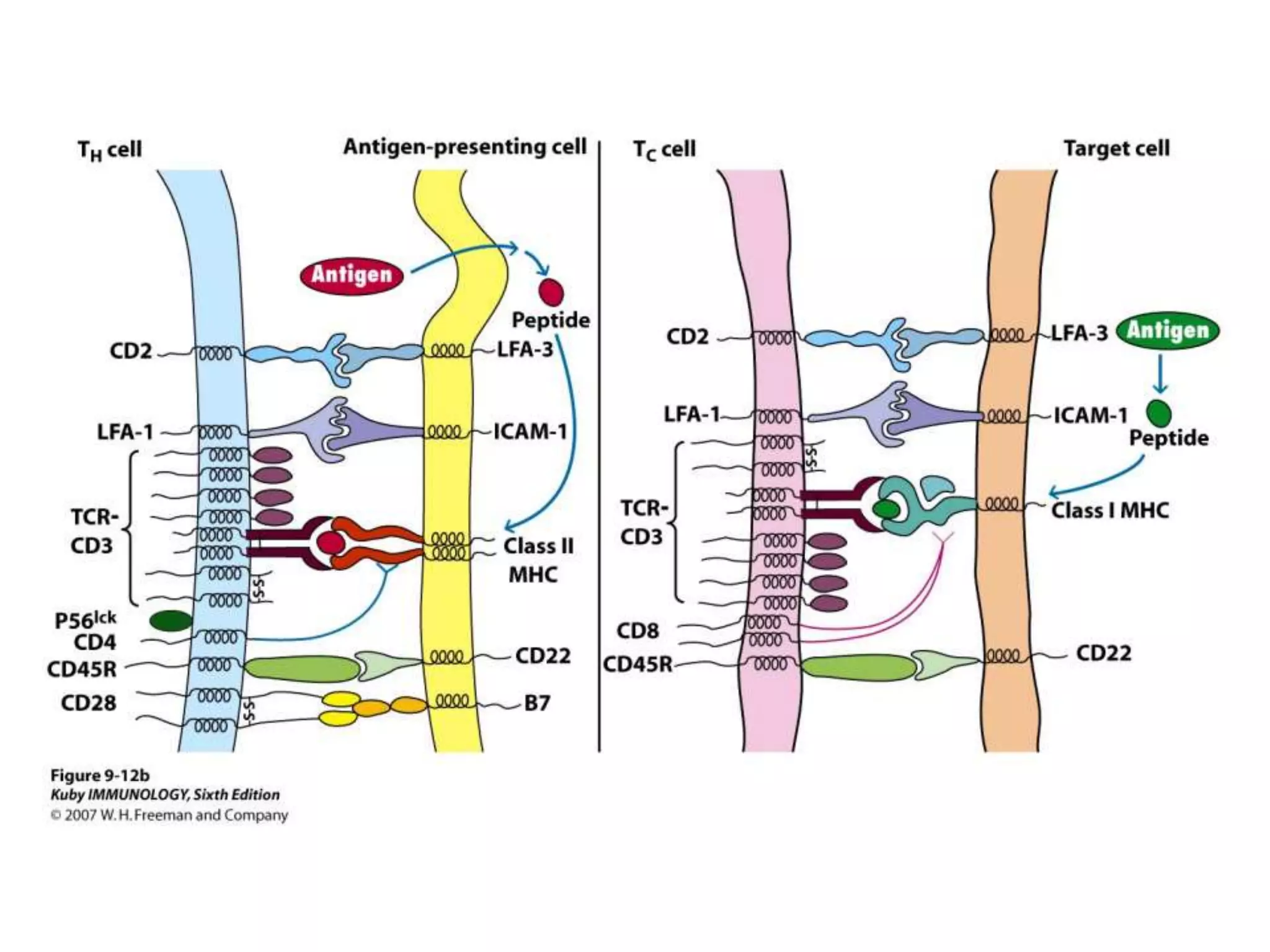
• Initiated by TCR-CD3 complex with
processed antigen on MHC molecule
• CD8+ cells with Class I
• CD4+ cells with Class II
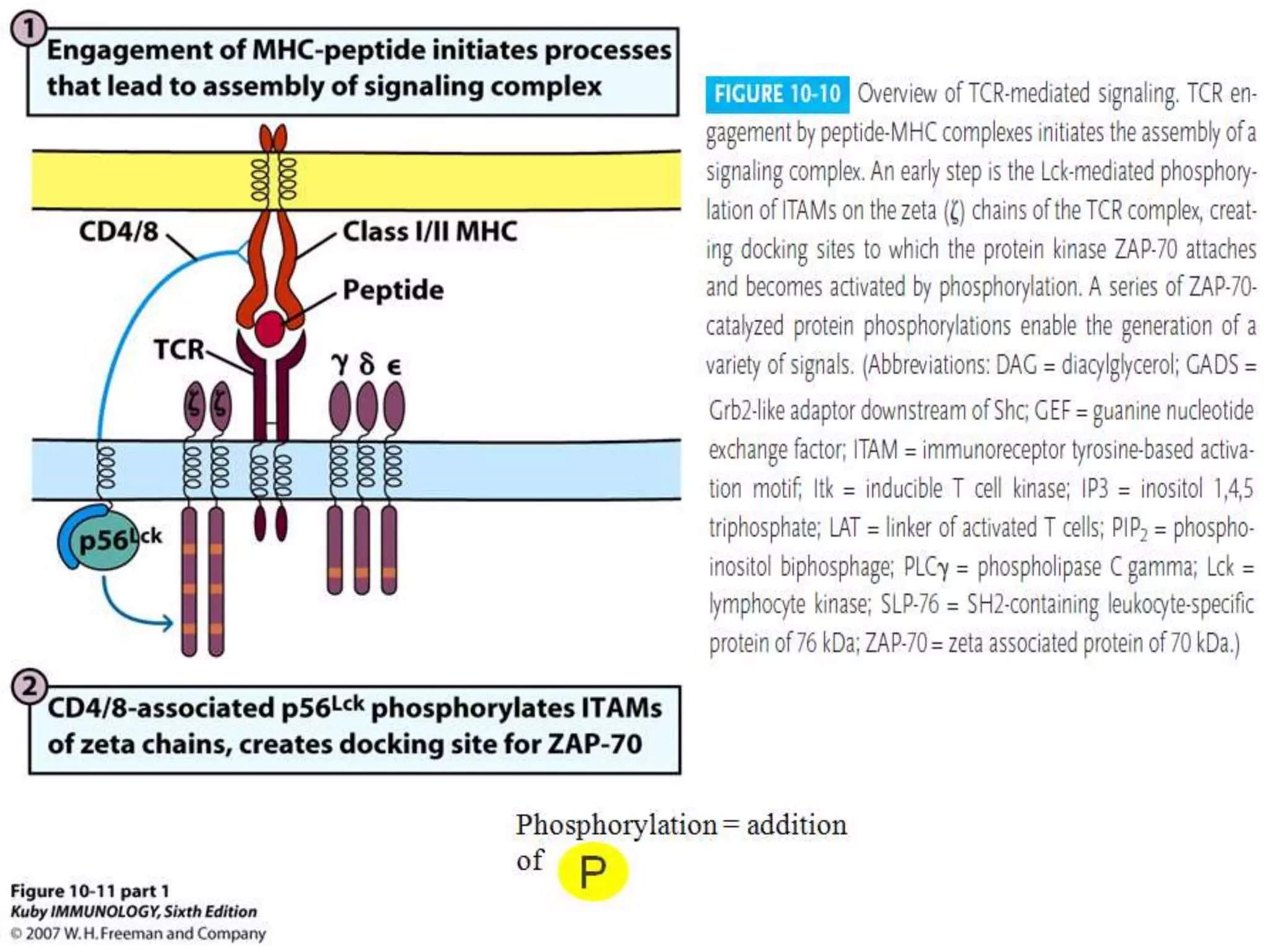
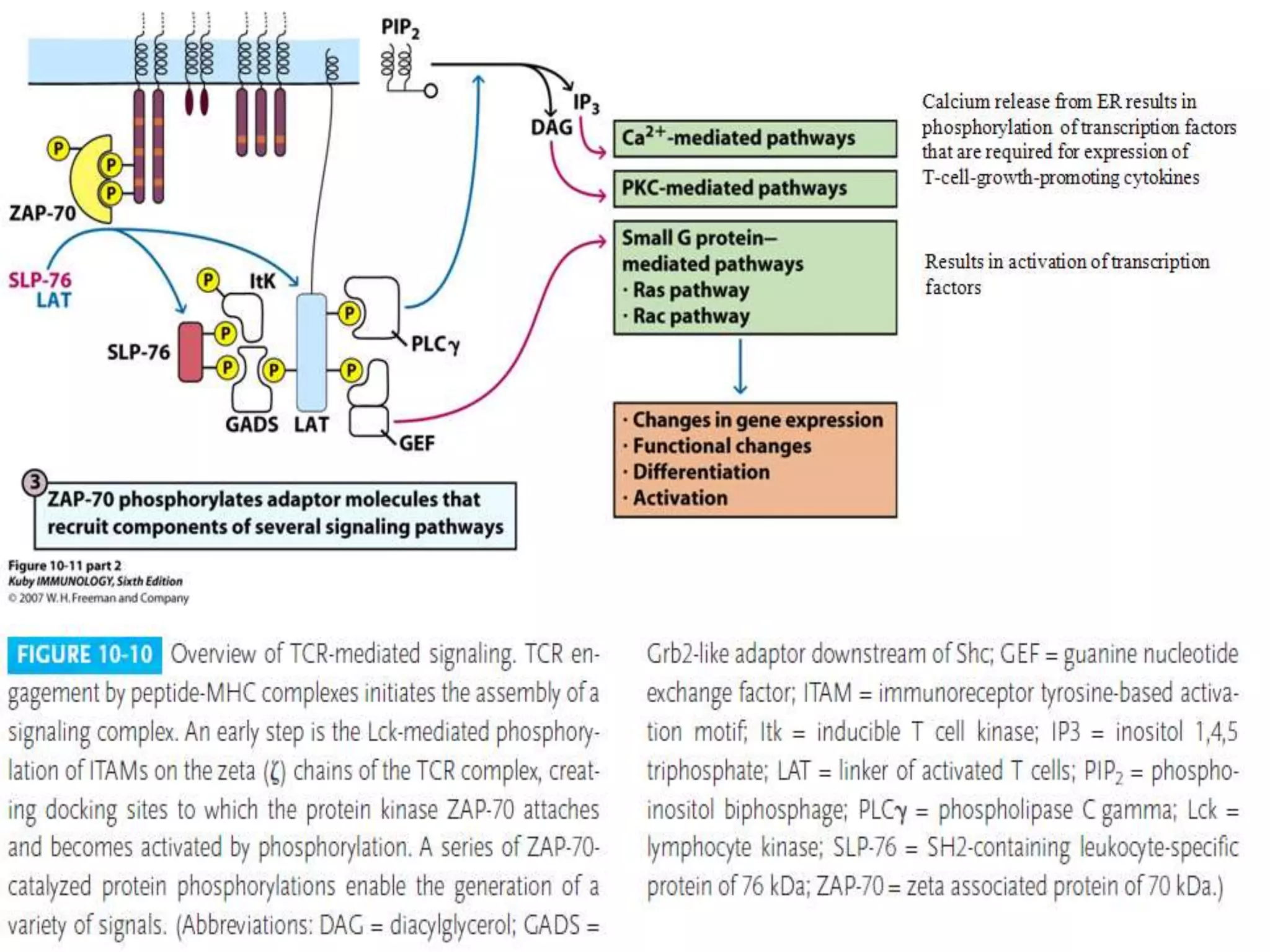
• Initiates cascade of biochemical events
• Inducing resting T cell to enter cell cycle,
proliferate, differentiate into memory and effector T
cells
T cell Activation
• Cascade of biochemical events leading to
gene expression:
– Interaction of signal and molecule (example:
TCR + MHC and antigen)
– Generation of “second messenger” that
diffuses to other areas of cell
– Protein kinases and protein phosphatases are
activated or inhibitied
– Signals are amplified by enzyme cascades
T cell Activation
• Gene products after activation
• Immediate genes (1/2 hour of recognition)
– Transcription factors (c-Myc, NFAT, NF-κB)
• Early genes (1-2 hours from recognition)
– IL-2, IL2R, IL-6, IFN-γ
• Late genes (more than 2 days later)
– Encode adhesion molecules
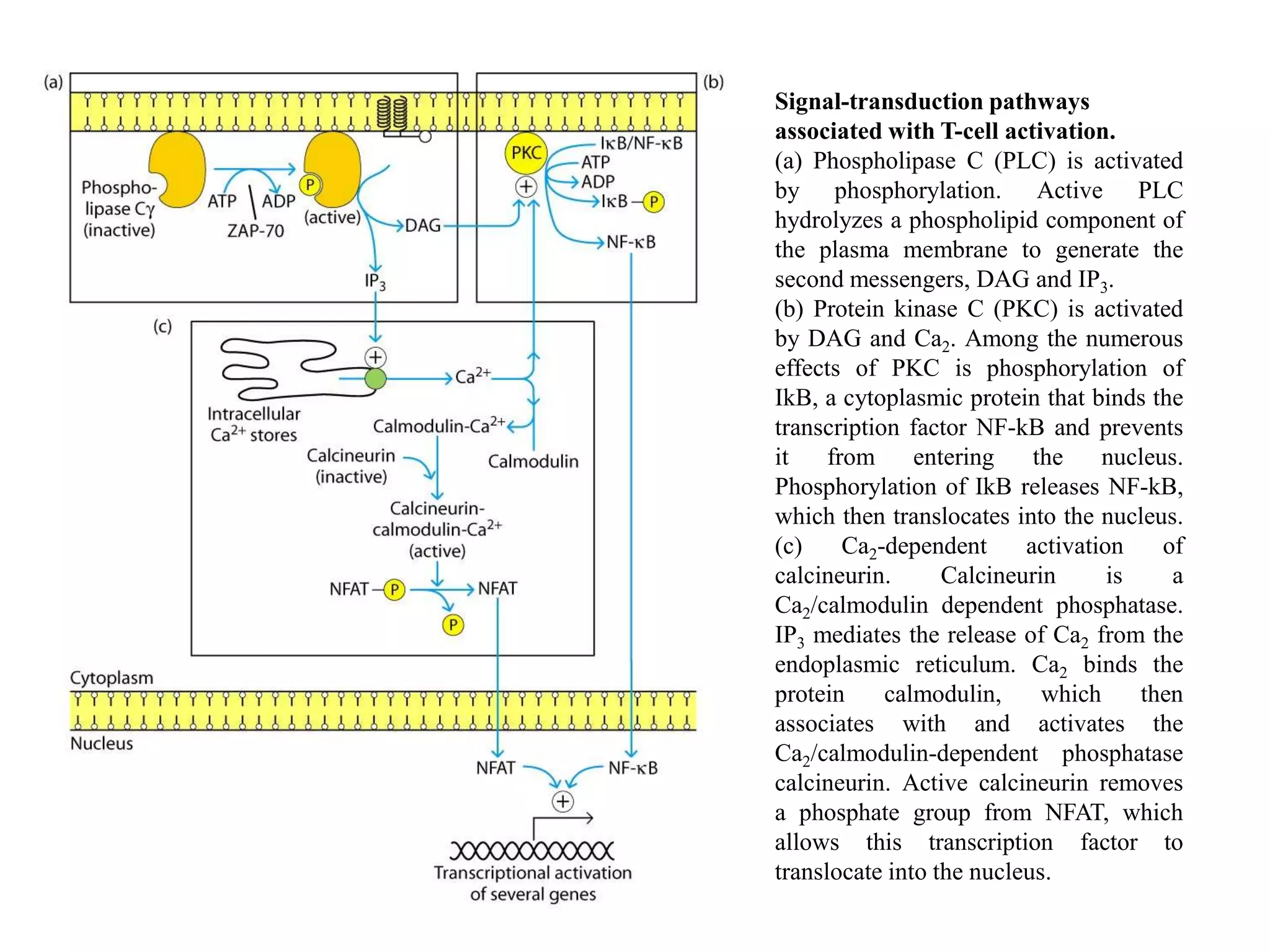
Signal-transduction pathways
associated with T-cell activation.
(a) Phospholipase C (PLC) is activated
by phosphorylation. Active PLC
hydrolyzes a phospholipid component of
the plasma membrane to generate the
second messengers, DAG and IP3.
(b) Protein kinase C (PKC) is activated
by DAG and Ca2. Among the numerous
effects of PKC is phosphorylation of
IkB, a cytoplasmic protein that binds the
transcription factor NF-kB and prevents
it from entering the nucleus.
Phosphorylation of IkB releases NF-kB,
which then translocates into the nucleus.
(c) Ca2-dependent activation of
calcineurin. Calcineurin is a
Ca2/calmodulin dependent phosphatase.
IP3 mediates the release of Ca2 from the
endoplasmic reticulum. Ca2 binds the
protein calmodulin, which then
associates with and activates the
Ca2/calmodulin-dependent phosphatase
calcineurin. Active calcineurin removes
a phosphate group from NFAT, which
allows this transcription factor to
translocate into the nucleus.
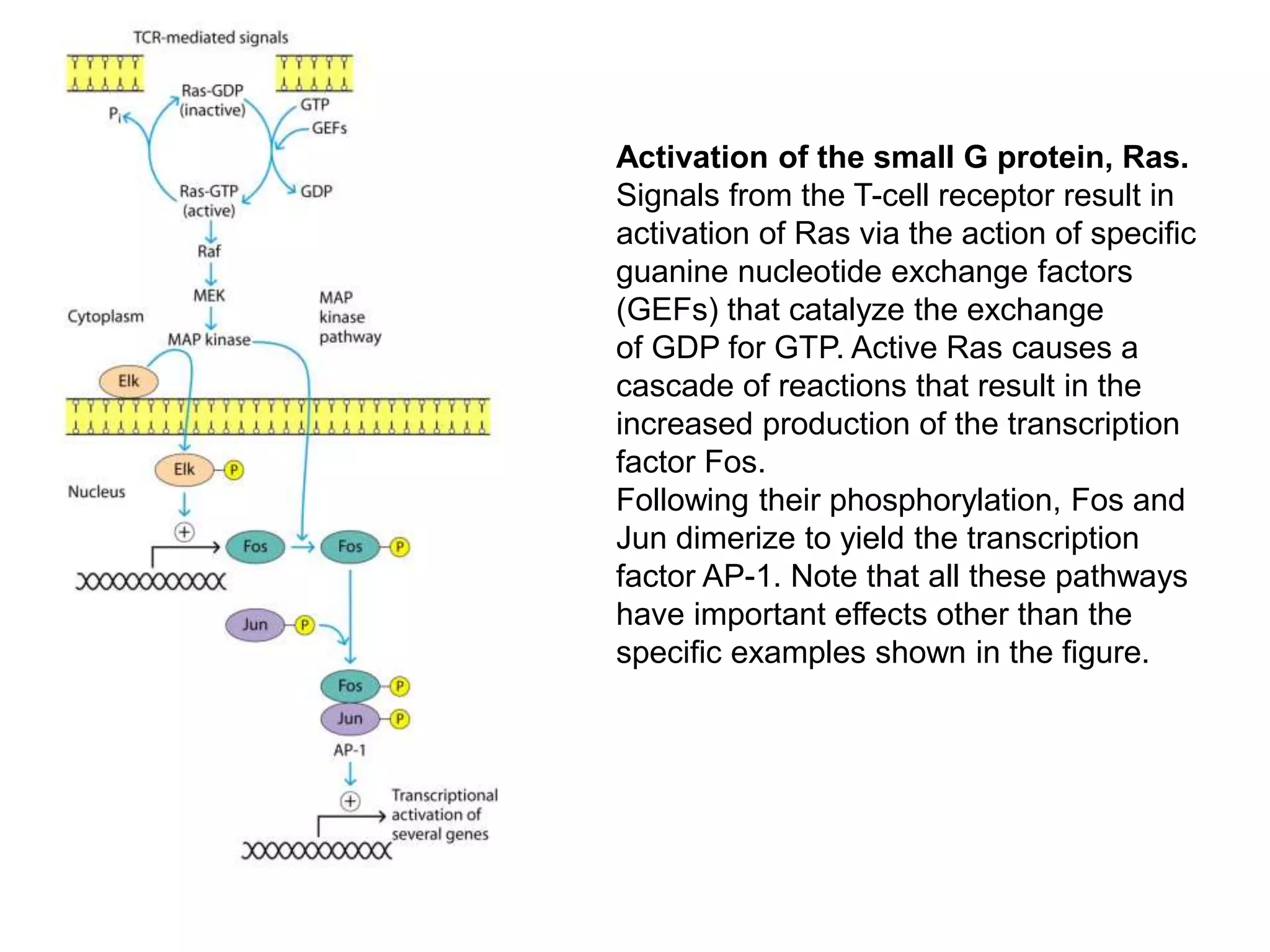
Activation of the small G protein, Ras.
Signals from the T-cell receptor result in
activation of Ras via the action of specific
guanine nucleotide exchange factors
(GEFs) that catalyze the exchange
of GDP for GTP. Active Ras causes a
cascade of reactions that result in the
increased production of the transcription
factor Fos.
Following their phosphorylation, Fos and
Jun dimerize to yield the transcription
factor AP-1. Note that all these pathways
have important effects other than the
specific examples shown in the figure.
Chokingly complex- what to
remember
• Importance of CD3
• Phosphorylation activates proteins
• Cascade
• G proteins,
• 2nd messengers
• Gene activation
• Ongoing proliferation- IL2 and its receptor.
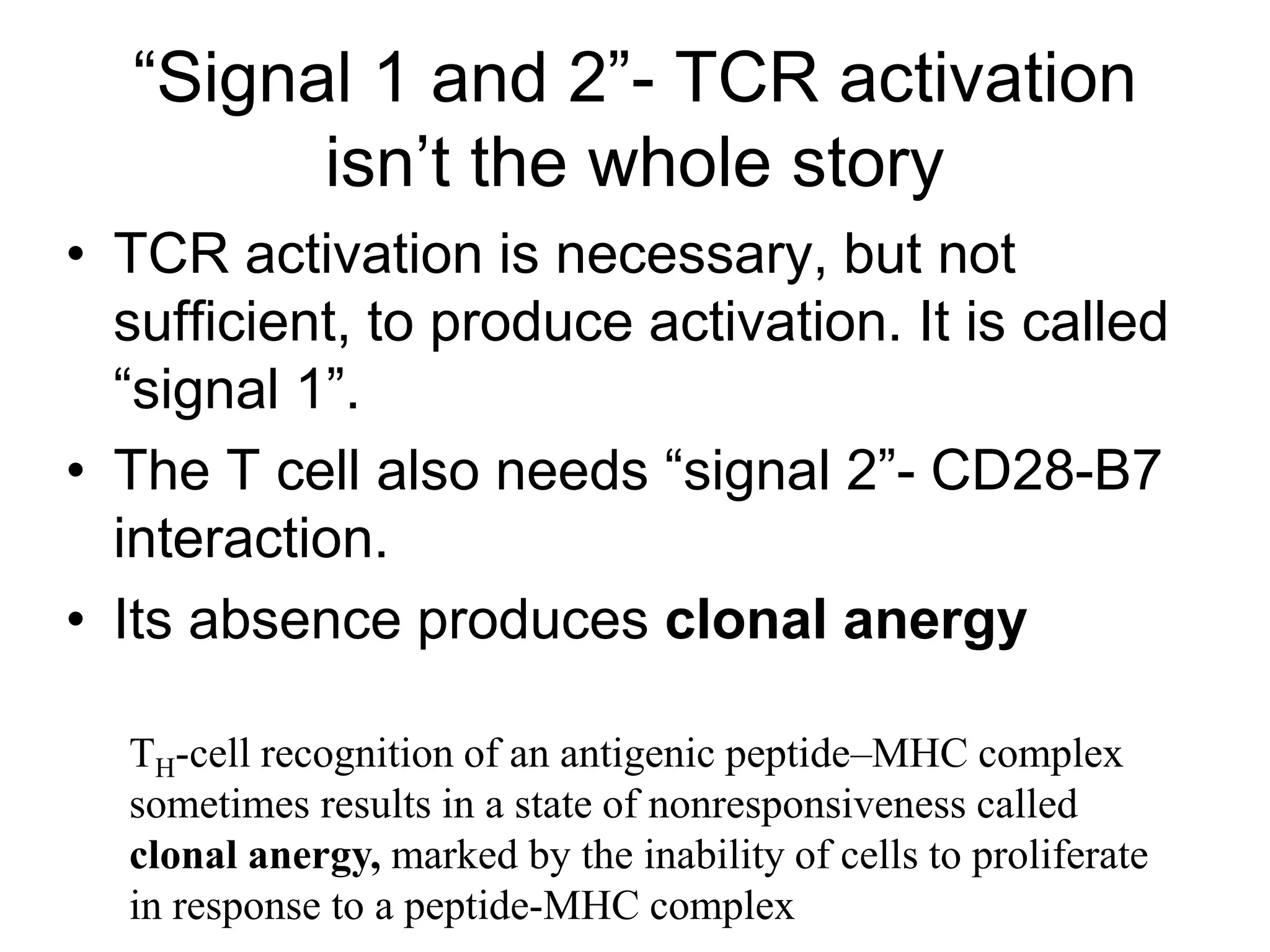
“Signal 1 and 2”- TCR activation
isn’t the whole story
• TCR activation is necessary, but not
sufficient, to produce activation. It is called
“signal 1”.
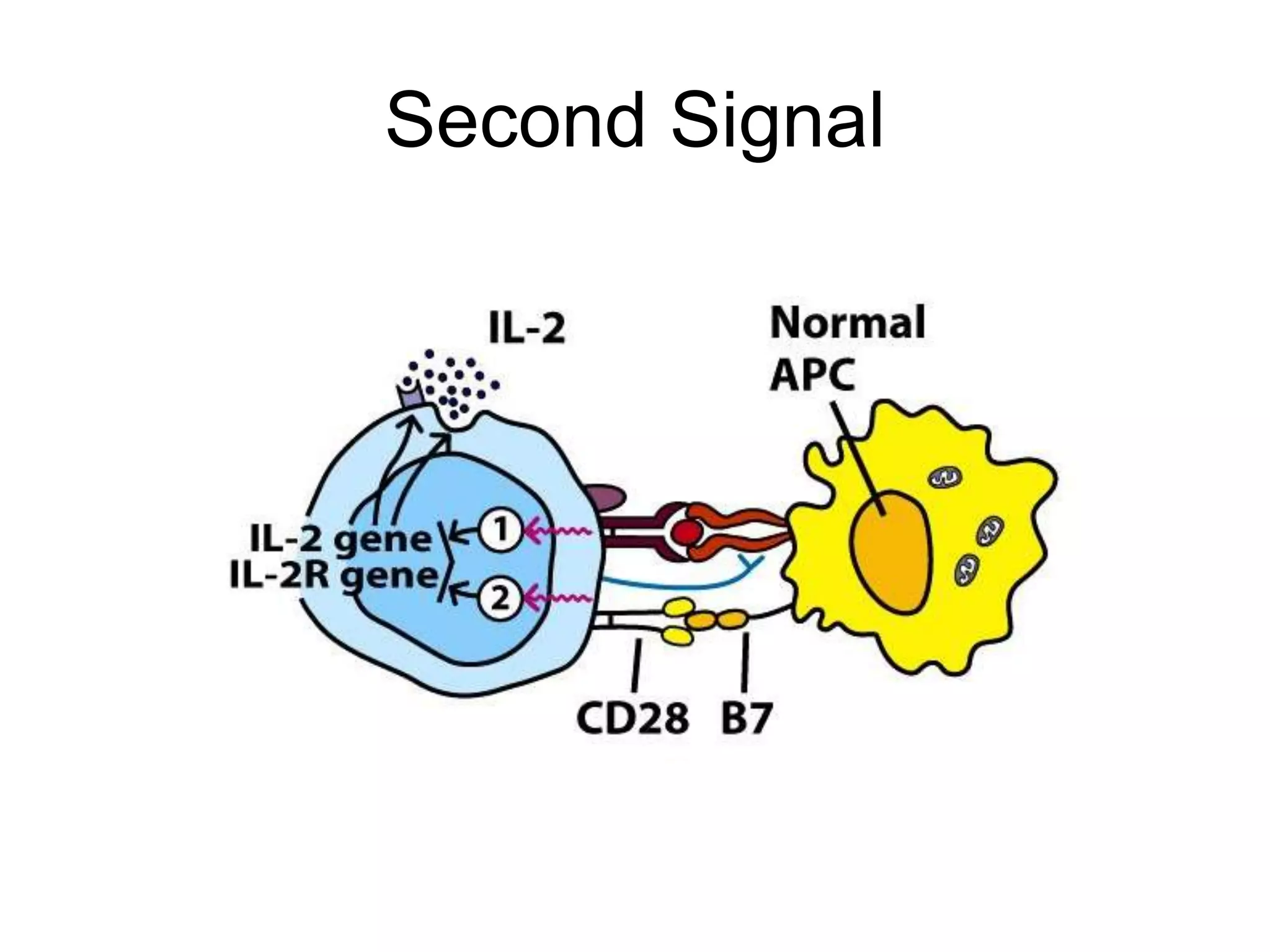
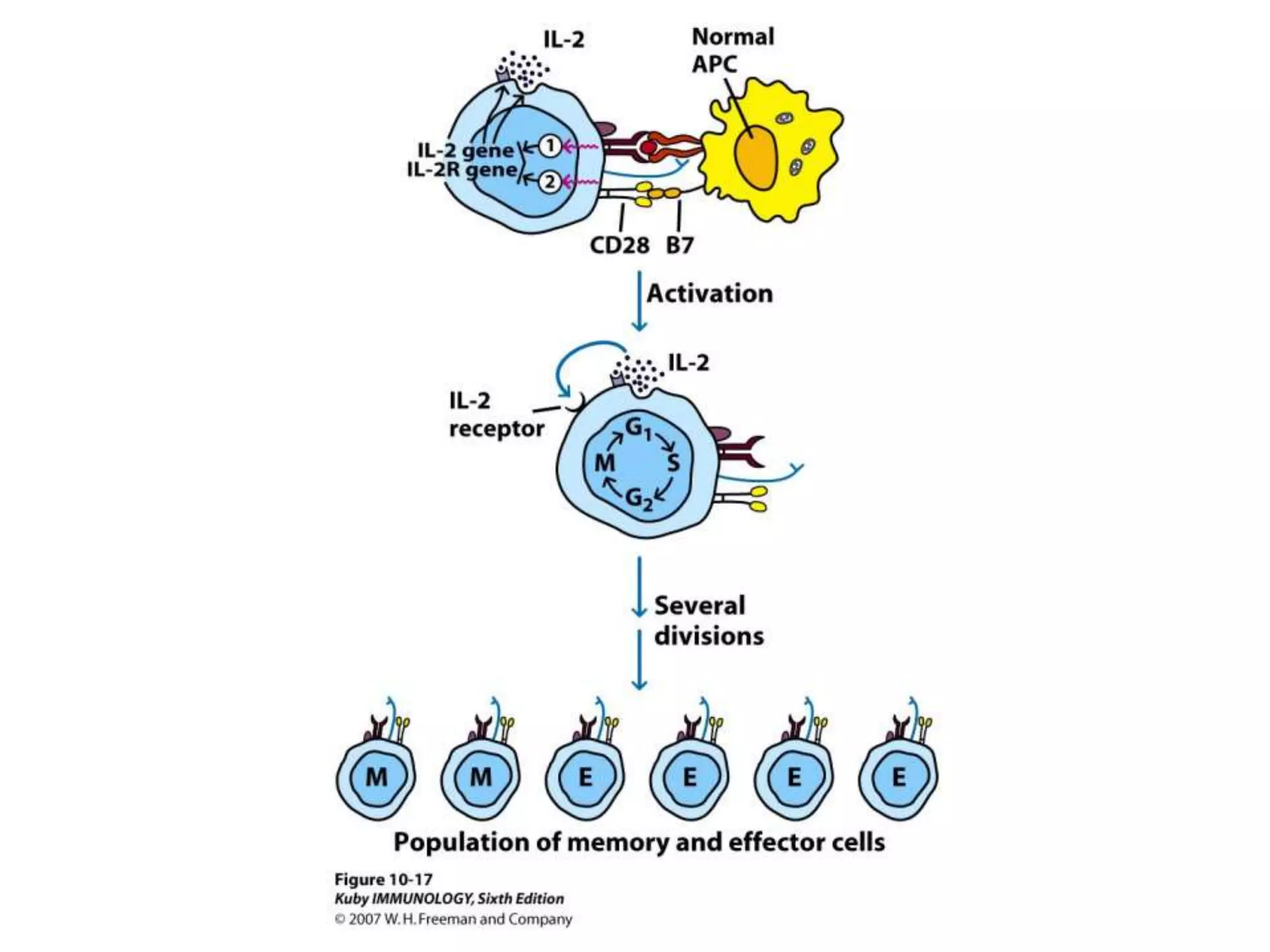
• The T cell also needs “signal 2”- CD28-B7
interaction.
• Its absence produces clonal anergy
TH-cell recognition of an antigenic peptide–MHC complex
sometimes results in a state of nonresponsiveness called
clonal anergy, marked by the inability of cells to proliferate
in response to a peptide-MHC complex
Second Signal
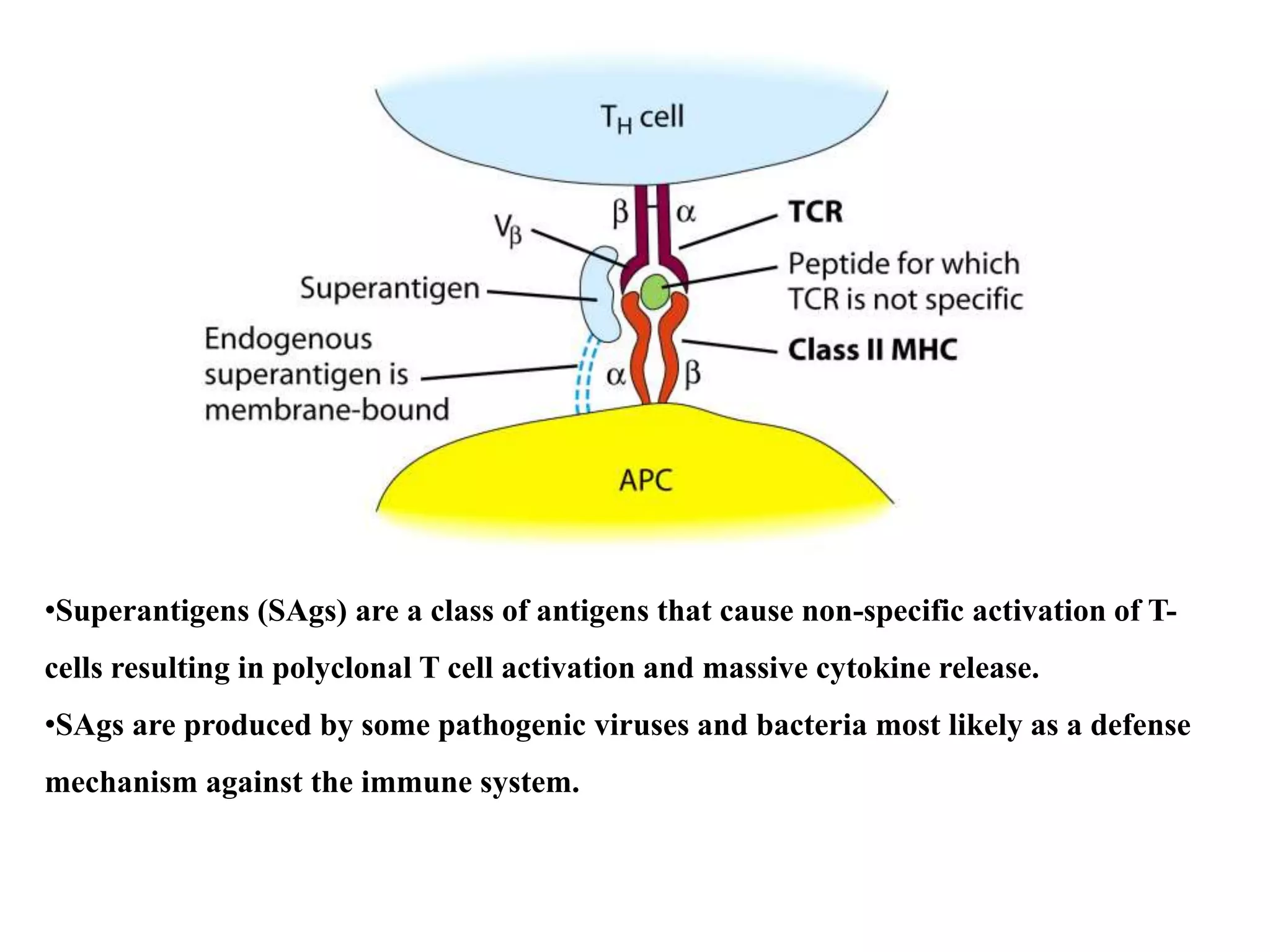
•Superantigens (SAgs) are a class of antigens that cause non-specific activation of T-
cells resulting in polyclonal T cell activation and massive cytokine release.
•SAgs are produced by some pathogenic viruses and bacteria most likely as a defense
mechanism against the immune system.
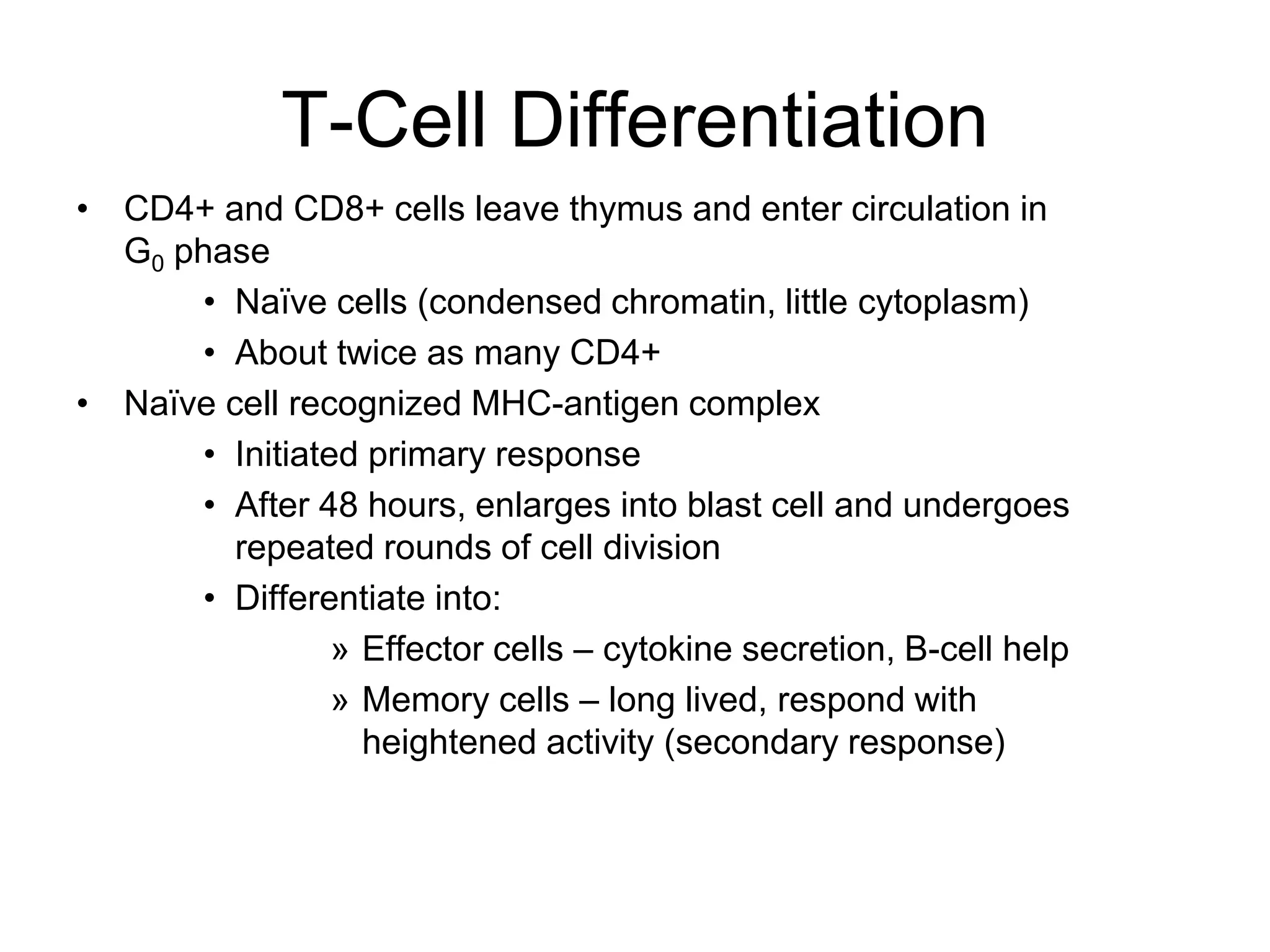
T-Cell Differentiation
• CD4+ and CD8+ cells leave thymus and enter circulation in
G0 phase
• Naïve cells (condensed chromatin, little cytoplasm)
• About twice as many CD4+
• Naïve cell recognized MHC-antigen complex
• Initiated primary response
• After 48 hours, enlarges into blast cell and undergoes
repeated rounds of cell division
• Differentiate into:
» Effector cells – cytokine secretion, B-cell help
» Memory cells – long lived, respond with
heightened activity (secondary response)
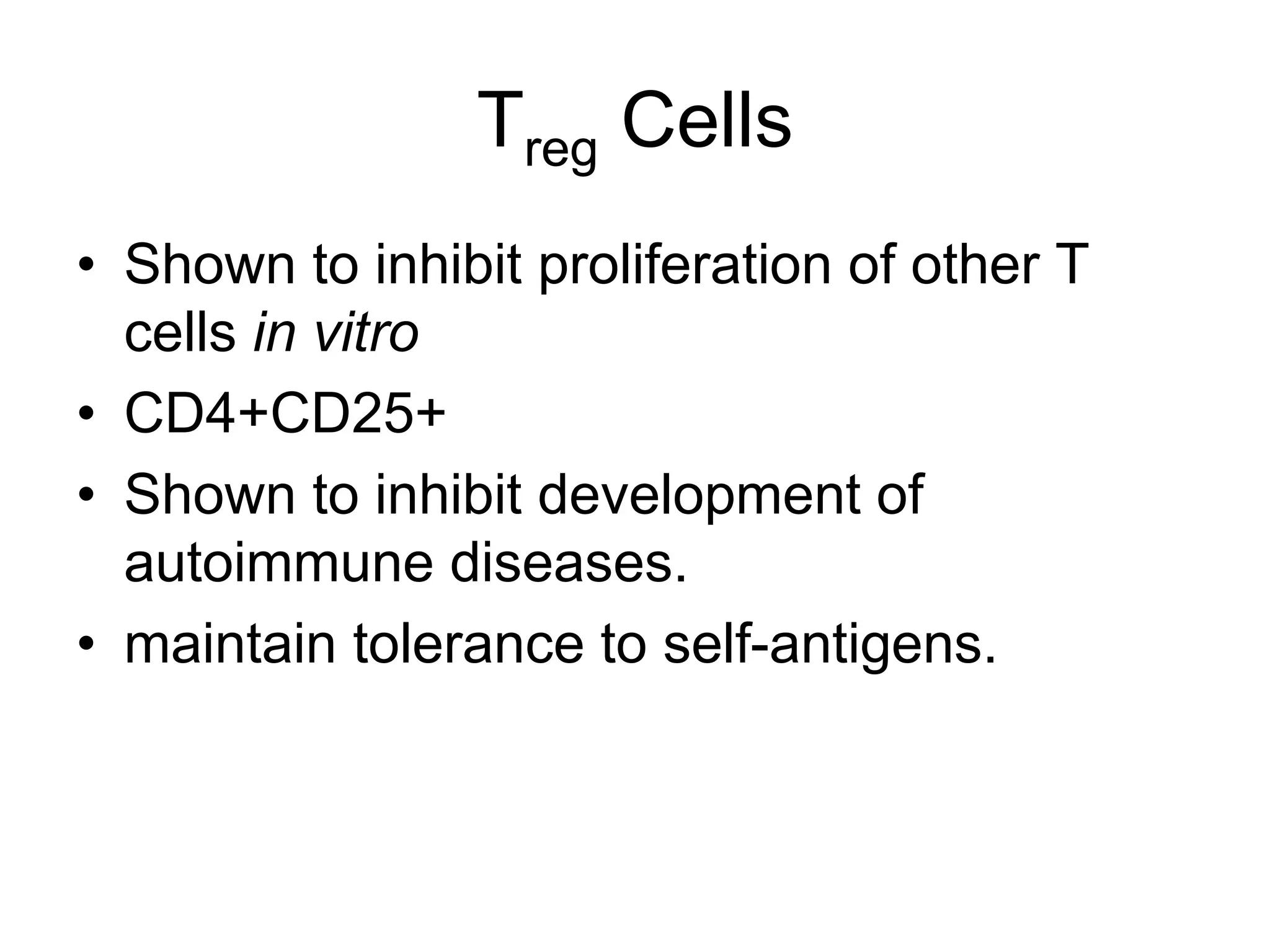
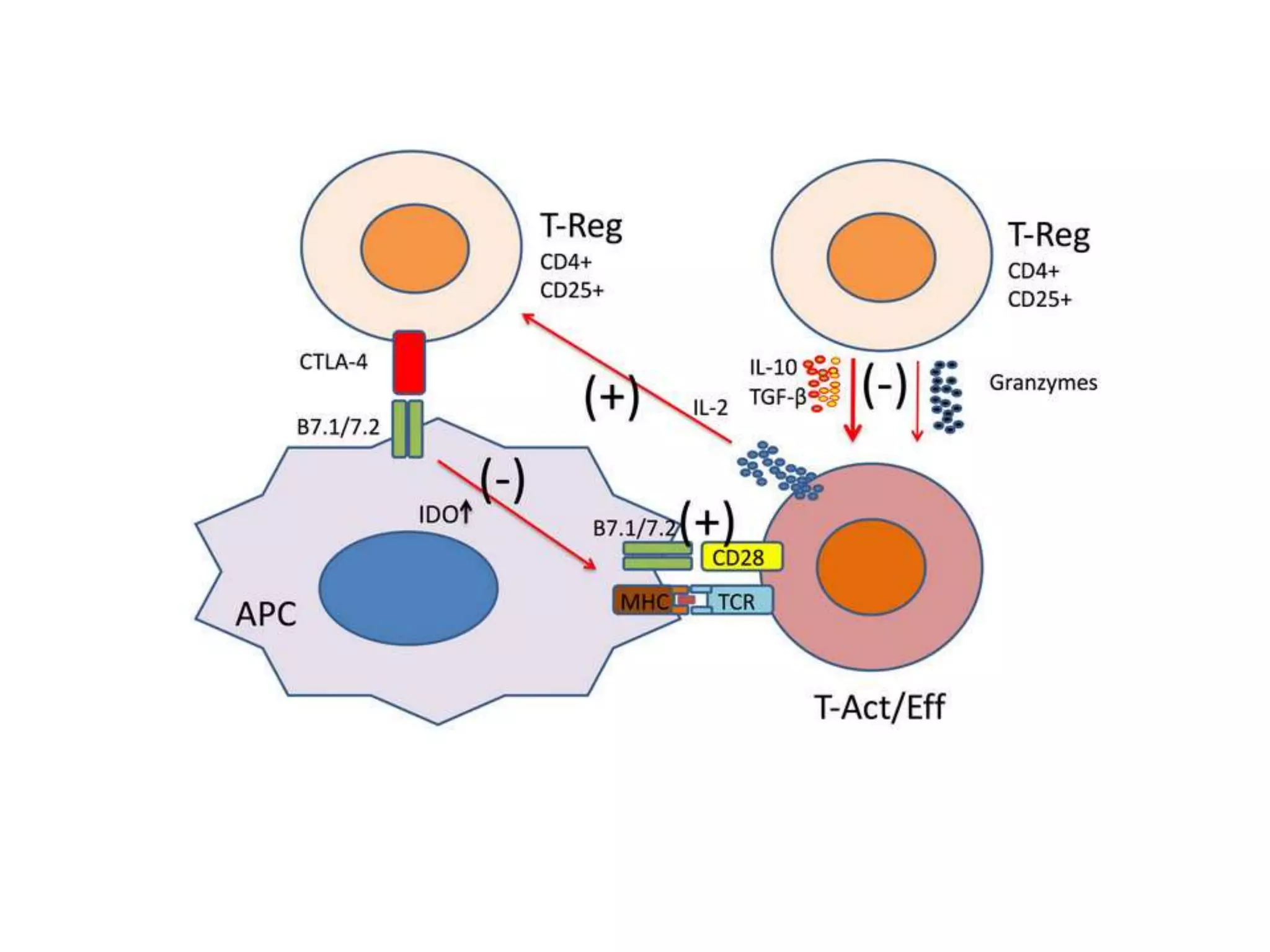
Treg Cells
• Shown to inhibit proliferation of other T
cells in vitro
• CD4+CD25+
• Shown to inhibit development of
autoimmune diseases.
• maintain tolerance to self-antigens.
Cell Death and T Cell Populations
• Apoptosis plays critical role
– Deletion of potentially autoreactive
thymocytes
– Deletion of T cell populations after activation
• Fas and FasL pathway to induce self death
Cell Death!
• How does apoptosis occur during
thymocyte selection??
• Specialized Protease called “Caspases”
• Every cell produces these proteases which
are maintained in an inactive form
• Must get activated to undergo apoptosis
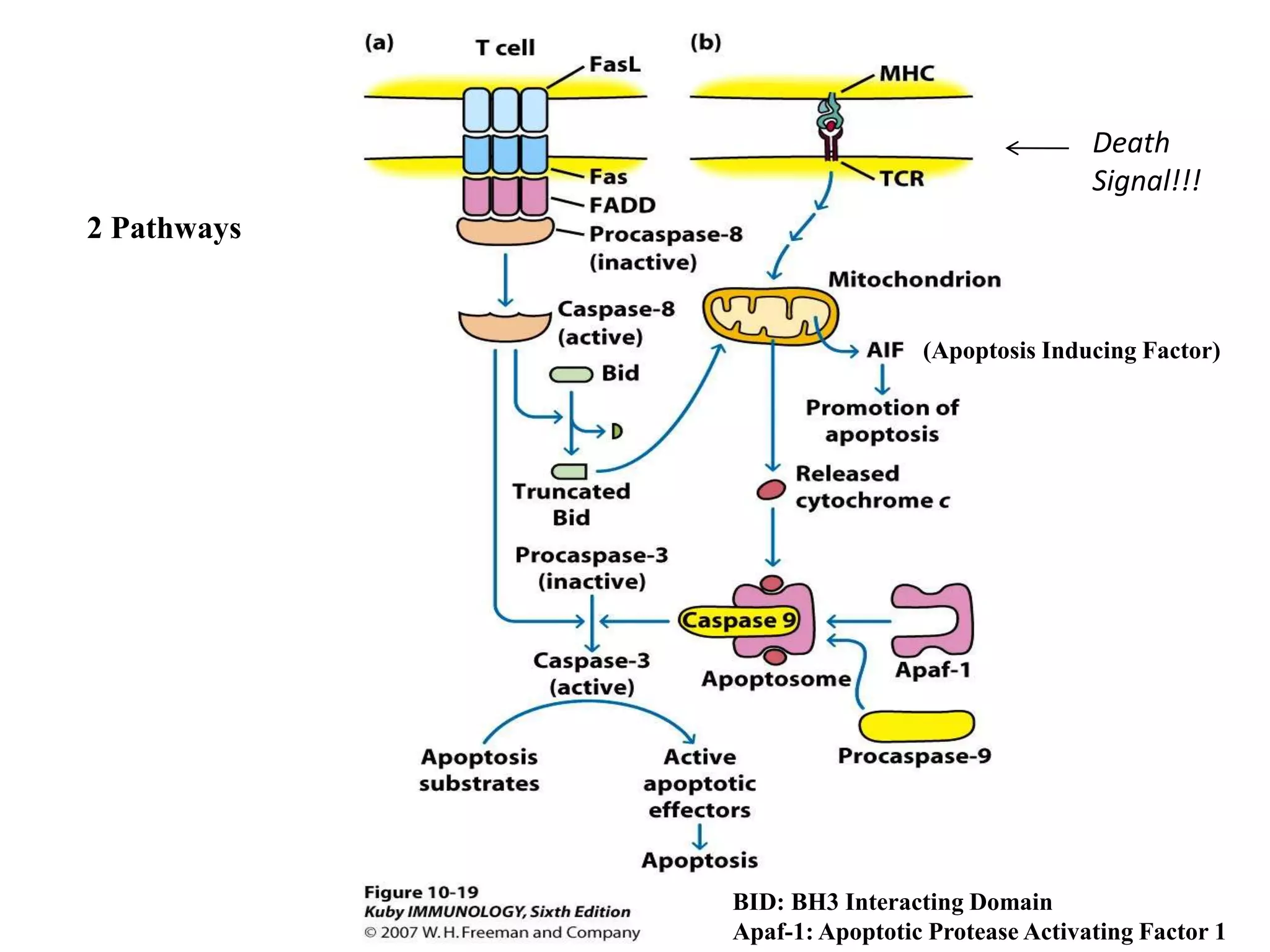
2 Pathways
Death
Signal!!!
(Apoptosis Inducing Factor)
BID: BH3 Interacting Domain
Apaf-1: Apoptotic Protease Activating Factor 1
THANK YOU

T cell development, maturation, activation and differentiation

  • 1.
    T-cell Maturation, Activation,& Differentiation BT6602 Unit 2 Dr K.Geetha Associate Professor Department of Biotechnology Kamaraj College of Engg & Tech Madurai
  • 2.
    Overview • Early Development •T-Cell Repertoire Selection Processes • Late Development • Activation • Differentiation • Cell Death
  • 4.
    • Progenitor Tcells migrate to thymus • At about 8th or 9th week of gestation in humans • T cell maturation involves rearrangements of the germ-line TCR genes • In thymus, thymocytes proliferate and differentiate
  • 5.
  • 6.
    Figure 7-8 part1 of 2 The cellular organization of the human Thymus
  • 7.
    Figure 7-9 The cellularorganization of the human Thymus
  • 8.
    • Selection processin thymus – Positive selection • Survival of only T cells whose TCRs recognize self-MHC molecules – Negative selection • Eliminates T cells that react too strongly with self MHC or MHC with self-peptides
  • 9.
    T-cell Development • Beginswith arrival of small numbers of lymphoid precursors migrating from blood to thymus • When they do arrive in thymus, T-cell precursors don’t express signature surface markers (CD3, CD4, and CD8) – Double Negatives (DN) • Do not express RAG-1 or RAG-2 that are necessary for gene rearrangement
  • 10.
    Figure 7-12 Changes incell surface molecules throughout T-cell maturation in the Thymus
  • 11.
    T-cell Development • During3 week development, differentiating T cells pass through stages of development based on surface phenotypes
  • 12.
    DN= double negative Cell-Surface Molecules •c-Kit: Receptor for stemcell growth factor •CD44: Adhesion Molecule •CD25: Alpha-Chain of the IL-2 receptor
  • 13.
    TCR is nowin the Double Positive (DP) State
  • 15.
    Positive Selection • Resultsin MHC restriction • Mechanism: – Immature thymocytes cluster with MHC molecules on the cortical cells of the thymus • If TCR interacts with MHC  protective signal results that prevents apoptosis. • If TCR does not interact with MHC  no protective signal and apoptosis occurs. • Result? Only reactive thymocytes survive.
  • 16.
    Negative Selection • Ensuresself-tolerance • Weeds out High affinity thymocytes • Mechanism: – APC’s bearing MHC’s interact with thymocytes • If avidity is too strong  thymocyte undergoes apoptosis. • Details unknown… • Result? Only self-tolerant thymocytes survive. Avidity (functional affinity) is the accumulated strength of multiple affinities.
  • 17.
    • T celldevelopment is expensive for host • 98% of all thymocytes do not mature, die by apoptosis within thymus
  • 18.
    T cell Activation •Initiated by TCR-CD3 complex with processed antigen on MHC molecule • CD8+ cells with Class I • CD4+ cells with Class II • Initiates cascade of biochemical events • Inducing resting T cell to enter cell cycle, proliferate, differentiate into memory and effector T cells
  • 19.
    T cell Activation •Cascade of biochemical events leading to gene expression: – Interaction of signal and molecule (example: TCR + MHC and antigen) – Generation of “second messenger” that diffuses to other areas of cell – Protein kinases and protein phosphatases are activated or inhibitied – Signals are amplified by enzyme cascades
  • 20.
    T cell Activation •Gene products after activation • Immediate genes (1/2 hour of recognition) – Transcription factors (c-Myc, NFAT, NF-κB) • Early genes (1-2 hours from recognition) – IL-2, IL2R, IL-6, IFN-γ • Late genes (more than 2 days later) – Encode adhesion molecules
  • 23.
    Signal-transduction pathways associated withT-cell activation. (a) Phospholipase C (PLC) is activated by phosphorylation. Active PLC hydrolyzes a phospholipid component of the plasma membrane to generate the second messengers, DAG and IP3. (b) Protein kinase C (PKC) is activated by DAG and Ca2. Among the numerous effects of PKC is phosphorylation of IkB, a cytoplasmic protein that binds the transcription factor NF-kB and prevents it from entering the nucleus. Phosphorylation of IkB releases NF-kB, which then translocates into the nucleus. (c) Ca2-dependent activation of calcineurin. Calcineurin is a Ca2/calmodulin dependent phosphatase. IP3 mediates the release of Ca2 from the endoplasmic reticulum. Ca2 binds the protein calmodulin, which then associates with and activates the Ca2/calmodulin-dependent phosphatase calcineurin. Active calcineurin removes a phosphate group from NFAT, which allows this transcription factor to translocate into the nucleus.
  • 24.
    Activation of thesmall G protein, Ras. Signals from the T-cell receptor result in activation of Ras via the action of specific guanine nucleotide exchange factors (GEFs) that catalyze the exchange of GDP for GTP. Active Ras causes a cascade of reactions that result in the increased production of the transcription factor Fos. Following their phosphorylation, Fos and Jun dimerize to yield the transcription factor AP-1. Note that all these pathways have important effects other than the specific examples shown in the figure.
  • 25.
    Chokingly complex- whatto remember • Importance of CD3 • Phosphorylation activates proteins • Cascade • G proteins, • 2nd messengers • Gene activation • Ongoing proliferation- IL2 and its receptor.
  • 26.
    “Signal 1 and2”- TCR activation isn’t the whole story • TCR activation is necessary, but not sufficient, to produce activation. It is called “signal 1”. • The T cell also needs “signal 2”- CD28-B7 interaction. • Its absence produces clonal anergy TH-cell recognition of an antigenic peptide–MHC complex sometimes results in a state of nonresponsiveness called clonal anergy, marked by the inability of cells to proliferate in response to a peptide-MHC complex

  • 27.
  • 28.
    •Superantigens (SAgs) area class of antigens that cause non-specific activation of T- cells resulting in polyclonal T cell activation and massive cytokine release. •SAgs are produced by some pathogenic viruses and bacteria most likely as a defense mechanism against the immune system.
  • 29.
    T-Cell Differentiation • CD4+and CD8+ cells leave thymus and enter circulation in G0 phase • Naïve cells (condensed chromatin, little cytoplasm) • About twice as many CD4+ • Naïve cell recognized MHC-antigen complex • Initiated primary response • After 48 hours, enlarges into blast cell and undergoes repeated rounds of cell division • Differentiate into: » Effector cells – cytokine secretion, B-cell help » Memory cells – long lived, respond with heightened activity (secondary response)
  • 31.
    Treg Cells • Shownto inhibit proliferation of other T cells in vitro • CD4+CD25+ • Shown to inhibit development of autoimmune diseases. • maintain tolerance to self-antigens.
  • 33.
    Cell Death andT Cell Populations • Apoptosis plays critical role – Deletion of potentially autoreactive thymocytes – Deletion of T cell populations after activation • Fas and FasL pathway to induce self death
  • 34.
    Cell Death! • Howdoes apoptosis occur during thymocyte selection?? • Specialized Protease called “Caspases” • Every cell produces these proteases which are maintained in an inactive form • Must get activated to undergo apoptosis
  • 35.
    2 Pathways Death Signal!!! (Apoptosis InducingFactor) BID: BH3 Interacting Domain Apaf-1: Apoptotic Protease Activating Factor 1
  • 36.