Solving Systems of Three
Linear Equations in Three
Variables
The Elimination Method
LEQ      How to solve systems of three linear equations in three variables?
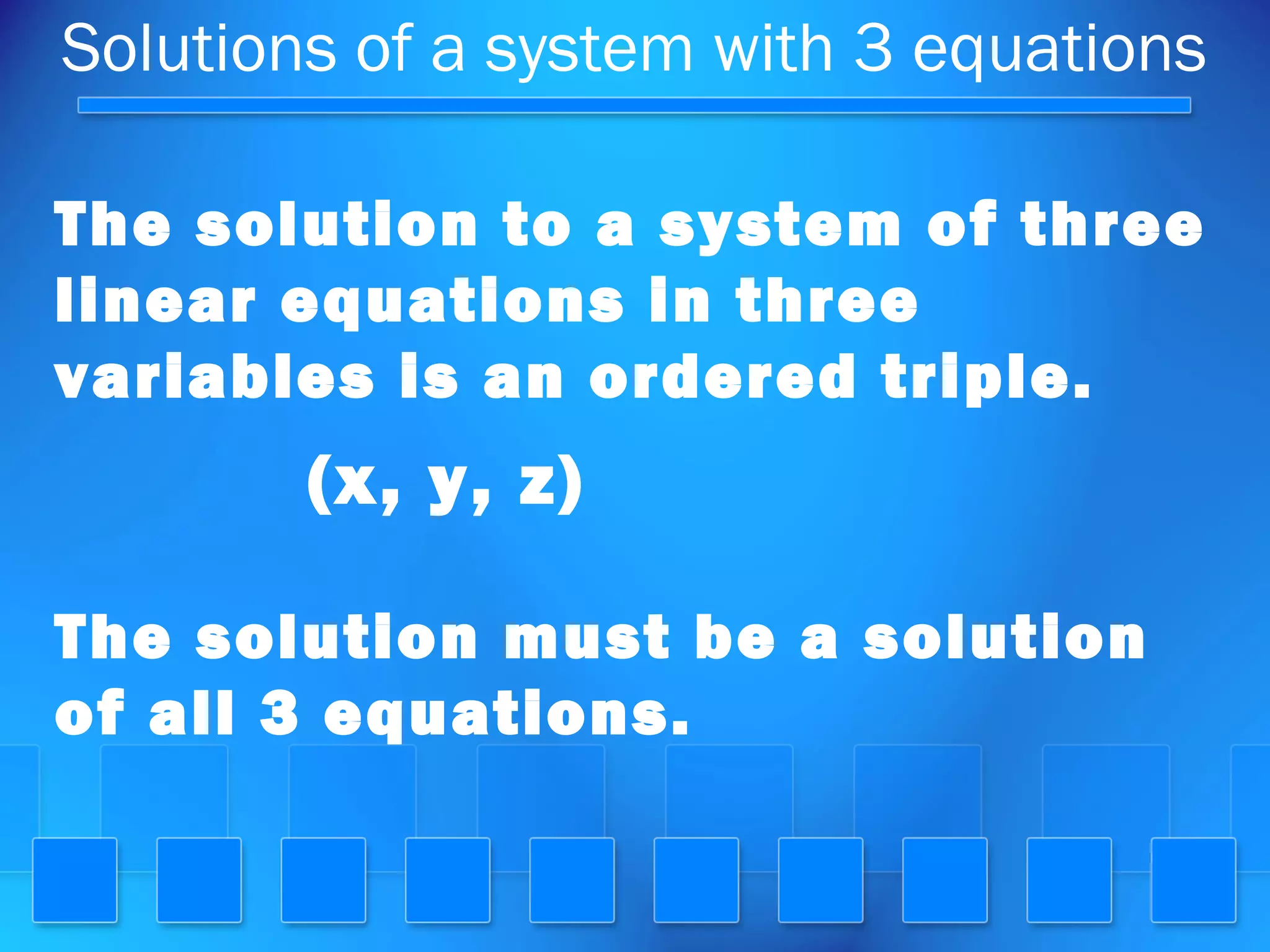
Solutions of a system with 3 equations
The solution to a system of three
linear equations in three
variables is an ordered triple.
(x, y, z)
The solution must be a solution
of all 3 equations.
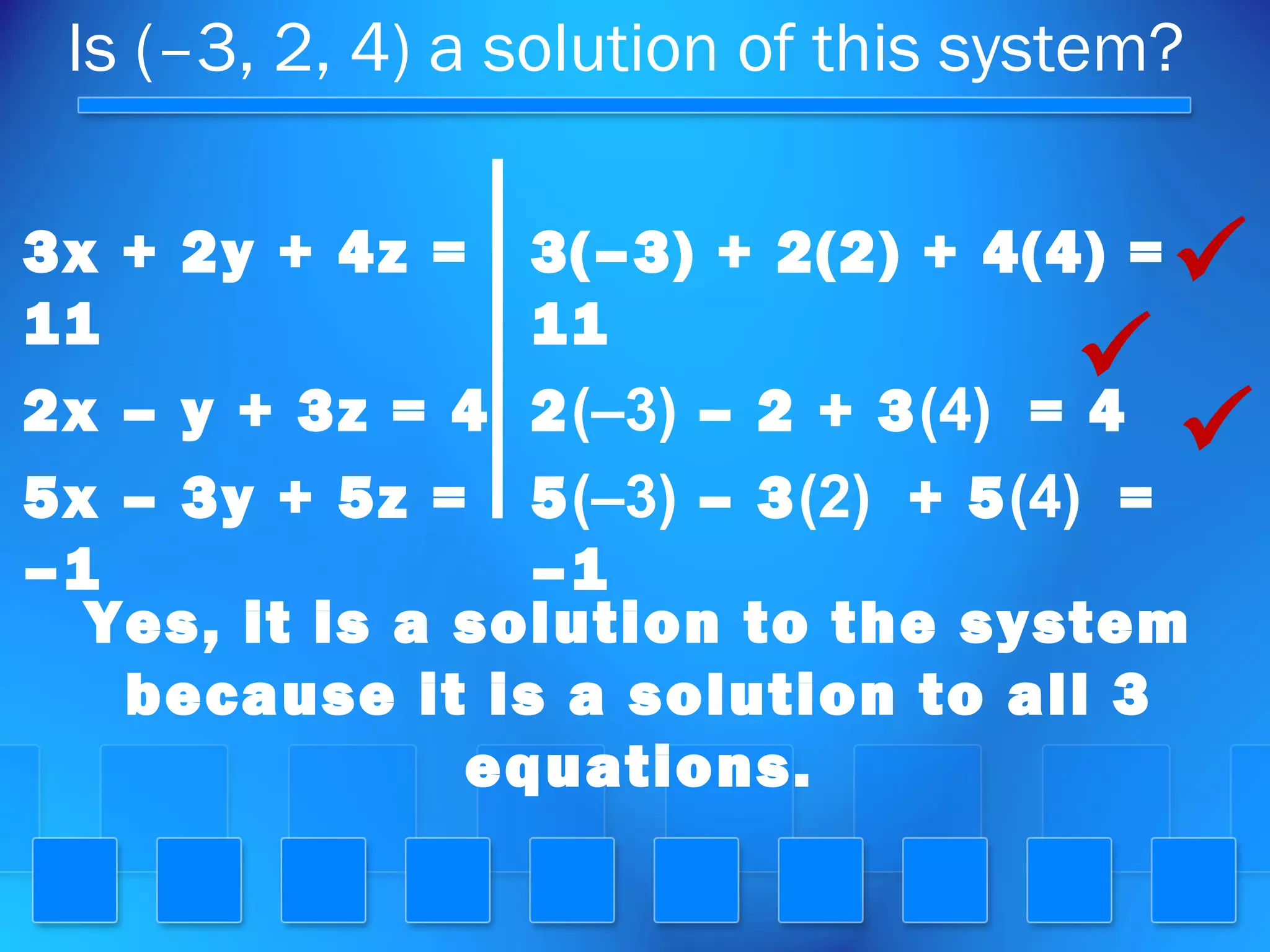
Is (–3, 2, 4) a solution of this system?
3x + 2y + 4z =
11
2x – y + 3z = 4
5x – 3y + 5z =
–1
3(–3) + 2(2) + 4(4) =
11
2(–3) – 2 + 3(4)  = 4
5(–3) – 3(2)  + 5(4)  =
–1



Yes, it is a solution to the system
because it is a solution to all 3
equations.
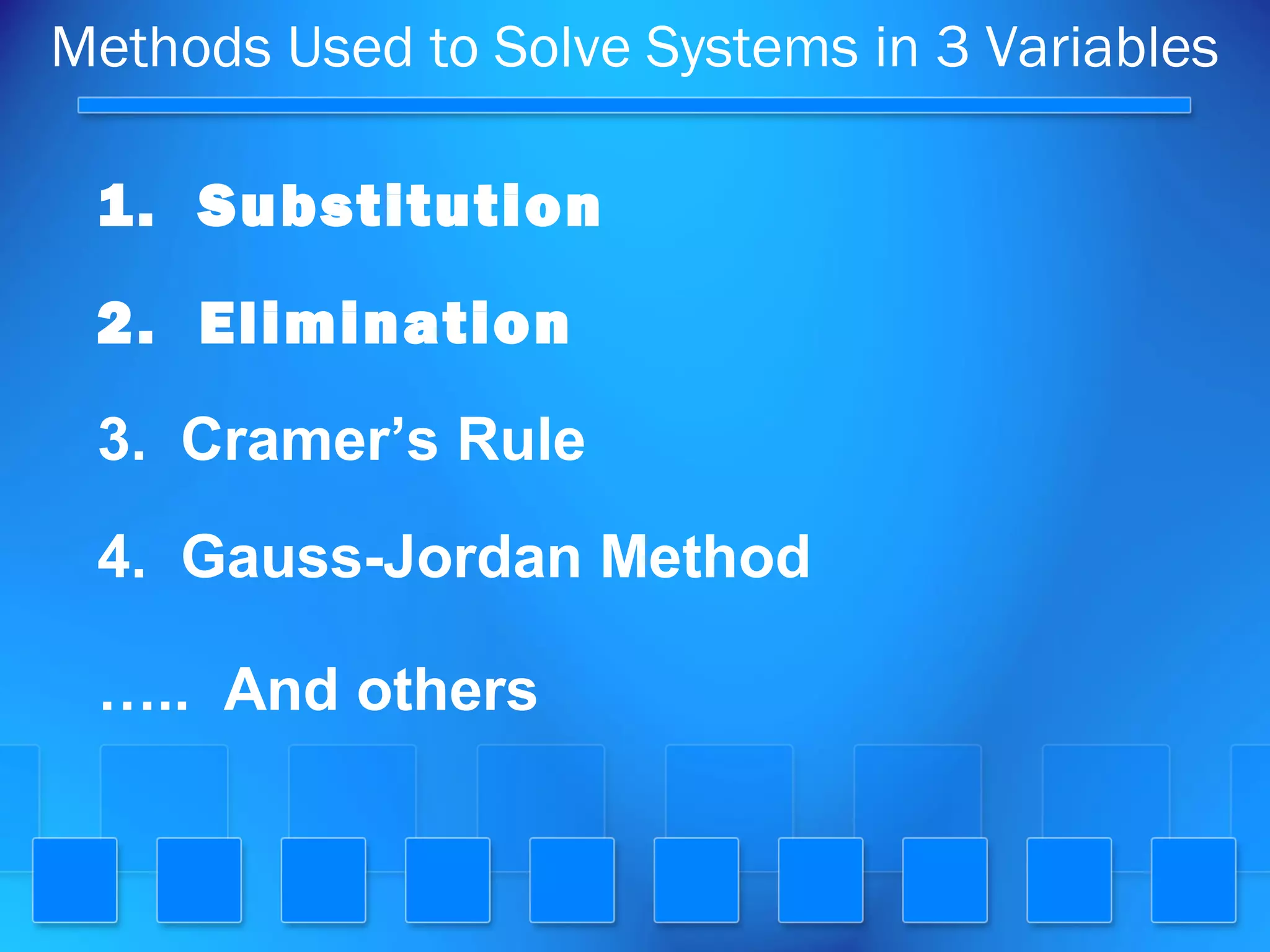
Methods Used to Solve Systems in 3 Variables
1. Substitution
2. Elimination
3.  Cramer’s Rule
4.  Gauss-Jordan Method
…..  And others
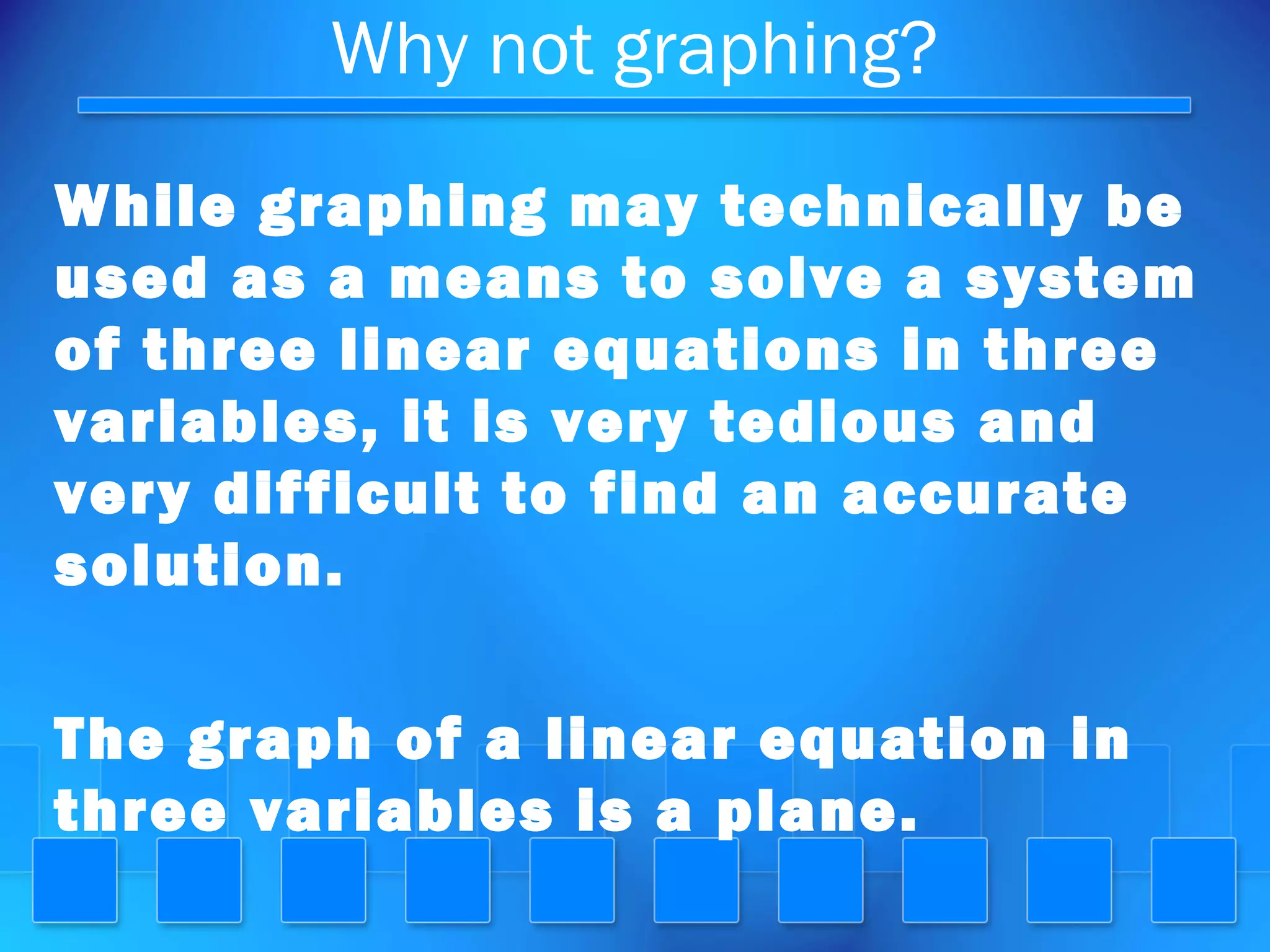
Why not graphing?
While graphing may technically be
used as a means to solve a system
of three linear equations in three
variables, it is very tedious and
very difficult to find an accurate
solution.
The graph of a linear equation in
three variables is a plane.
This lesson will focus on the
Elimination Method.
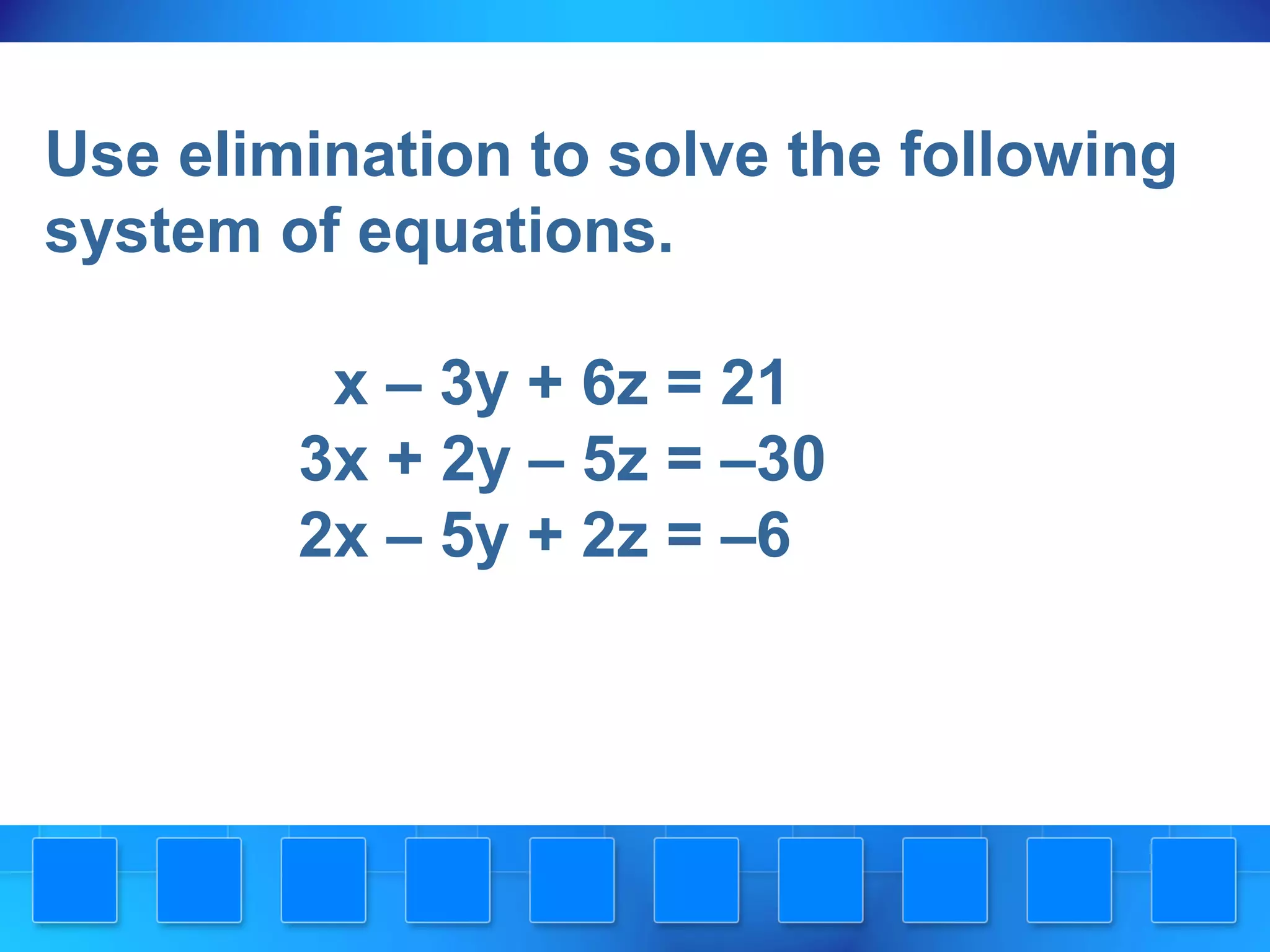
Use elimination to solve the following
system of equations.
x – 3y + 6z = 21
3x + 2y – 5z = –30
2x – 5y + 2z = –6
Step 1
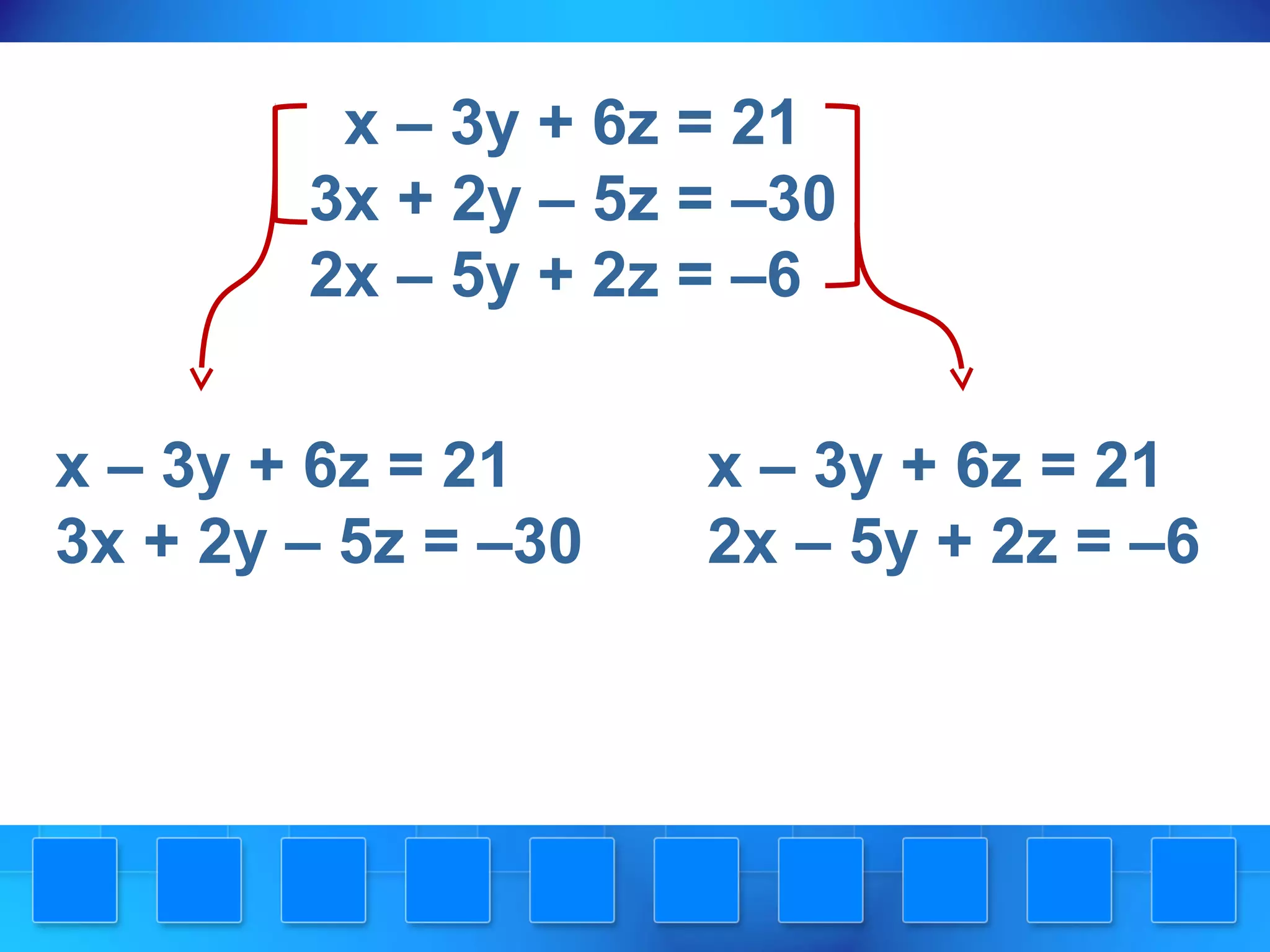
Rewrite the system as two smaller
systems, each containing two of the
three equations.
x – 3y + 6z = 21
3x + 2y – 5z = –30
2x – 5y + 2z = –6
x – 3y + 6z = 21 x – 3y + 6z = 21
3x + 2y – 5z = –30 2x – 5y + 2z = –6
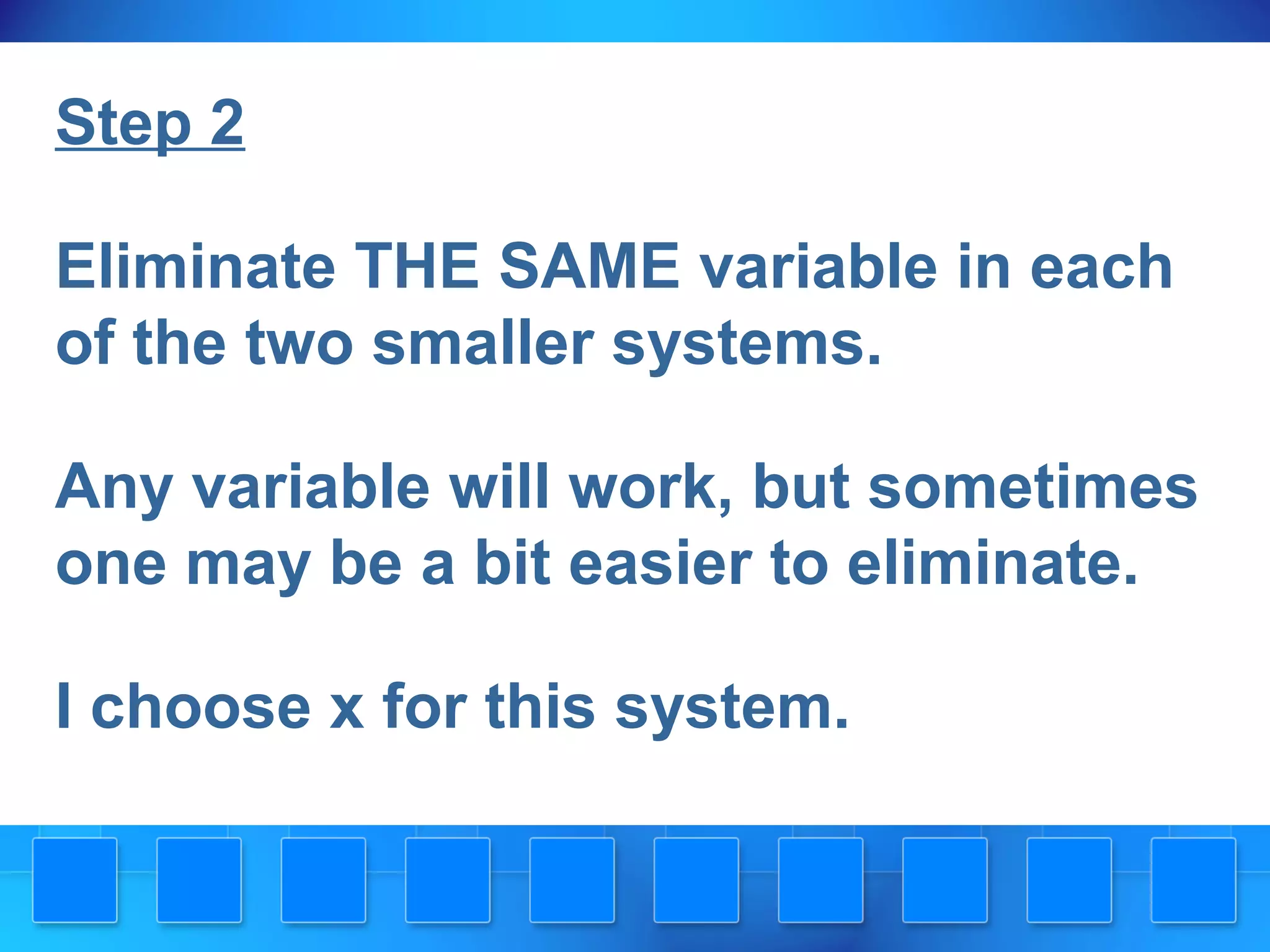
Step 2
Eliminate THE SAME variable in each
of the two smaller systems.
Any variable will work, but sometimes
one may be a bit easier to eliminate.
I choose x for this system.
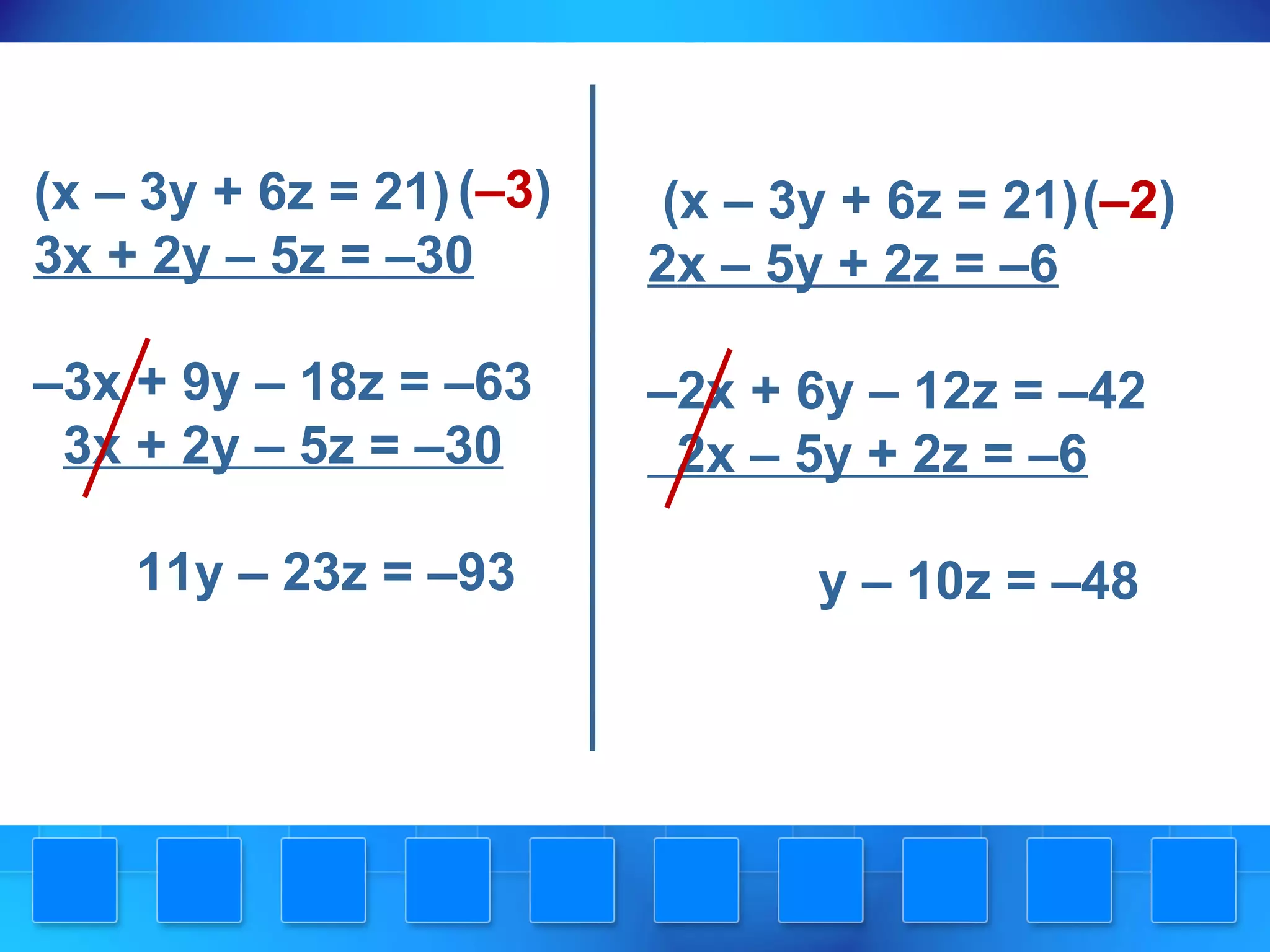
(x – 3y + 6z = 21)
3x + 2y – 5z = –30
–3x + 9y – 18z = –63
3x + 2y – 5z = –30
11y – 23z = –93
(x – 3y + 6z = 21)
2x – 5y + 2z = –6
–2x + 6y – 12z = –42
2x – 5y + 2z = –6
y – 10z = –48
(–3) (–2)
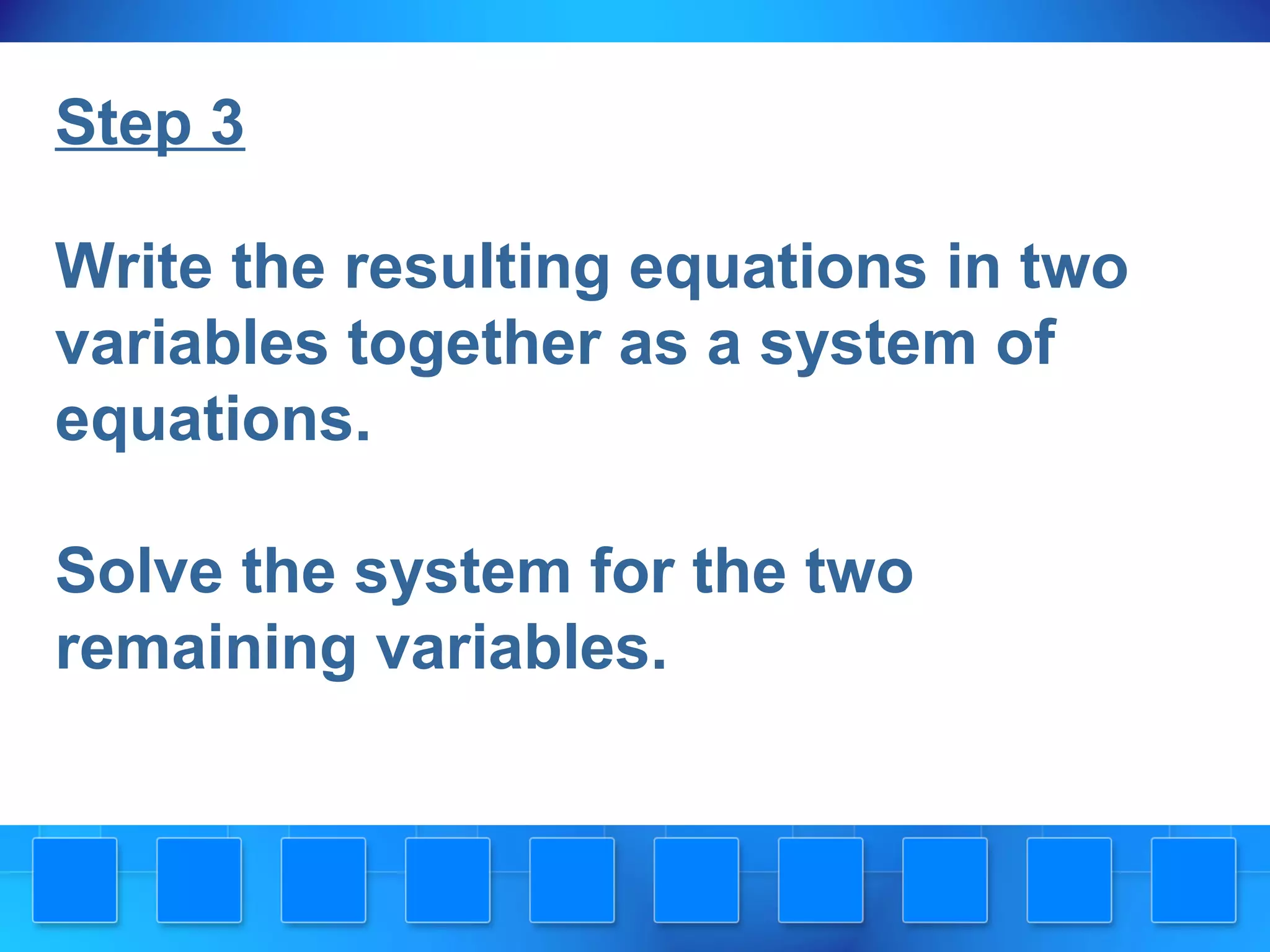
Step 3
Write the resulting equations in two
variables together as a system of
equations.
Solve the system for the two
remaining variables.
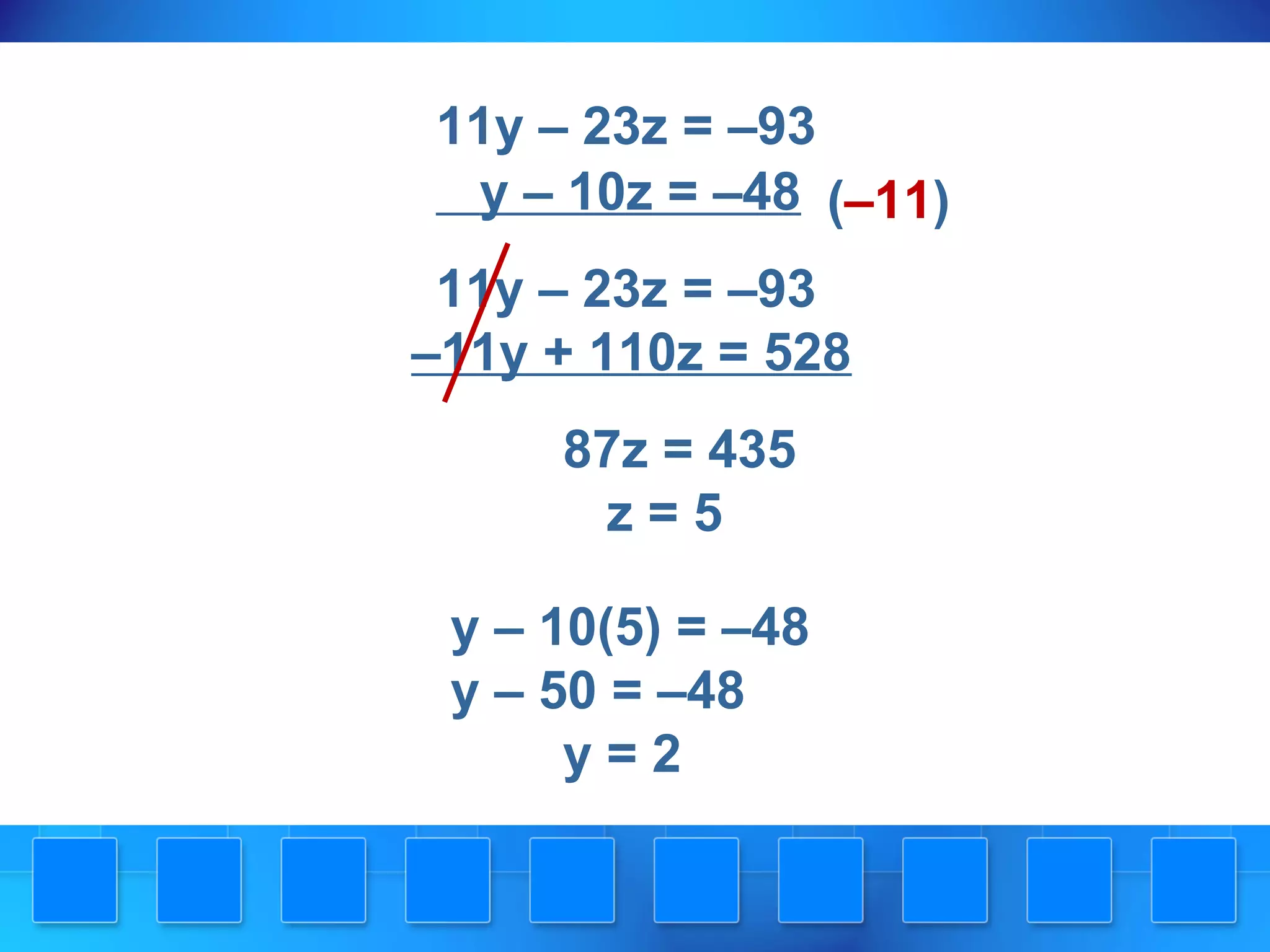
11y – 23z = –93
y – 10z = –48
11y – 23z = –93
–11y + 110z = 528
87z = 435
z = 5
y – 10(5) = –48
y – 50 = –48
y = 2
(–11)
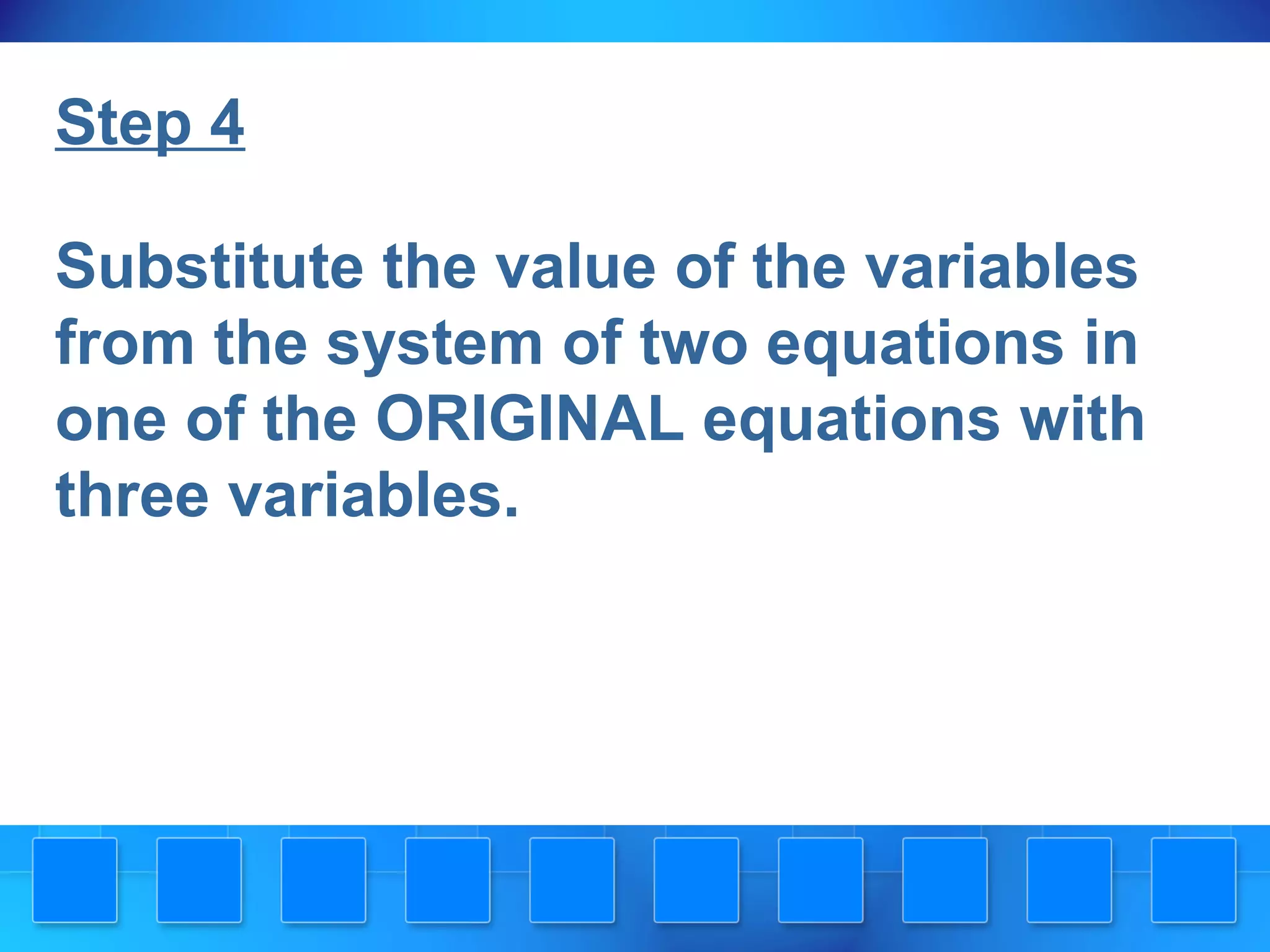
Step 4
Substitute the value of the variables
from the system of two equations in
one of the ORIGINAL equations with
three variables.
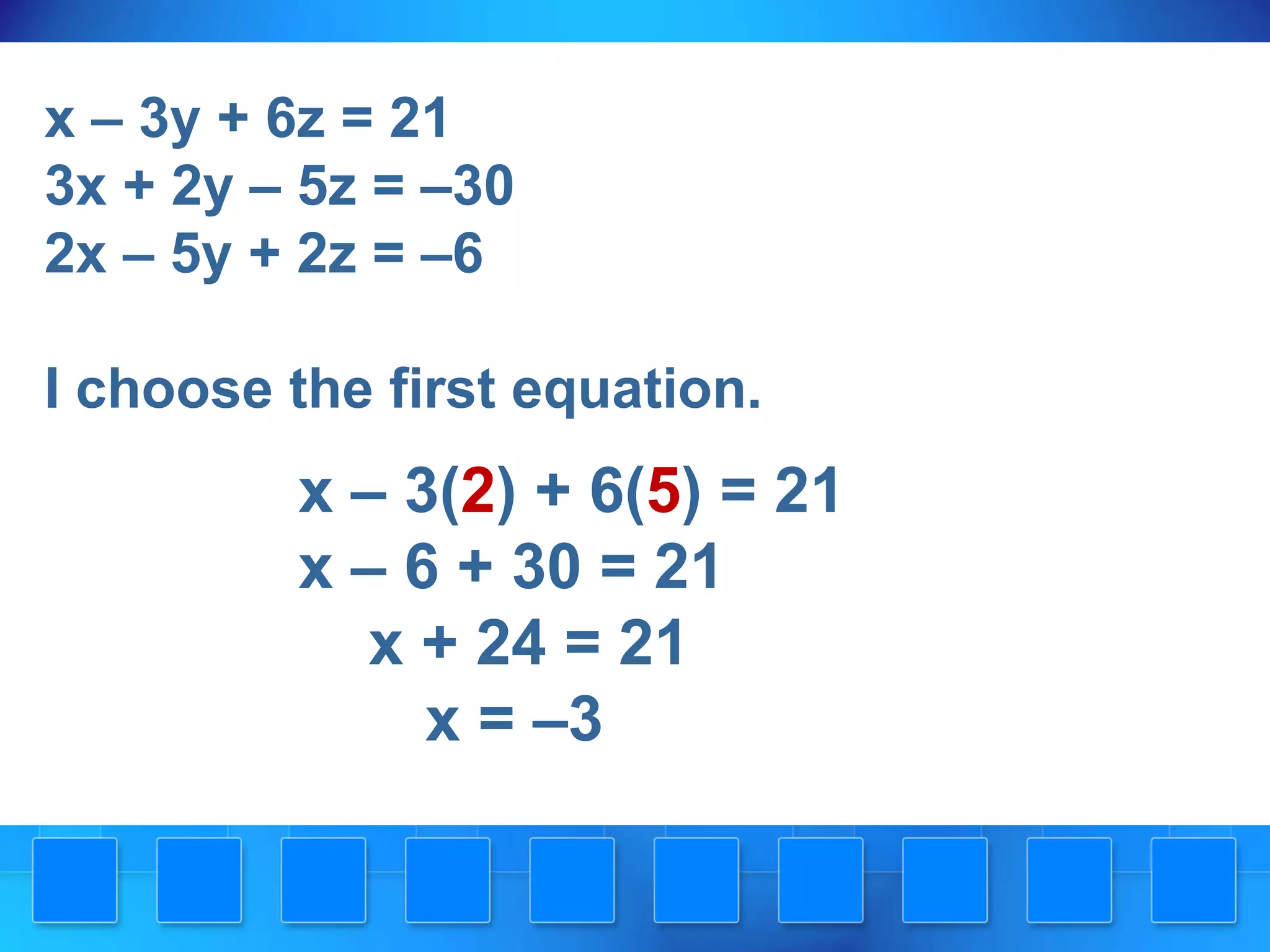
x – 3y + 6z = 21
3x + 2y – 5z = –30
2x – 5y + 2z = –6
I choose the first equation.
x – 3(2) + 6(5) = 21
x – 6 + 30 = 21
x + 24 = 21
x = –3
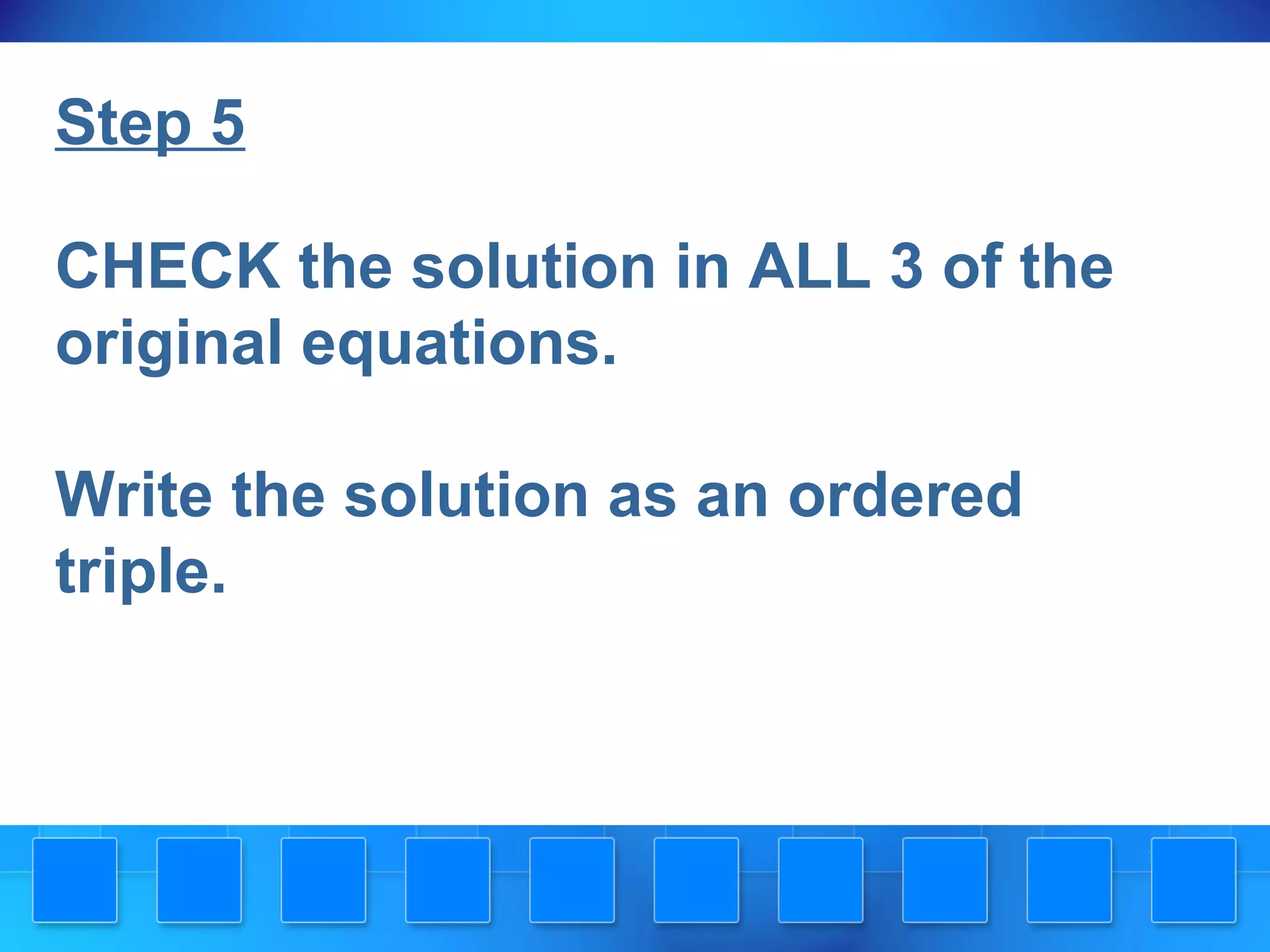
Step 5
CHECK the solution in ALL 3 of the
original equations.
Write the solution as an ordered
triple.
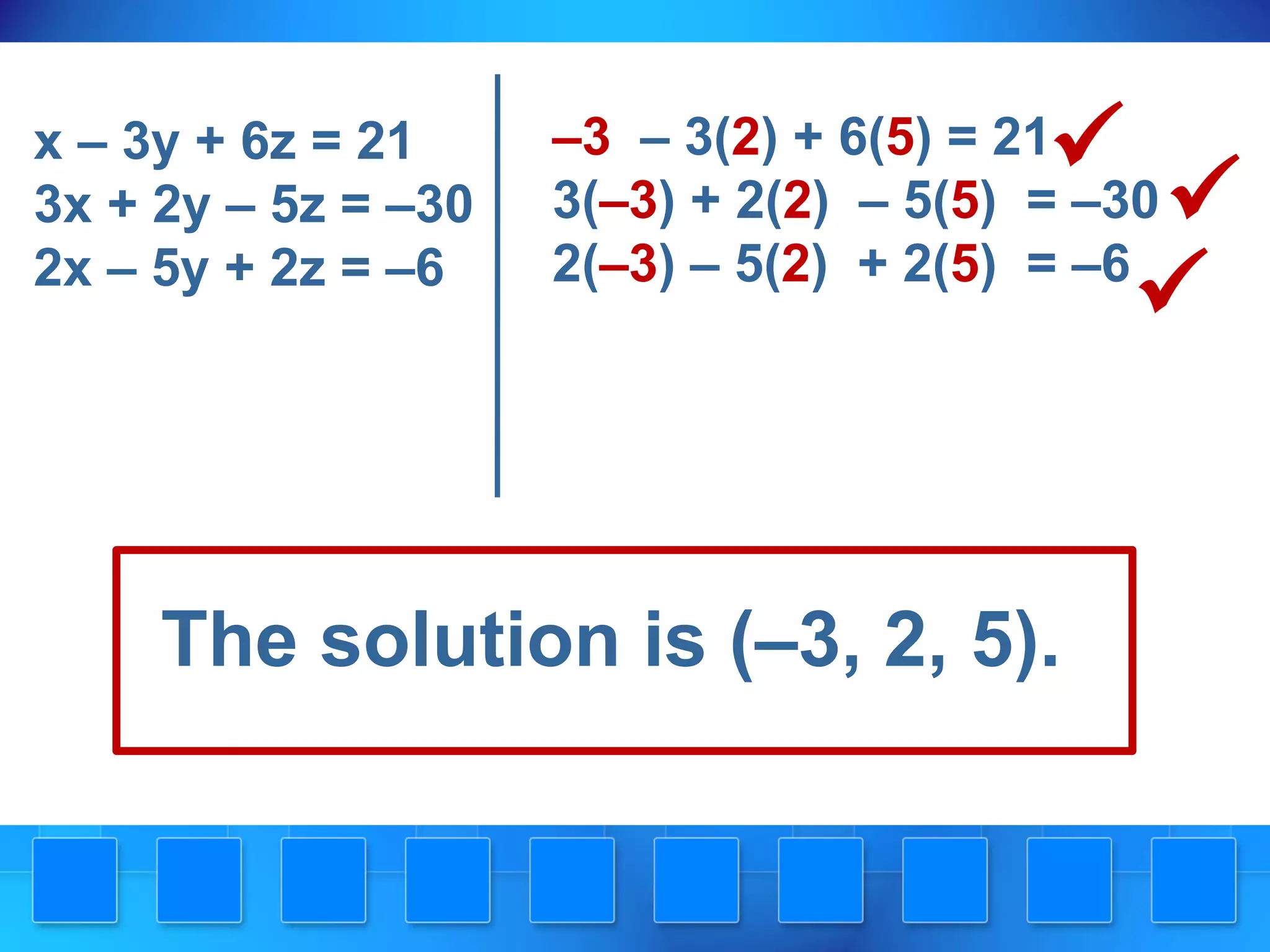
x – 3y + 6z = 21
3x + 2y – 5z = –30
2x – 5y + 2z = –6
–3 – 3(2) + 6(5) = 21
3(–3) + 2(2) – 5(5) = –30
2(–3) – 5(2) + 2(5) = –6



The solution is (–3, 2, 5).
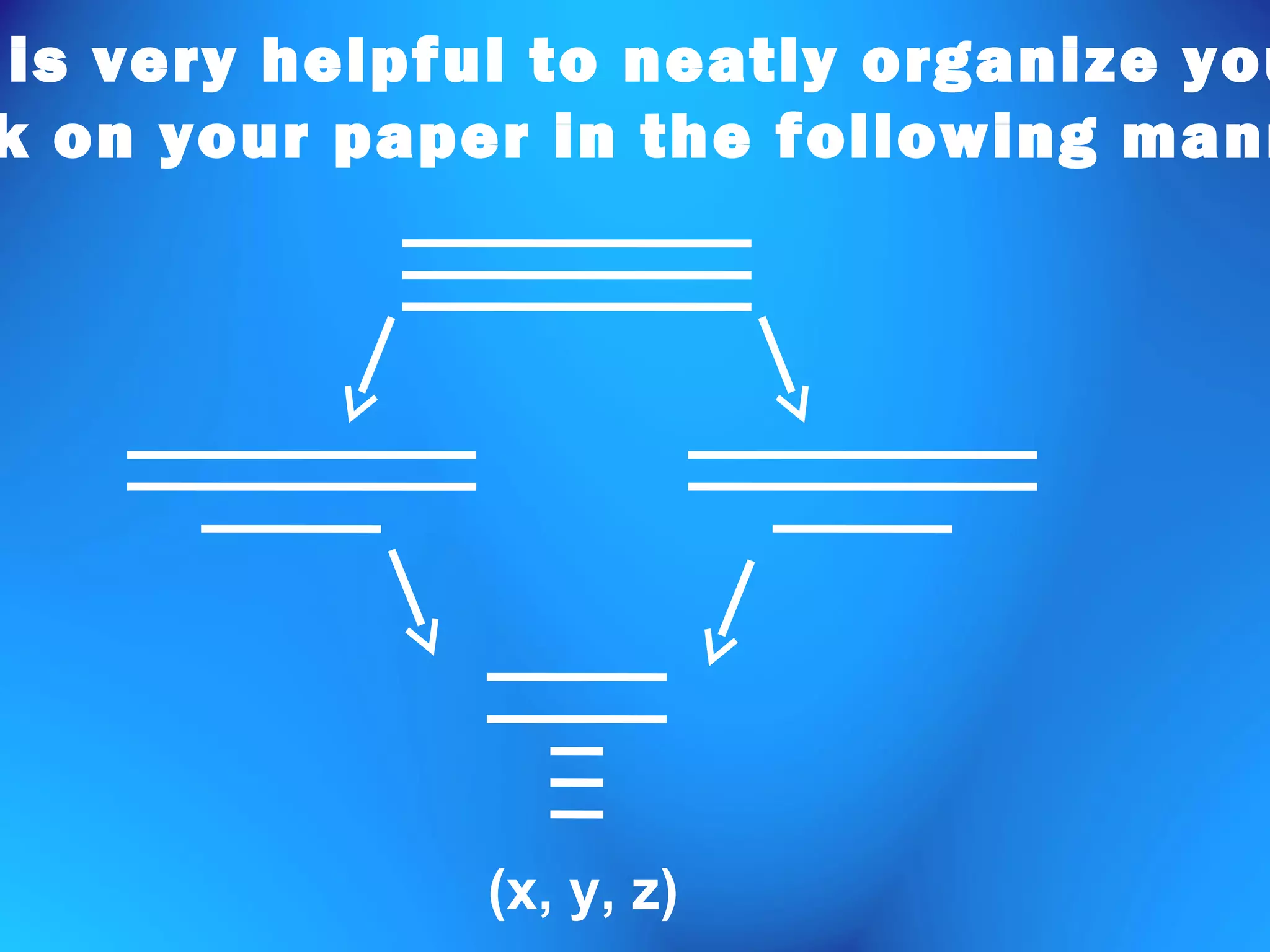
is very helpful to neatly organize you
k on your paper in the following mann
(x, y, z)
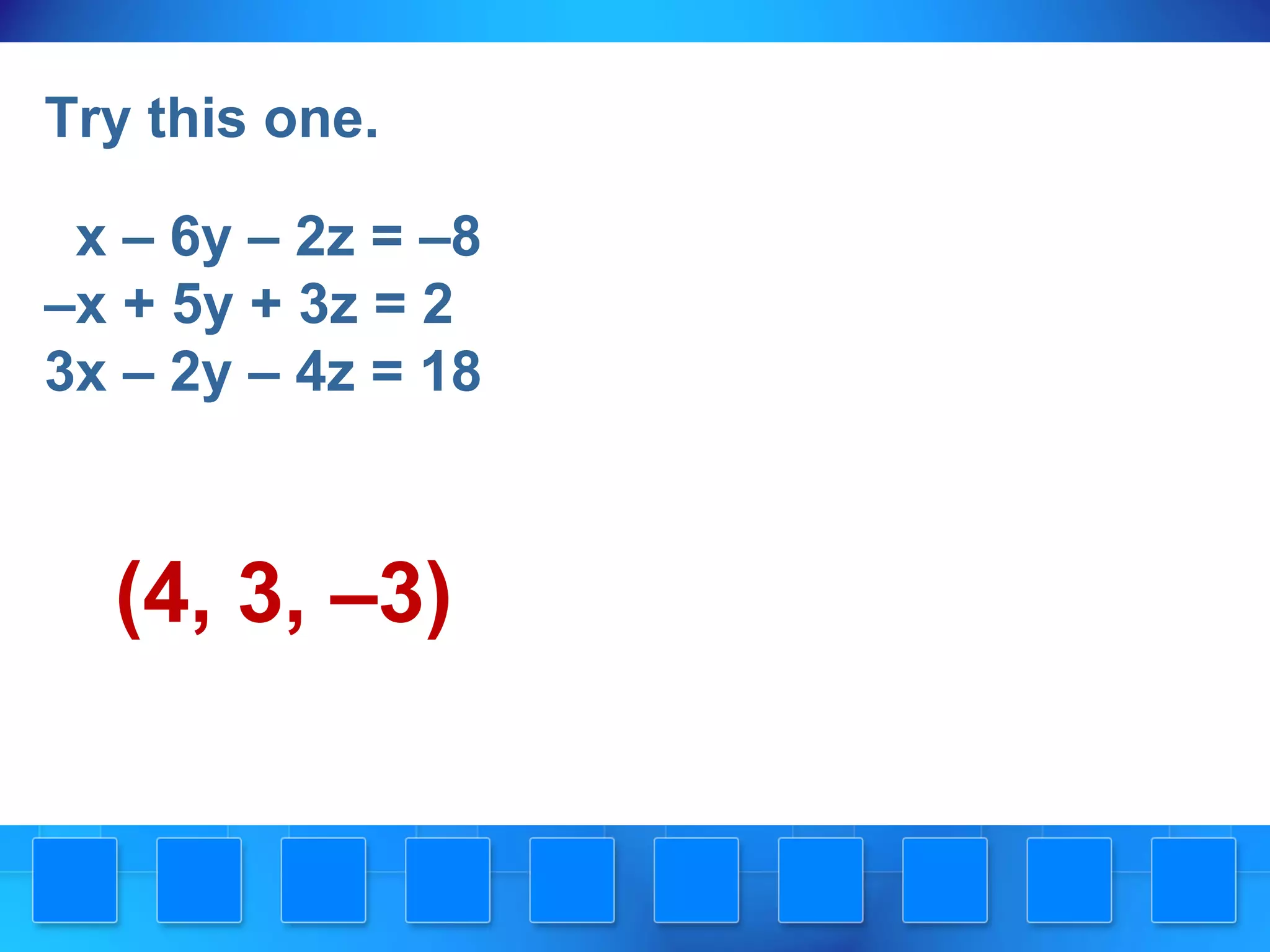
Try this one.
x – 6y – 2z = –8
–x + 5y + 3z = 2
3x – 2y – 4z = 18
(4, 3, –3)
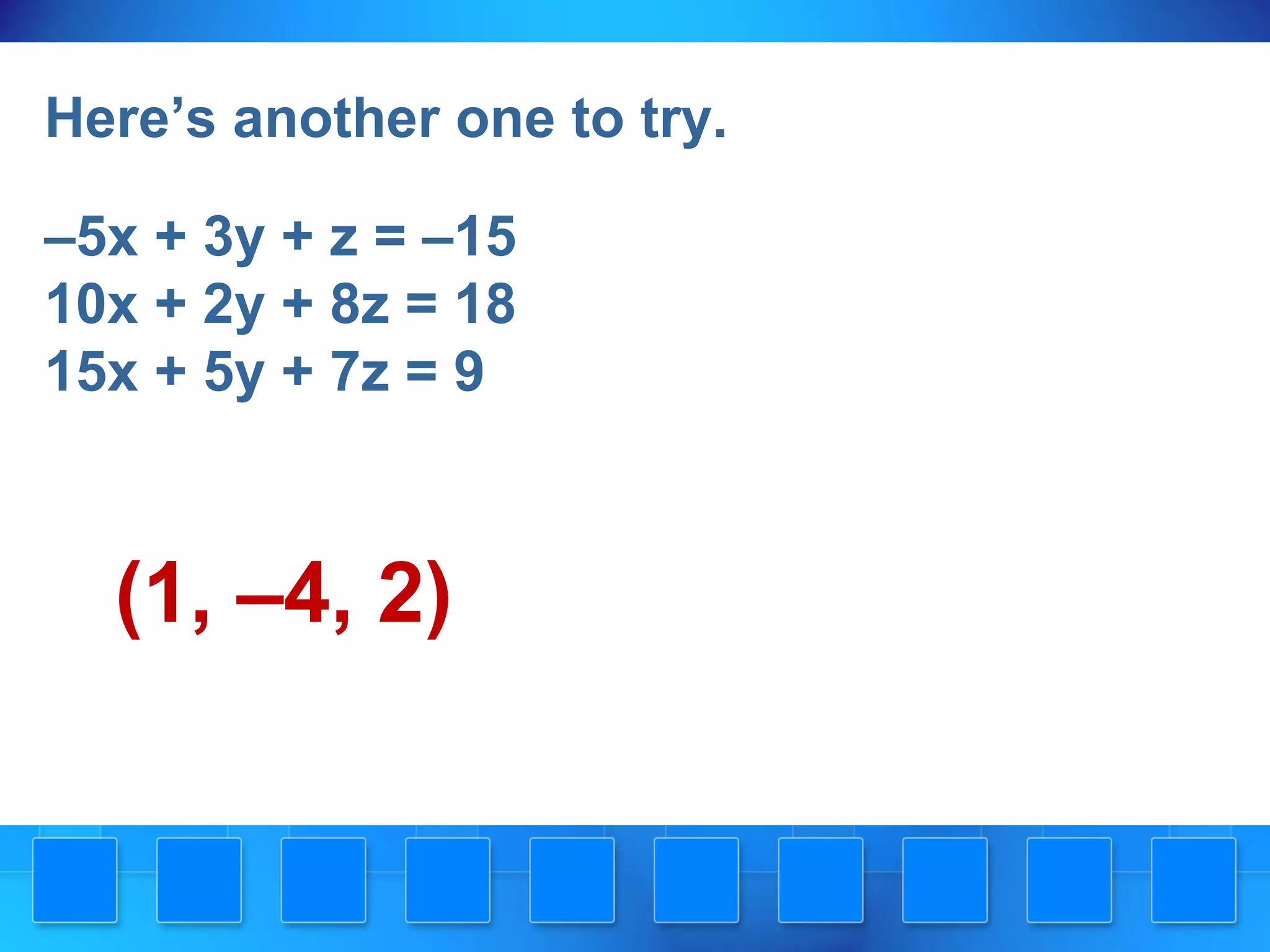
Here’s another one to try.
–5x + 3y + z = –15
10x + 2y + 8z = 18
15x + 5y + 7z = 9
(1, –4, 2)

Systemsof3 equations ppt_alg2

  • 1.
    Solving Systems ofThree Linear Equations in Three Variables The Elimination Method LEQ      How to solve systems of three linear equations in three variables?
  • 2.
    Solutions of asystem with 3 equations The solution to a system of three linear equations in three variables is an ordered triple. (x, y, z) The solution must be a solution of all 3 equations.
  • 3.
    Is (–3, 2,4) a solution of this system? 3x + 2y + 4z = 11 2x – y + 3z = 4 5x – 3y + 5z = –1 3(–3) + 2(2) + 4(4) = 11 2(–3) – 2 + 3(4)  = 4 5(–3) – 3(2)  + 5(4)  = –1    Yes, it is a solution to the system because it is a solution to all 3 equations.
  • 4.
    Methods Used toSolve Systems in 3 Variables 1. Substitution 2. Elimination 3.  Cramer’s Rule 4.  Gauss-Jordan Method …..  And others
  • 5.
    Why not graphing? Whilegraphing may technically be used as a means to solve a system of three linear equations in three variables, it is very tedious and very difficult to find an accurate solution. The graph of a linear equation in three variables is a plane.
  • 6.
    This lesson willfocus on the Elimination Method.
  • 7.
    Use elimination tosolve the following system of equations. x – 3y + 6z = 21 3x + 2y – 5z = –30 2x – 5y + 2z = –6
  • 8.
    Step 1 Rewrite thesystem as two smaller systems, each containing two of the three equations.
  • 9.
    x – 3y+ 6z = 21 3x + 2y – 5z = –30 2x – 5y + 2z = –6 x – 3y + 6z = 21 x – 3y + 6z = 21 3x + 2y – 5z = –30 2x – 5y + 2z = –6
  • 10.
    Step 2 Eliminate THESAME variable in each of the two smaller systems. Any variable will work, but sometimes one may be a bit easier to eliminate. I choose x for this system.
  • 11.
    (x – 3y+ 6z = 21) 3x + 2y – 5z = –30 –3x + 9y – 18z = –63 3x + 2y – 5z = –30 11y – 23z = –93 (x – 3y + 6z = 21) 2x – 5y + 2z = –6 –2x + 6y – 12z = –42 2x – 5y + 2z = –6 y – 10z = –48 (–3) (–2)
  • 12.
    Step 3 Write theresulting equations in two variables together as a system of equations. Solve the system for the two remaining variables.
  • 13.
    11y – 23z= –93 y – 10z = –48 11y – 23z = –93 –11y + 110z = 528 87z = 435 z = 5 y – 10(5) = –48 y – 50 = –48 y = 2 (–11)
  • 14.
    Step 4 Substitute thevalue of the variables from the system of two equations in one of the ORIGINAL equations with three variables.
  • 15.
    x – 3y+ 6z = 21 3x + 2y – 5z = –30 2x – 5y + 2z = –6 I choose the first equation. x – 3(2) + 6(5) = 21 x – 6 + 30 = 21 x + 24 = 21 x = –3
  • 16.
    Step 5 CHECK thesolution in ALL 3 of the original equations. Write the solution as an ordered triple.
  • 17.
    x – 3y+ 6z = 21 3x + 2y – 5z = –30 2x – 5y + 2z = –6 –3 – 3(2) + 6(5) = 21 3(–3) + 2(2) – 5(5) = –30 2(–3) – 5(2) + 2(5) = –6    The solution is (–3, 2, 5).
  • 18.
    is very helpfulto neatly organize you k on your paper in the following mann (x, y, z)
  • 19.
    Try this one. x– 6y – 2z = –8 –x + 5y + 3z = 2 3x – 2y – 4z = 18 (4, 3, –3)
  • 20.
    Here’s another oneto try. –5x + 3y + z = –15 10x + 2y + 8z = 18 15x + 5y + 7z = 9 (1, –4, 2)