1
“Insanity: doing the same thing over and over
again, expecting different results.” – Einstein
Complexity |Uncertainty |Choice |Consequences
Proposed workshop title: systems thinking tools for climate
resilience programming
Using systems thinking tools to sharpen the design of humanitarian and development programs
Dates: November 10-13, 2015
Venue: Kenya School of Government, Nairobi
Cost Ksh 39,500 $ 400
Early Bird Price - Pay by 30th October 2015 Ksh 35,550 $ 360
Background and Introduction
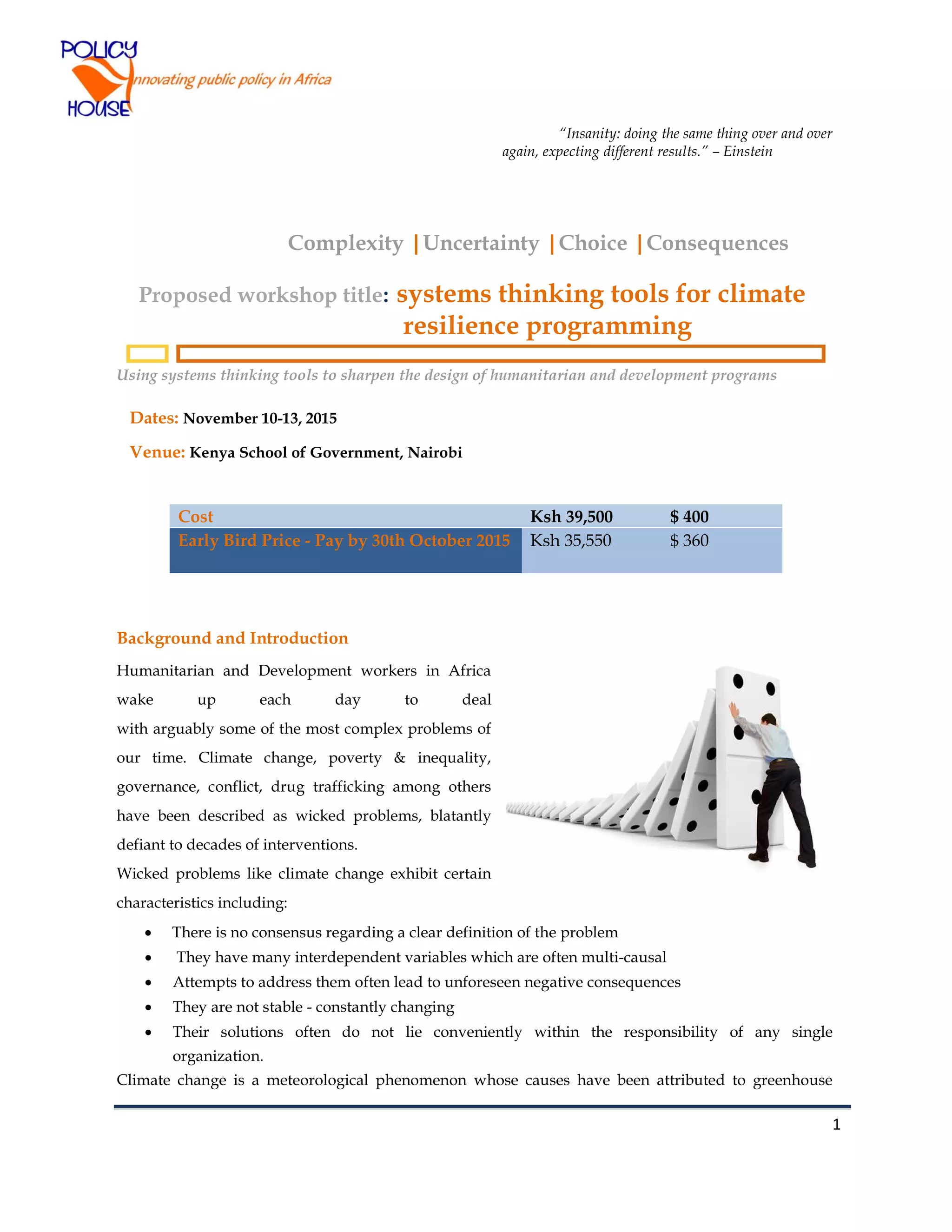
Humanitarian and Development workers in Africa
wake up each day to deal
with arguably some of the most complex problems of
our time. Climate change, poverty & inequality,
governance, conflict, drug trafficking among others
have been described as wicked problems, blatantly
defiant to decades of interventions.
Wicked problems like climate change exhibit certain
characteristics including:
There is no consensus regarding a clear definition of the problem
They have many interdependent variables which are often multi-causal
Attempts to address them often lead to unforeseen negative consequences
They are not stable - constantly changing
Their solutions often do not lie conveniently within the responsibility of any single
organization.
Climate change is a meteorological phenomenon whose causes have been attributed to greenhouse
2
gases generated by human activity over recent decades. Its impacts are varied touching on several
sectors including agriculture, health, biodiversity, energy, infrastructure, insurance, tourism and more,
making it a truly multifaceted and multi-sectoral problem. Climate change impacts have had serious
negative impacts on national development, especially in the developing world, reversing poverty
reduction gains in the recent past and in some cases leading to calamitous loss of lives and property.
The global climate system is a shared resource that accumulates greenhouse emissions from all nations,
and indiscriminately unleashes its negative impacts across all nations in most cases hitting the
vulnerable poor in the global south hardest.
No single agency or government has the silver bullet capable of resolving the climate change problem.
Different agents must collaboratively work together in coordinated fashion to successfully address the
causes and impacts of climate change. This requires a reassessment of some of the traditional ways of
working across sectors; how we prioritize interventions; and ensuring that our solutions don’t worsen
the problem. This challenges our governance structures, our skills base and our organizational capacity.
“Climate change is an issue that presents great scientific and economic complexity, some very deep
uncertainties, profound ethical issues, and even lack of agreement on what the problem is,” Economists
will generally think about the trade-offs involved. Ecologists will talk about the idea that we’re driving
towards the edge of a cliff. I think both views are right. The question is, how do you reconcile these
two?”1
“Tackling wicked problems like climate change also calls for high levels of systems thinking. This big
picture thinking helps policy makers to make the connections between the multiple causes and
interdependencies of wicked problems that are necessary in order to avoid a narrow approach and the
artificial taming of wicked problems.”2
Systems thinking tools provide an avenue to analyze community vulnerabilities as a basis for
designing interventions that strengthen the ability to withstand shocks caused by extreme weather
events.
The proposed workshop teaches use of systems thinking and system dynamics modeling tools to
conduct analysis of the causes and impacts of climate change. This multi-sectoral analysis is very useful
in understanding the dynamic relationship between variables in the climate change ecosystem and
provides a basis to align institutional strategy and identify alternative inclusive interventions to
mitigate, adapt and build resilience against climate impacts.
1 Attributed to Mike Toman, Development Research Group, World Bank.
2 Lynelle Briggs, Australian Public Service Commissioner, 2007
3
Brief Introduction to Systems Thinking and System Dynamics
Systems Thinking (ST) has been de fined as an approach to problem solving, by viewing "problems" as
parts of an overall system, rather than reacting to specific part, outcomes or events and potentially
contributing to further development of unintended consequences. This is based on the belief that the
component parts of a system can best be understood in the context of relationships with each other and
with other systems, rather than in isolation. Systems Thinking focuses on cyclical rather than linear cause
and effect.
System Dynamics (SD) is a methodology developed at MIT for framing, understanding, and discussing
complex issues and problems. Originally developed in the 1950s to help corporate managers improve
their understanding of industrial processes, system dynamics is currently being used throughout the
public and private sector for policy analysis and design. Key applications in the public sector have been
in climate change, development planning, disease control, ecological management, water systems
management among others.
Specific benefits of this workshop include:
1. Be able to appreciate the dynamic relationships between different causal and impact variables
of climate change in different sectors.
2. Be able to model vulnerability to extreme weather events and identify
3. Define a framework to reconcile different perspectives on the causes and impacts of climate
change.
4. Have a framework to confidently defend certain positions during climate negotiations at
national, regional and international levels.
5. Be able articulate advocacy messages on issues relating to climate change mitigation,
adaptation and resilience.
6. Be able to identify alternative interventions to strengthen resilience against climate shocks.
7. Be able to develop a logically consistent theory(ies) of change with respect to selected climate
change interventions.
8. Identify relevant indicators to measure resilience to climate change interventions
9. Find a basis for development or review of institutional and program strategies regarding
climate change mitigation, adaptation and resilience.
10. Guide development of a strategy to transition from emergency disaster response to
development programming.
Target Course Participants
This course targets senior managers involved in climate change mitigation, adaptation and resilience
programming, climate negotiations, Disaster Risk Reduction & the Sendai Framework, Green economy,
Millennium Development Goals & Sustainable Development Goals and related issues.
This is an intensive program and should not exceed 25 participants for sufficient individualized
attention.
4
Course Curriculum
Day 1-3
What is Climate Resilience?
Risks, Shocks and their Impact on Systems
Why is Integrated Analysis of Climate Change necessary?
Systems Thinking Tools: Cause & Effect
Introduction to Vensim Simulation Software
Systems Thinking Tools: Stocks & Flows
Systems Thinking Tools: Causal Loop Diagrams
Systems Thinking Tools: Feedback Loop Analysis
Structure and behavior of dynamic systems
The Problem Analysis Process
Joint Plenary Case Study: Causes of Climate Change
Joint Plenary Case Study: Impacts of Climate Change
Supervised Group Project: Systems Analysis of Climate Mitigation, Adaptation and Resilience
Group Project Presentations & Discussions
Lead Course Facilitator
Eric Momanyi is a policy analyst intrigued by complexity. He studies
complex problems ranging from organizational development dynamics to
public policy including national development, climate change, poverty
traps and health systems among others. He has 13 years’ experience
working on these issues in Kenya, South Sudan, Liberia & Norway. He has
conducted similar training seminars for various organizations among them
Research Institutions (ICIPE & KEMRI), Government of Kenya (Ministries
of Health, Planning, Environment, Central Bank of Kenya, KNBS, NEMA & KIPPRA among others) and
United Nations (UNDP, U NEP & WHO). He was involved in the development & institutionalization of
Kenya’s T-21 Model (Kenya’s main dynamic long-range planning model in use at the Ministry of
Planning). He is the author of ‘Dynamics of Poverty Traps in Kenya: Modeling Food Security, Population
Growth and the Poverty Trap (2012)’. Eric holds an MA (Cum Laude) in Development Studies from the
University of the Western Cape, South Africa and a BA (Economics) from the University of Nairobi,
Kenya. He studied System Dynamics Modeling at the post-graduate level at the University of Bergen,
Norway and is a member of the System Dynamics Society.
5
Registration
To reserve your seat in this course, write an email to learning.nairobi@gmail.com with a copy to
momwanza@gmail.com latest by Friday October 30, 2015 (this is the registration deadline for this
workshop. Include your name, Organization, position title and brief reason why you are interested to
attend the workshop and you will be guided accordingly. You will then be issued with a participant
application form and bank account details. Get the early bird offer of 10% off by paying by October
30th, 2015. Registration at the workshop will only be confirmed upon payment of the registration fees.
Note that the participant limit for this workshop is 25 persons and admission will be done on first come
first served basis. Participants who miss the first day may find it difficult to follow proceedings on the
second day. Prompt arrival early on the first day is therefore emphasized.
Practical issues
Participants are reminded that this is an intensive workshop and must be prepared to leave the
workshop later than the normal 17 00 hours on some days.
Each participant will be expected to bring along a laptop computer, as most of the workshop will be
conducted with the aid of computer software.
For more information contact Eric on:
Policy House | 13th floor, Landmark Plaza | Argwings Kodhek Rd -
Hurlingham | P.O Box 9376 -00200 Nairobi, Kenya | Tel. +254 20 3673 155, +254 703 041155,
Mobile: +254 726 890 113 | E-mail: learning.nairobi@gmail.com / momwanza@gmail.com

Systems Thinking Tools for Climate Resilience Programming Workshop - Nov 2015

  • 1.
    1 “Insanity: doing thesame thing over and over again, expecting different results.” – Einstein Complexity |Uncertainty |Choice |Consequences Proposed workshop title: systems thinking tools for climate resilience programming Using systems thinking tools to sharpen the design of humanitarian and development programs Dates: November 10-13, 2015 Venue: Kenya School of Government, Nairobi Cost Ksh 39,500 $ 400 Early Bird Price - Pay by 30th October 2015 Ksh 35,550 $ 360 Background and Introduction Humanitarian and Development workers in Africa wake up each day to deal with arguably some of the most complex problems of our time. Climate change, poverty & inequality, governance, conflict, drug trafficking among others have been described as wicked problems, blatantly defiant to decades of interventions. Wicked problems like climate change exhibit certain characteristics including: There is no consensus regarding a clear definition of the problem They have many interdependent variables which are often multi-causal Attempts to address them often lead to unforeseen negative consequences They are not stable - constantly changing Their solutions often do not lie conveniently within the responsibility of any single organization. Climate change is a meteorological phenomenon whose causes have been attributed to greenhouse
  • 2.
    2 gases generated byhuman activity over recent decades. Its impacts are varied touching on several sectors including agriculture, health, biodiversity, energy, infrastructure, insurance, tourism and more, making it a truly multifaceted and multi-sectoral problem. Climate change impacts have had serious negative impacts on national development, especially in the developing world, reversing poverty reduction gains in the recent past and in some cases leading to calamitous loss of lives and property. The global climate system is a shared resource that accumulates greenhouse emissions from all nations, and indiscriminately unleashes its negative impacts across all nations in most cases hitting the vulnerable poor in the global south hardest. No single agency or government has the silver bullet capable of resolving the climate change problem. Different agents must collaboratively work together in coordinated fashion to successfully address the causes and impacts of climate change. This requires a reassessment of some of the traditional ways of working across sectors; how we prioritize interventions; and ensuring that our solutions don’t worsen the problem. This challenges our governance structures, our skills base and our organizational capacity. “Climate change is an issue that presents great scientific and economic complexity, some very deep uncertainties, profound ethical issues, and even lack of agreement on what the problem is,” Economists will generally think about the trade-offs involved. Ecologists will talk about the idea that we’re driving towards the edge of a cliff. I think both views are right. The question is, how do you reconcile these two?”1 “Tackling wicked problems like climate change also calls for high levels of systems thinking. This big picture thinking helps policy makers to make the connections between the multiple causes and interdependencies of wicked problems that are necessary in order to avoid a narrow approach and the artificial taming of wicked problems.”2 Systems thinking tools provide an avenue to analyze community vulnerabilities as a basis for designing interventions that strengthen the ability to withstand shocks caused by extreme weather events. The proposed workshop teaches use of systems thinking and system dynamics modeling tools to conduct analysis of the causes and impacts of climate change. This multi-sectoral analysis is very useful in understanding the dynamic relationship between variables in the climate change ecosystem and provides a basis to align institutional strategy and identify alternative inclusive interventions to mitigate, adapt and build resilience against climate impacts. 1 Attributed to Mike Toman, Development Research Group, World Bank. 2 Lynelle Briggs, Australian Public Service Commissioner, 2007
  • 3.
    3 Brief Introduction toSystems Thinking and System Dynamics Systems Thinking (ST) has been de fined as an approach to problem solving, by viewing "problems" as parts of an overall system, rather than reacting to specific part, outcomes or events and potentially contributing to further development of unintended consequences. This is based on the belief that the component parts of a system can best be understood in the context of relationships with each other and with other systems, rather than in isolation. Systems Thinking focuses on cyclical rather than linear cause and effect. System Dynamics (SD) is a methodology developed at MIT for framing, understanding, and discussing complex issues and problems. Originally developed in the 1950s to help corporate managers improve their understanding of industrial processes, system dynamics is currently being used throughout the public and private sector for policy analysis and design. Key applications in the public sector have been in climate change, development planning, disease control, ecological management, water systems management among others. Specific benefits of this workshop include: 1. Be able to appreciate the dynamic relationships between different causal and impact variables of climate change in different sectors. 2. Be able to model vulnerability to extreme weather events and identify 3. Define a framework to reconcile different perspectives on the causes and impacts of climate change. 4. Have a framework to confidently defend certain positions during climate negotiations at national, regional and international levels. 5. Be able articulate advocacy messages on issues relating to climate change mitigation, adaptation and resilience. 6. Be able to identify alternative interventions to strengthen resilience against climate shocks. 7. Be able to develop a logically consistent theory(ies) of change with respect to selected climate change interventions. 8. Identify relevant indicators to measure resilience to climate change interventions 9. Find a basis for development or review of institutional and program strategies regarding climate change mitigation, adaptation and resilience. 10. Guide development of a strategy to transition from emergency disaster response to development programming. Target Course Participants This course targets senior managers involved in climate change mitigation, adaptation and resilience programming, climate negotiations, Disaster Risk Reduction & the Sendai Framework, Green economy, Millennium Development Goals & Sustainable Development Goals and related issues. This is an intensive program and should not exceed 25 participants for sufficient individualized attention.
  • 4.
    4 Course Curriculum Day 1-3 Whatis Climate Resilience? Risks, Shocks and their Impact on Systems Why is Integrated Analysis of Climate Change necessary? Systems Thinking Tools: Cause & Effect Introduction to Vensim Simulation Software Systems Thinking Tools: Stocks & Flows Systems Thinking Tools: Causal Loop Diagrams Systems Thinking Tools: Feedback Loop Analysis Structure and behavior of dynamic systems The Problem Analysis Process Joint Plenary Case Study: Causes of Climate Change Joint Plenary Case Study: Impacts of Climate Change Supervised Group Project: Systems Analysis of Climate Mitigation, Adaptation and Resilience Group Project Presentations & Discussions Lead Course Facilitator Eric Momanyi is a policy analyst intrigued by complexity. He studies complex problems ranging from organizational development dynamics to public policy including national development, climate change, poverty traps and health systems among others. He has 13 years’ experience working on these issues in Kenya, South Sudan, Liberia & Norway. He has conducted similar training seminars for various organizations among them Research Institutions (ICIPE & KEMRI), Government of Kenya (Ministries of Health, Planning, Environment, Central Bank of Kenya, KNBS, NEMA & KIPPRA among others) and United Nations (UNDP, U NEP & WHO). He was involved in the development & institutionalization of Kenya’s T-21 Model (Kenya’s main dynamic long-range planning model in use at the Ministry of Planning). He is the author of ‘Dynamics of Poverty Traps in Kenya: Modeling Food Security, Population Growth and the Poverty Trap (2012)’. Eric holds an MA (Cum Laude) in Development Studies from the University of the Western Cape, South Africa and a BA (Economics) from the University of Nairobi, Kenya. He studied System Dynamics Modeling at the post-graduate level at the University of Bergen, Norway and is a member of the System Dynamics Society.
  • 5.
    5 Registration To reserve yourseat in this course, write an email to learning.nairobi@gmail.com with a copy to momwanza@gmail.com latest by Friday October 30, 2015 (this is the registration deadline for this workshop. Include your name, Organization, position title and brief reason why you are interested to attend the workshop and you will be guided accordingly. You will then be issued with a participant application form and bank account details. Get the early bird offer of 10% off by paying by October 30th, 2015. Registration at the workshop will only be confirmed upon payment of the registration fees. Note that the participant limit for this workshop is 25 persons and admission will be done on first come first served basis. Participants who miss the first day may find it difficult to follow proceedings on the second day. Prompt arrival early on the first day is therefore emphasized. Practical issues Participants are reminded that this is an intensive workshop and must be prepared to leave the workshop later than the normal 17 00 hours on some days. Each participant will be expected to bring along a laptop computer, as most of the workshop will be conducted with the aid of computer software. For more information contact Eric on: Policy House | 13th floor, Landmark Plaza | Argwings Kodhek Rd - Hurlingham | P.O Box 9376 -00200 Nairobi, Kenya | Tel. +254 20 3673 155, +254 703 041155, Mobile: +254 726 890 113 | E-mail: learning.nairobi@gmail.com / momwanza@gmail.com