SYSTEMIC COMPLICATIONS
OF LOCAL ANESTHESIA
CONTENTS
 Introduction
 Systemic complication
 Overdosage
 Allergy
 Idiosyncrasy
 Conclusion
INTRODUCTION
Drugs have 2 types of effect when administered
Desirable=actions may be sought beneficial
Undesirable =actions may not be beneficial not sought
 THREE PRINCIPLES OF DRUG
1. No drug ever exerts a single action
2. No clinically useful drug is entirely devoid of toxicity
3. The potential toxicity of a drug rests in the hand of user
SYSTEMIC COMPLICATIONS
The adverse reaction which occurs in the body as a side effect of adverse
experiences , drug induced disease , disease of medical progress , secondary
effects of a drug and intolerance
Three major methods by which drug produce adverse reactions
1. Overdosage
2. Allergy
3. Idiosyncrasy
OVERDOSE
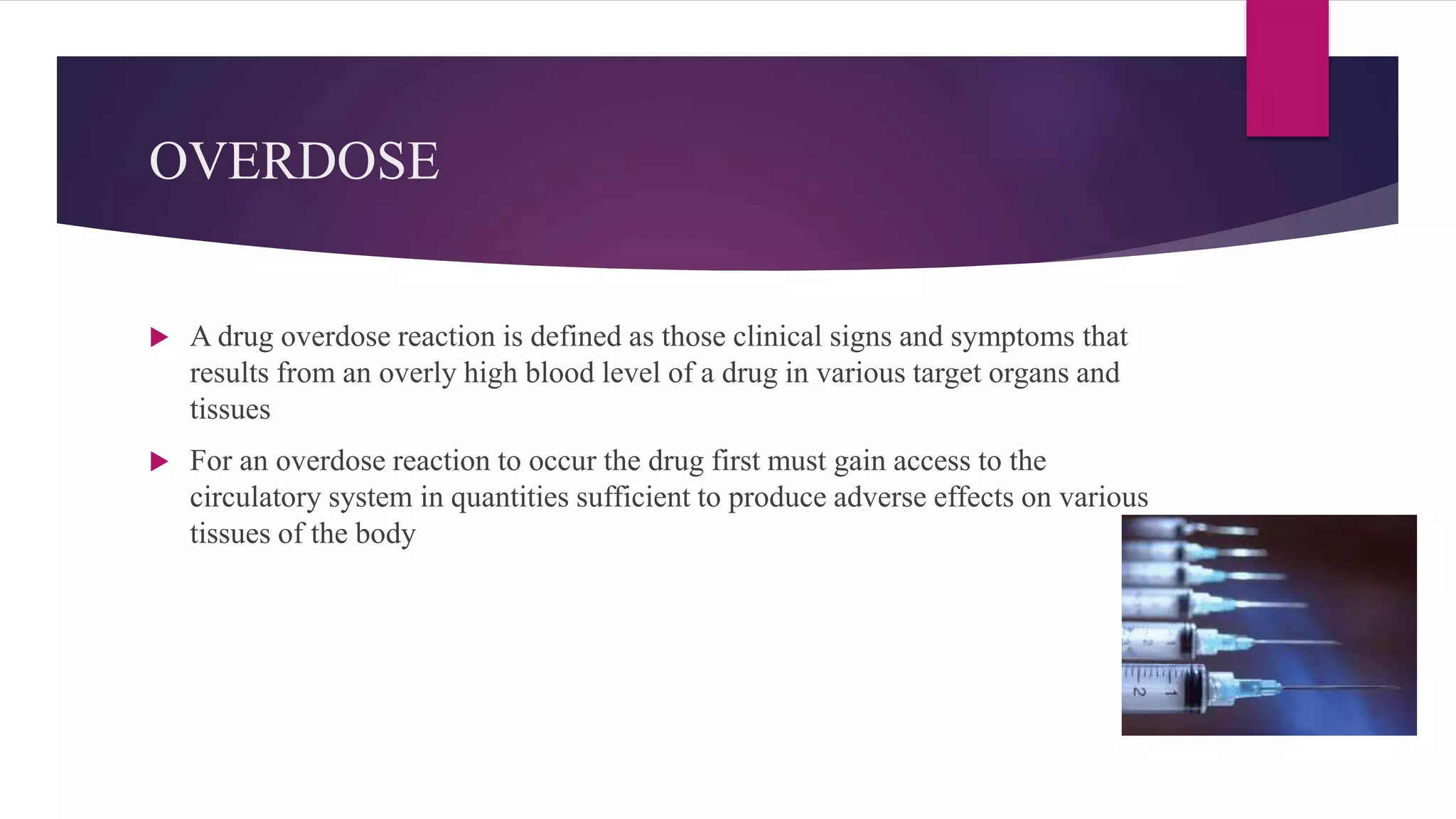
 A drug overdose reaction is defined as those clinical signs and symptoms that
results from an overly high blood level of a drug in various target organs and
tissues
 For an overdose reaction to occur the drug first must gain access to the
circulatory system in quantities sufficient to produce adverse effects on various
tissues of the body
PREDISPOSING FACTORS
Patient factors
 Age
 Weight
 Other drugs
 Sex
 Presence of disease
 Genetics
 Mental attitude and environment
Drug factors
 Vasoactivity
 Concentration
 Dose
 Route of administration
 Rate of injection
 Vascularity of injection site
 Presence of vasoconstrictors
MILD TO MODERATE OVERDOSE
LEVELS
SIGNS
Talkativeness
Apprehension
Elevated blood pressure , heart rate , respiratory rate
Excitability
Slurred speech
Twitching and tremor
Euphoria
Dysarthria
Nystagmus
Sweating
Vomiting
Disorientation
MODERATE TO HIGH OVERDOSE
LEVELS
SIGNS
Tonic-clonic seizure activity followed by
 generalized central nervous system depression
 depressed blood pressure, heart rate , respiratory rate
SYMPTOMS ( PROGRESSIVE WITH
INCREASING BLOOD LEVELS)
 Lightheadedness
 Dizziness
 Nervousness
 Numbness
 Metallic taste
 Visual disturbances
 Auditory disturbances
 Drowsiness and disorientation
 Loss of consciousness
MAXIMUM RECOMMENDED DOSAGE OF LA
ARTICAINE 7.0
LIDOCAINE PLAIN 4.4
MEPIVACAINE 4.4
PRILOCAINE 6.0
BUPIVACAINE 1.3
LIDOCAINE WITH EPINEPHRINE 7.0
DRUG RECOMMEN
DED mg/kg
LOCAL ANESTHETIC BLOOD LEVELS
CARDIOVASCULAR SYSTEM
normal blood level after intraoral injection
No cardiovascular actions
1.8-5.0 antidysrhythmic actions , tachycardia
5.0-10.0 ECG alterations , myocardial
depression , peripheral vasodilation
10.0+ massive peripheral vasodilation
Intensive myocardial depression
cardiac arrest
CENTRAL NERVOUS SYSTEM
Normal blood level after intraoral injection
0.5-4.0 ( Anticonvulsant actions)
4.5-7.0 CNS depression manifest as excitation , agitation,
irritability
7.5-10.0 CNS depression manifest as tonic clonic seizures
10.0+ generalized CNS depression
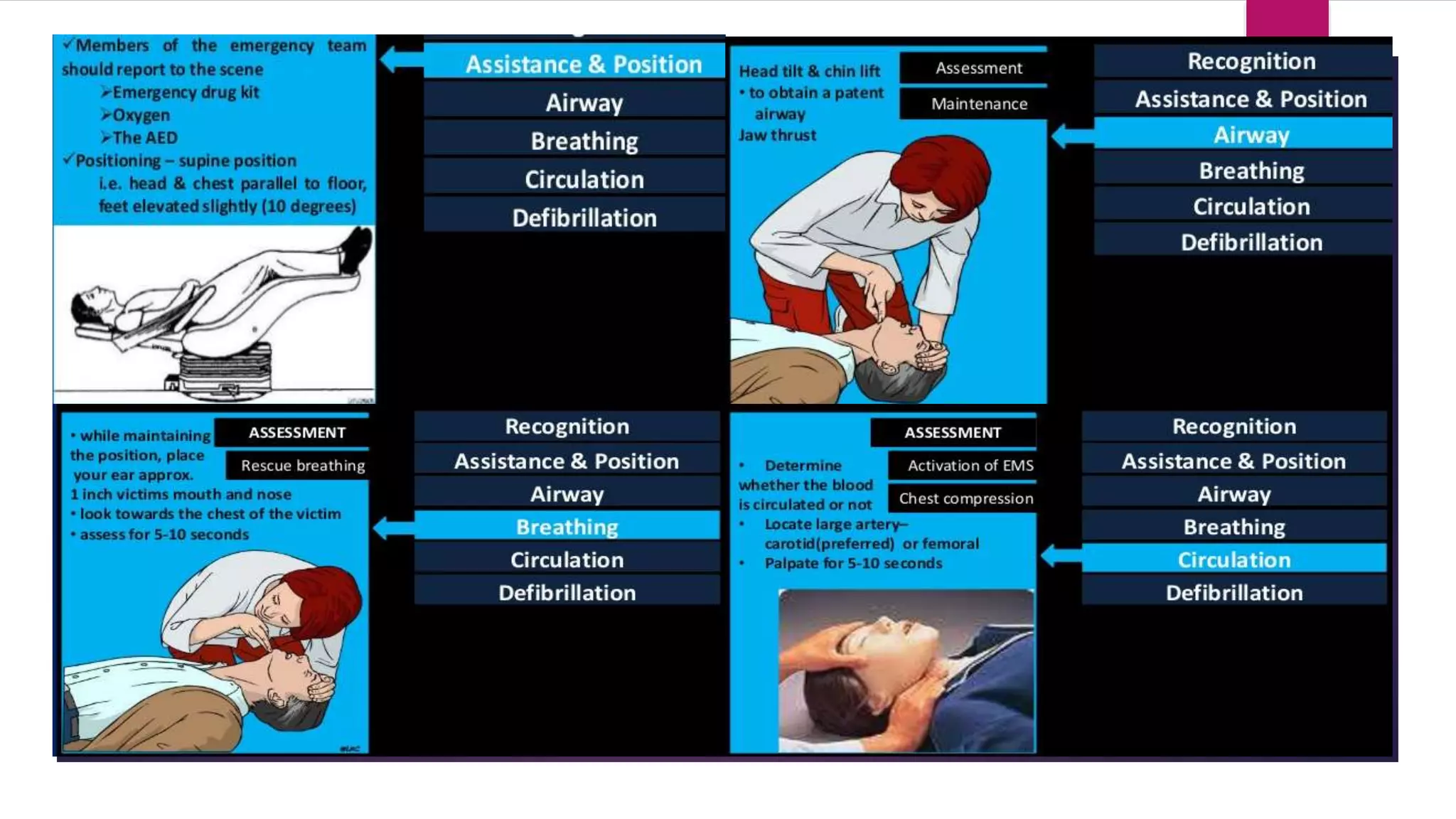
BASIC EMERGENCY MANAGEMENT
P … POSITION
unconscious - supine with feet elevated
conscious - based on patient comfort
A…. AIRWAY
unconscious -assess and maintain airway
conscious – assess airway
B…..BREATHING
unconscious - assess and ventilate if necessary
conscious - asses breathing
C….CIRCULATION
unconsciouss -external cardiac compression if necessary
conscious -asses circulation
D…..DEFINITE CARE – diagnosis , management (emergency medicines)
MANAGEMENT
 MILD OVERDOSE REACTION
Slow onset (>5minutes after administration) - slow absorption and rapid absorption
Slower onset (>15minutes after administration) - abnormal biotranformation & renal dysfunction
P – A – B – C – D for all medical emergency
Definitive care
1. Reassure the patient
2. Administer oxygen
3. Monitor vital signs
4. Administer anticonvulsant(midazolam)
 Severe overdose reactions
Rapid onset(within 1 minute)-loss of consciousness with or without convulsion
severe onset( 5 to 15 minutes)-rapid absorption , biotransformation , renal dysfunction
P – A – B – C
Definitive care
1. Protect the patient arms , legs, head
2. Immediately call emergency medical assistance
3. BLS
4. Maintain airway ventilation
5. Administer anticonvulsant
6. IM OR IV administration
ALLERGY
 Allergy is a hypersensitive state acquired through a exposure of a
particular allergen it long lasts for 48 hours from immediate to life
threatening reactions developing within seconds of exposure
PREDISPOSING FACTORS
 Ester type local anesthetics(procaine , benzocaine ,tetracaine)
 Sodium bisulfite allergy
 Epinephrine allergy
 Latex allergy
 Topical anesthetic allergy( benzocaine, tetracaine)
Type 1 anaphylactic(IgE)
ANAPHYLAXIS( DRUGS )
BRONCHIAL ASTHMA
ALLERGIC RHINITIS
URTICARIA
ANGIOEDEMA
HAY FEVER
Type 2 cytotoxic(IgG,IgM)
TRANSFUSION REACTION
AUTOIMMUNE HAEMOLYSIS
HEMOLYTIC ANAEMIA
CERTAIN DRUG REACTIONS
GLOMERULONEPHRITIS
GOODPASTURES SYNDROME
Type 3 immune complex(IgG)
SERUM SICKNES
LUPUS NEPHRITIS
ALLERGIC ALVEOLITIS
VIRAL HEPATITIS
Type 4 cell mediated
ALLERGIC CONTACT DERMATITIS
INFECTIOUS GRANULOMA
TISSUE GRAFT REJECTION
CHRONIC HEPATITIS
SIGNS AND SYMPTOMS
SKIN REACTIONS
 Itching (pruritis)
 Flushing (erythema)
 Urticaria
 Nausea and vomiting
 Conjunctivitis
 rhinitis
SKIN RESPONSE TO SMOOTH
MUSCLE SPASM
 Abdominal cramps
 Diarrhoea
 Urinary incontinence
 Nausea and vomiting
RESPIRATORY SYSTEM
 Substernal tightness or pain in chest
 Cough
 Bronchospasm
 Dyspnea
 Cyanosis
 Laryngeal edema
CARDIOVASCULAR SYSTEM
 Pallor
 Lightheadedness
 Tachycardia
 Hypotension
 Cardiac dysrhythmias
 Unconsciousness
 Cardiac arrest
MANAGEMENT
 Delayed skin reaction
 Immediate skin reaction
 Respiratory reactions
 Generalized anaphylaxis
P – A – B - C
DEFINITIVE CARE
 Administer oral histamine blockers
 IM IV
 Monitor vital signs
 Administer oxygen(bronchospasm)
 Cricothyrotomy(laryngeal edema)
 Activate EMS(emergency medical service)
administer epinephrine
IDIOSYNCRASY
 Any reaction to a LA agent or any other drug that cannot be classified as allergic or
toxic reaction is often called as idiosyncrasy
 Also used to describe a qualitatively abnormal unexpected response to a drug
differing from its pharmacological actions and thus resembling hypersensitivity
PREVENTION
 Pre anesthetic evaluation
 Precautions to the patients from injury
 Psychotherapy
 Pre medication
MANAGEMENT
 Supine position with legs slightly elevated
 Maintainence of airway
 Adequate O2 supply
 Evaluate circulation
 Administer parenteral fluids
CONCLUSION
Systemic complication associated with LA drug administration can be prevented by
 Medical evaluation should be done before administering LA
 All dental injections should be administered in patients supine position
 Topical anesthetic should be applied before injections for a minimum of 1minute
 Vasoconstrictors should be included in all local anesthetics
 Observe the patient during and after anesthetic administration for signs and symptoms of
undesirable reaction
 The anesthetic solution selected should be appropriate for particular dental
treatment(duration of action)

systemic complications.pptx

  • 1.
  • 2.
    CONTENTS  Introduction  Systemiccomplication  Overdosage  Allergy  Idiosyncrasy  Conclusion
  • 3.
    INTRODUCTION Drugs have 2types of effect when administered Desirable=actions may be sought beneficial Undesirable =actions may not be beneficial not sought  THREE PRINCIPLES OF DRUG 1. No drug ever exerts a single action 2. No clinically useful drug is entirely devoid of toxicity 3. The potential toxicity of a drug rests in the hand of user
  • 4.
    SYSTEMIC COMPLICATIONS The adversereaction which occurs in the body as a side effect of adverse experiences , drug induced disease , disease of medical progress , secondary effects of a drug and intolerance Three major methods by which drug produce adverse reactions 1. Overdosage 2. Allergy 3. Idiosyncrasy
  • 5.
    OVERDOSE  A drugoverdose reaction is defined as those clinical signs and symptoms that results from an overly high blood level of a drug in various target organs and tissues  For an overdose reaction to occur the drug first must gain access to the circulatory system in quantities sufficient to produce adverse effects on various tissues of the body
  • 6.
    PREDISPOSING FACTORS Patient factors Age  Weight  Other drugs  Sex  Presence of disease  Genetics  Mental attitude and environment Drug factors  Vasoactivity  Concentration  Dose  Route of administration  Rate of injection  Vascularity of injection site  Presence of vasoconstrictors
  • 7.
    MILD TO MODERATEOVERDOSE LEVELS SIGNS Talkativeness Apprehension Elevated blood pressure , heart rate , respiratory rate Excitability Slurred speech Twitching and tremor Euphoria Dysarthria Nystagmus Sweating Vomiting Disorientation
  • 8.
    MODERATE TO HIGHOVERDOSE LEVELS SIGNS Tonic-clonic seizure activity followed by  generalized central nervous system depression  depressed blood pressure, heart rate , respiratory rate
  • 9.
    SYMPTOMS ( PROGRESSIVEWITH INCREASING BLOOD LEVELS)  Lightheadedness  Dizziness  Nervousness  Numbness  Metallic taste  Visual disturbances  Auditory disturbances  Drowsiness and disorientation  Loss of consciousness
  • 10.
    MAXIMUM RECOMMENDED DOSAGEOF LA ARTICAINE 7.0 LIDOCAINE PLAIN 4.4 MEPIVACAINE 4.4 PRILOCAINE 6.0 BUPIVACAINE 1.3 LIDOCAINE WITH EPINEPHRINE 7.0 DRUG RECOMMEN DED mg/kg
  • 11.
    LOCAL ANESTHETIC BLOODLEVELS CARDIOVASCULAR SYSTEM normal blood level after intraoral injection No cardiovascular actions 1.8-5.0 antidysrhythmic actions , tachycardia 5.0-10.0 ECG alterations , myocardial depression , peripheral vasodilation 10.0+ massive peripheral vasodilation Intensive myocardial depression cardiac arrest CENTRAL NERVOUS SYSTEM Normal blood level after intraoral injection 0.5-4.0 ( Anticonvulsant actions) 4.5-7.0 CNS depression manifest as excitation , agitation, irritability 7.5-10.0 CNS depression manifest as tonic clonic seizures 10.0+ generalized CNS depression
  • 12.
    BASIC EMERGENCY MANAGEMENT P… POSITION unconscious - supine with feet elevated conscious - based on patient comfort A…. AIRWAY unconscious -assess and maintain airway conscious – assess airway B…..BREATHING unconscious - assess and ventilate if necessary conscious - asses breathing C….CIRCULATION unconsciouss -external cardiac compression if necessary conscious -asses circulation D…..DEFINITE CARE – diagnosis , management (emergency medicines)
  • 14.
    MANAGEMENT  MILD OVERDOSEREACTION Slow onset (>5minutes after administration) - slow absorption and rapid absorption Slower onset (>15minutes after administration) - abnormal biotranformation & renal dysfunction P – A – B – C – D for all medical emergency Definitive care 1. Reassure the patient 2. Administer oxygen 3. Monitor vital signs 4. Administer anticonvulsant(midazolam)
  • 15.
     Severe overdosereactions Rapid onset(within 1 minute)-loss of consciousness with or without convulsion severe onset( 5 to 15 minutes)-rapid absorption , biotransformation , renal dysfunction P – A – B – C Definitive care 1. Protect the patient arms , legs, head 2. Immediately call emergency medical assistance 3. BLS 4. Maintain airway ventilation 5. Administer anticonvulsant 6. IM OR IV administration
  • 16.
    ALLERGY  Allergy isa hypersensitive state acquired through a exposure of a particular allergen it long lasts for 48 hours from immediate to life threatening reactions developing within seconds of exposure
  • 17.
    PREDISPOSING FACTORS  Estertype local anesthetics(procaine , benzocaine ,tetracaine)  Sodium bisulfite allergy  Epinephrine allergy  Latex allergy  Topical anesthetic allergy( benzocaine, tetracaine)
  • 18.
    Type 1 anaphylactic(IgE) ANAPHYLAXIS(DRUGS ) BRONCHIAL ASTHMA ALLERGIC RHINITIS URTICARIA ANGIOEDEMA HAY FEVER
  • 19.
    Type 2 cytotoxic(IgG,IgM) TRANSFUSIONREACTION AUTOIMMUNE HAEMOLYSIS HEMOLYTIC ANAEMIA CERTAIN DRUG REACTIONS GLOMERULONEPHRITIS GOODPASTURES SYNDROME
  • 20.
    Type 3 immunecomplex(IgG) SERUM SICKNES LUPUS NEPHRITIS ALLERGIC ALVEOLITIS VIRAL HEPATITIS
  • 21.
    Type 4 cellmediated ALLERGIC CONTACT DERMATITIS INFECTIOUS GRANULOMA TISSUE GRAFT REJECTION CHRONIC HEPATITIS
  • 22.
    SIGNS AND SYMPTOMS SKINREACTIONS  Itching (pruritis)  Flushing (erythema)  Urticaria  Nausea and vomiting  Conjunctivitis  rhinitis SKIN RESPONSE TO SMOOTH MUSCLE SPASM  Abdominal cramps  Diarrhoea  Urinary incontinence  Nausea and vomiting
  • 23.
    RESPIRATORY SYSTEM  Substernaltightness or pain in chest  Cough  Bronchospasm  Dyspnea  Cyanosis  Laryngeal edema CARDIOVASCULAR SYSTEM  Pallor  Lightheadedness  Tachycardia  Hypotension  Cardiac dysrhythmias  Unconsciousness  Cardiac arrest
  • 24.
    MANAGEMENT  Delayed skinreaction  Immediate skin reaction  Respiratory reactions  Generalized anaphylaxis P – A – B - C
  • 25.
    DEFINITIVE CARE  Administeroral histamine blockers  IM IV  Monitor vital signs  Administer oxygen(bronchospasm)  Cricothyrotomy(laryngeal edema)  Activate EMS(emergency medical service) administer epinephrine
  • 26.
    IDIOSYNCRASY  Any reactionto a LA agent or any other drug that cannot be classified as allergic or toxic reaction is often called as idiosyncrasy  Also used to describe a qualitatively abnormal unexpected response to a drug differing from its pharmacological actions and thus resembling hypersensitivity PREVENTION  Pre anesthetic evaluation  Precautions to the patients from injury  Psychotherapy  Pre medication
  • 27.
    MANAGEMENT  Supine positionwith legs slightly elevated  Maintainence of airway  Adequate O2 supply  Evaluate circulation  Administer parenteral fluids
  • 28.
    CONCLUSION Systemic complication associatedwith LA drug administration can be prevented by  Medical evaluation should be done before administering LA  All dental injections should be administered in patients supine position  Topical anesthetic should be applied before injections for a minimum of 1minute  Vasoconstrictors should be included in all local anesthetics  Observe the patient during and after anesthetic administration for signs and symptoms of undesirable reaction  The anesthetic solution selected should be appropriate for particular dental treatment(duration of action)