Systems
Analysis Laboratory
Helsinki University of Technology 1
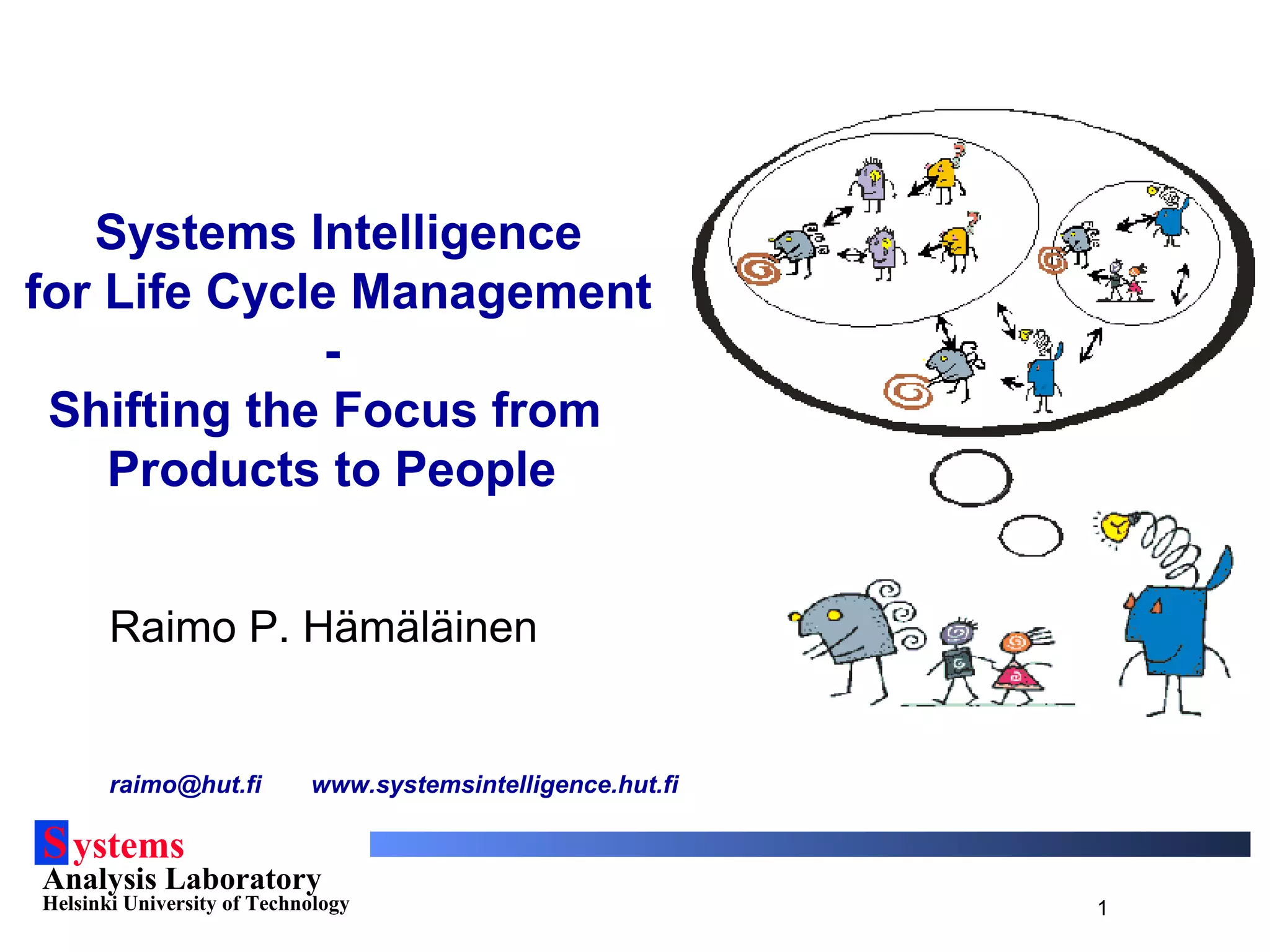
Systems Intelligence
for Life Cycle Management
-
Shifting the Focus from
Products to People
Raimo P. Hämäläinen
raimo@hut.fi www.systemsintelligence.hut.fi
Systems
Analysis Laboratory
Helsinki University of Technology 2
Disciplines for coping with
complexity
Operation Research / Management Science /
Systems Analysis
Develop generic tools and methods for
structured problem solving and decision
support.
The “Science of Better”
Goals: Improve problem solving by learning,
understanding and communication
Based on a systems thinking perspective
Systems
Analysis Laboratory
Helsinki University of Technology 3
Multi-Criteria Decision Analysis
(MCDA)
Transparency in decision making
– Integrated management of
objective data and subjective values
– Incorporation of risks and uncertainty
Well developed theory
Textbooks e.g.Belton, Stewart 2002; French et al. 2009
Increasingly used in environmental management
Introduced into Life Cycle Assessment literature
in the late 1990’s ( Miettinen, Hämäläinen 1997)
Systems
Analysis Laboratory
Helsinki University of Technology 4
Steps in MCDA
• Problem structuring
• Value focused thinking
• Identification of objectives and alternatives
• Interactive preference elicitation
• Composition of overall preferences and rankings
• Sensitivity analysis – what if
Result: Transparent recommendation
Tools and e-learning material available on the web:
www.decisionarium.hut.fi
Systems
Analysis Laboratory
Helsinki University of Technology 5
Todays Topic
Systems Thinking in LCM
New lens:
Systems Intelligence (SI)
LCM is a systems approach
Shifting the focus from products to people makes
human thinking the driver for improvement
SI + LCM = Ecological Intelligence
Key perspective in Environmental Leadership
Systems
Analysis Laboratory
Helsinki University of Technology 6
Systems Intelligence
(Hämäläinen and Saarinen, 2004)
• Intelligent behaviour in the context of complex
systems involving interaction,dynamics and
feedback
• Combines human sensitivities with
engineering thinking
• Pursuing the idea of making things work
Systems
Analysis Laboratory
Helsinki University of Technology 7
Systems Intelligence
A person with Systems Intelligence
understands that she is always part of a
system in her environment
• She perceives herself as part of the whole
- her own influence upon the whole
- the influence of the whole upon herself
- she realizes that others in the system can
have different views of the whole
- she is able to act intelligently in the system
Systems
Analysis Laboratory
Helsinki University of Technology 8
The SI perspective
• Helps to identify productive forms of action
• It is a competence that can be improved by
learning
• Systems Intelligence is a basic form of
human intelligence
Systems
Analysis Laboratory
Helsinki University of Technology 9
Multiple Intelligences
(Howard Gardner 1983)
• Linguistic
• Musical
• Logical-Mathematical
• Spatial
• Bodily-Kinesthetic
• The Personal Intelligences – intra / inter
• Plus higher-level cognitive capacities e.g.
common sense and wisdom
Systems
Analysis Laboratory
Helsinki University of Technology 10
SI and Multiple Intelligences
• Systems Intelligence is another higher level
cognitive capacity
• SI links intelligence with the concept of
system and systemic thinking
• SI embedds Social and Emotional intelligence
(Goleman 1995, 2006)
• Systems Intelligence is a survival asset we
have as a species
Systems
Analysis Laboratory
Helsinki University of Technology 11
SI relates to
• Systems Thinking
(Churchman 1968, Senge 1990,Checkland 1999,Jackson 2003)
• Organizational theories and Action research
(Argylis, Schön , Schein ,Bohm 1980, Isaacs 1999)
• Philosophy, Socratic tradition for thinking for good life
• Positive psychology
(Bateson 2000, Goffman 1974, Seligman 2002)
• Theories of decision making and problem solving
(Simon 1956, Keeney 1992, Kahneman, Tversky 2000)
Systems
Analysis Laboratory
Helsinki University of Technology 12
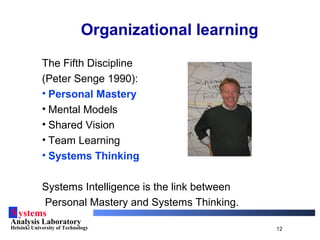
Organizational learning
The Fifth Discipline
(Peter Senge 1990):
• Personal Mastery
• Mental Models
• Shared Vision
• Team Learning
• Systems Thinking
Systems Intelligence is the link between
Personal Mastery and Systems Thinking.
Systems
Analysis Laboratory
Helsinki University of Technology 13
Systems Thinking
• Emphasizes the importance of wholes and
perspectives
• Models systems of interaction from outside
• Can become a trap when one only sees the
system from outside and does not
recognize herself being an active player in the
system
Systems
Analysis Laboratory
Helsinki University of Technology 14
Characteristics of systems
• Whole is more than the sum of its parts
• “Whole” and “Part” are relative abstractions
• Always subject to redefinition by changing the
perspective
Systems
Analysis Laboratory
Helsinki University of Technology 15
How we see systems
determines the model
• Beliefs about needs and goals
• Framing: costs or benefits
• Boundaries: fixed or flexible
• Alternatives: fixed or flexible
• Values: fixed or evolving and constructed in
the context.
Systems
Analysis Laboratory
Helsinki University of Technology 16
Systems can take over
• People can get caught in systems that serve
nobody’s interests
• People can feel helpless regarding their
possibilities of changing the system
• People react to the system without seeing
their effect on the whole
Systems
Analysis Laboratory
Helsinki University of Technology 17
Systems Intelligence
• Becomes a challenge for personal learning
• Trusts that people can influence complex
systems
• The theoretical understanding of Systems
Thinking need not increase Systems
Intelligence
Systems
Analysis Laboratory
Helsinki University of Technology 18
1. What does the system generate – and to what
extent is this what we want?
2. How does the system mold us as human
beings?
3. What kind of in-between does the system
endorse?
Ask first the System Questions
Systems
Analysis Laboratory
Helsinki University of Technology 19
Change is not easy
• Mental change
• Perceptual change
• Individual behavioural change
• Change in the system
Systems
Analysis Laboratory
Helsinki University of Technology 20
Thinking about thinking
• Key to learning Systems Intelligence
• One’s actions are a function of one’s thinking
(mental models, beliefs, assumptions,
interpretations, etc.)
• Challenge my mental models by meta-level
thinking regarding my own thinking
Systems
Analysis Laboratory
Helsinki University of Technology 21
Invisible system
• We often perceive systems only through a
mechanistic perspective
• We see materials, products and costs
When people are considered:
– the true system often includes hidden
subsystems
– such as processes of trust or fear generation
Systems
Analysis Laboratory
Helsinki University of Technology 22
Seeing oneself in the system
• With the eyes of the others
• The impact of my behaviour upon the
behaviours of others
• The impact of the current system on all of
us
Systems
Analysis Laboratory
Helsinki University of Technology 23
Managing the invisible
• To understand the system, it can be more
important to know what is not produced than
what the standard output is
• SI tries to understand both the visible and the
invisible part
Systems
Analysis Laboratory
Helsinki University of Technology 24
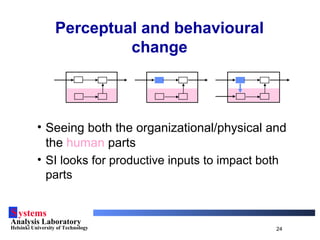
Perceptual and behavioural
change
• Seeing both the organizational/physical and
the human parts
• SI looks for productive inputs to impact both
parts
Systems
Analysis Laboratory
Helsinki University of Technology 25
Change in the system
• People adjust to systems instinctively.
• If a system is changed, people also change
their behaviours. This leads to further change
• A small change in my behaviour might trigger
a chain of changes in the behaviours of
others
Systems
Analysis Laboratory
Helsinki University of Technology 26
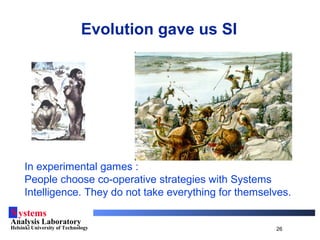
In experimental games :
People choose co-operative strategies with Systems
Intelligence. They do not take everything for themselves.
Evolution gave us SI
Systems
Analysis Laboratory
Helsinki University of Technology 27
1. Seeing oneself in the System – Ability to see ones roles and
behaviour in the system. Also through the eyes of other people and
with different framings of the system. Systems thinking awareness.
2. Thinking about Systems Intelligence – Ability to envision
and identify productive ways of behaviour for oneself in the system
and understanding systemic possibilities.
3. Managing Systems Intelligence – Ability to personally work
with systems intelligence.
4. Sustaining Systems Intelligence – Ability to continue and
foster systems intelligence in the long run .
5. Leadership with Systems Intelligence – Ability to initiate
and create systems intelligence culture in one’s organization.
5 step ladder of SI
Systems
Analysis Laboratory
Helsinki University of Technology 28
So What?
Is there a role for
Systems Intelligence in LCM?
Systems
Analysis Laboratory
Helsinki University of Technology 29
LCA is Systems Thinking
• Describes a product system and assesses
the inventories and impacts.
• LCA is not enough
• The Systems Thinking trap lurks in LCA.
• Life Cycle Management takes LCA into action
Systems
Analysis Laboratory
Helsinki University of Technology 30
Life Cycle Management
(UNEP/SETAC LMC Definition Study 2003)
Integration of
life cycle perspective and economic, social,
environmental considerations
into overall
strategy, planning and decision making of
organization’s product portfolio
System oriented platform
Improvement and sustainability driver
Systems
Analysis Laboratory
Helsinki University of Technology 31
The system questions
• What does a product system produce?
- satisfaction of needs – what else?
- environmental costs – is this what we want?
• How does the product system mold us?
• How does the product system influence
our in - between?
- does it endorse environmental responsibility
and sustainability culture
Systems
Analysis Laboratory
Helsinki University of Technology 32
Happiness as an indicator in LCA
(Hofstetter, Madjau, Ozawa, 2006)
Does the system produce happiness ?
A weighted sum of happiness enhancers and
rebound effects?
• set achievable important non-materialistic
goals (weight = 2.5)
• become an outgoing personality (1.5)
• focus beyond self (1)
• ……….
But - happiness is systemic
Systems
Analysis Laboratory
Helsinki University of Technology 33
Systems can take over
• People can be caught in environmentally
harmful systems that serve nobody’s interests
• People in the system can feel helpless
regarding their possibilities of changing the
system
• We live in consumption systems without
seeing the cumulative overall effects
Systems
Analysis Laboratory
Helsinki University of Technology 34
Social Life Cycle Management
• Impact categories are expanded
• Social evaluation of companies is not enough
• Expanding the product / service system
boundary with a social perspective?
–involve the stakeholders
–re-evaluate needs
Systems
Analysis Laboratory
Helsinki University of Technology 35
Stakeholder involvement with SI
• Invisible elements, emotions / trust are
important in the process
• The way people are encountered can be
more influential than the issue itself
• Dialogue not conflict resolution
• Beliefs about the expected beliefs and goals
of others do matter
Systems
Analysis Laboratory
Helsinki University of Technology 36
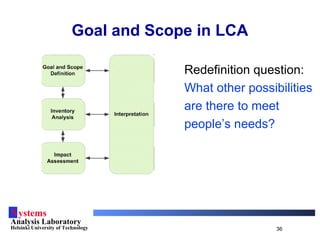
Redefinition question:
What other possibilities
are there to meet
people’s needs?
Goal and Scope in LCA
Systems
Analysis Laboratory
Helsinki University of Technology 37
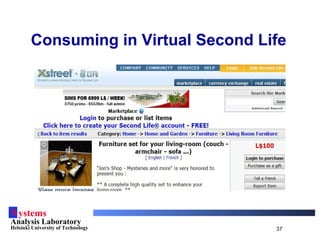
Consuming in Virtual Second Life
Systems
Analysis Laboratory
Helsinki University of Technology 38
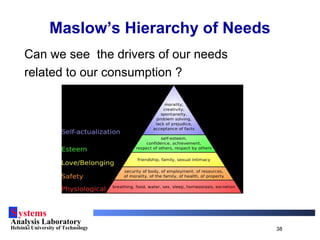
Can we see the drivers of our needs
related to our consumption ?
Maslow’s Hierarchy of Needs
Systems
Analysis Laboratory
Helsinki University of Technology 39
Invisible systems
• What is not produced (happiness /sustainability)
can be more important than the material output of
the products system
• The process of achieving a social goal can
matter more than the end product:
-buying a bread or home baking the bread
Systems
Analysis Laboratory
Helsinki University of Technology 40
• My priorities in the satisfaction of needs over my
own life
• Rethinking values can lead to revision of needs
= a change in the system
• Where can I make value based trade-offs?
• Can I learn to manage consumption in a more
sustainable way
• Change is not easy
Personal Life Cycle Management
Systems
Analysis Laboratory
Helsinki University of Technology 41
1. Seeing oneself in the Environmental System – Ability to
see ones impacts on the environment. Environmental awareness.
2. Thinking about Environmental Systems Intelligence –
Ability to envision changes in one’s consumption
3. Managing Environmental Systems Intelligence – Ability to
personally change consumption patterns.
4. Sustaining Environmental Systems Intelligence – Ability
to continue personal systems intelligent LCM in the long run .
5. Leadership with Environmental Systems Intelligence –
Ability to initiate and create systems intelligent LCM culture in ones
social network/ organinzation.
5 Levels of SI in personal LCM
Systems
Analysis Laboratory
Helsinki University of Technology 42
• Underlying philosophy in Life Cycle Thinking?
• Awareness of SI makes people want to have
more of it
• It is systems intelligent for companies and
people to use LCM
• Formula for Ecological Intelligence:
EI = SI + LCM
Systems Intelligence in LCM
Systems
Analysis Laboratory
Helsinki University of Technology 43
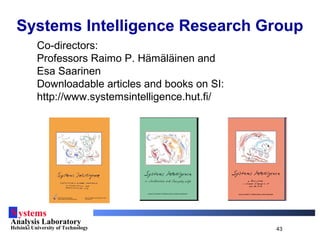
Systems Intelligence Research Group
Co-directors:
Professors Raimo P. Hämäläinen and
Esa Saarinen
Downloadable articles and books on SI:
http://www.systemsintelligence.hut.fi/
Systems
Analysis Laboratory
Helsinki University of Technology 44
References
Belton Valerie and Stewart Theodor J. 2002. Multiple Criteria Analysis, An
Integrated Approach. Massachusetts, Kluwer
Churchman C. West. 1968. The Systems Approach. New York, Delta
French Simon, Maule John and Papamichail Nadia. 2009. Decision
Behaviour, Analysis and Support. Cambridge, University Press
Gardner Howard. 1983. Frames of Mind: The Theory of Multiple
Intelligences, Tenth anniversary edition. New York, Basic Books
Griesshammer Rainer et al. 2006. Feasibility Study: Integration of Social
Aspects into LCA, UNEP-SETAC
Goleman Daniel. 1995. Emotional Intelligence, New York, Bantam Books
Systems
Analysis Laboratory
Helsinki University of Technology 45
References
Goleman Daniel. 2006. Social Intelligence, London, Hutchinson
Goleman Daniel. 2009. Ecological Intelligence, Bantam
Hofstetter Patrick, Madjar Michael and Ozawa Toshisuke. 2006.
Happiness and Sustainable Consumption, Int J LCA 11, Special Issue 1,
Ecomed Publishers
Hämäläinen Raimo P. and Saarinen Esa (Eds.). 2004b. Systems
Intelligence - Discovering a Hidden Competence in Human Action and
Organizational Life, Helsinki University of Technology, Systems Analysis
Laboratory Research Reports, A88, October 2004
Jackson Michael C. 2000. Systems Approaches to Management, New
York, Kluwer
Systems
Analysis Laboratory
Helsinki University of Technology 46
References
Keeney Ralph L. 1992. Value-Focused Thinking: A Path to Creative
Decisionmaking, Cambridge, Harvard University Press
Miettinen Pauli and Hämäläinen Raimo P. 1997. How to Benefit from
Decision Analysis in Environmental Life Cycle Assessment (LCA), European
Journal of Operational Research 102, Elsevier
Miettinen Pauli and Hämäläinen Raimo P. 1999. Indexes for Fixed and
Feasible Environmental Target Setting: a Decision Analytical Perspective,
International Journal of Environment and Pollution 12, Nos.2/3.
Saur Kondrad et al. 2003. LMC Definition Study, UNEP/SETAC Life Cycle
Initiative
Senge Peter. 1990. The Fifth Discipline: The Art and Practice of the
Learning Organization, New York, Doubleday Currency

System thinking

  • 1.
    Systems Analysis Laboratory Helsinki Universityof Technology 1 Systems Intelligence for Life Cycle Management - Shifting the Focus from Products to People Raimo P. Hämäläinen raimo@hut.fi www.systemsintelligence.hut.fi
  • 2.
    Systems Analysis Laboratory Helsinki Universityof Technology 2 Disciplines for coping with complexity Operation Research / Management Science / Systems Analysis Develop generic tools and methods for structured problem solving and decision support. The “Science of Better” Goals: Improve problem solving by learning, understanding and communication Based on a systems thinking perspective
  • 3.
    Systems Analysis Laboratory Helsinki Universityof Technology 3 Multi-Criteria Decision Analysis (MCDA) Transparency in decision making – Integrated management of objective data and subjective values – Incorporation of risks and uncertainty Well developed theory Textbooks e.g.Belton, Stewart 2002; French et al. 2009 Increasingly used in environmental management Introduced into Life Cycle Assessment literature in the late 1990’s ( Miettinen, Hämäläinen 1997)
  • 4.
    Systems Analysis Laboratory Helsinki Universityof Technology 4 Steps in MCDA • Problem structuring • Value focused thinking • Identification of objectives and alternatives • Interactive preference elicitation • Composition of overall preferences and rankings • Sensitivity analysis – what if Result: Transparent recommendation Tools and e-learning material available on the web: www.decisionarium.hut.fi
  • 5.
    Systems Analysis Laboratory Helsinki Universityof Technology 5 Todays Topic Systems Thinking in LCM New lens: Systems Intelligence (SI) LCM is a systems approach Shifting the focus from products to people makes human thinking the driver for improvement SI + LCM = Ecological Intelligence Key perspective in Environmental Leadership
  • 6.
    Systems Analysis Laboratory Helsinki Universityof Technology 6 Systems Intelligence (Hämäläinen and Saarinen, 2004) • Intelligent behaviour in the context of complex systems involving interaction,dynamics and feedback • Combines human sensitivities with engineering thinking • Pursuing the idea of making things work
  • 7.
    Systems Analysis Laboratory Helsinki Universityof Technology 7 Systems Intelligence A person with Systems Intelligence understands that she is always part of a system in her environment • She perceives herself as part of the whole - her own influence upon the whole - the influence of the whole upon herself - she realizes that others in the system can have different views of the whole - she is able to act intelligently in the system
  • 8.
    Systems Analysis Laboratory Helsinki Universityof Technology 8 The SI perspective • Helps to identify productive forms of action • It is a competence that can be improved by learning • Systems Intelligence is a basic form of human intelligence
  • 9.
    Systems Analysis Laboratory Helsinki Universityof Technology 9 Multiple Intelligences (Howard Gardner 1983) • Linguistic • Musical • Logical-Mathematical • Spatial • Bodily-Kinesthetic • The Personal Intelligences – intra / inter • Plus higher-level cognitive capacities e.g. common sense and wisdom
  • 10.
    Systems Analysis Laboratory Helsinki Universityof Technology 10 SI and Multiple Intelligences • Systems Intelligence is another higher level cognitive capacity • SI links intelligence with the concept of system and systemic thinking • SI embedds Social and Emotional intelligence (Goleman 1995, 2006) • Systems Intelligence is a survival asset we have as a species
  • 11.
    Systems Analysis Laboratory Helsinki Universityof Technology 11 SI relates to • Systems Thinking (Churchman 1968, Senge 1990,Checkland 1999,Jackson 2003) • Organizational theories and Action research (Argylis, Schön , Schein ,Bohm 1980, Isaacs 1999) • Philosophy, Socratic tradition for thinking for good life • Positive psychology (Bateson 2000, Goffman 1974, Seligman 2002) • Theories of decision making and problem solving (Simon 1956, Keeney 1992, Kahneman, Tversky 2000)
  • 12.
    Systems Analysis Laboratory Helsinki Universityof Technology 12 Organizational learning The Fifth Discipline (Peter Senge 1990): • Personal Mastery • Mental Models • Shared Vision • Team Learning • Systems Thinking Systems Intelligence is the link between Personal Mastery and Systems Thinking.
  • 13.
    Systems Analysis Laboratory Helsinki Universityof Technology 13 Systems Thinking • Emphasizes the importance of wholes and perspectives • Models systems of interaction from outside • Can become a trap when one only sees the system from outside and does not recognize herself being an active player in the system
  • 14.
    Systems Analysis Laboratory Helsinki Universityof Technology 14 Characteristics of systems • Whole is more than the sum of its parts • “Whole” and “Part” are relative abstractions • Always subject to redefinition by changing the perspective
  • 15.
    Systems Analysis Laboratory Helsinki Universityof Technology 15 How we see systems determines the model • Beliefs about needs and goals • Framing: costs or benefits • Boundaries: fixed or flexible • Alternatives: fixed or flexible • Values: fixed or evolving and constructed in the context.
  • 16.
    Systems Analysis Laboratory Helsinki Universityof Technology 16 Systems can take over • People can get caught in systems that serve nobody’s interests • People can feel helpless regarding their possibilities of changing the system • People react to the system without seeing their effect on the whole
  • 17.
    Systems Analysis Laboratory Helsinki Universityof Technology 17 Systems Intelligence • Becomes a challenge for personal learning • Trusts that people can influence complex systems • The theoretical understanding of Systems Thinking need not increase Systems Intelligence
  • 18.
    Systems Analysis Laboratory Helsinki Universityof Technology 18 1. What does the system generate – and to what extent is this what we want? 2. How does the system mold us as human beings? 3. What kind of in-between does the system endorse? Ask first the System Questions
  • 19.
    Systems Analysis Laboratory Helsinki Universityof Technology 19 Change is not easy • Mental change • Perceptual change • Individual behavioural change • Change in the system
  • 20.
    Systems Analysis Laboratory Helsinki Universityof Technology 20 Thinking about thinking • Key to learning Systems Intelligence • One’s actions are a function of one’s thinking (mental models, beliefs, assumptions, interpretations, etc.) • Challenge my mental models by meta-level thinking regarding my own thinking
  • 21.
    Systems Analysis Laboratory Helsinki Universityof Technology 21 Invisible system • We often perceive systems only through a mechanistic perspective • We see materials, products and costs When people are considered: – the true system often includes hidden subsystems – such as processes of trust or fear generation
  • 22.
    Systems Analysis Laboratory Helsinki Universityof Technology 22 Seeing oneself in the system • With the eyes of the others • The impact of my behaviour upon the behaviours of others • The impact of the current system on all of us
  • 23.
    Systems Analysis Laboratory Helsinki Universityof Technology 23 Managing the invisible • To understand the system, it can be more important to know what is not produced than what the standard output is • SI tries to understand both the visible and the invisible part
  • 24.
    Systems Analysis Laboratory Helsinki Universityof Technology 24 Perceptual and behavioural change • Seeing both the organizational/physical and the human parts • SI looks for productive inputs to impact both parts
  • 25.
    Systems Analysis Laboratory Helsinki Universityof Technology 25 Change in the system • People adjust to systems instinctively. • If a system is changed, people also change their behaviours. This leads to further change • A small change in my behaviour might trigger a chain of changes in the behaviours of others
  • 26.
    Systems Analysis Laboratory Helsinki Universityof Technology 26 In experimental games : People choose co-operative strategies with Systems Intelligence. They do not take everything for themselves. Evolution gave us SI
  • 27.
    Systems Analysis Laboratory Helsinki Universityof Technology 27 1. Seeing oneself in the System – Ability to see ones roles and behaviour in the system. Also through the eyes of other people and with different framings of the system. Systems thinking awareness. 2. Thinking about Systems Intelligence – Ability to envision and identify productive ways of behaviour for oneself in the system and understanding systemic possibilities. 3. Managing Systems Intelligence – Ability to personally work with systems intelligence. 4. Sustaining Systems Intelligence – Ability to continue and foster systems intelligence in the long run . 5. Leadership with Systems Intelligence – Ability to initiate and create systems intelligence culture in one’s organization. 5 step ladder of SI
  • 28.
    Systems Analysis Laboratory Helsinki Universityof Technology 28 So What? Is there a role for Systems Intelligence in LCM?
  • 29.
    Systems Analysis Laboratory Helsinki Universityof Technology 29 LCA is Systems Thinking • Describes a product system and assesses the inventories and impacts. • LCA is not enough • The Systems Thinking trap lurks in LCA. • Life Cycle Management takes LCA into action
  • 30.
    Systems Analysis Laboratory Helsinki Universityof Technology 30 Life Cycle Management (UNEP/SETAC LMC Definition Study 2003) Integration of life cycle perspective and economic, social, environmental considerations into overall strategy, planning and decision making of organization’s product portfolio System oriented platform Improvement and sustainability driver
  • 31.
    Systems Analysis Laboratory Helsinki Universityof Technology 31 The system questions • What does a product system produce? - satisfaction of needs – what else? - environmental costs – is this what we want? • How does the product system mold us? • How does the product system influence our in - between? - does it endorse environmental responsibility and sustainability culture
  • 32.
    Systems Analysis Laboratory Helsinki Universityof Technology 32 Happiness as an indicator in LCA (Hofstetter, Madjau, Ozawa, 2006) Does the system produce happiness ? A weighted sum of happiness enhancers and rebound effects? • set achievable important non-materialistic goals (weight = 2.5) • become an outgoing personality (1.5) • focus beyond self (1) • ………. But - happiness is systemic
  • 33.
    Systems Analysis Laboratory Helsinki Universityof Technology 33 Systems can take over • People can be caught in environmentally harmful systems that serve nobody’s interests • People in the system can feel helpless regarding their possibilities of changing the system • We live in consumption systems without seeing the cumulative overall effects
  • 34.
    Systems Analysis Laboratory Helsinki Universityof Technology 34 Social Life Cycle Management • Impact categories are expanded • Social evaluation of companies is not enough • Expanding the product / service system boundary with a social perspective? –involve the stakeholders –re-evaluate needs
  • 35.
    Systems Analysis Laboratory Helsinki Universityof Technology 35 Stakeholder involvement with SI • Invisible elements, emotions / trust are important in the process • The way people are encountered can be more influential than the issue itself • Dialogue not conflict resolution • Beliefs about the expected beliefs and goals of others do matter
  • 36.
    Systems Analysis Laboratory Helsinki Universityof Technology 36 Redefinition question: What other possibilities are there to meet people’s needs? Goal and Scope in LCA
  • 37.
    Systems Analysis Laboratory Helsinki Universityof Technology 37 Consuming in Virtual Second Life
  • 38.
    Systems Analysis Laboratory Helsinki Universityof Technology 38 Can we see the drivers of our needs related to our consumption ? Maslow’s Hierarchy of Needs
  • 39.
    Systems Analysis Laboratory Helsinki Universityof Technology 39 Invisible systems • What is not produced (happiness /sustainability) can be more important than the material output of the products system • The process of achieving a social goal can matter more than the end product: -buying a bread or home baking the bread
  • 40.
    Systems Analysis Laboratory Helsinki Universityof Technology 40 • My priorities in the satisfaction of needs over my own life • Rethinking values can lead to revision of needs = a change in the system • Where can I make value based trade-offs? • Can I learn to manage consumption in a more sustainable way • Change is not easy Personal Life Cycle Management
  • 41.
    Systems Analysis Laboratory Helsinki Universityof Technology 41 1. Seeing oneself in the Environmental System – Ability to see ones impacts on the environment. Environmental awareness. 2. Thinking about Environmental Systems Intelligence – Ability to envision changes in one’s consumption 3. Managing Environmental Systems Intelligence – Ability to personally change consumption patterns. 4. Sustaining Environmental Systems Intelligence – Ability to continue personal systems intelligent LCM in the long run . 5. Leadership with Environmental Systems Intelligence – Ability to initiate and create systems intelligent LCM culture in ones social network/ organinzation. 5 Levels of SI in personal LCM
  • 42.
    Systems Analysis Laboratory Helsinki Universityof Technology 42 • Underlying philosophy in Life Cycle Thinking? • Awareness of SI makes people want to have more of it • It is systems intelligent for companies and people to use LCM • Formula for Ecological Intelligence: EI = SI + LCM Systems Intelligence in LCM
  • 43.
    Systems Analysis Laboratory Helsinki Universityof Technology 43 Systems Intelligence Research Group Co-directors: Professors Raimo P. Hämäläinen and Esa Saarinen Downloadable articles and books on SI: http://www.systemsintelligence.hut.fi/
  • 44.
    Systems Analysis Laboratory Helsinki Universityof Technology 44 References Belton Valerie and Stewart Theodor J. 2002. Multiple Criteria Analysis, An Integrated Approach. Massachusetts, Kluwer Churchman C. West. 1968. The Systems Approach. New York, Delta French Simon, Maule John and Papamichail Nadia. 2009. Decision Behaviour, Analysis and Support. Cambridge, University Press Gardner Howard. 1983. Frames of Mind: The Theory of Multiple Intelligences, Tenth anniversary edition. New York, Basic Books Griesshammer Rainer et al. 2006. Feasibility Study: Integration of Social Aspects into LCA, UNEP-SETAC Goleman Daniel. 1995. Emotional Intelligence, New York, Bantam Books
  • 45.
    Systems Analysis Laboratory Helsinki Universityof Technology 45 References Goleman Daniel. 2006. Social Intelligence, London, Hutchinson Goleman Daniel. 2009. Ecological Intelligence, Bantam Hofstetter Patrick, Madjar Michael and Ozawa Toshisuke. 2006. Happiness and Sustainable Consumption, Int J LCA 11, Special Issue 1, Ecomed Publishers Hämäläinen Raimo P. and Saarinen Esa (Eds.). 2004b. Systems Intelligence - Discovering a Hidden Competence in Human Action and Organizational Life, Helsinki University of Technology, Systems Analysis Laboratory Research Reports, A88, October 2004 Jackson Michael C. 2000. Systems Approaches to Management, New York, Kluwer
  • 46.
    Systems Analysis Laboratory Helsinki Universityof Technology 46 References Keeney Ralph L. 1992. Value-Focused Thinking: A Path to Creative Decisionmaking, Cambridge, Harvard University Press Miettinen Pauli and Hämäläinen Raimo P. 1997. How to Benefit from Decision Analysis in Environmental Life Cycle Assessment (LCA), European Journal of Operational Research 102, Elsevier Miettinen Pauli and Hämäläinen Raimo P. 1999. Indexes for Fixed and Feasible Environmental Target Setting: a Decision Analytical Perspective, International Journal of Environment and Pollution 12, Nos.2/3. Saur Kondrad et al. 2003. LMC Definition Study, UNEP/SETAC Life Cycle Initiative Senge Peter. 1990. The Fifth Discipline: The Art and Practice of the Learning Organization, New York, Doubleday Currency