Syntax Of The Hebrew Language Of The Old Testament Heinrich Ewald
Syntax Of The Hebrew Language Of The Old Testament Heinrich Ewald
Syntax Of The Hebrew Language Of The Old Testament Heinrich Ewald
Syntax Of The Hebrew Language Of The Old Testament Heinrich Ewald
Syntax Of The Hebrew Language Of The Old Testament Heinrich Ewald
1.
Syntax Of TheHebrew Language Of The Old
Testament Heinrich Ewald download
https://ebookbell.com/product/syntax-of-the-hebrew-language-of-
the-old-testament-heinrich-ewald-49451056
Explore and download more ebooks at ebookbell.com
2.
Here are somerecommended products that we believe you will be
interested in. You can click the link to download.
Syntax Of The Hebrew Language Of The Old Testament Heinrich Ewald
https://ebookbell.com/product/syntax-of-the-hebrew-language-of-the-
old-testament-heinrich-ewald-50344382
The Syntax Of Volitives In Biblical Hebrew And Amarna Canaanite Prose
Hlne M Dallaire
https://ebookbell.com/product/the-syntax-of-volitives-in-biblical-
hebrew-and-amarna-canaanite-prose-hlne-m-dallaire-51830066
The Syntax Of Volitives In Biblical Hebrew And Amarna Canaanite Prose
Hlne Dallaire
https://ebookbell.com/product/the-syntax-of-volitives-in-biblical-
hebrew-and-amarna-canaanite-prose-hlne-dallaire-5156830
The Fundamentals Of Hebrew Accents Divisions And Exegetical Roles
Beyond Syntax Sung Jin Park
https://ebookbell.com/product/the-fundamentals-of-hebrew-accents-
divisions-and-exegetical-roles-beyond-syntax-sung-jin-park-33156634
3.
Syntax Of TheModern Greek Verbal System 2nd Edition Rolf Hesse
https://ebookbell.com/product/syntax-of-the-modern-greek-verbal-
system-2nd-edition-rolf-hesse-2357564
Aspects Of The Syntax Of Agreement 1st Edition Cedric Boeckx
https://ebookbell.com/product/aspects-of-the-syntax-of-agreement-1st-
edition-cedric-boeckx-1946702
A Syntax Of The Nivkh Language The Amur Dialect Vladimir P Nedjalkov
https://ebookbell.com/product/a-syntax-of-the-nivkh-language-the-amur-
dialect-vladimir-p-nedjalkov-5146750
The Syntax Of The Bepossessive Parametric Variation And Surface
Diversities Hakyung Jung
https://ebookbell.com/product/the-syntax-of-the-bepossessive-
parametric-variation-and-surface-diversities-hakyung-jung-5614072
Comparative Syntax Of The Balkan Languages Rivero Maraluisa
https://ebookbell.com/product/comparative-syntax-of-the-balkan-
languages-rivero-maraluisa-6607714
S Y NT A X
OF
THE HEBREW LANGUAGE
OF
THE OLD TESTAMENT.
BY HEINRICH EWALD.
Cïanslateïi front tïje fEigl&tïjffietmatilEìrittim
BY
JAMES KENNEDY, B.D.
A
1
GORGIAS PRESS
2005
7.
First Gorgias PressEdition, 2005.
The special contents of this edition are copyright <
£
> 2005 by
Gorgias Press LLC.
All rights reserved under International and Pan-American Copyright
Conventions. Published in the United States of America by Gorgias
Press LLC, New Jersey. This edition is a facsimile reprint of the
original edition published by T. & T. Clark, Edinburgh, 1881.
ISBN 1-59333-137-1
&
Ì G
GORGIAS PRESS
46 Orris Ave., Piscataway, NJ 08854 USA
www.gorgiaspress.com
Printed and bound in the United States of America.
8.
T E AN S L ATOE'S PEEEACE.
MOEE than one attempt has already been made to la^
before the English reader the earlier labours of Ewald
in the field of Hebrew Grammar. A complete translation, by
Nicholson, of an early edition, was published at London in
1836; but so many changes were made in subsequent editions
of the original, both as regards arrangement and extent, that
it is long since out of date. A translation of the third edition
of Ewald's Introductory Hebrew Grammar was subsequently
made by J. F. Smith, and published at London in 1870; but,
though the arrangement of the work is substantially the same
as is found in the later editions of the larger grammar, the
whole is much too brief to prove satisfactory.
The following work is a translation of the third part ot
Ewald's Ausführliches Lehrbuch der hebräischen Sprache des
alten Bundes (Göttingen 1870). There is all the less need
for rendering the whole treatise into English because the first
two parts deal mainly with grammatical forms, a very full
knowledge of which may be obtained from the latest editions
of Gesenius (by Davies, London), from the work of W. H.
Green (New York), and, more in Ewald's peculiar line, from
the smaller, but excellent introductory grammar of Dr. A. B.
Davidson (Edinburgh): to these works, for the sake of conveni-
ence, occasional reference has been made. But, indeed, even
the labours of Ewald in that department have, in some respects,
been surpassed by the colossal work of Böttcher (Ausführliches
Lehrbuch, Leipzig 1866-68).
s
9.
vi TRANSLATOR'S PREFACE.
Thepagination of the original is indicated by the bold
figures embodied in the text (thus, [734]). A few references
have been made to special treatises on Hebrew Syntax that
have recently appeared.
The translator has to record his thanks for assistance kindly
and freely rendered by Mr. David Patrick, M.A., and especially
by the Eev. Dr. A. B. Davidson, who has done so much to
stimulate and encourage him, as so many others, in the study
of the Old Testament Scriptures.
EDIKBUUGH, December 1873.
10.
T A BL E OF CONTENTS.
PRELIMINARY REMARKS ON THE VERB.
The Hebrew Tenses, viewed with regard to their Meaning, . . 1
Tlie Relations (Moods) of the Verb :—
(1) The Relations of the Predicated Action, as impassioned or un-
impassioned (Voluntative, Imperative), . . . 1 4
(2) Actions as stated absolutely, or relatively (Consecutive Moods
and Tenses), . . . . . . . 18
S Y N T A X .
The Sentence generally, . . . . . . . 26
Structure and Meaning of particular Groups of Words, as Members of a
Sentence, . . . . . . . . 27
The Noun as Definite or Indefinite, . . . . . 2 9
(«) First kind of Word-groups : the Verb with its sphere of Free Sub-
ordination, . . . . . . . . 42
(1) The Verb with the Accusative or with Prepositions, . . 43
(2) The Verb with another Verb subordinated, . . . 7 1
(;3) Second kind of "Word-groups: Words in Attraction (the Construct
State) ; the Genitival and other similar Eelations, . . 77
(1) Extension of the Chain of Words, . . . . 7 7
(2) Consequences arising from the Concatenation of Words, . 102
(3) Expression of the Genitival Relation by Circumlocution, . I l l
(y) Third kind of Word-groups : Words in Co-ordination (Apposition), . 117
I. Formation and Completion of the Sentence, viewed in relation to
(A.) Its Members :—
(a) The two Chief Members, . . . . . 1 2 3
(b) The Secondary Members, . . . . . 1 4 1
(c) The Imperfect or Abbreviated Members, . . . 1 4 5
11.
viii TABLE OFCONTENTS.
P A O !
(B.) The Connection of the Words in the Sentence :—
(а) The Position, Relation, and Force of the "Words, . . 1 5 1
(б) Agreement of the "Words in Gender and Number, . 176
(c) Special kinds of Sentences :—
(1) Negative Sentences, . . . . . 186
(2) Interrogative Sentences, . . . . 192
(3) Exclamatory Sentences, . . . . 200
II. Dependent Propositions :—
1. Relative Sentences :—-
(1) Relative Sentences proceeding from an Independent "Word, 207
(2) Dependent Relative Sentences, . . . . 221
(3) Relative Discourse (oratio obliqua), . . . 231
2. Copulative "Words and Sentences :—
(1) The usual Copulative "Words and Sentences, . . 233
(2) The stronger kinds of Conjunctions, . . . 264
(3) Causal, Inferential, and Antithetical Propositions, . 266
III. Correlative Words and Propositions :—
1. Conditional Propositions, . . . . . 269
2. Equated Propositions, . . . . . . 2 7 9
3. Miscellaneous Double Propositions, . . . . 283
Conclusion : Longer and more Complex Sentences, . . . 285
A P P E N D I X .
Agreement of the Accentuation with the Syntax, . . . 286
Index of Texts cited or illustrated, . . . . . 295
Index of Contents, . . . . . . . 821
12.
EWALD'S H EB R E W SYNTAX.
THE VERB-STEMS VIEWED WITH REGARD TO THE DIFFERENCE
BETWEEN THE TWO TENSES.1
The Meaning of the Two Tenses.
[348] 134A. SINCE the verb signifies effective action and the
occurrence of events, while the latter, as passing on, cannot
but lead to the idea of time, distinction of tenses belongs to
the earliest stage in the formation of the verb; and every one
of the verb-stems [viz. Qal, Niphal, etc.] must equally be sub-
ject to the distinction. But the simplest distinction of time
in an action is, that the speaker first of all merely separates
between the two grand and opposite aspects under which
every conceivable action may be regarded. Man has first
acted, passed through an experience, and sees before him some-
thing that is finished, or has taken place; but this very fact
reminds him of that which does not yet exist,—that which
lies behind, and is expected. The former, or positive side,
is that of experience, objective contemplation of action; the
latter, or negative side, is the higher, subjective side of in-
dividual human thought and inference. Hence, with reference
to action, the speaker views everything either as already
finished, and thus before him, or as unfinished and non-existent,
but possibly becoming [Ger. werdend, Gr. <yi<yvo(ievov~ and corning:
1
[It has been deemed advisable to present, first, Ewald's account of these
verb-forms, since much of it really and properly, though not according to
the formal arrangement which he has actually made, belongs to ¡he depart-
ment of Syntax. For a very fall and able discussion of this subject, see
Driver's treatise, On the Use of the Tenses in Hebrew (Oxford 1874).]
A
13.
2 EWALD'S HEBREWSYNTAX, § 134.
he states it as something that is, or denies that there already
is such a thing. There is here, as yet, nothing whatever of
the three tenses precisely distinguished in later languages as
past, present, and future. In fact, however, no language,
when it introduces distinctions, can start from anything three-
fold j1
antithesis is almost always merely simple and thorough-
going, because elicited by its [counter] thesis: first, statement
(thesis), then its counter-statement (antithesis). Thus, both
in thought and language, every distinction is at first drawn
between no more than two things. Just as, in the sphere of
personality, there is, first of all, distinction made merely
between I and thou, and these two are only afterwards dis-
tinguished from the absolutely remote he (see § 105c); as,
secondly, in the case of all existent things, there is, first of all,
distinction made only between the animate and the inanimate,
and then, in the former class, between the masculine and the
feminine (see § 171) : so, in the primitive languages, the dis-
tinction of tenses has by no means originated with our three
tenses, or with the present as one of these three. Now, the
Hebrew has remained substantially upon the ancient basis of
this most simple distinction, and it is exactly in this respect
that it is still very strongly distinguished from later Semitic
languages ; it is only to a limited extent [350] that the parti-
ciple is employed as a specification of time, in addition to
these two, which still continue to be the main divisions
(see § 168).
b. These two ideas, viz. of what is complete and what is
incomplete (or coming), sharply distinguished from the point
of time at which the speaker takes his stand, lead, of course,
1
I have always shown, orally, in my lectures on Sanskrit grammar, that,
in the Indo-Germanic languages also, all the tenses and moods now em-
ployed, which have been so variously developed into their present condition,
point back to no more than two distinctions of time, just as in Semitic.
As regards the tenses, the same thing may be shown to hold in the Turkish,
Coptic, and other languages. Thus, in Odschi (according to Jim, Basel
1853), there is first a perfect (formed by usinga— ; cf. § 2816), and, in diiect
contrast with this, a shorter imperfect; and, only afterwards, a more
definite future, present, and present future. In many respects the Bornuese
language also is very similar ; see Kolle on the Kanuri language (London
1851), p. 226 if. ; see also the Amer. Oriental Journal, i. p. 370, cf. with
p. 391.
14.
MEANINGS OF THETENSES. 3
to those of the purely past and future; as, 'Tn* njn n? it
has not been, and will not be; DW etSn JJ3E0 He has sworn, and
will not repent. But, as the primitive languages generally
afford the freest scope to the imagination, and view everything
in an exceedingly animated and emotional manner (see § 171),
so also are these most natural distinctions of time far removed
from the more cold intellectuality of our tense-specifications.
Since, therefore, in virtue of the power and freedom accorded
to the imagination, the ideas of completeness and incom-
pleteness may also be used relatively, in such a way that the
speaker, in whichever of the three simple divisions of time
(past, present, or future) he may conceive of an action, can re-
present it either as complete, or as going on and coming; there
arises, through this very fact, a manifold application of the two
expressions for time which the language has at its command;
and, on the ground of this most simple distinction of time, a
multitude of finer distinctions and forms can be made. Such
forms—which no longer have any meaning, and hence appear
very strange, as soon as a language leaves this earliest founda-
tion and distinguishes the three tenses—the Hebrew possesses
as something peculiar to itself (see §§ 230-35). And, from
what has been said, this much is already evident, that here it
is really the connection of the whole discourse that must in
each case determine the meaning of the one tense-form or the
other. Since, as is already clear from what has just been
stated, the names " Preterite " and " Future " are unsuitable,
and have merely been derived from modern languages, we
designate them Perfect and Imperfect,—understanding these
names, however, not in the narrow sense attached to them in
Latin grammar, but in a quite general way.1
135«. I. The Perfect,2
accordingly, is used (1) of actions
which the speaker, from his present, regards as actually
finished, happened, past,—whether the act belongs to a parti-
cular period of the past, hence in narrative; as, in the beginning
1
These names I employed first in 1839 in my Gram. Arab.; the idea
presented by them I had already given in the [Hebrew] Grammar of 1828 :
and the names I. and II. mod., which I used at first, were merely an im-
perfect attempt to find substitutes for the unsuitable names " Preterite "
and " Future" (cf. further §§ 223-35).
2
[See Driver on the Hebrew Tenses, chap, ii ]
15.
4 EWALB'S HEBREWSYNTAX, § ICS.
«na token God created the world,—or simply applies to the past,
with reference to the present of the speaker ; as, n w what
hast thou done ? B^K Win n^ J have not slain any one. If such
an action is stated with special reference to [351] something
else that is past, as being already finished at that time, then
this simple perfect, merely in virtue of its connection, or the
mutual relation of the meaning in both actions, expresses our
pluperfect, for which the Hebrew still possesses no external dis-
tinguishing mark whatever.1 Such a perfect may either relate
to a past which has been already mentioned; as, God blessed
the ivorks which nby He made (but at that time they were
obviously in existence already; hence the expression is equi-
valent to our had made), Gen. ii. 2, 3, and in many other
combinations, Gen. viii. 13 ; Job xv. 7, 19 ; Ps. xl. lb; or it
may contain a preliminary allusion to a past to he mentioned
in what follows; as, from afar TIW??' I had heard Thee, but
now mine eye hath seen Thee, Job xlii. 5 ; Ps. xxx. 8, civ. 6 f.,
exxxix. 16c; or, the past may be mentioned both before and
after it, Gen. xxvii. 30 ; Job xxxii. 4 (cf. § 341). On the
contrary, the perfect may equally well be used, with direct
reference to something mentioned or regarded as future, to
indicate what would then appear as a past (hence, our future
perfect); as, they shall suffer ¡Ti^fijtf"W until the time when she
shall have brought forth, Mic. v. 2 ; Ps. lvi. 14, lix. 17 ; Isa.
xvi. 12 (ntnj); 1 Chron. xiv. 15, cf. with 2 Sam. v. 24,
where Ti? then, stands beside the verb, with greater perspicuity.
b. (2.) It is used of actions which the speaker, indeed,
regards as already finished, but yet in such a way as to reach
quite to the present,—in which case modern languages put the
simple present. This, accordingly, applies especially to un-
impassioned states of mind and body, which are looked on as
actually existent;2 as, 'PIJHJ otSa, novi, 'FT^T meminif Num.
xi. 5 ; Won I trust, ^nin he hopes, Ps. xxxviii. 16 ; JOS' oditf
1 The Arabic, however, and the Aramaic, can form it. But here, too,
the Ethiopic, in many cases, still resembles the Hebrew.
2 [Hence Bottcher (Ausfuhr. Lehrbuch, § 948) has very properly desig-
nated these stalive vei-hs.-]
3 These, accordingly, are some remains of what was originally a similar
usage in the Indo-Germanic languages, just like xitpo/lvftui and oihix.a;
but the same thing presents itself in many other languages also.
16.
M
E
A
N
I
N
G
S OF THETENSES. 5
¡sp he refuses, Ex. x. 3, xvi. 28 ; 3ns he loves, DXO he despises,
3JM he abhors, Job vii. 3 6, xix. 2 0 ; '•nnpe' I rejoice, Ps.
cxxii. 1 ; tp ^ b p / am too little for . . ., Gen. xxxii. 11. It
is also used for actions which, at the moment of speaking,
are really regarded as already past, though they may never-
theless still continue ; thus, ''IP?? I say, mean, WSJ I advise,
Amos v. 1 4 ; 2 Sam. xvii. 11 ; Eccles. vi. 3, viii. 14 ; Job
xxxiii. 3 ; Ps. xxxviii. 8 f., xxxix. 4, lxxxviii. 10, 14,
cxviii. 26, cxxix. 8 ; Prov. iv. 11, xxii. 19 f., and in lengthy
descriptions, Jer. xiv. 1-6, Zeph. iii. 6 f., 1 Sam. ii. 1, in
which case, certainly, the imperfect also readily intrudes itself
(see § 1366). This perfect may thus frequently be expressed
by our present, with the addition of already, as in Cant. ii. 12 f.,
vii. 13 f. Or, general truths, which are plainly taught, and
already fully established by experience, are described in the
perfect; [352] as, the wicked man despises God; and
frequently in comparisons and proverbs, Ps. x. 3,13, lxxxiv. 4,
xxxiii. 13 f.; Prov. xi. 2, 8, xxii. 12 f.; 1 Sam. ii. 3-5.
The perfect is also used in two closely consecutive propositions,
the former of which puts the matter more as a condition, Ps.
xxxix. 12. The perfect has also a special liking for being
joined in this way with not, almost exclusively, however,
at the beginning, and quite independently in the proposition,
as Ps. xxiv. 4, xv. 3—5.
e. (3.) It is used of actions, which, though really neither past
nor present, are, through the inclination or lively fancy of the
speaker, regarded as being already as good as finished ; these
are, accordingly, stated as if they were quite unconditional and
certain. Modern languages, at least, in such cases, employ the
more energetic and definite present instead of the future.
Thus, the construction is adopted when any one briefly states
what he intends to do, as his settled determination ; hence it
is especially frequent in utterances of God, whose will is
equivalent to His deed: ^ ^Dj J give to thee, vn^a J Uess
him, Gen. xv. 18, xvii. 20 ; and in the language of contracts,
buying and selling, Gen. xxiii. 11, 13 ; Euth iv. 3 ; cf. ver. 5.
(Cf. also § 2236.) Moreover, the fancy of the poet and
prophet frequently views the future as already clearly before
him, and experienced ; this, however, is not, for the most part,
the case in unimpassioned description, but it is more common
17.
6 EWALD'S HEBREWSYNTAX, § 135.
in more brief and rapid utterances ; as, it will dry up, ^ J it is
blown away, and is no more ! Isa. xix. 7, xliii. 3 ; Jer. xxxi. 5 ;
Ps. xx. 7, lxxxv. 11, cxvi. 16 ; Lam. iv. 22. In this case,
though nsn behold, is readily prefixed, to indicate the future
(as in 1 Kings iii. 12 twice), the perfect must always occupy
a position of emphatic prominence at the beginning of the pro-
position, or show, by the clearest self-evidence arising from
the meaning of the whole proposition, that its realization is
possible only in the future, as in Isa. lx. I.1
Sometimes,
however, a mental picture is also represented more fully, in
quite unimpassioned discourse, as it hovered before the eye of
the writer while in the ecstatic state, just as if it had been
actually experienced and were quite certain; but, in that case,
such singularly unimpassioned discourse not merely must be
easily distinguishable from the whole connection of the state-
ment, but also always readily resolves itself once more into
the ordinary style, as Ps. 1. 1-6, xxxvi. 13, lxiv. 8-10, ex. 5f.;
Isa. viii. 23 on till ix. 3, 5.
In ordinary discourse, there are at least two cases in which
this perfect of mere representation or fancy is constantly used,
viz. in conditional propositions (regarding which, see further
§ 355), and when it is combined with the Yav [353] of
sequence, in order to constitute the peculiar essence of the
consecutive perfect. (Since this latter formation, however, is
now far from being a simple one, it cannot be further discussed
till a later stage; see § 234.) But the language comes more
and more to look upon all these manifold kinds of the perfect
of volition and fancy (to give it this brief designation) as some-
thing extraordinary, more momentary than permanent; on this,
see further § 3 5 0.
d. Again, what is predicated simply of the past, may also,
from the meaning of the discourse (e.g. in a simple proposition,
through the influence of a particle), be regarded merely as the
statement of a possibility ; as, DJJD3 they almost killed me
(but, as is self-evident, did not do so); hence the expression is
1
This use of the perfect, accordingly, is not the same as that which is
found in Isa. Iv. 4, where, therefore, it is wrong to understand it as refer-
ring to the future. The extent to which this is imitated by the Septuagiut
and Hellenistic writers, and may even be adopted among them (see Thilo,
on Jac. 1'i-otev. c. 2), is another question.
18.
MEANINGS OF THETENSES. Y
equivalent to our; they would have killed me, Ps. cxix. 8 7 ;
Gen. xxvi. 10 ; cf. § 358«. Thus, there are contained in the
perfect a multitude of special references and meanings, which
might give occasion to the rise of as many new forms; but
this Hebrew perfect still remains in a quite rigid and simple
state.
136«. II. The Imperfect1
describes that which is incom-
plete, whether this be what does not yet exist, or what is
going on, merely progressing towards completion; hence it
may also, on the other hand, indicate what merely is to take
place, i.e. what, according to the speaker's way of thinking, is
merely dependent on something else. This includes two
meanings, which, both in conception and expression, may be
very widely different from one another, without, however,
completely removing all trace of their common origin. What
I state absolutely as incomplete, remains a mere predication
regarding a time, hence, a mere time-form (term); what, on
the other hand, I state as merely dependent on something
else, is set forth as in a particular hind of being, which hence
becomes more a mood than a tense (to use Latin terminology).
This is not yet the place, however, to discuss the kind of
being in its whole extent, since it brings new and finer dis-
tinctions into consideration (see §§ 223-35). We here confine
ourselves, therefore, to the explanation of the imperfect, so far
as it makes an absolute distinction of time. Now, it is very
evident that the idea of incompleteness in the imperfect may
at once further subdivide into two particular ideas. What is
incomplete is either viewed as becoming [i.e. progressing or
advancing], as just arising and continuing, but not yet gone
by; or, as absolutely future,—not yet existing at all; hence,
in accordance with the genius of our [modern] languages, as
present, or a& future.
b. (1.) The imperfect states what is merely becoming [or
advancing towards completion, i.e. coming to pass], arising; or
it represents the action as present. Looked at more exactly,
however, this admits of being regarded in a twofold manner;
the incomplete action is set forth either as incipient, or as
continuing in this incipiency. Hence, the imperfect indicates—•
1
[On this whole section, see also Driver on the Tenses in Hebrew, chap,
iii. {The Imperfect alone.)]
19.
8 EWALD's HEBREWSYNTAX, J 136.
(a.) An action which, at the present moment, is not yet
completed, but is beginning, and is being carried on with a
view to completion, or which happens in the present; as,
1XVPI ye are marching out, 1 Sam. xvii. 8. Thus, [354] the
perfect (see § 135&) is sometimes used interchangeably with
the imperfect for our present, according as the thing is depicted
as just completed, or rather, as still going on and scarcely
completed; as, 0N3 J^D Gen. xvi. 8, xlii. 7, and Nan |;ks
whence comest thou ? which latter is the more frequent con-
struction, Josh. ix. 8; Judg. xvii. 9, xix. 17; 2 Sam. i. 3;
Jonah i. 8 ; Job i. 7, ii. 2 ; cf. Isa. xxxix. 3.1
Similarly, the
two expressions may also be interchanged, merely for the sake
of variety, in poetic parallelism, Prov. xi. 7, xiv. 18, and in
negative propositions, Isa. v. 12. The distinction between the
two is often very slight; because that which occurs in the
present may easily be viewed as already complete, and thus as
existent, by a language which does not yet possess any settled
form for the present, strictly so called; in actual practice,
however, this application of the perfect becomes more rare.
But the imperfect may also, with equal propriety, indicate
what was becoming realized in the past (praesens praeteriti); for,
in the case of a thing that is to be viewed as having simply
occurred, and gone by, prominence may be assigned, in animated
description, to the one side of its occurrence,—the moment
when it actually happens. This is done when the speaker,
fancying that he is lingering within the sphere of a definite
past, looks down on what was then being realized, and thus
transports the hearer directly into the time when the thing
was taking place. The poets especially can do this with great
facility; as, the day "tax in which I was to be born (L. nascen-
dus eram); why FPiDX did I not die from the womb {i.e.
just when I had been born)? Job iii. 3, 11, xv. 7 ; Ps.
cxxxix. 16. In prose, this usage, though not entirely absent,
is nevertheless confined to certain definite cases and combina-
tions; e.g. to the construction with before (see § 337c),
that with TS then; as, WJ fN then sang . . ., Ex. xv. 1; Josh.
viii. 30 ; 1 Kings xvi. 21; 2 Kings xv. 16 ; Job xxxviii. 24;
Ps. cxxvi. 2,—especially, however, to the constant case of Vav
consecutive, explained in § 231.
1
Cf. a similar usage, e.g. in Vei: Kolle, Vei Grammar, pp. 100, 118.
20.
MEANINGS OF THETENSES. 9
Since, now, this use of the imperfect, in the greater
portion of the language, is more confined to particular com-
binations, and' accordingly seems further to be, even in its
form, rather a special kind of tense (modus temporis) than a
simple indication of time (see § 231), we must distinguish
from this the case in which a past action is, exceptional!}',
and merely from the desire of producing a more graphic
representation» so put in the imperfect that we also may use
the present instead. This construction is almost exclusively
poetical, and hardly once occurs in prose, even in animated
conversation, as 1 Kings xxi. 6. Further, it is only possible
either because the speaker is thinking more of the mere
thing itself than of the time of the action; thus, at the
beginning of the discourse; as, out of Aram, 'OW he brings
me, Num. xxiii. 7 ; Job x. 10 f.; Hab. iii. 3 ; Ps. lxxx. 9 ;
1 Kings xxi. 6 ; or, it is used in protases and apodoses, or
even in interjected, parenthetical propositions, [355] for the
purpose of bringing the events more closely together in
rapid succession, and to depict everything in the most vivid
manner, as if it were present, Ex. xv. 12, 14-16 ; Ps. xviii. 7,
civ. 6, 8, cvii. 26 ; Job iv. 15 f.; Ex. xv. 4 f. This construc-
tion, however, is also employed, with fine effect, in simple
narrative, to indicate the gradual occurrence of the event, as
Ezra ix. 4 ; or, the imperfect is used in giving more detailed
axplanation and description of what has already been men-
tioned, Neh. iii. 14 f.
c. (6.) It is implied in the meaning of many expressions, or
in the relation subsisting between one action and another,
that the imperfect may express the special idea of duration,
continuance, or even (if the action be of such a character)
repetition; because that which endures is also incomplete,—
always occurs again and again for an indefinite period, Isa.
lviii. 2, 3b. Even in the case of the present, when employed
to express what is usual, or customary, the imperfect is
preferred to the perfect for indicating this idea; as, i c ^
dicitur, dicunt; hence the form is particularly used in com-
parisons ; as, as one is wont to carry, Deut. i. 31.
The imperfect comes to be of special importance, however, inas-
much as it may, in accordance with the context, be equally
transferred to the sphere of the past, in order to describe, in
21.
10 EWALD'S HEBREWSYNTAX, § 136.
subordinate propositions, or in some other way by a sub-
ordinate relative clause, a circumstance that continued while
something else was going on, 2 Kings iii. 25 ; Jer. xiii. 7;
or even to depict, in propositions of a more independent
character, past habits and customs; as, r
H
B
> nb'jr he used to
do year by year, 1 Sam. i. 7, ii. 19; for forty years BipK was
I grieved, Ps. xcv. 10 ; Job xxix. 2 f., 6 f.; Prov. vii. 11 f.;
also in dependent propositions; as, they went away ^¡W
ivhithersoever they went, 1 Sam. xxiii. 13, where the Septuagint
has the appropriate rendering, oh eav iiropevovTo. Here,
accordingly, the Hebrew imperfect almost exactly corresponds
to the Latin imperfect, strictly so called (properly, imperfec-
tum prceteriti).
It often depends on the speaker whether he wishes to
state a thing that may have even been several times repeated,
simply as having happened, i.e. in the perfect, or to indicate it
more definitely [as having been repeated, by using the imper-
fect]. Hence, the one form may be exchanged for the other
in different lines of poetry; as, never hath the, bow of Jonathan
turned back (i.e. homewards); and never did the sword of Saul
return (i.e. it never used to return) in vain, 2 Sam. i. 22.
In Aramaic, this whole use of the imperfect for any kind
of present completely ceases, through the introduction of the
participle as a present, exactly as if it were a third tense-form;1
there is, indeed, a beginning made in the same direction by
the Hebrew also, but only to a limited extent (see § 168).
On the other hand, the Ethiopic has not at all admitted the
interchange of the participle with the imperfect: the Arabic
allows it, but at least to a still smaller extent than the
Hebrew.
d. (2.) The imperfect is the definite form of expression for
a thing that is absolutely future, in the strongest contrast with
the perfect; as, nvp ¡Tn i6 there has not been, and there will
not be. In narratives, however, this quite bald expression
may also indicate what was [356] then future, in relation to
the circumstances described; as, the firstborn who was to
rule (regnaturus erat), 2 Kings iii. 27, xiii. 14; Eccles. iv. 15.
1
[Regarding the Syriac, see Uhlemann's Grammar, § 64. 2, A. In
Chaldee, the pronominal fragments are sometimes completely fused with
tlie participial forms; see Winer's Grammar, § 13.]
22.
MEANINGS OF THETENSES. 11
Similarly, the imperfect stands, without anything farther, in
dependent propositions, even when the discourse treats of the
past (in which case, therefore, the Latin would employ the
imperfect subjunctive); as, "iDtf1
^ injin did we know that he
'would say ? (like "lipii'' ^ 'nyT / know that he will say), Gen.
xliii. 7, 25, cf. ii. 19 ; Ex. ii.'4; 1 Sam. xxii. 22.
e. Such is only the most natural application of this mean-
ing of the imperfect. But the colour and character of the
discourse, and, together with these, its actual mode of delivery,
which cannot be expressed in any written form, as well as the
tone of the speaker,—all these may further present very great
variety as regards the mode in which they are arranged and
connected. Nevertheless, this simple meaning of the future
still continues to be applied; while our [modern] languages,
in these cases, instead of the direct future, choose more definite
expressions. Thus (a) it stands in a doubting question when
there is uncertainty regarding what may happen; as, ¡I^sn shall
1 (i.e. am I to) got Mic. vi. 6; or in a question which indi-
cates rejection of a proposal; as, xta should I not do ?
Ps. cxxxix. 2 1 ; also, in discourse which signifies unwilling
rejection of a thought; as, -P>? no how am I to curse the good
man ? Num. xxiii. 8. But this may also be applied, once
more, in such a way that something actually past is meant;
as, r w n should Abner die ? or rather (for he was at that time
actually dead), ought he to have died (moriendumne ei erat) ?
2 Sam. iii. 33; 1 Sam. xxi. 16; Gen. xliii. 7, "WJ Ti? how were
we to sing! Ps. cxxxvii. 4. (/3) In propositions which form
merely a calm concession that something may possibly be,
while, at the same time, nothing is thrown in the way of its
accomplishment; as, afterwards thou wilt (or mayest)
mock, Job xxi. 3 ; Prov. xxii. 2 9 ; especially when there im-
mediately follows an antithetical proposition, by which the con-
cession is restricted; as, of all the trees of the garden ^ito thou
wilt (or mayest) eat, but not . . ., Gen. ii. 16 ; Lev. xxi. 22 f.,
xxii. 23 ; Deut. xii. 20 f. Similarly, it is used in propositions
indicative of general possibility; as, beings D1N3T which people
will (or may, can) crush,—hence the Lat. conterenda, Job iv.
19, xxviii. 1 ; Jer. xxiv. 2, 3, 8, xxix. 17: [your children
.nos'' may (might possibly) say. Josh. xxii. 24, according as he
may command, Ex. viii. 2 3 ; see Driver, p. 41]. (7) Or,
23.
12 EWALD'S HEBREWSYNTAX, § 136.
finally, in strict injunctions regarding what shall be done
and must he done (which, however, mostly occurs only in nega-
tive propositions, see § 328c), whether in the form of a law,
as, ^ x n t6 thou, slialt not (i.e. thou must not, art not to) eat!
Gen. ii. 17, or merely in a general way, in solemn diction, as,
thou hast done nb>JT "ic'N what is (or ought) not to be done,
the emphasis being laid on the negative (Lat. haud facienda),
Gen. xx. 9, xxxiv. 7; Lev. iv. 2; Job xxviii. 18.1
In pro-
positions which are at the same time dependent on another,
the same thing also occurs without negatives; as, he taught
them WV iJ'K how they should (i.e. were to, ought to) fear God,
2 Kings xvii. 28 [357] (for, in this case, it is impossible to
use the imperative or infinitive absolute, § 328c).2
f . Moreover, as the perfect within its own sphere (see § 13 bd),
so can this imperfect also indicate something which is merely
conceived of as becoming [i.e. progressing], coming and following,
if some other thing were (or in German [and English], more
briefly, of a thing which would, he); as, for then (if I had died
when a child) ttipB»« shall I be at rest; but, since the thing
is obviously now impossible, the expression is equivalent to,
would I be at rest, Job iii. 13, 16, vi. 27, ix. 15—18, xiii. 19,
xiv. 14 f.; xxxi. 36f.; Jer. iii. 1; with soon (easily)
would . . Job xxxii. 22.3
There may likewise (see above,
under e) come in here the idea of propriety, fitness, or obliga-
tion [Ger. das Sollen] (hence also the earnest wish that some-
thing, which actually belongs to the past, should have
happened); thus, Wix I should die (if it were necessary that
I should be born), hence I ought to have died, Job x. 18, 19,
and negatively in Obad. 12 ;4
cf. n ^ n moriendumne ei erat?
in t, above. In such cases, however, which are rare, the
1
Cf. i p-^i 1 Lc what is not to be (cannot be) described; J U j 1 it must
not be said, etc.
2
Cf. tliey had ears l^j with which they were to hear, Sura xxii,
45, and many similar expressions.
3
In Aramaic : we were angry at them <QJ| . *~)0 so that we would have
destroyed them, unless , . . Assemani's Bibl. orientalis, i. p. 371, 17. For
the sake of perspicuity, the later languages always readily add ]ocn or
^^ fuit to the imperfect when it refers to the past.
4
For all these words, in conformity with the whole context, would be
more clearly rendered thus: But thou ouyhtest not to have . . .
24.
MEANINGS OF THETENSES. 13'
immediately preceding context always contains some safe guide
to the correct meaning.
g. But it is something essentially new that presents itself
when the imperfect is used, in dependent propositions, to indi-
cate what is to take place as the intention of the agent; the
form may then be also employed in narrating what is past;
as, he commanded, ""S that they should return (ut re-
dirent), Job xxxvi. 10 ; ViDJPTisp imperavit (ut) starent, more
briefly without that, Dan! i. 5 ; Prov. viii. 29 ; cf. § 338 ;
also with iJ?p^ that I might do this, they did that, Eeh. vi. 13.
For, the idea of 'purpose may here be so completely predomi-
nant that the special mood already briefly mentioned in § a is
rather used instead. In Aramaic, certainly, the plain imper-
fect is always used in this sense as a future; in Arabic, how-
ever, and in Ethiopic, it is always the subjunctive mood, which,
indeed, in the latter language, coincides with the voluntative.1
Here, also, the Hebrew vacillates between the two cases, and
when it employs a more definite mood, resembles the Ethiopic;
cf. §§ 224, 337.
h. (3.) When neither these two tense-forms, either simply,
or as modified in accordance [358] with what is stated in
§§ 2 3 0 - 3 4 , nor the participles (see § 168c) are sufficient to
determine the time of an action, then far more definite indica-
tions still may be formed; thus, with the assistance of prepo-
sitions, the gate was I'ap^ to [be] shut, i.e. was just about to be
closed, Josh. ii. 5 (cf. § 2l7<£, 2); or, with the aid of the
verb to come, which is, in many languages, joined with the
chief verb in such a way that we could even say, Nisp K3 he
had come frrni coming, i.e. he had just come, Gen. xxiv. 62.2
But all these rather prolix indications of more definite time-
relations are still very rare in Hebrew.
1
[See Wright's Arabic Grammar, II. § 15 ; and Dillmann's Aethiop. Gram-
matik, § 9 0 ; 169, 7 ; 197a.]
2
See Ewald's Antiquities of Israel, pp. 202-3 [English translation. Cf.
also the French, il vient d'arriver].
25.
14 EWALD'S HEBREWSYNTAX, $ 223.
THE RELATIONS (MOODS) OF THE VERB.
[ 5 7 9 ] 1 . THE RELATIONS OF THE PREDICATED ACTION, A3
IMPASSIONED OR UNIMPASSIONED.
Voluntative and Imperative, simple, and intensified.
223a. The verb, as it appears in its earliest developed
form (described in §§ 190-199), expresses ideas, first of all, in
a wholly unimpassioned manner, without any indication that
the speaker feels an interest of his own in the subject of
which he treats. What he says consists of a mere mention :
he makes an objective, and hence unimpassioned statement,
contenting himself with simply doing this. But the speaker
may also, in quite another manner, directly import into the
predication of the action his own interest in it,—always sup-
posing that he wishes to take such an interest in it at all.
He can throw into it his whole personal (subjective) feelings
and desires; and, inasmuch as this (like everything personal)
varies very much in degree and kind, there may possibly arise,
in contrast with the indicative, a multitude of subjective moods,
which, however, differ more or less from one another; hence,
also, one may grow out of the other. That which, in the
case of the noun (see § 2025), is the exclamation (vocative), is
here the impassioned, abrupt mood. But we have now to
state here the special way in which the latter is expressed, and
to show how far this is done merely through the tone of the dis-
course (which, in the case of the fine shades of feeling imparted
by the addition of personal sympathy, may, of course, form an
element of considerable importance), or by fresh changes in
the form of the words.
b. The perfect, uttered more forcibly than at other times,
and as if in exclamation, may, even without any further modi-
fication, serve to express the ivish of the speaker,—the special
emphasis with which he declares his own wish being indi-
cated merely by the more lively colouring imparted to the
discourse. Now, since the perfect represents the action as
completed, the speaker thereby expresses, in somewhat unim-
passioned form, though with an indication of the interest which
26.
VOLUNTATIVE AND IMPERATIVE.Ì 5
lie himself feels, what he would like to see already fulfilled,
and believes is already fulfilled at the very moment when he
utters the wish. Hence the infusion of this colouring into the
discourse produces the [580] appropriate form of expression
in Arabic for a pious (religious) desire ; and the perfect with
such a position and meaning is most fitly termed the precative.
That the perfect could be so used in Hebrew also, is safely
inferred from the occurrence of particular expressions which
otherwise remain unintelligible; as, n^N perish the wicked!
Ps. x. 16, lvii. 7 ; the counsel of the wicked nfjrn be far from me!
Job xxi. 16, xxii. 18 ; nnna thou (0 God) hast redeemed me !
(ox,redeemest me!) Ps. xxxi. 6,cxvi. 16; Lam. i. 21, iii. 57-61;
Isa. xxvi. 15.1 In Arabic, the perfect, in such a case, must
likewise always stand at the beginning with emphasis; and
in the usage actually followed by the language, it has gradually
become restricted to certain expressions (see Ewald's Grain.
Arab. § 710). In Hebrew, as is shown by the instances
quoted above, somewhat greater freedom still remains here ; but,
besides the above few examples, all of which, moreover, belong
to the language of poetry, it can scarcely be said that there
are many others2 in the Old Testament.3 Still another old
mode of expression of this kind is ¡Tirp 'n may Jahve* live!
(see § 142b) which now occurs only in the genuine Davidic
poem, Ps. xviii. 47 (2 Sam. xxii. 47), and is accordingly
different from the expression used in swearing (see § 329a).
1 [Cf. the strong command in English, you go directly! and Germ, du
gehst sogleich /]
2 [Bottcher, who also allows that there is a precative perfect in Hebrew
(Lehrbuch, §§ 939g, 947<j), will not, however, admit it in all the cases cited
above by Ewald, but only in Ps. cxvi. 16 ; Job xxi. lfi, xxii. 18 ; Lam.
iii. 57-61; but he further adds Isa. xliii. 9 ; Mic. i. 10 (Iiethib) ; Ps. iv. 2,
vii. 7, xxii. 22, lxxi. 3, cxli. 6, 7. See Driver, § 20.]
8 In Syriac, the verb jocn, at least, is still employed thus as a remnant
of this old style of discourse ; in this case, however, it is not subordinated
to another verb or an adjective, as under other circumstances, but, in the
most direct opposition to that construction, takes up a position of most
emphatic prominence at the beginning (like tiie Arabic prccative).
4 [On the pronunciation of the divine name mn see especially Gesenius,
Thesaurus; or W. A. Wright's article in Smith's Bible Dictionary; Russel
Martineau's treatise appended to vol. ii. of the English translation of Ewald's
History of Israel.]
27.
16 EWALD'S HEBREWSYNTAX, § 224.
c. On the other hand, the imperfect (see § 136a), as the
expression for what is becoming [i.e. incipient], is very suitable,
when uttered with special emphasis, for indicating Avhat,
according to the speaker's own mind and wish, ought to be,
and the attainment of which he represents as meanwhile
dependent on something. Thus, out of the imperfect, in
addition to its first and most natural form,1
there arise several
new moods, which agree merely in this, that they all express
the most direct motions of the will, and thus are the same in
the verb as a vocative would be in the noun. The form, how-
ever, which shows itself to be the most natural in this case, we
call, pre-eminently, the voluntative,—to give it the most general
name that best answers to the idea which it presents.2
d. But it lies in the very nature of volition to express
itself with great variety of degree and force, just in the same
way as [581], in the case of the noun (see § 2026), the exclama-
tion varies. The precative, indeed (see § b), is merely a parti-
cular kind of it; but here, gradation comes into more distinct
prominence, so that we must at once distinguish between the
simple and the intensified expression.
224. 1st. The voluntative is the emphatic expression of the
desire felt by the speaker that something should take place.
Hence it differs from the imperfect almost solely in being
uttered more briefly and rapidly (like the ordinary vocative
in the case of the noun), the pause made by the voice being
rather strongly retracted from the end and laid on the begin-
ning of the word. The separate effects of this, however
(except in the mere tone of the proposition), are only in part
still distinctly perceptible in Hebrew; in Aramaic they have
almost completely disappeared.
In the case of the many persons which end with the third
radical, the shortening must be shown in the stem itself. In
1
Yiz. the indicative, which, inasmuch as the verb is not made dependent
on a word, either in impassioned language or otherwise, may also be com-
pared to the nominative. But it would be quite a mistake to suppose that
the Semitic originally formed the imperfect for the purpose of expressing
a nominative, because the resemblance between the indicative and nomi-
native is merely a remote one after all (cf. § 191a).
2
[Ewald includes, within the general designation Voluntative, both the
lengthened or Coiiortative, and the shortened or Jussive forms of the
imperfect; see §§ 224, 228.]
28.
VOLUNTATIVE AND IMPERATIVE.17
the strong verb, however, where, for the most part, two com-
pound syllables come together, and where, in the final syllable,
the vowels are very simple, the laws regarding the tone (see
§85) and those regarding the accented vowels (see § 32 ff.),
do not generally allow any further shortening of the final
syllable ; only in Hiphil is the Í (see § 252) regularly shortened
into the short sound X, which, on account of the tone, becomes
é (see § 3 3 5 ) ; as, ¡ 3 ^ let Mm cause to dwell, N-fin let it briny
forth, Gen. i. 10, 24; Ps. vii. 6; Job xi. 14. But in weak
roots, the shortening is, for the most part, much more easily
effected, and more generally capable of being distinguished.1
[584] 226. 2d. The imperative is the highest degree of the
voluntativo,—the briefest expression of a desire regarding what
is to be dona Hence it always presents itself in a still more
fragmentary form than the jussive, as a mere exclamation, and
thus also nearly always stands at the beginning of the pro-
position. And so little can it admit of being subordinated,
that the subjective negative b« (fj>r], Lat. ne) is not joined with
it, but always continues to be construed with the voluntative;
as, ne sis! S?J?n bx ne fac!1
[589] 228. 3d. An intensification of the voluntative and
imperative arises from the employment of n— by which still
greater and more special prominence is visibly assigned to the
mental endeavour and the direction of the will towards a
definite object. This sign, which, in the noun, expresses the
idea of direction towards a place (see § 216), attaches itself
to these moods also, and thus indicates the will of the speaker
in a still stronger manner. The use of this intensified volun-
tative [now generally called the cohortative], however, is, in
Hebrew, more confined within certain limits. It is most
frequently and properly employed only in the first "person, to
which, in fact, the short, quick command is less appropriate
than the effort which is founded on inward deliberation,
and which forms the impelling force urging on one's own more
tardy will; as, rnBtK then let me sing, then let us go. It
makes no difference whether that which one himself intends
1
[What immediately follows, in the original, refers to the forms assumed
by the jussive in the irregular verbs, and is here omitted, as belonging to
accidence rather than Syntax.—For a very full discussion of the cohortative
and jussive, see Driver on the Hebrew Tenses, chap. iv. and Appendix II.]
B
29.
18 EWALD'S HEBREWSYNTAX, § 228.
to do, and is on the point of doing, is to proceed from an
entirely free determination of will, Prov. xii. 19; or is likewise
conditioned by external influence, in which case we may often
render the form by, I am to . . . Isa. xxxviii. 10 ; Jer. iv. 21,
vi. 10; or, I must . . . Jer. iii. 25, iv. 19; Ps. xlii. 5, lv. 3,
lvii. 5, lxxxviii. 16. In the case of passive ideas, it is, of
course, more the fervency of the wish that is expressed in this
way, Ps. lxix. 15. In the other persons, this intensified form
is very rare; and, in the case of the third person, it occurs
only sometimes in poetry; as, ntrian let it come, Isa. v. 19 ;
Ps. xx. 4. But even the intensified form of the first person
becomes more and more restricted to poetry, and in Aramaic
this whole formation disappears. It may further be remarked
that it is most readily retained when, in contrast with a pre-
ceding unchangeable vowel, it is without the tone : it is least
likely to be preserved when it would necessitate the removal
of a preceding changeable vowel, as if a sound of this nature
mostly sought to defend itself against extinction; thus the
form «pVK is maintained between and nTDK in Isa. i. 25,
[593] 2. AN ACTION, AS STATED BY ITSELF, OB IN
KELATION TO ANOTHER.
Consecutive Moods and Tenses.
230. As a preposition and its subordinated noun, so can a
conjunction and its subordinated verb form an inseparably close
combination, in which the one member conditions the other,
and the exact sense is given by both only in this close con-
nection. But this takes place only when certain new ideas are
formed; because an ordinary conjunction, without such a force,
stands far more loosely before the proposition (see § 222).
A conjunction of this stronger kind is found pre-eminently in
the copulative "], inasmuch as it does not simply mean and,
but (like our then, or so) indicates, more emphatically, the
consequence of the action, the sequence of time, or thought;
and in such a case, it certainly received greater prominence in
the living language. If this, or a similar conjunction, be com-
bined with a tense or mood, progressive, connective, and there-
fore relative tenses and moods are formed; and for this purpose
30.
THE RELATIVELY-PROGRESSIVE IMPERFECT.19
tlie two tenses are developed in a new and peculiar fasliion. That
which most readily suggests itself, however, in this case, is—
231a. 1st. The relatively-progressive imperfect. To the
imperfect there is prefixed, as a particle of time referring to
the past, the syllable a-, while the consonant succeeding it
is doubled. This syllable, which was, perhaps, originally ad,
tx, is of pronominal origin, and corresponds to the augment
in other languages,1
has the meaning of then. But it has
always been fused with the conjunction ) and (which thereby
becomes more emphatic) [594] into va-, while the succeeding
consonant is doubled; and it is only through the fusion of
the two particles that there arises the more emphatic And,
which throws an action into the sphere of the past. To this
prefix is subordinated the imperfect in the form of the volunta-
tive, inasmuch as the latter posits the action itself as already
going on, and consequently dependent, or closely connecting
itself with some point or other.2
Thus there arises a composite
1
In Sanskrit and Zend, Greek, Armenian, Afghan; cf. Zeitschr. fur
die Kunde des Morgenlandes, Band ii. p. 304 f. The aorist and the poten-
tial both arise from a tense which is no longer preserved anywhere in Indo-
Germanic in its original form, which must have formed the analogue of
the Semitic imperfect, and whose antithesis has now, similarly, in the Indo-
Germanic, after decay, resolved itself into the ancient perfeet and the
modern present. The augment in Semitic may have been originally
-am; if so, an explanation is thereby given of the employment of ^J with
the apocopated imperfect (see Ewald's Gram. Arab. § 210; [Wright's
Arabic Grammar, ii. § 18]). This form, however, is too plainly an abbrevia-
tion of ^ not yet, though it never occurs in protases.
2
It is necessary to assume that the form is the voluntative, especially on
account of the occurrence, in the first person, of the <"l~, because this does
not admit of explanation in any other way. And, in fact, the idea pre-
sented by the form ceases to be any objection whatever against its employ-
ment, as soon as we grant that, in a somewhat wider sense, it might
indicate generally what is dependent and relative (cf. § 338). The mere
shortening of the imperfect might, if necessary, be explained on the principles
laid down in § 181« and 2436; but such an explanation is not required.
The modern Persian, in a very similar way, prefixes be- (a syllable which
indicates approach, advance), not merely to the present, for the purpose of
forming the definite future (and hence also to the subjunctive and impera-
tive), but also to the shortened perfect, in order to form the imperfect of
narration, i.e. the Greek aorist. The ancient languages have not such a
31.
20 EWALD'S HEBREWSYNTAX, § 231.
word-form which transfers an action that is taking place back
into the past (see § 1365); and attaches it there, at some
point already mentioned, in its necessary sequence, and in such
a way that it can be perceived in its beginning there. This
is the progressive imperfeetum perfecti, which advances from
some point, or thought, already stated; and which, conse-
quently, never stands by itself (absolutely), but always rela-
tively to another.
b. Now, since this imperfect (which, apart from the and
which ever adheres to. it, exactly answers to the Greek aorist)
is always attached, by the emphatic dnd, to a perfect already
mentioned, or at least assumed as known,—like the produced
effect to the primary producing cause,—it is plain that, setting
aside the force of the relative sequence, the perfect would be
used instead. But as, in creation, through the continual force
of motion and progress, that which has become [Ger. das Gewor-
dene], and is, constantly modifies its form for something new;
so, in thought, the new advance which takes place (and thus
. . ., then . . . ) suddenly changes the action which, taken by
itself absolutely, would stand in the perfect, into this tense,
which indicates becoming [Ger. das Werden, Gr. TO ytyvecrdat],
—the imperfect.1
But one [595] progressive action of this kind
may, in the case of a new advance in the course of thought,
be immediately succeeded by another, to an indefinite extent.
And various as the applications of the perfect are (see § 135),
equally so, in every single point, are those of its counterpart.
strong liking for the past as to narrate it merely under its proper form
but they, as it were, quickly throw it into some definite place or other in
the past, attach it there, and depict its approach and progress from that
point: in the Hebrew, this is rendered only still more evident by the
employment of the and. In Coptic, at least the construction of the imper-
fect with j l * . n e . . . and J U H I i - T • • which answers to the Arabic
negative already mentioned, is a similar instance (see Ewald's Sprachiviss.
Abhmtdliaiyen, i. p. 55 if.); cf. also Gabelentz, Melan. Sp. p. 89; Schlegel,
Jiire-Spr. p. 6;i.
1
Hence the old [Jewish] grammarians had already begun to speak of a
Vav conversive,—a name which, properly understood, is not incorrect,
though, to be more precise, it should be Vav consecutive-ccmversive. [Hit-
zig calls it Far relative, but this designation is rather indefinite.] That
the "
1 itself is derived from a Hjn fuit, as was formerly supposed, is
incorrect, in spite of an apparent similarity in Yei (see Kolle, p. 137 f ) .
[See further, Driver on the Hebrew Tenses, pp. 76-78.]
32.
THE RELATIVELY-PROGRESSIVE IMPERFECT.2 1
Thus, in the case of simple narration, ids ]IC spake, And
(as he had spoken, so) it was done; or, in the case of actions
which, at the moment when the statement is made, are
evidently completed, but, in their effects, reach to the present;
this one has come as a stranger Cat^l dnd judges (as we have
seen) nevertheless ! Gen. xix. 9, xxxi. 15 ; 2 Sam. iii. 8. See
further, § 342.
c. But if, besides, we look to history, it must be said that
this form, as owing its origin to the extremely lively fancy
which characterizes the language (like everything in this
department in which the youthful vigour of the language
shows itself, e.g. the distinction of gender made in relation to
all objects; on which, see § 171 if.), belongs to an earlier
period, and hence gradually gives way to other forms. In
Hebrew, indeed, this modification of the imperfect continues
very prevalent, and forms one of its essential characteristics ;
but even so early as the later times of the Old Testament
(especially, for instance, in the Book of Ecclesiastes1
[i. 13, 16,
ii. 5, 9, 12, 13, etc.]), the simple perfect with the ordinary t.
is employed instead; and, in the rest of the Semitic languages,
it almost wholly ceases to be used.2
[599] 233«. It is only the poetic writers who sometimes ven-
ture on using these short imperfects without the prefix. Though
1
[Ewald assigns Ecclesiastes to the end of the fifth or the beginning of
the fourth century B.C., i.e. to the later times of the Persian supremacy; he
thinks the book was written after Malachi, but before Chronicles and Esther.
See his History of Israel (Eng. translation), vol. v. pp. 182, 189; cf. also
pp. 192, 200, 202, and what he says in his Introduction to Qohelet (Dichter
des alten Bundes).]
2
In Aramaic, completely so: in the Mishna, III (to indicate it briefly
thus) is entirely wanting, and 11 (see § 234) is very rare. In Arabic, the
combination of ^ with the shortened imperfect (see Ewald's Gram. Arab.
§ 210 ; [Wright's Arabic Grammar, ii. § 18]) forms a still remaining instance
of the usage; and in the Saho language, ekke is the aorist, akke the
ordinary future, in which a similar distinction is still perceived, Journ.
asiat., 1843, torn. ii. p. 115 f. But the Phoenician here also still more closely
resembles the Hebrew (see Ewald's Abhandl. iiber die sidonische Inschrift,
pp. 18, 46) ; and in Arabic, the tneaning still continues to be expressed, if
in no other way, at least by the great change in the sound of the prefixed
particle ( _ j instead of .).
33.
22 EWALD's HEBREWSYNTAX, § 233.
the omission is to be regarded, generally, in almost the same
way as when, in Sanskrit (where it rarely happens), or in
Greek, the aorist is used without the augment, yet it has
other special reasons of its own in Hebrew (see §§ 343i, 346b);
thus nt£ in Ps. xviii. 12 for HB'jl in 2 Sam. xxii. 12. Poets espe-
cially, in order to depict the past more vividly, as if it were
present, may designedly omit the augment and use the simple
1 with this imperfect; which, again, is most apt to be so
treated when it occurs in the first person, and has an affix
(as if the word became lighter at the beginning, before the
heavy termination); thus Isa. x. 13, xii. 1, xliii. 28, xlviii. 3,
li. 2, lvii. 17, lxiii. 3 - 6 ; Ps. civ. 32, cvii. 26-29, lxvi. 6 ;
Prov. vii. 7; Hos. vi. 1; Deut. xxxii. 8. The form may then
also, contrary to its original use, and the genera] employment
of it everywhere else, be placed in some other position than at
the beginning of a proposition, as once actually happens in
Deut. xxxii. 18, where ^'ri is found, in pause, for 'BTi (.Hiph.
of W = nw, § ll'M, forget, neglect).
b. This imperfect is also used under other circumstances
without augment, but mostly with the same shortening, and
in the first person with n—; also after IS then, 1 Kings viii. 1 ;
Deut. iv. 41; there, used poetically of time, Ps. lxvi. 6,
and until, Ps. lxxiii. 17 (donee pervenirem). For here are
found in operation exactly the same causes which (according
to § 231) require that should be followed by the volun-
tative. In prose, however, this takes place only in the case
of t?.
234«. 2d. The relatively - progressive perfect. Since the
imperfect may have the perfect as its antithesis in every
respect, the relatively-progressive imperfect, of which we have
been treating, of itself calls forth the relatively-progressive
perfect. But this is a form in which the Semitic [600] alone
manifests thoroughgoing logical consistency, while the Indo-
Germanic stops short; and which very clearly shows the
highly exceptional wealth of peculiar forms which the Semitic
—amidst the seeming poverty arising from its having but two
leading tenses, which alone have been fully developed—has
at its command (see § 1345). As, therefore, in the combina-
tion previously explained, the flowing sequence of time or
thought causes that which has been realized [i.e. attained
34.
THE RELATIVELY-PROGRESSIVE PERFECT.23
completion, Ger. das Gewordene], and exists, to be regarded as
passing over into new realization; so, in the present case, it
has the effect of at once representing that which is advancing
towards realization [Ger. das Werdende], as entering into full
and complete existence [Ger. das SeynJ. Hence, each of the
plain tenses gracefully intersects the other, by interchanging
with its opposite,1
thus,—
Cf. similar interchanges in § 177«/ [Ges. § 87, 4; Gr.
§ 200/], 267/ [Ges. § 97, 1; Gr. § 223, 2; Dav. § 148, 3],
And in all those meanings in which (see § 136) the imperfect
itself, or even its abbreviations, the voluntative and impera-
tive, would be used, this perfect is at once introduced, with
the energetic And, or s6 (then), when the discourse proceeds in
an unimpassioned manner (see § 342).
b. As this relatively - progressive perfect is the exact
opposite of the progressive imperfect in idea, so is it also in
its form. In front, it wholly drops the augment, and thereby
allows the 1 to become a simple conjunction once more. But,
to compensate for this, the tone is so strongly placed on the
end of the word, that one would think the augment had
originally been wholly put behind. It is as if one wished
to say in English, tMnTspeahs or tMrT*spake, and, on the con-
trary, therTspdaJcs ; or as if the former, from the front, sought
to attach itself to the past, and the latter, from behind, to the
future. None of the later Semitic languages, however, shows
any trace of this ancient form,2
which, even in Hebrew,
is less and less employed. In the present condition of the
Hebrew, too, even the mere change of the tone is no longer
clearly marked in every case.
1
Cf. a similar usage in the Odschi (see Riis, p. 156).
2
Cf., however, Ewald's Gram. Arab. ii. p. 347; here, too, the Phoenician
show a Hebraizing tendency.
Perfect o o Imcerlecl
35.
24 EWALD's HEBREWSYNTAX, § 234
[602] In § 343 are shown the limitations to the em-
ployment of these two relative or modified tenses in a
proposition; as also the way in which, out of them again,
two new kinds of time-specifications are formed: so that
(to say nothing of the participle, on which see § 200)
we may, in Hebrew, even speak of six tense-forms (two
plain, two modified, two re-simplified).
235a. 3d. The relatively-progressive voluntative presents the
desire and the design of attaining something as the conse-
quence or aim of something presupposed,—answering to the
English in order that, and the Latin ut with the subjunctive. It
is usually preceded by an imperative; as, ^flNl 5P1} stop, that
I may speak ! But it may follow any other kind of proposi-
tion to which the idea of a purpose is attached; thus even, it
is good ^rn that he should wait, Lam. i. 19, iii. 26 ; Ex. i. 17;
Lev. xv. 24, xxvi. 43. It is most naturally employed, how-
ever, with the particles of purpose themselves; see § 337b}
And as the imperative, speaking generally, differs from the
voluntative merely in degree, so also a relative imperative
becomes possible, whenever the second person is employed;
thus, that he may pray for thee ivm and that thou (as I wish,
by this very means) mayest live, Gen. xx. 7 ; Buth i. 9 ; Job
xi. 6 ; cf. further, § 347. But where this voluntative has
more the sense merely of the Latin ut with the subjunctive,
and the imperative does not immediately precede, the n—
is less frequently used, even in the first person (see
§ 229).
[603] b. The voluntative remains in this case, through all
the persons, as it would appear even without this ) (according
to §§ 224-229): the forms nrsbni and ¡"Usúril ut veniant, are
both possible in this construction, as in § 225 ; cf. § 94a. In
the first person, the form frequently vacillates (as in § 232c?)
between abbreviation and assumption of the n—; so that words
like Mew, Zech. i. 3, from verbs l"ji, become possible, because
1 The Arabic here acquires greater power in exact distinction, by putting
the imperfect in a series of words, and thus making it dependent on the
telic particle, like an oblique case: in this way there arises a true sabjunc-
/ (j / O S
tive mood; as, ^ ut scribat. But tlie Ethiopic knows nothing of
this last development, and follows the Hebrew.
36.
THE BELA.TIVELY-PKOGRESSIVE VOLUNTATIVE.25
tlie n—, which indicates motion, falls away, while the short
voluntative form does not at once reappear. There are, to
he sure, in the mode of pronouncing the in this combination,
minor anomalies which would be impossible when the simple
and, is used; as, O^VDto, Zech. vii. 14, instead of 'Kl. (see
§ 625); IB'V«!, Zech. xi. 5, for (see § 736), nsytil (see §88iZ);
but these are, on the whole, rarely found. Since, however, the
idea of progress and sequence must be expressed somewhere
or other in the compound, we must assume that the here
employed is not the simple, but the stronger one; which also,
there can be no doubt, was originally sounded more strongly,
and may have this idea in itself, as well as before any other
word (see § 348). The latter Q], therefore, has certainly
arisen in such a way from the other '1 prefixed to the imper-
fect (already discussed in § 231), that it no longer indicates
anything more than sequence (consecution). Thus it corre-
sponds to the Arabic _i, which gives the same meaning as all
these Hebrew compounds, but which now, as bearing this
meaning in itself, may be prefixed to any simple tense or other
kind of word. Hence it is like a finer precipitate of the
much more cumbrous Hebrew compound forms.1
c. The voluntative may also be used (as in Arabic) in con-
ditional propositions (see § 3 5 lb); similarly, the shortened
imperfect ^ 2
is once closely joined with ''S, in the sense of
vjhen, Job xxvii. 8. Moreover, it is employed in relative pro-
positions which state a mere remote possibility; as, he receives
nothing which he may (can) take away with him, Eccles.
v. 14; cf. on the other hand, the form in Eccles. x. 20,
which, through the style and the context in which the propo-
sition stands, has quite a different meaning.
1
In Aramaic also, and still more in Ethiopic, the simple and may, never-
theless, in accordance with the context, always continue to bear the mean-
ing of the vav of sequence.
2
The root may be either ^p} or to draw out, imperf. ^ or
(see § 282b), from which fei could easily be formed (see § 232c).
37.
[684] S YN T A X .
276a. A sentence is a longer or shorter series of notions
connected in such way that the subject, i.e. the person or thing
spoken of, as being the chief word, and the predicate, or state-
ment made regarding him or it, form its two essential and
necessary elements, to which every other that it may also
happen to contain is more or less closely attached. If one of
these two members be wanting (as in an exclamation), we have
a kind of incomplete, insufficient proposition. Even the sim-
plest sentence, if it is to be complete and unimpassioned, must
contain the two indispensable corner-stones on which the
whole fabric is built: it must, on the one hand, mention a
person (or something that occupies the place of this); and, on
the other hand, make a statement regarding him. But since
(see § 190) both of these two elements are combined in the
verb, every fully inflected verb necessarily contains in itself a
complete proposition; as, 333 he (or, to take a more inanimate
subject, it) has teen stolen. As both the subject and the pre-
dicate are the necessary, so they are also the direct and inde-
pendent members of the proposition; hence, not merely the
former, as the leading word, but also the latter, or the state-
ment regarding it, if a mere noun, is to be considered as in
the nominative; and their several positions are to be regarded as
proper to the nominative [thus, David is the king]; cf. further,
§ 296. When one of these two main supports of the sentence
is omitted, it becomes incomplete, and there is but an imper-
fect expression of thought: this, indeed, may be tolerated,
under certain circumstances, but there is always something
obscure and unsatisfactory in such a case. Provided that
these two main elements are present, there may be the greatest
possible variety in meaning and expression; and to these two
chief constituents a number of others may be attached.
26
38.
GROUPING OF WORDS.27
Speaking generally, however, a sentence is either simple
[i.e. absolute] — an independent statement; or subordinate
[dependent] — attached to another as its support; or con-
ditional—placed before another in a contingent or variable
relation. But even a simple sentence admits of manifold
variety as regards manner and style.
b. Now, though all the words in a sentence must stand in
mutual relation to each other [685], arid though every one
must give a clear and distinct meaning in its own place and
connection, yet very much depends further on the means
which a language possesses of expressing the various possible
relations of a word in the sentence, and the manner in which
these are formed in it. This is that internal structure of the
parts of every sentence, which, more than anything else, ex-
hibits the distinctive character of each individual language.
Hence, before proceeding to consider more in detail the two
main elements in every sentence, first by themselves, and then
in their correlation, as well as in regard to their capability of
receiving additions, together with all other varieties in the
sentence, we must clearly understand the construction and the
peculiarities of separate groups of words that may possibly
be found in a sentence, inasmuch as these also help to de-
termine the special mode in which the sentence itself is
constructed.
STRUCTURE AND MEANING OF PARTICULAR GROUPS OF WORDS,
AS MEMBERS OF A SENTENCE.
c. There are certain groups of words in which, around one
word or particle, as if it were a stronger, or at least more
firmly fixed foundation-stone, there may be placed another, or
a multitude of others, which depend on it, and more or less
closely refer to it alone. Such a group, larger or smaller as
the case may be, when it does not happen to present an
incomplete proposition, may form any member of a whole
sentence; but it has, besides, a law of its own, which regulates
its form and functions. And these laws are of so much the
more importance in proportion as a language, such as those
forming the Semitic family, and more particularly the Hebrew,
39.
28 EVVALD'S HEBKEWSYNTAX, § 276.
is compelled to express the sense of many words in a sentence
merely through the position assigned to them, and the arrange-
ment of each one in relation to the others. Looking simply
to the most general mode of connecting words together, we see
there are three ways in which such groups may be formed,
(a) One word may be subordinated to [i.e. governed by]
another; and this either freely [loosely] {i.e. by being placed
in the accusative), or by means of an outward sign {i.e.
by having prepositions and such like particles attached to
it). (b) Or, through the influence of the first, it allows itself
to be attracted, and becomes the first link in a closely con-
nected chain of words {i.e. it is placed in the so - called
construct state, § 208) [see also Ges. § 89; Gr. § 212; Dav.
§ 17].1
Or, finally, (c) two words may be placed beside
each other without any visible change in form, or inequality,
and show only by the sense of the whole that they are
connected, — the second merely sustaining in the sen-
tence the position and force of the first: this is co-ordina-
tion (apposition), which arises when subordination, in either
of its two forms just described, may not be possible, or
seems unnecessary.
d. The strict and the more free kinds of subordination,
much though they differ, yet come ultimately to exhibit a
large amount of similarity, so that the one may possibly
accord with the other (see §§ 288«, 279c). Both varieties are
opposed to the co-ordinate relation, and yet not in such a way
as to exclude the possibility of a transition, at certain points,
between it and its opposites. Hence, also, it is a matter
of prime importance [686] to show how and when these three
possible constructions resemble, agree with, or totally differ
from each other.
e. In every case, however, an element of considerable
importance in giving greater completeness of form to such
1
[Koch well remarks that, in Semitic, the noun, as such, has but one
mode of regimen, viz. the genitival attraction; the finite verb, as the con-
tradictory opposite of the noun, has likewise really but one mode of govern-
ment, in virtue of which the subordinated word is put in the accusative ;
for the prepositions employed as more definite exponents of the verbal
regimen (see §§ 204a, 279) are nouns in the accusative, with genitival
iittractious (Der semilische Infinitiu, Stuttgart 1874, p. 20).]
40.
USE OF THEARTICLE. 29
groups is the difference between the noun as definite or as
indefinite (with or without the article); this point, therefore,
must be discussed here by way of preliminary. Strictly speak-
ing, indeed, the article forms an instance of apposition (see
§ 293); but, in the languages in which it is employed, it has
become so much of a light demonstrative to a noun, and, as
such, has thus acquired so much additional importance and
variety of meaning, that it will be best to begin by setting
forth here, in a connected manner, all that pertains to this
subject.
The Noun as Definite or Indefinite.
277a. The article originally stood in apposition to the noun,
like a pronoun, but it no longer retains in Hebrew an inde-
pendent position (see § 181 [also Ges. § 35, Eem. 1; Gr.
§ 229, la; Dav. § 11]). It is very frequently employed
in ordinary speech. (1) It may point back to what has
been already named, as in Gen. vi. 14 [an ark, the ark] ;
Jer. xiii. 1, 2 a girdle, the girdle~. (2) It may be joined
with well-known objects of a particular kind; as, tt'fjti'n the
sun, r]?? the earth. A kindred use of the article is its com-
bination with the singular of common nouns, which are thereby
rendered more prominent; as, ^xn the lion (and not the bull),
Amos v. 19, 1 Sam. xvii. 34; "ns? the mw'«, no^n the virgin,
Isa. vii. 14; t^Nn the man (see § 2946); the ancient,
the forefather, 1 Sam. xxiv. 14 ; B^sn, the fugitive, i.e. the
messenger with evil tidings, Gen. xiv. 13, 2 Sam. xv. 13 ;
the Her in wait, i.e. those of the soldiers who are placed
in ambush, Josh. viii. 19 ff., Judg, xx. 3 3 ff., in contrast with
nw'tsn the destroyer, i.e. those of the soldiers who openly
attack and destroy, 1 Sam. xiii. 17 ; E^n the avenger o,
blood, viz. all on whom this duty devolves, 2 Sam. xiv. 11.
This use of the article is particularly exemplified in the names
of nations ; as, 'SWSf? the Canaanite. (3) The noun may be
definite from the very circumstances under which the discourse
is carried on ; as in the stock expressions Di'H to-day, also
(when past time is spoken of) that day, that time, then, 1 Sam.
i. 4, Job i. 6 ; n ^ n this night, ¡W'n this year, Jer. xxviii. 16 ;
41.
30 EWALD'S HEBREWSYNTAX, § 277.
Cyan this time, now. Also (4) when the speaker assumes that
the object is well known to his hearers; as, saddle me "ibnn
the ass, i.e. my ass, 1 Kings xiii. 13, 23, 27; 2 Sam. xix. 27;
of when the narrator assumes, from the circumstances of the
c&se, that a particular object must evidently exist; as, he sat
down by the well, Ex. ii. 15, because there is usually oply one
well for cattle near a city ; the servant mentioned, Num. xi. 2 7,
2• Sam. xvii. 17, because it is usual for a special servant to
attend his master. (5) Further, a noun which must be re-
garded as in itself indefinite may nevertheless become definite
through the strongly retrospective influence of a succeeding
relative [687] clause; as, there will not be the people (i.e. such
a people) whither the outcasts will not come, Jer. xlix. 36 (cf.
§ 332c).
b. In poetry, however, the article is, in general, less fre-
quently employed (as in Sanskrit and Latin), inasmuch as the
language used is more brief and archaic in character. The omis-
sion even serves as an intensification of the meaning ; thus, for
instance, the discourse in Mic. vii. l l f . is altogether exceedingly
condensed and abrupt, and the use of the article is therefore
strenuously avoided. The omission of the article is also par-
ticularly suited to the artificially brief style of certain later
writers; as, DJ? the people, Hab. iii. 16, Isa. xiv. 32 ; the
word, Ps. lvi. 11 (cf. ver. 5), Job xix. 28 ; TP or rnp, like urbs,
for Jerusalem, Num. xxiv. 19, Prov. viii. 3, ix. 3, cf. i. 2 1 ; 1
KHp the sanctuary, Dan. viii. 13 f., x. 1; hence, even n ^ may
mean to-night, Neh. vi. 10, and ¡is"^ may signify, in poetry,
the whole mouth, Isa. ix. 11 (see § 290c). Less difficult of
explanation are cases like which may be regarded as
equivalent to our King Lemuel, Prov. xxxi. 1 ; 2
also, the
omission of the article from an attributive ; as, 'n D^K the
living God, Isa. xxxvii. 4, 17. Cf. further, § d.
1
See the Jahrbiicher der bibl. Wissenschaflen, xi. 202.
2
As on Maccabean coins, inj jm ¡TnriD, Mattathiah, high priest, or
h a n jron. When the presence of the article can be indicated only by the
use of the vowel-points (§ 244a), the Massoretes in many cases appear to
have maiked it, without sufficient reason ; cf. yah and m^fp in Ezek.
T T T TT
iii. 18-21 : this practice is especially frequent in the case of smaller words.
On the other hand, in Gen. ii. and iii., Dljjn is the prevailing form, yet
is the reading in iii. 17 ; see also the interchange in 2 Sam. xii. 2-4.
42.
USE OF THEARTICLE. 31
e. Those proper names, which, though originally and properly
collectives, may take the article for the purpose of giving them
distinct prominence, drop it all the more readily in proportion
as their primary meaning is forgotten, and as, in coming to
represent simple and specific ideas, they sufficiently define
themselves; hence, names of persons more rarely retain it,
while names of places often have it still. Some words, espe-
cially archaic ones, never take it; as, Dlnri) an almost mythical
term, like oceanus; others have always retained it for the
purpose of distinction; as, "i^an the stream, i.e. the Euphrates
(but also, in poetry, simply "»nj, Isa. vii. 20), hfan Baal (pro-
perly, the lord), tB&n, an expression whose application to Satan
is still comparatively recent, tlPM [the] Jordan, Lebanon;
the last two, however, are also used in poetry without the
article. In other cases, the article is dropped only gradually;
as, and Gilead, Gen. xxxi. 21 if., Num. xxxii. 1,
1 Sam. xiii. 7; n^ip?, Amos ii. 2, and ni»"}p, ,Ter. xlviii. 24, a
city, nisasn 'n^K the God of hosts, an expression which is still
found in Amos with the article, but which Hosea (xii. 6)
already mostly writes without it; and C
H
N man [man-
kind], men, with scarcely any perceptible difference, 1 Sam.
xvi. 7, xxiv. 10. Foreign [688] names, of obscure meaning,
are usually without the article; as, rna the Euphrates; and
when poets or prophets happen to form new proper names
after their own mind, these words, from the very fact of their
being without the article, assume the distinctive mark of most
proper names; as, rnfaa and nac'p, Jer. iii. On the other
hand, every proper name of the new adjectival form [viz. with
the termination , see § 164], especially in the singular, is
much more constantly written with the article, which gives it
a more lively turn; but even in this case the article may
gradually disappear; e.g. ^pi^ii, and poetically ^pirr the Jebusite,
as the name of the race, 2 Sam. v. 6, 8 ; DW^B and DW^an
the Philistines, 1 Sam. xvii. 5 2 f.; the Arameans, 2 Kings
viii. 28 f. (which, indeed, through the weakness of t? and its
vowel, has been changed into B ^ n in 2 Chron. xxii. 5 ; see
§ 72c). Moreover, a proper name which is only in a state of
transition to the complete loss of the article, is somewhat
more easily preserved against the loss, through the influence of
a preceding word, as with the construct state (according to
43.
32 EWALD'S HEBREWSYNTAX, § 277.
§ 2 9 0 6 ) ; e.g. ngtosn ayy the tribe of Manasseh, Deut. iii. 1 3 ,
though ntto, when used alone, no longer takes the article ;
so also t^K the man of God, Deut. xxxiii. 1; Judg. xiii.
6, 8.
Finally, it is to be added that the Hebrew language,
by employing the article, can distinguish individuals in a
way different from the Arabic; this construction, how-
ever, is rather an innovation; nor was there at any time
so free a use of the article with proper names as in the
Greek. Thus, though as the name of the true God,
like the rarer ^ dropped the article, it resumes it, in
conformity with the new construction employed by
certain writers, for the purpose of giving prominence to
the true God; first of all, when it is intended to bring
out a contrast, Ex, xix. 19, or after other prefixed particles;
as, n - n ^ n m with God; cf. Gen. v. 2 2 , 2 4 , vi. 9, 1 1 f.,
cf. Ex. xxiv. 11 ; afterwards, in somewhat later writers,
cnSxn becomes a standing formula, quite as much as the
Mohammedan aJJI;1
and the later narrator2
changes
1
But tan is always used with new emphasis, e.g. with a relative clause ;
thus, the [that] God who . . . see Ps. xviii. 31, cf. with vv. 33 and 48, and
Ps. Ixviii. 20, 21; it never stands absolutely for God [i.e. without further
specification].
2
[Ewald regards the Pentateuch and the Book of Joshua as forming but
one composite work, which he calls the Great Book of Origins (not to be
confounded with the Book of Origins, simply so called, mentioned below),
or Primitive History. The oldest part, he thinks, is the Book of the Wars
of Jahve, of which, however, only a few portions remain ; next in antiquity
he places the fragmentary Biography of Moses, written about a century
after the lawgiver: after this, the Book of Covenants, " of which many
more fragments have been preserved," and which he ascribes to Samson's
time. Later appeared the Book of the Upright, mostly a collection of
historical songs. Next, a Levite in Solomon's time, after the dedication of
the temple, wrote the Book of Origins, a large and important work, mainly
historical, sections of which begin with the words, " These are the origins
(ni'&fl, A. V. generations) of . . ." Afterwards came the first prophetic
narrator, also designated the third (or, reckoning the whole number of
historical works, the fifth) historian, who is assumed to have lived in the
10th or 9th century B.C. (i.e. about the times of Elijah and Joel), and to
have belonged to the northern kingdom. Still later, towards the close of
the 9th century, there appeared the fourth historian, or second prophetic
narrator. The fifth historian, or third prophetic narrator, is supposed to
have belonged to Judah: he first began to collect, and work up into a
44.
USE OF THEARTICLE. 33
in the sense of Adam, Gen. v. 3-5, into Bisn, ii. 8 ff.
But proper names in common use, which once drop the
article, cannot easily resume it, as in Greek.
Pronouns also, whether used alone or as suffixes, are self-
defined words, having no need of the article, and yet approxi-
mate in meaning to nouns with the article; as, nr this, 'O who ?
"
O
X I, "OS son of me (=my son). Numerals, and other words
which indicate relation, and resemble pronouns in their ground-
idea, are also readily regarded as definite in themselves; cf.
further, p. 3 5 f.
In accordance with §' 236, the infinitive, as being too much
akin to the verb,1
does not take the article, except in very
special instances, such as, ""n« njnn iW i6n is not that to know
(knowing) me ? Jer. xxii. 16, where an unusual force lies in
the question; moreover, njn, more than other infinitives, is
also used [689] as a substantive. On the contrary, the article
is not unsuited to intransitives; HD^ns like, the darkening,
rnisca2
like the dawning, Ps. cxxxix. 12 ; and always in the
phrase ^ 1S3 vjlien I am in distress, Ps. xviii. 7, lxvi. 14;
Deut. iv. 30 ; cf. Pa. cxx. 1.
whole, the materials left by his predecessors. Next came " the Deutero-
nomist," who is alleged to have lived in Egypt during the latter part of
Manasseh's reign ; but the Blessing of Moses (Deut. xxxiii.) is an inter-
polation in his work, and the product of an otherwise unknown poet of
Jeremiah's time. Lastly, an editor, who lived about the end of the 7th
century, brought the work into its present and final form. (See Hist, of
Israel, i. pp. 68-132, English translation.)
It may be added that Ewald has never found any one to support him
wholly in his theory.]
1
[See footnote to § 304a.]
2
[We quote, from Eiehm's (second) edition of Hupfeld On the Psalms
(vol. i. pp. 445-6), the following excellent Rules regarding the use of the
Article in comparisons:—
1. If the tertium comparationis is regarded as a property of the class formed
by the object compared, then 3 stands with the article before the noun.
2. If, on the contrary, it is regarded merely as a property of one or several
individuals of the class, the article is omitted.
The former construction is usually adopted when the,object compared is
simply mentioned, Isa. i. 18, xxii. 18, xxxiv. 4, etc., but pretty frequently
also when there is further added (with or without TJ'K) a relative clause
which states the point of the comparison, cf. Ps. i. 4, xlix. 13, 21, xc. 5
(according to the view indicated by the punctuation), Isa. liii. 7, Ixi. 10, 11,
etc.; very rarely, on the other hand, when the noun which indicates the
C
45.
34 EWALD'S HEBREWSYNTAX, § 277.
But the article may also be used to distinguish a word
which, though it has become an adverb, is restored in virtue
of a new force it receives. Thus, the oft-used CJJD, Lat. parum,
by taking the article, once more obtains a higher meaning;
layon the little [one], i.e. he who is little; hence it exactly
corresponds with the German der gering, Num. xxvi. 54,
xxxiii. 54, xxxv. 8; Deut. vii. 7. This is accordingly the
same usage as is found exemplified in the Greek o irdvv.
Finally, it is to be observed that the article may be
omitted from an ordinary substantive whose meaning is quite
definite, inasmuch as definition may be regarded as implied
in the context, and thus superfluous. This is particularly the
case with technical terms used in describing boundaries, build-
ing materials, etc.; as, and boundary, i.e. so far, Deut. iii.
16f.; Josh. xiii. 23, 27, xv. 47; or, 2lfi breadth, for, the
breadth. When "31.x its length, precedes, we expect its breadth,
or the breadth, to follow; but, instead of this, there is merely used
the shorter expression breadth, as if the context were already
sufficient to indicate the reference, Ezek. xli. 2, 4 ; 2 Chron.
iii. 3. This holds especially in compound expressions; as,
life ^nk the tent of the council, which is found without the
object compared is further specified by another kind of additional clause,
and in this case, too, only when this addition also holds good of the whole
class; cf. e.g. Ezek. xxxii. 2. The latter construction, on the contrary, ia
regularly followed when the noun which indicates the object compared is
further defined by an additional clause, an adjective, or participle, Isa.
xxix. 5, xli. 2; Hos. ii. 5; Ps. i. 3, xxxvii. 35, cxliii. 6, etc.; an adverbial
specification, Deut. xxxii. 2b (cf. the use of the article in the first part of
the verse); Hos. iv. 16 ; Mic. v. 7, etc. ; or a relative clause, mostly without
as Ps- xvii. 12, xxxviii. 14, xlii. 2; Isa. liii. 7, lxi. 10, 18 (in the
second comparison) ; Jer. xxiii. 29, etc.
Of a totally different character are the cases in which there is no real
comparison, but the expression of a mere adverbial notion, 3X3, 11333 (in
afatherly manner, heroically), «where the article would not naturally be used ;
cf. Job xvi. 14, xxxi. 18; Isa. xlii. 13 ; Ps. xxxviii. 14a; Ex. xxii. 24; Lev.
xiv. 35, xxv. 40, eta : to this class also belongs the passage in Prov. iii. 12,
which is usually incorrectly explained.
The use of 3 makes the nearest approach to that of -iti'iO in Jer. xxxi.
10, i n j ? njiha; but this is scarcely to be regarded as a real exception, for
the comparison, strictly speaking, does not even here refer to a proposition,
but merely to the subject and object together (to the former in its relation
to the latter).]
46.
NOUNS AS DEFINITEOE INDEFINITE. 35
article throughout the Book of Origins,1 "i^ the captain of
the host, 1 Kings xvi. 16, and infra, § 292a, rra the kings
house, 1 Kings xvi. 18.2
d. Thus all nouns used in connected discourse are definite
or indefinite, either from their own nature, i.e. in consequence
of the meaning in which they are used; or from choice, i.e.
through their assumption of the article: and every substantive
in a sentence must necessarily be considered as standing in
either of these two relations. But this variability in the con-
dition of nouns, whether as definite (through assumption of
the article, or in virtue of their own meaning) or freely inde-
finite, is of very great importance and significance; because
it must also exert a reflex influence on the surrounding words,
and because a definite noun, especially one which is necessarily
such, has much more weight and force in a sentence than one
which is not defined. This contrast will be found to reach
through a large portion of the sentence, and with it there is
associated the equally important antithesis between a noun
which indicates an animate, and another which signifies an in-
animate being (§ 1 7 2 ) ; for, though a definite noun is always
of more importance in a sentence than one which is indefinite,
what is animate [690] is likewise considered as of much greater
importance than that which is inanimate, and hence also as
having more need of being distinguished by an outward sign.
Several modes of indicating such words have already been
treated of elsewhere; but a mark of peculiar importance in this
case is found in the use of His or "HX as the sign of the accusative
(see § 2 0 7 c ; [Ges. § 117, 2 ; Gr.'§ 270]). This mark i s —
(1.) Necessary only in the case of personal pronouns, when
these cannot appear in the suffix-form (see § 247 f.; [Dav.
§ 3 1 ; Ges. §§ 5 7 - 6 1 ; Gr. §§ 1 0 1 - 1 0 6 ] ) ; for, in these
pronouns, the distinction between what is dependent and what
is independent has become so complete, that, when the idea
of dependence is to be expressed, they must necessarily
appear as suffixes; and when, on account of external difti-
1 [For an explanation of what Ewald means by this, see note at foot of
p. 32.]
2 Certain Greek writers, such as Paul and the author of the Epistle to
the Hebrews (to cite examples from the New Testament), omit the article,
as if they were following the style adopted by stone-cutters.
47.
36 EWALD'S HEBREWSYNTAX, § 277.
culties, the suffix cannot be attached to the verb itself, it is
joined with fix. Thus (a) it may be necessary, for the sake
of emphasis, to place the accusative of the pronoun before
the verb, or quite by itself; as, ^IK thee I would have
slain, Num. xxii. 33 ; Jer. vii. 19. (b) When a verb has two
objects, both of which, however, are personal pronouns, the
second must stand by itself, since the verb in Hebrew can take
but one suffix;1 as, inx 'JK-in he caused me to see [= showed
me] him; so also with the infinitive construct; as, inx ontoa
in their seeing [= when they saw] him. (e) Moreover, with
the infinitive in several cases; thus, with the infinitive abso-
lute, because this form (see § 240) is too rigid to accept such
additions, 1 Sam. ii. 28; this is the case also with the infini-
tive construct, when a nearer noun must be put first (§ 304a),
as, in« T™ Bh^ thy brother's seeking it, Deut. xxii. 2, or when
a suffix is to be distinguished as an accusative, Gen. iv. 15
(according to § 30 76). But there is manifested, under other
circumstances also, a constantly increasing tendency to sepa-
rate the accusative of the pronoun from the verb, even when
no urgent necessity exists.
(2.) The sign ns is also pretty often prefixed to substantives,
especially when they -precede the verb, or even under other
circumstances; its actual use, however, is very variable and
limited. For (a) it is employed only before definite nouns,
and even then, more before names of persons than names of
things; because such words, being possessed of more force
and independence, are also apt to become more strongly and
distinctly subordinated.2 Examples are, they anointed "iwtin
David; they brought vaKTlK his father; we saw pxnviN the
land; ^DTIK whom ? Isa. vi. 8 (but it is not used with no
what ?); nrnN this [fellow, or thing] ; IB'NTIX whom, or, very
definitely, that which, Gen. ix. 24. Also (b) with particles
which have a certain fundamental affinity, in nature and use,
with pronouns, inasmuch as, like the latter, they merely refer
1 In Arabic and Ethiopie, on the other hand, two different, suffixes may
be attached to one verb, at least if arranged in suitable order; see Ewald's
Gram. Arab. § 674; [Wright's Arab. Gram. i. § 187].
2 Cf. something very similar in the use of the accusative-sign in such
different families of speech as the Turkish and the Finnic (Zeitschr. fur
Sprachw. i. p. 114), and the z . . . in Armenian.
48.
NOUNS AS DEFINITEOE INDEFINITE. 37
to persons and things; hence with i>3 (cf. 2655),as, [691]
the whole, all; ^iJ? all fowls (according to § 286e), Gen. i.
21, 29, 30, viii. 21, ix. 3; Deut. ii. 34, iii. 6; Judg. vii. 8 ;
2 Sam. vi. 1 ; Ezek. xxvii. 5 ; Eccles. xii. 14 ; Esth. ii. 3.1
(c)
With in« another, Jer. xvi. 13. (d) With "tnx one, Num. xvi.
15 ; 1 Sam. ix. 3, xxvi. 20 (similarly, with other numerals
joined to their substantives, Num. vii. 7 £; 2 Sam. xv. 16;
1 Kings vi. .16 ; according to § 2 8 7i). (e) When the singular
stands for the whole species; as, E^K a man, any person, every-
body, Ex. xxi. 28; cf. similar cases in Lev. vii. 8, xx. 14;
2 Sam. iv. 11. ( / ) With the participle, in the sense of lie
who, as in Ezek. ii. 2. Lastly, {g) with a common noun
which has not the article, either, 1st, because the latter, in
accordance with poetic usage, is not considered necessary; as?
e
l??rri
? w m r
y one
> Isa- 1- 4, xli. 7 ; Job xiii. 25 ; 2 Sam. v.
24 (prophetic address); Ezek. xiii. 20 ; Eccles. vii. 7 ; or, 2d,
because it [viz. the article] is not employed in prose either, as
1 Sam. xxiv. 6, where *)}3 is merely a shorter expression for
«133, cf. ver. 5, 2 Sam. xviii. 18, where itf'K at once intro-
duces the more exact specification. Thus it is only through
the use of this HK that it becomes always evident when a word,
though without the article, has the meaning of one which is
more definite,—as if the mode in which the article is related
to the noun had become fixed at an earlier period in the
history of the language, while the use of n*?, so far as it falls
to be considered here, is the most recent as well as living
and flexible element in the language as it now remains
to us.
Moreover, ntjt is found more frequently with the nearer com-
pletions [of the predicate, i.e. its objects] than with the more
remote (Gen. xvii. 11,14, 25, cf. ver. 24), and never with ad-
verbs or adverbial expressions; rarely even with specifications
of time, Ex. xiii. 7, Deut. ix. 25, and with indications of motion
to a place, Judg. xix. 18. Finally, it is to be borne in mind
that these remarks especially apply only to prose in its more
fully expressed form, the particle being much more rarely used
in poetry: and as, even in prose, it may be used in one case
and omitted in another, Gen. xvii. 11, 25, cf. 24, so the form
of expression may vary, in accordance with the change in the
1
In Armenian, zoic, any one [accus.], Eznik iv. 1, is precisely similar.
49.
38 EWALD'S HEBREWSYNTAX, § 277.
members of the sentence, Lev. xix. 27. But even before
proper names also, fix is frequently omitted, especially in
earlier times, and in poetic language; thus, it nowhere occurs
in the song, Ex. xv., nor in the songs of Deborah, Judg. v.,
nor Ps. vii. 18, lxvi. 8, Ixviii. 2 7, ciii. 21 f., and (if the reading
be correct) Judg. viii. 33.
It is very remarkable that Hebrew gradually begins, by
means of nx, to subordinate, as an accusative in the sentence,
every noun concerning which something new is to be stated,
without being decidedly set down as the subject; in such a
case it signifies as regards . . . (Lat. quoad)} and approaches
in its use to that of ^ as described § 310a. Thus, it is
employed in a transition to something new, Ezek. vi. 96,
xvii. 21, xliv. 3; Isa. lvii. 15 ; Neh. ix. 19 ; when a thought
is briefly added, Judg. xx. 44, 46 ; Ezek. xiv. 22 ; Jer. xlv. 4 ;
[692] 2 Sam. xxi. 2 2 f at a complete break in the sentence, so
that 1 resumptive (§ 348«) is afterwards required, Jer. xxiii. 33 ;
Isa. lvii. 12. Similarly, riK begins to be employed in Hebrew,
instead of some more specific preposition, for indicating
generally any casus obliquus, Ezek. xxxvii. 19, xliii. 17;
Zech. xii. 10 ; Jer. xxxviii. 16, Kethib, 1 Kings vi. 5 (with
n^D around, cf. § 2 9 2d); especially after 1 copulative, before
a circumstantial clause (§ 341«), which thereby becomes more
distinctly subordinate, Jer. xxxvi. 22 ; 2 Kings vi. 5 ; or else
after a copulative 1 which merely appends something following,
to show it is less independent than what precedes,3
Num.
iii. 26; Josh. xvii. 11; 1 Kings xi. 25; 1 Sam. xvii. 34,
xxvi. 16 ; Jer. xxvii. 8 ; Ezek. xx. 16 ; 2 Chron. xxxi. 17 ;
cf. ver. 16; Neli. ix. 34. In the sentence 'nsw "ili'X T3
for, all this (accus.) it is that I hate ! Zech. viii. 17, the active
verb at the end preponderates; and similarly, Deut. xi. 2,
1
Similarly, riX is used to mean as regards, in making further sub-
divisions and explanations, Mishna, Berachoth, iii. 1.
2
We may, of course, in this passage also read 1 instead of (see
§ 205) ; at least, the reading has been changed in 1 Chron. xx 8.
8
As the accusative may be used in Arabic after^ and, when it means
together with, Ewald's Gram. Arab. § 561. But the reading in Gen. xlix. 25
is probably incorrect; see History of Israel, i. 409 [Eng. transl.]. Hence,
in the case of this JiNl we cannot regard it as a preposition, § 217/i, as if
it properly meant and with.
50.
NOUNS AS DEFINITEOK INDEFINITE. 39
DS'OaViK iib is an abrupt form of address, not your children
(I mean); cf. § 363c.
But this particle can never indicate the nominative; how-
ever, the general meaning of the discourse alone often elicits
the accusative, since the active form of construction always
intrudes itself as the most natural; as, fiKnviK detur (= dan-
dum, est, let them give) terram, Num. xxxii. 5 (see § 2956);
also, in such forms of expression as i^l1
""1
"1
? TJ.11
?? JT."^ let
it not be evil in thine eyes, i.e. look not on this thing as evil,
2 Sam. xi. 25 ; 1 Sam. xx. 13 ; Josk xxii. 17; Neh. ix. 32.1
e. The Aramaic avails itself, to a more limited extent, of the
preposition r>, in nearly the same cases in which the Hebrew
employs this nx to designate the accusative, thus using the
dative also for the stronger accusative; in this, both languages
but evince a true philological instinet when they employ
their different means for the same end. This use of ^2
is also
found here and there in some Aramaizing writers, Ps. lxix. 6,
cxvi. 16, cxxix. 3; Jer. xl. 2 ; Lam. iii. 51, iv. 5 ; 1 Chron.
v. 26, xvi. 37, xxix. 20, 22; 2 Chron. v. 11, xxiv. 12 (where,
as is seen from the arrangement of the members, [693] it is
interchanged with the unmarked accusative), xxv. 10; Ezra
viii. 24; Neh. ix. 37; Dan. xi. 38 (twice).3
278«. The absence of the article from a noun which is
capable of receiving it, sufficiently expresses of itself that
the word is meant to be individualized, or to be taken
indefinitely; as, a man; hence, even tsyp (§ 299c) in such
a connection may have the force of an adjective; as, tOTpb 2] pa
1
That the later instances must be regarded in this light becomes the
more certain when we compare the very similar case with "
>
i
> ¡Til (see
§ 295d). However, the result attained through all this is, that fix neyer
becomes wholly unfaithful to its meaning, and never absolutely indicates
the nominative. This, of course, would be the case in 2 Kings xviii. 30,
but the correct reading here is given in Isa. xxxvi. 15. In Dan. ix. 13,
also, is'sTiS is perhaps to be taken in more of a subordinate way.
2
[An excellent treatise on this particle has lately been published by Dr.
Fried. Giesebrecht (Die hebräische Präposition Lamed, Halle 1876). For a
fuller discussion of the point mentioned in the text, see p. 79 ff. of the
monograph.]
5
But DD^oK 1 Sam. xxii. 7, probably means each one of you, according
to the signification of b given at p. 5 5 9 ; and as to Ezek. xxvi. 3, cf. the
note made on the passage [in Ewald's Commentary].
51.
40 EWALD'S HEBKEWSYNTAX, § 278.
between great and little, Num. xxvi. 56. "Consequently, the
indefinite plural also may contain the idea of some; as, D"»^
after some clays, Gen. iv. 3 ; 1 Kings xvii. 7 ; t W a suckling
of some days,Isa. lxv. 20, cf. Ps. xxxix. 6 ; Dan. xi. 8,13, 33.
This seems a possible rendering even in the case of proper
names; as, D^V some Hebrews, 1 Sam. xiii. 7, xxiii. 19.
Earely, and mostly in other books than the Pentateuch, is
int? one, employed for this purpose, as in modern languages.
First, it is placed in construction with the plural; as, ni^asn nnx
one of the foolish women, a foolish woman, Job ii. 10 ; then it
is placed after the noun, as an adjective, "in?? t^K a man,
Judg. xiii. 2 ; still more rarely is this word applied to things;
as, inx bp a basket, Ex. xxix. 3 ; Gen. xxii. 13 (reading inx);
in one instance it is prefixed, as in Aramaic, Dan. viii. 13.
When men are spoken of, this idea may also be expressed by
the addition of t^N one, B^K some, or even by the insertion of
such a word*in a series, 1 Sam. xxxi. 3.
Generally, it is to be observed that the Hebrew, especially
in the condensed language of poetry, has great liberty in the
way of making every singular indefinite; as, fyi1
a multi-
tude of counsellor[s, Prov. xi. 14, xxiv. 6, so that, in our
modern languages, we must at least put the indefinite plural
for it, Job xxvii. 16 ; Ps. xii. 2 ; and even in the Hebrew itself,
the plural is readily interchanged with it, as, ^ p and
kings, Prov. xvi. 10, 12-15 ; one slain, and your
slain ones, Ezek. vi. 4, 7, xi. 6. (Cf. an important conse-
quence arising from this, ,§ 319a.) But the short singular is
particularly convenient in the case of designations for whole
classes: as, t^K, according to § 164a, almost our infantry,
B^K man of war, soldier, which, in 1 Chron. xxvi. 8, actually
stands in the predicate for the plural; cf. vers. 7, 9, una
young man, i.e. choice soldiers (see § 290.;).
b. The indefinite meaning, however, also attaches itself
especially to some nouns which are most frequently put in-
tentionally in this short form ; thus, "i^J word (thing), which
exactly expresses our something; cf. § 286/ Such a word,
also, may again assume different shades of meaning, varying
with the particular passages in which it occurs; used
without special force, is very often our [indefinite] man, one
[a person; Ger. man, einer; Fr. on], Prov. xii. 14, xiii 2;
52.
NOUNS AS DLTTsTfEOR INDEFINITE. 41
Job xii. 14 ; but when it must also indicate antithesis or
emphasis, like [694] our one, in the sense of every one, it is put
more strongly, appears as the subject, Ex. xvi. 19, and, instead
of becoming subordinate, rather presents an abrupt construc-
tion ; as, every one his half, i.e. the half of every one, Gen.
xv. 10, ix. 5 ( f r o m the hand of every one's brother), Job i. 4 ;
cf. Gen. xlii. 25, xlix. 28 ; Num. xvii. 17, xxvi. 54; 1 Sam.
ii. 33 ; Ezek. xxii. 6, and the cases cited in § 3015.
c. It is shown in §§ 282« and 294c how the preposition
JP can, in various ways, be used in a sentence to mark what
is indefinite; but it is to be observed that it also thrusts itself
in before similar particles (according to § 2 70S) merely for
the purpose of particularizing the idea as strongly as possible;
as, all whatever, Gen. vii. 22, ix. 10, xvii. 12, Cant. iii. 6 ;
inxp any one whatever, Deut. xv. 7; Ezek. xviii. 10. More-
over, in later usage, by combining nsp the end (the sum) with
IP, especial prominence is assigned to the idea of the individual
in contrast with the multitude, so that on^i?1
?. in a n
y Pa r t
the sentence, may mean some, Dan. i. 2, 5, 15, 18 ; cf. how JWP
is interchanged with IP in the same expression, Xeh. vii. 10 ;
Ezra ii. 68. Cf. also rnjrefo, 1 Sam. xiv. 45 ; 2 Sam. xiv. 11.
Independent sentences of the kind may next be formed by
the further addition of t^ there is (or are) . . .; as, WHiap E"
niHB'33 there are of our daughters enslaved, i.e. some of our
daughters have been enslaved, Neh. v. 5. But if distinction is
to be drawn between the different parts of whole, which has
been already mentioned, it is sufficient to refer to these by
using !P combined with a suffix; as, Dnp . . . Dnp they partly
. . . partly (properly, some of them, and others of them); so
much does IP, especially in Aramaizing language, in itself express
the idea of partition.
d. Finally, another inducement for leaving a substantive
undefined consists in the fact that, combined with a verb, it
merely presents a compound verbal idea; hence it gives up, as
much as possible, its noun-form, and consequently also the
article, attaching itself as closely as it can to its verb. Just
for this reason the construction is met with only in certain
1
Just like ^js*, which, according to Suia xxx. 58, may also be used
in other than negative propositions.
53.
4 2 EWALD'SHEBREW SYNTAX, § 279.
current phrases, and these more belonging to a later than an
earlier period of the language: we see below (§ 28 3d) that nB>y
to destroy, and tbs occur very seldom, except in this expression,
especially in prose; similar expressions are T3 ¡nj to give one
in hand, i.e. give him over, deliver him up, 1 Sam. xxvi. 23,
2 Chron. xxv. 20, and its contrary "TO fyf, 1 Kings xx. 42;
T }n: to give a hand, i.e. bind oneself in an engagement to
another, 2 Chron. xxx. 8, and its opposite I0J give neck, i.e.
turn stubbornly away, flee, 2 Chron. xxix. 6, cf. Ps. xviii. 41 ;
T nnn raise hand, i.e. rebel, 1 Kings xi. 26 f., like the more
poetic [695] Hp Nfi lift horn, which has the same meaning,
Zech. ii. 4. To the same class belong the phrases ^
like our to lay to heart, Jer. xii. 11, Mai. ii. 2; Dii'B'i' ft W he
asked him after (his) health, 2 Sam. viii. 10, where ft (according
to § 292) must be regarded as a circumlocution for the genitive.
With regard to the similar construction "W TEVi 0 r "i:n to
return word, reply, Num. xxii. 8, 2 Sam. xxiv. 13,1 Kings xii.
6, 9, 16, 2 Kings xxii. 9, 20, Neh. ii. 20, see § 283d.
FIRST KIND OF WORD-GROUPS.
The Verb vnth its Sphere of free Subordination.
279«. The verb occupies such an important and prominent
position in the sentence (see § 277), and has such a weight of
meaning connected with it, that, in most propositions, it seems
like a foundation-stone round which are placed many others
which depend on it. It may subordinate to itself one or
several nouns, or even another verb; but every word which it
governs it subordinates, not directly and strictly {i.e. as in the
case of the construct state), but only indirectly and freely,
inasmuch as it is in itself so independent and so self-contained
as a member of the sentence. Hence the subordinated word
takes the form of the accusative whenever this is indicated
by an outward sign (see §§ 203-206); but where this case is
not shown by any external mark, the subordination is indicated
merely by the whole sense as given in the context. Even the
prepositions are, in themselves (see § 204« [and p. 28, note]),
words of this kind, placed in the accusative; but since (see
§217 ff.) they indicate the relations of a noun in the proposition
54.
THE VERB WITHTHE ACCUSATIVE. 43
more exactly than an ordinary noun which is simply put in the
accusative, much depends in this, as in other similar cases of
word-grouping, on the way in which the verb subordinates a
word,—whether [directly] by means of the simple accusative,
or [mediately] by prepositions.
Since the participle and (though more remotely) the adjective
also, are derived from the verb, similar phenomena appear in
them; even the participle, however, may easily be construed
in the proposition more as a noun than as a verb (see § 292c).
How far the infinitive is construed more as a verb, or more as
a noun, is further discussed in § 305.
The Verb with the Accusative and with Prepositions.
The ordinary accusative forms the proper completion and
extension of the verb (§§ 204-6 [and p. 34, note]), though, of
course, in different ways; and all these modes may happen to
present themselves together in one sentence, and round the
same verb. In the Hebrew, this combination of a verb with a
noun, subordinated to it in all its possible modes (according to
§ 203&), is more generally employed than in the Indo-Germanic,
and especially to a much greater extent than in our modern
languages; but since, in the case of many ideas, prepositions
may be employed almost equally well (see § 217 [Gr. § 272,
2]), we must here show [696] how the prepositions creep into
the shorter construction with the mere accusative, and which
of them, in particular, most readily interchange their construc-
tion with that of the simple accusative.
I. When the idea contained in the verb is to be defined in the
most general way, as to its relation, or as to its way and manner,
the mere accusative, without the addition of a special prepo-
sition, is for the most part sufficient in Hebrew. Thus—
1. An adjective may be subordinated to the verb; but, along
with this subordination, (a) there may be combined a reference of
the whole to the subject; as, Blip DUJ he flees naked} Amos ii. 16,
and in a subordinate clause (§ 284a), he sees the moon moving
1 In Latin, since the reference, in such cases, is wholly to the subject,
the nominative may be used [nudus fugil] ; whereas the Arabic shows that,
in the Semitic languages, it is really the accusative which is employed.
Yet it is to be observed that, while the Hebrew does not, for the most part
remain freely availablefor generations to come. In 2001, the Project
Gutenberg Literary Archive Foundation was created to provide a
secure and permanent future for Project Gutenberg™ and future
generations. To learn more about the Project Gutenberg Literary
Archive Foundation and how your efforts and donations can help,
see Sections 3 and 4 and the Foundation information page at
www.gutenberg.org.
Section 3. Information about the Project
Gutenberg Literary Archive Foundation
The Project Gutenberg Literary Archive Foundation is a non-profit
501(c)(3) educational corporation organized under the laws of the
state of Mississippi and granted tax exempt status by the Internal
Revenue Service. The Foundation’s EIN or federal tax identification
number is 64-6221541. Contributions to the Project Gutenberg
Literary Archive Foundation are tax deductible to the full extent
permitted by U.S. federal laws and your state’s laws.
The Foundation’s business office is located at 809 North 1500 West,
Salt Lake City, UT 84116, (801) 596-1887. Email contact links and up
to date contact information can be found at the Foundation’s website
and official page at www.gutenberg.org/contact
Section 4. Information about Donations to
the Project Gutenberg Literary Archive
Foundation
Project Gutenberg™ depends upon and cannot survive without
widespread public support and donations to carry out its mission of
increasing the number of public domain and licensed works that can
be freely distributed in machine-readable form accessible by the
widest array of equipment including outdated equipment. Many
57.
small donations ($1to $5,000) are particularly important to
maintaining tax exempt status with the IRS.
The Foundation is committed to complying with the laws regulating
charities and charitable donations in all 50 states of the United
States. Compliance requirements are not uniform and it takes a
considerable effort, much paperwork and many fees to meet and
keep up with these requirements. We do not solicit donations in
locations where we have not received written confirmation of
compliance. To SEND DONATIONS or determine the status of
compliance for any particular state visit www.gutenberg.org/donate.
While we cannot and do not solicit contributions from states where
we have not met the solicitation requirements, we know of no
prohibition against accepting unsolicited donations from donors in
such states who approach us with offers to donate.
International donations are gratefully accepted, but we cannot make
any statements concerning tax treatment of donations received from
outside the United States. U.S. laws alone swamp our small staff.
Please check the Project Gutenberg web pages for current donation
methods and addresses. Donations are accepted in a number of
other ways including checks, online payments and credit card
donations. To donate, please visit: www.gutenberg.org/donate.
Section 5. General Information About
Project Gutenberg™ electronic works
Professor Michael S. Hart was the originator of the Project
Gutenberg™ concept of a library of electronic works that could be
freely shared with anyone. For forty years, he produced and
distributed Project Gutenberg™ eBooks with only a loose network of
volunteer support.
58.
Project Gutenberg™ eBooksare often created from several printed
editions, all of which are confirmed as not protected by copyright in
the U.S. unless a copyright notice is included. Thus, we do not
necessarily keep eBooks in compliance with any particular paper
edition.
Most people start at our website which has the main PG search
facility: www.gutenberg.org.
This website includes information about Project Gutenberg™,
including how to make donations to the Project Gutenberg Literary
Archive Foundation, how to help produce our new eBooks, and how
to subscribe to our email newsletter to hear about new eBooks.
59.
Welcome to ourwebsite – the perfect destination for book lovers and
knowledge seekers. We believe that every book holds a new world,
offering opportunities for learning, discovery, and personal growth.
That’s why we are dedicated to bringing you a diverse collection of
books, ranging from classic literature and specialized publications to
self-development guides and children's books.
More than just a book-buying platform, we strive to be a bridge
connecting you with timeless cultural and intellectual values. With an
elegant, user-friendly interface and a smart search system, you can
quickly find the books that best suit your interests. Additionally,
our special promotions and home delivery services help you save time
and fully enjoy the joy of reading.
Join us on a journey of knowledge exploration, passion nurturing, and
personal growth every day!
ebookbell.com


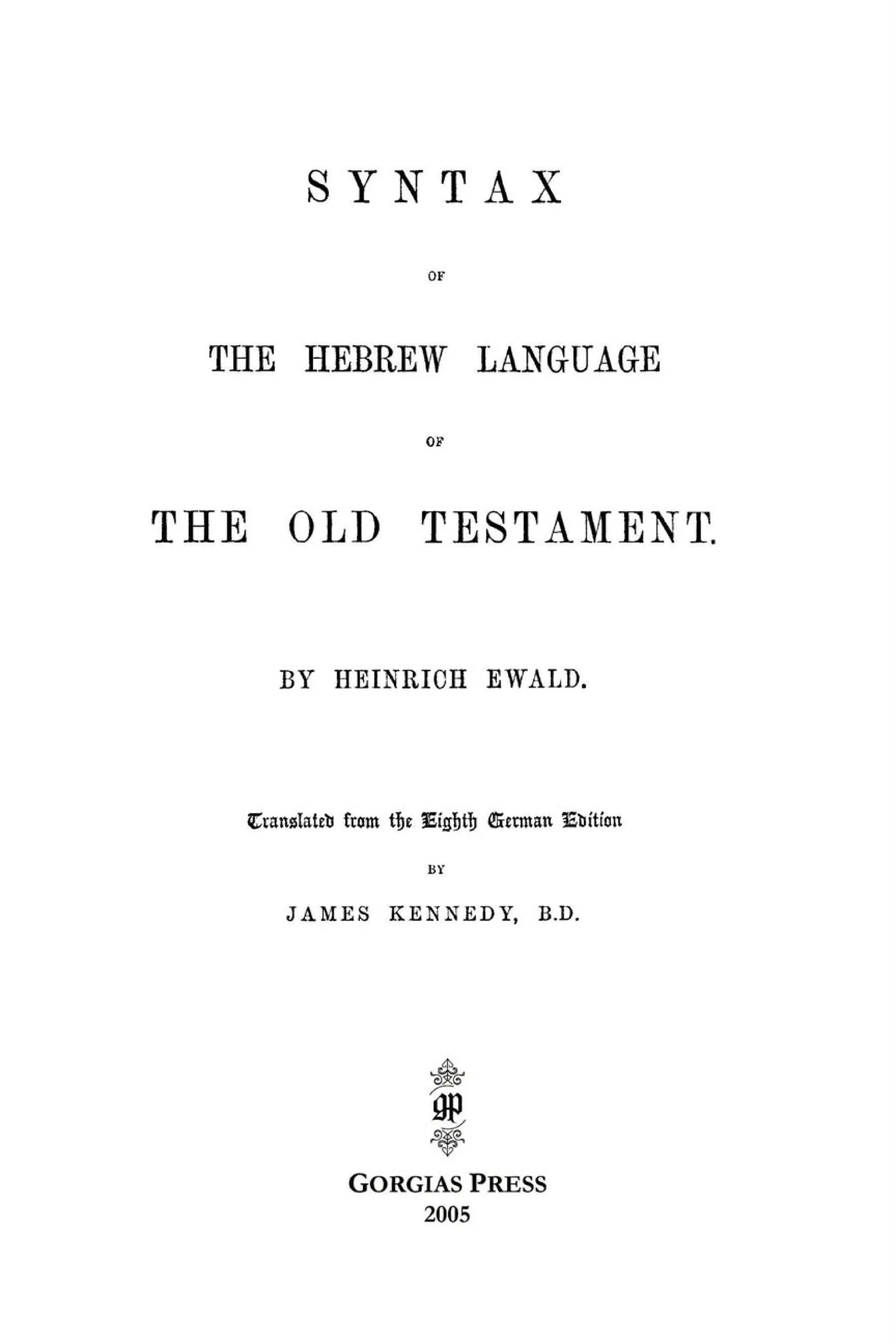
![vi TRANSLATOR'S PREFACE.
The pagination of the original is indicated by the bold
figures embodied in the text (thus, [734]). A few references
have been made to special treatises on Hebrew Syntax that
have recently appeared.
The translator has to record his thanks for assistance kindly
and freely rendered by Mr. David Patrick, M.A., and especially
by the Eev. Dr. A. B. Davidson, who has done so much to
stimulate and encourage him, as so many others, in the study
of the Old Testament Scriptures.
EDIKBUUGH, December 1873.](https://image.slidesharecdn.com/24725528-250511062323-9430fb82/75/Syntax-Of-The-Hebrew-Language-Of-The-Old-Testament-Heinrich-Ewald-9-2048.jpg)
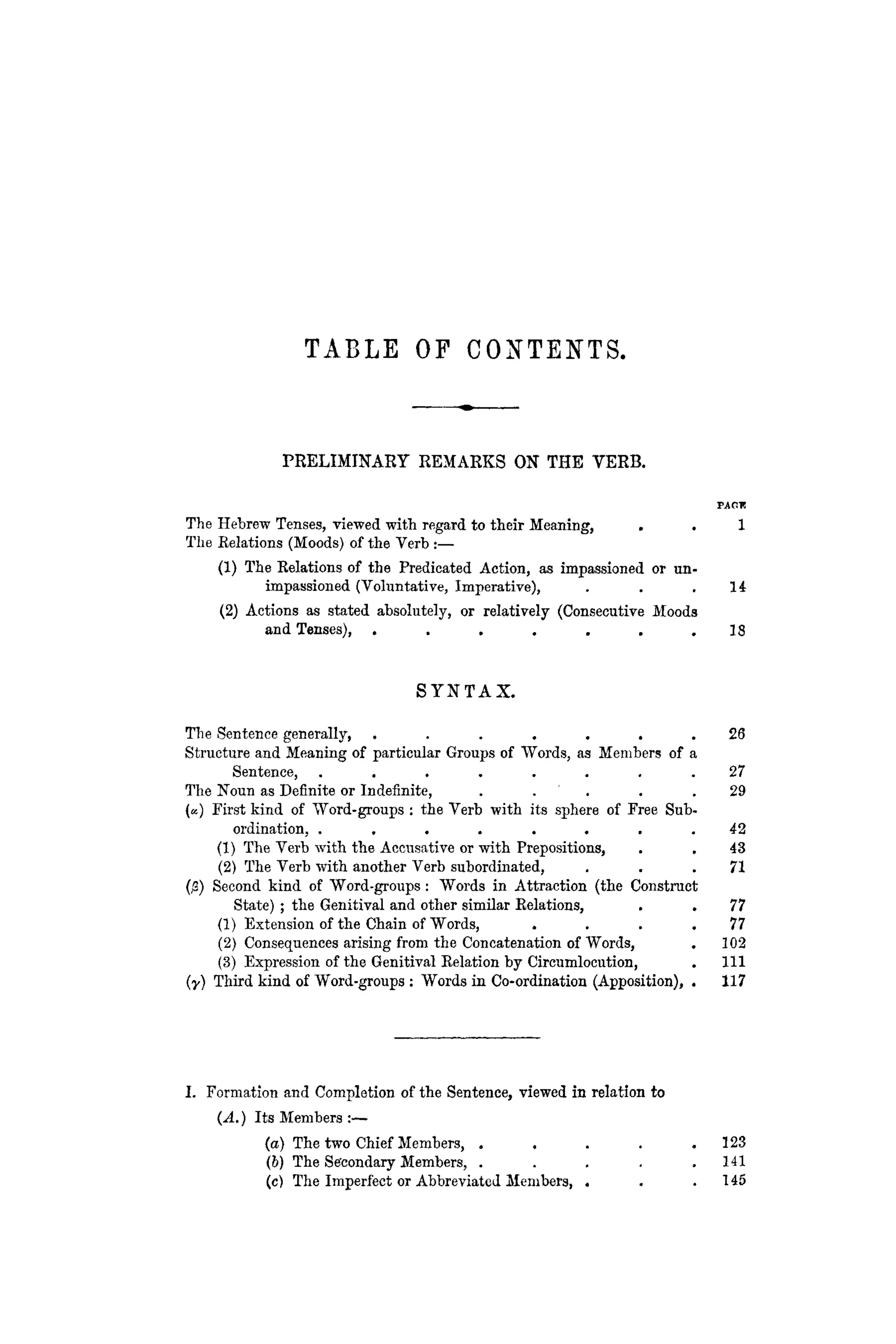
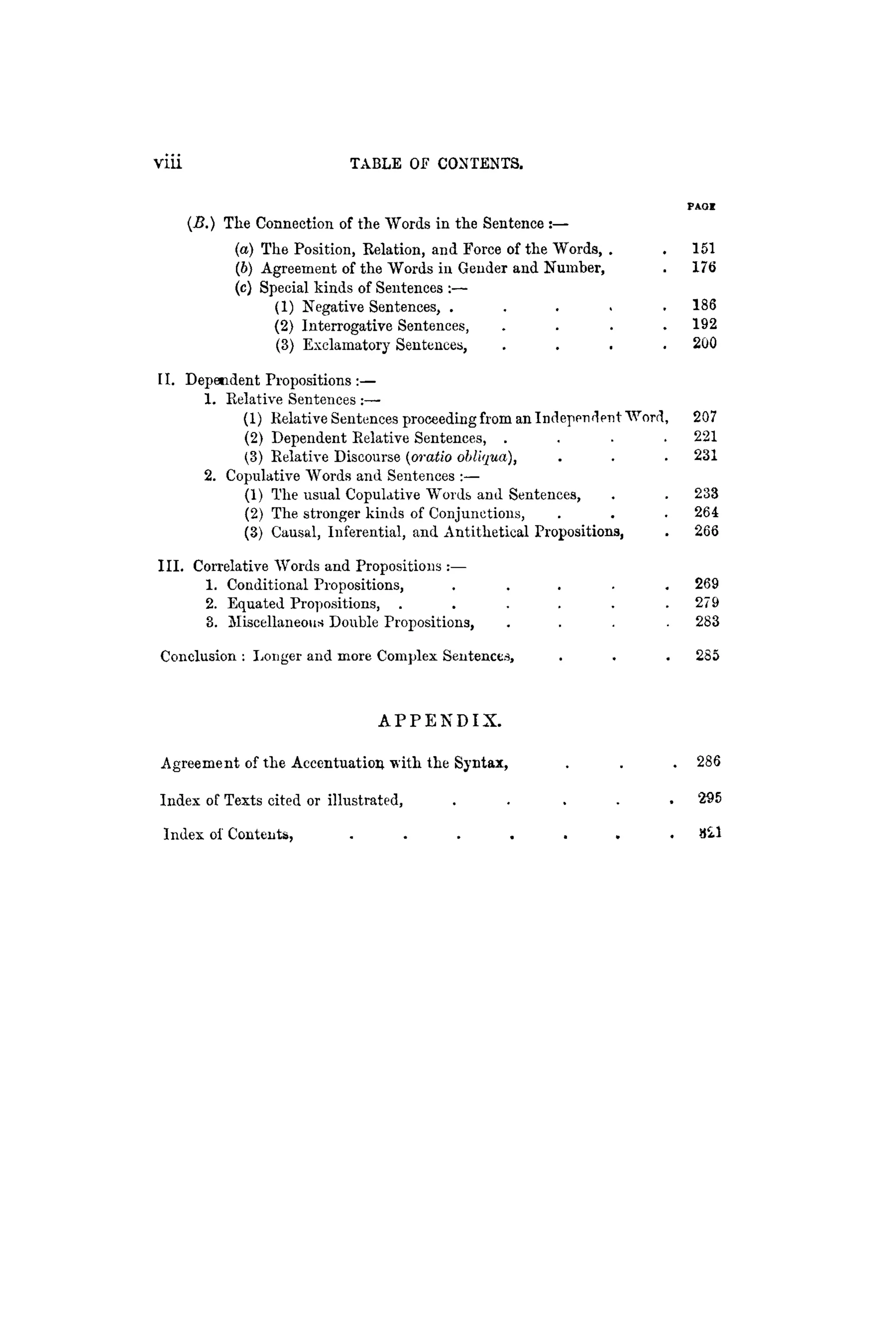
![EWALD'S H E B R E W SYNTAX.
THE VERB-STEMS VIEWED WITH REGARD TO THE DIFFERENCE
BETWEEN THE TWO TENSES.1
The Meaning of the Two Tenses.
[348] 134A. SINCE the verb signifies effective action and the
occurrence of events, while the latter, as passing on, cannot
but lead to the idea of time, distinction of tenses belongs to
the earliest stage in the formation of the verb; and every one
of the verb-stems [viz. Qal, Niphal, etc.] must equally be sub-
ject to the distinction. But the simplest distinction of time
in an action is, that the speaker first of all merely separates
between the two grand and opposite aspects under which
every conceivable action may be regarded. Man has first
acted, passed through an experience, and sees before him some-
thing that is finished, or has taken place; but this very fact
reminds him of that which does not yet exist,—that which
lies behind, and is expected. The former, or positive side,
is that of experience, objective contemplation of action; the
latter, or negative side, is the higher, subjective side of in-
dividual human thought and inference. Hence, with reference
to action, the speaker views everything either as already
finished, and thus before him, or as unfinished and non-existent,
but possibly becoming [Ger. werdend, Gr. <yi<yvo(ievov~ and corning:
1
[It has been deemed advisable to present, first, Ewald's account of these
verb-forms, since much of it really and properly, though not according to
the formal arrangement which he has actually made, belongs to ¡he depart-
ment of Syntax. For a very fall and able discussion of this subject, see
Driver's treatise, On the Use of the Tenses in Hebrew (Oxford 1874).]
A](https://image.slidesharecdn.com/24725528-250511062323-9430fb82/75/Syntax-Of-The-Hebrew-Language-Of-The-Old-Testament-Heinrich-Ewald-12-2048.jpg)
![2 EWALD'S HEBREW SYNTAX, § 134.
he states it as something that is, or denies that there already
is such a thing. There is here, as yet, nothing whatever of
the three tenses precisely distinguished in later languages as
past, present, and future. In fact, however, no language,
when it introduces distinctions, can start from anything three-
fold j1
antithesis is almost always merely simple and thorough-
going, because elicited by its [counter] thesis: first, statement
(thesis), then its counter-statement (antithesis). Thus, both
in thought and language, every distinction is at first drawn
between no more than two things. Just as, in the sphere of
personality, there is, first of all, distinction made merely
between I and thou, and these two are only afterwards dis-
tinguished from the absolutely remote he (see § 105c); as,
secondly, in the case of all existent things, there is, first of all,
distinction made only between the animate and the inanimate,
and then, in the former class, between the masculine and the
feminine (see § 171) : so, in the primitive languages, the dis-
tinction of tenses has by no means originated with our three
tenses, or with the present as one of these three. Now, the
Hebrew has remained substantially upon the ancient basis of
this most simple distinction, and it is exactly in this respect
that it is still very strongly distinguished from later Semitic
languages ; it is only to a limited extent [350] that the parti-
ciple is employed as a specification of time, in addition to
these two, which still continue to be the main divisions
(see § 168).
b. These two ideas, viz. of what is complete and what is
incomplete (or coming), sharply distinguished from the point
of time at which the speaker takes his stand, lead, of course,
1
I have always shown, orally, in my lectures on Sanskrit grammar, that,
in the Indo-Germanic languages also, all the tenses and moods now em-
ployed, which have been so variously developed into their present condition,
point back to no more than two distinctions of time, just as in Semitic.
As regards the tenses, the same thing may be shown to hold in the Turkish,
Coptic, and other languages. Thus, in Odschi (according to Jim, Basel
1853), there is first a perfect (formed by usinga— ; cf. § 2816), and, in diiect
contrast with this, a shorter imperfect; and, only afterwards, a more
definite future, present, and present future. In many respects the Bornuese
language also is very similar ; see Kolle on the Kanuri language (London
1851), p. 226 if. ; see also the Amer. Oriental Journal, i. p. 370, cf. with
p. 391.](https://image.slidesharecdn.com/24725528-250511062323-9430fb82/75/Syntax-Of-The-Hebrew-Language-Of-The-Old-Testament-Heinrich-Ewald-13-2048.jpg)
![MEANINGS OF THE TENSES. 3
to those of the purely past and future; as, 'Tn* njn n? it
has not been, and will not be; DW etSn JJ3E0 He has sworn, and
will not repent. But, as the primitive languages generally
afford the freest scope to the imagination, and view everything
in an exceedingly animated and emotional manner (see § 171),
so also are these most natural distinctions of time far removed
from the more cold intellectuality of our tense-specifications.
Since, therefore, in virtue of the power and freedom accorded
to the imagination, the ideas of completeness and incom-
pleteness may also be used relatively, in such a way that the
speaker, in whichever of the three simple divisions of time
(past, present, or future) he may conceive of an action, can re-
present it either as complete, or as going on and coming; there
arises, through this very fact, a manifold application of the two
expressions for time which the language has at its command;
and, on the ground of this most simple distinction of time, a
multitude of finer distinctions and forms can be made. Such
forms—which no longer have any meaning, and hence appear
very strange, as soon as a language leaves this earliest founda-
tion and distinguishes the three tenses—the Hebrew possesses
as something peculiar to itself (see §§ 230-35). And, from
what has been said, this much is already evident, that here it
is really the connection of the whole discourse that must in
each case determine the meaning of the one tense-form or the
other. Since, as is already clear from what has just been
stated, the names " Preterite " and " Future " are unsuitable,
and have merely been derived from modern languages, we
designate them Perfect and Imperfect,—understanding these
names, however, not in the narrow sense attached to them in
Latin grammar, but in a quite general way.1
135«. I. The Perfect,2
accordingly, is used (1) of actions
which the speaker, from his present, regards as actually
finished, happened, past,—whether the act belongs to a parti-
cular period of the past, hence in narrative; as, in the beginning
1
These names I employed first in 1839 in my Gram. Arab.; the idea
presented by them I had already given in the [Hebrew] Grammar of 1828 :
and the names I. and II. mod., which I used at first, were merely an im-
perfect attempt to find substitutes for the unsuitable names " Preterite "
and " Future" (cf. further §§ 223-35).
2
[See Driver on the Hebrew Tenses, chap, ii ]](https://image.slidesharecdn.com/24725528-250511062323-9430fb82/75/Syntax-Of-The-Hebrew-Language-Of-The-Old-Testament-Heinrich-Ewald-14-2048.jpg)
![4 EWALB'S HEBREW SYNTAX, § ICS.
«na token God created the world,—or simply applies to the past,
with reference to the present of the speaker ; as, n w what
hast thou done ? B^K Win n^ J have not slain any one. If such
an action is stated with special reference to [351] something
else that is past, as being already finished at that time, then
this simple perfect, merely in virtue of its connection, or the
mutual relation of the meaning in both actions, expresses our
pluperfect, for which the Hebrew still possesses no external dis-
tinguishing mark whatever.1 Such a perfect may either relate
to a past which has been already mentioned; as, God blessed
the ivorks which nby He made (but at that time they were
obviously in existence already; hence the expression is equi-
valent to our had made), Gen. ii. 2, 3, and in many other
combinations, Gen. viii. 13 ; Job xv. 7, 19 ; Ps. xl. lb; or it
may contain a preliminary allusion to a past to he mentioned
in what follows; as, from afar TIW??' I had heard Thee, but
now mine eye hath seen Thee, Job xlii. 5 ; Ps. xxx. 8, civ. 6 f.,
exxxix. 16c; or, the past may be mentioned both before and
after it, Gen. xxvii. 30 ; Job xxxii. 4 (cf. § 341). On the
contrary, the perfect may equally well be used, with direct
reference to something mentioned or regarded as future, to
indicate what would then appear as a past (hence, our future
perfect); as, they shall suffer ¡Ti^fijtf"W until the time when she
shall have brought forth, Mic. v. 2 ; Ps. lvi. 14, lix. 17 ; Isa.
xvi. 12 (ntnj); 1 Chron. xiv. 15, cf. with 2 Sam. v. 24,
where Ti? then, stands beside the verb, with greater perspicuity.
b. (2.) It is used of actions which the speaker, indeed,
regards as already finished, but yet in such a way as to reach
quite to the present,—in which case modern languages put the
simple present. This, accordingly, applies especially to un-
impassioned states of mind and body, which are looked on as
actually existent;2 as, 'PIJHJ otSa, novi, 'FT^T meminif Num.
xi. 5 ; Won I trust, ^nin he hopes, Ps. xxxviii. 16 ; JOS' oditf
1 The Arabic, however, and the Aramaic, can form it. But here, too,
the Ethiopic, in many cases, still resembles the Hebrew.
2 [Hence Bottcher (Ausfuhr. Lehrbuch, § 948) has very properly desig-
nated these stalive vei-hs.-]
3 These, accordingly, are some remains of what was originally a similar
usage in the Indo-Germanic languages, just like xitpo/lvftui and oihix.a;
but the same thing presents itself in many other languages also.](https://image.slidesharecdn.com/24725528-250511062323-9430fb82/75/Syntax-Of-The-Hebrew-Language-Of-The-Old-Testament-Heinrich-Ewald-15-2048.jpg)
![M
E
A
N
I
N
G
S OF THE TENSES. 5
¡sp he refuses, Ex. x. 3, xvi. 28 ; 3ns he loves, DXO he despises,
3JM he abhors, Job vii. 3 6, xix. 2 0 ; '•nnpe' I rejoice, Ps.
cxxii. 1 ; tp ^ b p / am too little for . . ., Gen. xxxii. 11. It
is also used for actions which, at the moment of speaking,
are really regarded as already past, though they may never-
theless still continue ; thus, ''IP?? I say, mean, WSJ I advise,
Amos v. 1 4 ; 2 Sam. xvii. 11 ; Eccles. vi. 3, viii. 14 ; Job
xxxiii. 3 ; Ps. xxxviii. 8 f., xxxix. 4, lxxxviii. 10, 14,
cxviii. 26, cxxix. 8 ; Prov. iv. 11, xxii. 19 f., and in lengthy
descriptions, Jer. xiv. 1-6, Zeph. iii. 6 f., 1 Sam. ii. 1, in
which case, certainly, the imperfect also readily intrudes itself
(see § 1366). This perfect may thus frequently be expressed
by our present, with the addition of already, as in Cant. ii. 12 f.,
vii. 13 f. Or, general truths, which are plainly taught, and
already fully established by experience, are described in the
perfect; [352] as, the wicked man despises God; and
frequently in comparisons and proverbs, Ps. x. 3,13, lxxxiv. 4,
xxxiii. 13 f.; Prov. xi. 2, 8, xxii. 12 f.; 1 Sam. ii. 3-5.
The perfect is also used in two closely consecutive propositions,
the former of which puts the matter more as a condition, Ps.
xxxix. 12. The perfect has also a special liking for being
joined in this way with not, almost exclusively, however,
at the beginning, and quite independently in the proposition,
as Ps. xxiv. 4, xv. 3—5.
e. (3.) It is used of actions, which, though really neither past
nor present, are, through the inclination or lively fancy of the
speaker, regarded as being already as good as finished ; these
are, accordingly, stated as if they were quite unconditional and
certain. Modern languages, at least, in such cases, employ the
more energetic and definite present instead of the future.
Thus, the construction is adopted when any one briefly states
what he intends to do, as his settled determination ; hence it
is especially frequent in utterances of God, whose will is
equivalent to His deed: ^ ^Dj J give to thee, vn^a J Uess
him, Gen. xv. 18, xvii. 20 ; and in the language of contracts,
buying and selling, Gen. xxiii. 11, 13 ; Euth iv. 3 ; cf. ver. 5.
(Cf. also § 2236.) Moreover, the fancy of the poet and
prophet frequently views the future as already clearly before
him, and experienced ; this, however, is not, for the most part,
the case in unimpassioned description, but it is more common](https://image.slidesharecdn.com/24725528-250511062323-9430fb82/75/Syntax-Of-The-Hebrew-Language-Of-The-Old-Testament-Heinrich-Ewald-16-2048.jpg)
![6 EWALD'S HEBREW SYNTAX, § 135.
in more brief and rapid utterances ; as, it will dry up, ^ J it is
blown away, and is no more ! Isa. xix. 7, xliii. 3 ; Jer. xxxi. 5 ;
Ps. xx. 7, lxxxv. 11, cxvi. 16 ; Lam. iv. 22. In this case,
though nsn behold, is readily prefixed, to indicate the future
(as in 1 Kings iii. 12 twice), the perfect must always occupy
a position of emphatic prominence at the beginning of the pro-
position, or show, by the clearest self-evidence arising from
the meaning of the whole proposition, that its realization is
possible only in the future, as in Isa. lx. I.1
Sometimes,
however, a mental picture is also represented more fully, in
quite unimpassioned discourse, as it hovered before the eye of
the writer while in the ecstatic state, just as if it had been
actually experienced and were quite certain; but, in that case,
such singularly unimpassioned discourse not merely must be
easily distinguishable from the whole connection of the state-
ment, but also always readily resolves itself once more into
the ordinary style, as Ps. 1. 1-6, xxxvi. 13, lxiv. 8-10, ex. 5f.;
Isa. viii. 23 on till ix. 3, 5.
In ordinary discourse, there are at least two cases in which
this perfect of mere representation or fancy is constantly used,
viz. in conditional propositions (regarding which, see further
§ 355), and when it is combined with the Yav [353] of
sequence, in order to constitute the peculiar essence of the
consecutive perfect. (Since this latter formation, however, is
now far from being a simple one, it cannot be further discussed
till a later stage; see § 234.) But the language comes more
and more to look upon all these manifold kinds of the perfect
of volition and fancy (to give it this brief designation) as some-
thing extraordinary, more momentary than permanent; on this,
see further § 3 5 0.
d. Again, what is predicated simply of the past, may also,
from the meaning of the discourse (e.g. in a simple proposition,
through the influence of a particle), be regarded merely as the
statement of a possibility ; as, DJJD3 they almost killed me
(but, as is self-evident, did not do so); hence the expression is
1
This use of the perfect, accordingly, is not the same as that which is
found in Isa. Iv. 4, where, therefore, it is wrong to understand it as refer-
ring to the future. The extent to which this is imitated by the Septuagiut
and Hellenistic writers, and may even be adopted among them (see Thilo,
on Jac. 1'i-otev. c. 2), is another question.](https://image.slidesharecdn.com/24725528-250511062323-9430fb82/75/Syntax-Of-The-Hebrew-Language-Of-The-Old-Testament-Heinrich-Ewald-17-2048.jpg)
![MEANINGS OF THE TENSES. Y
equivalent to our; they would have killed me, Ps. cxix. 8 7 ;
Gen. xxvi. 10 ; cf. § 358«. Thus, there are contained in the
perfect a multitude of special references and meanings, which
might give occasion to the rise of as many new forms; but
this Hebrew perfect still remains in a quite rigid and simple
state.
136«. II. The Imperfect1
describes that which is incom-
plete, whether this be what does not yet exist, or what is
going on, merely progressing towards completion; hence it
may also, on the other hand, indicate what merely is to take
place, i.e. what, according to the speaker's way of thinking, is
merely dependent on something else. This includes two
meanings, which, both in conception and expression, may be
very widely different from one another, without, however,
completely removing all trace of their common origin. What
I state absolutely as incomplete, remains a mere predication
regarding a time, hence, a mere time-form (term); what, on
the other hand, I state as merely dependent on something
else, is set forth as in a particular hind of being, which hence
becomes more a mood than a tense (to use Latin terminology).
This is not yet the place, however, to discuss the kind of
being in its whole extent, since it brings new and finer dis-
tinctions into consideration (see §§ 223-35). We here confine
ourselves, therefore, to the explanation of the imperfect, so far
as it makes an absolute distinction of time. Now, it is very
evident that the idea of incompleteness in the imperfect may
at once further subdivide into two particular ideas. What is
incomplete is either viewed as becoming [i.e. progressing or
advancing], as just arising and continuing, but not yet gone
by; or, as absolutely future,—not yet existing at all; hence,
in accordance with the genius of our [modern] languages, as
present, or a& future.
b. (1.) The imperfect states what is merely becoming [or
advancing towards completion, i.e. coming to pass], arising; or
it represents the action as present. Looked at more exactly,
however, this admits of being regarded in a twofold manner;
the incomplete action is set forth either as incipient, or as
continuing in this incipiency. Hence, the imperfect indicates—•
1
[On this whole section, see also Driver on the Tenses in Hebrew, chap,
iii. {The Imperfect alone.)]](https://image.slidesharecdn.com/24725528-250511062323-9430fb82/75/Syntax-Of-The-Hebrew-Language-Of-The-Old-Testament-Heinrich-Ewald-18-2048.jpg)
![8 EWALD's HEBREW SYNTAX, J 136.
(a.) An action which, at the present moment, is not yet
completed, but is beginning, and is being carried on with a
view to completion, or which happens in the present; as,
1XVPI ye are marching out, 1 Sam. xvii. 8. Thus, [354] the
perfect (see § 135&) is sometimes used interchangeably with
the imperfect for our present, according as the thing is depicted
as just completed, or rather, as still going on and scarcely
completed; as, 0N3 J^D Gen. xvi. 8, xlii. 7, and Nan |;ks
whence comest thou ? which latter is the more frequent con-
struction, Josh. ix. 8; Judg. xvii. 9, xix. 17; 2 Sam. i. 3;
Jonah i. 8 ; Job i. 7, ii. 2 ; cf. Isa. xxxix. 3.1
Similarly, the
two expressions may also be interchanged, merely for the sake
of variety, in poetic parallelism, Prov. xi. 7, xiv. 18, and in
negative propositions, Isa. v. 12. The distinction between the
two is often very slight; because that which occurs in the
present may easily be viewed as already complete, and thus as
existent, by a language which does not yet possess any settled
form for the present, strictly so called; in actual practice,
however, this application of the perfect becomes more rare.
But the imperfect may also, with equal propriety, indicate
what was becoming realized in the past (praesens praeteriti); for,
in the case of a thing that is to be viewed as having simply
occurred, and gone by, prominence may be assigned, in animated
description, to the one side of its occurrence,—the moment
when it actually happens. This is done when the speaker,
fancying that he is lingering within the sphere of a definite
past, looks down on what was then being realized, and thus
transports the hearer directly into the time when the thing
was taking place. The poets especially can do this with great
facility; as, the day "tax in which I was to be born (L. nascen-
dus eram); why FPiDX did I not die from the womb {i.e.
just when I had been born)? Job iii. 3, 11, xv. 7 ; Ps.
cxxxix. 16. In prose, this usage, though not entirely absent,
is nevertheless confined to certain definite cases and combina-
tions; e.g. to the construction with before (see § 337c),
that with TS then; as, WJ fN then sang . . ., Ex. xv. 1; Josh.
viii. 30 ; 1 Kings xvi. 21; 2 Kings xv. 16 ; Job xxxviii. 24;
Ps. cxxvi. 2,—especially, however, to the constant case of Vav
consecutive, explained in § 231.
1
Cf. a similar usage, e.g. in Vei: Kolle, Vei Grammar, pp. 100, 118.](https://image.slidesharecdn.com/24725528-250511062323-9430fb82/75/Syntax-Of-The-Hebrew-Language-Of-The-Old-Testament-Heinrich-Ewald-19-2048.jpg)
![MEANINGS OF THE TENSES. 9
Since, now, this use of the imperfect, in the greater
portion of the language, is more confined to particular com-
binations, and' accordingly seems further to be, even in its
form, rather a special kind of tense (modus temporis) than a
simple indication of time (see § 231), we must distinguish
from this the case in which a past action is, exceptional!}',
and merely from the desire of producing a more graphic
representation» so put in the imperfect that we also may use
the present instead. This construction is almost exclusively
poetical, and hardly once occurs in prose, even in animated
conversation, as 1 Kings xxi. 6. Further, it is only possible
either because the speaker is thinking more of the mere
thing itself than of the time of the action; thus, at the
beginning of the discourse; as, out of Aram, 'OW he brings
me, Num. xxiii. 7 ; Job x. 10 f.; Hab. iii. 3 ; Ps. lxxx. 9 ;
1 Kings xxi. 6 ; or, it is used in protases and apodoses, or
even in interjected, parenthetical propositions, [355] for the
purpose of bringing the events more closely together in
rapid succession, and to depict everything in the most vivid
manner, as if it were present, Ex. xv. 12, 14-16 ; Ps. xviii. 7,
civ. 6, 8, cvii. 26 ; Job iv. 15 f.; Ex. xv. 4 f. This construc-
tion, however, is also employed, with fine effect, in simple
narrative, to indicate the gradual occurrence of the event, as
Ezra ix. 4 ; or, the imperfect is used in giving more detailed
axplanation and description of what has already been men-
tioned, Neh. iii. 14 f.
c. (6.) It is implied in the meaning of many expressions, or
in the relation subsisting between one action and another,
that the imperfect may express the special idea of duration,
continuance, or even (if the action be of such a character)
repetition; because that which endures is also incomplete,—
always occurs again and again for an indefinite period, Isa.
lviii. 2, 3b. Even in the case of the present, when employed
to express what is usual, or customary, the imperfect is
preferred to the perfect for indicating this idea; as, i c ^
dicitur, dicunt; hence the form is particularly used in com-
parisons ; as, as one is wont to carry, Deut. i. 31.
The imperfect comes to be of special importance, however, inas-
much as it may, in accordance with the context, be equally
transferred to the sphere of the past, in order to describe, in](https://image.slidesharecdn.com/24725528-250511062323-9430fb82/75/Syntax-Of-The-Hebrew-Language-Of-The-Old-Testament-Heinrich-Ewald-20-2048.jpg)
![10 EWALD'S HEBREW SYNTAX, § 136.
subordinate propositions, or in some other way by a sub-
ordinate relative clause, a circumstance that continued while
something else was going on, 2 Kings iii. 25 ; Jer. xiii. 7;
or even to depict, in propositions of a more independent
character, past habits and customs; as, r
H
B
> nb'jr he used to
do year by year, 1 Sam. i. 7, ii. 19; for forty years BipK was
I grieved, Ps. xcv. 10 ; Job xxix. 2 f., 6 f.; Prov. vii. 11 f.;
also in dependent propositions; as, they went away ^¡W
ivhithersoever they went, 1 Sam. xxiii. 13, where the Septuagint
has the appropriate rendering, oh eav iiropevovTo. Here,
accordingly, the Hebrew imperfect almost exactly corresponds
to the Latin imperfect, strictly so called (properly, imperfec-
tum prceteriti).
It often depends on the speaker whether he wishes to
state a thing that may have even been several times repeated,
simply as having happened, i.e. in the perfect, or to indicate it
more definitely [as having been repeated, by using the imper-
fect]. Hence, the one form may be exchanged for the other
in different lines of poetry; as, never hath the, bow of Jonathan
turned back (i.e. homewards); and never did the sword of Saul
return (i.e. it never used to return) in vain, 2 Sam. i. 22.
In Aramaic, this whole use of the imperfect for any kind
of present completely ceases, through the introduction of the
participle as a present, exactly as if it were a third tense-form;1
there is, indeed, a beginning made in the same direction by
the Hebrew also, but only to a limited extent (see § 168).
On the other hand, the Ethiopic has not at all admitted the
interchange of the participle with the imperfect: the Arabic
allows it, but at least to a still smaller extent than the
Hebrew.
d. (2.) The imperfect is the definite form of expression for
a thing that is absolutely future, in the strongest contrast with
the perfect; as, nvp ¡Tn i6 there has not been, and there will
not be. In narratives, however, this quite bald expression
may also indicate what was [356] then future, in relation to
the circumstances described; as, the firstborn who was to
rule (regnaturus erat), 2 Kings iii. 27, xiii. 14; Eccles. iv. 15.
1
[Regarding the Syriac, see Uhlemann's Grammar, § 64. 2, A. In
Chaldee, the pronominal fragments are sometimes completely fused with
tlie participial forms; see Winer's Grammar, § 13.]](https://image.slidesharecdn.com/24725528-250511062323-9430fb82/75/Syntax-Of-The-Hebrew-Language-Of-The-Old-Testament-Heinrich-Ewald-21-2048.jpg)
![MEANINGS OF THE TENSES. 11
Similarly, the imperfect stands, without anything farther, in
dependent propositions, even when the discourse treats of the
past (in which case, therefore, the Latin would employ the
imperfect subjunctive); as, "iDtf1
^ injin did we know that he
'would say ? (like "lipii'' ^ 'nyT / know that he will say), Gen.
xliii. 7, 25, cf. ii. 19 ; Ex. ii.'4; 1 Sam. xxii. 22.
e. Such is only the most natural application of this mean-
ing of the imperfect. But the colour and character of the
discourse, and, together with these, its actual mode of delivery,
which cannot be expressed in any written form, as well as the
tone of the speaker,—all these may further present very great
variety as regards the mode in which they are arranged and
connected. Nevertheless, this simple meaning of the future
still continues to be applied; while our [modern] languages,
in these cases, instead of the direct future, choose more definite
expressions. Thus (a) it stands in a doubting question when
there is uncertainty regarding what may happen; as, ¡I^sn shall
1 (i.e. am I to) got Mic. vi. 6; or in a question which indi-
cates rejection of a proposal; as, xta should I not do ?
Ps. cxxxix. 2 1 ; also, in discourse which signifies unwilling
rejection of a thought; as, -P>? no how am I to curse the good
man ? Num. xxiii. 8. But this may also be applied, once
more, in such a way that something actually past is meant;
as, r w n should Abner die ? or rather (for he was at that time
actually dead), ought he to have died (moriendumne ei erat) ?
2 Sam. iii. 33; 1 Sam. xxi. 16; Gen. xliii. 7, "WJ Ti? how were
we to sing! Ps. cxxxvii. 4. (/3) In propositions which form
merely a calm concession that something may possibly be,
while, at the same time, nothing is thrown in the way of its
accomplishment; as, afterwards thou wilt (or mayest)
mock, Job xxi. 3 ; Prov. xxii. 2 9 ; especially when there im-
mediately follows an antithetical proposition, by which the con-
cession is restricted; as, of all the trees of the garden ^ito thou
wilt (or mayest) eat, but not . . ., Gen. ii. 16 ; Lev. xxi. 22 f.,
xxii. 23 ; Deut. xii. 20 f. Similarly, it is used in propositions
indicative of general possibility; as, beings D1N3T which people
will (or may, can) crush,—hence the Lat. conterenda, Job iv.
19, xxviii. 1 ; Jer. xxiv. 2, 3, 8, xxix. 17: [your children
.nos'' may (might possibly) say. Josh. xxii. 24, according as he
may command, Ex. viii. 2 3 ; see Driver, p. 41]. (7) Or,](https://image.slidesharecdn.com/24725528-250511062323-9430fb82/75/Syntax-Of-The-Hebrew-Language-Of-The-Old-Testament-Heinrich-Ewald-22-2048.jpg)
![12 EWALD'S HEBREW SYNTAX, § 136.
finally, in strict injunctions regarding what shall be done
and must he done (which, however, mostly occurs only in nega-
tive propositions, see § 328c), whether in the form of a law,
as, ^ x n t6 thou, slialt not (i.e. thou must not, art not to) eat!
Gen. ii. 17, or merely in a general way, in solemn diction, as,
thou hast done nb>JT "ic'N what is (or ought) not to be done,
the emphasis being laid on the negative (Lat. haud facienda),
Gen. xx. 9, xxxiv. 7; Lev. iv. 2; Job xxviii. 18.1
In pro-
positions which are at the same time dependent on another,
the same thing also occurs without negatives; as, he taught
them WV iJ'K how they should (i.e. were to, ought to) fear God,
2 Kings xvii. 28 [357] (for, in this case, it is impossible to
use the imperative or infinitive absolute, § 328c).2
f . Moreover, as the perfect within its own sphere (see § 13 bd),
so can this imperfect also indicate something which is merely
conceived of as becoming [i.e. progressing], coming and following,
if some other thing were (or in German [and English], more
briefly, of a thing which would, he); as, for then (if I had died
when a child) ttipB»« shall I be at rest; but, since the thing
is obviously now impossible, the expression is equivalent to,
would I be at rest, Job iii. 13, 16, vi. 27, ix. 15—18, xiii. 19,
xiv. 14 f.; xxxi. 36f.; Jer. iii. 1; with soon (easily)
would . . Job xxxii. 22.3
There may likewise (see above,
under e) come in here the idea of propriety, fitness, or obliga-
tion [Ger. das Sollen] (hence also the earnest wish that some-
thing, which actually belongs to the past, should have
happened); thus, Wix I should die (if it were necessary that
I should be born), hence I ought to have died, Job x. 18, 19,
and negatively in Obad. 12 ;4
cf. n ^ n moriendumne ei erat?
in t, above. In such cases, however, which are rare, the
1
Cf. i p-^i 1 Lc what is not to be (cannot be) described; J U j 1 it must
not be said, etc.
2
Cf. tliey had ears l^j with which they were to hear, Sura xxii,
45, and many similar expressions.
3
In Aramaic : we were angry at them <QJ| . *~)0 so that we would have
destroyed them, unless , . . Assemani's Bibl. orientalis, i. p. 371, 17. For
the sake of perspicuity, the later languages always readily add ]ocn or
^^ fuit to the imperfect when it refers to the past.
4
For all these words, in conformity with the whole context, would be
more clearly rendered thus: But thou ouyhtest not to have . . .](https://image.slidesharecdn.com/24725528-250511062323-9430fb82/75/Syntax-Of-The-Hebrew-Language-Of-The-Old-Testament-Heinrich-Ewald-23-2048.jpg)
![MEANINGS OF THE TENSES. 13'
immediately preceding context always contains some safe guide
to the correct meaning.
g. But it is something essentially new that presents itself
when the imperfect is used, in dependent propositions, to indi-
cate what is to take place as the intention of the agent; the
form may then be also employed in narrating what is past;
as, he commanded, ""S that they should return (ut re-
dirent), Job xxxvi. 10 ; ViDJPTisp imperavit (ut) starent, more
briefly without that, Dan! i. 5 ; Prov. viii. 29 ; cf. § 338 ;
also with iJ?p^ that I might do this, they did that, Eeh. vi. 13.
For, the idea of 'purpose may here be so completely predomi-
nant that the special mood already briefly mentioned in § a is
rather used instead. In Aramaic, certainly, the plain imper-
fect is always used in this sense as a future; in Arabic, how-
ever, and in Ethiopic, it is always the subjunctive mood, which,
indeed, in the latter language, coincides with the voluntative.1
Here, also, the Hebrew vacillates between the two cases, and
when it employs a more definite mood, resembles the Ethiopic;
cf. §§ 224, 337.
h. (3.) When neither these two tense-forms, either simply,
or as modified in accordance [358] with what is stated in
§§ 2 3 0 - 3 4 , nor the participles (see § 168c) are sufficient to
determine the time of an action, then far more definite indica-
tions still may be formed; thus, with the assistance of prepo-
sitions, the gate was I'ap^ to [be] shut, i.e. was just about to be
closed, Josh. ii. 5 (cf. § 2l7<£, 2); or, with the aid of the
verb to come, which is, in many languages, joined with the
chief verb in such a way that we could even say, Nisp K3 he
had come frrni coming, i.e. he had just come, Gen. xxiv. 62.2
But all these rather prolix indications of more definite time-
relations are still very rare in Hebrew.
1
[See Wright's Arabic Grammar, II. § 15 ; and Dillmann's Aethiop. Gram-
matik, § 9 0 ; 169, 7 ; 197a.]
2
See Ewald's Antiquities of Israel, pp. 202-3 [English translation. Cf.
also the French, il vient d'arriver].](https://image.slidesharecdn.com/24725528-250511062323-9430fb82/75/Syntax-Of-The-Hebrew-Language-Of-The-Old-Testament-Heinrich-Ewald-24-2048.jpg)
![14 EWALD'S HEBREW SYNTAX, $ 223.
THE RELATIONS (MOODS) OF THE VERB.
[ 5 7 9 ] 1 . THE RELATIONS OF THE PREDICATED ACTION, A3
IMPASSIONED OR UNIMPASSIONED.
Voluntative and Imperative, simple, and intensified.
223a. The verb, as it appears in its earliest developed
form (described in §§ 190-199), expresses ideas, first of all, in
a wholly unimpassioned manner, without any indication that
the speaker feels an interest of his own in the subject of
which he treats. What he says consists of a mere mention :
he makes an objective, and hence unimpassioned statement,
contenting himself with simply doing this. But the speaker
may also, in quite another manner, directly import into the
predication of the action his own interest in it,—always sup-
posing that he wishes to take such an interest in it at all.
He can throw into it his whole personal (subjective) feelings
and desires; and, inasmuch as this (like everything personal)
varies very much in degree and kind, there may possibly arise,
in contrast with the indicative, a multitude of subjective moods,
which, however, differ more or less from one another; hence,
also, one may grow out of the other. That which, in the
case of the noun (see § 2025), is the exclamation (vocative), is
here the impassioned, abrupt mood. But we have now to
state here the special way in which the latter is expressed, and
to show how far this is done merely through the tone of the dis-
course (which, in the case of the fine shades of feeling imparted
by the addition of personal sympathy, may, of course, form an
element of considerable importance), or by fresh changes in
the form of the words.
b. The perfect, uttered more forcibly than at other times,
and as if in exclamation, may, even without any further modi-
fication, serve to express the ivish of the speaker,—the special
emphasis with which he declares his own wish being indi-
cated merely by the more lively colouring imparted to the
discourse. Now, since the perfect represents the action as
completed, the speaker thereby expresses, in somewhat unim-
passioned form, though with an indication of the interest which](https://image.slidesharecdn.com/24725528-250511062323-9430fb82/75/Syntax-Of-The-Hebrew-Language-Of-The-Old-Testament-Heinrich-Ewald-25-2048.jpg)
![VOLUNTATIVE AND IMPERATIVE. Ì 5
lie himself feels, what he would like to see already fulfilled,
and believes is already fulfilled at the very moment when he
utters the wish. Hence the infusion of this colouring into the
discourse produces the [580] appropriate form of expression
in Arabic for a pious (religious) desire ; and the perfect with
such a position and meaning is most fitly termed the precative.
That the perfect could be so used in Hebrew also, is safely
inferred from the occurrence of particular expressions which
otherwise remain unintelligible; as, n^N perish the wicked!
Ps. x. 16, lvii. 7 ; the counsel of the wicked nfjrn be far from me!
Job xxi. 16, xxii. 18 ; nnna thou (0 God) hast redeemed me !
(ox,redeemest me!) Ps. xxxi. 6,cxvi. 16; Lam. i. 21, iii. 57-61;
Isa. xxvi. 15.1 In Arabic, the perfect, in such a case, must
likewise always stand at the beginning with emphasis; and
in the usage actually followed by the language, it has gradually
become restricted to certain expressions (see Ewald's Grain.
Arab. § 710). In Hebrew, as is shown by the instances
quoted above, somewhat greater freedom still remains here ; but,
besides the above few examples, all of which, moreover, belong
to the language of poetry, it can scarcely be said that there
are many others2 in the Old Testament.3 Still another old
mode of expression of this kind is ¡Tirp 'n may Jahve* live!
(see § 142b) which now occurs only in the genuine Davidic
poem, Ps. xviii. 47 (2 Sam. xxii. 47), and is accordingly
different from the expression used in swearing (see § 329a).
1 [Cf. the strong command in English, you go directly! and Germ, du
gehst sogleich /]
2 [Bottcher, who also allows that there is a precative perfect in Hebrew
(Lehrbuch, §§ 939g, 947<j), will not, however, admit it in all the cases cited
above by Ewald, but only in Ps. cxvi. 16 ; Job xxi. lfi, xxii. 18 ; Lam.
iii. 57-61; but he further adds Isa. xliii. 9 ; Mic. i. 10 (Iiethib) ; Ps. iv. 2,
vii. 7, xxii. 22, lxxi. 3, cxli. 6, 7. See Driver, § 20.]
8 In Syriac, the verb jocn, at least, is still employed thus as a remnant
of this old style of discourse ; in this case, however, it is not subordinated
to another verb or an adjective, as under other circumstances, but, in the
most direct opposition to that construction, takes up a position of most
emphatic prominence at the beginning (like tiie Arabic prccative).
4 [On the pronunciation of the divine name mn see especially Gesenius,
Thesaurus; or W. A. Wright's article in Smith's Bible Dictionary; Russel
Martineau's treatise appended to vol. ii. of the English translation of Ewald's
History of Israel.]](https://image.slidesharecdn.com/24725528-250511062323-9430fb82/75/Syntax-Of-The-Hebrew-Language-Of-The-Old-Testament-Heinrich-Ewald-26-2048.jpg)
![16 EWALD'S HEBREW SYNTAX, § 224.
c. On the other hand, the imperfect (see § 136a), as the
expression for what is becoming [i.e. incipient], is very suitable,
when uttered with special emphasis, for indicating Avhat,
according to the speaker's own mind and wish, ought to be,
and the attainment of which he represents as meanwhile
dependent on something. Thus, out of the imperfect, in
addition to its first and most natural form,1
there arise several
new moods, which agree merely in this, that they all express
the most direct motions of the will, and thus are the same in
the verb as a vocative would be in the noun. The form, how-
ever, which shows itself to be the most natural in this case, we
call, pre-eminently, the voluntative,—to give it the most general
name that best answers to the idea which it presents.2
d. But it lies in the very nature of volition to express
itself with great variety of degree and force, just in the same
way as [581], in the case of the noun (see § 2026), the exclama-
tion varies. The precative, indeed (see § b), is merely a parti-
cular kind of it; but here, gradation comes into more distinct
prominence, so that we must at once distinguish between the
simple and the intensified expression.
224. 1st. The voluntative is the emphatic expression of the
desire felt by the speaker that something should take place.
Hence it differs from the imperfect almost solely in being
uttered more briefly and rapidly (like the ordinary vocative
in the case of the noun), the pause made by the voice being
rather strongly retracted from the end and laid on the begin-
ning of the word. The separate effects of this, however
(except in the mere tone of the proposition), are only in part
still distinctly perceptible in Hebrew; in Aramaic they have
almost completely disappeared.
In the case of the many persons which end with the third
radical, the shortening must be shown in the stem itself. In
1
Yiz. the indicative, which, inasmuch as the verb is not made dependent
on a word, either in impassioned language or otherwise, may also be com-
pared to the nominative. But it would be quite a mistake to suppose that
the Semitic originally formed the imperfect for the purpose of expressing
a nominative, because the resemblance between the indicative and nomi-
native is merely a remote one after all (cf. § 191a).
2
[Ewald includes, within the general designation Voluntative, both the
lengthened or Coiiortative, and the shortened or Jussive forms of the
imperfect; see §§ 224, 228.]](https://image.slidesharecdn.com/24725528-250511062323-9430fb82/75/Syntax-Of-The-Hebrew-Language-Of-The-Old-Testament-Heinrich-Ewald-27-2048.jpg)
![VOLUNTATIVE AND IMPERATIVE. 17
the strong verb, however, where, for the most part, two com-
pound syllables come together, and where, in the final syllable,
the vowels are very simple, the laws regarding the tone (see
§85) and those regarding the accented vowels (see § 32 ff.),
do not generally allow any further shortening of the final
syllable ; only in Hiphil is the Í (see § 252) regularly shortened
into the short sound X, which, on account of the tone, becomes
é (see § 3 3 5 ) ; as, ¡ 3 ^ let Mm cause to dwell, N-fin let it briny
forth, Gen. i. 10, 24; Ps. vii. 6; Job xi. 14. But in weak
roots, the shortening is, for the most part, much more easily
effected, and more generally capable of being distinguished.1
[584] 226. 2d. The imperative is the highest degree of the
voluntativo,—the briefest expression of a desire regarding what
is to be dona Hence it always presents itself in a still more
fragmentary form than the jussive, as a mere exclamation, and
thus also nearly always stands at the beginning of the pro-
position. And so little can it admit of being subordinated,
that the subjective negative b« (fj>r], Lat. ne) is not joined with
it, but always continues to be construed with the voluntative;
as, ne sis! S?J?n bx ne fac!1
[589] 228. 3d. An intensification of the voluntative and
imperative arises from the employment of n— by which still
greater and more special prominence is visibly assigned to the
mental endeavour and the direction of the will towards a
definite object. This sign, which, in the noun, expresses the
idea of direction towards a place (see § 216), attaches itself
to these moods also, and thus indicates the will of the speaker
in a still stronger manner. The use of this intensified volun-
tative [now generally called the cohortative], however, is, in
Hebrew, more confined within certain limits. It is most
frequently and properly employed only in the first "person, to
which, in fact, the short, quick command is less appropriate
than the effort which is founded on inward deliberation,
and which forms the impelling force urging on one's own more
tardy will; as, rnBtK then let me sing, then let us go. It
makes no difference whether that which one himself intends
1
[What immediately follows, in the original, refers to the forms assumed
by the jussive in the irregular verbs, and is here omitted, as belonging to
accidence rather than Syntax.—For a very full discussion of the cohortative
and jussive, see Driver on the Hebrew Tenses, chap. iv. and Appendix II.]
B](https://image.slidesharecdn.com/24725528-250511062323-9430fb82/75/Syntax-Of-The-Hebrew-Language-Of-The-Old-Testament-Heinrich-Ewald-28-2048.jpg)
![18 EWALD'S HEBREW SYNTAX, § 228.
to do, and is on the point of doing, is to proceed from an
entirely free determination of will, Prov. xii. 19; or is likewise
conditioned by external influence, in which case we may often
render the form by, I am to . . . Isa. xxxviii. 10 ; Jer. iv. 21,
vi. 10; or, I must . . . Jer. iii. 25, iv. 19; Ps. xlii. 5, lv. 3,
lvii. 5, lxxxviii. 16. In the case of passive ideas, it is, of
course, more the fervency of the wish that is expressed in this
way, Ps. lxix. 15. In the other persons, this intensified form
is very rare; and, in the case of the third person, it occurs
only sometimes in poetry; as, ntrian let it come, Isa. v. 19 ;
Ps. xx. 4. But even the intensified form of the first person
becomes more and more restricted to poetry, and in Aramaic
this whole formation disappears. It may further be remarked
that it is most readily retained when, in contrast with a pre-
ceding unchangeable vowel, it is without the tone : it is least
likely to be preserved when it would necessitate the removal
of a preceding changeable vowel, as if a sound of this nature
mostly sought to defend itself against extinction; thus the
form «pVK is maintained between and nTDK in Isa. i. 25,
[593] 2. AN ACTION, AS STATED BY ITSELF, OB IN
KELATION TO ANOTHER.
Consecutive Moods and Tenses.
230. As a preposition and its subordinated noun, so can a
conjunction and its subordinated verb form an inseparably close
combination, in which the one member conditions the other,
and the exact sense is given by both only in this close con-
nection. But this takes place only when certain new ideas are
formed; because an ordinary conjunction, without such a force,
stands far more loosely before the proposition (see § 222).
A conjunction of this stronger kind is found pre-eminently in
the copulative "], inasmuch as it does not simply mean and,
but (like our then, or so) indicates, more emphatically, the
consequence of the action, the sequence of time, or thought;
and in such a case, it certainly received greater prominence in
the living language. If this, or a similar conjunction, be com-
bined with a tense or mood, progressive, connective, and there-
fore relative tenses and moods are formed; and for this purpose](https://image.slidesharecdn.com/24725528-250511062323-9430fb82/75/Syntax-Of-The-Hebrew-Language-Of-The-Old-Testament-Heinrich-Ewald-29-2048.jpg)
![THE RELATIVELY-PROGRESSIVE IMPERFECT. 19
tlie two tenses are developed in a new and peculiar fasliion. That
which most readily suggests itself, however, in this case, is—
231a. 1st. The relatively-progressive imperfect. To the
imperfect there is prefixed, as a particle of time referring to
the past, the syllable a-, while the consonant succeeding it
is doubled. This syllable, which was, perhaps, originally ad,
tx, is of pronominal origin, and corresponds to the augment
in other languages,1
has the meaning of then. But it has
always been fused with the conjunction ) and (which thereby
becomes more emphatic) [594] into va-, while the succeeding
consonant is doubled; and it is only through the fusion of
the two particles that there arises the more emphatic And,
which throws an action into the sphere of the past. To this
prefix is subordinated the imperfect in the form of the volunta-
tive, inasmuch as the latter posits the action itself as already
going on, and consequently dependent, or closely connecting
itself with some point or other.2
Thus there arises a composite
1
In Sanskrit and Zend, Greek, Armenian, Afghan; cf. Zeitschr. fur
die Kunde des Morgenlandes, Band ii. p. 304 f. The aorist and the poten-
tial both arise from a tense which is no longer preserved anywhere in Indo-
Germanic in its original form, which must have formed the analogue of
the Semitic imperfect, and whose antithesis has now, similarly, in the Indo-
Germanic, after decay, resolved itself into the ancient perfeet and the
modern present. The augment in Semitic may have been originally
-am; if so, an explanation is thereby given of the employment of ^J with
the apocopated imperfect (see Ewald's Gram. Arab. § 210; [Wright's
Arabic Grammar, ii. § 18]). This form, however, is too plainly an abbrevia-
tion of ^ not yet, though it never occurs in protases.
2
It is necessary to assume that the form is the voluntative, especially on
account of the occurrence, in the first person, of the <"l~, because this does
not admit of explanation in any other way. And, in fact, the idea pre-
sented by the form ceases to be any objection whatever against its employ-
ment, as soon as we grant that, in a somewhat wider sense, it might
indicate generally what is dependent and relative (cf. § 338). The mere
shortening of the imperfect might, if necessary, be explained on the principles
laid down in § 181« and 2436; but such an explanation is not required.
The modern Persian, in a very similar way, prefixes be- (a syllable which
indicates approach, advance), not merely to the present, for the purpose of
forming the definite future (and hence also to the subjunctive and impera-
tive), but also to the shortened perfect, in order to form the imperfect of
narration, i.e. the Greek aorist. The ancient languages have not such a](https://image.slidesharecdn.com/24725528-250511062323-9430fb82/75/Syntax-Of-The-Hebrew-Language-Of-The-Old-Testament-Heinrich-Ewald-30-2048.jpg)
![20 EWALD'S HEBREW SYNTAX, § 231.
word-form which transfers an action that is taking place back
into the past (see § 1365); and attaches it there, at some
point already mentioned, in its necessary sequence, and in such
a way that it can be perceived in its beginning there. This
is the progressive imperfeetum perfecti, which advances from
some point, or thought, already stated; and which, conse-
quently, never stands by itself (absolutely), but always rela-
tively to another.
b. Now, since this imperfect (which, apart from the and
which ever adheres to. it, exactly answers to the Greek aorist)
is always attached, by the emphatic dnd, to a perfect already
mentioned, or at least assumed as known,—like the produced
effect to the primary producing cause,—it is plain that, setting
aside the force of the relative sequence, the perfect would be
used instead. But as, in creation, through the continual force
of motion and progress, that which has become [Ger. das Gewor-
dene], and is, constantly modifies its form for something new;
so, in thought, the new advance which takes place (and thus
. . ., then . . . ) suddenly changes the action which, taken by
itself absolutely, would stand in the perfect, into this tense,
which indicates becoming [Ger. das Werden, Gr. TO ytyvecrdat],
—the imperfect.1
But one [595] progressive action of this kind
may, in the case of a new advance in the course of thought,
be immediately succeeded by another, to an indefinite extent.
And various as the applications of the perfect are (see § 135),
equally so, in every single point, are those of its counterpart.
strong liking for the past as to narrate it merely under its proper form
but they, as it were, quickly throw it into some definite place or other in
the past, attach it there, and depict its approach and progress from that
point: in the Hebrew, this is rendered only still more evident by the
employment of the and. In Coptic, at least the construction of the imper-
fect with j l * . n e . . . and J U H I i - T • • which answers to the Arabic
negative already mentioned, is a similar instance (see Ewald's Sprachiviss.
Abhmtdliaiyen, i. p. 55 if.); cf. also Gabelentz, Melan. Sp. p. 89; Schlegel,
Jiire-Spr. p. 6;i.
1
Hence the old [Jewish] grammarians had already begun to speak of a
Vav conversive,—a name which, properly understood, is not incorrect,
though, to be more precise, it should be Vav consecutive-ccmversive. [Hit-
zig calls it Far relative, but this designation is rather indefinite.] That
the "
1 itself is derived from a Hjn fuit, as was formerly supposed, is
incorrect, in spite of an apparent similarity in Yei (see Kolle, p. 137 f ) .
[See further, Driver on the Hebrew Tenses, pp. 76-78.]](https://image.slidesharecdn.com/24725528-250511062323-9430fb82/75/Syntax-Of-The-Hebrew-Language-Of-The-Old-Testament-Heinrich-Ewald-31-2048.jpg)
![THE RELATIVELY-PROGRESSIVE IMPERFECT. 2 1
Thus, in the case of simple narration, ids ]IC spake, And
(as he had spoken, so) it was done; or, in the case of actions
which, at the moment when the statement is made, are
evidently completed, but, in their effects, reach to the present;
this one has come as a stranger Cat^l dnd judges (as we have
seen) nevertheless ! Gen. xix. 9, xxxi. 15 ; 2 Sam. iii. 8. See
further, § 342.
c. But if, besides, we look to history, it must be said that
this form, as owing its origin to the extremely lively fancy
which characterizes the language (like everything in this
department in which the youthful vigour of the language
shows itself, e.g. the distinction of gender made in relation to
all objects; on which, see § 171 if.), belongs to an earlier
period, and hence gradually gives way to other forms. In
Hebrew, indeed, this modification of the imperfect continues
very prevalent, and forms one of its essential characteristics ;
but even so early as the later times of the Old Testament
(especially, for instance, in the Book of Ecclesiastes1
[i. 13, 16,
ii. 5, 9, 12, 13, etc.]), the simple perfect with the ordinary t.
is employed instead; and, in the rest of the Semitic languages,
it almost wholly ceases to be used.2
[599] 233«. It is only the poetic writers who sometimes ven-
ture on using these short imperfects without the prefix. Though
1
[Ewald assigns Ecclesiastes to the end of the fifth or the beginning of
the fourth century B.C., i.e. to the later times of the Persian supremacy; he
thinks the book was written after Malachi, but before Chronicles and Esther.
See his History of Israel (Eng. translation), vol. v. pp. 182, 189; cf. also
pp. 192, 200, 202, and what he says in his Introduction to Qohelet (Dichter
des alten Bundes).]
2
In Aramaic, completely so: in the Mishna, III (to indicate it briefly
thus) is entirely wanting, and 11 (see § 234) is very rare. In Arabic, the
combination of ^ with the shortened imperfect (see Ewald's Gram. Arab.
§ 210 ; [Wright's Arabic Grammar, ii. § 18]) forms a still remaining instance
of the usage; and in the Saho language, ekke is the aorist, akke the
ordinary future, in which a similar distinction is still perceived, Journ.
asiat., 1843, torn. ii. p. 115 f. But the Phoenician here also still more closely
resembles the Hebrew (see Ewald's Abhandl. iiber die sidonische Inschrift,
pp. 18, 46) ; and in Arabic, the tneaning still continues to be expressed, if
in no other way, at least by the great change in the sound of the prefixed
particle ( _ j instead of .).](https://image.slidesharecdn.com/24725528-250511062323-9430fb82/75/Syntax-Of-The-Hebrew-Language-Of-The-Old-Testament-Heinrich-Ewald-32-2048.jpg)
![22 EWALD's HEBREW SYNTAX, § 233.
the omission is to be regarded, generally, in almost the same
way as when, in Sanskrit (where it rarely happens), or in
Greek, the aorist is used without the augment, yet it has
other special reasons of its own in Hebrew (see §§ 343i, 346b);
thus nt£ in Ps. xviii. 12 for HB'jl in 2 Sam. xxii. 12. Poets espe-
cially, in order to depict the past more vividly, as if it were
present, may designedly omit the augment and use the simple
1 with this imperfect; which, again, is most apt to be so
treated when it occurs in the first person, and has an affix
(as if the word became lighter at the beginning, before the
heavy termination); thus Isa. x. 13, xii. 1, xliii. 28, xlviii. 3,
li. 2, lvii. 17, lxiii. 3 - 6 ; Ps. civ. 32, cvii. 26-29, lxvi. 6 ;
Prov. vii. 7; Hos. vi. 1; Deut. xxxii. 8. The form may then
also, contrary to its original use, and the genera] employment
of it everywhere else, be placed in some other position than at
the beginning of a proposition, as once actually happens in
Deut. xxxii. 18, where ^'ri is found, in pause, for 'BTi (.Hiph.
of W = nw, § ll'M, forget, neglect).
b. This imperfect is also used under other circumstances
without augment, but mostly with the same shortening, and
in the first person with n—; also after IS then, 1 Kings viii. 1 ;
Deut. iv. 41; there, used poetically of time, Ps. lxvi. 6,
and until, Ps. lxxiii. 17 (donee pervenirem). For here are
found in operation exactly the same causes which (according
to § 231) require that should be followed by the volun-
tative. In prose, however, this takes place only in the case
of t?.
234«. 2d. The relatively - progressive perfect. Since the
imperfect may have the perfect as its antithesis in every
respect, the relatively-progressive imperfect, of which we have
been treating, of itself calls forth the relatively-progressive
perfect. But this is a form in which the Semitic [600] alone
manifests thoroughgoing logical consistency, while the Indo-
Germanic stops short; and which very clearly shows the
highly exceptional wealth of peculiar forms which the Semitic
—amidst the seeming poverty arising from its having but two
leading tenses, which alone have been fully developed—has
at its command (see § 1345). As, therefore, in the combina-
tion previously explained, the flowing sequence of time or
thought causes that which has been realized [i.e. attained](https://image.slidesharecdn.com/24725528-250511062323-9430fb82/75/Syntax-Of-The-Hebrew-Language-Of-The-Old-Testament-Heinrich-Ewald-33-2048.jpg)
![THE RELATIVELY-PROGRESSIVE PERFECT. 23
completion, Ger. das Gewordene], and exists, to be regarded as
passing over into new realization; so, in the present case, it
has the effect of at once representing that which is advancing
towards realization [Ger. das Werdende], as entering into full
and complete existence [Ger. das SeynJ. Hence, each of the
plain tenses gracefully intersects the other, by interchanging
with its opposite,1
thus,—
Cf. similar interchanges in § 177«/ [Ges. § 87, 4; Gr.
§ 200/], 267/ [Ges. § 97, 1; Gr. § 223, 2; Dav. § 148, 3],
And in all those meanings in which (see § 136) the imperfect
itself, or even its abbreviations, the voluntative and impera-
tive, would be used, this perfect is at once introduced, with
the energetic And, or s6 (then), when the discourse proceeds in
an unimpassioned manner (see § 342).
b. As this relatively - progressive perfect is the exact
opposite of the progressive imperfect in idea, so is it also in
its form. In front, it wholly drops the augment, and thereby
allows the 1 to become a simple conjunction once more. But,
to compensate for this, the tone is so strongly placed on the
end of the word, that one would think the augment had
originally been wholly put behind. It is as if one wished
to say in English, tMnTspeahs or tMrT*spake, and, on the con-
trary, therTspdaJcs ; or as if the former, from the front, sought
to attach itself to the past, and the latter, from behind, to the
future. None of the later Semitic languages, however, shows
any trace of this ancient form,2
which, even in Hebrew,
is less and less employed. In the present condition of the
Hebrew, too, even the mere change of the tone is no longer
clearly marked in every case.
1
Cf. a similar usage in the Odschi (see Riis, p. 156).
2
Cf., however, Ewald's Gram. Arab. ii. p. 347; here, too, the Phoenician
show a Hebraizing tendency.
Perfect o o Imcerlecl](https://image.slidesharecdn.com/24725528-250511062323-9430fb82/75/Syntax-Of-The-Hebrew-Language-Of-The-Old-Testament-Heinrich-Ewald-34-2048.jpg)
![24 EWALD's HEBREW SYNTAX, § 234
[602] In § 343 are shown the limitations to the em-
ployment of these two relative or modified tenses in a
proposition; as also the way in which, out of them again,
two new kinds of time-specifications are formed: so that
(to say nothing of the participle, on which see § 200)
we may, in Hebrew, even speak of six tense-forms (two
plain, two modified, two re-simplified).
235a. 3d. The relatively-progressive voluntative presents the
desire and the design of attaining something as the conse-
quence or aim of something presupposed,—answering to the
English in order that, and the Latin ut with the subjunctive. It
is usually preceded by an imperative; as, ^flNl 5P1} stop, that
I may speak ! But it may follow any other kind of proposi-
tion to which the idea of a purpose is attached; thus even, it
is good ^rn that he should wait, Lam. i. 19, iii. 26 ; Ex. i. 17;
Lev. xv. 24, xxvi. 43. It is most naturally employed, how-
ever, with the particles of purpose themselves; see § 337b}
And as the imperative, speaking generally, differs from the
voluntative merely in degree, so also a relative imperative
becomes possible, whenever the second person is employed;
thus, that he may pray for thee ivm and that thou (as I wish,
by this very means) mayest live, Gen. xx. 7 ; Buth i. 9 ; Job
xi. 6 ; cf. further, § 347. But where this voluntative has
more the sense merely of the Latin ut with the subjunctive,
and the imperative does not immediately precede, the n—
is less frequently used, even in the first person (see
§ 229).
[603] b. The voluntative remains in this case, through all
the persons, as it would appear even without this ) (according
to §§ 224-229): the forms nrsbni and ¡"Usúril ut veniant, are
both possible in this construction, as in § 225 ; cf. § 94a. In
the first person, the form frequently vacillates (as in § 232c?)
between abbreviation and assumption of the n—; so that words
like Mew, Zech. i. 3, from verbs l"ji, become possible, because
1 The Arabic here acquires greater power in exact distinction, by putting
the imperfect in a series of words, and thus making it dependent on the
telic particle, like an oblique case: in this way there arises a true sabjunc-
/ (j / O S
tive mood; as, ^ ut scribat. But tlie Ethiopic knows nothing of
this last development, and follows the Hebrew.](https://image.slidesharecdn.com/24725528-250511062323-9430fb82/75/Syntax-Of-The-Hebrew-Language-Of-The-Old-Testament-Heinrich-Ewald-35-2048.jpg)
![THE BELA.TIVELY-PKOGRESSIVE VOLUNTATIVE. 25
tlie n—, which indicates motion, falls away, while the short
voluntative form does not at once reappear. There are, to
he sure, in the mode of pronouncing the in this combination,
minor anomalies which would be impossible when the simple
and, is used; as, O^VDto, Zech. vii. 14, instead of 'Kl. (see
§ 625); IB'V«!, Zech. xi. 5, for (see § 736), nsytil (see §88iZ);
but these are, on the whole, rarely found. Since, however, the
idea of progress and sequence must be expressed somewhere
or other in the compound, we must assume that the here
employed is not the simple, but the stronger one; which also,
there can be no doubt, was originally sounded more strongly,
and may have this idea in itself, as well as before any other
word (see § 348). The latter Q], therefore, has certainly
arisen in such a way from the other '1 prefixed to the imper-
fect (already discussed in § 231), that it no longer indicates
anything more than sequence (consecution). Thus it corre-
sponds to the Arabic _i, which gives the same meaning as all
these Hebrew compounds, but which now, as bearing this
meaning in itself, may be prefixed to any simple tense or other
kind of word. Hence it is like a finer precipitate of the
much more cumbrous Hebrew compound forms.1
c. The voluntative may also be used (as in Arabic) in con-
ditional propositions (see § 3 5 lb); similarly, the shortened
imperfect ^ 2
is once closely joined with ''S, in the sense of
vjhen, Job xxvii. 8. Moreover, it is employed in relative pro-
positions which state a mere remote possibility; as, he receives
nothing which he may (can) take away with him, Eccles.
v. 14; cf. on the other hand, the form in Eccles. x. 20,
which, through the style and the context in which the propo-
sition stands, has quite a different meaning.
1
In Aramaic also, and still more in Ethiopic, the simple and may, never-
theless, in accordance with the context, always continue to bear the mean-
ing of the vav of sequence.
2
The root may be either ^p} or to draw out, imperf. ^ or
(see § 282b), from which fei could easily be formed (see § 232c).](https://image.slidesharecdn.com/24725528-250511062323-9430fb82/75/Syntax-Of-The-Hebrew-Language-Of-The-Old-Testament-Heinrich-Ewald-36-2048.jpg)
![[684] S Y N T A X .
276a. A sentence is a longer or shorter series of notions
connected in such way that the subject, i.e. the person or thing
spoken of, as being the chief word, and the predicate, or state-
ment made regarding him or it, form its two essential and
necessary elements, to which every other that it may also
happen to contain is more or less closely attached. If one of
these two members be wanting (as in an exclamation), we have
a kind of incomplete, insufficient proposition. Even the sim-
plest sentence, if it is to be complete and unimpassioned, must
contain the two indispensable corner-stones on which the
whole fabric is built: it must, on the one hand, mention a
person (or something that occupies the place of this); and, on
the other hand, make a statement regarding him. But since
(see § 190) both of these two elements are combined in the
verb, every fully inflected verb necessarily contains in itself a
complete proposition; as, 333 he (or, to take a more inanimate
subject, it) has teen stolen. As both the subject and the pre-
dicate are the necessary, so they are also the direct and inde-
pendent members of the proposition; hence, not merely the
former, as the leading word, but also the latter, or the state-
ment regarding it, if a mere noun, is to be considered as in
the nominative; and their several positions are to be regarded as
proper to the nominative [thus, David is the king]; cf. further,
§ 296. When one of these two main supports of the sentence
is omitted, it becomes incomplete, and there is but an imper-
fect expression of thought: this, indeed, may be tolerated,
under certain circumstances, but there is always something
obscure and unsatisfactory in such a case. Provided that
these two main elements are present, there may be the greatest
possible variety in meaning and expression; and to these two
chief constituents a number of others may be attached.
26](https://image.slidesharecdn.com/24725528-250511062323-9430fb82/75/Syntax-Of-The-Hebrew-Language-Of-The-Old-Testament-Heinrich-Ewald-37-2048.jpg)
![GROUPING OF WORDS. 27
Speaking generally, however, a sentence is either simple
[i.e. absolute] — an independent statement; or subordinate
[dependent] — attached to another as its support; or con-
ditional—placed before another in a contingent or variable
relation. But even a simple sentence admits of manifold
variety as regards manner and style.
b. Now, though all the words in a sentence must stand in
mutual relation to each other [685], arid though every one
must give a clear and distinct meaning in its own place and
connection, yet very much depends further on the means
which a language possesses of expressing the various possible
relations of a word in the sentence, and the manner in which
these are formed in it. This is that internal structure of the
parts of every sentence, which, more than anything else, ex-
hibits the distinctive character of each individual language.
Hence, before proceeding to consider more in detail the two
main elements in every sentence, first by themselves, and then
in their correlation, as well as in regard to their capability of
receiving additions, together with all other varieties in the
sentence, we must clearly understand the construction and the
peculiarities of separate groups of words that may possibly
be found in a sentence, inasmuch as these also help to de-
termine the special mode in which the sentence itself is
constructed.
STRUCTURE AND MEANING OF PARTICULAR GROUPS OF WORDS,
AS MEMBERS OF A SENTENCE.
c. There are certain groups of words in which, around one
word or particle, as if it were a stronger, or at least more
firmly fixed foundation-stone, there may be placed another, or
a multitude of others, which depend on it, and more or less
closely refer to it alone. Such a group, larger or smaller as
the case may be, when it does not happen to present an
incomplete proposition, may form any member of a whole
sentence; but it has, besides, a law of its own, which regulates
its form and functions. And these laws are of so much the
more importance in proportion as a language, such as those
forming the Semitic family, and more particularly the Hebrew,](https://image.slidesharecdn.com/24725528-250511062323-9430fb82/75/Syntax-Of-The-Hebrew-Language-Of-The-Old-Testament-Heinrich-Ewald-38-2048.jpg)
![28 EVVALD'S HEBKEW SYNTAX, § 276.
is compelled to express the sense of many words in a sentence
merely through the position assigned to them, and the arrange-
ment of each one in relation to the others. Looking simply
to the most general mode of connecting words together, we see
there are three ways in which such groups may be formed,
(a) One word may be subordinated to [i.e. governed by]
another; and this either freely [loosely] {i.e. by being placed
in the accusative), or by means of an outward sign {i.e.
by having prepositions and such like particles attached to
it). (b) Or, through the influence of the first, it allows itself
to be attracted, and becomes the first link in a closely con-
nected chain of words {i.e. it is placed in the so - called
construct state, § 208) [see also Ges. § 89; Gr. § 212; Dav.
§ 17].1
Or, finally, (c) two words may be placed beside
each other without any visible change in form, or inequality,
and show only by the sense of the whole that they are
connected, — the second merely sustaining in the sen-
tence the position and force of the first: this is co-ordina-
tion (apposition), which arises when subordination, in either
of its two forms just described, may not be possible, or
seems unnecessary.
d. The strict and the more free kinds of subordination,
much though they differ, yet come ultimately to exhibit a
large amount of similarity, so that the one may possibly
accord with the other (see §§ 288«, 279c). Both varieties are
opposed to the co-ordinate relation, and yet not in such a way
as to exclude the possibility of a transition, at certain points,
between it and its opposites. Hence, also, it is a matter
of prime importance [686] to show how and when these three
possible constructions resemble, agree with, or totally differ
from each other.
e. In every case, however, an element of considerable
importance in giving greater completeness of form to such
1
[Koch well remarks that, in Semitic, the noun, as such, has but one
mode of regimen, viz. the genitival attraction; the finite verb, as the con-
tradictory opposite of the noun, has likewise really but one mode of govern-
ment, in virtue of which the subordinated word is put in the accusative ;
for the prepositions employed as more definite exponents of the verbal
regimen (see §§ 204a, 279) are nouns in the accusative, with genitival
iittractious (Der semilische Infinitiu, Stuttgart 1874, p. 20).]](https://image.slidesharecdn.com/24725528-250511062323-9430fb82/75/Syntax-Of-The-Hebrew-Language-Of-The-Old-Testament-Heinrich-Ewald-39-2048.jpg)
![USE OF THE ARTICLE. 29
groups is the difference between the noun as definite or as
indefinite (with or without the article); this point, therefore,
must be discussed here by way of preliminary. Strictly speak-
ing, indeed, the article forms an instance of apposition (see
§ 293); but, in the languages in which it is employed, it has
become so much of a light demonstrative to a noun, and, as
such, has thus acquired so much additional importance and
variety of meaning, that it will be best to begin by setting
forth here, in a connected manner, all that pertains to this
subject.
The Noun as Definite or Indefinite.
277a. The article originally stood in apposition to the noun,
like a pronoun, but it no longer retains in Hebrew an inde-
pendent position (see § 181 [also Ges. § 35, Eem. 1; Gr.
§ 229, la; Dav. § 11]). It is very frequently employed
in ordinary speech. (1) It may point back to what has
been already named, as in Gen. vi. 14 [an ark, the ark] ;
Jer. xiii. 1, 2 a girdle, the girdle~. (2) It may be joined
with well-known objects of a particular kind; as, tt'fjti'n the
sun, r]?? the earth. A kindred use of the article is its com-
bination with the singular of common nouns, which are thereby
rendered more prominent; as, ^xn the lion (and not the bull),
Amos v. 19, 1 Sam. xvii. 34; "ns? the mw'«, no^n the virgin,
Isa. vii. 14; t^Nn the man (see § 2946); the ancient,
the forefather, 1 Sam. xxiv. 14 ; B^sn, the fugitive, i.e. the
messenger with evil tidings, Gen. xiv. 13, 2 Sam. xv. 13 ;
the Her in wait, i.e. those of the soldiers who are placed
in ambush, Josh. viii. 19 ff., Judg, xx. 3 3 ff., in contrast with
nw'tsn the destroyer, i.e. those of the soldiers who openly
attack and destroy, 1 Sam. xiii. 17 ; E^n the avenger o,
blood, viz. all on whom this duty devolves, 2 Sam. xiv. 11.
This use of the article is particularly exemplified in the names
of nations ; as, 'SWSf? the Canaanite. (3) The noun may be
definite from the very circumstances under which the discourse
is carried on ; as in the stock expressions Di'H to-day, also
(when past time is spoken of) that day, that time, then, 1 Sam.
i. 4, Job i. 6 ; n ^ n this night, ¡W'n this year, Jer. xxviii. 16 ;](https://image.slidesharecdn.com/24725528-250511062323-9430fb82/75/Syntax-Of-The-Hebrew-Language-Of-The-Old-Testament-Heinrich-Ewald-40-2048.jpg)
![30 EWALD'S HEBREW SYNTAX, § 277.
Cyan this time, now. Also (4) when the speaker assumes that
the object is well known to his hearers; as, saddle me "ibnn
the ass, i.e. my ass, 1 Kings xiii. 13, 23, 27; 2 Sam. xix. 27;
of when the narrator assumes, from the circumstances of the
c&se, that a particular object must evidently exist; as, he sat
down by the well, Ex. ii. 15, because there is usually oply one
well for cattle near a city ; the servant mentioned, Num. xi. 2 7,
2• Sam. xvii. 17, because it is usual for a special servant to
attend his master. (5) Further, a noun which must be re-
garded as in itself indefinite may nevertheless become definite
through the strongly retrospective influence of a succeeding
relative [687] clause; as, there will not be the people (i.e. such
a people) whither the outcasts will not come, Jer. xlix. 36 (cf.
§ 332c).
b. In poetry, however, the article is, in general, less fre-
quently employed (as in Sanskrit and Latin), inasmuch as the
language used is more brief and archaic in character. The omis-
sion even serves as an intensification of the meaning ; thus, for
instance, the discourse in Mic. vii. l l f . is altogether exceedingly
condensed and abrupt, and the use of the article is therefore
strenuously avoided. The omission of the article is also par-
ticularly suited to the artificially brief style of certain later
writers; as, DJ? the people, Hab. iii. 16, Isa. xiv. 32 ; the
word, Ps. lvi. 11 (cf. ver. 5), Job xix. 28 ; TP or rnp, like urbs,
for Jerusalem, Num. xxiv. 19, Prov. viii. 3, ix. 3, cf. i. 2 1 ; 1
KHp the sanctuary, Dan. viii. 13 f., x. 1; hence, even n ^ may
mean to-night, Neh. vi. 10, and ¡is"^ may signify, in poetry,
the whole mouth, Isa. ix. 11 (see § 290c). Less difficult of
explanation are cases like which may be regarded as
equivalent to our King Lemuel, Prov. xxxi. 1 ; 2
also, the
omission of the article from an attributive ; as, 'n D^K the
living God, Isa. xxxvii. 4, 17. Cf. further, § d.
1
See the Jahrbiicher der bibl. Wissenschaflen, xi. 202.
2
As on Maccabean coins, inj jm ¡TnriD, Mattathiah, high priest, or
h a n jron. When the presence of the article can be indicated only by the
use of the vowel-points (§ 244a), the Massoretes in many cases appear to
have maiked it, without sufficient reason ; cf. yah and m^fp in Ezek.
T T T TT
iii. 18-21 : this practice is especially frequent in the case of smaller words.
On the other hand, in Gen. ii. and iii., Dljjn is the prevailing form, yet
is the reading in iii. 17 ; see also the interchange in 2 Sam. xii. 2-4.](https://image.slidesharecdn.com/24725528-250511062323-9430fb82/75/Syntax-Of-The-Hebrew-Language-Of-The-Old-Testament-Heinrich-Ewald-41-2048.jpg)
![USE OF THE ARTICLE. 31
e. Those proper names, which, though originally and properly
collectives, may take the article for the purpose of giving them
distinct prominence, drop it all the more readily in proportion
as their primary meaning is forgotten, and as, in coming to
represent simple and specific ideas, they sufficiently define
themselves; hence, names of persons more rarely retain it,
while names of places often have it still. Some words, espe-
cially archaic ones, never take it; as, Dlnri) an almost mythical
term, like oceanus; others have always retained it for the
purpose of distinction; as, "i^an the stream, i.e. the Euphrates
(but also, in poetry, simply "»nj, Isa. vii. 20), hfan Baal (pro-
perly, the lord), tB&n, an expression whose application to Satan
is still comparatively recent, tlPM [the] Jordan, Lebanon;
the last two, however, are also used in poetry without the
article. In other cases, the article is dropped only gradually;
as, and Gilead, Gen. xxxi. 21 if., Num. xxxii. 1,
1 Sam. xiii. 7; n^ip?, Amos ii. 2, and ni»"}p, ,Ter. xlviii. 24, a
city, nisasn 'n^K the God of hosts, an expression which is still
found in Amos with the article, but which Hosea (xii. 6)
already mostly writes without it; and C
H
N man [man-
kind], men, with scarcely any perceptible difference, 1 Sam.
xvi. 7, xxiv. 10. Foreign [688] names, of obscure meaning,
are usually without the article; as, rna the Euphrates; and
when poets or prophets happen to form new proper names
after their own mind, these words, from the very fact of their
being without the article, assume the distinctive mark of most
proper names; as, rnfaa and nac'p, Jer. iii. On the other
hand, every proper name of the new adjectival form [viz. with
the termination , see § 164], especially in the singular, is
much more constantly written with the article, which gives it
a more lively turn; but even in this case the article may
gradually disappear; e.g. ^pi^ii, and poetically ^pirr the Jebusite,
as the name of the race, 2 Sam. v. 6, 8 ; DW^B and DW^an
the Philistines, 1 Sam. xvii. 5 2 f.; the Arameans, 2 Kings
viii. 28 f. (which, indeed, through the weakness of t? and its
vowel, has been changed into B ^ n in 2 Chron. xxii. 5 ; see
§ 72c). Moreover, a proper name which is only in a state of
transition to the complete loss of the article, is somewhat
more easily preserved against the loss, through the influence of
a preceding word, as with the construct state (according to](https://image.slidesharecdn.com/24725528-250511062323-9430fb82/75/Syntax-Of-The-Hebrew-Language-Of-The-Old-Testament-Heinrich-Ewald-42-2048.jpg)
![32 EWALD'S HEBREW SYNTAX, § 277.
§ 2 9 0 6 ) ; e.g. ngtosn ayy the tribe of Manasseh, Deut. iii. 1 3 ,
though ntto, when used alone, no longer takes the article ;
so also t^K the man of God, Deut. xxxiii. 1; Judg. xiii.
6, 8.
Finally, it is to be added that the Hebrew language,
by employing the article, can distinguish individuals in a
way different from the Arabic; this construction, how-
ever, is rather an innovation; nor was there at any time
so free a use of the article with proper names as in the
Greek. Thus, though as the name of the true God,
like the rarer ^ dropped the article, it resumes it, in
conformity with the new construction employed by
certain writers, for the purpose of giving prominence to
the true God; first of all, when it is intended to bring
out a contrast, Ex, xix. 19, or after other prefixed particles;
as, n - n ^ n m with God; cf. Gen. v. 2 2 , 2 4 , vi. 9, 1 1 f.,
cf. Ex. xxiv. 11 ; afterwards, in somewhat later writers,
cnSxn becomes a standing formula, quite as much as the
Mohammedan aJJI;1
and the later narrator2
changes
1
But tan is always used with new emphasis, e.g. with a relative clause ;
thus, the [that] God who . . . see Ps. xviii. 31, cf. with vv. 33 and 48, and
Ps. Ixviii. 20, 21; it never stands absolutely for God [i.e. without further
specification].
2
[Ewald regards the Pentateuch and the Book of Joshua as forming but
one composite work, which he calls the Great Book of Origins (not to be
confounded with the Book of Origins, simply so called, mentioned below),
or Primitive History. The oldest part, he thinks, is the Book of the Wars
of Jahve, of which, however, only a few portions remain ; next in antiquity
he places the fragmentary Biography of Moses, written about a century
after the lawgiver: after this, the Book of Covenants, " of which many
more fragments have been preserved," and which he ascribes to Samson's
time. Later appeared the Book of the Upright, mostly a collection of
historical songs. Next, a Levite in Solomon's time, after the dedication of
the temple, wrote the Book of Origins, a large and important work, mainly
historical, sections of which begin with the words, " These are the origins
(ni'&fl, A. V. generations) of . . ." Afterwards came the first prophetic
narrator, also designated the third (or, reckoning the whole number of
historical works, the fifth) historian, who is assumed to have lived in the
10th or 9th century B.C. (i.e. about the times of Elijah and Joel), and to
have belonged to the northern kingdom. Still later, towards the close of
the 9th century, there appeared the fourth historian, or second prophetic
narrator. The fifth historian, or third prophetic narrator, is supposed to
have belonged to Judah: he first began to collect, and work up into a](https://image.slidesharecdn.com/24725528-250511062323-9430fb82/75/Syntax-Of-The-Hebrew-Language-Of-The-Old-Testament-Heinrich-Ewald-43-2048.jpg)
![USE OF THE ARTICLE. 33
in the sense of Adam, Gen. v. 3-5, into Bisn, ii. 8 ff.
But proper names in common use, which once drop the
article, cannot easily resume it, as in Greek.
Pronouns also, whether used alone or as suffixes, are self-
defined words, having no need of the article, and yet approxi-
mate in meaning to nouns with the article; as, nr this, 'O who ?
"
O
X I, "OS son of me (=my son). Numerals, and other words
which indicate relation, and resemble pronouns in their ground-
idea, are also readily regarded as definite in themselves; cf.
further, p. 3 5 f.
In accordance with §' 236, the infinitive, as being too much
akin to the verb,1
does not take the article, except in very
special instances, such as, ""n« njnn iW i6n is not that to know
(knowing) me ? Jer. xxii. 16, where an unusual force lies in
the question; moreover, njn, more than other infinitives, is
also used [689] as a substantive. On the contrary, the article
is not unsuited to intransitives; HD^ns like, the darkening,
rnisca2
like the dawning, Ps. cxxxix. 12 ; and always in the
phrase ^ 1S3 vjlien I am in distress, Ps. xviii. 7, lxvi. 14;
Deut. iv. 30 ; cf. Pa. cxx. 1.
whole, the materials left by his predecessors. Next came " the Deutero-
nomist," who is alleged to have lived in Egypt during the latter part of
Manasseh's reign ; but the Blessing of Moses (Deut. xxxiii.) is an inter-
polation in his work, and the product of an otherwise unknown poet of
Jeremiah's time. Lastly, an editor, who lived about the end of the 7th
century, brought the work into its present and final form. (See Hist, of
Israel, i. pp. 68-132, English translation.)
It may be added that Ewald has never found any one to support him
wholly in his theory.]
1
[See footnote to § 304a.]
2
[We quote, from Eiehm's (second) edition of Hupfeld On the Psalms
(vol. i. pp. 445-6), the following excellent Rules regarding the use of the
Article in comparisons:—
1. If the tertium comparationis is regarded as a property of the class formed
by the object compared, then 3 stands with the article before the noun.
2. If, on the contrary, it is regarded merely as a property of one or several
individuals of the class, the article is omitted.
The former construction is usually adopted when the,object compared is
simply mentioned, Isa. i. 18, xxii. 18, xxxiv. 4, etc., but pretty frequently
also when there is further added (with or without TJ'K) a relative clause
which states the point of the comparison, cf. Ps. i. 4, xlix. 13, 21, xc. 5
(according to the view indicated by the punctuation), Isa. liii. 7, Ixi. 10, 11,
etc.; very rarely, on the other hand, when the noun which indicates the
C](https://image.slidesharecdn.com/24725528-250511062323-9430fb82/75/Syntax-Of-The-Hebrew-Language-Of-The-Old-Testament-Heinrich-Ewald-44-2048.jpg)
![34 EWALD'S HEBREW SYNTAX, § 277.
But the article may also be used to distinguish a word
which, though it has become an adverb, is restored in virtue
of a new force it receives. Thus, the oft-used CJJD, Lat. parum,
by taking the article, once more obtains a higher meaning;
layon the little [one], i.e. he who is little; hence it exactly
corresponds with the German der gering, Num. xxvi. 54,
xxxiii. 54, xxxv. 8; Deut. vii. 7. This is accordingly the
same usage as is found exemplified in the Greek o irdvv.
Finally, it is to be observed that the article may be
omitted from an ordinary substantive whose meaning is quite
definite, inasmuch as definition may be regarded as implied
in the context, and thus superfluous. This is particularly the
case with technical terms used in describing boundaries, build-
ing materials, etc.; as, and boundary, i.e. so far, Deut. iii.
16f.; Josh. xiii. 23, 27, xv. 47; or, 2lfi breadth, for, the
breadth. When "31.x its length, precedes, we expect its breadth,
or the breadth, to follow; but, instead of this, there is merely used
the shorter expression breadth, as if the context were already
sufficient to indicate the reference, Ezek. xli. 2, 4 ; 2 Chron.
iii. 3. This holds especially in compound expressions; as,
life ^nk the tent of the council, which is found without the
object compared is further specified by another kind of additional clause,
and in this case, too, only when this addition also holds good of the whole
class; cf. e.g. Ezek. xxxii. 2. The latter construction, on the contrary, ia
regularly followed when the noun which indicates the object compared is
further defined by an additional clause, an adjective, or participle, Isa.
xxix. 5, xli. 2; Hos. ii. 5; Ps. i. 3, xxxvii. 35, cxliii. 6, etc.; an adverbial
specification, Deut. xxxii. 2b (cf. the use of the article in the first part of
the verse); Hos. iv. 16 ; Mic. v. 7, etc. ; or a relative clause, mostly without
as Ps- xvii. 12, xxxviii. 14, xlii. 2; Isa. liii. 7, lxi. 10, 18 (in the
second comparison) ; Jer. xxiii. 29, etc.
Of a totally different character are the cases in which there is no real
comparison, but the expression of a mere adverbial notion, 3X3, 11333 (in
afatherly manner, heroically), «where the article would not naturally be used ;
cf. Job xvi. 14, xxxi. 18; Isa. xlii. 13 ; Ps. xxxviii. 14a; Ex. xxii. 24; Lev.
xiv. 35, xxv. 40, eta : to this class also belongs the passage in Prov. iii. 12,
which is usually incorrectly explained.
The use of 3 makes the nearest approach to that of -iti'iO in Jer. xxxi.
10, i n j ? njiha; but this is scarcely to be regarded as a real exception, for
the comparison, strictly speaking, does not even here refer to a proposition,
but merely to the subject and object together (to the former in its relation
to the latter).]](https://image.slidesharecdn.com/24725528-250511062323-9430fb82/75/Syntax-Of-The-Hebrew-Language-Of-The-Old-Testament-Heinrich-Ewald-45-2048.jpg)
![NOUNS AS DEFINITE OE INDEFINITE. 35
article throughout the Book of Origins,1 "i^ the captain of
the host, 1 Kings xvi. 16, and infra, § 292a, rra the kings
house, 1 Kings xvi. 18.2
d. Thus all nouns used in connected discourse are definite
or indefinite, either from their own nature, i.e. in consequence
of the meaning in which they are used; or from choice, i.e.
through their assumption of the article: and every substantive
in a sentence must necessarily be considered as standing in
either of these two relations. But this variability in the con-
dition of nouns, whether as definite (through assumption of
the article, or in virtue of their own meaning) or freely inde-
finite, is of very great importance and significance; because
it must also exert a reflex influence on the surrounding words,
and because a definite noun, especially one which is necessarily
such, has much more weight and force in a sentence than one
which is not defined. This contrast will be found to reach
through a large portion of the sentence, and with it there is
associated the equally important antithesis between a noun
which indicates an animate, and another which signifies an in-
animate being (§ 1 7 2 ) ; for, though a definite noun is always
of more importance in a sentence than one which is indefinite,
what is animate [690] is likewise considered as of much greater
importance than that which is inanimate, and hence also as
having more need of being distinguished by an outward sign.
Several modes of indicating such words have already been
treated of elsewhere; but a mark of peculiar importance in this
case is found in the use of His or "HX as the sign of the accusative
(see § 2 0 7 c ; [Ges. § 117, 2 ; Gr.'§ 270]). This mark i s —
(1.) Necessary only in the case of personal pronouns, when
these cannot appear in the suffix-form (see § 247 f.; [Dav.
§ 3 1 ; Ges. §§ 5 7 - 6 1 ; Gr. §§ 1 0 1 - 1 0 6 ] ) ; for, in these
pronouns, the distinction between what is dependent and what
is independent has become so complete, that, when the idea
of dependence is to be expressed, they must necessarily
appear as suffixes; and when, on account of external difti-
1 [For an explanation of what Ewald means by this, see note at foot of
p. 32.]
2 Certain Greek writers, such as Paul and the author of the Epistle to
the Hebrews (to cite examples from the New Testament), omit the article,
as if they were following the style adopted by stone-cutters.](https://image.slidesharecdn.com/24725528-250511062323-9430fb82/75/Syntax-Of-The-Hebrew-Language-Of-The-Old-Testament-Heinrich-Ewald-46-2048.jpg)
![36 EWALD'S HEBREW SYNTAX, § 277.
culties, the suffix cannot be attached to the verb itself, it is
joined with fix. Thus (a) it may be necessary, for the sake
of emphasis, to place the accusative of the pronoun before
the verb, or quite by itself; as, ^IK thee I would have
slain, Num. xxii. 33 ; Jer. vii. 19. (b) When a verb has two
objects, both of which, however, are personal pronouns, the
second must stand by itself, since the verb in Hebrew can take
but one suffix;1 as, inx 'JK-in he caused me to see [= showed
me] him; so also with the infinitive construct; as, inx ontoa
in their seeing [= when they saw] him. (e) Moreover, with
the infinitive in several cases; thus, with the infinitive abso-
lute, because this form (see § 240) is too rigid to accept such
additions, 1 Sam. ii. 28; this is the case also with the infini-
tive construct, when a nearer noun must be put first (§ 304a),
as, in« T™ Bh^ thy brother's seeking it, Deut. xxii. 2, or when
a suffix is to be distinguished as an accusative, Gen. iv. 15
(according to § 30 76). But there is manifested, under other
circumstances also, a constantly increasing tendency to sepa-
rate the accusative of the pronoun from the verb, even when
no urgent necessity exists.
(2.) The sign ns is also pretty often prefixed to substantives,
especially when they -precede the verb, or even under other
circumstances; its actual use, however, is very variable and
limited. For (a) it is employed only before definite nouns,
and even then, more before names of persons than names of
things; because such words, being possessed of more force
and independence, are also apt to become more strongly and
distinctly subordinated.2 Examples are, they anointed "iwtin
David; they brought vaKTlK his father; we saw pxnviN the
land; ^DTIK whom ? Isa. vi. 8 (but it is not used with no
what ?); nrnN this [fellow, or thing] ; IB'NTIX whom, or, very
definitely, that which, Gen. ix. 24. Also (b) with particles
which have a certain fundamental affinity, in nature and use,
with pronouns, inasmuch as, like the latter, they merely refer
1 In Arabic and Ethiopie, on the other hand, two different, suffixes may
be attached to one verb, at least if arranged in suitable order; see Ewald's
Gram. Arab. § 674; [Wright's Arab. Gram. i. § 187].
2 Cf. something very similar in the use of the accusative-sign in such
different families of speech as the Turkish and the Finnic (Zeitschr. fur
Sprachw. i. p. 114), and the z . . . in Armenian.](https://image.slidesharecdn.com/24725528-250511062323-9430fb82/75/Syntax-Of-The-Hebrew-Language-Of-The-Old-Testament-Heinrich-Ewald-47-2048.jpg)
![NOUNS AS DEFINITE OE INDEFINITE. 37
to persons and things; hence with i>3 (cf. 2655),as, [691]
the whole, all; ^iJ? all fowls (according to § 286e), Gen. i.
21, 29, 30, viii. 21, ix. 3; Deut. ii. 34, iii. 6; Judg. vii. 8 ;
2 Sam. vi. 1 ; Ezek. xxvii. 5 ; Eccles. xii. 14 ; Esth. ii. 3.1
(c)
With in« another, Jer. xvi. 13. (d) With "tnx one, Num. xvi.
15 ; 1 Sam. ix. 3, xxvi. 20 (similarly, with other numerals
joined to their substantives, Num. vii. 7 £; 2 Sam. xv. 16;
1 Kings vi. .16 ; according to § 2 8 7i). (e) When the singular
stands for the whole species; as, E^K a man, any person, every-
body, Ex. xxi. 28; cf. similar cases in Lev. vii. 8, xx. 14;
2 Sam. iv. 11. ( / ) With the participle, in the sense of lie
who, as in Ezek. ii. 2. Lastly, {g) with a common noun
which has not the article, either, 1st, because the latter, in
accordance with poetic usage, is not considered necessary; as?
e
l??rri
? w m r
y one
> Isa- 1- 4, xli. 7 ; Job xiii. 25 ; 2 Sam. v.
24 (prophetic address); Ezek. xiii. 20 ; Eccles. vii. 7 ; or, 2d,
because it [viz. the article] is not employed in prose either, as
1 Sam. xxiv. 6, where *)}3 is merely a shorter expression for
«133, cf. ver. 5, 2 Sam. xviii. 18, where itf'K at once intro-
duces the more exact specification. Thus it is only through
the use of this HK that it becomes always evident when a word,
though without the article, has the meaning of one which is
more definite,—as if the mode in which the article is related
to the noun had become fixed at an earlier period in the
history of the language, while the use of n*?, so far as it falls
to be considered here, is the most recent as well as living
and flexible element in the language as it now remains
to us.
Moreover, ntjt is found more frequently with the nearer com-
pletions [of the predicate, i.e. its objects] than with the more
remote (Gen. xvii. 11,14, 25, cf. ver. 24), and never with ad-
verbs or adverbial expressions; rarely even with specifications
of time, Ex. xiii. 7, Deut. ix. 25, and with indications of motion
to a place, Judg. xix. 18. Finally, it is to be borne in mind
that these remarks especially apply only to prose in its more
fully expressed form, the particle being much more rarely used
in poetry: and as, even in prose, it may be used in one case
and omitted in another, Gen. xvii. 11, 25, cf. 24, so the form
of expression may vary, in accordance with the change in the
1
In Armenian, zoic, any one [accus.], Eznik iv. 1, is precisely similar.](https://image.slidesharecdn.com/24725528-250511062323-9430fb82/75/Syntax-Of-The-Hebrew-Language-Of-The-Old-Testament-Heinrich-Ewald-48-2048.jpg)
![38 EWALD'S HEBREW SYNTAX, § 277.
members of the sentence, Lev. xix. 27. But even before
proper names also, fix is frequently omitted, especially in
earlier times, and in poetic language; thus, it nowhere occurs
in the song, Ex. xv., nor in the songs of Deborah, Judg. v.,
nor Ps. vii. 18, lxvi. 8, Ixviii. 2 7, ciii. 21 f., and (if the reading
be correct) Judg. viii. 33.
It is very remarkable that Hebrew gradually begins, by
means of nx, to subordinate, as an accusative in the sentence,
every noun concerning which something new is to be stated,
without being decidedly set down as the subject; in such a
case it signifies as regards . . . (Lat. quoad)} and approaches
in its use to that of ^ as described § 310a. Thus, it is
employed in a transition to something new, Ezek. vi. 96,
xvii. 21, xliv. 3; Isa. lvii. 15 ; Neh. ix. 19 ; when a thought
is briefly added, Judg. xx. 44, 46 ; Ezek. xiv. 22 ; Jer. xlv. 4 ;
[692] 2 Sam. xxi. 2 2 f at a complete break in the sentence, so
that 1 resumptive (§ 348«) is afterwards required, Jer. xxiii. 33 ;
Isa. lvii. 12. Similarly, riK begins to be employed in Hebrew,
instead of some more specific preposition, for indicating
generally any casus obliquus, Ezek. xxxvii. 19, xliii. 17;
Zech. xii. 10 ; Jer. xxxviii. 16, Kethib, 1 Kings vi. 5 (with
n^D around, cf. § 2 9 2d); especially after 1 copulative, before
a circumstantial clause (§ 341«), which thereby becomes more
distinctly subordinate, Jer. xxxvi. 22 ; 2 Kings vi. 5 ; or else
after a copulative 1 which merely appends something following,
to show it is less independent than what precedes,3
Num.
iii. 26; Josh. xvii. 11; 1 Kings xi. 25; 1 Sam. xvii. 34,
xxvi. 16 ; Jer. xxvii. 8 ; Ezek. xx. 16 ; 2 Chron. xxxi. 17 ;
cf. ver. 16; Neli. ix. 34. In the sentence 'nsw "ili'X T3
for, all this (accus.) it is that I hate ! Zech. viii. 17, the active
verb at the end preponderates; and similarly, Deut. xi. 2,
1
Similarly, riX is used to mean as regards, in making further sub-
divisions and explanations, Mishna, Berachoth, iii. 1.
2
We may, of course, in this passage also read 1 instead of (see
§ 205) ; at least, the reading has been changed in 1 Chron. xx 8.
8
As the accusative may be used in Arabic after^ and, when it means
together with, Ewald's Gram. Arab. § 561. But the reading in Gen. xlix. 25
is probably incorrect; see History of Israel, i. 409 [Eng. transl.]. Hence,
in the case of this JiNl we cannot regard it as a preposition, § 217/i, as if
it properly meant and with.](https://image.slidesharecdn.com/24725528-250511062323-9430fb82/75/Syntax-Of-The-Hebrew-Language-Of-The-Old-Testament-Heinrich-Ewald-49-2048.jpg)
![NOUNS AS DEFINITE OK INDEFINITE. 39
DS'OaViK iib is an abrupt form of address, not your children
(I mean); cf. § 363c.
But this particle can never indicate the nominative; how-
ever, the general meaning of the discourse alone often elicits
the accusative, since the active form of construction always
intrudes itself as the most natural; as, fiKnviK detur (= dan-
dum, est, let them give) terram, Num. xxxii. 5 (see § 2956);
also, in such forms of expression as i^l1
""1
"1
? TJ.11
?? JT."^ let
it not be evil in thine eyes, i.e. look not on this thing as evil,
2 Sam. xi. 25 ; 1 Sam. xx. 13 ; Josk xxii. 17; Neh. ix. 32.1
e. The Aramaic avails itself, to a more limited extent, of the
preposition r>, in nearly the same cases in which the Hebrew
employs this nx to designate the accusative, thus using the
dative also for the stronger accusative; in this, both languages
but evince a true philological instinet when they employ
their different means for the same end. This use of ^2
is also
found here and there in some Aramaizing writers, Ps. lxix. 6,
cxvi. 16, cxxix. 3; Jer. xl. 2 ; Lam. iii. 51, iv. 5 ; 1 Chron.
v. 26, xvi. 37, xxix. 20, 22; 2 Chron. v. 11, xxiv. 12 (where,
as is seen from the arrangement of the members, [693] it is
interchanged with the unmarked accusative), xxv. 10; Ezra
viii. 24; Neh. ix. 37; Dan. xi. 38 (twice).3
278«. The absence of the article from a noun which is
capable of receiving it, sufficiently expresses of itself that
the word is meant to be individualized, or to be taken
indefinitely; as, a man; hence, even tsyp (§ 299c) in such
a connection may have the force of an adjective; as, tOTpb 2] pa
1
That the later instances must be regarded in this light becomes the
more certain when we compare the very similar case with "
>
i
> ¡Til (see
§ 295d). However, the result attained through all this is, that fix neyer
becomes wholly unfaithful to its meaning, and never absolutely indicates
the nominative. This, of course, would be the case in 2 Kings xviii. 30,
but the correct reading here is given in Isa. xxxvi. 15. In Dan. ix. 13,
also, is'sTiS is perhaps to be taken in more of a subordinate way.
2
[An excellent treatise on this particle has lately been published by Dr.
Fried. Giesebrecht (Die hebräische Präposition Lamed, Halle 1876). For a
fuller discussion of the point mentioned in the text, see p. 79 ff. of the
monograph.]
5
But DD^oK 1 Sam. xxii. 7, probably means each one of you, according
to the signification of b given at p. 5 5 9 ; and as to Ezek. xxvi. 3, cf. the
note made on the passage [in Ewald's Commentary].](https://image.slidesharecdn.com/24725528-250511062323-9430fb82/75/Syntax-Of-The-Hebrew-Language-Of-The-Old-Testament-Heinrich-Ewald-50-2048.jpg)
![40 EWALD'S HEBKEW SYNTAX, § 278.
between great and little, Num. xxvi. 56. "Consequently, the
indefinite plural also may contain the idea of some; as, D"»^
after some clays, Gen. iv. 3 ; 1 Kings xvii. 7 ; t W a suckling
of some days,Isa. lxv. 20, cf. Ps. xxxix. 6 ; Dan. xi. 8,13, 33.
This seems a possible rendering even in the case of proper
names; as, D^V some Hebrews, 1 Sam. xiii. 7, xxiii. 19.
Earely, and mostly in other books than the Pentateuch, is
int? one, employed for this purpose, as in modern languages.
First, it is placed in construction with the plural; as, ni^asn nnx
one of the foolish women, a foolish woman, Job ii. 10 ; then it
is placed after the noun, as an adjective, "in?? t^K a man,
Judg. xiii. 2 ; still more rarely is this word applied to things;
as, inx bp a basket, Ex. xxix. 3 ; Gen. xxii. 13 (reading inx);
in one instance it is prefixed, as in Aramaic, Dan. viii. 13.
When men are spoken of, this idea may also be expressed by
the addition of t^N one, B^K some, or even by the insertion of
such a word*in a series, 1 Sam. xxxi. 3.
Generally, it is to be observed that the Hebrew, especially
in the condensed language of poetry, has great liberty in the
way of making every singular indefinite; as, fyi1
a multi-
tude of counsellor[s, Prov. xi. 14, xxiv. 6, so that, in our
modern languages, we must at least put the indefinite plural
for it, Job xxvii. 16 ; Ps. xii. 2 ; and even in the Hebrew itself,
the plural is readily interchanged with it, as, ^ p and
kings, Prov. xvi. 10, 12-15 ; one slain, and your
slain ones, Ezek. vi. 4, 7, xi. 6. (Cf. an important conse-
quence arising from this, ,§ 319a.) But the short singular is
particularly convenient in the case of designations for whole
classes: as, t^K, according to § 164a, almost our infantry,
B^K man of war, soldier, which, in 1 Chron. xxvi. 8, actually
stands in the predicate for the plural; cf. vers. 7, 9, una
young man, i.e. choice soldiers (see § 290.;).
b. The indefinite meaning, however, also attaches itself
especially to some nouns which are most frequently put in-
tentionally in this short form ; thus, "i^J word (thing), which
exactly expresses our something; cf. § 286/ Such a word,
also, may again assume different shades of meaning, varying
with the particular passages in which it occurs; used
without special force, is very often our [indefinite] man, one
[a person; Ger. man, einer; Fr. on], Prov. xii. 14, xiii 2;](https://image.slidesharecdn.com/24725528-250511062323-9430fb82/75/Syntax-Of-The-Hebrew-Language-Of-The-Old-Testament-Heinrich-Ewald-51-2048.jpg)
![NOUNS AS DLTTsTfE OR INDEFINITE. 41
Job xii. 14 ; but when it must also indicate antithesis or
emphasis, like [694] our one, in the sense of every one, it is put
more strongly, appears as the subject, Ex. xvi. 19, and, instead
of becoming subordinate, rather presents an abrupt construc-
tion ; as, every one his half, i.e. the half of every one, Gen.
xv. 10, ix. 5 ( f r o m the hand of every one's brother), Job i. 4 ;
cf. Gen. xlii. 25, xlix. 28 ; Num. xvii. 17, xxvi. 54; 1 Sam.
ii. 33 ; Ezek. xxii. 6, and the cases cited in § 3015.
c. It is shown in §§ 282« and 294c how the preposition
JP can, in various ways, be used in a sentence to mark what
is indefinite; but it is to be observed that it also thrusts itself
in before similar particles (according to § 2 70S) merely for
the purpose of particularizing the idea as strongly as possible;
as, all whatever, Gen. vii. 22, ix. 10, xvii. 12, Cant. iii. 6 ;
inxp any one whatever, Deut. xv. 7; Ezek. xviii. 10. More-
over, in later usage, by combining nsp the end (the sum) with
IP, especial prominence is assigned to the idea of the individual
in contrast with the multitude, so that on^i?1
?. in a n
y Pa r t
the sentence, may mean some, Dan. i. 2, 5, 15, 18 ; cf. how JWP
is interchanged with IP in the same expression, Xeh. vii. 10 ;
Ezra ii. 68. Cf. also rnjrefo, 1 Sam. xiv. 45 ; 2 Sam. xiv. 11.
Independent sentences of the kind may next be formed by
the further addition of t^ there is (or are) . . .; as, WHiap E"
niHB'33 there are of our daughters enslaved, i.e. some of our
daughters have been enslaved, Neh. v. 5. But if distinction is
to be drawn between the different parts of whole, which has
been already mentioned, it is sufficient to refer to these by
using !P combined with a suffix; as, Dnp . . . Dnp they partly
. . . partly (properly, some of them, and others of them); so
much does IP, especially in Aramaizing language, in itself express
the idea of partition.
d. Finally, another inducement for leaving a substantive
undefined consists in the fact that, combined with a verb, it
merely presents a compound verbal idea; hence it gives up, as
much as possible, its noun-form, and consequently also the
article, attaching itself as closely as it can to its verb. Just
for this reason the construction is met with only in certain
1
Just like ^js*, which, according to Suia xxx. 58, may also be used
in other than negative propositions.](https://image.slidesharecdn.com/24725528-250511062323-9430fb82/75/Syntax-Of-The-Hebrew-Language-Of-The-Old-Testament-Heinrich-Ewald-52-2048.jpg)
![4 2 EWALD'S HEBREW SYNTAX, § 279.
current phrases, and these more belonging to a later than an
earlier period of the language: we see below (§ 28 3d) that nB>y
to destroy, and tbs occur very seldom, except in this expression,
especially in prose; similar expressions are T3 ¡nj to give one
in hand, i.e. give him over, deliver him up, 1 Sam. xxvi. 23,
2 Chron. xxv. 20, and its contrary "TO fyf, 1 Kings xx. 42;
T }n: to give a hand, i.e. bind oneself in an engagement to
another, 2 Chron. xxx. 8, and its opposite I0J give neck, i.e.
turn stubbornly away, flee, 2 Chron. xxix. 6, cf. Ps. xviii. 41 ;
T nnn raise hand, i.e. rebel, 1 Kings xi. 26 f., like the more
poetic [695] Hp Nfi lift horn, which has the same meaning,
Zech. ii. 4. To the same class belong the phrases ^
like our to lay to heart, Jer. xii. 11, Mai. ii. 2; Dii'B'i' ft W he
asked him after (his) health, 2 Sam. viii. 10, where ft (according
to § 292) must be regarded as a circumlocution for the genitive.
With regard to the similar construction "W TEVi 0 r "i:n to
return word, reply, Num. xxii. 8, 2 Sam. xxiv. 13,1 Kings xii.
6, 9, 16, 2 Kings xxii. 9, 20, Neh. ii. 20, see § 283d.
FIRST KIND OF WORD-GROUPS.
The Verb vnth its Sphere of free Subordination.
279«. The verb occupies such an important and prominent
position in the sentence (see § 277), and has such a weight of
meaning connected with it, that, in most propositions, it seems
like a foundation-stone round which are placed many others
which depend on it. It may subordinate to itself one or
several nouns, or even another verb; but every word which it
governs it subordinates, not directly and strictly {i.e. as in the
case of the construct state), but only indirectly and freely,
inasmuch as it is in itself so independent and so self-contained
as a member of the sentence. Hence the subordinated word
takes the form of the accusative whenever this is indicated
by an outward sign (see §§ 203-206); but where this case is
not shown by any external mark, the subordination is indicated
merely by the whole sense as given in the context. Even the
prepositions are, in themselves (see § 204« [and p. 28, note]),
words of this kind, placed in the accusative; but since (see
§217 ff.) they indicate the relations of a noun in the proposition](https://image.slidesharecdn.com/24725528-250511062323-9430fb82/75/Syntax-Of-The-Hebrew-Language-Of-The-Old-Testament-Heinrich-Ewald-53-2048.jpg)
![THE VERB WITH THE ACCUSATIVE. 43
more exactly than an ordinary noun which is simply put in the
accusative, much depends in this, as in other similar cases of
word-grouping, on the way in which the verb subordinates a
word,—whether [directly] by means of the simple accusative,
or [mediately] by prepositions.
Since the participle and (though more remotely) the adjective
also, are derived from the verb, similar phenomena appear in
them; even the participle, however, may easily be construed
in the proposition more as a noun than as a verb (see § 292c).
How far the infinitive is construed more as a verb, or more as
a noun, is further discussed in § 305.
The Verb with the Accusative and with Prepositions.
The ordinary accusative forms the proper completion and
extension of the verb (§§ 204-6 [and p. 34, note]), though, of
course, in different ways; and all these modes may happen to
present themselves together in one sentence, and round the
same verb. In the Hebrew, this combination of a verb with a
noun, subordinated to it in all its possible modes (according to
§ 203&), is more generally employed than in the Indo-Germanic,
and especially to a much greater extent than in our modern
languages; but since, in the case of many ideas, prepositions
may be employed almost equally well (see § 217 [Gr. § 272,
2]), we must here show [696] how the prepositions creep into
the shorter construction with the mere accusative, and which
of them, in particular, most readily interchange their construc-
tion with that of the simple accusative.
I. When the idea contained in the verb is to be defined in the
most general way, as to its relation, or as to its way and manner,
the mere accusative, without the addition of a special prepo-
sition, is for the most part sufficient in Hebrew. Thus—
1. An adjective may be subordinated to the verb; but, along
with this subordination, (a) there may be combined a reference of
the whole to the subject; as, Blip DUJ he flees naked} Amos ii. 16,
and in a subordinate clause (§ 284a), he sees the moon moving
1 In Latin, since the reference, in such cases, is wholly to the subject,
the nominative may be used [nudus fugil] ; whereas the Arabic shows that,
in the Semitic languages, it is really the accusative which is employed.
Yet it is to be observed that, while the Hebrew does not, for the most part](https://image.slidesharecdn.com/24725528-250511062323-9430fb82/75/Syntax-Of-The-Hebrew-Language-Of-The-Old-Testament-Heinrich-Ewald-54-2048.jpg)