www.katalystwealth.com
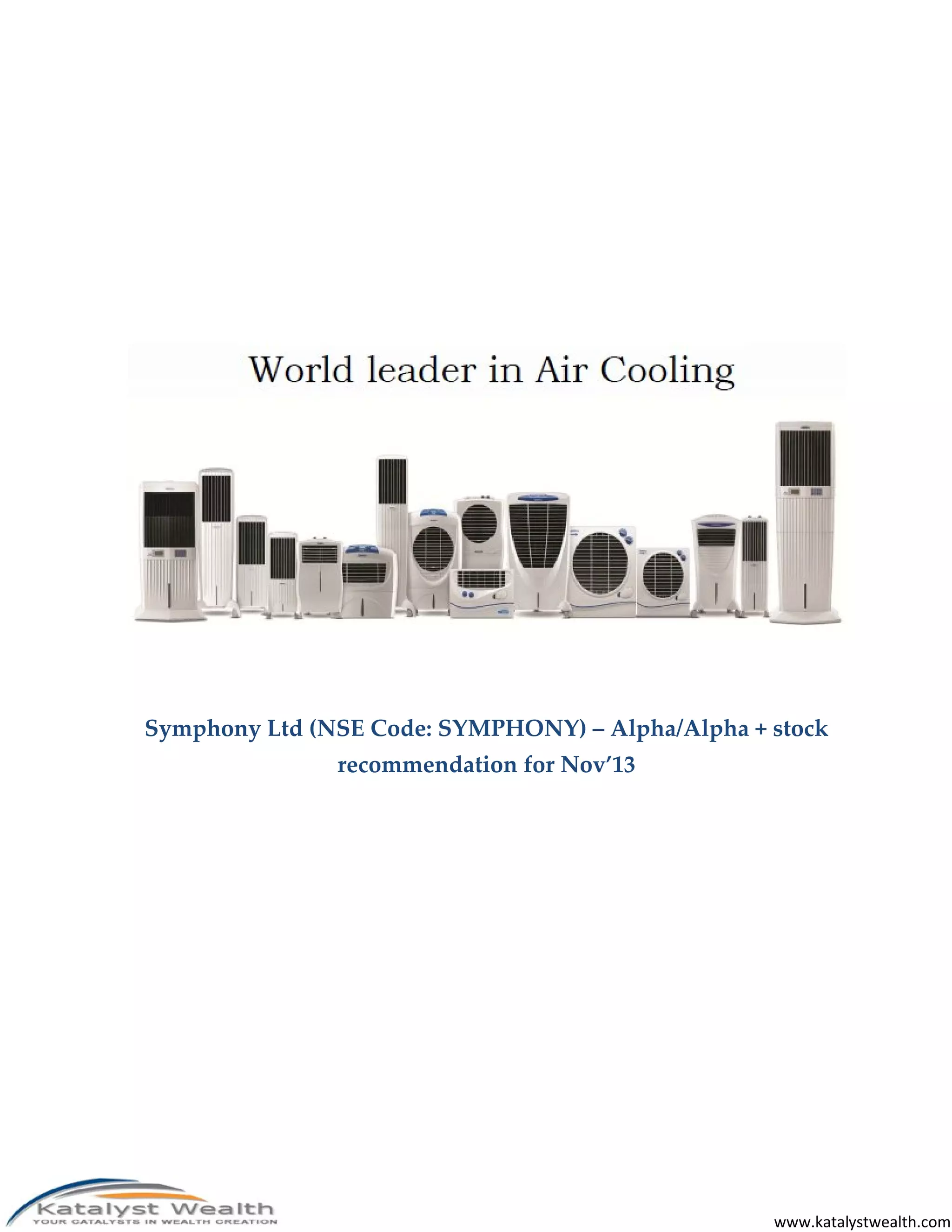
Symphony Ltd (NSE Code: SYMPHONY) – Alpha/Alpha + stock
recommendation for Nov’13
www.katalystwealth.com
Content Index
1. Company Snapshot
2. Symphony – Basic details
3. Fall and Rise of Symphony
4. Growth drivers for the air-coolers industry and thereby Symphony
 Rising average temperatures
 Low penetration of cooling appliances including air coolers
 Low capital and operating cost for air-coolers
 Increasing number of households in the lower-middle income group
 Vast unorganized market (~80% in terms of volume) and a shift in preference
for branded air-coolers
 No major competition from MNCs and thus huge export potential
 Industrial and commercial coolers at a very nascent stage in India
5. Symphony – Performance snapshot
6. What makes Symphony so profitable?
7. Shareholding pattern
8. Dividend Policy
9. Valuations
10. Risks & Concerns
www.katalystwealth.com
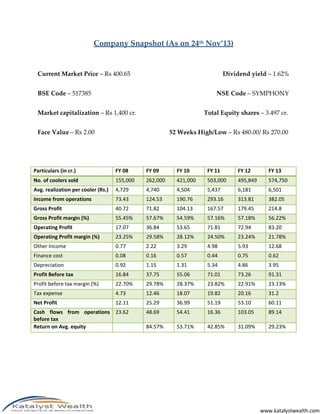
Company Snapshot (As on 24th Nov’13)
Current Market Price – Rs 400.65 Dividend yield – 1.62%
BSE Code – 517385 NSE Code – SYMPHONY
Market capitalization – Rs 1,400 cr. Total Equity shares – 3.497 cr.
Face Value – Rs 2.00 52 Weeks High/Low – Rs 480.00/ Rs 270.00
Particulars (in cr.) FY 08 FY 09 FY 10 FY 11 FY 12 FY 13
No. of coolers sold 155,000 262,000 421,000 503,000 495,849 574,750
Avg. realization per cooler (Rs.) 4,729 4,740 4,504 5,437 6,181 6,501
Income from operations 73.43 124.53 190.76 293.16 313.81 382.05
Gross Profit 40.72 71.82 104.13 167.57 179.45 214.8
Gross Profit margin (%) 55.45% 57.67% 54.59% 57.16% 57.18% 56.22%
Operating Profit 17.07 36.84 53.65 71.81 72.94 83.20
Operating Profit margin (%) 23.25% 29.58% 28.12% 24.50% 23.24% 21.78%
Other Income 0.77 2.22 3.29 4.98 5.93 12.68
Finance cost 0.08 0.16 0.57 0.44 0.75 0.62
Depreciation 0.92 1.15 1.31 5.34 4.86 3.95
Profit Before tax 16.84 37.75 55.06 71.01 73.26 91.31
Profit before tax margin (%) 22.70% 29.78% 28.37% 23.82% 22.91% 23.13%
Tax expense 4.73 12.46 18.07 19.82 20.16 31.2
Net Profit 12.11 25.29 36.99 51.19 53.10 60.11
Cash flows from operations
before tax
23.62 48.69 54.41 16.36 103.05 89.14
Return on Avg. equity 84.57% 53.71% 42.85% 31.09% 29.23%
www.katalystwealth.com
Dear Members,
Symphony is the leading company in the Air cooler industry with 50% share of the
organized segment in India. The company has an extraordinary track record for the past 5-
6 years i.e. since the time it started focusing only on “air coolers” and exited from other
businesses such as ACs, washing machines, etc.
As per the management they expect to maintain 25-30% annualized growth on the back of
good growth in the industry, continuous shift towards branded products, steadily
increasing exports and expansion of domestic dealer network from 16,400 to 40,000 dealers
in next few years.
Symphony operates on an asset light strategy and has outsourced most of its
manufacturing requirement; however it focuses extensively on design and introduction of
new models through continuous innovation. The working capital requirement is also very
low as the sales to distributors are on cash basis.
As a result of asset light strategy, Symphony is debt free with surplus cash to the tune of
150 crores (invested in various debt schemes) and only 80 crores employed in the
appliances business with return in excess of 100% on the capital employed.
Based on the guidance shared by the management, we expect Symphony to close FY 14
with net sales of 460-470 crores and pre-tax operating profit of 100-110 crores.
www.katalystwealth.com
Symphony Ltd – Basic Details
Established in 1988, Symphony happened to be the country’s first branded air cooler
manufacturer. The company’s air coolers literally gushed out fresh air in a market
dominated by shoddy products. With stress on innovation, superior quality and prompt
after-sales service, its products are now a big hit in the market. In India the company is the
largest player with a whopping 50% market share in the organized sector.
Symphony enjoys higher brand equity than its competitors because of its high ad spend,
innovative product portfolio and wide distribution network. The Company has
continuously evolved its product portfolio to infuse freshness among channel partners
and customers. It has created a basket of over 24 air coolers in the residential segment with
wide variety, niche segments (desert coolers, personal coolers, room coolers, tower coolers
and window coolers) and enhanced product features (power saver technology, space
saver range, four-side cooling, humidity control and fully functional remote operability).
The stress of innovation can be gauged from the fact that its intellectual property
comprises of 8 patents, 49 designs, 108 trademarks and 7 copyrights.
Symphony’s product line-up is well supported by 750-plus distributors and 16,400 dealers
across India. It has outsourced manufacturing to exclusive OEMs (original equipment
manufacturers) providing it with flexibility to increase production at a minimal capital
cost.
Besides its strong presence in India, Symphony has achieved the distinction of being one
of the few Indian brands with a presence in 60 countries across the globe and has emerged
as the largest air cooler company in the world with plans to expand to over 100 countries
over the next 3-4 years. It is one of the major air cooler suppliers globally to Wal-Mart,
Sears, Costco, Home Depot, Lowes and Famsa (products are sold under Symphony's
brand name in these retail outlets).
Though Symphony is now on a very strong footing, the past two decades have been a
roller-coaster ride as the company turned sick in 2002 from being a market leader in
plastic air coolers.
www.katalystwealth.com
In late 1990s the company diversified into other consumer durables like air conditioners
and washing machines to tap the consumer boom. However, Symphony’s diversification
proved to be a disaster. In 2002, the company’s net worth eroded as it suffered a loss of Rs
31 crore against a total income of Rs 28 crore. It registered with the Board for Industrial
and Financial Reconstruction and began drawing up a turnaround plan.
Since the air-cooler business was flourishing even in those bad times, the company
revamped its strategy from the earlier many-products-one-market to one-product-many-
markets, concentrating all its expertise on air coolers.
The management restructured its operations with a renewed focus on air coolers and
turned it back into a financially strong company with zero debt by 2008-09.
Foray into Industrial and commercial cooling space – Having established itself as the
leader in residential air-coolers segment, Symphony has also ventured into Industrial &
Commercial (I&C) air cooling which is a virgin market in India with huge potential.
These industrial and commercial air coolers are ideal in applications where extreme heat is
encountered or in large facilities where refrigerated air is considered expensive.
In 2008, Symphony acquired 49% stake in IMPCO, a Mexican company and later made it a
wholly owned subsidiary by acquiring balance 51% in 2011-12. IMPCO is one of the
world’s leading I&C air cooling company and Symphony is now utilizing the global
expertise of its subsidiary to aggressively tap factories, warehouses, office spaces, hotels as
well as the large format retail outlets in India and other countries.
In order to strengthen its presence in I&C space, Symphony has strengthened its
leadership team, widened its distribution network from 15 dealers in 2011-12 to 44 dealers
in 2012-13, participated in various meets and advertised in trade media, collaborated with
10 large opinion-driving HVAC consultants (play a key role in advising customers on
cooling solutions) and two large nationally renowned contractors.
www.katalystwealth.com
As a result of the above measures, Symphony achieved the following in I&C space in 2012-
13 (Source: Annual Report 2012-13):
1. Completed 109 installations against 56 installations in 2011-12
2. Penetrated some new industrial segments, namely paints, logistics and moulding
industries
3. Executed orders for some renowned brands namely Asian Paints, DHL, Dixon
Technologies, Swaminarayan Temple, ISKCON Temple, Marico, Tractor India and
Shivam Auto Tech (part of Hero Group)
4. Received the first order from Indian Railways to install air coolers in waiting rooms
of Kota and Godhra railway stations
5. Received a repeat order from Baba Ramdev’s Patanjali Yogpeeth
Outside India, Symphony and IMPCO have done industrial air cooling projects for the
stores of retail majors like Wal-Mart, Sears & Home Depot and for GE and Lear
Corporation’s production facilities. Recently, the company commissioned a pilot project to
air-cool super market chain, Makro, in Colombia and is in talks with Makro to air cool its
other super-markets.
Fall and Rise of Symphony
Warren Buffett once said, “Turnarounds seldom turn”; however Symphony is one such
exception which in our view is much stronger and much better because of the hardships it
faced in early 2000 when it turned sick.
Had it not turned sick, it may have continued with multi-product strategy in a highly
competitive market and may have remained a mediocre company than a high quality
company it currently is.
So, let’s look at what led to the fall of Symphony and the steps taken by the management
to turn it around (Source: CRISIL)
www.katalystwealth.com
Fall and Rise of Symphony – In its history of more than two decades, Symphony has
gone through various stages of development. From being a pioneer (first one to introduce
cooler as a lifestyle product and launched plastic body coolers compared to the then
available metal coolers) and a market leader in the air cooling market in the early 1990s its
fortunes took a dramatic turn due to the aggressive launch of new products between mid
’90s and early 2000.
During this period, the company launched various consumer durable products including
air conditioners, geysers, fans and washing machines. Moving out of its core DNA into the
highly competitive industry proved to be a tall task for the management.
Although the company did well in coolers, it failed to successfully establish itself in other
products resulting in huge losses and wiping off the net worth. The company filed a
reference with BIFR and was declared a sick industrial unit in 2002.
Grappling with various legal battles, the management made significant efforts to relook at
the overall group strategy and business operations. The following initiatives and measures
were undertaken by the management:
Defining the playing field: It decided to stick to its core DNA, i.e. coolers and geysers,
rather than venturing into ‘all’. Playing ground was clearly established and a clear-cut
market penetration strategy was adopted.
Product re-engineering: It re-engineered its product design to reduce per-unit cost and
improve efficiency. The company adopted standardized designs for small components
such as switches, cords, knobs, etc. to ensure efficiency in sourcing.
Outsourcing of manufacturing activities: Similar to large FMCG and consumer durable
players, the company outsourced all its manufacturing and testing activities to OEMs but
retained full quality control and product innovation.
Expansion of distribution network and brand promotion: Symphony focused more on
growing its distribution channel and promoting its brand.
www.katalystwealth.com
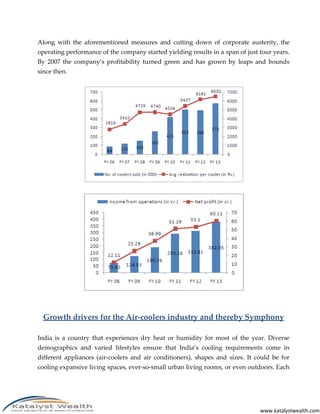
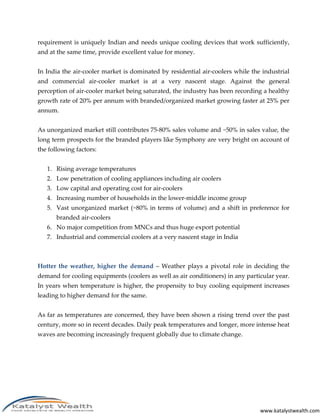
Along with the aforementioned measures and cutting down of corporate austerity, the
operating performance of the company started yielding results in a span of just four years.
By 2007 the company’s profitability turned green and has grown by leaps and bounds
since then.
Growth drivers for the Air-coolers industry and thereby Symphony
India is a country that experiences dry heat or humidity for most of the year. Diverse
demographics and varied lifestyles ensure that India’s cooling requirements come in
different appliances (air-coolers and air conditioners), shapes and sizes. It could be for
cooling expansive living spaces, ever-so-small urban living rooms, or even outdoors. Each
www.katalystwealth.com
requirement is uniquely Indian and needs unique cooling devices that work sufficiently,
and at the same time, provide excellent value for money.
In India the air-cooler market is dominated by residential air-coolers while the industrial
and commercial air-cooler market is at a very nascent stage. Against the general
perception of air-cooler market being saturated, the industry has been recording a healthy
growth rate of 20% per annum with branded/organized market growing faster at 25% per
annum.
As unorganized market still contributes 75-80% sales volume and ~50% in sales value, the
long term prospects for the branded players like Symphony are very bright on account of
the following factors:
1. Rising average temperatures
2. Low penetration of cooling appliances including air coolers
3. Low capital and operating cost for air-coolers
4. Increasing number of households in the lower-middle income group
5. Vast unorganized market (~80% in terms of volume) and a shift in preference for
branded air-coolers
6. No major competition from MNCs and thus huge export potential
7. Industrial and commercial coolers at a very nascent stage in India
Hotter the weather, higher the demand – Weather plays a pivotal role in deciding the
demand for cooling equipments (coolers as well as air conditioners) in any particular year.
In years when temperature is higher, the propensity to buy cooling equipment increases
leading to higher demand for the same.
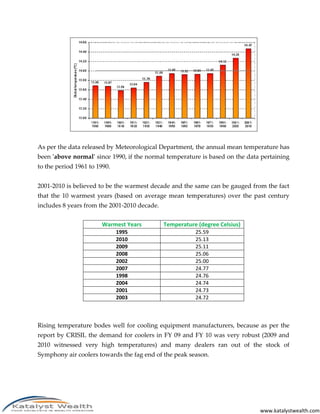
As far as temperatures are concerned, they have been shown a rising trend over the past
century, more so in recent decades. Daily peak temperatures and longer, more intense heat
waves are becoming increasingly frequent globally due to climate change.
www.katalystwealth.com
As per the data released by Meteorological Department, the annual mean temperature has
been 'above normal' since 1990, if the normal temperature is based on the data pertaining
to the period 1961 to 1990.
2001-2010 is believed to be the warmest decade and the same can be gauged from the fact
that the 10 warmest years (based on average mean temperatures) over the past century
includes 8 years from the 2001-2010 decade.
Warmest Years Temperature (degree Celsius)
1995 25.59
2010 25.13
2009 25.11
2008 25.06
2002 25.00
2007 24.77
1998 24.76
2004 24.74
2001 24.73
2003 24.72
Rising temperature bodes well for cooling equipment manufacturers, because as per the
report by CRISIL the demand for coolers in FY 09 and FY 10 was very robust (2009 and
2010 witnessed very high temperatures) and many dealers ran out of the stock of
Symphony air coolers towards the fag end of the peak season.
www.katalystwealth.com
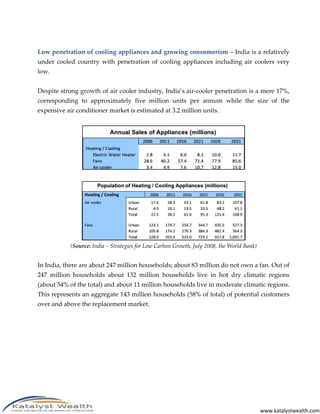
Low penetration of cooling appliances and growing consumerism – India is a relatively
under cooled country with penetration of cooling appliances including air coolers very
low.
Despite strong growth of air cooler industry, India’s air-cooler penetration is a mere 17%,
corresponding to approximately five million units per annum while the size of the
expensive air conditioner market is estimated at 3.2 million units.
(Source: India – Strategies for Low Carbon Growth, July 2008, the World Bank)
In India, there are about 247 million households; about 83 million do not own a fan. Out of
247 million households about 132 million households live in hot dry climatic regions
(about 54% of the total) and about 11 million households live in moderate climatic regions.
This represents an aggregate 143 million households (58% of total) of potential customers
over and above the replacement market.
www.katalystwealth.com
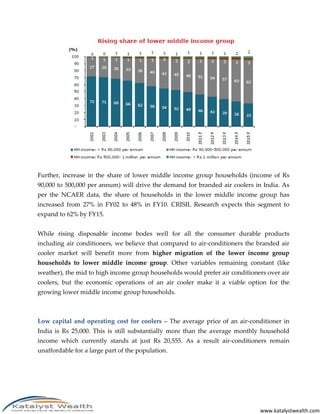
Further, increase in the share of lower middle income group households (income of Rs
90,000 to 500,000 per annum) will drive the demand for branded air coolers in India. As
per the NCAER data, the share of households in the lower middle income group has
increased from 27% in FY02 to 48% in FY10. CRISIL Research expects this segment to
expand to 62% by FY15.
While rising disposable income bodes well for all the consumer durable products
including air conditioners, we believe that compared to air-conditioners the branded air
cooler market will benefit more from higher migration of the lower income group
households to lower middle income group. Other variables remaining constant (like
weather), the mid to high income group households would prefer air conditioners over air
coolers, but the economic operations of an air cooler make it a viable option for the
growing lower middle income group households.
Low capital and operating cost for coolers – The average price of an air-conditioner in
India is Rs 25,000. This is still substantially more than the average monthly household
income which currently stands at just Rs 20,555. As a result air-conditioners remain
unaffordable for a large part of the population.
www.katalystwealth.com
Parameter Air cooler (Symphony) Air conditioner
Price of the equipment 4,000-7,000 20,000-25,000
Watts 185 1,500-2,000
Run time (hrs) 8 8
Total KWh consumed 1.5 14.0
Per month (KWh) 45.9 434.0
Price per KWh ~4.5 ~4.5
Running cost per month (Rs) 206 1,953
The price of an air cooler starts from as low as Rs 4,000, far less than the average price of
an air-conditioner and thus air-coolers render air-conditioners less attractive for the mass
market.
Besides low capital cost, much lower operating cost in comparison to air-conditioners
make air-coolers preferable for a large part of Indian population including upper middle
income households in hot and dry climatic regions.
The energy bill for an air-cooler with its simple fan and water pump amounts to
approximately Rs 206 per month compared to Rs 1,953 for an air-conditioner. Thus, an air-
conditioner is ~10 times more expensive to run than an air cooler.
Market share gain from unorganized players – In all major industries, be it sanitary ware,
kitchen appliances, and other consumer durables, unorganized players are losing market
share to branded players at a rapid pace.
As the discretionary spending has risen significantly over the past decade, so have the
aspirations of the consumers. A consumer using a fan aspires to buy an air-cooler while an
air-cooler user desires to move to an air-conditioner. In earlier times, air-coolers and air
conditioners were purchased to fulfill the basic need of cooling. Nowadays, with a rise in
discretionary income and aspiration levels, consumers seek to fulfill needs of aesthetics
and presentation along with cooling.
www.katalystwealth.com
Consumers are also giving preference to brand recall, serviceability, warranty, consistency
and reliability and in all these areas organized players score over unorganized players.
As per various sources, unorganized/unbranded air-coolers still account for ~80% of
annual sales volume and ~50% of annual sales value, however while the overall growth
rate of the industry has been 20% per annum, organized industry with Symphony at the
helm has been growing at ~25% per annum. Thus, Symphony and other branded players
are steadily gaining market share from unorganized players.
Over the years Symphony has pioneered many innovations in coolers – aesthetically
superior non-rusting ABS plastic body instead of wooden/metal body; electronic controls,
silent instead of noisy, powerful air throw, compact instead of large-sized/bulky, different
models with different shapes, sizes, capacities, and features for various segments.
While some of these have been copied by competition over time, the Symphony brand
recall is very high among consumers as it has the highest ad spend, is the only pure play
focused player in air-coolers and has the widest product offering.
Besides, the company recently introduced its window range of air coolers in both plastic
and metal bodies with advanced features like Dura Pump technology, automatic water
refill, inverter compatibility, etc. Window range has been introduced by the management
as the unorganized segment is still dominated by window installed metal body coolers
and should therefore open up huge market for Symphony.
Thus, Symphony with its innovative, quality products is best positioned to gain market
share from the unorganized local fringe.
No competition from MNCs – MNCs like LG, Samsung are busy competing in air-
conditioners segment and same is the case with national players like Voltas, Blue Star, etc.
The lack of competition from MNCs can be gauged from the fact that Symphony is the
world leader in air-coolers with presence in over 60 countries. Symphony has actually
created air-cooler segment in many countries and has therefore virtually no competitor in
www.katalystwealth.com
such countries. As a result Symphony’s international revenues have grown 10 fold from
Rs 3.3 crore in FY 06 to Rs 35.71 crore in FY 13.
In the domestic arena, Kenstar (Videocon group) and Bajaj (Bajaj Electricals) are number
two and three respectively in organized air coolers market and there are other small
branded players like Usha, Khaitan, Maharaja, etc, however none of these players are
focused players in air coolers; they all straddle various product categories. Over the years,
many branded players entered the category and exited; some of them are Onida,
Crompton, and Polar.
Symphony is the only pure play focused player in Air coolers with highest brand recall.
As per the annual report of the company, Symphony brand had over 70% share of voice in
media in the air cooler category, probably the highest for any brand in the consumer
durable and appliances category.
Industrial and commercial coolers is a huge untapped opportunity – As per the
management of Symphony, Industrial and commercial air-cooling is at nascent stage in
India, however it is gaining increasing importance as corporates are looking to create a
congenial working environment for their shop floor teams. Large and small factories are
the most pertinent examples as corporates can ill-afford centralized air conditioning due
to open-air areas as well as prohibitive capital and operating costs.
The key benefits of centralized air cooling over centralized air conditioning is that it is
environment friendly, can cool open spaces, consumes 90% less power as compared to air-
conditioners, has low initial cost as well as low installation and maintenance expenses.
Effective
Temp (C)
24 27 29 32 35 38 41
Loss of work
output
3% 8% 18% 29% 45% 62% 79%
Loss of
accuracy
0% 5% 40% 300% 700% >700%
Source: Study for NASA – “Comfort conditioning the plant with Evaporative cooling”
www.katalystwealth.com
Research shows that productivity increases manifold in a comfortable working
environment. A NASA report has stated that at 38 degrees temperature there is 62% loss
of work output and at 41 degrees it goes up to 79%. So, the potential for industrial air
cooling in India, where air conditioning is just not feasible, is enormous.
Basically, wherever centralized air conditioning is used, there is potential of using
centralized air cooling or ducted air coolers, especially if the budget is modest or if there’s
a large open space.
---------------Left intentionally blank---------------
www.katalystwealth.com
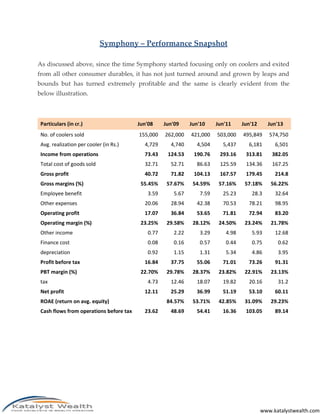
Symphony – Performance Snapshot
As discussed above, since the time Symphony started focusing only on coolers and exited
from all other consumer durables, it has not just turned around and grown by leaps and
bounds but has turned extremely profitable and the same is clearly evident from the
below illustration.
Particulars (in cr.) Jun'08 Jun'09 Jun'10 Jun'11 Jun'12 Jun'13
No. of coolers sold 155,000 262,000 421,000 503,000 495,849 574,750
Avg. realization per cooler (in Rs.) 4,729 4,740 4,504 5,437 6,181 6,501
Income from operations 73.43 124.53 190.76 293.16 313.81 382.05
Total cost of goods sold 32.71 52.71 86.63 125.59 134.36 167.25
Gross profit 40.72 71.82 104.13 167.57 179.45 214.8
Gross margins (%) 55.45% 57.67% 54.59% 57.16% 57.18% 56.22%
Employee benefit 3.59 5.67 7.59 25.23 28.3 32.64
Other expenses 20.06 28.94 42.38 70.53 78.21 98.95
Operating profit 17.07 36.84 53.65 71.81 72.94 83.20
Operating margin (%) 23.25% 29.58% 28.12% 24.50% 23.24% 21.78%
Other income 0.77 2.22 3.29 4.98 5.93 12.68
Finance cost 0.08 0.16 0.57 0.44 0.75 0.62
depreciation 0.92 1.15 1.31 5.34 4.86 3.95
Profit before tax 16.84 37.75 55.06 71.01 73.26 91.31
PBT margin (%) 22.70% 29.78% 28.37% 23.82% 22.91% 23.13%
tax 4.73 12.46 18.07 19.82 20.16 31.2
Net profit 12.11 25.29 36.99 51.19 53.10 60.11
ROAE (return on avg. equity) 84.57% 53.71% 42.85% 31.09% 29.23%
Cash flows from operations before tax 23.62 48.69 54.41 16.36 103.05 89.14
www.katalystwealth.com
There are some important points about the performance of Symphony and those are as
below:
 A combination of volume and value driven growth as the company has consistently
been introducing new models with better features and thus been able to improve
the average realization per cooler.
 High gross margins of 55%-57% and has maintained its margins despite
inflationary pressures. Thus, Symphony has been able to pass on the increase in
prices of goods to its customers without much lag.
 Some deterioration in operating margins since the acquisition of IMPCO, however
the management has already started implementing lean manufacturing practices in
order to bring down the operating cost at IMPCO, just as it did in case of Indian
operations a few years back.
 Besides the above, Symphony has done well on all other metrics such as cash flow
generation, return on equity, margins etc. Excluding the impact of other income, the
cash flows from operations have been actually higher than the reported profits.
 The Return on equity has been declining, though still very high, as the company
has been generating very strong cash flows while the capital requirement is low.
Thus, ~8% yield on surplus amount which is getting accumulated has been bringing
down the return on equity. It’s a kind of sweet problem to be in and is normally
encountered by high quality companies. Companies usually deal with the same by
increasing dividend payout and Symphony too has increased its payout to 36-37%
We believe, in order for shareholders to realize gains from their investments, it is
important for the company to grow, however what is even more important is the quality
of growth and Symphony scores high on quality quotient.
www.katalystwealth.com
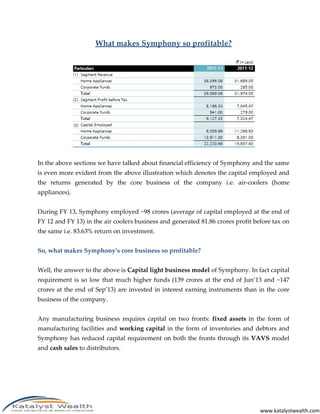
What makes Symphony so profitable?
In the above sections we have talked about financial efficiency of Symphony and the same
is even more evident from the above illustration which denotes the capital employed and
the returns generated by the core business of the company i.e. air-coolers (home
appliances).
During FY 13, Symphony employed ~98 crores (average of capital employed at the end of
FY 12 and FY 13) in the air coolers business and generated 81.86 crores profit before tax on
the same i.e. 83.63% return on investment.
So, what makes Symphony’s core business so profitable?
Well, the answer to the above is Capital light business model of Symphony. In fact capital
requirement is so low that much higher funds (139 crores at the end of Jun’13 and ~147
crores at the end of Sep’13) are invested in interest earning instruments than in the core
business of the company.
Any manufacturing business requires capital on two fronts: fixed assets in the form of
manufacturing facilities and working capital in the form of inventories and debtors and
Symphony has reduced capital requirement on both the fronts through its VAVS model
and cash sales to distributors.
www.katalystwealth.com
VAVS model – Value addition through Vendor Support (VAVS) has worked wonders for
Symphony, turning it into an asset light, capital-light, zero debt company. Under this
model, the company has been outsourcing its components and product manufacturing to
original equipment manufacturers (OEMs) with an established track record. This has left
the company with adequate resources – people, time and cash – to concentrate on product
design, development, value engineering, innovation, marketing and distribution.
Besides, the VAVS model has boosted the company’s growth as it has enabled
Symphony’s air cooler capacity to rise ten-fold in seven years from about 100,000 units in
2005-06 to 1,000,000 in 2012-13.
Working capital management – On the working capital front, the company has
implemented strategies like only cash sales to distributors (though sales to Modern Retail
are on credit) and discounts/offers to distributors during off-season to bring about faster
clearance of inventory, thus lowering working capital requirement.
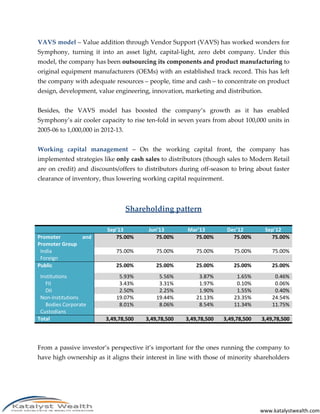
Shareholding pattern
Sep’13 Jun’13 Mar’13 Dec’12 Sep’12
Promoter and
Promoter Group
75.00% 75.00% 75.00% 75.00% 75.00%
India 75.00% 75.00% 75.00% 75.00% 75.00%
Foreign
Public 25.00% 25.00% 25.00% 25.00% 25.00%
Institutions 5.93% 5.56% 3.87% 1.65% 0.46%
FII 3.43% 3.31% 1.97% 0.10% 0.06%
DII 2.50% 2.25% 1.90% 1.55% 0.40%
Non-Institutions 19.07% 19.44% 21.13% 23.35% 24.54%
Bodies Corporate 8.01% 8.06% 8.54% 11.34% 11.75%
Custodians
Total 3,49,78,500 3,49,78,500 3,49,78,500 3,49,78,500 3,49,78,500
From a passive investor’s perspective it’s important for the ones running the company to
have high ownership as it aligns their interest in line with those of minority shareholders
www.katalystwealth.com
and in the case of Symphony the promoters (Mr. Achal Bakeri and the related parties) own
75% equity stake in the company.
Mr Achal Bakeri, Promoter and CMD of Symphony has more than two decades of
experience in the air cooler industry. He founded the company in 1988 and was the first
one to launch plastic coolers in India.
Mr Nrupesh Shah, Executive Director, looks after strategies, policies, corporate matters,
finance and accounts. He has over 20 years of experience in the industry and has been
working as a director since 2002.
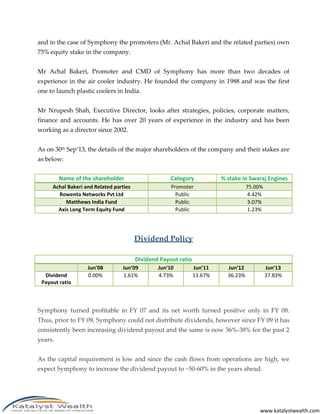
As on 30th Sep’13, the details of the major shareholders of the company and their stakes are
as below:
Name of the shareholder Category % stake in Swaraj Engines
Achal Bakeri and Related parties Promoter 75.00%
Rowenta Networks Pvt Ltd Public 4.42%
Matthews India Fund Public 3.07%
Axis Long Term Equity Fund Public 1.23%
Dividend Policy
Dividend Payout ratio
Jun’08 Jun’09 Jun’10 Jun’11 Jun’12 Jun’13
Dividend
Payout ratio
0.00% 1.61% 4.73% 13.67% 36.23% 37.83%
Symphony turned profitable in FY 07 and its net worth turned positive only in FY 08.
Thus, prior to FY 09, Symphony could not distribute dividends, however since FY 09 it has
consistently been increasing dividend payout and the same is now 36%-38% for the past 2
years.
As the capital requirement is low and since the cash flows from operations are high, we
expect Symphony to increase the dividend payout to ~50-60% in the years ahead.
www.katalystwealth.com
Stashing too much cash in the coffers may result in reckless acquisitions and we hope the
management remains cautious about the same.
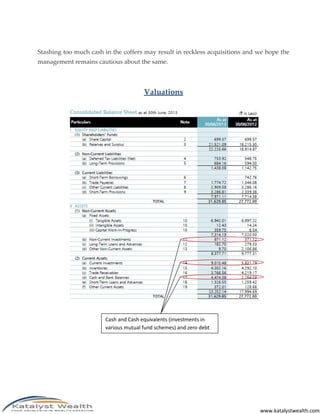
Valuations
Cash and Cash equivalents (investments in
various mutual fund schemes) and zero debt
www.katalystwealth.com
Before discussing valuations, let’s recall all that we have learnt about Symphony and the
air-coolers industry in the above sections:
 Symphony is the world leader in air-coolers business
 A pure-play focused company on air-coolers with no competition from MNCs and
limited competition from domestic organized companies
 Strong long term structural drivers for the air coolers industry in the form of rising
temperatures, low penetration of cooling appliances including air coolers, low
capital and operating cost for air-coolers, increasing number of households in the
lower-middle income group, vast unorganized market (~80% in terms of volume)
and a shift in preference for branded air-coolers, and huge untapped opportunity in
Industrial and commercial air cooling space
 Strong operating performance in terms of growth, margins, return on equity, cash
flow generation
 Capital light and scalable business model
 Debt free with surplus cash to the tune of ~10% of the current market cap
 Experienced and passionate promoters with 75% stake in the company
Coming back to valuations, at current price of 395-405, Symphony is available at a market
cap of 1,400 crores. We know that it’s a debt free company holding close to 140 crores as
cash and cash equivalents. Besides, we know that the business model is good, being very
low on capital requirement and consistently growing at 20-25% on annualized basis.
At the current stock price, the market is valuing the operating business of the company at
Rs 1,260 crores. In the trailing twelve months ending Sep’13, the company has delivered
pre-tax operating profit and cash flows of Rs 95-97 crores. Given the trajectory of growth
at which the company’s business happens to be, the current valuation does not seem to be
capturing expected future growth in earnings of Symphony.
Consider this: At present pre-tax AAA bond yields are 9% p.a. If Symphony’s business
was AAA bond and it paid Rs 96 crores a year in perpetuity, then the value of this non
growing perpetuity alone, at present interest rates would be Rs 1,067 crores. One can
therefore see that of the total enterprise value of Rs 1,260 crores, Rs 1,067 crore relates to
www.katalystwealth.com
the present value of future earnings if they were to not grow from here. The balance Rs
193 crore relates to the growth component of value.
In other words, at its current market value, the market expects Symphony to grow its
earnings at only 1.38% p.a. over the long term, though; to us it seems that Symphony will
continue to grow its earnings at a much higher rate for many years to come.
Risks & Concerns
 Though still early days into acquisition, IMPCO’s performance has been below
average. The management of Symphony has already started working on
implementation of lean manufacturing practices to bring down the operating cost at
IMPCO and it remains to be seen if they will be successful or not.
 Symphony sells coolers to Modern Retail chains on credit against the practice of only
cash sales to other distributors. Though Modern Retail’s contribution to Symphony’s
sales is low at this point of time, it is the fastest growing distribution channel and will
thus change the contours of working capital requirement of the company in the long
run.
 Industrial and commercial (I&C) cooling segment is a much more cyclical segment in
comparison to the residential cooling segment. At the moment the contribution of
I&C to the overall revenues of Symphony is ~15%, however in the longer run much
higher contribution is expected from I&C and will thus make the company more
susceptible to the vagaries of industrial cycles.
www.katalystwealth.com
Disclaimer: Nothing published herein or on www.katalystwealth.com should be considered as personalized
investment advice. Although our employees may answer your general customer service questions, they are not
licensed under laws to address your particular investment situation. No communication by our employees to you
should be deemed as personalized investment advice.
It should be noted that the information contained herein is from publicly available data or other sources believed to
be reliable. Neither Katalyst Wealth, nor any person connected with it accepts any liability arising from the use of this
document. This document is prepared for assistance only and is not intended to be and must not be taken as the basis
for any investment decision. The investment discussed or views expressed may not be suitable for all investors. The
user assumes the entire risk of any use made of this information. The recipients of Katalyst Wealth material should
rely on their own investigations and take their own professional advice. Each recipient of Katalyst Wealth should make
such investigations as it deems necessary to arrive at an independent evaluation of an investment referred to in this
document (including the merits and risks involved), and should consult its own advisers to determine the merits and
risks of such an investment. Price and value of the investments referred to in this material may go up or down.
www.katalystwealth.com
Mittal Consulting
7, Panch Ratan, 7/128
Swaroop Nagar, Kanpur – 208002
G – 52, 2nd
Floor
Sector – 39, Noida – 201301
Ph.: +91-512-6050062
Mob: +91-98188 66676
Email: info@katalystwealth.com

Symphony Ltd (NSE - SYMPHONY) - Nov'13 Katalyst Wealth Alpha recommendation

  • 1.
    www.katalystwealth.com Symphony Ltd (NSECode: SYMPHONY) – Alpha/Alpha + stock recommendation for Nov’13
  • 2.
    www.katalystwealth.com Content Index 1. CompanySnapshot 2. Symphony – Basic details 3. Fall and Rise of Symphony 4. Growth drivers for the air-coolers industry and thereby Symphony  Rising average temperatures  Low penetration of cooling appliances including air coolers  Low capital and operating cost for air-coolers  Increasing number of households in the lower-middle income group  Vast unorganized market (~80% in terms of volume) and a shift in preference for branded air-coolers  No major competition from MNCs and thus huge export potential  Industrial and commercial coolers at a very nascent stage in India 5. Symphony – Performance snapshot 6. What makes Symphony so profitable? 7. Shareholding pattern 8. Dividend Policy 9. Valuations 10. Risks & Concerns
  • 3.
    www.katalystwealth.com Company Snapshot (Ason 24th Nov’13) Current Market Price – Rs 400.65 Dividend yield – 1.62% BSE Code – 517385 NSE Code – SYMPHONY Market capitalization – Rs 1,400 cr. Total Equity shares – 3.497 cr. Face Value – Rs 2.00 52 Weeks High/Low – Rs 480.00/ Rs 270.00 Particulars (in cr.) FY 08 FY 09 FY 10 FY 11 FY 12 FY 13 No. of coolers sold 155,000 262,000 421,000 503,000 495,849 574,750 Avg. realization per cooler (Rs.) 4,729 4,740 4,504 5,437 6,181 6,501 Income from operations 73.43 124.53 190.76 293.16 313.81 382.05 Gross Profit 40.72 71.82 104.13 167.57 179.45 214.8 Gross Profit margin (%) 55.45% 57.67% 54.59% 57.16% 57.18% 56.22% Operating Profit 17.07 36.84 53.65 71.81 72.94 83.20 Operating Profit margin (%) 23.25% 29.58% 28.12% 24.50% 23.24% 21.78% Other Income 0.77 2.22 3.29 4.98 5.93 12.68 Finance cost 0.08 0.16 0.57 0.44 0.75 0.62 Depreciation 0.92 1.15 1.31 5.34 4.86 3.95 Profit Before tax 16.84 37.75 55.06 71.01 73.26 91.31 Profit before tax margin (%) 22.70% 29.78% 28.37% 23.82% 22.91% 23.13% Tax expense 4.73 12.46 18.07 19.82 20.16 31.2 Net Profit 12.11 25.29 36.99 51.19 53.10 60.11 Cash flows from operations before tax 23.62 48.69 54.41 16.36 103.05 89.14 Return on Avg. equity 84.57% 53.71% 42.85% 31.09% 29.23%
  • 4.
    www.katalystwealth.com Dear Members, Symphony isthe leading company in the Air cooler industry with 50% share of the organized segment in India. The company has an extraordinary track record for the past 5- 6 years i.e. since the time it started focusing only on “air coolers” and exited from other businesses such as ACs, washing machines, etc. As per the management they expect to maintain 25-30% annualized growth on the back of good growth in the industry, continuous shift towards branded products, steadily increasing exports and expansion of domestic dealer network from 16,400 to 40,000 dealers in next few years. Symphony operates on an asset light strategy and has outsourced most of its manufacturing requirement; however it focuses extensively on design and introduction of new models through continuous innovation. The working capital requirement is also very low as the sales to distributors are on cash basis. As a result of asset light strategy, Symphony is debt free with surplus cash to the tune of 150 crores (invested in various debt schemes) and only 80 crores employed in the appliances business with return in excess of 100% on the capital employed. Based on the guidance shared by the management, we expect Symphony to close FY 14 with net sales of 460-470 crores and pre-tax operating profit of 100-110 crores.
  • 5.
    www.katalystwealth.com Symphony Ltd –Basic Details Established in 1988, Symphony happened to be the country’s first branded air cooler manufacturer. The company’s air coolers literally gushed out fresh air in a market dominated by shoddy products. With stress on innovation, superior quality and prompt after-sales service, its products are now a big hit in the market. In India the company is the largest player with a whopping 50% market share in the organized sector. Symphony enjoys higher brand equity than its competitors because of its high ad spend, innovative product portfolio and wide distribution network. The Company has continuously evolved its product portfolio to infuse freshness among channel partners and customers. It has created a basket of over 24 air coolers in the residential segment with wide variety, niche segments (desert coolers, personal coolers, room coolers, tower coolers and window coolers) and enhanced product features (power saver technology, space saver range, four-side cooling, humidity control and fully functional remote operability). The stress of innovation can be gauged from the fact that its intellectual property comprises of 8 patents, 49 designs, 108 trademarks and 7 copyrights. Symphony’s product line-up is well supported by 750-plus distributors and 16,400 dealers across India. It has outsourced manufacturing to exclusive OEMs (original equipment manufacturers) providing it with flexibility to increase production at a minimal capital cost. Besides its strong presence in India, Symphony has achieved the distinction of being one of the few Indian brands with a presence in 60 countries across the globe and has emerged as the largest air cooler company in the world with plans to expand to over 100 countries over the next 3-4 years. It is one of the major air cooler suppliers globally to Wal-Mart, Sears, Costco, Home Depot, Lowes and Famsa (products are sold under Symphony's brand name in these retail outlets). Though Symphony is now on a very strong footing, the past two decades have been a roller-coaster ride as the company turned sick in 2002 from being a market leader in plastic air coolers.
  • 6.
    www.katalystwealth.com In late 1990sthe company diversified into other consumer durables like air conditioners and washing machines to tap the consumer boom. However, Symphony’s diversification proved to be a disaster. In 2002, the company’s net worth eroded as it suffered a loss of Rs 31 crore against a total income of Rs 28 crore. It registered with the Board for Industrial and Financial Reconstruction and began drawing up a turnaround plan. Since the air-cooler business was flourishing even in those bad times, the company revamped its strategy from the earlier many-products-one-market to one-product-many- markets, concentrating all its expertise on air coolers. The management restructured its operations with a renewed focus on air coolers and turned it back into a financially strong company with zero debt by 2008-09. Foray into Industrial and commercial cooling space – Having established itself as the leader in residential air-coolers segment, Symphony has also ventured into Industrial & Commercial (I&C) air cooling which is a virgin market in India with huge potential. These industrial and commercial air coolers are ideal in applications where extreme heat is encountered or in large facilities where refrigerated air is considered expensive. In 2008, Symphony acquired 49% stake in IMPCO, a Mexican company and later made it a wholly owned subsidiary by acquiring balance 51% in 2011-12. IMPCO is one of the world’s leading I&C air cooling company and Symphony is now utilizing the global expertise of its subsidiary to aggressively tap factories, warehouses, office spaces, hotels as well as the large format retail outlets in India and other countries. In order to strengthen its presence in I&C space, Symphony has strengthened its leadership team, widened its distribution network from 15 dealers in 2011-12 to 44 dealers in 2012-13, participated in various meets and advertised in trade media, collaborated with 10 large opinion-driving HVAC consultants (play a key role in advising customers on cooling solutions) and two large nationally renowned contractors.
  • 7.
    www.katalystwealth.com As a resultof the above measures, Symphony achieved the following in I&C space in 2012- 13 (Source: Annual Report 2012-13): 1. Completed 109 installations against 56 installations in 2011-12 2. Penetrated some new industrial segments, namely paints, logistics and moulding industries 3. Executed orders for some renowned brands namely Asian Paints, DHL, Dixon Technologies, Swaminarayan Temple, ISKCON Temple, Marico, Tractor India and Shivam Auto Tech (part of Hero Group) 4. Received the first order from Indian Railways to install air coolers in waiting rooms of Kota and Godhra railway stations 5. Received a repeat order from Baba Ramdev’s Patanjali Yogpeeth Outside India, Symphony and IMPCO have done industrial air cooling projects for the stores of retail majors like Wal-Mart, Sears & Home Depot and for GE and Lear Corporation’s production facilities. Recently, the company commissioned a pilot project to air-cool super market chain, Makro, in Colombia and is in talks with Makro to air cool its other super-markets. Fall and Rise of Symphony Warren Buffett once said, “Turnarounds seldom turn”; however Symphony is one such exception which in our view is much stronger and much better because of the hardships it faced in early 2000 when it turned sick. Had it not turned sick, it may have continued with multi-product strategy in a highly competitive market and may have remained a mediocre company than a high quality company it currently is. So, let’s look at what led to the fall of Symphony and the steps taken by the management to turn it around (Source: CRISIL)
  • 8.
    www.katalystwealth.com Fall and Riseof Symphony – In its history of more than two decades, Symphony has gone through various stages of development. From being a pioneer (first one to introduce cooler as a lifestyle product and launched plastic body coolers compared to the then available metal coolers) and a market leader in the air cooling market in the early 1990s its fortunes took a dramatic turn due to the aggressive launch of new products between mid ’90s and early 2000. During this period, the company launched various consumer durable products including air conditioners, geysers, fans and washing machines. Moving out of its core DNA into the highly competitive industry proved to be a tall task for the management. Although the company did well in coolers, it failed to successfully establish itself in other products resulting in huge losses and wiping off the net worth. The company filed a reference with BIFR and was declared a sick industrial unit in 2002. Grappling with various legal battles, the management made significant efforts to relook at the overall group strategy and business operations. The following initiatives and measures were undertaken by the management: Defining the playing field: It decided to stick to its core DNA, i.e. coolers and geysers, rather than venturing into ‘all’. Playing ground was clearly established and a clear-cut market penetration strategy was adopted. Product re-engineering: It re-engineered its product design to reduce per-unit cost and improve efficiency. The company adopted standardized designs for small components such as switches, cords, knobs, etc. to ensure efficiency in sourcing. Outsourcing of manufacturing activities: Similar to large FMCG and consumer durable players, the company outsourced all its manufacturing and testing activities to OEMs but retained full quality control and product innovation. Expansion of distribution network and brand promotion: Symphony focused more on growing its distribution channel and promoting its brand.
  • 9.
    www.katalystwealth.com Along with theaforementioned measures and cutting down of corporate austerity, the operating performance of the company started yielding results in a span of just four years. By 2007 the company’s profitability turned green and has grown by leaps and bounds since then. Growth drivers for the Air-coolers industry and thereby Symphony India is a country that experiences dry heat or humidity for most of the year. Diverse demographics and varied lifestyles ensure that India’s cooling requirements come in different appliances (air-coolers and air conditioners), shapes and sizes. It could be for cooling expansive living spaces, ever-so-small urban living rooms, or even outdoors. Each
  • 10.
    www.katalystwealth.com requirement is uniquelyIndian and needs unique cooling devices that work sufficiently, and at the same time, provide excellent value for money. In India the air-cooler market is dominated by residential air-coolers while the industrial and commercial air-cooler market is at a very nascent stage. Against the general perception of air-cooler market being saturated, the industry has been recording a healthy growth rate of 20% per annum with branded/organized market growing faster at 25% per annum. As unorganized market still contributes 75-80% sales volume and ~50% in sales value, the long term prospects for the branded players like Symphony are very bright on account of the following factors: 1. Rising average temperatures 2. Low penetration of cooling appliances including air coolers 3. Low capital and operating cost for air-coolers 4. Increasing number of households in the lower-middle income group 5. Vast unorganized market (~80% in terms of volume) and a shift in preference for branded air-coolers 6. No major competition from MNCs and thus huge export potential 7. Industrial and commercial coolers at a very nascent stage in India Hotter the weather, higher the demand – Weather plays a pivotal role in deciding the demand for cooling equipments (coolers as well as air conditioners) in any particular year. In years when temperature is higher, the propensity to buy cooling equipment increases leading to higher demand for the same. As far as temperatures are concerned, they have been shown a rising trend over the past century, more so in recent decades. Daily peak temperatures and longer, more intense heat waves are becoming increasingly frequent globally due to climate change.
  • 11.
    www.katalystwealth.com As per thedata released by Meteorological Department, the annual mean temperature has been 'above normal' since 1990, if the normal temperature is based on the data pertaining to the period 1961 to 1990. 2001-2010 is believed to be the warmest decade and the same can be gauged from the fact that the 10 warmest years (based on average mean temperatures) over the past century includes 8 years from the 2001-2010 decade. Warmest Years Temperature (degree Celsius) 1995 25.59 2010 25.13 2009 25.11 2008 25.06 2002 25.00 2007 24.77 1998 24.76 2004 24.74 2001 24.73 2003 24.72 Rising temperature bodes well for cooling equipment manufacturers, because as per the report by CRISIL the demand for coolers in FY 09 and FY 10 was very robust (2009 and 2010 witnessed very high temperatures) and many dealers ran out of the stock of Symphony air coolers towards the fag end of the peak season.
  • 12.
    www.katalystwealth.com Low penetration ofcooling appliances and growing consumerism – India is a relatively under cooled country with penetration of cooling appliances including air coolers very low. Despite strong growth of air cooler industry, India’s air-cooler penetration is a mere 17%, corresponding to approximately five million units per annum while the size of the expensive air conditioner market is estimated at 3.2 million units. (Source: India – Strategies for Low Carbon Growth, July 2008, the World Bank) In India, there are about 247 million households; about 83 million do not own a fan. Out of 247 million households about 132 million households live in hot dry climatic regions (about 54% of the total) and about 11 million households live in moderate climatic regions. This represents an aggregate 143 million households (58% of total) of potential customers over and above the replacement market.
  • 13.
    www.katalystwealth.com Further, increase inthe share of lower middle income group households (income of Rs 90,000 to 500,000 per annum) will drive the demand for branded air coolers in India. As per the NCAER data, the share of households in the lower middle income group has increased from 27% in FY02 to 48% in FY10. CRISIL Research expects this segment to expand to 62% by FY15. While rising disposable income bodes well for all the consumer durable products including air conditioners, we believe that compared to air-conditioners the branded air cooler market will benefit more from higher migration of the lower income group households to lower middle income group. Other variables remaining constant (like weather), the mid to high income group households would prefer air conditioners over air coolers, but the economic operations of an air cooler make it a viable option for the growing lower middle income group households. Low capital and operating cost for coolers – The average price of an air-conditioner in India is Rs 25,000. This is still substantially more than the average monthly household income which currently stands at just Rs 20,555. As a result air-conditioners remain unaffordable for a large part of the population.
  • 14.
    www.katalystwealth.com Parameter Air cooler(Symphony) Air conditioner Price of the equipment 4,000-7,000 20,000-25,000 Watts 185 1,500-2,000 Run time (hrs) 8 8 Total KWh consumed 1.5 14.0 Per month (KWh) 45.9 434.0 Price per KWh ~4.5 ~4.5 Running cost per month (Rs) 206 1,953 The price of an air cooler starts from as low as Rs 4,000, far less than the average price of an air-conditioner and thus air-coolers render air-conditioners less attractive for the mass market. Besides low capital cost, much lower operating cost in comparison to air-conditioners make air-coolers preferable for a large part of Indian population including upper middle income households in hot and dry climatic regions. The energy bill for an air-cooler with its simple fan and water pump amounts to approximately Rs 206 per month compared to Rs 1,953 for an air-conditioner. Thus, an air- conditioner is ~10 times more expensive to run than an air cooler. Market share gain from unorganized players – In all major industries, be it sanitary ware, kitchen appliances, and other consumer durables, unorganized players are losing market share to branded players at a rapid pace. As the discretionary spending has risen significantly over the past decade, so have the aspirations of the consumers. A consumer using a fan aspires to buy an air-cooler while an air-cooler user desires to move to an air-conditioner. In earlier times, air-coolers and air conditioners were purchased to fulfill the basic need of cooling. Nowadays, with a rise in discretionary income and aspiration levels, consumers seek to fulfill needs of aesthetics and presentation along with cooling.
  • 15.
    www.katalystwealth.com Consumers are alsogiving preference to brand recall, serviceability, warranty, consistency and reliability and in all these areas organized players score over unorganized players. As per various sources, unorganized/unbranded air-coolers still account for ~80% of annual sales volume and ~50% of annual sales value, however while the overall growth rate of the industry has been 20% per annum, organized industry with Symphony at the helm has been growing at ~25% per annum. Thus, Symphony and other branded players are steadily gaining market share from unorganized players. Over the years Symphony has pioneered many innovations in coolers – aesthetically superior non-rusting ABS plastic body instead of wooden/metal body; electronic controls, silent instead of noisy, powerful air throw, compact instead of large-sized/bulky, different models with different shapes, sizes, capacities, and features for various segments. While some of these have been copied by competition over time, the Symphony brand recall is very high among consumers as it has the highest ad spend, is the only pure play focused player in air-coolers and has the widest product offering. Besides, the company recently introduced its window range of air coolers in both plastic and metal bodies with advanced features like Dura Pump technology, automatic water refill, inverter compatibility, etc. Window range has been introduced by the management as the unorganized segment is still dominated by window installed metal body coolers and should therefore open up huge market for Symphony. Thus, Symphony with its innovative, quality products is best positioned to gain market share from the unorganized local fringe. No competition from MNCs – MNCs like LG, Samsung are busy competing in air- conditioners segment and same is the case with national players like Voltas, Blue Star, etc. The lack of competition from MNCs can be gauged from the fact that Symphony is the world leader in air-coolers with presence in over 60 countries. Symphony has actually created air-cooler segment in many countries and has therefore virtually no competitor in
  • 16.
    www.katalystwealth.com such countries. Asa result Symphony’s international revenues have grown 10 fold from Rs 3.3 crore in FY 06 to Rs 35.71 crore in FY 13. In the domestic arena, Kenstar (Videocon group) and Bajaj (Bajaj Electricals) are number two and three respectively in organized air coolers market and there are other small branded players like Usha, Khaitan, Maharaja, etc, however none of these players are focused players in air coolers; they all straddle various product categories. Over the years, many branded players entered the category and exited; some of them are Onida, Crompton, and Polar. Symphony is the only pure play focused player in Air coolers with highest brand recall. As per the annual report of the company, Symphony brand had over 70% share of voice in media in the air cooler category, probably the highest for any brand in the consumer durable and appliances category. Industrial and commercial coolers is a huge untapped opportunity – As per the management of Symphony, Industrial and commercial air-cooling is at nascent stage in India, however it is gaining increasing importance as corporates are looking to create a congenial working environment for their shop floor teams. Large and small factories are the most pertinent examples as corporates can ill-afford centralized air conditioning due to open-air areas as well as prohibitive capital and operating costs. The key benefits of centralized air cooling over centralized air conditioning is that it is environment friendly, can cool open spaces, consumes 90% less power as compared to air- conditioners, has low initial cost as well as low installation and maintenance expenses. Effective Temp (C) 24 27 29 32 35 38 41 Loss of work output 3% 8% 18% 29% 45% 62% 79% Loss of accuracy 0% 5% 40% 300% 700% >700% Source: Study for NASA – “Comfort conditioning the plant with Evaporative cooling”
  • 17.
    www.katalystwealth.com Research shows thatproductivity increases manifold in a comfortable working environment. A NASA report has stated that at 38 degrees temperature there is 62% loss of work output and at 41 degrees it goes up to 79%. So, the potential for industrial air cooling in India, where air conditioning is just not feasible, is enormous. Basically, wherever centralized air conditioning is used, there is potential of using centralized air cooling or ducted air coolers, especially if the budget is modest or if there’s a large open space. ---------------Left intentionally blank---------------
  • 18.
    www.katalystwealth.com Symphony – PerformanceSnapshot As discussed above, since the time Symphony started focusing only on coolers and exited from all other consumer durables, it has not just turned around and grown by leaps and bounds but has turned extremely profitable and the same is clearly evident from the below illustration. Particulars (in cr.) Jun'08 Jun'09 Jun'10 Jun'11 Jun'12 Jun'13 No. of coolers sold 155,000 262,000 421,000 503,000 495,849 574,750 Avg. realization per cooler (in Rs.) 4,729 4,740 4,504 5,437 6,181 6,501 Income from operations 73.43 124.53 190.76 293.16 313.81 382.05 Total cost of goods sold 32.71 52.71 86.63 125.59 134.36 167.25 Gross profit 40.72 71.82 104.13 167.57 179.45 214.8 Gross margins (%) 55.45% 57.67% 54.59% 57.16% 57.18% 56.22% Employee benefit 3.59 5.67 7.59 25.23 28.3 32.64 Other expenses 20.06 28.94 42.38 70.53 78.21 98.95 Operating profit 17.07 36.84 53.65 71.81 72.94 83.20 Operating margin (%) 23.25% 29.58% 28.12% 24.50% 23.24% 21.78% Other income 0.77 2.22 3.29 4.98 5.93 12.68 Finance cost 0.08 0.16 0.57 0.44 0.75 0.62 depreciation 0.92 1.15 1.31 5.34 4.86 3.95 Profit before tax 16.84 37.75 55.06 71.01 73.26 91.31 PBT margin (%) 22.70% 29.78% 28.37% 23.82% 22.91% 23.13% tax 4.73 12.46 18.07 19.82 20.16 31.2 Net profit 12.11 25.29 36.99 51.19 53.10 60.11 ROAE (return on avg. equity) 84.57% 53.71% 42.85% 31.09% 29.23% Cash flows from operations before tax 23.62 48.69 54.41 16.36 103.05 89.14
  • 19.
    www.katalystwealth.com There are someimportant points about the performance of Symphony and those are as below:  A combination of volume and value driven growth as the company has consistently been introducing new models with better features and thus been able to improve the average realization per cooler.  High gross margins of 55%-57% and has maintained its margins despite inflationary pressures. Thus, Symphony has been able to pass on the increase in prices of goods to its customers without much lag.  Some deterioration in operating margins since the acquisition of IMPCO, however the management has already started implementing lean manufacturing practices in order to bring down the operating cost at IMPCO, just as it did in case of Indian operations a few years back.  Besides the above, Symphony has done well on all other metrics such as cash flow generation, return on equity, margins etc. Excluding the impact of other income, the cash flows from operations have been actually higher than the reported profits.  The Return on equity has been declining, though still very high, as the company has been generating very strong cash flows while the capital requirement is low. Thus, ~8% yield on surplus amount which is getting accumulated has been bringing down the return on equity. It’s a kind of sweet problem to be in and is normally encountered by high quality companies. Companies usually deal with the same by increasing dividend payout and Symphony too has increased its payout to 36-37% We believe, in order for shareholders to realize gains from their investments, it is important for the company to grow, however what is even more important is the quality of growth and Symphony scores high on quality quotient.
  • 20.
    www.katalystwealth.com What makes Symphonyso profitable? In the above sections we have talked about financial efficiency of Symphony and the same is even more evident from the above illustration which denotes the capital employed and the returns generated by the core business of the company i.e. air-coolers (home appliances). During FY 13, Symphony employed ~98 crores (average of capital employed at the end of FY 12 and FY 13) in the air coolers business and generated 81.86 crores profit before tax on the same i.e. 83.63% return on investment. So, what makes Symphony’s core business so profitable? Well, the answer to the above is Capital light business model of Symphony. In fact capital requirement is so low that much higher funds (139 crores at the end of Jun’13 and ~147 crores at the end of Sep’13) are invested in interest earning instruments than in the core business of the company. Any manufacturing business requires capital on two fronts: fixed assets in the form of manufacturing facilities and working capital in the form of inventories and debtors and Symphony has reduced capital requirement on both the fronts through its VAVS model and cash sales to distributors.
  • 21.
    www.katalystwealth.com VAVS model –Value addition through Vendor Support (VAVS) has worked wonders for Symphony, turning it into an asset light, capital-light, zero debt company. Under this model, the company has been outsourcing its components and product manufacturing to original equipment manufacturers (OEMs) with an established track record. This has left the company with adequate resources – people, time and cash – to concentrate on product design, development, value engineering, innovation, marketing and distribution. Besides, the VAVS model has boosted the company’s growth as it has enabled Symphony’s air cooler capacity to rise ten-fold in seven years from about 100,000 units in 2005-06 to 1,000,000 in 2012-13. Working capital management – On the working capital front, the company has implemented strategies like only cash sales to distributors (though sales to Modern Retail are on credit) and discounts/offers to distributors during off-season to bring about faster clearance of inventory, thus lowering working capital requirement. Shareholding pattern Sep’13 Jun’13 Mar’13 Dec’12 Sep’12 Promoter and Promoter Group 75.00% 75.00% 75.00% 75.00% 75.00% India 75.00% 75.00% 75.00% 75.00% 75.00% Foreign Public 25.00% 25.00% 25.00% 25.00% 25.00% Institutions 5.93% 5.56% 3.87% 1.65% 0.46% FII 3.43% 3.31% 1.97% 0.10% 0.06% DII 2.50% 2.25% 1.90% 1.55% 0.40% Non-Institutions 19.07% 19.44% 21.13% 23.35% 24.54% Bodies Corporate 8.01% 8.06% 8.54% 11.34% 11.75% Custodians Total 3,49,78,500 3,49,78,500 3,49,78,500 3,49,78,500 3,49,78,500 From a passive investor’s perspective it’s important for the ones running the company to have high ownership as it aligns their interest in line with those of minority shareholders
  • 22.
    www.katalystwealth.com and in thecase of Symphony the promoters (Mr. Achal Bakeri and the related parties) own 75% equity stake in the company. Mr Achal Bakeri, Promoter and CMD of Symphony has more than two decades of experience in the air cooler industry. He founded the company in 1988 and was the first one to launch plastic coolers in India. Mr Nrupesh Shah, Executive Director, looks after strategies, policies, corporate matters, finance and accounts. He has over 20 years of experience in the industry and has been working as a director since 2002. As on 30th Sep’13, the details of the major shareholders of the company and their stakes are as below: Name of the shareholder Category % stake in Swaraj Engines Achal Bakeri and Related parties Promoter 75.00% Rowenta Networks Pvt Ltd Public 4.42% Matthews India Fund Public 3.07% Axis Long Term Equity Fund Public 1.23% Dividend Policy Dividend Payout ratio Jun’08 Jun’09 Jun’10 Jun’11 Jun’12 Jun’13 Dividend Payout ratio 0.00% 1.61% 4.73% 13.67% 36.23% 37.83% Symphony turned profitable in FY 07 and its net worth turned positive only in FY 08. Thus, prior to FY 09, Symphony could not distribute dividends, however since FY 09 it has consistently been increasing dividend payout and the same is now 36%-38% for the past 2 years. As the capital requirement is low and since the cash flows from operations are high, we expect Symphony to increase the dividend payout to ~50-60% in the years ahead.
  • 23.
    www.katalystwealth.com Stashing too muchcash in the coffers may result in reckless acquisitions and we hope the management remains cautious about the same. Valuations Cash and Cash equivalents (investments in various mutual fund schemes) and zero debt
  • 24.
    www.katalystwealth.com Before discussing valuations,let’s recall all that we have learnt about Symphony and the air-coolers industry in the above sections:  Symphony is the world leader in air-coolers business  A pure-play focused company on air-coolers with no competition from MNCs and limited competition from domestic organized companies  Strong long term structural drivers for the air coolers industry in the form of rising temperatures, low penetration of cooling appliances including air coolers, low capital and operating cost for air-coolers, increasing number of households in the lower-middle income group, vast unorganized market (~80% in terms of volume) and a shift in preference for branded air-coolers, and huge untapped opportunity in Industrial and commercial air cooling space  Strong operating performance in terms of growth, margins, return on equity, cash flow generation  Capital light and scalable business model  Debt free with surplus cash to the tune of ~10% of the current market cap  Experienced and passionate promoters with 75% stake in the company Coming back to valuations, at current price of 395-405, Symphony is available at a market cap of 1,400 crores. We know that it’s a debt free company holding close to 140 crores as cash and cash equivalents. Besides, we know that the business model is good, being very low on capital requirement and consistently growing at 20-25% on annualized basis. At the current stock price, the market is valuing the operating business of the company at Rs 1,260 crores. In the trailing twelve months ending Sep’13, the company has delivered pre-tax operating profit and cash flows of Rs 95-97 crores. Given the trajectory of growth at which the company’s business happens to be, the current valuation does not seem to be capturing expected future growth in earnings of Symphony. Consider this: At present pre-tax AAA bond yields are 9% p.a. If Symphony’s business was AAA bond and it paid Rs 96 crores a year in perpetuity, then the value of this non growing perpetuity alone, at present interest rates would be Rs 1,067 crores. One can therefore see that of the total enterprise value of Rs 1,260 crores, Rs 1,067 crore relates to
  • 25.
    www.katalystwealth.com the present valueof future earnings if they were to not grow from here. The balance Rs 193 crore relates to the growth component of value. In other words, at its current market value, the market expects Symphony to grow its earnings at only 1.38% p.a. over the long term, though; to us it seems that Symphony will continue to grow its earnings at a much higher rate for many years to come. Risks & Concerns  Though still early days into acquisition, IMPCO’s performance has been below average. The management of Symphony has already started working on implementation of lean manufacturing practices to bring down the operating cost at IMPCO and it remains to be seen if they will be successful or not.  Symphony sells coolers to Modern Retail chains on credit against the practice of only cash sales to other distributors. Though Modern Retail’s contribution to Symphony’s sales is low at this point of time, it is the fastest growing distribution channel and will thus change the contours of working capital requirement of the company in the long run.  Industrial and commercial (I&C) cooling segment is a much more cyclical segment in comparison to the residential cooling segment. At the moment the contribution of I&C to the overall revenues of Symphony is ~15%, however in the longer run much higher contribution is expected from I&C and will thus make the company more susceptible to the vagaries of industrial cycles.
  • 26.
    www.katalystwealth.com Disclaimer: Nothing publishedherein or on www.katalystwealth.com should be considered as personalized investment advice. Although our employees may answer your general customer service questions, they are not licensed under laws to address your particular investment situation. No communication by our employees to you should be deemed as personalized investment advice. It should be noted that the information contained herein is from publicly available data or other sources believed to be reliable. Neither Katalyst Wealth, nor any person connected with it accepts any liability arising from the use of this document. This document is prepared for assistance only and is not intended to be and must not be taken as the basis for any investment decision. The investment discussed or views expressed may not be suitable for all investors. The user assumes the entire risk of any use made of this information. The recipients of Katalyst Wealth material should rely on their own investigations and take their own professional advice. Each recipient of Katalyst Wealth should make such investigations as it deems necessary to arrive at an independent evaluation of an investment referred to in this document (including the merits and risks involved), and should consult its own advisers to determine the merits and risks of such an investment. Price and value of the investments referred to in this material may go up or down.
  • 27.
    www.katalystwealth.com Mittal Consulting 7, PanchRatan, 7/128 Swaroop Nagar, Kanpur – 208002 G – 52, 2nd Floor Sector – 39, Noida – 201301 Ph.: +91-512-6050062 Mob: +91-98188 66676 Email: info@katalystwealth.com