Recommendation : Buy
CMP : Rs 115
Target : NA
Upside Potential : NA
Sector : Textiles
Sensex : 25254
Bloomberg code : NAND. IN
Reuters Code : NANE.BO
AT A GLANCE
52 Week High Low :174/56.50
Mkt. Cap (Rs. in Crs) :520
Major Shareholders
Promoters (%) :61.47%
Free Float (%) :38.53%
Established domestic client base
NDL has successfully developed a strong client base in the
domestic market, including established apparel (such as Spyker,
Mufti, Gini & Jony and Color Plus) and textile products
manufacturers (such as Tirupati Denim and Vardhman Textiles).
Strong relationship with international players:
In the export market, NDL has developed relationship with some
international players, which provides good visibility. According to
the management, the company supplies to major global brands
such as Ralph Lauren, Armani Exchange, Talbots, Calvin Klein,
Tommy Hilfiger, Target, Anntaylor, Carrefour and Polo.
Backward integration-Margin Accretive:
Under its ongoing capacity expansion plan, NDL plans to
backward integrate its spinning facility, which is expected to lead
to improvement in operating margin in the medium term.
Outlook & Valuation
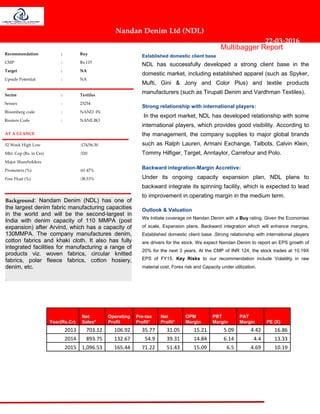
We Initiate coverage on Nandan Denim with a Buy rating. Given the Economies
of scale, Expansion plans, Backward integration which will enhance margins,
Established domestic client base ,Strong relationship with international players
are drivers for the stock. We expect Nandan Denim to report an EPS growth of
20% for the next 3 years. At the CMP of INR 124, the stock trades at 10.19X
EPS of FY15. Key Risks to our recommendation include Volatility in raw
material cost, Forex risk and Capacity under utilization.
Year(Rs.Cr)
Net
Sales*
Operating
Profit
Pre-tax
Profit*
Net
Profit*
OPM
Margin
PBT
Margin
PAT
Margin PE (X)
2013 703.12 106.92 35.77 31.05 15.21 5.09 4.42 16.86
2014 893.75 132.67 54.9 39.31 14.84 6.14 4.4 13.33
2015 1,096.53 165.44 71.22 51.43 15.09 6.5 4.69 10.19
23 March 2016Nandan Denim Ltd (NDL)
22-03-2016
Multibagger Report
Background: Nandam Denim (NDL) has one of
the largest denim fabric manufacturing capacities
in the world and will be the second-largest in
India with denim capacity of 110 MMPA (post
expansion) after Arvind, which has a capacity of
130MMPA. The company manufactures denim,
cotton fabrics and khaki cloth. It also has fully
integrated facilities for manufacturing a range of
products viz. woven fabrics, circular knitted
fabrics, polar fleece fabrics, cotton hosiery,
denim, etc.
.
Investment Arguments
Company Profile: Nandam Denim (NDL) has one of the largest denim fabric manufacturing
capacities in the world and will be the second-largest in India with denim capacity of 110 MMPA
(post expansion) after Arvind, which has a capacity of 130MMPA. The company manufactures
denim, cotton fabrics and khaki cloth. It also has fully integrated facilities for manufacturing a
range of products viz. woven fabrics, circular knitted fabrics, polar fleece fabrics, cotton hosiery,
denim, etc.
Expansion to drive growth:
NDL plans to carry out huge capacity expansion in denim fabric, spinning and shirting
segments. The total capex requirement stands at Rs.6,120mn, which will be funded with a debt-
equity ratio of 70:30 and the operations are expected to start by Q3FY16E. The company has
increased the denim capacity from 76 MMPA in FY14 to 99 MMPA in FY15; and plans to further
increase its capacity to 110 MMPA, which is set to be operational by 4QFY16E.
Established Client Base:
NDL has successfully developed a strong client base in the domestic market, including
established apparel (such as Spyker, Mufti, Gini & Jony and Color Plus) and textile products
manufacturers (such as Tirupati Denim and Vardhman Textiles). The top 10 clients account
for ~40%-45% of revenues, indicating moderate concentration risk. In the export market, NDL
has developed relationship with some international players, which provides good visibility.
According to the management, the company supplies to major global brands such as Ralph
Lauren, Armani Exchange, Talbots, Calvin Klein, Tommy Hilfiger, Target, Anntaylor,
Carrefour and Polo. Currently, exports account for ~10% of revenues.
Backward Integration to drive margins:
Under its ongoing capacity expansion plan, NDL plans to backward integrate its spinning
facility, which is expected to lead to improvement in operating margin in the medium term.
Under the phase II of its capex plan, expected to be completed by FY16E, the company
plans to install 2,080 rotors and 22,368 spindles for open end spinning which is expected to
increase its spinning capacity to ~124 tonnes/day (TPD) from ~64 TPD currently (post the
first phase of expansion). The expanded spinning capacity is likely to enable NDL to increase
its captive consumption of yarn. Considering the company currently purchases 25-30% of its
yarn requirement from the market, a higher captive consumption of yarn is expected to
improve operating margin in the medium term (although captive consumption may decline
owing to higher installed capacity in FY15, leading to margin pressure during the year).
However, the expanded capacity is likely to increase the company’s fixed costs and, hence,
low utilization may dent its operating margin owing to lack of operating leverage.
Under its ongoing capex project, NDL has installed 10 MMPA of shirting fabric processing
capacity, and is planning to increase the same in the longer run. The company is aiming to
leverage its existing dealer network to market its shirting fabrics. NDL has a good distribution
network, we expect the company to be able to ensure steady off-take for its new products.
Moreover, it also plans to enter the yarn dyeing segment in the future. The foray into shirting
fabrics and yarn dyeing is expected to lower the company’s dependency on a single product
– denim, and widen its revenue base although it is unlikely to be a major contributor to overall
revenues in the medium term.
Extensive distribution network:
Significant Over the past two decades, NDL has established an extensive distribution
network in the domestic market, comprising sales offices, agents and distributors. It sells a
majority of its products to garment manufacturers and the rest is sold through dealers. It has
tie-ups with over 35 distributors across the country, of which 10 exclusively sell NDL’s
products. Most of the distributors are based in northern (Delhi, Uttar Pradesh, Haryana,
Rajasthan and Punjab) and western (Maharashtra, Madhya Pradesh and Gujarat) states – a
hub of textile/RMG manufacturers in India. In recent years, the company has established a
distributor base in other parts of India, thereby expanding its geographic footprint in the
domestic market
Raw Material Scenario:
Global: Global share of cotton in textiles is 35%, with the balance 65% being MMF (Man-
Made Fiber). Cotton production is expected to decline by 5.2% while consumption is likely to
increase by 4.5% (expected to be driven by China). However, because of healthy stock,
cotton prices have limited triggers for an upside.
China: Cotton consumption is up after a four-year slide. Currently, cotton inventory
comprises 58% of global stock. If this is released, global trade will decline, exerting
downward pressure on international cotton prices.
If this is not released, cotton imports will increase, providing impetus to exporters and making
Chinese textile industry uncompetitive.
India: Production is expected to shrink by 3%-6% FY16E. However, Cotton Corporation of
India or CCI had inventory of four months to meet industry demand and therefore prices are
likely to remain soft. In addition, a benign monsoon will also keep cotton prices soft.
Global denim market is currently worth US$17bn, of which Asia accounts for 70% of denim
fabric production. Indian denim apparel market (14%-15%) is fast outpacing global denim
apparel market (3%-5%). India controls ~10% of this market while NDL accounts for ~10% of
Indian market. Therefore, effectively, NDL accounts for ~1% of global denim market.
India is fourth-largest denim exporter after China, Pakistan and Turkey. Per capita jeans
consumption is currently at 0.3x in India compared to 8.0x-9.0x globally. 7% of the population
drives 49% consumption in India whereby 85% is accounted for by men and the rest by
women and children. Estimated domestic market CAGR is ~18% and international market
CAGR is 3%-5%.
Strong revenue growth and profitability:
NDL reported healthy growth & margins during FY10-15 with a revenue CAGR of 24%. With
capex expansion of Rs.2000mn- 3000mn, the company plans to expand its current denim
capacity to 110 MMPA, which is expected to be operational by 4QFY16E. Going forward, we
believe this expansion to add significantly to the top-line, which thereby will increase the
profitability and margins in the long run. As of FY15, the company reported EBITDA growth of
25% & high PAT growth of 31% on the back of strong domestic demand & realizations. With
expansion in capacity, stable input costs and improving efficiencies EBITDA & PAT to post a
healthy growth.
Industry Overview
The global market for denim is forecast to reach USD 64.1 billion by 2020. The Indian denim
industry has shown continual growth over the years and currently the country boasts of a denim
manufacturing capacity of around 1.1 billion metres per annum. Its utilization levels are pegged
at 80-85%. Despite the impressive statistics, the Indian denim manufacturing industry
contributes ~5% to the global scenario, reflecting the overall performance of the textiles
industry.
Denim is the only segment in the Indian textile industry that has the potential to grow manifold .
An increasing number of global denim manufacturers are looking at India as an emerging denim
export region owing to its quality standards, cost effectiveness and large pool of skilled work
force.
On the domestic front, the denim wear market is driven by increasing disposable incomes,
westernization of work culture and the ensuing rise in the popularity of denim jeans as business
casual wear. With increasing globalization, young India prefers denims as a part of their
essential daily wear. As is true of the great Indian consumer story, the middle class is driving
this growth. The mid-value segment of denim wear, characterized by quality, value-for-money
and increasing styling quotient is their preferred option. Denim manufacturing and consumption
in India has grown at a compounded annual growth rate (CAGR) of up to 15% over the last
decade and is expected to grow at similar levels over the next few years.
Consumers, especially the youth, in cities beyond the metros and mini metros are growing
exceptionally aspirational. They are increasingly accepting denim as a core apparel category to
be worn as an everyday casual garment.
MARKET SIZE AND GROWTH
Denim is of the most promising category in India’s apparel market. In 2013, the denim market of
India was worth `13,500 Cr. which accounts for 5 percent of the total apparel market of the
country. The market is projected to grow at a CAGR of 15 percent to become `27,200 Cr.
market in 2018.
The denim market in India is skewed towards men’s segments with 85 percent contribution
coming from it. Women’s denim segment contributes 9 percent to the market and the kids
segment the rest 6 percent. The women’s and kid’s denim segments are expected to witness
higher growth rates due to their lower base and increasing focus of brands and retailers on
those segments.
The men, women and kids segments contribute 85%, 9% and 6% respectively to the overall
denim market and is expected to witness higher growth rates due to their lower base and
increasing focus of brands and retailers on those segments. The value share of Indian denim
market is skewed in favor of mega metros and metros which account for 49%, almost half of the
total denim market. On the other hand, the urban and rural Indian markets contribute about 51%
to the overall share. As the penetration of denim category and the awareness of denim quality
increases in those cities and rural India, their share in market value will start increasing with
more number of consumers willing to pay premium for the quality, design and fit.
Demin sectoral Contribution
COMPARISON WITH DENIM CONSUMPTION OF SOME OTHER COUNTRIES
In general the western lifestyle and western fashion has accelerated the trend of casualisation
across the globe. This trend has boosted the consumption of casual fashion apparel like
denims, dress shirts, tees, casual shirts among both men and women consumers in all
developing countries including India. The average number of denim items owned by Indian
consumer is much lower in comparison to consuming market of the United States, Europe etc.
The number is even lower than countries like Brazil and China. This difference in the number
demonstrates the huge potential that exists for denim in the domestic market.
CITY-WISE DISTRIBUTION OF DENIM MARKET
The value share of denim market is skewed in favour of mega metros and metros which account
for almost half of the total denim market at a share of 49 percent. Though the markets of other
urban areas and rural India contribute high in volume terms, their combined share in market
value is only 51 percent.
As the penetration of denim category and the awareness of denim quality increases in those
cities and rural India, their share in market value will start increasing with more number of
consumers willing to pay premium for the quality, design and fit.
PRESENCE OF BRANDS
In India unbranded denim products dominate the market with around 60 percent share of the
market. The share of brands in denim market stands at 40 percent. Most of the unbranded
players operate on the lower price segment of the market where awareness of quality of fabric,
finishing and washes, design and fi t are relatively low.
The emergence of semi-urban clusters, areas having less number of farming communities,
across the country has opened a plethora of opportunities for regional brands and retailers. A
typical denim consumer of the semi-urban cluster demonstrates a blend of the characteristics of
urban and rural consumers; like an urban consumer he or she shows awareness of brand and
product quality and like a rural consumer pricing and affordability plays a crucial role in his or
her purchase decisions. The regional brands have focusing to cater to these typical
requirements of the semi-urban consumers. However presence of lots of unbranded players in
such markets it a market of intense competition to many national level brands.
DENIM VALUE CHAIN IN INDIA
India has an integrated value chain for denim products starting from fi bre to retail. Denim is
primarily produced from cotton and India is expected to overcome China as the single largest
producer of cotton the world in 2014. The country is the second largest producer of cotton yarn.
The denim fabric production capacity of India is more than 1,000 million meters per year, and
India is still witnessing entrance of more denim fabric manufacturers in the industry.
Denim fabric production in India is concentrated in the western and northern parts of the country
with more than 45 percent contribution coming from Gujarat alone where Ahmedabad is the
production hub.
Denim apparel production in India remains a fragmented industry where only 20-30 percent of
denim apparel is manufactured in the organised units. The denim apparel production activities
are concentrated in Delhi and NCR, Mumbai, Bangalore and Ahmedabad.
ISSUES & CHALLENGES FOR DENIM MARKET
Though the denim category is among the most promising categories in apparel market of the
country, it faces its own set of issue and challenges. The prudence in which various
stakeholders of denim eco-system identify and address the issues and challenges associated
with the value chain will determine the growth of denim apparel market in the country. India at
present lacks behind in its ability of the denim product development and innovation. There is a
need to develop a larger portfolio of denim garments and accessories, including shorts, shirts,
bags, dresses, accessories among others.
At present the market is skewed towards denim jeans. The weight (gsm) range of available
denim fabric could be broadened to widen denim application. There is a lot of scope of
improvement in right processing and value addition in denim through fashion-led processes and
fi nishes. Establishment of high quality processing and could help to improve the quality and
colours, this attracting more to try denim.
Profit & Loss (StandAlone)
Balance Sheet(StandAlone)
Disclaimer for Investors
This report is for private circulation and for the personal information of the authorized recipient only, and we are not
soliciting any action based upon it. This report is not to be construed as an offer to sell or the solicitation of an offer to
buy any security in any jurisdiction where such an offer or solicitation would be illegal. It does not provide individually
tailor-made investment advice and has been prepared without regard to any specific investment objectives, financial
situation, or any particular needs of any of the persons who receive it. The research analyst who is primarily
responsible for this report certifies that: (1) all of the views expressed in this report accurately reflect his or her
personal opinions about any and all of the subject securities or issuers; and (2) no part of any of the research
analyst’s compensation was, is, or will be directly or indirectly related to the specific recommendations or views
expressed in this report. This report has been prepared on the basis of information that is already available in publicly
accessible media or developed through analysis of Sublime Financial services pvt Limited makes every effort to use
reliable, comprehensive information, but we make no representation that it is accurate or complete. The views
expressed are those of the analyst and the Company may or may not subscribe to all the views expressed therein.
Sublime Financial services pvt Limited reserves the right to make modifications and alterations to this statements as
may be required from time to time without any prior approval. Sublime Financial services pvt Limited, its affiliates,
directors and employees may from time to time, effect or have effect an own account transaction in or deal as agent
in or for the securities mentioned in this report. The recipient should take this into account before interpreting the
report. All investors may not find the securities discussed in this report to be suitable. Sublime Financial services pvt
Limited recommends that investors independently evaluate particular investments and strategies. Investors should
seek the advice of a financial advisor with regard to the appropriateness of investing in any securities / investment
strategies recommended in this report. The appropriateness of a particular investment or strategy will depend on an
investor’s individual preference. Past performance is not necessary a guide to future performance. Estimates of future
prospects are based on assumptions that may not be realized. The news items appearing in this are collected from
various media sources and we make no representations that it is complete or accurate

Nandan denim multibagger

  • 1.
    Recommendation : Buy CMP: Rs 115 Target : NA Upside Potential : NA Sector : Textiles Sensex : 25254 Bloomberg code : NAND. IN Reuters Code : NANE.BO AT A GLANCE 52 Week High Low :174/56.50 Mkt. Cap (Rs. in Crs) :520 Major Shareholders Promoters (%) :61.47% Free Float (%) :38.53% Established domestic client base NDL has successfully developed a strong client base in the domestic market, including established apparel (such as Spyker, Mufti, Gini & Jony and Color Plus) and textile products manufacturers (such as Tirupati Denim and Vardhman Textiles). Strong relationship with international players: In the export market, NDL has developed relationship with some international players, which provides good visibility. According to the management, the company supplies to major global brands such as Ralph Lauren, Armani Exchange, Talbots, Calvin Klein, Tommy Hilfiger, Target, Anntaylor, Carrefour and Polo. Backward integration-Margin Accretive: Under its ongoing capacity expansion plan, NDL plans to backward integrate its spinning facility, which is expected to lead to improvement in operating margin in the medium term. Outlook & Valuation We Initiate coverage on Nandan Denim with a Buy rating. Given the Economies of scale, Expansion plans, Backward integration which will enhance margins, Established domestic client base ,Strong relationship with international players are drivers for the stock. We expect Nandan Denim to report an EPS growth of 20% for the next 3 years. At the CMP of INR 124, the stock trades at 10.19X EPS of FY15. Key Risks to our recommendation include Volatility in raw material cost, Forex risk and Capacity under utilization. Year(Rs.Cr) Net Sales* Operating Profit Pre-tax Profit* Net Profit* OPM Margin PBT Margin PAT Margin PE (X) 2013 703.12 106.92 35.77 31.05 15.21 5.09 4.42 16.86 2014 893.75 132.67 54.9 39.31 14.84 6.14 4.4 13.33 2015 1,096.53 165.44 71.22 51.43 15.09 6.5 4.69 10.19 23 March 2016Nandan Denim Ltd (NDL) 22-03-2016 Multibagger Report Background: Nandam Denim (NDL) has one of the largest denim fabric manufacturing capacities in the world and will be the second-largest in India with denim capacity of 110 MMPA (post expansion) after Arvind, which has a capacity of 130MMPA. The company manufactures denim, cotton fabrics and khaki cloth. It also has fully integrated facilities for manufacturing a range of products viz. woven fabrics, circular knitted fabrics, polar fleece fabrics, cotton hosiery, denim, etc. .
  • 2.
    Investment Arguments Company Profile:Nandam Denim (NDL) has one of the largest denim fabric manufacturing capacities in the world and will be the second-largest in India with denim capacity of 110 MMPA (post expansion) after Arvind, which has a capacity of 130MMPA. The company manufactures denim, cotton fabrics and khaki cloth. It also has fully integrated facilities for manufacturing a range of products viz. woven fabrics, circular knitted fabrics, polar fleece fabrics, cotton hosiery, denim, etc. Expansion to drive growth: NDL plans to carry out huge capacity expansion in denim fabric, spinning and shirting segments. The total capex requirement stands at Rs.6,120mn, which will be funded with a debt- equity ratio of 70:30 and the operations are expected to start by Q3FY16E. The company has increased the denim capacity from 76 MMPA in FY14 to 99 MMPA in FY15; and plans to further increase its capacity to 110 MMPA, which is set to be operational by 4QFY16E.
  • 3.
    Established Client Base: NDLhas successfully developed a strong client base in the domestic market, including established apparel (such as Spyker, Mufti, Gini & Jony and Color Plus) and textile products manufacturers (such as Tirupati Denim and Vardhman Textiles). The top 10 clients account for ~40%-45% of revenues, indicating moderate concentration risk. In the export market, NDL has developed relationship with some international players, which provides good visibility. According to the management, the company supplies to major global brands such as Ralph Lauren, Armani Exchange, Talbots, Calvin Klein, Tommy Hilfiger, Target, Anntaylor, Carrefour and Polo. Currently, exports account for ~10% of revenues. Backward Integration to drive margins: Under its ongoing capacity expansion plan, NDL plans to backward integrate its spinning facility, which is expected to lead to improvement in operating margin in the medium term. Under the phase II of its capex plan, expected to be completed by FY16E, the company plans to install 2,080 rotors and 22,368 spindles for open end spinning which is expected to increase its spinning capacity to ~124 tonnes/day (TPD) from ~64 TPD currently (post the first phase of expansion). The expanded spinning capacity is likely to enable NDL to increase its captive consumption of yarn. Considering the company currently purchases 25-30% of its yarn requirement from the market, a higher captive consumption of yarn is expected to improve operating margin in the medium term (although captive consumption may decline owing to higher installed capacity in FY15, leading to margin pressure during the year). However, the expanded capacity is likely to increase the company’s fixed costs and, hence, low utilization may dent its operating margin owing to lack of operating leverage. Under its ongoing capex project, NDL has installed 10 MMPA of shirting fabric processing capacity, and is planning to increase the same in the longer run. The company is aiming to leverage its existing dealer network to market its shirting fabrics. NDL has a good distribution network, we expect the company to be able to ensure steady off-take for its new products. Moreover, it also plans to enter the yarn dyeing segment in the future. The foray into shirting fabrics and yarn dyeing is expected to lower the company’s dependency on a single product – denim, and widen its revenue base although it is unlikely to be a major contributor to overall revenues in the medium term. Extensive distribution network: Significant Over the past two decades, NDL has established an extensive distribution network in the domestic market, comprising sales offices, agents and distributors. It sells a majority of its products to garment manufacturers and the rest is sold through dealers. It has tie-ups with over 35 distributors across the country, of which 10 exclusively sell NDL’s products. Most of the distributors are based in northern (Delhi, Uttar Pradesh, Haryana, Rajasthan and Punjab) and western (Maharashtra, Madhya Pradesh and Gujarat) states – a hub of textile/RMG manufacturers in India. In recent years, the company has established a distributor base in other parts of India, thereby expanding its geographic footprint in the domestic market Raw Material Scenario: Global: Global share of cotton in textiles is 35%, with the balance 65% being MMF (Man- Made Fiber). Cotton production is expected to decline by 5.2% while consumption is likely to
  • 4.
    increase by 4.5%(expected to be driven by China). However, because of healthy stock, cotton prices have limited triggers for an upside. China: Cotton consumption is up after a four-year slide. Currently, cotton inventory comprises 58% of global stock. If this is released, global trade will decline, exerting downward pressure on international cotton prices. If this is not released, cotton imports will increase, providing impetus to exporters and making Chinese textile industry uncompetitive. India: Production is expected to shrink by 3%-6% FY16E. However, Cotton Corporation of India or CCI had inventory of four months to meet industry demand and therefore prices are likely to remain soft. In addition, a benign monsoon will also keep cotton prices soft. Global denim market is currently worth US$17bn, of which Asia accounts for 70% of denim fabric production. Indian denim apparel market (14%-15%) is fast outpacing global denim apparel market (3%-5%). India controls ~10% of this market while NDL accounts for ~10% of Indian market. Therefore, effectively, NDL accounts for ~1% of global denim market. India is fourth-largest denim exporter after China, Pakistan and Turkey. Per capita jeans consumption is currently at 0.3x in India compared to 8.0x-9.0x globally. 7% of the population drives 49% consumption in India whereby 85% is accounted for by men and the rest by women and children. Estimated domestic market CAGR is ~18% and international market CAGR is 3%-5%. Strong revenue growth and profitability: NDL reported healthy growth & margins during FY10-15 with a revenue CAGR of 24%. With capex expansion of Rs.2000mn- 3000mn, the company plans to expand its current denim capacity to 110 MMPA, which is expected to be operational by 4QFY16E. Going forward, we believe this expansion to add significantly to the top-line, which thereby will increase the profitability and margins in the long run. As of FY15, the company reported EBITDA growth of 25% & high PAT growth of 31% on the back of strong domestic demand & realizations. With expansion in capacity, stable input costs and improving efficiencies EBITDA & PAT to post a healthy growth.
  • 5.
    Industry Overview The globalmarket for denim is forecast to reach USD 64.1 billion by 2020. The Indian denim industry has shown continual growth over the years and currently the country boasts of a denim manufacturing capacity of around 1.1 billion metres per annum. Its utilization levels are pegged at 80-85%. Despite the impressive statistics, the Indian denim manufacturing industry contributes ~5% to the global scenario, reflecting the overall performance of the textiles industry. Denim is the only segment in the Indian textile industry that has the potential to grow manifold . An increasing number of global denim manufacturers are looking at India as an emerging denim export region owing to its quality standards, cost effectiveness and large pool of skilled work force. On the domestic front, the denim wear market is driven by increasing disposable incomes, westernization of work culture and the ensuing rise in the popularity of denim jeans as business casual wear. With increasing globalization, young India prefers denims as a part of their essential daily wear. As is true of the great Indian consumer story, the middle class is driving this growth. The mid-value segment of denim wear, characterized by quality, value-for-money and increasing styling quotient is their preferred option. Denim manufacturing and consumption in India has grown at a compounded annual growth rate (CAGR) of up to 15% over the last decade and is expected to grow at similar levels over the next few years.
  • 6.
    Consumers, especially theyouth, in cities beyond the metros and mini metros are growing exceptionally aspirational. They are increasingly accepting denim as a core apparel category to be worn as an everyday casual garment. MARKET SIZE AND GROWTH Denim is of the most promising category in India’s apparel market. In 2013, the denim market of India was worth `13,500 Cr. which accounts for 5 percent of the total apparel market of the country. The market is projected to grow at a CAGR of 15 percent to become `27,200 Cr. market in 2018. The denim market in India is skewed towards men’s segments with 85 percent contribution coming from it. Women’s denim segment contributes 9 percent to the market and the kids segment the rest 6 percent. The women’s and kid’s denim segments are expected to witness
  • 7.
    higher growth ratesdue to their lower base and increasing focus of brands and retailers on those segments. The men, women and kids segments contribute 85%, 9% and 6% respectively to the overall denim market and is expected to witness higher growth rates due to their lower base and increasing focus of brands and retailers on those segments. The value share of Indian denim market is skewed in favor of mega metros and metros which account for 49%, almost half of the total denim market. On the other hand, the urban and rural Indian markets contribute about 51% to the overall share. As the penetration of denim category and the awareness of denim quality increases in those cities and rural India, their share in market value will start increasing with more number of consumers willing to pay premium for the quality, design and fit. Demin sectoral Contribution COMPARISON WITH DENIM CONSUMPTION OF SOME OTHER COUNTRIES In general the western lifestyle and western fashion has accelerated the trend of casualisation across the globe. This trend has boosted the consumption of casual fashion apparel like denims, dress shirts, tees, casual shirts among both men and women consumers in all developing countries including India. The average number of denim items owned by Indian consumer is much lower in comparison to consuming market of the United States, Europe etc. The number is even lower than countries like Brazil and China. This difference in the number demonstrates the huge potential that exists for denim in the domestic market. CITY-WISE DISTRIBUTION OF DENIM MARKET The value share of denim market is skewed in favour of mega metros and metros which account for almost half of the total denim market at a share of 49 percent. Though the markets of other urban areas and rural India contribute high in volume terms, their combined share in market
  • 8.
    value is only51 percent. As the penetration of denim category and the awareness of denim quality increases in those cities and rural India, their share in market value will start increasing with more number of consumers willing to pay premium for the quality, design and fit. PRESENCE OF BRANDS In India unbranded denim products dominate the market with around 60 percent share of the market. The share of brands in denim market stands at 40 percent. Most of the unbranded players operate on the lower price segment of the market where awareness of quality of fabric, finishing and washes, design and fi t are relatively low. The emergence of semi-urban clusters, areas having less number of farming communities, across the country has opened a plethora of opportunities for regional brands and retailers. A typical denim consumer of the semi-urban cluster demonstrates a blend of the characteristics of urban and rural consumers; like an urban consumer he or she shows awareness of brand and product quality and like a rural consumer pricing and affordability plays a crucial role in his or her purchase decisions. The regional brands have focusing to cater to these typical requirements of the semi-urban consumers. However presence of lots of unbranded players in such markets it a market of intense competition to many national level brands. DENIM VALUE CHAIN IN INDIA India has an integrated value chain for denim products starting from fi bre to retail. Denim is primarily produced from cotton and India is expected to overcome China as the single largest producer of cotton the world in 2014. The country is the second largest producer of cotton yarn. The denim fabric production capacity of India is more than 1,000 million meters per year, and India is still witnessing entrance of more denim fabric manufacturers in the industry. Denim fabric production in India is concentrated in the western and northern parts of the country with more than 45 percent contribution coming from Gujarat alone where Ahmedabad is the production hub. Denim apparel production in India remains a fragmented industry where only 20-30 percent of denim apparel is manufactured in the organised units. The denim apparel production activities are concentrated in Delhi and NCR, Mumbai, Bangalore and Ahmedabad. ISSUES & CHALLENGES FOR DENIM MARKET Though the denim category is among the most promising categories in apparel market of the country, it faces its own set of issue and challenges. The prudence in which various stakeholders of denim eco-system identify and address the issues and challenges associated
  • 9.
    with the valuechain will determine the growth of denim apparel market in the country. India at present lacks behind in its ability of the denim product development and innovation. There is a need to develop a larger portfolio of denim garments and accessories, including shorts, shirts, bags, dresses, accessories among others. At present the market is skewed towards denim jeans. The weight (gsm) range of available denim fabric could be broadened to widen denim application. There is a lot of scope of improvement in right processing and value addition in denim through fashion-led processes and fi nishes. Establishment of high quality processing and could help to improve the quality and colours, this attracting more to try denim.
  • 10.
    Profit & Loss(StandAlone)
  • 11.
  • 12.
    Disclaimer for Investors Thisreport is for private circulation and for the personal information of the authorized recipient only, and we are not soliciting any action based upon it. This report is not to be construed as an offer to sell or the solicitation of an offer to buy any security in any jurisdiction where such an offer or solicitation would be illegal. It does not provide individually tailor-made investment advice and has been prepared without regard to any specific investment objectives, financial situation, or any particular needs of any of the persons who receive it. The research analyst who is primarily responsible for this report certifies that: (1) all of the views expressed in this report accurately reflect his or her personal opinions about any and all of the subject securities or issuers; and (2) no part of any of the research analyst’s compensation was, is, or will be directly or indirectly related to the specific recommendations or views expressed in this report. This report has been prepared on the basis of information that is already available in publicly accessible media or developed through analysis of Sublime Financial services pvt Limited makes every effort to use reliable, comprehensive information, but we make no representation that it is accurate or complete. The views expressed are those of the analyst and the Company may or may not subscribe to all the views expressed therein. Sublime Financial services pvt Limited reserves the right to make modifications and alterations to this statements as may be required from time to time without any prior approval. Sublime Financial services pvt Limited, its affiliates, directors and employees may from time to time, effect or have effect an own account transaction in or deal as agent in or for the securities mentioned in this report. The recipient should take this into account before interpreting the report. All investors may not find the securities discussed in this report to be suitable. Sublime Financial services pvt Limited recommends that investors independently evaluate particular investments and strategies. Investors should seek the advice of a financial advisor with regard to the appropriateness of investing in any securities / investment strategies recommended in this report. The appropriateness of a particular investment or strategy will depend on an investor’s individual preference. Past performance is not necessary a guide to future performance. Estimates of future prospects are based on assumptions that may not be realized. The news items appearing in this are collected from various media sources and we make no representations that it is complete or accurate