FACULTY OF LABORATORY SIENCE AND DIAGNOSTICS 1
Topic- Assessing disease severity in 0 2 years children suffering from malaria infection in 3 selected Hospitals in sierra Leone
−
Hamzza kamara
Mr. Arthur B.C. Garber
FACULTY OF LABORATORY SIENCE AND DIAGNOSTICS 2
Presentation outline
• Introduction
• Justification
• Aims and objectives
• Methodology
• Result
• Discussion
• Recommendation
• Limitation
• Reference
FACULTY OF LABORATORY SIENCE AND DIAGNOSTICS 3
Introduction
• Malaria is the most important parasitic disease affecting humans.(Talapko,
Škrlec, Alebić, Jukić, & Včev, 2019) It is a major cause of anaemia in endemic
areas, and in areas of higher transmission, malaria is one of the most
common reasons for blood transfusion.
• Five species of the genus Plasmodium infect humans commonly and all
cause anaemia they are P. vivax, P. malariae, P. ovale, P. falciparum, and P.
knowlesi. (Dagen, et, Al 2018).
• Malaria is endemic in Sierra Leone the entire population is at risk of
exposure because Sierra Leone is an area of stable malarial endemicity, and
most cases were infected with Plasmodium falciparum (Fombah et al., 2023)
• In Sierra Leone, malaria is the leading cause of morbidity, with 95% of the
population (6.7 million people) at risk, and it contributes to approximately
14% (131,383) of under-five mortality (MoHS, 2016).
FACULTY OF LABORATORY SIENCE AND DIAGNOSTICS 4
Justification
• Children under 0-2 years are at a higher risk for severe malaria and its complications
due to their immature immune systems. Targeting this age group can help in early
identification and treatment, potentially preventing severe outcomes and improving
overall child health and survival rates. (WHO. 2020)
• Anaemia is a common complication of malaria, particularly in young children (age 0-
2), and assessing its severity can help in managing and treating both malaria and
anaemia effectively. (Bah, n.d.).
• The mortality rate of malaria is highest amongst those under five with the under 0-2
age group being particularly at risk. Anemia a common complication of malaria can
exacerbate the risk of death in these young children.
FACULTY OF LABORATORY SIENCE AND DIAGNOSTICS 5
Aims and Objective
AIM
The aim of the study is to assess disease severity and determine anaemia levels in children
under the age of 2 in order to understand, the correlation between malaria and anaemia
severity and to inform better clinical management and treatment strategies for this
vulnerable population.
OBJECTIVES
• 1. To evaluate the haemoglobin level in children 0-2 years positive for malaria parasite
infection.
• 2. Analyze the severity of malaria in the three different hospitals by comparing malaria
parasite density and haemoglobin level
• 3. Investigate the relationship between the severity of malaria infection and the level of
anaemia in male and female children in Sierra Leone.
FACULTY OF LABORATORY SIENCE AND DIAGNOSTICS 6
METHODOLOGY 1
PRINCIPLE OF THE TEST
• Immunochromatographic method
Often called a rapid diagnostic test (RDT), is a quick and simple technique used for
detecting specific antigens or antibodies in a sample. It works on the principle of
antigen-antibody binding and is widely used in malaria diagnosis and other infectious
diseases.
• Spectrophotometry method
It’s based on measuring how much light a substance absorbs at various wavelengths.
This method is also called the beer-lambert law. which states that absorbance is
directly proportional to the concentration of the substance and the path length of the
light through the sample.
• Microscopic principle
A light microscope magnifies images by bending light through its glass lenses, a
process known as refraction. Refraction occurs when light moves between mediums
with different refractive indices, causing the light to bend at the interface.
FACULTY OF LABORATORY SIENCE AND DIAGNOSTICS 7
RESULTS
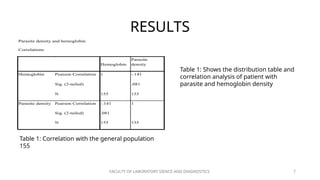
Table 1: Correlation with the general population
155
Parasite density and hemoglobin
Correlations
Hemoglobin
Parasite
density
Hemoglobin Pearson Correlation 1 -.141
Sig. (2-tailed) .081
N 155 155
Parasite density Pearson Correlation -.141 1
Sig. (2-tailed) .081
N 155 155
Table 1: Shows the distribution table and
correlation analysis of patient with
parasite and hemoglobin density
FACULTY OF LABORATORY SIENCE AND DIAGNOSTICS 8
RESULTS
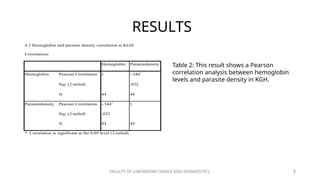
4.2 Hemoglobin and parasite density correlation at KGH
Correlations
Hemoglobin Parasitedensity
Hemoglobin Pearson Correlation 1 -.344*
Sig. (2-tailed) .022
N 44 44
Parasitedensity Pearson Correlation -.344*
1
Sig. (2-tailed) .022
N 44 44
*. Correlation is significant at the 0.05 level (2-tailed).
Table 2: This result shows a Pearson
correlation analysis between hemoglobin
levels and parasite density in KGH.
FACULTY OF LABORATORY SIENCE AND DIAGNOSTICS 9
RESULTS
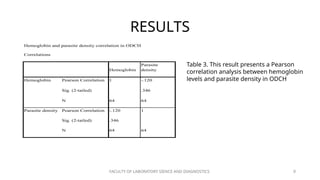
Hemoglobin and parasite density correlation in ODCH
Correlations
Hemoglobin
Parasite
density
Hemoglobin Pearson Correlation 1 -.120
Sig. (2-tailed) .346
N 64 64
Parasite density Pearson Correlation -.120 1
Sig. (2-tailed) .346
N 64 64
Table 3. This result presents a Pearson
correlation analysis between hemoglobin
levels and parasite density in ODCH
FACULTY OF LABORATORY SIENCE AND DIAGNOSTICS 10
RESULTS
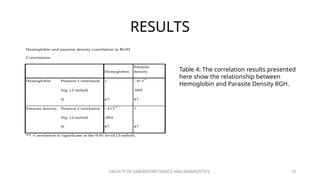
Hemoglobin and parasite density correlation in RGH
Correlations
Hemoglobin
Parasite
density
Hemoglobin Pearson Correlation 1 -.413**
Sig. (2-tailed) .004
N 47 47
Parasite density Pearson Correlation -.413**
1
Sig. (2-tailed) .004
N 47 47
**. Correlation is significant at the 0.01 level (2-tailed).
Table 4: The correlation results presented
here show the relationship between
Hemoglobin and Parasite Density RGH.
FACULTY OF LABORATORY SIENCE AND DIAGNOSTICS 11
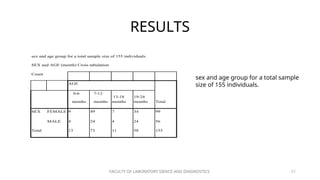
RESULTS
sex and age group for a total sample size of 155 individuals.
SEX and AGE (month) Cross tabulation
Count
AGE
Total
0-6
months
7-12
months
13-18
months
19-24
months
SEX FEMALE 9 49 7 34 99
MALE 4 24 4 24 56
Total 13 73 11 58 155
sex and age group for a total sample
size of 155 individuals.
FACULTY OF LABORATORY SIENCE AND DIAGNOSTICS 12
FACULTY OF LABORATORY SIENCE AND DIAGNOSTICS 13
Recommendation
• Further Studies with Larger Samples: Conducting studies with larger and more
representative samples could help validate these findings and establish stronger
statistical power. Specific focus on populations with higher parasite burdens might
provide clearer insights
• Regional or Environmental Factors: The distinct findings in different datasets
highlight the importance of considering regional or environmental factors in
correlation studies
• Complete blood count test should be done in other to confim anemia properly.
FACULTY OF LABORATORY SIENCE AND DIAGNOSTICS 14
Limitations
FACULTY OF LABORATORY SIENCE AND DIAGNOSTICS 15
References
FACULTY OF LABORATORY SIENCE AND DIAGNOSTICS 16

SYMNPOSIUM PRESENTATION GUIDE ..(1).pptx

  • 1.
    FACULTY OF LABORATORYSIENCE AND DIAGNOSTICS 1 Topic- Assessing disease severity in 0 2 years children suffering from malaria infection in 3 selected Hospitals in sierra Leone − Hamzza kamara Mr. Arthur B.C. Garber
  • 2.
    FACULTY OF LABORATORYSIENCE AND DIAGNOSTICS 2 Presentation outline • Introduction • Justification • Aims and objectives • Methodology • Result • Discussion • Recommendation • Limitation • Reference
  • 3.
    FACULTY OF LABORATORYSIENCE AND DIAGNOSTICS 3 Introduction • Malaria is the most important parasitic disease affecting humans.(Talapko, Škrlec, Alebić, Jukić, & Včev, 2019) It is a major cause of anaemia in endemic areas, and in areas of higher transmission, malaria is one of the most common reasons for blood transfusion. • Five species of the genus Plasmodium infect humans commonly and all cause anaemia they are P. vivax, P. malariae, P. ovale, P. falciparum, and P. knowlesi. (Dagen, et, Al 2018). • Malaria is endemic in Sierra Leone the entire population is at risk of exposure because Sierra Leone is an area of stable malarial endemicity, and most cases were infected with Plasmodium falciparum (Fombah et al., 2023) • In Sierra Leone, malaria is the leading cause of morbidity, with 95% of the population (6.7 million people) at risk, and it contributes to approximately 14% (131,383) of under-five mortality (MoHS, 2016).
  • 4.
    FACULTY OF LABORATORYSIENCE AND DIAGNOSTICS 4 Justification • Children under 0-2 years are at a higher risk for severe malaria and its complications due to their immature immune systems. Targeting this age group can help in early identification and treatment, potentially preventing severe outcomes and improving overall child health and survival rates. (WHO. 2020) • Anaemia is a common complication of malaria, particularly in young children (age 0- 2), and assessing its severity can help in managing and treating both malaria and anaemia effectively. (Bah, n.d.). • The mortality rate of malaria is highest amongst those under five with the under 0-2 age group being particularly at risk. Anemia a common complication of malaria can exacerbate the risk of death in these young children.
  • 5.
    FACULTY OF LABORATORYSIENCE AND DIAGNOSTICS 5 Aims and Objective AIM The aim of the study is to assess disease severity and determine anaemia levels in children under the age of 2 in order to understand, the correlation between malaria and anaemia severity and to inform better clinical management and treatment strategies for this vulnerable population. OBJECTIVES • 1. To evaluate the haemoglobin level in children 0-2 years positive for malaria parasite infection. • 2. Analyze the severity of malaria in the three different hospitals by comparing malaria parasite density and haemoglobin level • 3. Investigate the relationship between the severity of malaria infection and the level of anaemia in male and female children in Sierra Leone.
  • 6.
    FACULTY OF LABORATORYSIENCE AND DIAGNOSTICS 6 METHODOLOGY 1 PRINCIPLE OF THE TEST • Immunochromatographic method Often called a rapid diagnostic test (RDT), is a quick and simple technique used for detecting specific antigens or antibodies in a sample. It works on the principle of antigen-antibody binding and is widely used in malaria diagnosis and other infectious diseases. • Spectrophotometry method It’s based on measuring how much light a substance absorbs at various wavelengths. This method is also called the beer-lambert law. which states that absorbance is directly proportional to the concentration of the substance and the path length of the light through the sample. • Microscopic principle A light microscope magnifies images by bending light through its glass lenses, a process known as refraction. Refraction occurs when light moves between mediums with different refractive indices, causing the light to bend at the interface.
  • 7.
    FACULTY OF LABORATORYSIENCE AND DIAGNOSTICS 7 RESULTS Table 1: Correlation with the general population 155 Parasite density and hemoglobin Correlations Hemoglobin Parasite density Hemoglobin Pearson Correlation 1 -.141 Sig. (2-tailed) .081 N 155 155 Parasite density Pearson Correlation -.141 1 Sig. (2-tailed) .081 N 155 155 Table 1: Shows the distribution table and correlation analysis of patient with parasite and hemoglobin density
  • 8.
    FACULTY OF LABORATORYSIENCE AND DIAGNOSTICS 8 RESULTS 4.2 Hemoglobin and parasite density correlation at KGH Correlations Hemoglobin Parasitedensity Hemoglobin Pearson Correlation 1 -.344* Sig. (2-tailed) .022 N 44 44 Parasitedensity Pearson Correlation -.344* 1 Sig. (2-tailed) .022 N 44 44 *. Correlation is significant at the 0.05 level (2-tailed). Table 2: This result shows a Pearson correlation analysis between hemoglobin levels and parasite density in KGH.
  • 9.
    FACULTY OF LABORATORYSIENCE AND DIAGNOSTICS 9 RESULTS Hemoglobin and parasite density correlation in ODCH Correlations Hemoglobin Parasite density Hemoglobin Pearson Correlation 1 -.120 Sig. (2-tailed) .346 N 64 64 Parasite density Pearson Correlation -.120 1 Sig. (2-tailed) .346 N 64 64 Table 3. This result presents a Pearson correlation analysis between hemoglobin levels and parasite density in ODCH
  • 10.
    FACULTY OF LABORATORYSIENCE AND DIAGNOSTICS 10 RESULTS Hemoglobin and parasite density correlation in RGH Correlations Hemoglobin Parasite density Hemoglobin Pearson Correlation 1 -.413** Sig. (2-tailed) .004 N 47 47 Parasite density Pearson Correlation -.413** 1 Sig. (2-tailed) .004 N 47 47 **. Correlation is significant at the 0.01 level (2-tailed). Table 4: The correlation results presented here show the relationship between Hemoglobin and Parasite Density RGH.
  • 11.
    FACULTY OF LABORATORYSIENCE AND DIAGNOSTICS 11 RESULTS sex and age group for a total sample size of 155 individuals. SEX and AGE (month) Cross tabulation Count AGE Total 0-6 months 7-12 months 13-18 months 19-24 months SEX FEMALE 9 49 7 34 99 MALE 4 24 4 24 56 Total 13 73 11 58 155 sex and age group for a total sample size of 155 individuals.
  • 12.
    FACULTY OF LABORATORYSIENCE AND DIAGNOSTICS 12
  • 13.
    FACULTY OF LABORATORYSIENCE AND DIAGNOSTICS 13 Recommendation • Further Studies with Larger Samples: Conducting studies with larger and more representative samples could help validate these findings and establish stronger statistical power. Specific focus on populations with higher parasite burdens might provide clearer insights • Regional or Environmental Factors: The distinct findings in different datasets highlight the importance of considering regional or environmental factors in correlation studies • Complete blood count test should be done in other to confim anemia properly.
  • 14.
    FACULTY OF LABORATORYSIENCE AND DIAGNOSTICS 14 Limitations
  • 15.
    FACULTY OF LABORATORYSIENCE AND DIAGNOSTICS 15 References
  • 16.
    FACULTY OF LABORATORYSIENCE AND DIAGNOSTICS 16