SYMBOLIC-COGNITIVE PROCEDURALISM
AS A ROBUST JUSTIFICATION
FOR DEMOCRATIC DELIBERATION

Robert C. Richards, Jr. and John Gastil
The Pennsylvania State University
Department of Communication Arts & Sciences

Presentation at National Communication
Association, November 2013
Overview
Ingham’s Critique of the Epistemic Rationale
Alternative Justifications
Symbolic-Cognitive Proceduralism
Estlund’s
Epistemic Proceduralism
Estlund (2008) uses the criminal jury as a model to justify
deliberative democratic procedures
Estlund: Jury Deliberation
as Model of Legitimacy
Public deems jury verdicts legitimate, provided jury
followed deliberative procedures
Source of jury’s legitimacy: “epistemic virtues” of
deliberative procedures; give jury > 0.5 probability of
reaching correct verdict
Estlund argues jury is analogous to legislature and
executive
Ingham’s Critique
Estlund’s model is inconsistent with “two widely shared
beliefs about democracy”:
1. Nonconvergence Constraint: Consensus is impossible in
a diverse society
2. Constraint on Evidence: Procedure-independent
standards aren’t plausible, because agreement on those
standards is impossible
Results of Ingham’s Critique

Estlund’s jury model violates both of Ingham’s constraints
Alternative Justifications for
Deliberative Democracy
Deliberative democratic procedures may be justified on the
basis of their:
• Intrinsic Value
• Expressive Value
• Cognitive Value (Unrelated to Voting Decisions)
• Ethical Value
• Communal Value
Expressive
and Cognitive Rationales
can be combined with Estlund’s “jury analogy” to form a
justification that withstands Ingham’s critique
Symbolic-Cognitive
Proceduralism (SCP)
Elements of Estlund’s epistemic proceduralist theory of
legitimacy can be included in a new model that can
withstand Ingham’s critique
This new model we call symbolic-cognitive proceduralism
SCP: Account of Legitimacy
Jury deliberation furnishes the model for the legitimacy of
democratic deliberative procedures
Source of legitimacy: Expressive/Symbolic and Cognitive
functions of the procedures
SCP: Symbolic Functions
Jury’s deliberative procedures express fundamental values
of democracy:
• Popular Sovereignty
• Equality
• Rational Discourse
SCP: Cognitive Functions
Jury’s deliberative procedures increase jurors’:
• Knowledge of issues and solution options
• Understanding of their own and others’ interests, values,
and cognitive repertoires
• Understanding of collective interests
• Political efficacy (internal and external)
• Willingness to be civically engaged
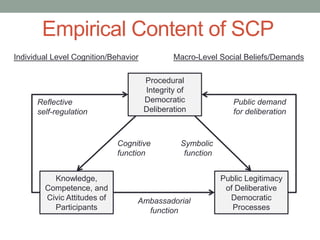
Empirical Content of SCP
Individual Level Cognition/Behavior

Reflective
self-regulation

Macro-Level Social Beliefs/Demands
Procedural
Integrity of
Democratic
Deliberation

Cognitive
function
Knowledge,
Competence, and
Civic Attitudes of
Participants

Public demand
for deliberation

Symbolic
function

Ambassadorial
function

Public Legitimacy
of Deliberative
Democratic
Processes
SCP: Effect on Legitimacy
Symbolic and cognitive functions lead public to deem jury’s
verdicts legitimate
Jury remains analogous to the legislature and executive
SCP: Not Susceptible to
Ingham’s Critique
since SCP’s account of legitimacy does not depend on an
epistemic justification
Conclusion
Ingham’s (2013) critique calls into question Estlund’s – and
all other – epistemic justifications for deliberative
democracy
Symbolic-cognitive proceduralism justifies democratic
deliberation on the basis of its expressive and cognitive
functions
Symbolic-cognitive proceduralism is not vulnerable to
Ingham’s critique
References
• Ackerman, B., & Fishkin, J. S. (2004). Deliberation day. New Haven, CT: Yale University

•
•
•
•

•
•

•
•

Press.
Allen, M. (2009). Civil disobedience and terrorism: Testing the limits of deliberative
democracy. Theoria, 56, 15–39.
Anderson, E. (2006). The epistemology of democracy. Episteme, 3(1), 8-22. Retrieved from
http://muse.jhu.edu.ezaccess.libraries.psu.edu/journals/episteme/v003/3.1anderson.html
Barber, B. R. (1984). Strong democracy: Participatory politics for a new age. Berkeley, CA:
University of California Press.
Benhabib, S. (1996). Toward a deliberative model of democratic legitimacy. In S. Benhabib
(Ed.), Democracy and difference: Contesting the boundaries of the political (pp. 67-94).
Princeton, NJ: Princeton University Press
Burkhalter, S., Gastil, J., & Kelshaw, T. (2002). A conceptual definition and theoretical model
of public deliberation in small face-to-face groups. Communication Theory, 12, 398-422.
Cappella, J. N., Price, V., & Nir, L. (2002). Argument repertoire as a reliable and valid
measure of opinion quality: Electronic dialogue during campaign 2000. Political
Communication, 19, 73-93.
Christiano, T. (1996). The rule of the many: Fundamental issues in democratic theory.
Boulder, CO: Westview Press.
Cohen, J. (1996). Procedure and substance in deliberative democracy. In S. Benhabib (Ed.),
Democracy and difference: Contesting the boundaries of the political (pp. 95-119). Princeton,
NJ: Princeton University Press.
References (continued)
• Cohen, J. (2003). Deliberation and democratic legitimacy. In D. Matravers & J. Pike (Eds.),

•
•
•
•

•

•

•
•

Debates in contemporary political philosophy: An anthology (pp. 342-360). London:
Routledge.
Cohen, J. (2010). Rousseau: A free community of equals. Oxford: Oxford University Press.
Cohen, J., & Rogers, J. (1995). Associations and democracy. London: Verso.
Consolini, P. (1992). Learning by doing justice: Private jury service and political attitudes.
Unpublished doctoral dissertation, University of California at Berkeley, Berkeley, CA.
Delli Carpini, M. X., Cook, F. L., & Jacobs, L. R. (2004). Public deliberation, discursive
participation, and citizen engagement: A review of the empirical literature. Annual Review of
Political Science, 7, 315-344. doi:10.1146/annurev.polisci.7.121003.091630
Dewey, J. (1976). Valuation and experimental knowledge. In J. A. Boydston (Ed.), The middle
works of John Dewey, 1899–1924 (vol. 13, pp. 3-28). Carbondale, IL: Southern Illinois
University Press.
Dewey, J. (1981). Creative democracy: The task before us. In J. A. Boydston (Ed.), The later
works of John Dewey, 1925–1953 (vol. 14, Essays, pp. 224–230). Carbondale, IL: Southern
Illinois University Press.
Dworkin, R. (2003a). The majoritarian premise and constitutionalism. In T. Christiano (Ed.),
Philosophy and democracy: An anthology. Oxford: Oxford University Press.
Dworkin, R. (2003b). What is equality? Part 4: Political equality. In T. Christiano (Ed.),
Philosophy and democracy: An anthology. Oxford: Oxford University Press. [Citations are to
Amazon Kindle edition.]
References (continued)
• Dwyer, W. L. (2002). In the hands of the people. New York: St. Martin’s.
• Elster, J. (2003). The market and the forum: Three varieties of political theory. In T. Christiano (Ed.),
•
•

•

•
•
•
•
•

Philosophy and democracy: An anthology. Oxford: Oxford University Press.
Estlund, D. M. (2008). Democratic authority: A philosophical framework. Princeton, NJ: Princeton University
Press.
Farrar, C., Fishkin, J. S., Green, D. P., List, C., Luskin, R. C., & Paluck, E. L. (2010). Disaggregating
deliberation’s effects: An experiment within a Deliberative Poll. British Journal of Political Science, 40, 333347. doi:10.1017/S0007123409990433
Farrell, H., & Shalizi, C. (2012, May 23). Cognitive democracy. Crooked Timber. Web log post. Retrieved
from http://crookedtimber.org/wp-content/uploads/2012/05/cognitive_democracy_may20121.pdf
Fishkin, J. S. (2009). When the people speak: Deliberative democracy and public consultation. Oxford:
Oxford University Press.
Gastil, J. (2000). By popular demand: Revitalizing representative democracy through deliberative elections.
Berkeley: University of California Press
Gastil, J., Deess, E. P., Weiser, P. J., and Simmons, C. (2010). The jury and democracy: How jury
deliberation promotes civic engagement and political participation. New York: Oxford University Press.
Gastil, J., & Dillard, J. P. (1999). Increasing political sophistication through public deliberation. Political
Communication, 16, 3-23.
Gastil, J., & Knobloch, K. (2010). Evaluation report to the Oregon State Legislature on the 2010 Oregon
Citizens’ Initiative Review. Seattle: University of Washington Department of Communication. Retrieved from
http://www.la1.psu.edu/cas/jgastil/CIR/OregonLegislativeReportCIR.pdf
References (continued)
• Habermas, J. (1975). The legitimation crisis of late capitalism. Trans. T. McCarthy. Boston,
•
•
•
•

•

•

•
•

MA: Beacon Press.
Habermas, J. (1983). Theory of communicative action (vol. 1). Reason and the rationalization
of society. T. McCarthy (Trans.). Boston: Beacon Press.
Habermas, J. (1987). Theory of communicative action (vol. 2). Lifeworld and system: A
critique of functionalist reason. T. McCarthy (Trans.). Boston: Beacon Press
Habermas, J. (1996a). Between facts and norms: Contributions to a discourse theory of law
and democracy. Cambridge, MA: MIT Press.
Habermas, J. (1996b). Three normative models of democracy. In S. Benhabib (Ed.),
Democracy and difference: Contesting the boundaries of the political (pp. 21-30). Princeton,
NJ: Princeton University Press.
Hartz-Karp, J. (2007). Understanding deliberativeness: Bridging theory and practice.
International Journal of Public Participation, 1(2). Retrieved from
http://www.iap2.org/displaycommon.cfm?an=1&subarticlenbr=258
Hirokawa, R. Y., & Salazar, A. J. (1999). Task-group communication and decision-making
performance. In L. R. Frey, D. Gouran, and M. S. Poole, eds., The handbook of group
communication theory and research (pp. 167-191). Thousand Oaks, CA: Sage.
Hong, L., & Page, S. (2004). Groups of diverse problem solvers can outperform groups of
high-ability problem solvers. PNAS, 101(46), 16385-16389. doi:10.1073/pnas.0403723101
Ingham, S. (2013). Disagreement and epistemic arguments for democracy. Politics,
Philosophy & Economics. doi:10.1177/1470594X12460642
References (continued)
• Knight, J., & Johnson, J. (2011). The priority of democracy: Political consequences of
•

•
•
•

•
•

•
•

pragmatism. Princeton, NJ: Princeton University Press.
Knobloch, K., & Gastil, J. (2013). Participant accounts of political transformation. In L.
Carson, J. Gastil, et al. (Eds.), The Australian Citizens’ Parliament and the future of
deliberative democracy. University Park: Pennsylvania State University Press.
List, C., & Goodin, R. E. (2001). Epistemic democracy: Generalizing the Condorcet jury
theorem. Journal of Political Philosophy, 9, 277-306. doi:10.1111/1467-9760.00128
Luskin, R. C., Fishkin, J. S., & Jowell R. (2002). Considered opinions: Deliberative polling in
Britain. British Journal of Political Science, 32, 455–487. doi:10.1017/S0007123402000194
Mansbridge, J., Bohman, J., Chambers, S., Estlund, D., Follesdal, A., Fung, A., Lafont, C.,
Manin, B., & Marti, J. L. (2010). The place of self interest and the role of power in deliberative
democracy. Journal of Political Philosophy, 18, 64-100.
McAfee, N., McKenzie, R., & Mathews, D. (1990). Hard choices. Dayton, OH: Kettering
Foundation.
Mill, J. S. (1966). Considerations on representative government. In On liberty, Representative
government, The subjection of women: Three essays (pp. 145-426). London: Oxford
University Press.
Page, S. E. (2007). The difference: How the power of diversity creates better groups, firms,
schools, and societies. Princeton, NJ: Princeton University Press.
Pateman, C. (1970). Participation and democratic theory. Cambridge: Cambridge University
Press.
References (continued)
• Pearce, W. B., & Littlejohn, S. W. (1997). Moral conflict: When social worlds collide.
•

•
•

•
•
•
•

•
•

Thousand Oaks, California: Sage.
Pincock, H. (2012). Does deliberation make better citizens? In T. Nabatchi, J. Gastil, M.
Weiksner, & M. Leighninger (Eds.), Democracy in motion: Evaluating the practice and impact
of deliberative civic engagement (pp. 135-162). Oxford: Oxford University Press.
Rawls, J. (2011). Political liberalism (expanded ed.). New York: Columbia University Press.
Rosell, S. A., & Gantwerk, H. (2010). Moving beyond polls and focus groups. In D.
Yankelovich & W. Friedman (Eds.), Toward wiser public judgment (pp. 110-128). Nashville,
TN: Vanderbilt University Press.
Rousseau, J. J. (2002). The social contract. In S. Dunn (Ed.), The social contract and The
first and second discourses (pp. 149-256). New Haven, CT: Yale University Press.
Sunstein, C. (1996). On the expressive function of law. University of Pennsylvania Law
Review, 144, 2021-2053.
Tracy, K. (2010). Challenges of ordinary democracy: A case study in deliberation and dissent.
University Park, PA: Pennsylvania State University Press.
Warren, M. E. (1993). Can participatory democracy produce better selves? Psychological
dimensions of Habermas’s discursive model of democracy. Political Psychology, 14, 209–
234.
Yankelovich, D. (1991). Coming to public judgment: Making democracy work in a complex
world. Syracuse, NY: Syracuse University Press.
Zarefsky, D. (2008). Two faces of democratic rhetoric. In T. F. McDorman & D. M.
Timmerman, eds., Rhetoric and democracy: pedagogical and political practices (pp 115-137).
East Lansing: Michigan State University Press.
Acknowledgements
• Grateful thanks to:
• Professor Dr. Sean Ingham, University of Georgia School of Public

and International Affairs, Department of Political Science
• Professor Dr. John Christman of The Pennsylvania State University

Department of Philosophy
Contact
• Robert C. Richards, Jr., JD, MSLIS, MA, BA
• PhD Candidate
• The Pennsylvania State University Department of Communication

Arts and Sciences
• Email: rcr5122@psu.edu
• Web: http://legalinformatics.wordpress.com/about/

Symbolic-Cognitive Proceduralism as a Robust Justification for Democratic Deliberation

  • 1.
    SYMBOLIC-COGNITIVE PROCEDURALISM AS AROBUST JUSTIFICATION FOR DEMOCRATIC DELIBERATION Robert C. Richards, Jr. and John Gastil The Pennsylvania State University Department of Communication Arts & Sciences Presentation at National Communication Association, November 2013
  • 2.
    Overview Ingham’s Critique ofthe Epistemic Rationale Alternative Justifications Symbolic-Cognitive Proceduralism
  • 3.
    Estlund’s Epistemic Proceduralism Estlund (2008)uses the criminal jury as a model to justify deliberative democratic procedures
  • 4.
    Estlund: Jury Deliberation asModel of Legitimacy Public deems jury verdicts legitimate, provided jury followed deliberative procedures Source of jury’s legitimacy: “epistemic virtues” of deliberative procedures; give jury > 0.5 probability of reaching correct verdict Estlund argues jury is analogous to legislature and executive
  • 5.
    Ingham’s Critique Estlund’s modelis inconsistent with “two widely shared beliefs about democracy”: 1. Nonconvergence Constraint: Consensus is impossible in a diverse society 2. Constraint on Evidence: Procedure-independent standards aren’t plausible, because agreement on those standards is impossible
  • 6.
    Results of Ingham’sCritique Estlund’s jury model violates both of Ingham’s constraints
  • 7.
    Alternative Justifications for DeliberativeDemocracy Deliberative democratic procedures may be justified on the basis of their: • Intrinsic Value • Expressive Value • Cognitive Value (Unrelated to Voting Decisions) • Ethical Value • Communal Value
  • 8.
    Expressive and Cognitive Rationales canbe combined with Estlund’s “jury analogy” to form a justification that withstands Ingham’s critique
  • 9.
    Symbolic-Cognitive Proceduralism (SCP) Elements ofEstlund’s epistemic proceduralist theory of legitimacy can be included in a new model that can withstand Ingham’s critique This new model we call symbolic-cognitive proceduralism
  • 10.
    SCP: Account ofLegitimacy Jury deliberation furnishes the model for the legitimacy of democratic deliberative procedures Source of legitimacy: Expressive/Symbolic and Cognitive functions of the procedures
  • 11.
    SCP: Symbolic Functions Jury’sdeliberative procedures express fundamental values of democracy: • Popular Sovereignty • Equality • Rational Discourse
  • 12.
    SCP: Cognitive Functions Jury’sdeliberative procedures increase jurors’: • Knowledge of issues and solution options • Understanding of their own and others’ interests, values, and cognitive repertoires • Understanding of collective interests • Political efficacy (internal and external) • Willingness to be civically engaged
  • 13.
    Empirical Content ofSCP Individual Level Cognition/Behavior Reflective self-regulation Macro-Level Social Beliefs/Demands Procedural Integrity of Democratic Deliberation Cognitive function Knowledge, Competence, and Civic Attitudes of Participants Public demand for deliberation Symbolic function Ambassadorial function Public Legitimacy of Deliberative Democratic Processes
  • 14.
    SCP: Effect onLegitimacy Symbolic and cognitive functions lead public to deem jury’s verdicts legitimate Jury remains analogous to the legislature and executive
  • 15.
    SCP: Not Susceptibleto Ingham’s Critique since SCP’s account of legitimacy does not depend on an epistemic justification
  • 16.
    Conclusion Ingham’s (2013) critiquecalls into question Estlund’s – and all other – epistemic justifications for deliberative democracy Symbolic-cognitive proceduralism justifies democratic deliberation on the basis of its expressive and cognitive functions Symbolic-cognitive proceduralism is not vulnerable to Ingham’s critique
  • 17.
    References • Ackerman, B.,& Fishkin, J. S. (2004). Deliberation day. New Haven, CT: Yale University • • • • • • • • Press. Allen, M. (2009). Civil disobedience and terrorism: Testing the limits of deliberative democracy. Theoria, 56, 15–39. Anderson, E. (2006). The epistemology of democracy. Episteme, 3(1), 8-22. Retrieved from http://muse.jhu.edu.ezaccess.libraries.psu.edu/journals/episteme/v003/3.1anderson.html Barber, B. R. (1984). Strong democracy: Participatory politics for a new age. Berkeley, CA: University of California Press. Benhabib, S. (1996). Toward a deliberative model of democratic legitimacy. In S. Benhabib (Ed.), Democracy and difference: Contesting the boundaries of the political (pp. 67-94). Princeton, NJ: Princeton University Press Burkhalter, S., Gastil, J., & Kelshaw, T. (2002). A conceptual definition and theoretical model of public deliberation in small face-to-face groups. Communication Theory, 12, 398-422. Cappella, J. N., Price, V., & Nir, L. (2002). Argument repertoire as a reliable and valid measure of opinion quality: Electronic dialogue during campaign 2000. Political Communication, 19, 73-93. Christiano, T. (1996). The rule of the many: Fundamental issues in democratic theory. Boulder, CO: Westview Press. Cohen, J. (1996). Procedure and substance in deliberative democracy. In S. Benhabib (Ed.), Democracy and difference: Contesting the boundaries of the political (pp. 95-119). Princeton, NJ: Princeton University Press.
  • 18.
    References (continued) • Cohen,J. (2003). Deliberation and democratic legitimacy. In D. Matravers & J. Pike (Eds.), • • • • • • • • Debates in contemporary political philosophy: An anthology (pp. 342-360). London: Routledge. Cohen, J. (2010). Rousseau: A free community of equals. Oxford: Oxford University Press. Cohen, J., & Rogers, J. (1995). Associations and democracy. London: Verso. Consolini, P. (1992). Learning by doing justice: Private jury service and political attitudes. Unpublished doctoral dissertation, University of California at Berkeley, Berkeley, CA. Delli Carpini, M. X., Cook, F. L., & Jacobs, L. R. (2004). Public deliberation, discursive participation, and citizen engagement: A review of the empirical literature. Annual Review of Political Science, 7, 315-344. doi:10.1146/annurev.polisci.7.121003.091630 Dewey, J. (1976). Valuation and experimental knowledge. In J. A. Boydston (Ed.), The middle works of John Dewey, 1899–1924 (vol. 13, pp. 3-28). Carbondale, IL: Southern Illinois University Press. Dewey, J. (1981). Creative democracy: The task before us. In J. A. Boydston (Ed.), The later works of John Dewey, 1925–1953 (vol. 14, Essays, pp. 224–230). Carbondale, IL: Southern Illinois University Press. Dworkin, R. (2003a). The majoritarian premise and constitutionalism. In T. Christiano (Ed.), Philosophy and democracy: An anthology. Oxford: Oxford University Press. Dworkin, R. (2003b). What is equality? Part 4: Political equality. In T. Christiano (Ed.), Philosophy and democracy: An anthology. Oxford: Oxford University Press. [Citations are to Amazon Kindle edition.]
  • 19.
    References (continued) • Dwyer,W. L. (2002). In the hands of the people. New York: St. Martin’s. • Elster, J. (2003). The market and the forum: Three varieties of political theory. In T. Christiano (Ed.), • • • • • • • • Philosophy and democracy: An anthology. Oxford: Oxford University Press. Estlund, D. M. (2008). Democratic authority: A philosophical framework. Princeton, NJ: Princeton University Press. Farrar, C., Fishkin, J. S., Green, D. P., List, C., Luskin, R. C., & Paluck, E. L. (2010). Disaggregating deliberation’s effects: An experiment within a Deliberative Poll. British Journal of Political Science, 40, 333347. doi:10.1017/S0007123409990433 Farrell, H., & Shalizi, C. (2012, May 23). Cognitive democracy. Crooked Timber. Web log post. Retrieved from http://crookedtimber.org/wp-content/uploads/2012/05/cognitive_democracy_may20121.pdf Fishkin, J. S. (2009). When the people speak: Deliberative democracy and public consultation. Oxford: Oxford University Press. Gastil, J. (2000). By popular demand: Revitalizing representative democracy through deliberative elections. Berkeley: University of California Press Gastil, J., Deess, E. P., Weiser, P. J., and Simmons, C. (2010). The jury and democracy: How jury deliberation promotes civic engagement and political participation. New York: Oxford University Press. Gastil, J., & Dillard, J. P. (1999). Increasing political sophistication through public deliberation. Political Communication, 16, 3-23. Gastil, J., & Knobloch, K. (2010). Evaluation report to the Oregon State Legislature on the 2010 Oregon Citizens’ Initiative Review. Seattle: University of Washington Department of Communication. Retrieved from http://www.la1.psu.edu/cas/jgastil/CIR/OregonLegislativeReportCIR.pdf
  • 20.
    References (continued) • Habermas,J. (1975). The legitimation crisis of late capitalism. Trans. T. McCarthy. Boston, • • • • • • • • MA: Beacon Press. Habermas, J. (1983). Theory of communicative action (vol. 1). Reason and the rationalization of society. T. McCarthy (Trans.). Boston: Beacon Press. Habermas, J. (1987). Theory of communicative action (vol. 2). Lifeworld and system: A critique of functionalist reason. T. McCarthy (Trans.). Boston: Beacon Press Habermas, J. (1996a). Between facts and norms: Contributions to a discourse theory of law and democracy. Cambridge, MA: MIT Press. Habermas, J. (1996b). Three normative models of democracy. In S. Benhabib (Ed.), Democracy and difference: Contesting the boundaries of the political (pp. 21-30). Princeton, NJ: Princeton University Press. Hartz-Karp, J. (2007). Understanding deliberativeness: Bridging theory and practice. International Journal of Public Participation, 1(2). Retrieved from http://www.iap2.org/displaycommon.cfm?an=1&subarticlenbr=258 Hirokawa, R. Y., & Salazar, A. J. (1999). Task-group communication and decision-making performance. In L. R. Frey, D. Gouran, and M. S. Poole, eds., The handbook of group communication theory and research (pp. 167-191). Thousand Oaks, CA: Sage. Hong, L., & Page, S. (2004). Groups of diverse problem solvers can outperform groups of high-ability problem solvers. PNAS, 101(46), 16385-16389. doi:10.1073/pnas.0403723101 Ingham, S. (2013). Disagreement and epistemic arguments for democracy. Politics, Philosophy & Economics. doi:10.1177/1470594X12460642
  • 21.
    References (continued) • Knight,J., & Johnson, J. (2011). The priority of democracy: Political consequences of • • • • • • • • pragmatism. Princeton, NJ: Princeton University Press. Knobloch, K., & Gastil, J. (2013). Participant accounts of political transformation. In L. Carson, J. Gastil, et al. (Eds.), The Australian Citizens’ Parliament and the future of deliberative democracy. University Park: Pennsylvania State University Press. List, C., & Goodin, R. E. (2001). Epistemic democracy: Generalizing the Condorcet jury theorem. Journal of Political Philosophy, 9, 277-306. doi:10.1111/1467-9760.00128 Luskin, R. C., Fishkin, J. S., & Jowell R. (2002). Considered opinions: Deliberative polling in Britain. British Journal of Political Science, 32, 455–487. doi:10.1017/S0007123402000194 Mansbridge, J., Bohman, J., Chambers, S., Estlund, D., Follesdal, A., Fung, A., Lafont, C., Manin, B., & Marti, J. L. (2010). The place of self interest and the role of power in deliberative democracy. Journal of Political Philosophy, 18, 64-100. McAfee, N., McKenzie, R., & Mathews, D. (1990). Hard choices. Dayton, OH: Kettering Foundation. Mill, J. S. (1966). Considerations on representative government. In On liberty, Representative government, The subjection of women: Three essays (pp. 145-426). London: Oxford University Press. Page, S. E. (2007). The difference: How the power of diversity creates better groups, firms, schools, and societies. Princeton, NJ: Princeton University Press. Pateman, C. (1970). Participation and democratic theory. Cambridge: Cambridge University Press.
  • 22.
    References (continued) • Pearce,W. B., & Littlejohn, S. W. (1997). Moral conflict: When social worlds collide. • • • • • • • • • Thousand Oaks, California: Sage. Pincock, H. (2012). Does deliberation make better citizens? In T. Nabatchi, J. Gastil, M. Weiksner, & M. Leighninger (Eds.), Democracy in motion: Evaluating the practice and impact of deliberative civic engagement (pp. 135-162). Oxford: Oxford University Press. Rawls, J. (2011). Political liberalism (expanded ed.). New York: Columbia University Press. Rosell, S. A., & Gantwerk, H. (2010). Moving beyond polls and focus groups. In D. Yankelovich & W. Friedman (Eds.), Toward wiser public judgment (pp. 110-128). Nashville, TN: Vanderbilt University Press. Rousseau, J. J. (2002). The social contract. In S. Dunn (Ed.), The social contract and The first and second discourses (pp. 149-256). New Haven, CT: Yale University Press. Sunstein, C. (1996). On the expressive function of law. University of Pennsylvania Law Review, 144, 2021-2053. Tracy, K. (2010). Challenges of ordinary democracy: A case study in deliberation and dissent. University Park, PA: Pennsylvania State University Press. Warren, M. E. (1993). Can participatory democracy produce better selves? Psychological dimensions of Habermas’s discursive model of democracy. Political Psychology, 14, 209– 234. Yankelovich, D. (1991). Coming to public judgment: Making democracy work in a complex world. Syracuse, NY: Syracuse University Press. Zarefsky, D. (2008). Two faces of democratic rhetoric. In T. F. McDorman & D. M. Timmerman, eds., Rhetoric and democracy: pedagogical and political practices (pp 115-137). East Lansing: Michigan State University Press.
  • 23.
    Acknowledgements • Grateful thanksto: • Professor Dr. Sean Ingham, University of Georgia School of Public and International Affairs, Department of Political Science • Professor Dr. John Christman of The Pennsylvania State University Department of Philosophy
  • 24.
    Contact • Robert C.Richards, Jr., JD, MSLIS, MA, BA • PhD Candidate • The Pennsylvania State University Department of Communication Arts and Sciences • Email: rcr5122@psu.edu • Web: http://legalinformatics.wordpress.com/about/