Examples of Specialized Legal Metadata to the Digital Environment, From the U.S. Code of Federal RegulationsThomas R. Bruce, Legal Information InstituteRobert C. Richards, Jr., University of Washingtondg.o 2011: 12th Annual International Conference on Digital Government Research, 14 June 2011, University of Maryland, College Park  http://dgo2011.dgsna.org/
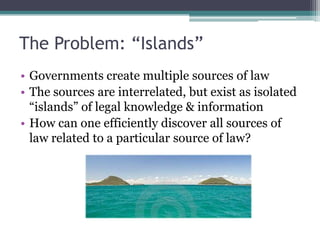
The Problem: “Islands”Governments create multiple sources of lawThe sources are interrelated, but exist as isolated “islands” of legal knowledge & informationHow can one efficiently discover all sources of law related to a particular source of law?
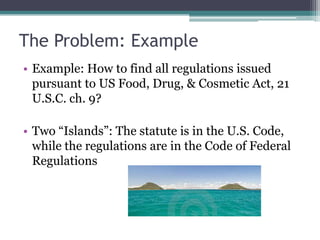
The Problem: ExampleExample: How to find all regulations issued pursuant to US Food, Drug, & Cosmetic Act, 21 U.S.C. ch.9?Two “Islands”: The statute is in the U.S. Code, while the regulations are in the Code of Federal Regulations
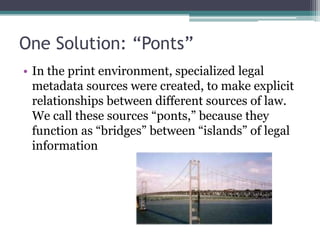
One Solution: “Ponts”In the print environment, specialized legal metadata sources were created, to make explicit relationships between different sources of law. We call these sources “ponts,” because they function as “bridges” between “islands” of legal information
Ponts: Proprietary vs. Public DomainProprietary ponts are of limited use in digital environment because of usage restrictions & license feese.g., West’s American Digest System
Public domain ponts—like those created by U.S. federal government, which are free from copyright, 17 U.S.C. § 105—lack usage restrictions & license fees, have great potential in digital domaine.g., PTOA, CONAN, Cong. Rec. History of Bills
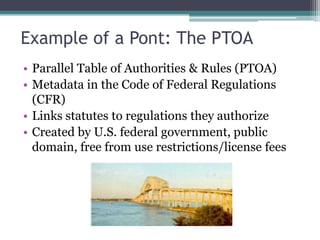
Example of a Pont: The PTOAParallel Table of Authorities & Rules (PTOA)Metadata in the Code of Federal Regulations (CFR)Links statutes to regulations they authorizeCreated by U.S. federal government, public domain, free from use restrictions/license fees
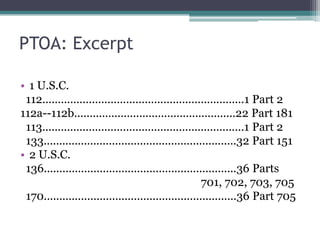
PTOA: Excerpt1 U.S.C.    112.................................................................1 Part 2  112a--112b....................................................22 Part 181  113.................................................................1 Part 2  133..............................................................32 Part 151 2 U.S.C.    136..............................................................36 Parts 701, 702, 703, 705   170..............................................................36 Part 705
PTOA in Print: Human-DependentMost ponts created for print environment require human intervention to ensure connection between the different legal sources they seek to linkPTOA in print requires human intervention
PTOA: Preparing It for DigitalGoals:Disintermediation:Make PTOA processable by software without human interventionFoster interoperability & re-useCreate “generative resource” (Zittrain)Foster innovation
PTOA: Preparing It for Digital (cont’d)Recommended formats:XML RDF/OWLWhy XML & RDF/OWL?Open, international standardsWidely used and understoodEnable re-use and interoperabilityEnable “generative” usesFoster innovation: developers are equipped to create new systems to process them
PTOA: Use CasesInformation Retrieval & DiscoveryBidirectional discoveryRevelation of implicit relationshipsAutomated retrievalCross-language retrievalLinked DataScholarly ResearchPublic AdministrationeParticipationGISMachine Learning: Automatic Creation of Ponts
PTOA: Obstacles to Preparation for Digital UseSemantics (Ambiguity)GranularityDirectionalityData Quality
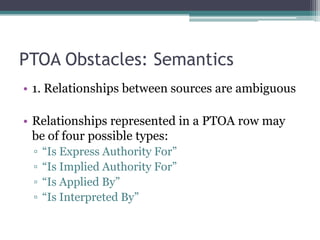
PTOA Obstacles: Semantics1. Relationships between sources are ambiguousRelationships represented in a PTOA row may be of four possible types:“Is Express Authority For”“Is Implied Authority For”“Is Applied By”“Is Interpreted By”
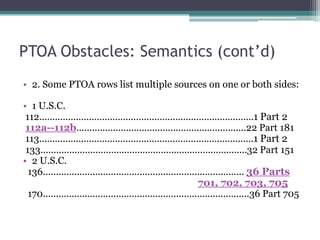
PTOA Obstacles: Semantics (cont’d)2. Some PTOA rows list multiple sources on one or both sides:1 U.S.C.  112..................................................................................1 Part 2  112a--112b.................................................................22 Part 181  113..................................................................................1 Part 2  133...............................................................................32 Part 151 2 U.S.C.    136............................................................................. 36 Parts 701, 702, 703, 705  170...............................................................................36 Part 705
PTOA Obstacles: Semantics (cont’d)Result: In many PTOA rows, relationships between sources are multiple and complexResult: In most rows, the precise meaning of relationships is implicit & often not discernible by software
PTOA Obstacles: GranularityPTOA regulation cites refer only to the “Part” level of CFRBut the relationships intended to be represented in PTOA usually occur at more granular levels: “section” or “sub-section”
PTOA Obstacles: Granularity: Example“1 U.S.C. […]“112a--112b................................22 Part 181”1 U.S.C. section 112b (specifically subsection (f)) expressly provides authority for components of 22 C.F.R. part 181 (specifically sections 181.1 through 181.7). 1 U.S.C. section 112a (specifically subsection (d)) implicitly provides authority for components of 22 C.F.R. part 181 (specifically sections 181.8 and 181.9).
PTOA Obstacles: Granularity (cont’d)So each PTOA row must be analyzed & divided into multiple rows at accurate level of granularity
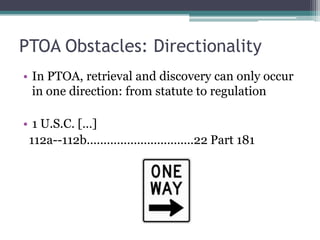
PTOA Obstacles: DirectionalityIn PTOA, retrieval and discovery can only occur in one direction: from statute to regulation1 U.S.C. […]  112a--112b................................22 Part 181
PTOA Obstacles: DirectionalityBut in digital world, PTOA could add great value if it were bidirectional: if it enabled discovery from regulations to statutes, as well as from statutes to regulations
PTOA Obstacle: Data QualityProduction of PTOA is decentralized: each individual agency creates rows for its regulationsResult: Inconsistent quality of PTOA dataNeed: For Digital PTOA to express editor’s evaluation of data quality, in machine-processable metadata
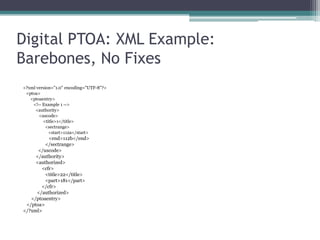
Digital PTOA: XML Example: Barebones, No Fixes<?xml version="1.0" encoding="UTF-8"?>  <ptoa>       <ptoaentry>          <!-- Example 1 -->            <authority>               <uscode><title>1</title><sectrange><start>112a</start>                      <end>112b</end></sectrange></uscode>    </authority><authorized> <cfr>                   <title>22</title>                   <part>181</part>                </cfr> </authorized></ptoaentry></ptoa></?xml>
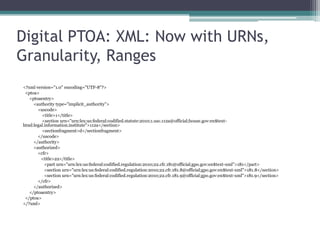
Digital PTOA: XML: Now with URNs, Granularity, Ranges<?xml version="1.0" encoding="UTF-8"?>  <ptoa><ptoaentry><authority type="implicit_authority"><uscode><title>1</title><section urn="urn:lex:us:federal:codified.statute:2010;1.usc.112a@official;house.gov:en$text-html:legal.information.institute">112a</section><sectionfragment>d</sectionfragment></uscode></authority>          <authorized>              <cfr>                 <title>22</title>                    <part urn="urn:lex:us:federal:codified.regulation:2010;22.cfr.181@official;gpo.gov:en$text-xml">181</part>                    <section urn="urn:lex:us:federal:codified.regulation:2010;22.cfr.181.8@official;gpo.gov:en$text-xml">181.8</section>                    <section urn="urn:lex:us:federal:codified.regulation:2010;22.cfr.181.9@official;gpo.gov:en$text-xml">181.9</section>              </cfr>         </authorized></ptoaentry></ptoa></?xml>
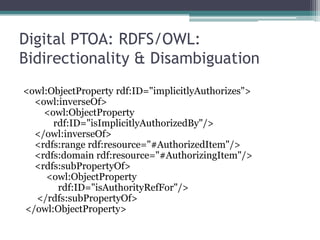
Digital PTOA: RDFS/OWL: Bidirectionality & Disambiguation<owl:ObjectPropertyrdf:ID="implicitlyAuthorizes"> <owl:inverseOf>         <owl:ObjectPropertyrdf:ID="isImplicitlyAuthorizedBy"/>     </owl:inverseOf>     <rdfs:rangerdf:resource="#AuthorizedItem"/>     <rdfs:domainrdf:resource="#AuthorizingItem"/>     <rdfs:subPropertyOf>         <owl:ObjectPropertyrdf:ID="isAuthorityRefFor"/>              </rdfs:subPropertyOf></owl:ObjectProperty>
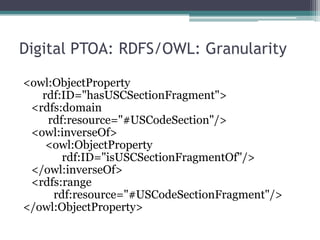
Digital PTOA: RDFS/OWL: Granularity<owl:ObjectPropertyrdf:ID="hasUSCSectionFragment">  <rdfs:domainrdf:resource="#USCodeSection"/><owl:inverseOf>  <owl:ObjectPropertyrdf:ID="isUSCSectionFragmentOf"/></owl:inverseOf><rdfs:rangerdf:resource="#USCodeSectionFragment"/></owl:ObjectProperty>
Challenges to Adapting the PTOA for the Digital EnvironmentMuch relevant information is implicit, might not be automatableNeed experiments to determineLikely will require labor by humans trained in lawPossible approach: partial automation: application recommends options to human coders
Challenges to Adapting the PTOA for the Digital Environment (cont’d)Inter-coder reliability needs to be tested & kept at high levelPaucity of law-related Linked Data resources, http://legalinformatics.wordpress.com/2009/08/19/linked-data-and-law/
Related ResearchEarlier studies of print-based ponts introduced into digital environment: Al-Kofahi et al. (2001); Dabney (1986); McDermott (1986) Findings:a. New uses of ponts arose in digital environment b. Ponts positively influenced retrieval performance
Similar ProjectsLegislation.gov.uk (Legislative Information Retrieval): Table of Legislative Effects, CEN MetaLex (legislative status)AGILE (Public Administration System): CEN MetaLex & OWL, http://ceur-ws.org/Vol-582/paper4.pdf
Other Ponts to ExamineAlready Known:Congressional Record: “History of Bills & Resolutions,” http://tinyurl.com/432awbwCFR List of Subjects & Subject Index, http://tinyurl.com/3udaqa2United States Code Subject IndexConstitution of the United States Annotated (CONAN), http://tinyurl.com/3w5xm6q
Other Ponts to Examine (cont’d)To Be Discovered:Legal information professionals might examine legal research bibliographies & legal research systems to identify additional public domain pontsEspecially state & local jurisdictions, or respecting particular areas of law
Digital PTOA: Next StepsSpring 2011: Receive input from colleagues at conferencesSummer & Fall 2011: Build prototype
References (1/7)Administrative Conference of the United States. 1971. Report of the Committee on Information, Education, and Reports in Support of Recommendation no. 3. In Recommendations and Reports of the Administrative Conference of the United States, January 8, 1968-June 30, 1970 (Vol. 1). US GPO, Washington, DC, 63-65.Al-Kofahi, K., Tyrrell, A., Vachher, A., Travers, T., and Jackson, P. 2001. Combining multiple classifiers for text categorization. In Proceedings of the 10th International Conference on Information and Knowledge Management (Atlanta, Georgia, November 05 - 10, 2001). CIKM '01. ACM, New York, NY, 97-104. DOI=10.1145/502585.502603. Alvite Díez, M. L., Pérez-León, B., Martínez González, M., and Blanco, D. F. J. V. 2010. Propuesta de representación del tesauro Eurovoc en SKOS para su integración en sistemas de información jurídica. Scire16, 2 (July-Dec. 2010), 47-51. Axel-Lute, P. 1979. Federal documents, 1978. Law Libr. J. 72, 2 (Spr. 1979), 222-234, 228. Bartolini, R., Lenci, A., Montemagni, S., Pirrelli, V., and Soria, C. 2004. Automatic classification and analysis of provisions in Italian legal texts: A case study. In Proceedings of the OTM Confederated International Workshops and Posters (Cyprus, October 25-29, 2004). OTM ’04. Springer, Berlin. 593-604. DOI=10.1007/978-3-540-30470-8_72.
References (2/7)Bennett, D. and Harvey, A. 2009. Publishing Open Government Data: W3C Working Draft 8 September 2009. World Wide Web Consortium. http://www.w3.org/TR/2009/WD-gov-data-20090908/ . Boer, A. 2009. The Agile project (late 2008-2010). Presentation given at Jacquard Bijeenkomst 2009 (The Hague, The Netherlands, December 11, 2009). http://www.jacquard.nl/8/assets/File/December2009/Jacquard-2009-12-11-Agile-zoals-gegeven.ppt . Boer, A. and Van Engers, T. 2009. The Agile project: Reconciling agility and legal accountability. In Proceedings of the 2nd International Conference on ICT Solutions for Justice (Skopje, Macedonia, September 24, 2009). ICT4JUSTICE ’09. CEUR Workshop Proceedings 582. CEUR, Aachen, Germany, 41-49, http://ceur-ws.org/Vol-582/paper4.pdfBontouri, L., Papatheodorou, C., Soulikias, V., and Stratis, M. 2009. Metadata interoperability in public sector information. J. Inform. Sci. 35, 2 (Apr. 2009), 204-231. DOI=10.1177/0165551508098601. Congressional Research Service. 2004. The Constitution of the United States of America: Analysis and Interpretation. US GPO, Washington, DC.
References (3/7)Dabney, D. P. 1986. The curse of Thamus: An analysis of full-text legal document retrieval. Law Libr. J. 78, 1 (Win. 1986), 5-40. Dini, L., Peters, W., Liebwald, D., Schweighofer, E., Mommers, L., and Voermans, W. 2005. Cross-lingual legal information retrieval using a WordNet architecture. In Proceedings of the 10th International Conference on Artificial Intelligence and Law (Bologna, Italy, June 06 - 11, 2007). ICAIL '05. ACM, New York, NY, 163-167. DOI=10.1145/1165485.1165510. Ekstrom, J. A. and Lau, G. T. 2008. Exploratory text mining of ocean law to measure overlapping agency and jurisdictional authority. In Proceedings of the 9th Annual International Conference on Digital Government Research (Montreal, Canada, May 18 - 21, 2008). dg.o ’08. ACM, New York, NY, 53-62. Farina, C. R., Katzen, S., Bruce, T. R., et al. 2008. Achieving the Potential: The Future of Federal E-rulemaking: A Report to Congress and the President. American Bar Association, Chicago, IL. Francesconi, E., Montemagni, S., Peters, W., and Tiscornia, D., Eds. 2010. Semantic Processing of Legal Texts: Where the Language of Law Meets the Law of Language. Springer, Berlin.
References (4/7)García, R. and Gil, R. 2008. A Web ontology for copyright contracts management. Int. J. Electron. Comm. 12, 4 (Sum. 2008), 99-114. DOI=10.2753/JEC1086-4415120404. Krippendorff, K. 2004. Content Analysis: An Introduction to Its Methodology (2nd ed.). Sage, Thousand Oaks, CA. Library of Congress. Policy and Standards Division. 2010. Library of Congress Subject Headings (32nd ed.). Library of Congress, Cataloging Distribution Service, Washington, DC. Marchetti, A., Megale, F., Seta, E., and Vitali, F. 2002. Using XML as a means to access legislative documents: Italian and foreign experiences. ACM SIGAPP Appl. Comput. Rev. 10, 1 (Spring 2002), 54-62. DOI=10.1145/568235.568246. McDermott, J. 1986. Another analysis of full-text legal document retrieval. Law Libr. J. 78, 2 (Spr. 1986), 337-344.
References (5/7)Mersky, R. M. and Dunn, D. J. 2002. Fundamentals of Legal Research. 8th ed. Foundation Press, New York, NY. Nadah, N., Dulong de Rosnay, M., and Bachimont, B. 2007. Licensing digital content with a generic ontology: Escaping from the jungle of rights expression languages. In Proceedings of the 11th International Conference on Artificial Intelligence and Law (Stanford, California, June 04 - 08, 2007). ICAIL '07. ACM, New York, NY, 65-69. DOI=10.1145/1276318.1276330. National Archives. 2010. Table of Legislative Effects. National Archives, London, UK. http://www.statutelaw.gov.uk/help/Table_of_Legislative_Effects.htm. Office of the Federal Register. 2004. Code of Federal Regulations List of Subjects. Office of the Federal Register, NARA, Washington, DC. http://www.archives.gov/federal-register/cfr/subjects.html . Office of the Federal Register. 2009. CFR Index and Finding Aids, Revised as of January 1, 2009. US GPO, Washington, DC, 1-776.
References (6/7)Office of the Federal Register. 1949. Parallel tables of statutory authorities and rules. In Code of Federal Regulations (Vol. 2). US GPO, Washington, DC, 19-144. Office of the Federal Register. 2009. Parallel table of authorities and rules. In CFR Index and Finding Aids, Revised as of January 1, 2009. US GPO, Washington, DC, 779-888. Ortiz-Rodríguez, F. 2007. EGODO and applications: Sharing, retrieving and exchanging legal documentation across e-government. In Proceedings of the Workshop on Semantic Web Technology for Law (Stanford, California, June 08, 2007). SW4Law ’07. VrijeUniversiteit Amsterdam Department of Computer Science, Amsterdam, 21-26. Robinson, D. G., Yu, H., Zeller, W., and Felten, E. W. 2009. Government data and the invisible hand. Yale J. Law & Technol. 11, 1 (Fall 2009), 160-175, http://ssrn.com/abstract=1138083 . Sheridan, J. L. 2010. Legislation.gov.uk. VoxPopuLII(Aug. 15, 2010). http://blog.law.cornell.edu/voxpop/2010/08/15/legislationgovuk/ .
References (7/7)Thomson Reuters. 2010. Using Related Materials on WestlawNext. Thomson Reuters, Eagan, MN. United States. 2008. United States Code (2006 ed.) (Vols. 33-36). US GPO, Washington, DC. Zittrain, J. 2009. The Future of the Internet—And How to Stop It. Yale University Press, New Haven, CT.

Bruce, T. R., and Richards, R. C. (2011). Examples of Specialized Legal Metadata Adapted to the Digital Environment, from The U.S. Code of Federal Regulations

  • 1.
    Examples of SpecializedLegal Metadata to the Digital Environment, From the U.S. Code of Federal RegulationsThomas R. Bruce, Legal Information InstituteRobert C. Richards, Jr., University of Washingtondg.o 2011: 12th Annual International Conference on Digital Government Research, 14 June 2011, University of Maryland, College Park http://dgo2011.dgsna.org/
  • 2.
    The Problem: “Islands”Governmentscreate multiple sources of lawThe sources are interrelated, but exist as isolated “islands” of legal knowledge & informationHow can one efficiently discover all sources of law related to a particular source of law?
  • 3.
    The Problem: ExampleExample:How to find all regulations issued pursuant to US Food, Drug, & Cosmetic Act, 21 U.S.C. ch.9?Two “Islands”: The statute is in the U.S. Code, while the regulations are in the Code of Federal Regulations
  • 4.
    One Solution: “Ponts”Inthe print environment, specialized legal metadata sources were created, to make explicit relationships between different sources of law. We call these sources “ponts,” because they function as “bridges” between “islands” of legal information
  • 5.
    Ponts: Proprietary vs.Public DomainProprietary ponts are of limited use in digital environment because of usage restrictions & license feese.g., West’s American Digest System
  • 6.
    Public domain ponts—likethose created by U.S. federal government, which are free from copyright, 17 U.S.C. § 105—lack usage restrictions & license fees, have great potential in digital domaine.g., PTOA, CONAN, Cong. Rec. History of Bills
  • 7.
    Example of aPont: The PTOAParallel Table of Authorities & Rules (PTOA)Metadata in the Code of Federal Regulations (CFR)Links statutes to regulations they authorizeCreated by U.S. federal government, public domain, free from use restrictions/license fees
  • 8.
    PTOA: Excerpt1 U.S.C. 112.................................................................1 Part 2 112a--112b....................................................22 Part 181 113.................................................................1 Part 2 133..............................................................32 Part 151 2 U.S.C. 136..............................................................36 Parts 701, 702, 703, 705 170..............................................................36 Part 705
  • 9.
    PTOA in Print:Human-DependentMost ponts created for print environment require human intervention to ensure connection between the different legal sources they seek to linkPTOA in print requires human intervention
  • 10.
    PTOA: Preparing Itfor DigitalGoals:Disintermediation:Make PTOA processable by software without human interventionFoster interoperability & re-useCreate “generative resource” (Zittrain)Foster innovation
  • 11.
    PTOA: Preparing Itfor Digital (cont’d)Recommended formats:XML RDF/OWLWhy XML & RDF/OWL?Open, international standardsWidely used and understoodEnable re-use and interoperabilityEnable “generative” usesFoster innovation: developers are equipped to create new systems to process them
  • 12.
    PTOA: Use CasesInformationRetrieval & DiscoveryBidirectional discoveryRevelation of implicit relationshipsAutomated retrievalCross-language retrievalLinked DataScholarly ResearchPublic AdministrationeParticipationGISMachine Learning: Automatic Creation of Ponts
  • 13.
    PTOA: Obstacles toPreparation for Digital UseSemantics (Ambiguity)GranularityDirectionalityData Quality
  • 14.
    PTOA Obstacles: Semantics1.Relationships between sources are ambiguousRelationships represented in a PTOA row may be of four possible types:“Is Express Authority For”“Is Implied Authority For”“Is Applied By”“Is Interpreted By”
  • 15.
    PTOA Obstacles: Semantics(cont’d)2. Some PTOA rows list multiple sources on one or both sides:1 U.S.C. 112..................................................................................1 Part 2 112a--112b.................................................................22 Part 181 113..................................................................................1 Part 2 133...............................................................................32 Part 151 2 U.S.C. 136............................................................................. 36 Parts 701, 702, 703, 705 170...............................................................................36 Part 705
  • 16.
    PTOA Obstacles: Semantics(cont’d)Result: In many PTOA rows, relationships between sources are multiple and complexResult: In most rows, the precise meaning of relationships is implicit & often not discernible by software
  • 17.
    PTOA Obstacles: GranularityPTOAregulation cites refer only to the “Part” level of CFRBut the relationships intended to be represented in PTOA usually occur at more granular levels: “section” or “sub-section”
  • 18.
    PTOA Obstacles: Granularity:Example“1 U.S.C. […]“112a--112b................................22 Part 181”1 U.S.C. section 112b (specifically subsection (f)) expressly provides authority for components of 22 C.F.R. part 181 (specifically sections 181.1 through 181.7). 1 U.S.C. section 112a (specifically subsection (d)) implicitly provides authority for components of 22 C.F.R. part 181 (specifically sections 181.8 and 181.9).
  • 19.
    PTOA Obstacles: Granularity(cont’d)So each PTOA row must be analyzed & divided into multiple rows at accurate level of granularity
  • 20.
    PTOA Obstacles: DirectionalityInPTOA, retrieval and discovery can only occur in one direction: from statute to regulation1 U.S.C. […] 112a--112b................................22 Part 181
  • 21.
    PTOA Obstacles: DirectionalityButin digital world, PTOA could add great value if it were bidirectional: if it enabled discovery from regulations to statutes, as well as from statutes to regulations
  • 22.
    PTOA Obstacle: DataQualityProduction of PTOA is decentralized: each individual agency creates rows for its regulationsResult: Inconsistent quality of PTOA dataNeed: For Digital PTOA to express editor’s evaluation of data quality, in machine-processable metadata
  • 23.
    Digital PTOA: XMLExample: Barebones, No Fixes<?xml version="1.0" encoding="UTF-8"?> <ptoa> <ptoaentry> <!-- Example 1 --> <authority> <uscode><title>1</title><sectrange><start>112a</start> <end>112b</end></sectrange></uscode> </authority><authorized> <cfr> <title>22</title> <part>181</part> </cfr> </authorized></ptoaentry></ptoa></?xml>
  • 24.
    Digital PTOA: XML:Now with URNs, Granularity, Ranges<?xml version="1.0" encoding="UTF-8"?> <ptoa><ptoaentry><authority type="implicit_authority"><uscode><title>1</title><section urn="urn:lex:us:federal:codified.statute:2010;1.usc.112a@official;house.gov:en$text-html:legal.information.institute">112a</section><sectionfragment>d</sectionfragment></uscode></authority> <authorized> <cfr> <title>22</title> <part urn="urn:lex:us:federal:codified.regulation:2010;22.cfr.181@official;gpo.gov:en$text-xml">181</part> <section urn="urn:lex:us:federal:codified.regulation:2010;22.cfr.181.8@official;gpo.gov:en$text-xml">181.8</section> <section urn="urn:lex:us:federal:codified.regulation:2010;22.cfr.181.9@official;gpo.gov:en$text-xml">181.9</section> </cfr> </authorized></ptoaentry></ptoa></?xml>
  • 25.
    Digital PTOA: RDFS/OWL:Bidirectionality & Disambiguation<owl:ObjectPropertyrdf:ID="implicitlyAuthorizes"> <owl:inverseOf> <owl:ObjectPropertyrdf:ID="isImplicitlyAuthorizedBy"/> </owl:inverseOf> <rdfs:rangerdf:resource="#AuthorizedItem"/> <rdfs:domainrdf:resource="#AuthorizingItem"/> <rdfs:subPropertyOf> <owl:ObjectPropertyrdf:ID="isAuthorityRefFor"/> </rdfs:subPropertyOf></owl:ObjectProperty>
  • 26.
    Digital PTOA: RDFS/OWL:Granularity<owl:ObjectPropertyrdf:ID="hasUSCSectionFragment"> <rdfs:domainrdf:resource="#USCodeSection"/><owl:inverseOf> <owl:ObjectPropertyrdf:ID="isUSCSectionFragmentOf"/></owl:inverseOf><rdfs:rangerdf:resource="#USCodeSectionFragment"/></owl:ObjectProperty>
  • 27.
    Challenges to Adaptingthe PTOA for the Digital EnvironmentMuch relevant information is implicit, might not be automatableNeed experiments to determineLikely will require labor by humans trained in lawPossible approach: partial automation: application recommends options to human coders
  • 28.
    Challenges to Adaptingthe PTOA for the Digital Environment (cont’d)Inter-coder reliability needs to be tested & kept at high levelPaucity of law-related Linked Data resources, http://legalinformatics.wordpress.com/2009/08/19/linked-data-and-law/
  • 29.
    Related ResearchEarlier studiesof print-based ponts introduced into digital environment: Al-Kofahi et al. (2001); Dabney (1986); McDermott (1986) Findings:a. New uses of ponts arose in digital environment b. Ponts positively influenced retrieval performance
  • 30.
    Similar ProjectsLegislation.gov.uk (LegislativeInformation Retrieval): Table of Legislative Effects, CEN MetaLex (legislative status)AGILE (Public Administration System): CEN MetaLex & OWL, http://ceur-ws.org/Vol-582/paper4.pdf
  • 31.
    Other Ponts toExamineAlready Known:Congressional Record: “History of Bills & Resolutions,” http://tinyurl.com/432awbwCFR List of Subjects & Subject Index, http://tinyurl.com/3udaqa2United States Code Subject IndexConstitution of the United States Annotated (CONAN), http://tinyurl.com/3w5xm6q
  • 32.
    Other Ponts toExamine (cont’d)To Be Discovered:Legal information professionals might examine legal research bibliographies & legal research systems to identify additional public domain pontsEspecially state & local jurisdictions, or respecting particular areas of law
  • 33.
    Digital PTOA: NextStepsSpring 2011: Receive input from colleagues at conferencesSummer & Fall 2011: Build prototype
  • 34.
    References (1/7)Administrative Conferenceof the United States. 1971. Report of the Committee on Information, Education, and Reports in Support of Recommendation no. 3. In Recommendations and Reports of the Administrative Conference of the United States, January 8, 1968-June 30, 1970 (Vol. 1). US GPO, Washington, DC, 63-65.Al-Kofahi, K., Tyrrell, A., Vachher, A., Travers, T., and Jackson, P. 2001. Combining multiple classifiers for text categorization. In Proceedings of the 10th International Conference on Information and Knowledge Management (Atlanta, Georgia, November 05 - 10, 2001). CIKM '01. ACM, New York, NY, 97-104. DOI=10.1145/502585.502603. Alvite Díez, M. L., Pérez-León, B., Martínez González, M., and Blanco, D. F. J. V. 2010. Propuesta de representación del tesauro Eurovoc en SKOS para su integración en sistemas de información jurídica. Scire16, 2 (July-Dec. 2010), 47-51. Axel-Lute, P. 1979. Federal documents, 1978. Law Libr. J. 72, 2 (Spr. 1979), 222-234, 228. Bartolini, R., Lenci, A., Montemagni, S., Pirrelli, V., and Soria, C. 2004. Automatic classification and analysis of provisions in Italian legal texts: A case study. In Proceedings of the OTM Confederated International Workshops and Posters (Cyprus, October 25-29, 2004). OTM ’04. Springer, Berlin. 593-604. DOI=10.1007/978-3-540-30470-8_72.
  • 35.
    References (2/7)Bennett, D.and Harvey, A. 2009. Publishing Open Government Data: W3C Working Draft 8 September 2009. World Wide Web Consortium. http://www.w3.org/TR/2009/WD-gov-data-20090908/ . Boer, A. 2009. The Agile project (late 2008-2010). Presentation given at Jacquard Bijeenkomst 2009 (The Hague, The Netherlands, December 11, 2009). http://www.jacquard.nl/8/assets/File/December2009/Jacquard-2009-12-11-Agile-zoals-gegeven.ppt . Boer, A. and Van Engers, T. 2009. The Agile project: Reconciling agility and legal accountability. In Proceedings of the 2nd International Conference on ICT Solutions for Justice (Skopje, Macedonia, September 24, 2009). ICT4JUSTICE ’09. CEUR Workshop Proceedings 582. CEUR, Aachen, Germany, 41-49, http://ceur-ws.org/Vol-582/paper4.pdfBontouri, L., Papatheodorou, C., Soulikias, V., and Stratis, M. 2009. Metadata interoperability in public sector information. J. Inform. Sci. 35, 2 (Apr. 2009), 204-231. DOI=10.1177/0165551508098601. Congressional Research Service. 2004. The Constitution of the United States of America: Analysis and Interpretation. US GPO, Washington, DC.
  • 36.
    References (3/7)Dabney, D.P. 1986. The curse of Thamus: An analysis of full-text legal document retrieval. Law Libr. J. 78, 1 (Win. 1986), 5-40. Dini, L., Peters, W., Liebwald, D., Schweighofer, E., Mommers, L., and Voermans, W. 2005. Cross-lingual legal information retrieval using a WordNet architecture. In Proceedings of the 10th International Conference on Artificial Intelligence and Law (Bologna, Italy, June 06 - 11, 2007). ICAIL '05. ACM, New York, NY, 163-167. DOI=10.1145/1165485.1165510. Ekstrom, J. A. and Lau, G. T. 2008. Exploratory text mining of ocean law to measure overlapping agency and jurisdictional authority. In Proceedings of the 9th Annual International Conference on Digital Government Research (Montreal, Canada, May 18 - 21, 2008). dg.o ’08. ACM, New York, NY, 53-62. Farina, C. R., Katzen, S., Bruce, T. R., et al. 2008. Achieving the Potential: The Future of Federal E-rulemaking: A Report to Congress and the President. American Bar Association, Chicago, IL. Francesconi, E., Montemagni, S., Peters, W., and Tiscornia, D., Eds. 2010. Semantic Processing of Legal Texts: Where the Language of Law Meets the Law of Language. Springer, Berlin.
  • 37.
    References (4/7)García, R.and Gil, R. 2008. A Web ontology for copyright contracts management. Int. J. Electron. Comm. 12, 4 (Sum. 2008), 99-114. DOI=10.2753/JEC1086-4415120404. Krippendorff, K. 2004. Content Analysis: An Introduction to Its Methodology (2nd ed.). Sage, Thousand Oaks, CA. Library of Congress. Policy and Standards Division. 2010. Library of Congress Subject Headings (32nd ed.). Library of Congress, Cataloging Distribution Service, Washington, DC. Marchetti, A., Megale, F., Seta, E., and Vitali, F. 2002. Using XML as a means to access legislative documents: Italian and foreign experiences. ACM SIGAPP Appl. Comput. Rev. 10, 1 (Spring 2002), 54-62. DOI=10.1145/568235.568246. McDermott, J. 1986. Another analysis of full-text legal document retrieval. Law Libr. J. 78, 2 (Spr. 1986), 337-344.
  • 38.
    References (5/7)Mersky, R.M. and Dunn, D. J. 2002. Fundamentals of Legal Research. 8th ed. Foundation Press, New York, NY. Nadah, N., Dulong de Rosnay, M., and Bachimont, B. 2007. Licensing digital content with a generic ontology: Escaping from the jungle of rights expression languages. In Proceedings of the 11th International Conference on Artificial Intelligence and Law (Stanford, California, June 04 - 08, 2007). ICAIL '07. ACM, New York, NY, 65-69. DOI=10.1145/1276318.1276330. National Archives. 2010. Table of Legislative Effects. National Archives, London, UK. http://www.statutelaw.gov.uk/help/Table_of_Legislative_Effects.htm. Office of the Federal Register. 2004. Code of Federal Regulations List of Subjects. Office of the Federal Register, NARA, Washington, DC. http://www.archives.gov/federal-register/cfr/subjects.html . Office of the Federal Register. 2009. CFR Index and Finding Aids, Revised as of January 1, 2009. US GPO, Washington, DC, 1-776.
  • 39.
    References (6/7)Office ofthe Federal Register. 1949. Parallel tables of statutory authorities and rules. In Code of Federal Regulations (Vol. 2). US GPO, Washington, DC, 19-144. Office of the Federal Register. 2009. Parallel table of authorities and rules. In CFR Index and Finding Aids, Revised as of January 1, 2009. US GPO, Washington, DC, 779-888. Ortiz-Rodríguez, F. 2007. EGODO and applications: Sharing, retrieving and exchanging legal documentation across e-government. In Proceedings of the Workshop on Semantic Web Technology for Law (Stanford, California, June 08, 2007). SW4Law ’07. VrijeUniversiteit Amsterdam Department of Computer Science, Amsterdam, 21-26. Robinson, D. G., Yu, H., Zeller, W., and Felten, E. W. 2009. Government data and the invisible hand. Yale J. Law & Technol. 11, 1 (Fall 2009), 160-175, http://ssrn.com/abstract=1138083 . Sheridan, J. L. 2010. Legislation.gov.uk. VoxPopuLII(Aug. 15, 2010). http://blog.law.cornell.edu/voxpop/2010/08/15/legislationgovuk/ .
  • 40.
    References (7/7)Thomson Reuters.2010. Using Related Materials on WestlawNext. Thomson Reuters, Eagan, MN. United States. 2008. United States Code (2006 ed.) (Vols. 33-36). US GPO, Washington, DC. Zittrain, J. 2009. The Future of the Internet—And How to Stop It. Yale University Press, New Haven, CT.