Coordinación bilingüe Isabel Pérez Torres
Template to design a CLIL didactic unit
Subject: Physical Education Teacher:Narciso Marín Marín
Title of the Unit “Swimming: main strokes Course / Level 2nd
Bachillerato
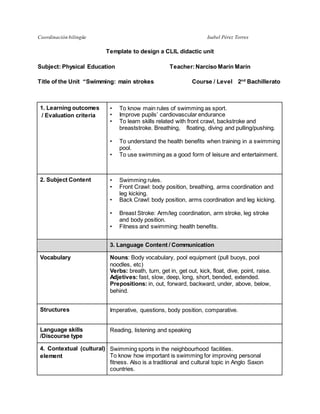
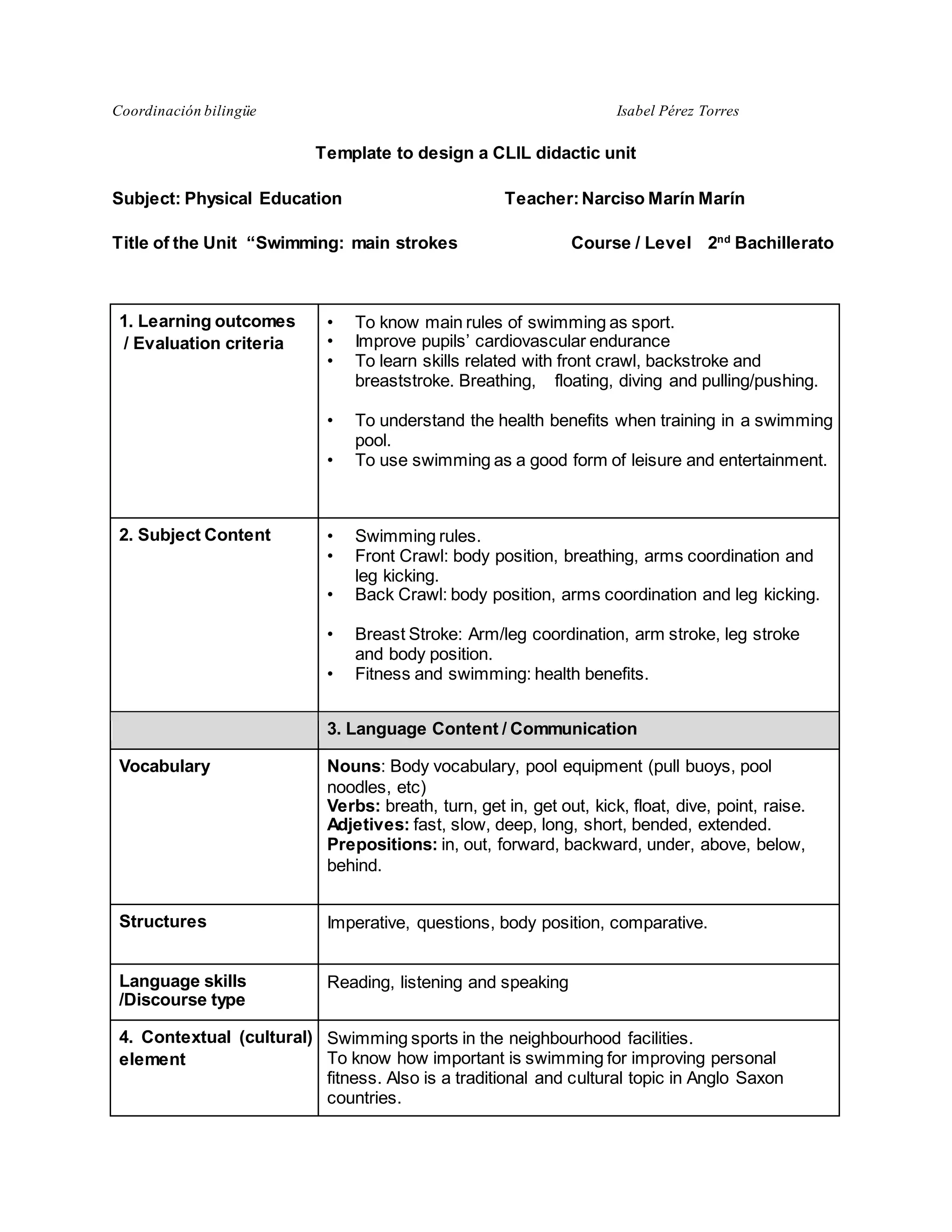
1. Learning outcomes
/ Evaluation criteria
• To know main rules of swimming as sport. 

• Improve pupils’ cardiovascular endurance 

• To learn skills related with front crawl, backstroke and
breaststroke. Breathing, 
 floating, diving and pulling/pushing.


• To understand the health benefits when training in a swimming
pool. 

• To use swimming as a good form of leisure and entertainment.


2. Subject Content • Swimming rules. 

• Front Crawl: body position, breathing, arms coordination and
leg kicking. 

• Back Crawl: body position, arms coordination and leg kicking.


• Breast Stroke: Arm/leg coordination, arm stroke, leg stroke
and body position. 

• Fitness and swimming: health benefits. 

3. Language Content / Communication
Vocabulary Nouns: Body vocabulary, pool equipment (pull buoys, pool
noodles, etc)
Verbs: breath, turn, get in, get out, kick, float, dive, point, raise.
Adjetives: fast, slow, deep, long, short, bended, extended.
Prepositions: in, out, forward, backward, under, above, below,
behind.
Structures Imperative, questions, body position, comparative.
Language skills
/Discourse type
Reading, listening and speaking
4. Contextual (cultural)
element
Swimming sports in the neighbourhood facilities.
To know how important is swimming for improving personal
fitness. Also is a traditional and cultural topic in Anglo Saxon
countries.
Coordinación bilingüe Isabel Pérez Torres
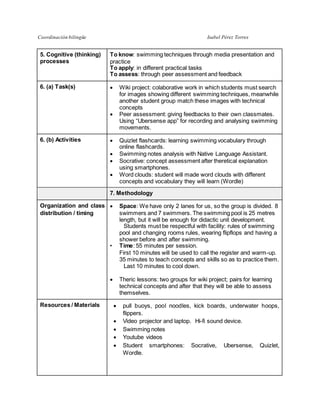
5. Cognitive (thinking)
processes
To know: swimming techniques through media presentation and
practice
To apply: in different practical tasks
To assess: through peer assessment and feedback
6. (a) Task(s)  Wiki project: colaborative work in which students must search
for images showing different swimming techniques, meanwhile
another student group match these images with technical
concepts
 Peer assessment: giving feedbacks to their own classmates.
Using “Ubersense app” for recording and analysing swimming
movements.
6. (b) Activities  Quizlet flashcards: learning swimming vocabulary through
online flashcards.
 Swimming notes analysis with Native Language Assistant.
 Socrative: concept assessment after theretical explanation
using smartphones.
 Word clouds: student will made word clouds with different
concepts and vocabulary they will learn (Wordle)
7. Methodology
Organization and class
distribution / timing
 Space: We have only 2 lanes for us, so the group is divided. 8
swimmers and 7 swimmers. The swimming pool is 25 metres
length, but it will be enough for didactic unit development.

 Students must be respectful with facility: rules of swimming
pool and changing rooms rules, wearing flipflops and having a
shower before and after swimming.
• Time: 55 minutes per session.
First 10 minutes will be used to call the register and warm-up.
35 minutes to teach concepts and skills so as to practice them.

 Last 10 minutes to cool down.


 Theric lessons: two groups for wiki project; pairs for learning
technical concepts and after that they will be able to assess
themselves.
Resources / Materials  pull buoys, pool noodles, kick boards, underwater hoops,
flippers.
 Video projector and laptop. Hi-fi sound device.
 Swimming notes
 Youtube videos
 Student smartphones: Socrative, Ubersense, Quizlet,
Wordle.
Coordinación bilingüe Isabel Pérez Torres
Key Competences  Comunicación lingüística
 Conocimiento e interacción con el mundo físico
 Tratamiento de la información y competencia digital
 Autonomía e iniciativa personal
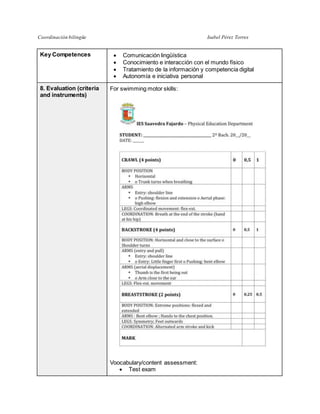
8. Evaluation (criteria
and instruments)
For swimming motor skills:
Voocabulary/content assessment:
 Test exam
Coordinación bilingüe Isabel Pérez Torres
Feel free to use this template. Thanks for attributing the source.
A first sample of this template has been published at:
Pérez Torres, I. 2009. "Apuntes sobre los principios y características de la metodología AICLE" en V.
Pavón, J. Ávila (eds.), Aplicaciones didácticas para la enseñanza integrada de lengua y contenidos.
Sevilla: Consejería de Educación de la Junta de Andalucía-Universidad de Córdoba.171-180.
It is mainly based on the hands-on experience at designing units and on conversations with
experts and peers. The theory of the 4Cs by Do Coyle has also been taken into account. This
theory has been shown in various publications, such as: Coyle, D., Hood, P. and Marsh, D.,
2010. Content and Language Integrated Learning. Cambridge University Press.

Swimming didactic unit - Narciso Marín Marín

  • 1.
    Coordinación bilingüe IsabelPérez Torres Template to design a CLIL didactic unit Subject: Physical Education Teacher:Narciso Marín Marín Title of the Unit “Swimming: main strokes Course / Level 2nd Bachillerato 1. Learning outcomes / Evaluation criteria • To know main rules of swimming as sport. 
 • Improve pupils’ cardiovascular endurance 
 • To learn skills related with front crawl, backstroke and breaststroke. Breathing, 
 floating, diving and pulling/pushing. 
 • To understand the health benefits when training in a swimming pool. 
 • To use swimming as a good form of leisure and entertainment. 
 2. Subject Content • Swimming rules. 
 • Front Crawl: body position, breathing, arms coordination and leg kicking. 
 • Back Crawl: body position, arms coordination and leg kicking. 
 • Breast Stroke: Arm/leg coordination, arm stroke, leg stroke and body position. 
 • Fitness and swimming: health benefits. 
 3. Language Content / Communication Vocabulary Nouns: Body vocabulary, pool equipment (pull buoys, pool noodles, etc) Verbs: breath, turn, get in, get out, kick, float, dive, point, raise. Adjetives: fast, slow, deep, long, short, bended, extended. Prepositions: in, out, forward, backward, under, above, below, behind. Structures Imperative, questions, body position, comparative. Language skills /Discourse type Reading, listening and speaking 4. Contextual (cultural) element Swimming sports in the neighbourhood facilities. To know how important is swimming for improving personal fitness. Also is a traditional and cultural topic in Anglo Saxon countries.
  • 2.
    Coordinación bilingüe IsabelPérez Torres 5. Cognitive (thinking) processes To know: swimming techniques through media presentation and practice To apply: in different practical tasks To assess: through peer assessment and feedback 6. (a) Task(s)  Wiki project: colaborative work in which students must search for images showing different swimming techniques, meanwhile another student group match these images with technical concepts  Peer assessment: giving feedbacks to their own classmates. Using “Ubersense app” for recording and analysing swimming movements. 6. (b) Activities  Quizlet flashcards: learning swimming vocabulary through online flashcards.  Swimming notes analysis with Native Language Assistant.  Socrative: concept assessment after theretical explanation using smartphones.  Word clouds: student will made word clouds with different concepts and vocabulary they will learn (Wordle) 7. Methodology Organization and class distribution / timing  Space: We have only 2 lanes for us, so the group is divided. 8 swimmers and 7 swimmers. The swimming pool is 25 metres length, but it will be enough for didactic unit development. 
 Students must be respectful with facility: rules of swimming pool and changing rooms rules, wearing flipflops and having a shower before and after swimming. • Time: 55 minutes per session. First 10 minutes will be used to call the register and warm-up. 35 minutes to teach concepts and skills so as to practice them. 
 Last 10 minutes to cool down. 
  Theric lessons: two groups for wiki project; pairs for learning technical concepts and after that they will be able to assess themselves. Resources / Materials  pull buoys, pool noodles, kick boards, underwater hoops, flippers.  Video projector and laptop. Hi-fi sound device.  Swimming notes  Youtube videos  Student smartphones: Socrative, Ubersense, Quizlet, Wordle.
  • 3.
    Coordinación bilingüe IsabelPérez Torres Key Competences  Comunicación lingüística  Conocimiento e interacción con el mundo físico  Tratamiento de la información y competencia digital  Autonomía e iniciativa personal 8. Evaluation (criteria and instruments) For swimming motor skills: Voocabulary/content assessment:  Test exam
  • 4.
    Coordinación bilingüe IsabelPérez Torres Feel free to use this template. Thanks for attributing the source. A first sample of this template has been published at: Pérez Torres, I. 2009. "Apuntes sobre los principios y características de la metodología AICLE" en V. Pavón, J. Ávila (eds.), Aplicaciones didácticas para la enseñanza integrada de lengua y contenidos. Sevilla: Consejería de Educación de la Junta de Andalucía-Universidad de Córdoba.171-180. It is mainly based on the hands-on experience at designing units and on conversations with experts and peers. The theory of the 4Cs by Do Coyle has also been taken into account. This theory has been shown in various publications, such as: Coyle, D., Hood, P. and Marsh, D., 2010. Content and Language Integrated Learning. Cambridge University Press.