www.stillaguamishwatershed.org


 Dedicated to restoring and
      maintaining a healthy
Stillaguamish River Watershed
           since 1990
The mission of the Stillaguamish Watershed Council
(SWC) is to maintain a healthy, functioning Stillaguamish
     Watershed by providing a local forum in which
 agencies, organizations, communities, and the public can
   engage in a collaborative watershed based process of
            decision making and coordination.
    This slideshow highlights the work of the SWC

          www.stillaguamishwatershed.org
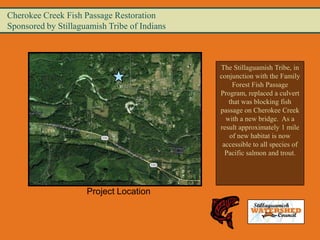
Cherokee Creek Fish Passage Restoration
Sponsored by Stillaguamish Tribe of Indians


                                              The Stillaguamish Tribe, in
                                              conjunction with the Family
                                                  Forest Fish Passage
                                              Program, replaced a culvert
                                                 that was blocking fish
                                              passage on Cherokee Creek
                                                with a new bridge. As a
                                              result approximately 1 mile
                                                 of new habitat is now
                                               accessible to all species of
                                                Pacific salmon and trout.


                     Project Location
Cherokee Creek Fish Passage Restoration
Sponsored by Stillaguamish Tribe of Indians


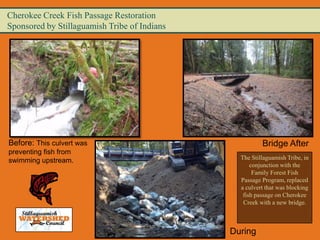
Before: This culvert was                                Bridge After
preventing fish from
swimming upstream.                              The Stillaguamish Tribe, in
                                                    conjunction with the
                                                     Family Forest Fish
                                                Passage Program, replaced
                                                a culvert that was blocking
                                                 fish passage on Cherokee
                                                 Creek with a new bridge.


                                              During
Jim Creek Bank Restoration
Sponsored by the Stillaguamish Tribe of Indians

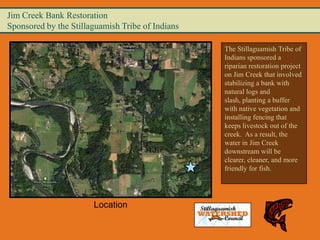
                                                  The Stillaguamish Tribe of
                                                  Indians sponsored a
                                                  riparian restoration project
                                                  on Jim Creek that involved
                                                  stabilizing a bank with
                                                  natural logs and
                                                  slash, planting a buffer
                                                  with native vegetation and
                                                  installing fencing that
                                                  keeps livestock out of the
                                                  creek. As a result, the
                                                  water in Jim Creek
                                                  downstream will be
                                                  clearer, cleaner, and more
                                                  friendly for fish.


                       Location
Jim Creek Bank Restoration
Sponsored by the Stillaguamish Tribe of Indians


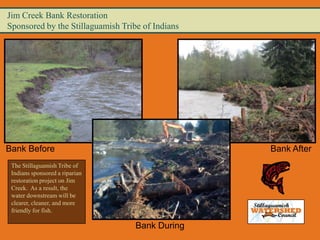
Bank Before                                       Bank After
 The Stillaguamish Tribe of
 Indians sponsored a riparian
 restoration project on Jim
 Creek. As a result, the
 water downstream will be
 clearer, cleaner, and more
 friendly for fish.

                                   Bank During
South Fork Riparian Restoration
Sponsored by the Stillaguamish Tribe of Indians


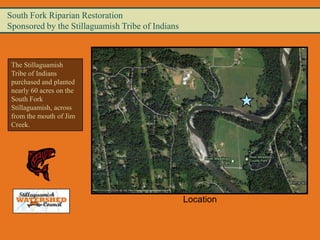
 The Stillaguamish
 Tribe of Indians
 purchased and planted
 nearly 60 acres on the
 South Fork
 Stillaguamish, across
 from the mouth of Jim
 Creek.


                                                  Location
South Fork Riparian Restoration
Sponsored by the Stillaguamish Tribe of Indians


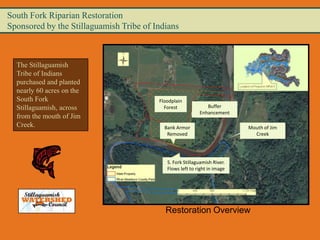
  The Stillaguamish
  Tribe of Indians
  purchased and planted
  nearly 60 acres on the
  South Fork                             Floodplain
  Stillaguamish, across                    Forest             Buffer
                                                           Enhancement
  from the mouth of Jim
  Creek.                                   Bank Armor                      Mouth of Jim
                                            Removed                          Creek


                                            S. Fork Stillaguamish River.
                                            Flows left to right in image


                                           Restoration Overview
South Fork Riparian Restoration
Sponsored by the Stillaguamish Tribe of Indians


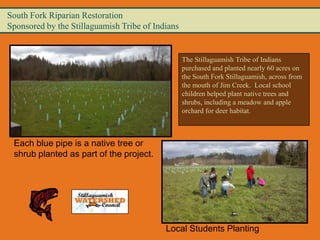
                                                  The Stillaguamish Tribe of Indians
                                                  purchased and planted nearly 60 acres on
                                                  the South Fork Stillaguamish, across from
                                                  the mouth of Jim Creek. Local school
                                                  children helped plant native trees and
                                                  shrubs, including a meadow and apple
                                                  orchard for deer habitat.


 Each blue pipe is a native tree or
 shrub planted as part of the project.


                                           Local Students Planting
North Fork Riparian Restoration
Sponsored by the Stillaguamish Tribe of Indians


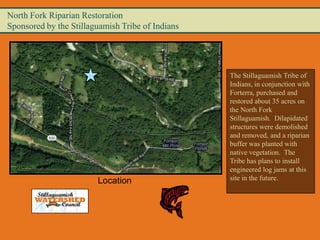
                                                  The Stillaguamish Tribe of
                                                  Indians, in conjunction with
                                                  Forterra, purchased and
                                                  restored about 35 acres on
                                                  the North Fork
                                                  Stillaguamish. Dilapidated
                                                  structures were demolished
                                                  and removed, and a riparian
                                                  buffer was planted with
                                                  native vegetation. The
                                                  Tribe has plans to install
                                                  engineered log jams at this
                        Location                  site in the future.
North Fork Riparian Restoration
Sponsored by the Stillaguamish Tribe of Indians


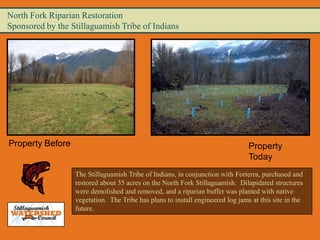
Property Before                                                                 Property
                                                                                Today
                  The Stillaguamish Tribe of Indians, in conjunction with Forterra, purchased and
                  restored about 35 acres on the North Fork Stillaguamish. Dilapidated structures
                  were demolished and removed, and a riparian buffer was planted with native
                  vegetation. The Tribe has plans to install engineered log jams at this site in the
                  future.
North Fork Riparian Restoration
Sponsored by the Stillaguamish Tribe of Indians

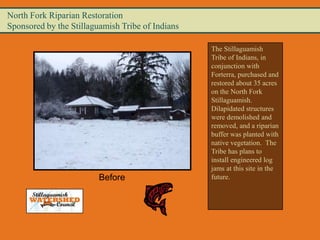
                                                  The Stillaguamish
                                                  Tribe of Indians, in
                                                  conjunction with
                                                  Forterra, purchased and
                                                  restored about 35 acres
                                                  on the North Fork
                                                  Stillaguamish.
                                                  Dilapidated structures
                                                  were demolished and
                                                  removed, and a riparian
                                                  buffer was planted with
                                                  native vegetation. The
                                                  Tribe has plans to
                                                  install engineered log
                                                  jams at this site in the
                         Before                   future.
Blue Slough Reconnection
Sponsored by the Stillaguamish Tribe of Indians

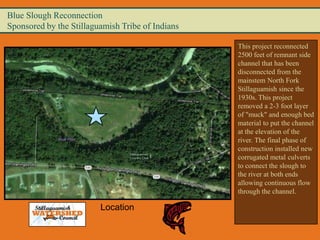
                                                  This project reconnected
                                                  2500 feet of remnant side
                                                  channel that has been
                                                  disconnected from the
                                                  mainstem North Fork
                                                  Stillaguamish since the
                                                  1930s. This project
                                                  removed a 2-3 foot layer
                                                  of "muck" and enough bed
                                                  material to put the channel
                                                  at the elevation of the
                                                  river. The final phase of
                                                  construction installed new
                                                  corrugated metal culverts
                                                  to connect the slough to
                                                  the river at both ends
                                                  allowing continuous flow
                                                  through the channel.

                         Location
Blue Slough Reconnection
Sponsored by the Stillaguamish Tribe of Indians
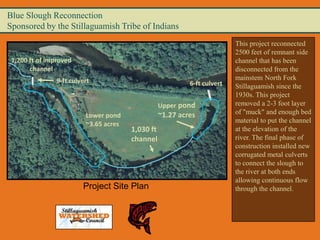
                                                                           This project reconnected
                                                                           2500 feet of remnant side
 1,200 ft of improved                                                      channel that has been
       channel                                                             disconnected from the
                9-ft culvert                                               mainstem North Fork
                                                            6-ft culvert   Stillaguamish since the
                                                                           1930s. This project
                                                   Upper pond              removed a 2-3 foot layer
                          Lower pond               ~1.27 acres             of "muck" and enough bed
                          ~3.65 acres                                      material to put the channel
                                        1,030 ft                           at the elevation of the
                                        channel                            river. The final phase of
                                                                           construction installed new
                                                                           corrugated metal culverts
                                                                           to connect the slough to
                                                                           the river at both ends
                                                                           allowing continuous flow
                         Project Site Plan                                 through the channel.
Blue Slough Reconnection
Sponsored by the Stillaguamish Tribe of Indians


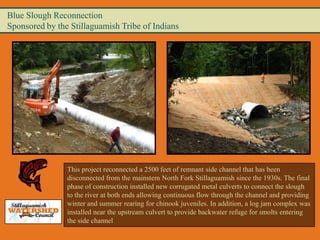
                This project reconnected a 2500 feet of remnant side channel that has been
                disconnected from the mainstem North Fork Stillaguamish since the 1930s. The final
                phase of construction installed new corrugated metal culverts to connect the slough
                to the river at both ends allowing continuous flow through the channel and providing
                winter and summer rearing for chinook juveniles. In addition, a log jam complex was
                installed near the upstream culvert to provide backwater refuge for smolts entering
                the side channel
Blue Slough Reconnection
Sponsored by the Stillaguamish Tribe of Indians


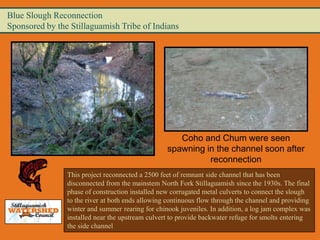
                                                     Coho and Chum were seen
                                                  spawning in the channel soon after
                                                            reconnection
                This project reconnected a 2500 feet of remnant side channel that has been
                disconnected from the mainstem North Fork Stillaguamish since the 1930s. The final
                phase of construction installed new corrugated metal culverts to connect the slough
                to the river at both ends allowing continuous flow through the channel and providing
                winter and summer rearing for chinook juveniles. In addition, a log jam complex was
                installed near the upstream culvert to provide backwater refuge for smolts entering
                the side channel
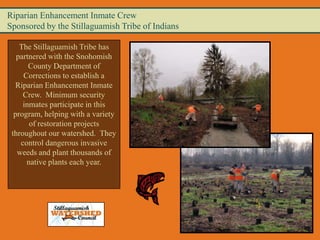
Riparian Enhancement Inmate Crew
Sponsored by the Stillaguamish Tribe of Indians

    The Stillaguamish Tribe has
   partnered with the Snohomish
       County Department of
     Corrections to establish a
  Riparian Enhancement Inmate
     Crew. Minimum security
     inmates participate in this
  program, helping with a variety
       of restoration projects
 throughout our watershed. They
    control dangerous invasive
   weeds and plant thousands of
      native plants each year.
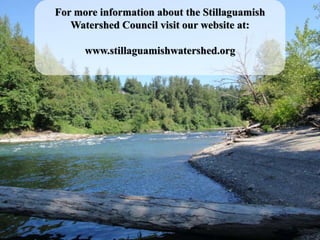
For more information about the Stillaguamish
   Watershed Council visit our website at:

      www.stillaguamishwatershed.org

SWC2012Projects-Stillaguamish Tribe

  • 1.
    www.stillaguamishwatershed.org Dedicated torestoring and maintaining a healthy Stillaguamish River Watershed since 1990
  • 2.
    The mission ofthe Stillaguamish Watershed Council (SWC) is to maintain a healthy, functioning Stillaguamish Watershed by providing a local forum in which agencies, organizations, communities, and the public can engage in a collaborative watershed based process of decision making and coordination. This slideshow highlights the work of the SWC www.stillaguamishwatershed.org
  • 3.
    Cherokee Creek FishPassage Restoration Sponsored by Stillaguamish Tribe of Indians The Stillaguamish Tribe, in conjunction with the Family Forest Fish Passage Program, replaced a culvert that was blocking fish passage on Cherokee Creek with a new bridge. As a result approximately 1 mile of new habitat is now accessible to all species of Pacific salmon and trout. Project Location
  • 4.
    Cherokee Creek FishPassage Restoration Sponsored by Stillaguamish Tribe of Indians Before: This culvert was Bridge After preventing fish from swimming upstream. The Stillaguamish Tribe, in conjunction with the Family Forest Fish Passage Program, replaced a culvert that was blocking fish passage on Cherokee Creek with a new bridge. During
  • 5.
    Jim Creek BankRestoration Sponsored by the Stillaguamish Tribe of Indians The Stillaguamish Tribe of Indians sponsored a riparian restoration project on Jim Creek that involved stabilizing a bank with natural logs and slash, planting a buffer with native vegetation and installing fencing that keeps livestock out of the creek. As a result, the water in Jim Creek downstream will be clearer, cleaner, and more friendly for fish. Location
  • 6.
    Jim Creek BankRestoration Sponsored by the Stillaguamish Tribe of Indians Bank Before Bank After The Stillaguamish Tribe of Indians sponsored a riparian restoration project on Jim Creek. As a result, the water downstream will be clearer, cleaner, and more friendly for fish. Bank During
  • 7.
    South Fork RiparianRestoration Sponsored by the Stillaguamish Tribe of Indians The Stillaguamish Tribe of Indians purchased and planted nearly 60 acres on the South Fork Stillaguamish, across from the mouth of Jim Creek. Location
  • 8.
    South Fork RiparianRestoration Sponsored by the Stillaguamish Tribe of Indians The Stillaguamish Tribe of Indians purchased and planted nearly 60 acres on the South Fork Floodplain Stillaguamish, across Forest Buffer Enhancement from the mouth of Jim Creek. Bank Armor Mouth of Jim Removed Creek S. Fork Stillaguamish River. Flows left to right in image Restoration Overview
  • 9.
    South Fork RiparianRestoration Sponsored by the Stillaguamish Tribe of Indians The Stillaguamish Tribe of Indians purchased and planted nearly 60 acres on the South Fork Stillaguamish, across from the mouth of Jim Creek. Local school children helped plant native trees and shrubs, including a meadow and apple orchard for deer habitat. Each blue pipe is a native tree or shrub planted as part of the project. Local Students Planting
  • 10.
    North Fork RiparianRestoration Sponsored by the Stillaguamish Tribe of Indians The Stillaguamish Tribe of Indians, in conjunction with Forterra, purchased and restored about 35 acres on the North Fork Stillaguamish. Dilapidated structures were demolished and removed, and a riparian buffer was planted with native vegetation. The Tribe has plans to install engineered log jams at this Location site in the future.
  • 11.
    North Fork RiparianRestoration Sponsored by the Stillaguamish Tribe of Indians Property Before Property Today The Stillaguamish Tribe of Indians, in conjunction with Forterra, purchased and restored about 35 acres on the North Fork Stillaguamish. Dilapidated structures were demolished and removed, and a riparian buffer was planted with native vegetation. The Tribe has plans to install engineered log jams at this site in the future.
  • 12.
    North Fork RiparianRestoration Sponsored by the Stillaguamish Tribe of Indians The Stillaguamish Tribe of Indians, in conjunction with Forterra, purchased and restored about 35 acres on the North Fork Stillaguamish. Dilapidated structures were demolished and removed, and a riparian buffer was planted with native vegetation. The Tribe has plans to install engineered log jams at this site in the Before future.
  • 13.
    Blue Slough Reconnection Sponsoredby the Stillaguamish Tribe of Indians This project reconnected 2500 feet of remnant side channel that has been disconnected from the mainstem North Fork Stillaguamish since the 1930s. This project removed a 2-3 foot layer of "muck" and enough bed material to put the channel at the elevation of the river. The final phase of construction installed new corrugated metal culverts to connect the slough to the river at both ends allowing continuous flow through the channel. Location
  • 14.
    Blue Slough Reconnection Sponsoredby the Stillaguamish Tribe of Indians This project reconnected 2500 feet of remnant side 1,200 ft of improved channel that has been channel disconnected from the 9-ft culvert mainstem North Fork 6-ft culvert Stillaguamish since the 1930s. This project Upper pond removed a 2-3 foot layer Lower pond ~1.27 acres of "muck" and enough bed ~3.65 acres material to put the channel 1,030 ft at the elevation of the channel river. The final phase of construction installed new corrugated metal culverts to connect the slough to the river at both ends allowing continuous flow Project Site Plan through the channel.
  • 15.
    Blue Slough Reconnection Sponsoredby the Stillaguamish Tribe of Indians This project reconnected a 2500 feet of remnant side channel that has been disconnected from the mainstem North Fork Stillaguamish since the 1930s. The final phase of construction installed new corrugated metal culverts to connect the slough to the river at both ends allowing continuous flow through the channel and providing winter and summer rearing for chinook juveniles. In addition, a log jam complex was installed near the upstream culvert to provide backwater refuge for smolts entering the side channel
  • 16.
    Blue Slough Reconnection Sponsoredby the Stillaguamish Tribe of Indians Coho and Chum were seen spawning in the channel soon after reconnection This project reconnected a 2500 feet of remnant side channel that has been disconnected from the mainstem North Fork Stillaguamish since the 1930s. The final phase of construction installed new corrugated metal culverts to connect the slough to the river at both ends allowing continuous flow through the channel and providing winter and summer rearing for chinook juveniles. In addition, a log jam complex was installed near the upstream culvert to provide backwater refuge for smolts entering the side channel
  • 17.
    Riparian Enhancement InmateCrew Sponsored by the Stillaguamish Tribe of Indians The Stillaguamish Tribe has partnered with the Snohomish County Department of Corrections to establish a Riparian Enhancement Inmate Crew. Minimum security inmates participate in this program, helping with a variety of restoration projects throughout our watershed. They control dangerous invasive weeds and plant thousands of native plants each year.
  • 18.
    For more informationabout the Stillaguamish Watershed Council visit our website at: www.stillaguamishwatershed.org

Editor's Notes

  • #4 Needs blurb and fffpp logo
  • #5 Same as 12
  • #6 Needs blurb and sponsor and logo
  • #7 As 14
  • #8 Needs blurb and sponsor and logo
  • #9 Same as 16
  • #10 Same as 16
  • #11 Needs location map. And blurb and sponsor and logo
  • #12 Needs property today photo and blurb and sponsor and logo
  • #14 Needs location map. And blurb and sponsor and logo
  • #15 Needs location map. And blurb and sponsor and logo
  • #16 Needs property today photo and blurb and sponsor and logo
  • #17 Needs property today photo and blurb and sponsor and logo
  • #18 Needs a review of the blurb and logo—snoco?