1
Review Presentation of the Research Work to be submitted in
Partial Fulfillment of the Requirement for the degree
Doctor of Philosophy
In
COMPUTER SCIENCE AND ENGINEERING
By
Swati Jain
(REG. No: 2020-0107-007)
Department of Computer Science and Engineering
College of Technology and Engineering
Maharana Pratap University of Agriculture and Technology
Udaipur -313 001 (Rajasthan)
2
Unsupervised Anomaly Detection
On Multivariate Time Series Stock
Based Data Using Deep Learning
Under the Guidance of
Dr. Naveen Choudhary-: Major Advisor
Dr. Sunil Joshi-Member Advisor
Dr. Jai Kumar Maherchandani- Member Advisor
Dr. Trilok Gupta- Member Advisor
Dr. Mahendra Singh Khidiya- DRI Nominee
3
Outline
1. Introduction
2. Objective
3. Proposed Methodology
4. Implementation Platform
5. Conclusion and Present status of Work
6. References
4
Introduction
• Anomaly detection (also outlier detection) is the identification of rare items, events or
observations which raise suspicions by differing significantly from the majority of the
data. Typically the anomalous items will translate to some kind of problem such as bank
fraud, a structural defect, medical problems or errors in a text.
• The detection of outliers is a challenging task that can reveal system faults, fraud, and
save people’s lives. The main challenge in outlier detection relates to modelling the
normal behaviour in order to identify abnormalities.
• Outlier detection is largely an unsupervised problem, In this we study a deep learning
techniques to build data-driven and domain oriented outlier detection models.
• There are several factors such as the nature of the input data, availability of the labeled
data together with the constraints, and the requirements of the outlier detection problem.
• An Anomaly Detection Model using Deep Learning techniques. Specifically, designing
and training an LSTM to detect anomalies.
5
 An Autoencoder is a type of artificial neural network used to learn efficient data coding
in an unsupervised manner.
 Long short-term memory is an artificial recurrent neural network architecture used in the
field of deep learning. LSTM is capable of learning long term dependency and
remembering the information of long period. LSTM has different type of layers for the
processing.
 The autoencoder is trained to reconstruct data with normal pattern (e.g., normal time
series) by minimizing a loss function that measures the quality of the reconstructions.
After training, the model can now reconstruct the normal data well enough with minimal
reconstruction error.
 LSTM Autoencoder simply because our time series data is a sequential data and LSTM
captures the temporal dependencies of the data by introducing memory. Specifically,
LSTM has the ability to capture long term temporal interactions and correlations between
variables in the input sequence which is highly required in this scenario since this
relationship are time dependent and they determine the state of the machine.
 Generative adversarial nets (GAN) is powerful class of neural network used for
unsupervised learning. GAN, system of two NN. Competing against each other in a zero
game framework.
6
Research Gap
An anomaly detection system is quite difficult and tedious to design manually. Data
generation, storing, and processing are dynamic processes that require a continuous approach
as a whole, then there’s also the need to predict potential issues and find ways around them
only to implement algorithms.
Limitations of Long Short Term Memory Anomaly Detection (LSTMAD) deep leaning
approach is that the current version is prominently used for univariate time series data and in
some approach used for multivariate sequences. Bias also exists in the selection of public data
because anomalies in periodic sequences are often more easily detected or enough evidence is
still lacking to mathematically prove that the structure of current LSTM network is optimal.
In deep anomaly detection aims at learning feature representations or anomaly scores via
neural networks for the sake of anomaly detection. In recent years, a large number of deep
anomaly detection methods have been introduced, demonstrating significantly better
performance than conventional anomaly detection on addressing challenging detection
problems in a variety of real-world applications. We systematically review the current deep
anomaly detection methods and their capabilities in addressing the aforementioned
challenges.To have a thorough understanding of the area, proposed work introduces a outlier
detection method on time series data with the help of deep anomaly detection methods like
Lstm,Gan,Van,autoencoder. etc.
7
Objectives
Therefore, the main objectives of the proposed work are:
1. Study and Analyze various machine learning methodology for outlier detection in
time series data with their pros and cons.
2. Propose a novel methodology based on deep learning for outlier detection in
stock related multivariate time series data.
3. Propose a novel methodology for filling missing value in multivariate time series
Stock data.
4. Analyze and validate the performance of the proposed methodologies in
comparison to the popular existing techniques of detecting outliers in multivariate
time series stock data with performance matrix such as accuracy, mean square error,
reconstruction error, Loss function etc.
8
Proposed Research
Methodology
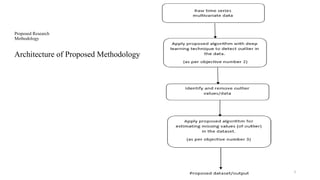
Architecture of Proposed Methodology
9
Working of Proposed Methodology
• In our proposed work, an Unsupervised Anomaly Detection(USAD) for multivariate time
series method based on autoencoder and trained within an adversarial training inspired by the
deep learning networks.
The proposed work is defining in following steps which are as follows:
STEP 1: Data Gathering-A time series is a sequence of data points that occur in successive
order over some period of time. The time series data of the multivariate dataset, Multiple
variables are varying over time, is acquired from the appropriate data sources (kaggle,UCI
repository etc.) and data sets are formed.
STEP 2: Data Selection- after acquiring the data, remove noise and data is processed. A time
series whose statistical properties, such as mean, variance, etc., remain constant over time, are
stationary time series data which will be used further. Proposed plan will use TensorFlow,
NumPy, pandas, matplotlib, seaborn and plotly libraries from python and read the dataset which
is CSV file format, now read csv file where we have imported pandas library of python as pd,
uses time series data to either better understand the data set and check multivariate data set for
further processing.
STEP 3: Data preprocessing and data cleaning- Data preprocessing is a very important task
in any data mining process, the proposed work uses the data and train our model on it also
rescale the data using the training data and apply the same transformation to the test data.
10
STEP 4: Build an Autoencoder:. Our plan can create sequences with a specific time step, after
Create Training and Test Splits, we build an LSTM Autoencoder network and visualize the
architecture and data flow to detect anomalies using an autoencoder. For that, first, our work is need
to train the data with no anomalies and then take the new data point and try to reconstruct that using
an autoencoder. If the reconstruction error for the new dataset is above some threshold, we are going
to label that example/data point as an anomaly. Time Distributed function creates a dense layer with
number of nodes equal to the number of features. And the model is compiled finally using adam
optimizer function which is gradient descent optimizer.
STEP 5: Feature extraction: The dataset on the basis of the factors and choosing a model to detect
outliers and visualize the architecture and data flow, detect anomalies using the help of deep learning
techniques like Lstm , Gan, Autoencoder, Van etc. and process a novel algorithm for filling missing
values which were outliers in previous multivariate time series Stock data and at last process
estimated value for missing data in our proposed work.
Step 6: Interpretation- for the analysis of the result plot the matrix (evaluation matrix) that is
training loss and validation loss. In our plot, validation loss is consistently found to be lower than
training loss that means the training data due to the high dropout value used So we can change the
hyper parameters to optimize the model. Also need to still predict the anomaly in our test data by
calculating the mean absolute error on the training data. First get prediction on our training data and
then evaluate the model on our test data. The final result will be predicted i.e. which will detect
outlier occurring in the particular dataset taken as the input of the model and predict missing value in
further process with better accuracy.
11
Implementation Platform
The proposed work uses Python libraries in our proposed plan implementation.
For the Data implementation scikit- learn, tensor flow and keras are used.
For the Data visualization metplotlib, seaborn, plotly and Ggplot libraries are used.
For the Data manipulation and analysis pandas, numpy, scipy and various other libraries will
be used, Google Colabs and various tools are used for analysis.
Result of the study will be examined on the various stages with various tools. The tools are
applied both mathematically and with the help of Software package.
Data source- our proposed work will collect the data from kaggle and UCI repository.
Performance matrix- The different measurements of central tendency and measures of
dispersion are used here such as Confusion matrix, root mean square error, accuracy, f1 score,
loss function, reconstruction error, coefficient of variation etc.
Existing facilities: The well equipped computer systems in PG Lab with internet facility and
licensed software tools and numerous books available in library available with the computer
science and engineering department will be adequate to conduct the above research work.
12
Conclusion and present Status of work
• The detection of outliers is a challenging task that can reveal system faults, fraud, and save
people’s lives. Outlier detection is largely an unsupervised problem, In this we study a deep
learning techniques to build data-driven and domain oriented outlier detection models. An
Anomaly(outlier) Detection Model using Deep Learning, Specifically, designing and training an
LSTM to detect anomalies. The autoencoder is trained to reconstruct data with normal pattern
(e.g., normal time series) by minimizing a loss function that measures the quality of the
reconstructions.. First get prediction on our training data and then evaluate the model on our test
data. The final result will be predicted i.e. which will detect outlier occurring in the particular
dataset taken as the input of the model and predict missing value in further process with better
accuracy.
•Present Status of Work :
• Publications : writing papers in process for international Conference and Springer International
Conference
• Present status of Work :
The stock data is gathered, first the data is analyzed manually to understand
13
Conclusion and present Status of work
• Present status of Work (continued) :
the each attribute and generate the target column, then the data is preprocessed for
missing , outlier values.
•Future targets:
The proposed framework , implementation is in progress.
Two to three publication in reputed journals of NAAS rating / Scopus Indexed / Web of
Science/ UGC CARE by November 2022
Thesis writing to be completed tentatively by January 2023.
14
Proposed Plan of Work
15
References
 López-Oriona, Á., & Vilar, J. A. (2021). Outlier detection for multivariate time series: A
functional data approach. Knowledge-Based Systems, 233, 107527.
Wang, X., Wang, X., & Wilkes, M. (2021). Unsupervised fraud detection in environmental time
series data. In New Developments in Unsupervised Outlier Detection (pp. 257-277). Springer,
Singapore.
Malhotra, P., Ramakrishnan, A., Anand, G., Vig, L., Agarwal, P., & Shroff, G. (2016). LSTM-
based encoder-decoder for multi-sensor anomaly detection. arXiv preprint arXiv:1607.00148.
Pang, G., Shen, C., Cao, L., & Hengel, A. V. D. (2021). Deep learning for anomaly detection: A
review. ACM Computing Surveys (CSUR), 54(2), 1-38.
Singh, Gurjeet. "Machine Learning Models in Stock Market Prediction." arXiv preprint
arXiv:2202.09359 (2022).
Said Elsayed, M., Le-Khac, N. A., Dev, S., & Jurcut, A. D. (2020, November). Network anomaly
detection using LSTM based autoencoder. In Proceedings of the 16th ACM Symposium on QoS
and Security for Wireless and Mobile Networks (pp. 37-45).
Ji, Z., Gong, J., & Feng, J. (2021). A Novel Deep Learning Approach for Anomaly Detection of
Time Series Data. Scientific Programming, 2021.
16
 Al-amri, R., Murugesan, R. K., Man, M., Abdulateef, A. F., Al-Sharafi, M. A., & Alkahtani, A. A.
(2021). A review of machine learning and deep learning techniques for anomaly detection in IoT
data. Applied Sciences, 11(12), 5320.
 Emmanuel, T., Maupong, T., Mpoeleng, D., Semong, T., Mphago, B., & Tabona, O. (2021). A
survey on missing data in machine learning. Journal of Big Data, 8(1), 1-37.
 Samara, M. A., Bennis, I., Abouaissa, A., & Lorenz, P. (2022). A Survey of Outlier Detection
Techniques in IoT: Review and Classification. Journal of Sensor and Actuator Networks, 11(1), 4.
 Nassif, A. B., Talib, M. A., Nasir, Q., & Dakalbab, F. M. (2021). Machine learning for anomaly
detection: a systematic review. IEEE Access.
 Thudumu, S., Branch, P., Jin, J., & Singh, J. J. (2020). A comprehensive survey of anomaly
detection techniques for high dimensional big data. Journal of Big Data, 7(1), 1-30.
 Ghimire, S., Deo, R. C., Wang, H., Al-Musaylh, M. S., Casillas-Pérez, D., & Salcedo-Sanz, S.
(2022). Stacked LSTM Sequence-to-Sequence Autoencoder with Feature Selection for Daily
Solar Radiation Prediction: A Review and New Modeling Results. Energies, 15(3), 1061.
 Ji, Z., Gong, J., & Feng, J. (2021). A Novel Deep Learning Approach for Anomaly Detection of
Time Series Data. Scientific Programming, 2021.
 Aggarwal, K., Mijwil, M. M., Al-Mistarehi, A. H., Alomari, S., Gök, M., Alaabdin, A. M. Z., &
Abdulrhman, S. H. (2022). Has the Future Started? The Current Growth of Artificial Intelligence,
Machine Learning, and Deep Learning. Iraqi Journal For Computer Science and
Mathematics, 3(1), 115-123.
17
Panjei, E., Gruenwald, L., Leal, E., Nguyen, C., & Silvia, S. (2022). A survey on outlier
explanations. The VLDB Journal, 1-32.
Said Elsayed, M., Le-Khac, N. A., Dev, S., & Jurcut, A. D. (2020, November). Network anomaly
detection using LSTM based autoencoder. In Proceedings of the 16th ACM Symposium on QoS
and Security for Wireless and Mobile Networks (pp. 37-45).
 Park, Y. J., Fan, S. K. S., & Hsu, C. Y. (2020). A review on fault detection and process diagnostics
in industrial processes. Processes, 8(9), 1123.
Ordóñez, P. (2008). Visualizing multivariate time series data to detect specific medical conditions.
In AMIA Annual Symposium Proceedings (Vol. 2008, p. 530). American Medical Informatics
Association.
Yadav, K., Yadav, M., & Saini, S. (2022). Stock values predictions using deep learning based
hybrid models. CAAI Transactions on Intelligence Technology, 7(1), 107-116.
Essien, A., & Giannetti, C. (2019, July). A deep learning framework for univariate time series
prediction using convolutional LSTM stacked autoencoders. In 2019 IEEE International
Symposium on INnovations in Intelligent SysTems and Applications (INISTA) (pp. 1-6). IEEE.
Grzymala-Busse, J. W., & Hu, M. (2000, October). A comparison of several approaches to missing
attribute values in data mining. In International Conference on Rough Sets and Current Trends in
Computing (pp. 378-385). Springer, Berlin, Heidelberg.
18
 Grzymala-Busse, J. W., Goodwin, L. K., Grzymala-Busse, W. J., & Zheng, X. (2005, August). Handling
missing attribute values in preterm birth data sets. In International Workshop on Rough Sets, Fuzzy Sets,
Data Mining, and Granular-Soft Computing (pp. 342-351). Springer, Berlin, Heidelberg.
 Gong, Y., Li, Z., Zhang, J., Liu, W., Yin, Y., & Zheng, Y. (2021). Missing value imputation for multi-view
urban statistical data via spatial correlation learning. IEEE Transactions on Knowledge and Data Engineering
 Song, Q., Lin, P., Ma, H., & Wu, Y. (2021, April). Explaining Missing Data in Graphs: A Constraint-
based Approach. In 2021 IEEE 37th International Conference on Data Engineering (ICDE) (pp. 1476-
1487). IEEE.
 Noor, M. N., Yahaya, A. S., Ramli, N. A., & Al Bakri, A. M. M. (2014). Mean imputation techniques for
filling the missing observations in air pollution dataset (Vol. 594, pp. 902-908). Trans Tech Publications
Ltd.
 Khan, S. I., & Hoque, A. S. M. L. (2020). SICE: an improved missing data imputation technique. Journal
of big Data, 7(1), 1-21.
 Li, D., Zhang, H., Li, T., Bouras, A., Yu, X., & Wang, T. (2021). Hybrid missing value imputation
algorithms using fuzzy c-means and vaguely quantified rough set. IEEE Transactions on Fuzzy Systems.
 Farhangfar, A., Kurgan, L. A., & Pedrycz, W. (2007). A novel framework for imputation of missing
values in databases. IEEE Transactions on Systems, Man, and Cybernetics-Part A: Systems and
Humans, 37(5), 692-709.
THANKS
19

swatiVCprsentation artificial learning and machine learning.pptx

  • 1.
    1 Review Presentation ofthe Research Work to be submitted in Partial Fulfillment of the Requirement for the degree Doctor of Philosophy In COMPUTER SCIENCE AND ENGINEERING By Swati Jain (REG. No: 2020-0107-007) Department of Computer Science and Engineering College of Technology and Engineering Maharana Pratap University of Agriculture and Technology Udaipur -313 001 (Rajasthan)
  • 2.
    2 Unsupervised Anomaly Detection OnMultivariate Time Series Stock Based Data Using Deep Learning Under the Guidance of Dr. Naveen Choudhary-: Major Advisor Dr. Sunil Joshi-Member Advisor Dr. Jai Kumar Maherchandani- Member Advisor Dr. Trilok Gupta- Member Advisor Dr. Mahendra Singh Khidiya- DRI Nominee
  • 3.
    3 Outline 1. Introduction 2. Objective 3.Proposed Methodology 4. Implementation Platform 5. Conclusion and Present status of Work 6. References
  • 4.
    4 Introduction • Anomaly detection(also outlier detection) is the identification of rare items, events or observations which raise suspicions by differing significantly from the majority of the data. Typically the anomalous items will translate to some kind of problem such as bank fraud, a structural defect, medical problems or errors in a text. • The detection of outliers is a challenging task that can reveal system faults, fraud, and save people’s lives. The main challenge in outlier detection relates to modelling the normal behaviour in order to identify abnormalities. • Outlier detection is largely an unsupervised problem, In this we study a deep learning techniques to build data-driven and domain oriented outlier detection models. • There are several factors such as the nature of the input data, availability of the labeled data together with the constraints, and the requirements of the outlier detection problem. • An Anomaly Detection Model using Deep Learning techniques. Specifically, designing and training an LSTM to detect anomalies.
  • 5.
    5  An Autoencoderis a type of artificial neural network used to learn efficient data coding in an unsupervised manner.  Long short-term memory is an artificial recurrent neural network architecture used in the field of deep learning. LSTM is capable of learning long term dependency and remembering the information of long period. LSTM has different type of layers for the processing.  The autoencoder is trained to reconstruct data with normal pattern (e.g., normal time series) by minimizing a loss function that measures the quality of the reconstructions. After training, the model can now reconstruct the normal data well enough with minimal reconstruction error.  LSTM Autoencoder simply because our time series data is a sequential data and LSTM captures the temporal dependencies of the data by introducing memory. Specifically, LSTM has the ability to capture long term temporal interactions and correlations between variables in the input sequence which is highly required in this scenario since this relationship are time dependent and they determine the state of the machine.  Generative adversarial nets (GAN) is powerful class of neural network used for unsupervised learning. GAN, system of two NN. Competing against each other in a zero game framework.
  • 6.
    6 Research Gap An anomalydetection system is quite difficult and tedious to design manually. Data generation, storing, and processing are dynamic processes that require a continuous approach as a whole, then there’s also the need to predict potential issues and find ways around them only to implement algorithms. Limitations of Long Short Term Memory Anomaly Detection (LSTMAD) deep leaning approach is that the current version is prominently used for univariate time series data and in some approach used for multivariate sequences. Bias also exists in the selection of public data because anomalies in periodic sequences are often more easily detected or enough evidence is still lacking to mathematically prove that the structure of current LSTM network is optimal. In deep anomaly detection aims at learning feature representations or anomaly scores via neural networks for the sake of anomaly detection. In recent years, a large number of deep anomaly detection methods have been introduced, demonstrating significantly better performance than conventional anomaly detection on addressing challenging detection problems in a variety of real-world applications. We systematically review the current deep anomaly detection methods and their capabilities in addressing the aforementioned challenges.To have a thorough understanding of the area, proposed work introduces a outlier detection method on time series data with the help of deep anomaly detection methods like Lstm,Gan,Van,autoencoder. etc.
  • 7.
    7 Objectives Therefore, the mainobjectives of the proposed work are: 1. Study and Analyze various machine learning methodology for outlier detection in time series data with their pros and cons. 2. Propose a novel methodology based on deep learning for outlier detection in stock related multivariate time series data. 3. Propose a novel methodology for filling missing value in multivariate time series Stock data. 4. Analyze and validate the performance of the proposed methodologies in comparison to the popular existing techniques of detecting outliers in multivariate time series stock data with performance matrix such as accuracy, mean square error, reconstruction error, Loss function etc.
  • 8.
  • 9.
    9 Working of ProposedMethodology • In our proposed work, an Unsupervised Anomaly Detection(USAD) for multivariate time series method based on autoencoder and trained within an adversarial training inspired by the deep learning networks. The proposed work is defining in following steps which are as follows: STEP 1: Data Gathering-A time series is a sequence of data points that occur in successive order over some period of time. The time series data of the multivariate dataset, Multiple variables are varying over time, is acquired from the appropriate data sources (kaggle,UCI repository etc.) and data sets are formed. STEP 2: Data Selection- after acquiring the data, remove noise and data is processed. A time series whose statistical properties, such as mean, variance, etc., remain constant over time, are stationary time series data which will be used further. Proposed plan will use TensorFlow, NumPy, pandas, matplotlib, seaborn and plotly libraries from python and read the dataset which is CSV file format, now read csv file where we have imported pandas library of python as pd, uses time series data to either better understand the data set and check multivariate data set for further processing. STEP 3: Data preprocessing and data cleaning- Data preprocessing is a very important task in any data mining process, the proposed work uses the data and train our model on it also rescale the data using the training data and apply the same transformation to the test data.
  • 10.
    10 STEP 4: Buildan Autoencoder:. Our plan can create sequences with a specific time step, after Create Training and Test Splits, we build an LSTM Autoencoder network and visualize the architecture and data flow to detect anomalies using an autoencoder. For that, first, our work is need to train the data with no anomalies and then take the new data point and try to reconstruct that using an autoencoder. If the reconstruction error for the new dataset is above some threshold, we are going to label that example/data point as an anomaly. Time Distributed function creates a dense layer with number of nodes equal to the number of features. And the model is compiled finally using adam optimizer function which is gradient descent optimizer. STEP 5: Feature extraction: The dataset on the basis of the factors and choosing a model to detect outliers and visualize the architecture and data flow, detect anomalies using the help of deep learning techniques like Lstm , Gan, Autoencoder, Van etc. and process a novel algorithm for filling missing values which were outliers in previous multivariate time series Stock data and at last process estimated value for missing data in our proposed work. Step 6: Interpretation- for the analysis of the result plot the matrix (evaluation matrix) that is training loss and validation loss. In our plot, validation loss is consistently found to be lower than training loss that means the training data due to the high dropout value used So we can change the hyper parameters to optimize the model. Also need to still predict the anomaly in our test data by calculating the mean absolute error on the training data. First get prediction on our training data and then evaluate the model on our test data. The final result will be predicted i.e. which will detect outlier occurring in the particular dataset taken as the input of the model and predict missing value in further process with better accuracy.
  • 11.
    11 Implementation Platform The proposedwork uses Python libraries in our proposed plan implementation. For the Data implementation scikit- learn, tensor flow and keras are used. For the Data visualization metplotlib, seaborn, plotly and Ggplot libraries are used. For the Data manipulation and analysis pandas, numpy, scipy and various other libraries will be used, Google Colabs and various tools are used for analysis. Result of the study will be examined on the various stages with various tools. The tools are applied both mathematically and with the help of Software package. Data source- our proposed work will collect the data from kaggle and UCI repository. Performance matrix- The different measurements of central tendency and measures of dispersion are used here such as Confusion matrix, root mean square error, accuracy, f1 score, loss function, reconstruction error, coefficient of variation etc. Existing facilities: The well equipped computer systems in PG Lab with internet facility and licensed software tools and numerous books available in library available with the computer science and engineering department will be adequate to conduct the above research work.
  • 12.
    12 Conclusion and presentStatus of work • The detection of outliers is a challenging task that can reveal system faults, fraud, and save people’s lives. Outlier detection is largely an unsupervised problem, In this we study a deep learning techniques to build data-driven and domain oriented outlier detection models. An Anomaly(outlier) Detection Model using Deep Learning, Specifically, designing and training an LSTM to detect anomalies. The autoencoder is trained to reconstruct data with normal pattern (e.g., normal time series) by minimizing a loss function that measures the quality of the reconstructions.. First get prediction on our training data and then evaluate the model on our test data. The final result will be predicted i.e. which will detect outlier occurring in the particular dataset taken as the input of the model and predict missing value in further process with better accuracy. •Present Status of Work : • Publications : writing papers in process for international Conference and Springer International Conference • Present status of Work : The stock data is gathered, first the data is analyzed manually to understand
  • 13.
    13 Conclusion and presentStatus of work • Present status of Work (continued) : the each attribute and generate the target column, then the data is preprocessed for missing , outlier values. •Future targets: The proposed framework , implementation is in progress. Two to three publication in reputed journals of NAAS rating / Scopus Indexed / Web of Science/ UGC CARE by November 2022 Thesis writing to be completed tentatively by January 2023.
  • 14.
  • 15.
    15 References  López-Oriona, Á.,& Vilar, J. A. (2021). Outlier detection for multivariate time series: A functional data approach. Knowledge-Based Systems, 233, 107527. Wang, X., Wang, X., & Wilkes, M. (2021). Unsupervised fraud detection in environmental time series data. In New Developments in Unsupervised Outlier Detection (pp. 257-277). Springer, Singapore. Malhotra, P., Ramakrishnan, A., Anand, G., Vig, L., Agarwal, P., & Shroff, G. (2016). LSTM- based encoder-decoder for multi-sensor anomaly detection. arXiv preprint arXiv:1607.00148. Pang, G., Shen, C., Cao, L., & Hengel, A. V. D. (2021). Deep learning for anomaly detection: A review. ACM Computing Surveys (CSUR), 54(2), 1-38. Singh, Gurjeet. "Machine Learning Models in Stock Market Prediction." arXiv preprint arXiv:2202.09359 (2022). Said Elsayed, M., Le-Khac, N. A., Dev, S., & Jurcut, A. D. (2020, November). Network anomaly detection using LSTM based autoencoder. In Proceedings of the 16th ACM Symposium on QoS and Security for Wireless and Mobile Networks (pp. 37-45). Ji, Z., Gong, J., & Feng, J. (2021). A Novel Deep Learning Approach for Anomaly Detection of Time Series Data. Scientific Programming, 2021.
  • 16.
    16  Al-amri, R.,Murugesan, R. K., Man, M., Abdulateef, A. F., Al-Sharafi, M. A., & Alkahtani, A. A. (2021). A review of machine learning and deep learning techniques for anomaly detection in IoT data. Applied Sciences, 11(12), 5320.  Emmanuel, T., Maupong, T., Mpoeleng, D., Semong, T., Mphago, B., & Tabona, O. (2021). A survey on missing data in machine learning. Journal of Big Data, 8(1), 1-37.  Samara, M. A., Bennis, I., Abouaissa, A., & Lorenz, P. (2022). A Survey of Outlier Detection Techniques in IoT: Review and Classification. Journal of Sensor and Actuator Networks, 11(1), 4.  Nassif, A. B., Talib, M. A., Nasir, Q., & Dakalbab, F. M. (2021). Machine learning for anomaly detection: a systematic review. IEEE Access.  Thudumu, S., Branch, P., Jin, J., & Singh, J. J. (2020). A comprehensive survey of anomaly detection techniques for high dimensional big data. Journal of Big Data, 7(1), 1-30.  Ghimire, S., Deo, R. C., Wang, H., Al-Musaylh, M. S., Casillas-Pérez, D., & Salcedo-Sanz, S. (2022). Stacked LSTM Sequence-to-Sequence Autoencoder with Feature Selection for Daily Solar Radiation Prediction: A Review and New Modeling Results. Energies, 15(3), 1061.  Ji, Z., Gong, J., & Feng, J. (2021). A Novel Deep Learning Approach for Anomaly Detection of Time Series Data. Scientific Programming, 2021.  Aggarwal, K., Mijwil, M. M., Al-Mistarehi, A. H., Alomari, S., Gök, M., Alaabdin, A. M. Z., & Abdulrhman, S. H. (2022). Has the Future Started? The Current Growth of Artificial Intelligence, Machine Learning, and Deep Learning. Iraqi Journal For Computer Science and Mathematics, 3(1), 115-123.
  • 17.
    17 Panjei, E., Gruenwald,L., Leal, E., Nguyen, C., & Silvia, S. (2022). A survey on outlier explanations. The VLDB Journal, 1-32. Said Elsayed, M., Le-Khac, N. A., Dev, S., & Jurcut, A. D. (2020, November). Network anomaly detection using LSTM based autoencoder. In Proceedings of the 16th ACM Symposium on QoS and Security for Wireless and Mobile Networks (pp. 37-45).  Park, Y. J., Fan, S. K. S., & Hsu, C. Y. (2020). A review on fault detection and process diagnostics in industrial processes. Processes, 8(9), 1123. Ordóñez, P. (2008). Visualizing multivariate time series data to detect specific medical conditions. In AMIA Annual Symposium Proceedings (Vol. 2008, p. 530). American Medical Informatics Association. Yadav, K., Yadav, M., & Saini, S. (2022). Stock values predictions using deep learning based hybrid models. CAAI Transactions on Intelligence Technology, 7(1), 107-116. Essien, A., & Giannetti, C. (2019, July). A deep learning framework for univariate time series prediction using convolutional LSTM stacked autoencoders. In 2019 IEEE International Symposium on INnovations in Intelligent SysTems and Applications (INISTA) (pp. 1-6). IEEE. Grzymala-Busse, J. W., & Hu, M. (2000, October). A comparison of several approaches to missing attribute values in data mining. In International Conference on Rough Sets and Current Trends in Computing (pp. 378-385). Springer, Berlin, Heidelberg.
  • 18.
    18  Grzymala-Busse, J.W., Goodwin, L. K., Grzymala-Busse, W. J., & Zheng, X. (2005, August). Handling missing attribute values in preterm birth data sets. In International Workshop on Rough Sets, Fuzzy Sets, Data Mining, and Granular-Soft Computing (pp. 342-351). Springer, Berlin, Heidelberg.  Gong, Y., Li, Z., Zhang, J., Liu, W., Yin, Y., & Zheng, Y. (2021). Missing value imputation for multi-view urban statistical data via spatial correlation learning. IEEE Transactions on Knowledge and Data Engineering  Song, Q., Lin, P., Ma, H., & Wu, Y. (2021, April). Explaining Missing Data in Graphs: A Constraint- based Approach. In 2021 IEEE 37th International Conference on Data Engineering (ICDE) (pp. 1476- 1487). IEEE.  Noor, M. N., Yahaya, A. S., Ramli, N. A., & Al Bakri, A. M. M. (2014). Mean imputation techniques for filling the missing observations in air pollution dataset (Vol. 594, pp. 902-908). Trans Tech Publications Ltd.  Khan, S. I., & Hoque, A. S. M. L. (2020). SICE: an improved missing data imputation technique. Journal of big Data, 7(1), 1-21.  Li, D., Zhang, H., Li, T., Bouras, A., Yu, X., & Wang, T. (2021). Hybrid missing value imputation algorithms using fuzzy c-means and vaguely quantified rough set. IEEE Transactions on Fuzzy Systems.  Farhangfar, A., Kurgan, L. A., & Pedrycz, W. (2007). A novel framework for imputation of missing values in databases. IEEE Transactions on Systems, Man, and Cybernetics-Part A: Systems and Humans, 37(5), 692-709.
  • 19.