

SVG(ScalableSVG(Scalable
Vector Graphics)Vector Graphics)
infobizzs.com
What is SVG?What is SVG?
• SVG stands for Scalable Vector Graphics.
• SVG defines vector-based graphics in XML format.
• SVG stands for Scalable Vector Graphics.
• SVG is used to define vector-based graphics for the Web.
• SVG defines the graphics in XML format.
• SVG graphics do NOT lose any quality if they are zoomed or
resized .
• Every element and every attribute in SVG files can be animated.
• SVG is a W3C recommendation.
• SVG integrates with other W3C standards such as the DOM and
XSL.
infobizzs.com
SVG AdvantagesSVG Advantages
Advantages of using SVG over other image formats (like JPEG and
GIF) are:
• SVG images can be created and edited with any text editor
• SVG images can be searched, indexed, scripted, and
compressed
• SVG images are scalable
• SVG images can be printed with high quality at any
resolution
• SVG images are zoomable (and the image can be zoomed
without degradation)
• SVG is an open standard
• SVG files are pure XML
infobizzs.com
SVG in HTMLSVG in HTML
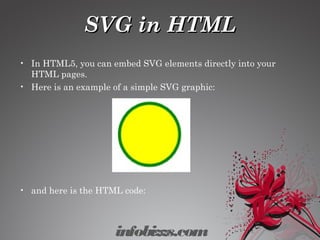
• In HTML5, you can embed SVG elements directly into your
HTML pages.
• Here is an example of a simple SVG graphic:
• and here is the HTML code:
infobizzs.com
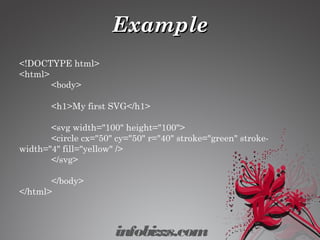
ExampleExample
<!DOCTYPE html>
<html>
<body>
<h1>My first SVG</h1>
<svg width="100" height="100">
  <circle cx="50" cy="50" r="40" stroke="green" stroke-
width="4" fill="yellow" />
</svg>
</body>
</html>
infobizzs.com
OutputOutput
infobizzs.com
SVG Code explanation:SVG Code explanation:
infobizzs.com
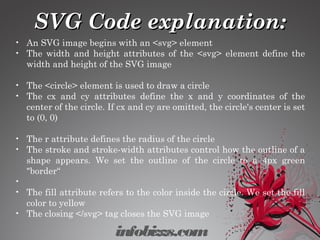
• An SVG image begins with an <svg> element
• The width and height attributes of the <svg> element define the
width and height of the SVG image
• The <circle> element is used to draw a circle
• The cx and cy attributes define the x and y coordinates of the
center of the circle. If cx and cy are omitted, the circle's center is set
to (0, 0)
• The r attribute defines the radius of the circle
• The stroke and stroke-width attributes control how the outline of a
shape appears. We set the outline of the circle to a 4px green
"border“
•
• The fill attribute refers to the color inside the circle. We set the fill
color to yellow
• The closing </svg> tag closes the SVG image
SVG ShapesSVG Shapes
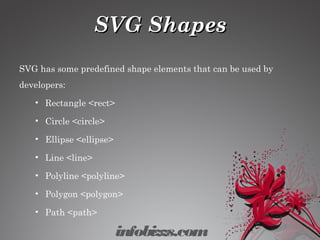
SVG has some predefined shape elements that can be used by
developers:
• Rectangle <rect>
• Circle <circle>
• Ellipse <ellipse>
• Line <line>
• Polyline <polyline>
• Polygon <polygon>
• Path <path>
infobizzs.com
SVG Rectangle - <rect>SVG Rectangle - <rect>
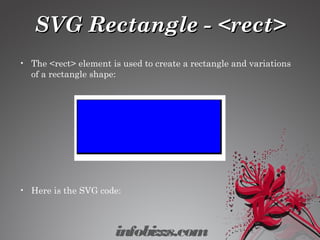
• The <rect> element is used to create a rectangle and variations
of a rectangle shape:
• Here is the SVG code:
infobizzs.com
ExampleExample
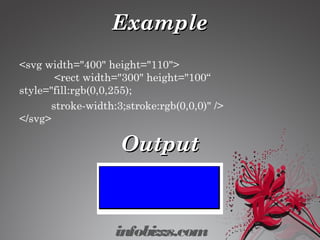
<svg width="400" height="110">
  <rect width="300" height="100“
style="fill:rgb(0,0,255);
stroke-width:3;stroke:rgb(0,0,0)" />
</svg>
OutputOutput
infobizzs.com
Code explanation:Code explanation:
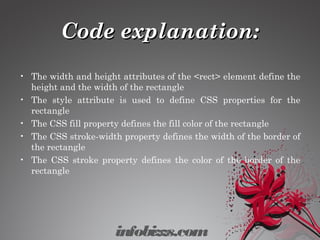
• The width and height attributes of the <rect> element define the
height and the width of the rectangle
• The style attribute is used to define CSS properties for the
rectangle
• The CSS fill property defines the fill color of the rectangle
• The CSS stroke-width property defines the width of the border of
the rectangle
• The CSS stroke property defines the color of the border of the
rectangle
infobizzs.com
SVG Circle - <circle>SVG Circle - <circle>
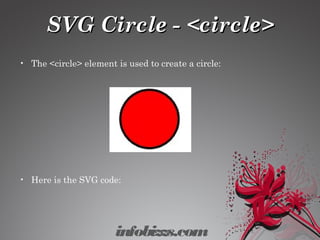
• The <circle> element is used to create a circle:
• Here is the SVG code:
infobizzs.com
ExampleExample
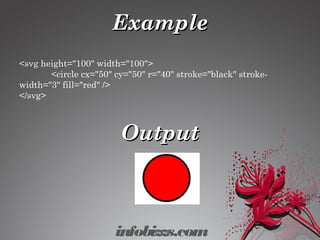
<svg height="100" width="100">
  <circle cx="50" cy="50" r="40" stroke="black" stroke-
width="3" fill="red" />
</svg>
OutputOutput
infobizzs.com
Code explanation:Code explanation:
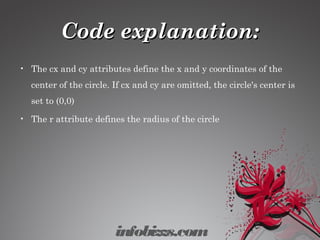
• The cx and cy attributes define the x and y coordinates of the
center of the circle. If cx and cy are omitted, the circle's center is
set to (0,0)
• The r attribute defines the radius of the circle
infobizzs.com
SVG Ellipse - <ellipse>SVG Ellipse - <ellipse>
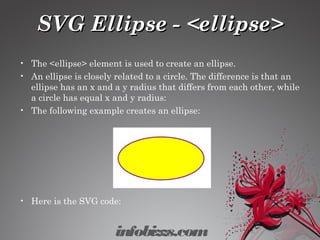
• The <ellipse> element is used to create an ellipse.
• An ellipse is closely related to a circle. The difference is that an
ellipse has an x and a y radius that differs from each other, while
a circle has equal x and y radius:
• The following example creates an ellipse:
• Here is the SVG code:
infobizzs.com
ExampleExample
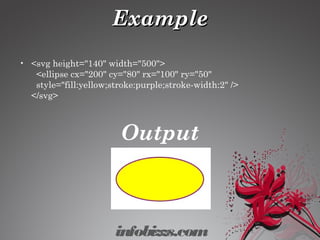
• <svg height="140" width="500">
  <ellipse cx="200" cy="80" rx="100" ry="50"
  style="fill:yellow;stroke:purple;stroke-width:2" />
</svg>
Output
infobizzs.com
Code explanation:Code explanation:
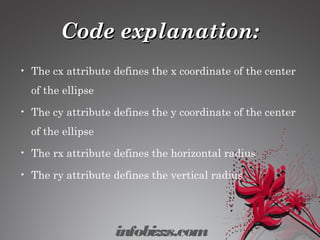
• The cx attribute defines the x coordinate of the center
of the ellipse
• The cy attribute defines the y coordinate of the center
of the ellipse
• The rx attribute defines the horizontal radius
• The ry attribute defines the vertical radius
infobizzs.com
SVG Line - <line>SVG Line - <line>
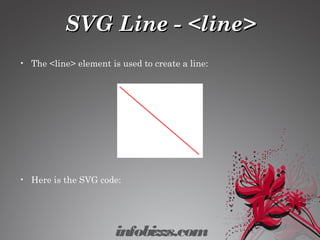
• The <line> element is used to create a line:
• Here is the SVG code:
infobizzs.com
ExampleExample
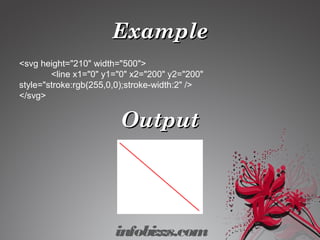
<svg height="210" width="500">
<line x1="0" y1="0" x2="200" y2="200"
style="stroke:rgb(255,0,0);stroke-width:2" />
</svg>
OutputOutput
infobizzs.com
Code explanation:Code explanation:
• The x1 attribute defines the start of the line on the x-
axis
• The y1 attribute defines the start of the line on the y-
axis
• The x2 attribute defines the end of the line on the x-
axis
• The y2 attribute defines the end of the line on the y-
axis
infobizzs.com

Svg

  • 1.
  • 2.
    What is SVG?Whatis SVG? • SVG stands for Scalable Vector Graphics. • SVG defines vector-based graphics in XML format. • SVG stands for Scalable Vector Graphics. • SVG is used to define vector-based graphics for the Web. • SVG defines the graphics in XML format. • SVG graphics do NOT lose any quality if they are zoomed or resized . • Every element and every attribute in SVG files can be animated. • SVG is a W3C recommendation. • SVG integrates with other W3C standards such as the DOM and XSL. infobizzs.com
  • 3.
    SVG AdvantagesSVG Advantages Advantagesof using SVG over other image formats (like JPEG and GIF) are: • SVG images can be created and edited with any text editor • SVG images can be searched, indexed, scripted, and compressed • SVG images are scalable • SVG images can be printed with high quality at any resolution • SVG images are zoomable (and the image can be zoomed without degradation) • SVG is an open standard • SVG files are pure XML infobizzs.com
  • 4.
    SVG in HTMLSVGin HTML • In HTML5, you can embed SVG elements directly into your HTML pages. • Here is an example of a simple SVG graphic: • and here is the HTML code: infobizzs.com
  • 5.
    ExampleExample <!DOCTYPE html> <html> <body> <h1>My firstSVG</h1> <svg width="100" height="100">   <circle cx="50" cy="50" r="40" stroke="green" stroke- width="4" fill="yellow" /> </svg> </body> </html> infobizzs.com
  • 6.
  • 7.
    SVG Code explanation:SVGCode explanation: infobizzs.com • An SVG image begins with an <svg> element • The width and height attributes of the <svg> element define the width and height of the SVG image • The <circle> element is used to draw a circle • The cx and cy attributes define the x and y coordinates of the center of the circle. If cx and cy are omitted, the circle's center is set to (0, 0) • The r attribute defines the radius of the circle • The stroke and stroke-width attributes control how the outline of a shape appears. We set the outline of the circle to a 4px green "border“ • • The fill attribute refers to the color inside the circle. We set the fill color to yellow • The closing </svg> tag closes the SVG image
  • 8.
    SVG ShapesSVG Shapes SVGhas some predefined shape elements that can be used by developers: • Rectangle <rect> • Circle <circle> • Ellipse <ellipse> • Line <line> • Polyline <polyline> • Polygon <polygon> • Path <path> infobizzs.com
  • 9.
    SVG Rectangle -<rect>SVG Rectangle - <rect> • The <rect> element is used to create a rectangle and variations of a rectangle shape: • Here is the SVG code: infobizzs.com
  • 10.
    ExampleExample <svg width="400" height="110">  <rect width="300" height="100“ style="fill:rgb(0,0,255); stroke-width:3;stroke:rgb(0,0,0)" /> </svg> OutputOutput infobizzs.com
  • 11.
    Code explanation:Code explanation: •The width and height attributes of the <rect> element define the height and the width of the rectangle • The style attribute is used to define CSS properties for the rectangle • The CSS fill property defines the fill color of the rectangle • The CSS stroke-width property defines the width of the border of the rectangle • The CSS stroke property defines the color of the border of the rectangle infobizzs.com
  • 12.
    SVG Circle -<circle>SVG Circle - <circle> • The <circle> element is used to create a circle: • Here is the SVG code: infobizzs.com
  • 13.
    ExampleExample <svg height="100" width="100">  <circle cx="50" cy="50" r="40" stroke="black" stroke- width="3" fill="red" /> </svg> OutputOutput infobizzs.com
  • 14.
    Code explanation:Code explanation: •The cx and cy attributes define the x and y coordinates of the center of the circle. If cx and cy are omitted, the circle's center is set to (0,0) • The r attribute defines the radius of the circle infobizzs.com
  • 15.
    SVG Ellipse -<ellipse>SVG Ellipse - <ellipse> • The <ellipse> element is used to create an ellipse. • An ellipse is closely related to a circle. The difference is that an ellipse has an x and a y radius that differs from each other, while a circle has equal x and y radius: • The following example creates an ellipse: • Here is the SVG code: infobizzs.com
  • 16.
    ExampleExample • <svg height="140"width="500">   <ellipse cx="200" cy="80" rx="100" ry="50"   style="fill:yellow;stroke:purple;stroke-width:2" /> </svg> Output infobizzs.com
  • 17.
    Code explanation:Code explanation: •The cx attribute defines the x coordinate of the center of the ellipse • The cy attribute defines the y coordinate of the center of the ellipse • The rx attribute defines the horizontal radius • The ry attribute defines the vertical radius infobizzs.com
  • 18.
    SVG Line -<line>SVG Line - <line> • The <line> element is used to create a line: • Here is the SVG code: infobizzs.com
  • 19.
    ExampleExample <svg height="210" width="500"> <linex1="0" y1="0" x2="200" y2="200" style="stroke:rgb(255,0,0);stroke-width:2" /> </svg> OutputOutput infobizzs.com
  • 20.
    Code explanation:Code explanation: •The x1 attribute defines the start of the line on the x- axis • The y1 attribute defines the start of the line on the y- axis • The x2 attribute defines the end of the line on the x- axis • The y2 attribute defines the end of the line on the y- axis infobizzs.com