Integrating Digital Inclusion,
Dissolving Silos
ICA Digital Divide Preconference: Communication and "The Good Life”
May 22, 2014
AlissonWalsh
Communications and
Outreach Manager,
Broadband Rhode Island
awalsh@riedc.com
@broadbandri
Angela Siefer
Senior Research Associate,
Center for Digital Inclusion
asiefer@illinois.edu
@angelasiefer
Digital Inclusion Definition
"Digital inclusion is the ability of
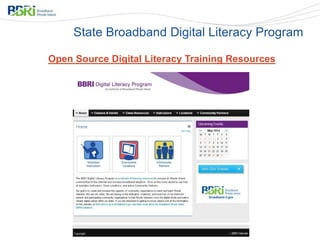
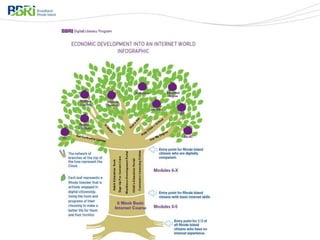
individuals and groups to access and use
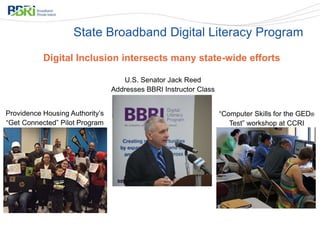
information and communication
technologies."
From “Building DigitalCommunities: A
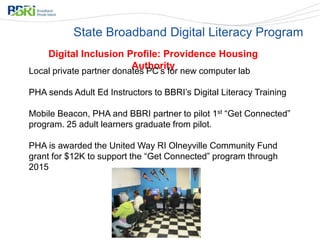
Framework for Action”, 2011
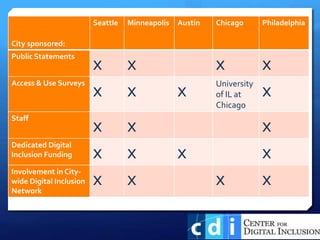
City sponsored:
Seattle Minneapolis Austin Chicago Philadelphia
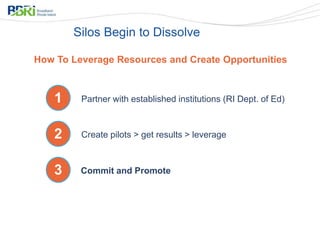
Public Statements
x x x x
Access & Use Surveys
x x x
University
of IL at
Chicago
x
Staff
x x x
Dedicated Digital
Inclusion Funding x x x x
Involvement in City-
wide Digital Inclusion
Network
x x x x
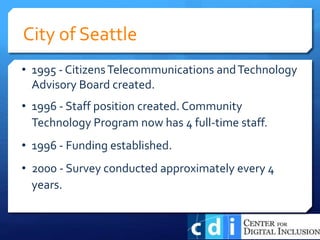
• 1995 - CitizensTelecommunications andTechnology
Advisory Board created.
• 1996 - Staff position created. Community
Technology Program now has 4 full-time staff.
• 1996 - Funding established.
• 2000 - Survey conducted approximately every 4
years.
City of Seattle
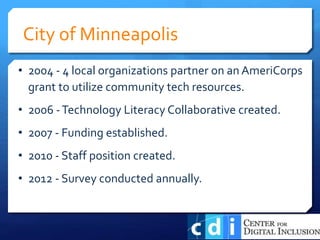
• 2004 - 4 local organizations partner on an AmeriCorps
grant to utilize community tech resources.
• 2006 -Technology Literacy Collaborative created.
• 2007 - Funding established.
• 2010 - Staff position created.
• 2012 - Survey conducted annually.
City of Minneapolis
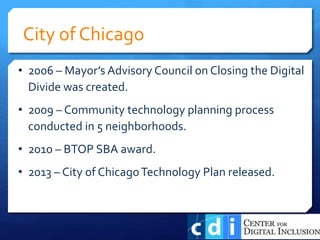
• 2006 – Mayor’s Advisory Council on Closing the Digital
Divide was created.
• 2009 – Community technology planning process
conducted in 5 neighborhoods.
• 2010 – BTOP SBA award.
• 2013 – City of ChicagoTechnology Plan released.
City of Chicago
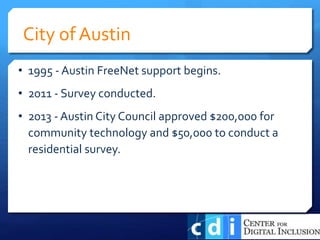
• 1995 - Austin FreeNet support begins.
• 2011 - Survey conducted.
• 2013 - Austin City Council approved $200,000 for
community technology and $50,000 to conduct a
residential survey.
City of Austin
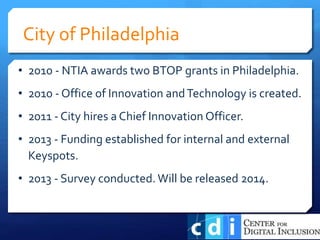
• 2010 - NTIA awards two BTOP grants in Philadelphia.
• 2010 - Office of Innovation andTechnology is created.
• 2011 - City hires a Chief Innovation Officer.
• 2013 - Funding established for internal and external
Keyspots.
• 2013 - Survey conducted.Will be released 2014.
City of Philadelphia
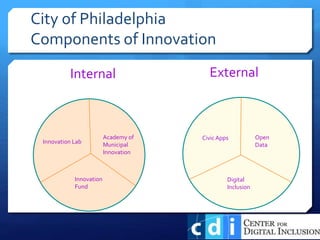
Internal External
Academy of
Municipal
Innovation
Innovation Lab
Innovation
Fund
City of Philadelphia
Components of Innovation
CivicApps Open
Data
Digital
Inclusion
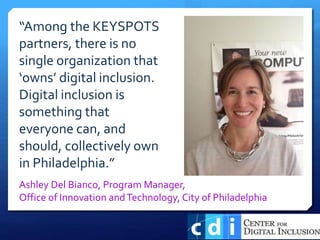
“Among the KEYSPOTS
partners, there is no
single organization that
‘owns’ digital inclusion.
Digital inclusion is
something that
everyone can, and
should, collectively own
in Philadelphia.”
Ashley Del Bianco, Program Manager,
Office of Innovation andTechnology, City of Philadelphia
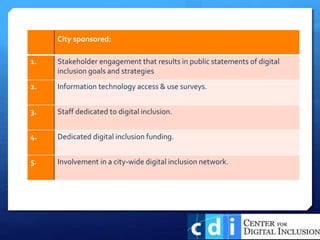
City sponsored:
1. Stakeholder engagement that results in public statements of digital
inclusion goals and strategies
2. Information technology access & use surveys.
3. Staff dedicated to digital inclusion.
4. Dedicated digital inclusion funding.
5. Involvement in a city-wide digital inclusion network.
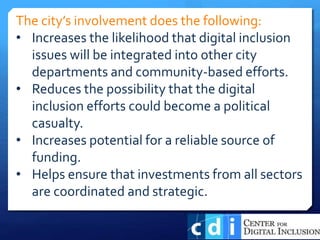
The city’s involvement does the following:
• Increases the likelihood that digital inclusion
issues will be integrated into other city
departments and community-based efforts.
• Reduces the possibility that the digital
inclusion efforts could become a political
casualty.
• Increases potential for a reliable source of
funding.
• Helps ensure that investments from all sectors
are coordinated and strategic.
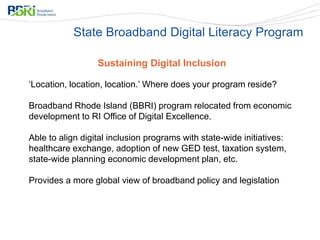
Sustaining Digital Inclusion
‘Location, location, location.’ Where does your program reside?
Broadband Rhode Island (BBRI) program relocated from economic
development to RI Office of Digital Excellence.
Able to align digital inclusion programs with state-wide initiatives:
healthcare exchange, adoption of new GED test, taxation system,
state-wide planning economic development plan, etc.
Provides a more global view of broadband policy and legislation
State Broadband Digital Literacy Program
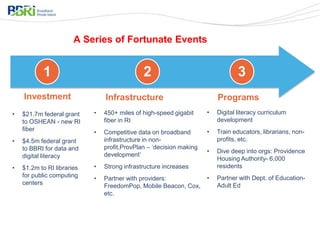
A Series of Fortunate Events
1 2 3
Investment Infrastructure Programs
• $21.7m federal grant
to OSHEAN - new RI
fiber
• $4.5m federal grant
to BBRI for data and
digital literacy
• $1.2m to RI libraries
for public computing
centers
• 450+ miles of high-speed gigabit
fiber in RI
• Competitive data on broadband
infrastructure in non-
profit,ProvPlan – ‘decision making
development’
• Strong infrastructure increases
• Partner with providers:
FreedomPop, Mobile Beacon, Cox,
etc.
• Digital literacy curriculum
development
• Train educators, librarians, non-
profits, etc.
• Dive deep into orgs: Providence
Housing Authority- 6,000
residents
• Partner with Dept. of Education-
Adult Ed
Open Source Digital Literacy Training Resources
State Broadband Digital Literacy Program
Digital Inclusion intersects many state-wide efforts
State Broadband Digital Literacy Program
Providence Housing Authority’s
“Get Connected” Pilot Program
U.S. Senator Jack Reed
Addresses BBRI Instructor Class
“Computer Skills for the GED®
Test” workshop at CCRI
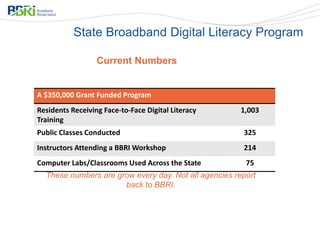
Current Numbers
A $350,000 Grant Funded Program
Residents Receiving Face-to-Face Digital Literacy
Training
1,003
Public Classes Conducted 325
Instructors Attending a BBRI Workshop 214
Computer Labs/Classrooms Used Across the State 75
These numbers are grow every day. Not all agencies report
back to BBRI.
State Broadband Digital Literacy Program
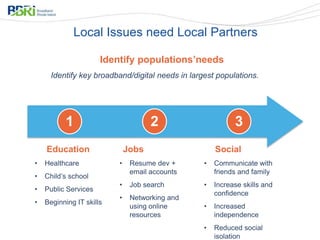
Local Issues need Local Partners
Identify populations’needs
1 2 3
Education Jobs Social
Identify key broadband/digital needs in largest populations.
• Healthcare
• Child’s school
• Public Services
• Beginning IT skills
• Resume dev +
email accounts
• Job search
• Networking and
using online
resources
• Communicate with
friends and family
• Increase skills and
confidence
• Increased
independence
• Reduced social
isolation
Digital Inclusion Profile: Providence Housing
Authority
Local private partner donates PC’s for new computer lab
PHA sends Adult Ed Instructors to BBRI’s Digital Literacy Training
Mobile Beacon, PHA and BBRI partner to pilot 1st “Get Connected”
program. 25 adult learners graduate from pilot.
PHA is awarded the United Way RI Olneyville Community Fund
grant for $12K to support the “Get Connected” program through
2015
State Broadband Digital Literacy Program
From Grassroots to the Statehouse
Over 45 of 50 states have some type of Broadband Policy
Governance - advisory councils, authority, etc.
Created the first Broadband Policy White Paper for the state of
Rhode Island through stakeholder engagement programs.
RI House Resolution- sponsored by elected official representing an
underserved area of RI S 2827
RI Senate Resolution- sponsored by an elected official representing
digital divide in RI H 7634
State Broadband Digital Literacy Program
Silos Begin to Dissolve
How To Leverage Resources and Create Opportunities
2
3
Partner with established institutions (RI Dept. of Ed)1
Create pilots > get results > leverage
Commit and Promote
 Trailblazing Digital Inclusion
Communities
http://oc.lc/bdcpilot
 Broadband Rhode Island
http://broadband.ri.gov
 BBRI Digital LiteracyTraining Portal
http://literacy.broadband.ri.gov
Angela Siefer
asiefer@illinois.edu
@angelasiefer
AlissonWalsh
awalsh@riedc.com
@broadbandri
Resources Contact Us

Sustaining digital inclusion

  • 1.
    Integrating Digital Inclusion, DissolvingSilos ICA Digital Divide Preconference: Communication and "The Good Life” May 22, 2014
  • 2.
    AlissonWalsh Communications and Outreach Manager, BroadbandRhode Island awalsh@riedc.com @broadbandri Angela Siefer Senior Research Associate, Center for Digital Inclusion asiefer@illinois.edu @angelasiefer
  • 4.
    Digital Inclusion Definition "Digitalinclusion is the ability of individuals and groups to access and use information and communication technologies." From “Building DigitalCommunities: A Framework for Action”, 2011
  • 5.
    City sponsored: Seattle MinneapolisAustin Chicago Philadelphia Public Statements x x x x Access & Use Surveys x x x University of IL at Chicago x Staff x x x Dedicated Digital Inclusion Funding x x x x Involvement in City- wide Digital Inclusion Network x x x x
  • 6.
    • 1995 -CitizensTelecommunications andTechnology Advisory Board created. • 1996 - Staff position created. Community Technology Program now has 4 full-time staff. • 1996 - Funding established. • 2000 - Survey conducted approximately every 4 years. City of Seattle
  • 7.
    • 2004 -4 local organizations partner on an AmeriCorps grant to utilize community tech resources. • 2006 -Technology Literacy Collaborative created. • 2007 - Funding established. • 2010 - Staff position created. • 2012 - Survey conducted annually. City of Minneapolis
  • 8.
    • 2006 –Mayor’s Advisory Council on Closing the Digital Divide was created. • 2009 – Community technology planning process conducted in 5 neighborhoods. • 2010 – BTOP SBA award. • 2013 – City of ChicagoTechnology Plan released. City of Chicago
  • 9.
    • 1995 -Austin FreeNet support begins. • 2011 - Survey conducted. • 2013 - Austin City Council approved $200,000 for community technology and $50,000 to conduct a residential survey. City of Austin
  • 10.
    • 2010 -NTIA awards two BTOP grants in Philadelphia. • 2010 - Office of Innovation andTechnology is created. • 2011 - City hires a Chief Innovation Officer. • 2013 - Funding established for internal and external Keyspots. • 2013 - Survey conducted.Will be released 2014. City of Philadelphia
  • 11.
    Internal External Academy of Municipal Innovation InnovationLab Innovation Fund City of Philadelphia Components of Innovation CivicApps Open Data Digital Inclusion
  • 12.
    “Among the KEYSPOTS partners,there is no single organization that ‘owns’ digital inclusion. Digital inclusion is something that everyone can, and should, collectively own in Philadelphia.” Ashley Del Bianco, Program Manager, Office of Innovation andTechnology, City of Philadelphia
  • 13.
    City sponsored: 1. Stakeholderengagement that results in public statements of digital inclusion goals and strategies 2. Information technology access & use surveys. 3. Staff dedicated to digital inclusion. 4. Dedicated digital inclusion funding. 5. Involvement in a city-wide digital inclusion network.
  • 14.
    The city’s involvementdoes the following: • Increases the likelihood that digital inclusion issues will be integrated into other city departments and community-based efforts. • Reduces the possibility that the digital inclusion efforts could become a political casualty. • Increases potential for a reliable source of funding. • Helps ensure that investments from all sectors are coordinated and strategic.
  • 15.
    Sustaining Digital Inclusion ‘Location,location, location.’ Where does your program reside? Broadband Rhode Island (BBRI) program relocated from economic development to RI Office of Digital Excellence. Able to align digital inclusion programs with state-wide initiatives: healthcare exchange, adoption of new GED test, taxation system, state-wide planning economic development plan, etc. Provides a more global view of broadband policy and legislation State Broadband Digital Literacy Program
  • 16.
    A Series ofFortunate Events 1 2 3 Investment Infrastructure Programs • $21.7m federal grant to OSHEAN - new RI fiber • $4.5m federal grant to BBRI for data and digital literacy • $1.2m to RI libraries for public computing centers • 450+ miles of high-speed gigabit fiber in RI • Competitive data on broadband infrastructure in non- profit,ProvPlan – ‘decision making development’ • Strong infrastructure increases • Partner with providers: FreedomPop, Mobile Beacon, Cox, etc. • Digital literacy curriculum development • Train educators, librarians, non- profits, etc. • Dive deep into orgs: Providence Housing Authority- 6,000 residents • Partner with Dept. of Education- Adult Ed
  • 17.
    Open Source DigitalLiteracy Training Resources State Broadband Digital Literacy Program
  • 18.
    Digital Inclusion intersectsmany state-wide efforts State Broadband Digital Literacy Program Providence Housing Authority’s “Get Connected” Pilot Program U.S. Senator Jack Reed Addresses BBRI Instructor Class “Computer Skills for the GED® Test” workshop at CCRI
  • 19.
    Current Numbers A $350,000Grant Funded Program Residents Receiving Face-to-Face Digital Literacy Training 1,003 Public Classes Conducted 325 Instructors Attending a BBRI Workshop 214 Computer Labs/Classrooms Used Across the State 75 These numbers are grow every day. Not all agencies report back to BBRI. State Broadband Digital Literacy Program
  • 20.
    Local Issues needLocal Partners Identify populations’needs 1 2 3 Education Jobs Social Identify key broadband/digital needs in largest populations. • Healthcare • Child’s school • Public Services • Beginning IT skills • Resume dev + email accounts • Job search • Networking and using online resources • Communicate with friends and family • Increase skills and confidence • Increased independence • Reduced social isolation
  • 21.
    Digital Inclusion Profile:Providence Housing Authority Local private partner donates PC’s for new computer lab PHA sends Adult Ed Instructors to BBRI’s Digital Literacy Training Mobile Beacon, PHA and BBRI partner to pilot 1st “Get Connected” program. 25 adult learners graduate from pilot. PHA is awarded the United Way RI Olneyville Community Fund grant for $12K to support the “Get Connected” program through 2015 State Broadband Digital Literacy Program
  • 22.
    From Grassroots tothe Statehouse Over 45 of 50 states have some type of Broadband Policy Governance - advisory councils, authority, etc. Created the first Broadband Policy White Paper for the state of Rhode Island through stakeholder engagement programs. RI House Resolution- sponsored by elected official representing an underserved area of RI S 2827 RI Senate Resolution- sponsored by an elected official representing digital divide in RI H 7634 State Broadband Digital Literacy Program
  • 24.
    Silos Begin toDissolve How To Leverage Resources and Create Opportunities 2 3 Partner with established institutions (RI Dept. of Ed)1 Create pilots > get results > leverage Commit and Promote
  • 28.
     Trailblazing DigitalInclusion Communities http://oc.lc/bdcpilot  Broadband Rhode Island http://broadband.ri.gov  BBRI Digital LiteracyTraining Portal http://literacy.broadband.ri.gov Angela Siefer asiefer@illinois.edu @angelasiefer AlissonWalsh awalsh@riedc.com @broadbandri Resources Contact Us

Editor's Notes

  • #3 Practitioner #1
  • #4 Welcome. We are glad you are here. We are assuming you know digital inclusion related jargon so please stop us if we use terms and program names you are not familiar with.
  • #6 Other than Chicago, each of the Cities is conducting access and use surveys on at least a tentative schedule. All Cities with a dedicated staff (or portion of a person dedicated to digital inclusion) are located in a technology department. I’m going to run through the highlights of each of these 5 cities. It’ll be fast so I’ll stick with the most relevant activities in each city.
  • #7 Granddaddy of them all. Their slide should be 3 slides but we don’t have enough time. The staff have integrated digital inclusion issues into other city departments, advocated for digital inclusion locally and nationally and helped establish local and state networks of community technology programs. The funding is a result of a cable franchise agreement.
  • #8 The first two bullets are important because they show the community working together. Everything that follows would not have happened without the local organizations together convincing the City that digital inclusion should be part of the Wireless Minneapolis discussion. Nor would it all have happened without a strong champion. The funding source is 5% of profits from Wireless Minneapolis, which recently has not resulted in amounts large enough to distribute.
  • #9 Chicago has a rich history of community-based technology services and community organizing dating back to the 1990’s. Chicago was the only city to organize itself into a chapter of the national Community Technology Center Network (now dissolved). The community technology planning process conducted with neighborhoods occurred BEFORE they received the BTOP funding. The City of Chicago Technology Plan, now released, includes support and expansion of Chicago’s five Smart Communities plus creation of a benchmark and toolkit for broadband access and use. Chicago does not have staff, funding or a regularly scheduled survey. BUT they are the largest city with a Technology Plan that even mentions strategies for digital inclusion.
  • #10 Austin is example of a city in the initial stages, exemplified by the survey and the funding. The Austin Internet and Global Citizens Project was conducted in 2011. The survey focused on access to the Internet both at home and at public locations, the barriers to access, and reasons for using the Internet.
  • #11 Philadelphia is an example of a city with lasting impact from BTOP. The City of Philadelphia is funding Keyspots (PCCs) that are operated by City departments. The City has also made available funding for Keyspots in CBOs. 10 CBOs are receiving approximately $12,000 each. 60 of the original 80 Keyspots are in operation. Went from being a partnership to being a network. They are meeting quarterly. Drexel is maintaining the website.
  • #12 The items in the Internal circle are how the City is encouraging City departments and staff to be innovative. The items in the External circle show how the City is using innovation to engage and support residents to be more innovative themselves.
  • #18 Credit HuffPost
  • #27 Oh, wait. That’s not what I wanted to say. Oh, but I do love cookies.
  • #28 We need more information. We have only scratched the surface. We need to know why some cities see the value of a digitally inclusive community and take action toward it. The more we understand about those places, the more we can provide guidance to individuals and organizations who want to strengthen their communities.