
Sustainable Tourism Development
Introduction
 Tourism has affected directly and indirectly for 9% of the GDP
globally.
 Every single employee of 11 employees engage in a tourism related
job
 1.8 billion of international tourists in 2030
What STD is?
"Tourism that takes full account of its current
and future economic, social and
environmental impacts, addressing the
needs of visitors, the industry, and the
environment and host communities"
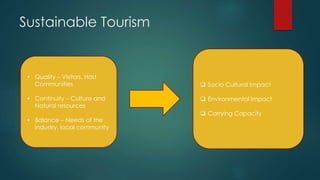
Sustainable Tourism
• Quality – Visitors, Host
Communities
• Continuity – Culture and
Natural resources
• Balance – Needs of the
industry, local community
 Socio Cultural Impact
 Environmental Impact
 Carrying Capacity
Socio-cultural Impact
 Most of the tourist attractions and activities are related to both the
natural environment and historic and cultural heritage of a
particular area
 Community Involvement
 Cultural Exchange
 Cultural Interpretation
Environmental Impact
 Although it is recognized that tourism can be beneficial to the
natural environment by promoting environment conservation,
tourism also has a negative impact on the environment.
Carrying Capacity
 Intensity of a certain environment to stand over a determined
period of time without damaging its sustainable potential for the
respective use.
 Environmental/ Ecological capacity - Number of visitors that can be
accommodate before damage to be caused to the environment or
ecosystem
 Economic Capacity - The number of tourists that can be welcomed
before the local community start to suffer economic problems.
 Social Capacity - The number of people beyond which social disruption
damage will occur.
 Infrastructure Capacity - The number of tourists that can be
accommodate by the destination infrastructure.
Issues
 Exclusive nature of tourism is a major issue.
 Policy and the practices.
 Narrow definition of tourism is another issue.
 Resource management.
Trends
 Collaboration of private and public sector.
 Indigenous Tourism
 Community Tourism
Thank You

Sustainable Tourism Development

  • 1.
  • 2.
    Introduction  Tourism hasaffected directly and indirectly for 9% of the GDP globally.  Every single employee of 11 employees engage in a tourism related job  1.8 billion of international tourists in 2030
  • 3.
    What STD is? "Tourismthat takes full account of its current and future economic, social and environmental impacts, addressing the needs of visitors, the industry, and the environment and host communities"
  • 4.
    Sustainable Tourism • Quality– Visitors, Host Communities • Continuity – Culture and Natural resources • Balance – Needs of the industry, local community  Socio Cultural Impact  Environmental Impact  Carrying Capacity
  • 5.
    Socio-cultural Impact  Mostof the tourist attractions and activities are related to both the natural environment and historic and cultural heritage of a particular area  Community Involvement  Cultural Exchange  Cultural Interpretation
  • 6.
    Environmental Impact  Althoughit is recognized that tourism can be beneficial to the natural environment by promoting environment conservation, tourism also has a negative impact on the environment.
  • 7.
    Carrying Capacity  Intensityof a certain environment to stand over a determined period of time without damaging its sustainable potential for the respective use.  Environmental/ Ecological capacity - Number of visitors that can be accommodate before damage to be caused to the environment or ecosystem  Economic Capacity - The number of tourists that can be welcomed before the local community start to suffer economic problems.  Social Capacity - The number of people beyond which social disruption damage will occur.  Infrastructure Capacity - The number of tourists that can be accommodate by the destination infrastructure.
  • 8.
    Issues  Exclusive natureof tourism is a major issue.  Policy and the practices.  Narrow definition of tourism is another issue.  Resource management.
  • 9.
    Trends  Collaboration ofprivate and public sector.  Indigenous Tourism  Community Tourism
  • 10.