Sustainable business -
where to start!
Camilla Dahle
Hello!
Camilla Dahle/Dahle Digital/inUse
I am a design strategist
with a passion for sustainability
A paradigm shift is happening these
years in the world of business.
https://www.nielsen.com/us/en/insights/news/2018/sustainability-sells-linking-sustainability-claims-to-sales.html
Opportunity for
entrepreneurial minds
and a chance to create
better futures.
We are linked through a
complex network of
connections and value chains.
Sustainable businesses utilises
and optimises these
collaborative systems.
Instead a new 'thing'
.. designing FOR the systems
we live in.
Today:
1. What is a sustainable business
2. The product
3. Up and running
Exercises using your own idea,
getting a feel for what it means
Did you bring ideas?
Raise of hands
So what are reasons for moving
towards sustainable business?
"A profitable, socially, environmentally,
responsible business
by conserving resources and reducing
expenses while engaging employees
and building customer loyalty"
Cultivating Capital
First things first:
The core of the business
Governance and mission
Sustainability is not an add-on
it's a core belief system
Simon Sinek's
Golden Circle
Common sense business practices
Common sense
business practices
Sustainable
business practices
WHAT IS A SUSTAINABLE
BUSINESS?
Sustainability
Regenerative business
Circular economy
Cradle to cradle
Zero waste
Waste to wealth
....
Sustainability is about BALANCED human living
"Sustainability is the ability to meet the needs
of the present without compromising the
ability of future generations to meet their
needs." UN 1987
Sustainability focuses on three dimensions:
Planet
Economic Social
Ecological
Sustainability
TRIPLE BOTTOM LINE*
in a sustainable business:
*John Elkington
People
Profit
Planet
The need for sustainable
business minds:

Thinking holistically
PEOPLE
as a sustainable BUSINESS you have a
social bottom line:
Positively impacting:
Employees
People in your value chain
..and surrounding communities
PROFIT
as a sustainable BUSINESS you have an
economic bottom line:
Business profit bottom line
Impact on suppliers and community.
Building a positive economic environment
PLANET
as a sustainable BUSINESS you have an
environmental bottom line:
Minimal impact the environment
Consuming few natural resources
Renewable energy + Water use
It is all about being part of the
system. No one is an island.
Where do you start?
To understand where you are going
You need to know where you are
Start with an audit
... when you already have a
business
.. Or use it as a start guide for
setting up your business
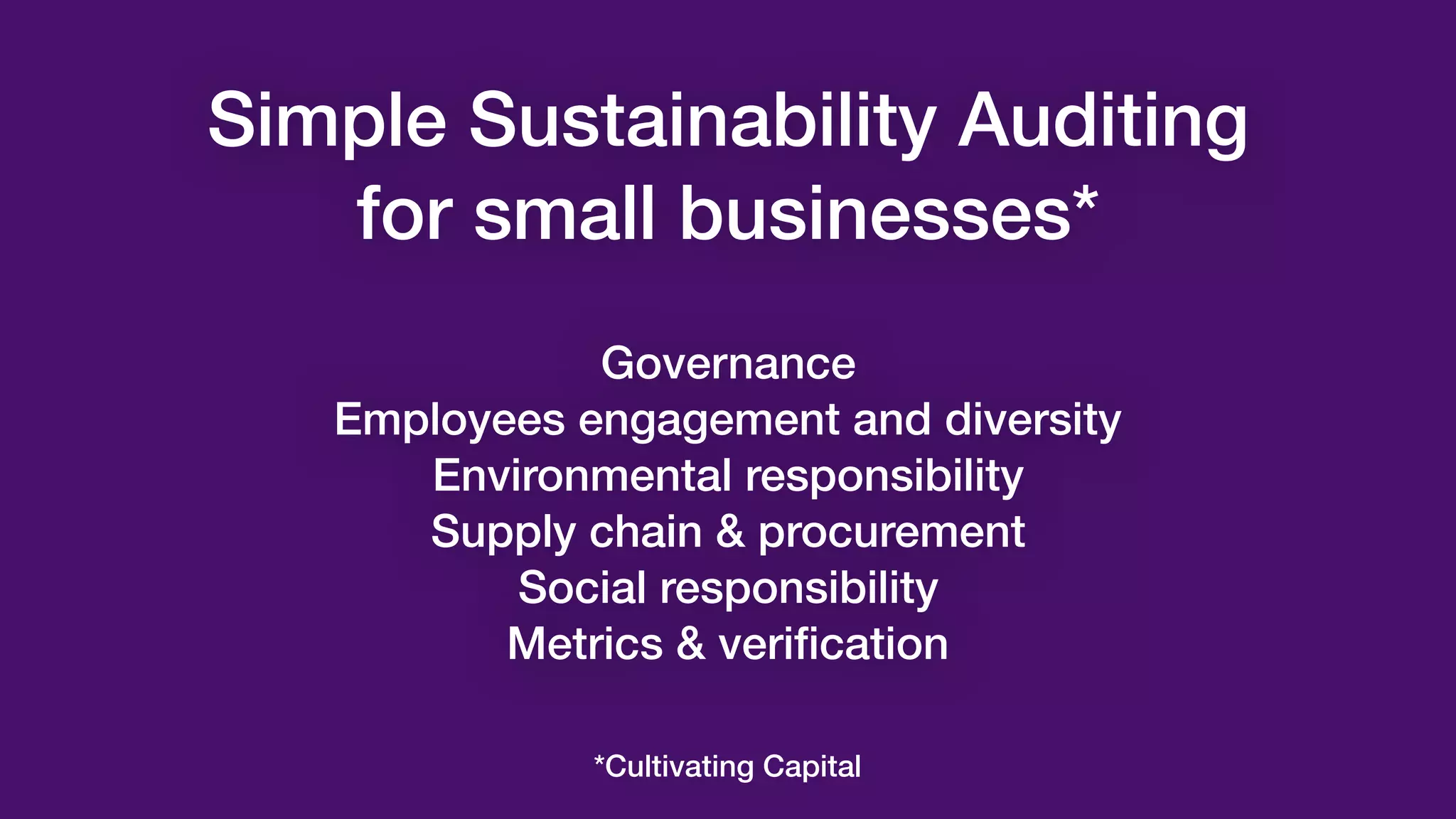
Simple Sustainability Auditing
for small businesses*
Governance
Employees engagement and diversity
Environmental responsibility
Supply chain & procurement
Social responsibility
Metrics & verification
*Cultivating Capital
Once you are up and running you
use more detailed certifications
Example from B Corps audit
THE PRODUCT
Developing a sustainable
product idea
Thinking holistically from the
beginning:
Systems methods
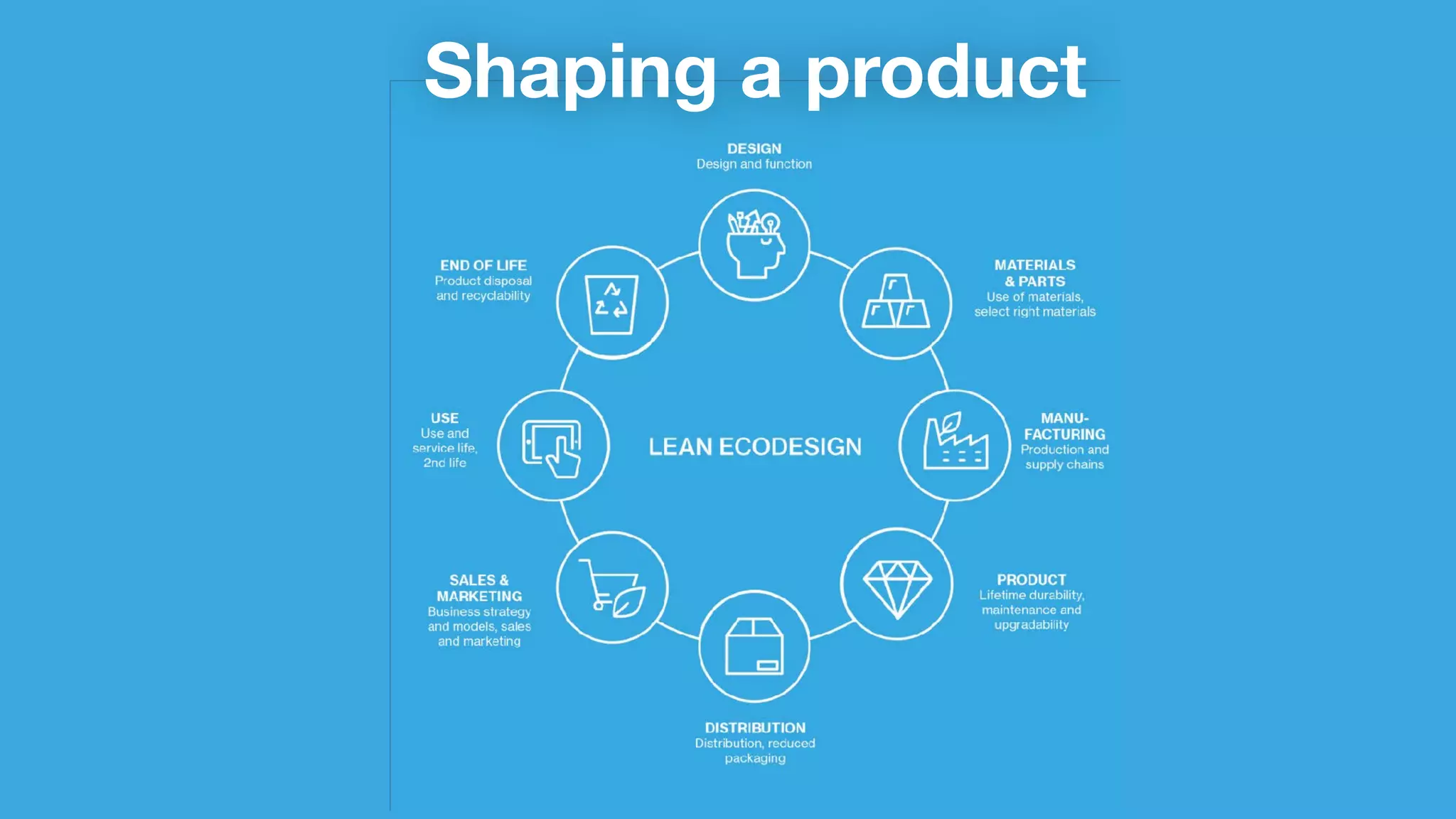
Shaping a product
Systems thinking
The butterfly model - Ellen McArthur
Foundation
The butterfly model - Ellen McArthur
Foundation
From a linear economy
To a circular economy:
• Prolonging product life
• Purposeful use of
resources
A simplified model*
...we make our product or service more
modular/adaptable?
...our product be inspired by living systems?
...how might we turn our product offering
into a service?
...how might our product be refurbished
over time?
How Might ..:
Bio-Mimicry
Regenerative
Circular
Adaptive
Balanced feedback
Systems
Flows
https://asknature.org
Inspiration from nature
Human centered, service focused
How a product is used is central
for a product to be sustainable
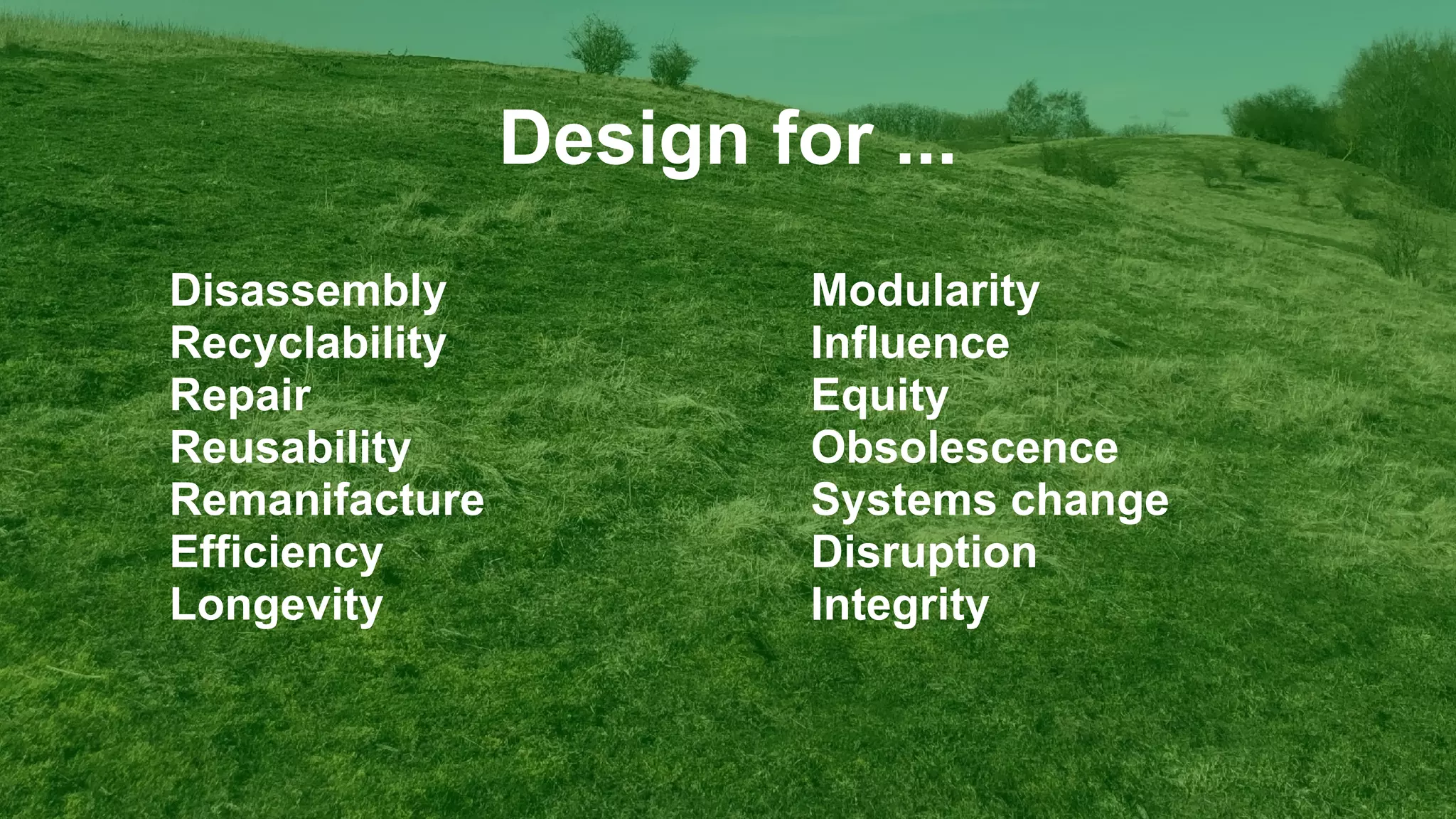
Disassembly
Recyclability
Repair
Reusability
Remanifacture
Efficiency
Longevity
Modularity
Influence
Equity
Obsolescence
Systems change
Disruption
Integrity
Design for ...
Find more idea generation methods:
IDEO/Circular Designguide
Leyla Acaroglu/ Unschool
Sustainability Guide
MATERIALS
It's about impact.
Understand the life cycle of the
materials
Materials are not good or bad
How it is used is everything
Key factors
• from easily-grown matter
• it’s renewable
• locally available
• Strong & durable
• Turning waste into a resources
• Non-toxic and harmless
• existing materials
• Substitute harmful,
synthetic materials with
sustainable materials
The level of recyclability:
Metal
Glass
Paper
Plastic
Only an estimated 12% of plastic
is recycled with a significant loss
in quality.
...But it is under research and
investment
• Mono plastic materials suitable for recycling
• Use recycled plastic if food safety/ regulation
permits
• Increase use of bio-based plastic
• Collaborate with external parties to reduce
ocean plastic pollution
• Rethink the use of new plastic technologies
About plastic..
Green chemistry and
commerce council
Cradle to Cradle Certified
(c2ccertified.org)
... what not to use
THE IMPORTANCE OF PARTNERSHIPS:
SUPPLY CHAINS
Work closely with suppliers
Reliable partnerships are
everything!
Remember the business is
part of a system.
Potential issues:
Sweat shops
Water overuse
Dirty energy sources
Unfair wages
Locate critical issues across
the whole the supply chain
Work together with your
suppliers to help them achieve
the sustainability goals
Do a systems map!
Free measurement framework
for supply chains:
The Sustainability Consortium
(TSC)
Traceability is key
It validates your product!
“The ability to identify and trace the history,
distribution, location and application of
products, parts and materials, to ensure the
reliability of sustainability claims, in the areas of
human rights, labour (including health and
safety), the environment and anti-corruption.”
United Nations Global Combat
B Corp
TRUE zero waste
Fairtrade
Or tools :
IPE Supply Chain
Map
Sustainable Minds
Using 3rd party certification:
Future:
Using blockchain for traceability of
partners and materials
Even if your product or service
is largely digital
it is still part of a larger system
The internet's carbon
footprint is growing
Streaming content is
60-70%!
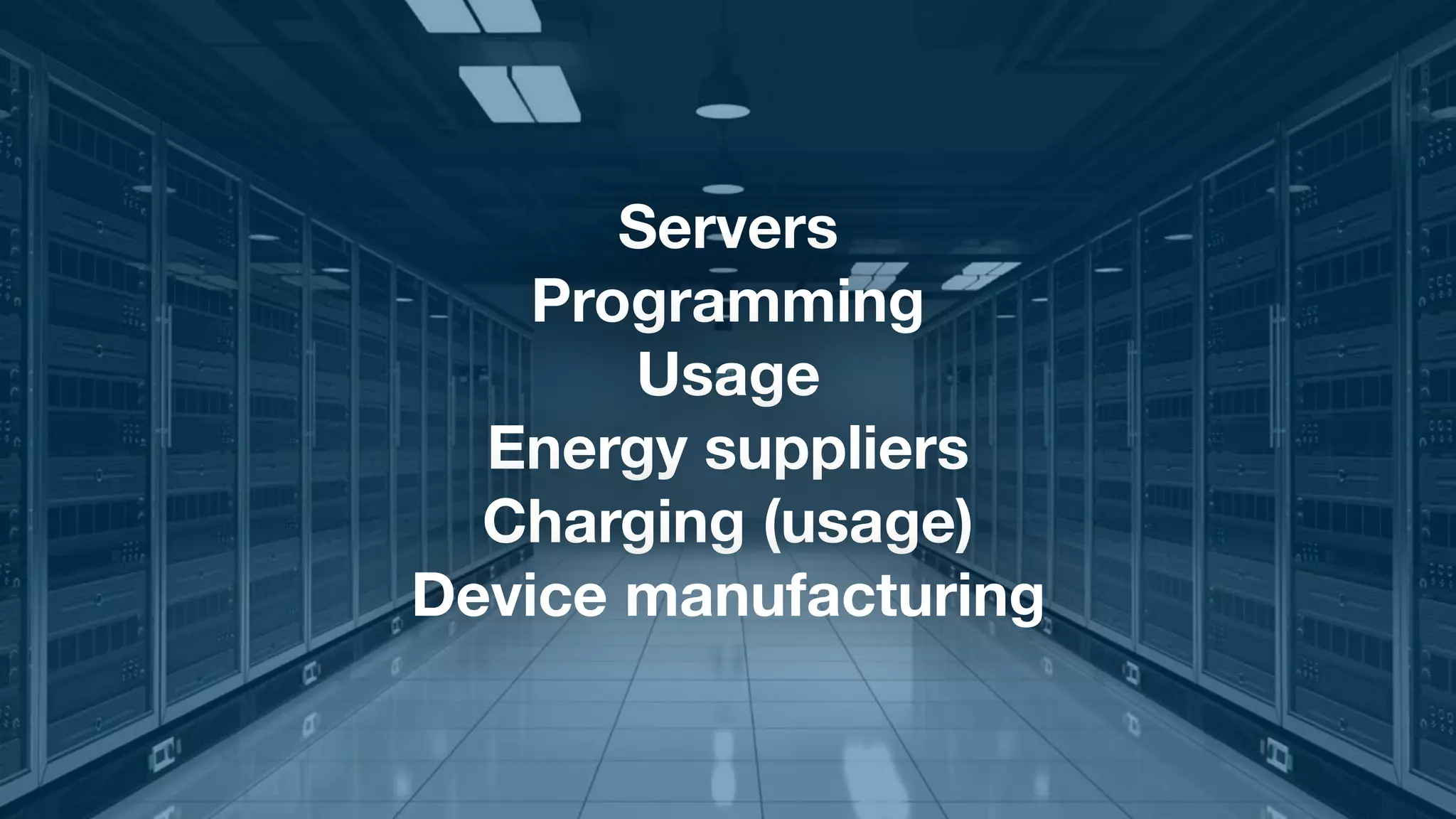
Servers
Programming
Usage
Energy suppliers
Charging (usage)
Device manufacturing
UP AND RUNNING
Running the business 360*
in the workplace
Continuous buyin throughout
the business
Conserving resources and
reduce pollution*
Alternatives to travel:
Meetings
Workshop
Commute
Equipment:
IT - servers - cloud
IT - hardware
Mobiles
The business space:
Office materials
Lighting, water & heating
Waste & recycling
Food
Events
Doing well by doing good
Engaging in the community
Sounds complex?
The simplest and safest way is
to make use of the many great
resources
Certified frameworks
Frameworks are great as an
all-round goal.
One of the largest is B Corps
What resources are needed?
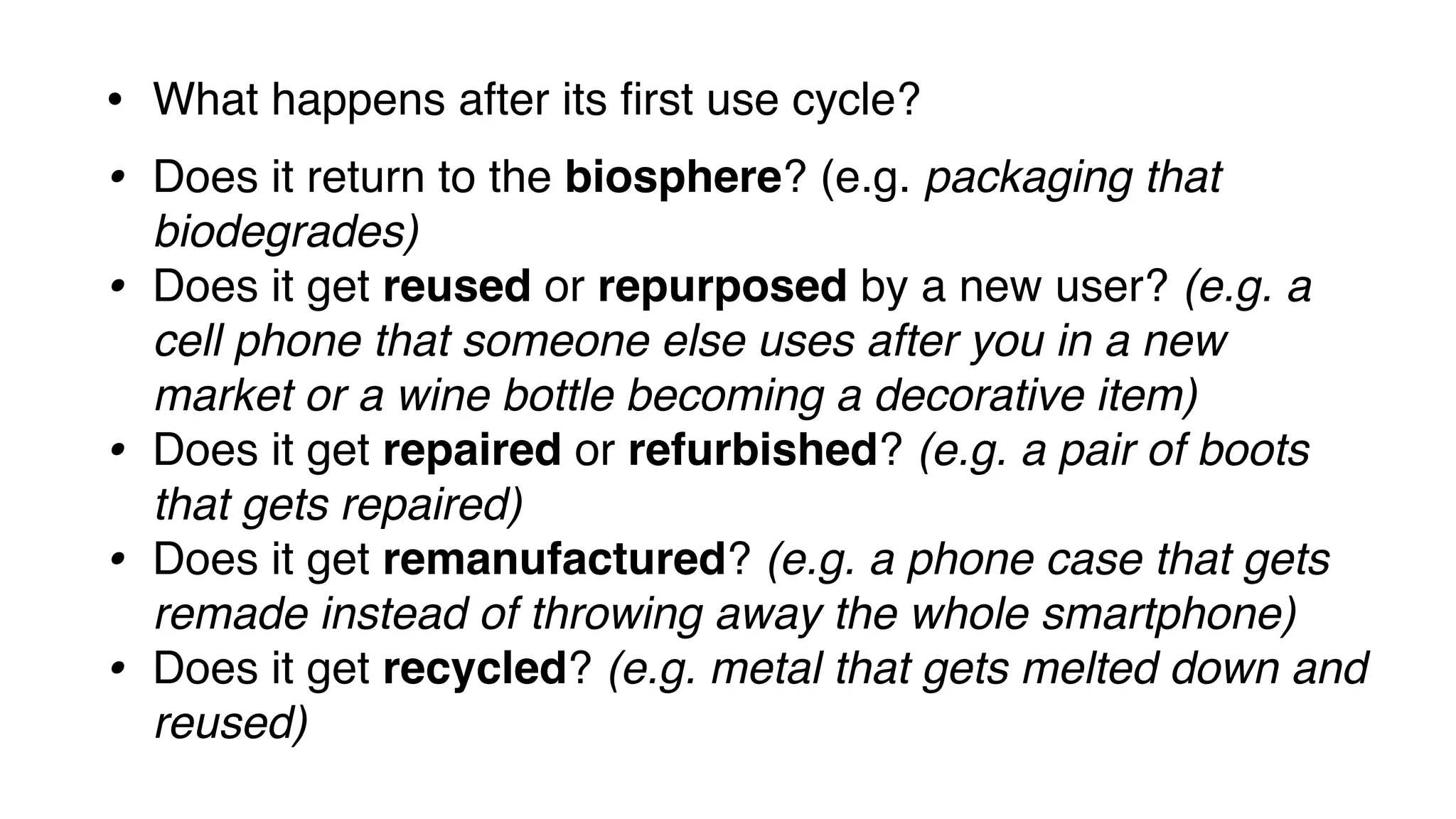
• What happens after its first use cycle?
• Does it return to the biosphere? (e.g. packaging that
biodegrades)
• Does it get reused or repurposed by a new user? (e.g. a
cell phone that someone else uses after you in a new
market or a wine bottle becoming a decorative item)
• Does it get repaired or refurbished? (e.g. a pair of boots
that gets repaired)
• Does it get remanufactured? (e.g. a phone case that gets
remade instead of throwing away the whole smartphone)
• Does it get recycled? (e.g. metal that gets melted down and
reused)
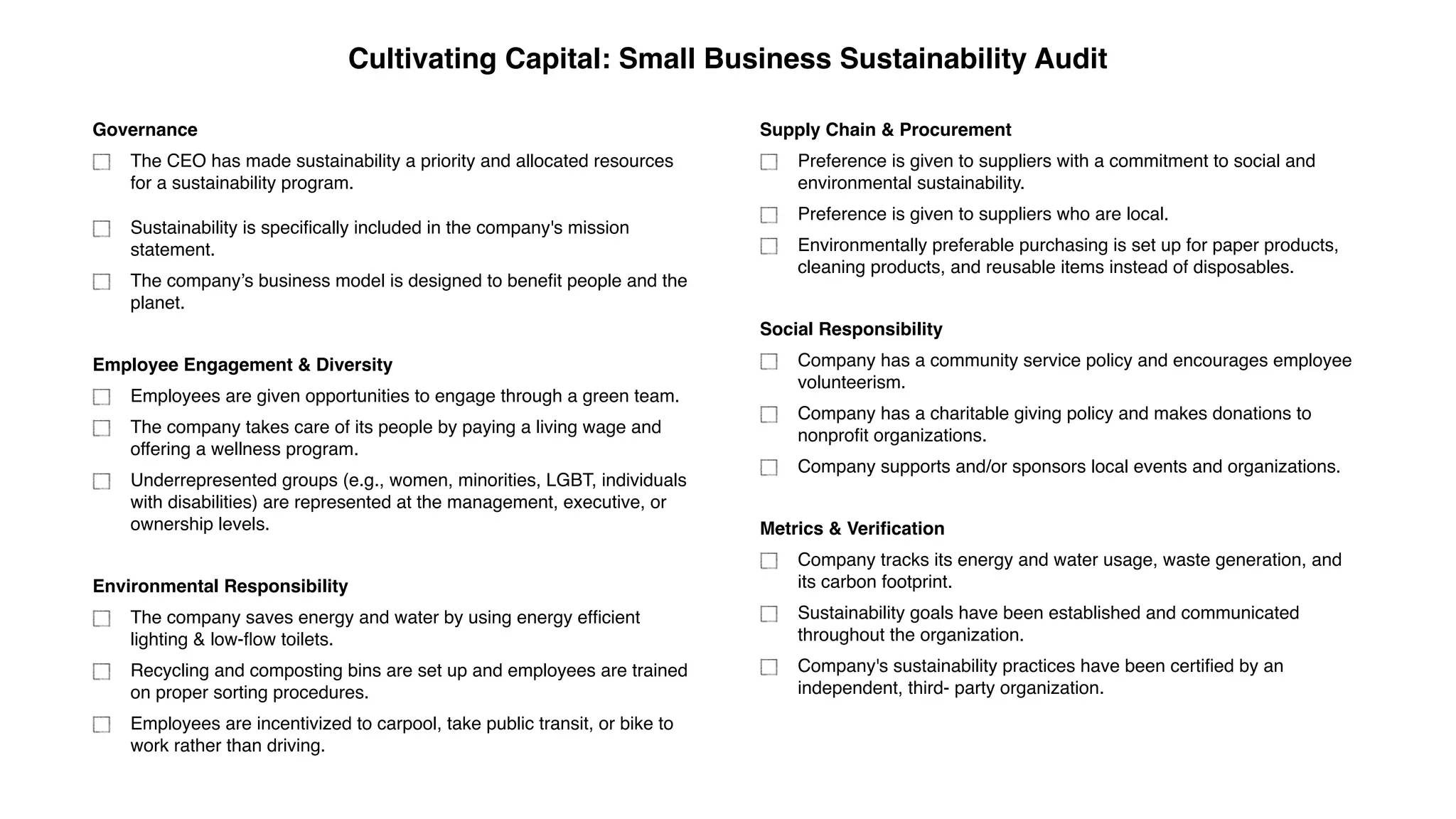
Governance
The CEO has made sustainability a priority and allocated resources
for a sustainability program.
Sustainability is specifically included in the company's mission
statement.
The company’s business model is designed to benefit people and the
planet.
Employee Engagement & Diversity
Employees are given opportunities to engage through a green team.
The company takes care of its people by paying a living wage and
offering a wellness program.
Underrepresented groups (e.g., women, minorities, LGBT, individuals
with disabilities) are represented at the management, executive, or
ownership levels.
Environmental Responsibility
The company saves energy and water by using energy efficient
lighting & low-flow toilets.
Recycling and composting bins are set up and employees are trained
on proper sorting procedures.
Employees are incentivized to carpool, take public transit, or bike to
work rather than driving.
Supply Chain & Procurement
Preference is given to suppliers with a commitment to social and
environmental sustainability.
Preference is given to suppliers who are local.
Environmentally preferable purchasing is set up for paper products,
cleaning products, and reusable items instead of disposables.
Social Responsibility
Company has a community service policy and encourages employee
volunteerism.
Company has a charitable giving policy and makes donations to
nonprofit organizations.
Company supports and/or sponsors local events and organizations.
Metrics & Verification
Company tracks its energy and water usage, waste generation, and
its carbon footprint.
Sustainability goals have been established and communicated
throughout the organization.
Company's sustainability practices have been certified by an
independent, third- party organization.
Cultivating Capital: Small Business Sustainability Audit
Thank you!
camilla@dahledigital.com
Camilla Dahle: LinkedIn

Sustainable business - where to start