Abbondanza


                                                                      04 A3_ORIZ.


Chairman’s
 Letter
In a macro-economic environment characterised by one of the worst international econom-
ic crisis since the end of the war, which in just two years (2008 and 2009) reduced gross
domestic product by two percentage points, wiping out the slow growth achieved with great
difficulty during the previous five years, we have handled the challenges imposed by the
competitive and business environment with courage and determination.
The arrival of new players in the world of telecommunication has led to a profound rethink
of the way we are required to operate, but we have faced the new competitive environment
with awareness of the values that make us unique.

In the four years just ended, we have worked tirelessly to cut costs and improve the com-
petitiveness of our commercial offerings, for the benefit of customers and the market. We
have dealt responsibly with the staff redundancies foreseen by the business plan, imple-
menting solutions agreed with the social partners that have minimised the impact on em-
ployees.
Thanks to the consolidation and relaunch of activities in Brazil and Argentina, we have
been able to rebalance our presence in foreign markets, recovering the strong international
vocation that Telecom Italia had in the past.
Through a careful management of company’s operations we have rebalanced the ratio be-
tween debt and cash generation, bringing it back to normal levels.
We have developed a constructive dialogue with the Authorities, promoting innovative so-
lutions that fulfil requirements in terms of ensuring protection and equality of treatment
between our sales division and alternative operators.
We have continued to act incisively with regard to compliance and behavioural practices,
transforming our organisational architecture in order to build more effective control sys-
tems.

Responding to customer needs remains the main priority in the Group's business strate-
gies and the results achieved in terms of improving satisfaction indexes reward the efforts
made, although we believe we can do even better.
All of this has been done because we believe that a sustainable company is a company
that takes into high consideration its own impacts on the whole system with which it has
to interact in every corporate decision it makes.
And it is precisely with the aim of increasing the level of awareness of the importance of
these aspects in the decision-making process that we have launched a sustainability train-
ing plan dedicated to all employees, which will continue throughout 2012. This is a con-
crete knowledge development tool based on an e-learning platform and on themed virtual
classrooms aimed at creating a common and shared knowledge base within the Group.

Constant attention to technological innovation and process management improvement
has allowed us to increase our energy efficiency and produce significant results, including
a 6.3% reduction in electricity consumption and a 6.2% reduction in carbon dioxide emis-
sions into the atmosphere.
Our commitment to supporting the values of sustainability has allowed us to achieve im-
portant national and international acknowledgements, including our inclusion in all the ma-
jor global sustainability indexes.
We continue to support the United National Global Compact through our involvement in the
Italian network and our reporting of the progress achieved in applying the ten principles.

In the near future, our Group will be required to make important strategic choices, the ef-
fects of which will extend over the medium to long term. When evaluating choices of this
magnitude we need to consider the interests of today as well as those of tomorrow, as-
sessing their sustainability from all points of view.
In developing next generation networks, for example, we have opted for an architecture
which, in addition to being economically efficient, is also a solution that allows the great-
est energy savings to be achieved.
In the future, companies and Public Administrations will increasingly be opting for innova-
tive Smart Service solutions that allow the most efficient use of resources, while at the
same time ensuring a reduction in environmental impact and an improvement in citizens'
quality of life. Telecom Italia intends to play a leading role in this context.

In less than five years, our Group has changed. Its expectations, prospects, behaviour and
fundamental values have changed and its commitment to doing business responsibly has
strengthened, in the belief that this is a prerequisite for the success of the Group in the
long term.

                                                                            Franco Bernabè
                                                                          (Chairman & Ceo)
Executive Summary                                            7


Introduction     1. References and Governance                               17
                 2. Codes, Charters and Values                              18
                 3. Hot Topics                                              20
                 4. Placement in the indexes                                20
                 5. Other acknowledgements                                  22
                 6. Communication of non-financial performance              23
                 7. Reporting                                               24
                 8. 2011 Results and 2012 Objectives                        27
                 9. The Group Sustainability Department                     27
                 10. Stakeholder Involvement                                28
                 11. Economic value generated and distributed               32


External       1. Customers                                                 37
                   1.1 Strategy                                             37
stakeholders
                   1.2 Relevant stakeholders                                37
                   1.3 Quality of the service                               38
                   1.4 Customer satisfaction                                39
                   1.5 Certifications                                       40
                   1.6 Digital Divide                                       41
                   1.7 Innovative services                                  42
                   1.8 Child protection                                     44
                   1.9 Conciliation procedures                              45
                   1.10 Safeguarding privacy and personal data protection   46


               2. Suppliers                                                 49
                   2.1 Strategy                                             49
                   2.2 Relevant stakeholders                                49
                   2.3 General matters                                      49
                   2.4 Sustainability initiatives                           50
                   2.5 Sustainability checks                                51
                   2.6 Involvement initiatives                              52
                   2.7 2011 Results and 2012 Commitments                    53


               3. The Environment                                           55
                   3.1 Strategy                                             55
                   3.2 Relevant stakeholders                                56
                   3.3 Environmental performance                            56
                   3.4 Climate change                                       70
                   3.5 Communicating sustainability                         72
                   3.6 Product responsibility                               74
4. The Community                                               77
                      4.1 Strategy                                               77
                      4.2 The measurement of our contribution to the Community   78
                      4.3 Responses to stakeholders                              79
                      4.4 Media relations and communication projects             82
                      4.5 Research and development                               83


Internal          1. Human Resources                                              91
                     1.1 Strategy                                                 91
stakeholders
                     1.2 Relevant stakeholders                                    91
                     1.3 Headcount and changes                                    91
                     1.4 Gender balance                                           95
                     1.5 People Caring                                            96
                     1.6 Development                                             100
                     1.7 Selection                                               101
                     1.8 Training                                                103
                     1.9 Listening activities and projects                       105
                     1.10 Internal communication                                 106
                     1.11 Health and Safety                                      106
                     1.12 Industrial relations                                   108
                     1.13 Remuneration policy                                    110
                     1.14 Employees share ownership plan 2010-2014               111


                  2. Shareholders                                                113
                      2.1 Strategy                                               113
                      2.2 Stakeholders and their expectations                    113
                      2.3 Financial communication                                114
                      2.4 Risk Management                                        115
                      2.5 CORPORATE GOVERNANCE                                   116


Appendix          2010 and 2011 Results                                          131
                  2012 Objectives                                                134


Auditors’report   Report of the independent auditors (PricewaterhouseCoopers)    140
Group Structure

The Telecom Italia Group offers telecommunication services and state-of-the-art ICT and
media solutions, contributing to the digitalization and development of the country in which
it operates. In addition to its domestic leadership, the Group has a significant international
presence in the South American market with the “Brazil” Business Unit and the “Argen-
tina” Business Unit.

The Group operates in the following business sectors:
•	 the “Domestic” Business Unit has a leading position in the field of voice on fixed and
   mobile networks and data services for final customers (retail) and other operators
   (wholesale) in the domestic context. Internationally it operates in the field of optical
   fibre network development (international wholesale) in Europe, the Mediterranean and
   South America;
•	 the “Brazil” Business Unit includes mobile telecommunication activities with Tim Celu-
   lar, and fixed telecommunication activities with Intelig Telecomunicações, Tim Fiber SP
   and Tim Fiber RJ;
•	 the “Argentina” Business Unit operates in fixed telecommunications through the com-
   pany Telecom Argentina, in mobile telecommunications through the company Telecom
   Personal in Argentina and Nucleo in Paraguay, and in the Broadband through the “Arnet”
   brand;
•	 the “Media” Business Unit includes the activities of the Group's television broadcast-
   ers (La7, La7D, MTV, MTV+) and the activities of Telecom Italia Media Broadcasting that
   relate to managing the analogue and digital broadcasting networks of the Group's tel-
   evision broadcasters and to the supply of accessory services to these broadcasters;
•	 the “Olivetti” Business Unit includes the manufacturing operations for digital printing
   systems, office products and Information Technology services;
•	 Other Activities” includes financial companies and other minor companies not strictly
   connected with the “core business” of the Telecom Italia Group, not included in the
   scope of the Sustainability Report.
8 | EXECUTIVE SUMMARY


             ITALY                 BRAZIL           ARGENTINA


                        OLIVETTI            MEDIA
EXECUTIVE SUMMARY | 9


Main economic, financial and operational data


Telecom Italia Group – Main economic and financial consolidated data


                                         Revenues                           EBITDA                            EBIT            Industrial        Headcount at the end of
                                                                                                                            Investments            the period (units)
(million euros)                       2011            2010             2011            2010          2011         2010      2011    2010 12.31.2011 12.31.2010
Domestic                            19,032          20,068             9,243           9,393        (1,945)       5,162     4,200   3,106              55,389          56,530
Brazil                                7,343           6,199            1,990           1,801               986       685    1,290   1,216              10,539          10,114
Argentina(*)                          3,220               798          1,035              245              509       110     556      188              16,350          15,650
Media                                    238              258               28              13             (87)      (92)     61        67                765            777
Olivetti                                 343              391             (35)            (19)             (41)      (24)      5         5              1,075           1,090
Other activities                             2              64            (15)            (21)             (15)      (38)       -        4                 36             39
Adjustments and
                                       (221)           (207)                    -               -          (10)       15     (17)       (3)                    -            -
eliminations
Consolidated total                  29,957          27,571           12,246          11,412          (603)        5,818     6,095   4,583              84,154          84,200
*
The Argentina Business Unit has been included in the consolidation scope starting from October 13, 2010.


Telecom Italia Group – Other economic and financial consolidated data


                                                                                                                                              12.31.2011           12.31.2010
(million euros)
Total equity                                                                                                                                         26,695            32,555
•	attributable to owners of the Parent Company                                                                                                       22,791            28,819
•	attributable to minority shareholdings                                                                                                              3,904             3,736
Profit(loss) for the financial year attributable to Parent Company Shareholders                                                                      (4,726)            3,121
Profit(loss) for the financial year attributable to Minority Shareholdings                                                                              446              454
Net financial accounting debt                                                                                                                        30,819            32,087


Telecom Italia Group – Main operational data of the Business Units


                                                                                                                                              12.31.2011           12.31.2010
DOMESTIC FIXED
Connections to the fixed network in Italy at year end (thousands)                                                                                    16,745            17,609
Broadband connections in Italy at year end (thousands)                                                                                                9,089             9,058
DOMESTIC MOBILE
Number of lines at year end (thousands)                                                                                                              32,227            31,018
BRAZIL
Number of lines at year end (thousands)                                                                                                              64,070            51,015
ARGENTINA
Number of fixed lines at year end (thousands)                                                                                                         4,141             4,107
Number of broadband connections at year end (thousands)                                                                                               1,550             1,380
MEDIA
La7 audience share Free to Air (analogue mode) – (average for the year in %)                                                                            3.8               3.1
La7 audience share Free to Air (analogue mode) – (average for last month of the year in %)                                                              3.9               3.3
10 | EXECUTIVE SUMMARY


Background


Telecom Italia began to deal with sustainability in 1997 by creating a specific department
and by publishing the first socio-environmental report. The document then evolved into the
Sustainability Report and included an analysis of performance in respect of stakeholders
with whom the Company interacts on a daily basis: the stakeholders. As of 2003, the data
and information regarding sustainability became part of the Report on Operations for the
consolidated Financial Statements, thus confirming the Group's intention to present its fi-
nancial data together with non-financial data.
In 2002, Telecom Italia published the Group's first Code of Ethics and signed up to the
Global Compact, the global pact by the UN to promote the protection of the environment,
respect for human rights and working standards, and anti-corruption practices.
In 2003, a structured system for managing sustainability based on indicators (Key Perform-
ance Indicators) was implemented to measure the results achieved in respect of all stake-
holders and allow appropriate improvement actions to be planned.
In 2007, Telecom Italia participated as co-leader in the laboratory set up in the context of
the Alliance with the European Commission in March 2006 on the evaluation and commu-
nication of non-financial performance. The laboratory then drew up an original communi-
cation template (investorvalue.org) presented in Brussels in May 2010 during the Senior
Leaders Forum of the European Academy for Business in Society (EABIS).
The further development of this model is currently under way, as part of a project moder-
ated by EABIS and CSR Europe in which Telecom Italia continues to play a leadership role
together with other multinational companies. At the end of 2008, sustainability was for-
mally brought to the attention of the Board of Directors through the Internal Control and
Corporate Governance Committee, which performs a senior supervision function in this
respect.
In 2009, the Sustainability Report was drawn up for the first time according to the princi-
ples of the AA1000 AccountAbility Principles Standard (APS), which are based on on the
involvement of stakeholders in the reporting and the underlying processes. This is the
most advanced standard in this area.
As a confirmation of the results achieved, Telecom Italia was included in the most prestig-
ious international sustainability indexes, including the Dow Jones Sustainability Indexes
(DJSI) and the Financial Times Stock Exchange for Good (FTSE4Good).


The main sustainability challenges for Telecom Italia


Focus on customers
The achievement of high standards of customer satisfaction is a priority for Telecom Italia.
The formal quality commitments summarised in the Customer Promise have been the sub-
ject of a structured internal dissemination plan through the “Esprimere Qualità” (Express-
ing Quality) project, which came to an end in 2011 after more than 2 years and involved
several different departments of the company.
In 2011, the listening system was extended to measure quality of service and customer
experience in all contacts made with the company. Quality is also taken into consideration
in the manager and staff incentives system.
As a fundamental player in the broadband ecosystem, the Telecom Italia Group is responsi-
ble for ensuring that the technological development it brings by offering innovative services
is always associated with the balanced development of the population in terms of com-
EXECUTIVE SUMMARY | 11


puter literacy, thus contributing to overcoming the socio-cultural barriers that can restrict
the opportunity to participate in the information society and enjoy its benefits. Particular
attention is therefore paid to customers with specific needs or belonging to the weakest
layers of society, such as children, the elderly, the sick and the disabled. For example, the
“Smart Inclusion” project, implemented in some Italian paediatric hospitals, provides a
single technological platform allowing hospitalised children to participate actively in school
lessons, communicate with their families and access various entertainment programmes,
while allowing healthcare staff to view and update clinical patient documentation. As re-
gards children, safe Internet browsing is definitely a priority for Telecom Italia, which now
provides various online protection and control tools. It has also launched a “Navigare In-
sieme” (Browsing Together) project aimed at teaching children, teenagers and adults (par-
ents and teachers) to make an informed and responsible use of the Internet and digital
technologies. For further information see § Customers and § The Community.


Closeness to our people
Telecom Italia confirms its care for the people who work in the Company.
The People Caring initiatives, implemented by listening to the needs of employees, are
intended to improve the work life balance and to provide a concrete response to the re-
quirements of daily life. Telecom Italia supports the involvement of employees in volun-
teering initiatives and pays specific attention to diversity within the Company. Talents are
attracted and retained with specific initiatives, particularly by establishing direct links with
universities and further education institutions. With the “I care about myself” project, for
employees who have passed the required examinations, Telecom Italia covers tuition fees
for a number of degree courses provided by the Uninettuno International Telematic Uni-
versity. Dialogue with employees takes place through various channels, including tools
that promote bilateralism, exchange and discussion between members of the corporate
community through such things as blogs, open virtual communities, climate analysis and
the intranet portal. A training plan has been launched to inform and involve employees in
matters related to sustainability using an e-learning platform and themed virtual classes.
For further details of the initiatives taken regarding Telecom Italia personnel see § Human
Resources.


Contribution to the Community
As a large company, Telecom Italia has a major impact on the communities of the countries
in which it operates.
First of all it contributes to improving general well-being by distributing part of the value
produced through salaries and wages, payments to suppliers and work providers, interest
to capital investors and dividends to shareholders (see § Economic value produced and
distributed). Furthermore, the investments made are of general benefit to the community
in terms of infrastructure and services, while also promoting virtuous effects on the sup-
ply chain.
The Group's contribution to the community also includes products and services that im-
prove people's quality of life by promoting new ways of learning, travelling, working and
looking after oneself, reducing the need for travel and therefore increasing the amount of
free time and improving quality of life in general.
One example is the MyDoctor@Home remote home monitoring service, operating in a
number of establishments in Piedmont since December 2010, which allows patients suf-
fering from a number of chronic diseases to be monitored remotely thanks to Telecom Ita-
lia's technologies. The service allows the quality of life of patients to be significantly im-
12 | EXECUTIVE SUMMARY


proved as well as allowing considerable savings to be made by the healthcare system on
hospitalisation costs. By reducing the need to travel to the doctor, this service also allows
carbon dioxide (CO2) emissions generated by the means of transport to be reduced (see §
Customers/Innovative Services and § The Community/Responses to stakeholders).
Finally, the Group's contribution to the community includes projects and initiatives for the
general development of the community by means of cultural, solidarity and environmental
protection activities carried out directly by Telecom Italia through the Foundation. These
include, for example, the programme of activities launched with the Italian Dyslexia As-
sociation to combat this disorder in Italian schools (see § The Community/Responses to
stakeholders).


Fighting climate change
This is one of the great challenges that humanity will have to deal with in the near future,
mainly by reducing emissions of CO2 and other greenhouse gases in order to limit the in-
crease in the earth's temperature to levels that are deemed acceptable.
The Information and Communication Technology (ICT) industry can play a fundamental role
in this respect, not only by limiting its emissions of CO2 generated primarily by the high
amount of energy required by transmission networks, but also by contributing to reducing
emissions in other sectors by offering innovative services that promote different and more
sustainable lifestyles in environmental terms. According to the Global e-Sustainability Ini-
tiative (GeSI Smart 2020), by 2020 ICT will be responsible for approximately 3% of world
CO2 emissions but will contribute to reducing the CO2 emissions of other industrial sectors
by around 15% by means of services such as video conferencing, teleworking, telemedi-
cine and promoting the virtualisation of the economy in general, which means replacing
systems with lower impact alternatives in terms of CO2 (e-commerce, e-tourism, online
billing and payments, etc.). ICT solutions allow intelligent buildings to be constructed in
which technology combined with new materials considerably improves levels of energy con-
sumption, comfort and safety. By using “smart grids” these solutions allow energy to be
transferred from areas where there is a surplus to ones where there is a deficit, allowing
considerable amounts of energy to be saved, with benefits for citizens and companies, con-
tributing to the creation of more efficient and safer cities with lower CO2 emissions. In this
respect, Telecom Italia has launched the Smart Town offer, based on an integrated platform
of services for “smart” cities which uses existing public lighting systems, integrated with
telecommunication networks, to implement innovative environmental management, secu-
rity and energy saving services for local authorities and the public. For further information
see § Customers/Innovative Services and § The Environment/Climate change.
EXECUTIVE SUMMARY | 13


Main results of 2011


    Results(*)                                                                        Reference to the chapters in the Report

    8.5% reduction in the energy used for transport                                   The Environment/Environmental performance/
                                                                                      Energy

    6.3% decrease in electricity consumption                                          The Environment/Environmental performance/
                                                                                      Energy

    An increase of 29.7% in the eco-efficiency                                        The Environment/Climate Change
    indicator

    6.2% reduction in CO2 emissions                                                   The Environment/Environmental performance/
                                                                                      Atmospheric emissions

    9.6% reduction in paper purchased                                                 The Environment/Environmental performance/
                                                                                      Paper

    500,000 low environmental impact Wi-Fi modems                                     The Environment/Product responsibility
    purchased as part of the new range of “Telecom
    Italia Green” branded products

    Confirmation of Telecom Italia's and TIM Brasil's                                 Introduction/Placement in the indexes
    ranking in all the leading international sustain-
    ability indexes

    Over 30 million euros invested in the Community                                   The Community/The measurement of our contri-
    at Group level, measured according to the LBG                                     bution to the Community
    model

    Confirmation of Telecom Italia's co-leadership in                                 Introduction/The communication of non financial
    the project (collaborative venture) on the communi-                               performance
    cation of non financial performance

    Numerous acknowledgements for sustainability                                      Introduction/Other acknowledgements
    projects and communication of sustainability
    activities

    Confirmation of the success of the “I care about                                  Human Resources/Training
    myself” project with 2,800 employees registered
    with the Uninettuno International Telematic Uni-
    versity

*
The percentage increases or decreases shown in the table are calculated in comparison to 2010 data. Unless otherwise stated all the information and data relate to
Telecom Italia S.p.A.
1. References and Governance

The Telecom Italia Group operates with the conviction that business activities must be
conducted in a way that considers the expectations of stakeholders, in keeping with the
principles established by internationally recognised standards. In defining and implement-
ing its sustainability strategy and programmes, the Group is inspired by the guidelines is-
sued by the main global guidance and standardisation organisations in the field of Corpo-
rate Responsibility.
In 2002, Telecom Italia subscribed to the principles of the main
point of reference at the global level, that is, the Global Compact, THE SUSTAINABILITY MANAGEMENT
which was launched in 2000 by the UN to promote the protection SYSTEM TAKES INTO ACCOUNT THE MAIN
of the environment, respect for human rights and working stand- INTERNATIONAL STANDARDS. IN 2002,
ards, and anti-corruption practices.                                   TELECOM ITALIA SIGNED UP TO THE GLOBAL
The System of Sustainability Management also takes into account COMPACT
the principal reference regulations and international standards:
•	 European Commission directives, recommendations and communications;
•	 the OCSE guidelines directed at multinational enterprises;
•	 ISO 9000 and ISO 14000 quality and environmental management system certifica-
   tions;
•	 the principles of the Conventions of the International Labour Organisation (ILO) on re-
   specting the fundamental rights of workers;
•	 the Social AccountAbility 8000 standard (SA 8000), aimed at promoting respect for hu-
   man rights and working conditions by companies and their supply chains;
•	 AA1000 AccountAbility Principles Standard (APS 2008) drawn up by AccountAbility, an
   international organisation which promotes collaboration between stakeholders, and
   lays down standards and guidelines on matters of sustainability. The APS 2008 estab-
18 | introduction


                           lishes the principles that a company must respect in order to define itself as account-
                           able, which are covered in the § Reporting;
                        •	 ISO 26000 guidelines for private and public organisations of all sizes.
                        The Group’s Corporate Governance system is founded on the central role of the Board
                        of Directors and the independent administrators, the transparency of management deci-
                        sions, the effectiveness of the Internal Control System and on the strict regulations on po-
                        tential conflicts of interest. The Internal Control System includes the Organisational Model
                        pursuant to Legislative Decree No. 231 of June 8, 2001, aimed at preventing offences
                        such as corruption, extortion and corporate offences.
                        Sustainability issues are subject to the supervision of the Committee for Internal Control
                        and Corporate Governance, which performs guidance and control of sustainability activi-
                        ties in general, including projects conducted by the Telecom Italia Foundation, to ensure
                        they are consistent with the Group’s ethical values.


                        2. Codes, Charters and Values

                      The undertakings given by the Group to its stakeholders are expressed in a system
                      of Charters and Codes available in the sustainability section of the telecomitalia.com
                      website.
                      In the belief that the success of the company cannot be separated from business ethics, the
                      Code of Ethics sets out the objectives and values of the Company's activities in respect of
                      the main stakeholders with whom the group interacts. Respecting the Code is a requirement
                      for statutory bodies, managers and employees of all the companies of the Group, as well as
                      for collaborators and third parties in business relationships with the Group, within the bound-
                      aries of their respective competence, functions and responsibilities.
                                                The Service Charters, which are intended to simplify the relation-
THE CODE OF ETHICS IS AT THE BASIS OF THE ship with customers and make it more direct, set out the principles
 GROUP’S CORPORATE GOVERNANCE SYSTEM of conduct and undertakings given by Telecom Italia regarding the
                                                quality of the services offered. They also provide information re-
                      garding the ongoing improvement of quality standards and contact channels available to
                      customers. The Service Charters are also available on the Group's commercial websites
                      (telecomitalia.it, impresasemplice.it, tim.it).
                      The General Conditions of Subscription govern relations with customers who subscribe
                      to the fixed voice telephony service and are additional to the Service Charter. They are
                      published in the telephone directories and on the telecomitalia.it and impresasemplice.it
                      websites.
                      Furthermore, in order to comply with the various resolutions of the Italian communications
                      authority regarding quality, the relevant websites state the objectives set for the year for
                      the individual services (fixed and mobile voice services, Internet access services, IP-IPTV
                      pay-per-view television services, call centre services for customer support). A selection
                      of the objectives and their respective levels of achievement is set out in the § Appendix.

                       The other commitments undertaken by the Group are contained in the following docu-
                       ments, which are available in the sustainability section of the Internet site:
                       •	 Social responsibility in the Telecom Italia Group” on compliance with labour stand-
                          ards within the Group, with particular reference to child labour, forced labour, health
                          and safety, freedom of association, discrimination, disciplinary procedures, working
                          hours and pay.
introduction | 19


•	 Relations with suppliers in Telecom Italia Group’s procurement process, which gov-
   erns the negotiating ethic of the Group (transparency, the separation of roles, fairness
   and traceability) and the requirements that Telecom Italia demands of its suppliers in
   the area of working and environmental standards.
•	 Green Procurement Policy, which is intended to minimise the environmental impact
   directly attributable to the Company and its suppliers in the context of the procurement
   process.
•	 Self-Regulation Code for Mobile Services, “Self-Regulation Code for TV and Children,
   “Code of Conduct for Premium Services, “Self-Regulation Code for Commercial Com-
   munication, a series of codes relating to the protection of children and consumers.
•	 Self-Regulation Code on Sports Information” and Self-Regulation Code on the Report-
   ing of Legal Disputes in Radio and Television Programmes.
•	 Telecom Italia Group Guidelines on Voluntary Contributions to the Community, which
   govern the ways in which the Group makes investments in favour of the communities in
   which it operates.
•	 Code of conduct for the confidentiality of OLO (Other Licensed Operator) Data, which
   ensures the proper handling and confidentiality of data by the departments that supply
   services to other operators.
•	 Telecom Italia Group Guidelines for Responsible Marketing, which outline the princi-
   ples followed by the Group to ensure honest, transparent and fair business practices in
   addition to those contained in the Charters and Codes mentioned above.

The System of Values adopted by Telecom Italia is the benchmark for the conduct of all
those who work for the Group, creating a sense of belonging to a single organisation. The
various corporate processes and systems for staff development, rewards, assessment
and training are inspired by the Charter of Values, in order to steer individual behaviour in
a consistent way throughout the Group.

Focus on the customer
To consider the customer as the main employer, and customer satisfaction as the core
value. To be ready to listen to both internal and external customers, and to take steps to
anticipate and respond rapidly to emerging requirements.
Taking responsibility
To participate in the achievement of tangible results and to accept delegation as an op-
portunity, without referring problems to management that are within the individual’s sphere
of competence
Innovation
To ensure the development of innovative solutions and promote new ways to improve the
existing processes and systems in order to reinforce the positioning of the company in the
market.
Proactivity
Being proactive by anticipating and influencing events. To seize and develop any opportuni-
ties, even if initially unpromising, that the individual may encounter within their sphere of
activity, and to advance proposals and initiatives that may be useful in achieving the goals
of the company and the Group.
Time management
To consider time as an important resource that impacts on the costs of the services provid-
ed and on the loyalty of both internal and external customers. To meet needs and problems
and handle multiple, sketchy inputs, working out timely and practical solutions.
Integration
To work together with team spirit, minimising disputes and maximising the effectiveness
20 | introduction


of the exchange of information and professional contributions, working towards a common
goal on behalf the company and the Group.
Transparency
To ensure ethically-correct business conduct; to maintain internal and external relations
that are correct and honest, favouring the circulation of information.
Professional excellence
To continuously improve one’s own abilities, taking responsibility for one’s own profession-
al growth in order to contribute to the success of the company and the Group.


3. Hot Topics

Sustainability concerns all the company processes but certain matters are of particular
importance and are consequently given special consideration in implementing the model
of Corporate Responsibility defined by the company. These are the sustainability “Hot Top-
ics” identified by Telecom Italia Group on the basis of:
•	 requests made by the sustainability rating agencies for admission to the relevant sus-
   tainability indexes for the industry, through questionnaires assessing the Group’s per-
   formance;
•	 requests from investors during the dedicated road shows or one-to-one contacts;
•	 analysis of the media and reports published by the specialist agencies;
•	 benchmarking of the sustainability activities carried out by other companies, in Italy and
   abroad;
•	 opinions expressed by stakeholders consulted directly (see § Stakeholder Involve-
   ment).
The Hot Topics reported in the following table, together with other aspects of the compa-
ny’s activities, are taken into consideration in determining the relevance of the reporting,
in accordance with the AA1000 AccountAbility Principles Standard (APS) – (see § Report-
ing).


4. Placement in the indexes

Sustainability indexes are stock indexes in which securities are selected not only on the
basis of economic-financial parameters but also in the light of social and environmental cri-
teria. The selection process is carried out by specialised agencies that assess companies
on the basis of publicly available information or questionnaires, taking account of opinions
expressed by the media and stakeholders. Inclusion in these indexes is of strategic im-
portance to companies because of the positive effects on their reputation and because,
in addition to the pension funds and ethical funds, an ever increasing number of investors
favour sustainable companies, considering them to be less risky and more promising in
the medium to long term.
Taking part in the process of evaluation is, moreover, a timely moment for reflection within
the company on the results achieved. The suggestions of the rating agencies at the end
of the process are taken into consideration when planning improvement actions in the fu-
ture.
introduction | 21


HOT TOPICS TABLE


Issues           Stakeholders       Telecom Italia commitment                                   Reference


Relations with   Customers          Attending to customer requirements and improving            Customers/ Customer
customers                           customer satisfaction are among Telecom Italia's main       Satisfaction
                                    objectives and are the subject of numerous projects
                                    and initiatives.


Digital Divide   Customers,         The dissemination of communications technologies            Customers/Innovative
                 The Community      can create social and geographical discrimination.          Services,
                                    The risk of exclusion is especially high for certain        The Community/Responses
                                    population bands, such as the elderly, the sick and         to stakeholders
                                    the disabled. Telecom Italia has undertaken numerous
                                    initiatives to ensure the wide availability of the new
                                    technologies.


Climate change   Customers,         The Group is committed to reducing its own CO2              The Environment/Climate
                 Suppliers,         emissions and to providing services that contribute to      Change
                 Institutions,      reducing emissions in other sectors.
                 The Environment,
                 The Community


Relations with   Human              Even at a difficult time for the global economy, the        Human Resources
employees        Resources          Group pays the maximum possible attention to the
                                    needs of employees in terms of training, development
                                    and the improvement of company welfare.


Supply chain     Suppliers,         With the globalisation of the markets and supply,           Suppliers/Sustainability
                 The Environment,   the monitoring of the supply chain becomes a vital          Initiatives
                 The Community      element in the sustainability of businesses. The            The Environment/Product
                                    Group is implementing a series of actions designed to       responsibility
                                    protect the environment and working standards and to
                                    promote the principles of sustainable procurement.


Privacy and      Customers          Telecom Italia has implemented a series of measures         Customers/Safeguarding
data security                       to protect data security and the privacy of those who       privacy and personal data
                                    use the networks and services.                              protection


Child            Customers          The spread of the Internet is a great opportunity but       Customers/Child protection
protection                          it can also be a source of danger. Telecom Italia has
                                    implemented a series of measures to protect children
                                    from content that could harm their psychological and
                                    physical development, and to prevent and detect
                                    any abuse carried out through telecommunication
                                    networks.


Relations with   Shareholders       The dialogue with the investors on financial and non-       Introduction/Communication
shareholders/                       financial issues is of strategic importance for a major,    of non-financial performance
investors                           quoted company. In order to improve communication
                                    among the stakeholders on environmental, social
                                    and governance issues Telecom Italia promoted a
                                    European workshop on the communication of non-
                                    financial performance.
22 | introduction


In 2011, Telecom Italia's place was confirmed, for the eighth year running, in both the Dow
Jones Sustainability indexes:
•	 the Dow Jones Sustainability World Index (DJSI World), which includes 341 compo-
   nents;
•	 the Dow Jones Sustainability Europe index (DJSI Europe), consisting of 172 European
   components, and the respective Eurozone index, consisting of 97 components in the
   Euro area.

Since the inception of the Financial Times Stock Exchange for Good (FTSE4Good) series,
Telecom Italia has been present in all the major indexes:
•	 FTSE4Good Global, consisting of 719 components;
•	 FTSE4Good Europe, consisting of 284 components;
•	 FTSE4Good Environmental Leaders Europe, which includes 40 components selected
   from the FTSE4Good Europe on the basis of the results achieved on matters of environ-
   mental protection.

Telecom Italia is also included in the following indexes:
•	 Advanced Sustainable Performance Index (ASPI) Eurozone, consisting of 120 compo-
   nents;
•	 Ethibel Sustainability Indexes (ESI):
   ›› Excellence Europe, comprising 199 components;
   ›› Excellence Euro, consisting of 114 components;
   ›› Excellence Global, comprising 121 components.
•	 MSCI ESG Indexes:
   ›› MSCI WORLD ESG INDEX, consisting of 795 components;
   ›› MSCI WORLD formerly USA ESG INDEX, consisting of 482 components;
   ›› MSCI EAFE ESG INDEX, consisting of 433 components;
   ›› MSCI EUROPE ESG INDEX, consisting of 227 components.
•	 ECPI Indexes:
   ›› ECPI Ethical Global Equity, consisting of 300 components;
   ›› ECPI Ethical Euro Equity, consisting of 150 components;
   ›› ECPI Ethical EMU Equity, consisting of 150 components.
•	 AXIA Sustainable Index (ASI), consisting of 40 components.

Tim Participações, the TIM Brasil Group’s listed holding , had its position confirmed in the
ISE (Índice de Sustentabilidade Empresarial) index managed by BMF Bovespa (the São
Paolo stock exchange), together with the Brazilian Environment Ministry and other financial
and sustainability organisations. The index consists of 38 components that have achieved
the highest sustainability scores, selected on the basis of a questionnaire submitted to
the 182 most traded companies on the BMF Bovespa.


5. Other acknowledgements

The main awards won by Telecom Italia concerning sustainability and its communication,
include the following:
•	 top Italian company in the “Newsweek Green Ranking” of the 500 most highly capital-
   ised companies in the world. This is a list drawn up according to the results of surveys
   conducted by the Trucost rating agency on the environmental performance of companies;
introduction | 23


•	 top Italian company among the 50 biggest listed companies and third European compa-
   ny among the 100 companies in the FTSE Eurotop 100 index in the “Lundquist CSR On-
   line Awards 2011” online sustainability communication ranking drawn up by Lundquist;
•	 first place in the Italian and European “KWD Webranking 2011” for the best corporate
   communication on the web. The rankings drawn up by KWD, the digital division of Hall-
   varsson  Halvarsson, in co-operation with Lundquist, respectively considered the 101
   most highly capitalised Italian companies and the 500 most highly capitalised European
   companies included in the FT Europe 500 index;
•	 “Grand Prix Brand Identity 2011” Literature Design award for the 2010 Sustainability
   Report presented by TVN Media Group, which rewards the best brand identity and stra-
   tegic design projects in terms of the structural profile of visual communication;
•	 special award for corporate governance in the context of the “Oscar di Bilancio 2011”
   award promoted by FERPI (Federazione Relazioni Pubbliche Italiana) under the High Pa-
   tronage of the President of the Republic. Telecom Italia was recognised for its increased
   attention to governance issues in the 2010 Financial Statements which, thanks to their
   interactive version, was easy to browse and allowed information to be found and used
   more easily even by non-experts. Also particularly appreciated was the inclusion of Cor-
   porate Social Responsibility among the activities subject to verification by the Internal
   Control and Corporate Governance Committee;
•	 “Macchianera Blog Award 2011” in the “best social site or blog” presented during the
   Blog Fest, the themed festival organised by the Macchianera blogs. The award was won
   by AVoiComunicare, the site created by Telecom Italia to discuss issues that are critical
   to our future, including the environment and sustainable development, balance between
   different worlds and cultures, integration and peace building (for more information see
   § The Environment/Communicating sustainability);
•	 2012 “Skills for Employability Award” award received by the Internet Saloon project
   (for more information see § The Community/Responses to stakeholders) in the “Active
   Ageing through IT learning” category reserved for organisations that have distinguished
   themselves with initiatives aimed at facilitating the digital inclusion of elderly people.
   The award is organised by the European Alliance on Skills for Employability (EASE) in
   partnership with Adecco.


6. Communication of non-financial performance

In the context of the Alliance between the European Commission and companies launched
in March 2006 with the aim of turning Europe into a centre of excellence in CSR, a “Sus-
tainability and non-financial performance assessment” laboratory has been set up, of
which Telecom Italia has been a co-leader. Following a wide-ranging consultation process
involving companies, investors, academics, representatives of the European Commission
and stakeholders in Italy and abroad, the laboratory launched an advanced communication
model for non-financial performance. On the basis of the opinions expressed, the model
identified six priority areas (Human Capital, Customer Relations, Community, Innovation,
Environment and Corporate Governance) in which companies and investors are both inter-
ested, and in respect of which, therefore, the high quality reporting of financial information
by companies is valued by the financial markets and taken into consideration for the pur-
pose of valuations. For further information, see the website launched by the laboratory
investorvalue.org.
During 2011, the laboratory's work continued in the context of a collaborative venture
24 | introduction


                                          project launched by CSR Europe and EABIS (European Academy for Business in Society),
                                          in which Telecom Italia plays a leading role together with other big companies and interna-
                                          tional organisations. The project has the dual purpose of:
                                          •	 identifying a small number of concise sustainability performance indicators shared with
                                             the financial community (analysts, asset managers, banks and funds);
                                          •	 sharing the best practice used by companies to measure and manage non-financial per-
                                             formance.
                                          For further information, see the sustainability section of the telecomitalia.com website and
                                          the Enterprise 2020/Priority topics 2011 – 2013 section of the csreurope.org website.


                                          7. Reporting

                                          Scope and criteria
                                          In accordance with the principle of materiality, unless otherwise stated (see § Human Re-
                                          sources), only subsidiaries included in the consolidated accounts that have revenue great-
                                          er than 300,000 euros and more than 40 employees, excluding discontinued companies
                                          and non-current assets held for sale, are taken into consideration in the sustainability re-
                                          porting.
1
This approach was defined for the         In accordance with the triple bottom line(1) approach, the company's economic and financial
first time by John Elkington in 1994
in the article “Towards the sustainable
                                          data has to be analysed and represented together with the environmental and social results.
corporation: Win-win-win business         Only an overall analysis of company performance including all three dimensions can provide
strategies for sustainable develop-
ment. California Management Review       stakeholders with comprehensive information and allow interests to be balanced in a way
36, no. 2: 2: 90-100.
                                          that guarantees the success and survival of the company in the medium and long term. For
                                          this reason, the Group has included sustainability data in the Consolidated Financial State-
                                          ments since 2003, pre-empting the implementation of European Directive 51/2003, which
                                          was transposed in Italy by Legislative Decree no. 32 of February 2, 2007.

                                                                    The Sustainability Report is based on a multi-stakeholder approach
       THE REPORTING IS CONSISTENT WITH THE                         involving the joint analysis of actions taken in respect of the main
               TRIPLE BOTTOM LINE APPROACH                          stakeholders with whom the Company interacts. It is drawn up on
                                                                    the basis of a system of around 200 Key Performance Indicators
                                          (KPIs) relating to all the areas in which the Company has a major impact and measuring its
                                          capacity to respond as well as the degree to which it has achieved the established objec-
                                          tives.
                                          The KPIs are defined on the basis of:
                                          •	 the analysis of the Global Reporting Initiative (GRI), an international organisation which
                                             has developed universally applicable guidelines for drawing up the sustainability report,
                                             in order to facilitate comparisons between companies;
                                          •	 the demands of stakeholders;
                                          •	 the questionnaires sent out by the leading rating agencies for the purpose of admission
                                             to the stock market sustainability indexes;
                                          •	 the experience gained over the 15 years during which the Company has performed this
                                             activity.
                                          The KPIs are managed on the CPM system, a dedicated application, in a similar way to that
                                          in which financial reports are drawn up.
introduction | 25


Accountability 1000 and Global Compact/GRI Cross Reference Table
The Sustainability Report is based on the AA1000 AccountAbility Principles Standard (APS
2008), adopted as of the 2009 Financial Statements, and set out below:
•	 inclusivity: identification of the stakeholders and their expectations, and development
   of involvement strategies aimed at improving the Company's sustainability perform-
   ance;
•	 materiality: identification of the important issues for the organisation and its stakehold-
   ers;
•	 responsiveness: a description of the initiatives carried out by the Company to meet the
   expectations of stakeholders.

The Telecom Italia Report's compliance with the AA1000 standard is verified by the audit-
ing firm PricewaterhouseCoopers (see § Independent Auditors's Report).

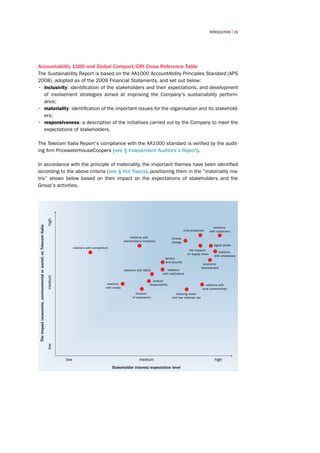
In accordance with the principle of materiality, the important themes have been identified
according to the above criteria (see § Hot Topics), positioning them in the “materiality ma-
trix” shown below based on their impact on the expectations of stakeholders and the
Group's activities.
                                                                   high
The impact (economic, environmental or social) on Telecom Italia


                                                                                                                                                                                            relations
                                                                                                                                                                    child protection     with customers
                                                                                                                           relations with                 climate
                                                                                                                       shareholders/investors             change
                                                                                                                                                                                           digital divide
                                                                                  relations with competitors
                                                                                                                                                                        the impacts
                                                                                                                                                                                               relations
                                                                                                                                                                       on supply chain
                                                                                                                                                                                            with employees
                                                                                                                                                     privacy
                                                                                                                                                     and security
                                                                                                                                                                                  economic
                                                                                                                                                                                 development
                                                                                                                       relations with NGOs             relations
                                                                                                                                                   with institutions
                                                                   medium


                                                                                                                                           product
                                                                                                          relations                      responsibility                              relations with
                                                                                                          with media                                                              local communities
                                                                                                                               freedom                      reducing waste
                                                                                                                             of expression                and raw material use
                                                                   low


                                                                            low                                                  medium                                                     high
                                                                                                               Stakeholder interest/expectation level
26 | introduction


The following table gives indications of the chapters/paragraphs and pages which make
direct or indirect reference to the principles of the Global Compact and the respective GRI
indicators.


 Global Compact (GC) Princi-            GRI relevant        Related chapters/para-            Page
 ples                                   indicators          graphs                            number


 1. Businesses should support           HR1-7, LA4, LA7-    Reference and Governance,         17, 18,
 and respect the protection of          9, LA13, PR1, PR8   Codes, Charters and Values,       24, 28,
 internationally proclaimed human                           Reporting, Stakeholder Involve-   49, 77,
 rights in the areas of the respec-                         ment, Suppliers, The Commu-       91
 tive spheres of influence.                                 nity, Human Resources

 2. Businesses should make sure         HR1-7               References and Governance,        17, 18,
 they are not complicit, even indi-                         Codes, Charters and Values,       49, 91
 rectly, in human rights abuses.                            Suppliers, Human Resources

 3. Businesses should uphold the        HR1-3, HR5, LA4-5   Codes, Charters and Values,       18, 24,
 freedom of association of workers                          Reporting, Stakeholder In-        28, 91
 and the effective recognition of                           volvement, Human Resources
 the right to collective bargaining.

 4. Businesses should uphold the        HR1-3, HR7          Codes, Charters and Values,       18, 49,
 elimination of all forms of forced                         Suppliers, Human Resources        91
 and compulsory labour.

 5. Businesses should uphold the        HR1-3, HR6          Codes, Charters and Values,       18, 49,
 effective abolition of child labour.                       Suppliers, Human Resources        91

 6. Businesses should uphold            HR1-4, LA2, LA13    Codes, Charters and Values,       18, 28,
 the elimination of discrimination                          Stakeholder Involvement, Sup-     49, 91
 in respect of employment and                               pliers, Human Resources
 occupation.

 7. Businesses should support a         EC2, EN18, EN26     Hot Topics, Reporting, Stake-     20, 24,
 precautionary approach to envi-                            holder Involvement, Suppliers,    28, 49,
 ronmental challenges.                                      The Environment, 2010 and         55, 131,
                                                            2011 Results, and 2012            134
                                                            Objectives in the Appendix

 8. Business should undertake           EN3, EN5-6, EN8,    Stakeholder Involvement,          28, 49,
 initiatives to promote greater         EN16-19, EN22-      Suppliers, The Environment,       55, 131,
 environmental responsibility.          23, EN26-29, PR3    2010 and 2011 Results,            134
                                                            and 2012 Objectives in the
                                                            Appendix

 9. Businesses should encourage         EN5-7, EN18,        Hot Topics, Reporting, The        20, 24,
 the development and diffusion of       EN26                Environment, The Community        55, 77
 environmentally friendly technolo-
 gies.

 10. Businesses should work             SO2-4               References and Governance,        17, 18,
 against corruption in all its forms,                       Codes, Charters and Values,       49, 113
 including extortion and bribery.                           Suppliers, Shareholders


The Content Index, which is one of the documents according to which the Group is exam-
ined for the purpose of obtaining the rating, is available in the sustainability section of the
telecomitalia.com website, as well as the Application Level Table which reports GRI require-
ments for the different Application Levels.
Since 2008, Telecom Italia has had an A+ GRI Application Level for its sustainability re-
porting.
introduction | 27


8. 2011 Results and 2012 Objectives

These are shown in the Appendix to this Report.
The targets of a qualitative nature for suppliers are included in the respective chapter.


9. The Group Sustainability Department

Mission and structure
Sustainability management in Telecom Italia is ensured by the Group Sustainability section
which carries out the following activities:
•	 promoting projects and initiatives at Group level with environmental and social impact,
   collaborating with the company departments which have operational responsibility for
   them;
•	 contributing to the dissemination of a correct approach to sustainability within the com-
   pany, under the perspective of continuous improvement;
•	 ensuring the reporting to the outside of the activities of sustainability carried out;
•	 managing relations with specialised rating agencies for the purpose of admission to
   stock market sustainability indexes;
•	 representing the Group in the relevant national and international forums.

Since 2009, this section has been operating as part of the External Relations manage-
ment department in order to ensure more structured communication of the initiatives un-
dertaken and the results achieved.

The organisational structure is shown below.


                                                                                                   BOARD OF DIRECTORS
                                            CHAIRMAN AND CEO
                                                                                       COMMITTEE FOR INTERNAL CONTROL
                                                                                         AND CORPORATE GOVERNANCE
                                           EXTERNAL RELATIONS
                                               DEPARTMENT                                           Supervision on sustainability issues


                                                   GROUP
                                                SUSTAINABILITY


        SUSTAINABILITY REPORTING                                     RELATIONS WITH RATING AGENCIES


                       In each department/BU, data owners are responsible for monitoring the activities
                                and gathering data and information for sustainability reporting
28 | introduction


The guidelines
The management of sustainability within the Telecom Italia Group is based on the follow-
ing guidelines:
•	 inclusion of a summary of the sustainability data within the Financial Statement, con-
   firming the Group’s determination to present its financial performance jointly with non-
   financial information;
•	 collaboration with the stakeholders through projects and initiatives at various levels
   (see § Stakeholder Involvement);
•	 definition of quantitative objectives in line with the major sustainability issues (see Ap-
   pendix);
•	 integration between sustainability and innovation: a specific section is dedicated to is-
   sues of business responsibility within the technological plan, the document in which the
   Company defines its strategy in terms of the evolution of the transmission network;
•	 confirmation of the international commitments on matters of sustainability, including
   adherence to the Global Compact;
•	 contribution to projects and initiatives on a national and international basis, including
   those implemented by industry organisations (see § Introduction/Communication of
   non-financial performance and § The Environment/Environmental performance);
•	 adherence to the main international standards on matters of sustainability (see § Refer-
   ences and Governance and § Reporting);
•	 continuous improvement of its own performance, including through benchmarking with
   peers;
•	 contribution to the spread of a correct approach to sustainability issues by means of
   communication initiatives organised within the Company and externally (see § The Envi-
   ronment/Communicating sustainability).


10. Stakeholder Involvement

Stakeholder involvement, which includes listening to their requests, is one of the pillars of
Telecom Italia's sustainability model.
During 2010, the Sustainability Report was submitted to a multi-stakeholder panel to
measure their satisfaction and the extent to which it fulfilled their expectations. The sug-
gestions for improvement, which were also implemented in the previous Report, have re-
sulted in an increased degree of conciseness and a different graphic design to improve its
legibility and usability.

In order to make the Group Sustainability managers easier to contact and therefore facili-
tate dialogue with stakeholders on matters of greatest interest, all the necessary details
have been added to the contacts area in the sustainability section of the telecomitalia.
com website. During the course of 2011, the groupsustainability@telecomitalia.it mailbox
received around 250 emails, all of which were considered for the purpose of any response
required.

The following table shows the main initiatives in which stakeholders were involved in com-
pany processes, classified according to the guidelines recommended by AccountAbility
(see Reporting), except for the initiatives relating to Competitors and Institutions, details
of which can be found in the sustainability section of the telecomitalia.com website.
introduction | 29


                                                                       INITIATIVES
                           INFORMATION              CONSULTATION                DIALOGUE                      PARTNERSHIP
               Customers   Notification to the      Customer satisfaction       Collaboration with the        Participation in national
                           customers of offers      is surveyed systemati-      consumer associations         and international work-
                           and conditions through   cally (Customers/Cus-       (Customers/Concilia-          ing groups, in partner-
                           various methods          tomer Satisfaction)         tion Procedures)              ship with UN agencies,
                           (Customers/Communi-                                                                non-governmental
                           cation with customers                                                              organisations, and
                           at telecomitalia.com)                                                              organisations in the
                                                                                                              sector, on the issue of
                                                                                                              protecting children from
                                                                                                              potential abuses car-
                                                                                                              ried out via the Internet
                                                                                                              (Customers/Child pro-
                                                                                                              tection at telecomitalia.
                                                                                                              com)

                           Information on the                                   Use of web-based tools        Partnership projects
                           rules for the safe use                               on social networks by         with institutions and
                           of the Internet and                                  call centre operators to      other companies to
                           for combating abuses                                 talk to customers             test and create in-
                           through the Internet                                 (Customers/Quality of         novative assistance
                           (Customers/Child                                     service)                      services
Stakeholders


                           protection)                                                                        (Customers/Innovative
                                                                                                              services)

                                                                                Employee awareness-
                                                                                building activities con-
                                                                                tinued on aspects of
                                                                                the Customer Promise
                                                                                in order to ensure its
                                                                                implementation within
                                                                                the Company
                                                                                (Customers/Quality of
                                                                                service)

               Suppliers                            Fifth survey of satisfac-   E-community of the            CSR audit activities
                                                    tion with the Purchas-      main suppliers through        conducted in the
                                                    ing department, and         the “TelecHome” web-          production plants of
                                                    more generally with Tel-    site accessible through       suppliers and sub-
                                                    ecom Italia, conducted      the suppliers’ portal         suppliers based on
                                                    among the Group’s           (Suppliers/Involvement        the Memorandum of
                                                    main suppliers              initiatives)                  Understanding signed
                                                    (Suppliers/Involvement                                    with other operators
                                                    initiatives)                                              (Suppliers/Sustainabil-
                                                                                                              ity checks)

                                                    Self-assessment ques-
                                                    tionnaire sent to the
                                                    most risky suppliers in
                                                    terms of sustainability
                                                    (Suppliers/Involvement
                                                    initiatives
30 | introduction


                                                                        INITIATIVES
                             INFORMATION               CONSULTATION               DIALOGUE                   PARTNERSHIP
               The           “Carbon Meter” avail-                                Collaboration with         Co-siting agreements
               Environment   able on AVoiComu-                                    other European Tlc         with the other Italian
                             nicare                                               operators on issues        Tlc operators
                             (The Environment/Com-                                of environmental           (The Environment/
                             municating sustain-                                  relevance within the       Energy)
                             ability)                                             framework of industry
                                                                                  associations, including
                                                                                  GeSI and ETNO
                                                                                  (The Environment/
                                                                                  Relevant stakeholders,
                                                                                  and Climate change)

                             External and internal                                Contributions to the
                             sustainability com-                                  Working Groups pro-
                             munication initiatives                               moted by the EU and
                             carried out                                          ETNO in defining the
                             (The Environment/Com-                                Code of Conduct on
                             municating sustain-                                  broadband equipment
Stakeholders


                             ability)                                             and data centres
                                                                                  (The Environment/
                                                                                  Energy)

               The           Correct information to    Consultation with          The “Safe Browsing”        Projects carried out in
               Community     stakeholders provided     stakeholders as part       tour involved over         partnership with non-
                             via the traditional me-   of the analysis and        100,000 people in Ital-    governmental and civil
                             dia and the Group's       definition of potential    ian cities on subjects     society organisations,
                             website                   initiatives and projects   related to safe Internet   particularly through the
                             (Community/Media          for the protection of      browsing                   Telecom Italia Founda-
                             relations and communi-    historic and artistic      (The Community/Re-         tion
                             cation projects)          heritage by the Telecom    sponses to stakehold-      (The Community/Re-
                                                       Italia Foundation          ers)                       sponses to stakehold-
                                                       (The Community/Re-                                    ers)
                                                       sponses to stakehold-
                                                       ers)

                                                                                  The AVoiComunicare
                                                                                  integrated communica-
                                                                                  tion project fosters
                                                                                  discussion about social
                                                                                  matters
                                                                                  (The Community/Media
                                                                                  relations and commu-
                                                                                  nication projects, and
                                                                                  telecomitalia.com)
introduction | 31


                                                                         INITIATIVES
                           INFORMATION                CONSULTATION                 DIALOGUE                      PARTNERSHIP
               Human       Internal communication     Archimede” project          Mailboxes, Intranet,          Selection and training
               Resources   activities                 (Human Resources/            blogs, virtual com-           programmes carried out
                           (Human Resources /In-      Listening projects and       munities, multimedia          with research centres,
                           ternal communication)      activities)                  conventions to commu-         universities, associa-
                                                                                   nicate with employees         tions and foundations
                                                                                   (Human Resources/             (Human Resources/
                                                                                   Listening projects and        Selection)
                                                                                   activities)

                           Courses on health and      Initiatives carried out by   Numerous informa-             The activities of the
                           safety matters             the People Caring Cen-       tion and discussion           Industrial Relations
                           (Human Resources/          tre to fulfil the require-   sessions organised            School, a network of
                           Health and Safety)         ments of employees           with trade unions on          professionals from
                                                      (Human Resources/            matters of interest           the world of business,
                                                      People Caring)               (Human Resources/             institutions and trade
                                                                                   Industrial Relations)         unions continued
                                                                                                                 (Human Resources/
                                                                                                                 Training)

                                                      Initiatives to improve       Counselling service for       Volunteering initiatives
                                                      the management of di-        dealing with personal         with the involvement of
                                                      versity in the company       difficulties or problems      employees and external
                                                      (Human Resources/            at work experience by         partners
                                                      People Caring)               employees                     (Human Resources/
Stakeholders


                                                                                   (Human Resources/             People Caring)
                                                                                   People Caring)

                                                      Involvement of em-                                         The “I care about my-
                                                      ployees in the stress                                      self” project continued
                                                      at work assessment                                         with the main trade
                                                      programme                                                  unions, which allows
                                                      (Human Resources/                                          employees to sign up
                                                      Health and Safety)                                         free of charge to some
                                                                                                                 of the faculties of the
                                                                                                                 Uninettuno Internation-
                                                                                                                 al Telematic University
                                                                                                                 (Human Resources/
                                                                                                                 Training)

               Share-      The “TI Alw@ys ON”                                      Three monthly confer-         Phase 2 of the sustain-
               holders     (telecomitaliaclub.                                     ence calls, meetings at       ability performance as-
                           it) shareholders' club                                  institutional offices of      sessment project mod-
                           provides important                                      the Group (reverse road       erated by CSR Europe
                           information to indi-                                    shows), participation         and EABIS has been
                           vidual investors and the                                in sector conferences,        launched. Telecom
                           general public                                          making a total of             Italia acts as co-leader
                           (Shareholders/Finan-                                    around 300 investors          with other multinational
                           cial communication)                                     meetings                      companies
                                                                                   (Shareholders/Finan-          (Introduction/Commu-
                                                                                   cial communication)           nication of non-financial
                                                                                                                 performance)

                           Online financial com-
                           munication
                           (Shareholders/Finan-
                           cial communication)
32 | introduction


                                       11. Economic value generated and distributed

2
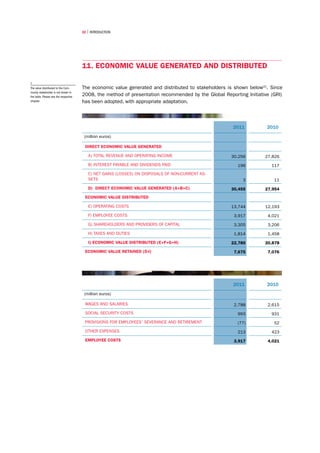
The value distributed to the Com-      The economic value generated and distributed to stakeholders is shown below(2). Since
munity stakeholder is not shown in
the table. Please see the respective
                                       2008, the method of presentation recommended by the Global Reporting Initiative (GRI)
chapter.                               has been adopted, with appropriate adaptation.


                                                                                                       2011          2010
                                        (million euros)

                                        Direct economic value generated

                                          a) Total revenue and operating income                       30,256        27,826
                                          b) Interest payable and dividends paid                         196           117
                                          c) Net gains (losses) on disposals of non-current as-
                                          sets                                                             3            11
                                          d) Direct economic value generated (a+b+c)                  30,455        27,954
                                        Economic value distributed

                                          e) Operating costs                                          13,744        12,193
                                          f) Employee costs                                            3,917         4,021
                                          g) Shareholders and providers of capital                     3,305         3,206
                                          h) Taxes and duties                                          1,814         1,458
                                          i) Economic value distributed (e+f+g+h)                     22,780        20,878
                                        Economic value retained (d-i)                                  7,675         7,076


                                                                                                       2011          2010
                                        (million euros)

                                        Wages and salaries                                             2,788         2,615
                                        Social security costs                                            993           931
                                        Provisions for employees’ severance and retirement               (77)           52
                                        Other expenses                                                   213           423
                                        Employee costs                                                 3,917         4,021
introduction | 33


                                                                                                                               2011                         2010
    (million euros)

    Acquisition of external goods and services                                                                                12,842                      11,371
    Other operating costs                   (*)
                                                                                                                                1,527                       1,234
    Change in inventories                                                                                                          (56)                         135
    Internally generated assets                                                                                                  (569)                        (547)
    Operating costs                                                                                                           13,744                      12,193

*
Mainly includes write-downs and charges connected to the management of non-financial credits of 533 million euros (478 million euros in 2010), accruals for risks of
128 million euros (80 million euros in 2010), and contributions and fees for the performance of Tlc activities of 675 million euros (484 million euros in 2010) net of
“Other taxes and duties” of 349 million euros (200 million euros in 2010) included in the item “Taxes and duties”.


                                                                                                                               2011                         2010
    (million euros)

    Dividends distributed                                                                                                       1,257                       1,064
    Interest payable                                                                                                            2,048                       2,142
    Shareholders and providers of capital                                                                                       3,305                       3,206


                                                                                                                               2011                         2010
    (million euros)

    Income taxes                                                                                                                1,465                       1,258
    Indirect taxes and duties                                                                                                      349                          200
    Taxes and duties                                                                                                            1,814                       1,458
      regarding Italian activities                                                                                              1,177                       1,240
      regarding activities abroad                                                                                                  637                          218
Offering


                 improving people’s quality of life


1. Customers


1.1 Strategy

The companies of the Telecom Italia Group base the excellence of their products and serv-
ices on their care of customers and their willingness to meet their requirements. The ob-
jective sought is to ensure an immediate, effective response to customers’ needs, model-
ling conduct on business propriety, transparency in dealings and contractual commitments,
courtesy and collaboration and the underlying viewpoint that the customer has a central
role, in full compliance with the principles established by company procedures. In such a
context, collaboration with Consumer Associations, through the stipulation of agreements
in specific areas, is highly prized.


1.2 Relevant stakeholders

The relevant stakeholders are:
•	 consumer customers (residential), with particular attention to customers with special
   needs (the disabled, the elderly, children, etc.);
•	 business and top customers (major clients);
•	 the consumer associations.
38 | external stakeholders | CUSTOMERS


                        1.3 Quality of the service

                        Customer focus and the achievement of high standards of customer satisfaction continue
                        to be a priority for Telecom Italia which, having listened to its major stakeholders (custom-
                        ers, employees, institutions), has drawn up a customer promise based on:
                        •	 an all-round provision of high quality and reliability;
                        •	 services which improve the quality of life of customers and contribute to the develop-
                            ment of the country;
                        •	 offers and communications in clear, simple and direct language to win and maintain the
                            trust of customers;
                        •	 a company which is close to its customers, values human relationships and is easy to
                            talk to when problems connected to the service need to be resolved;
                        •	 people who listen to and understand the needs of the customer, with whom they build
                            a partnership.
                        The undertakings contained in the “customer promise” are guiding many initiatives, in-
                        cluding the “Expressing Quality” programme for awareness-building among employees.
                        Launched in 2009, with the involvement of managers, including area/local unit and cus-
                        tomer contact team managers, the programme was completed in 2011 with a series of
                        further initiatives, details of which can be found on the telecomitalia.com website.
                        Top Management oversees the quality aspects of customer listening activities via the Qual-
                        ity Governance Steering Committee (SCQG), which meets monthly and is chaired by the
                        CEO, with the aim of:
                        •	 directing and supervising the initiatives and activities aimed at improving the quality of
                            the processes end-to-end;
                        •	 monitoring the quality results achieved and analysing them also in relation to the qual-
                            ity requirements demanded by the supervisory authorities, the most important/recur-
                            ring complaints by customers and, more generally, the feedback coming from all stake-
                            holders;
                        •	 supervising the quality certification process during the launch of new products/services
                            offered to customers, in particular those of greatest impact in terms of image and com-
                            petitive positioning on the market.


Use of social                              Group's official pages and accounts        Telecom Italia also uses web tools

networking                                 and through 9 Twitter accounts. This
                                           service is on Facebook: the customer
                                                                                      based on the social networking con-
                                                                                      cept to develop and support the peo-
in customer care                           accesses the Facebook page to re-          ple working in customer care. These
                                           quest support and is subsequently          provide effective assistance, both for
                                           contacted by various means depend-         disseminating and sharing knowledge
At the end of 2010, Telecom Italia was     ing on the problem to be solved, while     among staff and for making the most
the first company in Italy to launch a     the Twitter service is based on direct     of informal knowledge resulting from
social caring service providing direct     contact with an assistant.                 discussions held in forums in order
customer support via social networks       One year since the initiative was          to build on know-how and integrate
(Facebook and Twitter) allowing direct     launched, Telecom Italia is the leader     it into operational processes. For in-
interaction with customers and a high      in social caring services in Italy, with   formation about these tools (Cam-
speed of response.                         a growing monthly average of over          pus and TUO) go to the sustainabil-
A specialised team answers custom-         1,000 reports dealt with every month       ity section of the telecomitalia.com
er queries and reports both via the        and a 96% rate of cases resolved.          website.
CUSTOMERS | external stakeholders | 39


1.4 Customer satisfaction


Customer listening at Telecom Italia
Telecom Italia has developed a plan for listening to customers that allows the quality of the
service offered and the customer experience to be assessed in the various interactions
between the customer and the company, from a recent contact (e.g. to activate a connec-
tion, ask for information or report a fault) to an overall perception over time. The results
are used in an ongoing offer improvement process with the aim of providing services that
are ever more responsive to customer needs.
The listening system was extended in 2011 and structured into 6
areas:                                                                  IN 2011 THE LISTENING SYSTEM
•	 operational processes and events assessed on a “reactive” ba- WAS EXTENDED
   sis, i.e. immediately after a specific event (e.g. delivery, assur-
   ance, sale, sales support);
•	 touch point which are the customer contact channels (e.g. points of sale, customer
   care, web, billing);
•	 key products and services, e.g. fixed and mobile broadband, smartphones;
•	 lifecycle, monitored during the stages that characterise the customer's relationship with
   his/her operator;
•	 intangible issues that have a cross-cutting impact on customer satisfaction (e.g. inno-
   vation);
•	 overall perception measured on a “reflective” basis, i.e. not connected with a specific
   event. The indicator used is the Customer Satisfaction Index (CSI) which, by adopting in-
   ternational statistical survey standards (ACSI model), measures the perception of qual-
   ity according to the main satisfaction drivers in the different types of customer (fixed
   consumer, mobile consumer, fixed business, mobile business, top clients, public sector)
   and the similar services provided by the leading competitors. During 2011, a new CSI
   measurement model was introduced that takes further dimensions into account (e.g.
   socio-cultural variables, local context, etc.). In December 2011, Telecom Italia obtained
   from IMQ-CSQ a Certificate of Conformity of its Customer Satisfaction Index (CSI) meas-
   urement process with the requirements of the UNI 11098-2003 standard (Guidelines
   for determining customer satisfaction and for measuring the respective process indica-
   tors).

The CSI values of Telecom Italia by type of customer are shown below. The data relating to
2010 have therefore been recalculated in order to make them comparable to 2011.


    Customer type(*)

                                                                                                                              2011           2010
    CONSUMER                                                                                                                  74.24          73.86
    BUSINESS                                                                                                                  62.98          62.10
    TOP CLIENTS                                                                                                               68.40          67.19
    PUBLIC SECTOR                                                                                                             71.91          71.34
    TOTALS                                                                                                                    70.86          70.38
*
Average satisfaction is measured on a scale of 0-100, where 0 means “not at all satisfied” and 100 means “completely satisfied”.
40 | external stakeholders | CUSTOMERS


The information in the following table refers to the average annual progressive value of to-
tal customer satisfaction with Telecom Italia's customer care service.


    Type of customer care customer

                                                                                                                       Overall satisfaction(*)
                                                                                                                              2011           2010
    187 consumer fixed telephony                                                                                               8.32              7.39
    119 consumer mobile telephony                                                                                              8.56              8.33
    191 business fixed telephony                                                                                               7.06              6.72
    191 business mobile telephony                                                                                              7.13              6.47
*
Average satisfaction measured on a scale of 1-10, where 1 means “not at all satisfied” and 10 means “completely satisfied”.


For information on the satisfaction measurement indexes used in Brazil and Argentina, go
to the sustainability section of the telecomitalia.com website.


Customer satisfaction within the managerial incentives scheme
The targets set for all the employees included in Telecom Italia’s short term management
incentives scheme include targets linked to customer satisfaction, in line with the busi-
ness plan for the period. The targets are measured using customer satisfaction indexes
monitored by means of periodic “reflective” surveys: the overall CSI for the company and
the specific customer satisfaction indicators per customer segment.
Additional targets are set for particularly critical processes and activities (commercial and
technical front-end) based on quality parameters measured by “reactive” surveys.


Customer satisfaction within collective incentives schemes
Telecom Italia’s collective incentives schemes also include a target linked to customer sat-
isfaction. In particular, the performance-related pay award for employees not covered by an
individual incentive scheme, incorporates both a total customer satisfaction target across
the whole company and specific targets for the organisational structures responsible for
different customer categories.


1.5 Certifications

For areas of the company that have a significant impact on the Community, through the
products and services offered, the Group has obtained certifications that ensure the adop-
tion of procedures and conduct in line with the expectations of the relevant stakeholders.
Specifically:
•	 care for the customer and the quality of the products and services offered is considered
   in the UNI EN ISO 9001:2008 standard;
•	 concern for environmental protection in the UNI EN ISO 14001:2004 standard;
•	 health and safety at work in the BS OHSAS 18001:2007 standard;
•	 the protection of human capital by companies and their suppliers in the SA 8000 stand-
   ard;
CUSTOMERS | external stakeholders | 41


•	 data security in the ISO 27001:2005 standard ;
•	 Information Technology services with the ISO/IEC 20000-1:2005 standard;
•	 the quality of call centre services in the EN 15838:2010 standard;
•	 software and IT solution production processes in the CMMI-DEV (Capability Maturity
   Model Integration - Development) certifications;
•	 service management and delivery processes through the CMMI-SVC (Capability Maturity
   Model Integration for Services) certification.

Detailed information about the certifications achieved by the various departments/com-
panies of the Group is available in the sustainability section of the telecomitalia.com web-
site.


1.6 Digital Divide

The spread of information and communication technology creates considerable opportuni-
ties for progress for the public. Telecom Italia is aware of the need to manage this devel-
opment in the best way, taking on the responsibility for coordinating the actions of all the
players in the broadband ecosystem, in order to avoid exposing the Community to the risk
of a technological divide due to geographic and socio-cultural reasons.


Geographical Digital Divide
In order to deal with the technological divide generated in the so-called marginal areas of
Italy, which would otherwise be excluded from the ordinary plans of telecommunication
operators, because of the low return on investments, over the years Telecom Italia has
implemented an exceptional investment programme aimed at providing ADSL coverage
of up to 640 k/bit in some of these areas. Telecom Italia has also established coopera-
tion agreements with several Regions and Provinces in order to reconcile its corporate
objectives (financial, business and institutional) with those of local authorities, both by
activating public tender procedures approved by the EU to finance work using public in-
centives and by signing memorandums of understanding with local institutions for the
purpose of simplifying the installation of networks and encouraging their use by citizens
and local authorities.
As of December 2011, the gross coverage of Telecom Italia's ADSL services, meaning the
percentage of lines connected to exchanges where the ADSL service has been activated
with a speed of up to 7 Mbit/s, reached 97.1% of the telephone population.
For the purpose of local investments, there are two main forms of cooperation with the Re-
gions: the first is “contributive” (the so-called “claw-back” method), based on direct finan-
cial incentives (in accordance with the regulatory framework in matters of State Aid), the
second is “collaborative,” based on supporting potential demand.

Specifically:
•	 the claw-back model is used by the EU to speed up the dissemination of broadband in
   market failure areas. The model provides for the allocation of contributions to compen-
   sate for the lack of a return on investments, disbursed on the basis of a public tender.
   This model has been used in the past by the regions of Sardinia and Tuscany and is cur-
   rently being implemented in Lombardy.
•	 The collaborative model includes some of the main agreements signed by Telecom Italia
   during 2011, including the Memorandum of Understanding with the Autonomous Prov-
   ince of Trento.
42 | external stakeholders | CUSTOMERS


                          •	 The collaboration agreements launched in 2011 also include those signed with the
                             Province of Lucca, which has allowed broadband coverage to be provided in a number of
                             industrial districts, and with the Province of Bolzano, according to which all the munici-
                             palities of Aldo Adige will have access to broadband services using fibre optic technol-
                             ogy by 2013.


                          Socio-cultural Digital Divide
                          In a world in which technology facilitates contact among people, Telecom Italia is making
                          a contribution to breaking down the socio-cultural barriers that restrict the opportunity to
                          take part in the information society, allowing people to enjoy its benefits. The innovative
                          services aimed at promoting the digitisation of important areas of activity (e.g. healthcare)
                          include those listed in the following paragraph.
                          For information regarding the initiatives implemented by Telecom Italia for the social inclu-
                          sion of customers with specific needs (the elderly, children, etc.) see § The Community.


                          1.7 Innovative services


                          Smart Services
                          In the context of services aimed at the public sector, in 2011 Telecom Italia continued to
                          implement its Smart Services, a family of services intended to provide a global response
                          to local and urban requirements for the purpose of improving quality of life. They are in-
                          tended to promote the “smart cities” model through the development of innovative digital
                          services that can improve key areas for municipalities, such as energy efficiency, environ-
                          mental monitoring, security, public communication and tourism promotion.


Smart Town                        Smart Building                     Smart School                       Smart Hospital
Integrated management of lo-      Smart management and               Management of school build-        Management of services
cal infrastructure networks.      automation of offices.             ings.                              and consumption in hospital
Enabled services:                 Enabled services:                  Enabled services:                  buildings and care given to
•	planning of electricity con-    •	monitoring and reduction of      •	classroom computerisation        hospitalised patients.
  sumption and maintenance;         consumption (electricity, wa-      with PCs for students con-       The services delivered are:
•	video surveillance;               ter, etc.), mainly for central     nected to interactive smart      •	monitoring of consumption,
•	digital communication with        government bodies;                 boards;                            lighting systems, security
  citizens and users in gen-      •	video surveillance;              •	extension of the building's        and heating systems;
  eral (e.g. tourists);           •	digital communication;             LAN using low infrastructure     •	remote video calling ser-
•	Wi-Fi hot spots (broadband      •	extension of the IT network        impact technologies;               vices and Internet access
  access);                          (LAN) of buildings by using      •	administrative and school          for hospitalised patients;
•	remote management and             the electricity network via a      management;                      •	healthcare services for
  monitoring of gas meters;         device that connects to the      •	distance learning using web        nurses (video calling, video
•	planning, management and          power socket.                      cams and microphones.              surveillance of patients and
  monitoring of waste collec-                                          Allows lessons to be at-           computerised management
  tion;                                                                tended remotely as well as         of clinical records).
•	outsourcing of public light-                                         recorded, filed and viewed
  ing services provided by                                             later;
  local authorities.                                                 •	management of power
                                                                       consumption and monitor-
                                                                       ing of utilities in the school
                                                                       building.
CUSTOMERS | external stakeholders | 43


e-health Services
Telecom Italia is actively involved, either
alone or in partnership with other compa-              MyDoctor@Home
nies and organisations, in devising and de-
veloping healthcare services at national, re-
gional and local level. The services, which            This allows patients suffering from chronic illnesses, or in post-
are directed at improving the quality and ef-          hospital care, to monitor their physiological parameters (body
fectiveness of healthcare, with positive ef-           weight, blood pressure, heart rate, blood oxygen levels, glycae-
fects on the lives of individuals and envi-            mia, lung capacity, electrocardiogram, etc.) directly from their own
ronmental sustainability as a result of the            homes or in properly equipped facilities (health centres, pharma-
reduction in local travel, allow doctors, nurs-        cies, doctors’ surgeries etc.). The system consists of a techno-
es and patients to perform many different              logical platform and software configured on the patient's mobile
activities remotely.                                   phone (or alternatively a PC or tablet) and on the healthcare
The main applications already available or             personnel's PC. Based on the plans established by the doctor,
being developed include solutions for:                 patients receive reminders on their mobile phones regarding the
•	 the legal online storage of digital diag-           measurements to be taken, they take these measurements us-
   nostic images;                                      ing portable electro-medical devices equipped with a Bluetooth
•	 the management of healthcare, adminis-              interface and, using their phone, they send the measurement
   trative and logistical processes;                   automatically to the online platform.
•	 the management and coordination of op-              On February 1, 2012, the service was launched for patients in
   erational telephone exchanges dedicat-              the geriatrics department of the Molinette hospital (Turin) and
   ed to emergencies (118) and continuity              patients being cared for at home. This service will gradually be
   of assistance;                                      extended to the cardiology, neurology and haematology depart-
•	 remote healthcare monitoring (“MyDoc-               ments and to a number of internal medical departments. The
   tor@Home” and “MuoviTI”).                           solution is also expected to be adopted by other hospitals in the
                                                       Piedmont Region, which will be able to monitor up to 5,000 pa-
For other examples of e-health servic-                 tients in their homes.
es, go to the sustainability section of the
telecomitalia.com website.


MuoviTI
This is an experimental continuous remote monitoring application for people with motor
problems. It allows healthcare staff to monitor the amount of movement made by patients
even outside rehabilitation times and at home after they have been discharged. The as-
sumption is that this will allow daily doses of medicine to be adapted and the frequency of
hospital visits to be reduced.
The system uses sensors worn by the patient which process the data locally and send the
results to a mobile phone. The mobile phone runs algorithms that estimate movement and
recognise posture and the information regarding the patient's motor status are send to the
Telecom Italia remote monitoring platform to be read remotely by authorised personnel (doc-
tors, relations, carers, etc.).
The application is based on the SPINE framework, an open source project managed by Tel-
ecom Italia and developed in association with the academic world, particularly the University
of Calabria, the University of California in Berkeley and the University of Texas in Dallas.
44 | external stakeholders | CUSTOMERS


                   Energy@home
                   The “Energy@home” system is a prototype solution that integrates and allows communi-
                   cation between smart household appliances and will eventually do this for all domestic
                   electrical systems. It uses special sockets that monitor consumption and remotely con-
                   trol the power supply to the connected devices.
                   For consumers, the system consists of a kind of dashboard, a user interface available
                   on any device, including a tablet, PC, smartphone or television or - in a few cases – the
                   actual user interface on the household appliance. The dashboard provides consumers
                   with a full picture of their electricity consumption and costs and the effect of their CO2
                   emissions. The dashboard also makes suggestions that help consumers identify virtu-
                   ous behaviour and respond semi-automatically to market events (multi-hour electricity
                   rates) and system events (i.e. the need to reduce consumption peaks).
                   This is a joint project between Telecom Italia and other partners which aims to estab-
                   lish the rules for an ecosystem of connected electrical appliances, a system in which
                   “smart” household appliances will be able to manage themselves, regulating the elec-
                   tricity consumption of the whole house, avoiding peaks and network overloads, without
                   compromising user comfort. At the end of 2011, an experimental phase was launched to
                   test whether the solutions could be marketed on a large scale.


                   1.8 Child protection

                  The Group’s companies have undertaken numerous initiatives in order to protect children
                  from content that may harm their psychological and physical development (e.g. content
                  that is violent, racist, offensive to religious sentiment, pornography etc.).
                  The Telecom Italia Group adopts precise guidelines for classifying and checking distrib-
                  uted content. These cover both the content offered directly by Group companies and con-
                  tent owned by third parties offering their own services on space acquired within Telecom
                  Italia's portals. These guidelines are regularly updated to take account of new codes,
                  standards and platforms.
                  In Italy, in accordance with current regulations and codes of conduct signed by the Group,
                  filtering systems and procedures are implemented aimed at preventing children from ac-
                  cessing adult content on all the Group's service platforms (IPTV, web TV, generalist por-
                  tals, WAP services, television broadcasters).
                                            For services delivered by IP connection, the “Alice Total Security”
    MAXIMIZING THE POSITIVE ASPECTS software is available, which includes antivirus and anti-spyware
OF THE WEB AND MINIMIZING RISKS ARE services; parental control, firewall, advanced download protec-
       ONE OF THE GROUP’S PRIORITIES tion, anti-phishing, SPAM protection, wireless PC protection.
                                            For the purpose of combating crime and abuse, from an organi-
                  sational point of view, Telecom Italia has identified, within its Security (Risk Prevention/
                  Protection of Information) department, the role of “Key contact for the Postal Police”.
                  This professional manages relations, and the flow of information, with the Postal Police
                  (CNCPO - National Centre for the Fight against Child Pornography on line, CNAIPIC – Na-
                  tional Centre against Digital Crime for the Protection of Critical Infrastructure etc.) and
                  the competent authorities, and has the task of coordinating, within the Telecom Italia
                  Group, the process of abuse management in accordance with the relevant legislative
                  framework. Furthermore, the Telecom Italia Group has adopted an organisational model
                  in accordance with Legislative Decree 231/2001, which defines the tools required to
                  oversee and anticipate offences, particularly the dissemination of child pornography, as
                  well as to ensure the organisational/disciplinary management of computer crimes. For
                  this purpose, Telecom Italia has fielded resources, technologies, processes and instru-
CUSTOMERS | external stakeholders | 45


ments to prevent and combat “abuse”, meaning any activity committed in violation of the
rules of conduct and legislation that governs the use of network services, digital systems
or means of communication in general. In this respect, information initiatives have been
implemented, aimed at children, parents and teachers, on the risks connected with the
new technologies and navigation on the Internet (chat lines, instant messaging, forums,
communities etc.). These initiatives have involved a number of important public and pri-
vate stakeholders selected above all on the basis of their activities and commitment to
safeguarding the rights of children (including, for example, the Postal and Communica-
tion Police, Save the Children, Adiconsum, GSMA, ITU etc.).
The Group has also implemented appropriate filtering and abuse prevention systems for
services delivered in Brazil and Argentina. In particular, WAP services with adult content
require user authentication while the delivery of adult videos on IP platforms, which is
only available in on demand mode, requires a PIN to be entered and a parental control
code to be activated.
Telecom Italia's commitment to promote the right cultural approach to the subject and
prevent offences being committed translates into many initiatives, details of which can
be found in the sustainability section of the telecomitalia.com website.


1.9 Conciliation procedures

The conciliation procedure between Telecom Italia and the consumer associations who
signed the framework agreement for the out-of-court settlement of telephone disputes,
was the first example of joint conciliation in Italy. Introduced on a trial basis in 1991 by
SIP it was implemented throughout the country in 1993. In 1995 it was substantially rec-
   ,
ognised by the European Union as a “pilot project for consumer access to justice. The
model is still used today but has been adapted over the years to fulfil new requirements,
computerised and made easier to use, while maintaining the basic values that made it
such an excellent tool, contributing to improving the transparency of the system, cus-
tomer relations and a number of the Company's operational processes as well. Twenty
consumer associations have signed up to the conciliation agreement to date.
In 2009, Telecom Italia, in compliance with the voluntary undertakings given and approved
by the Italian Communications Authority (AGCOM) in December 2008, also started manag-
ing conciliation requests submitted by customers at the offices of Co.Re.Com and the
Chambers of Commerce, thus providing a “one stop shop” for contacts and replicating the
organisational model successfully applied for joint conciliations. This system allows cus-
tomers who do not wish to approach a consumer association to use an alternative method
for resolving their dispute through a streamlined and out-of-court procedure.
As for joint conciliations, the management of conciliations at the
offices of Co.Re.Com and the Chambers of Commerce is based THE ONE STOP SHOP AIMED TO SOLVE
on an approach that considers the needs of the customer and, DISPUTES HAS PROVED TO BE AN EFFECTIVE
regardless of the procedure selected, allows the customer's rela- TOOL, WELL APPRECIATED BY CUSTOMERS
tionship with the company to be improved.
The “one stop shop” model has thus far allowed the undertakings given to AGCOM to
be fulfilled and the qualitative and numeric targets to be achieved. In 2011, the number
of conciliation requests submitted to Co.Re.Com and Chamber of Commerce offices fell
by 14.3%. (from 21,681 to 18,585)(3). Of these applications, 87.8% were discussed in 3
that same year and 12.2% were cancelled (there are no received applications awaiting Consistent with the fall in the number
                                                                                             of joint conciliation requests received
discussion). The percentage of conciliation requests discussed at Co.Re.Com and Cham- in the same period (-13.6%, from
ber of Commerce offices and settled during the period (compared to the total number 7,095 to 6,246).
of applications discussed during the same period) was 87.5% (12.5% were not settled).
46 | external stakeholders | CUSTOMERS


                    Telecom Italia supported the conciliation activity by means of:
                    •	 seminars and joint training initiatives involving dedicated personnel from Telecom Italia,
                       AGCOM, Co.Re.Com and consumer associations;
                    •	 debates, conferences, interviews and other promotional activities involving senior man-
                       agement in order to disseminate the correct cultural approach to the subject.
                    The internal structure of the Customer Operations area was also consequently modified
                    in order to improve its operational and support capabilities.


                    1.10 Safeguarding privacy and personal data protection

                  In order to ensure personal data protection (Legislative Decree 193/03, known as the “Pri-
                  vacy Code) in the performance of its business activities, Telecom Italia has equipped itself
                  with an organisation model that assigns central departments the responsibility for super-
                  vising correct application of the regulations in this sector at Group level. In this context,
                  when it establishes or acquires new companies, the Parent Company provides the support
                  required to identify and carry out the formalities required to comply with the relevant legal
                  and regulatory provisions.
                  Legal provisions and the instructions of the Italian Data Protection Authority are transposed
                  by constantly updating the Group's regulations and policies. The “System of rules for the
                  application of privacy regulations in the Telecom Italia Group” is particularly significant in
                  this respect. It establishes the provisions and operating instructions needed to carry out
                  the relevant formalities.
                                           In order to ensure the dissemination and correct application of
PRIVACY ISSUES HAVE BEEN THE SUBJECT these rules, intensive training activities were also carried out in
      OF A WIDE TRAINING PROGRAMME 2011, in a series of 42 meetings involving around 1,400 manag-
                                           ers and representatives of central and peripheral departments.
                  The purpose of this programme was to disseminate a privacy culture and provide the
                  organisations involved with the operational tools needed to reconcile the pursuit of busi-
                  ness objectives with respect for laws and regulations. This programme mainly involved a
                  number of Customer Operations, Consumer, Business and Top departments of the Com-
                  pany, including some outsourcers and commercial partners in the “push” consumer and
                  business sales channels, focusing also on their Sales departments. Additional special-
                  ised activities related to the processing of telephone and electronic data transmission
                  traffic and the procedures for verifying personal data security measures.
                  During the course of 2011, Group policies regulating the technical requirements regard-
                  ing the security of IT systems that handle personal data were also reviewed amongst oth-
                  ers.
                  With regard to the handling of customers' personal data, Telecom Italia performed the
                  technical and procedural adjustments required to implement telephone marketing cam-
                  paigns in accordance with the new legal requirements (Law 166/2009 and Presidential
                  Decree 178/2010), which allow all users listed in the directory of subscribers to be con-
                  tacted by telephone without the need for prior consent, for the purpose of sending ad-
                  vertising material, direct sales, market research or business communications, subject to
                  the right of users to object to telemarketing by registering on the Public Register of Objec-
                  tions, which has been in operation since February 1, 2011.
                  The effective application of the regulations is monitored through a control system based
                  on regular self-assessment procedures by those responsible for handling the data, and
                  on sample checks carried out by the relevant central departments, based on procedures
                  and methodologies prepared with the contribution of the Group’s auditing firm.
                  Finally, pursuant to rule 26 of appendix B (technical rules regarding minimum security
CUSTOMERS | external stakeholders | 47


measures) of the Privacy Code, Telecom Italia declares that it has drawn up a Security
Programme Document [Documento Programmatico sulla Sicurezza (DPS)] for 2011. This
document describes the technical and organisational criteria adopted for the protection
of shared, sensitive and judicial personal data handled with computerised tools, as well
as the training plan for data handling staff.
Ensuring that products
  and services
  are purchased for the


  while fulfilling quality, safety
  and environmental protection
  requirements


2. Suppliers


2.1 Strategy

Within the Telecom Italia Group, the procurement process is aimed at the acquisition of
products and services under the best possible market conditions, at the same time guar-
anteeing the prerequisites of quality, safety and respect for the environment. The procure-
ment process is based on a competitive comparison of the technical/economic offerings
of suppliers who are selected on the basis of well-founded company procedures at Group
level and bearing the hallmark of ethical dealings.
The Group is committed to guaranteeing the quality of the procurement process and its
continual improvement, in the light, too, of sustainable procurement, by obtaining the re-
spective certification of quality.


2.2 Relevant stakeholders

The relevant stakeholders are the suppliers and sub-suppliers from which the Group ac-
quires goods and/or services.


2.3 General matters

The selection, assessment and control of Telecom Italia Group’s suppliers, for high risk
procurement sectors, involves a pre-contractual qualification stage in which the economic/
50 | external stakeholders | suppliers


financial and technical/organisational characteristics are assessed. Verification of these
characteristics leads to inclusion in the register of suppliers. The Group requires every
supplier to make a commitment, on behalf of the company in question and any authorised
sub-contractors, collaborators and employees, to observe the principles of ethics and
conduct contained in the Group’s Code of Ethics.
Registered companies which have received purchase orders normally undergo checks
during the supply period, including incoming quality control (a requirement for the accept-
ance and use of the purchased goods) and monitoring of the vendor rating (systematic
assessment of the supply).
The Supply Chain  Real Estate (SCRE) department is split into purchasing divisions
that focus on specific sectors, so as to provide accurate responses to the requirements
of internal customers and stakeholders. These expectations are constantly monitored
through surveys of both internal customers and suppliers in order to verify the quality of
the services delivered (see § Involvement initiatives).


2.4 Sustainability initiatives

The main initiatives implemented in 2011 are listed below.
•	 The process that establishes the activities aimed at improving the Corporate Social
   Responsibility (CSR) of the supply chain has been redesigned by introducing a more
   comprehensive system of elements used to assess the sustainability of suppliers dur-
   ing the qualification stages, incoming quality and vendor rating.
   The most significant aspects of the process include:
   ›› the creation of a self-assessment questionnaire for new suppliers during the qual-
      ification phase. The questionnaire was developed according to the main require-
      ments contained in the relevant standards for responsible corporate management
      relating to respect for ethical values and to safeguarding the environment (including
      SA 8000, Global Compact and ISO 14000) and to the best industry practices. The
      questionnaire will be updated periodically to reflect the results and evolution of the
      qualification process;
   ›› the classification of suppliers based on the potential risks associated with their
      sustainability performance, using a specific method which considers the socio-
      environmental and business continuity aspects associated with the purchase mar-
      kets to which the suppliers belong, classified according to parameters such as
      relevant geographical area, potential impact on the environment and the company
      of suppliers activities and of the products/services supplied throughout their life
      cycle, impact on the reputation of Telecom Italia as a customer. A matrix has been
      constructed that relates the spending in the specific purchase market with the risk
      index calculated on the basis of the parameters described, which has allowed pur-
      chase markets to be subdivided into four categories, identifying the most critical
      ones in terms of sustainability.
      Suppliers belonging to the most at risk categories will undergo CSR audits carried
      out by staff from the company or specialised third party companies. These audits
      will be repeated periodically, non only to monitor and ensure the implementation of
      corrective action, but also if results are positive, in order to verify that the standard
      of performance found by auditors is being maintained.
      The activities described are intended to promote the improvement of sustainability
      performance throughout the supply chain and to identify a category of sustainable
      purchases (sustainable procurement).
Suppliers | external stakeholders | 51


      The whole process is expected to come into full operation in 2012. For 2011, an ex-
      perimental questionnaire was sent out to around 70 significant suppliers identified
      by the method described above, which allowed around 44% of orders made in 2011
      by the Domestic Business Unit to be covered.
•	 In December 2011, the ISO 9001:2008 certificate of conformity of the “Quality Man-
   agement System” was confirmed for the Group's entire SCRE department, with spe-
   cific recognition for the initiatives taken in the field of sustainability. The certification
   required 27 department processes to be mapped, identifying 155 performance indica-
   tors that allow the management of services supplied to internal clients and suppliers
   to be monitored and improved. Furthermore, the ISO 14001 certification was confirmed
   for the facility and real estate service unit and infrastructure purchases.
•	 Application continued of the green procurement policy established in 2009, which con-
   tains guidelines for establishing the environmental requirements of products/services
   purchased.
   The policy covers all stages of the product life: design, production, use and end of life.
   Published on the supplier portal of Telecom Italia and in the sustainability section of
   the telecomitalia.com website, the document contributes to orienting purchasing poli-
   cies towards low environmental impact products and services.
   With a view to ensuring the ongoing improvement and greater involvement of suppli-
   ers, questions regarding the green procurement policy, and supplier adherence to the
   principles set out within it, have been included in the annual satisfaction survey (see
   § Involvement initiatives).


2.5 Sustainability checks

CSR verification activities continued in respect of common suppliers and sub-suppliers,
as required by the Memorandum of Understanding (MOU) signed by Telecom Italia, France
Telecom and Deutsche Telekom at the end of 2009. Belgacom, KPN, Swisscom and Voda-
fone have since also subsequently signed up to the Memorandum.
The objectives of the initiative, known as Joint Audit Cooperation (JAC), are:
•	 to verify the sustainability of the most important suppliers/sub-suppliers that are com-
   mon to the members of the JAC, with production plants located in geographical areas
   with the greatest socio-environmental risk. The verification is carried out by means of
   specific audits conducted by third parties using a method developed for this purpose
   by the JAC members themselves, who share the results of the verifications;
•	 to contribute to the increased sustainability of suppliers/sub-suppliers involved by iden-
   tifying and implementing corrective actions and ongoing improvement programmes, es-
   tablishing a long-lasting cooperation with reciprocal benefits in terms of efficiency, pro-
   ductivity and risk reduction in the context of the supply chain.
Thanks to the new members, JAC's area of influence now extends to 55 production sites
located in Asia, Central and South America, North Africa and Eastern Europe. During
2010-2011, 33 audits were carried out by specialised international companies, selected
by competitive tender, covering approximately 155,000 workers in total.
The suppliers included in the audit campaign conducted in 2011 belonged to the user
devices and appliances, network appliances and IT equipment production sectors.
52 | external stakeholders | suppliers


TOTAL NON-CONFORMITIES DETECTED: 132

 2                                                                                        2
 Discrimination                                                      Disciplinary Practices

 4
 Environment                                                                              1
                                                                             Forced Labour
 5
 Business Ethics

 14
 Wages
                                                                                        56
                                                                           Health  Safety


 13
 Child and juvenile work


                                                                                        35
                                                                             Working Hours

The most recurrent non-conformities relate to health and safety at work, working hours and
remuneration. A corrective action plan was drawn up for all the non-conformities encoun-
tered, establishing the resolution procedures and timetables. The implementation of these
procedures is monitored on a constant basis by the JAC members.
In total, the work allowed 57% of orders to be verified in the main areas of supply consid-
ered.


2.6 Involvement initiatives

•	 The new suppliers' portal (Vendors Hub) was launched during the year to improve com-
   munication and optimise operational processes, applying social networking systems to
   a business context.
   Suppliers are able to access a private area to view important data and events connect-
   ed to their relationship with Telecom Italia and manage all their own details, thus improv-
   ing the smooth operation and transparency of the relationship. The Vendors Hub also
   includes a public area containing information for potential suppliers.
   Documentation is exchanged electronically (e.g. offers, purchase orders, contracts,
   qualification documentation, surveys), thus reducing the environmental impact resulting
   from the use of paper and transporting of documents. The Vendors Hub has also been
   used to manage the self-assessment questionnaire (see § Sustainability initiatives).
•	 For the fifth year in a row, the Group’s main suppliers have been involved in satisfaction
   surveys regarding the Supply Chain  Real Estate department and, more generally, Tel-
   ecom Italia. The online questionnaire, consisting of 27 questions, remained active for 3
   weeks. The survey involved 1,132 suppliers with access to the Vendors Hub with a 48%
Suppliers | external stakeholders | 53


   response rate. The overall assessment of the supply relationship with the Telecom Italia
   Group achieved a score of 73/100, which is consistent with 2010 and shows a consoli-
   dation of the improvement recorded by the previous survey and the generally positive
   trend in the level of satisfaction recorded since 2008. The analysis of the distribution
   of satisfaction among the various classes shows an upward trend in the percentage of
   suppliers who state they are “satisfied” or “very satisfied.
•	 The two e-communities set up in previous years for suppliers in the civil infrastructure
   and network operations sectors, aimed at improving dialogue mainly regarding social
   and environmental sustainability, remain active.
   The activities of the e-communities mainly take place through a platform known as “Te-
   lecHome”. Developed in Web 2.0 logic, it contributes to the exchange of information and
   experiences within the e-community, in order to:
   ›› integrate the best operational practices adopted in specific subject areas;
   ›› publish the results obtained, in terms of the environmental/social certifications at-
      tained;
   ›› support voting campaigns on various initiatives.


2.7 2011 Results and 2012 Commitments


 Subject                  2011 commitments                     Status                          2012 commitments

 ISO 9001, ISO 14001      Maintaining TI Group's SCRE         Achieved                        •	Maintaining the SCRE depart-
 and ISO 50001 certifi-   ISO 9001 certifications and the                                        ment's ISO 9001 certifications
 cations                  ISO 14001 certification for infra-                                     and the ISO 14001 certification for
                          structure purchasing and service                                       infrastructure purchasing and the
                          unit facility activities, extended                                     service unit facility, extended to
                          to the same department's real                                          the same department's real estate
                          estate activities.                                                     activities.
                                                                                               •	Obtaining the ISO 50001 certifica-
                                                                                                 tion for the Energy Purchasing 
                                                                                                 Management department.

 E-community project      Development and maintenance          Achieved                        Maintenance of active e-communities
                          of active e-communities.

 Green Procurement        Continue monitoring purchases        The introduction of the         Continue developing of the supply
                          made with green criteria and         new supply chain sus-           chain sustainability verification and
                          increase their volume.               tainability process has         improvement process, in order to
                                                               brought these activities        progress from green procurement
                          Continue applying the “Product       out of the action plan          to the wider concept of sustainable
                          Lifecycle Evaluation Guidelines”     (see § Sustainability           procurement.
                          - (LCA) to the product families      initiatives).
                          already identified.

 Controls on suppliers    Continued application of the         Achieved                        Application of the self-assessment
                          Corporate Social Responsibility                                      questionnaire for new suppliers
                          check list to a representative                                       (see § Sustainability initiatives).
                          sample of suppliers.

                          Extension of auditing activities     Achieved                        Continuation of audit activities in the
                          to supplier production establish-                                    production plants of suppliers located
                          ments overseas.                                                      abroad in the context of the JAC
                                                                                               (see § Sustainability checks).
Contributing to a


                       through solutions based on Information
                       and Communication Technologies


3. The Environment

In Telecom Italia, environmental protection and energy efficiency are the two key areas for
the promotion of the sustainable development of the country. These include specific ac-
tions to manage and reduce the Company's impact and proposals for technological solu-
tions for people, businesses and public administration that contribute to creating a more
inclusive and viable digital society (see § Climate change).


3.1 Strategy

The environmental strategy of the companies of the Group is founded on the following
principles:
•	 optimising the use of energy sources and other natural resources;
•	 pursuing the continuous improvement of environmental performance by reducing nega-
   tive impacts and increasing positive ones;
•	 adopting procurement policies that take environmental issues into account;
•	 disseminating a culture that promotes a correct approach to environmental issues.
In order to ensure the effective and sustainable management of operational processes
characterised by particular environmental impacts, Telecom Italia has equipped itself with
an Environmental Management System (Sistema di Gestione Ambientale - SGA) which is
ISO 14001 certified.
In two call centres, this Environmental Management system has been integrated with the
Safety Management System based on the OHSAS 18001 standard, both having achieved
the respective certification.
Application of the procedures is verified by means of internal audits of company depart-
ments and external companies.
For further details on this subject see § Customers/Certifications.
56 | external stakeholders | The Environment


                                        3.2 Relevant stakeholders

                                        The environment stakeholder representative is identified as the future generations who are
                                        entitled to live in a world that is not compromised by the negative effects resulting from
                                        the development of previous ones. The interests of this collective person are identified in
                                        the demands made by:
                                        •	 national and international environmental organisations;
                                        •	 national and supranational institutions;
                                        •	 the community in general, particularly in the areas in which Telecom Italia operates;
                                        •	 industry associations and non-profit organisations dealing with issues relating to the
                                           environment. These include the following in particular: CSR Europe, European Academy
                                           of Business in Society (EABIS), European Telecommunications Network Operators’ As-
                                           sociation (ETNO) - in ETNO Telecom Italia chairs both the Association and the “Sustaina-
                                           bility” working group -, European Telecommunications Standards Institute (ETSI), Global
                                           e-Sustainability Initiative (GeSI), Carbon Disclosure Project (CDP), European Round Table
                                           of Industrialists (ERT), International Telecommunication Union (ITU).
                                        Telecom Italia is attentive to the demands expressed by stakeholders interested in pro-
                                        tecting the environment and has developed various channels of communication with them,
                                        including AVoiComunicare, the Festival of Science, the Venice Future Centre and the dedi-
                                        cated pages of the Group Intranet/Internet site, in addition to formal and informal meet-
                                        ings with these stakeholders.
                                        Telecom Italia also promotes and in some cases coordinates national and international
                                        projects on this issue.


                                        3.3 Environmental performance

                                        The information regarding environmental performance has been drawn from management
                                        data, some of which is estimated.
                                        The data given below covers energy, atmospheric emissions, water, paper, waste and elec-
                                        tromagnetic emissions.


                                        Energy
                                        Energy consumption by Telecom Italia S.p.A. and the Group is presented according to the
                                        Global Reporting Initiative’s guidelines (GRI – G3 guidelines) regarding direct consumption
4
                                        for heating and transport (Scope1 according to the GreenHouse Gas Protocol(4)) and indi-
The GHG Protocol (Greenhouse Gas        rect consumption for the purchase and use of electricity (Scope2).
Protocol Initiative), established in
1998 by the World Resources Institute
and the World Business Council for
Sustainable Development, supports
business in respect of greenhouse gas    Heating systems
emissions through calculation meth-
ods and studies aimed at promoting
innovation and accountability for                                                                         Changes %
climate change.
                                                                               Telecom Italia S.p.A.      2011               2011
                                                                                              2011     vs 2010            vs 2009
                                         Energy generated              MJ              120,177,570       3.12%               6.37%
                                         by heating oil

                                         Energy generated              MJ              437,290,915       0.25%             (36.54%)
                                         by natural gas

                                         Total energy for              MJ              557,468,485       0.86%            (30.49%)
                                         heating
The Environment | external stakeholders | 57


 Heating systems

                                                                 TI Group breakdown by Business Unit (%)
                               TI Group 2011       Domestic              Brazil       Argentina              Media   Olivetti
 Total energy for        MJ      689,155,125           87.85%            0.00%             3.71%             0.44%    8.00%
 heating


The data in the table relating to Telecom Italia S.p.A. show that, compared to 2010, con-
sumption for heating purposes has remained substantially unchanged and that consump-
tion has been falling significantly compared to 2009, when the large cogeneration plants
came into service. Installed in a number of Data Processing Centres, these plants produce
electricity and heat at the same time, resulting in a reduction in the purchase of fossil fuels
used exclusively to heat working environments.
In Brazil, the climate makes it unnecessary to heat indoor premises and in Argentina
heating is only required for short periods of time and primarily in the coldest areas of
the country.


ENERGY CONSUMPTION                               ENERGY CONSUMPTION
FOR HEATING (%)                                  FOR HEATING (%)
TELECOM ITALIA S.p.A.                            TELECOM ITALIA GROUP
 21.56%                                           0%
 Energy consumption                               Brazil
 of heating oil
                                                  8%
                                                  Olivetti

                                                  0.44%
                                                  Media

                                                  3.71%
                                                  Argentina
 78.44%
 Energy consumption
 of natural gas
 for heating                                      87.85%
                                                  Domestic
58 | external stakeholders | The Environment


     Vehicles

                                                                                                                           Changes %
                                                        Telecom Italia S.p.A.                                          2011                                  2011
                                                                       2011                                         vs 2010                               vs 2009
     Unleaded petrol                            l                           2,081,298                                (46.02%)                             (60.99%)
     consumption

     Diesel consumption                         l                         17,526,407                                   (2.38%)                               (0.86%)

     LPG consumption                            l                              238,606                                         (*)                                   (*)


     Total energy for                        MJ                        699,138,479                                    (8.53%)                             (12.84%)
     transport(**)
*
The amount of LPG used in 2009 and 2010 was negligible and was not recorded.
**
Represents conversion into Megajoules of the consumption of unleaded petrol, diesel and LPG expressed in litres.


    FOSSIL FUELS FOR VEHICLES                                                           ENERGY CONSUMPTION FOR
    TELECOM ITALIA S.p.A.                                                               VEHICLES - TELECOM ITALIA S.p.A.
                                                                                            0.00%
    1.2%
    LPG consumption
    for vehicles


    10.5%                                                                                  -5.00%
    Unleaded petrol
    consumption
    for vehicles                                                                                                  2011 vs 2010

    88.3%                                                                                -10.00%
    Diesel consumption
    for vehicles
                                                                                                                                              2011 vs 2009


                                                                                         -15.00%


     Number of vehicles and distance travelled(*)

                                                                                                                           Changes %
                                                        Telecom Italia S.p.A.                                          2011                                  2011
                                                                       2011                                         vs 2010                               vs 2009
     Total number of                        no.                                  19,243                                (3.33%)                               (8.66%)
     company vehicles

     Number of low-                         no.                                  18,968                                (3.34%)                               (8.75%)
     emission vehicles(**)

     Total distance                         Km                         306,714,162                                    (4.16%)                               (0.64%)
     travelled
*
The data shown in the tables and graphs relating to transport refer to all the Group's vehicles (industrial, commercial, used by executives/managers/sales engineers),
both owned and hired. The vehicles, consumption and distance travelled of vehicles owned or in use by the sales force of TIM Brasil and Telecom Argentina have been
included only where usage is significant and continuous.
**
Euro4 or higher standard vehicles fuelled by unleaded petrol, diesel and LPG, electric vehicles or vehicles running on other fuels with comparable or lower emissions.
The Environment | external stakeholders | 59


At Telecom Italia S.p.A., the significant containment of energy consumption for transport
is due partly to the reduction in the distance travelled and partly to the greater efficiency
achieved in managing the fleet of vehicles. Implementation of the policy to reduce and
modernise the fleet with vehicles that comply with more rigorous environmental stand-
ards was slower than expected in 2011, primarily because of budgetary restrictions, and
involved just 600 vehicles instead of the expected 2,500. This resulted in a failure to
achieve the target for reducing CO2 emissions by replacing vehicles (see § 2010 and 2011
Results in the Appendix).


    Number of vehicles and distance travelled(*)

                                                                                                               TI Group breakdown by Business Unit (%)
                                                       TI Group 2011                     Domestic                         Brazil            Argentina                       Media                    Olivetti
    Total number of                         no.                      23,901                   81.59%                      3.30%                   13.85%                      0.38%                    0.88%
    vehicles

    Total energy con-                        MJ            956,252,389                        74.36%                      4.43%                   19.01%                      0.74%                    1.46%
    sumed

    Total distance                          Km             386,246,821                        80.60%                      3.54%                   14.00%                      0.64%                    1.22%
    travelled


*
The data shown in the tables and graphs relating to transport refer to all the Group's vehicles (industrial, commercial, used by executives/managers/sales engineers), both owned and hired. The vehicles, consump-
tion and distance travelled of vehicles owned or in use by the sales force of TIM Brasil and Telecom Argentina have been included only where usage is significant and continuous


    TOTAL DISTANCE TRAVELLED
    TELECOM ITALIA S.p.A.
    0.00%
    -0.50%                                          2011 vs 2009

    -1.00%
    -1.50%
    -2.00%
    -2.50%
    -3.00%
    -3.50%
    -4.00%               2011 vs 2010
    -4.50%
60 | external stakeholders | The Environment


                    Consumption figures for electricity used to operate the telecommunication and civil/indus-
                    trial plants are shown below.


                        Electricity procured and produced

                                                                                                                                              Changes %
                                                                               Telecom Italia S.p.A.                                       2011                              2011
                                                                                              2011                                      vs 2010                           vs 2009
                        Electricity from                         kWh                      1,896,664,295                                   (6.28%)                            (9.40%)
                        mixed sources(*)

                        Electricity from                         kWh                           37,032,133                                 (7.91%)                          (13.79%)
                        renewable sources

                        Total electricity                        kWh                      1,933,696,428                                   (6.31%)                           (9.49%)


                    *
                    Electricity purchased from mixed sources is equal to 1,813 GWh approximately. Self-produced electricity from mixed sources is equal to 84 GWh approximately and re-
                    fers to the co-generation plants, with an associated consumption equal to 22 million m3 of methane. The production of electricity from continuous generators (not shown
                    in the table) is estimated to be around 3 GWh.


Electricity procured and produced

                                                                                       TI Group breakdown by Business Unit (%)
                               TI Group 2011                      Domestic                        Brazil               Argentina                    Media                   Olivetti
Total electricity   kWh          2,743,240,667                         72.03%                   12.67%                    13.76%                      0.89%                    0.65%


                    ELECTRICITY PROCURED AND                                                              ELECTRICITY PROCURED AND
                    PRODUCED - TELECOM ITALIA S.p.A.                                                      PRODUCED - TELECOM ITALIA GROUP

                         0.00%
                                                                                                            0.65%
                                                                                                            Olivetti

                         -2.00%                                                                             0.89%
                                                                                                            Media

                                                                                                            13.76%
                         -4.00%                                                                             Argentina


                                                                                                            12.67%
                         -6.00%              2011 vs 2010                                                   Brazil


                                                                                                            72.03%
                         -8.00%                                                                             Domestic

                                                                         2011 vs 2009
                        -10.00%
The Environment | external stakeholders | 61


Energy saving and network efficiency improvement initiatives led to a significant reduction
in overall electricity consumption of over 6%.
The initiatives put in place in 2011, and aiming at energy efficiency ENERGY EFFICIENCY INITIATIVES ALLOWED
and optimisation of consumption primarily related to:                   IMPORTANT SAVINGS IN ELECTRICITY
•	 adoption of the most modern and efficient technological solu- CONSUMPTION
   tions for Tlc platforms and servers installed in Data Centres,
   including the concentration and virtualisation of machines(5);                            5
•	 introducing innovative mobile network system technologies in order to improve perform- Virtualisation makes the functions of
                                                                                             a data processing machine available
   ance in terms of transmission capacity and allow new services to be introduced that without the machine actually being
   significantly reduce energy consumption;                                                  present.

•	 rationalising and optimising air conditioning systems, particularly by segregating envi-
   ronments depending on their different temperature requirements, and increasing the
   average operating temperatures of telephone exchanges, servers and Radio Base Sta-
   tions (RBSs);
•	 modernising of AC/DC conversion systems through the introduction of technological so-
   lutions that guarantee better performance;
•	 maintaining the efficiency of the fixed traditional switching network and the data net-
   works;
•	 installing time switches to turn off the lighting systems;
•	 the targeted use of Full Free Cooling(6) technologies and other low environmental impact 6
   systems characterised by reduced energy consumption in cooling systems;                   The FFC cooling system consists
                                                                                             of a forced ventilation system and
•	 additional use of remote metering systems based on sensor to cover around 25% of the interaction between areas of differ-
   company's energy use in 2011 (with a plan to extend remote metering to cover around ent temperature without recourse to
                                                                                             traditional air conditioning systems
   50% of consumption in 2012);                                                              and, in particular, without the use of

•	 energy efficiency audits at Telecom Italia's most important sites in terms of energy con- climate altering gases. Thein over 400
                                                                                             which is currently applied
                                                                                                                          system,

   sumption and consequent adoption of improvement actions;                                  plants, allows a saving of over 85% to
                                                                                             be achieved compared to traditional
•	 sharing of technological sites thanks to co-siting agreements leading to energy sav- air conditioning solutions.
                                                                    (7)

   ings of around 30%.                                                                       7
                                                                                                                These reciprocal agreements be-
                                                                                                                tween operators are required by the
The following initiatives were carried out in 2011 regarding the use of non-traditional or al-                  Electronic Communications Code in
                                                                                                                order to promote more efficient use
ternative and experimental new technologies:                                                                    of network infrastructure and optimise
                                                                                                                mobile network coverage in urban
•	 cogeneration/trigeneration: 5 large systems are in operation in four Data Centre sites                       and rural areas. Each operator retains
   (Rozzano, Padua, Bologna and 2 in Pomezia) and energy requirements are fulfilled by                          ownership of their passive infrastruc-
                                                                                                                ture (poles and masts, power and air
   a trigeneration system (power generation, heating and cooling system) which, together                        conditioning systems and civil infra-
   with the traditional supply systems, allows energy savings estimated to be in the order                      structure) and hosts the other.

   30%;
•	 building of small scale cogeneration plants fuelled by natural gas with an electrical out-
   put of 120 kWe. 5 additional systems have been completed at industrial sites to join
   the 12 systems already producing electricity and heat;
•	 solar/wind power systems: at 8 RBSs situated in areas characterised by favourable
   environmental and meteorological conditions, which were previously powered by diesel
   generators, a supplementary mixed wind and photovoltaic supply has been installed (3
   to 6 kW wind power generator and 5 kWp photovoltaic panels). Similar work is taking
   place at a further 5 RBS sites and data analysis is continuing in order to identify addi-
   tional suitable sites;
•	 building of geo-cooling(8) systems at 3 medium-sized telecommunication exchanges to                          8
                                                                                                                This system uses the temperature
   provide air conditioning for the equipment rooms, replacing the traditional cooling units                    difference between the surface and
   and with a view to making wider use of the technology across the territory;                                  a point situated a few metres below
                                                                                                                ground in order to directly achieve
•	 commissioning of a further 52 energy backup systems based on hydrogen fuel cells re-                         natural cooling of the air in the venti-
                                                                                                                lation system or of a fluid that is sub-
   placing the traditional lead-acid battery systems, joining the 137 already in operation.                     sequently used via a heat exchanger.
   The introduction of these systems has allowed the purchase and subsequent disposal
62 | external stakeholders | The Environment


                                             of traditional batteries containing approximately 160 tonnes of lead to be avoided. Li-
                                             fecycle assessments show a benefit to the environment in terms of around 60 tonnes
                                             of CO2.
                                          A number of projects were launched in 2011 to obtain energy efficiency certificates (white
                                          certificates) with a value of 270,000 TOEs (Tonnes of Oil Equivalent) saved over five years.
                                          These certificates, which can be traded on the electricity market, have a unit value of 100
                                          Euro per TOE not used.
                                          At Telecom Argentina, an interdisciplinary energy committee was set up that meets on
                                          a quarterly basis in order to analyse energy consumption and determine rationalisation
                                          strategies.
                                          To this end, the methodical monitoring of consumption at each individual plant, using
                                          measurement and monitoring instruments with wireless technologies and remote sensors
                                          (Kaleidos project), and the preventive maintenance carried out to ensure that any correc-
                                          tive actions required can be quickly identified, are extremely important.
                                          In the city of Rosario, the first “green contact centre” has been put into operation and is
                                          currently in progress the process of obtaining its LEED (Leadership in Energy and Environ-
                                          mental Design) certification. The building has been designed and built according to green
                                          building standards and includes state-of-the-art technologies in its customer contact infra-
                                          structure and equipment.
                                          See the sustainability section of the telecomitalia.com website for further information
                                          about initiatives taken to reduce energy consumption, develop new mobile and fixed ac-
                                          cess technologies, save energy on mobile communication systems, ensure the efficiency
                                          of cabled network infrastructure and equipment and manage power consumption in do-
                                          mestic networks (Home networking).


                                          Atmospheric emissions
                                          Greenhouse gas emissions by Telecom Italia and the Group consist almost exclusively of
                                          carbon dioxide and are due to the use of fossil fuels for heating, transport, electricity gen-
                                          eration, purchase of electricity produced by third parties and staff travel (for business trips
9                                         and commuting between home and work). In addition to these, dispersals of hydrochloro-
Emissions relating to the consumption
of electricity purchased in the Italian   fluorocarbons and hydrofluorocarbons (HCFCs and HFCs) from air conditioning plants are
market have been calculated by using      also considered and converted into kg of CO2 equivalent.
the latest coefficient (2008) calcu-
lated by the GHG Protocol - which         As with the classification of energy consumption for atmospheric emissions use is made
considers the national energy mix -
equal to 398 grams of CO2/kWh. For        of the Global Reporting Initiative - GRI Version 3 - guidelines, which refer to the definitions
Argentina a similar coefficient has       of the GHG Protocol, distinguishing between direct emissions (Scope1: use of fossil fuels
been calculated and published by the
Secretaría de Energía de la Nación        for vehicles, heating, power generation), indirect emissions (Scope2: purchase of electric-
Argentina. The coefficient is equal to
541 grams of CO2/kWh. For Brazil, the
                                          ity for industrial and civil use) and other indirect emissions (Scope3).
average coefficient for 2011 has been     Unless otherwise stated, the atmospheric emissions recorded in this Report have been
used, which has been calculated and
published by the local Ministério da      calculated based on the latest coefficients made available by the GHG Protocol(9); emis-
Ciência, Tecnologia e Innovação. The
                                          sions in previous years have been recalculated based on these coefficients in order to al-
coefficient is equal to 29 grams of
CO2/kWh .                                 low comparison.
The Environment | external stakeholders | 63


     Atmospheric emissions

                                                                                                                                         Changes %
                                                                                      Telecom Italia S.p.A.                         2011                  2011
                                                                                                     2011                        vs 2010               vs 2009

     CO2 emissions from transport                                             kg                       52,018,660                   (8.43%)             (12.47%)

     CO2 emissions from heating                                               kg                       32,738,582                     1.03%             (28.60%)

     Emissions of CO2 equivalents for                                         kg                       21,508,900                 (19.81%)              (26.81%)
     HCFC/HFC(*) dispersals

     CO2 emissions from electricity gen-                                      kg                       40,975,696                   36.21%              213.87%
     eration by cogeneration

     CO2 emissions from electricity gen-                                      kg                         2,261,181                (15.23%)              (37.79%)
     eration using diesel

     Total direct emissions of CO2 – un-                                      kg                     149,503,019                      0.48%               (1.23%)
     der Scope1 GRI

     CO2 emissions from purchases of                                          kg                     722,386,641                    (7.50%)             (12.29%)
     electricity generated by mixed
     sources

     Total indirect emissions of CO2 –                                        kg                     722,386,641                    (7.50%)            (12.29%)
     under Scope2 GRI

     CO2 emissions from work-home                                             kg                       55,843,288                   (6.81%)             (14.72%)
     commuting(**)

     CO2 emissions from air travel(***)                                       kg                         9,942,526                  (0.61%)             (16.14%)

     Total other indirect emissions                                           kg                       65,785,814                   (5.93%)            (14.93%)
     of CO2 – under Scope3 GRI

     Total CO2 emissions                                                      kg                     937,675,474                    (6.20%)            (10.89%)

*
Hydrochlorofluorocarbons (HCFC) and hydrofluorocarbons (HFC), in terms of equivalent CO2 emissions are determined by reference to specific Global Warming Potential
(GWP) parameters for the two gases: the index is based on a relative scale that compares the gas considered with an equal mass of carbon dioxide with a GWP of 1. The
GWP of HCFC used was 1,780 and that of HFC was 1,300. In 2009, however, a single parameter was used without differentiating between the types of gas dispersed.
**
In determining the impact of home-work commuting, reference is made to statistical data produced on the company's personnel.
***
Air travel emissions were calculated based on the individual journeys actually made and the coefficients suggested by the GHG Protocol differentiating between short-
and long-haul flights.
64 | external stakeholders | The Environment


                      For Telecom Italia S.p.A. a process has been launched to assess emissions under Scope3
                      associated with the supply chain according to the specifications of the Corporate Value
                      Chain (Scope3) Accounting and Reporting Standard published in the Greenhouse Gas Pro-
                      tocol Initiative in 2011.
                      For information on the calculation method and estimated values for 2011 see the sustain-
                      ability section of the telecomitalia.com website.

                      The following table shows the total CO2 emissions of the Telecom Italia Group. The ex
                      Scope3 emissions include those generated by commuting and air travel by the staff of the
                      Business Units considered.


Atmospheric emissions

                                                                     TI Group breakdown by Business Unit (%)
                                    TI Group        Domestic              Brazil    Argentina         Media    Olivetti
                                       2011
Total CO2 emissions    kg      177,807,364              86.08%             2.14%        9.06%         0.44%     2.28%
– under Scope 1 GRI

Total CO2 emissions    kg      963,547,634              76.72%             1.05%       20.97%         1.01%     0.25%
– under Scope 2 GRI

Total other CO2        kg        96,316,630             75.98%             8.04%       15.44%         0.22%     0.32%
emissions
– under Scope 3 GRI

Total CO2 emissions    kg    1,237,671,628              78.00%             1.75%       18.83%         0.87%     0.55%


                      Atmospheric emissions by Telecom Italia S.p.A. are falling significantly in overall terms.
                      The following are a number of considerations on how individual items contributed to the
                      achievement of the overall result:
                      •	 reduction of emissions due to lower consumption by vehicles;
                      •	 reduction of equivalent CO2 emissions, relating to the dispersal of HCFCs and HFCs
                         used in air conditioning systems, due to the adoption of more efficient methods for
                         preventing leaks and the replacement of these gases with lower environmental impact
                         solutions;
                      •	 increase in emissions attributable to cogeneration, resulting from the company’s deci-
                         sion to invest more in this technology, with positive financial and environmental bene-
                         fits. The increase is in any case offset by the lower amount of power purchased from the
                         grid, which overall has led to a positive balance being achieved in terms of emissions;
                      •	 reduction of emissions from diesel electricity generators in situations where the electric-
                         ity distribution network is unavailable;
                      •	 reduction of emissions resulting from electricity consumption;
                      •	 reduction of emissions from business air travel by employees due to a reduction in the
                         number of trips, resulting in particular from increased use of video-conferencing.
The Environment | external stakeholders | 65


Water


    Water consumption

                                                                                                                            Changes %
                                                         Telecom Italia S.p.A.                                          2011                                  2011
                                                                        2011                                         vs 2010                               vs 2009
    Consumption of                           m3                                   53,858                              (20.50%)                              (36.80%)
    water drawn from
    artesian wells

    Consumption of                           m3                              4,300,000                                  (0.97%)                               (1.61%)
    water provided by
    water supply com-
    panies

    Total water                              m3                              4,353,858                                 (1.27%)                               (2.28%)
    consumption


    Water consumption

                                                                                                                  TI Group breakdown by Business Unit (%)
                                                        TI Group 2011                       Domestic                         Brazil             Argentina                        Media       Olivetti
    Consumption of                             m3                    944,003                       5.70%                     0.00%                      0.00%                     0.01%      94.29%
    water drawn from
    artesian wells

    Consumption of                             m3                6,528,173                       67.92%                      2.73%                   28.70%                       0.35%       0.30%
    water drawn from
    supply companies

    Total water                                m3                7,472,176                       60.06%                      2.39%                   25.07%                       0.31%      12.17%
    consumption(*)

*
The data of the Argentina BU was estimated on the basis of invoices received. The significant impact by Olivetti is due to water being drawn from artesian wells for industrial processes.


                                      WATER CONSUMPTION (%) – TELECOM ITALIA GROUP

                                     12.17%
                                     Olivetti

                                     0.31%
                                     Media

                                     25.07%
                                     Argentina


                                     2.39%
                                     Brazil

                                     60.06%
                                     Domestic
66 | external stakeholders | The Environment


                      Paper


                        Paper purchased

                                                                                                 Changes %
                                                            Telecom Italia S.p.A.             2011                2011
                                                                           2011            vs 2010             vs 2009
                        Paper purchased              kg                  413,578            (21.92%)           (35.16%)
                        for office use

                        Paper purchased              kg                1,551,076             (5.61%)           (23.18%)
                        for commercial
                        use

                        Total paper                  kg                1,964,654             (9.59%)           (26.05%)
                        consumption


                      Purchases of paper for office and commercial use (telephone bills) continue to be directed
                      at product types that meet the highest environmental standards based on the responsible
                      management of forests according to the Forest Stewardship Council (FSC, see fsc.org) re-
                      quirements.
                      With regard to the working environment, consumption has been rationalised by the aware-
                      ness-building work on rationalising use and by the “printing on demand” project which pro-
                      vides for the use of shared high performance printers.
                      As regards paper purchased for commercial use, activities continued for the purpose of
                      achieving an overall reduction in consumption, particularly by promoting the use of elec-
                      tronic invoices and statements among customers. This allowed over 92 tonnes of paper to
                      be saved, as well as reducing the production of CO2 associated with delivery of the pack-
                      ages.
                      The collection of sorted waste in offices, organised in all the company's office premises,
                      allowed 21,670 tons of paper to be sent for recycling during 2011.
                      Telecom Argentina is also focusing on e-billing, which currently covers around 5% of cus-
                      tomers and allows the company to avoid printing and sending out around 150,000 docu-
                      ments for each billing cycle.


Paper for office use

                                                                     TI Group breakdown by Business Unit (%)
                                TI Group 2011             Domestic          Brazil   Argentina         Media    Olivetti
Non-recycled paper        kg            255,828              1.03%          2.47%       96.50%         0.00%     0.00%
purchased

Recycled paper            kg              63,072             0.00%        100.00%        0.00%         0.00%     0.00%
purchased

FSC certified paper       kg            473,003             93.59%          1.34%        0.00%         2.96%     2.11%
purchased

Total paper pur-          kg            791,903             56.23%          9.56%       31.18%         1.77%     1.26%
chased for office use
The Environment | external stakeholders | 67


               TOTAL PAPER PURCHASED (%)                                                              TOTAL PAPER PURCHASED FOR
               TELECOM ITALIA S.p.A.                                                                  OFFICE USE (%)
                                                                                                      TELECOM ITALIA GROUP
                                       2011 vs 2010               2011 vs 2009                          1.26%
                   0.00%                                                                                Olivetti

                                                                                                        1.77%
2011 vs 2009                                                                                            Media
               -10.00%


               -20.00%                                                                                  31.18%
                                                                                                        Argentina

               -30.00%
                                                                                                        9.56%
                                                                                                      TOTAL PAPER PURCHASED FOR OFFICE USE
                                                                                                        Brazil
                                                                                                      TOTAL PAPER PURCHASED FOR COMMERCIAL USE
               -40.00%
                                                                                                        56.23%
                   TOTAL PAPER PURCHASED FOR OFFICE USE                                                 Domestic
                   TOTAL PAPER PURCHASED FOR COMMERCIAL USE


               Waste
               The data shown in the table refer to the quantity of waste consigned(10) and recorded by                                                                                 10
               law(11).                                                                                                                                                                 By “waste consigned” is meant
                                                                                                                                                                                        waste delivered to carriers for recy-
                                                                                                                                                                                        cling or reclamation or disposal.


                                                                                                                                                                                        11
                   Waste consigned(*)                                                                                                                                                   Slight variations compared to the
                                                                                                                                                                                        situation on December 31 may oc-
                                                                                                                                                                                        cur until the following March 30,
                                                                                                                                                Variazione %                            because the source of the data is
                                                                                                                                                                                        the amounts which are recorded
                                                                                        Telecom Italia S.p.A.                                2011                        2011           on the loading/unloading register,
                                                                                                       2011                               su 2010                     su 2009           which are consolidated once the ac-
                                                                                                                                                                                        tual weight at destination has been
                   Hazardous waste                                           kg                            5,747,941                           6.26%                     (8.30%)        verified. The information is supplied
                                                                                                                                                                                        to the producer of the waste within
                   Non-hazardous waste                                       kg                          12,406,059                          12.28%                         7.54%       3 months of consignment, which is
                                                                                                                                                                                        the reason for the potential varia-
                                                                                                                                                                                        tions in the data.
                   Total waste consigned                                     kg                          18,154,000                          10.30%                         1.96%

                   Waste sent for recycling or                               kg                          17,345,326                          15.16%                         7.13%
                   recovery

                   Ratio between the amount of                                %                                    95.55%                      4.41%                        5.07%
                   waste recycled/recovered
                   and the total waste

               *
               The data does not include telephone poles because these are not disposed of as ordinary waste but under the framework agreement signed in 2003 with the Ministry
               of the Environment , the Ministry of Production Activities and the manufactoring and recovery companies, subject to the favourable opinion of the conference of State-
               Regions-Autonomous Provinces. In 2011, Telecom Italia decommissioned 160,861 poles weighing a total of 12,868,880 kg.
68 | external stakeholders | The Environment


                                         WASTE CONSIGNED FOR RECYCLE/RECOVERY – TELECOM ITALIA S.p.A.
                                         million kilos
                                             20
                                               18
                                               16
                                               14
                                               12
                                               10
                                                 8
                                                 6
                                                 4                                       Total other waste
                                                             Hazardous waste              (not hazardous)                                         Total amount
                                                 2             handed over                  handed over                Total amount              of recycled and
                                                                to a carrier                 to a carrier           of waste produced           recuperated waste
                                                 0


    Waste consigned

                                                                                                        TI Group breakdown by Business Unit (%)
                                                     TI Group 2011                   Domestic                      Brazil            Argentina                     Media                 Olivetti
    Total waste                             kg            20,583,186                     89.89%                     4.49%                   2.36%                   0.69%                  2.57%
    consigned(*)

*
For comparison purposes among the Business Units, the data of the Telecom Argentina BU doesn’t include decommissioned telephone poles (kg 16,146,750 in 2011) although these have been consigned and are
not managed separately from other waste. Furthermore, the figure has not been calculated on the basis of estimated data, and only includes recorded waste.


                                         TOTAL WASTE CONSIGNED (%) – TELECOM ITALIA GROUP

                                         2.57%
                                         Olivetti

                                         0.69%
                                         Media

                                         2.36%
                                         Argentina

                                         4.49%
                                         Brazil


                                         89.89%
                                         Domestic
The Environment | external stakeholders | 69


Waste data varies over time according to the quantities and types delivered to the compa-
nies contracted to treat it. The most important item of data for Telecom Italia's purposes
is the ratio between waste produced and consigned for recycling/recovery, which has im-
proved significantly compared to the two previous years.
Ministerial Decree No. 65 of March 8, 2010 (published in the Gazzetta Ufficiale on May 10,
2010) implemented the collection of Waste Electrical and Electronic Equipment (WEEE) by
all Telecom Italia sales channels as of June 18, 2010. As required by the legislation, Tele-
com Italia and all its sales channels have been registered as “Distributors” in the National
Register of Environmental Managers and management procedures have been adapted to
comply with the legislation.

In 2011, Telecom Italia reconditioned a significant number of its own equipment items (in-
cluding 121,644 modems, 640 IPTV set top boxes, 35,900 fixed-line telephony products
and 150,679 other material related to technical logistics). The purpose of this activity is
twofold: to help reduce WEEE while at the same time generating savings an economic ben-
efit from the non-purchase of new equipment, which more than covers the reconditioning
cost of these products.
For ADSL modems (home gateway), a review has been carried out of the reconditioning and
disposal processes in the event of a failure or at the end of their useful life, in order to re-
duce the environmental impacts of these stages but also to identify solutions that improve
the choice of materials and the methods for disassembling future products. Part of this
analysis has already been used to build the new Telecom Italia Wi-Fi N modem, which inau-
gurated the new range of “green” products in 2011 (see Product responsibility).
An awareness-building campaign is taking place at Telecom Argentina urging customers to
deliver their used mobile phone batteries to retail outlets. An agreement with a specialised
company allows the lithium, cobalt and nickel contained in the batteries to be recovered
and re-introduced as materials in the production cycle under conditions that are completely
safe for the environment.


Electromagnetic emissions
The actions of the Telecom Italia Group on the subject of electromagnetic emissions are
essentially:
•	 careful and proper management of its equipment during its entire life cycle, in compli-
   ance with current regulations and internal standards of efficiency and safety;
•	 deployment of, and constant research into, the latest technological instruments for
   checks and controls.
Systematic monitoring has continued of the levels of electromagnetic emissions in the in-
stallations of La7, MTV and Telecom Italia Media in order to guarantee that legal limits are
respected and high safety standards are maintained. For the Telecom Italia Media Group
in particular, such monitoring is related to electromagnetic field levels for protection of the
population and the levels of exposure of workers. According to the checks carried out in It-               12
                                                                                                           SAR - Specific Absorption Rate: SAR
aly, the electromagnetic emissions generated by La7 and MTV are well within legal limits.                  is measured in Watts/kg and as-
                                                                                                           sesses the electromagnetic power
Similar attention is paid to the emissions from mobile handsets using the frequency                        absorbed by a mass of tissue.
bands operated by Telecom Italia: GSM 900MHz, DCS 1800MHz and UMTS. In 2011,
                                                                                                           13
in accordance with the established targets, all the models of technologically innovative                   Guidelines for Limiting Exposure
mobile phones marketed by Telecom Italia under the TIM brand were submitted to SAR                         to Time-Varying Electric, Magnetic,
                                                                                                           and Electromagnetic Fields (up to
qualification(12). In determining the SAR compliance of mobile terminals Telecom Italia com-               300 GHz). Health Physics 74 (4):
                                                                                                           494-522; 1998; Statement on the
plies with the limits defined in the ICNIRP (International Commission on Non-Ionizing Radia-               “Guidelines for limiting exposure to
tion Protection) guidelines and subsequent declarations of conformity(13). This qualification,             time-varying electric, magnetic and
                                                                                                           electromagnetic fields (up to 300
which is carried out during the pre-marketing stage, when Telecom Italia does not often                    GHz). Health Physics 97(3):257-
                                                                                                           259; 2009.
70 | external stakeholders | The Environment


                                          have the SAR value declared by the manufacturer, makes the test more valuable than a
                                          simple quality control check.
                                          During the year, the percentage of GSM network traffic in half rate mode increased. This
                                          technology allows a single radio resource to be used for two simultaneous conversations,
                                          thus reducing the overall power emitted as compared to the traditional voice coding sys-
                                          tem.
14
                                          In order to respond to the growing demand for information about non-ionising radiation(14)
The electromagnetic fields used in the    related issues, Telecom Argentina signed an agreement with the Argentinian federation of
context of Tlc are non-ionising radia-
tions, in fact they lack sufficient en-   municipalities and a continuous monitoring and data dissemination system has been in-
ergy to transform into ions the atoms     stalled in over 500 municipalities.
of the matter with which they interact,
which are electrically neutral.


                                          3.4 Climate change

                                         The subject of climate change has moved from the agenda of the scientific community,
                                         which has identified the impact on human life, to the international political agenda, which
                                         is trying to find methods which the various countries can agree upon to control its most
                                         negative effects. The subject was also discussed at the latest summit in Durban (United
                                         Nation Climate Change Conference - UNFCCC COP17) with the aim of limiting the global
                                         temperature increase to +2°C, restoring carbon dioxide emissions expected in 2100 to
15
                                         pre-industrial levels(15).
For more detailed information go to:     There are many market drivers that increase the importance of carbon management for
unfccc.int/2860.php.
                                         companies: operating costs, energy costs, the growing economic impact of carbon man-
                                         agement (the telecommunication sector is not currently part of the emission trading
16
                                         schemes(16)), brand reputation issues and the risks associated with the energy supply. In
The emissions market is an adminis-
trative tool used to control emissions   addition to these, there is the financial risk connected with the physical impact resulting
of pollutants and greenhouse gases
internationally by listing the emissions
                                         from climate change, competitive positioning, the demands of investors and the expecta-
themselves and trading emissions         tions of customers. The requirement for effective carbon management is governed by ad-
quotas between states:
--European Directive 2003/87/EC          ditional drivers that depend greatly on the specific market, including the expectations of
  establishes a system for trading
                                         employees, talent turnover and retention systems for particularly prestigious positions.
  greenhouse gas emissions quotas in
  order to allow the undertakings given  All of this makes “carbon” management strategic for companies, will tend to increase its
  in the Kyoto Protocol to be fulfilled
  more effectively using an economi-     importance in the coming years and will require increasingly strong integration with the
  cally efficient tool (Emission Trading business as of now, becoming a long-term priority.
  Scheme – EU-ETS).
--As of January 1, 2005, the carbon      The emissions produced by the sector are expected to grow. Nevertheless, the ICT sector
  dioxide emissions market (EU-ETS)
  formally came into force, involving
                                         is required to play a major role by contributing to the reduction in emissions in other sec-
  production sectors with high levels of tors.
  CO emissions.
     2
--European companies operating in        Once again this year the Group took part in the Carbon Disclosure Project (CDP), an inter-
  the sectors specified in the directive
                                         national initiative that aims to encourage companies to improve their performance on car-
  will be required to limit their emis-
  sions according to the requirements    bon management and communicating with the stakeholders on this issue. Also assessed
  of their national allocation plans for
  two reference periods: 2005-2007       is the ability of companies to better manage the risks and opportunities resulting from cli-
  and 2008-2012.                         mate change. Telecom Italia scored 73 out of 100 points in its CDP9 involvement, having
                                                                    improved its degree of disclosure by 4% compared to the previous
         THE FIGHT TO CLIMATE CHANGE IS BASED year and positioned itself in band B in terms of performance.
                    ON THREE LEVELS OF INTERVENTION The Group's approach to the fight against climate change is based
                                                                    on three synergic levels of action:
                                         •	 reducing its own direct and indirect emissions of greenhouse gases;
                                         •	 limiting the emissions of other sectors and customers in general by supporting virtuali-
                                            sation and the provisions of services that promote new ways of working, learning, trav-
                                            elling and living;
                                         •	 contributing to disseminating a culture based on a correct approach to environmental
                                            issues inside and outside the company.
The Environment | external stakeholders | 71


Reducing emissions
The environmental impact of Telecom Italia in terms of CO2 emissions is determined, as
shown in the preceding paragraphs, by direct emissions from the use of fossil fuels, indi-
rect emissions through the procurement of electricity and other indirect emissions due for
example to home-work commuting and air travel by staff.
For information on the initiatives launched to reduce energy consumption, and therefore
indirect emissions, see § Energy.


Eco-efficiency indicator
Telecom Italia S.p.A. measures its own energy efficiency by using an indicator that estab-
lishes a relationship between the service offered to the customer in terms of bits transmit-
ted and the company’s impact on the environment represented by Joules of energy con-
sumed. The factors taken into consideration are the amounts of data and voice traffic of
the fixed/mobile networks and energy consumption for industrial purposes (transmission
and cooling equipment in exchanges), offices (lighting, air conditioning and heating) and
vehicles.
The following table and chart show the values and trend of the eco-efficiency indicator over
the past three years.
In 2011, the indicator value exceeded expectations and work continues with an objective
of 2,450 bit/Joule being set for 2012, an increase of +11% compared to the figure for
2011 (see 2012 Objectives in the Appendix).


 Eco-efficiency

                                                                         Changes %
                                   Telecom Italia S.p.A.               2011                  2011
                                                  2011              vs 2010               vs 2009
 Eco-efficiency        bit/Joule                  2,204               29.72%                67.35%
 indicator


ECO-EFFICIENCY INDICATOR – TELECOM ITALIA S.p.A.
        bit/joule
       2,500


       2,000
                                                                          2,204
       1,500                                 1,699
                     1,317
       1,000


         500

                       2009                    2010                         2011
            0
                                                                                Years
72 | external stakeholders | The Environment


                                       Telecom Italia as part of the solution
                                       The Information Communication Technology sector is expected to play an important part
                                       in the fight against climate change by promoting the replacement of physical products and
                                       traditional services with digital products and processes (for further information see § Cus-
                                       tomers/Innovative services) that, where possible, can promote the virtualisation of society
                                       by reducing the need to move people and goods.
                                       In general(17):
                                                                 •	 video and audio conferencing services facilitate relations regard-
                                                                    less of whether people travel or not;
    ICT SECTOR CAN CONTRIBUTE TO DRAMATIC
                                                                 •	 broadband connection services enable teleworking by reducing
                          REDUCTION OF CO2 EMISSIONS
                                                                    the need to commute to the workplace;
                                       •	 on line invoicing and payments, in addition to saving paper and therefore the energy re-
                                          quired to produce and transport it, eliminate the need for transport to make payments;
17
                                       •	 telemedicine services reduce the need for doctor-patient meetings, limiting travel and,
It has been estimated that 100 mil-
lion audio-conferences in place of        as a consequence, the emission of greenhouse gases;
physical travel would save over 2 mil-
lion tonnes of CO emissions, that 10
                                       •	 infomobility systems, using information obtained from mobile handsets, allows the opti-
                 2
million teleworkers working from home     misation of traffic flows, reducing travel times and the emission of greenhouse gases;
for just two days a week would lead to
a saving of almost 11 million tonnes   •	 systems for the monitoring and analysis of consumption allow the optimisation of the
of CO and that if 10 million users
     2                                    energy efficiency of offices and households.
received their telephone bills online
instead of the traditional paper bills
there would be a saving of around 11
million tonnes of CO2. The examples
                                          ICT based solutions can influence the price, efficiency and relative convenience of products
are indicative and are intended to        and services, eventually affecting the demand for services and increasing the overall de-
give a concrete indication of the po-
tential of Tlc services. They are based   mand for energy. They can also accelerate the obsolescence of products and require the
on projects, verified by independent
third parties, tested on a small scale
                                          resulting technological waste to be managed. It is the responsibility of the ICT sector, and
by members of ETNO as part of the         therefore also of Telecom Italia, to give due consideration to these effects, focusing on
“Saving the climate @ the speed of
light” initiative developed together      research and development to create products with a low environmental impact throughout
with the WWF (see etno.be).               their entire life cycle (see § Product Responsibility).
                                          Technological convergence between Tlc and IT, on which the Telecom Italia “Nuvola itali-
                                          ana” Cloud Computing offer is based, allows companies and public administration to use
                                          infrastructure and services on an “on demand” and “pay per use” basis, optimising costs
                                          and performance and having up-to-date technological solutions available to them without
                                          having to invest in dedicated IT resources and specialised know-how. Telecom Italia's strat-
                                          egy allows innovative technological solutions to be combined with connectivity services,
                                          cutting the cost of IT infrastructure and energy consumption and thereby contributing to
                                          greater environmental sustainability.

                                          In 2011, around 1,100 video conferences were centrally handled by Telecom Italia be-
                                          tween its Rome and Milan offices and, thanks to the introduction of a specific automatic
                                          audio and video conference booking portal, over 7,000 video conferences and 38,000 au-
18                                        dio conferences were handled. The use of these communication systems has allowed a
On average, around 10 people take
part in each video conference and         significant amount of carbon dioxide and other polluting emissions associated with the use
half of these would have travelled to     of means of transport(18) to be avoided.
take part in the meeting. It can be es-
timated, solely for video conferences
carried out between the management
offices in Rome and Milan, that there
has been an overall reduction in          3.5 Communicating sustainability
emissions of 1,200 tons of CO2. Each
person travelling between Rome and
Milan would have led to an impact
                                          The debate about sustainability, and communicating the relevant action taken in this re-
of around 120 kg and each event
replaced by a video conference is es-     spect, have a very important role to play because they can generate a virtuous cycle, en-
timated to save at least 600 kg (the
calculation only relates to air travel:   couraging reflection and consequently facilitating a change of individual and collective be-
around 1000 km per round trip with        haviour. In this respect Telecom Italia carries out various communication initiatives:
an impact factor on medium range
travel of 0.12 kg per km - source GHG     •	 externally, for the purpose of disseminating the right approach to sustainability, in the
Protocol).
The Environment | external stakeholders | 73


   certainty that contributing to dialogue and culture on the subject is one of the responsi-
   bilities of a large corporation in every respect;
•	 internally, with the aim of increasing awareness of the importance of the subject for the
   company, by sharing information about the sustainability model adopted and the many
   initiatives implemented.

In 2011, for the second year running, Telecom Italia participated
as principal partner in the “Treno Verde” (Green Train) initiative SUSTAINABILITY COMMUNICATION IS
run by Legambiente and Ferrovie dello Stato, the aim of which IMPORTANT FOR THE PROMOTION OF
is to monitor the atmospheric and noise pollution in a number VIRTUOUS BEHAVIOURS INSIDE AND
of Italian cities and make the public and local authorities more OUTSIDE THE COMPANY
aware of environmental issues. Telecom Italia took part in the ini-
tiative by showing the public, inside a dedicated train carriage, how the ICT solutions of-
fered by the Group can reduce CO2 emissions and improve quality of life, and promoting
the “smart city” model. The train stopped off in Siracusa, Reggio Calabria, Bari, Saler-
no, Pisa, Genoa, Brescia, Vicenza and Rimini, and was visited by thousands of people,
as well as many local authorities and schools.

AVoiComunicare (see avoicomunicare.it) is an integrated communication project run
by Telecom Italia to maintain an open discussion on topical issues, amongst which
sustainability and environmental matters have always played an important part. Dur-
ing 2011, among other initiatives, AVoiComunicare hosted the World Food Programme
“Wefeedback” campaign, thus giving space to a discussion about nuclear energy, par-
ticularly following the Fukushima disaster. AVoiComunicare includes the Carbon Meter,
a simple tool developed by Telecom Italia together with PricewaterhouseCoopers, which
allows people to find out how much carbon dioxide is produced by their everyday activi-
ties and discover how and by how much they can contribute to mitigating climate chang-
es by making small changes to their behaviour. By using the Carbon Meter and answer-
ing a few questions on their lifestyle, people can calculate the CO2 emissions produced
by their activities in the following four areas: home, work, shopping and administrative
formalities. The Carbon Meter allows people to understand how to make their daily be-
haviour more sustainable. The simulation of a virtuous path shows how much one can
save in terms of emissions by making a few simple changes and using ICT solutions,
such as video conferencing or broadband connections, to make purchases and perform
other online operations.
The 14th CinemAmbiente Environmental Film Festival in Turin included a preview, in the
presence of Michael Cimino of “itali@mbiente” (italiambiente.avoicomunicare.it), the
first crowd-film dedicated to environmental hazards in Italy and entirely produced by
Internet users, which even chose the title from the 100 suggested by Internet users.
Thanks to over 200 video contributions and over 1,600 minutes of “filming” received,
the final version of the film was subsequently presented at the 2011 Blogfest in Riva del
Garda, documenting many situations of potential environmental risk around the country,
many of which turned into emergency situations in the following weeks.
On the internal communication front, in 2011 Telecom Italia launched a sustainability
training plan. Based on an e-learning platform accessible via the Internet and on virtual
classes providing a more in-depth analysis of specific topics, the training plan will ini-
tially be available to Italian employees and will subsequently be extended to Brazil and
Argentina.
For details about the internal communication activities carried out see § Human Re-
sources/Internal communication.
At Telecom Argentina too, the employees sustainability awareness-building campaign is
74 | external stakeholders | The Environment


considered essential to forming a common and responsible attitude towards issues of
major interest and is implemented by making targeted information available on the in-
tranet and in the company's magazines.


3.6 Product responsibility

To improve the product stewardship profile at the company level, products/services mar-
keted by Telecom Italia S.p.A. are also examined under the following criteria:
•	 health and safety of consumers;
•	 labelling of products and services;
•	 marketing communications;
•	 respect for privacy;
•	 conformity with applicable regulations;
•	 environmental impact of the product.

Marketed products are subject to a technical test aimed at ensuring their conformity with
European directives and national laws, in particular:
•	 the EU regulations on the protection and safety of customers in using the equipment;
•	 the RoHS regulation which prohibits the use of certain substances in electrical and elec-
   tronic equipment;
•	 the WEEE regulation on the disposal of electrical and electronic products at the end of
   their life cycle;
•	 European regulations nos. 1275/2008 and 278/2009 which implement the EuP (Ener-
   gy-using Products) directive for terminals and their respective external power supplies.

Development continued of the new range of “Telecom Italia Green” products launched in
April 2011 with the new Wi-Fi modem for the provision of broadband services, half a million
of which were sold bearing a specifically created logo.
	

Each product in the range is accompanied by an environmental declaration stating the im-
provements achieved in terms of energy efficiency and ecodesign, including, for example,
the use of partly recycled materials and recourse to technical devices to improve energy
efficiency. All the supporting documentation is available in the sustainability section of the
telecomitalia.com website.
A further two broadband modem models were added to the range and the environmental
declarations for the new Sirio Punto telephone and Cubovision multimedia box were final-
ised. These are expected to be marketed from the first few months of 2012 after various
environmental aspects have been optimised in close cooperation with the supplier (energy
consumption, choice of materials, disassembly methods, packaging).
Dialogue is continuing with the Electricity and Gas Regulator (AEEG) to formalise the appli-
cation for energy efficiency certificates (white certificates) for the new generation modems.
In fact these products conform to the Code of Conduct for Broadband Equipment, which al-
low energy savings to be made (by all suppliers) of more than 40% compared to the market
average calculated for products currently on sale. On an annual basis, the energy benefit
can be estimated to be around 33 kWh, corresponding to almost 40 GWh if projected on
the 2011 supply volumes. For further information, make reference to: autorita.energia.it/
it/docs/dc/10/044-10dco.jsp.
The Environment | external stakeholders | 75


In the context of the Green Procurement Policy adopted by Telecom Italia to optimise
procurement procedures (see § Suppliers/Sustainability initiatives), actions continued in
2011 to implement solutions to improve the environmental performance of products and
services.

With regard to the adoption of voluntary tools for sustainability, responding to market
expectations, Telecom Italia confirmed its subscription to the European Code of Con-
duct for Broadband Equipment, a document that establishes energy consumption tar-
gets for modems, home gateways and other domestic and access network appliances
(see § Energy). Telecom Italia is the co-publisher of the new version 4, released at the
beginning of 2011 for a period of three years, and has also played an active role in revis-
ing the Code of Conduct for Digital TV Systems (Set Top Box), which will be published at
the beginning of 2012.

In defining the network architecture and the technical specifications of the equipment and
passive components, work that started in 2010 to adopt criteria designed to minimise the
environmental impact (e.g. consumption, bulk, noise and battery use) continued in 2011.
These prerequisites are included in the Requests for Quotation (documents drawn up of
the technical lines to clarify the specifications of the products to be procured) compatible
with the requirements of service and costs.
The role of a major company in the


            of the Countries in which it operates


4. The Community


4.1 Strategy

The intention of the companies of the Group is to contribute to the economic wellbeing and
growth of the community by supplying efficient and technologically advanced services.
Consistent with these objectives and the responsibilities assumed towards the various
stakeholders, the Group companies see research and innovation as priorities for growth
and success.
As private entities requiring cost-effective management, Group companies take the social
impact of telecommunication services into account in their decision-making activities, re-
sponding to the needs of the community, including the weakest members of society.
The Group looks favourably on and, where appropriate, supports social, cultural and edu-
cational initiatives aimed at the advancement of the individual and the improvement of liv-
ing conditions.
In the projects they implement with communities the Group companies interact with:
•	 civil society: all citizens and people with special needs (young people, the elderly, the
   disabled etc.), their representative associations and non-profit organisations in gen-
   eral;
•	 institutions: local authorities and central, national and supranational institutions;
•	 University and research institutions;
•	 traditional media and social media.
The following table summarises the ways in which the strategy for investment in the Com-
munity is implemented, a strategy which is determined in accordance with the Account-
Ability 1000 standard.
78 | external stakeholders | the community


    Macro areas of intervention                                          Project identifications                                                 Project implementation

    The two main areas of intervention as                                Telecom Italia identifies the projects to                               The implementation of each project
    regards investment in the community are                              be implemented on the basis of:                                         passes through four phases:
    the following:                                                       •	consultation with the stakeholders and                                •	Planning: this phase determines the
    •	voluntary activities consistent with the                             direct contact with the associations of                                 objectives to be achieved, the benefi-
      Group's core business and associated                                 civil society;                                                          ciaries of the project, the time scales
      with the provision of ICT services(*);                             •	partnership projects with stakeholders                                  of the individual activities, the overall
    •	activities aimed at the general develop-                             and associations;                                                       duration of the initiative, the tools for
      ment of the Community (mainly the                                  •	benchmarking against the other Euro-                                    monitoring the progress of the project
      activities of the Telecom Italia Founda-                             pean Tlc operators;                                                     and the budget.
      tion).                                                             •	participation in industrial associations                              •	Selection:
                                                                           (e.g. the London Benchmarking Group);                                   -- through public tenders, as in the case
                                                                         •	sharing knowledge of the industry’s                                        with many projects pursued by the
                                                                           problems with the other departments                                        Telecom Italia Foundation;
                                                                           of the Group;                                                           -- by direct decision of the Company,
                                                                         •	external lobbying in response to social                                    following the stakeholder, consulta-
                                                                           emergencies (e.g. the flood in Liguria).                                   tion process, consistent with the
                                                                                                                                                      guidelines for voluntary contributions
                                                                                                                                                      to the Community(**).
                                                                                                                                                 •	Management: normally administered
                                                                                                                                                   through partnerships or framework
                                                                                                                                                   agreements. Sometimes cash dis-
                                                                                                                                                   bursements are made, leaving the
                                                                                                                                                   management of the activity to the
                                                                                                                                                   beneficiary organisation/association.
                                                                                                                                                 •	Control: takes place in different ways
                                                                                                                                                   according to the specific features of
                                                                                                                                                   the individual projects.

*
In this chapter, only those products/services provided at no charge are reported, while those which, although they have a significant impact on the Community, are provided for payment, are included
in § Customers.
**
The guidelines for voluntary contributions to the Community are available on the telecomitalia.com website, sustainability section, under codes and policies, environmental and social policies.


                                           4.2 The measurement of our contribution to the Community

                                           Contributions made by the Telecom Italia Group to the Community, calculated according to
                                           the guidelines of the London Benchmarking Group (LBG), amounted to 30.7 million euros
                                           in 2011 (33.4 million euros in 2010).
                                           The contribution has been calculated using management data partly based on estimates.
                                           Over 100 major international companies subscribe to the LBG, which was founded in 1994
                                           and is the global gold standard for the classification of voluntary contributions made by
                                           companies in favour of the Community.
                                           In accordance with the LBG model, in order to measure and represent the Group's commit-
                                           ment to the community, the contributions disbursed have been subdivided into three cat-
                                           egories (Charity, Investments in the community, Initiatives for the community), adopting the
                                           customary pyramid-shaped representation, which places initiatives of a charitable nature
                                           at the top and initiatives which in addition to being of benefit to the Community are in the
                                           commercial interest of the Company at the bottom. For further information regarding the
                                           LBG model and its investment classification criteria on the 3 levels, see the sustainability
                                           section of the telecomitalia.com website and the lbg-online.it website.
the community | external stakeholders | 79


                                               BREAKDOWN OF TELECOM ITALIA
                LBG diagram
        30.7 million euros                     GROUP CONTRIBUTION TO THE COM-
                                               MUNITY (%)

                                               63.32%
                   Charity                     Investments
                    0.7                        in the Community

                Investments
             in the Community
                                               34.51%
                                               Initiatives
                   19.4                        in the Community
         Initiatives in the Community
                   10.6                        2.17%
                                               Charity


4.3 Responses to stakeholders


Initiatives consistent with the core business
By way of example, here are some of the projects carried out in 2011 in response to the
needs of the Community using the technologies that underlie the provision of services by
Telecom Italia.

Fund raising
Fund raising is a particularly important tool, especially when it comes to dealing with emer-
gencies. For over ten years, Telecom Italia has been a key player in the solidarity chain
associated with humanitarian, scientific or environmental projects, which it supports by al-
lowing people to make a donation of 1 or 2 euros by sending a text message and of up to
10 euros by calling a dedicated free number from a land line.
The money raised was passed on in its entirety, without any deductions, either by the tax
authorities, who, thanks to an awareness campaign mounted by Tlc companies and non-
profit organisations, have exempted such operations from the application of VAT, nor by the
company for the disbursement of its costs.
102 fund raising projects were carried out in 2011, raising a total of over 22 million
euros(19).                                                                                              19
                                                                                                        The amount collected is not directly
                                                                                                        attributable to the initiatives men-
Digital literacy initiatives for the elderly                                                            tioned due to the time lag between
During 2011, two important projects dedicated to teaching people over the age of 50                     invoicing and payment.

the basics of IT and Internet browsing were completed: “Internet Saloon” and “Tele-
mouse.
The first Internet Saloon was started in Milan in 2000 and a further six subsequently
opened in Sondrio, Pavia, Catania, Ancona, Bari and Naples (the last three of these
were set up in Telecom Italia offices). In eleven years of operation, more than 50,000
people have successfully attended courses.
Telemouse was first arranged in Rome in 2009 and over two years it provided IT courses
for around 17,000 people over the age of 50, given by selected students who received
educational training credits for their commitment.
At the end of 2001, all digital literacy campaigns for the elderly were combined into the
Navigare Insieme project, based on a web platform (navigareinsieme.org) which pro-
80 | external stakeholders | the community


                 vides a simple and immediate approach to computers and the Internet. The project is
                 implemented with the help of Informatici Senza Frontiere, Scuola Holden, Auser and Con-
                 fagricoltura Pensionati.

                 Safe Browsing
                 The project Navigare Sicuri (Safe Browsing) is based on a twice yearly course aimed at
                 making children, young people and adults (parents and teachers) aware of how to use the
                 Internet and digital technologies sensibly and responsibly. The initiative has its own dedi-
                 cated site (navigaresicuri.org) and addresses the various target audiences using appropri-
                 ate language and tools, including an illustrated handbook and publications featuring the
                 Geronimo Stilton cartoon character for younger users, educational material and interactive
                 activities for teenagers, information and a specialised support service for adults.
                 The project is assisted by the Fondazione Movimento Bambino, Save the Children and At-
                 lantyca, copyright holder of the Geronimo Stilton character.
                 In November 2010, the Navigare Sicuri tour started in schools and town squares around
                 Italy. Over 100,000 people were involved in the 2010-2011 programme. The tour will con-
                 tinue throughout the 2011-2012 school year.

                 Future Lab
                 Since the Genoa Festival of Science in 2009 Telecom Italia has completed the installation
                 of several Telecom Italia Future Lab centres. These are laboratories where new digital tech-
                 nology applications and their impact on daily life can be tested.
                 On November 24, 2011, the “Telecom Italia Future Lab – The Future is Now”, entirely dedi-
                 cated to home automation, won the BEA – Best Event Awards 2011 in the Expo/Shows
                 category as the best event of the year dedicated to innovation.

                Smart Inclusion
                Implemented with the support of the Ministry for Public Administration and Innovation, the
                technological and financial support of Telecom Italia, the scientific and design supervision
                of the institute for organic synthesis and photoreactivity of the CNR-ISOF (national research
                council) of Bologna, this project aims to reduce the discomfort of hospitalised children, al-
                lowing them to stay in contact with their school and family.
                                          A single technological platform integrates remote teaching, enter-
THE GROUP’S TECHNOLOGIES SUPPORT tainment and clinical data management services, allowing hospi-
  SOCIAL INCLUSION OF HOSPITALIZED talised children to participate actively in school lessons, play re-
                            CHILDREN cordings of the lessons they have missed, do exercises and use
                                          individual self-tuition courses. Moreover, the children can commu-
                nicate with their loved ones through video calls and access various entertainment pro-
                grammes (cartoons, films, documentaries and sport). The medical staff can in turn use the
                system to display all the clinical files of patients with the option of updating them.
                Smart Inclusion is currently being used in some hospitals, in the cities of Bologna, Rome,
                Padua, Florence, Genoa and Turin.


                 Initiatives for general community development
                 The Telecom Italia Group companies are particularly attentive to the needs of the commu-
                 nity in which they operate and implement wide-ranging initiatives and projects dedicated to
                 their social and economic development.
external stakeholders | 81


Telecom Italia Foundation
Set up in 2008, it is the fruit of Tel-   cated primarily to disbursing funds,     Memorandum of Understanding be-
ecom Italia's CSR strategy, promot-       with a management fund tied to the       tween the Telecom Italia Foundation,
ing ideas and projects for improving      profitability of the Telecom Italia      the Ministry of Education, Universities
people's quality of life. The Founda-     Group, consisting of 0.5 per thou-       and Research and the Italian Dyslexia
tion operates in Italy and is active:     sand of the consolidated EBITDA          Association, is split into four opera-
•	in the social field, developing edu-    for the previous year. In 2011, it       tion projects aimed at:
   cational and support projects ded-     disbursed funds of 5,706 million         •	recognising dyslexia early;
   icated to the vulnerable and dis-      euros.                                   •	training teachers;
   advantaged categories and bands        Among its main projects, in 2009,        •	disseminating technologies in schools;
   of the population;                     the Telecom Italia Foundation            •	disseminating technologies among
•	in developing projects dedicated        launched an intensive programme             families.
   to education, training and scien-      of activities, together with the Ital-   For further information about the
   tific research;                        ian Dyslexia Association, to combat      Foundation's activities see the
•	in protecting artistic and historical   this disorder in Italian schools. The    fondazionetelecomitalia.it website
   heritage, through innovative ways      project lasts three academic years       and the sustainability section of the
   and means of enjoying and dis-         and provides for an investment of        telecomitalia.com website.
   seminating knowledge.                  1.5 million euros. The programme,
It is a corporate foundation dedi-        part of which was the subject of a


TIM Brasil                                Consistent with the Telecom Italia       social inclusion of the most disadvan-
                                          Group's social investment strategy,      taged categories through social and
                                          the company promoted the remov-          technological education projects.
                                          al of the socio-cultural barriers that   For further details about the contribu-
                                          prevent the full development of the      tions made to the Community by TIM
                                          country and of a telecommunication       Brasil, see the sustainability section
                                          market with an enormous potential        of the tim.com.br website.
                                          for growth.
                                          Initiatives for the Community were
                                          therefore aimed at promoting the


Music in schools
Launched in 2003 as a collaboration between the “Brazil” BU’s companies and the Brazil-
ian government, the project is designed to promote, through musical education, the social
inclusion of young children and adolescents who live in situations of hardship in 13 Brazil-
ian cities. During the music courses, notions of civic responsibility and peaceful co-exist-
ence are disseminated. In many cases, the musical knowledge acquired has smoothed the
way for participants into the world of work. To date, over 20,000 students from 62 public
schools have benefited from the project. In 2011, students belonging to the Porto Alegre
and Belém orchestras recorded their first CD and performed in a public concert.
82 | external stakeholders | the community


Tim ArtEducAção
Resulting from a partnership between TIM Brasil and the Humanizarte NGO, this is a
project aimed at young people and intended to stimulate learning at school, the develop-
ment of self-esteem and social inclusion through dance, theatre, capoeira, storytelling and
other forms of artistic expression.
In 2011 around 4,000 young people from 12 cities in the state of Minas Gerais attended
these lessons.
The University of Viçosa carried out a study which showed that 93% of the art teachers who
took part in the project noticed a significant improvement in the behaviour of the students
in terms of discipline, self-esteem, interest and study. This result was confirmed by 96% of
families and by the municipal authorities involved. Building on these initiatives, the munici-
pal authorities of other towns also organised similar courses, thus expanding the initiative
and increasing the number of participants.


 Telecom Argentina
 Telecom Argentina bases its Community relations strategy on social investment, this be-
 ing an economic, technical and human contribution made by the Company to help improve
 the well-being of the community, with a specific focus on education and digital inclusion.
 The strategy is based on listening to local requirements, formalised in a meeting with 12
 representatives of companies, associations, the public sector and industry experts.
 The main areas of intervention identified by Telecom Argentina are:


 Objectives                         Areas of intervention       Examples of projects imple-
                                                                mented
 •	Education for the                •	Education and technol-    •	Teachers for the future
   digital era                        ogy                       •	Technology in schools
 •	Technology for eve-              •	Technology and social     •	Digital spaces
   ryone                              inclusion                 •	IT for rural communities
 •	Volunteering                     •	Solidarity and develop-   •	Network of volunteers (Telecom
                                      ment                        Argentina employees) in nine
                                                                  provinces of Argentina

 For further information on the contributions made by Telecom Argentina to the Commu-
 nity, see the “Responsabilidad Sociale” section of the telecom.com.ar website.


4.4 Media relations and communication projects

Within Telecom Italia, dialogue with the community takes place by a variety of means: the
more traditional ones (press office, TV and corporate website), where communication is
characteristically one-way, are supplemented by new (social media) channels, which allow
the company to build a dialogue with stakeholders on an equal footing, thereby taking their
opinions and expectations into greater consideration.
Digital communication is a sector in which Telecom Italia is committed to having a stable
and recognised national presence. In this respect, the Group is becoming increasingly at-
the community | external stakeholders | 83


tractive, particularly in the social media dimension. The target audience consists of cus-
tomers, suppliers, institutions, individuals and entities emerging from the new Internet
(young talents, entrepreneurs, web early adopters, research centres, incubators and fund-
ing organisations, universities, hi-tech companies), opinion leaders (bloggers and journal-
ists), public and private entities, capable of innovating and promoting sustainable develop-
ment.
For further information regarding all the communication activities, objectives and stake-
holder involvement strategies and the main projects carried out in 2011 (Working Capital,
Italian Sessions, Social Media Camp, Navigare Sicuri, Navigare Insieme, AVoiComunicare,
Telecom Italia sui Social Media), go to telecomitalia.com.


4.5 Research and development

Within Telecom Italia, research and development activities are carried out by the Informa-
tion Technology, TILab and Innovation  Industry Relations departments, which oversee
the development of new technologies and the engineering aspects of Telecom Italia's serv-
ice offers through strategic partnerships with the main producers of telecommunications
equipment and systems and with research centres of excellence at the most highly quali-
fied national and international academic institutions. Activities to enhance and generate
competitive advantage for the Group are of particular importance and are pursued through
strategic management of the relationship between research, Intellectual Property Rights
(IPR) and business, aimed at developing the company’s assets in patents rights. 14 new
applications for patents were filed during 2011, broken down as shown in the following
diagram.


                                                                                18%
                                                                                Olivetti
         18%
         Fixed


                                                                                41%
                                                                                Mobile
         23%
         Fixed-Mobile


Relevant stakeholders and issues
The relevant stakeholders for research and development are:
•	 the company departments involved (e.g. Marketing and Purchasing);
•	 the suppliers, for the joint development of solutions in accordance with the technical
   requirements of Telecom Italia;
•	 research centres and universities, for cooperation and joint projects. In 2011, 13 new
   collaborative projects were begun with Italian universities (in addition to the 9 already
   under way at the beginning of 2010), covering research into new technologies, encryp-
   tion algorithms, new services and new communication standards;
•	 the standardisation organisations and forums (including NGMN, OpenIPTV Forum, OMA,
84 | external stakeholders | the community


   3GPP ETSI, TM Forum, W3C, ITU-T) in which Telecom Italia is actively involved;
        ,
•	 the Ministries (Ministry for Economic Development and Ministry of Education, Universi-
   ties and Research), the European Union and public authorities (e.g. CNR and local au-
   thorities) for projects funded through participation in competitive tenders, and partner-
   ship initiatives;
•	 non-governmental associations, associations, alliances and industry forums (e.g. GSMA,
   m-health, etc.) which bring together all the entities involved in the value chain of the
   specific market;
•	 international research and development organisations (e.g. EURESCO and Joint Tech-
   nology Initiative).
The themes on which projects are developed are identified on the basis of the three-year
technological plan, the reference document for the Group, which provides guidelines for the
evolution of the network, platform and services.
Published annually, following a wide-ranging process involving all the areas of the company
involved, the Plan identifies the main external factors (regulations, standards, vendors,
other market operators) that may influence the company's strategies and highlights the
emerging and cross-cutting technologies in other sectors that may be of interest to the
Group.

Projects and initiatives
The themes identified can be arranged in 3 macro-strands:
•	 network and service platform innovation
•	 services to reduce environmental impact
•	 services for the Community

Network and service platform innovation
•	 Careful electromagnetic compatibility analyses were carried out on the new generation
   wireless LTE (Long Term Evolution) networks currently being designed. The analyses fo-
   cused in particular on the interference problems associated with the proximity of the
   spectrum in the 800 MHz band between LTE channels and digital TV channels (DVB-T)
   and the problems connected with the proximity between aerials for receiving the TV sig-
   nal and the existing mobile telephony system transmitters (GSM, UMTS) for the purpose
   of complying with the legal emission limits for electromagnetic fields.
•	 In the context of activities aimed at developing new mobile access technologies, testing
   on “active aerials” is taking place for the purpose of improving the spectral efficiency
   and control and optimisation of the aerial radiation pattern. This activity is required in
   order to improve the energy efficiency of Radio Base Stations (RBS) by connecting these
   aerials using optical fibres, thus eliminating the losses due to coaxial cables.
•	 Research activities continued on mobile radio access as part of the European ARTIST4G
   project, working with a number of leading operators, manufacturing companies, universi-
   ties, research centres and European SMEs, with the aim of improving the quality of the
   service for users connected to the same mobile network cell, without affecting perform-
   ance for other users. The work is proceeding as planned and the project is expected to
   be completed by the first half of 2012.
•	 The new generation of high capacity hybrid radio links were added to the network. These
   allow both circuit and packet traffic to be carried and will be used, among other things,
   to connect the remote sites of the new LTE network.
•	 The first version of the M2M platform for Machine_to_Machine communications be-
   tween networked devices came into operation, allowing Telecom Italia's top customers
   (big companies and organisations) to manage their stock of terminals and SIM cards,
   even using automatic (not-human”) applications between networked devices.
the community | external stakeholders | 85


•	 Test campaigns were completed in the laboratory for solutions to be used on high speed
   trains. The Cubovision project was developed for Trenitalia (Cubo3n) for the purpose of
   delivering and updating multimedia content on the Frecciarossa fleet of trains (currently
   under development for the Frecciargento and Frecciabianca fleet as well). The services
   and offer (browsing of the catalogue, purchase and use of content) are delivered via a
   Wi-Fi multi-device (PC, MAC, iPhone, iPad) web portal hosted entirely on the servers in-
   stalled on board, thus optimising interaction with the Telecom Italia service centre plat-
   forms created with mobile radio access.
•	 For the “Cubovision mobile” project, two applications have been developed to offer con-
   tent: one for the Android platform and one for the IOS (iPhone, iPad) platform. These
   applications include video content management in adaptive formats that guarantee the
   best possible user experience in all band conditions (Wi-Fi, HSDPA mobile radio, UMTS
   mobile radio, etc.) and protection of pay-per-view content.
•	 As part of the “POF-PLUS” (Plastic Optical Fibre for Pervasive Low-cost Ultra-high ca-
   pacity Systems) project, a plastic fibre optic system was developed for Ethernet data
   transmission at 1 Gbit/s over a distance of 50 metres using an LED light source. This
   technology represents the state-of-the-art internationally and was even presented at
   the OFC 2011 conference. At the same time as its experimental activity, Telecom Italia
   contributed to drawing up an ETSI (European Telecommunications Standards Institute)
   technical specification which is the first international standard in this field.

Services to reduce environmental impact
•	 Next Generation Data Center: is a project aimed at developing hardware infrastructure
   according to virtualisation and cloudcomputing, principles, based on replacing the physi-
   cal servers in Telecom Italia data centres by making shared use of infrastructure be-
   tween the various applications. The project, which aims to develop commercial offers
   for the ICT market (e.g. ospit@virtuale), allows logistical and energy optimisations to
   be achieved.
•	 Next Generation Workplace: is a personal computing evolution project that allows cen-
   trally managed content and applications to be accessed remotely and in multichannel
   mode, replacing traditional workstations, based on a desktop with highly “simplified”
   PCs that only contain the basic network information needed to communicate with the
   centralised infrastructure. In addition to contributing in a decisive way to reducing energy
   consumption, the project is aimed at improving the operational flexibility of employees,
   establishing the foundation for future development of work models (e.g. teleworking).
•	 ITS  Infomobility Platform: aims to enable new mobility services for Public Adminis-
   tration and private users by gradually introducing the idea of a vehicle constantly con-
   nected with the outside world (e.g. service centre, roadside infrastructure, occupants,
   other vehicles, etc.). The objective is to improve the efficiency and eco-sustainability of
   transport for the benefit of the community. The strategy and solutions are developed
   in close synergy with the industry standardisation activities in which Telecom Italia is
   closely involved.
•	 Smart metering: solutions that allow energy consumption to be monitored and opti-
   mised, such as Energy@Home (see § Customers/Innovative services).
•	 Smart Town: the solution provides a package of services for municipalities by using the
   public lighting network and is offered as part of the Digital Town (Smart Cities) initiatives
   involving Italy's main cities (see § Customers/Innovative services).
•	 EARTH (Energy Aware Radio and NeTwork TecHnologies): studies network architectures
   and the individual radio components of existing and future generation mobile systems in
   order to improve their energy efficiency by at least 50% compared to current standards
   with resulting benefits in terms of savings and a reduction in harmful emissions.
86 | external stakeholders | the community


                   •	 ECONET (low Energy COnsumption NETworks): is intended to develop new technologies
                      and integrated control mechanisms in order to enable energy saving in fixed network
                      equipment by dynamically adapting network capacity and resources according to the ac-
                      tual traffic loads and requirements of users, guaranteeing quality of service at the same
                      time. The aim is to allow the energy requirement of equipment to be reduced by 50% in
                      the short to medium term and 80% in the long term.
                   •	 Telepresence: development of a prototype for the telepresence service for business,
                      customers, the features of which guarantee a high standard of video quality (resolution
                      up to full HD), visibility of the whole person, smoothness in the reproduction of move-
                      ments and polyphonic audio with echo and background noise suppression. The proto-
                      type is distinguished by the use of low cost technologies such as HD consumer web-
                      cam, low cost 50” plasma TV, medium range PC and new sound cards.
                   •	 On the Access Gateways (AG) front, work continued on creating the new range of Tele-
                      com Italia Green products, which was inaugurated in April 2011 with the new Wi-Fi mo-
                      dem for the supply of broadband services. A further two broadband modems were add-
                      ed and the environmental declaration was finalised for the new version of the “Sirio
                      Punto” telephone, which is expected to be launched in the first few months of 2012.
                                             Also completed was the environmental declaration for the Cubovi-
A NEW MODEL OF WI-FI MODEM HAS BEEN sion 2 multimedia box (which is expected to be launched by the
 MARKETED, BELONGING TO THE NEW LINE beginning of 2012), optimising various environmental aspects in
OF PRODUCTS WITH LOW ENVIRONMENTAL close cooperation with the supplier (energy consumption, choice of
   IMPACT IN TERMS OF MATERIALS USED, materials, disassembly procedures, packaging) (see Environment/
          MANUFACTURING TECHNIQUES, Product Responsibility).
                AND ENERGY EFFICIENCY •	 As of December 2008, Huawei and Telecom Italia have set up
                                             a Network Innovation Center (NIC) for synergistic collaborations on
                      various issues. In particular, a specific “Energy Saving” project has been launched with
                      the following aims:
                      ›› to test innovative and high energy efficiency air conditioning solutions for telecommu-
                         nication equipment (e.g. the new Free Cooling Cabinet fitted with a self-cleaning filter,
                         aimed at dramatically reducing maintenance work);
                      ›› to analyse the quality of the power supply and the performance of equipment in rela-
                         tion to voltage losses and interruptions, with the aim of improving the sizing of backup
                         systems;
                      ›› to assess the most promising technologies/solutions for increasing energy efficiency
                         in the Telecom Italia network (both fixed and mobile);
                      ›› to analyse the various consumption testing methods contained in international stand-
                         ard and assess whether convergence can be achieved on a common method;
                      ›› to participate and make joint contributions in the context of the ETSI, such as a docu-
                         ment establishing rules for the application of the Life Cycle Assessment method for
                         the telecommunication equipment sector.

                     Services for the Community
                     •	 Solutions for reducing the geographical divide: these are intended to facilitate access to
                        broadband in areas with Digital Divide problems and new urban areas.
                     •	 Laboratorio Accreditato di Prova (LAP) [accredited test laboratory]: operates within TILab
                        and carries out testing activities on ICT services and systems for the Company's inter-
                        nal departments and for external companies and organisations. The LAP is accredited
                        as a provider of various services to the Ministry of Economic Development, SIT (Italian
                        calibration service) and Accredia (the new national accreditation body) based on Euro-
                        pean Regulation EC 765/2008. During 2011, a new technical operating sector was set
                        up, consisting of the laboratory for mobile telephony added value services (VAS) and
the community | external stakeholders | 87


   three new accredited services for performing tests.
•	 Smart Inclusion: this project allows young long term hospital patients to stay in contact
   with their school and family via a touch screen terminal fitted with a camera, while also
   allowing doctors to optimise the management of care procedures. The technical solu-
   tion has been created by Telecom Italia by using innovative technologies such as plastic
   fibre optics and power lines, as well as specific software developments mainly based
   on opensource platforms (see § The Community/Initiatives consistent with the core
   business).
•	 e-learning and evolved teaching: a series of initiatives have been launched in the field of
   schooling with the aim of fulfilling the demand for evolved systems based on collabora-
   tion, communication and the use of innovative devices such as IMBs - Interactive Mul-
   timedia Boards.
•	 Nuvola Italiana Home Doctor: remote healthcare based on monitoring the physiological
   parameters of the patient directly from home or in appropriately equipped premises. The
   measurements are carried out by combining technologies developed by Telecom Italia
   with standard commercially available medical electronic apparatus (see § Customers/
   Innovative services).
The Group recognizes the
                       centrality of Human Resources
                       as the company’s


                       						 factor


1. Human Resources


1.1 strategy

The Group companies recognise the centrality of Human Resources, knowing that the prin-
cipal factor in the success of any business is the professional contribution of the people
who work in it, within a framework of openness and mutual trust.
The Group companies ensure health and safety in the workplace and believe that respect
for workers’ rights in the conduct of economic activity is a fundamental principle.
The management of the workforce aims to guarantee equal opportunities and to promote
the professional growth of each individual.


1.2 Relevant stakeholders

The relevant stakeholders are the employees and trade unions.


1.3 Headcount and changes

Unless otherwise stated, the data shown in the tables contained in the Human Resources
chapter relate to all the Telecom Italia Group companies (see § Reporting).
92 | internal stakeholders | human resources


Headcount as of December 31, 2011 is as follows:


Telecom Italia Group


 (units)                                                        12.31.2011           12.31.2010        Changes
 Italy                                                                  56,838           57,994          (1,156)

 Abroad                                                                 27,274           26,135           1,139

 Total personnel on payroll                                             84,112           84,129            (17)

 Agency contract workers                                                    42                 71           (29)

 Total personnel                                                        84,154           84,200            (46)

 Non-current assets held for                                                  -                  -                -
 sale

 Total                                                                  84,154           84,200            (46)


Excluding agency contract workers, the Group's headcount has decreased by 17 compared
to December 31, 2010.
The changes can be itemised as follows:
•	 exit of the company Loquendo S.p.A. from the consolidation scope (103 units);
•	 entry into the consolidation scope of the company 4GH Retail (699 units) and the com-
   panies Tim Fiber SP and Tim Fiber RJ (302 units);
•	 net turnover down by 915 units, as detailed below by individual Business Unit:


 (units)                                                        Recruited             Departed       Net change
 Domestic                                                               614              2,347           (1,733)

 Brazil                                                             4,523                4,400              123

 Argentina                                                          1,824                1,107              717

 Olivetti, Media and Others                                             191                213              (22)

 Turnover                                                           7,152                8,067            (915)


Telecom Italia S.p.A.(*)


 (units)                                                 12.31.2011               12.31.2010           Changes
 Total personnel                                               47,801                 49,636            (1,835)
 on payroll
 *
 In 2011, as in 2010, there were no agency contract workers.
human resources | internal stakeholders | 93


As of December 31, 2011, Telecom Italia S.p.A. had 47,801 employees on its payroll.
Compared to December 31, 2010, an overall reduction of 1,835 units was recorded, due
to:
•	 balance of 7 outgoing units due to inter-company transfers, (84 incoming units from the
    transfer, by the company Matrix S.p.A., of the business unit consisting of the Market 
    Technology Captive department);
•	 net turnover down by 1,828 units, as specified:


(units)                              Recruited             Departed                 Net change
 TURNOVER OF                               106                  1,934                    (1,828)
 TELECOM ITALIA S.P.A.


Brazil Business Unit


(units)                         12.31.2011             12.31.2010                     Changes
 Total personnel                     10,539                  10,114                          425
 on payroll


The headcount of the Brazil Business Unit as of December 31, 2011 was 10,539.
Compared to December 31, 2010, an increase of 425 units was recorded, due to:
•	 1 incoming unit from other Group companies;
•	 the entry into the consolidation scope of the companies Tim Fiber SP and Tim Fiber RJ
   (302 units);
•	 net turnover up by 122 units, as detailed below:


(units)                              Recruited             Departed                 Net change
 Brazil Business Unit                     4,522                 4,400                        122
 turnover


Argentina Business Unit


(units)                         12.31.2011             12.31.2010                     Changes
 Total personnel                     16,349                  15,632                          717
 on payroll


Excluding agency contract workers, the headcount of the Argentina Business Unit as of De-
cember 31, 2011 was 16,349.
94 | internal stakeholders | human resources


Compared to December 31, 2010, an increase of 717 units was recorded, due to:
•	 net turnover as detailed below:


 (units)                                       Recruited              Departed   Net change
  Argentina Business Unit                          1,824                 1,107          717
  turnover


Characteristics of Telecom Italia Group personnel

Staff operating in the Telecom Italia Group, net of agency workers, have the following char-
acteristics:


TELECOM ITALIA GROUP:                                  TELECOM ITALIA GROUP:
EMPLOYEE BREAKDOWN                                     EMPLOYEE BREAKDOWN
BY JOB CATEGORY                                        BY AGE BAND


90.5%                                                      41.9%
Office Staff                                               33 to 45

7.9%
Middle managers/
professionals                                              19.7%
                                                           Up to 32
1.5%
Senior managers

                                                           38.4%
0.1%                                                       Over 45
Workers


TELECOM ITALIA GROUP:
EMPLOYEE BREAKDOWN BY ACADEMIC QUALIFICATION


                      65.1%
                      Diploma holders


                      24.9%
                      Graduates


                      10.0%
                      Other
human resources | internal stakeholders | 95


The geographical distribution and intake of personnel by the Group are the following:


TELECOM ITALIA GROUP:                         TELECOM ITALIA GROUP:
EMPLOYEE BREAKDOWN                            RECRUITMENT BREAKDOWN
BY GEOGRAPHICAL AREA                          BY GEOGRAPHICAL AREA


 32.4%                                          9.2%
 Abroad                                         Italy


 67.6%                                          90.8%
 Italy                                          Abroad


For further details about the characteristics of Group personnel in the Business Units,
see the sustainability section of the telecomitalia.com website.


1.4 Gender balance

In 2011, the distribution of men and women in the Group was the following:


(units)                         12.31.2011               12.31.2010                     Changes
 Men                                 53,741                    54,363                        (622)

 Women                               30,371                    29,766                          605

 Total                               84,112                    84,129                         (17)
96 | internal stakeholders | human resources


DISTRIBUTION OF MEN AND WOMEN IN TELECOM ITALIA GROUP
(2010 – 2011)


                              100%                                Women
                                               35.4%   36.1%
                               75%


                               50%             64.6%   63.9%

                               25%


                                 0%                               Men
                                                2010    2011


In 2011, the percentage of women holding senior management positions in the Telecom
Group was approximately 12%. In middle management, the proportion of the total was 27%.
For further information regarding the distribution of men and women in the Business Units,
see the sustainability section of the telecomitalia.com website.


1.5 People Caring

Over the years, the Telecom Italia Group has developed several programmes and initiatives
to support its employees, to improve the quality of their working lives and also to support
those outside the Company.
People Caring is the structure created by Telecom Italia to respond to the expectations of
employees regarding certain important issues, identified through active listening carried
out both on line (Intranet, community, email) and through meetings and focus groups.

The main themes identified are:
•	 balance between working life and free time and support for the requirements of employ-
   ees' families;
•	 support for volunteering initiatives by employees;
•	 opromoting the forms of diversity that exist in the workplace through specific activities
   and projects.


Balance between employees' working life and free time and support for the needs of
employees' families

Initiatives in Telecom Italia
•	 Parking for expectant mothers: female employees are provided with a reserved parking
   space until the beginning of their maternity leave at all company offices with car parks.
•	 Nurseries: in addition to the nine nurseries currently available at the company's offices
   in Rome (3), Turin, Milan, Ancona, Naples, Catanzaro and Palermo, four agreements have
   been signed with an equal number of external nurseries in Rome (2), Naples and Padua
   (368 children were registered in 2011-2012).
•	 Loans for mums and dads: 263 loans were granted to new parents with children under
   the age of three.
human resources | internal stakeholders | 97


•	 Time saving:
   ›› handling of official formalities: 32 offices are available for this purpose at company offic-
      es in Turin, Milan, Venice, Padua, Bologna, Florence, Rome, Naples, Bari and Palermo;
   ›› wellness Area: available in a number of company offices in Padua and Rome;
   ›› laundry/shoe repairs: operational in five offices in Milan and Rome;
   ›› newsagents: available in three offices in Rome;
   ›› discount agreements: 38 online offers of products and services have been launched
      as a result of Telecom Italia’s partnership agreements, mostly within Italy (cars and
      motorbikes, culture and shows, electronic goods, sports, financial institutions, health
      and wellbeing, trips and holidays, miscellaneous).
•	 Company loans: 64 loans granted for house purchase/building purposes, 98 for home
   renovation work, 436 for various other purposes.
•	 Mobility manager: in order to assist colleagues commuting be- NUMEROUS INITIATIVES FOR EMPLOYEES AND
   tween home and work, an “Intranet Mobility” area has been cre- THEIR FAMILIES HAVE BEEN CARRIED OUT
   ated in some of the major cities (Rome, Milan, Turin) to answer
   questions from colleagues and provide an opportunity to share cars (car pooling). 15
   company offices have been provided with a shuttle service, making 315 journeys a day,
   and 32 offices have been equipped with bicycle racks.
•	 Breaks:
   ›› traditional 15-day summer camps for children between the ages of 6 and 12 with
      4,555 participants in 12 centres;
   ›› 14-day themed stays for older children between the ages of 11 and 17, dedicated to
      learning English and sports (football, tennis, sailing, horse-riding, volleyball, basket
      ball, canoeing etc.) as well as archaeology and music and theatre, with 1,971 partici-
      pants in 14 centres;
   ›› 14-day study holidays in the UK for teenagers between the ages of 15 and 17 at four
      colleges with 441 participants.
•	 Scholarships abroad: scholarships were provided for teenagers between the ages of
   15 and 17 for 100 4-week stays abroad to learn English and Spanish (Ireland, Finland,
   Spain) and 20 stays lasting one academic year (Europe, United States, Canada, Argen-
   tina, Japan, Brazil, China and India).
•	 Refund of university fees: 205 refunds were paid of first year university fees.
•	 Christmas Day: children up to the age of 10 visited their parents' offices on December
   15; in 73 offices, small gifts were distributed in addition to a snack.
•	 180 children of employees were given the opportunity to accompany TIM Serie A football
   players onto the field, wearing team strips.

Initiatives in Brazil
•	 Benefits for all employees (favourable terms for opening bank accounts, discount agree-
   ments, health insurance).
•	 “Happy day”: employees are entitled to take a day off on their birthday and, if on mater-
   nity leave, to full pay for the relevant day of maternity leave.
•	 TIM open day: this is an annual initiative aimed at introducing the children of employ-
   ees to the environments where their parents work.
•	 “A future without boundaries”: this programme helps the children of employees to
   choose their career through seminars and meetings with a number of employees in or-
   der to understand how the work is done.

Initiatives In Argentina
Development continued of the “Equilibrio en Acción” programme, which promotes a better
work/life balance. The initiatives to be included in the programme were agreed with a team
98 | internal stakeholders | human resources


of 95 “ambassadors” from various business and geographical areas of the country.
The initiatives included in the programme were grouped into 7 categories:


 Categories                Initiatives

 Working hours and         •	Teleworking, with reserved quotas in case of maternity and paternity
 working patterns          •	15-day paternity leave for births/adoptions
                           •	Equalisation of holiday and leave arrangements between workers covered by
                             the collective labour agreement for the industry and those excluded from it
                           •	One day's leave for mother's day with flexibility about when it can be taken
                           •	Half a day's leave for employees on their birthday

 Internal                  •	Blog for “ambassadors
 communication and         •	Inclusion of articles about work/life balance in the internal bi-monthly maga-
 information policies        zine

 Personal                  •	Boosting of the volunteering programme
 development               •	Launch of a free telephone service to support employees

 Economic benefits         •	Support for employees with disabled children
                           •	Discount agreements with travel agencies and universities for undergradu-
                             ate and postgraduate courses

 Family services           •	Refund of nursery fees
                           •	Holiday stays

 Measurement and           •	Monitoring of the effectiveness of action taken in the context of corporate
 control systems             climate surveys

 Other initiatives         •	Promotion of the artistic activities and hobbies of employees
                           •	No meetings on Fridays after 2.00 pm


Support for volunteering initiatives by employees

Initiatives in Telecom Italia
•	 Volunteering at Dynamo Camp: this is the first facility created to allow children and young
   people suffering from serious or chronic diseases to spend time playing and having fun in
   contact with nature and in complete safety. During 2011, 20 colleagues spent two ses-
   sions volunteering at the facility.
•	 Telecom donors group: during the year, the Group organised 66 days at the offices in Bari,
   Milan, Naples, Palermo, Rome, Turin and the regional donation day in Apulia.
•	 Charity initiatives: 144 banquets were organised at various company offices for charity ini-
   tiatives.
•	 The “Estate liberi” initiative, a corporate volunteering and civil responsibility camp, was
   organised with the Libera Association on July 2 -10, 2011 with the involvement of 11 Tel-
   ecom Italia employees, each one accompanied by a child over 12 or a parent. The company
   provided the 11 volunteers with five days paid leave in order to take part in the initiative.

Initiatives in Brazil
With the “Cidadão Sem Fronteiras” project, which attracted 38% more volunteers in 2011
compared to 2010 (a total of 132 volunteers, including 71 in São Paulo), TIM Brasil offers
one free day a year for employees to carry out volunteering work for organisations of their
choice or to take part in social actions promoted within the company.
For information about the other volunteering initiatives carried out by TIM Brasil, see the
sustainability section of the telecomitalia.com website.
human resources | internal stakeholders | 99


Initiatives in Argentina
•	 Training for volunteers: several training sessions were organised in various provinces of
   the country in order to encourage employees to get involved. The response was very posi-
   tive in terms of both participation and appreciation.
•	 Focus Group: internal meetings between employees and managers and external ones
   with NGOs took place to present the volunteering programmes. The company's intranet
   includes a website dedicated to the network of volunteers, which provides information on
   the various NGOs and their activities and projects.
•	 “Convocatoria de Iniciativas Solidarias”: a solidarity initiative that involved the presenta-
   tion of 15 projects by employees, 12 of which were selected and rewarded with a cash
   prize that will allow them to be implemented. An Evaluation Committee was appointed
   with internal representatives supported by an external consultant and a well-known expert
   from the social sector.
•	 Donations: 4 campaigns were organised in 2011 to promote solidarity among employees
   for socially relevant causes.


Boosting diversity at work through specific activities and projects

In Telecom Italia
Numerous information and awareness-building activities were carried out in this respect,
including:
•	 activities continued in the Diversity Committee, which consists of 35 colleagues repre-
   senting diversities of gender, religious, age, sexual orientation, disability and ethnicity.
   The committee meets periodically to discuss the impacts of diversity on the Company
   and to draw up proposals and projects to explore the issue in greater depth.
•	 several projects were carried out during 2011 relating to gender
   and age diversity:                                                    DIVERSITY AT WORK IS A VALUE TO THE
   ›› “Nuovamente in pista” (Back on track): a model was devised COMPANY AND AN OPPORTUNITY FOR
      to manage the return of employees after long absences for EMPLOYEE DEVELOPMENT
      whatever reason (maternity, study, illness) in order to strength-
      en the positive organisational climate and improve the motivation of human resourc-
      es. The experimental stage began in July with structured interviews taking place with
      employees and their managers 3 and 12 months after the return to work. The pilot
      phase will end in July 2012 with a final report prepared by the Elis Consortium per la
      formazione professionale superiore.
   ›› “Direzione Donna”: this initiative aims to increase the representation of female talent
      in Telecom Italia and to support their involvement in the company's activities by tak-
      ing concrete action, as well as to enhance the presence of women in technical envi-
      ronments reserved exclusively for men. Direzione Donna intends to enhance female
      leadership, individual skills and specific attributes, implement policies to reconcile
      work and private life (work life balance) and change the image of women in commu-
      nication.
   ›› “Working Age”: is the Sodalitas workshop in which Telecom Italia took part with other
      companies in order to deal with the management and motivation of employees of dif-
      ferent ages. The workshop also examined intergenerational dialogue, enhancing the
      best practice that already exists in the Companies. The results and proposals of the
      workshop were presented in November, during an event promoted by Sodalitas.
100 | internal stakeholders | human resources


Counselling                              sonal lives, a counselling service
                                         run by professional psychologists
                                                                                 and Sicily. 144 people contacted
                                                                                 the Centre and 54 counselling
service                                  has been operating since 2010           sessions were held to the full
                                         in the People Caring Centre.            satisfaction of colleagues. From
In order to help colleagues deal         Four regions have been involved         2012, the service will also be
with psychological difficulties and      in this first experimental stage:       extended to employees in other
problems at work and in their per-       Friuli Venezia Giulia, Liguria, Lazio   Italian regions.


                        In Argentina
                        •	 Diversity Committee: this consists of over 30 representatives of the various operational
                           areas of the company, with different levels of responsibility. Its aim is to promote inclu-
                           sion in the workplace and to establish the concept of diversity as a corporate value.
                           During 2011, the Committee published annual guidelines and assessed the progress
                           achieved by the three-year development programme adopted the previous year and
                           based on 3 pillars: gender, generations and disability. A brochure was created that illus-
                           trates the programme's objectives, the reasons that make diversity so important for the
                           Company, the action plan and the partnerships with external organisations.
                        •	 “Equilibrio en Accion” (Balance in Action): a survey was conducted as part of this pro-
                           gramme with the help of an external consultant who reported to the Diversity Commit-
                           tee on understanding historical changes and their impact on generations in terms of the
                           relationship between work, fun, learning and family.
                        •	 E-learning sessions: four training sessions were launched for 140 managers regarding
                           diversity issues and a module entitled “Difficult conversations about Diversity issues”
                           was run for 120 middle managers.
                        •	 2011 Calendar and NeoTV: the design of the 2011 calendar was based on ideas sur-
                           rounding the concept of diversity and was distributed to all employees. NeoTV (internal
                           TV stations) was used to broadcast campaigns to promote the key messages about di-
                           versity and inclusion.

                        For information regarding the other activities for employees and their families of a cul-
                        tural or recreational nature or relating to healthcare services and the refunds of medical
                        expenses (CRALT, ASSILT, ASSIDA) see the sustainability section of the telecomitalia.com
                        website.


                        1.6 Development


                        Initiatives in Telecom Italia
                        •	 Performance assessment: the 2010 Group performance assessment process for Italy
                           was completed in March 2011. For the first time, the process included the Shared Ser-
                           vice Center (SSC) and HR Services (HRS) companies.
                           The assessment system allows:
                           ›› behaviour to be promoted that the Company considers to be essential for the
                              achievement of its excellence and customer satisfaction objectives according to the
                              Customer Promise (see § Customers/Quality of the service);
human resources | internal stakeholders | 101


   ›› behaviour to be further directed towards the achievement of the Company's objectives
      in accordance with the principles established by the Group's Code of Ethics;
   ›› a selection process to be promoted that differentiates among the various contributions;
   ›› useful feedback to be gathered about the development and self-development paths
      of individuals.
      The uniformity of the assessment criteria used is ensured by appropriate Calibration
      Committees consisting of managers from the assessed employee's department and
      members of Human Resources. As of April, following the assessment process, spe-
      cific training plans were implemented.
•	 Assessment of the potential of middle managers and employees: assessment activi-
   ties continued during 2011 and in particular the management assessment process
   was extended to Group companies. As part of the assessment process aimed at mid-
   dle managers and employees, 58 assessments centre assessments were carried out
   (+18% compared to 2010) involving 348 people. The creation of the assessment cen-
   tres - which is governed by specific guidelines - is entrusted to the company HR Services
   S.r.l. of the Telecom Italia Group, which is ISO 9001 certified.


Initiatives in Brazil
The performance assessment process, which is conducted annually according to the activi-
ties carried out and the objectives established, allows useful information to be gathered
for the purpose of managing incentive, training and career processes, in order to ensure
the professional growth of the people assessed.
An online assessment system has been developed in order to map the potential of all the
Company's employees, identifying strengths and areas of improvement, and to provide
proper guidance on development activities.
In order to attract and retain the best talents, a “Talent without borders” programme was
launched for trainees and students enrolled in the last 2 years of university, which allows
them to access accelerated and diverse professional career paths.


Initiatives in Argentina
As part of the “Pool de Talentos” (Talent Pool) project, the assessment of fixed and mobile
telephony, Wholesale and Corporate middle managers and specialists was completed. This
process, which involved 197 people and also involved the use of an on line platform, al-
lowed skills development and coaching programmes to be planned.
During the second half of 2011, an assessment process was completed for senior manag-
ers in the mobile telephony unit, which was also extended to middle managers recruited
the previous year


1.7 Selection


Initiatives in Telecom Italia
Various forms of cooperation with the world of education and academia have been set up in
Italy through the presence of company representatives in scientific committees, company
representatives providing tuition on training courses, scholarships being granted to young
people, paid internships being provided in company offices (around 180 were provided in
2011), participation in the main career days, financial support for specific training plans.
Telecom Italia signed 2 important agreements with trade unions for the training and recruit-
102 | internal stakeholders | human resources


                ment by the company of young undergraduates and graduates, with the aim of renewing
                existing skills and developing new management skills, covering the generation gap.
                                           The following initiatives are taking place:
IMPORTANT INITIATIVES HAVE STARTED •	launch of research doctorates for 95 young engineering and eco-
 FOR THE ENTRY OF QUALIFIED YOUNG            nomics graduates through conventions signed with several Ital-
           PEOPLE IN THE COMPANY             ian universities, with the aim of acquiring people with excellent
                                             skills to be dedicated to specific research projects of interest to
                                             the company;
                •	 planning of 3 new master's degree courses in technological innovation for the ICT mar-
                   ket aimed at creating a pool of resources highly trained in topics of interest to the com-
                   pany from which to draw future recruits. The universities involved are the Polytechnic of
                   Turin, MIP - Polytechnic of Milan and Federico II University of Naples, involving a total of
                   65 young engineering and economics graduates;
                •	 extension of apprenticeship contracts for advanced training previously launched as part
                   of the “The Day Before” project. The experimental project launched by Telecom Italia in
                   agreement with trade unions was started up by the TeleContact Center (TCC) with the
                   aim of recruiting 200 engineering and economics undergraduates: to date 85 engineer-
                   ing undergraduates have been hired at the Naples, Catanzaro and Caltanissetta offices.
                   In July the initiative was also launched in Telecom Italia, within the Open Access depart-
                   ment, for the recruitment of a further 200 engineering undergraduates.
                •	 Cooperation also continued with the academic world which had already been success-
                   fully established in previous years, including the “Network Scuola-Impresa” project in
                   cooperation with the Elis Centre and the “Leader del Futuro” - development and merit
                   scholarships - implemented in cooperation with The European House-Ambrosetti and
                   the Federazione Nazionale Cavalieri del Lavoro.

                 Initiatives in Brazil
                 The main selection programmes implemented in 2011 were:
                 •	 “Jovem Aprendiz” (Training for young people): launched in 2008, this programme pro-
                    motes the training of young people between the ages of 16 and 24 for potential employ-
                    ment throughout all areas of the Company. An administrative training course is provided
                    for young people to prepare them to enter the world of work. The programme enrolled
                    270 participants in 2011.
                 •	 Talentos sem Fronteiras (Talent without borders): launched in 2009, is intended to
                    scout the market for young graduates in order to create a talented team to be trained
                    and developed in order to build the company management of the future. At the end of
                    2011, 16 young talented people were recruited in strategic areas of the business.
                 •	 “Estágio sem Fronteiras” (Stage without borders): a new programme was set up at the
                    end of 2009 to select talented interns with the aim of offering young university students
                    an opportunity to develop in diverse ways and prepare for the labour market, as well as
                    to increase their potential for finding permanent employment in the Company and pos-
                    sibly access the Talent without borders programme. 166 interns were recruited in 2011.

                 Initiatives in Argentina
                 At Telecom Argentina and Telecom Personal tools were diversified and optimised in 2011,
                 with the help of external consultants and head hunters, to seek talent outside the company.
                 Social networks and collaborations with universities were used during the year to contact
                 the required profiles. A pilot programme was launched during the second half of 2011 to
                 implement integrated software with which to seek and select candidates quickly and ef-
                 fectively.
human resources | internal stakeholders | 103


1.8 Training

In 2011, around 2.2 million hours of training were carried out in the company costing over
30 million euros in total. 96.8% of personnel, equal to 81,452 employees, participated in
at least one training session.


Total by training type (Telecom Italia Group)

    Type of Training                                                                                           Total by training type
                                                                                Hours
                                                                Total hours                        Hours per                Participations (*)   Participants
                                                                       (no.)                       head (no.)                           (no.)            (no.)   Coverage (%)
    Specialist training                                            1,848,683                                  22.0                   323,878           44,255           52.6%

    Senior Managers                                                        3,220                                2.5                       289             191           15.1%

    Middle Managers                                                     46,932                                  7.1                    4,389            1,977           29.9%

    Office Staff/Workers                                           1,798,531                                  23.7                   319,200           42,087           55.2%

    Management training                                               116,596                                   1.4                   11,645            5,878            7.0%

    Senior Managers                                                     25,426                                20.1                     3,475              762           60.3%

    Middle Managers                                                     35,324                                  5.4                    3,350            1,749           26.5%

    Office Staff/Workers                                                55,846                                  0.7                    4,820            3,367            4.4%

    Institutional training                                            125,102                                   1.5                   52,906           26,673           31.7%

    Senior Managers                                                        1,497                                1.2                       277             163           12.9%

    Middle Managers                                                        6,426                                1.0                    9,676            1,851           28.0%

    Office Staff/Workers                                              117,179                                   1.5                   42,953           24,659           32.3%

    Training for newly-hired                                            38,518                                  0.5                    2,823            1,162            1.4%
    employees

    Senior Managers                                                                 -                                   -                    -               -              -

    Middle Managers                                                           313                               0.0                        20              14            0.2%

    Office Staff/Workers                                                38,205                                  0.5                    2,803            1,148            1.5%

    Language training                                                   77,222                                  0.9                    4,982            3,484            4.1%

    Senior Managers                                                     15,846                                12.5                        649             326           25.8%

    Middle Managers                                                     22,199                                  3.4                    1,463            1,159           17.6%

    Office Staff/Workers                                                39,177                                  0.5                    2,870            1,999            2.6%

    TOTAL                                                          2,206,121                                  26.2                   396,234           81,452           96.8%

    Senior Managers                                                     45,989                                36.4                     4,690            1,442         114.1%

    Middle Managers                                                   111,194                                 16.8                    18,898            6,750         102.2%

    Office Staff/Workers                                           2,048,938                                  26.9                   372,646           73,260           96.1%

*
Shows the overall number of participations in the various forms of training (classroom, training on the job, online).
104 | internal stakeholders | human resources


I care about                            communication science, psychol-
                                        ogy and arts of the Uninettuto
                                                                            with the industry's main trade
                                                                            unions (SLC-CGIL, FISTel-CISL
myself                                  International Telematic Univer-     and UILCOM-UIL), the initiative
                                        sity, with the aim of promoting     has been considerably success-
Launched at the end of 2010,            non-work related knowledge and      ful. 2,800 employees signed up
the project gives employees             skills. Anyone obtaining at least   in 2011 and were able to interact
the opportunity to register free        50% of the credits required by      on the company's intranet via a
of charge for one of the degree         their curriculum is entitled to a   dedicated project blog.
courses offered by the faculties        refund of tuition fees for sub-
of law, economics, engineering,         sequent years as well. Agreed


                       In Telecom Italia
                       In 2011, training at Telecom Italia S.p.A. again supported:
                       •	 business culture transformation by means of support plans for the management of or-
                          ganisational changes;
                       •	 the development of individual skills by means of personalised plans;
                       •	 online publishing initiatives on the Intranet and on the company's web TV;
                       •	 professional retraining for the purpose of acquiring and reinforcing the skills required by
                          organisational developments;
                       •	 respect for the ethical and compliance principles declared by the Company (such as en-
                          vironmental protection, sustainability, ethics, compliance with Legislative Decree 231,
                          and respect for privacy).
                       At the end of 2010, the Telecom Italia Industrial Relations School was launched as a per-
                       manent forum for discussion between industrial relations operators from companies, insti-
                       tutions and industry associations, thus promoting social dialogue.
                       A scientific committee consisting of representatives from the world of academia and the
                       media, as well as executives from Telecom Italia, guide the decisions taken by the school,
                       which promotes training sessions and workshops in which industry professionals are able
                       to examine and discuss the main labour-related issues, industry trends and the evolution
                       of national and international scenarios.
                       In order to widen the discussion and stimulate the development of widespread understand-
                       ing of these issues, the school organised a meeting on the subject of “social investment
                       and sustainable enterprise, involving company managers and representatives of the aca-
                       demic and institutional world.


                       In Brazil
                       The main training activities included:
                       •	 the launch of two new courses regarding sustainability and sales techniques for con-
                          sumer area staff;
                       •	 an advanced certification programme aimed at business area sales staff and involving
                          212 employees for a total of 60 hours. The training activities also covered the new com-
                          mercial offers.


                       In Argentina
                       The main training activities included:
                       •	 a training programme for new recruits, which has been provided for 6 years with the aim
                          of helping new recruits to integrate and find their way around the Company, conveying
human resources | internal stakeholders | 105


   the operational information required and relevant corporate values;
•	 a technical knowledge certification programme planned to contribute to improving the
   professionalism of technical staff by certifying their knowledge. The initiative is part of
   the professional certification programme of the National Ministry of Labour and So-
   cial Security and has the academic support of ITBA (Institute of Technology of Buenos
   Aires). During 2011, around 187 employees were awarded a diploma that certifies the
   experience and knowledge gained by them;
•	 a cycle of 16 workshops entitled “Dialogue in the dark, involving over 400 employees.
   This is an experience in which participants are exposed to new and different situations
   while temporarily losing their sight. Based on an idea developed in Germany and imple-
   mented in over 110 cities around the world, the project allows participants to improve
   their emotional intelligence and social skills. The “invisible meetings” module, which
   involved 100 employees, was run by the La Usina NGO. This activity also applied the
   concept of blindness as a tool for guiding individuals through the eyes of another person
   and building dialogue between different people, which is useful for recognising others
   and ourselves in our network of social relations.


1.9 Listening activities and projects

The instruments available to employees within the company to have their voice heard, both
in a formal and informal way, are numerous.
In Telecom Italia, TIM Brasil and Telecom Argentina, employees can make a series of ap-
proaches of an informal nature to various dedicated email addresses, obtaining prompt
responses on the services required and the issues raised.
In an organisation as complex as Telecom Italia, unilateral communication is no longer suf-
ficient to encourage involvement and develop thought. For this reason, there is a gradual
“conversion” of the traditional communication channels to more innovative ways of favour-
ing two-way communication inspired by web 2.0 logic, promoting the exchange of ideas,
dialogue and discussion between members of the corporate community.
The intranet and the portal are increasingly important components in this respect. These
tools allow everyone to be reached, supplying information and organising more formal and
informal “listening” opportunities, such as climate analysis, blogs and open virtual com-
munities. In this way, discussion and debate are encouraged on internal issues linked to
the business and more general current topics, including environmental and social issues,
making structured channels available for the purpose of collecting contributions and pro-
posals. These include the Archimede Open Access project, which rewards the most inno-
vative and feasible ideas every year in order to optimise the processes and services sup-
plied, gathering proposals from the people directly involved in operational processes. Now
in its fourth year, the project has also been extended to staff in the company's shops, from
which over 600 ideas have been received on three areas of action: innovation, improving
commercial effectiveness and operational efficiency, improving the offer.


Reports to the manager responsible for internal control in Telecom Italia
Pursuant to article 7 of the Code of Ethics and Conduct, the “Whistleblowing Procedure,
published on the intranet and updated during 2010, is applicable to all Telecom Italia
Group companies. Administered by the manager responsible for internal control in Tel-
ecom Italia, this procedure ensures the receipt, analysis and handling of reports on mat-
ters concerning the internal control system, company information, fraud and other matters
(violations of the Code of Ethics, mobbing practices, theft, security etc.). Reports may be
106 | internal stakeholders | human resources


                 submitted in any form (in hard copy, electronically, by fax, etc.) by employees (including top
                 management), associates, consultants, freelance workers, as well as third parties who
                 have business relations with the Group. Each report is analysed and the outcomes of the
                 proceedings are conveyed to the top management of the company, to the statutory con-
                 trol bodies and to the company departments concerned, ensuring complete confidentiality
                 for the individuals making the reports (for further information on activities carried out by
                 the Manager responsible for internal control see § Shareholders/Corporate Governance).


                 1.10 Internal communication


               In Telecom Italia
               The main activities carried out related to:
               •	 offline publishing initiatives, with the production of the planned editions of the employee
                  magazine and multimedia products on compliance and regulation matters;
               •	 online publishing initiatives on the Intranet and on the company's web TV.
               Telecom Italia people were involved in internal events in person or remotely.
                                         For events attended by large numbers of people, multimedia con-
USE OF MULTIMEDIA CONVENTIONS TO ventions are now the established method, allowing a small number
  FAVOUR DIALOGUE IN THE COMPANY, of people to gather in a physical space (auditorium, large meeting
 REDUCING TRAVELS AND RESPECTIVE rooms) and interact with a vast virtual audience of colleagues con-
                     CO2 EMISSIONS nected from their workstations by video streaming.
                                         The main events held by this method include the 2 editions of “Par-
               li@mone”, in which the executives of Telecom Italia have talked to employees connected by
               video streaming on organisational and strategic matters. All the questions received were
               answered directly during the course of the event or subsequently.


                 In Brazil
                 In order to encourage internal integration and promote corporate identity and corporate
                 values, Olympic games were launched for the second year running. These are an internal
                 championship that includes 6 disciplines and involved over 2,000 employees split into
                 230 teams.
                 Internal communication activities also took place, dedicated to health, safety, the environ-
                 ment and volunteering activities.


                 In Argentina
                 NEO TV, a channel of multimedia content, broadcasts in streaming mode in all the company's
                 offices on subjects including health, presentation of work teams and developments in the
                 company's business. Tecotwitt, a tool similar to Twitter, has been developed to allow all em-
                 ployees to take part in discussions on issues of interest.


                 1.11 Health and Safety

                 During 2011, a number of specific initiatives were launched or continued regarding health
                 and safety at work, one of the most important of which was an assessment of work-related
                 stress. This initiative was implemented by means of a procedure that involved an assess-
                 ment based on indicators associated with the context and content of work (e.g. sick leave,
human resources | internal stakeholders | 107


holidays not taken, disciplinary procedures, accident rates, decision-making autonomy, in-
terpersonal relationships, home/work interface, work environments, work loads and pace
of work) surveyed by means of appropriate check lists. The assessment, which involved
all workers, regardless of the department in which they work, was carried out by subdivid-
ing the workers into 12 uniform groups, identified by reference to various criteria, including
the types of tasks performed, the ways in which they are performed and the area organisa-
tional context in which they work.
The context and content check lists were applied during specific work sessions attended
by workers' representatives, the Human Resources department and the Prevention and
Protection Service. The results of the assessment, which did not identify widespread situ-
ations of work-related stress but an estimate of average risk in three uniform groups, were
shared with the workers' health and safety representatives and the other interested par-
ties, with whom an agreement was also reached on the procedures to be used to identify
improvement actions.
For a description of the other health and safety initiatives carried out in Italy, Brazil and Ar-
gentina, see the sustainability section of the telecomitalia.com website.


Accidents
The Group continues to pay constant attention to the issue of safety in the workplace,
mainly by verifying implementation of risk control measures and providing training aimed
at disseminating a logic of respect and protection for oneself and others. Similar attention
is paid to providing training for the operation and maintenance of Tlc systems that involve
overhead work (poles, ladders and pylons) in order to ensure that people acquire sufficient
knowledge on how to behave correctly during work-related activities. Further education/
training efforts have also been directed at providing safe driving courses (operating since
2007). In 2011, these involved over 600 people who use company vehicles on a continu-
ous basis.
The accident at work data for Telecom Italia S.p.A. are shown below.


                                                                                                      2011                      2010
 Number of accidents (excluding commuting)                                                              657                        873

 Severity index(*)                                                                                     0.29                       0.20

 Frequency rate             (*)
                                                                                                       8.99                     10.91

 Average duration in hours                                                                          114.14                     136.44

 Unproductivity index                 (*)
                                                                                                       1.25                       1.80

 Accidents per 100 workers                                                                             1.35                       1.70
 *
 The severity, frequency and unproductivity indexes are respectively:
 --the number of conventional working days lost due to accident per thousand hours worked
 --the number of accidents per million hours worked
 --the number of hours lost due to accidents per thousand hours worked


The accident rates for 2011 show a general decrease in the statistical data, except for the
severity index, which increased as a result of a fatal accident at work caused by a car acci-
dent (no fatal accident in 2010).
108 | internal stakeholders | human resources


                       1.12 Industrial relations


                      In Telecom Italia
                      During 2011, many information and discussion meetings were held with the trade unions
                      to illustrate the reorganisation activities involving the various company departments (Cus-
                      tomer, Technology, Staff) and to examine any effects on personnel.
                      Trade union representatives were involved in the business ethics certification process for
                      the Open Access department (SA 8000 Certification). Obtained in May 2011, the certifica-
                      tion relates to the company's ethical performance and is a tool used to inform customers
                      that the company's products are made under proper working conditions and with respect
                      for human rights in the performance of production activities.
                      With regard to the solidarity contract applied to around 29,200 employees of Telecom Ita-
                      lia S.p.A. for the two-year period between November 8, 2010 and November 7, 2012, in
                      accordance with the agreement of October 25, 2010, the Company and the trade unions
                      held specific verification meetings aimed at discussing the many initiatives taken by Tel-
                      ecom Italia S.p.A. to promote the retraining of surplus personnel. Training is a crucial ele-
                      ment for the success of staff redevelopment processes and for this purpose specific pro-
                      jects have been discussed with the trade unions.
                                               Also in the context of training carried out in 2011, Telecom Italia
       COMPANY COMMITMENT WAS AGREED dedicated an initiative specifically to women in the company, allow-
   WITH THE UNIONS IN ORDER TO ALLOW 60 ing them to invest in their future thanks to personal growth. The
COLLEAGUES TO OBTAIN AN EXPERT DIPLOMA project, which was agreed with the trade unions through an agree-
IN ELECTRONICS AND TELECOMMUNICATIONS ment signed on September 7, 2011, gave 60 female colleagues
                                               from Rome, Milan and Turin the opportunity to obtain an expert di-
                      ploma in electronics and telecommunication, entirely paid by the company. Participation
                      is voluntary and, in addition to covering the cost of the courses and study, the company
                      took appropriate measures to ensure a sustainable work-life balance.
                      One of the most significant initiatives launched by Telecom Italia, as a sustainable compa-
                      ny that contributes to the economic and social development of the country, is the Senior
                      Apprenticeship Project. Agreed with the trade unions (SLC-CGIL, FISTel-CISL, UILCom-UIL)
                      under an agreement signed on March 4, 2011, the initiative aims to promote closer rela-
                      tions between the academic world and the world of work in southern Italy (see The Day
                      Before project in § Selection).
                      In order to strengthen its commitment and extend the geographical coverage of these
                      initiatives, through an agreement signed on July 27, 2011, Telecom Italia S.p.A. agreed
                      further projects with the trade unions for the implementation of innovative and concrete
                      initiatives.
                      On May 19, 2011, Telecom Italia S.p.A. and the national secretariats of SLC-CGIL, FISTel-
                      CISL and UILCom-UIL signed an agreement regarding facilitated tax exemption according
                      to the legal rules introduced on this subject. The agreement allows personnel who earn
                      no more than a specific threshold to benefit from tax exemptions established for the 2011
                      tax year.
                      In accordance with existing legislative provisions regarding company transfers, Telecom
                      Italia S.p.A. involved the trade union representatives in both procedures carried out dur-
                      ing the year, which ended with positive joint assessments:
                      •	 the first, which took place in May, related to the transfer, by means of the partial de-
                          merger of Matrix S.p.A., of its branch of activity called “Market  Technology Captive”
                          to Telecom Italia S.p.A..
                          The company and trade unions signed a specific agreement to harmonize work contract
                          conditions forall workers who joined Telecom Italia S.p.A. after October 1, 2011;
human resources | internal stakeholders | 109


•	 the second, which was completed in September, relates to all employees of the compa-
   ny Telecom Italia Audit  Compliance Services S.C. a r.l. which, following the merger by
   incorporation, will be transferred without interruption to Telecom Italia S.p.A. no earlier
   than January 1, 2012.
In accordance with the agreements reached with the union representatives in the context
of the framework agreement of August 4, 2010 for the management of surplus staff at
Telecom Italia S.p.A., on July 27, 2011 an additional 2-year extension of the “defensive”
solidarity contract was agreed between the Company and the trade unions. This will be
applied until August 31, 2013 to employees working in the Directory Assistance sector of
the Company (12.54, directory data assurance, call centres, international services cen-
tre, local support). The workers affected will be partially reimbursed by INPS for the money
lost as a result of the reduction in working hours.
In April, the industry's main trade unions (SLC-CGIL, FISTel-CISL and UILCom-UIL) dis-
cussed an agreement regarding the initiatives launched respectively by Pathnet S.p.A.
and Telecom Italia Sparkle S.p.A. to provide employees with an opportunity to register,
for the 2010-2011 academic year, for one of the degree courses run by the faculties of
law, economics, engineering, communication science, psychology and arts of the Uninet-
tuno International Telematic University (also see the “I care about myself” project in the
§ Training).


In Telecom Italia Media
During the year, discussions with the union of journalists, which are still under way, focused
primarily on a more detailed examination of the specific regulatory aspects of the national
labour agreement for journalists and the second level agreements.
On December 21, 2011, an agreement was signed with the trade union representations
of Telecom Italia Media, SLC-CGIL, UILCom-UIL and FISTel-CISL, both national and local,
which provides for the renewal of the union agreement for raising the overall limit set by
the law as the maximum length of temporary employment contracts according to article
5, paragraph 4-bis, of legislative decree no. 368 of September 6, 2001, as amended by
law 133/2008. This limit was raised from 36 to 63 months in total. The agreement also
governs certain aspects of fixed term and permanent employment contracts and various
issues relating to employment discipline.
As regards relations with unions other than those representing journalists, on May 20, 2011
the companies Telecom Italia Media S.p.A. and Telecom Italia Media Broadcasting S.r.l.
jointly signed an agreement with the national and local trade union representatives and
the company's unitary union representations relating to the methods for electing and run-
ning unitary union representations and workers' safety representatives. On the same day,
an agreement was also signed between the company Telecom Italia Media Broadcasting
S.r.l. and the national and local trade union representatives which, considering the strongly
improved results achieved by the company, values the contribution made by workers to sup-
porting the overall growth of the company, which has been significant over the past year.
Finally, the renewed national collective labour agreement for the employees of private radio
and television companies was signed on February 16, 2011.


In Brazil
At the beginning of 2011, the national collective labour agreement (valid until November
2011) was signed with 26 trade unions. The terms of the final proposal were accepted by
21 trade unions (representing around 97% of employees) and the final adjustment phase
is nearing completion for the missing 3%.
110 | internal stakeholders | human resources


                   In September, the company launched a new phase of negotiations with the trade unions
                   which was completed successfully with 19 trade unions representing 90% of employees
                   signing a new labour agreement (valid until November 2012). The final proposal include
                   profit distribution agreements for the two-year period 2011-2012. Negotiations continued
                   with the trade unions with which an agreement was not reached.


                  In Argentina
                  Since 2010, trade unions in the telecommunication industry have come together in a fed-
                  eration of telecommunication unions called the MUS (Mesa de Unidad Sindical de las Te-
                  lecomunicaciones), which is the main forum for dialogue about the various issues being
                  negotiated. Joint negotiations were conducted in 2011 and salary increases were agreed
                  that will apply until 2012.
                                           During 2011, the application of teleworking continued as part of
IN 2011,THE APPLICATION CONTINUED OF the pilot programme for the implementation and promotion of tel-
         THE TELEWORKING AGREEMENT eworking in the private companies PROPET (Programa Piloto de
  FOR 600 EMPLOYEES OF 11 PROVINCES Seguimiento y Promoción del Teletrabajo en Empresas Privadas)
                         OF ARGENTINA of the National Ministry of Employment MTEYSS (Ministerio de Tra-
                                           bajo, Empleo y Seguridad Social), as an additional tool for achiev-
                  ing a better work-life balance. The programme was applied during 2011 to 66 employees
                  in several areas of the company in 11 different provinces.


                   1.13 Remuneration policy

                   In 2011, remuneration policies pursued the aim of cooling the incremental effects of the
                   increase in the fixed component of labour costs over time. Intervention was focused on
                   the variable elements of remuneration, making exclusive use of one-off tools with a greater
                   degree of selectivity than in the past. Interventions on fixed remuneration were frozen, with
                   the exception of measures regarding individuals working in core business positions char-
                   acterised by the actual existence of risks of a competitive nature. The MBO 2011 system,
                   the only short-term formalised incentive tool aimed at managers and key employees, con-
                   firms the importance that the company has placed over the past two years and continues
                   to place on corporate and departmental macro-economic objectives. In 2011, investment
                   has continued to be made in enhancing the non-monetary components of the pay packet
                   (company benefits). Telecom Italia has equipped itself with a long-term incentive system
                   that brings together senior executive personnel, top management and a selected number
                   of senior managers in achieving pre-established three-year performance objectives in or-
                   der to strengthen the link between management remuneration and company performance
                   ensuring the long-term sustainability of the company's results.
human resources | internal stakeholders | 111


 Stakeholder of reference    Targets linked to incentives
 Customers                   •	Customer satisfaction
                             •	Quality of the service delivered
                             •	Quality of the service perceived by consumer and business customers
                             •	Quality of the service perceived by other national fixed and mobile
                               telephony operators

 Human Resources             •	Health and safety of employees
                             •	Programmes of training and professional growth
                             •	Welfare activities (People Caring) and the wellbeing of employees

 The Environment             •Consumption of materials, energy

 Shareholders and Institu-   •Quality and speed of company information delivery
 tions

 The Community               •	Organisation of corporate events
                             •	Quality of corporate initiatives/projects


1.14 Employees share ownership plan 2010-2014

In 2010, Telecom Italia launched the 2010-2014 employees share ownership plan for all
permanent employees of Telecom Italia or its subsidiaries with registered offices in Italy.
During the first subscription phase, which took place between June 28 and July 9, 2010,
all employees were able to purchase ordinary shares, with a 10% discount on the market
price, up to a maximum countervalue of three thousand euros.
On August 2, 2011 the second phase was completed, involving the allocation of one free
share for every three shares purchased to those who complied with the conditions set by
the plan, i.e. keeping the ownership of the shares purchased for one year and remaining
employees of one of the Group companies.
The plan complies with the conditions for access to the fiscal benefits of article 51 of the
consolidated law on income tax. Employees who decide to retain full ownership of the
shares, bought at a discount and assigned free of charge for three years from the respec-
tive dates of purchase/assignment, will be entitled to an exemption from tax and contribu-
tions on the benefit paid by the company in terms of discount and bonus shares.
The importance of


                                to everyone


2. Shareholders


2.1 StrategY

The Group companies are fully aware of the importance of supplying accurate information
about their activities to the market, investors and the Community in general.
Subject to the need for confidentiality in the running of the business, communication with
the market and investors is carried out in a way that ensures transparency, fairness, clarity
and equality of access to information, with a commitment to guaranteeing equality of treat-
ment of all categories of shareholders.
The Company has set up dedicated channels of communication with shareholders, bond-
holders and stakeholders interested in receiving information about the financial and non-
financial aspects of the Company (see § Financial communication).


2.2 Stakeholders and their expectations

The Investor Relations department manages relations with the main stakeholders: institu-
tional and retail investors. bondholders, socially responsible investors, financial analysts
and credit analysts.
Their shared expectations relate to:
•	 strengthening the Group's position in the markets in which it operates;
•	 confirming the objectives reported to the market through the strategic plan;
•	 the certainty of receiving a quick and effective response from the Company to requests
   for information.
114 | internal stakeholders | Shareholders


                                         The expectations of individual stakeholders are also given special consideration:


                                          Stakeholders                        Need
                                           Institutional and retail inves-    •	Good financial and operational performance by the company
                                          tors                                •	Positive total shareholder return (stock market performance of the
                                                                                shares and dividends distributed)
                                                                              •	Good reputation of the Group's brand
                                                                              •	Involvement in the Group's activities and initiatives

                                          Socially responsible inves-         •	Attention paid to the social and environmental impacts of the com-
                                          tors                                  pany's business and to the Group's governance
                                                                              •	Positive total shareholder return
                                                                              •	Good reputation of the Group's brand

                                          Bondholders and credit              •	Stability of the yield from the investment
                                          analysts                            •	Certainty of repayment of the debt at maturity
                                                                              •	Maintaining of creditworthiness

                                          Financial analysts                  •	Direct contact, even with the Group's management, on matters
                                                                                relevant to the business


20
                                         The shareholding structure as of December 31, 2011 is shown below(20).
Source: Register of shareholders as of
December 31, 2011, supplemented
by communications received and by
otheravailable information.
                                                                                                                                  0.07%
                                                     18.76%                                                     Other shareholders Abroad
                                                     Other shareholders Italy

                                                     4.87%                                                                       22.39%
                                                     Legal entities                                                                    Telco
                                                     Abroad

                                                     0.95%                                                                        1.21%
                                                                                                                      Telecom Italia Group
                                                     Legal entities Italy
                                                                                                                                 10.45%
                                                                                                                 Institutional shareholders
                                                     41.30%
                                                     Institutional shareholders                                                         Italy
                                                     Abroad


                                         2.3 Financial communication

                                         In 2011, the Company organised quarterly conference calls, road shows abroad and
                                         meetings in the Group's corporate centres (reverse road shows) as well as attending in-
                                         dustry conferences. During these events, the Company met over 350 investors. In addi-
                                         tion to these there are the direct contacts and telephone conversations that the Investor
                                         Relations team has on a daily basis.
                                         The responses given by the Group to the financial market are based on criteria of rele-
                                         vance, information sensitivity, consistency and topicality in respect of the Group's struc-
                                         ture and the actions undertaken to achieve the targets of the strategic plan.
                                         Financial communication also takes into consideration the needs of investors linked to
                                         Socially Responsible Investing (SRI), which favours companies that pay attention to ethi-
                                         cal, social and environmental factors as well as financial aspects. Communication with
Shareholders | internal stakeholders | 115


this particular category of investors, which is jointly administered with the Group Sustain-
ability department, is developed through individual contacts and participation in dedicat-
ed events.
As regards relations with individual (retail) shareholders - there are currently 500,000
holders of ordinary shares - Telecom Italia's strategy aims to increase communication
channels in order to respond quickly and effectively to queries regarding the performance
of shares and the Group as a whole. The messages and ideas that emerge from dialogue
with retail investors are collected and reported to top management.
The “TI Alw@ys ON” (telecomitaliaclub.it) Shareholders' Club was launched in 2006 as
a virtual meeting place between the Company and its individual investors. However, the
Club is also open to people who do not own shares in the Group and registration provides
access to the same free services that are reserved for shareholders, that is:
•	 SMS alert: which provides a daily report of the closing price and percentage variations
   of Telecom Italia’s ordinary and savings shares compared to the previous day, as well as
   the daily percentage variations in the FTSE/Mib index.
•	 Weekly stock exchange report: sent on Monday morning and summarising performance
   during the week ending the previous Friday.
•	 Quarterly Newsletter: contains a comment on the most recent economic and financial
   results and a focus on events and trends that have influenced the performance of re-
   sults.
In addition to these services, Telecom Italia offers shareholders the “Guide to the indi-
vidual shareholder,” an in-depth document about the Group, available on request and on
the website, as well as constant updates through the press releases (institutional, con-
cerning products, financial).
With regard to on line financial communication, the telecomitalia.com website is con-
stantly updated and innovated. This year, Telecom Italia achieved first place overall in the
Italian and European “KWD Webranking 2011” rankings produced by KWD, the digital divi-
sion of Hallvarsson  Halvarsson, a Swedish company that assesses and rewards listed
companies that are most attentive to on line corporate and financial communication.


2.4 Risk Management

In order to ensure a global approach to risk management, the Telecom Italia Group has
adopted a process inspired by the Enterprise Risk Management (ERM) Framework(21). This is              21
a corporate risk governance tool used to identify, assess and manage risks.                            Enterprise Risk Management, 2004 by
                                                                                                       the Committee of Sponsoring Organi-
                                                                                                       zations of the Treadway Commission.
At the heart of the system is the Group Risk Management Committee which is chaired and
coordinated by the head of the “Administration, Finance and Control  International Devel-
opment” department and is made up of:
•	 the Managing Director Domestic or Director President TIM Brasil or Chief Executive Tel-
   ecom Argentina or Vice President and Managing Director Telecom Italia Media, depend-
   ing on the matters being dealt with;
•	 the heads of the Legal Affairs, Human Resources and Organization, Supply Chain  Real
   Estate, Security departments;
•	 the Group Compliance Officer;
•	 the head of the Risk Management department within Administration, Finance and Con-
   trol  International Development.
The head of the Risk Management department coordinates the Committee. Heads of other
departments are involved depending on the specific matters being dealt with.
The Committee meets every three months (or when specifically required) and is intended
116 | internal stakeholders | Shareholders


to govern the Group risk management process based on the ERM approach, which is de-
signed to ensure the operational continuity of the company's business. This approach in-
volves:
•	 an assessment of the risk profile by management, covering both business processes
   and strategic objectives;
•	 risk mapping with a specific focus on the ones deemed to be most significant;
•	 the establishment of inter-departmental working group defined by the Risk Management
   Committee for the implementation of dedicated mitigation action plans and control Key
   Risk Indicators.

The process is updated on an annual basis (or more frequently) at the discretion of the
Risk Management Committee. During 2011:
•	 the stages required by the ERM 2010 cycle were completed, creating a more mature risk
   management process, defining action plans for the main risks and monitoring these us-
   ing a quarterly risk dashboard;
•	 the 2011 ERM cycle was launched;
•	 The Group's 2011 corporate risk profile was defined (excluding Telecom Argentina)
   which involved completing the analysis phase and part of the evaluation phase (risk as-
   sessment and allocation). The subsequent phases are expected to be completed dur-
   ing 2012;
•	 in September, the Group Risk Management Committee approved the updated version of
   the “Telecom Italia Group Risk Management Guidelines” and the “Enterprise Risk Man-
   agement in the Telecom Italia Group” organisational procedure, which are intended to
   provide Group companies with a reference tool for day-to-day risk management activities
   and to regulate the ERM process.


2.5 Corporate Governance


Introduction
Telecom Italia's system of corporate governance, structured according to the traditional mod-
el, is in line with the principles contained in the Self-regulatory Code drawn up by the Corpo-
rate Governance Committee of Borsa Italiana (available at the website www.borsaitaliana.it),
to which the Company adheres. Studies and investigations are moreover in progress, con-
ducted by a mixed workgroup, with contributions from the Chairman of the Board of Direc-
tors and members of the Internal Control and Corporate Governance Committee, and also
from the management, in view of the adaptation of the internal governing structures to the
amendments introduced in the aforesaid Code in December 2011.
The text that follows is an extract of the Report on corporate governance and share own-
ership of Telecom Italia S.p.A. (hereinafter the “Report”). The full text is available in the
Governance section of the web site telecomitalia.com.


Information on share ownership
Information regarding the following topics is included in the full text of the Report:
a) Share capital structure
b) Restrictions on transfer of securities
c) Significant shareholdings
d) Securities that confer special rights of control
e) Employee shareholdings: mechanism for exercising voting rights
Shareholders | internal stakeholders | 117


f) Restrictions on voting rights
g) Shareholders’ Agreements
h) Change of control clauses
i) Authorisation to increase share capital and share buy-back
j) Management and coordination


Compliance
Telecom Italia is a limited company with registered office in Italy, subject to Italian and Eu-
ropean Community law. Moreover,
•	 in relation to the listing of its shares on Borsa Italiana and of some of its bonds on the
   Luxembourg Stock Exchange, it is required to comply with corresponding;
•	 in its capacity as a foreign issuer, registered at the U.S. Securities and Exchange Com-
   mission and listed on the New York Stock Exchange, it is subject to U.S.
As indicated in the introduction, Telecom Italia adheres to the Self-Regulatory Codes of
Borsa Italiana and adapts its own system of corporate governance to Italian and interna-
tional best practices in the matter.

Telecom Italia’s strategic subsidiaries include:
•	 the TIM Brasil Group companies, the holding company of which, Tim Participações S.A.
   (indirectly controlled by Telecom Italia) is a company registered and listed in Brazil, as
   well as registered with the US Securities and Exchange Commission and listed on the
   New York Stock Exchangele;
•	 the Telecom Argentina Group companies, controlled through Sofora Telecomunicaciones
   S.A. and Nortel Inversora S.A., both companies registered in Argentina. Nortel Inversora
   S.A. and Telecom Argentina S.A. are listed locally, registered with the US Securities and
   Exchange Commission and listed on the New York Stock Exchange.

The corporate governance structure of Telecom Italia is not affected by the legal provisions
governing Tim Participações S.A. and Telecom Argentina S.A.
Further information can be found in the full text of the Report.


Board of Directors

Appointment and replacement
In accordance with Article 9 of the Bylaws (which it is proposed to amend at the sharehold-
ers' meeting on May 15, 2012, to bring them into line with the law on gender balance), the
Board of Directors (composed of a minimum of 7 to a maximum of 19 Directors, as deter-
mined by the Shareholders’ meeting) is appointed on the basis of slates submitted by per-
sons entitled to vote holding a total of at least 0.5% of the ordinary share capital or differ-
ent proportion as required by Consob. By Resolution no. 18083 of January 25, 2012,
Consob fixed this percentage for Telecom Italia at 1%.
Four-fifths of the Directors to be elected are chosen from the slate
that obtains more votes (so-called Majority Slate) in the order they BOARD MEMBERS' APPOINTMENT IS BASED
are listed on the slate; in the event of a fractional number, it shall ON THE “SLATE SYSTEM”
be rounded down to the nearest whole number. The remaining di-
rectors are chosen from the other slates. To that end, the votes obtained are divided by
progressive whole numbers starting from one up to the number of Directors to be elected
and the quotients assigned to the respective candidates, in the order listed. The quotients
assigned in this way are arranged in a single decreasing ranking and the candidates who
118 | internal stakeholders | Shareholders


have obtained the highest quotients are elected, without prejudice to the legal provisions
requiring the presence of at least one Director chosen from a slate not connected with the
shareholders who have submitted or voted for the Majority Slate and at least two Direc-
tors meeting the requirements of independence legally established for the members of the
Board of Auditors. For the appointment of Directors for any reason not appointed pursuant
to the procedure described above, the Shareholders’ meeting passes the resolutions with
the legal majority.
At its meeting on December 1, 2011 the Board of Directors adopted a procedure for plan-
ning the succession of Executive Directors, for which reference should be made at the full
text of the Report.

Composition
The Shareholders’meeting of April 12, 2011 set the number of members of the Board
of Directors at 15 and their term of office at three financial years (until the sharehold-
ers’ meeting called to approve the financial statements for the year ended December 31,
2013). The Directors were also authorised to continue their activities as indicated in their
curricula vitae, releasing them from the non-competition clause contained in Article 2390
of the Civil Code.
Further information on slates, Directors, and Board of Directors composition can be found
in the full text of the Report. The Report also includes conditions of incompatibility with
other offices present in the Self-regulatory Code of Telecom Italia. The CVs of Board mem-
bers are available in the Governance section of telecomitalia.com.

Role of the Board of Directors
During 2011, thirteen meetings of the Board of Directors were held; documentation was
sent to the Directors, as promptly as compatible with the circumstances of the case (as a
rule, the Friday preceding the day on which the meeting is to be held, which is normally a
Thursday), to enable informed participation in the meetings. When required by the subjects
discussed, representatives of the Company management or external consultants were in-
vited to take part, who ensured the necessary technical and professional support.
The average duration of meetings was approximately 3 hours. The percentage of attend-
ance was 92.20% (98.17% for independent Directors). There are ten meetings scheduled
for 2012, three of which have already been held.

Telecom Italia’s Self-regulatory Code reserves an active role for the Board in the strategic
guidance of the Company and in the control of operations, giving this body a broad range
of strategic powers and responsibilities to intervene directly in decisions having a major
impact on the activities of the Company and the Group.
In particular, the Board reserves to itself the right, among others:

•	 review and approve the strategic, business and financial plans, as well as the budget;
•	 review and approve strategic operations;
•	 assess the adequacy of the organisational, administrative and accounting structure,
   with particular reference to the internal control system;
•	 prepare and adopt the Company’s rules of corporate governance and define the Group’s
   corporate governance guidelines;
•	 define the limits, operating methods and frequency with which the delegated bodies are
   required to report on the activities performed;
•	 appoint the offices of Chairman and Chief Executive Officer of subsidiaries of strategic
   importance;
•	 to supervise the general trend in operations, periodically comparing the results achieved
Shareholders | internal stakeholders | 119


  with the results planned.

The following fall within the sphere of strategic operations subject to prior approval by the
board:
•	 agreements with competitors of the Group, which, considering the subject, commit-
   ments, conditions, or limits that they may produce, have long-term effects on the free-
   dom of strategic business decisions;
•	 acts and transactions that involve entry into (or exit from) geographical and/or product
   markets;
•	 industrial investments and disinvestments to a value of over 250 million;
•	 the acquisition and sale of companies or branches of companies of strategic impor-
   tance in the context of overall business activity or in any case for a value of over 250
   million euros;
•	 the acquisition and sale of controlling and associate holdings to a value of over 250
   million euros, and in any case (even if of less value) in companies engaged in activities
   within the Group's core business, as well as agreements on exercising rights attached
   to those holdings;
•	 obtaining loans for amounts in excess of 500 million euros, and the provision of loans
   and issue of guarantees on behalf of non-subsidiary companies for amounts over 250
   million euros;
•	 the above transactions, to be performed by unlisted subsidiaries of the Group, excluding
   those controlled by listed subsidiaries;
•	 the listing and delisting of financial instruments issued by the Company or Group com-
   panies in regulated markets inside or outside Europe;
•	 instructions to be given to listed subsidiaries (and their subsidiaries), when Telecom
   Italia exercises its managing and coordinating activity for the performance of operations
   with the characteristics indicated above.

The evaluation of business is based on a continuous flow of information to non-executive
Directors and Auditors, coordinated by the Chairman of the Board of Directors. This hap-
pens from time to time during the meetings and specifically, with a detailed comparison
between the results obtained and the objectives of the budget, when examining financial.

The Board of Directors has assessed the adequacy of the organizational, administrative
and accounting structure of the Company on the basis of information from management
and, with specific reference to the internal control system, based on the preparatory work
conducted by the Committee for internal control and corporate.
The Board of Directors has examined the proposals of the Nomination and Remuneration
Committee and consulted the Board of Auditors, and has determined the remuneration of
the Executive Chairman and the Chief Executive Officer, and the division of the total remu-
neration, approved by the Shareholders’ Meeting, due to the members of the Board: see
the Report on remuneration approved on March 29, 2012 and also available in the Gov-
ernance section of telecomitalia.com

The self-assessment of the size, composition and operation of the Board and its Committees
was carried out for 2011, as for every year since 2005. As in 2009 and 2010, support in the
preparation and performance of this assessment was provided by SpencerStuart.
The board review was conducted by means of: (i) individual interviews with Directors, involv-
ing the three components of self-assessment provided for by the Self-regulatory Code of
Borsa Italiana (size, composition, operation), based on a “Guide to Interviewing” transmit-
ted in advance; (ii) reading the minutes, to analyze issues covered as well as the duration
120 | internal stakeholders | Shareholders


                     and frequency of meetings; (iii) comparison with the best practices adopted by other com-
                     panies.
                                              An overall positive picture emerged from the self-evaluation. This
    ALSO IN 2011 THE SELF-EVALUATION OF is a constructive and positive Board, characterised by effective
SIZE, COMPOSITION AND OPERATION OF THE and productive group work, whose members diligently participate
    BOARD AND ITS COMMITTEES HAS BEEN in meetings. Its methods of conducting its proceedings are appre-
                              CARRIED OUT ciated for ensuring effective management of the decision-making
                                              process, in terms of information made available, preparatory work
                     carried out by the Committees and quality of debate. The degree of interaction between
                     executive Members and others, including outside of institutional meetings, was considered
                     extremely good. The minutes of the meetings are deemed complete and highly valued.
                     The level of knowledge of the key factors of the business and technological developments,
                     in the opinion of those concerned, is an area susceptible of improvement. The Board con-
                     siders it appropriate to further broaden the debating and sharing of strategies, organisa-
                     tional and investment topics and analysis of risks to the Company. In this regard, satisfac-
                     tion was expressed in relation to the organisation of informal meetings, including off-site,
                     with the management, which represented occasions for networking and in-depth examina-
                     tion of matters of interest.
                     In general, the Board expresses the view that the assessment contributes to the improve-
                     ment of its operations. In particular, there was appreciation for the implementation of
                     initiatives indicated in the action plan set up as a result of the previous exercise in self-
                     evaluation, and the use of the results of the 2011 board review for activating further im-
                     provement processes.

                      Delegated bodies
                      The assignment (and revocation) of powers to Directors is reserved to the Board, which
                      defines the purpose, limits and methods of exercising the assigned powers, and receives
                      a flow of information on their activities, the overall management performance and the most
                      significant transactions.

                      On April 13, 2011, following the renewal approved by the Shareholders' Meeting on April
                      12, 2011, the Board of Directors appointed Franco Bernabè Executive Chairman, Aldo Mi-
                      nucci Vice Chairman and Marco Patuano Chief Executive Officer.
                      In addition to the power to legally represent the Company, as laid down in the Bylaws and
                      all the powers necessary for performing actions pertinent to the activity of the company
                      in its various manifestations, to be exercised with a single signature, the following powers
                      were conferred on the Chairman,
                      •	 overall governance of the Group, including coordinating the activities of the Chief Execu-
                          tive Officer, and defining the Company's strategic guidelines;
                      •	 responsibility for extraordinary transactions and extraordinary finance operations to be
                          proposed to the Board of Directors.

                      The powers conferred on the Vice Chairman were as follows: representing the Company, as
                      laid down in the Bylaws, in the event that the Chairman is absent or unable to act, and a
                      proxy power in the matter of the operation of the internal control system, this to be taken
                      to mean representing the Board of Directors as a whole, by means of this proxy, in relation
                      to the internal control functions.
                      In addition to the power to legally represent the Company and to exercise, with a single
                      signature, all powers required to perform actions pertinent to the activity of the company in
                      its various manifestations, the Chief Executive Officer was made responsible for the overall
                      governance of operations in Italy.
Shareholders | internal stakeholders | 121


Since 2008 there has been an Executive Committee, composed of the executive Directors
(who ensure coordination with the Group's management) and some non-executive Direc-
tors; the Chairman of the Committee is the Chairman of the Board of Directors. Its current
composition can be found in the full text of the Report.
As provided for by the Self-regulatory Code of the Company, the Committee has the task
of monitoring the Company and Group performance, approving, upon the proposal of the
executive Directors, the organizational macro-structures, formulating opinions to the Board
of Directors on the budget and the strategic, industrial and financial plans of the Company
and the Group and carrying out any other duties assigned by the Board of Directors relating
to matters that can be delegated. At its meeting on April 13, 2011, the Board assigned
the Executive Committee the task of expressing an advance opinion on the transactions
which, by their nature, their strategic importance, their size or the commitments which they
might entail, may have a significant impact on the activities of the Company and the Group.
The Committee reports to the Board on the activities carried out in the most appropriate
ways, and, in any case, each time at the following Board meeting.
During 2011, the Committee held five meetings, with an average duration of approximately
1.3 hours. The percentage of attendance was 97.14% (100% for independent Directors).
In 2012, three meetings are planned, of which one has already been held.

Other executive Directors
The Chairman and the Chief Executive Officer are deemed to be executive Directors.
On taking up his office, the Vice Chairman, who has a proxy in the matter of the operation
of the internal control system, stated that said proxy should be understood in terms of
mere representation, by means thereof, of the Board of Directors as a whole, consequently
excluding the assumption of an executive role.

Independent Directors
Telecom Italia has adopted the criteria established by the Self-regulatory Code of Borsa
Italiana for the qualification of the independence of Directors. On the basis of the informa-
tion provided by the Directors, the following are independent Directors: Lucia Calvosa, Elio
Cosimo Catania, Massimo Egidi, Jean Paul Fitoussi, Mauro Sentinelli and Luigi Zingales.
The Board of Directors, at its meeting of March 29, 2012, verified the independence re-
quirements of its members, noting that the requirements of the composition of the admin-
istrative body (the presence of at least two independent Directors according to the criteria
established by law for Auditors) had been complied with. The Board of Auditors monitored
the verification of the requirements and the correct application of the criteria of independ-
ence.

Lead Independent Director
The Lead Independent Director is the Director Luigi Zingales.
He is the point of reference and coordination for the issues and
contributions of the independent Directors. He is granted the right THE LEAD INDEPENDENT DIRECTOR IS THE
to use corporate structures to perform the tasks entrusted to him POINT OF REFERENCE AND COORDINATION
and to convene special meetings of the Independent Directors (In- FOR THE ISSUES AND CONTRIBUTIONS OF
dependent Directors' Executive Sessions) to discuss issues affect- THE INDEPENDENT DIRECTORS
ing the functioning of the Board of Directors or the management of
the business. In the course of 2011 there were seven such meetings.
Pursuant to the Self-regulatory Code, the Chairman of the Board of Directors is assisted
by the Lead Independent Director in improving the functioning of the administrative body
(including the identification of topics to be examined by the entire Board).
122 | internal stakeholders | Shareholders


                                        Handling of corporate information
                                        Telecom Italia has suitable procedures for classifying and managing information in terms
                                        of confidentiality.
                                        Moreover, a procedure has been adopted for the internal handling and external commu-
                                        nication of documents and information concerning the Company, with specific reference
                                        to sensitive information (available at telecomitalia.com, Governance Section, Governance
                                        System Channel). The procedure regulates the management of sensitive information relat-
                                        ing to Telecom Italia, its unlisted subsidiaries and listed financial instruments of the Group;
                                        this procedure is addressed to all members of corporate bodies as well as employees and
                                        outside collaborators who have access to information that is likely to evolve into sensitive
                                        information (known as market sensitive information). It also applies as an instruction to all
                                        subsidiaries in order to obtain from them, without delay, the information necessary for the
                                        timely and proper fulfilment of the public disclosure obligations.
                                        The procedure in question, finally, regulates the establishment of the register of persons
                                        having access to sensitive information (Article152-bis et seq. of the Issuers Regulations).


                                        Board committees
                                        In addition to the aforementioned Executive Committee, the Board also has a Nomination
                                        and Remuneration Committee and a Committee for Internal Control and Corporate Govern-
                                        ance, whose functions are described in the Company’s Self-regulatory Code.


22
                                        Nomination and remuneration committee(22)
As specified in the Introduction, the   The Committee is composed of four non-executive Directors, the majority of them inde-
process of bringing the internal Com-
pany rules into line with the amend-    pendent (of whom at least one is drawn from a minority slate, as per the Company's Self-
ments to the Self-Regulatory Code of    Regulatory Code) all in various capacities in possession of sufficient knowledge and ex-
Borsa Italiana, introduced on Decem-
ber 5, 2011, is in progress.            perience in the area of accounting and finance. Its current composition can be found in
                                        Table 2. Since the reconstitution of the Committee, following the renewal of the Board of
                                        Directors approved by the Shareholders' Meeting on April 12, 2011, the Chairman of the
                                        Board of Auditors (or, in the event that he is unable to act, another Auditor designated by
                                        the Chairman) takes part in the meetings.
                                        The Committee is responsible for providing advice and recommendations
                                        •	 on the remuneration of the Directors who hold particular positions, in order to ensure
                                           alignment with the objective of creating shareholder value over time;
                                        •	 on the periodic evaluation of the criteria for the remuneration of the Company’s top man-
                                           agement and the adoption, following the indication of the managing directors, of any
                                           stock option plans or share assignment plans;
                                        •	 on the monitoring of the implementation of decisions taken, and of corporate policy re-
                                           garding the compensation of top management, and
                                        •	 on the proposal of candidates to the Board in case of the replacement, during the term
                                           of office, of an independent Director.

                                        The Board at its meeting on April 13, 2011 assigned the Nomination and Remuneration
                                        committee the responsibility for the process of succession and replacement of the man-
                                        agement and of selection/designation of the external member of the Supervisory Board,
                                        in addition to the task of formulating proposals regarding the criteria for dividing the total
                                        remuneration approved by the Shareholders' Meeting for the entire Board of Directors.
                                        Further information on activities carried out by the Committee in 2011 can be found in the
                                        full text of the Report.
Shareholders | internal stakeholders | 123


Remuneration of directors, general managers and key managers with strategic re-
sponsibilities
The information in this section and that required by Article 123-bis, subsection 1, letter i),
regarding the agreements between the Company and the Directors which provide for com-
pensation in the case of resignation or dismissal without just cause or in the event that
their employment ceases following a public offer to purchase, are made available in the
Report on remuneration published in compliance with Article 123-ter of the CFL.


Internal control and corporate governance committee(23)                                                  23
The Committee for internal control and corporate governance, present in the governance                   As specified in the Introduction, the
                                                                                                         process of bringing the internal Com-
structure of the Company since 2000, has the following consultative and advisory func-                   pany rules into line with the amend-
tions. The Committee:                                                                                    ments to the Self-Regulatory Code of
                                                                                                         Borsa Italiana, introduced on Decem-
•	 assists the Board and, upon request, the Managing Directors in performing their duties                ber 5, 2011, is in progress.

   related to the Company's internal control system;
•	 evaluates the work plan prepared by the internal control manager, who sends its peri-
   odic reports (on a quarterly basis, with updates each time with respect to the most sig-
   nificant results of the activities performed) to the Committee;
•	 assesses, together with the Company heads of administration and the executive in
   charge of preparing the company’s accounting reports, having consulted the Statutory
   Auditor, the correct application of accounting principles and their consistent application
   within the Group for the purpose of preparing consolidated financial statements;
•	 evaluates the work plan submitted for review and the results described in the report and
   any letter of suggestion from the Statutory Auditor;
•	 reports to the Board on its activities at each following Board meeting, and on the ad-
   equacy of the internal control system upon approval of the annual financial statements
   and half-yearly report.

The Committee also,
•	 keeps a watch on the effectiveness of the statutory auditing process, on compliance
   with the procedure for carrying out transactions with related parties, and on the observ-
   ance and periodic updating of the corporate governance rules;
•	 expresses its opinion on the appointment, revocation and conferment of powers to the
   internal control manager and the executive in charge of preparing company’s account-
   ing documents;
•	 defines the procedure and timing of the “board performance evaluation”;
•	 performs other duties assigned to it from time to time by the Board of Directors.

In particular the Board at its meeting following the Shareholders'
Meeting of April 13, 2011 assigned to the Internal Control and Cor-        THE INTERNAL CONTROL AND CORPORATE
porate Governance Committee the function of high-level supervi-            GOVERNANCE COMMITTEE OVERSEES
sion in the matter of corporate social responsibility.                     CORPORATE SOCIAL RESPONSIBILITY
The composition of the Committee, as well as information on its            ACTIVITIES
activities in 2011, can be found in the full text of the Report.


Internal control system
The internal control system is a set of rules, procedures and organizational structures
which are intended to ensure the efficiency of company operations and entrepreneurial
conduct, its transparency and verifiability, the reliability of information and management
and accounting data, and compliance with applicable laws and regulations as well as the
124 | internal stakeholders | Shareholders


safeguarding of company integrity and its assets, in order to prevent fraud against the
Company and the financial markets.
The Board of Directors, insofar as it is responsible for the internal control system, sets the
guidelines, verifying its adequacy, effectiveness and proper functioning, so that the main
company risks (operational, compliance-related, economic and financial) are properly iden-
tified and managed over time.

In order to ensure a global approach to the management of risks, the Telecom Italia Group
has implemented and is perfecting an integrated process inspired by Enterprise Risk Man-
agement (ERM), through which the identification, evaluation and management of risks are
carried out.
A description of the system and respective responsibilities can be found in the full text of
the Report.

Director in charge of the internal control system
The Board of Directors at its meeting on April 13, 2011 conferred the proxy in respect of
functionality of the internal control system on the Vice Chairman, who - according to the
same logic as inspired the amendments made to the Self-Regulatory Code of Borsa Italia-
na in December 2011 - exercises it in terms of representing the Board of Directors in its
entirety by means of this proxy.
The institution and maintenance of the internal control system are assigned to the Ex-
ecutive directors, each with respect to the area delegated to him, and to the Executive in
charge of drawing up the Company's accounting documents for this field of competence,
so as to ensure the overall adequacy of the system and its practical functionality, in a risk-
based perspective, which is also taken into account in determining the agenda for the
Board's proceedings.

Manager responsible for internal control
In accordance with the Company's Self-regulatory Code (which is currently being updated
in the light of the amendments to the Borsa Italiana code introduced in December 2011),
in the exercise of its responsibility for the internal control system the Board makes use not
only of the Committee for internal control and corporate governance, but also of a Manager
who is given an adequate level of independence and suitable means for performing his
function. The Manager is responsible for supporting the management and control boards
in assessing the adequacy and effectiveness of the control system, and consequently for
proposing corrective measures in case of irregularities, deficiencies and malfunctions.
In particular the Internal Control Manager:
•	 reports on his work to the Director delegated for this purpose, to the Committee for
   Internal Control and Corporate Governance and to the Board of Auditors. In particular,
   he reports on how risk is managed, as well as on compliance with established plans for
   risk containment, and expresses his assessment on the suitability of the internal con-
   trol system for achieving an acceptable overall risk profile;
•	 he carries out checks, including at the request of the executive responsible for prepar-
   ing the Company accounting documents;
•	 he has a role in ensuring respect for the principles and values expressed in the Code
   of Conduct and Ethics, by handling reports from employees, collaborators, consultants,
   employers and third parties in business relationships with the Group on violations of
   laws or regulations, of the Code itself, and of internal procedures, as well as irregulari-
   ties or negligence (including accounting), and promoting the most appropriate resulting
   initiatives, including the proposal to impose sanctions.
Shareholders | internal stakeholders | 125


Further information on contents, procedures and activities concerning the manager respon-
sible for internal control can be found in the full text of the Report, as well as the descrip-
tion of the merger of Telecom Italia Audit  Compliance Services S.c. a r.l. into Telecom
Italia S.p.A..

Organizational model pursuant to Legislative Decree 231/2001
Internal control system is complemented by the so-called “Organizational Model 231,
i.e. a model of organization and management adopted pursuant to Legislative Decree No.
231/2001, aimed at preventing offences that can result in liability for the Company. This
Organizational Model is comprised of:
•	 the Code of Conduct and Ethics of the Telecom Italia Group, where the general principles
   (transparency, fairness, loyalty) that guide the Company in the organization and conduct
   of business are indicated;
•	 the “general principles of internal control” tools to provide a guarantee with regard to
   the objectives of efficiency and operational effectiveness, reliability of financial and
   management information, compliance with laws and regulations, safeguarding of assets
   against possible fraud;
•	 the “principles of conduct, which consist of specific rules for relations with representa-
   tives of public administration and for all fulfilments and activities of a corporate nature,
   and
•	 the “internal control checklists” that describe business processes at risk of crime, any
   crimes committed in relation to them, the preventive control activities aimed at avoiding
   the related risks.

The internal control schemes have been compiled in accordance with the following basic
principles: (i) the separation of roles in undertaking the principal
activities involved in business processes; (ii) the traceability of de- THE ORGANIZATIONAL MODEL 231 IS AIMED
cisions, to allow for identification of specific points of responsibility AT PREVENTING OFFENCES THAT CAN RESULT
and the motivations for the decisions themselves; and (iii) the ob- IN LIABILITY FOR THE COMPANY
jectification of the decision-making processes, so that decisions
are not to be purely subjective considerations, but based on pre-
established criteria.
The Organizational Model is a dynamic instrument, which affects the corporate operation,
which in turn must be constantly checked and updated in the light of feedback, as well as
the evolution of the regulatory framework. During 2011, it was therefore subject to updat-
ing and refinement; in particular, an internal control checklist was introduced aimed at pre-
venting the “risk 231” resulting from the inclusion of environmental crimes in the category
of offences relevant for the purposes of Organizational Model 231.
The amendments were drafted by a managerial committee called Steering Committee 231,
and prepared by the Supervisory Board. The latter (supported in its activities by appropri-
ate offices) oversees the operation and observance of the Organizational Model and re-
ports on it to the Board, to the internal control and corporate governance Committee and
the Board of Auditors.
About the composition of the Supervisory Board please refer to the full text of the Report
that includes information about the following topics:
•	 Appointment of statutory auditors
•	 Executive responsible for preparing the corporate accounting documents
•	 Risk management and internal control system relating to the financial reporting proc-
   ess
•	 Interests of Directors and transactions with related parties.
126 | internal stakeholders | Shareholders


Appointment of auditors
In accordance with Article 17 of the Bylaws (which it is proposed to amend at the Share-
holders' meeting on May 15, 2012 to bring them into line with the law on gender balance),
the Board of Auditors is made up of five standing auditors. The Meeting also appoints four
alternate auditors.
The Board of Auditors is appointed in accordance with the law and applicable regulations,
on the basis of slates presented by persons entitled to vote who jointly or separately hold
shares representing at least 0.5% of the share capital with voting rights, or the different
measure required by Consob for presentation of the slates of candidates for the appoint-
ment of the Board of Directors (Resolution No. 18083 of January 25, 2012 set the said
percentage for Telecom Italia at 1%).
The slates are divided into two sections: one for candidates for the office of Standing Au-
ditor and the other for candidates for the office of Alternate Auditor. Three standing and
two alternate auditors are chosen from the slate that obtains the majority of the votes
(so-called Majority Slate), while the remaining standing and alternate auditors are chosen
from other slates (so-called Minority Slates), in compliance with the applicable regulations
concerning the limits of connection with the Majority Slate. For this purpose, the votes ob-
tained from the Minority Slate are divided first by one and then by two and the quotients
are assigned to the candidates of one section and of the other, according to the order
listed. On the basis of the quotients assigned, the candidates on the various slates are ar-
ranged in a single decreasing ranking for the appointment of the standing auditor position
and in a single decreasing ranking for the appointment of the alternate auditor position
and those who have obtained the two highest quotients are elected. If more than one can-
didate obtains the same quotient, the candidate from the slate that has not yet elected an
auditor is elected or, subordinately, there is a tiebreaker vote by the entire Shareholders’
Meeting and the candidate who obtains the majority of the votes is elected.
In the event that an auditor chosen from the Majority Slate or one of the Minority Slates
should cease to serve, the alternate from the Majority Slate or the Minority Slate shall take
his/her place. In the event that a standing auditor chosen from the Minority Slate should
cease to serve, the principle of necessary representation of the minority shall be deemed
to have occurred if one of the alternate auditors chosen from the Minority Slate takes his/
her place.
Information about the composition of the Board of Auditors, activities carried out in 2011
and auditors’ remunerations can be found in the full text of the Report.


Meetings
Pursuant to law, the shareholders entitled to attend the Meeting and to vote are those
for whom the reference intermediary sent the Company specific communication certifying
such right at the record date (seventh working day prior to the meeting first call). Those
who are holders of shares only after such date will not be entitled to attend the Meeting
and vote.
Ordinary shareholders may also exercise their right to vote by mail, as well as be repre-
sented, by giving a proxy to a physical or legal person, including the representative desig-
nated by the Company, if appointed (the decision is to be taken by the Board of Directors,
at the time of calling the meeting). The Board of Directors also has the option of allowing
electronic voting, specifying the procedure in the notice convening the meeting.
In order to facilitate the collection of proxies among employee ordinary shareholders of
the Company and its subsidiaries who belong to shareholder associations satisfying the
requirements established by law, special areas and instruments are made available for
communication and performance of the activity.
Shareholders | internal stakeholders | 127


The Board of Directors shall use its best endeavours to ensure that Shareholders have
adequate information about the elements necessary for taking decisions within the com-
petence of the Shareholders' meeting, with full knowledge of the facts.
During the course of the year no significant variations occurred in the market capitalisation
of Telecom Italia shares and in the composition of the Shareholders' list.
To ensure the regular conduct of shareholders’ meetings, since 2000 the Company
has adopted the Regulations for the Shareholders’ Meetings, available at the website
telecomitalia.com, Governance section, Governance System channel. The Sharehold-
ers' meeting of April 12, 2011 resolved to update the regulations with coordinating
and terminological amendments, but especially aimed at (i) regulating the right of
Shareholders to ask questions before the meeting by relegating it to the notice con-
vening the meeting, and (ii) leaving to the discretion of the Chairman the definition of
the length of speeches in the course of the discussion (normally not longer than ten
minutes) and when replying (normally not longer than five minutes).
24
The actual figures for 2011 will be
published in July 2012 on the web-
sites stated in note 25.

25
The full list of mobile service qual-
ity indicators, and the respective
objectives for 2011, are available
at tim.it; the full list of quality in-
dicators for fixed network and IPTV
Internet access services, and the
respective objectives for 2011 are
available at telecomitalia.it


*
Status target:
 achieved
 not achieved
1. 2010 and 2011 Results

The results achieved are shown below, compared to the objectives published in the previ-
ous Sustainability Report for 2011 and, for the Customers stakeholder only, for the year
2010(24).


1.1 Telecom Italia – Customers(25)

 Area of       Indicator                                                  Unit of      2010     2010     2010     2011
 reference                                                                measure-     Target   Result   Target   Target
                                                                          ment                           Status
                                                                                                         (*)


 Customers -   Activation time for voice service (pre-paid service)       %            97       99.8              97
 Mobile        – Percentage of valid orders completed within the
               maximum period laid down in the contract

 Customers -   Activation time for voice service (post-paid service)      %            97       100               97
 Mobile        – Percentage of valid orders completed within the
               maximum period laid down in the contract

 Customers -   Customer assistance services – Average response            Seconds      40       20                35
 Mobile        time of the operator to incoming calls

 Customers -   Disputed charges – Ratio between the number of             %            1.6      0.3               1.4
 Mobile        disputed charges in invoices received within the
               survey period and the number of invoices issued in
               the same period (post-paid service)

 Customers -   Disputed charges – Ratio between the number of             %            1.3      0.2               1.2
 Mobile        disputed charges on pre-paid cards within the survey
               period and the average number of active SIM/USIM
               in the same period (pre-paid service)

 Customers -   Activation time for broadband Internet access services     %            92       99.9              94
 Internet      – Percentage of valid orders completed within the date
               agreed with the customer (active telephone lines)

 Customers -   Activation time for broadband Internet access servic-      Days         10       5                 9
 Internet      es – Average time of supply (active telephone lines)

 Customers -   Broadband Internet access service faults – Average         Hours        32       17                30
 Internet      repair time

 Customers -   Customer assistance services – Average response            Seconds      78       64                70
 Internet      time of the operator to incoming calls

 Customers -   Disputed charges – Ratio between the number of             %            1.4      0.4               1.2
 Internet      disputed charges in invoices regarding all Internet
               access services (received during the survey period)
               and the total number of invoices issued in the same
               period

 Customers -   Activation time of the IPTV service – percentage of        %            78       77.6              78
 IPTV          valid orders completed within the date agreed with
               the customer

 Customers -   Customer assistance response time – Average time           Seconds      80       58                70
 IPTV          of operator response to incoming calls

 Customers -   Disputed charges – Ratio between the number of             %            1.4      0.5               1.2
 IPTV          disputed charges in invoices regarding the IPTV ser-
               vice (received during the survey period) and the total
               number of invoices containing charges regarding this
               service (issued during the same survey period)

 Customers -   Availability of IPTV service – Average unavailability of   Hours/Year   40       8                 36
 IPTV          the service
132 | APPENDIx


                                          1.2 Telecom Italia – Other stakeholders


                                           Area of             Indicator                        Unit of     2011      2011      2011
                                           reference                                            measure-    Target    Result    Target
                                                                                                ment                            status
                                           Human Resources     Training in health, safety and   Hours of    75,000    76,460
1
Training delivered directly by the
                                           - Training          environment issues(1)            training
SPPA (Prevention, Protection and
Environment Services) division of the      Human Resources     Training – Training hours per    Training    28        23.6
Human Resources and Organization           - Training          head(2)                          hours per
department.                                                                                     head
2
The data includes classroom, online        Human Resources     Training - Coverage (percent-    %           81.5      82.20
and on-the-job training.                   - Training          age of employees out of the
3                                                              entire workforce who have
For further information on the eco-                            taken part in at least one
efficiency indicator see § The Environ-
ment/Energy.
                                                               training session)
4
                                           Human Resources     Verified accidents per 100       Number      1.97     1.35
This is the percentage of mobile
phones subject to the SAR (Specific
                                           - Accidents         workers
Absorption Rate) qualification. The
percentage is calculated on the most
                                           The Environment     Eco-efficiency indicator(3)      Bit/Joule   1,900     2,204
widespread and technologically in-         - Energy
novative models of mobile phone
handsets.                                  The Environment     Total electricity procured or    GWh         2,064     1,933
5                                          - Energy            produced
The percentage refers to fixed tel-
ephone lines.                              The Environment     Self-generation of electricity   KWh         300,000   231,000
6                                          - Energy            from renewable sources
The percentage refers to the resident
population. Coverage values are sub-       The Environment     Self-generation of electricity   MWh         75,000    83,736
ject to change based on ISTAT and          - Energy            from mixed sources
urbanisations updates.
                                           The Environment     Number of fuel cell plants       Number      45        52
                                           - Energy            in replacement of lead bat-
                                                               teries

                                           The Environment     Number of fluorescent light-     Number      70,000    70,500
                                           - Energy            ing units replaced with LED
                                                               units

                                           The Environment     High energy efficiency Gate-     Number      500,000   769,000
                                           - Energy            ways with the Telecom Italia
                                                               Green logo

                                           The Environment     Reduction of the quantity of     Kg          8,000     7,048
                                           - Atmospheric       ozone-harmful gas used in
                                           emissions           air-conditioning plants and
                                                               cooling systems

                                           The Environment     Reduction of CO2 emissions       Tons        510       42
                                           - Atmospheric       resulting from the replace-
                                           emissions           ment of Euro3 cars with
                                                               Euro4 cars

                                           The Environment     Used paper sent for recycling    Tons        20,000    21,070
                                           - Paper

                                           The Environment     SAR qualification(4)             %           100       100
                                           - Atmospheric
                                           emissions

                                           Digital Inclusion   ADSL coverage(5)                 %           98.00     97.65

                                           Digital Inclusion   IPTV coverage(5)                 %           67.30     64.99

                                           Digital Inclusion   UMTS and HSDPA coverage(6)       %           84.50     83.80
APPENDIx | 133


1.3 Tim brasil


    Area of                      Indicator                        Unit of    2011      2011       2011
    reference                                                     measure-   Target    Result     Target
                                                                  ment                            status
    Human                        Volunteering activities -        %          1         1
    Resources                    Cidadão sem Fronteiras
                                 (Citizens without Frontiers)
                                 programme – Percentage of
                                 employees benefiting from at
                                 least one day of paid leave
                                 to take part in volunteering
                                 activities

    Human                        Training (total number of        Hours of   715,000   636,202
    Resources                    hours: in class + online + on    training
                                 the job) provided to employ-
                                 ees, outsourced employees
                                 and interns

    Human                        Sustainability training          %          20        34
    Resources                    (percentage of employees,
                                 outsourced employees and
                                 interns out of the total work-
                                 force who have taken part in
                                 at least one training session
                                 on sustainability issues)

    The Environment              Ratio between recycled           %          55        55
                                 waste and the total waste
                                 generated in the offices

    The Environment              Reduction of electricity con-    KWh        300,000   (1)
                                 sumption in the offices

    The Environment              Collection of old mobile         Tons       12        16
                                 phones, batteries and other
                                 accessories to be sent for
                                 recycling

    Suppliers                    Number of suppliers as-          Number     140       140
                                 sessed under sustainability
                                 criteria


1
Objective not pursued in 2011.
134 | APPENDIx


                                            2012 Objectives

                                            The objectives for 2012 are shown below.


                                            2.1 Telecom Italia – Customers


1
                                             Area            Indicator(1)                                                   Unit of    2012
The full list of mobile service qual-
                                             of reference                                                                   measure-   Target
ity indicators, and the respective                                                                                          ment
objectives for 2012, are available
at tim.it; the full list of quality indi-    Customers -     Activation time for voice service (pre-paid service) –         %          97
cators for fixed network and IPTV            Mobile          Percentage of valid orders completed within the maximum
Internet access sevices, and the                             period laid down in the contract
respective objectives for 2012 are
available at telecomitalia.it                Customers -     Activation time for voice service (post-paid service) –        %          97
                                             Mobile          Percentage of valid orders completed within the maximum
                                                             period laid down in the contract

                                             Customers -     Customer assistance services – Average response time           Seconds    35
                                             Mobile          of the operator to incoming calls

                                             Customers -     Disputed charges – Ratio between the number of disputed        %          1.3
                                             Mobile          charges in invoices received within the survey period and
                                                             the number of invoices issued in the same period (post-
                                                             paid service)

                                             Customers -     Disputed charges – Ratio between the number of disputed        %          1.2
                                             Mobile          charges on pre-paid cards within the survey period and
                                                             the average number of active SIM/USIM in the same
                                                             period (pre-paid service)

                                             Customers -     Activation time for broadband Internet access services         %          94
                                             Internet        – Percentage of valid orders completed within the date
                                                             agreed with the customer (active telephone lines)

                                             Customers -     Activation time for broadband Internet access services –       Days       9
                                             Internet        Average time of supply (active telephone lines)

                                             Customers -     Broadband internet access service faults – Average             Hours      27
                                             Internet        repair time

                                             Customers -     Disputed charges – Ratio between the number of disputed        %          1.2
                                             Internet        charges in invoices regarding all Internet access services
                                                             (received during the survey period) and the total number
                                                             of invoices issued in the same period

                                             Customers -     Activation time of the IPTV service – percentage of            %          78
                                             IPTV            valid orders completed within the date agreed with the
                                                             customer

                                             Customers -     Customer assistance response time – Average time of            Seconds    70
                                             IPTV            operator response to incoming calls

                                             Customers -     Disputed charges – Ratio between the number of disputed        %          1.2
                                             IPTV            charges in invoices regarding the IPTV service (received
                                                             during the survey period) and the total number of invoices
                                                             containing charges regarding this service (issued during
                                                             the same survey period)

                                             Customers -     Availability of IPTV service – Average unavailability of the   Hours/     36
                                             IPTV            service                                                        Year
APPENDIx | 135


2.2 Telecom Italia – Other stakeholders


 Area of reference       Indicator                                   Unit of     2011     Target
                                                                     measure-    Result   2012
                                                                     ment
 Human Resources -       Training in Health, Safety and              Hours of    76,460   80,000           1
 Training                Environment issues(1)                       training                              Training delivered directly by SPPA
                                                                                                           (Prevention, Protection and Environ-
 Human Resources -       Training – Training hours per head    (2)
                                                                     Training    23.6     24               ment Services).
 Training                                                            hours per                             2

                                                                     head                                  The data includes classroom, online
                                                                                                           and on-the-job training.
 Human Resources -       Training – companies coverage               %           82.20    82.50            3

 Training                (percentage of employees out of                                                   For further information on the eco-
                                                                                                           efficiency indicator see § The Environ-
                         the entire workforce who have
                                                                                                           ment/Energy.
                         taken part in at least one training
                                                                                                           4
                         session)
                                                                                                           Modern LED lighting systems provide
                                                                                                           significant benefits in terms of lower
 Human Resources -       Accidents per 100 workers                   Number      1.35     1.41            electricity consumption and reduc-
 Accidents                                                                                                 tions in the disposal of materials/use
                                                                                                           of resources.
 The Environment -       Eco-efficiency indicator(3)                 bit/Joule   2,204    2,450            5
 Energy                                                                                                    This is the percentage of mobile
                                                                                                           phones subject to the SAR (Specific
 The Environment -       Self-generation of energy from              MWh         83,736   84,000           Absorption Rate) qualification. The
 Energy                  mixed sources (cogeneration)                                                      percentage is calculated on the most
                                                                                                           widespread and technologically in-
 The Environment -       Fuel cell plants installed in               Number      52       45               novative models of mobile phone
                                                                                                           handsets.
 Energy                  replacement of lead batteries
                                                                                                           6

 The Environment -       Fluorescent lighting units replaced         Number      70,500   150,000          The percentage refers to fixed tel-
 Energy                  with LED units(4)                                                                 ephone lines.
                                                                                                           7
 The Environment -       Reduction of the quantity of                Kg          7,048    5,000            The percentage refers to the resident
 Atmospheric emissions   ozone-harmful gas (R22) used in                                                   population.

                         air-conditioning systems

 The Environment -       SAR qualification(5)                        %           100      100
 Atmospheric emissions

 The Environment -       SAR qualification of technologically        Number      -        10
 Atmospheric emissions   innovative devices (memory sticks,
                         USBs and tablets) marketed under
                         the TIM brand

 The Environment -       Used paper sent for recycling               Tons        21,070   21,050
 Paper

 Digital Inclusion       ADSL coverage(6)                            %           97.65    98.00

 Digital Inclusion       UMTS and HSDPA coverage(7)                  %           83.80    86.00

 Digital Inclusion       LTE coverage   (7)
                                                                     %           -        9.00
136 | APPENDIx


2.3 Telecom Italia – Multiannual objectives – The Environment


 Area              Indicator                             Unit of       2012          2013      2014
 of reference                                            measure-      Target        Target    Target
                                                         ment
 The Environment   Total electricity procured or         GWh           1,875         1,814     1,750
 - Energy          produced

 The Environment   Reduction of CO2 emissions from       Tons          20,000        42,000    66,000
 - Atmospheric     the purchase and generation of
 emissions         electricity compared to 2011


2.4 TIM Brasil


 Area              Indicator                                    Unit of         2011          Target
 of reference                                                   measure-        Result        2012
                                                                ment
 Human             Training (total number of hours: in class    Hours of        636,202       600,000
 Resources         + online + on the job) provided to its own   training
                   employees, outsourced employees and
                   interns

 Human             Sustainability training (percentage of       %               34            30
 Resources         employees, outsourced employees and
                   interns out of the total workforce who
                   have taken part in at least one training
                   session on sustainability issues)

 The Environment   Collection of old mobile phones, batter-     Tons            16            13
                   ies and other accessories to be sent for
                   recycling

 The Environment   Ratio between recycled waste and the         %               55            58
                   total waste generated in the offices

 The Environment   Energy - Increase in the consumption         %               -             3.5
                   of energy to operate the transmission
                   network resulting from the expected
                   increase in the volume of traffic

 Suppliers         Percentage of the main suppliers             Number          140           180
                   assessed under sustainability criteria
APPENDIx | 137


2.5 Telecom Argentina


Area              Indicator                                    Unit of    2011       Target
of reference                                                   measure-   Result     2012
                                                               ment
Human             Sustainability training: managers involved   Number     117        500
Resources         in at least one training event

Human             Employees taking part in the company's       Number     480        650
Resources         volunteering programme

Human             Employees with teleworking contracts         Number     600        810
Resources

Suppliers         Percentage assessed under                    Number     -          200
                  sustainability criteria

The Environment   Quantity of mobile phone batteries sent      Kg         590        2,000
                  for recycling
INDEPENDENT REPORT ON THE LIMITED ASSURANCE ENGAGEMENT
OF THE SUSTAINABILITY REPORT 2011

To the Shareholders of
Telecom Italia SpA


1.      We have carried out the limited assurance engagement of the Sustainability Report of the
        Telecom Italia Group (hereafter the “Group”) as of 31 December 2011 (hereafter the “Report”),
        following the verification procedures summarized in paragraph 3 to this Report. The Board of
        Directors of Telecom Italia SpA are responsible for the preparation of the Report in accordance
        with the Inclusivity, Materiality and Responsiveness principles included in AA1000
        AccountAbility Principles Standard (2008) (AA1000APS - 2008), issued by AccountAbility
        (Institute of Social and Ethical Accountability), as described in the paragraph “Reporting”. The
        Board of Directors of Telecom Italia SpA are responsible for the definition of the Group
        objectives with regard to the sustainability performance and reporting results achieved. The
        Board of Directors are also responsible for the identification of the stakeholders and of the
        significant aspects to report, as well as for the implementation and maintenance of appropriate
        management and internal control processes concerning data and information included in the
        Report. We are responsible for the preparation of this Report on the basis of the work
        performed.
2.      Our work has been conducted in accordance with the principles and guidelines established, for a
        limited assurance engagement, by the International Standard on Assurance Engagements
        3000 - Assurance Engagements other than Audits or Reviews of Historical Financial
        Information (ISAE 3000), issued by the International Auditing and Assurance Standards
        Board. These principles require the compliance with applicable ethical principles (Code of
        Ethics for Professional Accountants of the International Federation of Accountants), including
        professional independence. It also requires that our work is planned and performed with the
        aim of obtaining a limited assurance, rather than a reasonable assurance, that the Report is free
        of material errors.
        Furthermore, our work has been conducted taking into account, consistently with the AA1000
        AccountAbility Assurance Standard (2008) (AA1000AS - 2008), those aspects relevant for the
        valuation of the reliability of data and information on sustainability performance detailed in
        Appendix 1.
        A limited assurance engagement of the sustainability report consists in interviews, primarily
        with company’s personnel responsible for the preparation of the information included in the
        sustainability report, in the analysis of the sustainability report and in other verification
        procedures.


PricewaterhouseCoopers Advisory SpA
Sede legale: Milano 20149 Via Monte Rosa 91 Tel. 02667201 Fax 0266720501 Cap. Soc. 1.800.000 Euro i.v. - C.F. e P.IVA e Iscrizione al Reg.
Imp.Milano N. 03230150967 – Altri Uffici: Bari 70124 Via Don Luigi Guanella 17 Tel. 0805640311 Fax 0805640349 - Bologna Zola Predosa
40069 Via Tevere 18 Tel. 0516186211 - Firenze 50121 Viale Gramsci 15 Tel. 0552482811 Fax 0552482899 - Napoli 80121 Piazza dei Martiri
58 Tel. 08136181 - Padova 35138 Via Vicenza 4 Tel. 049873431 Fax 0498734399 - Palermo 90141 Via Marchese Ugo 60 Tel. 0916256313 Fax
0917829221 - Roma 00154 Largo Fochetti 28 Tel. 06570831 Fax 06570832536 - Torino 10122 Corso Palestro 10 Tel. 0115773211 Fax 0115773299
- Treviso 31100 Viale Felissent 90 Tel. 0422696911 Fax 0422696902 - Trieste 34125 Via Cesare Battisti 18 Tel. 0403480781 Fax 040364737

www.pwc.com/it
3   The verification procedures performed on the Report are summarized as follows:
    •   comparison between the economic and financial information and data included in the
        Report with those included in the Group consolidated financial statements as of 31
        December 2011;
    •   analysis of design and implementation of governance and management system of
        sustainability topics related to strategy and operation of Telecom Italia SpA, as well as of
        the processes and instruments used to identify the stakeholders and the most significant
        issues to them;
    •   analysis of the processes underlying the generation, recording and management of
        quantitative data included in the Report. In particular, we held meetings and discussions
        with Telecom Italia SpA, Telecom Italia Media SpA, TIM Participaçoes SA, Telecom
        Argentina SA and HR Services Srl management representatives selected on the basis of a
        quantitative and qualitative risk analysis, in order to achieve a general understanding of the
        information, accounting and reporting system in use to prepare the Report, as well as of the
        internal control processes and procedures supporting the collection, aggregation,
        processing and transmission of data and information to the department responsible for
        drawing it up;
    •   meetings and discussions with Telecom Italia SpA, Telecom Italia Media SpA., TIM
        Participaçoes SA, Telecom Argentina SA and HR Services Srl management, in order to
        understand and evaluate the processes utilized to comply with the Inclusivity, Materiality
        and Responsiveness principles included in the AA1000APS – 2008 standard;
    •   analysis, on a sample basis, of the documentation supporting the Report in order to obtain
        the evidence of processes in place, confirm the reliability of data and information obtained
        in the above-mentioned meetings and discussions and regarding the sustainability
        performance, as included in Appendix 1;
    •   verification of the engagement of stakeholders, through:
            analysis of the most relevant aspects arisen and documented in internal minutes and
             comparison with data and information included in the Report,
            meetings and interviews with some employees to understand their awareness on the
             sustainability reporting process;
    •   obtaining a representation letter, signed by the legal representative of Telecom Italia SpA,
        relating to the completeness and reliability of the Report and of the information and data
        included in it, as well as to the compliance with the principles referred to in paragraph 1.
    A limited assurance engagement is less in scope than a reasonable assurance engagement
    carried out in accordance with ISAE 3000 and, as a consequence, it provides a lower level of
    assurance that we became aware of all the significant events and circumstances that a
    reasonable assurance engagement could have identified.


                                                                                                 2 di 3
As far as data and information concerning the sustainability report of the prior year, presented
      for comparative purposes, are concerned, refer to the assurance statement we issued on 28
      March 2011.
4     Based on the procedures carried out, nothing came to our attention that causes us to believe that
      the sustainability report of Telecom Italia Group as of 31 December 2011 is not in compliance, in
      all material respects, with AA1000 AccountAbility Principles Standard (2008), as stated in the
      paragraph “Reporting” of the Report, and that the sustainability performance included in
      Appendix 1 is not reliable.


Turin, 16 April 2012

PricewaterhouseCoopers Advisory SpA

Paolo Bersani
(Partner)


This report has been translated from the original, which was issued in Italian.
We have not performed any control on the Sustainability Report 2011 translation.


                                                                                                  3 di 3
Appendix 1 Data and information on sustainability performance
Area                 Information/KPI                                        Page
Economic value       Economic value generated and distributed                 32
Human Resources      Training Telecom Italia S.p.A.                          103
Human Resources      Training TIM Brasil                                     133
Human Resources      Accidents Telecom Italia S.p.A                          107
Human Resources      People caring                                            96
Human Resources      Turnover Telecom Italia SpA, Brasil, Argentina           92
Environment          Heating systems                                          56
Environment          Vehicles                                                 58
Environment          Number of vehicles and distance travelled                59
Environment          Electricity procured and produced                        60
Environment          Atmospheric emissions                                    62
Environment          Waste                                                    67
Stakeholder
                     Stakeholder Involvement                                  28
Involvement
Community            The measurement of our contribution to the Community     78
Community            Initiatives consistent with the core business            79
Community            Initiatives for general community development           80
Customers            Customer Satisfaction Index                              39
Customers            Customer satisfaction concerning customer care           40
Customers            Geographical Digital Divide ADSL/broad band coverage     41
Customers            The conciliation procedures                              45
Customers            Certifications                                           40
Suppliers            Sustainability checks                                    51
Shareholders         Financial communication                                 114
Shareholders         Risk Management                                         115
Shareholders         Corporate Governance                                    116
contacts
Group Sustainability
Telecom Italia S.p.A.
Corso d’Italia, 41
00198 Roma
Fax: +39 06 3688 2803
www.telecomitalia.com

SEND US YOUR SUGGESTIONS TO
groupsustainability@telecomitalia.it


DESIGN
CB’a

Printed in June 2012


                                       Cert no. SQS-COC-100548

Telecom Italia - Sustainability Report 2011

  • 2.
    Abbondanza 04 A3_ORIZ. Chairman’s Letter In a macro-economic environment characterised by one of the worst international econom- ic crisis since the end of the war, which in just two years (2008 and 2009) reduced gross domestic product by two percentage points, wiping out the slow growth achieved with great difficulty during the previous five years, we have handled the challenges imposed by the competitive and business environment with courage and determination. The arrival of new players in the world of telecommunication has led to a profound rethink of the way we are required to operate, but we have faced the new competitive environment with awareness of the values that make us unique. In the four years just ended, we have worked tirelessly to cut costs and improve the com- petitiveness of our commercial offerings, for the benefit of customers and the market. We have dealt responsibly with the staff redundancies foreseen by the business plan, imple- menting solutions agreed with the social partners that have minimised the impact on em- ployees. Thanks to the consolidation and relaunch of activities in Brazil and Argentina, we have been able to rebalance our presence in foreign markets, recovering the strong international vocation that Telecom Italia had in the past. Through a careful management of company’s operations we have rebalanced the ratio be- tween debt and cash generation, bringing it back to normal levels. We have developed a constructive dialogue with the Authorities, promoting innovative so- lutions that fulfil requirements in terms of ensuring protection and equality of treatment between our sales division and alternative operators. We have continued to act incisively with regard to compliance and behavioural practices, transforming our organisational architecture in order to build more effective control sys- tems. Responding to customer needs remains the main priority in the Group's business strate- gies and the results achieved in terms of improving satisfaction indexes reward the efforts made, although we believe we can do even better. All of this has been done because we believe that a sustainable company is a company that takes into high consideration its own impacts on the whole system with which it has to interact in every corporate decision it makes.
  • 3.
    And it isprecisely with the aim of increasing the level of awareness of the importance of these aspects in the decision-making process that we have launched a sustainability train- ing plan dedicated to all employees, which will continue throughout 2012. This is a con- crete knowledge development tool based on an e-learning platform and on themed virtual classrooms aimed at creating a common and shared knowledge base within the Group. Constant attention to technological innovation and process management improvement has allowed us to increase our energy efficiency and produce significant results, including a 6.3% reduction in electricity consumption and a 6.2% reduction in carbon dioxide emis- sions into the atmosphere. Our commitment to supporting the values of sustainability has allowed us to achieve im- portant national and international acknowledgements, including our inclusion in all the ma- jor global sustainability indexes. We continue to support the United National Global Compact through our involvement in the Italian network and our reporting of the progress achieved in applying the ten principles. In the near future, our Group will be required to make important strategic choices, the ef- fects of which will extend over the medium to long term. When evaluating choices of this magnitude we need to consider the interests of today as well as those of tomorrow, as- sessing their sustainability from all points of view. In developing next generation networks, for example, we have opted for an architecture which, in addition to being economically efficient, is also a solution that allows the great- est energy savings to be achieved. In the future, companies and Public Administrations will increasingly be opting for innova- tive Smart Service solutions that allow the most efficient use of resources, while at the same time ensuring a reduction in environmental impact and an improvement in citizens' quality of life. Telecom Italia intends to play a leading role in this context. In less than five years, our Group has changed. Its expectations, prospects, behaviour and fundamental values have changed and its commitment to doing business responsibly has strengthened, in the belief that this is a prerequisite for the success of the Group in the long term. Franco Bernabè (Chairman & Ceo)
  • 4.
    Executive Summary 7 Introduction 1. References and Governance 17 2. Codes, Charters and Values 18 3. Hot Topics 20 4. Placement in the indexes 20 5. Other acknowledgements 22 6. Communication of non-financial performance 23 7. Reporting 24 8. 2011 Results and 2012 Objectives 27 9. The Group Sustainability Department 27 10. Stakeholder Involvement 28 11. Economic value generated and distributed 32 External 1. Customers 37 1.1 Strategy 37 stakeholders 1.2 Relevant stakeholders 37 1.3 Quality of the service 38 1.4 Customer satisfaction 39 1.5 Certifications 40 1.6 Digital Divide 41 1.7 Innovative services 42 1.8 Child protection 44 1.9 Conciliation procedures 45 1.10 Safeguarding privacy and personal data protection 46 2. Suppliers 49 2.1 Strategy 49 2.2 Relevant stakeholders 49 2.3 General matters 49 2.4 Sustainability initiatives 50 2.5 Sustainability checks 51 2.6 Involvement initiatives 52 2.7 2011 Results and 2012 Commitments 53 3. The Environment 55 3.1 Strategy 55 3.2 Relevant stakeholders 56 3.3 Environmental performance 56 3.4 Climate change 70 3.5 Communicating sustainability 72 3.6 Product responsibility 74
  • 5.
    4. The Community 77 4.1 Strategy 77 4.2 The measurement of our contribution to the Community 78 4.3 Responses to stakeholders 79 4.4 Media relations and communication projects 82 4.5 Research and development 83 Internal 1. Human Resources 91 1.1 Strategy 91 stakeholders 1.2 Relevant stakeholders 91 1.3 Headcount and changes 91 1.4 Gender balance 95 1.5 People Caring 96 1.6 Development 100 1.7 Selection 101 1.8 Training 103 1.9 Listening activities and projects 105 1.10 Internal communication 106 1.11 Health and Safety 106 1.12 Industrial relations 108 1.13 Remuneration policy 110 1.14 Employees share ownership plan 2010-2014 111 2. Shareholders 113 2.1 Strategy 113 2.2 Stakeholders and their expectations 113 2.3 Financial communication 114 2.4 Risk Management 115 2.5 CORPORATE GOVERNANCE 116 Appendix 2010 and 2011 Results 131 2012 Objectives 134 Auditors’report Report of the independent auditors (PricewaterhouseCoopers) 140
  • 7.
    Group Structure The TelecomItalia Group offers telecommunication services and state-of-the-art ICT and media solutions, contributing to the digitalization and development of the country in which it operates. In addition to its domestic leadership, the Group has a significant international presence in the South American market with the “Brazil” Business Unit and the “Argen- tina” Business Unit. The Group operates in the following business sectors: • the “Domestic” Business Unit has a leading position in the field of voice on fixed and mobile networks and data services for final customers (retail) and other operators (wholesale) in the domestic context. Internationally it operates in the field of optical fibre network development (international wholesale) in Europe, the Mediterranean and South America; • the “Brazil” Business Unit includes mobile telecommunication activities with Tim Celu- lar, and fixed telecommunication activities with Intelig Telecomunicações, Tim Fiber SP and Tim Fiber RJ; • the “Argentina” Business Unit operates in fixed telecommunications through the com- pany Telecom Argentina, in mobile telecommunications through the company Telecom Personal in Argentina and Nucleo in Paraguay, and in the Broadband through the “Arnet” brand; • the “Media” Business Unit includes the activities of the Group's television broadcast- ers (La7, La7D, MTV, MTV+) and the activities of Telecom Italia Media Broadcasting that relate to managing the analogue and digital broadcasting networks of the Group's tel- evision broadcasters and to the supply of accessory services to these broadcasters; • the “Olivetti” Business Unit includes the manufacturing operations for digital printing systems, office products and Information Technology services; • Other Activities” includes financial companies and other minor companies not strictly connected with the “core business” of the Telecom Italia Group, not included in the scope of the Sustainability Report.
  • 8.
    8 | EXECUTIVESUMMARY ITALY BRAZIL ARGENTINA OLIVETTI MEDIA
  • 9.
    EXECUTIVE SUMMARY |9 Main economic, financial and operational data Telecom Italia Group – Main economic and financial consolidated data Revenues EBITDA EBIT Industrial Headcount at the end of Investments the period (units) (million euros) 2011 2010 2011 2010 2011 2010 2011 2010 12.31.2011 12.31.2010 Domestic 19,032 20,068 9,243 9,393 (1,945) 5,162 4,200 3,106 55,389 56,530 Brazil 7,343 6,199 1,990 1,801 986 685 1,290 1,216 10,539 10,114 Argentina(*) 3,220 798 1,035 245 509 110 556 188 16,350 15,650 Media 238 258 28 13 (87) (92) 61 67 765 777 Olivetti 343 391 (35) (19) (41) (24) 5 5 1,075 1,090 Other activities 2 64 (15) (21) (15) (38) - 4 36 39 Adjustments and (221) (207) - - (10) 15 (17) (3) - - eliminations Consolidated total 29,957 27,571 12,246 11,412 (603) 5,818 6,095 4,583 84,154 84,200 * The Argentina Business Unit has been included in the consolidation scope starting from October 13, 2010. Telecom Italia Group – Other economic and financial consolidated data 12.31.2011 12.31.2010 (million euros) Total equity 26,695 32,555 • attributable to owners of the Parent Company 22,791 28,819 • attributable to minority shareholdings 3,904 3,736 Profit(loss) for the financial year attributable to Parent Company Shareholders (4,726) 3,121 Profit(loss) for the financial year attributable to Minority Shareholdings 446 454 Net financial accounting debt 30,819 32,087 Telecom Italia Group – Main operational data of the Business Units 12.31.2011 12.31.2010 DOMESTIC FIXED Connections to the fixed network in Italy at year end (thousands) 16,745 17,609 Broadband connections in Italy at year end (thousands) 9,089 9,058 DOMESTIC MOBILE Number of lines at year end (thousands) 32,227 31,018 BRAZIL Number of lines at year end (thousands) 64,070 51,015 ARGENTINA Number of fixed lines at year end (thousands) 4,141 4,107 Number of broadband connections at year end (thousands) 1,550 1,380 MEDIA La7 audience share Free to Air (analogue mode) – (average for the year in %) 3.8 3.1 La7 audience share Free to Air (analogue mode) – (average for last month of the year in %) 3.9 3.3
  • 10.
    10 | EXECUTIVESUMMARY Background Telecom Italia began to deal with sustainability in 1997 by creating a specific department and by publishing the first socio-environmental report. The document then evolved into the Sustainability Report and included an analysis of performance in respect of stakeholders with whom the Company interacts on a daily basis: the stakeholders. As of 2003, the data and information regarding sustainability became part of the Report on Operations for the consolidated Financial Statements, thus confirming the Group's intention to present its fi- nancial data together with non-financial data. In 2002, Telecom Italia published the Group's first Code of Ethics and signed up to the Global Compact, the global pact by the UN to promote the protection of the environment, respect for human rights and working standards, and anti-corruption practices. In 2003, a structured system for managing sustainability based on indicators (Key Perform- ance Indicators) was implemented to measure the results achieved in respect of all stake- holders and allow appropriate improvement actions to be planned. In 2007, Telecom Italia participated as co-leader in the laboratory set up in the context of the Alliance with the European Commission in March 2006 on the evaluation and commu- nication of non-financial performance. The laboratory then drew up an original communi- cation template (investorvalue.org) presented in Brussels in May 2010 during the Senior Leaders Forum of the European Academy for Business in Society (EABIS). The further development of this model is currently under way, as part of a project moder- ated by EABIS and CSR Europe in which Telecom Italia continues to play a leadership role together with other multinational companies. At the end of 2008, sustainability was for- mally brought to the attention of the Board of Directors through the Internal Control and Corporate Governance Committee, which performs a senior supervision function in this respect. In 2009, the Sustainability Report was drawn up for the first time according to the princi- ples of the AA1000 AccountAbility Principles Standard (APS), which are based on on the involvement of stakeholders in the reporting and the underlying processes. This is the most advanced standard in this area. As a confirmation of the results achieved, Telecom Italia was included in the most prestig- ious international sustainability indexes, including the Dow Jones Sustainability Indexes (DJSI) and the Financial Times Stock Exchange for Good (FTSE4Good). The main sustainability challenges for Telecom Italia Focus on customers The achievement of high standards of customer satisfaction is a priority for Telecom Italia. The formal quality commitments summarised in the Customer Promise have been the sub- ject of a structured internal dissemination plan through the “Esprimere Qualità” (Express- ing Quality) project, which came to an end in 2011 after more than 2 years and involved several different departments of the company. In 2011, the listening system was extended to measure quality of service and customer experience in all contacts made with the company. Quality is also taken into consideration in the manager and staff incentives system. As a fundamental player in the broadband ecosystem, the Telecom Italia Group is responsi- ble for ensuring that the technological development it brings by offering innovative services is always associated with the balanced development of the population in terms of com-
  • 11.
    EXECUTIVE SUMMARY |11 puter literacy, thus contributing to overcoming the socio-cultural barriers that can restrict the opportunity to participate in the information society and enjoy its benefits. Particular attention is therefore paid to customers with specific needs or belonging to the weakest layers of society, such as children, the elderly, the sick and the disabled. For example, the “Smart Inclusion” project, implemented in some Italian paediatric hospitals, provides a single technological platform allowing hospitalised children to participate actively in school lessons, communicate with their families and access various entertainment programmes, while allowing healthcare staff to view and update clinical patient documentation. As re- gards children, safe Internet browsing is definitely a priority for Telecom Italia, which now provides various online protection and control tools. It has also launched a “Navigare In- sieme” (Browsing Together) project aimed at teaching children, teenagers and adults (par- ents and teachers) to make an informed and responsible use of the Internet and digital technologies. For further information see § Customers and § The Community. Closeness to our people Telecom Italia confirms its care for the people who work in the Company. The People Caring initiatives, implemented by listening to the needs of employees, are intended to improve the work life balance and to provide a concrete response to the re- quirements of daily life. Telecom Italia supports the involvement of employees in volun- teering initiatives and pays specific attention to diversity within the Company. Talents are attracted and retained with specific initiatives, particularly by establishing direct links with universities and further education institutions. With the “I care about myself” project, for employees who have passed the required examinations, Telecom Italia covers tuition fees for a number of degree courses provided by the Uninettuno International Telematic Uni- versity. Dialogue with employees takes place through various channels, including tools that promote bilateralism, exchange and discussion between members of the corporate community through such things as blogs, open virtual communities, climate analysis and the intranet portal. A training plan has been launched to inform and involve employees in matters related to sustainability using an e-learning platform and themed virtual classes. For further details of the initiatives taken regarding Telecom Italia personnel see § Human Resources. Contribution to the Community As a large company, Telecom Italia has a major impact on the communities of the countries in which it operates. First of all it contributes to improving general well-being by distributing part of the value produced through salaries and wages, payments to suppliers and work providers, interest to capital investors and dividends to shareholders (see § Economic value produced and distributed). Furthermore, the investments made are of general benefit to the community in terms of infrastructure and services, while also promoting virtuous effects on the sup- ply chain. The Group's contribution to the community also includes products and services that im- prove people's quality of life by promoting new ways of learning, travelling, working and looking after oneself, reducing the need for travel and therefore increasing the amount of free time and improving quality of life in general. One example is the MyDoctor@Home remote home monitoring service, operating in a number of establishments in Piedmont since December 2010, which allows patients suf- fering from a number of chronic diseases to be monitored remotely thanks to Telecom Ita- lia's technologies. The service allows the quality of life of patients to be significantly im-
  • 12.
    12 | EXECUTIVESUMMARY proved as well as allowing considerable savings to be made by the healthcare system on hospitalisation costs. By reducing the need to travel to the doctor, this service also allows carbon dioxide (CO2) emissions generated by the means of transport to be reduced (see § Customers/Innovative Services and § The Community/Responses to stakeholders). Finally, the Group's contribution to the community includes projects and initiatives for the general development of the community by means of cultural, solidarity and environmental protection activities carried out directly by Telecom Italia through the Foundation. These include, for example, the programme of activities launched with the Italian Dyslexia As- sociation to combat this disorder in Italian schools (see § The Community/Responses to stakeholders). Fighting climate change This is one of the great challenges that humanity will have to deal with in the near future, mainly by reducing emissions of CO2 and other greenhouse gases in order to limit the in- crease in the earth's temperature to levels that are deemed acceptable. The Information and Communication Technology (ICT) industry can play a fundamental role in this respect, not only by limiting its emissions of CO2 generated primarily by the high amount of energy required by transmission networks, but also by contributing to reducing emissions in other sectors by offering innovative services that promote different and more sustainable lifestyles in environmental terms. According to the Global e-Sustainability Ini- tiative (GeSI Smart 2020), by 2020 ICT will be responsible for approximately 3% of world CO2 emissions but will contribute to reducing the CO2 emissions of other industrial sectors by around 15% by means of services such as video conferencing, teleworking, telemedi- cine and promoting the virtualisation of the economy in general, which means replacing systems with lower impact alternatives in terms of CO2 (e-commerce, e-tourism, online billing and payments, etc.). ICT solutions allow intelligent buildings to be constructed in which technology combined with new materials considerably improves levels of energy con- sumption, comfort and safety. By using “smart grids” these solutions allow energy to be transferred from areas where there is a surplus to ones where there is a deficit, allowing considerable amounts of energy to be saved, with benefits for citizens and companies, con- tributing to the creation of more efficient and safer cities with lower CO2 emissions. In this respect, Telecom Italia has launched the Smart Town offer, based on an integrated platform of services for “smart” cities which uses existing public lighting systems, integrated with telecommunication networks, to implement innovative environmental management, secu- rity and energy saving services for local authorities and the public. For further information see § Customers/Innovative Services and § The Environment/Climate change.
  • 13.
    EXECUTIVE SUMMARY |13 Main results of 2011 Results(*) Reference to the chapters in the Report 8.5% reduction in the energy used for transport The Environment/Environmental performance/ Energy 6.3% decrease in electricity consumption The Environment/Environmental performance/ Energy An increase of 29.7% in the eco-efficiency The Environment/Climate Change indicator 6.2% reduction in CO2 emissions The Environment/Environmental performance/ Atmospheric emissions 9.6% reduction in paper purchased The Environment/Environmental performance/ Paper 500,000 low environmental impact Wi-Fi modems The Environment/Product responsibility purchased as part of the new range of “Telecom Italia Green” branded products Confirmation of Telecom Italia's and TIM Brasil's Introduction/Placement in the indexes ranking in all the leading international sustain- ability indexes Over 30 million euros invested in the Community The Community/The measurement of our contri- at Group level, measured according to the LBG bution to the Community model Confirmation of Telecom Italia's co-leadership in Introduction/The communication of non financial the project (collaborative venture) on the communi- performance cation of non financial performance Numerous acknowledgements for sustainability Introduction/Other acknowledgements projects and communication of sustainability activities Confirmation of the success of the “I care about Human Resources/Training myself” project with 2,800 employees registered with the Uninettuno International Telematic Uni- versity * The percentage increases or decreases shown in the table are calculated in comparison to 2010 data. Unless otherwise stated all the information and data relate to Telecom Italia S.p.A.
  • 17.
    1. References andGovernance The Telecom Italia Group operates with the conviction that business activities must be conducted in a way that considers the expectations of stakeholders, in keeping with the principles established by internationally recognised standards. In defining and implement- ing its sustainability strategy and programmes, the Group is inspired by the guidelines is- sued by the main global guidance and standardisation organisations in the field of Corpo- rate Responsibility. In 2002, Telecom Italia subscribed to the principles of the main point of reference at the global level, that is, the Global Compact, THE SUSTAINABILITY MANAGEMENT which was launched in 2000 by the UN to promote the protection SYSTEM TAKES INTO ACCOUNT THE MAIN of the environment, respect for human rights and working stand- INTERNATIONAL STANDARDS. IN 2002, ards, and anti-corruption practices. TELECOM ITALIA SIGNED UP TO THE GLOBAL The System of Sustainability Management also takes into account COMPACT the principal reference regulations and international standards: • European Commission directives, recommendations and communications; • the OCSE guidelines directed at multinational enterprises; • ISO 9000 and ISO 14000 quality and environmental management system certifica- tions; • the principles of the Conventions of the International Labour Organisation (ILO) on re- specting the fundamental rights of workers; • the Social AccountAbility 8000 standard (SA 8000), aimed at promoting respect for hu- man rights and working conditions by companies and their supply chains; • AA1000 AccountAbility Principles Standard (APS 2008) drawn up by AccountAbility, an international organisation which promotes collaboration between stakeholders, and lays down standards and guidelines on matters of sustainability. The APS 2008 estab-
  • 18.
    18 | introduction lishes the principles that a company must respect in order to define itself as account- able, which are covered in the § Reporting; • ISO 26000 guidelines for private and public organisations of all sizes. The Group’s Corporate Governance system is founded on the central role of the Board of Directors and the independent administrators, the transparency of management deci- sions, the effectiveness of the Internal Control System and on the strict regulations on po- tential conflicts of interest. The Internal Control System includes the Organisational Model pursuant to Legislative Decree No. 231 of June 8, 2001, aimed at preventing offences such as corruption, extortion and corporate offences. Sustainability issues are subject to the supervision of the Committee for Internal Control and Corporate Governance, which performs guidance and control of sustainability activi- ties in general, including projects conducted by the Telecom Italia Foundation, to ensure they are consistent with the Group’s ethical values. 2. Codes, Charters and Values The undertakings given by the Group to its stakeholders are expressed in a system of Charters and Codes available in the sustainability section of the telecomitalia.com website. In the belief that the success of the company cannot be separated from business ethics, the Code of Ethics sets out the objectives and values of the Company's activities in respect of the main stakeholders with whom the group interacts. Respecting the Code is a requirement for statutory bodies, managers and employees of all the companies of the Group, as well as for collaborators and third parties in business relationships with the Group, within the bound- aries of their respective competence, functions and responsibilities. The Service Charters, which are intended to simplify the relation- THE CODE OF ETHICS IS AT THE BASIS OF THE ship with customers and make it more direct, set out the principles GROUP’S CORPORATE GOVERNANCE SYSTEM of conduct and undertakings given by Telecom Italia regarding the quality of the services offered. They also provide information re- garding the ongoing improvement of quality standards and contact channels available to customers. The Service Charters are also available on the Group's commercial websites (telecomitalia.it, impresasemplice.it, tim.it). The General Conditions of Subscription govern relations with customers who subscribe to the fixed voice telephony service and are additional to the Service Charter. They are published in the telephone directories and on the telecomitalia.it and impresasemplice.it websites. Furthermore, in order to comply with the various resolutions of the Italian communications authority regarding quality, the relevant websites state the objectives set for the year for the individual services (fixed and mobile voice services, Internet access services, IP-IPTV pay-per-view television services, call centre services for customer support). A selection of the objectives and their respective levels of achievement is set out in the § Appendix. The other commitments undertaken by the Group are contained in the following docu- ments, which are available in the sustainability section of the Internet site: • Social responsibility in the Telecom Italia Group” on compliance with labour stand- ards within the Group, with particular reference to child labour, forced labour, health and safety, freedom of association, discrimination, disciplinary procedures, working hours and pay.
  • 19.
    introduction | 19 • Relations with suppliers in Telecom Italia Group’s procurement process, which gov- erns the negotiating ethic of the Group (transparency, the separation of roles, fairness and traceability) and the requirements that Telecom Italia demands of its suppliers in the area of working and environmental standards. • Green Procurement Policy, which is intended to minimise the environmental impact directly attributable to the Company and its suppliers in the context of the procurement process. • Self-Regulation Code for Mobile Services, “Self-Regulation Code for TV and Children, “Code of Conduct for Premium Services, “Self-Regulation Code for Commercial Com- munication, a series of codes relating to the protection of children and consumers. • Self-Regulation Code on Sports Information” and Self-Regulation Code on the Report- ing of Legal Disputes in Radio and Television Programmes. • Telecom Italia Group Guidelines on Voluntary Contributions to the Community, which govern the ways in which the Group makes investments in favour of the communities in which it operates. • Code of conduct for the confidentiality of OLO (Other Licensed Operator) Data, which ensures the proper handling and confidentiality of data by the departments that supply services to other operators. • Telecom Italia Group Guidelines for Responsible Marketing, which outline the princi- ples followed by the Group to ensure honest, transparent and fair business practices in addition to those contained in the Charters and Codes mentioned above. The System of Values adopted by Telecom Italia is the benchmark for the conduct of all those who work for the Group, creating a sense of belonging to a single organisation. The various corporate processes and systems for staff development, rewards, assessment and training are inspired by the Charter of Values, in order to steer individual behaviour in a consistent way throughout the Group. Focus on the customer To consider the customer as the main employer, and customer satisfaction as the core value. To be ready to listen to both internal and external customers, and to take steps to anticipate and respond rapidly to emerging requirements. Taking responsibility To participate in the achievement of tangible results and to accept delegation as an op- portunity, without referring problems to management that are within the individual’s sphere of competence Innovation To ensure the development of innovative solutions and promote new ways to improve the existing processes and systems in order to reinforce the positioning of the company in the market. Proactivity Being proactive by anticipating and influencing events. To seize and develop any opportuni- ties, even if initially unpromising, that the individual may encounter within their sphere of activity, and to advance proposals and initiatives that may be useful in achieving the goals of the company and the Group. Time management To consider time as an important resource that impacts on the costs of the services provid- ed and on the loyalty of both internal and external customers. To meet needs and problems and handle multiple, sketchy inputs, working out timely and practical solutions. Integration To work together with team spirit, minimising disputes and maximising the effectiveness
  • 20.
    20 | introduction ofthe exchange of information and professional contributions, working towards a common goal on behalf the company and the Group. Transparency To ensure ethically-correct business conduct; to maintain internal and external relations that are correct and honest, favouring the circulation of information. Professional excellence To continuously improve one’s own abilities, taking responsibility for one’s own profession- al growth in order to contribute to the success of the company and the Group. 3. Hot Topics Sustainability concerns all the company processes but certain matters are of particular importance and are consequently given special consideration in implementing the model of Corporate Responsibility defined by the company. These are the sustainability “Hot Top- ics” identified by Telecom Italia Group on the basis of: • requests made by the sustainability rating agencies for admission to the relevant sus- tainability indexes for the industry, through questionnaires assessing the Group’s per- formance; • requests from investors during the dedicated road shows or one-to-one contacts; • analysis of the media and reports published by the specialist agencies; • benchmarking of the sustainability activities carried out by other companies, in Italy and abroad; • opinions expressed by stakeholders consulted directly (see § Stakeholder Involve- ment). The Hot Topics reported in the following table, together with other aspects of the compa- ny’s activities, are taken into consideration in determining the relevance of the reporting, in accordance with the AA1000 AccountAbility Principles Standard (APS) – (see § Report- ing). 4. Placement in the indexes Sustainability indexes are stock indexes in which securities are selected not only on the basis of economic-financial parameters but also in the light of social and environmental cri- teria. The selection process is carried out by specialised agencies that assess companies on the basis of publicly available information or questionnaires, taking account of opinions expressed by the media and stakeholders. Inclusion in these indexes is of strategic im- portance to companies because of the positive effects on their reputation and because, in addition to the pension funds and ethical funds, an ever increasing number of investors favour sustainable companies, considering them to be less risky and more promising in the medium to long term. Taking part in the process of evaluation is, moreover, a timely moment for reflection within the company on the results achieved. The suggestions of the rating agencies at the end of the process are taken into consideration when planning improvement actions in the fu- ture.
  • 21.
    introduction | 21 HOTTOPICS TABLE Issues Stakeholders Telecom Italia commitment Reference Relations with Customers Attending to customer requirements and improving Customers/ Customer customers customer satisfaction are among Telecom Italia's main Satisfaction objectives and are the subject of numerous projects and initiatives. Digital Divide Customers, The dissemination of communications technologies Customers/Innovative The Community can create social and geographical discrimination. Services, The risk of exclusion is especially high for certain The Community/Responses population bands, such as the elderly, the sick and to stakeholders the disabled. Telecom Italia has undertaken numerous initiatives to ensure the wide availability of the new technologies. Climate change Customers, The Group is committed to reducing its own CO2 The Environment/Climate Suppliers, emissions and to providing services that contribute to Change Institutions, reducing emissions in other sectors. The Environment, The Community Relations with Human Even at a difficult time for the global economy, the Human Resources employees Resources Group pays the maximum possible attention to the needs of employees in terms of training, development and the improvement of company welfare. Supply chain Suppliers, With the globalisation of the markets and supply, Suppliers/Sustainability The Environment, the monitoring of the supply chain becomes a vital Initiatives The Community element in the sustainability of businesses. The The Environment/Product Group is implementing a series of actions designed to responsibility protect the environment and working standards and to promote the principles of sustainable procurement. Privacy and Customers Telecom Italia has implemented a series of measures Customers/Safeguarding data security to protect data security and the privacy of those who privacy and personal data use the networks and services. protection Child Customers The spread of the Internet is a great opportunity but Customers/Child protection protection it can also be a source of danger. Telecom Italia has implemented a series of measures to protect children from content that could harm their psychological and physical development, and to prevent and detect any abuse carried out through telecommunication networks. Relations with Shareholders The dialogue with the investors on financial and non- Introduction/Communication shareholders/ financial issues is of strategic importance for a major, of non-financial performance investors quoted company. In order to improve communication among the stakeholders on environmental, social and governance issues Telecom Italia promoted a European workshop on the communication of non- financial performance.
  • 22.
    22 | introduction In2011, Telecom Italia's place was confirmed, for the eighth year running, in both the Dow Jones Sustainability indexes: • the Dow Jones Sustainability World Index (DJSI World), which includes 341 compo- nents; • the Dow Jones Sustainability Europe index (DJSI Europe), consisting of 172 European components, and the respective Eurozone index, consisting of 97 components in the Euro area. Since the inception of the Financial Times Stock Exchange for Good (FTSE4Good) series, Telecom Italia has been present in all the major indexes: • FTSE4Good Global, consisting of 719 components; • FTSE4Good Europe, consisting of 284 components; • FTSE4Good Environmental Leaders Europe, which includes 40 components selected from the FTSE4Good Europe on the basis of the results achieved on matters of environ- mental protection. Telecom Italia is also included in the following indexes: • Advanced Sustainable Performance Index (ASPI) Eurozone, consisting of 120 compo- nents; • Ethibel Sustainability Indexes (ESI): ›› Excellence Europe, comprising 199 components; ›› Excellence Euro, consisting of 114 components; ›› Excellence Global, comprising 121 components. • MSCI ESG Indexes: ›› MSCI WORLD ESG INDEX, consisting of 795 components; ›› MSCI WORLD formerly USA ESG INDEX, consisting of 482 components; ›› MSCI EAFE ESG INDEX, consisting of 433 components; ›› MSCI EUROPE ESG INDEX, consisting of 227 components. • ECPI Indexes: ›› ECPI Ethical Global Equity, consisting of 300 components; ›› ECPI Ethical Euro Equity, consisting of 150 components; ›› ECPI Ethical EMU Equity, consisting of 150 components. • AXIA Sustainable Index (ASI), consisting of 40 components. Tim Participações, the TIM Brasil Group’s listed holding , had its position confirmed in the ISE (Índice de Sustentabilidade Empresarial) index managed by BMF Bovespa (the São Paolo stock exchange), together with the Brazilian Environment Ministry and other financial and sustainability organisations. The index consists of 38 components that have achieved the highest sustainability scores, selected on the basis of a questionnaire submitted to the 182 most traded companies on the BMF Bovespa. 5. Other acknowledgements The main awards won by Telecom Italia concerning sustainability and its communication, include the following: • top Italian company in the “Newsweek Green Ranking” of the 500 most highly capital- ised companies in the world. This is a list drawn up according to the results of surveys conducted by the Trucost rating agency on the environmental performance of companies;
  • 23.
    introduction | 23 • top Italian company among the 50 biggest listed companies and third European compa- ny among the 100 companies in the FTSE Eurotop 100 index in the “Lundquist CSR On- line Awards 2011” online sustainability communication ranking drawn up by Lundquist; • first place in the Italian and European “KWD Webranking 2011” for the best corporate communication on the web. The rankings drawn up by KWD, the digital division of Hall- varsson Halvarsson, in co-operation with Lundquist, respectively considered the 101 most highly capitalised Italian companies and the 500 most highly capitalised European companies included in the FT Europe 500 index; • “Grand Prix Brand Identity 2011” Literature Design award for the 2010 Sustainability Report presented by TVN Media Group, which rewards the best brand identity and stra- tegic design projects in terms of the structural profile of visual communication; • special award for corporate governance in the context of the “Oscar di Bilancio 2011” award promoted by FERPI (Federazione Relazioni Pubbliche Italiana) under the High Pa- tronage of the President of the Republic. Telecom Italia was recognised for its increased attention to governance issues in the 2010 Financial Statements which, thanks to their interactive version, was easy to browse and allowed information to be found and used more easily even by non-experts. Also particularly appreciated was the inclusion of Cor- porate Social Responsibility among the activities subject to verification by the Internal Control and Corporate Governance Committee; • “Macchianera Blog Award 2011” in the “best social site or blog” presented during the Blog Fest, the themed festival organised by the Macchianera blogs. The award was won by AVoiComunicare, the site created by Telecom Italia to discuss issues that are critical to our future, including the environment and sustainable development, balance between different worlds and cultures, integration and peace building (for more information see § The Environment/Communicating sustainability); • 2012 “Skills for Employability Award” award received by the Internet Saloon project (for more information see § The Community/Responses to stakeholders) in the “Active Ageing through IT learning” category reserved for organisations that have distinguished themselves with initiatives aimed at facilitating the digital inclusion of elderly people. The award is organised by the European Alliance on Skills for Employability (EASE) in partnership with Adecco. 6. Communication of non-financial performance In the context of the Alliance between the European Commission and companies launched in March 2006 with the aim of turning Europe into a centre of excellence in CSR, a “Sus- tainability and non-financial performance assessment” laboratory has been set up, of which Telecom Italia has been a co-leader. Following a wide-ranging consultation process involving companies, investors, academics, representatives of the European Commission and stakeholders in Italy and abroad, the laboratory launched an advanced communication model for non-financial performance. On the basis of the opinions expressed, the model identified six priority areas (Human Capital, Customer Relations, Community, Innovation, Environment and Corporate Governance) in which companies and investors are both inter- ested, and in respect of which, therefore, the high quality reporting of financial information by companies is valued by the financial markets and taken into consideration for the pur- pose of valuations. For further information, see the website launched by the laboratory investorvalue.org. During 2011, the laboratory's work continued in the context of a collaborative venture
  • 24.
    24 | introduction project launched by CSR Europe and EABIS (European Academy for Business in Society), in which Telecom Italia plays a leading role together with other big companies and interna- tional organisations. The project has the dual purpose of: • identifying a small number of concise sustainability performance indicators shared with the financial community (analysts, asset managers, banks and funds); • sharing the best practice used by companies to measure and manage non-financial per- formance. For further information, see the sustainability section of the telecomitalia.com website and the Enterprise 2020/Priority topics 2011 – 2013 section of the csreurope.org website. 7. Reporting Scope and criteria In accordance with the principle of materiality, unless otherwise stated (see § Human Re- sources), only subsidiaries included in the consolidated accounts that have revenue great- er than 300,000 euros and more than 40 employees, excluding discontinued companies and non-current assets held for sale, are taken into consideration in the sustainability re- porting. 1 This approach was defined for the In accordance with the triple bottom line(1) approach, the company's economic and financial first time by John Elkington in 1994 in the article “Towards the sustainable data has to be analysed and represented together with the environmental and social results. corporation: Win-win-win business Only an overall analysis of company performance including all three dimensions can provide strategies for sustainable develop- ment. California Management Review stakeholders with comprehensive information and allow interests to be balanced in a way 36, no. 2: 2: 90-100. that guarantees the success and survival of the company in the medium and long term. For this reason, the Group has included sustainability data in the Consolidated Financial State- ments since 2003, pre-empting the implementation of European Directive 51/2003, which was transposed in Italy by Legislative Decree no. 32 of February 2, 2007. The Sustainability Report is based on a multi-stakeholder approach THE REPORTING IS CONSISTENT WITH THE involving the joint analysis of actions taken in respect of the main TRIPLE BOTTOM LINE APPROACH stakeholders with whom the Company interacts. It is drawn up on the basis of a system of around 200 Key Performance Indicators (KPIs) relating to all the areas in which the Company has a major impact and measuring its capacity to respond as well as the degree to which it has achieved the established objec- tives. The KPIs are defined on the basis of: • the analysis of the Global Reporting Initiative (GRI), an international organisation which has developed universally applicable guidelines for drawing up the sustainability report, in order to facilitate comparisons between companies; • the demands of stakeholders; • the questionnaires sent out by the leading rating agencies for the purpose of admission to the stock market sustainability indexes; • the experience gained over the 15 years during which the Company has performed this activity. The KPIs are managed on the CPM system, a dedicated application, in a similar way to that in which financial reports are drawn up.
  • 25.
    introduction | 25 Accountability1000 and Global Compact/GRI Cross Reference Table The Sustainability Report is based on the AA1000 AccountAbility Principles Standard (APS 2008), adopted as of the 2009 Financial Statements, and set out below: • inclusivity: identification of the stakeholders and their expectations, and development of involvement strategies aimed at improving the Company's sustainability perform- ance; • materiality: identification of the important issues for the organisation and its stakehold- ers; • responsiveness: a description of the initiatives carried out by the Company to meet the expectations of stakeholders. The Telecom Italia Report's compliance with the AA1000 standard is verified by the audit- ing firm PricewaterhouseCoopers (see § Independent Auditors's Report). In accordance with the principle of materiality, the important themes have been identified according to the above criteria (see § Hot Topics), positioning them in the “materiality ma- trix” shown below based on their impact on the expectations of stakeholders and the Group's activities. high The impact (economic, environmental or social) on Telecom Italia relations child protection with customers relations with climate shareholders/investors change digital divide relations with competitors the impacts relations on supply chain with employees privacy and security economic development relations with NGOs relations with institutions medium product relations responsibility relations with with media local communities freedom reducing waste of expression and raw material use low low medium high Stakeholder interest/expectation level
  • 26.
    26 | introduction Thefollowing table gives indications of the chapters/paragraphs and pages which make direct or indirect reference to the principles of the Global Compact and the respective GRI indicators. Global Compact (GC) Princi- GRI relevant Related chapters/para- Page ples indicators graphs number 1. Businesses should support HR1-7, LA4, LA7- Reference and Governance, 17, 18, and respect the protection of 9, LA13, PR1, PR8 Codes, Charters and Values, 24, 28, internationally proclaimed human Reporting, Stakeholder Involve- 49, 77, rights in the areas of the respec- ment, Suppliers, The Commu- 91 tive spheres of influence. nity, Human Resources 2. Businesses should make sure HR1-7 References and Governance, 17, 18, they are not complicit, even indi- Codes, Charters and Values, 49, 91 rectly, in human rights abuses. Suppliers, Human Resources 3. Businesses should uphold the HR1-3, HR5, LA4-5 Codes, Charters and Values, 18, 24, freedom of association of workers Reporting, Stakeholder In- 28, 91 and the effective recognition of volvement, Human Resources the right to collective bargaining. 4. Businesses should uphold the HR1-3, HR7 Codes, Charters and Values, 18, 49, elimination of all forms of forced Suppliers, Human Resources 91 and compulsory labour. 5. Businesses should uphold the HR1-3, HR6 Codes, Charters and Values, 18, 49, effective abolition of child labour. Suppliers, Human Resources 91 6. Businesses should uphold HR1-4, LA2, LA13 Codes, Charters and Values, 18, 28, the elimination of discrimination Stakeholder Involvement, Sup- 49, 91 in respect of employment and pliers, Human Resources occupation. 7. Businesses should support a EC2, EN18, EN26 Hot Topics, Reporting, Stake- 20, 24, precautionary approach to envi- holder Involvement, Suppliers, 28, 49, ronmental challenges. The Environment, 2010 and 55, 131, 2011 Results, and 2012 134 Objectives in the Appendix 8. Business should undertake EN3, EN5-6, EN8, Stakeholder Involvement, 28, 49, initiatives to promote greater EN16-19, EN22- Suppliers, The Environment, 55, 131, environmental responsibility. 23, EN26-29, PR3 2010 and 2011 Results, 134 and 2012 Objectives in the Appendix 9. Businesses should encourage EN5-7, EN18, Hot Topics, Reporting, The 20, 24, the development and diffusion of EN26 Environment, The Community 55, 77 environmentally friendly technolo- gies. 10. Businesses should work SO2-4 References and Governance, 17, 18, against corruption in all its forms, Codes, Charters and Values, 49, 113 including extortion and bribery. Suppliers, Shareholders The Content Index, which is one of the documents according to which the Group is exam- ined for the purpose of obtaining the rating, is available in the sustainability section of the telecomitalia.com website, as well as the Application Level Table which reports GRI require- ments for the different Application Levels. Since 2008, Telecom Italia has had an A+ GRI Application Level for its sustainability re- porting.
  • 27.
    introduction | 27 8.2011 Results and 2012 Objectives These are shown in the Appendix to this Report. The targets of a qualitative nature for suppliers are included in the respective chapter. 9. The Group Sustainability Department Mission and structure Sustainability management in Telecom Italia is ensured by the Group Sustainability section which carries out the following activities: • promoting projects and initiatives at Group level with environmental and social impact, collaborating with the company departments which have operational responsibility for them; • contributing to the dissemination of a correct approach to sustainability within the com- pany, under the perspective of continuous improvement; • ensuring the reporting to the outside of the activities of sustainability carried out; • managing relations with specialised rating agencies for the purpose of admission to stock market sustainability indexes; • representing the Group in the relevant national and international forums. Since 2009, this section has been operating as part of the External Relations manage- ment department in order to ensure more structured communication of the initiatives un- dertaken and the results achieved. The organisational structure is shown below. BOARD OF DIRECTORS CHAIRMAN AND CEO COMMITTEE FOR INTERNAL CONTROL AND CORPORATE GOVERNANCE EXTERNAL RELATIONS DEPARTMENT Supervision on sustainability issues GROUP SUSTAINABILITY SUSTAINABILITY REPORTING RELATIONS WITH RATING AGENCIES In each department/BU, data owners are responsible for monitoring the activities and gathering data and information for sustainability reporting
  • 28.
    28 | introduction Theguidelines The management of sustainability within the Telecom Italia Group is based on the follow- ing guidelines: • inclusion of a summary of the sustainability data within the Financial Statement, con- firming the Group’s determination to present its financial performance jointly with non- financial information; • collaboration with the stakeholders through projects and initiatives at various levels (see § Stakeholder Involvement); • definition of quantitative objectives in line with the major sustainability issues (see Ap- pendix); • integration between sustainability and innovation: a specific section is dedicated to is- sues of business responsibility within the technological plan, the document in which the Company defines its strategy in terms of the evolution of the transmission network; • confirmation of the international commitments on matters of sustainability, including adherence to the Global Compact; • contribution to projects and initiatives on a national and international basis, including those implemented by industry organisations (see § Introduction/Communication of non-financial performance and § The Environment/Environmental performance); • adherence to the main international standards on matters of sustainability (see § Refer- ences and Governance and § Reporting); • continuous improvement of its own performance, including through benchmarking with peers; • contribution to the spread of a correct approach to sustainability issues by means of communication initiatives organised within the Company and externally (see § The Envi- ronment/Communicating sustainability). 10. Stakeholder Involvement Stakeholder involvement, which includes listening to their requests, is one of the pillars of Telecom Italia's sustainability model. During 2010, the Sustainability Report was submitted to a multi-stakeholder panel to measure their satisfaction and the extent to which it fulfilled their expectations. The sug- gestions for improvement, which were also implemented in the previous Report, have re- sulted in an increased degree of conciseness and a different graphic design to improve its legibility and usability. In order to make the Group Sustainability managers easier to contact and therefore facili- tate dialogue with stakeholders on matters of greatest interest, all the necessary details have been added to the contacts area in the sustainability section of the telecomitalia. com website. During the course of 2011, the groupsustainability@telecomitalia.it mailbox received around 250 emails, all of which were considered for the purpose of any response required. The following table shows the main initiatives in which stakeholders were involved in com- pany processes, classified according to the guidelines recommended by AccountAbility (see Reporting), except for the initiatives relating to Competitors and Institutions, details of which can be found in the sustainability section of the telecomitalia.com website.
  • 29.
    introduction | 29 INITIATIVES INFORMATION CONSULTATION DIALOGUE PARTNERSHIP Customers Notification to the Customer satisfaction Collaboration with the Participation in national customers of offers is surveyed systemati- consumer associations and international work- and conditions through cally (Customers/Cus- (Customers/Concilia- ing groups, in partner- various methods tomer Satisfaction) tion Procedures) ship with UN agencies, (Customers/Communi- non-governmental cation with customers organisations, and at telecomitalia.com) organisations in the sector, on the issue of protecting children from potential abuses car- ried out via the Internet (Customers/Child pro- tection at telecomitalia. com) Information on the Use of web-based tools Partnership projects rules for the safe use on social networks by with institutions and of the Internet and call centre operators to other companies to for combating abuses talk to customers test and create in- through the Internet (Customers/Quality of novative assistance (Customers/Child service) services Stakeholders protection) (Customers/Innovative services) Employee awareness- building activities con- tinued on aspects of the Customer Promise in order to ensure its implementation within the Company (Customers/Quality of service) Suppliers Fifth survey of satisfac- E-community of the CSR audit activities tion with the Purchas- main suppliers through conducted in the ing department, and the “TelecHome” web- production plants of more generally with Tel- site accessible through suppliers and sub- ecom Italia, conducted the suppliers’ portal suppliers based on among the Group’s (Suppliers/Involvement the Memorandum of main suppliers initiatives) Understanding signed (Suppliers/Involvement with other operators initiatives) (Suppliers/Sustainabil- ity checks) Self-assessment ques- tionnaire sent to the most risky suppliers in terms of sustainability (Suppliers/Involvement initiatives
  • 30.
    30 | introduction INITIATIVES INFORMATION CONSULTATION DIALOGUE PARTNERSHIP The “Carbon Meter” avail- Collaboration with Co-siting agreements Environment able on AVoiComu- other European Tlc with the other Italian nicare operators on issues Tlc operators (The Environment/Com- of environmental (The Environment/ municating sustain- relevance within the Energy) ability) framework of industry associations, including GeSI and ETNO (The Environment/ Relevant stakeholders, and Climate change) External and internal Contributions to the sustainability com- Working Groups pro- munication initiatives moted by the EU and carried out ETNO in defining the (The Environment/Com- Code of Conduct on municating sustain- broadband equipment Stakeholders ability) and data centres (The Environment/ Energy) The Correct information to Consultation with The “Safe Browsing” Projects carried out in Community stakeholders provided stakeholders as part tour involved over partnership with non- via the traditional me- of the analysis and 100,000 people in Ital- governmental and civil dia and the Group's definition of potential ian cities on subjects society organisations, website initiatives and projects related to safe Internet particularly through the (Community/Media for the protection of browsing Telecom Italia Founda- relations and communi- historic and artistic (The Community/Re- tion cation projects) heritage by the Telecom sponses to stakehold- (The Community/Re- Italia Foundation ers) sponses to stakehold- (The Community/Re- ers) sponses to stakehold- ers) The AVoiComunicare integrated communica- tion project fosters discussion about social matters (The Community/Media relations and commu- nication projects, and telecomitalia.com)
  • 31.
    introduction | 31 INITIATIVES INFORMATION CONSULTATION DIALOGUE PARTNERSHIP Human Internal communication Archimede” project Mailboxes, Intranet, Selection and training Resources activities (Human Resources/ blogs, virtual com- programmes carried out (Human Resources /In- Listening projects and munities, multimedia with research centres, ternal communication) activities) conventions to commu- universities, associa- nicate with employees tions and foundations (Human Resources/ (Human Resources/ Listening projects and Selection) activities) Courses on health and Initiatives carried out by Numerous informa- The activities of the safety matters the People Caring Cen- tion and discussion Industrial Relations (Human Resources/ tre to fulfil the require- sessions organised School, a network of Health and Safety) ments of employees with trade unions on professionals from (Human Resources/ matters of interest the world of business, People Caring) (Human Resources/ institutions and trade Industrial Relations) unions continued (Human Resources/ Training) Initiatives to improve Counselling service for Volunteering initiatives the management of di- dealing with personal with the involvement of versity in the company difficulties or problems employees and external (Human Resources/ at work experience by partners People Caring) employees (Human Resources/ Stakeholders (Human Resources/ People Caring) People Caring) Involvement of em- The “I care about my- ployees in the stress self” project continued at work assessment with the main trade programme unions, which allows (Human Resources/ employees to sign up Health and Safety) free of charge to some of the faculties of the Uninettuno Internation- al Telematic University (Human Resources/ Training) Share- The “TI Alw@ys ON” Three monthly confer- Phase 2 of the sustain- holders (telecomitaliaclub. ence calls, meetings at ability performance as- it) shareholders' club institutional offices of sessment project mod- provides important the Group (reverse road erated by CSR Europe information to indi- shows), participation and EABIS has been vidual investors and the in sector conferences, launched. Telecom general public making a total of Italia acts as co-leader (Shareholders/Finan- around 300 investors with other multinational cial communication) meetings companies (Shareholders/Finan- (Introduction/Commu- cial communication) nication of non-financial performance) Online financial com- munication (Shareholders/Finan- cial communication)
  • 32.
    32 | introduction 11. Economic value generated and distributed 2 The value distributed to the Com- The economic value generated and distributed to stakeholders is shown below(2). Since munity stakeholder is not shown in the table. Please see the respective 2008, the method of presentation recommended by the Global Reporting Initiative (GRI) chapter. has been adopted, with appropriate adaptation. 2011 2010 (million euros) Direct economic value generated a) Total revenue and operating income 30,256 27,826 b) Interest payable and dividends paid 196 117 c) Net gains (losses) on disposals of non-current as- sets 3 11 d) Direct economic value generated (a+b+c) 30,455 27,954 Economic value distributed e) Operating costs 13,744 12,193 f) Employee costs 3,917 4,021 g) Shareholders and providers of capital 3,305 3,206 h) Taxes and duties 1,814 1,458 i) Economic value distributed (e+f+g+h) 22,780 20,878 Economic value retained (d-i) 7,675 7,076 2011 2010 (million euros) Wages and salaries 2,788 2,615 Social security costs 993 931 Provisions for employees’ severance and retirement (77) 52 Other expenses 213 423 Employee costs 3,917 4,021
  • 33.
    introduction | 33 2011 2010 (million euros) Acquisition of external goods and services 12,842 11,371 Other operating costs (*) 1,527 1,234 Change in inventories (56) 135 Internally generated assets (569) (547) Operating costs 13,744 12,193 * Mainly includes write-downs and charges connected to the management of non-financial credits of 533 million euros (478 million euros in 2010), accruals for risks of 128 million euros (80 million euros in 2010), and contributions and fees for the performance of Tlc activities of 675 million euros (484 million euros in 2010) net of “Other taxes and duties” of 349 million euros (200 million euros in 2010) included in the item “Taxes and duties”. 2011 2010 (million euros) Dividends distributed 1,257 1,064 Interest payable 2,048 2,142 Shareholders and providers of capital 3,305 3,206 2011 2010 (million euros) Income taxes 1,465 1,258 Indirect taxes and duties 349 200 Taxes and duties 1,814 1,458 regarding Italian activities 1,177 1,240 regarding activities abroad 637 218
  • 37.
    Offering improving people’s quality of life 1. Customers 1.1 Strategy The companies of the Telecom Italia Group base the excellence of their products and serv- ices on their care of customers and their willingness to meet their requirements. The ob- jective sought is to ensure an immediate, effective response to customers’ needs, model- ling conduct on business propriety, transparency in dealings and contractual commitments, courtesy and collaboration and the underlying viewpoint that the customer has a central role, in full compliance with the principles established by company procedures. In such a context, collaboration with Consumer Associations, through the stipulation of agreements in specific areas, is highly prized. 1.2 Relevant stakeholders The relevant stakeholders are: • consumer customers (residential), with particular attention to customers with special needs (the disabled, the elderly, children, etc.); • business and top customers (major clients); • the consumer associations.
  • 38.
    38 | externalstakeholders | CUSTOMERS 1.3 Quality of the service Customer focus and the achievement of high standards of customer satisfaction continue to be a priority for Telecom Italia which, having listened to its major stakeholders (custom- ers, employees, institutions), has drawn up a customer promise based on: • an all-round provision of high quality and reliability; • services which improve the quality of life of customers and contribute to the develop- ment of the country; • offers and communications in clear, simple and direct language to win and maintain the trust of customers; • a company which is close to its customers, values human relationships and is easy to talk to when problems connected to the service need to be resolved; • people who listen to and understand the needs of the customer, with whom they build a partnership. The undertakings contained in the “customer promise” are guiding many initiatives, in- cluding the “Expressing Quality” programme for awareness-building among employees. Launched in 2009, with the involvement of managers, including area/local unit and cus- tomer contact team managers, the programme was completed in 2011 with a series of further initiatives, details of which can be found on the telecomitalia.com website. Top Management oversees the quality aspects of customer listening activities via the Qual- ity Governance Steering Committee (SCQG), which meets monthly and is chaired by the CEO, with the aim of: • directing and supervising the initiatives and activities aimed at improving the quality of the processes end-to-end; • monitoring the quality results achieved and analysing them also in relation to the qual- ity requirements demanded by the supervisory authorities, the most important/recur- ring complaints by customers and, more generally, the feedback coming from all stake- holders; • supervising the quality certification process during the launch of new products/services offered to customers, in particular those of greatest impact in terms of image and com- petitive positioning on the market. Use of social Group's official pages and accounts Telecom Italia also uses web tools networking and through 9 Twitter accounts. This service is on Facebook: the customer based on the social networking con- cept to develop and support the peo- in customer care accesses the Facebook page to re- ple working in customer care. These quest support and is subsequently provide effective assistance, both for contacted by various means depend- disseminating and sharing knowledge At the end of 2010, Telecom Italia was ing on the problem to be solved, while among staff and for making the most the first company in Italy to launch a the Twitter service is based on direct of informal knowledge resulting from social caring service providing direct contact with an assistant. discussions held in forums in order customer support via social networks One year since the initiative was to build on know-how and integrate (Facebook and Twitter) allowing direct launched, Telecom Italia is the leader it into operational processes. For in- interaction with customers and a high in social caring services in Italy, with formation about these tools (Cam- speed of response. a growing monthly average of over pus and TUO) go to the sustainabil- A specialised team answers custom- 1,000 reports dealt with every month ity section of the telecomitalia.com er queries and reports both via the and a 96% rate of cases resolved. website.
  • 39.
    CUSTOMERS | externalstakeholders | 39 1.4 Customer satisfaction Customer listening at Telecom Italia Telecom Italia has developed a plan for listening to customers that allows the quality of the service offered and the customer experience to be assessed in the various interactions between the customer and the company, from a recent contact (e.g. to activate a connec- tion, ask for information or report a fault) to an overall perception over time. The results are used in an ongoing offer improvement process with the aim of providing services that are ever more responsive to customer needs. The listening system was extended in 2011 and structured into 6 areas: IN 2011 THE LISTENING SYSTEM • operational processes and events assessed on a “reactive” ba- WAS EXTENDED sis, i.e. immediately after a specific event (e.g. delivery, assur- ance, sale, sales support); • touch point which are the customer contact channels (e.g. points of sale, customer care, web, billing); • key products and services, e.g. fixed and mobile broadband, smartphones; • lifecycle, monitored during the stages that characterise the customer's relationship with his/her operator; • intangible issues that have a cross-cutting impact on customer satisfaction (e.g. inno- vation); • overall perception measured on a “reflective” basis, i.e. not connected with a specific event. The indicator used is the Customer Satisfaction Index (CSI) which, by adopting in- ternational statistical survey standards (ACSI model), measures the perception of qual- ity according to the main satisfaction drivers in the different types of customer (fixed consumer, mobile consumer, fixed business, mobile business, top clients, public sector) and the similar services provided by the leading competitors. During 2011, a new CSI measurement model was introduced that takes further dimensions into account (e.g. socio-cultural variables, local context, etc.). In December 2011, Telecom Italia obtained from IMQ-CSQ a Certificate of Conformity of its Customer Satisfaction Index (CSI) meas- urement process with the requirements of the UNI 11098-2003 standard (Guidelines for determining customer satisfaction and for measuring the respective process indica- tors). The CSI values of Telecom Italia by type of customer are shown below. The data relating to 2010 have therefore been recalculated in order to make them comparable to 2011. Customer type(*) 2011 2010 CONSUMER 74.24 73.86 BUSINESS 62.98 62.10 TOP CLIENTS 68.40 67.19 PUBLIC SECTOR 71.91 71.34 TOTALS 70.86 70.38 * Average satisfaction is measured on a scale of 0-100, where 0 means “not at all satisfied” and 100 means “completely satisfied”.
  • 40.
    40 | externalstakeholders | CUSTOMERS The information in the following table refers to the average annual progressive value of to- tal customer satisfaction with Telecom Italia's customer care service. Type of customer care customer Overall satisfaction(*) 2011 2010 187 consumer fixed telephony 8.32 7.39 119 consumer mobile telephony 8.56 8.33 191 business fixed telephony 7.06 6.72 191 business mobile telephony 7.13 6.47 * Average satisfaction measured on a scale of 1-10, where 1 means “not at all satisfied” and 10 means “completely satisfied”. For information on the satisfaction measurement indexes used in Brazil and Argentina, go to the sustainability section of the telecomitalia.com website. Customer satisfaction within the managerial incentives scheme The targets set for all the employees included in Telecom Italia’s short term management incentives scheme include targets linked to customer satisfaction, in line with the busi- ness plan for the period. The targets are measured using customer satisfaction indexes monitored by means of periodic “reflective” surveys: the overall CSI for the company and the specific customer satisfaction indicators per customer segment. Additional targets are set for particularly critical processes and activities (commercial and technical front-end) based on quality parameters measured by “reactive” surveys. Customer satisfaction within collective incentives schemes Telecom Italia’s collective incentives schemes also include a target linked to customer sat- isfaction. In particular, the performance-related pay award for employees not covered by an individual incentive scheme, incorporates both a total customer satisfaction target across the whole company and specific targets for the organisational structures responsible for different customer categories. 1.5 Certifications For areas of the company that have a significant impact on the Community, through the products and services offered, the Group has obtained certifications that ensure the adop- tion of procedures and conduct in line with the expectations of the relevant stakeholders. Specifically: • care for the customer and the quality of the products and services offered is considered in the UNI EN ISO 9001:2008 standard; • concern for environmental protection in the UNI EN ISO 14001:2004 standard; • health and safety at work in the BS OHSAS 18001:2007 standard; • the protection of human capital by companies and their suppliers in the SA 8000 stand- ard;
  • 41.
    CUSTOMERS | externalstakeholders | 41 • data security in the ISO 27001:2005 standard ; • Information Technology services with the ISO/IEC 20000-1:2005 standard; • the quality of call centre services in the EN 15838:2010 standard; • software and IT solution production processes in the CMMI-DEV (Capability Maturity Model Integration - Development) certifications; • service management and delivery processes through the CMMI-SVC (Capability Maturity Model Integration for Services) certification. Detailed information about the certifications achieved by the various departments/com- panies of the Group is available in the sustainability section of the telecomitalia.com web- site. 1.6 Digital Divide The spread of information and communication technology creates considerable opportuni- ties for progress for the public. Telecom Italia is aware of the need to manage this devel- opment in the best way, taking on the responsibility for coordinating the actions of all the players in the broadband ecosystem, in order to avoid exposing the Community to the risk of a technological divide due to geographic and socio-cultural reasons. Geographical Digital Divide In order to deal with the technological divide generated in the so-called marginal areas of Italy, which would otherwise be excluded from the ordinary plans of telecommunication operators, because of the low return on investments, over the years Telecom Italia has implemented an exceptional investment programme aimed at providing ADSL coverage of up to 640 k/bit in some of these areas. Telecom Italia has also established coopera- tion agreements with several Regions and Provinces in order to reconcile its corporate objectives (financial, business and institutional) with those of local authorities, both by activating public tender procedures approved by the EU to finance work using public in- centives and by signing memorandums of understanding with local institutions for the purpose of simplifying the installation of networks and encouraging their use by citizens and local authorities. As of December 2011, the gross coverage of Telecom Italia's ADSL services, meaning the percentage of lines connected to exchanges where the ADSL service has been activated with a speed of up to 7 Mbit/s, reached 97.1% of the telephone population. For the purpose of local investments, there are two main forms of cooperation with the Re- gions: the first is “contributive” (the so-called “claw-back” method), based on direct finan- cial incentives (in accordance with the regulatory framework in matters of State Aid), the second is “collaborative,” based on supporting potential demand. Specifically: • the claw-back model is used by the EU to speed up the dissemination of broadband in market failure areas. The model provides for the allocation of contributions to compen- sate for the lack of a return on investments, disbursed on the basis of a public tender. This model has been used in the past by the regions of Sardinia and Tuscany and is cur- rently being implemented in Lombardy. • The collaborative model includes some of the main agreements signed by Telecom Italia during 2011, including the Memorandum of Understanding with the Autonomous Prov- ince of Trento.
  • 42.
    42 | externalstakeholders | CUSTOMERS • The collaboration agreements launched in 2011 also include those signed with the Province of Lucca, which has allowed broadband coverage to be provided in a number of industrial districts, and with the Province of Bolzano, according to which all the munici- palities of Aldo Adige will have access to broadband services using fibre optic technol- ogy by 2013. Socio-cultural Digital Divide In a world in which technology facilitates contact among people, Telecom Italia is making a contribution to breaking down the socio-cultural barriers that restrict the opportunity to take part in the information society, allowing people to enjoy its benefits. The innovative services aimed at promoting the digitisation of important areas of activity (e.g. healthcare) include those listed in the following paragraph. For information regarding the initiatives implemented by Telecom Italia for the social inclu- sion of customers with specific needs (the elderly, children, etc.) see § The Community. 1.7 Innovative services Smart Services In the context of services aimed at the public sector, in 2011 Telecom Italia continued to implement its Smart Services, a family of services intended to provide a global response to local and urban requirements for the purpose of improving quality of life. They are in- tended to promote the “smart cities” model through the development of innovative digital services that can improve key areas for municipalities, such as energy efficiency, environ- mental monitoring, security, public communication and tourism promotion. Smart Town Smart Building Smart School Smart Hospital Integrated management of lo- Smart management and Management of school build- Management of services cal infrastructure networks. automation of offices. ings. and consumption in hospital Enabled services: Enabled services: Enabled services: buildings and care given to • planning of electricity con- • monitoring and reduction of • classroom computerisation hospitalised patients. sumption and maintenance; consumption (electricity, wa- with PCs for students con- The services delivered are: • video surveillance; ter, etc.), mainly for central nected to interactive smart • monitoring of consumption, • digital communication with government bodies; boards; lighting systems, security citizens and users in gen- • video surveillance; • extension of the building's and heating systems; eral (e.g. tourists); • digital communication; LAN using low infrastructure • remote video calling ser- • Wi-Fi hot spots (broadband • extension of the IT network impact technologies; vices and Internet access access); (LAN) of buildings by using • administrative and school for hospitalised patients; • remote management and the electricity network via a management; • healthcare services for monitoring of gas meters; device that connects to the • distance learning using web nurses (video calling, video • planning, management and power socket. cams and microphones. surveillance of patients and monitoring of waste collec- Allows lessons to be at- computerised management tion; tended remotely as well as of clinical records). • outsourcing of public light- recorded, filed and viewed ing services provided by later; local authorities. • management of power consumption and monitor- ing of utilities in the school building.
  • 43.
    CUSTOMERS | externalstakeholders | 43 e-health Services Telecom Italia is actively involved, either alone or in partnership with other compa- MyDoctor@Home nies and organisations, in devising and de- veloping healthcare services at national, re- gional and local level. The services, which This allows patients suffering from chronic illnesses, or in post- are directed at improving the quality and ef- hospital care, to monitor their physiological parameters (body fectiveness of healthcare, with positive ef- weight, blood pressure, heart rate, blood oxygen levels, glycae- fects on the lives of individuals and envi- mia, lung capacity, electrocardiogram, etc.) directly from their own ronmental sustainability as a result of the homes or in properly equipped facilities (health centres, pharma- reduction in local travel, allow doctors, nurs- cies, doctors’ surgeries etc.). The system consists of a techno- es and patients to perform many different logical platform and software configured on the patient's mobile activities remotely. phone (or alternatively a PC or tablet) and on the healthcare The main applications already available or personnel's PC. Based on the plans established by the doctor, being developed include solutions for: patients receive reminders on their mobile phones regarding the • the legal online storage of digital diag- measurements to be taken, they take these measurements us- nostic images; ing portable electro-medical devices equipped with a Bluetooth • the management of healthcare, adminis- interface and, using their phone, they send the measurement trative and logistical processes; automatically to the online platform. • the management and coordination of op- On February 1, 2012, the service was launched for patients in erational telephone exchanges dedicat- the geriatrics department of the Molinette hospital (Turin) and ed to emergencies (118) and continuity patients being cared for at home. This service will gradually be of assistance; extended to the cardiology, neurology and haematology depart- • remote healthcare monitoring (“MyDoc- ments and to a number of internal medical departments. The tor@Home” and “MuoviTI”). solution is also expected to be adopted by other hospitals in the Piedmont Region, which will be able to monitor up to 5,000 pa- For other examples of e-health servic- tients in their homes. es, go to the sustainability section of the telecomitalia.com website. MuoviTI This is an experimental continuous remote monitoring application for people with motor problems. It allows healthcare staff to monitor the amount of movement made by patients even outside rehabilitation times and at home after they have been discharged. The as- sumption is that this will allow daily doses of medicine to be adapted and the frequency of hospital visits to be reduced. The system uses sensors worn by the patient which process the data locally and send the results to a mobile phone. The mobile phone runs algorithms that estimate movement and recognise posture and the information regarding the patient's motor status are send to the Telecom Italia remote monitoring platform to be read remotely by authorised personnel (doc- tors, relations, carers, etc.). The application is based on the SPINE framework, an open source project managed by Tel- ecom Italia and developed in association with the academic world, particularly the University of Calabria, the University of California in Berkeley and the University of Texas in Dallas.
  • 44.
    44 | externalstakeholders | CUSTOMERS Energy@home The “Energy@home” system is a prototype solution that integrates and allows communi- cation between smart household appliances and will eventually do this for all domestic electrical systems. It uses special sockets that monitor consumption and remotely con- trol the power supply to the connected devices. For consumers, the system consists of a kind of dashboard, a user interface available on any device, including a tablet, PC, smartphone or television or - in a few cases – the actual user interface on the household appliance. The dashboard provides consumers with a full picture of their electricity consumption and costs and the effect of their CO2 emissions. The dashboard also makes suggestions that help consumers identify virtu- ous behaviour and respond semi-automatically to market events (multi-hour electricity rates) and system events (i.e. the need to reduce consumption peaks). This is a joint project between Telecom Italia and other partners which aims to estab- lish the rules for an ecosystem of connected electrical appliances, a system in which “smart” household appliances will be able to manage themselves, regulating the elec- tricity consumption of the whole house, avoiding peaks and network overloads, without compromising user comfort. At the end of 2011, an experimental phase was launched to test whether the solutions could be marketed on a large scale. 1.8 Child protection The Group’s companies have undertaken numerous initiatives in order to protect children from content that may harm their psychological and physical development (e.g. content that is violent, racist, offensive to religious sentiment, pornography etc.). The Telecom Italia Group adopts precise guidelines for classifying and checking distrib- uted content. These cover both the content offered directly by Group companies and con- tent owned by third parties offering their own services on space acquired within Telecom Italia's portals. These guidelines are regularly updated to take account of new codes, standards and platforms. In Italy, in accordance with current regulations and codes of conduct signed by the Group, filtering systems and procedures are implemented aimed at preventing children from ac- cessing adult content on all the Group's service platforms (IPTV, web TV, generalist por- tals, WAP services, television broadcasters). For services delivered by IP connection, the “Alice Total Security” MAXIMIZING THE POSITIVE ASPECTS software is available, which includes antivirus and anti-spyware OF THE WEB AND MINIMIZING RISKS ARE services; parental control, firewall, advanced download protec- ONE OF THE GROUP’S PRIORITIES tion, anti-phishing, SPAM protection, wireless PC protection. For the purpose of combating crime and abuse, from an organi- sational point of view, Telecom Italia has identified, within its Security (Risk Prevention/ Protection of Information) department, the role of “Key contact for the Postal Police”. This professional manages relations, and the flow of information, with the Postal Police (CNCPO - National Centre for the Fight against Child Pornography on line, CNAIPIC – Na- tional Centre against Digital Crime for the Protection of Critical Infrastructure etc.) and the competent authorities, and has the task of coordinating, within the Telecom Italia Group, the process of abuse management in accordance with the relevant legislative framework. Furthermore, the Telecom Italia Group has adopted an organisational model in accordance with Legislative Decree 231/2001, which defines the tools required to oversee and anticipate offences, particularly the dissemination of child pornography, as well as to ensure the organisational/disciplinary management of computer crimes. For this purpose, Telecom Italia has fielded resources, technologies, processes and instru-
  • 45.
    CUSTOMERS | externalstakeholders | 45 ments to prevent and combat “abuse”, meaning any activity committed in violation of the rules of conduct and legislation that governs the use of network services, digital systems or means of communication in general. In this respect, information initiatives have been implemented, aimed at children, parents and teachers, on the risks connected with the new technologies and navigation on the Internet (chat lines, instant messaging, forums, communities etc.). These initiatives have involved a number of important public and pri- vate stakeholders selected above all on the basis of their activities and commitment to safeguarding the rights of children (including, for example, the Postal and Communica- tion Police, Save the Children, Adiconsum, GSMA, ITU etc.). The Group has also implemented appropriate filtering and abuse prevention systems for services delivered in Brazil and Argentina. In particular, WAP services with adult content require user authentication while the delivery of adult videos on IP platforms, which is only available in on demand mode, requires a PIN to be entered and a parental control code to be activated. Telecom Italia's commitment to promote the right cultural approach to the subject and prevent offences being committed translates into many initiatives, details of which can be found in the sustainability section of the telecomitalia.com website. 1.9 Conciliation procedures The conciliation procedure between Telecom Italia and the consumer associations who signed the framework agreement for the out-of-court settlement of telephone disputes, was the first example of joint conciliation in Italy. Introduced on a trial basis in 1991 by SIP it was implemented throughout the country in 1993. In 1995 it was substantially rec- , ognised by the European Union as a “pilot project for consumer access to justice. The model is still used today but has been adapted over the years to fulfil new requirements, computerised and made easier to use, while maintaining the basic values that made it such an excellent tool, contributing to improving the transparency of the system, cus- tomer relations and a number of the Company's operational processes as well. Twenty consumer associations have signed up to the conciliation agreement to date. In 2009, Telecom Italia, in compliance with the voluntary undertakings given and approved by the Italian Communications Authority (AGCOM) in December 2008, also started manag- ing conciliation requests submitted by customers at the offices of Co.Re.Com and the Chambers of Commerce, thus providing a “one stop shop” for contacts and replicating the organisational model successfully applied for joint conciliations. This system allows cus- tomers who do not wish to approach a consumer association to use an alternative method for resolving their dispute through a streamlined and out-of-court procedure. As for joint conciliations, the management of conciliations at the offices of Co.Re.Com and the Chambers of Commerce is based THE ONE STOP SHOP AIMED TO SOLVE on an approach that considers the needs of the customer and, DISPUTES HAS PROVED TO BE AN EFFECTIVE regardless of the procedure selected, allows the customer's rela- TOOL, WELL APPRECIATED BY CUSTOMERS tionship with the company to be improved. The “one stop shop” model has thus far allowed the undertakings given to AGCOM to be fulfilled and the qualitative and numeric targets to be achieved. In 2011, the number of conciliation requests submitted to Co.Re.Com and Chamber of Commerce offices fell by 14.3%. (from 21,681 to 18,585)(3). Of these applications, 87.8% were discussed in 3 that same year and 12.2% were cancelled (there are no received applications awaiting Consistent with the fall in the number of joint conciliation requests received discussion). The percentage of conciliation requests discussed at Co.Re.Com and Cham- in the same period (-13.6%, from ber of Commerce offices and settled during the period (compared to the total number 7,095 to 6,246). of applications discussed during the same period) was 87.5% (12.5% were not settled).
  • 46.
    46 | externalstakeholders | CUSTOMERS Telecom Italia supported the conciliation activity by means of: • seminars and joint training initiatives involving dedicated personnel from Telecom Italia, AGCOM, Co.Re.Com and consumer associations; • debates, conferences, interviews and other promotional activities involving senior man- agement in order to disseminate the correct cultural approach to the subject. The internal structure of the Customer Operations area was also consequently modified in order to improve its operational and support capabilities. 1.10 Safeguarding privacy and personal data protection In order to ensure personal data protection (Legislative Decree 193/03, known as the “Pri- vacy Code) in the performance of its business activities, Telecom Italia has equipped itself with an organisation model that assigns central departments the responsibility for super- vising correct application of the regulations in this sector at Group level. In this context, when it establishes or acquires new companies, the Parent Company provides the support required to identify and carry out the formalities required to comply with the relevant legal and regulatory provisions. Legal provisions and the instructions of the Italian Data Protection Authority are transposed by constantly updating the Group's regulations and policies. The “System of rules for the application of privacy regulations in the Telecom Italia Group” is particularly significant in this respect. It establishes the provisions and operating instructions needed to carry out the relevant formalities. In order to ensure the dissemination and correct application of PRIVACY ISSUES HAVE BEEN THE SUBJECT these rules, intensive training activities were also carried out in OF A WIDE TRAINING PROGRAMME 2011, in a series of 42 meetings involving around 1,400 manag- ers and representatives of central and peripheral departments. The purpose of this programme was to disseminate a privacy culture and provide the organisations involved with the operational tools needed to reconcile the pursuit of busi- ness objectives with respect for laws and regulations. This programme mainly involved a number of Customer Operations, Consumer, Business and Top departments of the Com- pany, including some outsourcers and commercial partners in the “push” consumer and business sales channels, focusing also on their Sales departments. Additional special- ised activities related to the processing of telephone and electronic data transmission traffic and the procedures for verifying personal data security measures. During the course of 2011, Group policies regulating the technical requirements regard- ing the security of IT systems that handle personal data were also reviewed amongst oth- ers. With regard to the handling of customers' personal data, Telecom Italia performed the technical and procedural adjustments required to implement telephone marketing cam- paigns in accordance with the new legal requirements (Law 166/2009 and Presidential Decree 178/2010), which allow all users listed in the directory of subscribers to be con- tacted by telephone without the need for prior consent, for the purpose of sending ad- vertising material, direct sales, market research or business communications, subject to the right of users to object to telemarketing by registering on the Public Register of Objec- tions, which has been in operation since February 1, 2011. The effective application of the regulations is monitored through a control system based on regular self-assessment procedures by those responsible for handling the data, and on sample checks carried out by the relevant central departments, based on procedures and methodologies prepared with the contribution of the Group’s auditing firm. Finally, pursuant to rule 26 of appendix B (technical rules regarding minimum security
  • 47.
    CUSTOMERS | externalstakeholders | 47 measures) of the Privacy Code, Telecom Italia declares that it has drawn up a Security Programme Document [Documento Programmatico sulla Sicurezza (DPS)] for 2011. This document describes the technical and organisational criteria adopted for the protection of shared, sensitive and judicial personal data handled with computerised tools, as well as the training plan for data handling staff.
  • 49.
    Ensuring that products and services are purchased for the while fulfilling quality, safety and environmental protection requirements 2. Suppliers 2.1 Strategy Within the Telecom Italia Group, the procurement process is aimed at the acquisition of products and services under the best possible market conditions, at the same time guar- anteeing the prerequisites of quality, safety and respect for the environment. The procure- ment process is based on a competitive comparison of the technical/economic offerings of suppliers who are selected on the basis of well-founded company procedures at Group level and bearing the hallmark of ethical dealings. The Group is committed to guaranteeing the quality of the procurement process and its continual improvement, in the light, too, of sustainable procurement, by obtaining the re- spective certification of quality. 2.2 Relevant stakeholders The relevant stakeholders are the suppliers and sub-suppliers from which the Group ac- quires goods and/or services. 2.3 General matters The selection, assessment and control of Telecom Italia Group’s suppliers, for high risk procurement sectors, involves a pre-contractual qualification stage in which the economic/
  • 50.
    50 | externalstakeholders | suppliers financial and technical/organisational characteristics are assessed. Verification of these characteristics leads to inclusion in the register of suppliers. The Group requires every supplier to make a commitment, on behalf of the company in question and any authorised sub-contractors, collaborators and employees, to observe the principles of ethics and conduct contained in the Group’s Code of Ethics. Registered companies which have received purchase orders normally undergo checks during the supply period, including incoming quality control (a requirement for the accept- ance and use of the purchased goods) and monitoring of the vendor rating (systematic assessment of the supply). The Supply Chain Real Estate (SCRE) department is split into purchasing divisions that focus on specific sectors, so as to provide accurate responses to the requirements of internal customers and stakeholders. These expectations are constantly monitored through surveys of both internal customers and suppliers in order to verify the quality of the services delivered (see § Involvement initiatives). 2.4 Sustainability initiatives The main initiatives implemented in 2011 are listed below. • The process that establishes the activities aimed at improving the Corporate Social Responsibility (CSR) of the supply chain has been redesigned by introducing a more comprehensive system of elements used to assess the sustainability of suppliers dur- ing the qualification stages, incoming quality and vendor rating. The most significant aspects of the process include: ›› the creation of a self-assessment questionnaire for new suppliers during the qual- ification phase. The questionnaire was developed according to the main require- ments contained in the relevant standards for responsible corporate management relating to respect for ethical values and to safeguarding the environment (including SA 8000, Global Compact and ISO 14000) and to the best industry practices. The questionnaire will be updated periodically to reflect the results and evolution of the qualification process; ›› the classification of suppliers based on the potential risks associated with their sustainability performance, using a specific method which considers the socio- environmental and business continuity aspects associated with the purchase mar- kets to which the suppliers belong, classified according to parameters such as relevant geographical area, potential impact on the environment and the company of suppliers activities and of the products/services supplied throughout their life cycle, impact on the reputation of Telecom Italia as a customer. A matrix has been constructed that relates the spending in the specific purchase market with the risk index calculated on the basis of the parameters described, which has allowed pur- chase markets to be subdivided into four categories, identifying the most critical ones in terms of sustainability. Suppliers belonging to the most at risk categories will undergo CSR audits carried out by staff from the company or specialised third party companies. These audits will be repeated periodically, non only to monitor and ensure the implementation of corrective action, but also if results are positive, in order to verify that the standard of performance found by auditors is being maintained. The activities described are intended to promote the improvement of sustainability performance throughout the supply chain and to identify a category of sustainable purchases (sustainable procurement).
  • 51.
    Suppliers | externalstakeholders | 51 The whole process is expected to come into full operation in 2012. For 2011, an ex- perimental questionnaire was sent out to around 70 significant suppliers identified by the method described above, which allowed around 44% of orders made in 2011 by the Domestic Business Unit to be covered. • In December 2011, the ISO 9001:2008 certificate of conformity of the “Quality Man- agement System” was confirmed for the Group's entire SCRE department, with spe- cific recognition for the initiatives taken in the field of sustainability. The certification required 27 department processes to be mapped, identifying 155 performance indica- tors that allow the management of services supplied to internal clients and suppliers to be monitored and improved. Furthermore, the ISO 14001 certification was confirmed for the facility and real estate service unit and infrastructure purchases. • Application continued of the green procurement policy established in 2009, which con- tains guidelines for establishing the environmental requirements of products/services purchased. The policy covers all stages of the product life: design, production, use and end of life. Published on the supplier portal of Telecom Italia and in the sustainability section of the telecomitalia.com website, the document contributes to orienting purchasing poli- cies towards low environmental impact products and services. With a view to ensuring the ongoing improvement and greater involvement of suppli- ers, questions regarding the green procurement policy, and supplier adherence to the principles set out within it, have been included in the annual satisfaction survey (see § Involvement initiatives). 2.5 Sustainability checks CSR verification activities continued in respect of common suppliers and sub-suppliers, as required by the Memorandum of Understanding (MOU) signed by Telecom Italia, France Telecom and Deutsche Telekom at the end of 2009. Belgacom, KPN, Swisscom and Voda- fone have since also subsequently signed up to the Memorandum. The objectives of the initiative, known as Joint Audit Cooperation (JAC), are: • to verify the sustainability of the most important suppliers/sub-suppliers that are com- mon to the members of the JAC, with production plants located in geographical areas with the greatest socio-environmental risk. The verification is carried out by means of specific audits conducted by third parties using a method developed for this purpose by the JAC members themselves, who share the results of the verifications; • to contribute to the increased sustainability of suppliers/sub-suppliers involved by iden- tifying and implementing corrective actions and ongoing improvement programmes, es- tablishing a long-lasting cooperation with reciprocal benefits in terms of efficiency, pro- ductivity and risk reduction in the context of the supply chain. Thanks to the new members, JAC's area of influence now extends to 55 production sites located in Asia, Central and South America, North Africa and Eastern Europe. During 2010-2011, 33 audits were carried out by specialised international companies, selected by competitive tender, covering approximately 155,000 workers in total. The suppliers included in the audit campaign conducted in 2011 belonged to the user devices and appliances, network appliances and IT equipment production sectors.
  • 52.
    52 | externalstakeholders | suppliers TOTAL NON-CONFORMITIES DETECTED: 132 2 2 Discrimination Disciplinary Practices 4 Environment 1 Forced Labour 5 Business Ethics 14 Wages 56 Health Safety 13 Child and juvenile work 35 Working Hours The most recurrent non-conformities relate to health and safety at work, working hours and remuneration. A corrective action plan was drawn up for all the non-conformities encoun- tered, establishing the resolution procedures and timetables. The implementation of these procedures is monitored on a constant basis by the JAC members. In total, the work allowed 57% of orders to be verified in the main areas of supply consid- ered. 2.6 Involvement initiatives • The new suppliers' portal (Vendors Hub) was launched during the year to improve com- munication and optimise operational processes, applying social networking systems to a business context. Suppliers are able to access a private area to view important data and events connect- ed to their relationship with Telecom Italia and manage all their own details, thus improv- ing the smooth operation and transparency of the relationship. The Vendors Hub also includes a public area containing information for potential suppliers. Documentation is exchanged electronically (e.g. offers, purchase orders, contracts, qualification documentation, surveys), thus reducing the environmental impact resulting from the use of paper and transporting of documents. The Vendors Hub has also been used to manage the self-assessment questionnaire (see § Sustainability initiatives). • For the fifth year in a row, the Group’s main suppliers have been involved in satisfaction surveys regarding the Supply Chain Real Estate department and, more generally, Tel- ecom Italia. The online questionnaire, consisting of 27 questions, remained active for 3 weeks. The survey involved 1,132 suppliers with access to the Vendors Hub with a 48%
  • 53.
    Suppliers | externalstakeholders | 53 response rate. The overall assessment of the supply relationship with the Telecom Italia Group achieved a score of 73/100, which is consistent with 2010 and shows a consoli- dation of the improvement recorded by the previous survey and the generally positive trend in the level of satisfaction recorded since 2008. The analysis of the distribution of satisfaction among the various classes shows an upward trend in the percentage of suppliers who state they are “satisfied” or “very satisfied. • The two e-communities set up in previous years for suppliers in the civil infrastructure and network operations sectors, aimed at improving dialogue mainly regarding social and environmental sustainability, remain active. The activities of the e-communities mainly take place through a platform known as “Te- lecHome”. Developed in Web 2.0 logic, it contributes to the exchange of information and experiences within the e-community, in order to: ›› integrate the best operational practices adopted in specific subject areas; ›› publish the results obtained, in terms of the environmental/social certifications at- tained; ›› support voting campaigns on various initiatives. 2.7 2011 Results and 2012 Commitments Subject 2011 commitments Status 2012 commitments ISO 9001, ISO 14001 Maintaining TI Group's SCRE Achieved • Maintaining the SCRE depart- and ISO 50001 certifi- ISO 9001 certifications and the ment's ISO 9001 certifications cations ISO 14001 certification for infra- and the ISO 14001 certification for structure purchasing and service infrastructure purchasing and the unit facility activities, extended service unit facility, extended to to the same department's real the same department's real estate estate activities. activities. • Obtaining the ISO 50001 certifica- tion for the Energy Purchasing Management department. E-community project Development and maintenance Achieved Maintenance of active e-communities of active e-communities. Green Procurement Continue monitoring purchases The introduction of the Continue developing of the supply made with green criteria and new supply chain sus- chain sustainability verification and increase their volume. tainability process has improvement process, in order to brought these activities progress from green procurement Continue applying the “Product out of the action plan to the wider concept of sustainable Lifecycle Evaluation Guidelines” (see § Sustainability procurement. - (LCA) to the product families initiatives). already identified. Controls on suppliers Continued application of the Achieved Application of the self-assessment Corporate Social Responsibility questionnaire for new suppliers check list to a representative (see § Sustainability initiatives). sample of suppliers. Extension of auditing activities Achieved Continuation of audit activities in the to supplier production establish- production plants of suppliers located ments overseas. abroad in the context of the JAC (see § Sustainability checks).
  • 55.
    Contributing to a through solutions based on Information and Communication Technologies 3. The Environment In Telecom Italia, environmental protection and energy efficiency are the two key areas for the promotion of the sustainable development of the country. These include specific ac- tions to manage and reduce the Company's impact and proposals for technological solu- tions for people, businesses and public administration that contribute to creating a more inclusive and viable digital society (see § Climate change). 3.1 Strategy The environmental strategy of the companies of the Group is founded on the following principles: • optimising the use of energy sources and other natural resources; • pursuing the continuous improvement of environmental performance by reducing nega- tive impacts and increasing positive ones; • adopting procurement policies that take environmental issues into account; • disseminating a culture that promotes a correct approach to environmental issues. In order to ensure the effective and sustainable management of operational processes characterised by particular environmental impacts, Telecom Italia has equipped itself with an Environmental Management System (Sistema di Gestione Ambientale - SGA) which is ISO 14001 certified. In two call centres, this Environmental Management system has been integrated with the Safety Management System based on the OHSAS 18001 standard, both having achieved the respective certification. Application of the procedures is verified by means of internal audits of company depart- ments and external companies. For further details on this subject see § Customers/Certifications.
  • 56.
    56 | externalstakeholders | The Environment 3.2 Relevant stakeholders The environment stakeholder representative is identified as the future generations who are entitled to live in a world that is not compromised by the negative effects resulting from the development of previous ones. The interests of this collective person are identified in the demands made by: • national and international environmental organisations; • national and supranational institutions; • the community in general, particularly in the areas in which Telecom Italia operates; • industry associations and non-profit organisations dealing with issues relating to the environment. These include the following in particular: CSR Europe, European Academy of Business in Society (EABIS), European Telecommunications Network Operators’ As- sociation (ETNO) - in ETNO Telecom Italia chairs both the Association and the “Sustaina- bility” working group -, European Telecommunications Standards Institute (ETSI), Global e-Sustainability Initiative (GeSI), Carbon Disclosure Project (CDP), European Round Table of Industrialists (ERT), International Telecommunication Union (ITU). Telecom Italia is attentive to the demands expressed by stakeholders interested in pro- tecting the environment and has developed various channels of communication with them, including AVoiComunicare, the Festival of Science, the Venice Future Centre and the dedi- cated pages of the Group Intranet/Internet site, in addition to formal and informal meet- ings with these stakeholders. Telecom Italia also promotes and in some cases coordinates national and international projects on this issue. 3.3 Environmental performance The information regarding environmental performance has been drawn from management data, some of which is estimated. The data given below covers energy, atmospheric emissions, water, paper, waste and elec- tromagnetic emissions. Energy Energy consumption by Telecom Italia S.p.A. and the Group is presented according to the Global Reporting Initiative’s guidelines (GRI – G3 guidelines) regarding direct consumption 4 for heating and transport (Scope1 according to the GreenHouse Gas Protocol(4)) and indi- The GHG Protocol (Greenhouse Gas rect consumption for the purchase and use of electricity (Scope2). Protocol Initiative), established in 1998 by the World Resources Institute and the World Business Council for Sustainable Development, supports business in respect of greenhouse gas Heating systems emissions through calculation meth- ods and studies aimed at promoting innovation and accountability for Changes % climate change. Telecom Italia S.p.A. 2011 2011 2011 vs 2010 vs 2009 Energy generated MJ 120,177,570 3.12% 6.37% by heating oil Energy generated MJ 437,290,915 0.25% (36.54%) by natural gas Total energy for MJ 557,468,485 0.86% (30.49%) heating
  • 57.
    The Environment |external stakeholders | 57 Heating systems TI Group breakdown by Business Unit (%) TI Group 2011 Domestic Brazil Argentina Media Olivetti Total energy for MJ 689,155,125 87.85% 0.00% 3.71% 0.44% 8.00% heating The data in the table relating to Telecom Italia S.p.A. show that, compared to 2010, con- sumption for heating purposes has remained substantially unchanged and that consump- tion has been falling significantly compared to 2009, when the large cogeneration plants came into service. Installed in a number of Data Processing Centres, these plants produce electricity and heat at the same time, resulting in a reduction in the purchase of fossil fuels used exclusively to heat working environments. In Brazil, the climate makes it unnecessary to heat indoor premises and in Argentina heating is only required for short periods of time and primarily in the coldest areas of the country. ENERGY CONSUMPTION ENERGY CONSUMPTION FOR HEATING (%) FOR HEATING (%) TELECOM ITALIA S.p.A. TELECOM ITALIA GROUP 21.56% 0% Energy consumption Brazil of heating oil 8% Olivetti 0.44% Media 3.71% Argentina 78.44% Energy consumption of natural gas for heating 87.85% Domestic
  • 58.
    58 | externalstakeholders | The Environment Vehicles Changes % Telecom Italia S.p.A. 2011 2011 2011 vs 2010 vs 2009 Unleaded petrol l 2,081,298 (46.02%) (60.99%) consumption Diesel consumption l 17,526,407 (2.38%) (0.86%) LPG consumption l 238,606 (*) (*) Total energy for MJ 699,138,479 (8.53%) (12.84%) transport(**) * The amount of LPG used in 2009 and 2010 was negligible and was not recorded. ** Represents conversion into Megajoules of the consumption of unleaded petrol, diesel and LPG expressed in litres. FOSSIL FUELS FOR VEHICLES ENERGY CONSUMPTION FOR TELECOM ITALIA S.p.A. VEHICLES - TELECOM ITALIA S.p.A. 0.00% 1.2% LPG consumption for vehicles 10.5% -5.00% Unleaded petrol consumption for vehicles 2011 vs 2010 88.3% -10.00% Diesel consumption for vehicles 2011 vs 2009 -15.00% Number of vehicles and distance travelled(*) Changes % Telecom Italia S.p.A. 2011 2011 2011 vs 2010 vs 2009 Total number of no. 19,243 (3.33%) (8.66%) company vehicles Number of low- no. 18,968 (3.34%) (8.75%) emission vehicles(**) Total distance Km 306,714,162 (4.16%) (0.64%) travelled * The data shown in the tables and graphs relating to transport refer to all the Group's vehicles (industrial, commercial, used by executives/managers/sales engineers), both owned and hired. The vehicles, consumption and distance travelled of vehicles owned or in use by the sales force of TIM Brasil and Telecom Argentina have been included only where usage is significant and continuous. ** Euro4 or higher standard vehicles fuelled by unleaded petrol, diesel and LPG, electric vehicles or vehicles running on other fuels with comparable or lower emissions.
  • 59.
    The Environment |external stakeholders | 59 At Telecom Italia S.p.A., the significant containment of energy consumption for transport is due partly to the reduction in the distance travelled and partly to the greater efficiency achieved in managing the fleet of vehicles. Implementation of the policy to reduce and modernise the fleet with vehicles that comply with more rigorous environmental stand- ards was slower than expected in 2011, primarily because of budgetary restrictions, and involved just 600 vehicles instead of the expected 2,500. This resulted in a failure to achieve the target for reducing CO2 emissions by replacing vehicles (see § 2010 and 2011 Results in the Appendix). Number of vehicles and distance travelled(*) TI Group breakdown by Business Unit (%) TI Group 2011 Domestic Brazil Argentina Media Olivetti Total number of no. 23,901 81.59% 3.30% 13.85% 0.38% 0.88% vehicles Total energy con- MJ 956,252,389 74.36% 4.43% 19.01% 0.74% 1.46% sumed Total distance Km 386,246,821 80.60% 3.54% 14.00% 0.64% 1.22% travelled * The data shown in the tables and graphs relating to transport refer to all the Group's vehicles (industrial, commercial, used by executives/managers/sales engineers), both owned and hired. The vehicles, consump- tion and distance travelled of vehicles owned or in use by the sales force of TIM Brasil and Telecom Argentina have been included only where usage is significant and continuous TOTAL DISTANCE TRAVELLED TELECOM ITALIA S.p.A. 0.00% -0.50% 2011 vs 2009 -1.00% -1.50% -2.00% -2.50% -3.00% -3.50% -4.00% 2011 vs 2010 -4.50%
  • 60.
    60 | externalstakeholders | The Environment Consumption figures for electricity used to operate the telecommunication and civil/indus- trial plants are shown below. Electricity procured and produced Changes % Telecom Italia S.p.A. 2011 2011 2011 vs 2010 vs 2009 Electricity from kWh 1,896,664,295 (6.28%) (9.40%) mixed sources(*) Electricity from kWh 37,032,133 (7.91%) (13.79%) renewable sources Total electricity kWh 1,933,696,428 (6.31%) (9.49%) * Electricity purchased from mixed sources is equal to 1,813 GWh approximately. Self-produced electricity from mixed sources is equal to 84 GWh approximately and re- fers to the co-generation plants, with an associated consumption equal to 22 million m3 of methane. The production of electricity from continuous generators (not shown in the table) is estimated to be around 3 GWh. Electricity procured and produced TI Group breakdown by Business Unit (%) TI Group 2011 Domestic Brazil Argentina Media Olivetti Total electricity kWh 2,743,240,667 72.03% 12.67% 13.76% 0.89% 0.65% ELECTRICITY PROCURED AND ELECTRICITY PROCURED AND PRODUCED - TELECOM ITALIA S.p.A. PRODUCED - TELECOM ITALIA GROUP 0.00% 0.65% Olivetti -2.00% 0.89% Media 13.76% -4.00% Argentina 12.67% -6.00% 2011 vs 2010 Brazil 72.03% -8.00% Domestic 2011 vs 2009 -10.00%
  • 61.
    The Environment |external stakeholders | 61 Energy saving and network efficiency improvement initiatives led to a significant reduction in overall electricity consumption of over 6%. The initiatives put in place in 2011, and aiming at energy efficiency ENERGY EFFICIENCY INITIATIVES ALLOWED and optimisation of consumption primarily related to: IMPORTANT SAVINGS IN ELECTRICITY • adoption of the most modern and efficient technological solu- CONSUMPTION tions for Tlc platforms and servers installed in Data Centres, including the concentration and virtualisation of machines(5); 5 • introducing innovative mobile network system technologies in order to improve perform- Virtualisation makes the functions of a data processing machine available ance in terms of transmission capacity and allow new services to be introduced that without the machine actually being significantly reduce energy consumption; present. • rationalising and optimising air conditioning systems, particularly by segregating envi- ronments depending on their different temperature requirements, and increasing the average operating temperatures of telephone exchanges, servers and Radio Base Sta- tions (RBSs); • modernising of AC/DC conversion systems through the introduction of technological so- lutions that guarantee better performance; • maintaining the efficiency of the fixed traditional switching network and the data net- works; • installing time switches to turn off the lighting systems; • the targeted use of Full Free Cooling(6) technologies and other low environmental impact 6 systems characterised by reduced energy consumption in cooling systems; The FFC cooling system consists of a forced ventilation system and • additional use of remote metering systems based on sensor to cover around 25% of the interaction between areas of differ- company's energy use in 2011 (with a plan to extend remote metering to cover around ent temperature without recourse to traditional air conditioning systems 50% of consumption in 2012); and, in particular, without the use of • energy efficiency audits at Telecom Italia's most important sites in terms of energy con- climate altering gases. Thein over 400 which is currently applied system, sumption and consequent adoption of improvement actions; plants, allows a saving of over 85% to be achieved compared to traditional • sharing of technological sites thanks to co-siting agreements leading to energy sav- air conditioning solutions. (7) ings of around 30%. 7 These reciprocal agreements be- tween operators are required by the The following initiatives were carried out in 2011 regarding the use of non-traditional or al- Electronic Communications Code in order to promote more efficient use ternative and experimental new technologies: of network infrastructure and optimise mobile network coverage in urban • cogeneration/trigeneration: 5 large systems are in operation in four Data Centre sites and rural areas. Each operator retains (Rozzano, Padua, Bologna and 2 in Pomezia) and energy requirements are fulfilled by ownership of their passive infrastruc- ture (poles and masts, power and air a trigeneration system (power generation, heating and cooling system) which, together conditioning systems and civil infra- with the traditional supply systems, allows energy savings estimated to be in the order structure) and hosts the other. 30%; • building of small scale cogeneration plants fuelled by natural gas with an electrical out- put of 120 kWe. 5 additional systems have been completed at industrial sites to join the 12 systems already producing electricity and heat; • solar/wind power systems: at 8 RBSs situated in areas characterised by favourable environmental and meteorological conditions, which were previously powered by diesel generators, a supplementary mixed wind and photovoltaic supply has been installed (3 to 6 kW wind power generator and 5 kWp photovoltaic panels). Similar work is taking place at a further 5 RBS sites and data analysis is continuing in order to identify addi- tional suitable sites; • building of geo-cooling(8) systems at 3 medium-sized telecommunication exchanges to 8 This system uses the temperature provide air conditioning for the equipment rooms, replacing the traditional cooling units difference between the surface and and with a view to making wider use of the technology across the territory; a point situated a few metres below ground in order to directly achieve • commissioning of a further 52 energy backup systems based on hydrogen fuel cells re- natural cooling of the air in the venti- lation system or of a fluid that is sub- placing the traditional lead-acid battery systems, joining the 137 already in operation. sequently used via a heat exchanger. The introduction of these systems has allowed the purchase and subsequent disposal
  • 62.
    62 | externalstakeholders | The Environment of traditional batteries containing approximately 160 tonnes of lead to be avoided. Li- fecycle assessments show a benefit to the environment in terms of around 60 tonnes of CO2. A number of projects were launched in 2011 to obtain energy efficiency certificates (white certificates) with a value of 270,000 TOEs (Tonnes of Oil Equivalent) saved over five years. These certificates, which can be traded on the electricity market, have a unit value of 100 Euro per TOE not used. At Telecom Argentina, an interdisciplinary energy committee was set up that meets on a quarterly basis in order to analyse energy consumption and determine rationalisation strategies. To this end, the methodical monitoring of consumption at each individual plant, using measurement and monitoring instruments with wireless technologies and remote sensors (Kaleidos project), and the preventive maintenance carried out to ensure that any correc- tive actions required can be quickly identified, are extremely important. In the city of Rosario, the first “green contact centre” has been put into operation and is currently in progress the process of obtaining its LEED (Leadership in Energy and Environ- mental Design) certification. The building has been designed and built according to green building standards and includes state-of-the-art technologies in its customer contact infra- structure and equipment. See the sustainability section of the telecomitalia.com website for further information about initiatives taken to reduce energy consumption, develop new mobile and fixed ac- cess technologies, save energy on mobile communication systems, ensure the efficiency of cabled network infrastructure and equipment and manage power consumption in do- mestic networks (Home networking). Atmospheric emissions Greenhouse gas emissions by Telecom Italia and the Group consist almost exclusively of carbon dioxide and are due to the use of fossil fuels for heating, transport, electricity gen- eration, purchase of electricity produced by third parties and staff travel (for business trips 9 and commuting between home and work). In addition to these, dispersals of hydrochloro- Emissions relating to the consumption of electricity purchased in the Italian fluorocarbons and hydrofluorocarbons (HCFCs and HFCs) from air conditioning plants are market have been calculated by using also considered and converted into kg of CO2 equivalent. the latest coefficient (2008) calcu- lated by the GHG Protocol - which As with the classification of energy consumption for atmospheric emissions use is made considers the national energy mix - equal to 398 grams of CO2/kWh. For of the Global Reporting Initiative - GRI Version 3 - guidelines, which refer to the definitions Argentina a similar coefficient has of the GHG Protocol, distinguishing between direct emissions (Scope1: use of fossil fuels been calculated and published by the Secretaría de Energía de la Nación for vehicles, heating, power generation), indirect emissions (Scope2: purchase of electric- Argentina. The coefficient is equal to 541 grams of CO2/kWh. For Brazil, the ity for industrial and civil use) and other indirect emissions (Scope3). average coefficient for 2011 has been Unless otherwise stated, the atmospheric emissions recorded in this Report have been used, which has been calculated and published by the local Ministério da calculated based on the latest coefficients made available by the GHG Protocol(9); emis- Ciência, Tecnologia e Innovação. The sions in previous years have been recalculated based on these coefficients in order to al- coefficient is equal to 29 grams of CO2/kWh . low comparison.
  • 63.
    The Environment |external stakeholders | 63 Atmospheric emissions Changes % Telecom Italia S.p.A. 2011 2011 2011 vs 2010 vs 2009 CO2 emissions from transport kg 52,018,660 (8.43%) (12.47%) CO2 emissions from heating kg 32,738,582 1.03% (28.60%) Emissions of CO2 equivalents for kg 21,508,900 (19.81%) (26.81%) HCFC/HFC(*) dispersals CO2 emissions from electricity gen- kg 40,975,696 36.21% 213.87% eration by cogeneration CO2 emissions from electricity gen- kg 2,261,181 (15.23%) (37.79%) eration using diesel Total direct emissions of CO2 – un- kg 149,503,019 0.48% (1.23%) der Scope1 GRI CO2 emissions from purchases of kg 722,386,641 (7.50%) (12.29%) electricity generated by mixed sources Total indirect emissions of CO2 – kg 722,386,641 (7.50%) (12.29%) under Scope2 GRI CO2 emissions from work-home kg 55,843,288 (6.81%) (14.72%) commuting(**) CO2 emissions from air travel(***) kg 9,942,526 (0.61%) (16.14%) Total other indirect emissions kg 65,785,814 (5.93%) (14.93%) of CO2 – under Scope3 GRI Total CO2 emissions kg 937,675,474 (6.20%) (10.89%) * Hydrochlorofluorocarbons (HCFC) and hydrofluorocarbons (HFC), in terms of equivalent CO2 emissions are determined by reference to specific Global Warming Potential (GWP) parameters for the two gases: the index is based on a relative scale that compares the gas considered with an equal mass of carbon dioxide with a GWP of 1. The GWP of HCFC used was 1,780 and that of HFC was 1,300. In 2009, however, a single parameter was used without differentiating between the types of gas dispersed. ** In determining the impact of home-work commuting, reference is made to statistical data produced on the company's personnel. *** Air travel emissions were calculated based on the individual journeys actually made and the coefficients suggested by the GHG Protocol differentiating between short- and long-haul flights.
  • 64.
    64 | externalstakeholders | The Environment For Telecom Italia S.p.A. a process has been launched to assess emissions under Scope3 associated with the supply chain according to the specifications of the Corporate Value Chain (Scope3) Accounting and Reporting Standard published in the Greenhouse Gas Pro- tocol Initiative in 2011. For information on the calculation method and estimated values for 2011 see the sustain- ability section of the telecomitalia.com website. The following table shows the total CO2 emissions of the Telecom Italia Group. The ex Scope3 emissions include those generated by commuting and air travel by the staff of the Business Units considered. Atmospheric emissions TI Group breakdown by Business Unit (%) TI Group Domestic Brazil Argentina Media Olivetti 2011 Total CO2 emissions kg 177,807,364 86.08% 2.14% 9.06% 0.44% 2.28% – under Scope 1 GRI Total CO2 emissions kg 963,547,634 76.72% 1.05% 20.97% 1.01% 0.25% – under Scope 2 GRI Total other CO2 kg 96,316,630 75.98% 8.04% 15.44% 0.22% 0.32% emissions – under Scope 3 GRI Total CO2 emissions kg 1,237,671,628 78.00% 1.75% 18.83% 0.87% 0.55% Atmospheric emissions by Telecom Italia S.p.A. are falling significantly in overall terms. The following are a number of considerations on how individual items contributed to the achievement of the overall result: • reduction of emissions due to lower consumption by vehicles; • reduction of equivalent CO2 emissions, relating to the dispersal of HCFCs and HFCs used in air conditioning systems, due to the adoption of more efficient methods for preventing leaks and the replacement of these gases with lower environmental impact solutions; • increase in emissions attributable to cogeneration, resulting from the company’s deci- sion to invest more in this technology, with positive financial and environmental bene- fits. The increase is in any case offset by the lower amount of power purchased from the grid, which overall has led to a positive balance being achieved in terms of emissions; • reduction of emissions from diesel electricity generators in situations where the electric- ity distribution network is unavailable; • reduction of emissions resulting from electricity consumption; • reduction of emissions from business air travel by employees due to a reduction in the number of trips, resulting in particular from increased use of video-conferencing.
  • 65.
    The Environment |external stakeholders | 65 Water Water consumption Changes % Telecom Italia S.p.A. 2011 2011 2011 vs 2010 vs 2009 Consumption of m3 53,858 (20.50%) (36.80%) water drawn from artesian wells Consumption of m3 4,300,000 (0.97%) (1.61%) water provided by water supply com- panies Total water m3 4,353,858 (1.27%) (2.28%) consumption Water consumption TI Group breakdown by Business Unit (%) TI Group 2011 Domestic Brazil Argentina Media Olivetti Consumption of m3 944,003 5.70% 0.00% 0.00% 0.01% 94.29% water drawn from artesian wells Consumption of m3 6,528,173 67.92% 2.73% 28.70% 0.35% 0.30% water drawn from supply companies Total water m3 7,472,176 60.06% 2.39% 25.07% 0.31% 12.17% consumption(*) * The data of the Argentina BU was estimated on the basis of invoices received. The significant impact by Olivetti is due to water being drawn from artesian wells for industrial processes. WATER CONSUMPTION (%) – TELECOM ITALIA GROUP 12.17% Olivetti 0.31% Media 25.07% Argentina 2.39% Brazil 60.06% Domestic
  • 66.
    66 | externalstakeholders | The Environment Paper Paper purchased Changes % Telecom Italia S.p.A. 2011 2011 2011 vs 2010 vs 2009 Paper purchased kg 413,578 (21.92%) (35.16%) for office use Paper purchased kg 1,551,076 (5.61%) (23.18%) for commercial use Total paper kg 1,964,654 (9.59%) (26.05%) consumption Purchases of paper for office and commercial use (telephone bills) continue to be directed at product types that meet the highest environmental standards based on the responsible management of forests according to the Forest Stewardship Council (FSC, see fsc.org) re- quirements. With regard to the working environment, consumption has been rationalised by the aware- ness-building work on rationalising use and by the “printing on demand” project which pro- vides for the use of shared high performance printers. As regards paper purchased for commercial use, activities continued for the purpose of achieving an overall reduction in consumption, particularly by promoting the use of elec- tronic invoices and statements among customers. This allowed over 92 tonnes of paper to be saved, as well as reducing the production of CO2 associated with delivery of the pack- ages. The collection of sorted waste in offices, organised in all the company's office premises, allowed 21,670 tons of paper to be sent for recycling during 2011. Telecom Argentina is also focusing on e-billing, which currently covers around 5% of cus- tomers and allows the company to avoid printing and sending out around 150,000 docu- ments for each billing cycle. Paper for office use TI Group breakdown by Business Unit (%) TI Group 2011 Domestic Brazil Argentina Media Olivetti Non-recycled paper kg 255,828 1.03% 2.47% 96.50% 0.00% 0.00% purchased Recycled paper kg 63,072 0.00% 100.00% 0.00% 0.00% 0.00% purchased FSC certified paper kg 473,003 93.59% 1.34% 0.00% 2.96% 2.11% purchased Total paper pur- kg 791,903 56.23% 9.56% 31.18% 1.77% 1.26% chased for office use
  • 67.
    The Environment |external stakeholders | 67 TOTAL PAPER PURCHASED (%) TOTAL PAPER PURCHASED FOR TELECOM ITALIA S.p.A. OFFICE USE (%) TELECOM ITALIA GROUP 2011 vs 2010 2011 vs 2009 1.26% 0.00% Olivetti 1.77% 2011 vs 2009 Media -10.00% -20.00% 31.18% Argentina -30.00% 9.56% TOTAL PAPER PURCHASED FOR OFFICE USE Brazil TOTAL PAPER PURCHASED FOR COMMERCIAL USE -40.00% 56.23% TOTAL PAPER PURCHASED FOR OFFICE USE Domestic TOTAL PAPER PURCHASED FOR COMMERCIAL USE Waste The data shown in the table refer to the quantity of waste consigned(10) and recorded by 10 law(11). By “waste consigned” is meant waste delivered to carriers for recy- cling or reclamation or disposal. 11 Waste consigned(*) Slight variations compared to the situation on December 31 may oc- cur until the following March 30, Variazione % because the source of the data is the amounts which are recorded Telecom Italia S.p.A. 2011 2011 on the loading/unloading register, 2011 su 2010 su 2009 which are consolidated once the ac- tual weight at destination has been Hazardous waste kg 5,747,941 6.26% (8.30%) verified. The information is supplied to the producer of the waste within Non-hazardous waste kg 12,406,059 12.28% 7.54% 3 months of consignment, which is the reason for the potential varia- tions in the data. Total waste consigned kg 18,154,000 10.30% 1.96% Waste sent for recycling or kg 17,345,326 15.16% 7.13% recovery Ratio between the amount of % 95.55% 4.41% 5.07% waste recycled/recovered and the total waste * The data does not include telephone poles because these are not disposed of as ordinary waste but under the framework agreement signed in 2003 with the Ministry of the Environment , the Ministry of Production Activities and the manufactoring and recovery companies, subject to the favourable opinion of the conference of State- Regions-Autonomous Provinces. In 2011, Telecom Italia decommissioned 160,861 poles weighing a total of 12,868,880 kg.
  • 68.
    68 | externalstakeholders | The Environment WASTE CONSIGNED FOR RECYCLE/RECOVERY – TELECOM ITALIA S.p.A. million kilos 20 18 16 14 12 10 8 6 4 Total other waste Hazardous waste (not hazardous) Total amount 2 handed over handed over Total amount of recycled and to a carrier to a carrier of waste produced recuperated waste 0 Waste consigned TI Group breakdown by Business Unit (%) TI Group 2011 Domestic Brazil Argentina Media Olivetti Total waste kg 20,583,186 89.89% 4.49% 2.36% 0.69% 2.57% consigned(*) * For comparison purposes among the Business Units, the data of the Telecom Argentina BU doesn’t include decommissioned telephone poles (kg 16,146,750 in 2011) although these have been consigned and are not managed separately from other waste. Furthermore, the figure has not been calculated on the basis of estimated data, and only includes recorded waste. TOTAL WASTE CONSIGNED (%) – TELECOM ITALIA GROUP 2.57% Olivetti 0.69% Media 2.36% Argentina 4.49% Brazil 89.89% Domestic
  • 69.
    The Environment |external stakeholders | 69 Waste data varies over time according to the quantities and types delivered to the compa- nies contracted to treat it. The most important item of data for Telecom Italia's purposes is the ratio between waste produced and consigned for recycling/recovery, which has im- proved significantly compared to the two previous years. Ministerial Decree No. 65 of March 8, 2010 (published in the Gazzetta Ufficiale on May 10, 2010) implemented the collection of Waste Electrical and Electronic Equipment (WEEE) by all Telecom Italia sales channels as of June 18, 2010. As required by the legislation, Tele- com Italia and all its sales channels have been registered as “Distributors” in the National Register of Environmental Managers and management procedures have been adapted to comply with the legislation. In 2011, Telecom Italia reconditioned a significant number of its own equipment items (in- cluding 121,644 modems, 640 IPTV set top boxes, 35,900 fixed-line telephony products and 150,679 other material related to technical logistics). The purpose of this activity is twofold: to help reduce WEEE while at the same time generating savings an economic ben- efit from the non-purchase of new equipment, which more than covers the reconditioning cost of these products. For ADSL modems (home gateway), a review has been carried out of the reconditioning and disposal processes in the event of a failure or at the end of their useful life, in order to re- duce the environmental impacts of these stages but also to identify solutions that improve the choice of materials and the methods for disassembling future products. Part of this analysis has already been used to build the new Telecom Italia Wi-Fi N modem, which inau- gurated the new range of “green” products in 2011 (see Product responsibility). An awareness-building campaign is taking place at Telecom Argentina urging customers to deliver their used mobile phone batteries to retail outlets. An agreement with a specialised company allows the lithium, cobalt and nickel contained in the batteries to be recovered and re-introduced as materials in the production cycle under conditions that are completely safe for the environment. Electromagnetic emissions The actions of the Telecom Italia Group on the subject of electromagnetic emissions are essentially: • careful and proper management of its equipment during its entire life cycle, in compli- ance with current regulations and internal standards of efficiency and safety; • deployment of, and constant research into, the latest technological instruments for checks and controls. Systematic monitoring has continued of the levels of electromagnetic emissions in the in- stallations of La7, MTV and Telecom Italia Media in order to guarantee that legal limits are respected and high safety standards are maintained. For the Telecom Italia Media Group in particular, such monitoring is related to electromagnetic field levels for protection of the population and the levels of exposure of workers. According to the checks carried out in It- 12 SAR - Specific Absorption Rate: SAR aly, the electromagnetic emissions generated by La7 and MTV are well within legal limits. is measured in Watts/kg and as- sesses the electromagnetic power Similar attention is paid to the emissions from mobile handsets using the frequency absorbed by a mass of tissue. bands operated by Telecom Italia: GSM 900MHz, DCS 1800MHz and UMTS. In 2011, 13 in accordance with the established targets, all the models of technologically innovative Guidelines for Limiting Exposure mobile phones marketed by Telecom Italia under the TIM brand were submitted to SAR to Time-Varying Electric, Magnetic, and Electromagnetic Fields (up to qualification(12). In determining the SAR compliance of mobile terminals Telecom Italia com- 300 GHz). Health Physics 74 (4): 494-522; 1998; Statement on the plies with the limits defined in the ICNIRP (International Commission on Non-Ionizing Radia- “Guidelines for limiting exposure to tion Protection) guidelines and subsequent declarations of conformity(13). This qualification, time-varying electric, magnetic and electromagnetic fields (up to 300 which is carried out during the pre-marketing stage, when Telecom Italia does not often GHz). Health Physics 97(3):257- 259; 2009.
  • 70.
    70 | externalstakeholders | The Environment have the SAR value declared by the manufacturer, makes the test more valuable than a simple quality control check. During the year, the percentage of GSM network traffic in half rate mode increased. This technology allows a single radio resource to be used for two simultaneous conversations, thus reducing the overall power emitted as compared to the traditional voice coding sys- tem. 14 In order to respond to the growing demand for information about non-ionising radiation(14) The electromagnetic fields used in the related issues, Telecom Argentina signed an agreement with the Argentinian federation of context of Tlc are non-ionising radia- tions, in fact they lack sufficient en- municipalities and a continuous monitoring and data dissemination system has been in- ergy to transform into ions the atoms stalled in over 500 municipalities. of the matter with which they interact, which are electrically neutral. 3.4 Climate change The subject of climate change has moved from the agenda of the scientific community, which has identified the impact on human life, to the international political agenda, which is trying to find methods which the various countries can agree upon to control its most negative effects. The subject was also discussed at the latest summit in Durban (United Nation Climate Change Conference - UNFCCC COP17) with the aim of limiting the global temperature increase to +2°C, restoring carbon dioxide emissions expected in 2100 to 15 pre-industrial levels(15). For more detailed information go to: There are many market drivers that increase the importance of carbon management for unfccc.int/2860.php. companies: operating costs, energy costs, the growing economic impact of carbon man- agement (the telecommunication sector is not currently part of the emission trading 16 schemes(16)), brand reputation issues and the risks associated with the energy supply. In The emissions market is an adminis- trative tool used to control emissions addition to these, there is the financial risk connected with the physical impact resulting of pollutants and greenhouse gases internationally by listing the emissions from climate change, competitive positioning, the demands of investors and the expecta- themselves and trading emissions tions of customers. The requirement for effective carbon management is governed by ad- quotas between states: --European Directive 2003/87/EC ditional drivers that depend greatly on the specific market, including the expectations of establishes a system for trading employees, talent turnover and retention systems for particularly prestigious positions. greenhouse gas emissions quotas in order to allow the undertakings given All of this makes “carbon” management strategic for companies, will tend to increase its in the Kyoto Protocol to be fulfilled more effectively using an economi- importance in the coming years and will require increasingly strong integration with the cally efficient tool (Emission Trading business as of now, becoming a long-term priority. Scheme – EU-ETS). --As of January 1, 2005, the carbon The emissions produced by the sector are expected to grow. Nevertheless, the ICT sector dioxide emissions market (EU-ETS) formally came into force, involving is required to play a major role by contributing to the reduction in emissions in other sec- production sectors with high levels of tors. CO emissions. 2 --European companies operating in Once again this year the Group took part in the Carbon Disclosure Project (CDP), an inter- the sectors specified in the directive national initiative that aims to encourage companies to improve their performance on car- will be required to limit their emis- sions according to the requirements bon management and communicating with the stakeholders on this issue. Also assessed of their national allocation plans for two reference periods: 2005-2007 is the ability of companies to better manage the risks and opportunities resulting from cli- and 2008-2012. mate change. Telecom Italia scored 73 out of 100 points in its CDP9 involvement, having improved its degree of disclosure by 4% compared to the previous THE FIGHT TO CLIMATE CHANGE IS BASED year and positioned itself in band B in terms of performance. ON THREE LEVELS OF INTERVENTION The Group's approach to the fight against climate change is based on three synergic levels of action: • reducing its own direct and indirect emissions of greenhouse gases; • limiting the emissions of other sectors and customers in general by supporting virtuali- sation and the provisions of services that promote new ways of working, learning, trav- elling and living; • contributing to disseminating a culture based on a correct approach to environmental issues inside and outside the company.
  • 71.
    The Environment |external stakeholders | 71 Reducing emissions The environmental impact of Telecom Italia in terms of CO2 emissions is determined, as shown in the preceding paragraphs, by direct emissions from the use of fossil fuels, indi- rect emissions through the procurement of electricity and other indirect emissions due for example to home-work commuting and air travel by staff. For information on the initiatives launched to reduce energy consumption, and therefore indirect emissions, see § Energy. Eco-efficiency indicator Telecom Italia S.p.A. measures its own energy efficiency by using an indicator that estab- lishes a relationship between the service offered to the customer in terms of bits transmit- ted and the company’s impact on the environment represented by Joules of energy con- sumed. The factors taken into consideration are the amounts of data and voice traffic of the fixed/mobile networks and energy consumption for industrial purposes (transmission and cooling equipment in exchanges), offices (lighting, air conditioning and heating) and vehicles. The following table and chart show the values and trend of the eco-efficiency indicator over the past three years. In 2011, the indicator value exceeded expectations and work continues with an objective of 2,450 bit/Joule being set for 2012, an increase of +11% compared to the figure for 2011 (see 2012 Objectives in the Appendix). Eco-efficiency Changes % Telecom Italia S.p.A. 2011 2011 2011 vs 2010 vs 2009 Eco-efficiency bit/Joule 2,204 29.72% 67.35% indicator ECO-EFFICIENCY INDICATOR – TELECOM ITALIA S.p.A. bit/joule 2,500 2,000 2,204 1,500 1,699 1,317 1,000 500 2009 2010 2011 0 Years
  • 72.
    72 | externalstakeholders | The Environment Telecom Italia as part of the solution The Information Communication Technology sector is expected to play an important part in the fight against climate change by promoting the replacement of physical products and traditional services with digital products and processes (for further information see § Cus- tomers/Innovative services) that, where possible, can promote the virtualisation of society by reducing the need to move people and goods. In general(17): • video and audio conferencing services facilitate relations regard- less of whether people travel or not; ICT SECTOR CAN CONTRIBUTE TO DRAMATIC • broadband connection services enable teleworking by reducing REDUCTION OF CO2 EMISSIONS the need to commute to the workplace; • on line invoicing and payments, in addition to saving paper and therefore the energy re- quired to produce and transport it, eliminate the need for transport to make payments; 17 • telemedicine services reduce the need for doctor-patient meetings, limiting travel and, It has been estimated that 100 mil- lion audio-conferences in place of as a consequence, the emission of greenhouse gases; physical travel would save over 2 mil- lion tonnes of CO emissions, that 10 • infomobility systems, using information obtained from mobile handsets, allows the opti- 2 million teleworkers working from home misation of traffic flows, reducing travel times and the emission of greenhouse gases; for just two days a week would lead to a saving of almost 11 million tonnes • systems for the monitoring and analysis of consumption allow the optimisation of the of CO and that if 10 million users 2 energy efficiency of offices and households. received their telephone bills online instead of the traditional paper bills there would be a saving of around 11 million tonnes of CO2. The examples ICT based solutions can influence the price, efficiency and relative convenience of products are indicative and are intended to and services, eventually affecting the demand for services and increasing the overall de- give a concrete indication of the po- tential of Tlc services. They are based mand for energy. They can also accelerate the obsolescence of products and require the on projects, verified by independent third parties, tested on a small scale resulting technological waste to be managed. It is the responsibility of the ICT sector, and by members of ETNO as part of the therefore also of Telecom Italia, to give due consideration to these effects, focusing on “Saving the climate @ the speed of light” initiative developed together research and development to create products with a low environmental impact throughout with the WWF (see etno.be). their entire life cycle (see § Product Responsibility). Technological convergence between Tlc and IT, on which the Telecom Italia “Nuvola itali- ana” Cloud Computing offer is based, allows companies and public administration to use infrastructure and services on an “on demand” and “pay per use” basis, optimising costs and performance and having up-to-date technological solutions available to them without having to invest in dedicated IT resources and specialised know-how. Telecom Italia's strat- egy allows innovative technological solutions to be combined with connectivity services, cutting the cost of IT infrastructure and energy consumption and thereby contributing to greater environmental sustainability. In 2011, around 1,100 video conferences were centrally handled by Telecom Italia be- tween its Rome and Milan offices and, thanks to the introduction of a specific automatic audio and video conference booking portal, over 7,000 video conferences and 38,000 au- 18 dio conferences were handled. The use of these communication systems has allowed a On average, around 10 people take part in each video conference and significant amount of carbon dioxide and other polluting emissions associated with the use half of these would have travelled to of means of transport(18) to be avoided. take part in the meeting. It can be es- timated, solely for video conferences carried out between the management offices in Rome and Milan, that there has been an overall reduction in 3.5 Communicating sustainability emissions of 1,200 tons of CO2. Each person travelling between Rome and Milan would have led to an impact The debate about sustainability, and communicating the relevant action taken in this re- of around 120 kg and each event replaced by a video conference is es- spect, have a very important role to play because they can generate a virtuous cycle, en- timated to save at least 600 kg (the calculation only relates to air travel: couraging reflection and consequently facilitating a change of individual and collective be- around 1000 km per round trip with haviour. In this respect Telecom Italia carries out various communication initiatives: an impact factor on medium range travel of 0.12 kg per km - source GHG • externally, for the purpose of disseminating the right approach to sustainability, in the Protocol).
  • 73.
    The Environment |external stakeholders | 73 certainty that contributing to dialogue and culture on the subject is one of the responsi- bilities of a large corporation in every respect; • internally, with the aim of increasing awareness of the importance of the subject for the company, by sharing information about the sustainability model adopted and the many initiatives implemented. In 2011, for the second year running, Telecom Italia participated as principal partner in the “Treno Verde” (Green Train) initiative SUSTAINABILITY COMMUNICATION IS run by Legambiente and Ferrovie dello Stato, the aim of which IMPORTANT FOR THE PROMOTION OF is to monitor the atmospheric and noise pollution in a number VIRTUOUS BEHAVIOURS INSIDE AND of Italian cities and make the public and local authorities more OUTSIDE THE COMPANY aware of environmental issues. Telecom Italia took part in the ini- tiative by showing the public, inside a dedicated train carriage, how the ICT solutions of- fered by the Group can reduce CO2 emissions and improve quality of life, and promoting the “smart city” model. The train stopped off in Siracusa, Reggio Calabria, Bari, Saler- no, Pisa, Genoa, Brescia, Vicenza and Rimini, and was visited by thousands of people, as well as many local authorities and schools. AVoiComunicare (see avoicomunicare.it) is an integrated communication project run by Telecom Italia to maintain an open discussion on topical issues, amongst which sustainability and environmental matters have always played an important part. Dur- ing 2011, among other initiatives, AVoiComunicare hosted the World Food Programme “Wefeedback” campaign, thus giving space to a discussion about nuclear energy, par- ticularly following the Fukushima disaster. AVoiComunicare includes the Carbon Meter, a simple tool developed by Telecom Italia together with PricewaterhouseCoopers, which allows people to find out how much carbon dioxide is produced by their everyday activi- ties and discover how and by how much they can contribute to mitigating climate chang- es by making small changes to their behaviour. By using the Carbon Meter and answer- ing a few questions on their lifestyle, people can calculate the CO2 emissions produced by their activities in the following four areas: home, work, shopping and administrative formalities. The Carbon Meter allows people to understand how to make their daily be- haviour more sustainable. The simulation of a virtuous path shows how much one can save in terms of emissions by making a few simple changes and using ICT solutions, such as video conferencing or broadband connections, to make purchases and perform other online operations. The 14th CinemAmbiente Environmental Film Festival in Turin included a preview, in the presence of Michael Cimino of “itali@mbiente” (italiambiente.avoicomunicare.it), the first crowd-film dedicated to environmental hazards in Italy and entirely produced by Internet users, which even chose the title from the 100 suggested by Internet users. Thanks to over 200 video contributions and over 1,600 minutes of “filming” received, the final version of the film was subsequently presented at the 2011 Blogfest in Riva del Garda, documenting many situations of potential environmental risk around the country, many of which turned into emergency situations in the following weeks. On the internal communication front, in 2011 Telecom Italia launched a sustainability training plan. Based on an e-learning platform accessible via the Internet and on virtual classes providing a more in-depth analysis of specific topics, the training plan will ini- tially be available to Italian employees and will subsequently be extended to Brazil and Argentina. For details about the internal communication activities carried out see § Human Re- sources/Internal communication. At Telecom Argentina too, the employees sustainability awareness-building campaign is
  • 74.
    74 | externalstakeholders | The Environment considered essential to forming a common and responsible attitude towards issues of major interest and is implemented by making targeted information available on the in- tranet and in the company's magazines. 3.6 Product responsibility To improve the product stewardship profile at the company level, products/services mar- keted by Telecom Italia S.p.A. are also examined under the following criteria: • health and safety of consumers; • labelling of products and services; • marketing communications; • respect for privacy; • conformity with applicable regulations; • environmental impact of the product. Marketed products are subject to a technical test aimed at ensuring their conformity with European directives and national laws, in particular: • the EU regulations on the protection and safety of customers in using the equipment; • the RoHS regulation which prohibits the use of certain substances in electrical and elec- tronic equipment; • the WEEE regulation on the disposal of electrical and electronic products at the end of their life cycle; • European regulations nos. 1275/2008 and 278/2009 which implement the EuP (Ener- gy-using Products) directive for terminals and their respective external power supplies. Development continued of the new range of “Telecom Italia Green” products launched in April 2011 with the new Wi-Fi modem for the provision of broadband services, half a million of which were sold bearing a specifically created logo. Each product in the range is accompanied by an environmental declaration stating the im- provements achieved in terms of energy efficiency and ecodesign, including, for example, the use of partly recycled materials and recourse to technical devices to improve energy efficiency. All the supporting documentation is available in the sustainability section of the telecomitalia.com website. A further two broadband modem models were added to the range and the environmental declarations for the new Sirio Punto telephone and Cubovision multimedia box were final- ised. These are expected to be marketed from the first few months of 2012 after various environmental aspects have been optimised in close cooperation with the supplier (energy consumption, choice of materials, disassembly methods, packaging). Dialogue is continuing with the Electricity and Gas Regulator (AEEG) to formalise the appli- cation for energy efficiency certificates (white certificates) for the new generation modems. In fact these products conform to the Code of Conduct for Broadband Equipment, which al- low energy savings to be made (by all suppliers) of more than 40% compared to the market average calculated for products currently on sale. On an annual basis, the energy benefit can be estimated to be around 33 kWh, corresponding to almost 40 GWh if projected on the 2011 supply volumes. For further information, make reference to: autorita.energia.it/ it/docs/dc/10/044-10dco.jsp.
  • 75.
    The Environment |external stakeholders | 75 In the context of the Green Procurement Policy adopted by Telecom Italia to optimise procurement procedures (see § Suppliers/Sustainability initiatives), actions continued in 2011 to implement solutions to improve the environmental performance of products and services. With regard to the adoption of voluntary tools for sustainability, responding to market expectations, Telecom Italia confirmed its subscription to the European Code of Con- duct for Broadband Equipment, a document that establishes energy consumption tar- gets for modems, home gateways and other domestic and access network appliances (see § Energy). Telecom Italia is the co-publisher of the new version 4, released at the beginning of 2011 for a period of three years, and has also played an active role in revis- ing the Code of Conduct for Digital TV Systems (Set Top Box), which will be published at the beginning of 2012. In defining the network architecture and the technical specifications of the equipment and passive components, work that started in 2010 to adopt criteria designed to minimise the environmental impact (e.g. consumption, bulk, noise and battery use) continued in 2011. These prerequisites are included in the Requests for Quotation (documents drawn up of the technical lines to clarify the specifications of the products to be procured) compatible with the requirements of service and costs.
  • 77.
    The role ofa major company in the of the Countries in which it operates 4. The Community 4.1 Strategy The intention of the companies of the Group is to contribute to the economic wellbeing and growth of the community by supplying efficient and technologically advanced services. Consistent with these objectives and the responsibilities assumed towards the various stakeholders, the Group companies see research and innovation as priorities for growth and success. As private entities requiring cost-effective management, Group companies take the social impact of telecommunication services into account in their decision-making activities, re- sponding to the needs of the community, including the weakest members of society. The Group looks favourably on and, where appropriate, supports social, cultural and edu- cational initiatives aimed at the advancement of the individual and the improvement of liv- ing conditions. In the projects they implement with communities the Group companies interact with: • civil society: all citizens and people with special needs (young people, the elderly, the disabled etc.), their representative associations and non-profit organisations in gen- eral; • institutions: local authorities and central, national and supranational institutions; • University and research institutions; • traditional media and social media. The following table summarises the ways in which the strategy for investment in the Com- munity is implemented, a strategy which is determined in accordance with the Account- Ability 1000 standard.
  • 78.
    78 | externalstakeholders | the community Macro areas of intervention Project identifications Project implementation The two main areas of intervention as Telecom Italia identifies the projects to The implementation of each project regards investment in the community are be implemented on the basis of: passes through four phases: the following: • consultation with the stakeholders and • Planning: this phase determines the • voluntary activities consistent with the direct contact with the associations of objectives to be achieved, the benefi- Group's core business and associated civil society; ciaries of the project, the time scales with the provision of ICT services(*); • partnership projects with stakeholders of the individual activities, the overall • activities aimed at the general develop- and associations; duration of the initiative, the tools for ment of the Community (mainly the • benchmarking against the other Euro- monitoring the progress of the project activities of the Telecom Italia Founda- pean Tlc operators; and the budget. tion). • participation in industrial associations • Selection: (e.g. the London Benchmarking Group); -- through public tenders, as in the case • sharing knowledge of the industry’s with many projects pursued by the problems with the other departments Telecom Italia Foundation; of the Group; -- by direct decision of the Company, • external lobbying in response to social following the stakeholder, consulta- emergencies (e.g. the flood in Liguria). tion process, consistent with the guidelines for voluntary contributions to the Community(**). • Management: normally administered through partnerships or framework agreements. Sometimes cash dis- bursements are made, leaving the management of the activity to the beneficiary organisation/association. • Control: takes place in different ways according to the specific features of the individual projects. * In this chapter, only those products/services provided at no charge are reported, while those which, although they have a significant impact on the Community, are provided for payment, are included in § Customers. ** The guidelines for voluntary contributions to the Community are available on the telecomitalia.com website, sustainability section, under codes and policies, environmental and social policies. 4.2 The measurement of our contribution to the Community Contributions made by the Telecom Italia Group to the Community, calculated according to the guidelines of the London Benchmarking Group (LBG), amounted to 30.7 million euros in 2011 (33.4 million euros in 2010). The contribution has been calculated using management data partly based on estimates. Over 100 major international companies subscribe to the LBG, which was founded in 1994 and is the global gold standard for the classification of voluntary contributions made by companies in favour of the Community. In accordance with the LBG model, in order to measure and represent the Group's commit- ment to the community, the contributions disbursed have been subdivided into three cat- egories (Charity, Investments in the community, Initiatives for the community), adopting the customary pyramid-shaped representation, which places initiatives of a charitable nature at the top and initiatives which in addition to being of benefit to the Community are in the commercial interest of the Company at the bottom. For further information regarding the LBG model and its investment classification criteria on the 3 levels, see the sustainability section of the telecomitalia.com website and the lbg-online.it website.
  • 79.
    the community |external stakeholders | 79 BREAKDOWN OF TELECOM ITALIA LBG diagram 30.7 million euros GROUP CONTRIBUTION TO THE COM- MUNITY (%) 63.32% Charity Investments 0.7 in the Community Investments in the Community 34.51% Initiatives 19.4 in the Community Initiatives in the Community 10.6 2.17% Charity 4.3 Responses to stakeholders Initiatives consistent with the core business By way of example, here are some of the projects carried out in 2011 in response to the needs of the Community using the technologies that underlie the provision of services by Telecom Italia. Fund raising Fund raising is a particularly important tool, especially when it comes to dealing with emer- gencies. For over ten years, Telecom Italia has been a key player in the solidarity chain associated with humanitarian, scientific or environmental projects, which it supports by al- lowing people to make a donation of 1 or 2 euros by sending a text message and of up to 10 euros by calling a dedicated free number from a land line. The money raised was passed on in its entirety, without any deductions, either by the tax authorities, who, thanks to an awareness campaign mounted by Tlc companies and non- profit organisations, have exempted such operations from the application of VAT, nor by the company for the disbursement of its costs. 102 fund raising projects were carried out in 2011, raising a total of over 22 million euros(19). 19 The amount collected is not directly attributable to the initiatives men- Digital literacy initiatives for the elderly tioned due to the time lag between During 2011, two important projects dedicated to teaching people over the age of 50 invoicing and payment. the basics of IT and Internet browsing were completed: “Internet Saloon” and “Tele- mouse. The first Internet Saloon was started in Milan in 2000 and a further six subsequently opened in Sondrio, Pavia, Catania, Ancona, Bari and Naples (the last three of these were set up in Telecom Italia offices). In eleven years of operation, more than 50,000 people have successfully attended courses. Telemouse was first arranged in Rome in 2009 and over two years it provided IT courses for around 17,000 people over the age of 50, given by selected students who received educational training credits for their commitment. At the end of 2001, all digital literacy campaigns for the elderly were combined into the Navigare Insieme project, based on a web platform (navigareinsieme.org) which pro-
  • 80.
    80 | externalstakeholders | the community vides a simple and immediate approach to computers and the Internet. The project is implemented with the help of Informatici Senza Frontiere, Scuola Holden, Auser and Con- fagricoltura Pensionati. Safe Browsing The project Navigare Sicuri (Safe Browsing) is based on a twice yearly course aimed at making children, young people and adults (parents and teachers) aware of how to use the Internet and digital technologies sensibly and responsibly. The initiative has its own dedi- cated site (navigaresicuri.org) and addresses the various target audiences using appropri- ate language and tools, including an illustrated handbook and publications featuring the Geronimo Stilton cartoon character for younger users, educational material and interactive activities for teenagers, information and a specialised support service for adults. The project is assisted by the Fondazione Movimento Bambino, Save the Children and At- lantyca, copyright holder of the Geronimo Stilton character. In November 2010, the Navigare Sicuri tour started in schools and town squares around Italy. Over 100,000 people were involved in the 2010-2011 programme. The tour will con- tinue throughout the 2011-2012 school year. Future Lab Since the Genoa Festival of Science in 2009 Telecom Italia has completed the installation of several Telecom Italia Future Lab centres. These are laboratories where new digital tech- nology applications and their impact on daily life can be tested. On November 24, 2011, the “Telecom Italia Future Lab – The Future is Now”, entirely dedi- cated to home automation, won the BEA – Best Event Awards 2011 in the Expo/Shows category as the best event of the year dedicated to innovation. Smart Inclusion Implemented with the support of the Ministry for Public Administration and Innovation, the technological and financial support of Telecom Italia, the scientific and design supervision of the institute for organic synthesis and photoreactivity of the CNR-ISOF (national research council) of Bologna, this project aims to reduce the discomfort of hospitalised children, al- lowing them to stay in contact with their school and family. A single technological platform integrates remote teaching, enter- THE GROUP’S TECHNOLOGIES SUPPORT tainment and clinical data management services, allowing hospi- SOCIAL INCLUSION OF HOSPITALIZED talised children to participate actively in school lessons, play re- CHILDREN cordings of the lessons they have missed, do exercises and use individual self-tuition courses. Moreover, the children can commu- nicate with their loved ones through video calls and access various entertainment pro- grammes (cartoons, films, documentaries and sport). The medical staff can in turn use the system to display all the clinical files of patients with the option of updating them. Smart Inclusion is currently being used in some hospitals, in the cities of Bologna, Rome, Padua, Florence, Genoa and Turin. Initiatives for general community development The Telecom Italia Group companies are particularly attentive to the needs of the commu- nity in which they operate and implement wide-ranging initiatives and projects dedicated to their social and economic development.
  • 81.
    external stakeholders |81 Telecom Italia Foundation Set up in 2008, it is the fruit of Tel- cated primarily to disbursing funds, Memorandum of Understanding be- ecom Italia's CSR strategy, promot- with a management fund tied to the tween the Telecom Italia Foundation, ing ideas and projects for improving profitability of the Telecom Italia the Ministry of Education, Universities people's quality of life. The Founda- Group, consisting of 0.5 per thou- and Research and the Italian Dyslexia tion operates in Italy and is active: sand of the consolidated EBITDA Association, is split into four opera- • in the social field, developing edu- for the previous year. In 2011, it tion projects aimed at: cational and support projects ded- disbursed funds of 5,706 million • recognising dyslexia early; icated to the vulnerable and dis- euros. • training teachers; advantaged categories and bands Among its main projects, in 2009, • disseminating technologies in schools; of the population; the Telecom Italia Foundation • disseminating technologies among • in developing projects dedicated launched an intensive programme families. to education, training and scien- of activities, together with the Ital- For further information about the tific research; ian Dyslexia Association, to combat Foundation's activities see the • in protecting artistic and historical this disorder in Italian schools. The fondazionetelecomitalia.it website heritage, through innovative ways project lasts three academic years and the sustainability section of the and means of enjoying and dis- and provides for an investment of telecomitalia.com website. seminating knowledge. 1.5 million euros. The programme, It is a corporate foundation dedi- part of which was the subject of a TIM Brasil Consistent with the Telecom Italia social inclusion of the most disadvan- Group's social investment strategy, taged categories through social and the company promoted the remov- technological education projects. al of the socio-cultural barriers that For further details about the contribu- prevent the full development of the tions made to the Community by TIM country and of a telecommunication Brasil, see the sustainability section market with an enormous potential of the tim.com.br website. for growth. Initiatives for the Community were therefore aimed at promoting the Music in schools Launched in 2003 as a collaboration between the “Brazil” BU’s companies and the Brazil- ian government, the project is designed to promote, through musical education, the social inclusion of young children and adolescents who live in situations of hardship in 13 Brazil- ian cities. During the music courses, notions of civic responsibility and peaceful co-exist- ence are disseminated. In many cases, the musical knowledge acquired has smoothed the way for participants into the world of work. To date, over 20,000 students from 62 public schools have benefited from the project. In 2011, students belonging to the Porto Alegre and Belém orchestras recorded their first CD and performed in a public concert.
  • 82.
    82 | externalstakeholders | the community Tim ArtEducAção Resulting from a partnership between TIM Brasil and the Humanizarte NGO, this is a project aimed at young people and intended to stimulate learning at school, the develop- ment of self-esteem and social inclusion through dance, theatre, capoeira, storytelling and other forms of artistic expression. In 2011 around 4,000 young people from 12 cities in the state of Minas Gerais attended these lessons. The University of Viçosa carried out a study which showed that 93% of the art teachers who took part in the project noticed a significant improvement in the behaviour of the students in terms of discipline, self-esteem, interest and study. This result was confirmed by 96% of families and by the municipal authorities involved. Building on these initiatives, the munici- pal authorities of other towns also organised similar courses, thus expanding the initiative and increasing the number of participants. Telecom Argentina Telecom Argentina bases its Community relations strategy on social investment, this be- ing an economic, technical and human contribution made by the Company to help improve the well-being of the community, with a specific focus on education and digital inclusion. The strategy is based on listening to local requirements, formalised in a meeting with 12 representatives of companies, associations, the public sector and industry experts. The main areas of intervention identified by Telecom Argentina are: Objectives Areas of intervention Examples of projects imple- mented • Education for the • Education and technol- • Teachers for the future digital era ogy • Technology in schools • Technology for eve- • Technology and social • Digital spaces ryone inclusion • IT for rural communities • Volunteering • Solidarity and develop- • Network of volunteers (Telecom ment Argentina employees) in nine provinces of Argentina For further information on the contributions made by Telecom Argentina to the Commu- nity, see the “Responsabilidad Sociale” section of the telecom.com.ar website. 4.4 Media relations and communication projects Within Telecom Italia, dialogue with the community takes place by a variety of means: the more traditional ones (press office, TV and corporate website), where communication is characteristically one-way, are supplemented by new (social media) channels, which allow the company to build a dialogue with stakeholders on an equal footing, thereby taking their opinions and expectations into greater consideration. Digital communication is a sector in which Telecom Italia is committed to having a stable and recognised national presence. In this respect, the Group is becoming increasingly at-
  • 83.
    the community |external stakeholders | 83 tractive, particularly in the social media dimension. The target audience consists of cus- tomers, suppliers, institutions, individuals and entities emerging from the new Internet (young talents, entrepreneurs, web early adopters, research centres, incubators and fund- ing organisations, universities, hi-tech companies), opinion leaders (bloggers and journal- ists), public and private entities, capable of innovating and promoting sustainable develop- ment. For further information regarding all the communication activities, objectives and stake- holder involvement strategies and the main projects carried out in 2011 (Working Capital, Italian Sessions, Social Media Camp, Navigare Sicuri, Navigare Insieme, AVoiComunicare, Telecom Italia sui Social Media), go to telecomitalia.com. 4.5 Research and development Within Telecom Italia, research and development activities are carried out by the Informa- tion Technology, TILab and Innovation Industry Relations departments, which oversee the development of new technologies and the engineering aspects of Telecom Italia's serv- ice offers through strategic partnerships with the main producers of telecommunications equipment and systems and with research centres of excellence at the most highly quali- fied national and international academic institutions. Activities to enhance and generate competitive advantage for the Group are of particular importance and are pursued through strategic management of the relationship between research, Intellectual Property Rights (IPR) and business, aimed at developing the company’s assets in patents rights. 14 new applications for patents were filed during 2011, broken down as shown in the following diagram. 18% Olivetti 18% Fixed 41% Mobile 23% Fixed-Mobile Relevant stakeholders and issues The relevant stakeholders for research and development are: • the company departments involved (e.g. Marketing and Purchasing); • the suppliers, for the joint development of solutions in accordance with the technical requirements of Telecom Italia; • research centres and universities, for cooperation and joint projects. In 2011, 13 new collaborative projects were begun with Italian universities (in addition to the 9 already under way at the beginning of 2010), covering research into new technologies, encryp- tion algorithms, new services and new communication standards; • the standardisation organisations and forums (including NGMN, OpenIPTV Forum, OMA,
  • 84.
    84 | externalstakeholders | the community 3GPP ETSI, TM Forum, W3C, ITU-T) in which Telecom Italia is actively involved; , • the Ministries (Ministry for Economic Development and Ministry of Education, Universi- ties and Research), the European Union and public authorities (e.g. CNR and local au- thorities) for projects funded through participation in competitive tenders, and partner- ship initiatives; • non-governmental associations, associations, alliances and industry forums (e.g. GSMA, m-health, etc.) which bring together all the entities involved in the value chain of the specific market; • international research and development organisations (e.g. EURESCO and Joint Tech- nology Initiative). The themes on which projects are developed are identified on the basis of the three-year technological plan, the reference document for the Group, which provides guidelines for the evolution of the network, platform and services. Published annually, following a wide-ranging process involving all the areas of the company involved, the Plan identifies the main external factors (regulations, standards, vendors, other market operators) that may influence the company's strategies and highlights the emerging and cross-cutting technologies in other sectors that may be of interest to the Group. Projects and initiatives The themes identified can be arranged in 3 macro-strands: • network and service platform innovation • services to reduce environmental impact • services for the Community Network and service platform innovation • Careful electromagnetic compatibility analyses were carried out on the new generation wireless LTE (Long Term Evolution) networks currently being designed. The analyses fo- cused in particular on the interference problems associated with the proximity of the spectrum in the 800 MHz band between LTE channels and digital TV channels (DVB-T) and the problems connected with the proximity between aerials for receiving the TV sig- nal and the existing mobile telephony system transmitters (GSM, UMTS) for the purpose of complying with the legal emission limits for electromagnetic fields. • In the context of activities aimed at developing new mobile access technologies, testing on “active aerials” is taking place for the purpose of improving the spectral efficiency and control and optimisation of the aerial radiation pattern. This activity is required in order to improve the energy efficiency of Radio Base Stations (RBS) by connecting these aerials using optical fibres, thus eliminating the losses due to coaxial cables. • Research activities continued on mobile radio access as part of the European ARTIST4G project, working with a number of leading operators, manufacturing companies, universi- ties, research centres and European SMEs, with the aim of improving the quality of the service for users connected to the same mobile network cell, without affecting perform- ance for other users. The work is proceeding as planned and the project is expected to be completed by the first half of 2012. • The new generation of high capacity hybrid radio links were added to the network. These allow both circuit and packet traffic to be carried and will be used, among other things, to connect the remote sites of the new LTE network. • The first version of the M2M platform for Machine_to_Machine communications be- tween networked devices came into operation, allowing Telecom Italia's top customers (big companies and organisations) to manage their stock of terminals and SIM cards, even using automatic (not-human”) applications between networked devices.
  • 85.
    the community |external stakeholders | 85 • Test campaigns were completed in the laboratory for solutions to be used on high speed trains. The Cubovision project was developed for Trenitalia (Cubo3n) for the purpose of delivering and updating multimedia content on the Frecciarossa fleet of trains (currently under development for the Frecciargento and Frecciabianca fleet as well). The services and offer (browsing of the catalogue, purchase and use of content) are delivered via a Wi-Fi multi-device (PC, MAC, iPhone, iPad) web portal hosted entirely on the servers in- stalled on board, thus optimising interaction with the Telecom Italia service centre plat- forms created with mobile radio access. • For the “Cubovision mobile” project, two applications have been developed to offer con- tent: one for the Android platform and one for the IOS (iPhone, iPad) platform. These applications include video content management in adaptive formats that guarantee the best possible user experience in all band conditions (Wi-Fi, HSDPA mobile radio, UMTS mobile radio, etc.) and protection of pay-per-view content. • As part of the “POF-PLUS” (Plastic Optical Fibre for Pervasive Low-cost Ultra-high ca- pacity Systems) project, a plastic fibre optic system was developed for Ethernet data transmission at 1 Gbit/s over a distance of 50 metres using an LED light source. This technology represents the state-of-the-art internationally and was even presented at the OFC 2011 conference. At the same time as its experimental activity, Telecom Italia contributed to drawing up an ETSI (European Telecommunications Standards Institute) technical specification which is the first international standard in this field. Services to reduce environmental impact • Next Generation Data Center: is a project aimed at developing hardware infrastructure according to virtualisation and cloudcomputing, principles, based on replacing the physi- cal servers in Telecom Italia data centres by making shared use of infrastructure be- tween the various applications. The project, which aims to develop commercial offers for the ICT market (e.g. ospit@virtuale), allows logistical and energy optimisations to be achieved. • Next Generation Workplace: is a personal computing evolution project that allows cen- trally managed content and applications to be accessed remotely and in multichannel mode, replacing traditional workstations, based on a desktop with highly “simplified” PCs that only contain the basic network information needed to communicate with the centralised infrastructure. In addition to contributing in a decisive way to reducing energy consumption, the project is aimed at improving the operational flexibility of employees, establishing the foundation for future development of work models (e.g. teleworking). • ITS Infomobility Platform: aims to enable new mobility services for Public Adminis- tration and private users by gradually introducing the idea of a vehicle constantly con- nected with the outside world (e.g. service centre, roadside infrastructure, occupants, other vehicles, etc.). The objective is to improve the efficiency and eco-sustainability of transport for the benefit of the community. The strategy and solutions are developed in close synergy with the industry standardisation activities in which Telecom Italia is closely involved. • Smart metering: solutions that allow energy consumption to be monitored and opti- mised, such as Energy@Home (see § Customers/Innovative services). • Smart Town: the solution provides a package of services for municipalities by using the public lighting network and is offered as part of the Digital Town (Smart Cities) initiatives involving Italy's main cities (see § Customers/Innovative services). • EARTH (Energy Aware Radio and NeTwork TecHnologies): studies network architectures and the individual radio components of existing and future generation mobile systems in order to improve their energy efficiency by at least 50% compared to current standards with resulting benefits in terms of savings and a reduction in harmful emissions.
  • 86.
    86 | externalstakeholders | the community • ECONET (low Energy COnsumption NETworks): is intended to develop new technologies and integrated control mechanisms in order to enable energy saving in fixed network equipment by dynamically adapting network capacity and resources according to the ac- tual traffic loads and requirements of users, guaranteeing quality of service at the same time. The aim is to allow the energy requirement of equipment to be reduced by 50% in the short to medium term and 80% in the long term. • Telepresence: development of a prototype for the telepresence service for business, customers, the features of which guarantee a high standard of video quality (resolution up to full HD), visibility of the whole person, smoothness in the reproduction of move- ments and polyphonic audio with echo and background noise suppression. The proto- type is distinguished by the use of low cost technologies such as HD consumer web- cam, low cost 50” plasma TV, medium range PC and new sound cards. • On the Access Gateways (AG) front, work continued on creating the new range of Tele- com Italia Green products, which was inaugurated in April 2011 with the new Wi-Fi mo- dem for the supply of broadband services. A further two broadband modems were add- ed and the environmental declaration was finalised for the new version of the “Sirio Punto” telephone, which is expected to be launched in the first few months of 2012. Also completed was the environmental declaration for the Cubovi- A NEW MODEL OF WI-FI MODEM HAS BEEN sion 2 multimedia box (which is expected to be launched by the MARKETED, BELONGING TO THE NEW LINE beginning of 2012), optimising various environmental aspects in OF PRODUCTS WITH LOW ENVIRONMENTAL close cooperation with the supplier (energy consumption, choice of IMPACT IN TERMS OF MATERIALS USED, materials, disassembly procedures, packaging) (see Environment/ MANUFACTURING TECHNIQUES, Product Responsibility). AND ENERGY EFFICIENCY • As of December 2008, Huawei and Telecom Italia have set up a Network Innovation Center (NIC) for synergistic collaborations on various issues. In particular, a specific “Energy Saving” project has been launched with the following aims: ›› to test innovative and high energy efficiency air conditioning solutions for telecommu- nication equipment (e.g. the new Free Cooling Cabinet fitted with a self-cleaning filter, aimed at dramatically reducing maintenance work); ›› to analyse the quality of the power supply and the performance of equipment in rela- tion to voltage losses and interruptions, with the aim of improving the sizing of backup systems; ›› to assess the most promising technologies/solutions for increasing energy efficiency in the Telecom Italia network (both fixed and mobile); ›› to analyse the various consumption testing methods contained in international stand- ard and assess whether convergence can be achieved on a common method; ›› to participate and make joint contributions in the context of the ETSI, such as a docu- ment establishing rules for the application of the Life Cycle Assessment method for the telecommunication equipment sector. Services for the Community • Solutions for reducing the geographical divide: these are intended to facilitate access to broadband in areas with Digital Divide problems and new urban areas. • Laboratorio Accreditato di Prova (LAP) [accredited test laboratory]: operates within TILab and carries out testing activities on ICT services and systems for the Company's inter- nal departments and for external companies and organisations. The LAP is accredited as a provider of various services to the Ministry of Economic Development, SIT (Italian calibration service) and Accredia (the new national accreditation body) based on Euro- pean Regulation EC 765/2008. During 2011, a new technical operating sector was set up, consisting of the laboratory for mobile telephony added value services (VAS) and
  • 87.
    the community |external stakeholders | 87 three new accredited services for performing tests. • Smart Inclusion: this project allows young long term hospital patients to stay in contact with their school and family via a touch screen terminal fitted with a camera, while also allowing doctors to optimise the management of care procedures. The technical solu- tion has been created by Telecom Italia by using innovative technologies such as plastic fibre optics and power lines, as well as specific software developments mainly based on opensource platforms (see § The Community/Initiatives consistent with the core business). • e-learning and evolved teaching: a series of initiatives have been launched in the field of schooling with the aim of fulfilling the demand for evolved systems based on collabora- tion, communication and the use of innovative devices such as IMBs - Interactive Mul- timedia Boards. • Nuvola Italiana Home Doctor: remote healthcare based on monitoring the physiological parameters of the patient directly from home or in appropriately equipped premises. The measurements are carried out by combining technologies developed by Telecom Italia with standard commercially available medical electronic apparatus (see § Customers/ Innovative services).
  • 91.
    The Group recognizesthe centrality of Human Resources as the company’s factor 1. Human Resources 1.1 strategy The Group companies recognise the centrality of Human Resources, knowing that the prin- cipal factor in the success of any business is the professional contribution of the people who work in it, within a framework of openness and mutual trust. The Group companies ensure health and safety in the workplace and believe that respect for workers’ rights in the conduct of economic activity is a fundamental principle. The management of the workforce aims to guarantee equal opportunities and to promote the professional growth of each individual. 1.2 Relevant stakeholders The relevant stakeholders are the employees and trade unions. 1.3 Headcount and changes Unless otherwise stated, the data shown in the tables contained in the Human Resources chapter relate to all the Telecom Italia Group companies (see § Reporting).
  • 92.
    92 | internalstakeholders | human resources Headcount as of December 31, 2011 is as follows: Telecom Italia Group (units) 12.31.2011 12.31.2010 Changes Italy 56,838 57,994 (1,156) Abroad 27,274 26,135 1,139 Total personnel on payroll 84,112 84,129 (17) Agency contract workers 42 71 (29) Total personnel 84,154 84,200 (46) Non-current assets held for - - - sale Total 84,154 84,200 (46) Excluding agency contract workers, the Group's headcount has decreased by 17 compared to December 31, 2010. The changes can be itemised as follows: • exit of the company Loquendo S.p.A. from the consolidation scope (103 units); • entry into the consolidation scope of the company 4GH Retail (699 units) and the com- panies Tim Fiber SP and Tim Fiber RJ (302 units); • net turnover down by 915 units, as detailed below by individual Business Unit: (units) Recruited Departed Net change Domestic 614 2,347 (1,733) Brazil 4,523 4,400 123 Argentina 1,824 1,107 717 Olivetti, Media and Others 191 213 (22) Turnover 7,152 8,067 (915) Telecom Italia S.p.A.(*) (units) 12.31.2011 12.31.2010 Changes Total personnel 47,801 49,636 (1,835) on payroll * In 2011, as in 2010, there were no agency contract workers.
  • 93.
    human resources |internal stakeholders | 93 As of December 31, 2011, Telecom Italia S.p.A. had 47,801 employees on its payroll. Compared to December 31, 2010, an overall reduction of 1,835 units was recorded, due to: • balance of 7 outgoing units due to inter-company transfers, (84 incoming units from the transfer, by the company Matrix S.p.A., of the business unit consisting of the Market Technology Captive department); • net turnover down by 1,828 units, as specified: (units) Recruited Departed Net change TURNOVER OF 106 1,934 (1,828) TELECOM ITALIA S.P.A. Brazil Business Unit (units) 12.31.2011 12.31.2010 Changes Total personnel 10,539 10,114 425 on payroll The headcount of the Brazil Business Unit as of December 31, 2011 was 10,539. Compared to December 31, 2010, an increase of 425 units was recorded, due to: • 1 incoming unit from other Group companies; • the entry into the consolidation scope of the companies Tim Fiber SP and Tim Fiber RJ (302 units); • net turnover up by 122 units, as detailed below: (units) Recruited Departed Net change Brazil Business Unit 4,522 4,400 122 turnover Argentina Business Unit (units) 12.31.2011 12.31.2010 Changes Total personnel 16,349 15,632 717 on payroll Excluding agency contract workers, the headcount of the Argentina Business Unit as of De- cember 31, 2011 was 16,349.
  • 94.
    94 | internalstakeholders | human resources Compared to December 31, 2010, an increase of 717 units was recorded, due to: • net turnover as detailed below: (units) Recruited Departed Net change Argentina Business Unit 1,824 1,107 717 turnover Characteristics of Telecom Italia Group personnel Staff operating in the Telecom Italia Group, net of agency workers, have the following char- acteristics: TELECOM ITALIA GROUP: TELECOM ITALIA GROUP: EMPLOYEE BREAKDOWN EMPLOYEE BREAKDOWN BY JOB CATEGORY BY AGE BAND 90.5% 41.9% Office Staff 33 to 45 7.9% Middle managers/ professionals 19.7% Up to 32 1.5% Senior managers 38.4% 0.1% Over 45 Workers TELECOM ITALIA GROUP: EMPLOYEE BREAKDOWN BY ACADEMIC QUALIFICATION 65.1% Diploma holders 24.9% Graduates 10.0% Other
  • 95.
    human resources |internal stakeholders | 95 The geographical distribution and intake of personnel by the Group are the following: TELECOM ITALIA GROUP: TELECOM ITALIA GROUP: EMPLOYEE BREAKDOWN RECRUITMENT BREAKDOWN BY GEOGRAPHICAL AREA BY GEOGRAPHICAL AREA 32.4% 9.2% Abroad Italy 67.6% 90.8% Italy Abroad For further details about the characteristics of Group personnel in the Business Units, see the sustainability section of the telecomitalia.com website. 1.4 Gender balance In 2011, the distribution of men and women in the Group was the following: (units) 12.31.2011 12.31.2010 Changes Men 53,741 54,363 (622) Women 30,371 29,766 605 Total 84,112 84,129 (17)
  • 96.
    96 | internalstakeholders | human resources DISTRIBUTION OF MEN AND WOMEN IN TELECOM ITALIA GROUP (2010 – 2011) 100% Women 35.4% 36.1% 75% 50% 64.6% 63.9% 25% 0% Men 2010 2011 In 2011, the percentage of women holding senior management positions in the Telecom Group was approximately 12%. In middle management, the proportion of the total was 27%. For further information regarding the distribution of men and women in the Business Units, see the sustainability section of the telecomitalia.com website. 1.5 People Caring Over the years, the Telecom Italia Group has developed several programmes and initiatives to support its employees, to improve the quality of their working lives and also to support those outside the Company. People Caring is the structure created by Telecom Italia to respond to the expectations of employees regarding certain important issues, identified through active listening carried out both on line (Intranet, community, email) and through meetings and focus groups. The main themes identified are: • balance between working life and free time and support for the requirements of employ- ees' families; • support for volunteering initiatives by employees; • opromoting the forms of diversity that exist in the workplace through specific activities and projects. Balance between employees' working life and free time and support for the needs of employees' families Initiatives in Telecom Italia • Parking for expectant mothers: female employees are provided with a reserved parking space until the beginning of their maternity leave at all company offices with car parks. • Nurseries: in addition to the nine nurseries currently available at the company's offices in Rome (3), Turin, Milan, Ancona, Naples, Catanzaro and Palermo, four agreements have been signed with an equal number of external nurseries in Rome (2), Naples and Padua (368 children were registered in 2011-2012). • Loans for mums and dads: 263 loans were granted to new parents with children under the age of three.
  • 97.
    human resources |internal stakeholders | 97 • Time saving: ›› handling of official formalities: 32 offices are available for this purpose at company offic- es in Turin, Milan, Venice, Padua, Bologna, Florence, Rome, Naples, Bari and Palermo; ›› wellness Area: available in a number of company offices in Padua and Rome; ›› laundry/shoe repairs: operational in five offices in Milan and Rome; ›› newsagents: available in three offices in Rome; ›› discount agreements: 38 online offers of products and services have been launched as a result of Telecom Italia’s partnership agreements, mostly within Italy (cars and motorbikes, culture and shows, electronic goods, sports, financial institutions, health and wellbeing, trips and holidays, miscellaneous). • Company loans: 64 loans granted for house purchase/building purposes, 98 for home renovation work, 436 for various other purposes. • Mobility manager: in order to assist colleagues commuting be- NUMEROUS INITIATIVES FOR EMPLOYEES AND tween home and work, an “Intranet Mobility” area has been cre- THEIR FAMILIES HAVE BEEN CARRIED OUT ated in some of the major cities (Rome, Milan, Turin) to answer questions from colleagues and provide an opportunity to share cars (car pooling). 15 company offices have been provided with a shuttle service, making 315 journeys a day, and 32 offices have been equipped with bicycle racks. • Breaks: ›› traditional 15-day summer camps for children between the ages of 6 and 12 with 4,555 participants in 12 centres; ›› 14-day themed stays for older children between the ages of 11 and 17, dedicated to learning English and sports (football, tennis, sailing, horse-riding, volleyball, basket ball, canoeing etc.) as well as archaeology and music and theatre, with 1,971 partici- pants in 14 centres; ›› 14-day study holidays in the UK for teenagers between the ages of 15 and 17 at four colleges with 441 participants. • Scholarships abroad: scholarships were provided for teenagers between the ages of 15 and 17 for 100 4-week stays abroad to learn English and Spanish (Ireland, Finland, Spain) and 20 stays lasting one academic year (Europe, United States, Canada, Argen- tina, Japan, Brazil, China and India). • Refund of university fees: 205 refunds were paid of first year university fees. • Christmas Day: children up to the age of 10 visited their parents' offices on December 15; in 73 offices, small gifts were distributed in addition to a snack. • 180 children of employees were given the opportunity to accompany TIM Serie A football players onto the field, wearing team strips. Initiatives in Brazil • Benefits for all employees (favourable terms for opening bank accounts, discount agree- ments, health insurance). • “Happy day”: employees are entitled to take a day off on their birthday and, if on mater- nity leave, to full pay for the relevant day of maternity leave. • TIM open day: this is an annual initiative aimed at introducing the children of employ- ees to the environments where their parents work. • “A future without boundaries”: this programme helps the children of employees to choose their career through seminars and meetings with a number of employees in or- der to understand how the work is done. Initiatives In Argentina Development continued of the “Equilibrio en Acción” programme, which promotes a better work/life balance. The initiatives to be included in the programme were agreed with a team
  • 98.
    98 | internalstakeholders | human resources of 95 “ambassadors” from various business and geographical areas of the country. The initiatives included in the programme were grouped into 7 categories: Categories Initiatives Working hours and • Teleworking, with reserved quotas in case of maternity and paternity working patterns • 15-day paternity leave for births/adoptions • Equalisation of holiday and leave arrangements between workers covered by the collective labour agreement for the industry and those excluded from it • One day's leave for mother's day with flexibility about when it can be taken • Half a day's leave for employees on their birthday Internal • Blog for “ambassadors communication and • Inclusion of articles about work/life balance in the internal bi-monthly maga- information policies zine Personal • Boosting of the volunteering programme development • Launch of a free telephone service to support employees Economic benefits • Support for employees with disabled children • Discount agreements with travel agencies and universities for undergradu- ate and postgraduate courses Family services • Refund of nursery fees • Holiday stays Measurement and • Monitoring of the effectiveness of action taken in the context of corporate control systems climate surveys Other initiatives • Promotion of the artistic activities and hobbies of employees • No meetings on Fridays after 2.00 pm Support for volunteering initiatives by employees Initiatives in Telecom Italia • Volunteering at Dynamo Camp: this is the first facility created to allow children and young people suffering from serious or chronic diseases to spend time playing and having fun in contact with nature and in complete safety. During 2011, 20 colleagues spent two ses- sions volunteering at the facility. • Telecom donors group: during the year, the Group organised 66 days at the offices in Bari, Milan, Naples, Palermo, Rome, Turin and the regional donation day in Apulia. • Charity initiatives: 144 banquets were organised at various company offices for charity ini- tiatives. • The “Estate liberi” initiative, a corporate volunteering and civil responsibility camp, was organised with the Libera Association on July 2 -10, 2011 with the involvement of 11 Tel- ecom Italia employees, each one accompanied by a child over 12 or a parent. The company provided the 11 volunteers with five days paid leave in order to take part in the initiative. Initiatives in Brazil With the “Cidadão Sem Fronteiras” project, which attracted 38% more volunteers in 2011 compared to 2010 (a total of 132 volunteers, including 71 in São Paulo), TIM Brasil offers one free day a year for employees to carry out volunteering work for organisations of their choice or to take part in social actions promoted within the company. For information about the other volunteering initiatives carried out by TIM Brasil, see the sustainability section of the telecomitalia.com website.
  • 99.
    human resources |internal stakeholders | 99 Initiatives in Argentina • Training for volunteers: several training sessions were organised in various provinces of the country in order to encourage employees to get involved. The response was very posi- tive in terms of both participation and appreciation. • Focus Group: internal meetings between employees and managers and external ones with NGOs took place to present the volunteering programmes. The company's intranet includes a website dedicated to the network of volunteers, which provides information on the various NGOs and their activities and projects. • “Convocatoria de Iniciativas Solidarias”: a solidarity initiative that involved the presenta- tion of 15 projects by employees, 12 of which were selected and rewarded with a cash prize that will allow them to be implemented. An Evaluation Committee was appointed with internal representatives supported by an external consultant and a well-known expert from the social sector. • Donations: 4 campaigns were organised in 2011 to promote solidarity among employees for socially relevant causes. Boosting diversity at work through specific activities and projects In Telecom Italia Numerous information and awareness-building activities were carried out in this respect, including: • activities continued in the Diversity Committee, which consists of 35 colleagues repre- senting diversities of gender, religious, age, sexual orientation, disability and ethnicity. The committee meets periodically to discuss the impacts of diversity on the Company and to draw up proposals and projects to explore the issue in greater depth. • several projects were carried out during 2011 relating to gender and age diversity: DIVERSITY AT WORK IS A VALUE TO THE ›› “Nuovamente in pista” (Back on track): a model was devised COMPANY AND AN OPPORTUNITY FOR to manage the return of employees after long absences for EMPLOYEE DEVELOPMENT whatever reason (maternity, study, illness) in order to strength- en the positive organisational climate and improve the motivation of human resourc- es. The experimental stage began in July with structured interviews taking place with employees and their managers 3 and 12 months after the return to work. The pilot phase will end in July 2012 with a final report prepared by the Elis Consortium per la formazione professionale superiore. ›› “Direzione Donna”: this initiative aims to increase the representation of female talent in Telecom Italia and to support their involvement in the company's activities by tak- ing concrete action, as well as to enhance the presence of women in technical envi- ronments reserved exclusively for men. Direzione Donna intends to enhance female leadership, individual skills and specific attributes, implement policies to reconcile work and private life (work life balance) and change the image of women in commu- nication. ›› “Working Age”: is the Sodalitas workshop in which Telecom Italia took part with other companies in order to deal with the management and motivation of employees of dif- ferent ages. The workshop also examined intergenerational dialogue, enhancing the best practice that already exists in the Companies. The results and proposals of the workshop were presented in November, during an event promoted by Sodalitas.
  • 100.
    100 | internalstakeholders | human resources Counselling sonal lives, a counselling service run by professional psychologists and Sicily. 144 people contacted the Centre and 54 counselling service has been operating since 2010 sessions were held to the full in the People Caring Centre. satisfaction of colleagues. From In order to help colleagues deal Four regions have been involved 2012, the service will also be with psychological difficulties and in this first experimental stage: extended to employees in other problems at work and in their per- Friuli Venezia Giulia, Liguria, Lazio Italian regions. In Argentina • Diversity Committee: this consists of over 30 representatives of the various operational areas of the company, with different levels of responsibility. Its aim is to promote inclu- sion in the workplace and to establish the concept of diversity as a corporate value. During 2011, the Committee published annual guidelines and assessed the progress achieved by the three-year development programme adopted the previous year and based on 3 pillars: gender, generations and disability. A brochure was created that illus- trates the programme's objectives, the reasons that make diversity so important for the Company, the action plan and the partnerships with external organisations. • “Equilibrio en Accion” (Balance in Action): a survey was conducted as part of this pro- gramme with the help of an external consultant who reported to the Diversity Commit- tee on understanding historical changes and their impact on generations in terms of the relationship between work, fun, learning and family. • E-learning sessions: four training sessions were launched for 140 managers regarding diversity issues and a module entitled “Difficult conversations about Diversity issues” was run for 120 middle managers. • 2011 Calendar and NeoTV: the design of the 2011 calendar was based on ideas sur- rounding the concept of diversity and was distributed to all employees. NeoTV (internal TV stations) was used to broadcast campaigns to promote the key messages about di- versity and inclusion. For information regarding the other activities for employees and their families of a cul- tural or recreational nature or relating to healthcare services and the refunds of medical expenses (CRALT, ASSILT, ASSIDA) see the sustainability section of the telecomitalia.com website. 1.6 Development Initiatives in Telecom Italia • Performance assessment: the 2010 Group performance assessment process for Italy was completed in March 2011. For the first time, the process included the Shared Ser- vice Center (SSC) and HR Services (HRS) companies. The assessment system allows: ›› behaviour to be promoted that the Company considers to be essential for the achievement of its excellence and customer satisfaction objectives according to the Customer Promise (see § Customers/Quality of the service);
  • 101.
    human resources |internal stakeholders | 101 ›› behaviour to be further directed towards the achievement of the Company's objectives in accordance with the principles established by the Group's Code of Ethics; ›› a selection process to be promoted that differentiates among the various contributions; ›› useful feedback to be gathered about the development and self-development paths of individuals. The uniformity of the assessment criteria used is ensured by appropriate Calibration Committees consisting of managers from the assessed employee's department and members of Human Resources. As of April, following the assessment process, spe- cific training plans were implemented. • Assessment of the potential of middle managers and employees: assessment activi- ties continued during 2011 and in particular the management assessment process was extended to Group companies. As part of the assessment process aimed at mid- dle managers and employees, 58 assessments centre assessments were carried out (+18% compared to 2010) involving 348 people. The creation of the assessment cen- tres - which is governed by specific guidelines - is entrusted to the company HR Services S.r.l. of the Telecom Italia Group, which is ISO 9001 certified. Initiatives in Brazil The performance assessment process, which is conducted annually according to the activi- ties carried out and the objectives established, allows useful information to be gathered for the purpose of managing incentive, training and career processes, in order to ensure the professional growth of the people assessed. An online assessment system has been developed in order to map the potential of all the Company's employees, identifying strengths and areas of improvement, and to provide proper guidance on development activities. In order to attract and retain the best talents, a “Talent without borders” programme was launched for trainees and students enrolled in the last 2 years of university, which allows them to access accelerated and diverse professional career paths. Initiatives in Argentina As part of the “Pool de Talentos” (Talent Pool) project, the assessment of fixed and mobile telephony, Wholesale and Corporate middle managers and specialists was completed. This process, which involved 197 people and also involved the use of an on line platform, al- lowed skills development and coaching programmes to be planned. During the second half of 2011, an assessment process was completed for senior manag- ers in the mobile telephony unit, which was also extended to middle managers recruited the previous year 1.7 Selection Initiatives in Telecom Italia Various forms of cooperation with the world of education and academia have been set up in Italy through the presence of company representatives in scientific committees, company representatives providing tuition on training courses, scholarships being granted to young people, paid internships being provided in company offices (around 180 were provided in 2011), participation in the main career days, financial support for specific training plans. Telecom Italia signed 2 important agreements with trade unions for the training and recruit-
  • 102.
    102 | internalstakeholders | human resources ment by the company of young undergraduates and graduates, with the aim of renewing existing skills and developing new management skills, covering the generation gap. The following initiatives are taking place: IMPORTANT INITIATIVES HAVE STARTED • launch of research doctorates for 95 young engineering and eco- FOR THE ENTRY OF QUALIFIED YOUNG nomics graduates through conventions signed with several Ital- PEOPLE IN THE COMPANY ian universities, with the aim of acquiring people with excellent skills to be dedicated to specific research projects of interest to the company; • planning of 3 new master's degree courses in technological innovation for the ICT mar- ket aimed at creating a pool of resources highly trained in topics of interest to the com- pany from which to draw future recruits. The universities involved are the Polytechnic of Turin, MIP - Polytechnic of Milan and Federico II University of Naples, involving a total of 65 young engineering and economics graduates; • extension of apprenticeship contracts for advanced training previously launched as part of the “The Day Before” project. The experimental project launched by Telecom Italia in agreement with trade unions was started up by the TeleContact Center (TCC) with the aim of recruiting 200 engineering and economics undergraduates: to date 85 engineer- ing undergraduates have been hired at the Naples, Catanzaro and Caltanissetta offices. In July the initiative was also launched in Telecom Italia, within the Open Access depart- ment, for the recruitment of a further 200 engineering undergraduates. • Cooperation also continued with the academic world which had already been success- fully established in previous years, including the “Network Scuola-Impresa” project in cooperation with the Elis Centre and the “Leader del Futuro” - development and merit scholarships - implemented in cooperation with The European House-Ambrosetti and the Federazione Nazionale Cavalieri del Lavoro. Initiatives in Brazil The main selection programmes implemented in 2011 were: • “Jovem Aprendiz” (Training for young people): launched in 2008, this programme pro- motes the training of young people between the ages of 16 and 24 for potential employ- ment throughout all areas of the Company. An administrative training course is provided for young people to prepare them to enter the world of work. The programme enrolled 270 participants in 2011. • Talentos sem Fronteiras (Talent without borders): launched in 2009, is intended to scout the market for young graduates in order to create a talented team to be trained and developed in order to build the company management of the future. At the end of 2011, 16 young talented people were recruited in strategic areas of the business. • “Estágio sem Fronteiras” (Stage without borders): a new programme was set up at the end of 2009 to select talented interns with the aim of offering young university students an opportunity to develop in diverse ways and prepare for the labour market, as well as to increase their potential for finding permanent employment in the Company and pos- sibly access the Talent without borders programme. 166 interns were recruited in 2011. Initiatives in Argentina At Telecom Argentina and Telecom Personal tools were diversified and optimised in 2011, with the help of external consultants and head hunters, to seek talent outside the company. Social networks and collaborations with universities were used during the year to contact the required profiles. A pilot programme was launched during the second half of 2011 to implement integrated software with which to seek and select candidates quickly and ef- fectively.
  • 103.
    human resources |internal stakeholders | 103 1.8 Training In 2011, around 2.2 million hours of training were carried out in the company costing over 30 million euros in total. 96.8% of personnel, equal to 81,452 employees, participated in at least one training session. Total by training type (Telecom Italia Group) Type of Training Total by training type Hours Total hours Hours per Participations (*) Participants (no.) head (no.) (no.) (no.) Coverage (%) Specialist training 1,848,683 22.0 323,878 44,255 52.6% Senior Managers 3,220 2.5 289 191 15.1% Middle Managers 46,932 7.1 4,389 1,977 29.9% Office Staff/Workers 1,798,531 23.7 319,200 42,087 55.2% Management training 116,596 1.4 11,645 5,878 7.0% Senior Managers 25,426 20.1 3,475 762 60.3% Middle Managers 35,324 5.4 3,350 1,749 26.5% Office Staff/Workers 55,846 0.7 4,820 3,367 4.4% Institutional training 125,102 1.5 52,906 26,673 31.7% Senior Managers 1,497 1.2 277 163 12.9% Middle Managers 6,426 1.0 9,676 1,851 28.0% Office Staff/Workers 117,179 1.5 42,953 24,659 32.3% Training for newly-hired 38,518 0.5 2,823 1,162 1.4% employees Senior Managers - - - - - Middle Managers 313 0.0 20 14 0.2% Office Staff/Workers 38,205 0.5 2,803 1,148 1.5% Language training 77,222 0.9 4,982 3,484 4.1% Senior Managers 15,846 12.5 649 326 25.8% Middle Managers 22,199 3.4 1,463 1,159 17.6% Office Staff/Workers 39,177 0.5 2,870 1,999 2.6% TOTAL 2,206,121 26.2 396,234 81,452 96.8% Senior Managers 45,989 36.4 4,690 1,442 114.1% Middle Managers 111,194 16.8 18,898 6,750 102.2% Office Staff/Workers 2,048,938 26.9 372,646 73,260 96.1% * Shows the overall number of participations in the various forms of training (classroom, training on the job, online).
  • 104.
    104 | internalstakeholders | human resources I care about communication science, psychol- ogy and arts of the Uninettuto with the industry's main trade unions (SLC-CGIL, FISTel-CISL myself International Telematic Univer- and UILCOM-UIL), the initiative sity, with the aim of promoting has been considerably success- Launched at the end of 2010, non-work related knowledge and ful. 2,800 employees signed up the project gives employees skills. Anyone obtaining at least in 2011 and were able to interact the opportunity to register free 50% of the credits required by on the company's intranet via a of charge for one of the degree their curriculum is entitled to a dedicated project blog. courses offered by the faculties refund of tuition fees for sub- of law, economics, engineering, sequent years as well. Agreed In Telecom Italia In 2011, training at Telecom Italia S.p.A. again supported: • business culture transformation by means of support plans for the management of or- ganisational changes; • the development of individual skills by means of personalised plans; • online publishing initiatives on the Intranet and on the company's web TV; • professional retraining for the purpose of acquiring and reinforcing the skills required by organisational developments; • respect for the ethical and compliance principles declared by the Company (such as en- vironmental protection, sustainability, ethics, compliance with Legislative Decree 231, and respect for privacy). At the end of 2010, the Telecom Italia Industrial Relations School was launched as a per- manent forum for discussion between industrial relations operators from companies, insti- tutions and industry associations, thus promoting social dialogue. A scientific committee consisting of representatives from the world of academia and the media, as well as executives from Telecom Italia, guide the decisions taken by the school, which promotes training sessions and workshops in which industry professionals are able to examine and discuss the main labour-related issues, industry trends and the evolution of national and international scenarios. In order to widen the discussion and stimulate the development of widespread understand- ing of these issues, the school organised a meeting on the subject of “social investment and sustainable enterprise, involving company managers and representatives of the aca- demic and institutional world. In Brazil The main training activities included: • the launch of two new courses regarding sustainability and sales techniques for con- sumer area staff; • an advanced certification programme aimed at business area sales staff and involving 212 employees for a total of 60 hours. The training activities also covered the new com- mercial offers. In Argentina The main training activities included: • a training programme for new recruits, which has been provided for 6 years with the aim of helping new recruits to integrate and find their way around the Company, conveying
  • 105.
    human resources |internal stakeholders | 105 the operational information required and relevant corporate values; • a technical knowledge certification programme planned to contribute to improving the professionalism of technical staff by certifying their knowledge. The initiative is part of the professional certification programme of the National Ministry of Labour and So- cial Security and has the academic support of ITBA (Institute of Technology of Buenos Aires). During 2011, around 187 employees were awarded a diploma that certifies the experience and knowledge gained by them; • a cycle of 16 workshops entitled “Dialogue in the dark, involving over 400 employees. This is an experience in which participants are exposed to new and different situations while temporarily losing their sight. Based on an idea developed in Germany and imple- mented in over 110 cities around the world, the project allows participants to improve their emotional intelligence and social skills. The “invisible meetings” module, which involved 100 employees, was run by the La Usina NGO. This activity also applied the concept of blindness as a tool for guiding individuals through the eyes of another person and building dialogue between different people, which is useful for recognising others and ourselves in our network of social relations. 1.9 Listening activities and projects The instruments available to employees within the company to have their voice heard, both in a formal and informal way, are numerous. In Telecom Italia, TIM Brasil and Telecom Argentina, employees can make a series of ap- proaches of an informal nature to various dedicated email addresses, obtaining prompt responses on the services required and the issues raised. In an organisation as complex as Telecom Italia, unilateral communication is no longer suf- ficient to encourage involvement and develop thought. For this reason, there is a gradual “conversion” of the traditional communication channels to more innovative ways of favour- ing two-way communication inspired by web 2.0 logic, promoting the exchange of ideas, dialogue and discussion between members of the corporate community. The intranet and the portal are increasingly important components in this respect. These tools allow everyone to be reached, supplying information and organising more formal and informal “listening” opportunities, such as climate analysis, blogs and open virtual com- munities. In this way, discussion and debate are encouraged on internal issues linked to the business and more general current topics, including environmental and social issues, making structured channels available for the purpose of collecting contributions and pro- posals. These include the Archimede Open Access project, which rewards the most inno- vative and feasible ideas every year in order to optimise the processes and services sup- plied, gathering proposals from the people directly involved in operational processes. Now in its fourth year, the project has also been extended to staff in the company's shops, from which over 600 ideas have been received on three areas of action: innovation, improving commercial effectiveness and operational efficiency, improving the offer. Reports to the manager responsible for internal control in Telecom Italia Pursuant to article 7 of the Code of Ethics and Conduct, the “Whistleblowing Procedure, published on the intranet and updated during 2010, is applicable to all Telecom Italia Group companies. Administered by the manager responsible for internal control in Tel- ecom Italia, this procedure ensures the receipt, analysis and handling of reports on mat- ters concerning the internal control system, company information, fraud and other matters (violations of the Code of Ethics, mobbing practices, theft, security etc.). Reports may be
  • 106.
    106 | internalstakeholders | human resources submitted in any form (in hard copy, electronically, by fax, etc.) by employees (including top management), associates, consultants, freelance workers, as well as third parties who have business relations with the Group. Each report is analysed and the outcomes of the proceedings are conveyed to the top management of the company, to the statutory con- trol bodies and to the company departments concerned, ensuring complete confidentiality for the individuals making the reports (for further information on activities carried out by the Manager responsible for internal control see § Shareholders/Corporate Governance). 1.10 Internal communication In Telecom Italia The main activities carried out related to: • offline publishing initiatives, with the production of the planned editions of the employee magazine and multimedia products on compliance and regulation matters; • online publishing initiatives on the Intranet and on the company's web TV. Telecom Italia people were involved in internal events in person or remotely. For events attended by large numbers of people, multimedia con- USE OF MULTIMEDIA CONVENTIONS TO ventions are now the established method, allowing a small number FAVOUR DIALOGUE IN THE COMPANY, of people to gather in a physical space (auditorium, large meeting REDUCING TRAVELS AND RESPECTIVE rooms) and interact with a vast virtual audience of colleagues con- CO2 EMISSIONS nected from their workstations by video streaming. The main events held by this method include the 2 editions of “Par- li@mone”, in which the executives of Telecom Italia have talked to employees connected by video streaming on organisational and strategic matters. All the questions received were answered directly during the course of the event or subsequently. In Brazil In order to encourage internal integration and promote corporate identity and corporate values, Olympic games were launched for the second year running. These are an internal championship that includes 6 disciplines and involved over 2,000 employees split into 230 teams. Internal communication activities also took place, dedicated to health, safety, the environ- ment and volunteering activities. In Argentina NEO TV, a channel of multimedia content, broadcasts in streaming mode in all the company's offices on subjects including health, presentation of work teams and developments in the company's business. Tecotwitt, a tool similar to Twitter, has been developed to allow all em- ployees to take part in discussions on issues of interest. 1.11 Health and Safety During 2011, a number of specific initiatives were launched or continued regarding health and safety at work, one of the most important of which was an assessment of work-related stress. This initiative was implemented by means of a procedure that involved an assess- ment based on indicators associated with the context and content of work (e.g. sick leave,
  • 107.
    human resources |internal stakeholders | 107 holidays not taken, disciplinary procedures, accident rates, decision-making autonomy, in- terpersonal relationships, home/work interface, work environments, work loads and pace of work) surveyed by means of appropriate check lists. The assessment, which involved all workers, regardless of the department in which they work, was carried out by subdivid- ing the workers into 12 uniform groups, identified by reference to various criteria, including the types of tasks performed, the ways in which they are performed and the area organisa- tional context in which they work. The context and content check lists were applied during specific work sessions attended by workers' representatives, the Human Resources department and the Prevention and Protection Service. The results of the assessment, which did not identify widespread situ- ations of work-related stress but an estimate of average risk in three uniform groups, were shared with the workers' health and safety representatives and the other interested par- ties, with whom an agreement was also reached on the procedures to be used to identify improvement actions. For a description of the other health and safety initiatives carried out in Italy, Brazil and Ar- gentina, see the sustainability section of the telecomitalia.com website. Accidents The Group continues to pay constant attention to the issue of safety in the workplace, mainly by verifying implementation of risk control measures and providing training aimed at disseminating a logic of respect and protection for oneself and others. Similar attention is paid to providing training for the operation and maintenance of Tlc systems that involve overhead work (poles, ladders and pylons) in order to ensure that people acquire sufficient knowledge on how to behave correctly during work-related activities. Further education/ training efforts have also been directed at providing safe driving courses (operating since 2007). In 2011, these involved over 600 people who use company vehicles on a continu- ous basis. The accident at work data for Telecom Italia S.p.A. are shown below. 2011 2010 Number of accidents (excluding commuting) 657 873 Severity index(*) 0.29 0.20 Frequency rate (*) 8.99 10.91 Average duration in hours 114.14 136.44 Unproductivity index (*) 1.25 1.80 Accidents per 100 workers 1.35 1.70 * The severity, frequency and unproductivity indexes are respectively: --the number of conventional working days lost due to accident per thousand hours worked --the number of accidents per million hours worked --the number of hours lost due to accidents per thousand hours worked The accident rates for 2011 show a general decrease in the statistical data, except for the severity index, which increased as a result of a fatal accident at work caused by a car acci- dent (no fatal accident in 2010).
  • 108.
    108 | internalstakeholders | human resources 1.12 Industrial relations In Telecom Italia During 2011, many information and discussion meetings were held with the trade unions to illustrate the reorganisation activities involving the various company departments (Cus- tomer, Technology, Staff) and to examine any effects on personnel. Trade union representatives were involved in the business ethics certification process for the Open Access department (SA 8000 Certification). Obtained in May 2011, the certifica- tion relates to the company's ethical performance and is a tool used to inform customers that the company's products are made under proper working conditions and with respect for human rights in the performance of production activities. With regard to the solidarity contract applied to around 29,200 employees of Telecom Ita- lia S.p.A. for the two-year period between November 8, 2010 and November 7, 2012, in accordance with the agreement of October 25, 2010, the Company and the trade unions held specific verification meetings aimed at discussing the many initiatives taken by Tel- ecom Italia S.p.A. to promote the retraining of surplus personnel. Training is a crucial ele- ment for the success of staff redevelopment processes and for this purpose specific pro- jects have been discussed with the trade unions. Also in the context of training carried out in 2011, Telecom Italia COMPANY COMMITMENT WAS AGREED dedicated an initiative specifically to women in the company, allow- WITH THE UNIONS IN ORDER TO ALLOW 60 ing them to invest in their future thanks to personal growth. The COLLEAGUES TO OBTAIN AN EXPERT DIPLOMA project, which was agreed with the trade unions through an agree- IN ELECTRONICS AND TELECOMMUNICATIONS ment signed on September 7, 2011, gave 60 female colleagues from Rome, Milan and Turin the opportunity to obtain an expert di- ploma in electronics and telecommunication, entirely paid by the company. Participation is voluntary and, in addition to covering the cost of the courses and study, the company took appropriate measures to ensure a sustainable work-life balance. One of the most significant initiatives launched by Telecom Italia, as a sustainable compa- ny that contributes to the economic and social development of the country, is the Senior Apprenticeship Project. Agreed with the trade unions (SLC-CGIL, FISTel-CISL, UILCom-UIL) under an agreement signed on March 4, 2011, the initiative aims to promote closer rela- tions between the academic world and the world of work in southern Italy (see The Day Before project in § Selection). In order to strengthen its commitment and extend the geographical coverage of these initiatives, through an agreement signed on July 27, 2011, Telecom Italia S.p.A. agreed further projects with the trade unions for the implementation of innovative and concrete initiatives. On May 19, 2011, Telecom Italia S.p.A. and the national secretariats of SLC-CGIL, FISTel- CISL and UILCom-UIL signed an agreement regarding facilitated tax exemption according to the legal rules introduced on this subject. The agreement allows personnel who earn no more than a specific threshold to benefit from tax exemptions established for the 2011 tax year. In accordance with existing legislative provisions regarding company transfers, Telecom Italia S.p.A. involved the trade union representatives in both procedures carried out dur- ing the year, which ended with positive joint assessments: • the first, which took place in May, related to the transfer, by means of the partial de- merger of Matrix S.p.A., of its branch of activity called “Market Technology Captive” to Telecom Italia S.p.A.. The company and trade unions signed a specific agreement to harmonize work contract conditions forall workers who joined Telecom Italia S.p.A. after October 1, 2011;
  • 109.
    human resources |internal stakeholders | 109 • the second, which was completed in September, relates to all employees of the compa- ny Telecom Italia Audit Compliance Services S.C. a r.l. which, following the merger by incorporation, will be transferred without interruption to Telecom Italia S.p.A. no earlier than January 1, 2012. In accordance with the agreements reached with the union representatives in the context of the framework agreement of August 4, 2010 for the management of surplus staff at Telecom Italia S.p.A., on July 27, 2011 an additional 2-year extension of the “defensive” solidarity contract was agreed between the Company and the trade unions. This will be applied until August 31, 2013 to employees working in the Directory Assistance sector of the Company (12.54, directory data assurance, call centres, international services cen- tre, local support). The workers affected will be partially reimbursed by INPS for the money lost as a result of the reduction in working hours. In April, the industry's main trade unions (SLC-CGIL, FISTel-CISL and UILCom-UIL) dis- cussed an agreement regarding the initiatives launched respectively by Pathnet S.p.A. and Telecom Italia Sparkle S.p.A. to provide employees with an opportunity to register, for the 2010-2011 academic year, for one of the degree courses run by the faculties of law, economics, engineering, communication science, psychology and arts of the Uninet- tuno International Telematic University (also see the “I care about myself” project in the § Training). In Telecom Italia Media During the year, discussions with the union of journalists, which are still under way, focused primarily on a more detailed examination of the specific regulatory aspects of the national labour agreement for journalists and the second level agreements. On December 21, 2011, an agreement was signed with the trade union representations of Telecom Italia Media, SLC-CGIL, UILCom-UIL and FISTel-CISL, both national and local, which provides for the renewal of the union agreement for raising the overall limit set by the law as the maximum length of temporary employment contracts according to article 5, paragraph 4-bis, of legislative decree no. 368 of September 6, 2001, as amended by law 133/2008. This limit was raised from 36 to 63 months in total. The agreement also governs certain aspects of fixed term and permanent employment contracts and various issues relating to employment discipline. As regards relations with unions other than those representing journalists, on May 20, 2011 the companies Telecom Italia Media S.p.A. and Telecom Italia Media Broadcasting S.r.l. jointly signed an agreement with the national and local trade union representatives and the company's unitary union representations relating to the methods for electing and run- ning unitary union representations and workers' safety representatives. On the same day, an agreement was also signed between the company Telecom Italia Media Broadcasting S.r.l. and the national and local trade union representatives which, considering the strongly improved results achieved by the company, values the contribution made by workers to sup- porting the overall growth of the company, which has been significant over the past year. Finally, the renewed national collective labour agreement for the employees of private radio and television companies was signed on February 16, 2011. In Brazil At the beginning of 2011, the national collective labour agreement (valid until November 2011) was signed with 26 trade unions. The terms of the final proposal were accepted by 21 trade unions (representing around 97% of employees) and the final adjustment phase is nearing completion for the missing 3%.
  • 110.
    110 | internalstakeholders | human resources In September, the company launched a new phase of negotiations with the trade unions which was completed successfully with 19 trade unions representing 90% of employees signing a new labour agreement (valid until November 2012). The final proposal include profit distribution agreements for the two-year period 2011-2012. Negotiations continued with the trade unions with which an agreement was not reached. In Argentina Since 2010, trade unions in the telecommunication industry have come together in a fed- eration of telecommunication unions called the MUS (Mesa de Unidad Sindical de las Te- lecomunicaciones), which is the main forum for dialogue about the various issues being negotiated. Joint negotiations were conducted in 2011 and salary increases were agreed that will apply until 2012. During 2011, the application of teleworking continued as part of IN 2011,THE APPLICATION CONTINUED OF the pilot programme for the implementation and promotion of tel- THE TELEWORKING AGREEMENT eworking in the private companies PROPET (Programa Piloto de FOR 600 EMPLOYEES OF 11 PROVINCES Seguimiento y Promoción del Teletrabajo en Empresas Privadas) OF ARGENTINA of the National Ministry of Employment MTEYSS (Ministerio de Tra- bajo, Empleo y Seguridad Social), as an additional tool for achiev- ing a better work-life balance. The programme was applied during 2011 to 66 employees in several areas of the company in 11 different provinces. 1.13 Remuneration policy In 2011, remuneration policies pursued the aim of cooling the incremental effects of the increase in the fixed component of labour costs over time. Intervention was focused on the variable elements of remuneration, making exclusive use of one-off tools with a greater degree of selectivity than in the past. Interventions on fixed remuneration were frozen, with the exception of measures regarding individuals working in core business positions char- acterised by the actual existence of risks of a competitive nature. The MBO 2011 system, the only short-term formalised incentive tool aimed at managers and key employees, con- firms the importance that the company has placed over the past two years and continues to place on corporate and departmental macro-economic objectives. In 2011, investment has continued to be made in enhancing the non-monetary components of the pay packet (company benefits). Telecom Italia has equipped itself with a long-term incentive system that brings together senior executive personnel, top management and a selected number of senior managers in achieving pre-established three-year performance objectives in or- der to strengthen the link between management remuneration and company performance ensuring the long-term sustainability of the company's results.
  • 111.
    human resources |internal stakeholders | 111 Stakeholder of reference Targets linked to incentives Customers • Customer satisfaction • Quality of the service delivered • Quality of the service perceived by consumer and business customers • Quality of the service perceived by other national fixed and mobile telephony operators Human Resources • Health and safety of employees • Programmes of training and professional growth • Welfare activities (People Caring) and the wellbeing of employees The Environment •Consumption of materials, energy Shareholders and Institu- •Quality and speed of company information delivery tions The Community • Organisation of corporate events • Quality of corporate initiatives/projects 1.14 Employees share ownership plan 2010-2014 In 2010, Telecom Italia launched the 2010-2014 employees share ownership plan for all permanent employees of Telecom Italia or its subsidiaries with registered offices in Italy. During the first subscription phase, which took place between June 28 and July 9, 2010, all employees were able to purchase ordinary shares, with a 10% discount on the market price, up to a maximum countervalue of three thousand euros. On August 2, 2011 the second phase was completed, involving the allocation of one free share for every three shares purchased to those who complied with the conditions set by the plan, i.e. keeping the ownership of the shares purchased for one year and remaining employees of one of the Group companies. The plan complies with the conditions for access to the fiscal benefits of article 51 of the consolidated law on income tax. Employees who decide to retain full ownership of the shares, bought at a discount and assigned free of charge for three years from the respec- tive dates of purchase/assignment, will be entitled to an exemption from tax and contribu- tions on the benefit paid by the company in terms of discount and bonus shares.
  • 113.
    The importance of to everyone 2. Shareholders 2.1 StrategY The Group companies are fully aware of the importance of supplying accurate information about their activities to the market, investors and the Community in general. Subject to the need for confidentiality in the running of the business, communication with the market and investors is carried out in a way that ensures transparency, fairness, clarity and equality of access to information, with a commitment to guaranteeing equality of treat- ment of all categories of shareholders. The Company has set up dedicated channels of communication with shareholders, bond- holders and stakeholders interested in receiving information about the financial and non- financial aspects of the Company (see § Financial communication). 2.2 Stakeholders and their expectations The Investor Relations department manages relations with the main stakeholders: institu- tional and retail investors. bondholders, socially responsible investors, financial analysts and credit analysts. Their shared expectations relate to: • strengthening the Group's position in the markets in which it operates; • confirming the objectives reported to the market through the strategic plan; • the certainty of receiving a quick and effective response from the Company to requests for information.
  • 114.
    114 | internalstakeholders | Shareholders The expectations of individual stakeholders are also given special consideration: Stakeholders Need Institutional and retail inves- • Good financial and operational performance by the company tors • Positive total shareholder return (stock market performance of the shares and dividends distributed) • Good reputation of the Group's brand • Involvement in the Group's activities and initiatives Socially responsible inves- • Attention paid to the social and environmental impacts of the com- tors pany's business and to the Group's governance • Positive total shareholder return • Good reputation of the Group's brand Bondholders and credit • Stability of the yield from the investment analysts • Certainty of repayment of the debt at maturity • Maintaining of creditworthiness Financial analysts • Direct contact, even with the Group's management, on matters relevant to the business 20 The shareholding structure as of December 31, 2011 is shown below(20). Source: Register of shareholders as of December 31, 2011, supplemented by communications received and by otheravailable information. 0.07% 18.76% Other shareholders Abroad Other shareholders Italy 4.87% 22.39% Legal entities Telco Abroad 0.95% 1.21% Telecom Italia Group Legal entities Italy 10.45% Institutional shareholders 41.30% Institutional shareholders Italy Abroad 2.3 Financial communication In 2011, the Company organised quarterly conference calls, road shows abroad and meetings in the Group's corporate centres (reverse road shows) as well as attending in- dustry conferences. During these events, the Company met over 350 investors. In addi- tion to these there are the direct contacts and telephone conversations that the Investor Relations team has on a daily basis. The responses given by the Group to the financial market are based on criteria of rele- vance, information sensitivity, consistency and topicality in respect of the Group's struc- ture and the actions undertaken to achieve the targets of the strategic plan. Financial communication also takes into consideration the needs of investors linked to Socially Responsible Investing (SRI), which favours companies that pay attention to ethi- cal, social and environmental factors as well as financial aspects. Communication with
  • 115.
    Shareholders | internalstakeholders | 115 this particular category of investors, which is jointly administered with the Group Sustain- ability department, is developed through individual contacts and participation in dedicat- ed events. As regards relations with individual (retail) shareholders - there are currently 500,000 holders of ordinary shares - Telecom Italia's strategy aims to increase communication channels in order to respond quickly and effectively to queries regarding the performance of shares and the Group as a whole. The messages and ideas that emerge from dialogue with retail investors are collected and reported to top management. The “TI Alw@ys ON” (telecomitaliaclub.it) Shareholders' Club was launched in 2006 as a virtual meeting place between the Company and its individual investors. However, the Club is also open to people who do not own shares in the Group and registration provides access to the same free services that are reserved for shareholders, that is: • SMS alert: which provides a daily report of the closing price and percentage variations of Telecom Italia’s ordinary and savings shares compared to the previous day, as well as the daily percentage variations in the FTSE/Mib index. • Weekly stock exchange report: sent on Monday morning and summarising performance during the week ending the previous Friday. • Quarterly Newsletter: contains a comment on the most recent economic and financial results and a focus on events and trends that have influenced the performance of re- sults. In addition to these services, Telecom Italia offers shareholders the “Guide to the indi- vidual shareholder,” an in-depth document about the Group, available on request and on the website, as well as constant updates through the press releases (institutional, con- cerning products, financial). With regard to on line financial communication, the telecomitalia.com website is con- stantly updated and innovated. This year, Telecom Italia achieved first place overall in the Italian and European “KWD Webranking 2011” rankings produced by KWD, the digital divi- sion of Hallvarsson Halvarsson, a Swedish company that assesses and rewards listed companies that are most attentive to on line corporate and financial communication. 2.4 Risk Management In order to ensure a global approach to risk management, the Telecom Italia Group has adopted a process inspired by the Enterprise Risk Management (ERM) Framework(21). This is 21 a corporate risk governance tool used to identify, assess and manage risks. Enterprise Risk Management, 2004 by the Committee of Sponsoring Organi- zations of the Treadway Commission. At the heart of the system is the Group Risk Management Committee which is chaired and coordinated by the head of the “Administration, Finance and Control International Devel- opment” department and is made up of: • the Managing Director Domestic or Director President TIM Brasil or Chief Executive Tel- ecom Argentina or Vice President and Managing Director Telecom Italia Media, depend- ing on the matters being dealt with; • the heads of the Legal Affairs, Human Resources and Organization, Supply Chain Real Estate, Security departments; • the Group Compliance Officer; • the head of the Risk Management department within Administration, Finance and Con- trol International Development. The head of the Risk Management department coordinates the Committee. Heads of other departments are involved depending on the specific matters being dealt with. The Committee meets every three months (or when specifically required) and is intended
  • 116.
    116 | internalstakeholders | Shareholders to govern the Group risk management process based on the ERM approach, which is de- signed to ensure the operational continuity of the company's business. This approach in- volves: • an assessment of the risk profile by management, covering both business processes and strategic objectives; • risk mapping with a specific focus on the ones deemed to be most significant; • the establishment of inter-departmental working group defined by the Risk Management Committee for the implementation of dedicated mitigation action plans and control Key Risk Indicators. The process is updated on an annual basis (or more frequently) at the discretion of the Risk Management Committee. During 2011: • the stages required by the ERM 2010 cycle were completed, creating a more mature risk management process, defining action plans for the main risks and monitoring these us- ing a quarterly risk dashboard; • the 2011 ERM cycle was launched; • The Group's 2011 corporate risk profile was defined (excluding Telecom Argentina) which involved completing the analysis phase and part of the evaluation phase (risk as- sessment and allocation). The subsequent phases are expected to be completed dur- ing 2012; • in September, the Group Risk Management Committee approved the updated version of the “Telecom Italia Group Risk Management Guidelines” and the “Enterprise Risk Man- agement in the Telecom Italia Group” organisational procedure, which are intended to provide Group companies with a reference tool for day-to-day risk management activities and to regulate the ERM process. 2.5 Corporate Governance Introduction Telecom Italia's system of corporate governance, structured according to the traditional mod- el, is in line with the principles contained in the Self-regulatory Code drawn up by the Corpo- rate Governance Committee of Borsa Italiana (available at the website www.borsaitaliana.it), to which the Company adheres. Studies and investigations are moreover in progress, con- ducted by a mixed workgroup, with contributions from the Chairman of the Board of Direc- tors and members of the Internal Control and Corporate Governance Committee, and also from the management, in view of the adaptation of the internal governing structures to the amendments introduced in the aforesaid Code in December 2011. The text that follows is an extract of the Report on corporate governance and share own- ership of Telecom Italia S.p.A. (hereinafter the “Report”). The full text is available in the Governance section of the web site telecomitalia.com. Information on share ownership Information regarding the following topics is included in the full text of the Report: a) Share capital structure b) Restrictions on transfer of securities c) Significant shareholdings d) Securities that confer special rights of control e) Employee shareholdings: mechanism for exercising voting rights
  • 117.
    Shareholders | internalstakeholders | 117 f) Restrictions on voting rights g) Shareholders’ Agreements h) Change of control clauses i) Authorisation to increase share capital and share buy-back j) Management and coordination Compliance Telecom Italia is a limited company with registered office in Italy, subject to Italian and Eu- ropean Community law. Moreover, • in relation to the listing of its shares on Borsa Italiana and of some of its bonds on the Luxembourg Stock Exchange, it is required to comply with corresponding; • in its capacity as a foreign issuer, registered at the U.S. Securities and Exchange Com- mission and listed on the New York Stock Exchange, it is subject to U.S. As indicated in the introduction, Telecom Italia adheres to the Self-Regulatory Codes of Borsa Italiana and adapts its own system of corporate governance to Italian and interna- tional best practices in the matter. Telecom Italia’s strategic subsidiaries include: • the TIM Brasil Group companies, the holding company of which, Tim Participações S.A. (indirectly controlled by Telecom Italia) is a company registered and listed in Brazil, as well as registered with the US Securities and Exchange Commission and listed on the New York Stock Exchangele; • the Telecom Argentina Group companies, controlled through Sofora Telecomunicaciones S.A. and Nortel Inversora S.A., both companies registered in Argentina. Nortel Inversora S.A. and Telecom Argentina S.A. are listed locally, registered with the US Securities and Exchange Commission and listed on the New York Stock Exchange. The corporate governance structure of Telecom Italia is not affected by the legal provisions governing Tim Participações S.A. and Telecom Argentina S.A. Further information can be found in the full text of the Report. Board of Directors Appointment and replacement In accordance with Article 9 of the Bylaws (which it is proposed to amend at the sharehold- ers' meeting on May 15, 2012, to bring them into line with the law on gender balance), the Board of Directors (composed of a minimum of 7 to a maximum of 19 Directors, as deter- mined by the Shareholders’ meeting) is appointed on the basis of slates submitted by per- sons entitled to vote holding a total of at least 0.5% of the ordinary share capital or differ- ent proportion as required by Consob. By Resolution no. 18083 of January 25, 2012, Consob fixed this percentage for Telecom Italia at 1%. Four-fifths of the Directors to be elected are chosen from the slate that obtains more votes (so-called Majority Slate) in the order they BOARD MEMBERS' APPOINTMENT IS BASED are listed on the slate; in the event of a fractional number, it shall ON THE “SLATE SYSTEM” be rounded down to the nearest whole number. The remaining di- rectors are chosen from the other slates. To that end, the votes obtained are divided by progressive whole numbers starting from one up to the number of Directors to be elected and the quotients assigned to the respective candidates, in the order listed. The quotients assigned in this way are arranged in a single decreasing ranking and the candidates who
  • 118.
    118 | internalstakeholders | Shareholders have obtained the highest quotients are elected, without prejudice to the legal provisions requiring the presence of at least one Director chosen from a slate not connected with the shareholders who have submitted or voted for the Majority Slate and at least two Direc- tors meeting the requirements of independence legally established for the members of the Board of Auditors. For the appointment of Directors for any reason not appointed pursuant to the procedure described above, the Shareholders’ meeting passes the resolutions with the legal majority. At its meeting on December 1, 2011 the Board of Directors adopted a procedure for plan- ning the succession of Executive Directors, for which reference should be made at the full text of the Report. Composition The Shareholders’meeting of April 12, 2011 set the number of members of the Board of Directors at 15 and their term of office at three financial years (until the sharehold- ers’ meeting called to approve the financial statements for the year ended December 31, 2013). The Directors were also authorised to continue their activities as indicated in their curricula vitae, releasing them from the non-competition clause contained in Article 2390 of the Civil Code. Further information on slates, Directors, and Board of Directors composition can be found in the full text of the Report. The Report also includes conditions of incompatibility with other offices present in the Self-regulatory Code of Telecom Italia. The CVs of Board mem- bers are available in the Governance section of telecomitalia.com. Role of the Board of Directors During 2011, thirteen meetings of the Board of Directors were held; documentation was sent to the Directors, as promptly as compatible with the circumstances of the case (as a rule, the Friday preceding the day on which the meeting is to be held, which is normally a Thursday), to enable informed participation in the meetings. When required by the subjects discussed, representatives of the Company management or external consultants were in- vited to take part, who ensured the necessary technical and professional support. The average duration of meetings was approximately 3 hours. The percentage of attend- ance was 92.20% (98.17% for independent Directors). There are ten meetings scheduled for 2012, three of which have already been held. Telecom Italia’s Self-regulatory Code reserves an active role for the Board in the strategic guidance of the Company and in the control of operations, giving this body a broad range of strategic powers and responsibilities to intervene directly in decisions having a major impact on the activities of the Company and the Group. In particular, the Board reserves to itself the right, among others: • review and approve the strategic, business and financial plans, as well as the budget; • review and approve strategic operations; • assess the adequacy of the organisational, administrative and accounting structure, with particular reference to the internal control system; • prepare and adopt the Company’s rules of corporate governance and define the Group’s corporate governance guidelines; • define the limits, operating methods and frequency with which the delegated bodies are required to report on the activities performed; • appoint the offices of Chairman and Chief Executive Officer of subsidiaries of strategic importance; • to supervise the general trend in operations, periodically comparing the results achieved
  • 119.
    Shareholders | internalstakeholders | 119 with the results planned. The following fall within the sphere of strategic operations subject to prior approval by the board: • agreements with competitors of the Group, which, considering the subject, commit- ments, conditions, or limits that they may produce, have long-term effects on the free- dom of strategic business decisions; • acts and transactions that involve entry into (or exit from) geographical and/or product markets; • industrial investments and disinvestments to a value of over 250 million; • the acquisition and sale of companies or branches of companies of strategic impor- tance in the context of overall business activity or in any case for a value of over 250 million euros; • the acquisition and sale of controlling and associate holdings to a value of over 250 million euros, and in any case (even if of less value) in companies engaged in activities within the Group's core business, as well as agreements on exercising rights attached to those holdings; • obtaining loans for amounts in excess of 500 million euros, and the provision of loans and issue of guarantees on behalf of non-subsidiary companies for amounts over 250 million euros; • the above transactions, to be performed by unlisted subsidiaries of the Group, excluding those controlled by listed subsidiaries; • the listing and delisting of financial instruments issued by the Company or Group com- panies in regulated markets inside or outside Europe; • instructions to be given to listed subsidiaries (and their subsidiaries), when Telecom Italia exercises its managing and coordinating activity for the performance of operations with the characteristics indicated above. The evaluation of business is based on a continuous flow of information to non-executive Directors and Auditors, coordinated by the Chairman of the Board of Directors. This hap- pens from time to time during the meetings and specifically, with a detailed comparison between the results obtained and the objectives of the budget, when examining financial. The Board of Directors has assessed the adequacy of the organizational, administrative and accounting structure of the Company on the basis of information from management and, with specific reference to the internal control system, based on the preparatory work conducted by the Committee for internal control and corporate. The Board of Directors has examined the proposals of the Nomination and Remuneration Committee and consulted the Board of Auditors, and has determined the remuneration of the Executive Chairman and the Chief Executive Officer, and the division of the total remu- neration, approved by the Shareholders’ Meeting, due to the members of the Board: see the Report on remuneration approved on March 29, 2012 and also available in the Gov- ernance section of telecomitalia.com The self-assessment of the size, composition and operation of the Board and its Committees was carried out for 2011, as for every year since 2005. As in 2009 and 2010, support in the preparation and performance of this assessment was provided by SpencerStuart. The board review was conducted by means of: (i) individual interviews with Directors, involv- ing the three components of self-assessment provided for by the Self-regulatory Code of Borsa Italiana (size, composition, operation), based on a “Guide to Interviewing” transmit- ted in advance; (ii) reading the minutes, to analyze issues covered as well as the duration
  • 120.
    120 | internalstakeholders | Shareholders and frequency of meetings; (iii) comparison with the best practices adopted by other com- panies. An overall positive picture emerged from the self-evaluation. This ALSO IN 2011 THE SELF-EVALUATION OF is a constructive and positive Board, characterised by effective SIZE, COMPOSITION AND OPERATION OF THE and productive group work, whose members diligently participate BOARD AND ITS COMMITTEES HAS BEEN in meetings. Its methods of conducting its proceedings are appre- CARRIED OUT ciated for ensuring effective management of the decision-making process, in terms of information made available, preparatory work carried out by the Committees and quality of debate. The degree of interaction between executive Members and others, including outside of institutional meetings, was considered extremely good. The minutes of the meetings are deemed complete and highly valued. The level of knowledge of the key factors of the business and technological developments, in the opinion of those concerned, is an area susceptible of improvement. The Board con- siders it appropriate to further broaden the debating and sharing of strategies, organisa- tional and investment topics and analysis of risks to the Company. In this regard, satisfac- tion was expressed in relation to the organisation of informal meetings, including off-site, with the management, which represented occasions for networking and in-depth examina- tion of matters of interest. In general, the Board expresses the view that the assessment contributes to the improve- ment of its operations. In particular, there was appreciation for the implementation of initiatives indicated in the action plan set up as a result of the previous exercise in self- evaluation, and the use of the results of the 2011 board review for activating further im- provement processes. Delegated bodies The assignment (and revocation) of powers to Directors is reserved to the Board, which defines the purpose, limits and methods of exercising the assigned powers, and receives a flow of information on their activities, the overall management performance and the most significant transactions. On April 13, 2011, following the renewal approved by the Shareholders' Meeting on April 12, 2011, the Board of Directors appointed Franco Bernabè Executive Chairman, Aldo Mi- nucci Vice Chairman and Marco Patuano Chief Executive Officer. In addition to the power to legally represent the Company, as laid down in the Bylaws and all the powers necessary for performing actions pertinent to the activity of the company in its various manifestations, to be exercised with a single signature, the following powers were conferred on the Chairman, • overall governance of the Group, including coordinating the activities of the Chief Execu- tive Officer, and defining the Company's strategic guidelines; • responsibility for extraordinary transactions and extraordinary finance operations to be proposed to the Board of Directors. The powers conferred on the Vice Chairman were as follows: representing the Company, as laid down in the Bylaws, in the event that the Chairman is absent or unable to act, and a proxy power in the matter of the operation of the internal control system, this to be taken to mean representing the Board of Directors as a whole, by means of this proxy, in relation to the internal control functions. In addition to the power to legally represent the Company and to exercise, with a single signature, all powers required to perform actions pertinent to the activity of the company in its various manifestations, the Chief Executive Officer was made responsible for the overall governance of operations in Italy.
  • 121.
    Shareholders | internalstakeholders | 121 Since 2008 there has been an Executive Committee, composed of the executive Directors (who ensure coordination with the Group's management) and some non-executive Direc- tors; the Chairman of the Committee is the Chairman of the Board of Directors. Its current composition can be found in the full text of the Report. As provided for by the Self-regulatory Code of the Company, the Committee has the task of monitoring the Company and Group performance, approving, upon the proposal of the executive Directors, the organizational macro-structures, formulating opinions to the Board of Directors on the budget and the strategic, industrial and financial plans of the Company and the Group and carrying out any other duties assigned by the Board of Directors relating to matters that can be delegated. At its meeting on April 13, 2011, the Board assigned the Executive Committee the task of expressing an advance opinion on the transactions which, by their nature, their strategic importance, their size or the commitments which they might entail, may have a significant impact on the activities of the Company and the Group. The Committee reports to the Board on the activities carried out in the most appropriate ways, and, in any case, each time at the following Board meeting. During 2011, the Committee held five meetings, with an average duration of approximately 1.3 hours. The percentage of attendance was 97.14% (100% for independent Directors). In 2012, three meetings are planned, of which one has already been held. Other executive Directors The Chairman and the Chief Executive Officer are deemed to be executive Directors. On taking up his office, the Vice Chairman, who has a proxy in the matter of the operation of the internal control system, stated that said proxy should be understood in terms of mere representation, by means thereof, of the Board of Directors as a whole, consequently excluding the assumption of an executive role. Independent Directors Telecom Italia has adopted the criteria established by the Self-regulatory Code of Borsa Italiana for the qualification of the independence of Directors. On the basis of the informa- tion provided by the Directors, the following are independent Directors: Lucia Calvosa, Elio Cosimo Catania, Massimo Egidi, Jean Paul Fitoussi, Mauro Sentinelli and Luigi Zingales. The Board of Directors, at its meeting of March 29, 2012, verified the independence re- quirements of its members, noting that the requirements of the composition of the admin- istrative body (the presence of at least two independent Directors according to the criteria established by law for Auditors) had been complied with. The Board of Auditors monitored the verification of the requirements and the correct application of the criteria of independ- ence. Lead Independent Director The Lead Independent Director is the Director Luigi Zingales. He is the point of reference and coordination for the issues and contributions of the independent Directors. He is granted the right THE LEAD INDEPENDENT DIRECTOR IS THE to use corporate structures to perform the tasks entrusted to him POINT OF REFERENCE AND COORDINATION and to convene special meetings of the Independent Directors (In- FOR THE ISSUES AND CONTRIBUTIONS OF dependent Directors' Executive Sessions) to discuss issues affect- THE INDEPENDENT DIRECTORS ing the functioning of the Board of Directors or the management of the business. In the course of 2011 there were seven such meetings. Pursuant to the Self-regulatory Code, the Chairman of the Board of Directors is assisted by the Lead Independent Director in improving the functioning of the administrative body (including the identification of topics to be examined by the entire Board).
  • 122.
    122 | internalstakeholders | Shareholders Handling of corporate information Telecom Italia has suitable procedures for classifying and managing information in terms of confidentiality. Moreover, a procedure has been adopted for the internal handling and external commu- nication of documents and information concerning the Company, with specific reference to sensitive information (available at telecomitalia.com, Governance Section, Governance System Channel). The procedure regulates the management of sensitive information relat- ing to Telecom Italia, its unlisted subsidiaries and listed financial instruments of the Group; this procedure is addressed to all members of corporate bodies as well as employees and outside collaborators who have access to information that is likely to evolve into sensitive information (known as market sensitive information). It also applies as an instruction to all subsidiaries in order to obtain from them, without delay, the information necessary for the timely and proper fulfilment of the public disclosure obligations. The procedure in question, finally, regulates the establishment of the register of persons having access to sensitive information (Article152-bis et seq. of the Issuers Regulations). Board committees In addition to the aforementioned Executive Committee, the Board also has a Nomination and Remuneration Committee and a Committee for Internal Control and Corporate Govern- ance, whose functions are described in the Company’s Self-regulatory Code. 22 Nomination and remuneration committee(22) As specified in the Introduction, the The Committee is composed of four non-executive Directors, the majority of them inde- process of bringing the internal Com- pany rules into line with the amend- pendent (of whom at least one is drawn from a minority slate, as per the Company's Self- ments to the Self-Regulatory Code of Regulatory Code) all in various capacities in possession of sufficient knowledge and ex- Borsa Italiana, introduced on Decem- ber 5, 2011, is in progress. perience in the area of accounting and finance. Its current composition can be found in Table 2. Since the reconstitution of the Committee, following the renewal of the Board of Directors approved by the Shareholders' Meeting on April 12, 2011, the Chairman of the Board of Auditors (or, in the event that he is unable to act, another Auditor designated by the Chairman) takes part in the meetings. The Committee is responsible for providing advice and recommendations • on the remuneration of the Directors who hold particular positions, in order to ensure alignment with the objective of creating shareholder value over time; • on the periodic evaluation of the criteria for the remuneration of the Company’s top man- agement and the adoption, following the indication of the managing directors, of any stock option plans or share assignment plans; • on the monitoring of the implementation of decisions taken, and of corporate policy re- garding the compensation of top management, and • on the proposal of candidates to the Board in case of the replacement, during the term of office, of an independent Director. The Board at its meeting on April 13, 2011 assigned the Nomination and Remuneration committee the responsibility for the process of succession and replacement of the man- agement and of selection/designation of the external member of the Supervisory Board, in addition to the task of formulating proposals regarding the criteria for dividing the total remuneration approved by the Shareholders' Meeting for the entire Board of Directors. Further information on activities carried out by the Committee in 2011 can be found in the full text of the Report.
  • 123.
    Shareholders | internalstakeholders | 123 Remuneration of directors, general managers and key managers with strategic re- sponsibilities The information in this section and that required by Article 123-bis, subsection 1, letter i), regarding the agreements between the Company and the Directors which provide for com- pensation in the case of resignation or dismissal without just cause or in the event that their employment ceases following a public offer to purchase, are made available in the Report on remuneration published in compliance with Article 123-ter of the CFL. Internal control and corporate governance committee(23) 23 The Committee for internal control and corporate governance, present in the governance As specified in the Introduction, the process of bringing the internal Com- structure of the Company since 2000, has the following consultative and advisory func- pany rules into line with the amend- tions. The Committee: ments to the Self-Regulatory Code of Borsa Italiana, introduced on Decem- • assists the Board and, upon request, the Managing Directors in performing their duties ber 5, 2011, is in progress. related to the Company's internal control system; • evaluates the work plan prepared by the internal control manager, who sends its peri- odic reports (on a quarterly basis, with updates each time with respect to the most sig- nificant results of the activities performed) to the Committee; • assesses, together with the Company heads of administration and the executive in charge of preparing the company’s accounting reports, having consulted the Statutory Auditor, the correct application of accounting principles and their consistent application within the Group for the purpose of preparing consolidated financial statements; • evaluates the work plan submitted for review and the results described in the report and any letter of suggestion from the Statutory Auditor; • reports to the Board on its activities at each following Board meeting, and on the ad- equacy of the internal control system upon approval of the annual financial statements and half-yearly report. The Committee also, • keeps a watch on the effectiveness of the statutory auditing process, on compliance with the procedure for carrying out transactions with related parties, and on the observ- ance and periodic updating of the corporate governance rules; • expresses its opinion on the appointment, revocation and conferment of powers to the internal control manager and the executive in charge of preparing company’s account- ing documents; • defines the procedure and timing of the “board performance evaluation”; • performs other duties assigned to it from time to time by the Board of Directors. In particular the Board at its meeting following the Shareholders' Meeting of April 13, 2011 assigned to the Internal Control and Cor- THE INTERNAL CONTROL AND CORPORATE porate Governance Committee the function of high-level supervi- GOVERNANCE COMMITTEE OVERSEES sion in the matter of corporate social responsibility. CORPORATE SOCIAL RESPONSIBILITY The composition of the Committee, as well as information on its ACTIVITIES activities in 2011, can be found in the full text of the Report. Internal control system The internal control system is a set of rules, procedures and organizational structures which are intended to ensure the efficiency of company operations and entrepreneurial conduct, its transparency and verifiability, the reliability of information and management and accounting data, and compliance with applicable laws and regulations as well as the
  • 124.
    124 | internalstakeholders | Shareholders safeguarding of company integrity and its assets, in order to prevent fraud against the Company and the financial markets. The Board of Directors, insofar as it is responsible for the internal control system, sets the guidelines, verifying its adequacy, effectiveness and proper functioning, so that the main company risks (operational, compliance-related, economic and financial) are properly iden- tified and managed over time. In order to ensure a global approach to the management of risks, the Telecom Italia Group has implemented and is perfecting an integrated process inspired by Enterprise Risk Man- agement (ERM), through which the identification, evaluation and management of risks are carried out. A description of the system and respective responsibilities can be found in the full text of the Report. Director in charge of the internal control system The Board of Directors at its meeting on April 13, 2011 conferred the proxy in respect of functionality of the internal control system on the Vice Chairman, who - according to the same logic as inspired the amendments made to the Self-Regulatory Code of Borsa Italia- na in December 2011 - exercises it in terms of representing the Board of Directors in its entirety by means of this proxy. The institution and maintenance of the internal control system are assigned to the Ex- ecutive directors, each with respect to the area delegated to him, and to the Executive in charge of drawing up the Company's accounting documents for this field of competence, so as to ensure the overall adequacy of the system and its practical functionality, in a risk- based perspective, which is also taken into account in determining the agenda for the Board's proceedings. Manager responsible for internal control In accordance with the Company's Self-regulatory Code (which is currently being updated in the light of the amendments to the Borsa Italiana code introduced in December 2011), in the exercise of its responsibility for the internal control system the Board makes use not only of the Committee for internal control and corporate governance, but also of a Manager who is given an adequate level of independence and suitable means for performing his function. The Manager is responsible for supporting the management and control boards in assessing the adequacy and effectiveness of the control system, and consequently for proposing corrective measures in case of irregularities, deficiencies and malfunctions. In particular the Internal Control Manager: • reports on his work to the Director delegated for this purpose, to the Committee for Internal Control and Corporate Governance and to the Board of Auditors. In particular, he reports on how risk is managed, as well as on compliance with established plans for risk containment, and expresses his assessment on the suitability of the internal con- trol system for achieving an acceptable overall risk profile; • he carries out checks, including at the request of the executive responsible for prepar- ing the Company accounting documents; • he has a role in ensuring respect for the principles and values expressed in the Code of Conduct and Ethics, by handling reports from employees, collaborators, consultants, employers and third parties in business relationships with the Group on violations of laws or regulations, of the Code itself, and of internal procedures, as well as irregulari- ties or negligence (including accounting), and promoting the most appropriate resulting initiatives, including the proposal to impose sanctions.
  • 125.
    Shareholders | internalstakeholders | 125 Further information on contents, procedures and activities concerning the manager respon- sible for internal control can be found in the full text of the Report, as well as the descrip- tion of the merger of Telecom Italia Audit Compliance Services S.c. a r.l. into Telecom Italia S.p.A.. Organizational model pursuant to Legislative Decree 231/2001 Internal control system is complemented by the so-called “Organizational Model 231, i.e. a model of organization and management adopted pursuant to Legislative Decree No. 231/2001, aimed at preventing offences that can result in liability for the Company. This Organizational Model is comprised of: • the Code of Conduct and Ethics of the Telecom Italia Group, where the general principles (transparency, fairness, loyalty) that guide the Company in the organization and conduct of business are indicated; • the “general principles of internal control” tools to provide a guarantee with regard to the objectives of efficiency and operational effectiveness, reliability of financial and management information, compliance with laws and regulations, safeguarding of assets against possible fraud; • the “principles of conduct, which consist of specific rules for relations with representa- tives of public administration and for all fulfilments and activities of a corporate nature, and • the “internal control checklists” that describe business processes at risk of crime, any crimes committed in relation to them, the preventive control activities aimed at avoiding the related risks. The internal control schemes have been compiled in accordance with the following basic principles: (i) the separation of roles in undertaking the principal activities involved in business processes; (ii) the traceability of de- THE ORGANIZATIONAL MODEL 231 IS AIMED cisions, to allow for identification of specific points of responsibility AT PREVENTING OFFENCES THAT CAN RESULT and the motivations for the decisions themselves; and (iii) the ob- IN LIABILITY FOR THE COMPANY jectification of the decision-making processes, so that decisions are not to be purely subjective considerations, but based on pre- established criteria. The Organizational Model is a dynamic instrument, which affects the corporate operation, which in turn must be constantly checked and updated in the light of feedback, as well as the evolution of the regulatory framework. During 2011, it was therefore subject to updat- ing and refinement; in particular, an internal control checklist was introduced aimed at pre- venting the “risk 231” resulting from the inclusion of environmental crimes in the category of offences relevant for the purposes of Organizational Model 231. The amendments were drafted by a managerial committee called Steering Committee 231, and prepared by the Supervisory Board. The latter (supported in its activities by appropri- ate offices) oversees the operation and observance of the Organizational Model and re- ports on it to the Board, to the internal control and corporate governance Committee and the Board of Auditors. About the composition of the Supervisory Board please refer to the full text of the Report that includes information about the following topics: • Appointment of statutory auditors • Executive responsible for preparing the corporate accounting documents • Risk management and internal control system relating to the financial reporting proc- ess • Interests of Directors and transactions with related parties.
  • 126.
    126 | internalstakeholders | Shareholders Appointment of auditors In accordance with Article 17 of the Bylaws (which it is proposed to amend at the Share- holders' meeting on May 15, 2012 to bring them into line with the law on gender balance), the Board of Auditors is made up of five standing auditors. The Meeting also appoints four alternate auditors. The Board of Auditors is appointed in accordance with the law and applicable regulations, on the basis of slates presented by persons entitled to vote who jointly or separately hold shares representing at least 0.5% of the share capital with voting rights, or the different measure required by Consob for presentation of the slates of candidates for the appoint- ment of the Board of Directors (Resolution No. 18083 of January 25, 2012 set the said percentage for Telecom Italia at 1%). The slates are divided into two sections: one for candidates for the office of Standing Au- ditor and the other for candidates for the office of Alternate Auditor. Three standing and two alternate auditors are chosen from the slate that obtains the majority of the votes (so-called Majority Slate), while the remaining standing and alternate auditors are chosen from other slates (so-called Minority Slates), in compliance with the applicable regulations concerning the limits of connection with the Majority Slate. For this purpose, the votes ob- tained from the Minority Slate are divided first by one and then by two and the quotients are assigned to the candidates of one section and of the other, according to the order listed. On the basis of the quotients assigned, the candidates on the various slates are ar- ranged in a single decreasing ranking for the appointment of the standing auditor position and in a single decreasing ranking for the appointment of the alternate auditor position and those who have obtained the two highest quotients are elected. If more than one can- didate obtains the same quotient, the candidate from the slate that has not yet elected an auditor is elected or, subordinately, there is a tiebreaker vote by the entire Shareholders’ Meeting and the candidate who obtains the majority of the votes is elected. In the event that an auditor chosen from the Majority Slate or one of the Minority Slates should cease to serve, the alternate from the Majority Slate or the Minority Slate shall take his/her place. In the event that a standing auditor chosen from the Minority Slate should cease to serve, the principle of necessary representation of the minority shall be deemed to have occurred if one of the alternate auditors chosen from the Minority Slate takes his/ her place. Information about the composition of the Board of Auditors, activities carried out in 2011 and auditors’ remunerations can be found in the full text of the Report. Meetings Pursuant to law, the shareholders entitled to attend the Meeting and to vote are those for whom the reference intermediary sent the Company specific communication certifying such right at the record date (seventh working day prior to the meeting first call). Those who are holders of shares only after such date will not be entitled to attend the Meeting and vote. Ordinary shareholders may also exercise their right to vote by mail, as well as be repre- sented, by giving a proxy to a physical or legal person, including the representative desig- nated by the Company, if appointed (the decision is to be taken by the Board of Directors, at the time of calling the meeting). The Board of Directors also has the option of allowing electronic voting, specifying the procedure in the notice convening the meeting. In order to facilitate the collection of proxies among employee ordinary shareholders of the Company and its subsidiaries who belong to shareholder associations satisfying the requirements established by law, special areas and instruments are made available for communication and performance of the activity.
  • 127.
    Shareholders | internalstakeholders | 127 The Board of Directors shall use its best endeavours to ensure that Shareholders have adequate information about the elements necessary for taking decisions within the com- petence of the Shareholders' meeting, with full knowledge of the facts. During the course of the year no significant variations occurred in the market capitalisation of Telecom Italia shares and in the composition of the Shareholders' list. To ensure the regular conduct of shareholders’ meetings, since 2000 the Company has adopted the Regulations for the Shareholders’ Meetings, available at the website telecomitalia.com, Governance section, Governance System channel. The Sharehold- ers' meeting of April 12, 2011 resolved to update the regulations with coordinating and terminological amendments, but especially aimed at (i) regulating the right of Shareholders to ask questions before the meeting by relegating it to the notice con- vening the meeting, and (ii) leaving to the discretion of the Chairman the definition of the length of speeches in the course of the discussion (normally not longer than ten minutes) and when replying (normally not longer than five minutes).
  • 130.
    24 The actual figuresfor 2011 will be published in July 2012 on the web- sites stated in note 25. 25 The full list of mobile service qual- ity indicators, and the respective objectives for 2011, are available at tim.it; the full list of quality in- dicators for fixed network and IPTV Internet access services, and the respective objectives for 2011 are available at telecomitalia.it * Status target: achieved not achieved
  • 131.
    1. 2010 and2011 Results The results achieved are shown below, compared to the objectives published in the previ- ous Sustainability Report for 2011 and, for the Customers stakeholder only, for the year 2010(24). 1.1 Telecom Italia – Customers(25) Area of Indicator Unit of 2010 2010 2010 2011 reference measure- Target Result Target Target ment Status (*) Customers - Activation time for voice service (pre-paid service) % 97 99.8 97 Mobile – Percentage of valid orders completed within the maximum period laid down in the contract Customers - Activation time for voice service (post-paid service) % 97 100 97 Mobile – Percentage of valid orders completed within the maximum period laid down in the contract Customers - Customer assistance services – Average response Seconds 40 20 35 Mobile time of the operator to incoming calls Customers - Disputed charges – Ratio between the number of % 1.6 0.3 1.4 Mobile disputed charges in invoices received within the survey period and the number of invoices issued in the same period (post-paid service) Customers - Disputed charges – Ratio between the number of % 1.3 0.2 1.2 Mobile disputed charges on pre-paid cards within the survey period and the average number of active SIM/USIM in the same period (pre-paid service) Customers - Activation time for broadband Internet access services % 92 99.9 94 Internet – Percentage of valid orders completed within the date agreed with the customer (active telephone lines) Customers - Activation time for broadband Internet access servic- Days 10 5 9 Internet es – Average time of supply (active telephone lines) Customers - Broadband Internet access service faults – Average Hours 32 17 30 Internet repair time Customers - Customer assistance services – Average response Seconds 78 64 70 Internet time of the operator to incoming calls Customers - Disputed charges – Ratio between the number of % 1.4 0.4 1.2 Internet disputed charges in invoices regarding all Internet access services (received during the survey period) and the total number of invoices issued in the same period Customers - Activation time of the IPTV service – percentage of % 78 77.6 78 IPTV valid orders completed within the date agreed with the customer Customers - Customer assistance response time – Average time Seconds 80 58 70 IPTV of operator response to incoming calls Customers - Disputed charges – Ratio between the number of % 1.4 0.5 1.2 IPTV disputed charges in invoices regarding the IPTV ser- vice (received during the survey period) and the total number of invoices containing charges regarding this service (issued during the same survey period) Customers - Availability of IPTV service – Average unavailability of Hours/Year 40 8 36 IPTV the service
  • 132.
    132 | APPENDIx 1.2 Telecom Italia – Other stakeholders Area of Indicator Unit of 2011 2011 2011 reference measure- Target Result Target ment status Human Resources Training in health, safety and Hours of 75,000 76,460 1 Training delivered directly by the - Training environment issues(1) training SPPA (Prevention, Protection and Environment Services) division of the Human Resources Training – Training hours per Training 28 23.6 Human Resources and Organization - Training head(2) hours per department. head 2 The data includes classroom, online Human Resources Training - Coverage (percent- % 81.5 82.20 and on-the-job training. - Training age of employees out of the 3 entire workforce who have For further information on the eco- taken part in at least one efficiency indicator see § The Environ- ment/Energy. training session) 4 Human Resources Verified accidents per 100 Number 1.97 1.35 This is the percentage of mobile phones subject to the SAR (Specific - Accidents workers Absorption Rate) qualification. The percentage is calculated on the most The Environment Eco-efficiency indicator(3) Bit/Joule 1,900 2,204 widespread and technologically in- - Energy novative models of mobile phone handsets. The Environment Total electricity procured or GWh 2,064 1,933 5 - Energy produced The percentage refers to fixed tel- ephone lines. The Environment Self-generation of electricity KWh 300,000 231,000 6 - Energy from renewable sources The percentage refers to the resident population. Coverage values are sub- The Environment Self-generation of electricity MWh 75,000 83,736 ject to change based on ISTAT and - Energy from mixed sources urbanisations updates. The Environment Number of fuel cell plants Number 45 52 - Energy in replacement of lead bat- teries The Environment Number of fluorescent light- Number 70,000 70,500 - Energy ing units replaced with LED units The Environment High energy efficiency Gate- Number 500,000 769,000 - Energy ways with the Telecom Italia Green logo The Environment Reduction of the quantity of Kg 8,000 7,048 - Atmospheric ozone-harmful gas used in emissions air-conditioning plants and cooling systems The Environment Reduction of CO2 emissions Tons 510 42 - Atmospheric resulting from the replace- emissions ment of Euro3 cars with Euro4 cars The Environment Used paper sent for recycling Tons 20,000 21,070 - Paper The Environment SAR qualification(4) % 100 100 - Atmospheric emissions Digital Inclusion ADSL coverage(5) % 98.00 97.65 Digital Inclusion IPTV coverage(5) % 67.30 64.99 Digital Inclusion UMTS and HSDPA coverage(6) % 84.50 83.80
  • 133.
    APPENDIx | 133 1.3Tim brasil Area of Indicator Unit of 2011 2011 2011 reference measure- Target Result Target ment status Human Volunteering activities - % 1 1 Resources Cidadão sem Fronteiras (Citizens without Frontiers) programme – Percentage of employees benefiting from at least one day of paid leave to take part in volunteering activities Human Training (total number of Hours of 715,000 636,202 Resources hours: in class + online + on training the job) provided to employ- ees, outsourced employees and interns Human Sustainability training % 20 34 Resources (percentage of employees, outsourced employees and interns out of the total work- force who have taken part in at least one training session on sustainability issues) The Environment Ratio between recycled % 55 55 waste and the total waste generated in the offices The Environment Reduction of electricity con- KWh 300,000 (1) sumption in the offices The Environment Collection of old mobile Tons 12 16 phones, batteries and other accessories to be sent for recycling Suppliers Number of suppliers as- Number 140 140 sessed under sustainability criteria 1 Objective not pursued in 2011.
  • 134.
    134 | APPENDIx 2012 Objectives The objectives for 2012 are shown below. 2.1 Telecom Italia – Customers 1 Area Indicator(1) Unit of 2012 The full list of mobile service qual- of reference measure- Target ity indicators, and the respective ment objectives for 2012, are available at tim.it; the full list of quality indi- Customers - Activation time for voice service (pre-paid service) – % 97 cators for fixed network and IPTV Mobile Percentage of valid orders completed within the maximum Internet access sevices, and the period laid down in the contract respective objectives for 2012 are available at telecomitalia.it Customers - Activation time for voice service (post-paid service) – % 97 Mobile Percentage of valid orders completed within the maximum period laid down in the contract Customers - Customer assistance services – Average response time Seconds 35 Mobile of the operator to incoming calls Customers - Disputed charges – Ratio between the number of disputed % 1.3 Mobile charges in invoices received within the survey period and the number of invoices issued in the same period (post- paid service) Customers - Disputed charges – Ratio between the number of disputed % 1.2 Mobile charges on pre-paid cards within the survey period and the average number of active SIM/USIM in the same period (pre-paid service) Customers - Activation time for broadband Internet access services % 94 Internet – Percentage of valid orders completed within the date agreed with the customer (active telephone lines) Customers - Activation time for broadband Internet access services – Days 9 Internet Average time of supply (active telephone lines) Customers - Broadband internet access service faults – Average Hours 27 Internet repair time Customers - Disputed charges – Ratio between the number of disputed % 1.2 Internet charges in invoices regarding all Internet access services (received during the survey period) and the total number of invoices issued in the same period Customers - Activation time of the IPTV service – percentage of % 78 IPTV valid orders completed within the date agreed with the customer Customers - Customer assistance response time – Average time of Seconds 70 IPTV operator response to incoming calls Customers - Disputed charges – Ratio between the number of disputed % 1.2 IPTV charges in invoices regarding the IPTV service (received during the survey period) and the total number of invoices containing charges regarding this service (issued during the same survey period) Customers - Availability of IPTV service – Average unavailability of the Hours/ 36 IPTV service Year
  • 135.
    APPENDIx | 135 2.2Telecom Italia – Other stakeholders Area of reference Indicator Unit of 2011 Target measure- Result 2012 ment Human Resources - Training in Health, Safety and Hours of 76,460 80,000 1 Training Environment issues(1) training Training delivered directly by SPPA (Prevention, Protection and Environ- Human Resources - Training – Training hours per head (2) Training 23.6 24 ment Services). Training hours per 2 head The data includes classroom, online and on-the-job training. Human Resources - Training – companies coverage % 82.20 82.50 3 Training (percentage of employees out of For further information on the eco- efficiency indicator see § The Environ- the entire workforce who have ment/Energy. taken part in at least one training 4 session) Modern LED lighting systems provide significant benefits in terms of lower Human Resources - Accidents per 100 workers Number 1.35 1.41 electricity consumption and reduc- Accidents tions in the disposal of materials/use of resources. The Environment - Eco-efficiency indicator(3) bit/Joule 2,204 2,450 5 Energy This is the percentage of mobile phones subject to the SAR (Specific The Environment - Self-generation of energy from MWh 83,736 84,000 Absorption Rate) qualification. The Energy mixed sources (cogeneration) percentage is calculated on the most widespread and technologically in- The Environment - Fuel cell plants installed in Number 52 45 novative models of mobile phone handsets. Energy replacement of lead batteries 6 The Environment - Fluorescent lighting units replaced Number 70,500 150,000 The percentage refers to fixed tel- Energy with LED units(4) ephone lines. 7 The Environment - Reduction of the quantity of Kg 7,048 5,000 The percentage refers to the resident Atmospheric emissions ozone-harmful gas (R22) used in population. air-conditioning systems The Environment - SAR qualification(5) % 100 100 Atmospheric emissions The Environment - SAR qualification of technologically Number - 10 Atmospheric emissions innovative devices (memory sticks, USBs and tablets) marketed under the TIM brand The Environment - Used paper sent for recycling Tons 21,070 21,050 Paper Digital Inclusion ADSL coverage(6) % 97.65 98.00 Digital Inclusion UMTS and HSDPA coverage(7) % 83.80 86.00 Digital Inclusion LTE coverage (7) % - 9.00
  • 136.
    136 | APPENDIx 2.3Telecom Italia – Multiannual objectives – The Environment Area Indicator Unit of 2012 2013 2014 of reference measure- Target Target Target ment The Environment Total electricity procured or GWh 1,875 1,814 1,750 - Energy produced The Environment Reduction of CO2 emissions from Tons 20,000 42,000 66,000 - Atmospheric the purchase and generation of emissions electricity compared to 2011 2.4 TIM Brasil Area Indicator Unit of 2011 Target of reference measure- Result 2012 ment Human Training (total number of hours: in class Hours of 636,202 600,000 Resources + online + on the job) provided to its own training employees, outsourced employees and interns Human Sustainability training (percentage of % 34 30 Resources employees, outsourced employees and interns out of the total workforce who have taken part in at least one training session on sustainability issues) The Environment Collection of old mobile phones, batter- Tons 16 13 ies and other accessories to be sent for recycling The Environment Ratio between recycled waste and the % 55 58 total waste generated in the offices The Environment Energy - Increase in the consumption % - 3.5 of energy to operate the transmission network resulting from the expected increase in the volume of traffic Suppliers Percentage of the main suppliers Number 140 180 assessed under sustainability criteria
  • 137.
    APPENDIx | 137 2.5Telecom Argentina Area Indicator Unit of 2011 Target of reference measure- Result 2012 ment Human Sustainability training: managers involved Number 117 500 Resources in at least one training event Human Employees taking part in the company's Number 480 650 Resources volunteering programme Human Employees with teleworking contracts Number 600 810 Resources Suppliers Percentage assessed under Number - 200 sustainability criteria The Environment Quantity of mobile phone batteries sent Kg 590 2,000 for recycling
  • 140.
    INDEPENDENT REPORT ONTHE LIMITED ASSURANCE ENGAGEMENT OF THE SUSTAINABILITY REPORT 2011 To the Shareholders of Telecom Italia SpA 1. We have carried out the limited assurance engagement of the Sustainability Report of the Telecom Italia Group (hereafter the “Group”) as of 31 December 2011 (hereafter the “Report”), following the verification procedures summarized in paragraph 3 to this Report. The Board of Directors of Telecom Italia SpA are responsible for the preparation of the Report in accordance with the Inclusivity, Materiality and Responsiveness principles included in AA1000 AccountAbility Principles Standard (2008) (AA1000APS - 2008), issued by AccountAbility (Institute of Social and Ethical Accountability), as described in the paragraph “Reporting”. The Board of Directors of Telecom Italia SpA are responsible for the definition of the Group objectives with regard to the sustainability performance and reporting results achieved. The Board of Directors are also responsible for the identification of the stakeholders and of the significant aspects to report, as well as for the implementation and maintenance of appropriate management and internal control processes concerning data and information included in the Report. We are responsible for the preparation of this Report on the basis of the work performed. 2. Our work has been conducted in accordance with the principles and guidelines established, for a limited assurance engagement, by the International Standard on Assurance Engagements 3000 - Assurance Engagements other than Audits or Reviews of Historical Financial Information (ISAE 3000), issued by the International Auditing and Assurance Standards Board. These principles require the compliance with applicable ethical principles (Code of Ethics for Professional Accountants of the International Federation of Accountants), including professional independence. It also requires that our work is planned and performed with the aim of obtaining a limited assurance, rather than a reasonable assurance, that the Report is free of material errors. Furthermore, our work has been conducted taking into account, consistently with the AA1000 AccountAbility Assurance Standard (2008) (AA1000AS - 2008), those aspects relevant for the valuation of the reliability of data and information on sustainability performance detailed in Appendix 1. A limited assurance engagement of the sustainability report consists in interviews, primarily with company’s personnel responsible for the preparation of the information included in the sustainability report, in the analysis of the sustainability report and in other verification procedures. PricewaterhouseCoopers Advisory SpA Sede legale: Milano 20149 Via Monte Rosa 91 Tel. 02667201 Fax 0266720501 Cap. Soc. 1.800.000 Euro i.v. - C.F. e P.IVA e Iscrizione al Reg. Imp.Milano N. 03230150967 – Altri Uffici: Bari 70124 Via Don Luigi Guanella 17 Tel. 0805640311 Fax 0805640349 - Bologna Zola Predosa 40069 Via Tevere 18 Tel. 0516186211 - Firenze 50121 Viale Gramsci 15 Tel. 0552482811 Fax 0552482899 - Napoli 80121 Piazza dei Martiri 58 Tel. 08136181 - Padova 35138 Via Vicenza 4 Tel. 049873431 Fax 0498734399 - Palermo 90141 Via Marchese Ugo 60 Tel. 0916256313 Fax 0917829221 - Roma 00154 Largo Fochetti 28 Tel. 06570831 Fax 06570832536 - Torino 10122 Corso Palestro 10 Tel. 0115773211 Fax 0115773299 - Treviso 31100 Viale Felissent 90 Tel. 0422696911 Fax 0422696902 - Trieste 34125 Via Cesare Battisti 18 Tel. 0403480781 Fax 040364737 www.pwc.com/it
  • 141.
    3 The verification procedures performed on the Report are summarized as follows: • comparison between the economic and financial information and data included in the Report with those included in the Group consolidated financial statements as of 31 December 2011; • analysis of design and implementation of governance and management system of sustainability topics related to strategy and operation of Telecom Italia SpA, as well as of the processes and instruments used to identify the stakeholders and the most significant issues to them; • analysis of the processes underlying the generation, recording and management of quantitative data included in the Report. In particular, we held meetings and discussions with Telecom Italia SpA, Telecom Italia Media SpA, TIM Participaçoes SA, Telecom Argentina SA and HR Services Srl management representatives selected on the basis of a quantitative and qualitative risk analysis, in order to achieve a general understanding of the information, accounting and reporting system in use to prepare the Report, as well as of the internal control processes and procedures supporting the collection, aggregation, processing and transmission of data and information to the department responsible for drawing it up; • meetings and discussions with Telecom Italia SpA, Telecom Italia Media SpA., TIM Participaçoes SA, Telecom Argentina SA and HR Services Srl management, in order to understand and evaluate the processes utilized to comply with the Inclusivity, Materiality and Responsiveness principles included in the AA1000APS – 2008 standard; • analysis, on a sample basis, of the documentation supporting the Report in order to obtain the evidence of processes in place, confirm the reliability of data and information obtained in the above-mentioned meetings and discussions and regarding the sustainability performance, as included in Appendix 1; • verification of the engagement of stakeholders, through:  analysis of the most relevant aspects arisen and documented in internal minutes and comparison with data and information included in the Report,  meetings and interviews with some employees to understand their awareness on the sustainability reporting process; • obtaining a representation letter, signed by the legal representative of Telecom Italia SpA, relating to the completeness and reliability of the Report and of the information and data included in it, as well as to the compliance with the principles referred to in paragraph 1. A limited assurance engagement is less in scope than a reasonable assurance engagement carried out in accordance with ISAE 3000 and, as a consequence, it provides a lower level of assurance that we became aware of all the significant events and circumstances that a reasonable assurance engagement could have identified. 2 di 3
  • 142.
    As far asdata and information concerning the sustainability report of the prior year, presented for comparative purposes, are concerned, refer to the assurance statement we issued on 28 March 2011. 4 Based on the procedures carried out, nothing came to our attention that causes us to believe that the sustainability report of Telecom Italia Group as of 31 December 2011 is not in compliance, in all material respects, with AA1000 AccountAbility Principles Standard (2008), as stated in the paragraph “Reporting” of the Report, and that the sustainability performance included in Appendix 1 is not reliable. Turin, 16 April 2012 PricewaterhouseCoopers Advisory SpA Paolo Bersani (Partner) This report has been translated from the original, which was issued in Italian. We have not performed any control on the Sustainability Report 2011 translation. 3 di 3
  • 143.
    Appendix 1 Dataand information on sustainability performance Area Information/KPI Page Economic value Economic value generated and distributed 32 Human Resources Training Telecom Italia S.p.A. 103 Human Resources Training TIM Brasil 133 Human Resources Accidents Telecom Italia S.p.A 107 Human Resources People caring 96 Human Resources Turnover Telecom Italia SpA, Brasil, Argentina 92 Environment Heating systems 56 Environment Vehicles 58 Environment Number of vehicles and distance travelled 59 Environment Electricity procured and produced 60 Environment Atmospheric emissions 62 Environment Waste 67 Stakeholder Stakeholder Involvement 28 Involvement Community The measurement of our contribution to the Community 78 Community Initiatives consistent with the core business 79 Community Initiatives for general community development 80 Customers Customer Satisfaction Index 39 Customers Customer satisfaction concerning customer care 40 Customers Geographical Digital Divide ADSL/broad band coverage 41 Customers The conciliation procedures 45 Customers Certifications 40 Suppliers Sustainability checks 51 Shareholders Financial communication 114 Shareholders Risk Management 115 Shareholders Corporate Governance 116
  • 144.
    contacts Group Sustainability Telecom ItaliaS.p.A. Corso d’Italia, 41 00198 Roma Fax: +39 06 3688 2803 www.telecomitalia.com SEND US YOUR SUGGESTIONS TO groupsustainability@telecomitalia.it DESIGN CB’a Printed in June 2012 Cert no. SQS-COC-100548