Evaluating Racial Disparities in Survival after AIDS Diagnosis using Standardized  Kaplan-Meier Estimation Felicia P. Hardnett 1 , John M. Karon 1,2  and Lorena Espinoza 3 1  Centers for Disease Control and Prevention, National Center for HIV, STD, and TB Prevention, Division of HIV/AIDS Prevention, Statistics and Data Management Branch 2  Emergint Corporation 3  Centers for Disease Control and Prevention, National Center for HIV, STD, and TB Prevention, Division of HIV/AIDS Prevention, HIV Incidence and Case Surveillance The findings and conclusions in this presentation are those of the author(s) and do not necessarily represent the views of the Centers for Disease Control and Prevention.
Study Objective To evaluate whether or not to use the Cox PH model to test for racial differences in survival while adjusting for the potentially confounding effects of diagnosis year, age, gender, CD4 count and geographic region of residence To explore the use of directly standardized Kaplan-Meier (SKM) estimates in determining whether or not covariate adjustment is necessary to produce reliable estimates of survival
Population Description Heterosexually-acquired HIV infection Adolescent and adult cases age 13+ Cases diagnosed from 1996-2002 and reported through June 2004 Deaths occurring from 1996-2003  reported through June 2004 Restricted to Whites, Blacks and Hispanics
Unadjusted Kaplan-Meier Curves Hispanics and whites experience similar survival Blacks experience increased mortality when compared  to whites and Hispanics
Log Rank Test Test for equality across racial strata suggest a  significant difference Does not provide parameter estimates which would tell how the groups differ. Limited covariate adjustment possible via the stratified log rank test Chi-Square  DF  p-value 156.91  2  <.0001
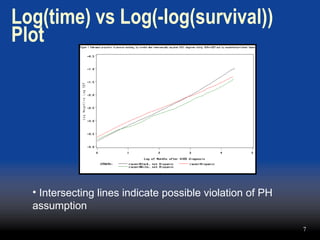
Testing the Proportional Hazards Assumption Graphical test using transformed KM: log(-log(time) vs log(survival)) Statistical test proposed by Grambsch and Therneau 1 Generalized Schoenfeld’s residuals approach which tests for non-proportionality in multiple covariates  Asymptotic  Χ 2  test statistic with degrees of freedom equal to the number of covariates under consideration (H 0 : hazards are proportional) ____________ 1Patricia M. Grambsch and Terry M. Therneau.  Proportional hazards tests and  diagnostics based on weighted residuals.  Biometrics 81, 515-526 (1994).
Log(time) vs Log(-log(survival)) Plot  Intersecting lines indicate possible violation of PH assumption
Statistical Test using Grambsch and Therneau Test of proportionality relative to whites  PH assumption is violated for blacks and not  Hispanics. Cox proportional hazards results are, therefore, suspect. Chi-Square P-value Black 28.72 0.000 Hispanic 1.46 0.226 Global 36.67 0.000
Standardized KM Estimation Directly estimates survival  probabilities at each time point Does not require an assumption of proportionality Adjusts for covariates using direct standardization (weighting). 2 _____________________ 2 Amato, DA.  A generalized Kaplan-Meier estimator for heterogeneous populations.  Communications in Statistics, Theory and Methods 17, 263-286 (1988).
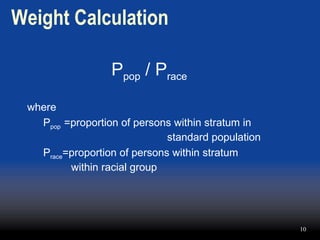
Weight Calculation P pop  / P race where  P pop  =proportion of persons within stratum in    standard population P race =proportion of persons within stratum    within racial group
Weighting Example- Geographic Region Blacks: (60% South) Whites: (42% South) Study Population:  (57% South) 7% 57% 60% 42%
Weighting Example (cont’) 36201 36201 Group Race Region Cases Weight Weighted  Contribution 1 Black Northeast 7668 1.003 7691.004 2 Black South 17536 0.934 16378.624 3 Black North 2172 1.176 2554.272 4 Black West 1324 1.432 1895.968 5 White Northeast 2033 0.989 2010.637 6 White South 3117 1.373 4279.641 7 White North 1049 0.636 667.164 8 White  West 1302 0.417 542.934 Total      36201
Weighted contribution of strata with smaller proportions than the standard population is larger than the case count Weighted contribution of strata with larger proportions than the standard population is smaller than the case count Sum of weights equals the total population size
Weighting accomplishes at least two things: Simultaneously adjusts for all covariates by either augmenting or reducing the influence of a stratum to be equivalent to their relative size within a standard population. Allows for the comparison of survival across subgroups without the PH assumption (Amato,  1988)
Standardized K-M  Crude K-M  d j = number of deaths at time t n j = number of persons at risk  at time t W D (u)= sum of weights for  cases who die at or before time t W R (u)= sum of weights for  cases at risk at time t
Comparison of KM and SKM   12 months (95% CI) 24 months (95% CI) 36 months (95% CI) Whites SKM 0.927 (0.924, 0.929) 0.892 (0.889, 0.894) 0.868 (0.867, 0.870) KM 0.922 (0.916, 0.927)    0.884 (0.877, 0.891) 0.858 (0.850, 0.866)  Hispanics SKM 0.927 (0.924, 0.930) 0.898 (0.896, 0.901) 0.871 (0.869, 0.873) KM 0.907 (0.901, 0.912) 0.872 (0.865, 0.878) 0.840 (0.832, 0.848) Blacks SKM 0.908 (0.906, 0.911) 0.863 (0.861, 0.866) 0.821 (0.819, 0.824) KM 0.907 (0.904, 0.910)  0.859 (0.855, 0.863)    0.815 (0.810, 0.819)
Results Whites and Hispanics experience similar survival Blacks experience increased mortality when compared to Whites and Hispanics (non-overlapping CIs) KM and SKM estimates are very similar across time and strata but some CI’s do not overlap (evidence of confounding)
Conclusions- Advantages of SKM Survival estimates at individual survival times. Covariate adjustment without the PH assumption. Comparison of KM and SKM assesses confounding effect of covariates.  Alternative to Cox regression when event is rare.

Evaluating Racial Disparities in Survival after AIDS Diagnosis using Standardized

  • 1.
    Evaluating Racial Disparitiesin Survival after AIDS Diagnosis using Standardized Kaplan-Meier Estimation Felicia P. Hardnett 1 , John M. Karon 1,2 and Lorena Espinoza 3 1 Centers for Disease Control and Prevention, National Center for HIV, STD, and TB Prevention, Division of HIV/AIDS Prevention, Statistics and Data Management Branch 2 Emergint Corporation 3 Centers for Disease Control and Prevention, National Center for HIV, STD, and TB Prevention, Division of HIV/AIDS Prevention, HIV Incidence and Case Surveillance The findings and conclusions in this presentation are those of the author(s) and do not necessarily represent the views of the Centers for Disease Control and Prevention.
  • 2.
    Study Objective Toevaluate whether or not to use the Cox PH model to test for racial differences in survival while adjusting for the potentially confounding effects of diagnosis year, age, gender, CD4 count and geographic region of residence To explore the use of directly standardized Kaplan-Meier (SKM) estimates in determining whether or not covariate adjustment is necessary to produce reliable estimates of survival
  • 3.
    Population Description Heterosexually-acquiredHIV infection Adolescent and adult cases age 13+ Cases diagnosed from 1996-2002 and reported through June 2004 Deaths occurring from 1996-2003 reported through June 2004 Restricted to Whites, Blacks and Hispanics
  • 4.
    Unadjusted Kaplan-Meier CurvesHispanics and whites experience similar survival Blacks experience increased mortality when compared to whites and Hispanics
  • 5.
    Log Rank TestTest for equality across racial strata suggest a significant difference Does not provide parameter estimates which would tell how the groups differ. Limited covariate adjustment possible via the stratified log rank test Chi-Square DF p-value 156.91 2 <.0001
  • 6.
    Testing the ProportionalHazards Assumption Graphical test using transformed KM: log(-log(time) vs log(survival)) Statistical test proposed by Grambsch and Therneau 1 Generalized Schoenfeld’s residuals approach which tests for non-proportionality in multiple covariates Asymptotic Χ 2 test statistic with degrees of freedom equal to the number of covariates under consideration (H 0 : hazards are proportional) ____________ 1Patricia M. Grambsch and Terry M. Therneau. Proportional hazards tests and diagnostics based on weighted residuals. Biometrics 81, 515-526 (1994).
  • 7.
    Log(time) vs Log(-log(survival))Plot Intersecting lines indicate possible violation of PH assumption
  • 8.
    Statistical Test usingGrambsch and Therneau Test of proportionality relative to whites PH assumption is violated for blacks and not Hispanics. Cox proportional hazards results are, therefore, suspect. Chi-Square P-value Black 28.72 0.000 Hispanic 1.46 0.226 Global 36.67 0.000
  • 9.
    Standardized KM EstimationDirectly estimates survival probabilities at each time point Does not require an assumption of proportionality Adjusts for covariates using direct standardization (weighting). 2 _____________________ 2 Amato, DA. A generalized Kaplan-Meier estimator for heterogeneous populations. Communications in Statistics, Theory and Methods 17, 263-286 (1988).
  • 10.
    Weight Calculation Ppop / P race where P pop =proportion of persons within stratum in standard population P race =proportion of persons within stratum within racial group
  • 11.
    Weighting Example- GeographicRegion Blacks: (60% South) Whites: (42% South) Study Population: (57% South) 7% 57% 60% 42%
  • 12.
    Weighting Example (cont’)36201 36201 Group Race Region Cases Weight Weighted Contribution 1 Black Northeast 7668 1.003 7691.004 2 Black South 17536 0.934 16378.624 3 Black North 2172 1.176 2554.272 4 Black West 1324 1.432 1895.968 5 White Northeast 2033 0.989 2010.637 6 White South 3117 1.373 4279.641 7 White North 1049 0.636 667.164 8 White West 1302 0.417 542.934 Total     36201
  • 13.
    Weighted contribution ofstrata with smaller proportions than the standard population is larger than the case count Weighted contribution of strata with larger proportions than the standard population is smaller than the case count Sum of weights equals the total population size
  • 14.
    Weighting accomplishes atleast two things: Simultaneously adjusts for all covariates by either augmenting or reducing the influence of a stratum to be equivalent to their relative size within a standard population. Allows for the comparison of survival across subgroups without the PH assumption (Amato, 1988)
  • 15.
    Standardized K-M Crude K-M d j = number of deaths at time t n j = number of persons at risk at time t W D (u)= sum of weights for cases who die at or before time t W R (u)= sum of weights for cases at risk at time t
  • 16.
    Comparison of KMand SKM   12 months (95% CI) 24 months (95% CI) 36 months (95% CI) Whites SKM 0.927 (0.924, 0.929) 0.892 (0.889, 0.894) 0.868 (0.867, 0.870) KM 0.922 (0.916, 0.927)    0.884 (0.877, 0.891) 0.858 (0.850, 0.866)  Hispanics SKM 0.927 (0.924, 0.930) 0.898 (0.896, 0.901) 0.871 (0.869, 0.873) KM 0.907 (0.901, 0.912) 0.872 (0.865, 0.878) 0.840 (0.832, 0.848) Blacks SKM 0.908 (0.906, 0.911) 0.863 (0.861, 0.866) 0.821 (0.819, 0.824) KM 0.907 (0.904, 0.910)  0.859 (0.855, 0.863)    0.815 (0.810, 0.819)
  • 17.
    Results Whites andHispanics experience similar survival Blacks experience increased mortality when compared to Whites and Hispanics (non-overlapping CIs) KM and SKM estimates are very similar across time and strata but some CI’s do not overlap (evidence of confounding)
  • 18.
    Conclusions- Advantages ofSKM Survival estimates at individual survival times. Covariate adjustment without the PH assumption. Comparison of KM and SKM assesses confounding effect of covariates. Alternative to Cox regression when event is rare.