Surfing the Chaotic Ocean

The RULES of Laun
ching and Navigat
ing

Your Career
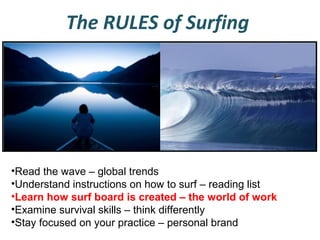
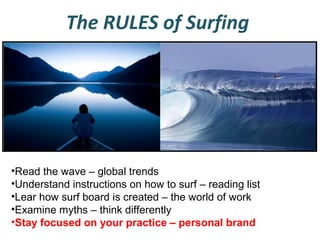
The RULES of Surfing

•Read the wave – global trends
•Understand instructions on how to surf – reading list
•Learn how surf board is created – the world of work
•Examine survival skills – think differently
•Stay focused on your practice – personal brand
The RULES of Surfing

•Read the wave – global trends
•Understand instructions on how to surf – reading list
•Learn how surf board is created – the world of work
•Examine survival skills – think differently
•Stay focused on your practice – personal brand
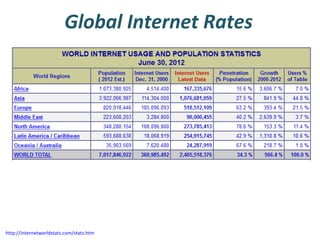
Global Internet Rates

http://internetworldstats.com/stats.htm
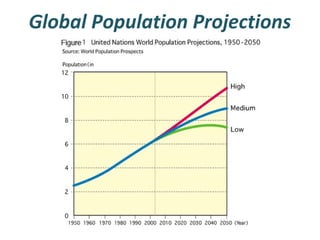
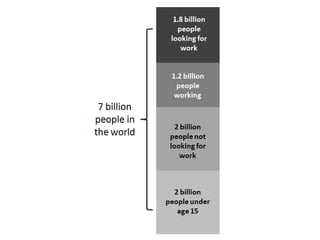
Global Population Projections
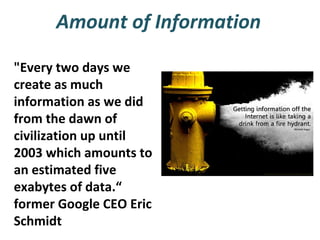
Amount of Information
"Every two days we
create as much
information as we did
from the dawn of
civilization up until
2003 which amounts to
an estimated five
exabytes of data.“
former Google CEO Eric
Schmidt
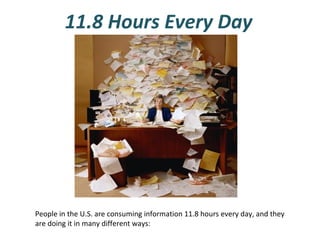
11.8 Hours Every Day

People in the U.S. are consuming information 11.8 hours every day, and they
are doing it in many different ways:
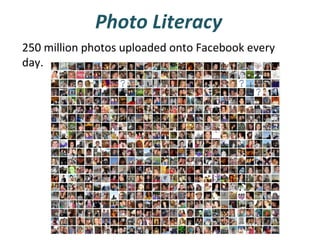
Photo Literacy
250 million photos uploaded onto Facebook every
day.
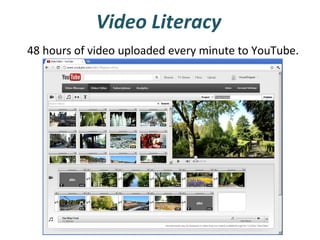
Video Literacy
48 hours of video uploaded every minute to YouTube.
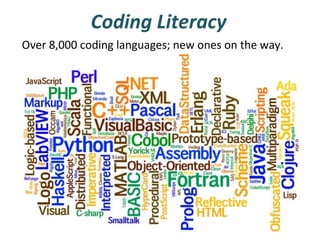
Coding Literacy
Over 8,000 coding languages; new ones on the way.
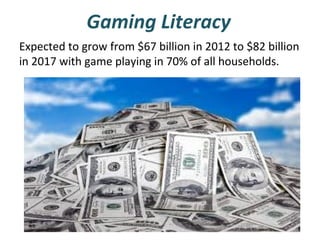
Gaming Literacy
Expected to grow from $67 billion in 2012 to $82 billion
in 2017 with game playing in 70% of all households.
App Literacy
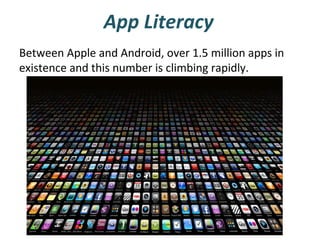
Between Apple and Android, over 1.5 million apps in
existence and this number is climbing rapidly.
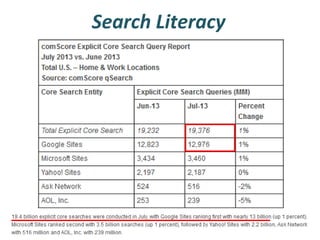
Search Literacy
Hyper-connected
"Thanks to cloud computing, robotics, 3G wireless connectivity, Skype,
Facebook, Google, LinkedIn, Twitter, the iPad, and cheap Internet-enabled
smartphones, the world has gone from connected to hyper-connected. This
is the single most important trend in the world today and why to get into
the middle class now, you have to study harder, work smarter and adapt
quicker than ever before.“ Thomas Friedman (August 13, 2011
New York Times)
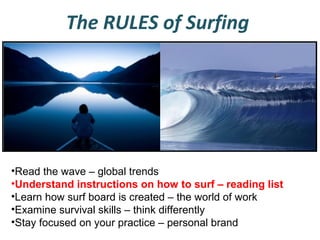
The RULES of Surfing

•Read the wave – global trends
•Understand instructions on how to surf – reading list
•Learn how surf board is created – the world of work
•Examine survival skills – think differently
•Stay focused on your practice – personal brand
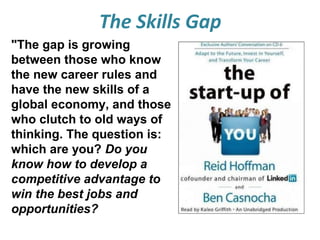
The Skills Gap
"The gap is growing
between those who know
the new career rules and
have the new skills of a
global economy, and those
who clutch to old ways of
thinking. The question is:
which are you? Do you
know how to develop a
competitive advantage to
win the best jobs and
opportunities?
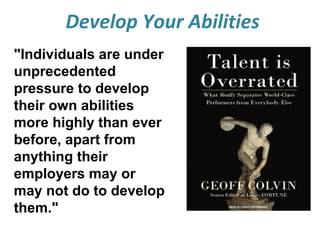
Develop Your Abilities
"Individuals are under
unprecedented
pressure to develop
their own abilities
more highly than ever
before, apart from
anything their
employers may or
may not do to develop
them."
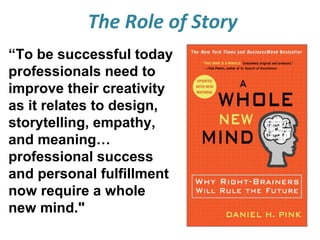
The Role of Story
“To be successful today
professionals need to
improve their creativity
as it relates to design,
storytelling, empathy,
and meaning…
professional success
and personal fulfillment
now require a whole
new mind."
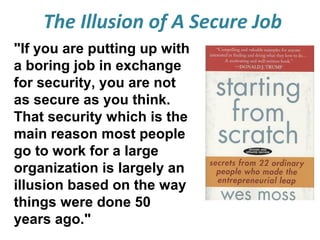
The Illusion of A Secure Job
"If you are putting up with
a boring job in exchange
for security, you are not
as secure as you think.
That security which is the
main reason most people
go to work for a large
organization is largely an
illusion based on the way
things were done 50
years ago."
Multiple Revenue Streams
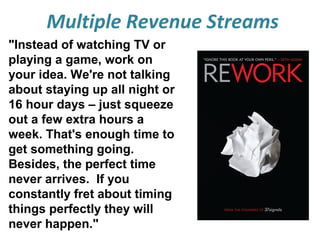
"Instead of watching TV or
playing a game, work on
your idea. We're not talking
about staying up all night or
16 hour days – just squeeze
out a few extra hours a
week. That's enough time to
get something going.
Besides, the perfect time
never arrives. If you
constantly fret about timing
things perfectly they will
never happen."
The Focusing Illusion
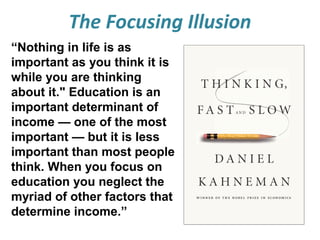
“Nothing in life is as
important as you think it is
while you are thinking
about it." Education is an
important determinant of
income — one of the most
important — but it is less
important than most people
think. When you focus on
education you neglect the
myriad of other factors that
determine income.”
Translate Your Dream Into Reality
How Good Do You Want To Be?
The RULES of Surfing

•Read the wave – global trends
•Understand instructions on how to surf – reading list
•Learn how surf board is created – the world of work
•Examine survival skills – think differently
•Stay focused on your practice – personal brand
Being Average Is Over
As Thomas Friedman
wrote in a January 25,
2012 New York Times
editorial: "Being average
just won't earn you what
it used to. Everyone
needs to find their
unique value
contribution that makes
them stand out in
whatever is their field of
employment. Average is
over."
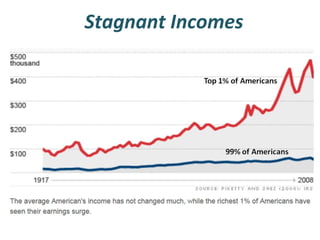
Stagnant Incomes
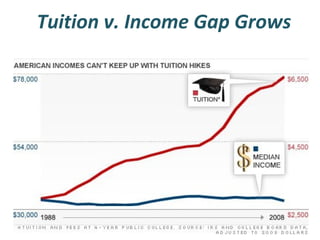
Tuition v. Income Gap Grows
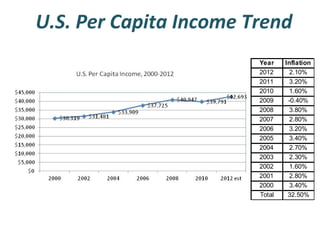
U.S. Per Capita Income Trend
Year
2012
2011
2010
2009
2008
2007
2006
2005
2004
2003
2002
2001
2000
Total

Inflation
2.10%
3.20%
1.60%
-0.40%
3.80%
2.80%
3.20%
3.40%
2.70%
2.30%
1.60%
2.80%
3.40%
32.50%
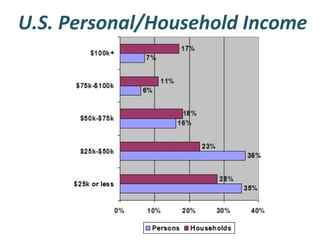
U.S. Personal/Household Income
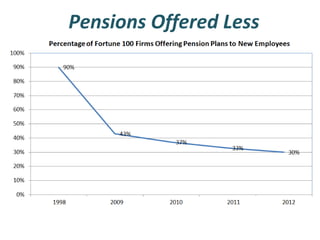
Pensions Offered Less
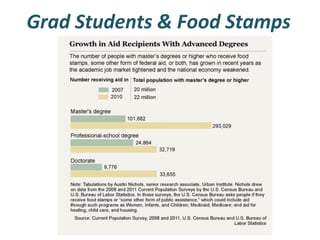
Grad Students & Food Stamps
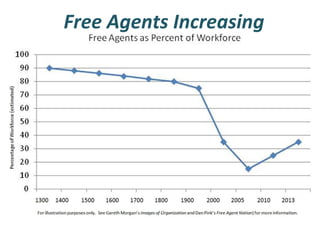
Free Agents Increasing
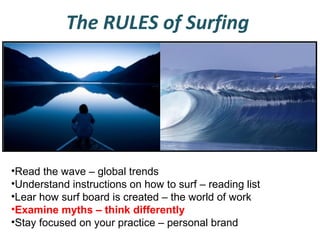
The RULES of Surfing

•Read the wave – global trends
•Understand instructions on how to surf – reading list
•Lear how surf board is created – the world of work
•Examine myths – think differently
•Stay focused on your practice – personal brand
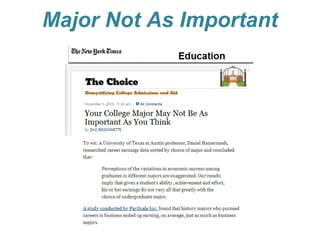
Major Not As Important
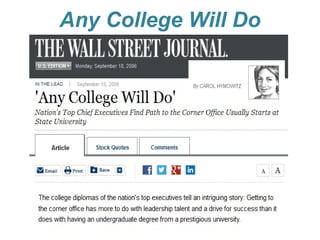
Any College Will Do
Jungle Gym or Corporate Ladder?
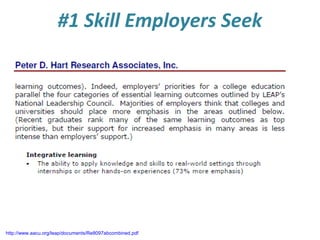
#1 Skill Employers Seek

http://www.aacu.org/leap/documents/Re8097abcombined.pdf
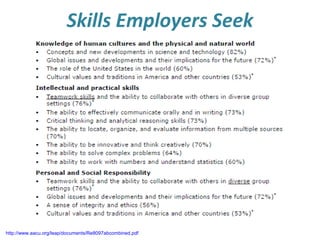
Skills Employers Seek

http://www.aacu.org/leap/documents/Re8097abcombined.pdf
The RULES of Surfing

•Read the wave – global trends
•Understand instructions on how to surf – reading list
•Lear how surf board is created – the world of work
•Examine myths – think differently
•Stay focused on your practice – personal brand
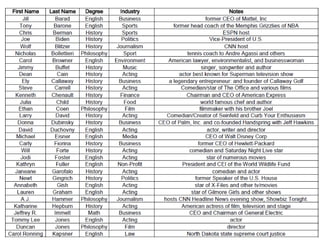
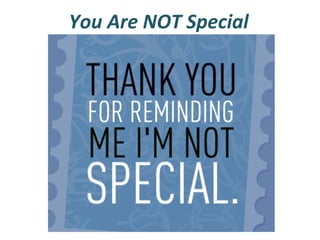
You Are NOT Special
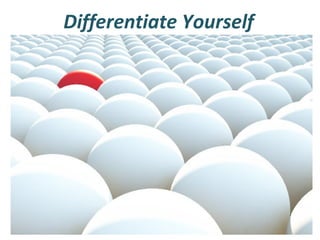
Differentiate Yourself
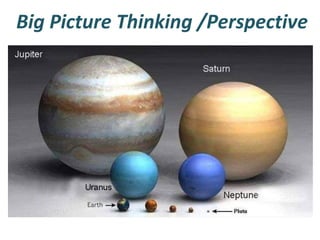
Big Picture Thinking /Perspective
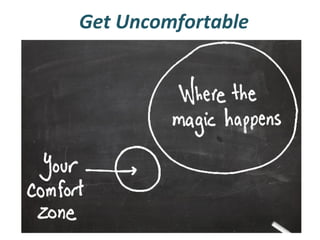
Get Uncomfortable
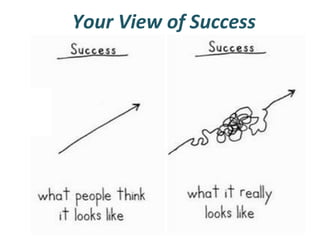
Your View of Success
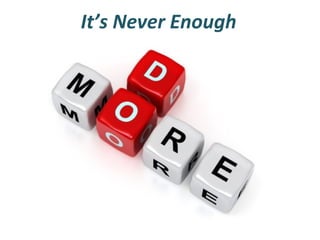
It’s Never Enough
Maintain Inner Peace
Creating Your Brand
•
•
•
•
•
•

Identify Your One Word
Create Your Value Proposition
Write Your Personal Statement
List Your Success Factors
Design Your Business Card
Publish Your Web Site
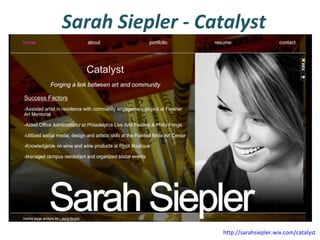
Sarah Siepler - Catalyst

http://sarahsiepler.wix.com/catalyst
Surfing the Chaotic Ocean

The RULES of Laun
ching and Navigat
ing

Your Career

Surfing the chaotic ocean

  • 1.
    Surfing the ChaoticOcean The RULES of Laun ching and Navigat ing Your Career
  • 2.
    The RULES ofSurfing •Read the wave – global trends •Understand instructions on how to surf – reading list •Learn how surf board is created – the world of work •Examine survival skills – think differently •Stay focused on your practice – personal brand
  • 3.
    The RULES ofSurfing •Read the wave – global trends •Understand instructions on how to surf – reading list •Learn how surf board is created – the world of work •Examine survival skills – think differently •Stay focused on your practice – personal brand
  • 5.
  • 6.
  • 7.
    Amount of Information "Everytwo days we create as much information as we did from the dawn of civilization up until 2003 which amounts to an estimated five exabytes of data.“ former Google CEO Eric Schmidt
  • 8.
    11.8 Hours EveryDay People in the U.S. are consuming information 11.8 hours every day, and they are doing it in many different ways:
  • 9.
    Photo Literacy 250 millionphotos uploaded onto Facebook every day.
  • 10.
    Video Literacy 48 hoursof video uploaded every minute to YouTube.
  • 11.
    Coding Literacy Over 8,000coding languages; new ones on the way.
  • 12.
    Gaming Literacy Expected togrow from $67 billion in 2012 to $82 billion in 2017 with game playing in 70% of all households.
  • 13.
    App Literacy Between Appleand Android, over 1.5 million apps in existence and this number is climbing rapidly.
  • 14.
  • 15.
    Hyper-connected "Thanks to cloudcomputing, robotics, 3G wireless connectivity, Skype, Facebook, Google, LinkedIn, Twitter, the iPad, and cheap Internet-enabled smartphones, the world has gone from connected to hyper-connected. This is the single most important trend in the world today and why to get into the middle class now, you have to study harder, work smarter and adapt quicker than ever before.“ Thomas Friedman (August 13, 2011 New York Times)
  • 16.
    The RULES ofSurfing •Read the wave – global trends •Understand instructions on how to surf – reading list •Learn how surf board is created – the world of work •Examine survival skills – think differently •Stay focused on your practice – personal brand
  • 17.
    The Skills Gap "Thegap is growing between those who know the new career rules and have the new skills of a global economy, and those who clutch to old ways of thinking. The question is: which are you? Do you know how to develop a competitive advantage to win the best jobs and opportunities?
  • 18.
    Develop Your Abilities "Individualsare under unprecedented pressure to develop their own abilities more highly than ever before, apart from anything their employers may or may not do to develop them."
  • 19.
    The Role ofStory “To be successful today professionals need to improve their creativity as it relates to design, storytelling, empathy, and meaning… professional success and personal fulfillment now require a whole new mind."
  • 20.
    The Illusion ofA Secure Job "If you are putting up with a boring job in exchange for security, you are not as secure as you think. That security which is the main reason most people go to work for a large organization is largely an illusion based on the way things were done 50 years ago."
  • 21.
    Multiple Revenue Streams "Insteadof watching TV or playing a game, work on your idea. We're not talking about staying up all night or 16 hour days – just squeeze out a few extra hours a week. That's enough time to get something going. Besides, the perfect time never arrives. If you constantly fret about timing things perfectly they will never happen."
  • 22.
    The Focusing Illusion “Nothingin life is as important as you think it is while you are thinking about it." Education is an important determinant of income — one of the most important — but it is less important than most people think. When you focus on education you neglect the myriad of other factors that determine income.”
  • 23.
  • 24.
    How Good DoYou Want To Be?
  • 25.
    The RULES ofSurfing •Read the wave – global trends •Understand instructions on how to surf – reading list •Learn how surf board is created – the world of work •Examine survival skills – think differently •Stay focused on your practice – personal brand
  • 26.
    Being Average IsOver As Thomas Friedman wrote in a January 25, 2012 New York Times editorial: "Being average just won't earn you what it used to. Everyone needs to find their unique value contribution that makes them stand out in whatever is their field of employment. Average is over."
  • 29.
  • 30.
  • 31.
    U.S. Per CapitaIncome Trend Year 2012 2011 2010 2009 2008 2007 2006 2005 2004 2003 2002 2001 2000 Total Inflation 2.10% 3.20% 1.60% -0.40% 3.80% 2.80% 3.20% 3.40% 2.70% 2.30% 1.60% 2.80% 3.40% 32.50%
  • 32.
  • 33.
  • 34.
    Grad Students &Food Stamps
  • 35.
  • 36.
    The RULES ofSurfing •Read the wave – global trends •Understand instructions on how to surf – reading list •Lear how surf board is created – the world of work •Examine myths – think differently •Stay focused on your practice – personal brand
  • 37.
    Major Not AsImportant
  • 38.
  • 39.
    Jungle Gym orCorporate Ladder?
  • 40.
    #1 Skill EmployersSeek http://www.aacu.org/leap/documents/Re8097abcombined.pdf
  • 41.
  • 43.
    The RULES ofSurfing •Read the wave – global trends •Understand instructions on how to surf – reading list •Lear how surf board is created – the world of work •Examine myths – think differently •Stay focused on your practice – personal brand
  • 44.
    You Are NOTSpecial
  • 45.
  • 46.
  • 47.
  • 48.
    Your View ofSuccess
  • 49.
  • 50.
  • 51.
    Creating Your Brand • • • • • • IdentifyYour One Word Create Your Value Proposition Write Your Personal Statement List Your Success Factors Design Your Business Card Publish Your Web Site
  • 52.
    Sarah Siepler -Catalyst http://sarahsiepler.wix.com/catalyst
  • 53.
    Surfing the ChaoticOcean The RULES of Laun ching and Navigat ing Your Career

Editor's Notes

  • #2 {"39":"As Sheryl Sandberg's "Lean In" continues to dominate discussions about women and the workplace and tops bestseller lists, a second "First Lady" of Facebook is voicing her thoughts on work-life balance. \nLike Sandberg and an estimated 70.6 percent of US women, Carolyn Everson is a working mother. The 41-year old, who has an MBA from Harvard and has worked in senior positions at Pets.com, MTV and Microsoft, is currently Facebook's global advertising chief and is raising ten-year-old twin daughters.\nThe media turned its attention to Everson in May 2011 with a profile in AdAge, and the spotlight has been intermittently on her ever since, especially as she has begun to speak publicly about her own efforts to juggle her career and parenthood. She was the subject of a January 2012 "Worldmakers" segment, a September 2012 Bloomberg "Women to Watch" profile and a March 2013 interview in the London Evening Standard, among other coverage.\nLike Sandberg, Everson, an American who moved to London in December 2012, has a lot to say about women and work. She told the Evening Standard that she has discussed "leaning in" extensively with Sandberg during their years of work together, and spoke out about her own views on the subject in the March 2013 interview. \n“I do think women get to a point where they have to love their job and their career," Everson told the Standard. "It has to be so fulfilling and they have to feel as if they are having impact, in order to make the sacrifices they may feel they have to make on the home front. Women get to a point where if they are not fulfilled in their career, the inclination is to stay at home, which is totally understandable.”\nIn an October 2011 interview with genConnect's Nancy Spears, Everson stated that her daughters and her husband were her top priority, but that it's important to teach her children the value of work. “I say 'mommy works because we need to pay the mortgage' … I am trying to instill a work ethic in the kids that hopefully will last a lifetime.”\nEverson's Bloomberg "Women To Watch" video shows her getting her daughters ready for camp, listening to their piano practice and worrying if they have enough sunscreen, interspersed with scenes from the office and interview clips about her professional history and plans for Facebook's future. Everson describes her career more as a jungle gym -- a term Sandberg also uses -- than the traditional corporate ladder.\n"If you look back at my career, at any given moment, I could have stayed on the ladder," Everson told Bloomberg special correspondent and Huffington Post senior editor Willow Bay. "But I actually chose not to do that. I chose not to focus on the next promotion or the next opportunity, but rather build my toolkit."\n","23":"PAULO COELHO'S enchanting novel has inspired a devoted following around the world. This story, dazzling in its powerful simplicity and inspiring wisdom, is about an Andalusian shepherd boy named Santiago who travels from his homeland in Spain to the Egyptian desert in search of a treasure buried in the Pyramids. Along the way he meets a Gypsy woman, a man who calls himself king, and an alchemist, all of whom points Santiago in the direction of his quest. No one knows what the treasure is, or if Santiago will be able to surmount the obstacles along the way. But what starts out as a journey to find worldly goods turns into a discovery of the treasure found within. Lush, evocative, and deeply humane, the story of Santiago is an eternal testament to the transformation power of o \n“It's the possibility of having a dream come true that makes life interesting.” \nTo realize one's destiny is a person's only obligation.” \nThe secret of life, though, is to fall seven times and to get up eight times.” \n","37":"November 3, 2010\nYour College Major May Not Be As Important As You Think\nBy ZAC BISSONNETTE Here’s an excerpt from a letter that an indignant father sent to his son after hearing that he had opted for an impractical major:\nI am appalled, even horrified, that you have adopted Classics as a major. As a matter of fact, I almost puked on my way home today. … I am a practical man, and for the life of me I cannot possibly understand why you should wish to speak Greek. With whom will you communicate in Greek? …\nI suppose you will feel that you are distinguishing yourself from the herd by becoming a Classical snob. … I think you are rapidly becoming a jackass, and the sooner you get out of that filthy atmosphere, the better it will suit me.\nThe reaction of Ted Turner’s father, who wrote that letter to his son, years before he founded CNN, is pretty typical.\nMany students encounter tremendous pressure from their parents to adopt “practical” majors, and I’ve talked to a handful of students whose parents flatly refused to provide for their educational expenses unless they majored in something career-oriented.\nWith less than half of recent college graduates landing jobs that require a college degree, this concern is understandable. But it’s misguided. In recent years, research into the importance of choice of major has led to a surprising conclusion: it’s really not all that important.\nTo wit: A University of Texas at Austin professor, Daniel Hamermesh, researched career earnings data sorted by choice of major and concluded that:\nPerceptions of the variations in economic success among graduates in different majors are exaggerated. Our results imply that given a student’s ability, achievement and effort, his or her earnings do not vary all that greatly with the choice of undergraduate major.\nA study conducted by PayScale Inc. found that history majors who pursued careers in business ended up earning, on average, just as much as business majors.\nRamit Sethi, a blogger and the author of “I Will Teach You to Be Rich” is also a fan of “impractical majors.” He studied in the Sciences, Technology, and Society Program at Stanford.\n“I never thought of my university education as technical training. If it was, why wouldn’t I just go to ITT Tech?” he said in an e-mail, adding:\nWhere else will you get four years to intellectually challenge yourself and learn subjects in university-level depth? In fact, pair a ‘weird’ major with summer internships and interesting projects and you’ve got a leg up on the typical 3.5-G.P.A., by-the-book student. I majored in an obscure major — S.T..S — and I use my background in social influence, persuasion and behavioral change every day of running my own company.\nTo be sure: if a student wants to be an engineer or an accountant, those are fine majors. But don’t think that you are doomed to a life of poverty if you pick the wrong major. There are at least four great reasons to pick a liberal arts major:\nMost people will graduate with higher G.P.A.’s if they study something they are passionate about. High G.P..A’s help graduates land jobs, and there is a fairly strong correlation between class rank and career earnings. Great grades also help with graduate school admissions, and the rigors of liberal arts often lead to better performance on the G.M.A.T. and L.S.A.T. than other majors.\nOne study found that economics majors achieve the best scores of anyone on the G.M.A.T., meaning that students interested in M.B.A.’s are probably better pursuing an economics major than a finance major.\nThere is a disconnect between students’ perceptions of what employers want and what employers actually want, according to a survey described in an article in Canadian HR Reporter, which reported: “Most employers cite communication skills as the most important skill for a candidate to possess, while generation Y (aged 18 to 35) believe employers are looking for experience, found the survey by Toronto’s George Brown College.”\nIf your goal is to develop written and verbal communications skills, a finance major may not be the best bet.\nTransferability of skills. It’s become a cliché that the best jobs of tomorrow don’t even exist today. Such is life in a rapidly changing, technology-driven global economy. Remember all those television ads for training in VCR repair that suddenly stopped running a few years ago? That’s the potential risk of a major that places job training ahead of mind development.\nMost importantly, majoring in something that interests you is just the obvious thing to do. You’ll have more fun, have a richer experience and be less likely to dropout if you are actually passionate about what you’re studying.\nNow, here’s my message for parents: Relax about your children’s choice of major, and realize that their abilities, work ethic and passion will ultimately lead them to a fine destination.\n"}