SUPPLY CHAIN
MANAGEMENT
Presented by Mohammed Abdul Raheel, Rajdeep Nayak & Ebad Ur Rahman
O P E R A T I O N A L M A N A G E M E N T
FOR SUBMISSION TO DR. ARUN KUMAR
What is
Supply Chain
Mangement?
S U P P L Y C H A I N M A N A G E M E N T
Content and Topic Outline
About Supply Chain Management
Evolution
Working of a Supply Chain
Logistics and Supply Chain Management
Importance
Societal Roles of Supply Chain Management
S U P P L Y C H A I N M A N A G E M E N T
About
Supply Chain
Management
A CHAIN WITHOUT SHACKLES
Supply Chain Management is the broad range of activities required
to plan, control and execute a product's flow, from acquiring raw
materials and production through distribution to the final customer,
in the most streamlined and cost-effective way possible.
SCM encompasses the integrated planning and execution of
processes required to optimize the flow of materials, information
and financial capital in the areas that broadly include  demand
planning, sourcing, production,  inventory management  and storage,
transportation - or  logistics  - and return for excess or defective
products. Both business strategy and specialized software are used
in these endeavors to create a competitive advantage.
S U P P L Y C H A I N M A N A G E M E N T
While yesterday’s supply chains were focused on the availability, movement
and cost of physical assets, today’s supply chains are about the
management of data, services and products bundled into solutions. Modern
supply chain management is about much more than just  where  and  when.
Supply chain management affects product and service quality, delivery,
costs, the customer experience and ultimately, profitability.
As recently as 2017 a typical supply chain accessed 50 times more data
than just five years earlier. However, less than a quarter of this data is
being analyzed. That means the value of critical, time-sensitive data — such
as weather, sudden labor shortages, political unrest and microbursts in
demand — can be lost.
Modern supply chains take advantage of massive amounts of data
generated by the chain process and are curated by analytical experts and
data scientists. Future supply chains leaders and the Enterprise Resource
Planning (ERP) systems they manage will likely focus on optimizing the
usefulness of this data — analyzing it in real time with minimal latency.
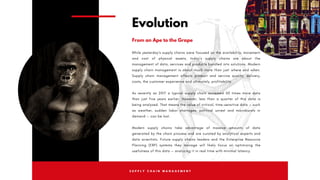
Evolution
From an Ape to the Grape
Working
Supply Chain Management attempts to centrally control or link the production, shipment, and distribution
of a product. By managing the supply chain, companies are able to cut excess costs and deliver products
to the consumer faster. This is done by keeping tighter control of internal inventories, internal
production, distribution, sales, and the inventories of company vendors.
SCM is based on the idea that nearly every product that comes to market results from the efforts of
various organizations that make up a supply chain. Although supply chains have existed for ages, most
companies have only recently paid attention to them as a value-add to their operations.
In SCM, the Supply Chain Manager coordinates the logistics of all aspects of the supply chain which
consists of five parts:
The plan or strategy
The source (of raw materials or services)
Manufacturing (focused on productivity and efficiency)
Delivery and Logistics
The return system (for defective or unwanted products)
Basic Idea
S U P P L Y C H A I N M A N A G E M E N T
The terms Supply Chain Management  and Logistics are often confused or used
synonymously. However, logistics is a component of supply chain management.
It focuses on moving a product or material in the most efficient way so it
arrives at the right place at the right time. It manages activities such as
packaging, transportation, distribution, warehousing and delivery.In contrast,
SCM involves a more expansive range of activities, such as  strategic
sourcing  of raw materials, procuring the best prices on goods and materials,
and coordinating Supply Chain Visibility (SCV) efforts across the supply chain
network of partners, to name just a few.
Logistics and SCM
A Colossal Confusion
S U P P L Y C H A I N M A N A G E M E N T
Importance
IMPACT AND EFFECTIVENESS
The importance of SCM cannot be underestimated as it is the
train which carries money back to the seller. It can be
elaborated in the following:
Boosts Customer Service
Reduces Operating Costs
Improves Financial Position
Societal Roles
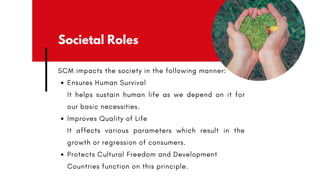
SCM impacts the society in the following manner:
Ensures Human Survival
It helps sustain human life as we depend on it for
our basic necessities.
Improves Quality of Life
It affects various parameters which result in the
growth or regression of consumers.
Protects Cultural Freedom and Development
Countries function on this principle.
S U P P L Y C H A I N M A N A G E M E N T
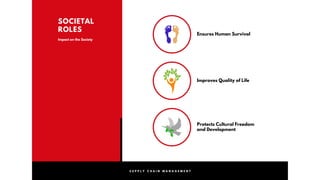
Ensures Human Survival
Improves Quality of Life
Protects Cultural Freedom
and Development
SOCIETAL
ROLES
Impact on the Society
S U P P L Y C H A I N M A N A G E M E N T
PRESENTED BY
Mohammed Abdul Raheel
1BFLICHH010092
Ebad Ur Rahman
18FLICHH010099
Two and a Half, Students
Rajdeep Nayak
1BFLICHH010208

Supply Chain Management

  • 1.
    SUPPLY CHAIN MANAGEMENT Presented byMohammed Abdul Raheel, Rajdeep Nayak & Ebad Ur Rahman O P E R A T I O N A L M A N A G E M E N T FOR SUBMISSION TO DR. ARUN KUMAR
  • 2.
    What is Supply Chain Mangement? SU P P L Y C H A I N M A N A G E M E N T Content and Topic Outline About Supply Chain Management Evolution Working of a Supply Chain Logistics and Supply Chain Management Importance Societal Roles of Supply Chain Management
  • 3.
    S U PP L Y C H A I N M A N A G E M E N T About Supply Chain Management A CHAIN WITHOUT SHACKLES Supply Chain Management is the broad range of activities required to plan, control and execute a product's flow, from acquiring raw materials and production through distribution to the final customer, in the most streamlined and cost-effective way possible. SCM encompasses the integrated planning and execution of processes required to optimize the flow of materials, information and financial capital in the areas that broadly include  demand planning, sourcing, production,  inventory management  and storage, transportation - or  logistics  - and return for excess or defective products. Both business strategy and specialized software are used in these endeavors to create a competitive advantage.
  • 4.
    S U PP L Y C H A I N M A N A G E M E N T While yesterday’s supply chains were focused on the availability, movement and cost of physical assets, today’s supply chains are about the management of data, services and products bundled into solutions. Modern supply chain management is about much more than just  where  and  when. Supply chain management affects product and service quality, delivery, costs, the customer experience and ultimately, profitability. As recently as 2017 a typical supply chain accessed 50 times more data than just five years earlier. However, less than a quarter of this data is being analyzed. That means the value of critical, time-sensitive data — such as weather, sudden labor shortages, political unrest and microbursts in demand — can be lost. Modern supply chains take advantage of massive amounts of data generated by the chain process and are curated by analytical experts and data scientists. Future supply chains leaders and the Enterprise Resource Planning (ERP) systems they manage will likely focus on optimizing the usefulness of this data — analyzing it in real time with minimal latency. Evolution From an Ape to the Grape
  • 5.
    Working Supply Chain Managementattempts to centrally control or link the production, shipment, and distribution of a product. By managing the supply chain, companies are able to cut excess costs and deliver products to the consumer faster. This is done by keeping tighter control of internal inventories, internal production, distribution, sales, and the inventories of company vendors. SCM is based on the idea that nearly every product that comes to market results from the efforts of various organizations that make up a supply chain. Although supply chains have existed for ages, most companies have only recently paid attention to them as a value-add to their operations. In SCM, the Supply Chain Manager coordinates the logistics of all aspects of the supply chain which consists of five parts: The plan or strategy The source (of raw materials or services) Manufacturing (focused on productivity and efficiency) Delivery and Logistics The return system (for defective or unwanted products) Basic Idea
  • 6.
    S U PP L Y C H A I N M A N A G E M E N T The terms Supply Chain Management  and Logistics are often confused or used synonymously. However, logistics is a component of supply chain management. It focuses on moving a product or material in the most efficient way so it arrives at the right place at the right time. It manages activities such as packaging, transportation, distribution, warehousing and delivery.In contrast, SCM involves a more expansive range of activities, such as  strategic sourcing  of raw materials, procuring the best prices on goods and materials, and coordinating Supply Chain Visibility (SCV) efforts across the supply chain network of partners, to name just a few. Logistics and SCM A Colossal Confusion
  • 7.
    S U PP L Y C H A I N M A N A G E M E N T Importance IMPACT AND EFFECTIVENESS The importance of SCM cannot be underestimated as it is the train which carries money back to the seller. It can be elaborated in the following: Boosts Customer Service Reduces Operating Costs Improves Financial Position
  • 8.
    Societal Roles SCM impactsthe society in the following manner: Ensures Human Survival It helps sustain human life as we depend on it for our basic necessities. Improves Quality of Life It affects various parameters which result in the growth or regression of consumers. Protects Cultural Freedom and Development Countries function on this principle.
  • 9.
    S U PP L Y C H A I N M A N A G E M E N T Ensures Human Survival Improves Quality of Life Protects Cultural Freedom and Development SOCIETAL ROLES Impact on the Society
  • 10.
    S U PP L Y C H A I N M A N A G E M E N T PRESENTED BY Mohammed Abdul Raheel 1BFLICHH010092 Ebad Ur Rahman 18FLICHH010099 Two and a Half, Students Rajdeep Nayak 1BFLICHH010208