Supply Chain
Benchmarking Study
Indian Two wheeler
Industry
Benchmarking


“the process of comparing one’s
business process and performance
metrics to industry bests or best
practices from other industries”.



Benchmarking can be of two types
◦ Qualitative
◦ Quantitative
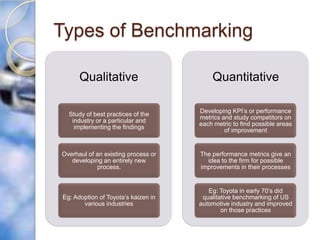
Types of Benchmarking
Qualitative

Quantitative

Study of best practices of the
industry or a particular and
implementing the findings

Developing KPI’s or performance
metrics and study competitors on
each metric to find possible areas
of improvement

Overhaul of an existing process or
developing an entirely new
process.

The performance metrics give an
idea to the firm for possible
improvements in their processes

Eg: Adoption of Toyota’s kaizen in
various industries

Eg: Toyota in early 70’s did
qualitative benchmarking of US
automotive industry and improved
on those practices
Scor® Model
Supply chain council (SCC), provides
an appropriate framework for
conducting benchmarking.
 Framework links business process,
metrics and best practices into a
unique structure.
 Includes 11 performance measures


◦ Internal measures – Cost, assets
◦ External measures - flexibility and
reliability of the firm w.r.t. Customer
Objective of study
To carry out a supply chain benchmarking study of
Indian Two-wheeler industry.
 Target area of study


Company

Reason

Bajaj Auto Ltd.

First entrant in the market

Market leader in scooter segment till 2010
Hero Motocorp

Market leader in Indian 2W market

TVS Motor

A market follower has been in the shadows of its
more illustrious competitors. TVS motor

Enfield India

Niche player in motorcycle segment. A long history
and also first entrant in Indian Market.

Mahindra 2W

New entrant of the market
Objective of study
Longitudinal Analysis of Supply Chain
Performance for the period 2009-2012
 The companies were evaluated on
following three performance
measures;


1. Total length of the supply chain
2. Supply chain efficiency
3. Supply chain working capital
productivity
Indian two-wheeler industry
Indian 2-wheeler Market Share
3% 2% 1%

13%
38%
18%

25%

Hero Motocorp
Bajaj Auto
Honda
TVS
Suzuki
Mahindra
Enfield India
Indian 2W Industry
Existing market structure
Year 2000

Year 2011

Remarks

Bajaj Auto

Bajaj Auto

Bajaj Auto exited the scooter segment
in 2010

Hero Honda

Hero Motocorp

Hero Honda entered domestic
scooters segment in 2006; ended its

JV with Honda in 2010
TVS-Suzuki

TVS Motor

TVS and Suzuki parted ways in 2011;
Both Continue to be Indian 2-W
market

Royal Enfield India Royal Enfield India Remains a niche player
manufacturing cruiser bikes
Mahindra 2W

Mahindra 2-W

Entered the scooter segment in 2010
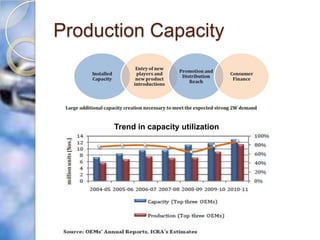
Production Capacity

Trend in capacity utilization
Methodology
• Identified Indian two wheeler industry

• Study of secondary data for the industry and identifying possible
objects of study. (Parameter chosen was , market share)
• Collected financial data for the five companies. Sources used
were CMIE "Prowess" & respective company's annual reports.

• Data Analysis was done through MS Excel

• Interpretation and results of data
Data Analysis
Total Length of Supply Chain

1.

◦

◦

◦

The firm with the minimum length of
chain can be said to have the best
performance.
Longer supply chain means more time
for conversion of raw materials into
finished goods.
Total length of supply chain in days =
DRM+DWIP+DFG
Interpretation







Hero Motocorp has least supply chain
length of 11 days.
Hero Motocorp has the lowest DFG of 2
days compared to Bajaj’s 8 days.
As expected Mahindra has the highest
supply chain length.
TVS has supply chain length of 28 days
which is significantly higher than industry
average.
TVS’s DWIP is 2 days compared to
industry average of half a day.
Data Analysis
Efficiency of Supply Chain
Management

1.

◦

◦

Parameter measures the overall
inefficiency of supply chain
management.
Lower the value, better managed is the
supply chain of company
 Calculated as
 SCC = DC + (INV x ICC)
 SCI = SCC/ NS
Interpretation










Industry average of 0.25
Bajaj Auto has the most efficient supply
chain.
Hero motocorp in spite of highest inventory
costs has inefficiency ratio of 0.3 – because
of their higher net sales.
Hero motocorp is incurring maximum
inventory cost in terms of raw material (High
DRM and High inventory cost)
TVS has the most inefficient supply chain
management – because of their longer
supply chain length (High DRM, DFG &
DWIP).
Mahindra 2W has increased the efficiency of
its supply chain since 2011
Data Analysis
1.

Working Capital productivity
◦ gives the overall measure of the
improvements in the organization due to
the various improvement projects.
◦ Calculated as,
 SWC = INV+AR-AP
 SWCP = NS/SWC
Interpretation


For overall industry, this ratio is negative
– due to investment in capacity
expansion projects.
◦ Mahindra 2W is expanding capacity of its
Pithampura plant.
◦ TVS has invested in Mahabharat motors mfg
ltd in West Bengal, to gain presence in West
Bengal.
◦ Hero Motocorp is building its fourth
manufacturing plant in Rajasthan.
◦ Bajaj Auto is planning its fourth plant at
Mundra, Gujrat.
Recommendations
Bajaj Auto needs to implement more
sales source and outlets to reduce
their DFG which is stretching their
supply chain and hence the costs of it
 TVS motors and Enfield India need a
better inventory management system
or a implementation of Just in Time to
reduce their raw material inventory
costs.

Contd…
The production process of TVS motors
is highly inefficient and there is
considerable scope of improvement.
Use of technology can help them
reduce their DWIP.
 TVS, Bajaj & Hero all have high
inventory costs, which need to be
reduced to increase the efficiency of
supply chain.

Supply Chain Benchmarking Study

Supply Chain Benchmarking Study

  • 1.
  • 2.
    Benchmarking  “the process ofcomparing one’s business process and performance metrics to industry bests or best practices from other industries”.  Benchmarking can be of two types ◦ Qualitative ◦ Quantitative
  • 3.
    Types of Benchmarking Qualitative Quantitative Studyof best practices of the industry or a particular and implementing the findings Developing KPI’s or performance metrics and study competitors on each metric to find possible areas of improvement Overhaul of an existing process or developing an entirely new process. The performance metrics give an idea to the firm for possible improvements in their processes Eg: Adoption of Toyota’s kaizen in various industries Eg: Toyota in early 70’s did qualitative benchmarking of US automotive industry and improved on those practices
  • 4.
    Scor® Model Supply chaincouncil (SCC), provides an appropriate framework for conducting benchmarking.  Framework links business process, metrics and best practices into a unique structure.  Includes 11 performance measures  ◦ Internal measures – Cost, assets ◦ External measures - flexibility and reliability of the firm w.r.t. Customer
  • 5.
    Objective of study Tocarry out a supply chain benchmarking study of Indian Two-wheeler industry.  Target area of study  Company Reason Bajaj Auto Ltd. First entrant in the market Market leader in scooter segment till 2010 Hero Motocorp Market leader in Indian 2W market TVS Motor A market follower has been in the shadows of its more illustrious competitors. TVS motor Enfield India Niche player in motorcycle segment. A long history and also first entrant in Indian Market. Mahindra 2W New entrant of the market
  • 6.
    Objective of study LongitudinalAnalysis of Supply Chain Performance for the period 2009-2012  The companies were evaluated on following three performance measures;  1. Total length of the supply chain 2. Supply chain efficiency 3. Supply chain working capital productivity
  • 7.
    Indian two-wheeler industry Indian2-wheeler Market Share 3% 2% 1% 13% 38% 18% 25% Hero Motocorp Bajaj Auto Honda TVS Suzuki Mahindra Enfield India
  • 8.
    Indian 2W Industry Existingmarket structure Year 2000 Year 2011 Remarks Bajaj Auto Bajaj Auto Bajaj Auto exited the scooter segment in 2010 Hero Honda Hero Motocorp Hero Honda entered domestic scooters segment in 2006; ended its JV with Honda in 2010 TVS-Suzuki TVS Motor TVS and Suzuki parted ways in 2011; Both Continue to be Indian 2-W market Royal Enfield India Royal Enfield India Remains a niche player manufacturing cruiser bikes Mahindra 2W Mahindra 2-W Entered the scooter segment in 2010
  • 9.
    Production Capacity Trend incapacity utilization
  • 10.
    Methodology • Identified Indiantwo wheeler industry • Study of secondary data for the industry and identifying possible objects of study. (Parameter chosen was , market share) • Collected financial data for the five companies. Sources used were CMIE "Prowess" & respective company's annual reports. • Data Analysis was done through MS Excel • Interpretation and results of data
  • 11.
    Data Analysis Total Lengthof Supply Chain 1. ◦ ◦ ◦ The firm with the minimum length of chain can be said to have the best performance. Longer supply chain means more time for conversion of raw materials into finished goods. Total length of supply chain in days = DRM+DWIP+DFG
  • 12.
    Interpretation      Hero Motocorp hasleast supply chain length of 11 days. Hero Motocorp has the lowest DFG of 2 days compared to Bajaj’s 8 days. As expected Mahindra has the highest supply chain length. TVS has supply chain length of 28 days which is significantly higher than industry average. TVS’s DWIP is 2 days compared to industry average of half a day.
  • 13.
    Data Analysis Efficiency ofSupply Chain Management 1. ◦ ◦ Parameter measures the overall inefficiency of supply chain management. Lower the value, better managed is the supply chain of company  Calculated as  SCC = DC + (INV x ICC)  SCI = SCC/ NS
  • 14.
    Interpretation       Industry average of0.25 Bajaj Auto has the most efficient supply chain. Hero motocorp in spite of highest inventory costs has inefficiency ratio of 0.3 – because of their higher net sales. Hero motocorp is incurring maximum inventory cost in terms of raw material (High DRM and High inventory cost) TVS has the most inefficient supply chain management – because of their longer supply chain length (High DRM, DFG & DWIP). Mahindra 2W has increased the efficiency of its supply chain since 2011
  • 15.
    Data Analysis 1. Working Capitalproductivity ◦ gives the overall measure of the improvements in the organization due to the various improvement projects. ◦ Calculated as,  SWC = INV+AR-AP  SWCP = NS/SWC
  • 16.
    Interpretation  For overall industry,this ratio is negative – due to investment in capacity expansion projects. ◦ Mahindra 2W is expanding capacity of its Pithampura plant. ◦ TVS has invested in Mahabharat motors mfg ltd in West Bengal, to gain presence in West Bengal. ◦ Hero Motocorp is building its fourth manufacturing plant in Rajasthan. ◦ Bajaj Auto is planning its fourth plant at Mundra, Gujrat.
  • 17.
    Recommendations Bajaj Auto needsto implement more sales source and outlets to reduce their DFG which is stretching their supply chain and hence the costs of it  TVS motors and Enfield India need a better inventory management system or a implementation of Just in Time to reduce their raw material inventory costs. 
  • 18.
    Contd… The production processof TVS motors is highly inefficient and there is considerable scope of improvement. Use of technology can help them reduce their DWIP.  TVS, Bajaj & Hero all have high inventory costs, which need to be reduced to increase the efficiency of supply chain. 

Editor's Notes

  • #5 SCOR = (Supply chain operations research)
  • #7 Total length of the supply chain (days of raw material inventory + days of work in progress inventory + days of finished goods inventory)