UNIT – 2
SUPERVISED LEARNING
AGENDA
Multivariate Regression
2
MULTIVARIATE REGRESSION
• Multivariate regression is a powerful statistical technique that
analyzes the relationship between a dependent variable and multiple
independent variables. But Multivariate Regression deals with one
dependent variable and multiple independent variables. In
multivariate regression, we aim to predict an output based on
several independent variables.
• It's widely used in various fields, including economics, finance, and
healthcare, to understand complex relationships and make accurate
predictions.
3
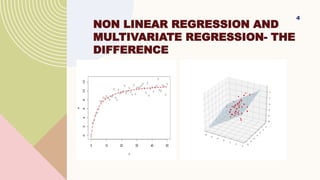
NON LINEAR REGRESSION AND
MULTIVARIATE REGRESSION- THE
DIFFERENCE
4
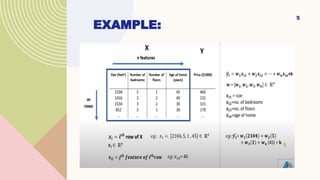
EXAMPLE:
5
LOGISTIC REGRESSION
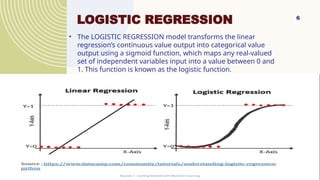
• The LOGISTIC REGRESSION model transforms the linear
regression’s continuous value output into categorical value
output using a sigmoid function, which maps any real-valued
set of independent variables input into a value between 0 and
1. This function is known as the logistic function.
6
7
LOGISTIC REGRESSION…
• Let the independent input features be:
• X= [x11 …x1m]
[x21 …x2m]
[xn1 …xnm]
• and the dependent variable is Y  0 or 1.
• then, apply the multi-linear function to the input variables X.
• Here xi​is the ith observation of X.
• wi=[w1,w2,w3, ,wm]
⋯ , here w is the weights or Coefficient, and b is
the bias term also known as intercept, simply this can be
represented as the dot product of weight and bias.
8
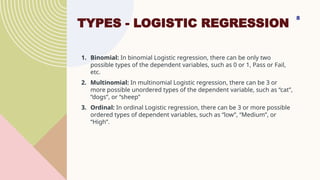
TYPES - LOGISTIC REGRESSION
1. Binomial: In binomial Logistic regression, there can be only two
possible types of the dependent variables, such as 0 or 1, Pass or Fail,
etc.
2. Multinomial: In multinomial Logistic regression, there can be 3 or
more possible unordered types of the dependent variable, such as “cat”,
“dogs”, or “sheep”
3. Ordinal: In ordinal Logistic regression, there can be 3 or more possible
ordered types of dependent variables, such as “low”, “Medium”, or
“High”.
9
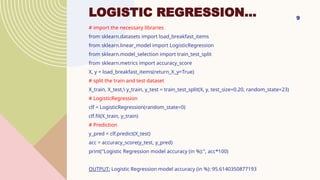
LOGISTIC REGRESSION…
# import the necessary libraries
from sklearn.datasets import load_breakfast_items
from sklearn.linear_model import LogisticRegression
from sklearn.model_selection import train_test_split
from sklearn.metrics import accuracy_score
X, y = load_breakfast_items(return_X_y=True)
# split the train and test dataset
X_train, X_test, y_train, y_test = train_test_split(X, y, test_size=0.20, random_state=23)
# LogisticRegression
clf = LogisticRegression(random_state=0)
clf.fit(X_train, y_train)
# Prediction
y_pred = clf.predict(X_test)
acc = accuracy_score(y_test, y_pred)
print("Logistic Regression model accuracy (in %):", acc*100)
OUTPUT: Logistic Regression model accuracy (in %): 95.6140350877193
EFFECTIVE DELIVERY
TECHNIQUES
10
This is a powerful tool in
public speaking. It involves
varying pitch, tone, and
volume to convey emotion,
emphasize points, and
maintain interest.
• Pitch variation
• Tone inflection
• Volume control
Effective body language
enhances your message,
making it more impactful
and memorable.
• Meaningful eye contact
• Purposeful gestures
• Maintain good posture
• Control your expressions
NAVIGATING Q&A
SESSIONS
1. Maintaining composure
during the Q&A session
is essential for
projecting confidence
and authority. Consider
the following tips for
staying composed:
2. Stay calm
3. Actively listen
4. Pause and reflect
5. Maintain eye contact
Know your material in advance
Anticipate common questions
Rehearse your responses
11
SPEAKING IMPACT
Your ability to communicate effectively will
leave a lasting impact on your audience
Effectively communicating involves not only
delivering a message but also resonating with
the experiences, values, and emotions of
those listening
12
DYNAMIC DELIVERY
Learn to infuse energy
into your delivery to leave
a lasting impression
One of the goals of
effective communication
is to motivate your
audience
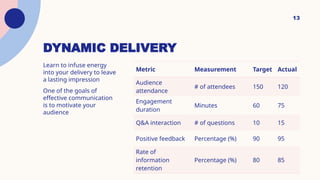
Metric Measurement Target Actual
Audience
attendance
# of attendees 150 120
Engagement
duration
Minutes 60 75
Q&A interaction # of questions 10 15
Positive feedback Percentage (%) 90 95
Rate of
information
retention
Percentage (%) 80 85
13
FINAL TIPS & TAKEAWAYS
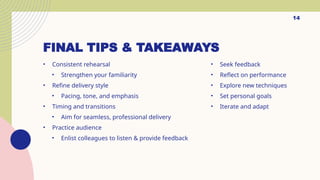
• Consistent rehearsal
• Strengthen your familiarity
• Refine delivery style
• Pacing, tone, and emphasis
• Timing and transitions
• Aim for seamless, professional delivery
• Practice audience
• Enlist colleagues to listen & provide feedback
• Seek feedback
• Reflect on performance
• Explore new techniques
• Set personal goals
• Iterate and adapt
14
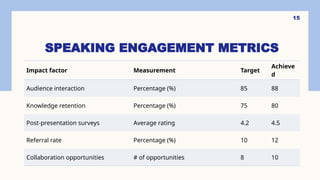
SPEAKING ENGAGEMENT METRICS
Impact factor Measurement Target
Achieve
d
Audience interaction Percentage (%) 85 88
Knowledge retention Percentage (%) 75 80
Post-presentation surveys Average rating 4.2 4.5
Referral rate Percentage (%) 10 12
Collaboration opportunities # of opportunities 8 10
15
THANK
YOU
Brita Tamm
502-555-0152
brita@firstupconsultants.com
www.firstupconsultants.com

Supervised learning in Machine Learning.pptx

  • 1.
  • 2.
  • 3.
    MULTIVARIATE REGRESSION • Multivariateregression is a powerful statistical technique that analyzes the relationship between a dependent variable and multiple independent variables. But Multivariate Regression deals with one dependent variable and multiple independent variables. In multivariate regression, we aim to predict an output based on several independent variables. • It's widely used in various fields, including economics, finance, and healthcare, to understand complex relationships and make accurate predictions. 3
  • 4.
    NON LINEAR REGRESSIONAND MULTIVARIATE REGRESSION- THE DIFFERENCE 4
  • 5.
  • 6.
    LOGISTIC REGRESSION • TheLOGISTIC REGRESSION model transforms the linear regression’s continuous value output into categorical value output using a sigmoid function, which maps any real-valued set of independent variables input into a value between 0 and 1. This function is known as the logistic function. 6
  • 7.
    7 LOGISTIC REGRESSION… • Letthe independent input features be: • X= [x11 …x1m] [x21 …x2m] [xn1 …xnm] • and the dependent variable is Y  0 or 1. • then, apply the multi-linear function to the input variables X. • Here xi​is the ith observation of X. • wi=[w1,w2,w3, ,wm] ⋯ , here w is the weights or Coefficient, and b is the bias term also known as intercept, simply this can be represented as the dot product of weight and bias.
  • 8.
    8 TYPES - LOGISTICREGRESSION 1. Binomial: In binomial Logistic regression, there can be only two possible types of the dependent variables, such as 0 or 1, Pass or Fail, etc. 2. Multinomial: In multinomial Logistic regression, there can be 3 or more possible unordered types of the dependent variable, such as “cat”, “dogs”, or “sheep” 3. Ordinal: In ordinal Logistic regression, there can be 3 or more possible ordered types of dependent variables, such as “low”, “Medium”, or “High”.
  • 9.
    9 LOGISTIC REGRESSION… # importthe necessary libraries from sklearn.datasets import load_breakfast_items from sklearn.linear_model import LogisticRegression from sklearn.model_selection import train_test_split from sklearn.metrics import accuracy_score X, y = load_breakfast_items(return_X_y=True) # split the train and test dataset X_train, X_test, y_train, y_test = train_test_split(X, y, test_size=0.20, random_state=23) # LogisticRegression clf = LogisticRegression(random_state=0) clf.fit(X_train, y_train) # Prediction y_pred = clf.predict(X_test) acc = accuracy_score(y_test, y_pred) print("Logistic Regression model accuracy (in %):", acc*100) OUTPUT: Logistic Regression model accuracy (in %): 95.6140350877193
  • 10.
    EFFECTIVE DELIVERY TECHNIQUES 10 This isa powerful tool in public speaking. It involves varying pitch, tone, and volume to convey emotion, emphasize points, and maintain interest. • Pitch variation • Tone inflection • Volume control Effective body language enhances your message, making it more impactful and memorable. • Meaningful eye contact • Purposeful gestures • Maintain good posture • Control your expressions
  • 11.
    NAVIGATING Q&A SESSIONS 1. Maintainingcomposure during the Q&A session is essential for projecting confidence and authority. Consider the following tips for staying composed: 2. Stay calm 3. Actively listen 4. Pause and reflect 5. Maintain eye contact Know your material in advance Anticipate common questions Rehearse your responses 11
  • 12.
    SPEAKING IMPACT Your abilityto communicate effectively will leave a lasting impact on your audience Effectively communicating involves not only delivering a message but also resonating with the experiences, values, and emotions of those listening 12
  • 13.
    DYNAMIC DELIVERY Learn toinfuse energy into your delivery to leave a lasting impression One of the goals of effective communication is to motivate your audience Metric Measurement Target Actual Audience attendance # of attendees 150 120 Engagement duration Minutes 60 75 Q&A interaction # of questions 10 15 Positive feedback Percentage (%) 90 95 Rate of information retention Percentage (%) 80 85 13
  • 14.
    FINAL TIPS &TAKEAWAYS • Consistent rehearsal • Strengthen your familiarity • Refine delivery style • Pacing, tone, and emphasis • Timing and transitions • Aim for seamless, professional delivery • Practice audience • Enlist colleagues to listen & provide feedback • Seek feedback • Reflect on performance • Explore new techniques • Set personal goals • Iterate and adapt 14
  • 15.
    SPEAKING ENGAGEMENT METRICS Impactfactor Measurement Target Achieve d Audience interaction Percentage (%) 85 88 Knowledge retention Percentage (%) 75 80 Post-presentation surveys Average rating 4.2 4.5 Referral rate Percentage (%) 10 12 Collaboration opportunities # of opportunities 8 10 15
  • 16.