Targeting Financial Stability
    Hayden, Perla, Christine, and Enia
ON TARGET

            Discussion Flow

                              Turnaround strategies for Supervalu


                              Causation of Supervalu’s Struggle


                              Discussion of Management and comparison to Safeway and
                              A&P Grocers

                              Forward Strategies


                              Forward Projections of Recovery


                              Q&A
ON TARGET


            Recommendations for

            SUPERVALU SURVIVAL
ON TARGET

            Recommendations:

            • Close 35% of stores nationwide to increase cash
              on hand and lower SG&A costs
            • Reduce overall headcount by 30-40% nationwide
            • Close all international locations (Caribbean)
            • Eliminate 6-9 distribution centers outside core
              geographical areas
            • Reduce employee benefits and pension
              contributions
            • Convert existing Save-A-Lot’s owned by
              Supervalu into franchise locations or close them
            • Tighten Credit to independent grocery customers
ON TARGET


            CAUSATION OF SUPERVALU’S STRUGGLE
ON TARGET

            Why is Supervalu Struggling?


             • Heavy SG&A costs weighing      • Large debt assumed after
               down financial performance       purchasing Albertson’s

             • Ineffective management of      • Did not close underperforming
               current operations               stores in a timely manner

             • Failed attempt to break into   • Sluggish distribution network
               the “hard discount” segment
                                              • Too many chains within the
             • Distribution network is not      Supervalu network
               focused on supplying just
               Supervalu stores
ON TARGET
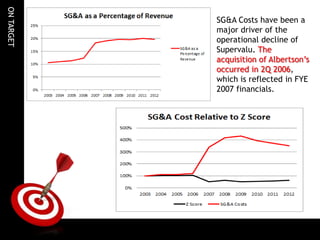
            SG&A Costs have been a
            major driver of the
            operational decline of
            Supervalu. The
            acquisition of Albertson’s
            occurred in 2Q 2006,
            which is reflected in FYE
            2007 financials.
ON TARGET


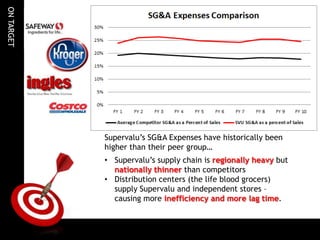
            Supervalu’s SG&A Expenses have historically been
            higher than their peer group…
            • Supervalu’s supply chain is regionally heavy but
              nationally thinner than competitors
            • Distribution centers (the life blood grocers)
              supply Supervalu and independent stores –
              causing more inefficiency and more lag time.
ON TARGET
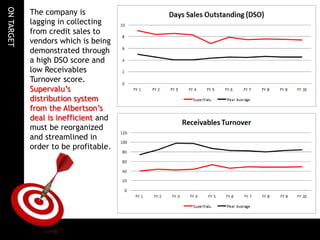
            The company is
            lagging in collecting
            from credit sales to
            vendors which is being
            demonstrated through
            a high DSO score and
            low Receivables
            Turnover score.
            Supervalu’s
            distribution system
            from the Albertson’s
            deal is inefficient and
            must be reorganized
            and streamlined in
            order to be profitable.
ON TARGET


            DISCUSSION OF MANAGEMENT AND COMPARISON TO
            SAFEWAY AND A&P GROCERS
ON TARGET
            SUPERVALU's CESO
                      Jeff Noddle
                      CEO from June 2001-June 2009
                       • Led Albertson’s Acquisition in 2006


                               Craig Herket
                               CEO from May 2009- July 2012
                                • Wal-Mart’s “Everyday low
                                  Prices” mentality
                                • Save A-Lot expansion

                                           Wayne Sales
                                           CEO from July 2012- Present
                                              • Turn around CEO
ON TARGET   Employee Benefits and Pension Plans:


               Reduce the benefits by 25-30% by      Benefits:
               fiscal year ended 2017:               • Medical Insurance
               • 130,000 Employees                   • Dental Insurance
               • 84,000 insured                      • Life Insurance
                                                     • Competitive 401k
                                                     • Tuition Reimbursement
                                                     • Vacation and Holidays


                                                   Other Changes:
                                                   • Employees to share more of the
                                                     cost of health insurance due to
                                                     uncertainty with healthcare reform

                                                   • Mandate direct deposit for all
                                                     employees – more efficient

                                                   • No tuition reimbursement for the
                                                     next 2-3 years
ON TARGET

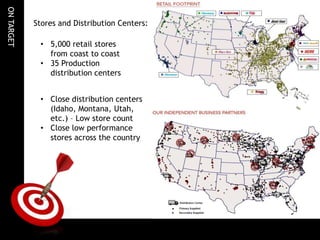
            Stores and Distribution Centers:

             • 5,000 retail stores
               from coast to coast
             • 35 Production
               distribution centers


             • Close distribution centers
               (Idaho, Montana, Utah,
               etc.) – Low store count
             • Close low performance
               stores across the country
ON TARGET   Safeway Comparison to Supervalu:
                              • Safeway and A&P are similar because they accumulated
                                a lot of debt just as Supervalu did when they acquired
                                Albertsons in 2006.

                              • In the 1980’s Safeway was taken private by Kohlberg
                                Kravis Roberts (KKR) and assumed tremendous debt.

                              • The company chose to close 1,132 stores (over half of
                                the 2,200 store nationwide) to regain profitability during
                                this period.

                              • Safeway sold all locations outside of the United States
                                and Canada to simplify operations.

                              • Today, Safeway runs over 1,700 stores in the United
                                States and Canada and is more efficiently operating
                                compared to the 1980’s.
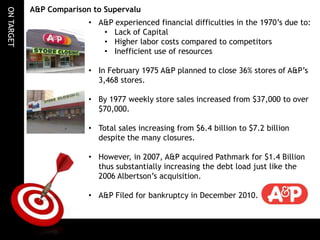
ON TARGET   A&P Comparison to Supervalu
                          • A&P experienced financial difficulties in the 1970’s due to:
                             • Lack of Capital
                             • Higher labor costs compared to competitors
                             • Inefficient use of resources

                          • In February 1975 A&P planned to close 36% stores of A&P’s
                            3,468 stores.

                          • By 1977 weekly store sales increased from $37,000 to over
                            $70,000.

                          • Total sales increasing from $6.4 billion to $7.2 billion
                            despite the many closures.

                          • However, in 2007, A&P acquired Pathmark for $1.4 Billion
                            thus substantially increasing the debt load just like the
                            2006 Albertson’s acquisition.

                          • A&P Filed for bankruptcy in December 2010.
ON TARGET


            FORWARD STRATEGIES
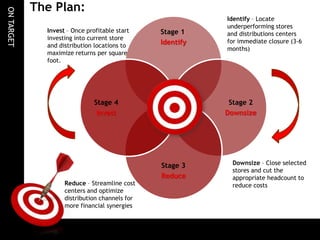
ON TARGET   The Plan:
                                                           Identify – Locate
                                                           underperforming stores
              Invest – Once profitable start    Stage 1    and distributions centers
              investing into current store
                                                Identify   for immediate closure (3-6
              and distribution locations to
                                                           months)
              maximize returns per square
              foot.


                               Stage 4                      Stage 2
                                Invest                     Downsize


                                                Stage 3     Downsize – Close selected
                                                            stores and cut the
                                                Reduce      appropriate headcount to
                    Reduce – Streamline cost                reduce costs
                    centers and optimize
                    distribution channels for
                    more financial synergies
ON TARGET


            FORWARD PROJECTIONS OF RECOVERY
ON TARGET


            Projected Financial Impact on Supervalu
            Projected financial improvement based on cost cutting assumptions and
            low/moderate growth in the regions in which the stores operate. In addition,
            the team inserted the assumption that current financial partners would
            refinance an estimated 33% of current or close to current debt obligations.
Q&A
ON TARGET

Supervalu presentation version 3 final

  • 1.
    Targeting Financial Stability Hayden, Perla, Christine, and Enia
  • 2.
    ON TARGET Discussion Flow Turnaround strategies for Supervalu Causation of Supervalu’s Struggle Discussion of Management and comparison to Safeway and A&P Grocers Forward Strategies Forward Projections of Recovery Q&A
  • 3.
    ON TARGET Recommendations for SUPERVALU SURVIVAL
  • 4.
    ON TARGET Recommendations: • Close 35% of stores nationwide to increase cash on hand and lower SG&A costs • Reduce overall headcount by 30-40% nationwide • Close all international locations (Caribbean) • Eliminate 6-9 distribution centers outside core geographical areas • Reduce employee benefits and pension contributions • Convert existing Save-A-Lot’s owned by Supervalu into franchise locations or close them • Tighten Credit to independent grocery customers
  • 5.
    ON TARGET CAUSATION OF SUPERVALU’S STRUGGLE
  • 6.
    ON TARGET Why is Supervalu Struggling? • Heavy SG&A costs weighing • Large debt assumed after down financial performance purchasing Albertson’s • Ineffective management of • Did not close underperforming current operations stores in a timely manner • Failed attempt to break into • Sluggish distribution network the “hard discount” segment • Too many chains within the • Distribution network is not Supervalu network focused on supplying just Supervalu stores
  • 7.
    ON TARGET SG&A Costs have been a major driver of the operational decline of Supervalu. The acquisition of Albertson’s occurred in 2Q 2006, which is reflected in FYE 2007 financials.
  • 8.
    ON TARGET Supervalu’s SG&A Expenses have historically been higher than their peer group… • Supervalu’s supply chain is regionally heavy but nationally thinner than competitors • Distribution centers (the life blood grocers) supply Supervalu and independent stores – causing more inefficiency and more lag time.
  • 9.
    ON TARGET The company is lagging in collecting from credit sales to vendors which is being demonstrated through a high DSO score and low Receivables Turnover score. Supervalu’s distribution system from the Albertson’s deal is inefficient and must be reorganized and streamlined in order to be profitable.
  • 10.
    ON TARGET DISCUSSION OF MANAGEMENT AND COMPARISON TO SAFEWAY AND A&P GROCERS
  • 11.
    ON TARGET SUPERVALU's CESO Jeff Noddle CEO from June 2001-June 2009 • Led Albertson’s Acquisition in 2006 Craig Herket CEO from May 2009- July 2012 • Wal-Mart’s “Everyday low Prices” mentality • Save A-Lot expansion Wayne Sales CEO from July 2012- Present • Turn around CEO
  • 12.
    ON TARGET Employee Benefits and Pension Plans: Reduce the benefits by 25-30% by Benefits: fiscal year ended 2017: • Medical Insurance • 130,000 Employees • Dental Insurance • 84,000 insured • Life Insurance • Competitive 401k • Tuition Reimbursement • Vacation and Holidays Other Changes: • Employees to share more of the cost of health insurance due to uncertainty with healthcare reform • Mandate direct deposit for all employees – more efficient • No tuition reimbursement for the next 2-3 years
  • 13.
    ON TARGET Stores and Distribution Centers: • 5,000 retail stores from coast to coast • 35 Production distribution centers • Close distribution centers (Idaho, Montana, Utah, etc.) – Low store count • Close low performance stores across the country
  • 14.
    ON TARGET Safeway Comparison to Supervalu: • Safeway and A&P are similar because they accumulated a lot of debt just as Supervalu did when they acquired Albertsons in 2006. • In the 1980’s Safeway was taken private by Kohlberg Kravis Roberts (KKR) and assumed tremendous debt. • The company chose to close 1,132 stores (over half of the 2,200 store nationwide) to regain profitability during this period. • Safeway sold all locations outside of the United States and Canada to simplify operations. • Today, Safeway runs over 1,700 stores in the United States and Canada and is more efficiently operating compared to the 1980’s.
  • 15.
    ON TARGET A&P Comparison to Supervalu • A&P experienced financial difficulties in the 1970’s due to: • Lack of Capital • Higher labor costs compared to competitors • Inefficient use of resources • In February 1975 A&P planned to close 36% stores of A&P’s 3,468 stores. • By 1977 weekly store sales increased from $37,000 to over $70,000. • Total sales increasing from $6.4 billion to $7.2 billion despite the many closures. • However, in 2007, A&P acquired Pathmark for $1.4 Billion thus substantially increasing the debt load just like the 2006 Albertson’s acquisition. • A&P Filed for bankruptcy in December 2010.
  • 16.
    ON TARGET FORWARD STRATEGIES
  • 17.
    ON TARGET The Plan: Identify – Locate underperforming stores Invest – Once profitable start Stage 1 and distributions centers investing into current store Identify for immediate closure (3-6 and distribution locations to months) maximize returns per square foot. Stage 4 Stage 2 Invest Downsize Stage 3 Downsize – Close selected stores and cut the Reduce appropriate headcount to Reduce – Streamline cost reduce costs centers and optimize distribution channels for more financial synergies
  • 18.
    ON TARGET FORWARD PROJECTIONS OF RECOVERY
  • 19.
    ON TARGET Projected Financial Impact on Supervalu Projected financial improvement based on cost cutting assumptions and low/moderate growth in the regions in which the stores operate. In addition, the team inserted the assumption that current financial partners would refinance an estimated 33% of current or close to current debt obligations.
  • 20.