Download to read offline

![Super keyword:
The super is a reference variable that is used to refer immediate parent
class objects.
Use:
1. Super() is used to refer the immediate parent class instance
variables.
2. Super() is used to invoke immediate parent class constructor.
3. Super() is used to invoke immediate parent class methods.
Example:
ClassVehicle
{
Int speed=100;
}
ClassBike extendsvehicle
{
Int speed=50;
Voiddisplay()
{
System.out.println(“speed=”+super.speed);
}
Publicstaticvoidmain(Stringarr[])
{
Bike b= new Bike();
b.display();
}
}
Output:speed=100
Example:the followingprogram show the use of superfor immediate parent class constructor
invocation](https://image.slidesharecdn.com/superkeyword-220203072405/85/Super-keyword-2-320.jpg)
![classBox
{
int height,width;
publicBox(inth,intw)
{
height=h;
width=w;
}
}
classBox1 extendsBox
{
intlength;
publicBox1(inth,intw,intl)
{
super(h,w);
length=l;
}
publicvoiddisplay()
{
System.out.println("height=t"+height+"
width=t"+width+"length=t"+length);
}
}
classBox3 extendsBox1
{
intweight;
publicBox3(inth,intw,intl,intw1)
{
super(h,w,l);
weight=w1;
}
publicvoid display1()
{
intdim=height*width*length*weight;
System.out.println("dimensionsare=t"+dim);
}
}
classBox2
{
publicstaticvoidmain(Stringarr[])
{
Box3 a=new Box3(10,20,20,70);
a.display();
a.display1();
}
}
Note:to access constructor with in second class i.e constructor chainingwe use super.
To access constructor within a class we use this keyword.
Example:Use ofsuper for constructor chaining with in two classes
classcommon
{
intl ,b;
publiccommon(intx,inty)
{
l=x;
b=y;
}
voiddisplay()
publicvoiddisplay()
{
super.display();
System.out.println("height="+h);
}
publicintvol()
{
returnl*b*h;
}
}
classcubetest
{](https://image.slidesharecdn.com/superkeyword-220203072405/85/Super-keyword-3-320.jpg)
![{
System.out.println("length="+l);
System.out.println("Breadth="+b);
}
}
classRectangle extendscommon
{
publicRectangle(intx ,inty)
{
super(x,y);
}
publicintarea()
{
returnl*b;
}
}
classcube extendsRectangle
{
inth;
publiccube(int x,inty,intz)
{
super(x,y);
h=z;
}
publicstaticvoidmain(Stringarr[])
{
cube c = new cube(40,20,30);
//Rectangle r=new Rectangle(30,20);
c.display();
System.out.println("areais
equal="+c.area());
System.out.println("areais
equal="+c.vol());
}}
Method overriding:
Methodoverriding occurs whenasubclass defines amethodthat has the
same signature and return type as method insuper class.
Note: method with different signature is overloaded not overridden
ClassA ClassB extendsA](https://image.slidesharecdn.com/superkeyword-220203072405/85/Super-keyword-4-320.jpg)
![{
Int I,j;
A(inta,intb)
{
I=a;
J=b;
}
Voidshow()
{
System.out.println(“I&j”+i+””+j);
}
}
{
Int k;
B(inta,intb,intc)
{
Super(a,b);
K=c;
}
Voidshow()
{
System.out.println(“k===”+k);
}
}
Classoverload
{
Publicstaticvoidmain(Stringarr[])
{
B obj=new B(1,2,3);
Obj.show();
}
}
Output:subclassshow() overriddensuperclassshow()
K===3
What is importance of method overriding;
Overriddenmethodallowsjavatosupportrun-time polymorphism
Whenan overriddenmethodis calledthrough a superclass reference.Whichversionof
methodis executed.
The versionof an overriddenmethodthatisexecutedisdeterminedbythe type of the object
beingreferencedtoatthe time of call.Thisdeterminationismade atrun time.
Defaultconstructorisprovidedby
compilerisclassisempty:
class A
{
publicA()
{
System.out.println("i amA");
}
}
classB extendsA
{
class A extendsObject
{
publicA()
{
Super();
System.out.println("i amA");
}
}
classB extendsA
{
VoidB()](https://image.slidesharecdn.com/superkeyword-220203072405/85/Super-keyword-5-320.jpg)
![}
classC extendsB
{
publicC()
{
System.out.println("i amin c");
}
publicstaticvoidmain(Stringarr[])
{
A x= newA();
B y=newB();
C z=newC();
}
}
Output:
I am inA
I am inA
I am inA
I am inc
{
Super();
}
}
classC extendsB
{
publicC()
{
Super();
System.out.println("i amin c");
}
publicstaticvoidmain(Stringarr[])
{
A x= new A();
B y=new B();
C z=new C();
}
}
Explanation:
In javaeach classis a director indirectsubclassof java.lang.Object;
At the time of compilationcompileradds extendsObjectto definitionofeachindependent
class.
In case of inheritance eachsubclass inheritsdata memberfrom its superclassconstructor.
Compilerdo the following:
1. If a userdefinedclassdoesnothave aconstructor thencompileraddsadefault
constructorand writesSuperkeywordinit.
2. If a userdefinedclasshasconstructor thencompilerwritessuperkeywordtoeachof
the constructor whichdoesnotcontainsThisor superkeywordasitsfirststatement.
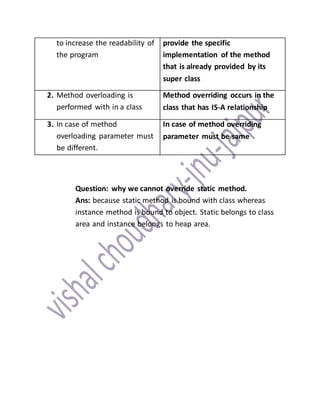
Difference between method overloading and method
overriding.
Overloading overriding
1. Method overloading is used Method overriding is used to](https://image.slidesharecdn.com/superkeyword-220203072405/85/Super-keyword-6-320.jpg)

This document discusses the super keyword in Java and method overloading and overriding. The super keyword is used to refer to the immediate parent class. It can be used to invoke the parent class constructor, access parent class variables and methods, and refer to parent class objects. Method overriding occurs when a subclass defines a method with the same signature as a method in the parent class, changing the inherited method's behavior. Method overloading involves defining multiple methods with the same name but different parameters within a class. It increases program readability. Method overriding supports runtime polymorphism by allowing the version of the method executed to be determined by the object's type. Static methods cannot be overridden as they are bound to the class, not objects.


