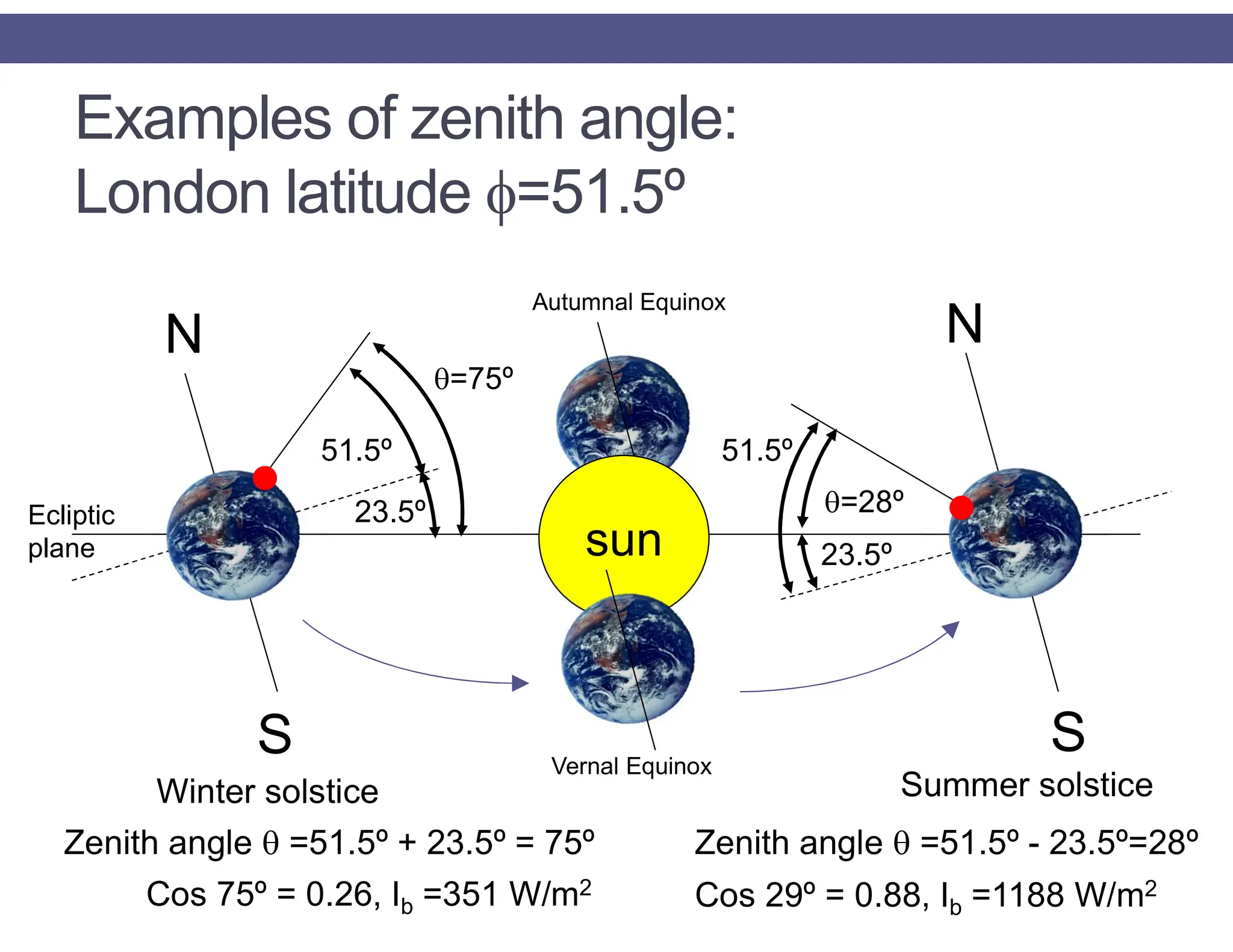
Examples of zenith angle:
London latitude f=51.5º
Ecliptic
plane
N
S
N
S
Winter solstice Summer solstice
23.5º
23.5º
51.5º
Zenith angle q =51.5º + 23.5º = 75º
Cos 75º = 0.26, Ib =351 W/m2
51.5º
q=28º
q=75º
Zenith angle q =51.5º - 23.5º=28º
Cos 29º = 0.88, Ib =1188 W/m2
sun
Vernal Equinox
Autumnal Equinox
Irradiance
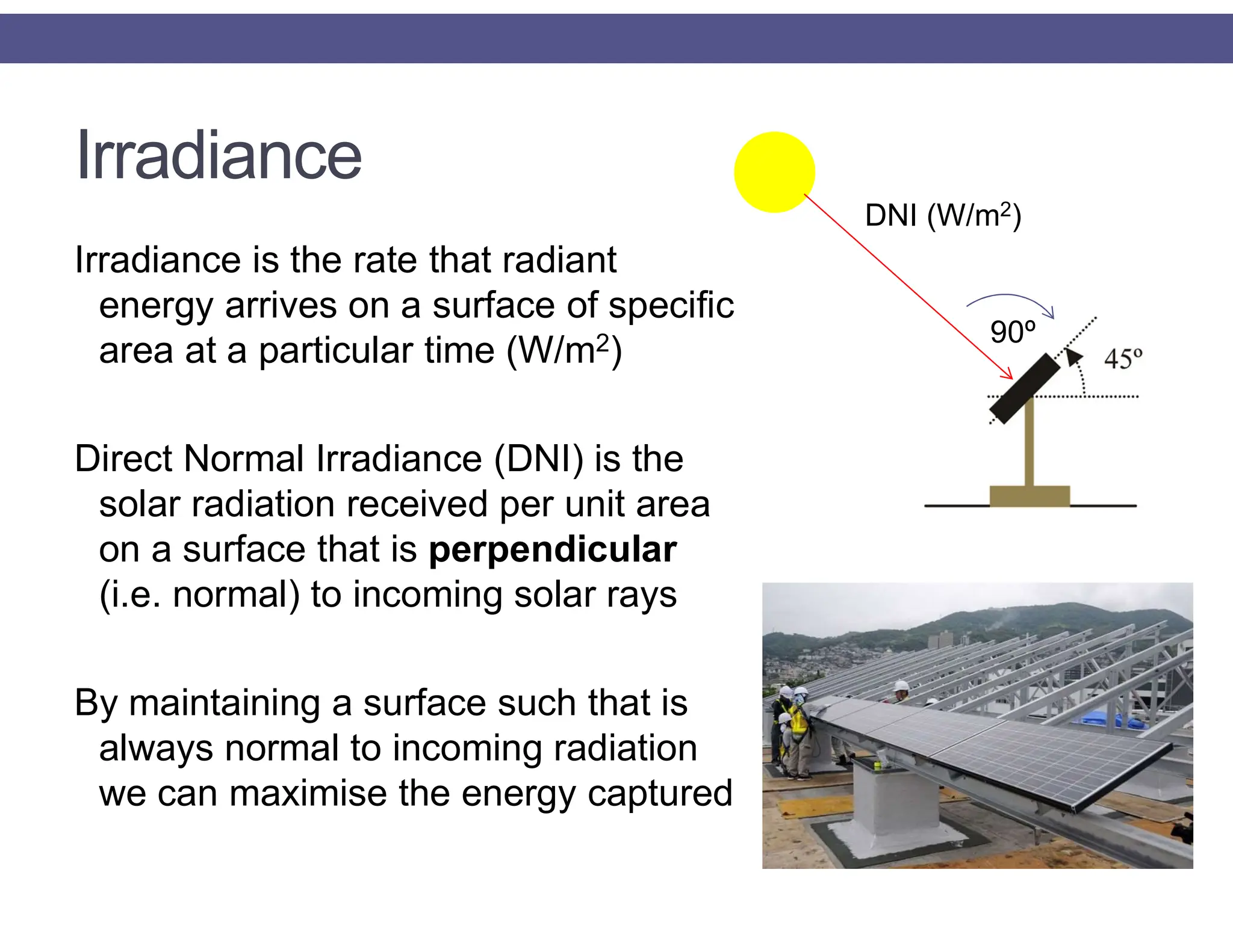
Irradiance is the rate that radiant
energy arrives on a surface of specific
area at a particular time (W/m2)
Direct Normal Irradiance (DNI) is the
solar radiation received per unit area
on a surface that is perpendicular
(i.e. normal) to incoming solar rays
By maintaining a surface such that is
always normal to incoming radiation
we can maximise the energy captured
DNI (W/m2)
90º
Sun-earth geometry
N
δ
Sun rays
(DNI)
Equator
normal
ω
θ
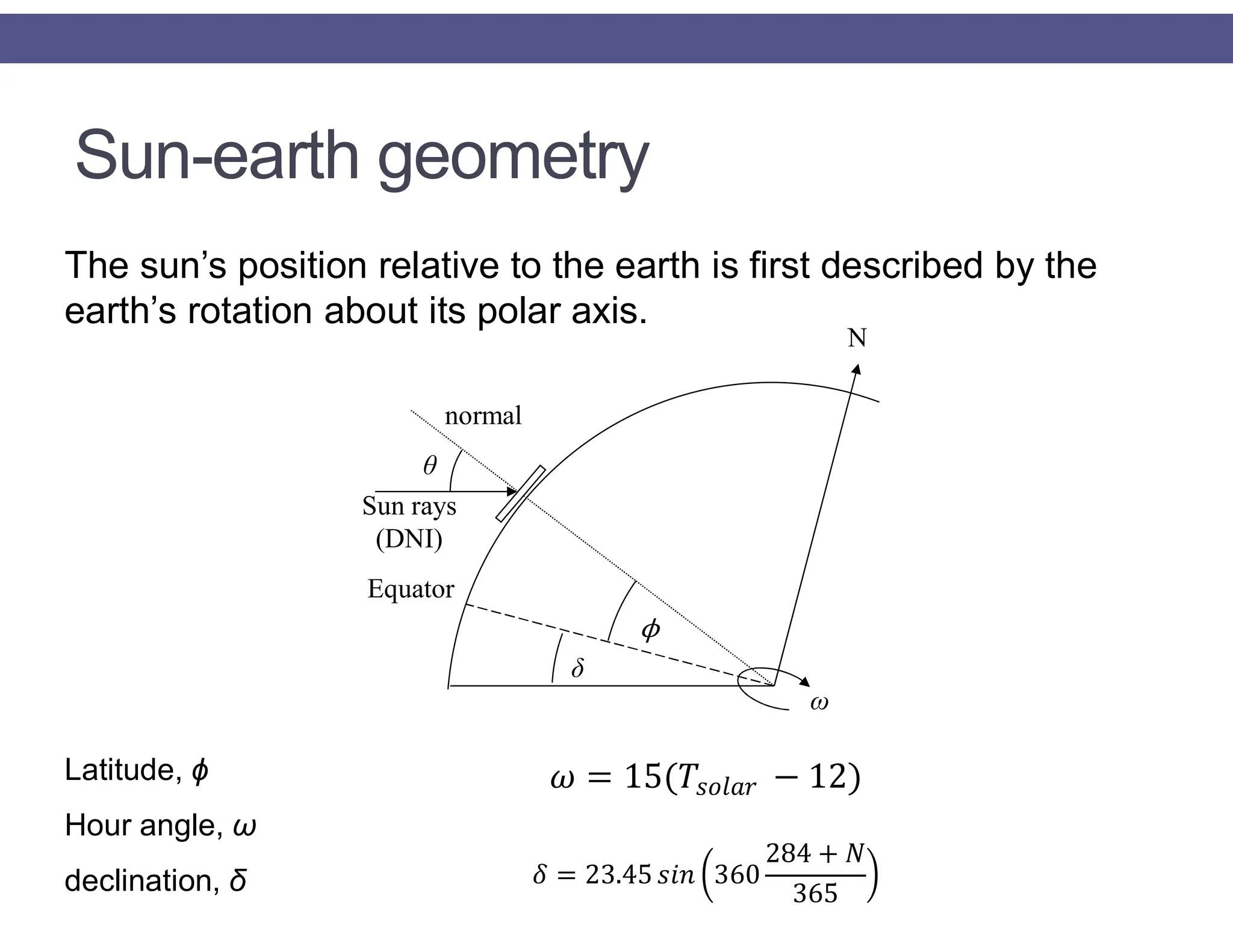
The sun’s position relative to the earth is first described by the
earth’s rotation about its polar axis.
Latitude, ϕ
Hour angle, ω
declination, δ
𝑠𝑜𝑙𝑎𝑟

Sun path calculations including definitions

  • 1.
    Examples of zenithangle: London latitude f=51.5º Ecliptic plane N S N S Winter solstice Summer solstice 23.5º 23.5º 51.5º Zenith angle q =51.5º + 23.5º = 75º Cos 75º = 0.26, Ib =351 W/m2 51.5º q=28º q=75º Zenith angle q =51.5º - 23.5º=28º Cos 29º = 0.88, Ib =1188 W/m2 sun Vernal Equinox Autumnal Equinox
  • 2.
    Irradiance Irradiance is therate that radiant energy arrives on a surface of specific area at a particular time (W/m2) Direct Normal Irradiance (DNI) is the solar radiation received per unit area on a surface that is perpendicular (i.e. normal) to incoming solar rays By maintaining a surface such that is always normal to incoming radiation we can maximise the energy captured DNI (W/m2) 90º
  • 3.
    Sun-earth geometry N δ Sun rays (DNI) Equator normal ω θ Thesun’s position relative to the earth is first described by the earth’s rotation about its polar axis. Latitude, ϕ Hour angle, ω declination, δ 𝑠𝑜𝑙𝑎𝑟