General Course Goals
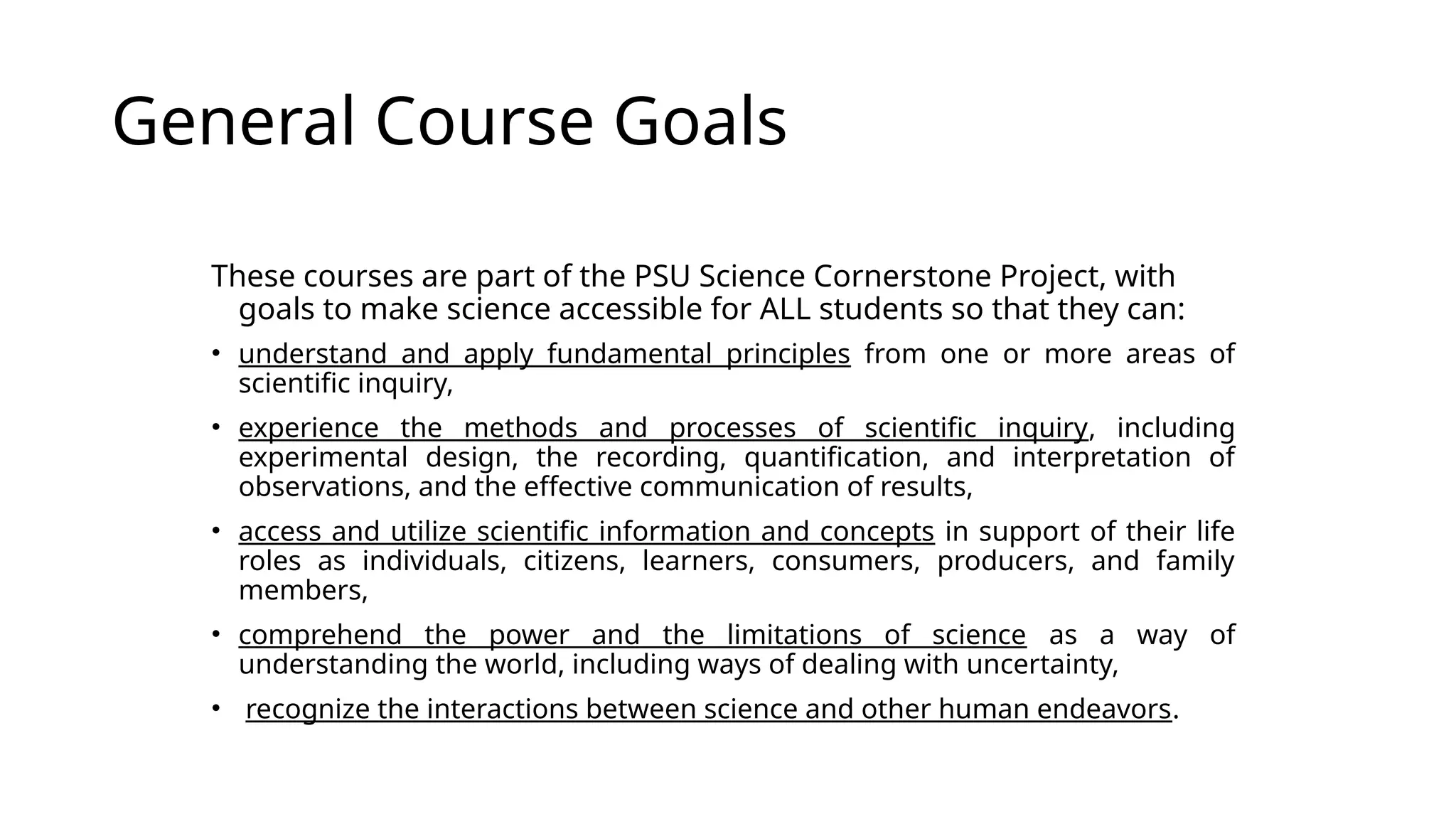
These courses are part of the PSU Science Cornerstone Project, with
goals to make science accessible for ALL students so that they can:
• understand and apply fundamental principles from one or more areas of
scientific inquiry,
• experience the methods and processes of scientific inquiry, including
experimental design, the recording, quantification, and interpretation of
observations, and the effective communication of results,
• access and utilize scientific information and concepts in support of their life
roles as individuals, citizens, learners, consumers, producers, and family
members,
• comprehend the power and the limitations of science as a way of
understanding the world, including ways of dealing with uncertainty,
• recognize the interactions between science and other human endeavors.
SCI 321 - Syllabus
• Study of the energy problem: a complex societal problem which has a
major technical component.
• Designed to help non-science majors understand the technical side of
the energy problem as well as the multidisciplinary effects of
technical decisions on the social, political, and economic framework.
• Examination of energy requirements and usage, energy resources,
methods for producing energy, environmental and economic
implications of energy production, energy conservation, and energy
policies.
• Power production techniques utilizing coal, nuclear, solar, wind,
geothermal, and other energy sources will be studied.
SCI 322 - Syllabus
• Energy - sources, measurements, interconversions
• Renewable energy - water cycle, carbon cycle, wind
energy, geothermal, other resources
• Solar energy - passive solar, architectural design, solar
collectors, photosynthesis
• Photovoltaics - semiconductor properties, performance
criteria, manufacturing, economic and strategic issues,
system installation, data collection and analysis,
educational uses
Course Pedagogy
• Both the NCTM Principles and Standards and the National
Science Standards advocate methods of instruction that
draw on student prior knowledge to build conceptual
bridges to the powerful ideas in mathematics and science.
• The context for this is usually in problem solving and field
and laboratory investigations, where students work
cooperatively to explore and communicate their thoughts
and discoveries.
• Our courses will focus on these activities and skills for the
majority of class time, and assessments will also vary so as
to include individual journals, group presentations, field
trips, lab work, class projects, and final reports and
presentations.
SCI 321 - Lecture Topics
Power Plant Comparisons:
• Fossil fueled
• Fuel cell
• Geothermal
• Hydropower
• Nuclear
• Ocean tidal
• Solar
• Wind
SCI 321 - Recitation Topics
• Power requirements of household appliances:
Refrigerator-freezer, Stove, Light bulbs, Oven, Water
heater, Television, Garage door opener, Dishwasher,
Laundry washer and dryer
• Heating load of a 3 bedroom ranch style house (1200 ft2
)
in the Pacific Northwest and improvement by insulation
• Global warming – research using the Internet
• Energy conservation
SCI 321 - Field Trips
• Bonneville Dam Hydropower Plant (1250 MW)
• Marion County Wastes-to-Energy Facility (27 MW)
• Columbia Boulevard Waste Treatment Fuel Cell Power
Plant (300 KW)
SCI 321 - Class Projects (1999)
• “Design and Construction of a Small Scale Model of Hydro-power
Plant” – by Scott Reed
• “Design of a Windmill Power Plant for a Township” – by Vivian Ahn,
Kimmy Chang and Tarlan Torabi
• “Development of a Lesson Plan for 5th
and 6th
Graders” – by J.
Porter
• “Fuel Cell Technology” – by L. Lim, M. Hritova, and A. Stefanovic
• “Environment Effects of Hydro-power Plants” - by Jason Bryan,
Heidi Brotherton, and Tim North
• “Environmental Effect of Power Generation in Oregon and Possible
Solutions” – by Jared Smith and Devin Stinger
• “Environmental Effects of Nuclear Power” – S. Koepping & T.
Hawlett
• “Study of Air Pollution from Energy Generation” – by Matthew
SCI 321 - Class Projects (2000)
• “Comparing Hybrid Vehicles: Toyota Prius and Honda
Insight” – by P. Cathey, S. Strang, and E. Arnsberg
• “The Future of Solar Technology: A Study in Residential
Application” – by Nancy Bliss, and Rachel Burr
• “The Self-sufficient Home” – by Theron Luttmann, John
Petkovich, and Jake Batty
• “Passive Solar Construction: Attached Sunspace Design
with Solar Water Heating” – by Allison Anderson, Robert
Gibbens, and Daniel Martinez
• “Tidal Basin Power: Potential Energy Resource” – by Rose
Mitchell and Juan Carlos Nuno

Solar system theory and design course.pptx

  • 1.
    General Course Goals Thesecourses are part of the PSU Science Cornerstone Project, with goals to make science accessible for ALL students so that they can: • understand and apply fundamental principles from one or more areas of scientific inquiry, • experience the methods and processes of scientific inquiry, including experimental design, the recording, quantification, and interpretation of observations, and the effective communication of results, • access and utilize scientific information and concepts in support of their life roles as individuals, citizens, learners, consumers, producers, and family members, • comprehend the power and the limitations of science as a way of understanding the world, including ways of dealing with uncertainty, • recognize the interactions between science and other human endeavors.
  • 2.
    SCI 321 -Syllabus • Study of the energy problem: a complex societal problem which has a major technical component. • Designed to help non-science majors understand the technical side of the energy problem as well as the multidisciplinary effects of technical decisions on the social, political, and economic framework. • Examination of energy requirements and usage, energy resources, methods for producing energy, environmental and economic implications of energy production, energy conservation, and energy policies. • Power production techniques utilizing coal, nuclear, solar, wind, geothermal, and other energy sources will be studied.
  • 3.
    SCI 322 -Syllabus • Energy - sources, measurements, interconversions • Renewable energy - water cycle, carbon cycle, wind energy, geothermal, other resources • Solar energy - passive solar, architectural design, solar collectors, photosynthesis • Photovoltaics - semiconductor properties, performance criteria, manufacturing, economic and strategic issues, system installation, data collection and analysis, educational uses
  • 4.
    Course Pedagogy • Boththe NCTM Principles and Standards and the National Science Standards advocate methods of instruction that draw on student prior knowledge to build conceptual bridges to the powerful ideas in mathematics and science. • The context for this is usually in problem solving and field and laboratory investigations, where students work cooperatively to explore and communicate their thoughts and discoveries. • Our courses will focus on these activities and skills for the majority of class time, and assessments will also vary so as to include individual journals, group presentations, field trips, lab work, class projects, and final reports and presentations.
  • 5.
    SCI 321 -Lecture Topics Power Plant Comparisons: • Fossil fueled • Fuel cell • Geothermal • Hydropower • Nuclear • Ocean tidal • Solar • Wind
  • 6.
    SCI 321 -Recitation Topics • Power requirements of household appliances: Refrigerator-freezer, Stove, Light bulbs, Oven, Water heater, Television, Garage door opener, Dishwasher, Laundry washer and dryer • Heating load of a 3 bedroom ranch style house (1200 ft2 ) in the Pacific Northwest and improvement by insulation • Global warming – research using the Internet • Energy conservation
  • 7.
    SCI 321 -Field Trips • Bonneville Dam Hydropower Plant (1250 MW) • Marion County Wastes-to-Energy Facility (27 MW) • Columbia Boulevard Waste Treatment Fuel Cell Power Plant (300 KW)
  • 8.
    SCI 321 -Class Projects (1999) • “Design and Construction of a Small Scale Model of Hydro-power Plant” – by Scott Reed • “Design of a Windmill Power Plant for a Township” – by Vivian Ahn, Kimmy Chang and Tarlan Torabi • “Development of a Lesson Plan for 5th and 6th Graders” – by J. Porter • “Fuel Cell Technology” – by L. Lim, M. Hritova, and A. Stefanovic • “Environment Effects of Hydro-power Plants” - by Jason Bryan, Heidi Brotherton, and Tim North • “Environmental Effect of Power Generation in Oregon and Possible Solutions” – by Jared Smith and Devin Stinger • “Environmental Effects of Nuclear Power” – S. Koepping & T. Hawlett • “Study of Air Pollution from Energy Generation” – by Matthew
  • 9.
    SCI 321 -Class Projects (2000) • “Comparing Hybrid Vehicles: Toyota Prius and Honda Insight” – by P. Cathey, S. Strang, and E. Arnsberg • “The Future of Solar Technology: A Study in Residential Application” – by Nancy Bliss, and Rachel Burr • “The Self-sufficient Home” – by Theron Luttmann, John Petkovich, and Jake Batty • “Passive Solar Construction: Attached Sunspace Design with Solar Water Heating” – by Allison Anderson, Robert Gibbens, and Daniel Martinez • “Tidal Basin Power: Potential Energy Resource” – by Rose Mitchell and Juan Carlos Nuno