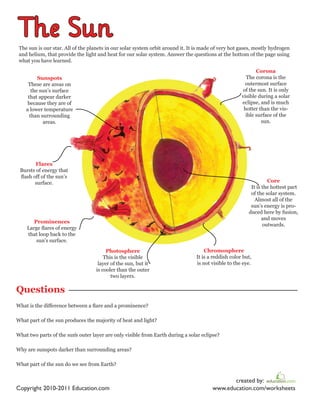
Corona
The corona is the
outermost surface
of the sun. It is only
visible during a solar
eclipse, and is much
hotter than the vis-
ible surface of the
sun.
The Sun
The sun is our star. All of the planets in our solar system orbit around it. It is made of very hot gases, mostly hydrogen
and helium, that provide the light and heat for our solar system. Answer the questions at the bottom of the page using
what you have learned.
Questions
Chromosphere
It is a reddish color but,
is not visible to the eye.
Flares
Bursts of energy that
surface.
Sunspots
These are areas on
that appear darker
because they are of
a lower temperature
than surrounding
areas.
Prominences
that loop back to the
Core
It is the hottest part
of the solar system.
Almost all of the
-
duced here by fusion,
and moves
outwards.
Photosphere
This is the visible
layer of the sun, but it
is cooler than the outer
two layers.
created by:
Copyright 2010-2011 Education.com www.education.com/worksheets
’
Corona
The corona is the
outermost surface
of the sun. It is only
visible during a solar
eclipse, and is much
hotter than the vis-
ible surface of the
sun.
The Sun
The sun is our star. All of the planets in our solar system orbit around it. It is made of very hot gases, mostly hydrogen
and helium, that provide the light and heat for our solar system. Answer the questions at the bottom of the page using
what you have learned.
Questions
Chromosphere
It is a reddish color but,
is not visible to the eye.
Flares
Bursts of energy that
surface.
Sunspots
These are areas on
that appear darker
because they are of
a lower temperature
than surrounding
areas.
Prominences
that loop back to the
Core
It is the hottest part
of the solar system.
Almost all of the
-
duced here by fusion,
and moves
outwards.
Photosphere
This is the visible
layer of the sun, but it
is cooler than the outer
two layers.
created by:
Copyright 2010-2011 Education.com www.education.com/worksheets
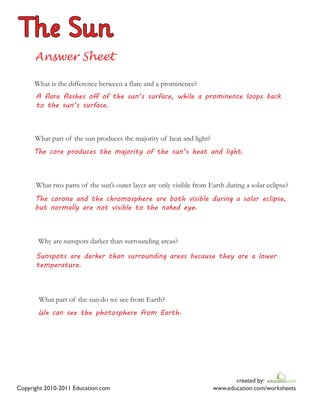
Answer Sheet
A flare flashes off of the sun’s surface, while a prominence loops back
to the sun’s surface
The core produces the majority of the sun’s heat and light
The corona and the chromosphere are both visible during a solar eclipse,
but normally are not visible to the naked eye
Sunspots are darker than surrounding areas because they are a lower
temperature
We can see the photosphere from Earth
What is the difference between a flare and a prominence?
What part of the sun produces the majority of heat and light?
What two parts of the sun’s outer layer are only visible from Earth during a solar eclipse?
Why are sunspots darker than surrounding areas?
What part of the sun do we see from Earth?
.
.
.
.
.

Sun diagram-review

  • 1.
    Corona The corona isthe outermost surface of the sun. It is only visible during a solar eclipse, and is much hotter than the vis- ible surface of the sun. The Sun The sun is our star. All of the planets in our solar system orbit around it. It is made of very hot gases, mostly hydrogen and helium, that provide the light and heat for our solar system. Answer the questions at the bottom of the page using what you have learned. Questions Chromosphere It is a reddish color but, is not visible to the eye. Flares Bursts of energy that surface. Sunspots These are areas on that appear darker because they are of a lower temperature than surrounding areas. Prominences that loop back to the Core It is the hottest part of the solar system. Almost all of the - duced here by fusion, and moves outwards. Photosphere This is the visible layer of the sun, but it is cooler than the outer two layers. created by: Copyright 2010-2011 Education.com www.education.com/worksheets ’
  • 2.
    Corona The corona isthe outermost surface of the sun. It is only visible during a solar eclipse, and is much hotter than the vis- ible surface of the sun. The Sun The sun is our star. All of the planets in our solar system orbit around it. It is made of very hot gases, mostly hydrogen and helium, that provide the light and heat for our solar system. Answer the questions at the bottom of the page using what you have learned. Questions Chromosphere It is a reddish color but, is not visible to the eye. Flares Bursts of energy that surface. Sunspots These are areas on that appear darker because they are of a lower temperature than surrounding areas. Prominences that loop back to the Core It is the hottest part of the solar system. Almost all of the - duced here by fusion, and moves outwards. Photosphere This is the visible layer of the sun, but it is cooler than the outer two layers. created by: Copyright 2010-2011 Education.com www.education.com/worksheets Answer Sheet A flare flashes off of the sun’s surface, while a prominence loops back to the sun’s surface The core produces the majority of the sun’s heat and light The corona and the chromosphere are both visible during a solar eclipse, but normally are not visible to the naked eye Sunspots are darker than surrounding areas because they are a lower temperature We can see the photosphere from Earth What is the difference between a flare and a prominence? What part of the sun produces the majority of heat and light? What two parts of the sun’s outer layer are only visible from Earth during a solar eclipse? Why are sunspots darker than surrounding areas? What part of the sun do we see from Earth? . . . . .