5.Ethiopian Income Tax Schedules and structures
5.1 EMPLOYMENT INCOME TAX (SCHEDULE A)
5.1.1 Introduction
 Employment income shall include any form of
payment or gain, either in the form of cash or in
kind, received from current, former or
prospecting employment by an individual. - If
the tax on employment is paid by the employer
in whole or in part, the amount so paid shall be
added to the taxable income and considered as
part thereof too. Nonetheless, income received in
the form of wages does not include
representation and other similar expenditures
(social functions, guest accommodation etc).
5.1.2 Determination of Employment Income
 The determination of employment income involves a
series of steps and requires such inputs as taxable
income and the use of relevant and appropriate tax
rates. The determination of taxable income, on the
other hand, requires identifying categories of income
that are exempted from the payment of tax from
those taxable under the law. The following are
categories of income that are exempted from the
payment of tax.
I. Income from employment by casual employees who
do not work for more than one month for the same
employee in any twelve months period.
II. Pension contribution, provident fund and all
forms of retirement benefit contributed by
employers in an amount that does not exceed
15% of the monthly salary of the employee.
III. Subject to reciprocity, income from
employment, received for services rendered in
the exercise of their duties by:
◦ Diplomatic and consular representatives, and
◦ Other persons employed in any Embassy, Legation,
consulate or mission of a foreign state performing state
of affairs, national of the state and bearers of diplomatic
passports.
IV. Payments made to a person as compensation or
gratitude in relation to personal injuries suffered by
that person or the death of another person.
V. Amounts paid by employers to cover the actual cost
of medical treatment of employees;
VI. Allowance in lieu of means of transportation
granted to employees under contract of
employment to the extent of the amount to be
determined by the Tax Authority.
VII. Hardship allowance
VIII. Reimbursement of traveling expenses incurred on
duty to the extent of the amount to be determined
by the Tax Authority.
IX. Traveling expenses paid to employees recruited
from elsewhere than the place of employment or
X. In case of foreigners traveling expenses from or to
their country provided that such payments are
specifically provided for in the contract. The
amount of such payment shall be determined by the
Tax Authority.
XI. Allowances paid to members and secretaries of
boards of public enterprises and public bodies as
well as to members and secretaries of study groups
set up by the Federal or Regional Government.
XII. Income of persons employed for domestic duties;
5.1.3 Compensation Payments
 An employee who has completed his probation period
but whose contract is terminated is entitled to receive
compensations payments from the employer. This
form of income falls under schedule A income which
represents income from employment. For such an
employee whose contract is terminated, the employer
is bound to pay compensation, an amount equal to
the employee’s one month salary for one year of
service plus 1/3rd of his monthly salary for every
additional year of service over one year. Income tax
is, therefore, payable on the earnings from
compensation payments.
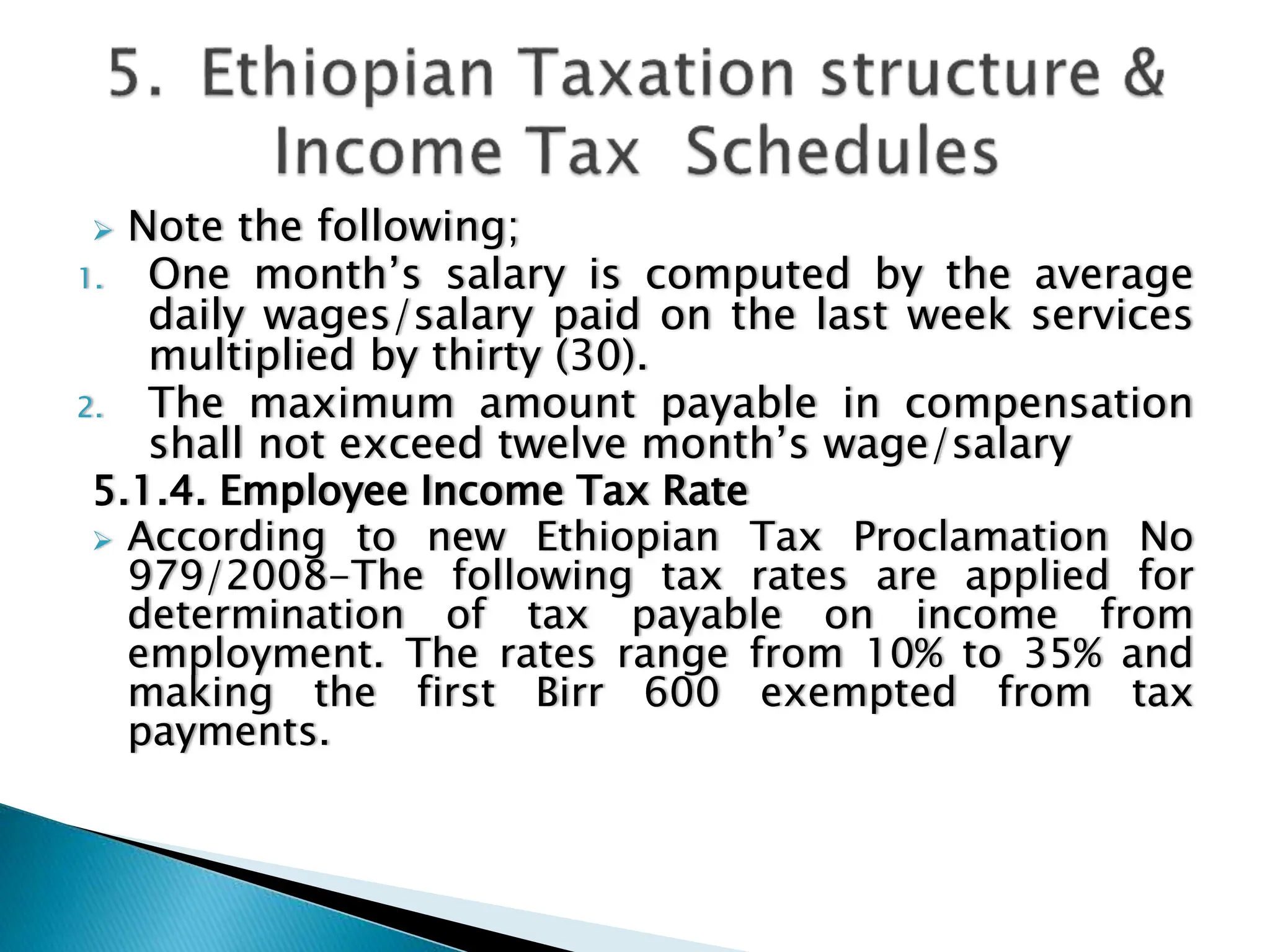
 Note the following;
1. One month’s salary is computed by the average
daily wages/salary paid on the last week services
multiplied by thirty (30).
2. The maximum amount payable in compensation
shall not exceed twelve month’s wage/salary
5.1.4. Employee Income Tax Rate
 According to new Ethiopian Tax Proclamation No
979/2008-The following tax rates are applied for
determination of tax payable on income from
employment. The rates range from 10% to 35% and
making the first Birr 600 exempted from tax
payments.
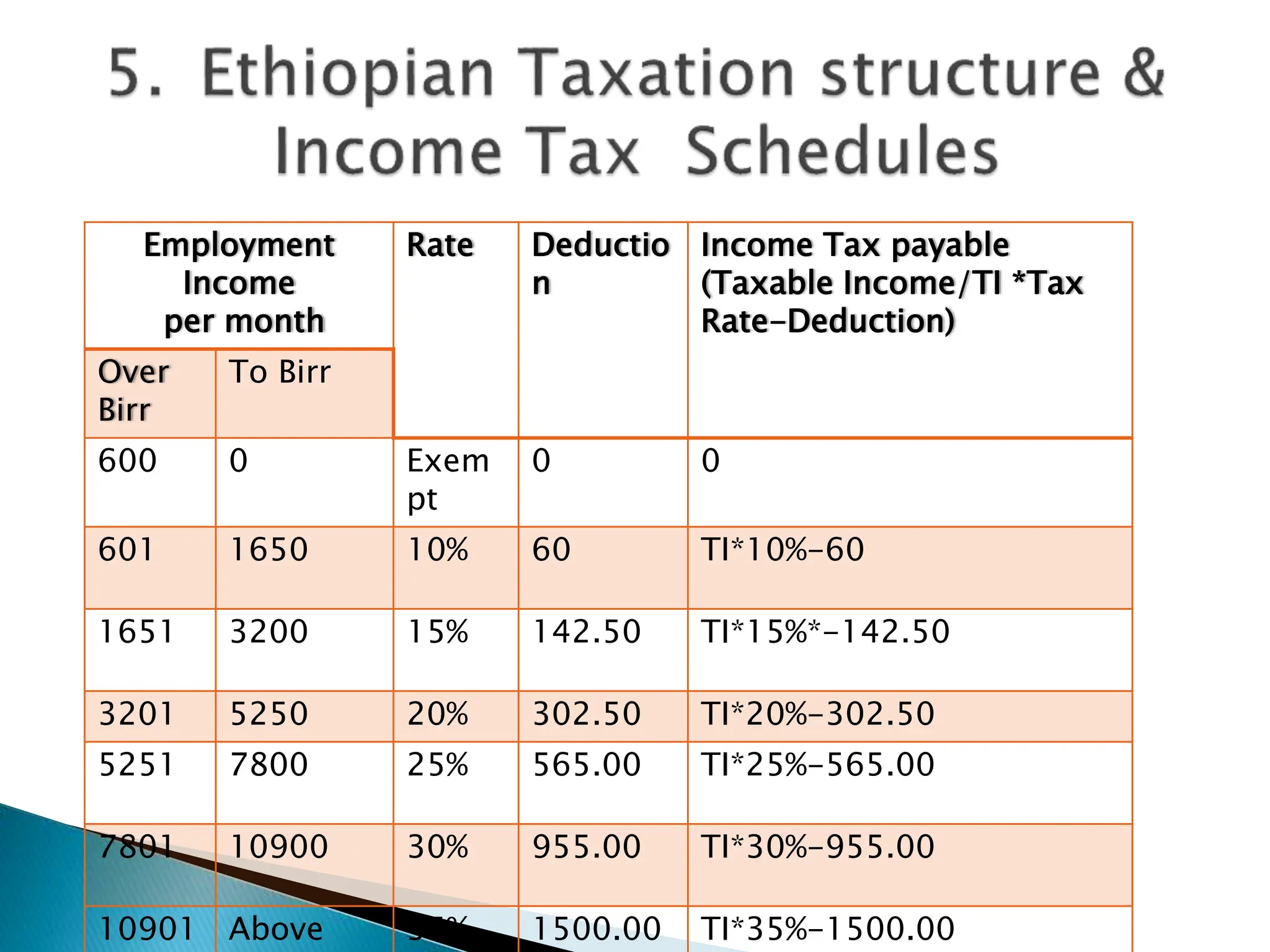
Employment
Income
per month
Rate Deductio
n
Income Tax payable
(Taxable Income/TI *Tax
Rate-Deduction)
Over
Birr
To Birr
600 0 Exem
pt
0 0
601 1650 10% 60 TI*10%-60
1651 3200 15% 142.50 TI*15%*-142.50
3201 5250 20% 302.50 TI*20%-302.50
5251 7800 25% 565.00 TI*25%-565.00
7801 10900 30% 955.00 TI*30%-955.00
10901 Above 35% 1500.00 TI*35%-1500.00
5.2 Ethiopian Rental Income Tax (RIT)
(schedule B)
5.2.1 Introduction
 Rental income includes all form of income from
rent of a building and rent of furniture and
equipment if the building is fully furnished.
Carefully note that income from the lease of
business, including goods, equipment and
building which are part of the normal operation
of a business, (called business lease) are taxable
under another schedule – schedule C.
5.2.1 DETERMINATION OF RENTAL
INCOME
 Gross rental income also includes any cost
incurred by the lessee for improvement to the
land or building and all payments made by the
lessee on behalf of the lessor in accordance with
the contract of lease. There are two parties
involved in renting a building – the lessee and
the lessor. The party who grants rent of the
building is the lessor while the one who leases
the property for use is the lessee.
 In some occasions the lessor may allow the
lessee to sub lease the building to another party
in such circumstances the first lessee will be
called sub - lessor. The sub - lessor must pay
tax on the difference between income from the
sub leasing and the rent paid to the lessor,
provided that the amount received by the sub
lessor is greater than the amount payable to the
lessor. The owner of the building who allows a
lessee to sub-lease is liable for payment of the
tax for which the sub-lessor is liable, in the event
the sub-lesser fails to pay.
 When a building is constructed for the purpose of
giving on lease, the owner and contractor should
inform the Kebele Administration about its
completion and the intention of giving it on
lease. This is also applicable when the building is
rented before its completion. The Kebele
Administration will pass the information to the
tax office for the determination of tax. It is also
the responsibility of Kebele Administration to
gather any such information and communicate to
tax office in case where the parties fail to do so.
5.2.3 Rental Taxable Income;-
 Gross income includes all payments, either in
cash or benefits in kind, received by the lessor
and all payments made by the lessee on the
behalf of the lessor. The value of any renovation
or improvement to the land or the building is
also part of taxable income under this schedule if
such cost is borne by the lessee in addition to
rent payable. Taxable income from schedule B
income is determined by subtracting the
allowable deductions from the gross income.
Allowable deductions include the following;
If the lessor does not maintain books of accounts his
allowable deductions include taxes paid on land and
buildings being leased and 20% of the gross income
received as an allowance for repairs, maintenance and
depreciation of such buildings, furniture equipment.
If the lessor maintains books of accounts the allowable
deductions (deductible expenses) include (but not
limited to):-
1. Tax on land and buildings being leased
2. Cost of lease (rent) of land
3. Repairs, maintenance and depreciation of building
(and furniture and equipment if furnished) per income
tax proclamations article 23.
4. Interest on bank loan
5. If any Premium paid on insurance of building.
 It is important to keep proper accounts for
period of times when the building was not
leased (kept idle).
5.2.4 Tax Rate
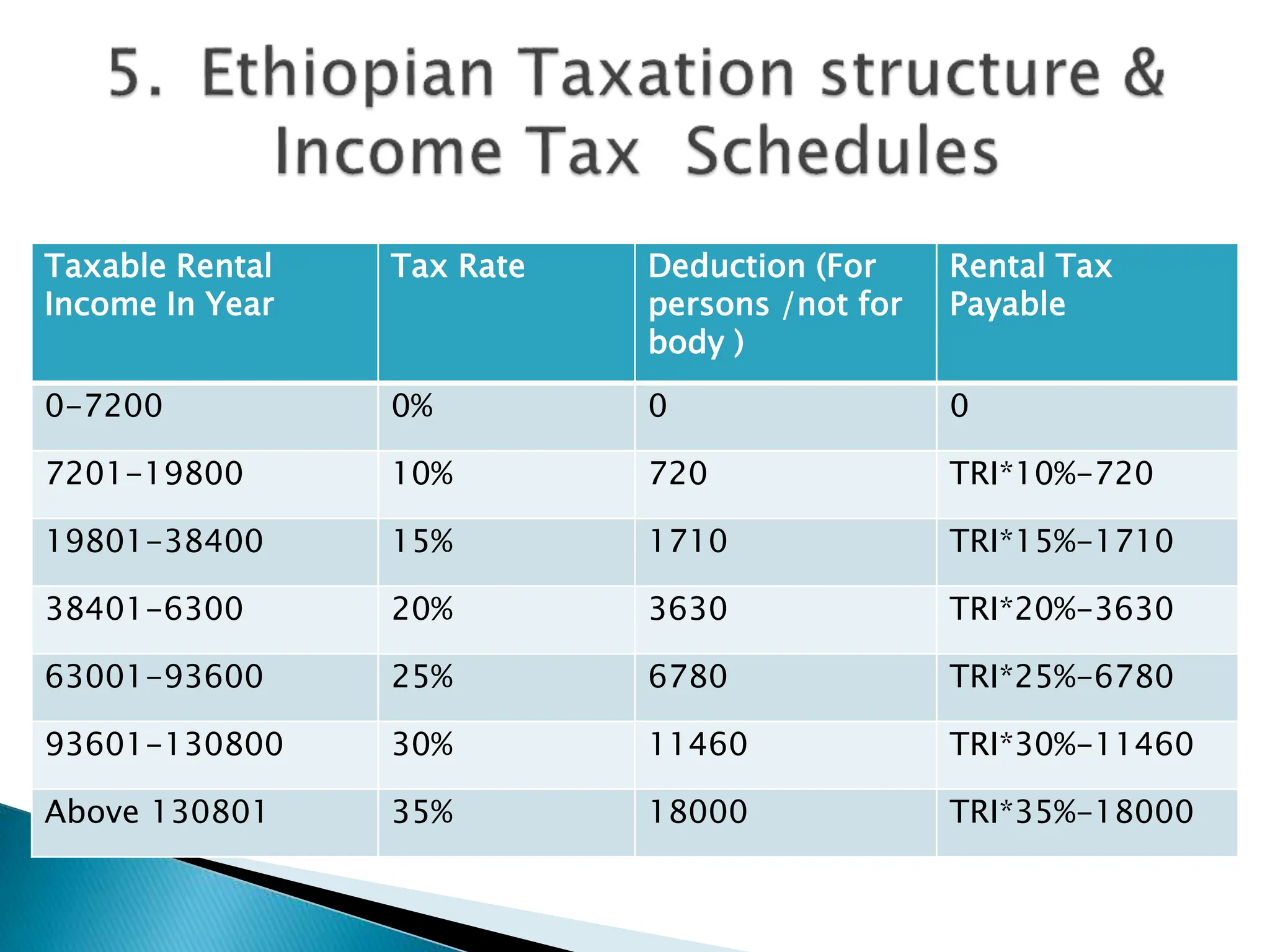
 The income tax payable on rented houses
shall be charged, levied and collected at the
following rates:- On income of legal bodies
30% of taxable income & If on income of
persons according to schedule B below;-
Taxable Rental
Income In Year
Tax Rate Deduction (For
persons /not for
body )
Rental Tax
Payable
0-7200 0% 0 0
7201-19800 10% 720 TRI*10%-720
19801-38400 15% 1710 TRI*15%-1710
38401-6300 20% 3630 TRI*20%-3630
63001-93600 25% 6780 TRI*25%-6780
93601-130800 30% 11460 TRI*30%-11460
Above 130801 35% 18000 TRI*35%-18000
5.3 Business Income Tax
5.3.1 Introduction
 The current income tax proclamation and related
regulations defined business as any industrial,
commercial, professional or vocational activity or
any other activity recognized as trade by the
commercial code of Ethiopia and carried on by
any person for profit. As compared to the
previous income tax rate, the current
proclamation provides a reduced tax rate on
business income as a measure of the tax reform
program in progress. The reduced tax rate is
believed to serve as an investment incentive.
 For the purpose of payments of business
income tax, tax payers are categorized into
three, namely category A, Category B,
Category C. based on the volume of their
sales for a tax year and form of business.
Subsequently, the Tax Authority will
determine whether the tax payer shall
continue in the same category or his/her
category be changed for the following tax
year
 Category A includes any company
incorporated under the laws of Ethiopia or
in a foreign country and other entities
having annual turnover of Birr 1,00,000 and
more. This group of tax payers have to
maintain all records and accounts which will
enable them to submit a balance sheet and
profit and loss account disclosing the gross
profit, general and administrative expenses,
depreciation, and provisions and reserves
(together, with the supporting vouchers).
 Category “B” unless already classified in category
“A”, includes businesses having an annual turnover
of over Br 500,000. This category of taxpayers
must submit profit and loss statement at the end
of the year. The law requires all entries in the
records and accounts to be supported by
appropriate vouchers.
 Category “C” unless already classified in categories
“A” and “B” include those tax payers whose annual
turnover is estimated by the Tax Authority at Birr
500,000 or less. Every businessman or body, with
the exception of category C, is required to keep
proper books of accounts and other records and
documents.
 The books of accounts must contain;
◦ a record of business assets and liabilities including
a detailed register of fixed assets;
◦ a record of all daily income and expenses,
◦ a record of all purchases and sales of goods and
services showing the following:-
1. the particular goods and services sold
2. the name of the buyers and sellers/providers
in such a manner that they can be identified
by the Tax authorities
3. Using pre-numbered invoices containing
vendor’s tax identification number.
4. a record of trading stock on hand at the end of
the accounting period with the method of
valuation
5. any other document relevant for the
determination of the tax liability
 If books and records are prepared in a foreign
language, the Tax Authority may require
translation to the official languages of Ethiopia at
the taxpayer’s expense. Moreover, the books and
records must be kept by the taxpayer for ten
years after the end of the tax period to which
they relate.
5.3.2 DETERMINATION OF TAXABLE BUSINESS INCOME
 Taxable business income is determined for each tax period on the basis of profit
and loss account otherwise known as income statement which should be prepared
in accordance with Generally Accepted Accounting Principles, and subject to
provisions of Income Tax Proclamation No.286/2002 and related directives issued
by the Tax Authority.
 At the end of each fiscal year, each taxpayer submits a tax return to the Income
Tax Authority. The tax return is a statement containing statistical information
filled in a pre-printed form (provided by the Tax Authority), given to the Income
tax Office. The return should contain full and true information about the income
earned by the tax payer. The law requires the tax payer to furnish such
information within a stipulated period.
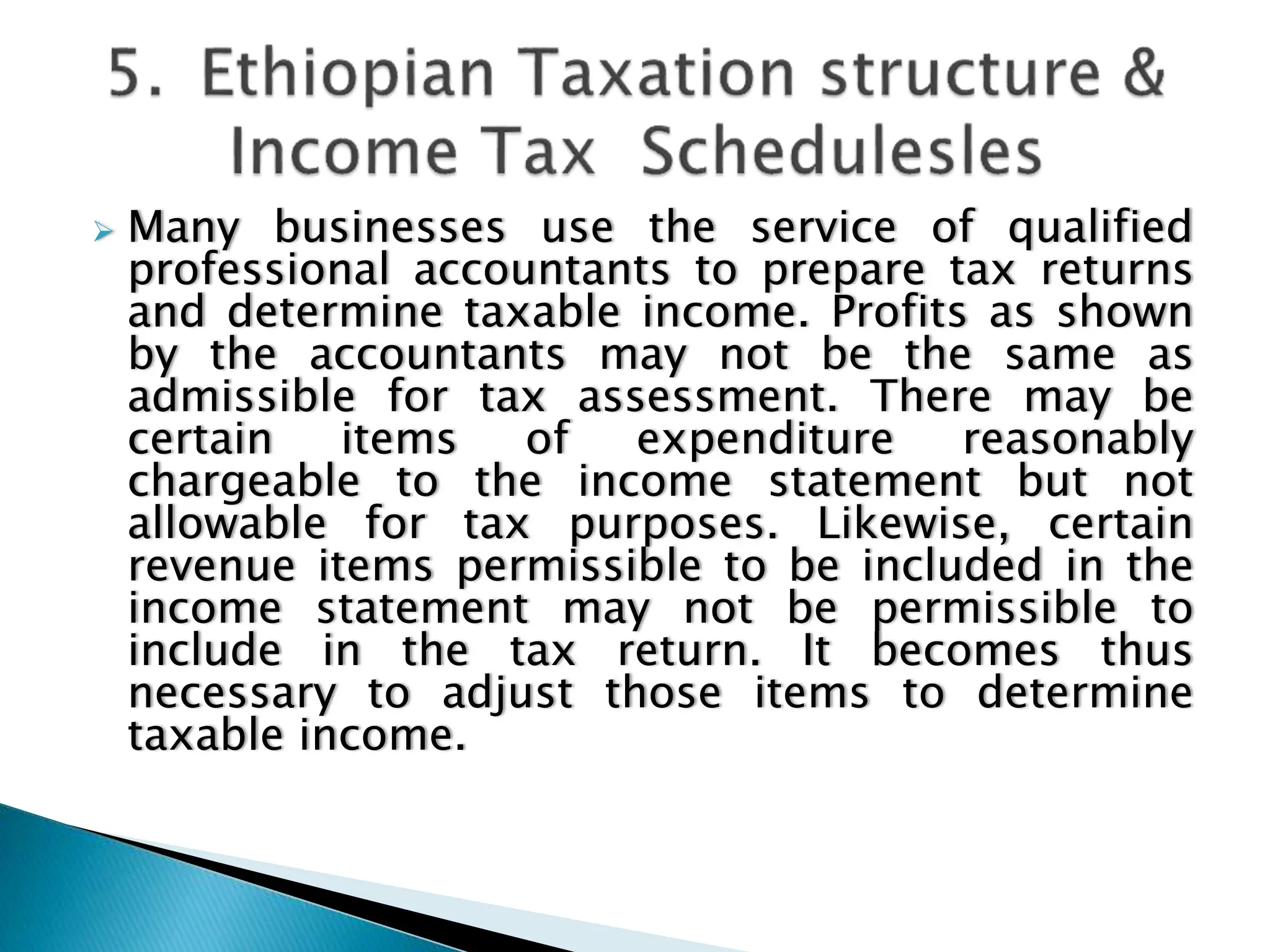
 Many businesses use the service of qualified
professional accountants to prepare tax returns
and determine taxable income. Profits as shown
by the accountants may not be the same as
admissible for tax assessment. There may be
certain items of expenditure reasonably
chargeable to the income statement but not
allowable for tax purposes. Likewise, certain
revenue items permissible to be included in the
income statement may not be permissible to
include in the tax return. It becomes thus
necessary to adjust those items to determine
taxable income.
5.3.2.1 Allowable Deductions (Deductible Expenses)
 The general principle regarding deductibility is that
deductions will be allowed for expenses incurred for
the purpose of earning, securing and maintaining the
business income to the extent that the expenses can
be proven by the tax payer and subject to the
limitations specified by the proclamation. On the
basis of this, the law permits the following lists of
expenses as deductible from business income.
1) The direct costs of producing the income, such as
the direct cost of manufacturing, purchasing,
importations, selling and such other similar costs
2) General administrative expenses connected with the
business activity; Premiums payable on insurance
directly connected with the business activity;
3) Expenses incurred in connection with the promotion
of the business inside and outside the country,
subject to the limits set by the directive issued by
the Minister of Revenue.
4) Commissions paid for services rendered to the
business, provided that:
(a) said services were in fact rendered.
(b)the amount paid corresponds to normal rates paid
for similar services. By other persons or bodies
similarly situated.
6) In the case of a business located and operating
in Ethiopia as the branch, subsidiary or
associated company of a business located and
operating abroad, no payment of any kind made
to the holding or associated company of the
business in Ethiopia shall be accepted as
deduction unless:
A.The payment in question was made for service actually
rendered: and
B. said service was necessary for the business and could
not be performed by the persons or bodies or by the
business itself at a lower cost.
7) If the income tax authority has reason to consider
that the total amount of salaries and other personal
emoluments payable to the manager of a private
limited company is exaggerated it may reduce paid
amount for taxation purpose to the limit which, in
view of operation of the company, appears
justifiable, either by disallowing the payments made
to more than one manager or in any other way which
may be just and appropriate.
8) Sums paid as salary, wages or other emoluments to
the children of the proprietor or member of the
partnership shall only be allowed as deduction if
such employees have the qualifications required by
the post.
5.3.2.2 Non-allowable Expenses
 All those expenses, which are not wholly or exclusively
incurred for the business activity, are not allowable
deductions from gross income. Therefore, in computing
taxable income the following expenses should be added
back;-
1) Capital Expenditure- the cost of acquisition,
improvement, renewal and reconstruction of depreciable
assets
2) Additional Investment- an increase of the share capital of
a company or the basic capital of a registered partnership
3) Declared dividends and paid out project shares.
4) Voluntary pension or provident fund contributions over
and above 15% of the monthly salary of the employee.
5) Damages covered by insurance policy
6) Interest in excess of the rate used between the
National Bank of Ethiopia and the commercial
Banks increased by two percentage points.
7) Punitive damages and penalties
8) The creation or increase of reserves, provisions
and other special purpose funds unless otherwise
allowed by the proclamation.
9) Income tax paid on schedule “C” income and
recoverable Value Added Tax (VAT)
10) Representation expenses over and above 10% of
the salary of the employee.
11) Personal consumption expenses
12) Expenditures exceeding the limits set forth by
the proclamation or regulations
13) Entertainment expenses “Entertainment” means
the provision of food, beverages, tobacco,
accommodation, amusement, recreation or
hospitality of any kind to any person whether
directly or indirectly.
14)Donation and gift other than those
permitted by regulation.
15)Sum paid as salary, wages or other
personal emoluments to the proprietor or
partner of the enterprises. Expenditure for
maintenance or other private purpose of
the proprietor or partner of the enterprise.
16)Losses that are not connected with or not
arising out of the activity of enterprise.
17)Grants and donations that exceed 10% of
the taxable income of the tax payer.
5.3.2.3 Allowable deductions that need
certain conditions to be met
 The following expenses need certain conditions to
be met before all are allowed to be deducted from
gross income:-
◦ Interest expense
A) Interest which is not in excess of the rate used
between National Bank of Ethiopia and Commercial
banks increased by 2 %) is allowable deduction if
the lending institution is recognized by NBE or a
foreign institution permitted to lend to enterprises
in the country. Moreover, for the interest paid to
foreign banks to be deductible, the lending bank
shall, prior to the granting of any loan to any such
person, file a declaration in writing with the Tax
Authority wherein it informs said authority
 In addition, the borrower shall withhold 10% from the
gross interest payable and transfer same to the Tax
authority within two months of the end of the fiscal year.
B. Interest paid to share holders on loans and advance can be
deducted to the extent that the interest paid is less than the
average of four times the amount of share capital in a tax period.
This provision doesn’t apply to banks and insurance companies.
 Representation allowances
 Representation allowance is hospitality expense incurred
in receiving guests coming from outside the enterprise in
connection with the promotion and enhancement of the
business. Such expenses are deductible to the extent of
10% of the salary of the employee.
◦ Gifts and donations
 Gifts and donations are allowable deductions under the following
conditions;-
A. If they are given to a registered welfare organization and
where it is certified by the registering authority that the
organization has a record of outstanding achievement and its
utilization of resources and accounting system operates
transparency, accountability.
B. If the payment is made in response to emergency call issued
by the government to defend the sovereignty and integrity of
the country, to prevent man made or natural catastrophe,
epidemic or for any other similar cause.
C. Donation made to non commercial education or health
facilities
 Nonetheless, grants and donations made for purpose listed
above may only be allowed as deduction where the amount of
the donation or grant does not exceed 10% of the taxable
income of the taxpayer.
◦ Trading stock
 Trading stock is a business asset that is either used in the
production process or become part of the product, or that is held
for resale purpose.
 The cost of trading stock disposed of during a tax period is
allowable deduction for the purposes of ascertaining income.
 The cost of trading stock disposed of during a tax period is
determined on the basis of the average cost method, i.e. the
generally accepted accounting principle under which trading
stock valuation is based on an average cost of units on hand.
Depreciation
 In accordance with the newly enacted income tax
proclamation and regulation, depreciation may be
deducted in the determination of taxable business
income. Nonetheless, fine arts, antiques, jewelry,
trading stock and other similar business assets not
subject to wear and tear and obsolescence shall not be
depreciated
Depreciation rate
A. In determining the amount of depreciation the
acquisition or construction cost, and the cost of
improvement, renewal and reconstruction of buildings
and constructions shall be depreciated individually on
a straight-line basis at five percent (5%).
B. The acquisition or construction cost, and the
cost of improvement, renewal and
reconstruction, of intangible assets shall be
depreciated individually on a straight line
basis at ten percent (10%).
 The above two categories of business assets are
depreciated at the given rates based on their cost (gross
value). The following two categories of business assets
shall be depreciated according to a poling system at the
following rates;
a. Computers, Information systems, software products and
data storage equipment as a rate of 25%
b. All other business assets at the rate of 20%. This category
includes motor vehicles, plant and machinery, furniture
and equipment, etc.
 For assets for which the pooling methods are used,
the rate is applied to the depreciation base for the
determination of depreciation. The depreciation base
is the book value of the asset as recorded on the
opening day of the balance sheet of the tax period
increased by the cost of asset acquired or created
and the cost of improvement, renewal and
reconstruction of the asset during the tax period. The
amount can also be decreased by the sales price of
assets disposed of during the period. Losses incurred
during the period due to natural calamity and other
involuntary conversion will also be considered in the
computation of depreciation base. Any compensation
received for these purposes will be deducted from the
book value.
◦ The regulation issued by the Council Of Ministers indicates
that depreciation will be allowed as deduction only if the
taxpayer claiming deductions for depreciation keeps proper
records showing the cost of acquisition of the asset and the
total amount deducted since the date of acquisition. Moreover,
the tax payer must furnish the Tax Authority with satisfactory
evidence that the data mentioned in the records are true and
correct.
◦ Bad debts
 In the determination of taxable income, a deduction for a bad
debt is allowed if the following conditions are met:
 An amount corresponding to this debt was previously
included in the income;
 The debt is written off in the books of tax payer; and
 Any legal action to collect the debt has been taken but the
debt is not recoverable.
5.3.3 Computing Taxable Income
 Using the income statement, taxable income may be
determined as follows;
1) Take the net profit as shown in the income
statement which is prepared in accordance with
Generally Accepted Accounting Principles (GAAP) or
International Accounting Standards (IAS).
2) Add back any item deducted as expense, which is
not allowed for tax purposes.
3) Deduct any item included in the income on which
income tax has already been withheld by the payer.
Examples of such items are income received from
royalties, income from games of chance, dividends
and interest received, etc. refer schedule ‘D” other
4) Multiply the figure so arrived (from step
1through step III) by the income tax rate. For
bodies use the progressive tax table for
persons (other tax payers) to get the tax
payable for the fiscal year.
5.3.4 Tax Rate
 Taxable business income of bodies is taxable at
the rate of 30%
 Taxable business income of other taxpayers shall
be taxed in accordance with the following
schedule C.
Taxable Business
Income In Year
Rate Deduction Payable
Business
Income Tax
0-7200 0% 0 0
7201-19800 10% 720 TBI*10%-720
19801-38400 15% 1710 TBI*15%-1710
38401-63000 20% 3630 TBI*20%-3630
63001-93600 25% 6780 TBI*25%-6780
93601-130800 30% 11460 TBI*30%-11460
Above 130800 35% 18000 TBI*35%-18000
5.4 SCHEDULE D INCOME TAX
5.4.1 Royalties
 Royalty refers to a payment of any kind received
as a consideration for the use of or the right to
use any copyright of literary, artistic
 or scientific work, including cinematography
film, and films or tapes for radio or television
broadcasting, any patent, trademark, design or
model, plan, secret formula, or process, or for
the use or for the right to use of any industrial,
commercial or scientific equipment, or for
information concerning industrial, commercial or
scientific experience.
 Royalties is subject to a tax at a flat rate of
5%. The withholding agent who effects
royalties payments, withholds the foregoing
tax and accounts to the Tax Authority.
However, if the payer resides abroad and the
recipient is a resident, the recipient must pay
the tax on royalty income.
 This tax is final in lieu of income tax
5.4.2 INCOME FROM RENDERING OF TECHNICAL
SERVICES
 Income from technical service refers to income
from any kind of expert advice or technological
service rendered. All payments made in
consideration of any kind of technical services
rendered outside Ethiopia to resident persons in
this form are subject to a tax rate of 10% which
will be withheld and paid to the tax authority by
the payer.
5.4.3. INCOME FROM GAMES OF CHANCE
 This form of income is derived from winning
at games of chance (lotteries, Tom bolas, and
other similar activities). This income is
subject to tax at the rate of 15%, except for
winnings of less than Br. 100 similar to
income from rendering technical activities the
payer must withhold or collect the tax and
account to the Tax Authority.
 This tax is final in lieu of income tax.
5.4.4 DIVIDENDS
 The taxable Income is income received in the
form of dividend from a share company or
withdrawals of profits from a private limited
company. Dividend Income is subject to tax
at the rate of 10%. The withholding agent
(payer) shall withhold or collect the tax and
account to the tax Authority.
 This tax is final in lieu of income tax.
5.4.5 INCOME FROM RENTAL OF PROPERTY
 The taxable income under this category is income
derived from casual rental of property (land, building,
or moveable asset) not related to a business activity.
This type of income is subject to tax at a flat rate 15%
of the annual gross income.
 This tax is a final tax in lieu of a net income tax.
5.4.6 INTEREST INCOME ON DEPOSITS
 This includes income derived from interest on
deposits. Interest Income will be taxed at the rate
of 5% and the payer must withhold the tax and
account to the Tax Authority.
5.4.7 GAINS ON TRANSFER OF CERTAIN
INVESTMENT PROPERTY
 Gains obtained from the transfer (sale or gift)
of building held for business, factory, and
office and a share of companies is taxable
under this category. Such income is taxable
at the following rates:-
◦ Building held for business, factory, and office at the
rate of 15%, and
◦ Shares of companies at the rate of 30%
 Nonetheless, Gains obtained from the transfer of
building held for residence is exempted from tax
provided that such building is fully used for dwelling
for two years prior to the date of transfer.
5.4.8 Computation of Capital Gain
Tax
 In computing capital gain tax, you should follow the
following procedures;
STEP 1.Determine the historical cost of the building or
the par-value of the Share, as appropriate.
◦ When calculating the capital gain realized from the
alienation of building, the cost registered with the
appropriate government body at the time of issuance of
construction permit shall be taken to be the cost of
constructing the building. Tax payable on gain realized
from alienation of buildings shall be applicable only to
buildings in municipal areas.
STEP 2 Determine allowable deductions which
includes
◦ inflation adjustment at a rate to be determined by
the appropriate authority
◦ taxes paid for the land and the buildings
STEP 3 Determine proceeds from the transfer of
capital assets
STEP 4 Capital gain tax equals tax rate
mentioned above times the amount obtained
after deducting the sum of step1 and step 2
from step 3.
5.5 DECLARATION AND ASSESSMENT
 As already indicated in earlier discussions each
tax payer submits a tax return (financial
statements) to the income tax authority at the
end of each fiscal year. The tax return will, then,
be subject to a review by a tax officials. This
review by a tax official of the tax declaration and
information provided by the tax payer and a
verification of the arithmetical and technical
accuracy of the declaration tax liability shortly
after the submission of the declaration is called
Tax Assessment.
 The tax year of a person is the fiscal year for an
individual or association whereas it is the accounting
year of the body in the case of a body. The
Procedures for the assessment of business income
tax takes two forms, assessment by books of account
and assessment by estimation.
A. Assessment by books of account.
 Assessment by books will be done for those who
maintain books of accounts (Category A&B). The
revenue authority makes assessment by estimation
when the taxpayers do not maintain the books or
when the submitted books are not acceptable. This is
also done if the taxpayer fails to declare his/her table
within the time required.
.
B) Assessment by estimation
 If the taxpayers keep no records, or if the
income tax authority does not accept the
submitted books, or if the taxpayer fails to
declare tax within the time specified, the
income tax authority estimates tax by the
use of certain indicators. Category ‘C’
should pay tax at fixed rate on the income
estimated by the income tax authority
 Assessment Notification
 Notification regarding the assessment of tax, in
writing, is served to taxpayers in the following ways.
 To non-residents: By a registered letter to the agent
or by affixing the notice on the residence or place of
business.
 To Resident individuals: By registered post or in
person. (Incase if the taxpayer is absent, to any adult
member of the family). In the absence of any person
to receive the notice, it will be affixed to the door of
residence or place of business.
 To bodies: By a registered letter to the body or to any
director or employee.
 Change of accounting year
 A body can not change its accounting year unless
it obtains prior approval in writing from the Tax
Authority and complies with any condition that
may be attached to the approval. However, the
Tax Authority may remove the approval granted
by notice in writing if the body fails to comply
with any conditions set by the tax authority.
When the tax year of a person changes, as a
result of failure to comply with the tax authority’s
conditions, the period between the last full year
and the date on which the new tax year
commences will be treated as a separate tax year
to be known as the “transitional year”.
 Declaration and assessment of Schedule B and C
income;-
 For the purpose of declaration and payment of
income tax, schedule “B” and schedule “C”
income tax payers are classified into three
categories, known as category “A” category “B”
and category “C” . The amount of tax due for the
year stated in the declaration is the amount
assessed by the tax authority although the
authority may issue an amended assessment if it
discovers an error or omission
 The tax calculated in accordance with the tax
declaration less tax withheld and foreign tax
credit must be transferred to the Tax
Authority. The tax authority will refund any
excess payments resulting from the above
within 90 days of becoming satisfied on the
tax declaration.
 Declaration and assessment of
schedule “D” income
 Income tax withheld by a payer from Schedule
“D” income at source constituting a final tax
payable to the tax Authority within 15 days of the
end of each calendar month. If, however, a
taxpayer who has schedule ‘D” income, not
subjected to withholding at source consulting a
final tax, shall prepare a declaration of that
income in a form prescribed by tax authority.
Taxpayers shall submit this declaration to the tax
authority within two months from the end of the
Ethiopian fiscal year.

Summerized_CH_5_Ethiopian_Income_Tax_Schedulesstructure (1).pptx

  • 1.
    5.Ethiopian Income TaxSchedules and structures
  • 2.
    5.1 EMPLOYMENT INCOMETAX (SCHEDULE A) 5.1.1 Introduction  Employment income shall include any form of payment or gain, either in the form of cash or in kind, received from current, former or prospecting employment by an individual. - If the tax on employment is paid by the employer in whole or in part, the amount so paid shall be added to the taxable income and considered as part thereof too. Nonetheless, income received in the form of wages does not include representation and other similar expenditures (social functions, guest accommodation etc).
  • 3.
    5.1.2 Determination ofEmployment Income  The determination of employment income involves a series of steps and requires such inputs as taxable income and the use of relevant and appropriate tax rates. The determination of taxable income, on the other hand, requires identifying categories of income that are exempted from the payment of tax from those taxable under the law. The following are categories of income that are exempted from the payment of tax. I. Income from employment by casual employees who do not work for more than one month for the same employee in any twelve months period.
  • 4.
    II. Pension contribution,provident fund and all forms of retirement benefit contributed by employers in an amount that does not exceed 15% of the monthly salary of the employee. III. Subject to reciprocity, income from employment, received for services rendered in the exercise of their duties by: ◦ Diplomatic and consular representatives, and ◦ Other persons employed in any Embassy, Legation, consulate or mission of a foreign state performing state of affairs, national of the state and bearers of diplomatic passports.
  • 5.
    IV. Payments madeto a person as compensation or gratitude in relation to personal injuries suffered by that person or the death of another person. V. Amounts paid by employers to cover the actual cost of medical treatment of employees; VI. Allowance in lieu of means of transportation granted to employees under contract of employment to the extent of the amount to be determined by the Tax Authority. VII. Hardship allowance VIII. Reimbursement of traveling expenses incurred on duty to the extent of the amount to be determined by the Tax Authority.
  • 6.
    IX. Traveling expensespaid to employees recruited from elsewhere than the place of employment or X. In case of foreigners traveling expenses from or to their country provided that such payments are specifically provided for in the contract. The amount of such payment shall be determined by the Tax Authority. XI. Allowances paid to members and secretaries of boards of public enterprises and public bodies as well as to members and secretaries of study groups set up by the Federal or Regional Government. XII. Income of persons employed for domestic duties;
  • 7.
    5.1.3 Compensation Payments An employee who has completed his probation period but whose contract is terminated is entitled to receive compensations payments from the employer. This form of income falls under schedule A income which represents income from employment. For such an employee whose contract is terminated, the employer is bound to pay compensation, an amount equal to the employee’s one month salary for one year of service plus 1/3rd of his monthly salary for every additional year of service over one year. Income tax is, therefore, payable on the earnings from compensation payments.
  • 8.
     Note thefollowing; 1. One month’s salary is computed by the average daily wages/salary paid on the last week services multiplied by thirty (30). 2. The maximum amount payable in compensation shall not exceed twelve month’s wage/salary 5.1.4. Employee Income Tax Rate  According to new Ethiopian Tax Proclamation No 979/2008-The following tax rates are applied for determination of tax payable on income from employment. The rates range from 10% to 35% and making the first Birr 600 exempted from tax payments.
  • 9.
    Employment Income per month Rate Deductio n IncomeTax payable (Taxable Income/TI *Tax Rate-Deduction) Over Birr To Birr 600 0 Exem pt 0 0 601 1650 10% 60 TI*10%-60 1651 3200 15% 142.50 TI*15%*-142.50 3201 5250 20% 302.50 TI*20%-302.50 5251 7800 25% 565.00 TI*25%-565.00 7801 10900 30% 955.00 TI*30%-955.00 10901 Above 35% 1500.00 TI*35%-1500.00
  • 10.
    5.2 Ethiopian RentalIncome Tax (RIT) (schedule B) 5.2.1 Introduction  Rental income includes all form of income from rent of a building and rent of furniture and equipment if the building is fully furnished. Carefully note that income from the lease of business, including goods, equipment and building which are part of the normal operation of a business, (called business lease) are taxable under another schedule – schedule C.
  • 11.
    5.2.1 DETERMINATION OFRENTAL INCOME  Gross rental income also includes any cost incurred by the lessee for improvement to the land or building and all payments made by the lessee on behalf of the lessor in accordance with the contract of lease. There are two parties involved in renting a building – the lessee and the lessor. The party who grants rent of the building is the lessor while the one who leases the property for use is the lessee.
  • 12.
     In someoccasions the lessor may allow the lessee to sub lease the building to another party in such circumstances the first lessee will be called sub - lessor. The sub - lessor must pay tax on the difference between income from the sub leasing and the rent paid to the lessor, provided that the amount received by the sub lessor is greater than the amount payable to the lessor. The owner of the building who allows a lessee to sub-lease is liable for payment of the tax for which the sub-lessor is liable, in the event the sub-lesser fails to pay.
  • 13.
     When abuilding is constructed for the purpose of giving on lease, the owner and contractor should inform the Kebele Administration about its completion and the intention of giving it on lease. This is also applicable when the building is rented before its completion. The Kebele Administration will pass the information to the tax office for the determination of tax. It is also the responsibility of Kebele Administration to gather any such information and communicate to tax office in case where the parties fail to do so.
  • 14.
    5.2.3 Rental TaxableIncome;-  Gross income includes all payments, either in cash or benefits in kind, received by the lessor and all payments made by the lessee on the behalf of the lessor. The value of any renovation or improvement to the land or the building is also part of taxable income under this schedule if such cost is borne by the lessee in addition to rent payable. Taxable income from schedule B income is determined by subtracting the allowable deductions from the gross income. Allowable deductions include the following;
  • 15.
    If the lessordoes not maintain books of accounts his allowable deductions include taxes paid on land and buildings being leased and 20% of the gross income received as an allowance for repairs, maintenance and depreciation of such buildings, furniture equipment. If the lessor maintains books of accounts the allowable deductions (deductible expenses) include (but not limited to):- 1. Tax on land and buildings being leased 2. Cost of lease (rent) of land 3. Repairs, maintenance and depreciation of building (and furniture and equipment if furnished) per income tax proclamations article 23. 4. Interest on bank loan 5. If any Premium paid on insurance of building.
  • 16.
     It isimportant to keep proper accounts for period of times when the building was not leased (kept idle). 5.2.4 Tax Rate  The income tax payable on rented houses shall be charged, levied and collected at the following rates:- On income of legal bodies 30% of taxable income & If on income of persons according to schedule B below;-
  • 17.
    Taxable Rental Income InYear Tax Rate Deduction (For persons /not for body ) Rental Tax Payable 0-7200 0% 0 0 7201-19800 10% 720 TRI*10%-720 19801-38400 15% 1710 TRI*15%-1710 38401-6300 20% 3630 TRI*20%-3630 63001-93600 25% 6780 TRI*25%-6780 93601-130800 30% 11460 TRI*30%-11460 Above 130801 35% 18000 TRI*35%-18000
  • 18.
    5.3 Business IncomeTax 5.3.1 Introduction  The current income tax proclamation and related regulations defined business as any industrial, commercial, professional or vocational activity or any other activity recognized as trade by the commercial code of Ethiopia and carried on by any person for profit. As compared to the previous income tax rate, the current proclamation provides a reduced tax rate on business income as a measure of the tax reform program in progress. The reduced tax rate is believed to serve as an investment incentive.
  • 19.
     For thepurpose of payments of business income tax, tax payers are categorized into three, namely category A, Category B, Category C. based on the volume of their sales for a tax year and form of business. Subsequently, the Tax Authority will determine whether the tax payer shall continue in the same category or his/her category be changed for the following tax year
  • 20.
     Category Aincludes any company incorporated under the laws of Ethiopia or in a foreign country and other entities having annual turnover of Birr 1,00,000 and more. This group of tax payers have to maintain all records and accounts which will enable them to submit a balance sheet and profit and loss account disclosing the gross profit, general and administrative expenses, depreciation, and provisions and reserves (together, with the supporting vouchers).
  • 21.
     Category “B”unless already classified in category “A”, includes businesses having an annual turnover of over Br 500,000. This category of taxpayers must submit profit and loss statement at the end of the year. The law requires all entries in the records and accounts to be supported by appropriate vouchers.  Category “C” unless already classified in categories “A” and “B” include those tax payers whose annual turnover is estimated by the Tax Authority at Birr 500,000 or less. Every businessman or body, with the exception of category C, is required to keep proper books of accounts and other records and documents.
  • 22.
     The booksof accounts must contain; ◦ a record of business assets and liabilities including a detailed register of fixed assets; ◦ a record of all daily income and expenses, ◦ a record of all purchases and sales of goods and services showing the following:- 1. the particular goods and services sold 2. the name of the buyers and sellers/providers in such a manner that they can be identified by the Tax authorities
  • 23.
    3. Using pre-numberedinvoices containing vendor’s tax identification number. 4. a record of trading stock on hand at the end of the accounting period with the method of valuation 5. any other document relevant for the determination of the tax liability  If books and records are prepared in a foreign language, the Tax Authority may require translation to the official languages of Ethiopia at the taxpayer’s expense. Moreover, the books and records must be kept by the taxpayer for ten years after the end of the tax period to which they relate.
  • 24.
    5.3.2 DETERMINATION OFTAXABLE BUSINESS INCOME  Taxable business income is determined for each tax period on the basis of profit and loss account otherwise known as income statement which should be prepared in accordance with Generally Accepted Accounting Principles, and subject to provisions of Income Tax Proclamation No.286/2002 and related directives issued by the Tax Authority.  At the end of each fiscal year, each taxpayer submits a tax return to the Income Tax Authority. The tax return is a statement containing statistical information filled in a pre-printed form (provided by the Tax Authority), given to the Income tax Office. The return should contain full and true information about the income earned by the tax payer. The law requires the tax payer to furnish such information within a stipulated period.
  • 25.
     Many businessesuse the service of qualified professional accountants to prepare tax returns and determine taxable income. Profits as shown by the accountants may not be the same as admissible for tax assessment. There may be certain items of expenditure reasonably chargeable to the income statement but not allowable for tax purposes. Likewise, certain revenue items permissible to be included in the income statement may not be permissible to include in the tax return. It becomes thus necessary to adjust those items to determine taxable income.
  • 26.
    5.3.2.1 Allowable Deductions(Deductible Expenses)  The general principle regarding deductibility is that deductions will be allowed for expenses incurred for the purpose of earning, securing and maintaining the business income to the extent that the expenses can be proven by the tax payer and subject to the limitations specified by the proclamation. On the basis of this, the law permits the following lists of expenses as deductible from business income. 1) The direct costs of producing the income, such as the direct cost of manufacturing, purchasing, importations, selling and such other similar costs
  • 27.
    2) General administrativeexpenses connected with the business activity; Premiums payable on insurance directly connected with the business activity; 3) Expenses incurred in connection with the promotion of the business inside and outside the country, subject to the limits set by the directive issued by the Minister of Revenue. 4) Commissions paid for services rendered to the business, provided that: (a) said services were in fact rendered. (b)the amount paid corresponds to normal rates paid for similar services. By other persons or bodies similarly situated.
  • 28.
    6) In thecase of a business located and operating in Ethiopia as the branch, subsidiary or associated company of a business located and operating abroad, no payment of any kind made to the holding or associated company of the business in Ethiopia shall be accepted as deduction unless: A.The payment in question was made for service actually rendered: and B. said service was necessary for the business and could not be performed by the persons or bodies or by the business itself at a lower cost.
  • 29.
    7) If theincome tax authority has reason to consider that the total amount of salaries and other personal emoluments payable to the manager of a private limited company is exaggerated it may reduce paid amount for taxation purpose to the limit which, in view of operation of the company, appears justifiable, either by disallowing the payments made to more than one manager or in any other way which may be just and appropriate. 8) Sums paid as salary, wages or other emoluments to the children of the proprietor or member of the partnership shall only be allowed as deduction if such employees have the qualifications required by the post.
  • 30.
    5.3.2.2 Non-allowable Expenses All those expenses, which are not wholly or exclusively incurred for the business activity, are not allowable deductions from gross income. Therefore, in computing taxable income the following expenses should be added back;- 1) Capital Expenditure- the cost of acquisition, improvement, renewal and reconstruction of depreciable assets 2) Additional Investment- an increase of the share capital of a company or the basic capital of a registered partnership 3) Declared dividends and paid out project shares. 4) Voluntary pension or provident fund contributions over and above 15% of the monthly salary of the employee.
  • 31.
    5) Damages coveredby insurance policy 6) Interest in excess of the rate used between the National Bank of Ethiopia and the commercial Banks increased by two percentage points. 7) Punitive damages and penalties 8) The creation or increase of reserves, provisions and other special purpose funds unless otherwise allowed by the proclamation. 9) Income tax paid on schedule “C” income and recoverable Value Added Tax (VAT)
  • 32.
    10) Representation expensesover and above 10% of the salary of the employee. 11) Personal consumption expenses 12) Expenditures exceeding the limits set forth by the proclamation or regulations 13) Entertainment expenses “Entertainment” means the provision of food, beverages, tobacco, accommodation, amusement, recreation or hospitality of any kind to any person whether directly or indirectly.
  • 33.
    14)Donation and giftother than those permitted by regulation. 15)Sum paid as salary, wages or other personal emoluments to the proprietor or partner of the enterprises. Expenditure for maintenance or other private purpose of the proprietor or partner of the enterprise. 16)Losses that are not connected with or not arising out of the activity of enterprise. 17)Grants and donations that exceed 10% of the taxable income of the tax payer.
  • 34.
    5.3.2.3 Allowable deductionsthat need certain conditions to be met  The following expenses need certain conditions to be met before all are allowed to be deducted from gross income:- ◦ Interest expense A) Interest which is not in excess of the rate used between National Bank of Ethiopia and Commercial banks increased by 2 %) is allowable deduction if the lending institution is recognized by NBE or a foreign institution permitted to lend to enterprises in the country. Moreover, for the interest paid to foreign banks to be deductible, the lending bank shall, prior to the granting of any loan to any such person, file a declaration in writing with the Tax Authority wherein it informs said authority
  • 35.
     In addition,the borrower shall withhold 10% from the gross interest payable and transfer same to the Tax authority within two months of the end of the fiscal year. B. Interest paid to share holders on loans and advance can be deducted to the extent that the interest paid is less than the average of four times the amount of share capital in a tax period. This provision doesn’t apply to banks and insurance companies.  Representation allowances  Representation allowance is hospitality expense incurred in receiving guests coming from outside the enterprise in connection with the promotion and enhancement of the business. Such expenses are deductible to the extent of 10% of the salary of the employee.
  • 36.
    ◦ Gifts anddonations  Gifts and donations are allowable deductions under the following conditions;- A. If they are given to a registered welfare organization and where it is certified by the registering authority that the organization has a record of outstanding achievement and its utilization of resources and accounting system operates transparency, accountability. B. If the payment is made in response to emergency call issued by the government to defend the sovereignty and integrity of the country, to prevent man made or natural catastrophe, epidemic or for any other similar cause. C. Donation made to non commercial education or health facilities
  • 37.
     Nonetheless, grantsand donations made for purpose listed above may only be allowed as deduction where the amount of the donation or grant does not exceed 10% of the taxable income of the taxpayer. ◦ Trading stock  Trading stock is a business asset that is either used in the production process or become part of the product, or that is held for resale purpose.  The cost of trading stock disposed of during a tax period is allowable deduction for the purposes of ascertaining income.  The cost of trading stock disposed of during a tax period is determined on the basis of the average cost method, i.e. the generally accepted accounting principle under which trading stock valuation is based on an average cost of units on hand.
  • 38.
    Depreciation  In accordancewith the newly enacted income tax proclamation and regulation, depreciation may be deducted in the determination of taxable business income. Nonetheless, fine arts, antiques, jewelry, trading stock and other similar business assets not subject to wear and tear and obsolescence shall not be depreciated Depreciation rate A. In determining the amount of depreciation the acquisition or construction cost, and the cost of improvement, renewal and reconstruction of buildings and constructions shall be depreciated individually on a straight-line basis at five percent (5%).
  • 39.
    B. The acquisitionor construction cost, and the cost of improvement, renewal and reconstruction, of intangible assets shall be depreciated individually on a straight line basis at ten percent (10%).  The above two categories of business assets are depreciated at the given rates based on their cost (gross value). The following two categories of business assets shall be depreciated according to a poling system at the following rates; a. Computers, Information systems, software products and data storage equipment as a rate of 25% b. All other business assets at the rate of 20%. This category includes motor vehicles, plant and machinery, furniture and equipment, etc.
  • 40.
     For assetsfor which the pooling methods are used, the rate is applied to the depreciation base for the determination of depreciation. The depreciation base is the book value of the asset as recorded on the opening day of the balance sheet of the tax period increased by the cost of asset acquired or created and the cost of improvement, renewal and reconstruction of the asset during the tax period. The amount can also be decreased by the sales price of assets disposed of during the period. Losses incurred during the period due to natural calamity and other involuntary conversion will also be considered in the computation of depreciation base. Any compensation received for these purposes will be deducted from the book value.
  • 41.
    ◦ The regulationissued by the Council Of Ministers indicates that depreciation will be allowed as deduction only if the taxpayer claiming deductions for depreciation keeps proper records showing the cost of acquisition of the asset and the total amount deducted since the date of acquisition. Moreover, the tax payer must furnish the Tax Authority with satisfactory evidence that the data mentioned in the records are true and correct. ◦ Bad debts  In the determination of taxable income, a deduction for a bad debt is allowed if the following conditions are met:  An amount corresponding to this debt was previously included in the income;  The debt is written off in the books of tax payer; and  Any legal action to collect the debt has been taken but the debt is not recoverable.
  • 42.
    5.3.3 Computing TaxableIncome  Using the income statement, taxable income may be determined as follows; 1) Take the net profit as shown in the income statement which is prepared in accordance with Generally Accepted Accounting Principles (GAAP) or International Accounting Standards (IAS). 2) Add back any item deducted as expense, which is not allowed for tax purposes. 3) Deduct any item included in the income on which income tax has already been withheld by the payer. Examples of such items are income received from royalties, income from games of chance, dividends and interest received, etc. refer schedule ‘D” other
  • 43.
    4) Multiply thefigure so arrived (from step 1through step III) by the income tax rate. For bodies use the progressive tax table for persons (other tax payers) to get the tax payable for the fiscal year. 5.3.4 Tax Rate  Taxable business income of bodies is taxable at the rate of 30%  Taxable business income of other taxpayers shall be taxed in accordance with the following schedule C.
  • 44.
    Taxable Business Income InYear Rate Deduction Payable Business Income Tax 0-7200 0% 0 0 7201-19800 10% 720 TBI*10%-720 19801-38400 15% 1710 TBI*15%-1710 38401-63000 20% 3630 TBI*20%-3630 63001-93600 25% 6780 TBI*25%-6780 93601-130800 30% 11460 TBI*30%-11460 Above 130800 35% 18000 TBI*35%-18000
  • 45.
    5.4 SCHEDULE DINCOME TAX 5.4.1 Royalties  Royalty refers to a payment of any kind received as a consideration for the use of or the right to use any copyright of literary, artistic  or scientific work, including cinematography film, and films or tapes for radio or television broadcasting, any patent, trademark, design or model, plan, secret formula, or process, or for the use or for the right to use of any industrial, commercial or scientific equipment, or for information concerning industrial, commercial or scientific experience.
  • 46.
     Royalties issubject to a tax at a flat rate of 5%. The withholding agent who effects royalties payments, withholds the foregoing tax and accounts to the Tax Authority. However, if the payer resides abroad and the recipient is a resident, the recipient must pay the tax on royalty income.  This tax is final in lieu of income tax
  • 47.
    5.4.2 INCOME FROMRENDERING OF TECHNICAL SERVICES  Income from technical service refers to income from any kind of expert advice or technological service rendered. All payments made in consideration of any kind of technical services rendered outside Ethiopia to resident persons in this form are subject to a tax rate of 10% which will be withheld and paid to the tax authority by the payer.
  • 48.
    5.4.3. INCOME FROMGAMES OF CHANCE  This form of income is derived from winning at games of chance (lotteries, Tom bolas, and other similar activities). This income is subject to tax at the rate of 15%, except for winnings of less than Br. 100 similar to income from rendering technical activities the payer must withhold or collect the tax and account to the Tax Authority.  This tax is final in lieu of income tax.
  • 49.
    5.4.4 DIVIDENDS  Thetaxable Income is income received in the form of dividend from a share company or withdrawals of profits from a private limited company. Dividend Income is subject to tax at the rate of 10%. The withholding agent (payer) shall withhold or collect the tax and account to the tax Authority.  This tax is final in lieu of income tax.
  • 50.
    5.4.5 INCOME FROMRENTAL OF PROPERTY  The taxable income under this category is income derived from casual rental of property (land, building, or moveable asset) not related to a business activity. This type of income is subject to tax at a flat rate 15% of the annual gross income.  This tax is a final tax in lieu of a net income tax. 5.4.6 INTEREST INCOME ON DEPOSITS  This includes income derived from interest on deposits. Interest Income will be taxed at the rate of 5% and the payer must withhold the tax and account to the Tax Authority.
  • 51.
    5.4.7 GAINS ONTRANSFER OF CERTAIN INVESTMENT PROPERTY  Gains obtained from the transfer (sale or gift) of building held for business, factory, and office and a share of companies is taxable under this category. Such income is taxable at the following rates:- ◦ Building held for business, factory, and office at the rate of 15%, and ◦ Shares of companies at the rate of 30%
  • 52.
     Nonetheless, Gainsobtained from the transfer of building held for residence is exempted from tax provided that such building is fully used for dwelling for two years prior to the date of transfer. 5.4.8 Computation of Capital Gain Tax  In computing capital gain tax, you should follow the following procedures; STEP 1.Determine the historical cost of the building or the par-value of the Share, as appropriate. ◦ When calculating the capital gain realized from the alienation of building, the cost registered with the appropriate government body at the time of issuance of construction permit shall be taken to be the cost of constructing the building. Tax payable on gain realized from alienation of buildings shall be applicable only to buildings in municipal areas.
  • 53.
    STEP 2 Determineallowable deductions which includes ◦ inflation adjustment at a rate to be determined by the appropriate authority ◦ taxes paid for the land and the buildings STEP 3 Determine proceeds from the transfer of capital assets STEP 4 Capital gain tax equals tax rate mentioned above times the amount obtained after deducting the sum of step1 and step 2 from step 3.
  • 54.
    5.5 DECLARATION ANDASSESSMENT  As already indicated in earlier discussions each tax payer submits a tax return (financial statements) to the income tax authority at the end of each fiscal year. The tax return will, then, be subject to a review by a tax officials. This review by a tax official of the tax declaration and information provided by the tax payer and a verification of the arithmetical and technical accuracy of the declaration tax liability shortly after the submission of the declaration is called Tax Assessment.
  • 55.
     The taxyear of a person is the fiscal year for an individual or association whereas it is the accounting year of the body in the case of a body. The Procedures for the assessment of business income tax takes two forms, assessment by books of account and assessment by estimation. A. Assessment by books of account.  Assessment by books will be done for those who maintain books of accounts (Category A&B). The revenue authority makes assessment by estimation when the taxpayers do not maintain the books or when the submitted books are not acceptable. This is also done if the taxpayer fails to declare his/her table within the time required. .
  • 56.
    B) Assessment byestimation  If the taxpayers keep no records, or if the income tax authority does not accept the submitted books, or if the taxpayer fails to declare tax within the time specified, the income tax authority estimates tax by the use of certain indicators. Category ‘C’ should pay tax at fixed rate on the income estimated by the income tax authority
  • 57.
     Assessment Notification Notification regarding the assessment of tax, in writing, is served to taxpayers in the following ways.  To non-residents: By a registered letter to the agent or by affixing the notice on the residence or place of business.  To Resident individuals: By registered post or in person. (Incase if the taxpayer is absent, to any adult member of the family). In the absence of any person to receive the notice, it will be affixed to the door of residence or place of business.  To bodies: By a registered letter to the body or to any director or employee.
  • 58.
     Change ofaccounting year  A body can not change its accounting year unless it obtains prior approval in writing from the Tax Authority and complies with any condition that may be attached to the approval. However, the Tax Authority may remove the approval granted by notice in writing if the body fails to comply with any conditions set by the tax authority. When the tax year of a person changes, as a result of failure to comply with the tax authority’s conditions, the period between the last full year and the date on which the new tax year commences will be treated as a separate tax year to be known as the “transitional year”.
  • 59.
     Declaration andassessment of Schedule B and C income;-  For the purpose of declaration and payment of income tax, schedule “B” and schedule “C” income tax payers are classified into three categories, known as category “A” category “B” and category “C” . The amount of tax due for the year stated in the declaration is the amount assessed by the tax authority although the authority may issue an amended assessment if it discovers an error or omission
  • 60.
     The taxcalculated in accordance with the tax declaration less tax withheld and foreign tax credit must be transferred to the Tax Authority. The tax authority will refund any excess payments resulting from the above within 90 days of becoming satisfied on the tax declaration.
  • 61.
     Declaration andassessment of schedule “D” income  Income tax withheld by a payer from Schedule “D” income at source constituting a final tax payable to the tax Authority within 15 days of the end of each calendar month. If, however, a taxpayer who has schedule ‘D” income, not subjected to withholding at source consulting a final tax, shall prepare a declaration of that income in a form prescribed by tax authority. Taxpayers shall submit this declaration to the tax authority within two months from the end of the Ethiopian fiscal year.