1
CHAPTER 1.1 ABSTRACT
Small and Medium Enterprises play a vital role for the growth of Indian economy by
contributing 45% of the industrial output, 40% of exports, 42 million in employment, create
one million jobs every year and produces more than 8000 quality products for the Indian and
international markets. As a result, MSMEs are today exposed to greater opportunities for
expansion and diversification across the sectors.
The Indian market is growing rapidly and Indian industry is making remarkable progress in
various Industries like Manufacturing, Precision Engineering, Food Processing,
Pharmaceuticals, Textile & Garments, Retail, IT, Agro and Service sectors. SMEs are finding
increasing opportunities to enhance their business activities in core sectors.
SMEs play an important role in the economic and social development of the country.
While offering huge opportunities, SMEs are more vulnerable to industry cycles and
technological progress than large companies. Therefore, it is observed that the SME portfolio
has more non-performing assets than large companies.
SME - Cluster Attractiveness Report 2010 is a special report to help clients identify High
Growth Sectors and Clusters within the SME space, and understand the investment
opportunities, success factors, and key risks for these sectors and clusters.
The report covers 16 SME-dominated sectors and 25 clusters within these sectors.
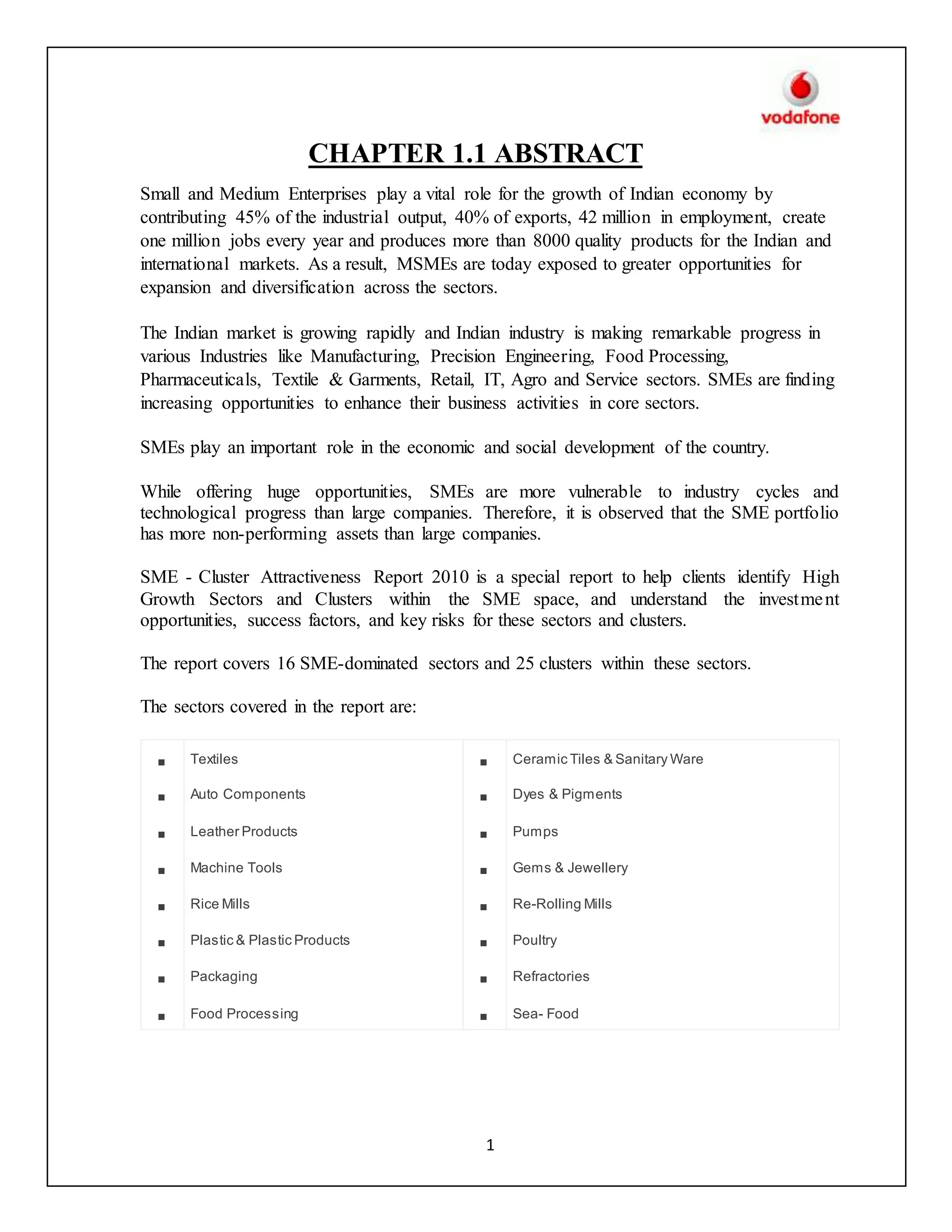
The sectors covered in the report are:
Textiles Ceramic Tiles & Sanitary Ware
Auto Components Dyes & Pigments
Leather Products Pumps
Machine Tools Gems & Jewellery
Rice Mills Re-Rolling Mills
Plastic & Plastic Products Poultry
Packaging Refractories
Food Processing Sea- Food
2
Indian Small and Medium Enterprises (SME) sector has emerged as a highly vibrant and
dynamic sector of the Indian economy over the last five decades. SMEs not only play crucial
role in providing large employment opportunities at comparatively lower capital cost than large
industries but also help in industrialization of rural areas. SMEs are complementary to large
industries as ancillary units and this sector contributes enormously to the socio-economic
development of the country. The Sector consisting of 36 million units, as of today, provides
employment to over 80 million persons. The Sector through more than 6,000 products
contributes about 8% to GDP besides 45% to the total manufacturing output and 40% to the
exports from the country. The SME sector has the potential to spread industrial growth across
the country and can be a major partner in the process of inclusive growth.
SMEs also play a significant role in Nation development through high contribution to Domestic
Production, Significant Export Earnings, Low Investment Requirements, Operational
Flexibility, Location Wise Mobility, Low Intensive Imports, Capacities to Develop
Appropriate Indigenous Technology, Import Substitution, Contribution towards Defence
Production, Technology – Oriented Industries, Competitiveness in Domestic and Export
Markets thereby generating new entrepreneurs by providing knowledge and training.
Despite their high enthusiasm and inherent capabilities to grow, SMEs in India are also facing
a number of problems like sub-optimal scale of operation, technological obsolescence, supply
chain inefficiencies, increasing domestic & global competition, working capital shortages, not
getting trade receivables from large and multinational companies on time, insufficient skilled
manpower, change in manufacturing strategies and turbulent and uncertain market scenario.
To survive with such issues and compete with large and global enterprises, SMEs need to adopt
innovative approaches in their operations. SMEs that are innovative, inventive, international
in their business outlook, have a strong technological base, competitive spirit and a willingness
to restructure themselves can withstand the present challenges and come out successfully to
contribute 22% to GDP. Indian SMEs are always ready to accept and acquire new technologies,
new business ideas and automation in industrial and allied sectors.
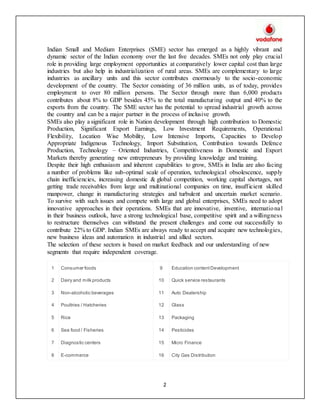
The selection of these sectors is based on market feedback and our understanding of new
segments that require independent coverage.
1 Consumer foods 9 Education contentDevelopment
2 Dairy and milk products 10 Quick service restaurants
3 Non-alcoholic beverages 11 Auto Dealership
4 Poultries / Hatcheries 12 Glass
5 Rice 13 Packaging
6 Sea food / Fisheries 14 Pesticides
7 Diagnostic centers 15 Micro Finance
8 E-commerce 16 City Gas Distribution
3
4 segments of an Enterprise
 VGE- Global accounts
 NC- National Corporate
 Govt.- Central & state
 SME- Small emerging medium enterprise
Despite its commendable contribution to the Nation's economy, SME Sector does not get the
required support from the concerned Government Departments, Banks, Financial Institutions
and Corporate, which is a handicap in becoming more competitive in the National and
International Markets.
SMEs face a number of problems - absence of adequate and timely banking finance, limited
capital and knowledge, non-availability of suitable technology, low production capacity,
ineffective marketing strategy, identification of new markets, constraints on modernization &
expansions, non-availability of highly skilled labour at affordable cost, follow-up with various
government agencies to resolve problems etc.
CHAPTER 1.2 INDUSTRY PROFILE
India's telecommunication network is the second largest in the world based on the total
number of telephone users (both fixed and mobile phone). It has one of the lowest call tariffs
in the world enabled by the mega telephone networks and hyper-competition among them. It
has the world's third-largest Internet user-base. According to the Internet and Mobile
Association of India (IAMAI), the Internet user base in the country stood at 190 million at
the end of June, 2013. Major sectors of the Indian telecommunication industry are telephony,
internet and television broadcast Industry in the country which is in an ongoing process of
transforming into next generation network, employs an extensive system of modern network
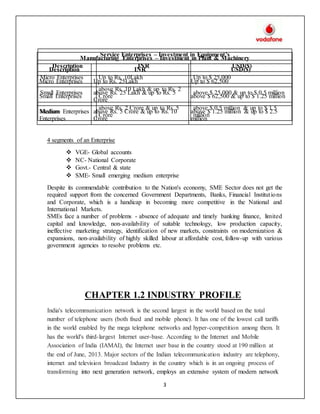
Manufacturing Enterprises – Investment in Plant & Machinery
Description INR USD($)
Micro Enterprises Up to Rs. 25Lakh Up to $ 62,500
Small Enterprises
above Rs. 25 Lakh & up to Rs. 5
Crore
above $ 62,500 & up to $ 1.25 million
Medium
Enterprises
above Rs. 5 Crore & up to Rs. 10
Crore
above $ 1.25 million & up to $ 2.5
million
Service Enterprises – Investment in Equipment’s
Description INR USD($)
Micro Enterprises Up to Rs. 10Lakh Up to $ 25,000
Small Enterprises
above Rs. 10 Lakh & up to Rs. 2
Crore
above $ 25,000 & up to $ 0.5 million
Medium Enterprises
above Rs. 2 Crore & up to Rs. 5
Crore
above $ 0.5 million & up to $ 1.5
million
4
elements such as digital telephone exchanges, mobile switching centers, media
gateways and signaling gateways at the core, interconnected by a wide variety of
transmission systems using fiber or Microwave radio relay networks. The access network,
which connects the subscriber to the core, is highly diversified with different copper-pair,
optic-fiber and wireless technologies. DTH, a relatively new broadcasting technology has
attained significant popularity in the Television segment. The introduction of private FM has
given a fillip to the radio broadcasting in India. Telecommunication in India has greatly been
supported by the INSAT system of the country, one of the largest domestic satellite systems
in the world. India possesses a diversified communications system, which links all parts of
the country by telephone, Internet, radio, television and satellite.[9]
Indian telecom industry underwent a high pace of MARKET liberalization and growth since
the 1990s and now has become the world's most competitive and one of the fastest growing
telecom markets. The Industry has grown over twenty times in just ten years, from under 37
million subscribers in the year 2001 to over 846 million subscribers in the year 2011. India
has the world's second-largest mobile phone user base with over 929.37 million users as of
May 2012. It has the world's second-largest Internet user-base with over 300 million as of
June 2015.
The total revenue of the Indian telecom sector grew by 7% to ₹2832 billion (US$43 billion)
for 2010–11FINANCIAL year, while revenues from telecom equipment segment stood
at ₹1170 billion (US$18 billion).
Telecommunication has supported the socioeconomic development of India and has played a
significant role to narrow down the rural-urban digital divide to some extent. It also has
helped to increase the transparency of governance with the introduction of e-governance in
India. The government has pragmatically used modern telecommunication facilities to
deliver mass education programmers for the rural folk of India.
MARKET SIZE
Driven by strong adoption of data consumption on handheld devices, the total mobile
services market revenue in India is expected to touch US$ 37 billion in 2017, registering a
Compound Annual Growth Rate (CAGR) of 5.2 per cent between 2014 and 2017, according
to research firm IDC.
According to a study by GSMA, smartphones are expected to account for two out of every
three mobile connections globally by 2020 making India the fourth largest smartphone
market.
The broadband services user-base in India is expected to grow to 250 million connections by
2017, according to GSMA.
5
India saw the fastest growth in new mobile-phone connections with 18 million net additions
in the third quarter of 2014, followed by China with 12 million new additions, according to a
report by Swedish mobile network equipment maker Ericsson.
International Data Corporation (IDC) predicts India to overtake US as the second-largest
smartphone market globally by 2017 and to maintain high growth rate over the next few
years as people switch to smartphones and gradually upgrade to 4G.
In spite of only 5 per cent increase in mobile connections in 2015, overall expenditure on
mobile services in India is expected to increase to US$ 21.4 billion in 2015, led by 15 per
cent growth in data services expenditure, as per research firm Gartner.
The Indian telecom sector is expected to generate four million direct and indirect jobs over
the next five years according to estimates by Randstad India. The employment opportunities
are expected to be created due to combination of government’s efforts to increase penetration
in rural areas and the rapid increase in smartphone sales and rising internet usage.
INVESTMENT
With daily increasing subscriber base, there have been a lot of investments and developments
in the sector. The industry has attracted FDI worth US$ 17,058.03 million during the period
April 2000 to March 2015, according to the data released by Department of Industrial Policy
and Promotion (DIPP).
Some of the major developments in the recent past are:
 Swedish telecom equipment maker Ericsson has announced the introduction of a new
radio system in the Indian market, which will provide the necessary infrastructure
required by mobile companies in order to provide fifth-generation (5G) services in
future.
 Out of the total number of smartphones shipped in India during the June 2015 quarter,
24.8 per cent were made locally - a significant rise as compared to 19.9 per cent in the
previous quarter - as per Cyber Media Research firm.
 Global telecom equipment makers like Ericsson, Nokia Networks and Huawei are
looking forward to over US$ 1 billion revenue opportunity as mobile phone operators
in India roll out high-speed broadband services on the 4G LTE technology across the
country.
 Lenovo Group of China has commenced manufacturing its smartphones in India,
through its contract manufacturer Flex’s facility near Chennai, thus becoming the
largest Chinese company to follow ‘Make in India’ strategy.
 Foxconn, the world’s largest contract-manufacturing firm for consumer electronics
and manufacturer for Apple products, has signed a Memorandum of Understanding
(MoU) with Maharashtra state government to invest US$ 5 billion over the next three
years for setting up a manufacturing unit between Mumbai and Pune.
 Micromax was able to secure trademark protection for 111 countries allowing it to
enter other markets such as South Africa, Nigeria and Indonesia.
 Karbonn looks to open an assembly line in Noida, Hyderabad and Bengaluru over
the next 12 months in its efforts to eventually assemble and produce phones in India
by earmarking an investment of Rs. 800 crore (US$ 121 million) over the next 3 -4
years
 Bharti Airtel has moved up to be the third largest mobile operator in the world owing
to its 303 million customers across.
6
Government Initiatives
The government has fast-tracked reforms in the telecom sector and continues to be
proactive in providing room for growth for telecom companies. Some of the other
major initiatives taken by the government are as follows:
 With a view to encourage consolidation in the telecom sector, the Government of
India has approved the rules for spectrum trading that will allow telecom companies
to buy and sell rights to unused spectrum among themselves. The Union Cabinet
chaired by the Prime Minister, Mr. Narendra Modi, gave its approval to the guidelines
on spectrum sharing, aimed to improve spectral efficiency and quality of service,
based on the recommendations of the Telecom Regulatory Authority of India (TRAI).
 The Central Government’s several initiatives to promote manufacturing in the
country, such as ‘Make in India’ campaign appears to have had a positive impact on
mobile handsets manufacturing in the country. Companies like Samsung, Micromax
and Spice had been assembling handsets in the country already. Xiaomi and
Motorola, along with Lenovo have also started assembly of smartphones in India.
Firms like HTC, Asus and Gionee too have shown interest in setting up a
manufacturing base in the country.
 The Government of India plans to roll out free high-speed Wi-Fi in 2,500 cities and
towns across the country over the next three years. The program entails an
investment of up to Rs 7,000 crore (US$ 1.06 billion) and will be implemented by
state-owned Bharat Sanchar Nigam Ltd (BSNL).
CHAPTER 1.3 COMPANY PROFILE
• India has the fastest growing telecom network in the world.
• Vodafone, Airtel, Idea, Reliance, Tata, BSNL, are market leaders.
• The name Vodafone comes from Voice data fone, chosen by the company to “Reflect
the Provision of Voice and Data Services over Mobile Phones.”
• Vodafone is a mobile network operator with its headquarters in Newbury ,
Berkshire, England & UK now in INDIA.
• Vodafone India Limited is headquartered in Mumbai, Maharashtra.
7
• The Subscriber base is approximately 173 million customers as of September 2014.
• It is second largest mobile network operator in India by subscriber base.
• It offers both Prepaid and Postpaid GSM cellular phone coverage throughout India
with better presence in the metros.
• Vodafone is the second largest player in telecom operator in India, with a market
share of 22.95%.
• Vodafone currently has operations in 25 countries and partner networks in a further
42 countries.
• Vodafone in INDIA came with acquiring Hutchison Essar Ltd.
• Vodafone was launched officially on 21st September 2007. Than on hutch was
rebranded as Vodafone.
• Vodafone Essar now has operations in 16 circles covering 86% of the India’s mobile
customer base, with over 34.1 million customers.
• Vodafone Essar, under the hutch brand, has been named the most respected Telecom
Company.
• Management Key People: GERARD KLEISTERLEE (CHAIRMAN) & VITTORIO
COLAO (CEO)
• Best mobile service in Country
• Most creative and most effective advertiser of the year.
Products & Services
 World Calling Grids
 Postpaid services
 Pre-paid Services
 Vodafone Handy phone
 Vodafone PCO
 Vodafone Office
8
 Vodafone Live! – Internet on mobile
 Vodafone Mobile connect
 Vodafone Mobile connect card
 Mobile Advertising
 Vodafone handsets
 Vodafone handy phone
 Vodafone Business handsets
 Magic Box Handsets
 Fixed line and Mobile telephone
 Internet services
 Digital television
STP Analysis
Segmentation
Income
Age
Service Usage
Nature of the Customer
Institutional
9
Life of the service
Geographical Condition
Targeting
 Vodafone is adopting a multi segment approach. They are offering a series of
differentiated products to their respective markets.
 Home calling cards for family of those professionals who use to work abroad.
 Rs. 10 recharge for small users.
 Cheap SMS facility for youths.
 Facilities for circle users.
Positioning – “Where you go our network follows U”
Hutch as a brand always tried to connect with the consumers in a simple, honest and real
manner, while Vodafone is a younger and fun brand. So consumers will see a shift reflecting
a more vibrant brand.
The “PUG” and the actor Irfan Khan will be retained for the brand promotions.
They are talking about the exclusivity of the network and the services they are offering to
the consumers.
VISION:
To enrich our customer’s lives through unique power of mobile communication.
MISSION:
 FOR CUSTOMERS: In anticipation of their customers’ trust Vodafone understands
their needs & delights themes' with its services.
 FOR PEOPLE: Outstanding people working together make Vodafone exceptionally
successful.
 FOR RESULTS: Vodafone believes in being action oriented & is driven by a desire
to be the BEST.
10
 FOR THE GLOBE: Vodafone believes helping people of the world to have fuller
lives through their services & its impacts.
AWARDS & REWARDS
 2011: Global Mobile Awards - Winner, Best Mobile Money for the Unbanked
Service (Vodafone Group, Safaricom, Vodacom, Vodafone Essar Limited and
Roshan Ltd)
 2010: Africa Com Awards - Telecom Innovation of the Year & Changing Lives
Award
 While India deliberated, Advertising Age in New York listed it as the world’s top
viral campaign, two weeks in a row.
Marketing Strategy:
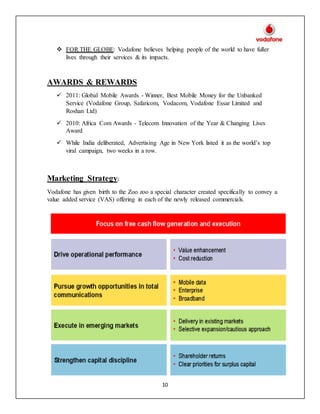
Vodafone has given birth to the Zoo zoo a special character created specifically to convey a
value added service (VAS) offering in each of the newly released commercials.
11
Market Competitors in India
 BHARTI AIRTEL
 RELIANCE
 BSNL
UNIVERSAL COMPETITORS
 ORANGE
 T-MOBILE INTERNATIONAL
 TELEFONICA 02 EUROPE
CHAPTER 1.3 SWOT ANALYSIS
Strengths
 Experience and knowledge phone business.
 Strong ability to manage change and acquisition
 Customer Oriented Tariff Plans & Schemes.
Weakness
 Vodafone slow in responding to trend towards bundling.
Opportunities
 Vodafone launched its own software application store- The joint Innovation lab in
May 2009.
 Maximum Revenue can be generated through 3G Services.
 With better rural network coverage/; Vodafone has best opportunity to take 1st mover
advantage
Threats
 Increasing Competition
12
 Difficult to raise funds because of recession,
 Hence Vodafone has to prove actively attack and defense against each new entrant
with a specific strategy to retain its No.1 Position in Delhi NCR.
CHAPTER 2: RESEARCH OBJECTIVES
 To know the market size of SME’s in the Karnataka state.
 To understand the current trend of SME’s
 To find out the total no. of industrial areas & all other verticals of SME’s.
 To study the importance and development of SME’s in today’s business scenario.
 To understand the various Marketing Strategies which VODAFONE has adopted in
SME industry.
13
CHAPTER 3: RESEARCH METHODOLOGY
Methodology is a way to systematically solve the research problem. It may be understand as
a science of studying how research is done scientifically. Research Methodology is a step by
step study of a problem.
The methodology adopted for this project is exploratory in nature since there is no hypothesis
that has to be tested. The conclusions have been drawn by exploratory research work.
Secondary source has played a vital role to play in this report. A good amount of data has been
collected from various published articles and reports found in magazines and journals. Another
vital source has been the Internet and particularly the SME’s own website.
Type of research Descriptive
Sources of data Secondary data
Data collection Internet & Magazines
14
Sampling technique Convenience sampling
CHAPTER 4: LIMITATIONS OF THE STUDY
Every attempt will be taken to obtain the error free and meaningful result but as nothing in
this world is 100% perfect I believe that there will still the chance for error on account of
following limitations:~
 There are many accounts of SME’s and many people involved. Hence to collect all
the information was not that easy.
 The study is restricted only to Karnataka state. The view of their other areas is not
taken.
 Since the researcher selected only the districts of Karnataka it is not sufficient to
cover opinion of entire population.
 Time Constraint.
 This research report based on secondary data so I cannot get actual number of
accounts of SME’s.
 The secondary records are for organizational purpose but used for the research report.
15
CHAPTER 5: FINDINGS
Bengaluru Urban
No. of industrial Areas: - 14
TOTAL INDUSTRIAL UNIT NO. 74282
REGISTERED INDUSTRIAL UNIT: 7482
REGISTERED MEDIUM & LARGE UNIT: - 3125
NO. OF GOVT. OFFICES
i) Sub divisions 2
ii) Tehsils 4
iii) Sub-Tehsil 6
iv) Patwar Circle 17
v) Panchayat Simitis -
vi) Nagar Nigam 1
vii) Nagar Palika 19
viii) Gram Panchayats 86
ix) Revenue villages 699
x) Assembly Area 11
16
PUBLIC HEALTH
Allopathic Hospital 9
Beds in Allopathic hospitals 1790
Ayurveda Hospital 6
Beds in Ayurveda hospitals 396
Unani hospitals -
Community health centers 3
Primary health centers 75
Sub Health Centers 15
Private hospitals 195
EDUCATION
Primary school 1030
Middle schools 3099
Secondary & senior
Secondary schools 2031
Colleges 545
Technical University 26 (Medical) + 73(Eng.)
Bengaluru Rural
No. of industrial Areas: - 7
TOTAL INDUSTRIAL UNIT NO. 5403
REGISTERED MEDIUM & LARGE UNIT: - 7148
NO. OF GOVT. OFFICES
Administrative Units Stats.
i) Sub divisions 2
ii) Tehsils 4
iii) Sub-Tehsil 8
iv) Patwar Circle 17
17
v) Panchayat Simitis -
vi)Nagar nigam 1
vii) Nagar Palika 6
viii) Gram Panchayats 98
POST OFFICES: - 180
PUBLIC HEALTH
EDUCATION
xi) Revenue villages 1050
x) Assembly Area 5
(a) Allopathic Hospital
(b) Beds in Allopathic hospitals
(c) Ayurveda Hospital
(d) Beds in Ayurveda hospitals
(e) Unani hospitals
(f) Community health centers
(g) Primary health centers
(h) Dispensaries
(i) Sub Health Centers
(j) Private hospitals
5
430
1
6
-
1
47
55
167
-
18
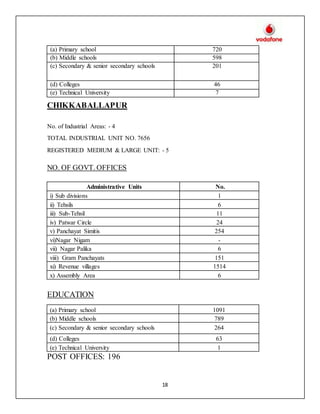
CHIKKABALLAPUR
No. of Industrial Areas: - 4
TOTAL INDUSTRIAL UNIT NO. 7656
REGISTERED MEDIUM & LARGE UNIT: - 5
NO. OF GOVT. OFFICES
Administrative Units No.
i) Sub divisions 1
ii) Tehsils 6
iii) Sub-Tehsil 11
iv) Patwar Circle 24
v) Panchayat Simitis 254
vi)Nagar Nigam -
vii) Nagar Palika 6
viii) Gram Panchayats 151
xi) Revenue villages 1514
x) Assembly Area 6
EDUCATION
POST OFFICES: 196
(a) Primary school 720
(b) Middle schools 598
(c) Secondary & senior secondary schools 201
(d) Colleges 46
(e) Technical University 7
(a) Primary school 1091
(b) Middle schools 789
(c) Secondary & senior secondary schools 264
(d) Colleges 63
(e) Technical University 1
19
PUBLIC HEALTH
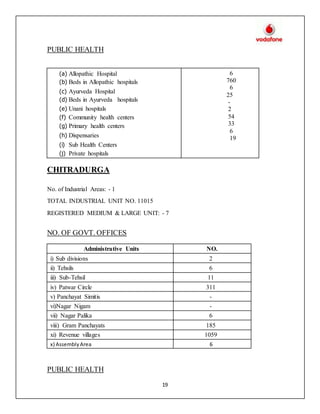
CHITRADURGA
No. of Industrial Areas: - 1
TOTAL INDUSTRIAL UNIT NO. 11015
REGISTERED MEDIUM & LARGE UNIT: - 7
NO. OF GOVT. OFFICES
PUBLIC HEALTH
(a) Allopathic Hospital
(b) Beds in Allopathic hospitals
(c) Ayurveda Hospital
(d) Beds in Ayurveda hospitals
(e) Unani hospitals
(f) Community health centers
(g) Primary health centers
(h) Dispensaries
(i) Sub Health Centers
(j) Private hospitals
6
760
6
25
-
2
54
33
6
19
Administrative Units NO.
i) Sub divisions 2
ii) Tehsils 6
iii) Sub-Tehsil 11
iv) Patwar Circle 311
v) Panchayat Simitis -
vi)Nagar Nigam -
vii) Nagar Palika 6
viii) Gram Panchayats 185
xi) Revenue villages 1059
x) AssemblyArea 6
20
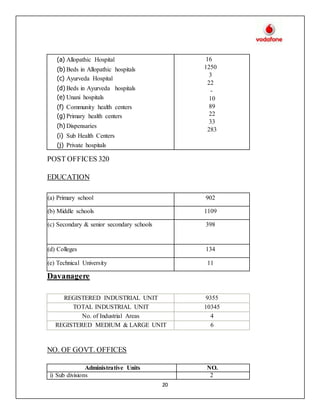
POST OFFICES 320
EDUCATION
Davanagere
REGISTERED INDUSTRIAL UNIT 9355
TOTAL INDUSTRIAL UNIT 10345
No. of Industrial Areas 4
REGISTERED MEDIUM & LARGE UNIT 6
NO. OF GOVT. OFFICES
Administrative Units NO.
i) Sub divisions 2
(a) Allopathic Hospital
(b) Beds in Allopathic hospitals
(c) Ayurveda Hospital
(d) Beds in Ayurveda hospitals
(e) Unani hospitals
(f) Community health centers
(g) Primary health centers
(h) Dispensaries
(i) Sub Health Centers
(j) Private hospitals
16
1250
3
22
-
10
89
22
33
283
(a) Primary school 902
(b) Middle schools 1109
(c) Secondary & senior secondary schools 398
(d) Colleges 134
(e) Technical University 11
21
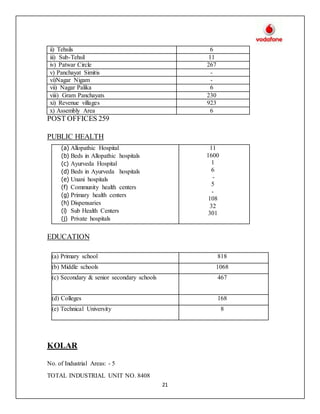
ii) Tehsils 6
iii) Sub-Tehsil 11
iv) Patwar Circle 267
v) Panchayat Simitis -
vi)Nagar Nigam -
vii) Nagar Palika 6
viii) Gram Panchayats 230
xi) Revenue villages 923
x) Assembly Area 6
POST OFFICES 259
PUBLIC HEALTH
EDUCATION
KOLAR
No. of Industrial Areas: - 5
TOTAL INDUSTRIAL UNIT NO. 8408
(a) Allopathic Hospital
(b) Beds in Allopathic hospitals
(c) Ayurveda Hospital
(d) Beds in Ayurveda hospitals
(e) Unani hospitals
(f) Community health centers
(g) Primary health centers
(h) Dispensaries
(i) Sub Health Centers
(j) Private hospitals
11
1600
1
6
-
5
-
108
32
301
(a) Primary school 818
(b) Middle schools 1068
(c) Secondary & senior secondary schools 467
(d) Colleges 168
(e) Technical University 8
22
REGISTERED MEDIUM & LARGE UNIT: - 3
NO. OF GOVT. OFFICES
Administrative Units No.
i) Sub divisions
ii) Tehsils 5
iii) Sub-Tehsil 10
iv) Patwar Circle 257
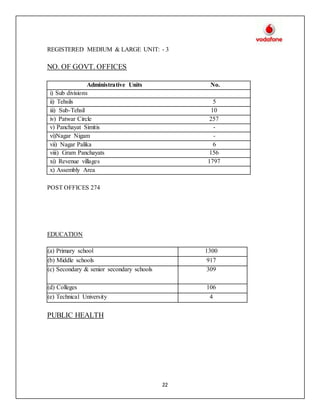
v) Panchayat Simitis -
vi)Nagar Nigam -
vii) Nagar Palika 6
viii) Gram Panchayats 156
xi) Revenue villages 1797
x) Assembly Area
POST OFFICES 274
EDUCATION
PUBLIC HEALTH
(a) Primary school 1300
(b) Middle schools 917
(c) Secondary & senior secondary schools 309
(d) Colleges 106
(e) Technical University 4
23
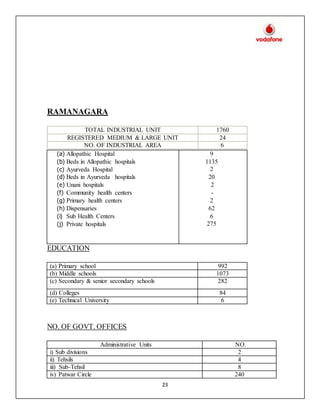
RAMANAGARA
EDUCATION
(a) Primary school 992
(b) Middle schools 1073
(c) Secondary & senior secondary schools 282
(d) Colleges 84
(e) Technical University 6
NO. OF GOVT. OFFICES
Administrative Units NO.
i) Sub divisions 2
ii) Tehsils 4
iii) Sub-Tehsil 8
iv) Patwar Circle 240
(a) Allopathic Hospital
(b) Beds in Allopathic hospitals
(c) Ayurveda Hospital
(d) Beds in Ayurveda hospitals
(e) Unani hospitals
(f) Community health centers
(g) Primary health centers
(h) Dispensaries
(i) Sub Health Centers
(j) Private hospitals
9
1135
2
20
2
-
2
62
6
275
TOTAL INDUSTRIAL UNIT 1760
REGISTERED MEDIUM & LARGE UNIT 24
NO. OF INDUSTRIAL AREA 6
24
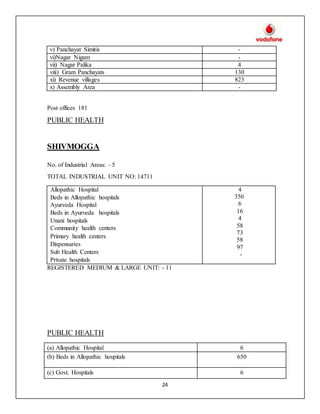
v) Panchayat Simitis -
vi)Nagar Nigam -
vii) Nagar Palika 4
viii) Gram Panchayats 130
xi) Revenue villages 823
x) Assembly Area -
Post offices 181
PUBLIC HEALTH
SHIVMOGGA
No. of Industrial Areas: - 5
TOTAL INDUSTRIAL UNIT NO: 14711
REGISTERED MEDIUM & LARGE UNIT: - 11
PUBLIC HEALTH
(a) Allopathic Hospital 6
(b) Beds in Allopathic hospitals 650
(c) Govt. Hospitals 6
Allopathic Hospital
Beds in Allopathic hospitals
Ayurveda Hospital
Beds in Ayurveda hospitals
Unani hospitals
Community health centers
Primary health centers
Dispensaries
Sub Health Centers
Private hospitals
4
350
6
16
4
58
73
58
97
-
25
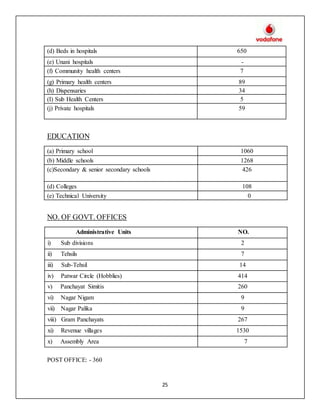
(d) Beds in hospitals 650
(e) Unani hospitals -
(f) Community health centers 7
(g) Primary health centers 89
(h) Dispensaries 34
(I) Sub Health Centers 5
(j) Private hospitals 59
EDUCATION
(a) Primary school 1060
(b) Middle schools 1268
(c)Secondary & senior secondary schools 426
(d) Colleges 108
(e) Technical University 0
NO. OF GOVT. OFFICES
Administrative Units NO.
i) Sub divisions 2
ii) Tehsils 7
iii) Sub-Tehsil 14
iv) Patwar Circle (Hobblies) 414
v) Panchayat Simitis 260
vi) Nagar Nigam 9
vii) Nagar Palika 9
viii) Gram Panchayats 267
xi) Revenue villages 1530
x) Assembly Area 7
POST OFFICE: - 360
26
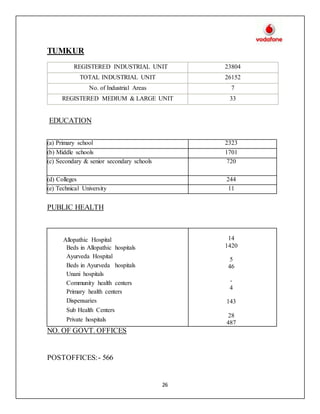
TUMKUR
EDUCATION
(a) Primary school 2323
(b) Middle schools 1701
(c) Secondary & senior secondary schools 720
(d) Colleges 244
(e) Technical University 11
PUBLIC HEALTH
NO. OF GOVT. OFFICES
POSTOFFICES:- 566
REGISTERED INDUSTRIAL UNIT 23804
TOTAL INDUSTRIAL UNIT 26152
No. of Industrial Areas 7
REGISTERED MEDIUM & LARGE UNIT 33
Allopathic Hospital
Beds in Allopathic hospitals
Ayurveda Hospital
Beds in Ayurveda hospitals
Unani hospitals
Community health centers
Primary health centers
Dispensaries
Sub Health Centers
Private hospitals
14
1420
5
46
-
4
143
28
487
27
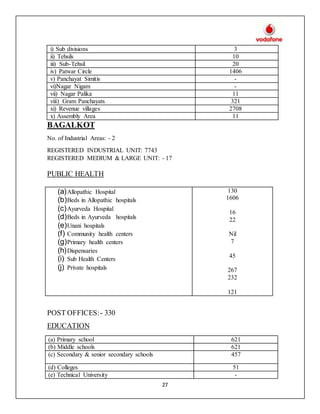
BAGALKOT
No. of Industrial Areas: - 2
REGISTERED INDUSTRIAL UNIT: 7743
REGISTERED MEDIUM & LARGE UNIT: - 17
PUBLIC HEALTH
(a)Allopathic Hospital
(b)Beds in Allopathic hospitals
(c)Ayurveda Hospital
(d)Beds in Ayurveda hospitals
(e)Unani hospitals
(f) Community health centers
(g)Primary health centers
(h)Dispensaries
(i) Sub Health Centers
(j) Private hospitals
130
1606
16
22
Nil
7
45
267
232
121
POST OFFICES:- 330
EDUCATION
(a) Primary school 621
(b) Middle schools 621
(c) Secondary & senior secondary schools 457
(d) Colleges 51
(e) Technical University -
i) Sub divisions 3
ii) Tehsils 10
iii) Sub-Tehsil 20
iv) Patwar Circle 1406
v) Panchayat Simitis -
vi)Nagar Nigam -
vii) Nagar Palika 11
viii) Gram Panchayats 321
xi) Revenue villages 2708
x) Assembly Area 11
28
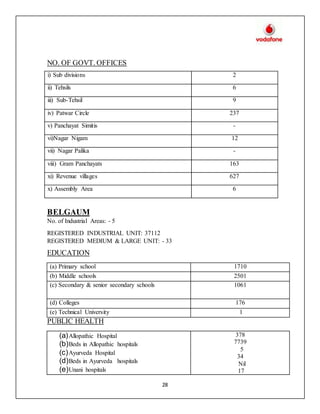
NO. OF GOVT. OFFICES
BELGAUM
No. of Industrial Areas: - 5
REGISTERED INDUSTRIAL UNIT: 37112
REGISTERED MEDIUM & LARGE UNIT: - 33
EDUCATION
(a) Primary school 1710
(b) Middle schools 2501
(c) Secondary & senior secondary schools 1061
(d) Colleges 176
(e) Technical University 1
PUBLIC HEALTH
(a)Allopathic Hospital
(b)Beds in Allopathic hospitals
(c)Ayurveda Hospital
(d)Beds in Ayurveda hospitals
(e)Unani hospitals
378
7739
5
34
Nil
17
i) Sub divisions 2
ii) Tehsils 6
iii) Sub-Tehsil 9
iv) Patwar Circle 237
v) Panchayat Simitis -
vi)Nagar Nigam 12
vii) Nagar Palika -
viii) Gram Panchayats 163
xi) Revenue villages 627
x) Assembly Area 6
29
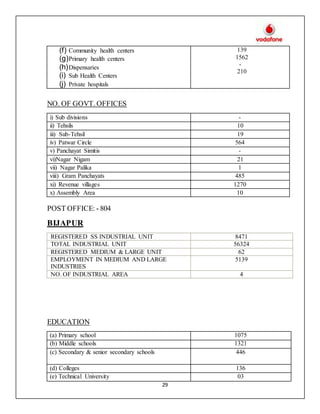
(f) Community health centers
(g)Primary health centers
(h)Dispensaries
(i) Sub Health Centers
(j) Private hospitals
139
1562
-
210
NO. OF GOVT. OFFICES
i) Sub divisions -
ii) Tehsils 10
iii) Sub-Tehsil 19
iv) Patwar Circle 564
v) Panchayat Simitis -
vi)Nagar Nigam 21
vii) Nagar Palika 1
viii) Gram Panchayats 485
xi) Revenue villages 1270
x) Assembly Area 10
POST OFFICE: - 804
BIJAPUR
REGISTERED SS INDUSTRIAL UNIT 8471
TOTAL INDUSTRIAL UNIT 56324
REGISTERED MEDIUM & LARGE UNIT 62
EMPLOYMENT IN MEDIUM AND LARGE
INDUSTRIES
5139
NO. OF INDUSTRIAL AREA 4
EDUCATION
(a) Primary school 1075
(b) Middle schools 1321
(c) Secondary & senior secondary schools 446
(d) Colleges 136
(e) Technical University 03
30
PUBLIC HEALTH
NO. OF GOVT. OFFICES
DHARWAD
No. of Industrial Areas: 5
REGISTERED INDUSTRIAL UNIT 924
TOTAL INDUSTRIAL UNIT 18,877
REGISTERED MEDIUM & LARGE UNIT 12
(a)Allopathic Hospital
(b)Beds in Allopathic hospitals
(c)Ayurveda Hospital
(d)Beds in Ayurveda hospitals
(e)Unani hospitals
(f) Community health centers
(g)Primary health centers
(h)Dispensaries
(i) Sub Health Centers (FW)
(j) Private hospitals
74
814
4
44
---
9
58
-
298
81
Administrative Units NO.
i) Sub divisions 2
ii) Tehsils 5
iii) Sub-Tehsil 10
iv) Patwar Circle 202
v) Panchayat Simitis
vi)Nagar Nigam 1
vii) Nagar Palika 5
viii) Gram Panchayat 199
xi) Revenue villages 677
x) Assembly Area 8
31
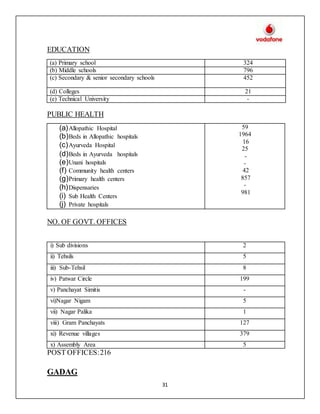
EDUCATION
(a) Primary school 324
(b) Middle schools 796
(c) Secondary & senior secondary schools 452
(d) Colleges 21
(e) Technical University -
PUBLIC HEALTH
NO. OF GOVT. OFFICES
POST OFFICES:216
GADAG
(a)Allopathic Hospital
(b)Beds in Allopathic hospitals
(c)Ayurveda Hospital
(d)Beds in Ayurveda hospitals
(e)Unani hospitals
(f) Community health centers
(g)Primary health centers
(h)Dispensaries
(i) Sub Health Centers
(j) Private hospitals
59
1964
16
25
-
-
42
857
-
981
i) Sub divisions 2
ii) Tehsils 5
iii) Sub-Tehsil 8
iv) Patwar Circle 199
v) Panchayat Simitis -
vi)Nagar Nigam 5
vii) Nagar Palika 1
viii) Gram Panchayats 127
xi) Revenue villages 379
x) Assembly Area 5
32
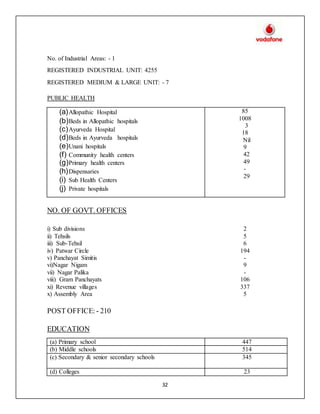
No. of Industrial Areas: - 1
REGISTERED INDUSTRIAL UNIT: 4255
REGISTERED MEDIUM & LARGE UNIT: - 7
PUBLIC HEALTH
NO. OF GOVT. OFFICES
POST OFFICE: - 210
EDUCATION
(a)Allopathic Hospital
(b)Beds in Allopathic hospitals
(c)Ayurveda Hospital
(d)Beds in Ayurveda hospitals
(e)Unani hospitals
(f) Community health centers
(g)Primary health centers
(h)Dispensaries
(i) Sub Health Centers
(j) Private hospitals
85
1008
3
18
Nil
9
42
49
-
29
i) Sub divisions 2
ii) Tehsils 5
iii) Sub-Tehsil 6
iv) Patwar Circle 194
v) Panchayat Simitis -
vi)Nagar Nigam 9
vii) Nagar Palika -
viii) Gram Panchayats 106
xi) Revenue villages 337
x) Assembly Area 5
(a) Primary school 447
(b) Middle schools 514
(c) Secondary & senior secondary schools 345
(d) Colleges 23
33
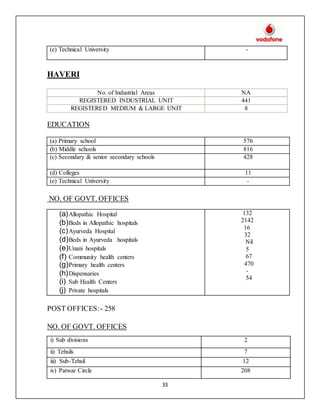
HAVERI
No. of Industrial Areas NA
REGISTERED INDUSTRIAL UNIT 441
REGISTERED MEDIUM & LARGE UNIT 8
EDUCATION
(a) Primary school 576
(b) Middle schools 816
(c) Secondary & senior secondary schools 428
(d) Colleges 11
(e) Technical University -
NO. OF GOVT. OFFICES
POST OFFICES:- 258
NO. OF GOVT. OFFICES
(e) Technical University -
(a)Allopathic Hospital
(b)Beds in Allopathic hospitals
(c)Ayurveda Hospital
(d)Beds in Ayurveda hospitals
(e)Unani hospitals
(f) Community health centers
(g)Primary health centers
(h)Dispensaries
(i) Sub Health Centers
(j) Private hospitals
132
2142
16
32
Nil
5
67
470
-
54
i) Sub divisions 2
ii) Tehsils 7
iii) Sub-Tehsil 12
iv) Patwar Circle 208
34
UTTAR KANNADA
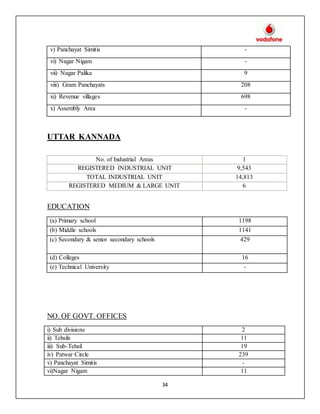
No. of Industrial Areas 1
REGISTERED INDUSTRIAL UNIT 9,543
TOTAL INDUSTRIAL UNIT 14,813
REGISTERED MEDIUM & LARGE UNIT 6
EDUCATION
(a) Primary school 1198
(b) Middle schools 1141
(c) Secondary & senior secondary schools 429
(d) Colleges 16
(e) Technical University -
NO. OF GOVT. OFFICES
i) Sub divisions 2
ii) Tehsils 11
iii) Sub-Tehsil 19
iv) Patwar Circle 239
v) Panchayat Simitis -
vi)Nagar Nigam 11
v) Panchayat Simitis -
vi) Nagar Nigam -
vii) Nagar Palika 9
viii) Gram Panchayats 208
xi) Revenue villages 698
x) Assembly Area -
35
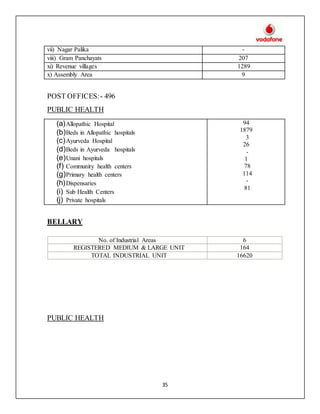
vii) Nagar Palika -
viii) Gram Panchayats 207
xi) Revenue villages 1289
x) Assembly Area 9
POST OFFICES:- 496
PUBLIC HEALTH
(a)Allopathic Hospital
(b)Beds in Allopathic hospitals
(c)Ayurveda Hospital
(d)Beds in Ayurveda hospitals
(e)Unani hospitals
(f) Community health centers
(g)Primary health centers
(h)Dispensaries
(i) Sub Health Centers
(j) Private hospitals
94
1879
3
26
-
1
78
114
-
81
BELLARY
No. of Industrial Areas 6
REGISTERED MEDIUM & LARGE UNIT 164
TOTAL INDUSTRIAL UNIT 16620
PUBLIC HEALTH
36
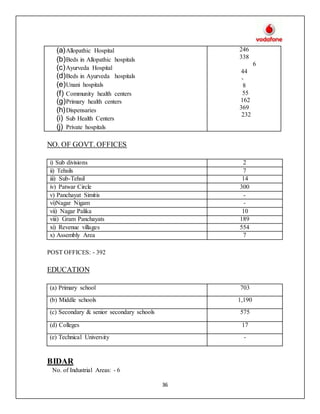
(a)Allopathic Hospital
(b)Beds in Allopathic hospitals
(c)Ayurveda Hospital
(d)Beds in Ayurveda hospitals
(e)Unani hospitals
(f) Community health centers
(g)Primary health centers
(h)Dispensaries
(i) Sub Health Centers
(j) Private hospitals
246
338
6
44
-
8
55
162
369
232
NO. OF GOVT. OFFICES
i) Sub divisions 2
ii) Tehsils 7
iii) Sub-Tehsil 14
iv) Patwar Circle 300
v) Panchayat Simitis -
vi)Nagar Nigam -
vii) Nagar Palika 10
viii) Gram Panchayats 189
xi) Revenue villages 554
x) Assembly Area 7
POST OFFICES: - 392
EDUCATION
(a) Primary school 703
(b) Middle schools 1,190
(c) Secondary & senior secondary schools 575
(d) Colleges 17
(e) Technical University -
BIDAR
No. of Industrial Areas: - 6
37
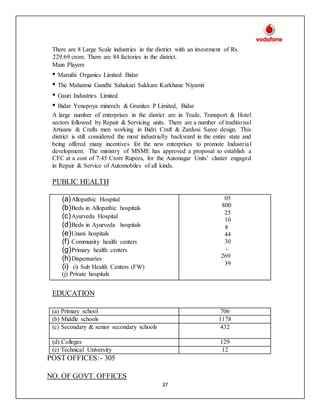
There are 8 Large Scale industries in the district with an investment of Rs.
229.69 crore. There are 84 factories in the district.
Main Players
• Maruthi Organics Limited Bidar
• The Mahatma Gandhi Sahakari Sakkare Karkhane Niyamit
• Gauri Industries Limited
• Bidar Yenepoya minerals & Granites P Limited, Bidar
A large number of enterprises in the district are in Trade, Transport & Hotel
sectors followed by Repair & Servicing units. There are a number of traditional
Artisans & Crafts men working in Bidri Craft & Zardosi Saree design. This
district is still considered the most industrially backward in the entire state and
being offered many incentives for the new enterprises to promote Industrial
development. The ministry of MSME has approved a proposal to establish a
CFC at a cost of 7.45 Crore Rupees, for the Autonagar Units’ cluster engaged
in Repair & Service of Automobiles of all kinds.
PUBLIC HEALTH
(a)Allopathic Hospital
(b)Beds in Allopathic hospitals
(c)Ayurveda Hospital
(d)Beds in Ayurveda hospitals
(e)Unani hospitals
(f) Community health centers
(g)Primary health centers
(h)Dispensaries
(i) (i) Sub Health Centers (FW)
(j) Private hospitals
05
800
25
10
8
44
30
-
269
39
EDUCATION
(a) Primary school 706
(b) Middle schools 1178
(c) Secondary & senior secondary schools 432
(d) Colleges 129
(e) Technical University 12
POST OFFICES:- 305
NO. OF GOVT. OFFICES
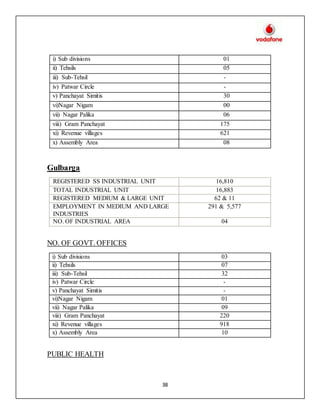
38
i) Sub divisions 01
ii) Tehsils 05
iii) Sub-Tehsil -
iv) Patwar Circle -
v) Panchayat Simitis 30
vi)Nagar Nigam 00
vii) Nagar Palika 06
viii) Gram Panchayat 175
xi) Revenue villages 621
x) Assembly Area 08
Gulbarga
REGISTERED SS INDUSTRIAL UNIT 16,810
TOTAL INDUSTRIAL UNIT 16,883
REGISTERED MEDIUM & LARGE UNIT 62 & 11
EMPLOYMENT IN MEDIUM AND LARGE
INDUSTRIES
291 & 5,577
NO. OF INDUSTRIAL AREA 04
NO. OF GOVT. OFFICES
i) Sub divisions 03
ii) Tehsils 07
iii) Sub-Tehsil 32
iv) Patwar Circle -
v) Panchayat Simitis -
vi)Nagar Nigam 01
vii) Nagar Palika 09
viii) Gram Panchayat 220
xi) Revenue villages 918
x) Assembly Area 10
PUBLIC HEALTH
39
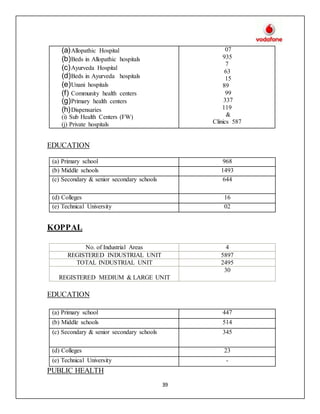
(a)Allopathic Hospital
(b)Beds in Allopathic hospitals
(c)Ayurveda Hospital
(d)Beds in Ayurveda hospitals
(e)Unani hospitals
(f) Community health centers
(g)Primary health centers
(h)Dispensaries
(i) Sub Health Centers (FW)
(j) Private hospitals
07
935
7
63
15
89
99
337
119
&
Clinics 587
EDUCATION
KOPPAL
No. of Industrial Areas 4
REGISTERED INDUSTRIAL UNIT 5897
TOTAL INDUSTRIAL UNIT 2495
REGISTERED MEDIUM & LARGE UNIT
30
EDUCATION
(a) Primary school 447
(b) Middle schools 514
(c) Secondary & senior secondary schools 345
(d) Colleges 23
(e) Technical University -
PUBLIC HEALTH
(a) Primary school 968
(b) Middle schools 1493
(c) Secondary & senior secondary schools 644
(d) Colleges 16
(e) Technical University 02
40
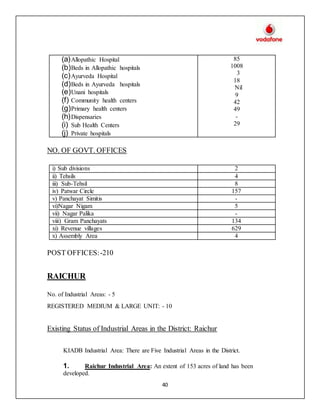
(a)Allopathic Hospital
(b)Beds in Allopathic hospitals
(c)Ayurveda Hospital
(d)Beds in Ayurveda hospitals
(e)Unani hospitals
(f) Community health centers
(g)Primary health centers
(h)Dispensaries
(i) Sub Health Centers
(j) Private hospitals
85
1008
3
18
Nil
9
42
49
-
29
NO. OF GOVT. OFFICES
i) Sub divisions 2
ii) Tehsils 4
iii) Sub-Tehsil 8
iv) Patwar Circle 157
v) Panchayat Simitis -
vi)Nagar Nigam 5
vii) Nagar Palika -
viii) Gram Panchayats 134
xi) Revenue villages 629
x) Assembly Area 4
POST OFFICES:-210
RAICHUR
No. of Industrial Areas: - 5
REGISTERED MEDIUM & LARGE UNIT: - 10
Existing Status of Industrial Areas in the District: Raichur
KIADB Industrial Area: There are Five Industrial Areas in the District.
1. Raichur Industrial Area: An extent of 153 acres of land has been
developed.
41
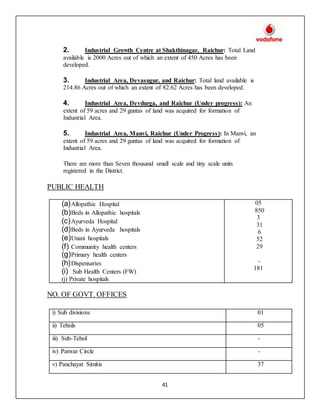
2. Industrial Growth Centre at Shakthinagar, Raichur: Total Land
available is 2000 Acres out of which an extent of 450 Acres has been
developed.
3. Industrial Area, Devasugur, and Raichur: Total land available is
214.86 Acres out of which an extent of 82.62 Acres has been developed.
4. Industrial Area, Devdurga, and Raichur (Under progress): An
extent of 59 acres and 29 guntas of land was acquired for formation of
Industrial Area.
5. Industrial Area, Manvi, Raichur (Under Progress): In Manvi, an
extent of 59 acres and 29 guntas of land was acquired for formation of
Industrial Area.
There are more than Seven thousand small scale and tiny scale units
registered in the District.
PUBLIC HEALTH
(a)Allopathic Hospital
(b)Beds in Allopathic hospitals
(c)Ayurveda Hospital
(d)Beds in Ayurveda hospitals
(e)Unani hospitals
(f) Community health centers
(g)Primary health centers
(h)Dispensaries
(i) Sub Health Centers (FW)
(j) Private hospitals
05
850
3
31
6
52
29
-
181
NO. OF GOVT. OFFICES
i) Sub divisions 01
ii) Tehsils 05
iii) Sub-Tehsil -
iv) Patwar Circle -
v) Panchayat Simitis 37
42
vi)Nagar Nigam 00
vii) Nagar Palika 08
viii) Gram Panchayat 164
xi) Revenue villages 883
x) Assembly Area 08
EDUCATION
YADGIR
No. of Industrial Areas: - 2+2 (IES)
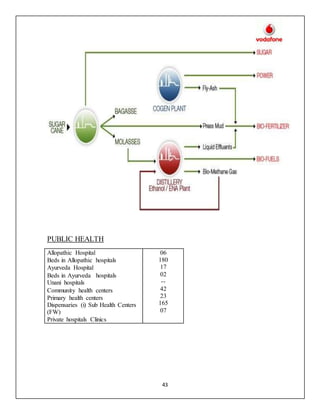
Core Green Sugar & Fuels Private Limited has commissioned an Integrated
Sugar Complex with 5000 TCD sugar plant, 24 MW Co-Generation Power
plant and 50 KLPD Distillery. This Greenfield project worth Rs.300 Crore
is located in Tumkur (v) in Yadgir Dist., Karnataka.
(a) Primary school 1806
(b) Middle schools 307
(c) Secondary & senior secondary schools 100
(d) Colleges 12
(e) Technical University 07
REGISTERED INDUSTRIAL UNIT 809
REGISTERED MEDIUM & LARGE UNIT 39
43
PUBLIC HEALTH
Allopathic Hospital
Beds in Allopathic hospitals
Ayurveda Hospital
Beds in Ayurveda hospitals
Unani hospitals
Community health centers
Primary health centers
Dispensaries (i) Sub Health Centers
(FW)
Private hospitals Clinics
06
180
17
02
--
42
23
165
07
44
EDUCATION
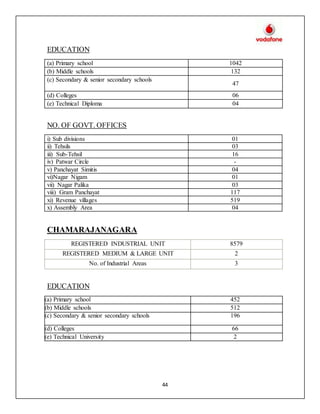
(a) Primary school 1042
(b) Middle schools 132
(c) Secondary & senior secondary schools
47
(d) Colleges 06
(e) Technical Diploma 04
NO. OF GOVT. OFFICES
i) Sub divisions 01
ii) Tehsils 03
iii) Sub-Tehsil 16
iv) Patwar Circle -
v) Panchayat Simitis 04
vi)Nagar Nigam 01
vii) Nagar Palika 03
viii) Gram Panchayat 117
xi) Revenue villages 519
x) Assembly Area 04
CHAMARAJANAGARA
REGISTERED INDUSTRIAL UNIT 8579
REGISTERED MEDIUM & LARGE UNIT 2
No. of Industrial Areas 3
EDUCATION
(a) Primary school 452
(b) Middle schools 512
(c) Secondary & senior secondary schools 196
(d) Colleges 66
(e) Technical University 2
45
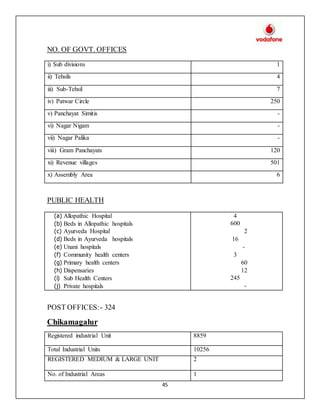
NO. OF GOVT. OFFICES
PUBLIC HEALTH
POST OFFICES:- 324
Chikamagalur
Registered industrial Unit 8859
Total Industrial Units 10256
REGISTERED MEDIUM & LARGE UNIT 2
No. of Industrial Areas 1
i) Sub divisions 1
ii) Tehsils 4
iii) Sub-Tehsil 7
iv) Patwar Circle 250
v) Panchayat Simitis -
vi) Nagar Nigam -
vii) Nagar Palika -
viii) Gram Panchayats 120
xi) Revenue villages 501
x) Assembly Area 6
(a) Allopathic Hospital
(b) Beds in Allopathic hospitals
(c) Ayurveda Hospital
(d) Beds in Ayurveda hospitals
(e) Unani hospitals
(f) Community health centers
(g) Primary health centers
(h) Dispensaries
(i) Sub Health Centers
(j) Private hospitals
4
600
2
16
-
3
60
12
245
-
46
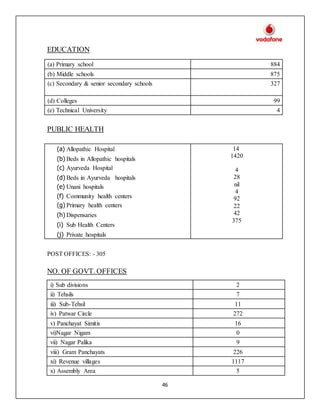
EDUCATION
(a) Primary school 884
(b) Middle schools 875
(c) Secondary & senior secondary schools 327
(d) Colleges 99
(e) Technical University 4
PUBLIC HEALTH
(a) Allopathic Hospital
(b) Beds in Allopathic hospitals
(c) Ayurveda Hospital
(d) Beds in Ayurveda hospitals
(e) Unani hospitals
(f) Community health centers
(g) Primary health centers
(h) Dispensaries
(i) Sub Health Centers
(j) Private hospitals
14
1420
4
28
nil
4
92
22
42
375
POST OFFICES: - 305
NO. OF GOVT. OFFICES
i) Sub divisions 2
ii) Tehsils 7
iii) Sub-Tehsil 11
iv) Patwar Circle 272
v) Panchayat Simitis 16
vi)Nagar Nigam 0
vii) Nagar Palika 9
viii) Gram Panchayats 226
xi) Revenue villages 1117
x) Assembly Area 5
47
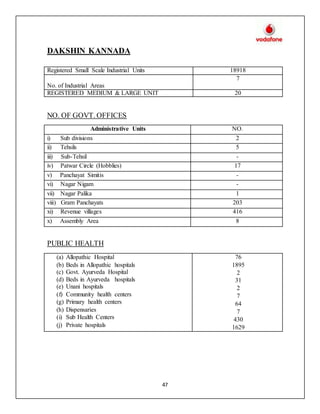
DAKSHIN KANNADA
Registered Small Scale Industrial Units 18918
No. of Industrial Areas
7
REGISTERED MEDIUM & LARGE UNIT 20
NO. OF GOVT. OFFICES
Administrative Units NO.
i) Sub divisions 2
ii) Tehsils 5
iii) Sub-Tehsil -
iv) Patwar Circle (Hobblies) 17
v) Panchayat Simitis -
vi) Nagar Nigam -
vii) Nagar Palika 1
viii) Gram Panchayats 203
xi) Revenue villages 416
x) Assembly Area 8
PUBLIC HEALTH
(a) Allopathic Hospital
(b) Beds in Allopathic hospitals
(c) Govt. Ayurveda Hospital
(d) Beds in Ayurveda hospitals
(e) Unani hospitals
(f) Community health centers
(g) Primary health centers
(h) Dispensaries
(i) Sub Health Centers
(j) Private hospitals
76
1895
2
31
2
7
64
7
430
1629
48
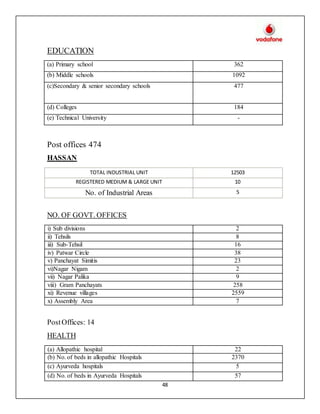
EDUCATION
(a) Primary school 362
(b) Middle schools 1092
(c)Secondary & senior secondary schools 477
(d) Colleges 184
(e) Technical University -
Post offices 474
HASSAN
TOTAL INDUSTRIAL UNIT 12503
REGISTERED MEDIUM & LARGE UNIT 10
No. of Industrial Areas 5
NO. OF GOVT. OFFICES
i) Sub divisions 2
ii) Tehsils 8
iii) Sub-Tehsil 16
iv) Patwar Circle 38
v) Panchayat Simitis 23
vi)Nagar Nigam 2
vii) Nagar Palika 9
viii) Gram Panchayats 258
xi) Revenue villages 2559
x) Assembly Area 7
PostOffices: 14
HEALTH
(a) Allopathic hospital 22
(b) No. of beds in allopathic Hospitals 2370
(c) Ayurveda hospitals 5
(d) No. of beds in Ayurveda Hospitals 57
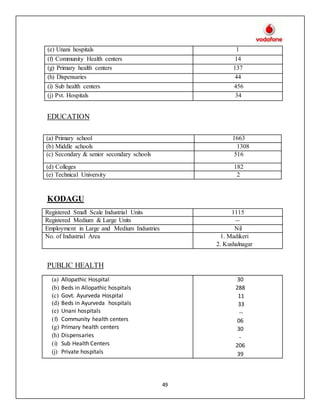
49
(e) Unani hospitals 1
(f) Community Health centers 14
(g) Primary health centers 137
(h) Dispensaries 44
(i) Sub health centers 456
(j) Pvt. Hospitals 34
EDUCATION
KODAGU
Registered Small Scale Industrial Units 1115
Registered Medium & Large Units --
Employment in Large and Medium Industries Nil
No. of Industrial Area 1. Madikeri
2. Kushalnagar
PUBLIC HEALTH
(a) Allopathic Hospital
(b) Beds in Allopathic hospitals
(c) Govt. Ayurveda Hospital
(d) Beds in Ayurveda hospitals
(e) Unani hospitals
(f) Community health centers
(g) Primary health centers
(h) Dispensaries
(i) Sub Health Centers
(j) Private hospitals
30
288
11
33
--
06
30
-
206
39
(a) Primary school 1663
(b) Middle schools 1308
(c) Secondary & senior secondary schools 516
(d) Colleges 182
(e) Technical University 2
50
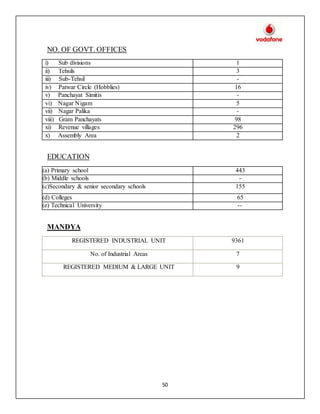
NO. OF GOVT. OFFICES
i) Sub divisions 1
ii) Tehsils 3
iii) Sub-Tehsil -
iv) Patwar Circle (Hobblies) 16
v) Panchayat Simitis -
vi) Nagar Nigam 5
vii) Nagar Palika -
viii) Gram Panchayats 98
xi) Revenue villages 296
x) Assembly Area 2
EDUCATION
(a) Primary school 443
(b) Middle schools -
(c)Secondary & senior secondary schools 155
(d) Colleges 65
(e) Technical University --
MANDYA
REGISTERED INDUSTRIAL UNIT 9361
No. of Industrial Areas 7
REGISTERED MEDIUM & LARGE UNIT 9
51
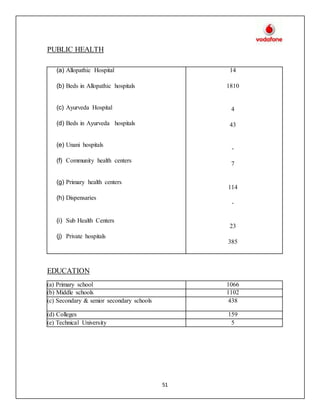
PUBLIC HEALTH
(a) Allopathic Hospital
(b) Beds in Allopathic hospitals
(c) Ayurveda Hospital
(d) Beds in Ayurveda hospitals
(e) Unani hospitals
(f) Community health centers
(g) Primary health centers
(h) Dispensaries
(i) Sub Health Centers
(j) Private hospitals
14
1810
4
43
-
7
114
-
23
385
EDUCATION
(a) Primary school 1066
(b) Middle schools 1102
(c) Secondary & senior secondary schools 438
(d) Colleges 159
(e) Technical University 5
52
NO. OF GOVT. OFFICES
i) Sub divisions 2
ii) Tehsils 7
iii) Sub-Tehsil 14
iv) Patwar Circle 446
v) Panchayat Simitis
vi)Nagar Nigam
vii) Nagar Palika 8
viii) Gram Panchayats 232
xi) Revenue villages 1479
x) Assembly Area 4
POST OFFICES:- 364
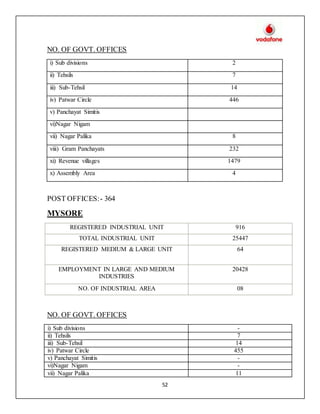
MYSORE
REGISTERED INDUSTRIAL UNIT 916
TOTAL INDUSTRIAL UNIT 25447
REGISTERED MEDIUM & LARGE UNIT 64
EMPLOYMENT IN LARGE AND MEDIUM
INDUSTRIES
20428
NO. OF INDUSTRIAL AREA 08
NO. OF GOVT. OFFICES
i) Sub divisions -
ii) Tehsils 7
iii) Sub-Tehsil 14
iv) Patwar Circle 455
v) Panchayat Simitis -
vi)Nagar Nigam -
vii) Nagar Palika 11
53
viii) Gram Panchayats 235
xi) Revenue villages 1340
x) Assembly Area 7
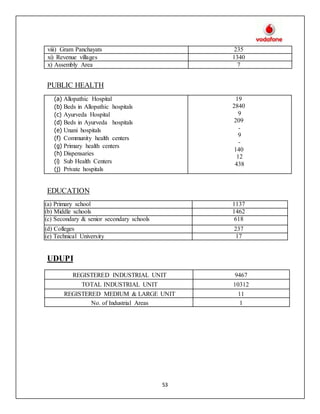
PUBLIC HEALTH
(a) Allopathic Hospital
(b) Beds in Allopathic hospitals
(c) Ayurveda Hospital
(d) Beds in Ayurveda hospitals
(e) Unani hospitals
(f) Community health centers
(g) Primary health centers
(h) Dispensaries
(i) Sub Health Centers
(j) Private hospitals
19
2840
9
209
-
9
-
140
12
438
EDUCATION
(a) Primary school 1137
(b) Middle schools 1462
(c) Secondary & senior secondary schools 618
(d) Colleges 237
(e) Technical University 17
UDUPI
REGISTERED INDUSTRIAL UNIT 9467
TOTAL INDUSTRIAL UNIT 10312
REGISTERED MEDIUM & LARGE UNIT 11
No. of Industrial Areas 1
54
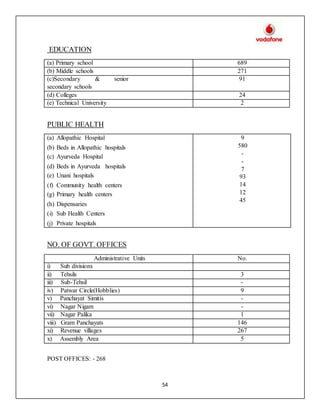
EDUCATION
(a) Primary school 689
(b) Middle schools 271
(c)Secondary & senior
secondary schools
91
(d) Colleges 24
(e) Technical University 2
PUBLIC HEALTH
(a) Allopathic Hospital
(b) Beds in Allopathic hospitals
(c) Ayurveda Hospital
(d) Beds in Ayurveda hospitals
(e) Unani hospitals
(f) Community health centers
(g) Primary health centers
(h) Dispensaries
(i) Sub Health Centers
(j) Private hospitals
9
580
-
-
7
93
14
12
45
NO. OF GOVT. OFFICES
Administrative Units No.
i) Sub divisions
ii) Tehsils 3
iii) Sub-Tehsil -
iv) Patwar Circle(Hobblies) 9
v) Panchayat Simitis -
vi) Nagar Nigam -
vii) Nagar Palika 1
viii) Gram Panchayats 146
xi) Revenue villages 267
x) Assembly Area 5
POST OFFICES: - 268
55
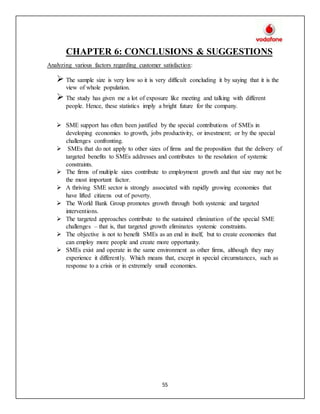
CHAPTER 6: CONCLUSIONS & SUGGESTIONS
Analyzing various factors regarding customer satisfaction:
 The sample size is very low so it is very difficult concluding it by saying that it is the
view of whole population.
 The study has given me a lot of exposure like meeting and talking with different
people. Hence, these statistics imply a bright future for the company.
 SME support has often been justified by the special contributions of SMEs in
developing economies to growth, jobs productivity, or investment; or by the special
challenges confronting.
 SMEs that do not apply to other sizes of firms and the proposition that the delivery of
targeted benefits to SMEs addresses and contributes to the resolution of systemic
constraints.
 The firms of multiple sizes contribute to employment growth and that size may not be
the most important factor.
 A thriving SME sector is strongly associated with rapidly growing economies that
have lifted citizens out of poverty.
 The World Bank Group promotes growth through both systemic and targeted
interventions.
 The targeted approaches contribute to the sustained elimination of the special SME
challenges – that is, that targeted growth eliminates systemic constraints.
 The objective is not to benefit SMEs as an end in itself, but to create economies that
can employ more people and create more opportunity.
 SMEs exist and operate in the same environment as other firms, although they may
experience it differently. Which means that, except in special circumstances, such as
response to a crisis or in extremely small economies.
56
SUGGESTIONS
 Enlarging the SME sector does not cause growth but may well accompany it.
 For SMEs to be a meaningful category of enterprises, it should be a group of firms
that is specifically differentiated from others by the way that it experiences particular
policy, institutional, or market failures or the way it benefits the economy or the poor.
 The only credible argument for channeling finance to SMEs is to build the capacity
and sustained activity of the financial sector to supply SME credit demand.
 In spite of its many achievements, the current portfolio does not consistently reflect a
clear and strategic view of which firms should be targeted, why, and for which
services, or of how serving them promotes market development to sustainably meet
their demand.
 Targeted support for SMEs needs to be more firmly rooted in a clear, evidence-based
understanding of what distinguishes an SME and how the proposed support will
sustainably remove the problems that constrain the ability of SMEs to contribute to
employment, growth, and economic opportunity in developing economies
 The lack of institutional consensus on what constitutes an SME, when it is
appropriate to support them, and how success is defined seems especially
inappropriate as the Bank moves toward global practices that cross traditional
institutional barriers.
 As the World Bank Group continues supporting SMEs, to help them realize their
potential contribution to developing economies (based on portfolio and case study
reviews, data analysis, field visits, and extensive literature review), IEG concludes
that, to make TSME support more effective, the World Bank Group needs to do
several things.
57
CHAPTER 7: BIBLOGRAPHY
WEBSITES:
http://www.msme.gov.in/
http://www.google.com
http://www.wikipedia.org/

Summer Internship Project on Vodafone South Ltd.

  • 1.
    1 CHAPTER 1.1 ABSTRACT Smalland Medium Enterprises play a vital role for the growth of Indian economy by contributing 45% of the industrial output, 40% of exports, 42 million in employment, create one million jobs every year and produces more than 8000 quality products for the Indian and international markets. As a result, MSMEs are today exposed to greater opportunities for expansion and diversification across the sectors. The Indian market is growing rapidly and Indian industry is making remarkable progress in various Industries like Manufacturing, Precision Engineering, Food Processing, Pharmaceuticals, Textile & Garments, Retail, IT, Agro and Service sectors. SMEs are finding increasing opportunities to enhance their business activities in core sectors. SMEs play an important role in the economic and social development of the country. While offering huge opportunities, SMEs are more vulnerable to industry cycles and technological progress than large companies. Therefore, it is observed that the SME portfolio has more non-performing assets than large companies. SME - Cluster Attractiveness Report 2010 is a special report to help clients identify High Growth Sectors and Clusters within the SME space, and understand the investment opportunities, success factors, and key risks for these sectors and clusters. The report covers 16 SME-dominated sectors and 25 clusters within these sectors. The sectors covered in the report are: Textiles Ceramic Tiles & Sanitary Ware Auto Components Dyes & Pigments Leather Products Pumps Machine Tools Gems & Jewellery Rice Mills Re-Rolling Mills Plastic & Plastic Products Poultry Packaging Refractories Food Processing Sea- Food
  • 2.
    2 Indian Small andMedium Enterprises (SME) sector has emerged as a highly vibrant and dynamic sector of the Indian economy over the last five decades. SMEs not only play crucial role in providing large employment opportunities at comparatively lower capital cost than large industries but also help in industrialization of rural areas. SMEs are complementary to large industries as ancillary units and this sector contributes enormously to the socio-economic development of the country. The Sector consisting of 36 million units, as of today, provides employment to over 80 million persons. The Sector through more than 6,000 products contributes about 8% to GDP besides 45% to the total manufacturing output and 40% to the exports from the country. The SME sector has the potential to spread industrial growth across the country and can be a major partner in the process of inclusive growth. SMEs also play a significant role in Nation development through high contribution to Domestic Production, Significant Export Earnings, Low Investment Requirements, Operational Flexibility, Location Wise Mobility, Low Intensive Imports, Capacities to Develop Appropriate Indigenous Technology, Import Substitution, Contribution towards Defence Production, Technology – Oriented Industries, Competitiveness in Domestic and Export Markets thereby generating new entrepreneurs by providing knowledge and training. Despite their high enthusiasm and inherent capabilities to grow, SMEs in India are also facing a number of problems like sub-optimal scale of operation, technological obsolescence, supply chain inefficiencies, increasing domestic & global competition, working capital shortages, not getting trade receivables from large and multinational companies on time, insufficient skilled manpower, change in manufacturing strategies and turbulent and uncertain market scenario. To survive with such issues and compete with large and global enterprises, SMEs need to adopt innovative approaches in their operations. SMEs that are innovative, inventive, international in their business outlook, have a strong technological base, competitive spirit and a willingness to restructure themselves can withstand the present challenges and come out successfully to contribute 22% to GDP. Indian SMEs are always ready to accept and acquire new technologies, new business ideas and automation in industrial and allied sectors. The selection of these sectors is based on market feedback and our understanding of new segments that require independent coverage. 1 Consumer foods 9 Education contentDevelopment 2 Dairy and milk products 10 Quick service restaurants 3 Non-alcoholic beverages 11 Auto Dealership 4 Poultries / Hatcheries 12 Glass 5 Rice 13 Packaging 6 Sea food / Fisheries 14 Pesticides 7 Diagnostic centers 15 Micro Finance 8 E-commerce 16 City Gas Distribution
  • 3.
    3 4 segments ofan Enterprise  VGE- Global accounts  NC- National Corporate  Govt.- Central & state  SME- Small emerging medium enterprise Despite its commendable contribution to the Nation's economy, SME Sector does not get the required support from the concerned Government Departments, Banks, Financial Institutions and Corporate, which is a handicap in becoming more competitive in the National and International Markets. SMEs face a number of problems - absence of adequate and timely banking finance, limited capital and knowledge, non-availability of suitable technology, low production capacity, ineffective marketing strategy, identification of new markets, constraints on modernization & expansions, non-availability of highly skilled labour at affordable cost, follow-up with various government agencies to resolve problems etc. CHAPTER 1.2 INDUSTRY PROFILE India's telecommunication network is the second largest in the world based on the total number of telephone users (both fixed and mobile phone). It has one of the lowest call tariffs in the world enabled by the mega telephone networks and hyper-competition among them. It has the world's third-largest Internet user-base. According to the Internet and Mobile Association of India (IAMAI), the Internet user base in the country stood at 190 million at the end of June, 2013. Major sectors of the Indian telecommunication industry are telephony, internet and television broadcast Industry in the country which is in an ongoing process of transforming into next generation network, employs an extensive system of modern network Manufacturing Enterprises – Investment in Plant & Machinery Description INR USD($) Micro Enterprises Up to Rs. 25Lakh Up to $ 62,500 Small Enterprises above Rs. 25 Lakh & up to Rs. 5 Crore above $ 62,500 & up to $ 1.25 million Medium Enterprises above Rs. 5 Crore & up to Rs. 10 Crore above $ 1.25 million & up to $ 2.5 million Service Enterprises – Investment in Equipment’s Description INR USD($) Micro Enterprises Up to Rs. 10Lakh Up to $ 25,000 Small Enterprises above Rs. 10 Lakh & up to Rs. 2 Crore above $ 25,000 & up to $ 0.5 million Medium Enterprises above Rs. 2 Crore & up to Rs. 5 Crore above $ 0.5 million & up to $ 1.5 million
  • 4.
    4 elements such asdigital telephone exchanges, mobile switching centers, media gateways and signaling gateways at the core, interconnected by a wide variety of transmission systems using fiber or Microwave radio relay networks. The access network, which connects the subscriber to the core, is highly diversified with different copper-pair, optic-fiber and wireless technologies. DTH, a relatively new broadcasting technology has attained significant popularity in the Television segment. The introduction of private FM has given a fillip to the radio broadcasting in India. Telecommunication in India has greatly been supported by the INSAT system of the country, one of the largest domestic satellite systems in the world. India possesses a diversified communications system, which links all parts of the country by telephone, Internet, radio, television and satellite.[9] Indian telecom industry underwent a high pace of MARKET liberalization and growth since the 1990s and now has become the world's most competitive and one of the fastest growing telecom markets. The Industry has grown over twenty times in just ten years, from under 37 million subscribers in the year 2001 to over 846 million subscribers in the year 2011. India has the world's second-largest mobile phone user base with over 929.37 million users as of May 2012. It has the world's second-largest Internet user-base with over 300 million as of June 2015. The total revenue of the Indian telecom sector grew by 7% to ₹2832 billion (US$43 billion) for 2010–11FINANCIAL year, while revenues from telecom equipment segment stood at ₹1170 billion (US$18 billion). Telecommunication has supported the socioeconomic development of India and has played a significant role to narrow down the rural-urban digital divide to some extent. It also has helped to increase the transparency of governance with the introduction of e-governance in India. The government has pragmatically used modern telecommunication facilities to deliver mass education programmers for the rural folk of India. MARKET SIZE Driven by strong adoption of data consumption on handheld devices, the total mobile services market revenue in India is expected to touch US$ 37 billion in 2017, registering a Compound Annual Growth Rate (CAGR) of 5.2 per cent between 2014 and 2017, according to research firm IDC. According to a study by GSMA, smartphones are expected to account for two out of every three mobile connections globally by 2020 making India the fourth largest smartphone market. The broadband services user-base in India is expected to grow to 250 million connections by 2017, according to GSMA.
  • 5.
    5 India saw thefastest growth in new mobile-phone connections with 18 million net additions in the third quarter of 2014, followed by China with 12 million new additions, according to a report by Swedish mobile network equipment maker Ericsson. International Data Corporation (IDC) predicts India to overtake US as the second-largest smartphone market globally by 2017 and to maintain high growth rate over the next few years as people switch to smartphones and gradually upgrade to 4G. In spite of only 5 per cent increase in mobile connections in 2015, overall expenditure on mobile services in India is expected to increase to US$ 21.4 billion in 2015, led by 15 per cent growth in data services expenditure, as per research firm Gartner. The Indian telecom sector is expected to generate four million direct and indirect jobs over the next five years according to estimates by Randstad India. The employment opportunities are expected to be created due to combination of government’s efforts to increase penetration in rural areas and the rapid increase in smartphone sales and rising internet usage. INVESTMENT With daily increasing subscriber base, there have been a lot of investments and developments in the sector. The industry has attracted FDI worth US$ 17,058.03 million during the period April 2000 to March 2015, according to the data released by Department of Industrial Policy and Promotion (DIPP). Some of the major developments in the recent past are:  Swedish telecom equipment maker Ericsson has announced the introduction of a new radio system in the Indian market, which will provide the necessary infrastructure required by mobile companies in order to provide fifth-generation (5G) services in future.  Out of the total number of smartphones shipped in India during the June 2015 quarter, 24.8 per cent were made locally - a significant rise as compared to 19.9 per cent in the previous quarter - as per Cyber Media Research firm.  Global telecom equipment makers like Ericsson, Nokia Networks and Huawei are looking forward to over US$ 1 billion revenue opportunity as mobile phone operators in India roll out high-speed broadband services on the 4G LTE technology across the country.  Lenovo Group of China has commenced manufacturing its smartphones in India, through its contract manufacturer Flex’s facility near Chennai, thus becoming the largest Chinese company to follow ‘Make in India’ strategy.  Foxconn, the world’s largest contract-manufacturing firm for consumer electronics and manufacturer for Apple products, has signed a Memorandum of Understanding (MoU) with Maharashtra state government to invest US$ 5 billion over the next three years for setting up a manufacturing unit between Mumbai and Pune.  Micromax was able to secure trademark protection for 111 countries allowing it to enter other markets such as South Africa, Nigeria and Indonesia.  Karbonn looks to open an assembly line in Noida, Hyderabad and Bengaluru over the next 12 months in its efforts to eventually assemble and produce phones in India by earmarking an investment of Rs. 800 crore (US$ 121 million) over the next 3 -4 years  Bharti Airtel has moved up to be the third largest mobile operator in the world owing to its 303 million customers across.
  • 6.
    6 Government Initiatives The governmenthas fast-tracked reforms in the telecom sector and continues to be proactive in providing room for growth for telecom companies. Some of the other major initiatives taken by the government are as follows:  With a view to encourage consolidation in the telecom sector, the Government of India has approved the rules for spectrum trading that will allow telecom companies to buy and sell rights to unused spectrum among themselves. The Union Cabinet chaired by the Prime Minister, Mr. Narendra Modi, gave its approval to the guidelines on spectrum sharing, aimed to improve spectral efficiency and quality of service, based on the recommendations of the Telecom Regulatory Authority of India (TRAI).  The Central Government’s several initiatives to promote manufacturing in the country, such as ‘Make in India’ campaign appears to have had a positive impact on mobile handsets manufacturing in the country. Companies like Samsung, Micromax and Spice had been assembling handsets in the country already. Xiaomi and Motorola, along with Lenovo have also started assembly of smartphones in India. Firms like HTC, Asus and Gionee too have shown interest in setting up a manufacturing base in the country.  The Government of India plans to roll out free high-speed Wi-Fi in 2,500 cities and towns across the country over the next three years. The program entails an investment of up to Rs 7,000 crore (US$ 1.06 billion) and will be implemented by state-owned Bharat Sanchar Nigam Ltd (BSNL). CHAPTER 1.3 COMPANY PROFILE • India has the fastest growing telecom network in the world. • Vodafone, Airtel, Idea, Reliance, Tata, BSNL, are market leaders. • The name Vodafone comes from Voice data fone, chosen by the company to “Reflect the Provision of Voice and Data Services over Mobile Phones.” • Vodafone is a mobile network operator with its headquarters in Newbury , Berkshire, England & UK now in INDIA. • Vodafone India Limited is headquartered in Mumbai, Maharashtra.
  • 7.
    7 • The Subscriberbase is approximately 173 million customers as of September 2014. • It is second largest mobile network operator in India by subscriber base. • It offers both Prepaid and Postpaid GSM cellular phone coverage throughout India with better presence in the metros. • Vodafone is the second largest player in telecom operator in India, with a market share of 22.95%. • Vodafone currently has operations in 25 countries and partner networks in a further 42 countries. • Vodafone in INDIA came with acquiring Hutchison Essar Ltd. • Vodafone was launched officially on 21st September 2007. Than on hutch was rebranded as Vodafone. • Vodafone Essar now has operations in 16 circles covering 86% of the India’s mobile customer base, with over 34.1 million customers. • Vodafone Essar, under the hutch brand, has been named the most respected Telecom Company. • Management Key People: GERARD KLEISTERLEE (CHAIRMAN) & VITTORIO COLAO (CEO) • Best mobile service in Country • Most creative and most effective advertiser of the year. Products & Services  World Calling Grids  Postpaid services  Pre-paid Services  Vodafone Handy phone  Vodafone PCO  Vodafone Office
  • 8.
    8  Vodafone Live!– Internet on mobile  Vodafone Mobile connect  Vodafone Mobile connect card  Mobile Advertising  Vodafone handsets  Vodafone handy phone  Vodafone Business handsets  Magic Box Handsets  Fixed line and Mobile telephone  Internet services  Digital television STP Analysis Segmentation Income Age Service Usage Nature of the Customer Institutional
  • 9.
    9 Life of theservice Geographical Condition Targeting  Vodafone is adopting a multi segment approach. They are offering a series of differentiated products to their respective markets.  Home calling cards for family of those professionals who use to work abroad.  Rs. 10 recharge for small users.  Cheap SMS facility for youths.  Facilities for circle users. Positioning – “Where you go our network follows U” Hutch as a brand always tried to connect with the consumers in a simple, honest and real manner, while Vodafone is a younger and fun brand. So consumers will see a shift reflecting a more vibrant brand. The “PUG” and the actor Irfan Khan will be retained for the brand promotions. They are talking about the exclusivity of the network and the services they are offering to the consumers. VISION: To enrich our customer’s lives through unique power of mobile communication. MISSION:  FOR CUSTOMERS: In anticipation of their customers’ trust Vodafone understands their needs & delights themes' with its services.  FOR PEOPLE: Outstanding people working together make Vodafone exceptionally successful.  FOR RESULTS: Vodafone believes in being action oriented & is driven by a desire to be the BEST.
  • 10.
    10  FOR THEGLOBE: Vodafone believes helping people of the world to have fuller lives through their services & its impacts. AWARDS & REWARDS  2011: Global Mobile Awards - Winner, Best Mobile Money for the Unbanked Service (Vodafone Group, Safaricom, Vodacom, Vodafone Essar Limited and Roshan Ltd)  2010: Africa Com Awards - Telecom Innovation of the Year & Changing Lives Award  While India deliberated, Advertising Age in New York listed it as the world’s top viral campaign, two weeks in a row. Marketing Strategy: Vodafone has given birth to the Zoo zoo a special character created specifically to convey a value added service (VAS) offering in each of the newly released commercials.
  • 11.
    11 Market Competitors inIndia  BHARTI AIRTEL  RELIANCE  BSNL UNIVERSAL COMPETITORS  ORANGE  T-MOBILE INTERNATIONAL  TELEFONICA 02 EUROPE CHAPTER 1.3 SWOT ANALYSIS Strengths  Experience and knowledge phone business.  Strong ability to manage change and acquisition  Customer Oriented Tariff Plans & Schemes. Weakness  Vodafone slow in responding to trend towards bundling. Opportunities  Vodafone launched its own software application store- The joint Innovation lab in May 2009.  Maximum Revenue can be generated through 3G Services.  With better rural network coverage/; Vodafone has best opportunity to take 1st mover advantage Threats  Increasing Competition
  • 12.
    12  Difficult toraise funds because of recession,  Hence Vodafone has to prove actively attack and defense against each new entrant with a specific strategy to retain its No.1 Position in Delhi NCR. CHAPTER 2: RESEARCH OBJECTIVES  To know the market size of SME’s in the Karnataka state.  To understand the current trend of SME’s  To find out the total no. of industrial areas & all other verticals of SME’s.  To study the importance and development of SME’s in today’s business scenario.  To understand the various Marketing Strategies which VODAFONE has adopted in SME industry.
  • 13.
    13 CHAPTER 3: RESEARCHMETHODOLOGY Methodology is a way to systematically solve the research problem. It may be understand as a science of studying how research is done scientifically. Research Methodology is a step by step study of a problem. The methodology adopted for this project is exploratory in nature since there is no hypothesis that has to be tested. The conclusions have been drawn by exploratory research work. Secondary source has played a vital role to play in this report. A good amount of data has been collected from various published articles and reports found in magazines and journals. Another vital source has been the Internet and particularly the SME’s own website. Type of research Descriptive Sources of data Secondary data Data collection Internet & Magazines
  • 14.
    14 Sampling technique Conveniencesampling CHAPTER 4: LIMITATIONS OF THE STUDY Every attempt will be taken to obtain the error free and meaningful result but as nothing in this world is 100% perfect I believe that there will still the chance for error on account of following limitations:~  There are many accounts of SME’s and many people involved. Hence to collect all the information was not that easy.  The study is restricted only to Karnataka state. The view of their other areas is not taken.  Since the researcher selected only the districts of Karnataka it is not sufficient to cover opinion of entire population.  Time Constraint.  This research report based on secondary data so I cannot get actual number of accounts of SME’s.  The secondary records are for organizational purpose but used for the research report.
  • 15.
    15 CHAPTER 5: FINDINGS BengaluruUrban No. of industrial Areas: - 14 TOTAL INDUSTRIAL UNIT NO. 74282 REGISTERED INDUSTRIAL UNIT: 7482 REGISTERED MEDIUM & LARGE UNIT: - 3125 NO. OF GOVT. OFFICES i) Sub divisions 2 ii) Tehsils 4 iii) Sub-Tehsil 6 iv) Patwar Circle 17 v) Panchayat Simitis - vi) Nagar Nigam 1 vii) Nagar Palika 19 viii) Gram Panchayats 86 ix) Revenue villages 699 x) Assembly Area 11
  • 16.
    16 PUBLIC HEALTH Allopathic Hospital9 Beds in Allopathic hospitals 1790 Ayurveda Hospital 6 Beds in Ayurveda hospitals 396 Unani hospitals - Community health centers 3 Primary health centers 75 Sub Health Centers 15 Private hospitals 195 EDUCATION Primary school 1030 Middle schools 3099 Secondary & senior Secondary schools 2031 Colleges 545 Technical University 26 (Medical) + 73(Eng.) Bengaluru Rural No. of industrial Areas: - 7 TOTAL INDUSTRIAL UNIT NO. 5403 REGISTERED MEDIUM & LARGE UNIT: - 7148 NO. OF GOVT. OFFICES Administrative Units Stats. i) Sub divisions 2 ii) Tehsils 4 iii) Sub-Tehsil 8 iv) Patwar Circle 17
  • 17.
    17 v) Panchayat Simitis- vi)Nagar nigam 1 vii) Nagar Palika 6 viii) Gram Panchayats 98 POST OFFICES: - 180 PUBLIC HEALTH EDUCATION xi) Revenue villages 1050 x) Assembly Area 5 (a) Allopathic Hospital (b) Beds in Allopathic hospitals (c) Ayurveda Hospital (d) Beds in Ayurveda hospitals (e) Unani hospitals (f) Community health centers (g) Primary health centers (h) Dispensaries (i) Sub Health Centers (j) Private hospitals 5 430 1 6 - 1 47 55 167 -
  • 18.
    18 CHIKKABALLAPUR No. of IndustrialAreas: - 4 TOTAL INDUSTRIAL UNIT NO. 7656 REGISTERED MEDIUM & LARGE UNIT: - 5 NO. OF GOVT. OFFICES Administrative Units No. i) Sub divisions 1 ii) Tehsils 6 iii) Sub-Tehsil 11 iv) Patwar Circle 24 v) Panchayat Simitis 254 vi)Nagar Nigam - vii) Nagar Palika 6 viii) Gram Panchayats 151 xi) Revenue villages 1514 x) Assembly Area 6 EDUCATION POST OFFICES: 196 (a) Primary school 720 (b) Middle schools 598 (c) Secondary & senior secondary schools 201 (d) Colleges 46 (e) Technical University 7 (a) Primary school 1091 (b) Middle schools 789 (c) Secondary & senior secondary schools 264 (d) Colleges 63 (e) Technical University 1
  • 19.
    19 PUBLIC HEALTH CHITRADURGA No. ofIndustrial Areas: - 1 TOTAL INDUSTRIAL UNIT NO. 11015 REGISTERED MEDIUM & LARGE UNIT: - 7 NO. OF GOVT. OFFICES PUBLIC HEALTH (a) Allopathic Hospital (b) Beds in Allopathic hospitals (c) Ayurveda Hospital (d) Beds in Ayurveda hospitals (e) Unani hospitals (f) Community health centers (g) Primary health centers (h) Dispensaries (i) Sub Health Centers (j) Private hospitals 6 760 6 25 - 2 54 33 6 19 Administrative Units NO. i) Sub divisions 2 ii) Tehsils 6 iii) Sub-Tehsil 11 iv) Patwar Circle 311 v) Panchayat Simitis - vi)Nagar Nigam - vii) Nagar Palika 6 viii) Gram Panchayats 185 xi) Revenue villages 1059 x) AssemblyArea 6
  • 20.
    20 POST OFFICES 320 EDUCATION Davanagere REGISTEREDINDUSTRIAL UNIT 9355 TOTAL INDUSTRIAL UNIT 10345 No. of Industrial Areas 4 REGISTERED MEDIUM & LARGE UNIT 6 NO. OF GOVT. OFFICES Administrative Units NO. i) Sub divisions 2 (a) Allopathic Hospital (b) Beds in Allopathic hospitals (c) Ayurveda Hospital (d) Beds in Ayurveda hospitals (e) Unani hospitals (f) Community health centers (g) Primary health centers (h) Dispensaries (i) Sub Health Centers (j) Private hospitals 16 1250 3 22 - 10 89 22 33 283 (a) Primary school 902 (b) Middle schools 1109 (c) Secondary & senior secondary schools 398 (d) Colleges 134 (e) Technical University 11
  • 21.
    21 ii) Tehsils 6 iii)Sub-Tehsil 11 iv) Patwar Circle 267 v) Panchayat Simitis - vi)Nagar Nigam - vii) Nagar Palika 6 viii) Gram Panchayats 230 xi) Revenue villages 923 x) Assembly Area 6 POST OFFICES 259 PUBLIC HEALTH EDUCATION KOLAR No. of Industrial Areas: - 5 TOTAL INDUSTRIAL UNIT NO. 8408 (a) Allopathic Hospital (b) Beds in Allopathic hospitals (c) Ayurveda Hospital (d) Beds in Ayurveda hospitals (e) Unani hospitals (f) Community health centers (g) Primary health centers (h) Dispensaries (i) Sub Health Centers (j) Private hospitals 11 1600 1 6 - 5 - 108 32 301 (a) Primary school 818 (b) Middle schools 1068 (c) Secondary & senior secondary schools 467 (d) Colleges 168 (e) Technical University 8
  • 22.
    22 REGISTERED MEDIUM &LARGE UNIT: - 3 NO. OF GOVT. OFFICES Administrative Units No. i) Sub divisions ii) Tehsils 5 iii) Sub-Tehsil 10 iv) Patwar Circle 257 v) Panchayat Simitis - vi)Nagar Nigam - vii) Nagar Palika 6 viii) Gram Panchayats 156 xi) Revenue villages 1797 x) Assembly Area POST OFFICES 274 EDUCATION PUBLIC HEALTH (a) Primary school 1300 (b) Middle schools 917 (c) Secondary & senior secondary schools 309 (d) Colleges 106 (e) Technical University 4
  • 23.
    23 RAMANAGARA EDUCATION (a) Primary school992 (b) Middle schools 1073 (c) Secondary & senior secondary schools 282 (d) Colleges 84 (e) Technical University 6 NO. OF GOVT. OFFICES Administrative Units NO. i) Sub divisions 2 ii) Tehsils 4 iii) Sub-Tehsil 8 iv) Patwar Circle 240 (a) Allopathic Hospital (b) Beds in Allopathic hospitals (c) Ayurveda Hospital (d) Beds in Ayurveda hospitals (e) Unani hospitals (f) Community health centers (g) Primary health centers (h) Dispensaries (i) Sub Health Centers (j) Private hospitals 9 1135 2 20 2 - 2 62 6 275 TOTAL INDUSTRIAL UNIT 1760 REGISTERED MEDIUM & LARGE UNIT 24 NO. OF INDUSTRIAL AREA 6
  • 24.
    24 v) Panchayat Simitis- vi)Nagar Nigam - vii) Nagar Palika 4 viii) Gram Panchayats 130 xi) Revenue villages 823 x) Assembly Area - Post offices 181 PUBLIC HEALTH SHIVMOGGA No. of Industrial Areas: - 5 TOTAL INDUSTRIAL UNIT NO: 14711 REGISTERED MEDIUM & LARGE UNIT: - 11 PUBLIC HEALTH (a) Allopathic Hospital 6 (b) Beds in Allopathic hospitals 650 (c) Govt. Hospitals 6 Allopathic Hospital Beds in Allopathic hospitals Ayurveda Hospital Beds in Ayurveda hospitals Unani hospitals Community health centers Primary health centers Dispensaries Sub Health Centers Private hospitals 4 350 6 16 4 58 73 58 97 -
  • 25.
    25 (d) Beds inhospitals 650 (e) Unani hospitals - (f) Community health centers 7 (g) Primary health centers 89 (h) Dispensaries 34 (I) Sub Health Centers 5 (j) Private hospitals 59 EDUCATION (a) Primary school 1060 (b) Middle schools 1268 (c)Secondary & senior secondary schools 426 (d) Colleges 108 (e) Technical University 0 NO. OF GOVT. OFFICES Administrative Units NO. i) Sub divisions 2 ii) Tehsils 7 iii) Sub-Tehsil 14 iv) Patwar Circle (Hobblies) 414 v) Panchayat Simitis 260 vi) Nagar Nigam 9 vii) Nagar Palika 9 viii) Gram Panchayats 267 xi) Revenue villages 1530 x) Assembly Area 7 POST OFFICE: - 360
  • 26.
    26 TUMKUR EDUCATION (a) Primary school2323 (b) Middle schools 1701 (c) Secondary & senior secondary schools 720 (d) Colleges 244 (e) Technical University 11 PUBLIC HEALTH NO. OF GOVT. OFFICES POSTOFFICES:- 566 REGISTERED INDUSTRIAL UNIT 23804 TOTAL INDUSTRIAL UNIT 26152 No. of Industrial Areas 7 REGISTERED MEDIUM & LARGE UNIT 33 Allopathic Hospital Beds in Allopathic hospitals Ayurveda Hospital Beds in Ayurveda hospitals Unani hospitals Community health centers Primary health centers Dispensaries Sub Health Centers Private hospitals 14 1420 5 46 - 4 143 28 487
  • 27.
    27 BAGALKOT No. of IndustrialAreas: - 2 REGISTERED INDUSTRIAL UNIT: 7743 REGISTERED MEDIUM & LARGE UNIT: - 17 PUBLIC HEALTH (a)Allopathic Hospital (b)Beds in Allopathic hospitals (c)Ayurveda Hospital (d)Beds in Ayurveda hospitals (e)Unani hospitals (f) Community health centers (g)Primary health centers (h)Dispensaries (i) Sub Health Centers (j) Private hospitals 130 1606 16 22 Nil 7 45 267 232 121 POST OFFICES:- 330 EDUCATION (a) Primary school 621 (b) Middle schools 621 (c) Secondary & senior secondary schools 457 (d) Colleges 51 (e) Technical University - i) Sub divisions 3 ii) Tehsils 10 iii) Sub-Tehsil 20 iv) Patwar Circle 1406 v) Panchayat Simitis - vi)Nagar Nigam - vii) Nagar Palika 11 viii) Gram Panchayats 321 xi) Revenue villages 2708 x) Assembly Area 11
  • 28.
    28 NO. OF GOVT.OFFICES BELGAUM No. of Industrial Areas: - 5 REGISTERED INDUSTRIAL UNIT: 37112 REGISTERED MEDIUM & LARGE UNIT: - 33 EDUCATION (a) Primary school 1710 (b) Middle schools 2501 (c) Secondary & senior secondary schools 1061 (d) Colleges 176 (e) Technical University 1 PUBLIC HEALTH (a)Allopathic Hospital (b)Beds in Allopathic hospitals (c)Ayurveda Hospital (d)Beds in Ayurveda hospitals (e)Unani hospitals 378 7739 5 34 Nil 17 i) Sub divisions 2 ii) Tehsils 6 iii) Sub-Tehsil 9 iv) Patwar Circle 237 v) Panchayat Simitis - vi)Nagar Nigam 12 vii) Nagar Palika - viii) Gram Panchayats 163 xi) Revenue villages 627 x) Assembly Area 6
  • 29.
    29 (f) Community healthcenters (g)Primary health centers (h)Dispensaries (i) Sub Health Centers (j) Private hospitals 139 1562 - 210 NO. OF GOVT. OFFICES i) Sub divisions - ii) Tehsils 10 iii) Sub-Tehsil 19 iv) Patwar Circle 564 v) Panchayat Simitis - vi)Nagar Nigam 21 vii) Nagar Palika 1 viii) Gram Panchayats 485 xi) Revenue villages 1270 x) Assembly Area 10 POST OFFICE: - 804 BIJAPUR REGISTERED SS INDUSTRIAL UNIT 8471 TOTAL INDUSTRIAL UNIT 56324 REGISTERED MEDIUM & LARGE UNIT 62 EMPLOYMENT IN MEDIUM AND LARGE INDUSTRIES 5139 NO. OF INDUSTRIAL AREA 4 EDUCATION (a) Primary school 1075 (b) Middle schools 1321 (c) Secondary & senior secondary schools 446 (d) Colleges 136 (e) Technical University 03
  • 30.
    30 PUBLIC HEALTH NO. OFGOVT. OFFICES DHARWAD No. of Industrial Areas: 5 REGISTERED INDUSTRIAL UNIT 924 TOTAL INDUSTRIAL UNIT 18,877 REGISTERED MEDIUM & LARGE UNIT 12 (a)Allopathic Hospital (b)Beds in Allopathic hospitals (c)Ayurveda Hospital (d)Beds in Ayurveda hospitals (e)Unani hospitals (f) Community health centers (g)Primary health centers (h)Dispensaries (i) Sub Health Centers (FW) (j) Private hospitals 74 814 4 44 --- 9 58 - 298 81 Administrative Units NO. i) Sub divisions 2 ii) Tehsils 5 iii) Sub-Tehsil 10 iv) Patwar Circle 202 v) Panchayat Simitis vi)Nagar Nigam 1 vii) Nagar Palika 5 viii) Gram Panchayat 199 xi) Revenue villages 677 x) Assembly Area 8
  • 31.
    31 EDUCATION (a) Primary school324 (b) Middle schools 796 (c) Secondary & senior secondary schools 452 (d) Colleges 21 (e) Technical University - PUBLIC HEALTH NO. OF GOVT. OFFICES POST OFFICES:216 GADAG (a)Allopathic Hospital (b)Beds in Allopathic hospitals (c)Ayurveda Hospital (d)Beds in Ayurveda hospitals (e)Unani hospitals (f) Community health centers (g)Primary health centers (h)Dispensaries (i) Sub Health Centers (j) Private hospitals 59 1964 16 25 - - 42 857 - 981 i) Sub divisions 2 ii) Tehsils 5 iii) Sub-Tehsil 8 iv) Patwar Circle 199 v) Panchayat Simitis - vi)Nagar Nigam 5 vii) Nagar Palika 1 viii) Gram Panchayats 127 xi) Revenue villages 379 x) Assembly Area 5
  • 32.
    32 No. of IndustrialAreas: - 1 REGISTERED INDUSTRIAL UNIT: 4255 REGISTERED MEDIUM & LARGE UNIT: - 7 PUBLIC HEALTH NO. OF GOVT. OFFICES POST OFFICE: - 210 EDUCATION (a)Allopathic Hospital (b)Beds in Allopathic hospitals (c)Ayurveda Hospital (d)Beds in Ayurveda hospitals (e)Unani hospitals (f) Community health centers (g)Primary health centers (h)Dispensaries (i) Sub Health Centers (j) Private hospitals 85 1008 3 18 Nil 9 42 49 - 29 i) Sub divisions 2 ii) Tehsils 5 iii) Sub-Tehsil 6 iv) Patwar Circle 194 v) Panchayat Simitis - vi)Nagar Nigam 9 vii) Nagar Palika - viii) Gram Panchayats 106 xi) Revenue villages 337 x) Assembly Area 5 (a) Primary school 447 (b) Middle schools 514 (c) Secondary & senior secondary schools 345 (d) Colleges 23
  • 33.
    33 HAVERI No. of IndustrialAreas NA REGISTERED INDUSTRIAL UNIT 441 REGISTERED MEDIUM & LARGE UNIT 8 EDUCATION (a) Primary school 576 (b) Middle schools 816 (c) Secondary & senior secondary schools 428 (d) Colleges 11 (e) Technical University - NO. OF GOVT. OFFICES POST OFFICES:- 258 NO. OF GOVT. OFFICES (e) Technical University - (a)Allopathic Hospital (b)Beds in Allopathic hospitals (c)Ayurveda Hospital (d)Beds in Ayurveda hospitals (e)Unani hospitals (f) Community health centers (g)Primary health centers (h)Dispensaries (i) Sub Health Centers (j) Private hospitals 132 2142 16 32 Nil 5 67 470 - 54 i) Sub divisions 2 ii) Tehsils 7 iii) Sub-Tehsil 12 iv) Patwar Circle 208
  • 34.
    34 UTTAR KANNADA No. ofIndustrial Areas 1 REGISTERED INDUSTRIAL UNIT 9,543 TOTAL INDUSTRIAL UNIT 14,813 REGISTERED MEDIUM & LARGE UNIT 6 EDUCATION (a) Primary school 1198 (b) Middle schools 1141 (c) Secondary & senior secondary schools 429 (d) Colleges 16 (e) Technical University - NO. OF GOVT. OFFICES i) Sub divisions 2 ii) Tehsils 11 iii) Sub-Tehsil 19 iv) Patwar Circle 239 v) Panchayat Simitis - vi)Nagar Nigam 11 v) Panchayat Simitis - vi) Nagar Nigam - vii) Nagar Palika 9 viii) Gram Panchayats 208 xi) Revenue villages 698 x) Assembly Area -
  • 35.
    35 vii) Nagar Palika- viii) Gram Panchayats 207 xi) Revenue villages 1289 x) Assembly Area 9 POST OFFICES:- 496 PUBLIC HEALTH (a)Allopathic Hospital (b)Beds in Allopathic hospitals (c)Ayurveda Hospital (d)Beds in Ayurveda hospitals (e)Unani hospitals (f) Community health centers (g)Primary health centers (h)Dispensaries (i) Sub Health Centers (j) Private hospitals 94 1879 3 26 - 1 78 114 - 81 BELLARY No. of Industrial Areas 6 REGISTERED MEDIUM & LARGE UNIT 164 TOTAL INDUSTRIAL UNIT 16620 PUBLIC HEALTH
  • 36.
    36 (a)Allopathic Hospital (b)Beds inAllopathic hospitals (c)Ayurveda Hospital (d)Beds in Ayurveda hospitals (e)Unani hospitals (f) Community health centers (g)Primary health centers (h)Dispensaries (i) Sub Health Centers (j) Private hospitals 246 338 6 44 - 8 55 162 369 232 NO. OF GOVT. OFFICES i) Sub divisions 2 ii) Tehsils 7 iii) Sub-Tehsil 14 iv) Patwar Circle 300 v) Panchayat Simitis - vi)Nagar Nigam - vii) Nagar Palika 10 viii) Gram Panchayats 189 xi) Revenue villages 554 x) Assembly Area 7 POST OFFICES: - 392 EDUCATION (a) Primary school 703 (b) Middle schools 1,190 (c) Secondary & senior secondary schools 575 (d) Colleges 17 (e) Technical University - BIDAR No. of Industrial Areas: - 6
  • 37.
    37 There are 8Large Scale industries in the district with an investment of Rs. 229.69 crore. There are 84 factories in the district. Main Players • Maruthi Organics Limited Bidar • The Mahatma Gandhi Sahakari Sakkare Karkhane Niyamit • Gauri Industries Limited • Bidar Yenepoya minerals & Granites P Limited, Bidar A large number of enterprises in the district are in Trade, Transport & Hotel sectors followed by Repair & Servicing units. There are a number of traditional Artisans & Crafts men working in Bidri Craft & Zardosi Saree design. This district is still considered the most industrially backward in the entire state and being offered many incentives for the new enterprises to promote Industrial development. The ministry of MSME has approved a proposal to establish a CFC at a cost of 7.45 Crore Rupees, for the Autonagar Units’ cluster engaged in Repair & Service of Automobiles of all kinds. PUBLIC HEALTH (a)Allopathic Hospital (b)Beds in Allopathic hospitals (c)Ayurveda Hospital (d)Beds in Ayurveda hospitals (e)Unani hospitals (f) Community health centers (g)Primary health centers (h)Dispensaries (i) (i) Sub Health Centers (FW) (j) Private hospitals 05 800 25 10 8 44 30 - 269 39 EDUCATION (a) Primary school 706 (b) Middle schools 1178 (c) Secondary & senior secondary schools 432 (d) Colleges 129 (e) Technical University 12 POST OFFICES:- 305 NO. OF GOVT. OFFICES
  • 38.
    38 i) Sub divisions01 ii) Tehsils 05 iii) Sub-Tehsil - iv) Patwar Circle - v) Panchayat Simitis 30 vi)Nagar Nigam 00 vii) Nagar Palika 06 viii) Gram Panchayat 175 xi) Revenue villages 621 x) Assembly Area 08 Gulbarga REGISTERED SS INDUSTRIAL UNIT 16,810 TOTAL INDUSTRIAL UNIT 16,883 REGISTERED MEDIUM & LARGE UNIT 62 & 11 EMPLOYMENT IN MEDIUM AND LARGE INDUSTRIES 291 & 5,577 NO. OF INDUSTRIAL AREA 04 NO. OF GOVT. OFFICES i) Sub divisions 03 ii) Tehsils 07 iii) Sub-Tehsil 32 iv) Patwar Circle - v) Panchayat Simitis - vi)Nagar Nigam 01 vii) Nagar Palika 09 viii) Gram Panchayat 220 xi) Revenue villages 918 x) Assembly Area 10 PUBLIC HEALTH
  • 39.
    39 (a)Allopathic Hospital (b)Beds inAllopathic hospitals (c)Ayurveda Hospital (d)Beds in Ayurveda hospitals (e)Unani hospitals (f) Community health centers (g)Primary health centers (h)Dispensaries (i) Sub Health Centers (FW) (j) Private hospitals 07 935 7 63 15 89 99 337 119 & Clinics 587 EDUCATION KOPPAL No. of Industrial Areas 4 REGISTERED INDUSTRIAL UNIT 5897 TOTAL INDUSTRIAL UNIT 2495 REGISTERED MEDIUM & LARGE UNIT 30 EDUCATION (a) Primary school 447 (b) Middle schools 514 (c) Secondary & senior secondary schools 345 (d) Colleges 23 (e) Technical University - PUBLIC HEALTH (a) Primary school 968 (b) Middle schools 1493 (c) Secondary & senior secondary schools 644 (d) Colleges 16 (e) Technical University 02
  • 40.
    40 (a)Allopathic Hospital (b)Beds inAllopathic hospitals (c)Ayurveda Hospital (d)Beds in Ayurveda hospitals (e)Unani hospitals (f) Community health centers (g)Primary health centers (h)Dispensaries (i) Sub Health Centers (j) Private hospitals 85 1008 3 18 Nil 9 42 49 - 29 NO. OF GOVT. OFFICES i) Sub divisions 2 ii) Tehsils 4 iii) Sub-Tehsil 8 iv) Patwar Circle 157 v) Panchayat Simitis - vi)Nagar Nigam 5 vii) Nagar Palika - viii) Gram Panchayats 134 xi) Revenue villages 629 x) Assembly Area 4 POST OFFICES:-210 RAICHUR No. of Industrial Areas: - 5 REGISTERED MEDIUM & LARGE UNIT: - 10 Existing Status of Industrial Areas in the District: Raichur KIADB Industrial Area: There are Five Industrial Areas in the District. 1. Raichur Industrial Area: An extent of 153 acres of land has been developed.
  • 41.
    41 2. Industrial GrowthCentre at Shakthinagar, Raichur: Total Land available is 2000 Acres out of which an extent of 450 Acres has been developed. 3. Industrial Area, Devasugur, and Raichur: Total land available is 214.86 Acres out of which an extent of 82.62 Acres has been developed. 4. Industrial Area, Devdurga, and Raichur (Under progress): An extent of 59 acres and 29 guntas of land was acquired for formation of Industrial Area. 5. Industrial Area, Manvi, Raichur (Under Progress): In Manvi, an extent of 59 acres and 29 guntas of land was acquired for formation of Industrial Area. There are more than Seven thousand small scale and tiny scale units registered in the District. PUBLIC HEALTH (a)Allopathic Hospital (b)Beds in Allopathic hospitals (c)Ayurveda Hospital (d)Beds in Ayurveda hospitals (e)Unani hospitals (f) Community health centers (g)Primary health centers (h)Dispensaries (i) Sub Health Centers (FW) (j) Private hospitals 05 850 3 31 6 52 29 - 181 NO. OF GOVT. OFFICES i) Sub divisions 01 ii) Tehsils 05 iii) Sub-Tehsil - iv) Patwar Circle - v) Panchayat Simitis 37
  • 42.
    42 vi)Nagar Nigam 00 vii)Nagar Palika 08 viii) Gram Panchayat 164 xi) Revenue villages 883 x) Assembly Area 08 EDUCATION YADGIR No. of Industrial Areas: - 2+2 (IES) Core Green Sugar & Fuels Private Limited has commissioned an Integrated Sugar Complex with 5000 TCD sugar plant, 24 MW Co-Generation Power plant and 50 KLPD Distillery. This Greenfield project worth Rs.300 Crore is located in Tumkur (v) in Yadgir Dist., Karnataka. (a) Primary school 1806 (b) Middle schools 307 (c) Secondary & senior secondary schools 100 (d) Colleges 12 (e) Technical University 07 REGISTERED INDUSTRIAL UNIT 809 REGISTERED MEDIUM & LARGE UNIT 39
  • 43.
    43 PUBLIC HEALTH Allopathic Hospital Bedsin Allopathic hospitals Ayurveda Hospital Beds in Ayurveda hospitals Unani hospitals Community health centers Primary health centers Dispensaries (i) Sub Health Centers (FW) Private hospitals Clinics 06 180 17 02 -- 42 23 165 07
  • 44.
    44 EDUCATION (a) Primary school1042 (b) Middle schools 132 (c) Secondary & senior secondary schools 47 (d) Colleges 06 (e) Technical Diploma 04 NO. OF GOVT. OFFICES i) Sub divisions 01 ii) Tehsils 03 iii) Sub-Tehsil 16 iv) Patwar Circle - v) Panchayat Simitis 04 vi)Nagar Nigam 01 vii) Nagar Palika 03 viii) Gram Panchayat 117 xi) Revenue villages 519 x) Assembly Area 04 CHAMARAJANAGARA REGISTERED INDUSTRIAL UNIT 8579 REGISTERED MEDIUM & LARGE UNIT 2 No. of Industrial Areas 3 EDUCATION (a) Primary school 452 (b) Middle schools 512 (c) Secondary & senior secondary schools 196 (d) Colleges 66 (e) Technical University 2
  • 45.
    45 NO. OF GOVT.OFFICES PUBLIC HEALTH POST OFFICES:- 324 Chikamagalur Registered industrial Unit 8859 Total Industrial Units 10256 REGISTERED MEDIUM & LARGE UNIT 2 No. of Industrial Areas 1 i) Sub divisions 1 ii) Tehsils 4 iii) Sub-Tehsil 7 iv) Patwar Circle 250 v) Panchayat Simitis - vi) Nagar Nigam - vii) Nagar Palika - viii) Gram Panchayats 120 xi) Revenue villages 501 x) Assembly Area 6 (a) Allopathic Hospital (b) Beds in Allopathic hospitals (c) Ayurveda Hospital (d) Beds in Ayurveda hospitals (e) Unani hospitals (f) Community health centers (g) Primary health centers (h) Dispensaries (i) Sub Health Centers (j) Private hospitals 4 600 2 16 - 3 60 12 245 -
  • 46.
    46 EDUCATION (a) Primary school884 (b) Middle schools 875 (c) Secondary & senior secondary schools 327 (d) Colleges 99 (e) Technical University 4 PUBLIC HEALTH (a) Allopathic Hospital (b) Beds in Allopathic hospitals (c) Ayurveda Hospital (d) Beds in Ayurveda hospitals (e) Unani hospitals (f) Community health centers (g) Primary health centers (h) Dispensaries (i) Sub Health Centers (j) Private hospitals 14 1420 4 28 nil 4 92 22 42 375 POST OFFICES: - 305 NO. OF GOVT. OFFICES i) Sub divisions 2 ii) Tehsils 7 iii) Sub-Tehsil 11 iv) Patwar Circle 272 v) Panchayat Simitis 16 vi)Nagar Nigam 0 vii) Nagar Palika 9 viii) Gram Panchayats 226 xi) Revenue villages 1117 x) Assembly Area 5
  • 47.
    47 DAKSHIN KANNADA Registered SmallScale Industrial Units 18918 No. of Industrial Areas 7 REGISTERED MEDIUM & LARGE UNIT 20 NO. OF GOVT. OFFICES Administrative Units NO. i) Sub divisions 2 ii) Tehsils 5 iii) Sub-Tehsil - iv) Patwar Circle (Hobblies) 17 v) Panchayat Simitis - vi) Nagar Nigam - vii) Nagar Palika 1 viii) Gram Panchayats 203 xi) Revenue villages 416 x) Assembly Area 8 PUBLIC HEALTH (a) Allopathic Hospital (b) Beds in Allopathic hospitals (c) Govt. Ayurveda Hospital (d) Beds in Ayurveda hospitals (e) Unani hospitals (f) Community health centers (g) Primary health centers (h) Dispensaries (i) Sub Health Centers (j) Private hospitals 76 1895 2 31 2 7 64 7 430 1629
  • 48.
    48 EDUCATION (a) Primary school362 (b) Middle schools 1092 (c)Secondary & senior secondary schools 477 (d) Colleges 184 (e) Technical University - Post offices 474 HASSAN TOTAL INDUSTRIAL UNIT 12503 REGISTERED MEDIUM & LARGE UNIT 10 No. of Industrial Areas 5 NO. OF GOVT. OFFICES i) Sub divisions 2 ii) Tehsils 8 iii) Sub-Tehsil 16 iv) Patwar Circle 38 v) Panchayat Simitis 23 vi)Nagar Nigam 2 vii) Nagar Palika 9 viii) Gram Panchayats 258 xi) Revenue villages 2559 x) Assembly Area 7 PostOffices: 14 HEALTH (a) Allopathic hospital 22 (b) No. of beds in allopathic Hospitals 2370 (c) Ayurveda hospitals 5 (d) No. of beds in Ayurveda Hospitals 57
  • 49.
    49 (e) Unani hospitals1 (f) Community Health centers 14 (g) Primary health centers 137 (h) Dispensaries 44 (i) Sub health centers 456 (j) Pvt. Hospitals 34 EDUCATION KODAGU Registered Small Scale Industrial Units 1115 Registered Medium & Large Units -- Employment in Large and Medium Industries Nil No. of Industrial Area 1. Madikeri 2. Kushalnagar PUBLIC HEALTH (a) Allopathic Hospital (b) Beds in Allopathic hospitals (c) Govt. Ayurveda Hospital (d) Beds in Ayurveda hospitals (e) Unani hospitals (f) Community health centers (g) Primary health centers (h) Dispensaries (i) Sub Health Centers (j) Private hospitals 30 288 11 33 -- 06 30 - 206 39 (a) Primary school 1663 (b) Middle schools 1308 (c) Secondary & senior secondary schools 516 (d) Colleges 182 (e) Technical University 2
  • 50.
    50 NO. OF GOVT.OFFICES i) Sub divisions 1 ii) Tehsils 3 iii) Sub-Tehsil - iv) Patwar Circle (Hobblies) 16 v) Panchayat Simitis - vi) Nagar Nigam 5 vii) Nagar Palika - viii) Gram Panchayats 98 xi) Revenue villages 296 x) Assembly Area 2 EDUCATION (a) Primary school 443 (b) Middle schools - (c)Secondary & senior secondary schools 155 (d) Colleges 65 (e) Technical University -- MANDYA REGISTERED INDUSTRIAL UNIT 9361 No. of Industrial Areas 7 REGISTERED MEDIUM & LARGE UNIT 9
  • 51.
    51 PUBLIC HEALTH (a) AllopathicHospital (b) Beds in Allopathic hospitals (c) Ayurveda Hospital (d) Beds in Ayurveda hospitals (e) Unani hospitals (f) Community health centers (g) Primary health centers (h) Dispensaries (i) Sub Health Centers (j) Private hospitals 14 1810 4 43 - 7 114 - 23 385 EDUCATION (a) Primary school 1066 (b) Middle schools 1102 (c) Secondary & senior secondary schools 438 (d) Colleges 159 (e) Technical University 5
  • 52.
    52 NO. OF GOVT.OFFICES i) Sub divisions 2 ii) Tehsils 7 iii) Sub-Tehsil 14 iv) Patwar Circle 446 v) Panchayat Simitis vi)Nagar Nigam vii) Nagar Palika 8 viii) Gram Panchayats 232 xi) Revenue villages 1479 x) Assembly Area 4 POST OFFICES:- 364 MYSORE REGISTERED INDUSTRIAL UNIT 916 TOTAL INDUSTRIAL UNIT 25447 REGISTERED MEDIUM & LARGE UNIT 64 EMPLOYMENT IN LARGE AND MEDIUM INDUSTRIES 20428 NO. OF INDUSTRIAL AREA 08 NO. OF GOVT. OFFICES i) Sub divisions - ii) Tehsils 7 iii) Sub-Tehsil 14 iv) Patwar Circle 455 v) Panchayat Simitis - vi)Nagar Nigam - vii) Nagar Palika 11
  • 53.
    53 viii) Gram Panchayats235 xi) Revenue villages 1340 x) Assembly Area 7 PUBLIC HEALTH (a) Allopathic Hospital (b) Beds in Allopathic hospitals (c) Ayurveda Hospital (d) Beds in Ayurveda hospitals (e) Unani hospitals (f) Community health centers (g) Primary health centers (h) Dispensaries (i) Sub Health Centers (j) Private hospitals 19 2840 9 209 - 9 - 140 12 438 EDUCATION (a) Primary school 1137 (b) Middle schools 1462 (c) Secondary & senior secondary schools 618 (d) Colleges 237 (e) Technical University 17 UDUPI REGISTERED INDUSTRIAL UNIT 9467 TOTAL INDUSTRIAL UNIT 10312 REGISTERED MEDIUM & LARGE UNIT 11 No. of Industrial Areas 1
  • 54.
    54 EDUCATION (a) Primary school689 (b) Middle schools 271 (c)Secondary & senior secondary schools 91 (d) Colleges 24 (e) Technical University 2 PUBLIC HEALTH (a) Allopathic Hospital (b) Beds in Allopathic hospitals (c) Ayurveda Hospital (d) Beds in Ayurveda hospitals (e) Unani hospitals (f) Community health centers (g) Primary health centers (h) Dispensaries (i) Sub Health Centers (j) Private hospitals 9 580 - - 7 93 14 12 45 NO. OF GOVT. OFFICES Administrative Units No. i) Sub divisions ii) Tehsils 3 iii) Sub-Tehsil - iv) Patwar Circle(Hobblies) 9 v) Panchayat Simitis - vi) Nagar Nigam - vii) Nagar Palika 1 viii) Gram Panchayats 146 xi) Revenue villages 267 x) Assembly Area 5 POST OFFICES: - 268
  • 55.
    55 CHAPTER 6: CONCLUSIONS& SUGGESTIONS Analyzing various factors regarding customer satisfaction:  The sample size is very low so it is very difficult concluding it by saying that it is the view of whole population.  The study has given me a lot of exposure like meeting and talking with different people. Hence, these statistics imply a bright future for the company.  SME support has often been justified by the special contributions of SMEs in developing economies to growth, jobs productivity, or investment; or by the special challenges confronting.  SMEs that do not apply to other sizes of firms and the proposition that the delivery of targeted benefits to SMEs addresses and contributes to the resolution of systemic constraints.  The firms of multiple sizes contribute to employment growth and that size may not be the most important factor.  A thriving SME sector is strongly associated with rapidly growing economies that have lifted citizens out of poverty.  The World Bank Group promotes growth through both systemic and targeted interventions.  The targeted approaches contribute to the sustained elimination of the special SME challenges – that is, that targeted growth eliminates systemic constraints.  The objective is not to benefit SMEs as an end in itself, but to create economies that can employ more people and create more opportunity.  SMEs exist and operate in the same environment as other firms, although they may experience it differently. Which means that, except in special circumstances, such as response to a crisis or in extremely small economies.
  • 56.
    56 SUGGESTIONS  Enlarging theSME sector does not cause growth but may well accompany it.  For SMEs to be a meaningful category of enterprises, it should be a group of firms that is specifically differentiated from others by the way that it experiences particular policy, institutional, or market failures or the way it benefits the economy or the poor.  The only credible argument for channeling finance to SMEs is to build the capacity and sustained activity of the financial sector to supply SME credit demand.  In spite of its many achievements, the current portfolio does not consistently reflect a clear and strategic view of which firms should be targeted, why, and for which services, or of how serving them promotes market development to sustainably meet their demand.  Targeted support for SMEs needs to be more firmly rooted in a clear, evidence-based understanding of what distinguishes an SME and how the proposed support will sustainably remove the problems that constrain the ability of SMEs to contribute to employment, growth, and economic opportunity in developing economies  The lack of institutional consensus on what constitutes an SME, when it is appropriate to support them, and how success is defined seems especially inappropriate as the Bank moves toward global practices that cross traditional institutional barriers.  As the World Bank Group continues supporting SMEs, to help them realize their potential contribution to developing economies (based on portfolio and case study reviews, data analysis, field visits, and extensive literature review), IEG concludes that, to make TSME support more effective, the World Bank Group needs to do several things.
  • 57.