Yorkshire Film Archive

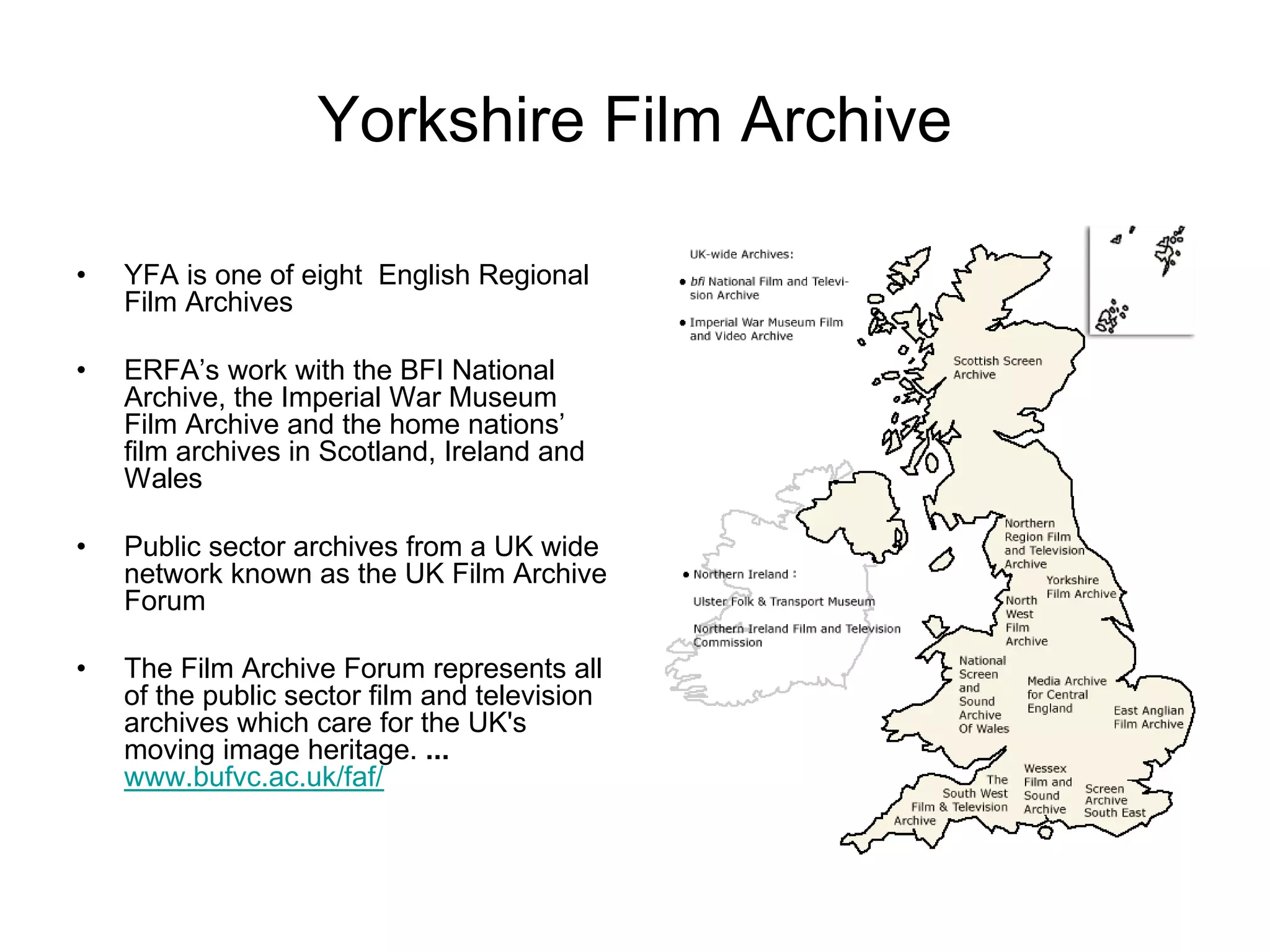
•   YFA is one of eight English Regional
    Film Archives

•   ERFA’s work with the BFI National
    Archive, the Imperial War Museum
    Film Archive and the home nations’
    film archives in Scotland, Ireland and
    Wales

•   Public sector archives from a UK wide
    network known as the UK Film Archive
    Forum

•   The Film Archive Forum represents all
    of the public sector film and television
    archives which care for the UK's
    moving image heritage. ...
    www.bufvc.ac.uk/faf/
Yorkshire Film Archive

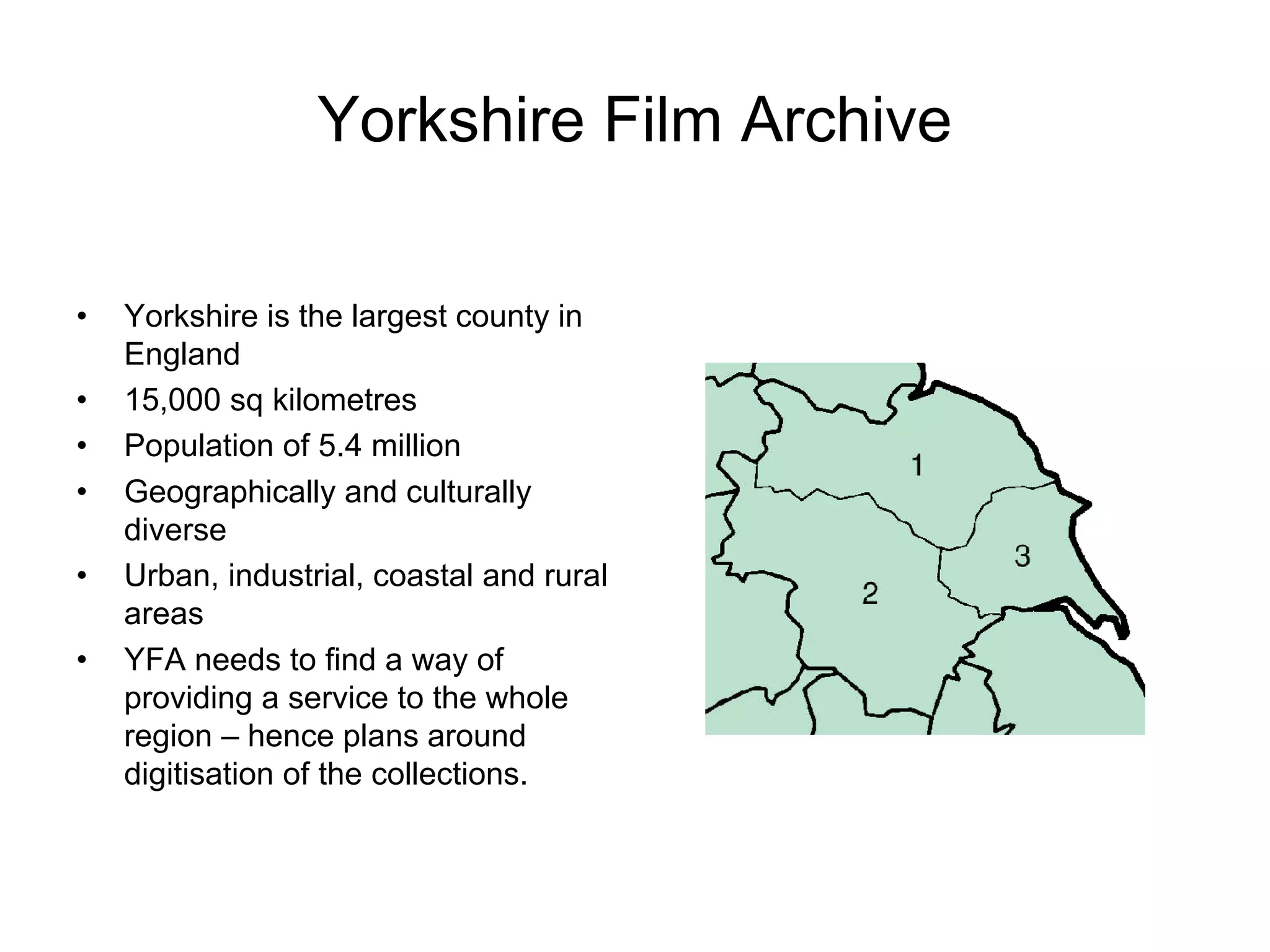
•   Yorkshire is the largest county in
    England
•   15,000 sq kilometres
•   Population of 5.4 million
•   Geographically and culturally
    diverse
•   Urban, industrial, coastal and rural
    areas
•   YFA needs to find a way of
    providing a service to the whole
    region – hence plans around
    digitisation of the collections.
Yorkshire Film Archive
•   YFA is an independent registered
    charity, with a Board of Trustees

•   The aim of the YFA is find, preserve,
    and show moving image made in, or
    about, Yorkshire

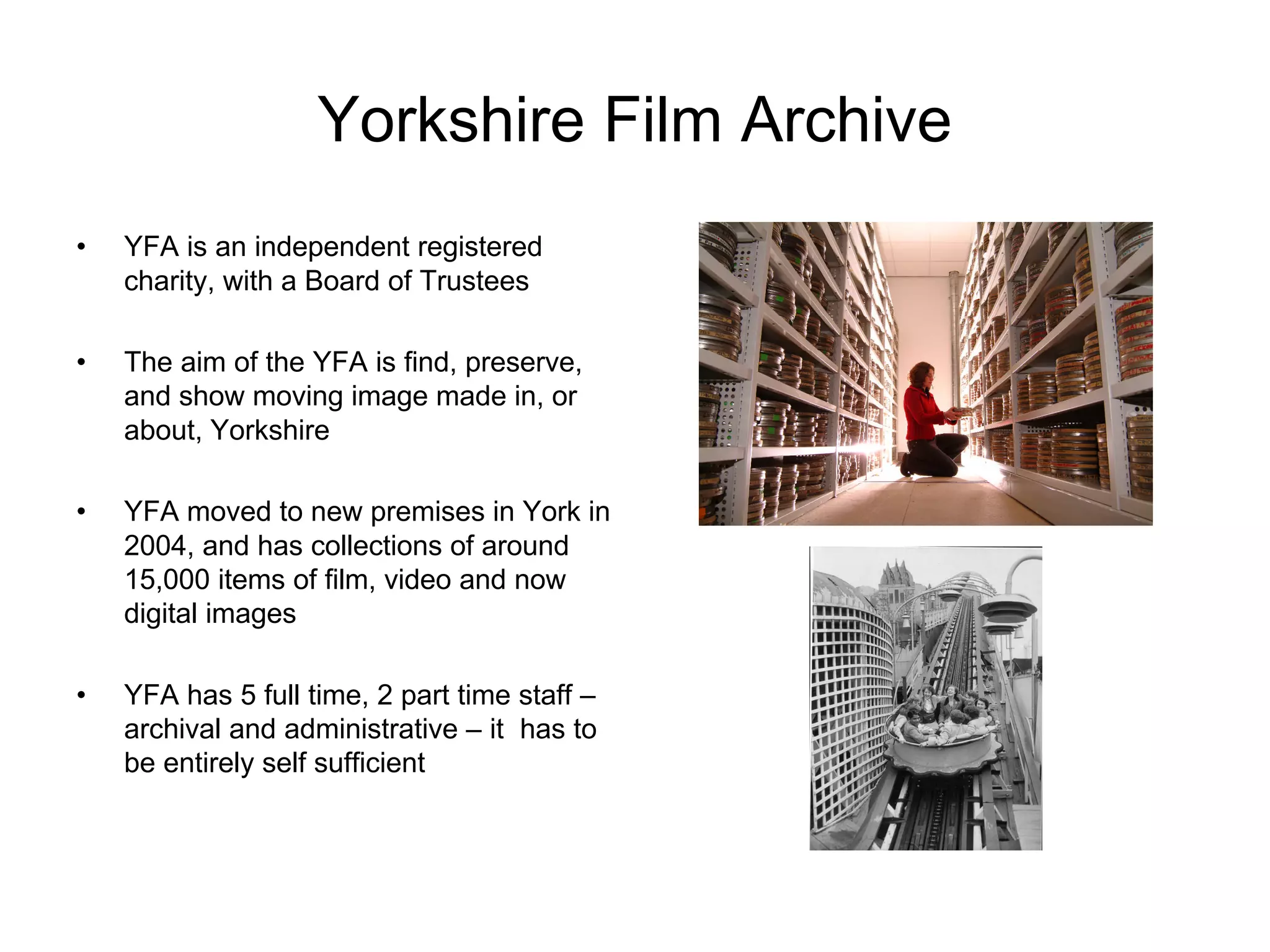
•   YFA moved to new premises in York in
    2004, and has collections of around
    15,000 items of film, video and now
    digital images

•   YFA has 5 full time, 2 part time staff –
    archival and administrative – it has to
    be entirely self sufficient
How YFA provides access to the Collections

YFA is committed to making it’s collections open and accessible to everyone
• On site viewing – for researchers, small interest groups, students etc
• Community Outreach Programmes – touring film shows and events across
  the region
• Education programmes – from primary school projects to Higher Education
  degree modules
• Curated material as ongoing displays in museums, galleries and libraries
• Television programmes – regional and national - such as ‘The Way We
  Were’ and ‘Nation on Film’
• Sell through themed DVD compilations
• Access via the YFA website
• Access via specific on-line projects with partners – regional and national
  All of these have been successful, but as we enter the digital world, there
  are new opportunities and YFA needs to respond to these positively
Research into online resources

• BFI Screenonline
www.screenonline.org.uk
• British Pathe
www.britishpathe.com
• Northern Ireland Digital Film Archive
www.digitalfilmarchive.net/dfa/
• Britons at War online
www.nationalmediamuseum.org.uk/Learning/britonsatwar/home.asp
• YFA website
www.yorkshirefilmarchive.com
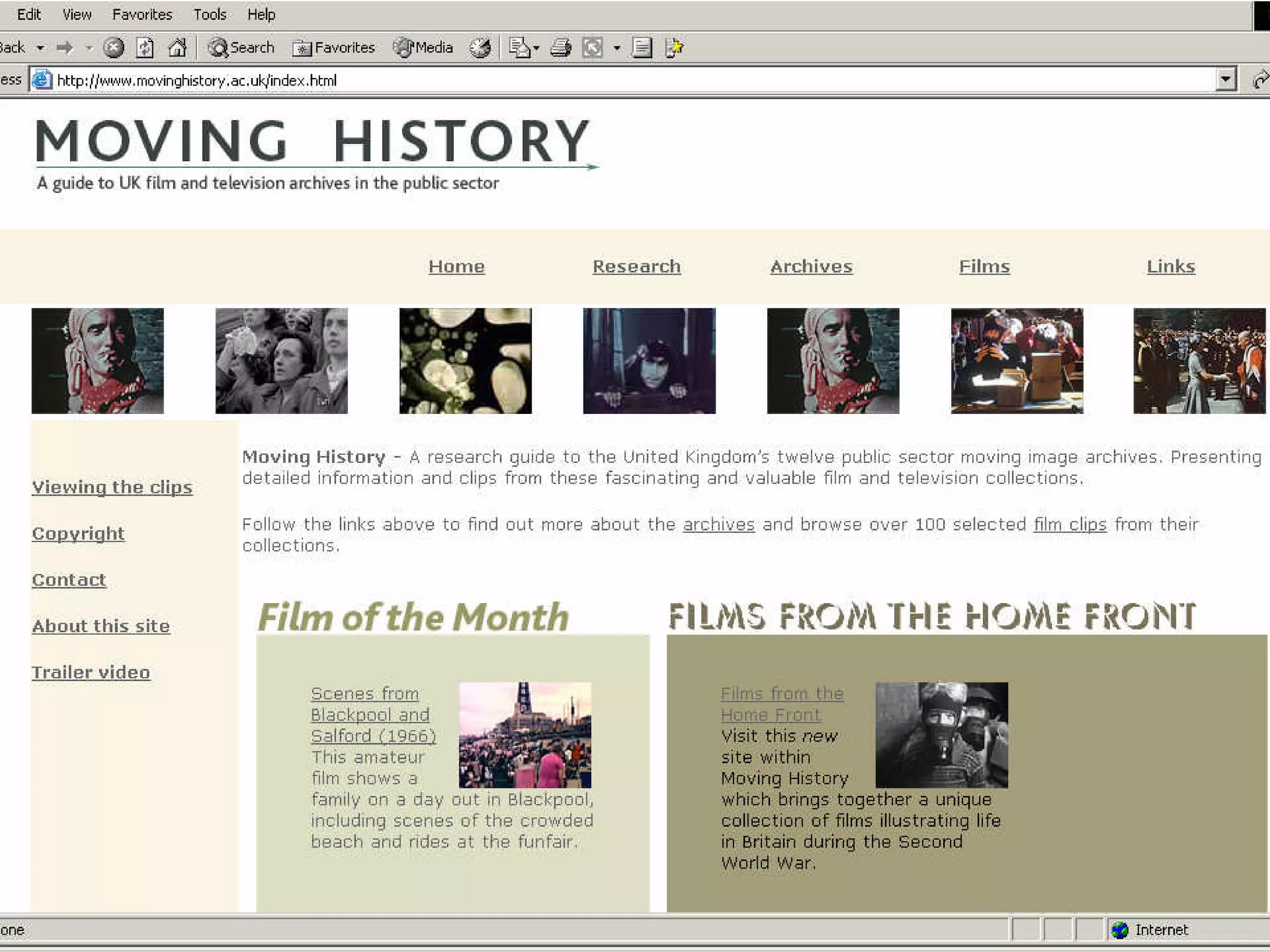
• Moving History
http://www.movinghistory.ac.uk/archives/index.html
( now incorporates Films from the Home Front )
A Digital Film Archive for Yorkshire

Questions

•   Why do we want to do this?
•   Who are we doing it for?
•   How are we going to build it?
•   What footage will be included?
•   Do we have the skills and/or
    capacity?
•   Who would fund it – and why?
•   What are the risks?
•   Where will we be at the end of the
    process?
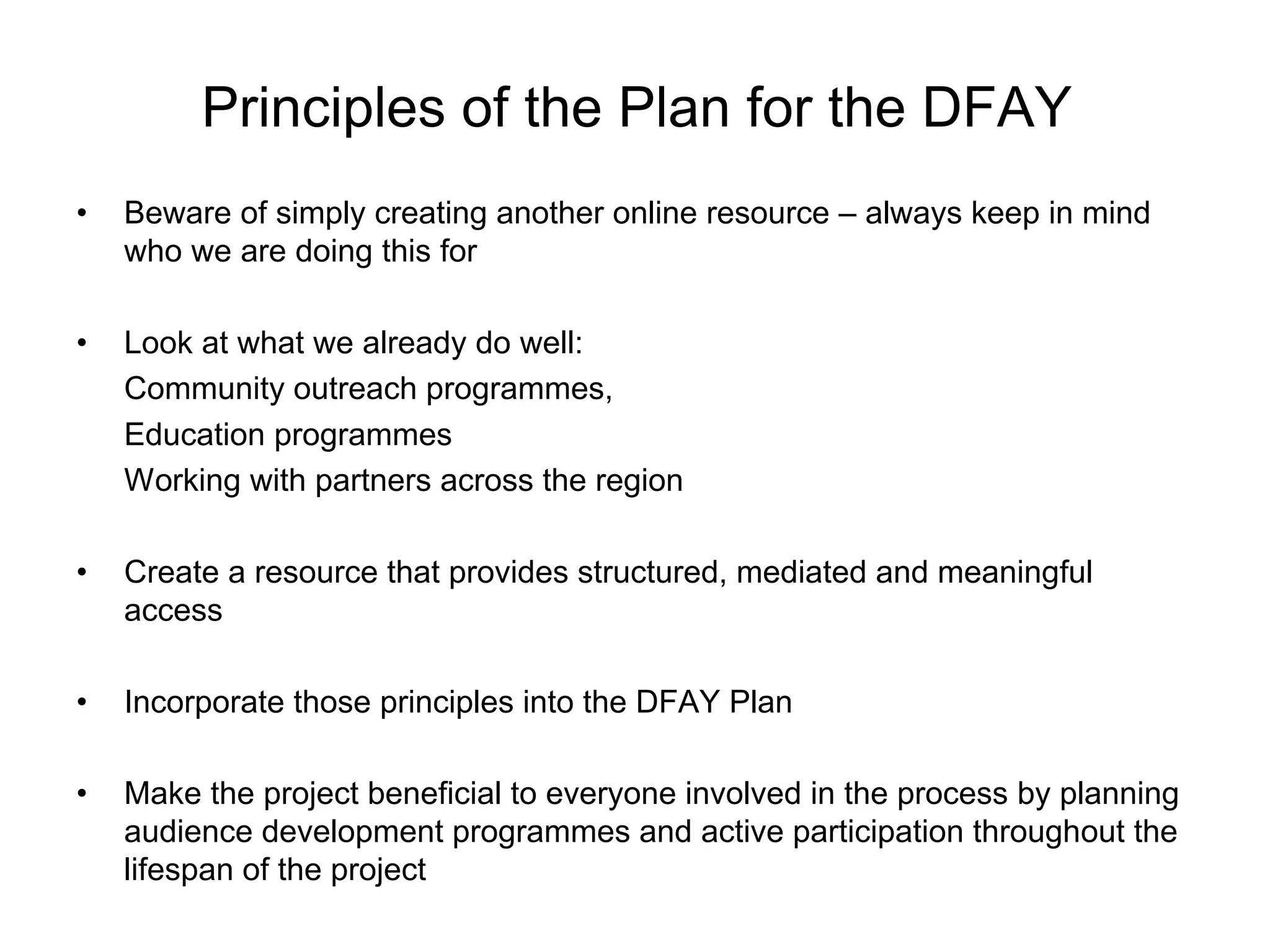
Principles of the Plan for the DFAY
•   Beware of simply creating another online resource – always keep in mind
    who we are doing this for

•   Look at what we already do well:
    Community outreach programmes,
    Education programmes
    Working with partners across the region

•   Create a resource that provides structured, mediated and meaningful
    access

•   Incorporate those principles into the DFAY Plan

•   Make the project beneficial to everyone involved in the process by planning
    audience development programmes and active participation throughout the
    lifespan of the project
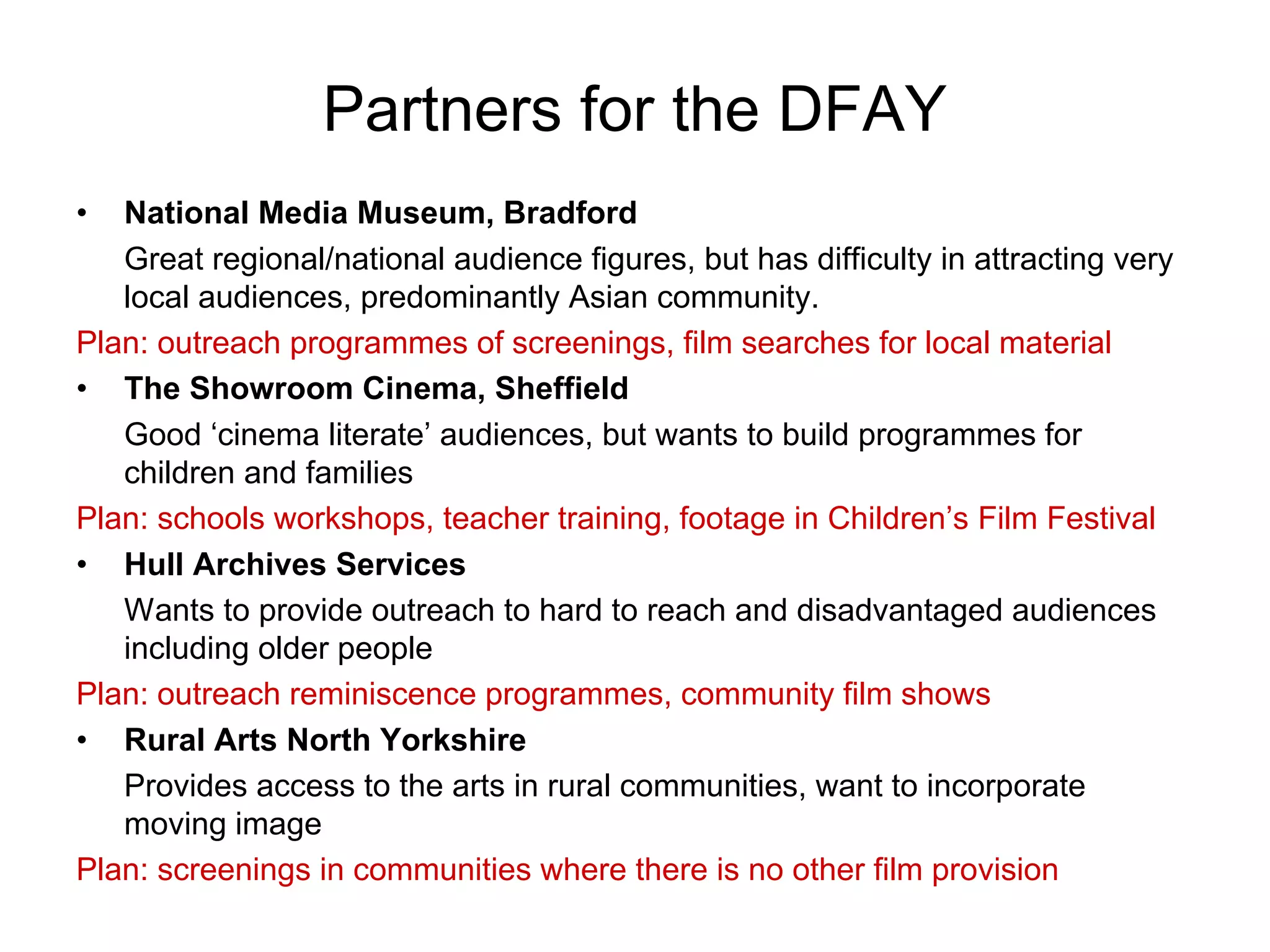
Partners for the DFAY
•  National Media Museum, Bradford
   Great regional/national audience figures, but has difficulty in attracting very
   local audiences, predominantly Asian community.
Plan: outreach programmes of screenings, film searches for local material
• The Showroom Cinema, Sheffield
   Good ‘cinema literate’ audiences, but wants to build programmes for
   children and families
Plan: schools workshops, teacher training, footage in Children’s Film Festival
• Hull Archives Services
   Wants to provide outreach to hard to reach and disadvantaged audiences
   including older people
Plan: outreach reminiscence programmes, community film shows
• Rural Arts North Yorkshire
   Provides access to the arts in rural communities, want to incorporate
   moving image
Plan: screenings in communities where there is no other film provision
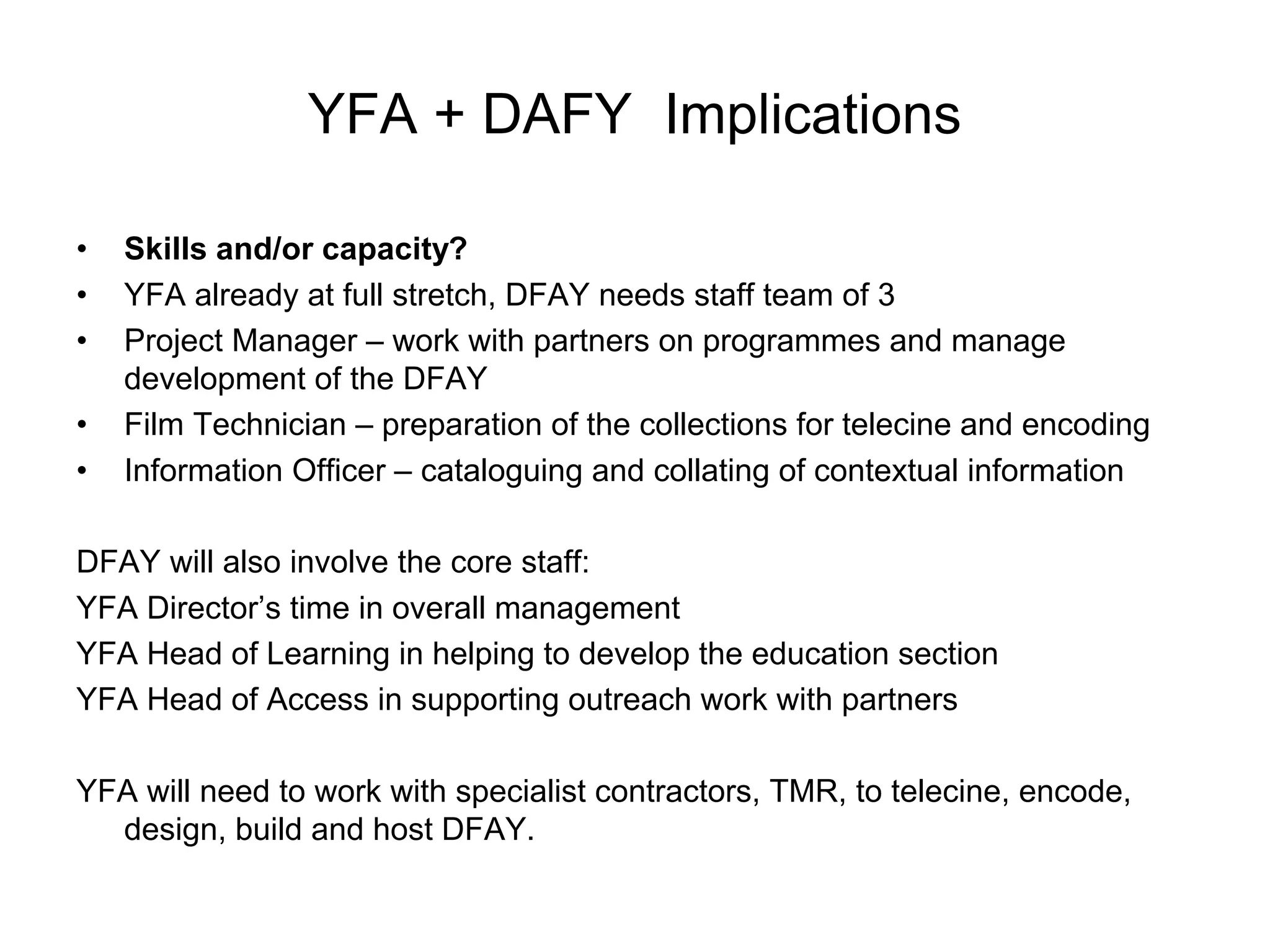
YFA + DAFY Implications

•   Skills and/or capacity?
•   YFA already at full stretch, DFAY needs staff team of 3
•   Project Manager – work with partners on programmes and manage
    development of the DFAY
•   Film Technician – preparation of the collections for telecine and encoding
•   Information Officer – cataloguing and collating of contextual information

DFAY will also involve the core staff:
YFA Director’s time in overall management
YFA Head of Learning in helping to develop the education section
YFA Head of Access in supporting outreach work with partners

YFA will need to work with specialist contractors, TMR, to telecine, encode,
  design, build and host DFAY.
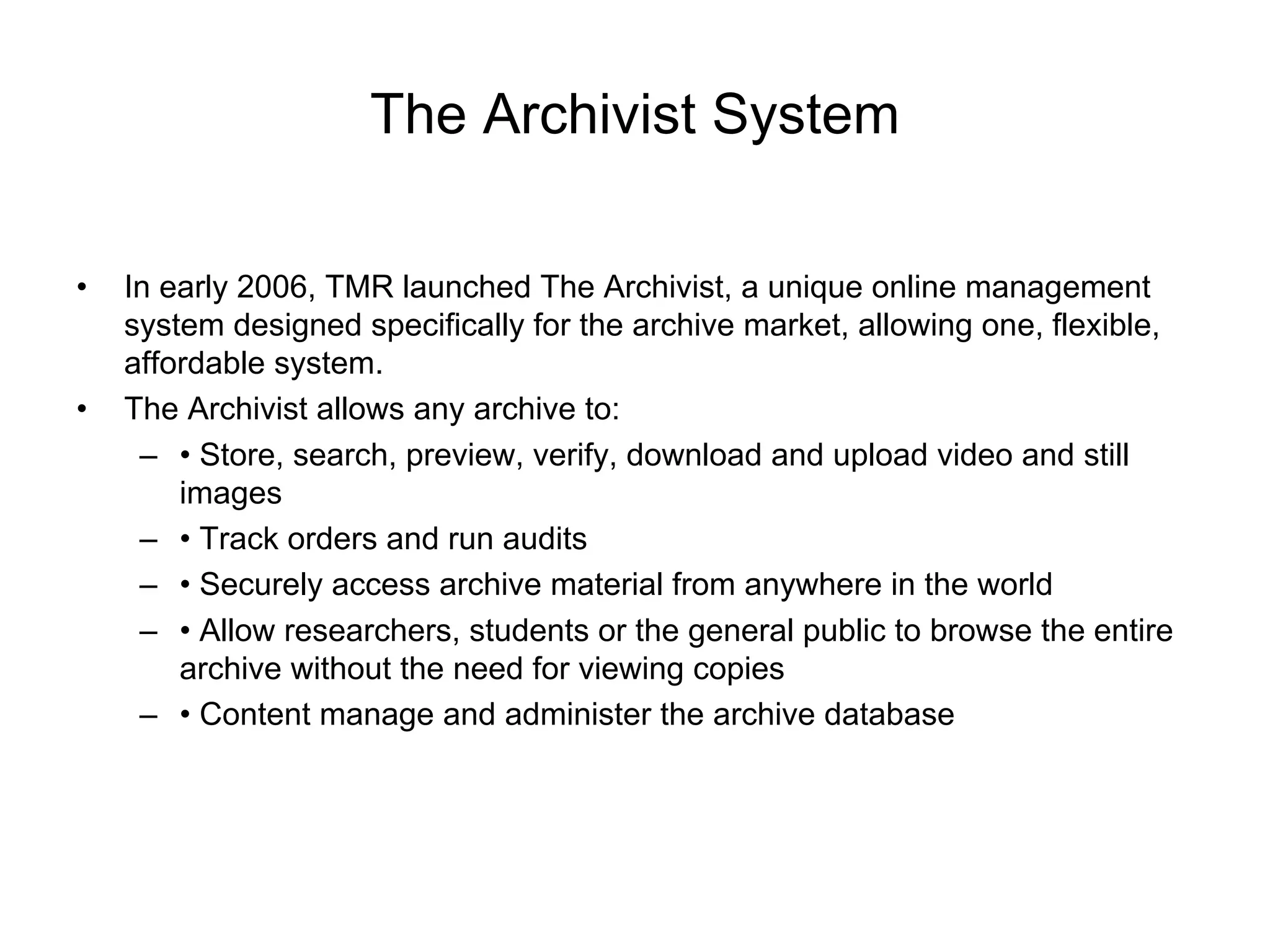
The Archivist System

•   In early 2006, TMR launched The Archivist, a unique online management
    system designed specifically for the archive market, allowing one, flexible,
    affordable system.
•   The Archivist allows any archive to:
     – • Store, search, preview, verify, download and upload video and still
        images
     – • Track orders and run audits
     – • Securely access archive material from anywhere in the world
     – • Allow researchers, students or the general public to browse the entire
        archive without the need for viewing copies
     – • Content manage and administer the archive database
Funding for the DFAY

•   Little statutory funding for the regional film archives
•   Would not be possible to take on a project of this size without additional
    funding
•   YFA applied to the Heritage Lottery Fund
•   The Heritage Lottery Fund (HLF) enables communities to celebrate, look
    after and learn more about our diverse heritage. We fund the entire spread
    of heritage – including buildings, museums, natural heritage and the
    heritage of cultural traditions and language.
•   Since 1994 the HLF has awarded over £3.97 billion to more than 26,000
    projects across England, Scotland, Wales and Northern Ireland.
•   6 month application process, but in March 2007 YFA was awarded over
    80% ( £363,000 ) of the total project costs ( £420,000 ) to create


             The Digital Film Archive for Yorkshire
Where are we now?

                3 year project goes live in July 2007
Risks
As with all projects there are risks, which can be split into 3 categories:

•   Time – is there enough time to do all the outreach work, address the
    technical and cataloguing needs of the collection, and export all of this to a
    newly designed online resource?
• Quality – the images have to telecined and encoded to high standards, and
    the website itself must be clear, informed and easy to use
• Cost – both of the above have to work within the set costs of the project.
    Any overspends would have serious consequences for the YFA.
This is why the project has been planned around a ‘pilot, test, evaluate’ model,
so that YFA has checks and balances at key stages during the project.
• Risks are minimal to the collections – nothing changes in the way we
    acquire, care for and preserve original film collections
Where will YFA be at the end of the Project?

•   Core work will have continued, so the YFA collections will continue to grow
•   Traditional forms of access work will have continued, but the DFAY will be
    planned into this work, giving YFA more flexiblity and greater access to new
    audiences
•   DFAY will be completed with:

At least 50 hours of moving image material on line
Detailed catalogue notes and contextual information
Background information including stills, journals etc
Dedicated education section for National Curriculum use
Flexible system that will allow for dedicated viewing stations at partner venues
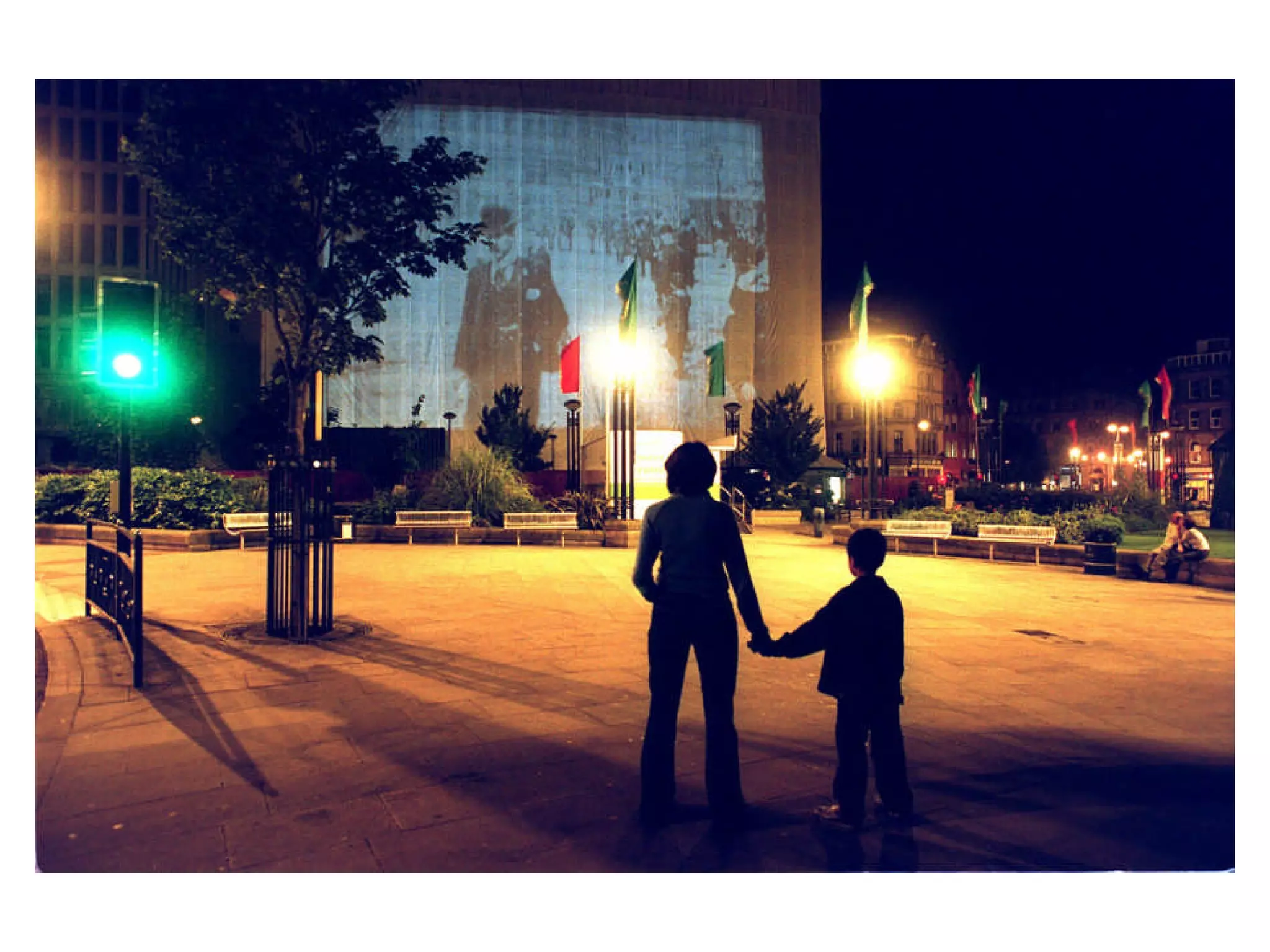
Portable laptop/projector viewing for community audiences, and ability for large
scale projections.
Sue Howard Når samlingerne bliver til guld 2007

Sue Howard Når samlingerne bliver til guld 2007

  • 1.
    Yorkshire Film Archive • YFA is one of eight English Regional Film Archives • ERFA’s work with the BFI National Archive, the Imperial War Museum Film Archive and the home nations’ film archives in Scotland, Ireland and Wales • Public sector archives from a UK wide network known as the UK Film Archive Forum • The Film Archive Forum represents all of the public sector film and television archives which care for the UK's moving image heritage. ... www.bufvc.ac.uk/faf/
  • 2.
    Yorkshire Film Archive • Yorkshire is the largest county in England • 15,000 sq kilometres • Population of 5.4 million • Geographically and culturally diverse • Urban, industrial, coastal and rural areas • YFA needs to find a way of providing a service to the whole region – hence plans around digitisation of the collections.
  • 3.
    Yorkshire Film Archive • YFA is an independent registered charity, with a Board of Trustees • The aim of the YFA is find, preserve, and show moving image made in, or about, Yorkshire • YFA moved to new premises in York in 2004, and has collections of around 15,000 items of film, video and now digital images • YFA has 5 full time, 2 part time staff – archival and administrative – it has to be entirely self sufficient
  • 5.
    How YFA providesaccess to the Collections YFA is committed to making it’s collections open and accessible to everyone • On site viewing – for researchers, small interest groups, students etc • Community Outreach Programmes – touring film shows and events across the region • Education programmes – from primary school projects to Higher Education degree modules • Curated material as ongoing displays in museums, galleries and libraries • Television programmes – regional and national - such as ‘The Way We Were’ and ‘Nation on Film’ • Sell through themed DVD compilations • Access via the YFA website • Access via specific on-line projects with partners – regional and national All of these have been successful, but as we enter the digital world, there are new opportunities and YFA needs to respond to these positively
  • 6.
    Research into onlineresources • BFI Screenonline www.screenonline.org.uk • British Pathe www.britishpathe.com • Northern Ireland Digital Film Archive www.digitalfilmarchive.net/dfa/ • Britons at War online www.nationalmediamuseum.org.uk/Learning/britonsatwar/home.asp • YFA website www.yorkshirefilmarchive.com • Moving History http://www.movinghistory.ac.uk/archives/index.html ( now incorporates Films from the Home Front )
  • 8.
    A Digital FilmArchive for Yorkshire Questions • Why do we want to do this? • Who are we doing it for? • How are we going to build it? • What footage will be included? • Do we have the skills and/or capacity? • Who would fund it – and why? • What are the risks? • Where will we be at the end of the process?
  • 9.
    Principles of thePlan for the DFAY • Beware of simply creating another online resource – always keep in mind who we are doing this for • Look at what we already do well: Community outreach programmes, Education programmes Working with partners across the region • Create a resource that provides structured, mediated and meaningful access • Incorporate those principles into the DFAY Plan • Make the project beneficial to everyone involved in the process by planning audience development programmes and active participation throughout the lifespan of the project
  • 10.
    Partners for theDFAY • National Media Museum, Bradford Great regional/national audience figures, but has difficulty in attracting very local audiences, predominantly Asian community. Plan: outreach programmes of screenings, film searches for local material • The Showroom Cinema, Sheffield Good ‘cinema literate’ audiences, but wants to build programmes for children and families Plan: schools workshops, teacher training, footage in Children’s Film Festival • Hull Archives Services Wants to provide outreach to hard to reach and disadvantaged audiences including older people Plan: outreach reminiscence programmes, community film shows • Rural Arts North Yorkshire Provides access to the arts in rural communities, want to incorporate moving image Plan: screenings in communities where there is no other film provision
  • 11.
    YFA + DAFYImplications • Skills and/or capacity? • YFA already at full stretch, DFAY needs staff team of 3 • Project Manager – work with partners on programmes and manage development of the DFAY • Film Technician – preparation of the collections for telecine and encoding • Information Officer – cataloguing and collating of contextual information DFAY will also involve the core staff: YFA Director’s time in overall management YFA Head of Learning in helping to develop the education section YFA Head of Access in supporting outreach work with partners YFA will need to work with specialist contractors, TMR, to telecine, encode, design, build and host DFAY.
  • 12.
    The Archivist System • In early 2006, TMR launched The Archivist, a unique online management system designed specifically for the archive market, allowing one, flexible, affordable system. • The Archivist allows any archive to: – • Store, search, preview, verify, download and upload video and still images – • Track orders and run audits – • Securely access archive material from anywhere in the world – • Allow researchers, students or the general public to browse the entire archive without the need for viewing copies – • Content manage and administer the archive database
  • 13.
    Funding for theDFAY • Little statutory funding for the regional film archives • Would not be possible to take on a project of this size without additional funding • YFA applied to the Heritage Lottery Fund • The Heritage Lottery Fund (HLF) enables communities to celebrate, look after and learn more about our diverse heritage. We fund the entire spread of heritage – including buildings, museums, natural heritage and the heritage of cultural traditions and language. • Since 1994 the HLF has awarded over £3.97 billion to more than 26,000 projects across England, Scotland, Wales and Northern Ireland. • 6 month application process, but in March 2007 YFA was awarded over 80% ( £363,000 ) of the total project costs ( £420,000 ) to create The Digital Film Archive for Yorkshire
  • 14.
    Where are wenow? 3 year project goes live in July 2007 Risks As with all projects there are risks, which can be split into 3 categories: • Time – is there enough time to do all the outreach work, address the technical and cataloguing needs of the collection, and export all of this to a newly designed online resource? • Quality – the images have to telecined and encoded to high standards, and the website itself must be clear, informed and easy to use • Cost – both of the above have to work within the set costs of the project. Any overspends would have serious consequences for the YFA. This is why the project has been planned around a ‘pilot, test, evaluate’ model, so that YFA has checks and balances at key stages during the project. • Risks are minimal to the collections – nothing changes in the way we acquire, care for and preserve original film collections
  • 15.
    Where will YFAbe at the end of the Project? • Core work will have continued, so the YFA collections will continue to grow • Traditional forms of access work will have continued, but the DFAY will be planned into this work, giving YFA more flexiblity and greater access to new audiences • DFAY will be completed with: At least 50 hours of moving image material on line Detailed catalogue notes and contextual information Background information including stills, journals etc Dedicated education section for National Curriculum use Flexible system that will allow for dedicated viewing stations at partner venues Portable laptop/projector viewing for community audiences, and ability for large scale projections.