Successful Project Planning and Delivery
By
Drasvin Cheowtirakul
4/15/2011
Successful Project Planning and Delivery
By
Drasvin Cheowtirakul
4/15/2011
1. Project Success Report and Survey
2. Common Project Issues
3. Key Project Success Factors
4. Possible Solutions
5. Q&A
Agenda
3
1. Project Success Report and Survey
4
Sources for Project Success Report and
Survey
2009 CHAOS Report 2010 IT Project Success Survey
5
Standish Group’s Chaos Report
Successful: On-time, on-budget, and
with all features and functions as
defined in the initial scope.
Challenged: Late, over budget,
and/or with less features and
functions than defined in the initial
scope.
Failed: Cancelled prior to
completion, or delivered but never
used.
6
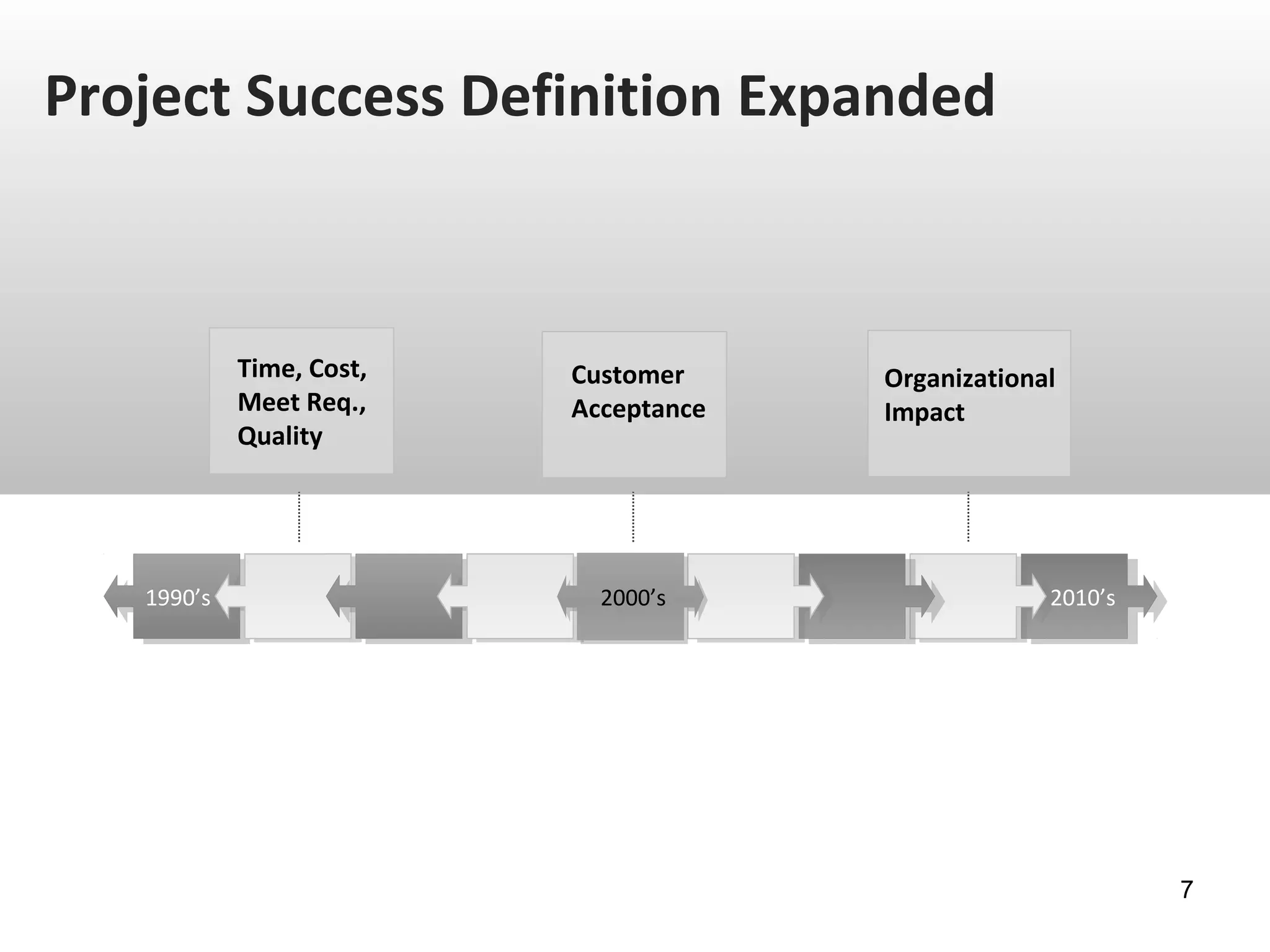
2000’s 2010’s1990’s
Customer
Acceptance
Time, Cost,
Meet Req.,
Quality
Organizational
Impact
Project Success Definition Expanded
7
IT Project Success Survey
• Definition of Successful Projects
Time/Schedule: 54% prefer deliver on time according to the
schedule; 44% prefer deliver when the system is ready.
Financial: 35% prefer deliver within budget; 60% prefer to
provide good return on investment (ROI).
Functionality: 14% prefer to build the system to specification;
85% prefer to meet the actual need of stakeholders.
Quality: 40% prefer to deliver on time and on budget, 57% prefer
to deliver high-quality, easy-to-maintain systems.
8
IT Project Success Survey
• Different Project Methodology
Ad-hoc: No defined process
Iterative: Rational Unified
Process (RUP)
Agile: Scrum and Extreme
Programming (XP)
Traditional: Waterfall, Classical,
and Serial Processes
9
IT Project Success Survey
• Perceived Project Success Rates
10
IT Project Success Survey
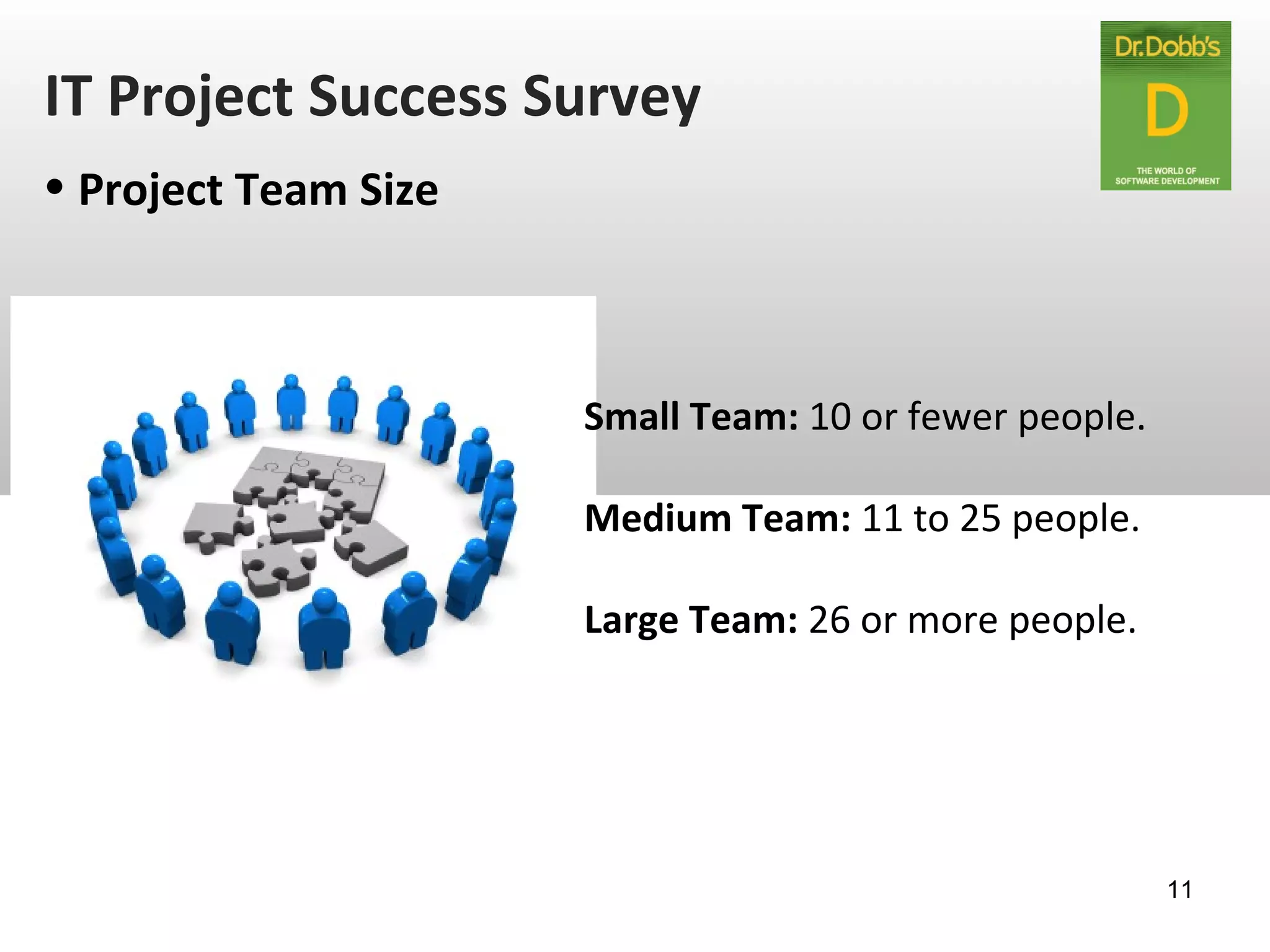
• Project Team Size
Small Team: 10 or fewer people.
Medium Team: 11 to 25 people.
Large Team: 26 or more people.
11
IT Project Success Survey
• Perceived Project Success Rates by Team Size
12
2. Common Project Issues
13
Project Management’s Five Deadly Sins
(Standish Group’s CHAOS Report)
1. Over Ambition: Project manager taking on too
much at once.
2. Prestige: Project manager having an over confident
attitude towards team members.
3. Ignorance: Poor understanding of project goals and
overall objective.
4. Absence: Key member or decision-maker are not
dedicating enough time.
5. Dishonesty: Concealing facts.
14
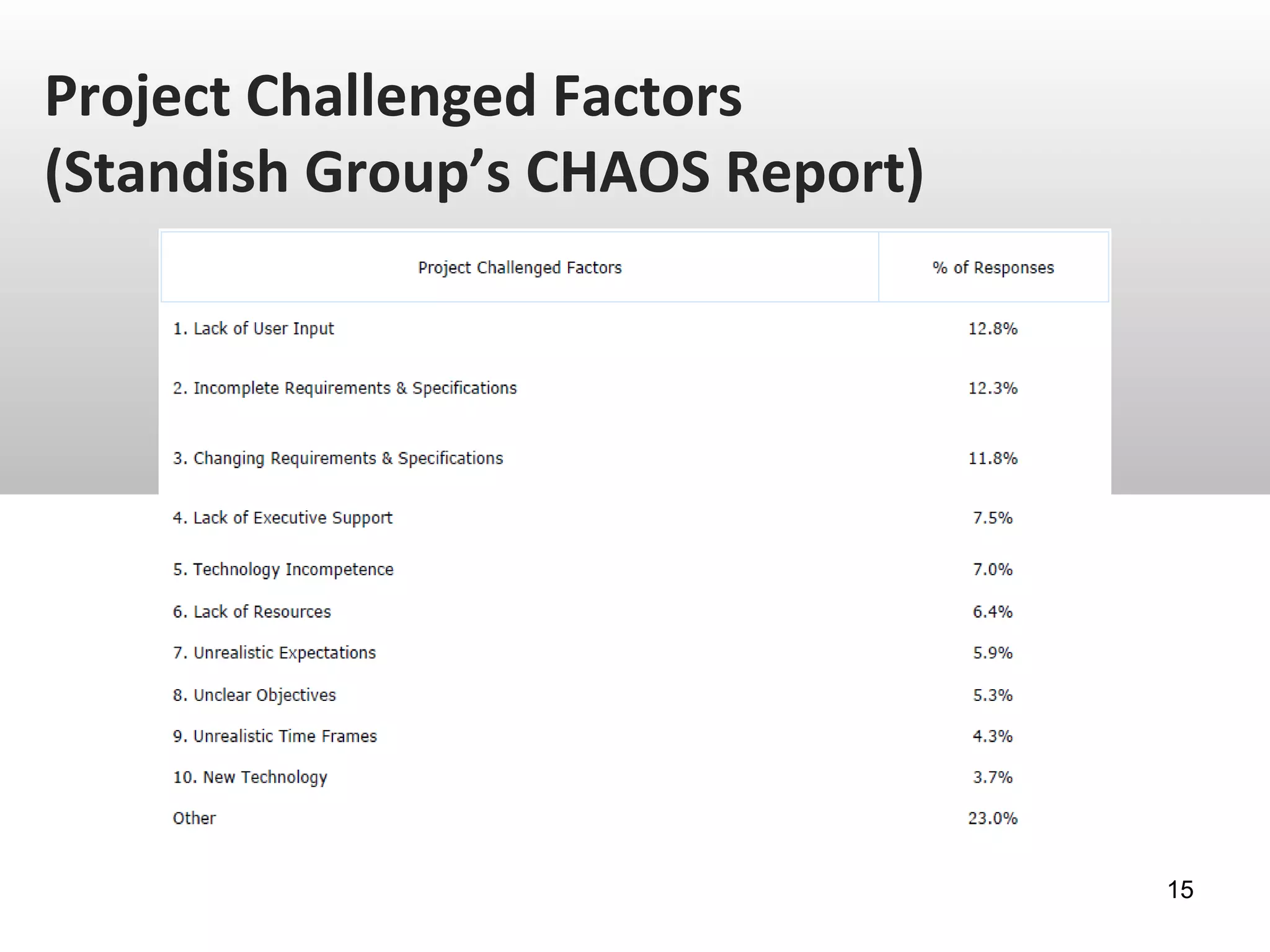
Project Challenged Factors
(Standish Group’s CHAOS Report)
15
Managing Project Requirements and
Expectation
16
3. Key Project Success Factors
17
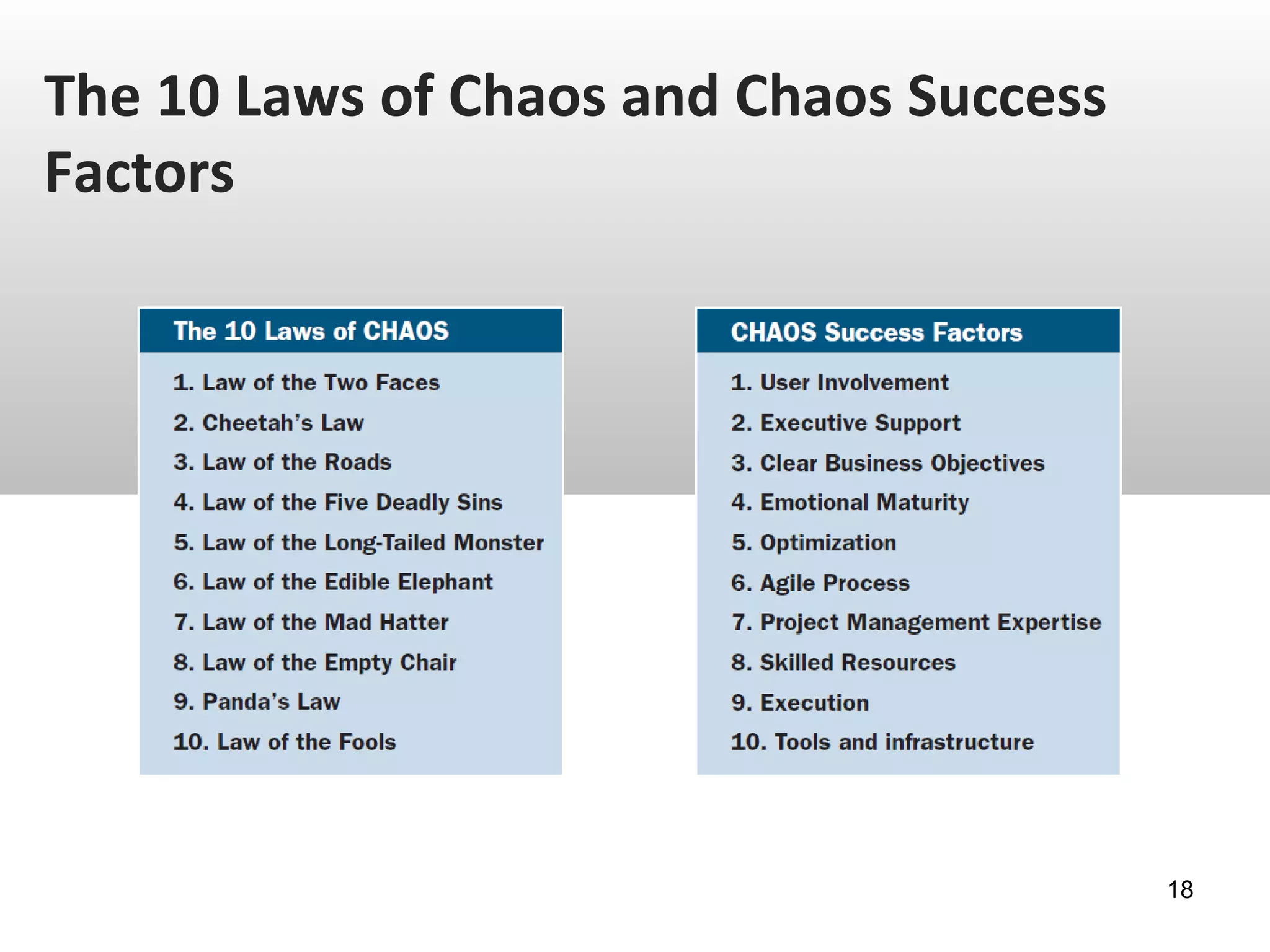
The 10 Laws of Chaos and Chaos Success
Factors
18
The 10 Laws of Chaos and Chaos Success
Factors
1. Law of the Two Faces
Successful projects include knowledgeable
business users with good communication skills.
User Involvement
19
The 10 Laws of Chaos and Chaos Success
Factors
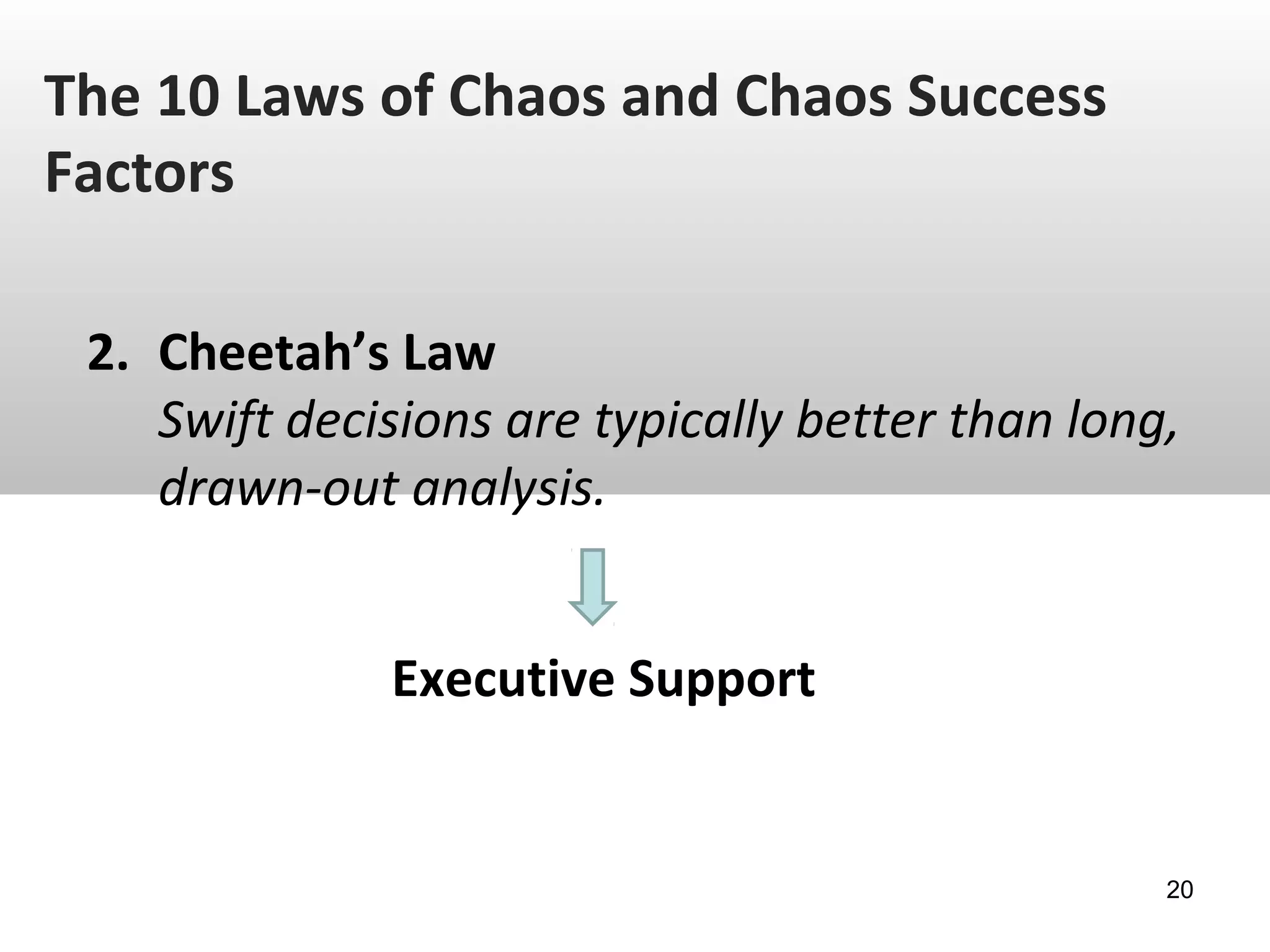
2. Cheetah’s Law
Swift decisions are typically better than long,
drawn-out analysis.
Executive Support
20
The 10 Laws of Chaos and Chaos Success
Factors
3. Law of the Roads
Clarity and focus are essential to a successful
project.
Clear Business Objects
21
The 10 Laws of Chaos and Chaos Success
Factors
4. Law of the Five Deadly Sins
It’s how you deal with these sins that will
determine the success or failure of the project.
Emotional Maturity
22
The 10 Laws of Chaos and Chaos Success
Factors
5. Law of the Long-Tailed Monster
You will always build too much of what you
don’t need and not enough of what you need.
Optimization
23
The 10 Laws of Chaos and Chaos Success
Factors
6. Law of the Edible Elephant
Large projects should be broken into small,
iterative steps with small, focused teams.
Agile Process
24
The 10 Laws of Chaos and Chaos Success
Factors
7. Law of the Mad Hatter
Complexity causes confusion and costs.
Project Management Expertise
25
The 10 Laws of Chaos and Chaos Success
Factors
8. Law of the Empty Chair
Keep the project cycles short with continuous
deliverable.
Skilled Resources
26
The 10 Laws of Chaos and Chaos Success
Factors
9. Panda’s Law
Inaction is the purest form of failure.
Execution
27
The 10 Laws of Chaos and Chaos Success
Factors
10. Law of the Fools
It is not just having the right tools but the skill
to use them that make all the difference.
Tools and Infrastructure
28
4. Possible Solutions
29
Possible Solution: Spend Extra Effort on
Project Planning
30
• Create Project Goals – Identify all stakeholders and define project
objective.
• Create Project Deliverables – List of things the project needs to deliver.
• Create Project Schedule – List of tasks with duration and resource
associated to it.
• Create Supporting Plan – HR Plan, Communications Plan, Risk
Management Plan.
• Continuous Improvement – Continuously manage and update the
project plan.
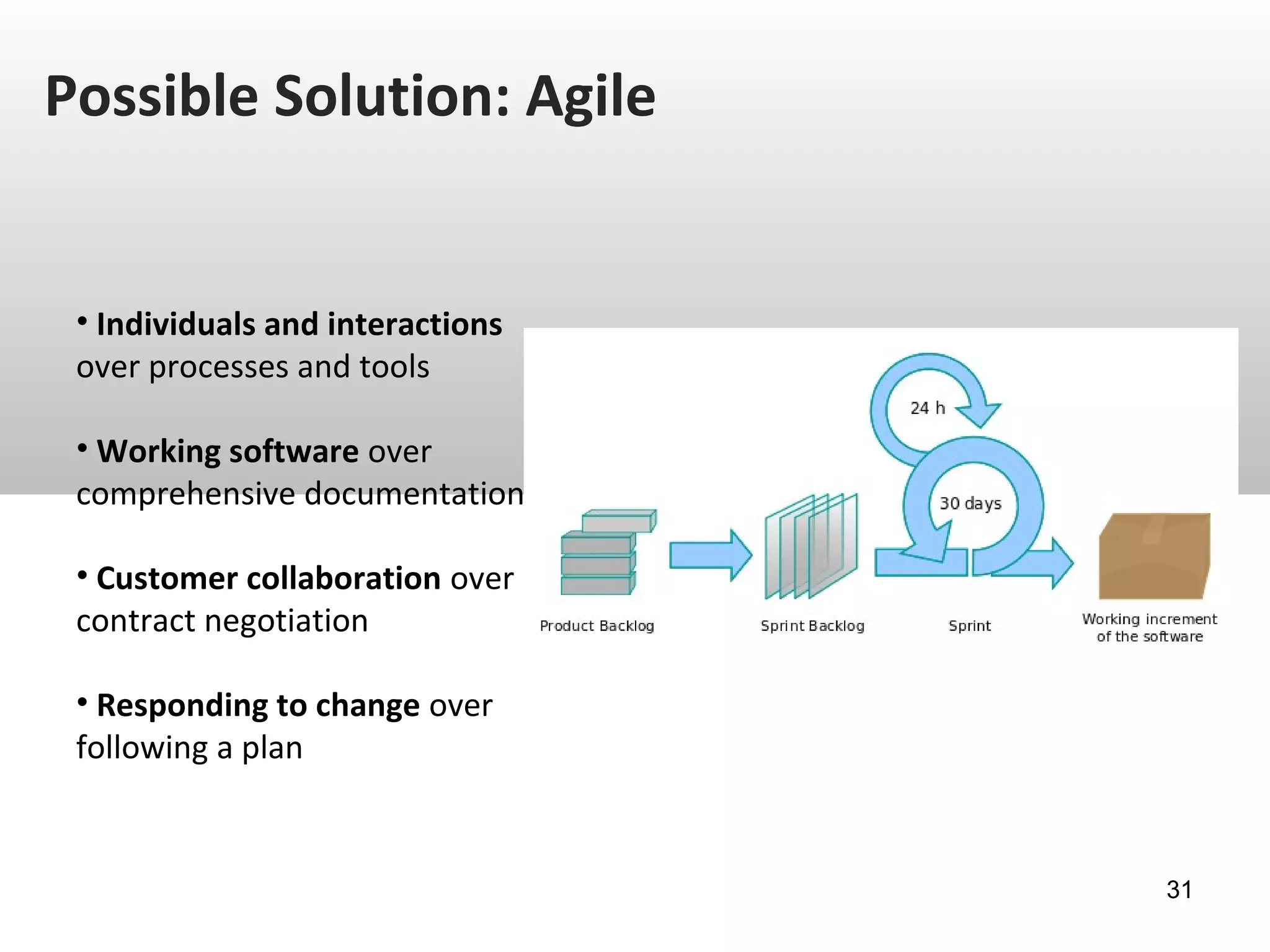
Possible Solution: Agile
31
• Individuals and interactions
over processes and tools
• Working software over
comprehensive documentation
• Customer collaboration over
contract negotiation
• Responding to change over
following a plan
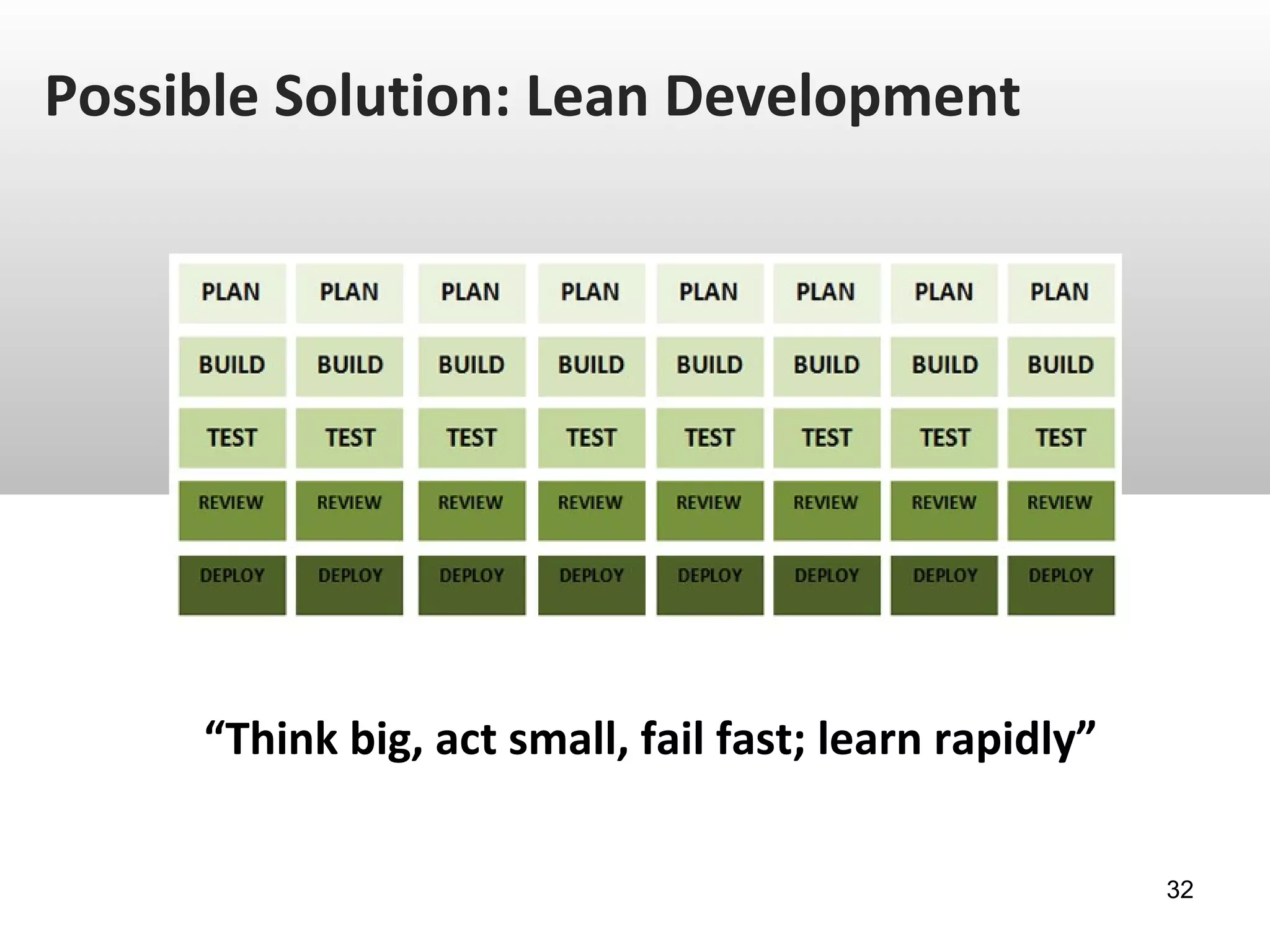
Possible Solution: Lean Development
32
“Think big, act small, fail fast; learn rapidly”
–
Conclusion
33
Choose the solution that best fits your project.
“Good project management is a process of
continuous improvement. It is a process of
making mistakes and learning from those
mistakes. It is a process of continuous study and
learning.”
5. Q&A
34
35

Successful Project Planning - Drasvin

  • 1.
    Successful Project Planningand Delivery By Drasvin Cheowtirakul 4/15/2011
  • 2.
    Successful Project Planningand Delivery By Drasvin Cheowtirakul 4/15/2011
  • 3.
    1. Project SuccessReport and Survey 2. Common Project Issues 3. Key Project Success Factors 4. Possible Solutions 5. Q&A Agenda 3
  • 4.
    1. Project SuccessReport and Survey 4
  • 5.
    Sources for ProjectSuccess Report and Survey 2009 CHAOS Report 2010 IT Project Success Survey 5
  • 6.
    Standish Group’s ChaosReport Successful: On-time, on-budget, and with all features and functions as defined in the initial scope. Challenged: Late, over budget, and/or with less features and functions than defined in the initial scope. Failed: Cancelled prior to completion, or delivered but never used. 6
  • 7.
    2000’s 2010’s1990’s Customer Acceptance Time, Cost, MeetReq., Quality Organizational Impact Project Success Definition Expanded 7
  • 8.
    IT Project SuccessSurvey • Definition of Successful Projects Time/Schedule: 54% prefer deliver on time according to the schedule; 44% prefer deliver when the system is ready. Financial: 35% prefer deliver within budget; 60% prefer to provide good return on investment (ROI). Functionality: 14% prefer to build the system to specification; 85% prefer to meet the actual need of stakeholders. Quality: 40% prefer to deliver on time and on budget, 57% prefer to deliver high-quality, easy-to-maintain systems. 8
  • 9.
    IT Project SuccessSurvey • Different Project Methodology Ad-hoc: No defined process Iterative: Rational Unified Process (RUP) Agile: Scrum and Extreme Programming (XP) Traditional: Waterfall, Classical, and Serial Processes 9
  • 10.
    IT Project SuccessSurvey • Perceived Project Success Rates 10
  • 11.
    IT Project SuccessSurvey • Project Team Size Small Team: 10 or fewer people. Medium Team: 11 to 25 people. Large Team: 26 or more people. 11
  • 12.
    IT Project SuccessSurvey • Perceived Project Success Rates by Team Size 12
  • 13.
  • 14.
    Project Management’s FiveDeadly Sins (Standish Group’s CHAOS Report) 1. Over Ambition: Project manager taking on too much at once. 2. Prestige: Project manager having an over confident attitude towards team members. 3. Ignorance: Poor understanding of project goals and overall objective. 4. Absence: Key member or decision-maker are not dedicating enough time. 5. Dishonesty: Concealing facts. 14
  • 15.
    Project Challenged Factors (StandishGroup’s CHAOS Report) 15
  • 16.
  • 17.
    3. Key ProjectSuccess Factors 17
  • 18.
    The 10 Lawsof Chaos and Chaos Success Factors 18
  • 19.
    The 10 Lawsof Chaos and Chaos Success Factors 1. Law of the Two Faces Successful projects include knowledgeable business users with good communication skills. User Involvement 19
  • 20.
    The 10 Lawsof Chaos and Chaos Success Factors 2. Cheetah’s Law Swift decisions are typically better than long, drawn-out analysis. Executive Support 20
  • 21.
    The 10 Lawsof Chaos and Chaos Success Factors 3. Law of the Roads Clarity and focus are essential to a successful project. Clear Business Objects 21
  • 22.
    The 10 Lawsof Chaos and Chaos Success Factors 4. Law of the Five Deadly Sins It’s how you deal with these sins that will determine the success or failure of the project. Emotional Maturity 22
  • 23.
    The 10 Lawsof Chaos and Chaos Success Factors 5. Law of the Long-Tailed Monster You will always build too much of what you don’t need and not enough of what you need. Optimization 23
  • 24.
    The 10 Lawsof Chaos and Chaos Success Factors 6. Law of the Edible Elephant Large projects should be broken into small, iterative steps with small, focused teams. Agile Process 24
  • 25.
    The 10 Lawsof Chaos and Chaos Success Factors 7. Law of the Mad Hatter Complexity causes confusion and costs. Project Management Expertise 25
  • 26.
    The 10 Lawsof Chaos and Chaos Success Factors 8. Law of the Empty Chair Keep the project cycles short with continuous deliverable. Skilled Resources 26
  • 27.
    The 10 Lawsof Chaos and Chaos Success Factors 9. Panda’s Law Inaction is the purest form of failure. Execution 27
  • 28.
    The 10 Lawsof Chaos and Chaos Success Factors 10. Law of the Fools It is not just having the right tools but the skill to use them that make all the difference. Tools and Infrastructure 28
  • 29.
  • 30.
    Possible Solution: SpendExtra Effort on Project Planning 30 • Create Project Goals – Identify all stakeholders and define project objective. • Create Project Deliverables – List of things the project needs to deliver. • Create Project Schedule – List of tasks with duration and resource associated to it. • Create Supporting Plan – HR Plan, Communications Plan, Risk Management Plan. • Continuous Improvement – Continuously manage and update the project plan.
  • 31.
    Possible Solution: Agile 31 •Individuals and interactions over processes and tools • Working software over comprehensive documentation • Customer collaboration over contract negotiation • Responding to change over following a plan
  • 32.
    Possible Solution: LeanDevelopment 32 “Think big, act small, fail fast; learn rapidly” –
  • 33.
    Conclusion 33 Choose the solutionthat best fits your project. “Good project management is a process of continuous improvement. It is a process of making mistakes and learning from those mistakes. It is a process of continuous study and learning.”
  • 34.
  • 35.