Substation Commissioning
• What is substation
commissioning?
– Proving the proper
operation of a newly
• Installed
• Replaced
• Modified
• Repaired
piece of equipment
before it is placed into
service
Substation Commissioning
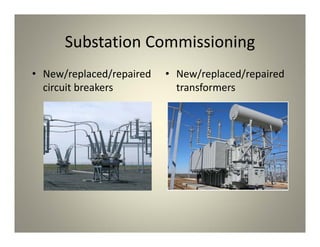
• New/replaced/repaired
circuit breakers
• New/replaced/repaired
transformers
Substation Commissioning
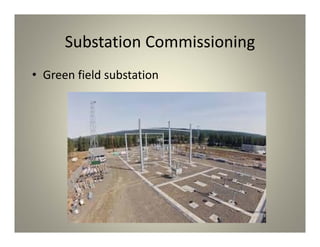
• Green field substation
Substation Commissioning
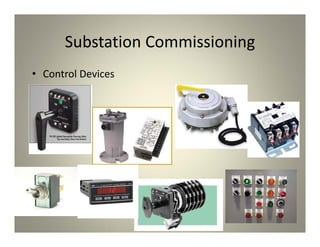
• Control Devices
Substation Commissioning
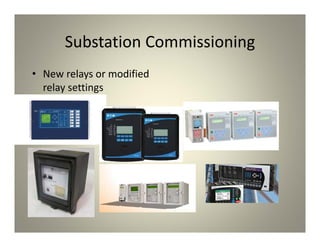
• New relays or modified
relay settings
Substation Commissioning
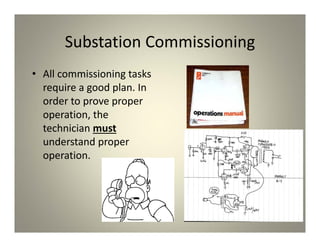
• All commissioning tasks
require a good plan. In
order to prove proper
operation, the
technician must
understand proper
operation.
Substation Commissioning
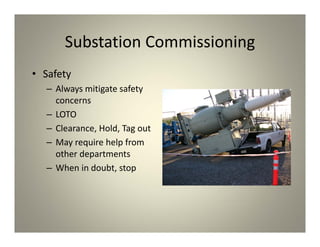
• Safety
– Always mitigate safety
concerns
– LOTO
– Clearance, Hold, Tag out
– May require help from
other departments
– When in doubt, stop
Substation Commissioning
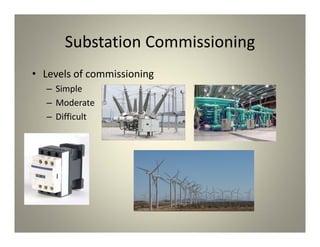
• Levels of commissioning
– Simple
– Moderate
– Difficult
Substation Commissioning
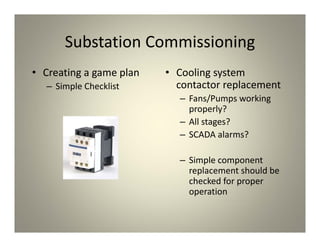
• Creating a game plan
– Simple Checklist
• Cooling system
contactor replacement
– Fans/Pumps working
properly?
– All stages?
– SCADA alarms?
– Simple component
replacement should be
checked for proper
operation
Substation Commissioning
• Moderate to difficult commissioning
– Intense familiarity with all aspects of the task at
hand isn’t always necessary. Sometimes there are
other groups involved in the commissioning
process. General familiarity with other work
groups responsibilities is highly encouraged.
– Thorough knowledge and expertise in the
responsibilities of the relay technician is required.
Substation Commissioning
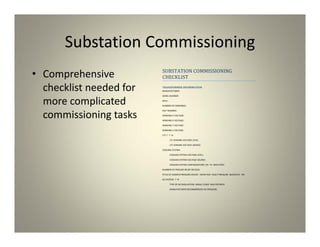
• Comprehensive
checklist needed for
more complicated
commissioning tasks
SUBSTATION COMMISSIONING
CHECKLIST
TRANSFORMER INFORMATION
MANUFACTURER:
SERIEL NUMBER:
MVA:
NUMBER OF WINDINGS:
SELF NUMBER:
WINDING H VOLTAGE:
WINDING X VOLTAGE:
WINDING Y VOLTAGE:
WINDING Z VOLTAGE:
LTC ? : Y N
LTC SENSING VOLTAGE LEVEL:
LTC SENSING VOLTAGE SOURCE:
COOLING SYSTEM:
COOLING SYSTEM VOLTAGE LEVEL:
COOLING SYSTEM VOLTAGE SOURCE:
COOLING SYSTEM CONFIGURATION: OA FA OAFA FOFA
NUMBER OF PRESURE RELIEF DEVICES:
STYLE OF SUDDEN PRESSURE DEVICE: RAPID RISE FAULT PRESSURE BUCHOLTZ NA
N2 SYSTEM: Y N
TYPE OF N2 REGULATION: SINGLE STAGE MULTISTAGED
MANUFACTURER RECOMMENDED N2 PRESSURE:
Substation Commissioning
• Large component replacement
– Transformers and Circuit Breakers
• Acceptance tests can be performed without prints and
relay settings
– CT saturation, ratio, polarity, and insulation testing
– VT ratio, polarity, insulation testing
– Power Factor testing
– Transformer turns ratio testing
Acceptance testing really only proves that the equipment was
built to specifications at the factory, it survived the travel and
installation, and is the baseline for future performance
comparison.
Substation Commissioning
• Testing that requires
prints and settings is
really the crux of the
commissioning process.
• These tests include:
– DC Circuit checks
– AC Circuit checks
– Relay testing
– Trip Checks
– Communication
processor programming
– Point to Point testing
Substation Commissioning
• DC Checks
– DC circuit checks can be accomplished in a few
different ways, but all must be documented to
stay on track.
– A good place to start is comparing the schematics
to the wiring diagrams. Mistakes can be identified
and possibly rectified during construction, or upon
arrival of equipment to the job site.
– Good time to review mistakes with engineering
Substation Commissioning
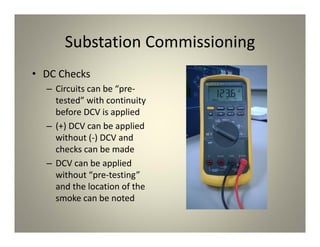
• DC Checks
– Circuits can be “pre‐
tested” with continuity
before DCV is applied
– (+) DCV can be applied
without (‐) DCV and
checks can be made
– DCV can be applied
without “pre‐testing”
and the location of the
smoke can be noted
Substation Commissioning
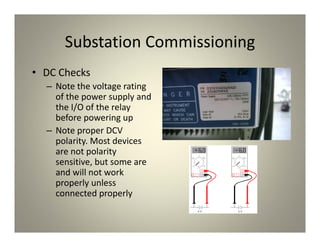
• DC Checks
– Note the voltage rating
of the power supply and
the I/O of the relay
before powering up
– Note proper DCV
polarity. Most devices
are not polarity
sensitive, but some are
and will not work
properly unless
connected properly
Substation Commissioning
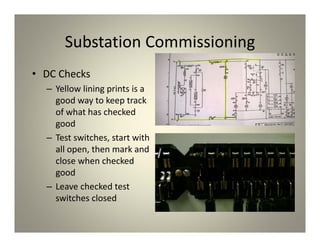
• DC Checks
– Yellow lining prints is a
good way to keep track
of what has checked
good
– Test switches, start with
all open, then mark and
close when checked
good
– Leave checked test
switches closed
Substation Commissioning
• AC Voltage Checks
– Goal of AC voltage circuit
checks is to prove proper
phasing and polarity
throughout the circuit
– Existing phasing can be
identified with
equipment that has
been in service
– Secondary wires checked
with continuity as long
as all conductors are
isolated
– “Live” Bus or Line
voltage can be used
– Phase between new and
old secondary wires
– Metering screen on
microprocessor relay
Substation Commissioning
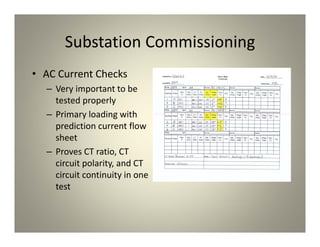
• AC Current Checks
– Very important to be
tested properly
– Primary loading with
prediction current flow
sheet
– Proves CT ratio, CT
circuit polarity, and CT
circuit continuity in one
test
Substation Commissioning
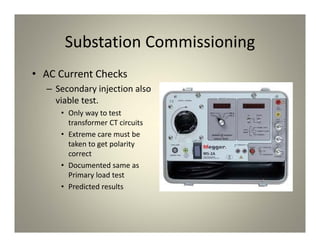
• AC Current Checks
– Secondary injection also
viable test.
• Only way to test
transformer CT circuits
• Extreme care must be
taken to get polarity
correct
• Documented same as
Primary load test
• Predicted results
Substation Commissioning
• Relay Testing
– Testing the relay is managed in different ways, but
the goal is to prove the relay settings, relay logic,
and relay functions are all working to “as set”
settings
– Element testing can be accomplished via manual
or automatic testing
– Strive to test relay logic with real dynamic testing
Substation Commissioning
• Dynamic Logic Testing
– Don’t just pulse/jumper contacts, create relay
reaction by injecting values into the relay
– Use logic diagrams and yellow line them as they
are tested is a great way to understand the relay
logic
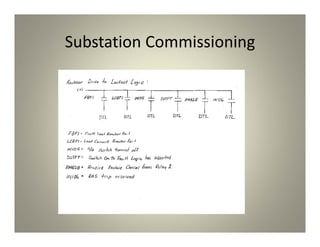
– Better yet, draw your own logic diagrams and test
them
Substation Commissioning
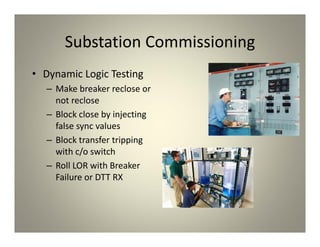
• Dynamic Logic Testing
– Make breaker reclose or
not reclose
– Block close by injecting
false sync values
– Block transfer tripping
with c/o switch
– Roll LOR with Breaker
Failure or DTT RX
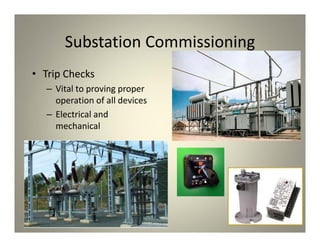
Substation Commissioning
• Trip Checks
– Vital to proving proper
operation of all devices
– Electrical and
mechanical
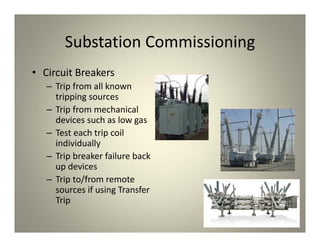
Substation Commissioning
• Circuit Breakers
– Trip from all known
tripping sources
– Trip from mechanical
devices such as low gas
– Test each trip coil
individually
– Trip breaker failure back
up devices
– Trip to/from remote
sources if using Transfer
Trip
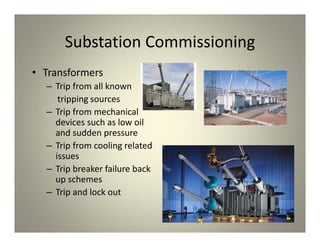
Substation Commissioning
• Transformers
– Trip from all known
tripping sources
– Trip from mechanical
devices such as low oil
and sudden pressure
– Trip from cooling related
issues
– Trip breaker failure back
up schemes
– Trip and lock out
Substation Commissioning
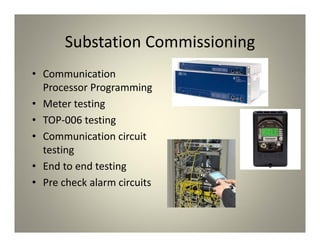
• Communication
Processor Programming
• Meter testing
• TOP‐006 testing
• Communication circuit
testing
• End to end testing
• Pre check alarm circuits
Substation Commissioning
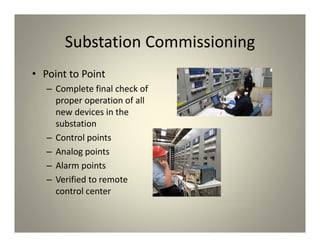
• Point to Point
– Complete final check of
proper operation of all
new devices in the
substation
– Control points
– Analog points
– Alarm points
– Verified to remote
control center
Substation Commissioning
• Energization Day
– Expectations
• Could be a long day
• Problems may arise
• Plan to mitigate problems
• Personal safety
• Non field personnel in
substation
• Confident
• All protective devices in
service
Substation Commissioning
• Post Energization
– Setting files
– Red/Green prints
– Complete all
documentation
– “Honey do” list
– Best commissioning jobs
are the substations you
never hear from
Substation Commissioning
• Conclusions
– A well thought out plan will guarantee the best
chance for a successful commissioning job
regardless of size of scope
– Strive for a plan that will “double check” yourself
– Ask for help when it’s needed
– Have confidence in your approach
Thank You

SubstationCommissioning.pdf

  • 1.
  • 2.
    Substation Commissioning • Whatis substation commissioning? – Proving the proper operation of a newly • Installed • Replaced • Modified • Repaired piece of equipment before it is placed into service
  • 3.
    Substation Commissioning • New/replaced/repaired circuitbreakers • New/replaced/repaired transformers
  • 4.
  • 5.
  • 6.
    Substation Commissioning • Newrelays or modified relay settings
  • 7.
    Substation Commissioning • Allcommissioning tasks require a good plan. In order to prove proper operation, the technician must understand proper operation.
  • 8.
    Substation Commissioning • Safety –Always mitigate safety concerns – LOTO – Clearance, Hold, Tag out – May require help from other departments – When in doubt, stop
  • 9.
    Substation Commissioning • Levelsof commissioning – Simple – Moderate – Difficult
  • 10.
    Substation Commissioning • Creatinga game plan – Simple Checklist • Cooling system contactor replacement – Fans/Pumps working properly? – All stages? – SCADA alarms? – Simple component replacement should be checked for proper operation
  • 11.
    Substation Commissioning • Moderateto difficult commissioning – Intense familiarity with all aspects of the task at hand isn’t always necessary. Sometimes there are other groups involved in the commissioning process. General familiarity with other work groups responsibilities is highly encouraged. – Thorough knowledge and expertise in the responsibilities of the relay technician is required.
  • 12.
    Substation Commissioning • Comprehensive checklistneeded for more complicated commissioning tasks SUBSTATION COMMISSIONING CHECKLIST TRANSFORMER INFORMATION MANUFACTURER: SERIEL NUMBER: MVA: NUMBER OF WINDINGS: SELF NUMBER: WINDING H VOLTAGE: WINDING X VOLTAGE: WINDING Y VOLTAGE: WINDING Z VOLTAGE: LTC ? : Y N LTC SENSING VOLTAGE LEVEL: LTC SENSING VOLTAGE SOURCE: COOLING SYSTEM: COOLING SYSTEM VOLTAGE LEVEL: COOLING SYSTEM VOLTAGE SOURCE: COOLING SYSTEM CONFIGURATION: OA FA OAFA FOFA NUMBER OF PRESURE RELIEF DEVICES: STYLE OF SUDDEN PRESSURE DEVICE: RAPID RISE FAULT PRESSURE BUCHOLTZ NA N2 SYSTEM: Y N TYPE OF N2 REGULATION: SINGLE STAGE MULTISTAGED MANUFACTURER RECOMMENDED N2 PRESSURE:
  • 13.
    Substation Commissioning • Largecomponent replacement – Transformers and Circuit Breakers • Acceptance tests can be performed without prints and relay settings – CT saturation, ratio, polarity, and insulation testing – VT ratio, polarity, insulation testing – Power Factor testing – Transformer turns ratio testing Acceptance testing really only proves that the equipment was built to specifications at the factory, it survived the travel and installation, and is the baseline for future performance comparison.
  • 14.
    Substation Commissioning • Testingthat requires prints and settings is really the crux of the commissioning process. • These tests include: – DC Circuit checks – AC Circuit checks – Relay testing – Trip Checks – Communication processor programming – Point to Point testing
  • 15.
    Substation Commissioning • DCChecks – DC circuit checks can be accomplished in a few different ways, but all must be documented to stay on track. – A good place to start is comparing the schematics to the wiring diagrams. Mistakes can be identified and possibly rectified during construction, or upon arrival of equipment to the job site. – Good time to review mistakes with engineering
  • 16.
    Substation Commissioning • DCChecks – Circuits can be “pre‐ tested” with continuity before DCV is applied – (+) DCV can be applied without (‐) DCV and checks can be made – DCV can be applied without “pre‐testing” and the location of the smoke can be noted
  • 17.
    Substation Commissioning • DCChecks – Note the voltage rating of the power supply and the I/O of the relay before powering up – Note proper DCV polarity. Most devices are not polarity sensitive, but some are and will not work properly unless connected properly
  • 18.
    Substation Commissioning • DCChecks – Yellow lining prints is a good way to keep track of what has checked good – Test switches, start with all open, then mark and close when checked good – Leave checked test switches closed
  • 19.
    Substation Commissioning • ACVoltage Checks – Goal of AC voltage circuit checks is to prove proper phasing and polarity throughout the circuit – Existing phasing can be identified with equipment that has been in service – Secondary wires checked with continuity as long as all conductors are isolated – “Live” Bus or Line voltage can be used – Phase between new and old secondary wires – Metering screen on microprocessor relay
  • 20.
    Substation Commissioning • ACCurrent Checks – Very important to be tested properly – Primary loading with prediction current flow sheet – Proves CT ratio, CT circuit polarity, and CT circuit continuity in one test
  • 21.
    Substation Commissioning • ACCurrent Checks – Secondary injection also viable test. • Only way to test transformer CT circuits • Extreme care must be taken to get polarity correct • Documented same as Primary load test • Predicted results
  • 22.
    Substation Commissioning • RelayTesting – Testing the relay is managed in different ways, but the goal is to prove the relay settings, relay logic, and relay functions are all working to “as set” settings – Element testing can be accomplished via manual or automatic testing – Strive to test relay logic with real dynamic testing
  • 23.
    Substation Commissioning • DynamicLogic Testing – Don’t just pulse/jumper contacts, create relay reaction by injecting values into the relay – Use logic diagrams and yellow line them as they are tested is a great way to understand the relay logic – Better yet, draw your own logic diagrams and test them
  • 24.
  • 25.
    Substation Commissioning • DynamicLogic Testing – Make breaker reclose or not reclose – Block close by injecting false sync values – Block transfer tripping with c/o switch – Roll LOR with Breaker Failure or DTT RX
  • 26.
    Substation Commissioning • TripChecks – Vital to proving proper operation of all devices – Electrical and mechanical
  • 27.
    Substation Commissioning • CircuitBreakers – Trip from all known tripping sources – Trip from mechanical devices such as low gas – Test each trip coil individually – Trip breaker failure back up devices – Trip to/from remote sources if using Transfer Trip
  • 28.
    Substation Commissioning • Transformers –Trip from all known tripping sources – Trip from mechanical devices such as low oil and sudden pressure – Trip from cooling related issues – Trip breaker failure back up schemes – Trip and lock out
  • 29.
    Substation Commissioning • Communication ProcessorProgramming • Meter testing • TOP‐006 testing • Communication circuit testing • End to end testing • Pre check alarm circuits
  • 30.
    Substation Commissioning • Pointto Point – Complete final check of proper operation of all new devices in the substation – Control points – Analog points – Alarm points – Verified to remote control center
  • 31.
    Substation Commissioning • EnergizationDay – Expectations • Could be a long day • Problems may arise • Plan to mitigate problems • Personal safety • Non field personnel in substation • Confident • All protective devices in service
  • 32.
    Substation Commissioning • PostEnergization – Setting files – Red/Green prints – Complete all documentation – “Honey do” list – Best commissioning jobs are the substations you never hear from
  • 33.
    Substation Commissioning • Conclusions –A well thought out plan will guarantee the best chance for a successful commissioning job regardless of size of scope – Strive for a plan that will “double check” yourself – Ask for help when it’s needed – Have confidence in your approach
  • 34.