Assignment on
‘Substance Abuse’
Group- Red
Program: MPH (HP&HE)
Session: 2022-2023
Department of Health Education
National institute of Preventive and Social Medicine (NIPSOM)
1
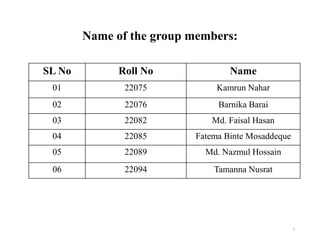
Name of the group members:
SL No Roll No Name
01 22075 Kamrun Nahar
02 22076 Barnika Barai
03 22082 Md. Faisal Hasan
04 22085 Fatema Binte Mosaddeque
05 22089 Md. Nazmul Hossain
06 22094 Tamanna Nusrat
2
Definition
Substance/ Drug Abuse:
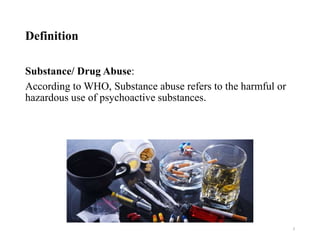
According to WHO, Substance abuse refers to the harmful or
hazardous use of psychoactive substances.
3
Classification of substances
Can be classified as-
 Opiates: Opium,morphine,heroine,pathidine
 Sedative-Hypnotics: Alcohol,barbiturates
 Stimulants: Amphetamine,cocaine
 Cannabis: Marijuana(ghanja, bhang, charas)
 Hallucinogenic: LSD(Lysergic acid
diethylamide),Phencyclidine
 Anabolic Steroids: Anadrol
 Others: Tobacco,betal-nut
4
Warning signs:
• Acute anxiety,depression and profuse sweating
• Changing mood,temper
• Impaired memory and concentration
• Depersonalization and emotional detachment
• Loss of interest in sports and daily routine
• Loss of appetite and body weight
• Unsteady gait,clumsy movements,tremors
• Slurring of speech
5
Warning signs(cont.)
• Reddening and puffiness of eyes,unclear vision
• Fresh numerous injection marks
• Nausea,vomiting and body ache
• Drowsiness,lethargy
6
Drug Addiction
Definition :Drug addiction is defined as the continued use of
drugs in spite of adverse health or social consequences .
Clinical features of drug addiction:
1.Impulsivity
2.Nonconformity
3.Anxiety
4.Low tolerance for stress
5.Sensation seeking
6.Blame shifting
7
Drug addiction(cont.)
Risk factors of drug addiction:
1.Family history of addiction
2.Abuse ,neglect or other traumatic experiences
3.Depression & anxiety
4.Early use of drugs
8
Drug dependence
Definition:
Drug dependence refers to someone feeling like they cannot
function normally without taking a subjects .
Types of drug dependence :
• Physical dependence : A condition in which aperson takes a
drug over a time & unpleasant physical symptoms /
withdrawl symptoms .
• Psychological dependence : A compulsive desire to take drug
and try to obtain it by any means .
• Tolerence : Tolerencey to increase the dose . Here, response
to a drug is diminished ,when a drug is used repeatedly.
9
Drug dependence(cont.)
Clinical features of drug dependence :
1.Anxiety
2. Depression
3.Muscle weakness
4.Neightmares
5.Body aches
6.Sweating
7.Nausia
8.Vomiting
10
Global Scenario
• Substance abuse is a major public health problem in the
whole world.
• Drug abuse rises in epidemic from in many country,
• In Sweden, drug dependency is more within 12 to 20 years
young adult population.
• In 2010 about 5% of people (230 million) used an illicit
substance.
11
Global Scenario (Cont.)
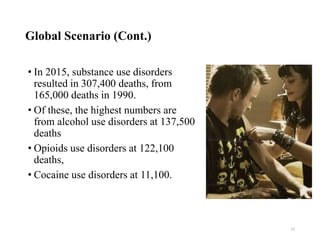
• In 2015, substance use disorders
resulted in 307,400 deaths, from
165,000 deaths in 1990.
• Of these, the highest numbers are
from alcohol use disorders at 137,500
deaths
• Opioids use disorders at 122,100
deaths,
• Cocaine use disorders at 11,100.
12
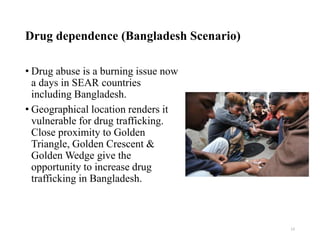
Drug dependence (Bangladesh Scenario)
• Drug abuse is a burning issue now
a days in SEAR countries
including Bangladesh.
• Geographical location renders it
vulnerable for drug trafficking.
Close proximity to Golden
Triangle, Golden Crescent &
Golden Wedge give the
opportunity to increase drug
trafficking in Bangladesh.
13
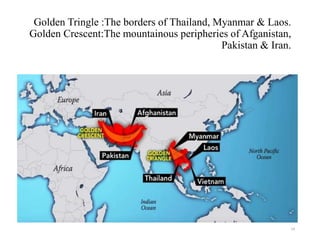
Golden Tringle :The borders of Thailand, Myanmar & Laos.
Golden Crescent:The mountainous peripheries of Afganistan,
Pakistan & Iran.
14
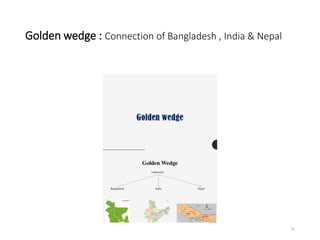
Golden wedge : Connection of Bangladesh , India & Nepal
15
Drug dependence
Bangladesh Scenario (Cont.)
• Poverty, unemployment, rapid urbanization, weak family
bondage, failure to success, Lack of psychological resources
to deal with inner conflict contribute a major role for drug
abuse.
• Among drug abusers in Bangladesh, most of the male use
tobacco & dried/processed tobacco used by female.
16
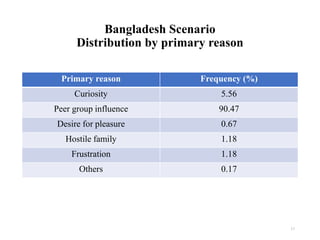
Bangladesh Scenario
Distribution by primary reason
Primary reason Frequency (%)
Curiosity 5.56
Peer group influence 90.47
Desire for pleasure 0.67
Hostile family 1.18
Frustration 1.18
Others 0.17
17
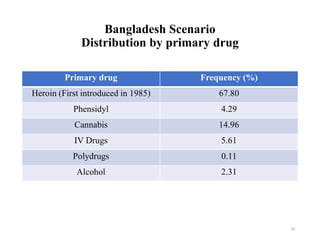
Bangladesh Scenario
Distribution by primary drug
Primary drug Frequency (%)
Heroin (First introduced in 1985) 67.80
Phensidyl 4.29
Cannabis 14.96
IV Drugs 5.61
Polydrugs 0.11
Alcohol 2.31
18
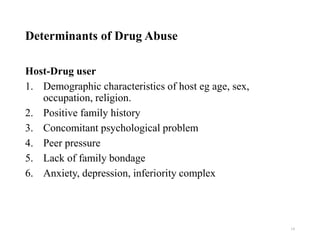
Determinants of Drug Abuse
Host-Drug user
1. Demographic characteristics of host eg age, sex,
occupation, religion.
2. Positive family history
3. Concomitant psychological problem
4. Peer pressure
5. Lack of family bondage
6. Anxiety, depression, inferiority complex
19
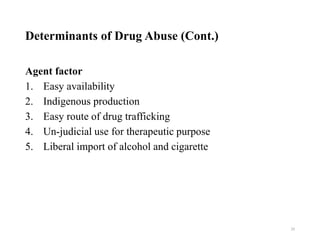
Determinants of Drug Abuse (Cont.)
Agent factor
1. Easy availability
2. Indigenous production
3. Easy route of drug trafficking
4. Un-judicial use for therapeutic purpose
5. Liberal import of alcohol and cigarette
20
Determinants of Drug Abuse (Cont.)
Environmental factors
1. Cultural or religious attitude of a community
2. Children or drug dependent parents or divorced or
separated parents.
3. Company of drug using persons.
4. Smell of drug
5. Poor socio-economic condition
21
High risk factors for Substance abuse(Source :WHO)
• Less parental care
• Broken homes
• Unstable personality
• One parent families
• Addicted parents
• Early exposure
• Easy availability
• Indigenous production
22
High risk factors(Cont.)
• Living on smuggling route
• Unemployment
• Living abroad
• Migration to cities
• Port area
• Brothels
• Peer pressure
23
High risk factors (Cont.)
• Allurement of leisure
• Living near drug dens
• Near by crime zone
• Dropout from school
• Occupation( e.g. driver)
24
Impacts of substance abuse
Health impacts
• Physical health: Injuries and accidents,
• Disease(both CDs&NCDs),getting pregnancy, damage of
internal organs
• Consequences: Death, Disabilities, Deformity
• Mental health: stress, psychosis,
• Depression
25
Impacts of substance abuse (Cont.)
Family and community impacts
• Conflicts with friends, relatives & family
• Homelessness
• Poor solvency
26
Impacts of substance abuse (Cont.)
Economic impacts
• Loss of safety
• Loss of productivity
• Loss of income, Financial pressure
• Poor economic development
• Loss of wealth/ resources
• High treatment cost
27
Impacts of substance abuse (Cont.)
Educational impacts:
• Drop out from school/institute
Environmental impacts:
• Impairment of psycho-social environment
• Invites different biological agents to initiate diseases
• Violence, Dependence
28
Impacts of substance abuse (Cont.)
Social impacts:
• Impairments in social status, position
• Loss of social security and peace.
• Increase crime, corruption & anti-social activities like
hijacking, kidnapping etc.
• Impairment of social development.
Political impacts:
• Political instability due to social & economical instability.
29
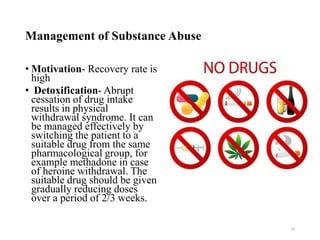
Management of Substance Abuse
• Motivation- Recovery rate is
high
• Detoxification- Abrupt
cessation of drug intake
results in physical
withdrawal syndrome. It can
be managed effectively by
switching the patient to a
suitable drug from the same
pharmacological group, for
example methadone in case
of heroine withdrawal. The
suitable drug should be given
gradually reducing doses
over a period of 2/3 weeks.
30
Management of Substance Abuse (Cont.)
• Psychotherapy- Psychotherapy should be given as per need
and nature of individual patientDifferent methods are used in
different occasion-
1. Individual Psychotherapy
2. Group Psychotherapy
3. Behavioral Therapy
31
Management of Substance Abuse (Cont.)
Rehabilitation-
1. Medical Rehabilitation-Restoration of function
2. Vocational Rehabilitation-Restoration of capacity to earn a
livelihood
3. Social Rehabilitation- Restoration of family and social
relationship
4. Psychological Rehabilitation- Restoration of personal
dignity and confidence
32
Treatment Facilities in Bangladesh
• Madokashokto Niramay Kendra- A 40 bed hospital with
outdoor service at Dhaka under MOHA
• Three more Hospitals at Chattogram, Rajshahi and Khulna
• Dhaka Medical College Hospital, Sir Salimullah Medical
College Hospital , Pabna Mental Hospital and National
Institute of Mental Health and Rehabilitation also Provide
treatment facilities.
• Besides ,many private service providers provide treatment
facilities
33
Prevention of Substance Abuse
• Avoid addiction to all these substances .
• Creat awareness about the side effects and the
consequences of the addiction .
• Treatment of the people who are already addicted .
• Provide moral support and counselling like individual
counselling , group counselling , court yeard meeting .
34
Prevention of Substance Abuse (Cont.)
• Development of Public Policy-
1. Anti Drug Act Narcotic control act 1990 which was
amended in 2004
2. Anti Smoking Act in 2003 – WHO unanimously
adopted the first ever global public health measure.
3. Framework convention on Tobacco Control (FCTC)-
World’s first global public health treaty. Entered into
force in February 2005.Establishes the mechanism to
control the use of and the proliferation of tobacco.
• Altering Population at risk
• Education and information dissemination
• Avoidance of risky prescription
• Early Detection of Cases
35
36

Substance abuse.pptx

  • 1.
    Assignment on ‘Substance Abuse’ Group-Red Program: MPH (HP&HE) Session: 2022-2023 Department of Health Education National institute of Preventive and Social Medicine (NIPSOM) 1
  • 2.
    Name of thegroup members: SL No Roll No Name 01 22075 Kamrun Nahar 02 22076 Barnika Barai 03 22082 Md. Faisal Hasan 04 22085 Fatema Binte Mosaddeque 05 22089 Md. Nazmul Hossain 06 22094 Tamanna Nusrat 2
  • 3.
    Definition Substance/ Drug Abuse: Accordingto WHO, Substance abuse refers to the harmful or hazardous use of psychoactive substances. 3
  • 4.
    Classification of substances Canbe classified as-  Opiates: Opium,morphine,heroine,pathidine  Sedative-Hypnotics: Alcohol,barbiturates  Stimulants: Amphetamine,cocaine  Cannabis: Marijuana(ghanja, bhang, charas)  Hallucinogenic: LSD(Lysergic acid diethylamide),Phencyclidine  Anabolic Steroids: Anadrol  Others: Tobacco,betal-nut 4
  • 5.
    Warning signs: • Acuteanxiety,depression and profuse sweating • Changing mood,temper • Impaired memory and concentration • Depersonalization and emotional detachment • Loss of interest in sports and daily routine • Loss of appetite and body weight • Unsteady gait,clumsy movements,tremors • Slurring of speech 5
  • 6.
    Warning signs(cont.) • Reddeningand puffiness of eyes,unclear vision • Fresh numerous injection marks • Nausea,vomiting and body ache • Drowsiness,lethargy 6
  • 7.
    Drug Addiction Definition :Drugaddiction is defined as the continued use of drugs in spite of adverse health or social consequences . Clinical features of drug addiction: 1.Impulsivity 2.Nonconformity 3.Anxiety 4.Low tolerance for stress 5.Sensation seeking 6.Blame shifting 7
  • 8.
    Drug addiction(cont.) Risk factorsof drug addiction: 1.Family history of addiction 2.Abuse ,neglect or other traumatic experiences 3.Depression & anxiety 4.Early use of drugs 8
  • 9.
    Drug dependence Definition: Drug dependencerefers to someone feeling like they cannot function normally without taking a subjects . Types of drug dependence : • Physical dependence : A condition in which aperson takes a drug over a time & unpleasant physical symptoms / withdrawl symptoms . • Psychological dependence : A compulsive desire to take drug and try to obtain it by any means . • Tolerence : Tolerencey to increase the dose . Here, response to a drug is diminished ,when a drug is used repeatedly. 9
  • 10.
    Drug dependence(cont.) Clinical featuresof drug dependence : 1.Anxiety 2. Depression 3.Muscle weakness 4.Neightmares 5.Body aches 6.Sweating 7.Nausia 8.Vomiting 10
  • 11.
    Global Scenario • Substanceabuse is a major public health problem in the whole world. • Drug abuse rises in epidemic from in many country, • In Sweden, drug dependency is more within 12 to 20 years young adult population. • In 2010 about 5% of people (230 million) used an illicit substance. 11
  • 12.
    Global Scenario (Cont.) •In 2015, substance use disorders resulted in 307,400 deaths, from 165,000 deaths in 1990. • Of these, the highest numbers are from alcohol use disorders at 137,500 deaths • Opioids use disorders at 122,100 deaths, • Cocaine use disorders at 11,100. 12
  • 13.
    Drug dependence (BangladeshScenario) • Drug abuse is a burning issue now a days in SEAR countries including Bangladesh. • Geographical location renders it vulnerable for drug trafficking. Close proximity to Golden Triangle, Golden Crescent & Golden Wedge give the opportunity to increase drug trafficking in Bangladesh. 13
  • 14.
    Golden Tringle :Theborders of Thailand, Myanmar & Laos. Golden Crescent:The mountainous peripheries of Afganistan, Pakistan & Iran. 14
  • 15.
    Golden wedge :Connection of Bangladesh , India & Nepal 15
  • 16.
    Drug dependence Bangladesh Scenario(Cont.) • Poverty, unemployment, rapid urbanization, weak family bondage, failure to success, Lack of psychological resources to deal with inner conflict contribute a major role for drug abuse. • Among drug abusers in Bangladesh, most of the male use tobacco & dried/processed tobacco used by female. 16
  • 17.
    Bangladesh Scenario Distribution byprimary reason Primary reason Frequency (%) Curiosity 5.56 Peer group influence 90.47 Desire for pleasure 0.67 Hostile family 1.18 Frustration 1.18 Others 0.17 17
  • 18.
    Bangladesh Scenario Distribution byprimary drug Primary drug Frequency (%) Heroin (First introduced in 1985) 67.80 Phensidyl 4.29 Cannabis 14.96 IV Drugs 5.61 Polydrugs 0.11 Alcohol 2.31 18
  • 19.
    Determinants of DrugAbuse Host-Drug user 1. Demographic characteristics of host eg age, sex, occupation, religion. 2. Positive family history 3. Concomitant psychological problem 4. Peer pressure 5. Lack of family bondage 6. Anxiety, depression, inferiority complex 19
  • 20.
    Determinants of DrugAbuse (Cont.) Agent factor 1. Easy availability 2. Indigenous production 3. Easy route of drug trafficking 4. Un-judicial use for therapeutic purpose 5. Liberal import of alcohol and cigarette 20
  • 21.
    Determinants of DrugAbuse (Cont.) Environmental factors 1. Cultural or religious attitude of a community 2. Children or drug dependent parents or divorced or separated parents. 3. Company of drug using persons. 4. Smell of drug 5. Poor socio-economic condition 21
  • 22.
    High risk factorsfor Substance abuse(Source :WHO) • Less parental care • Broken homes • Unstable personality • One parent families • Addicted parents • Early exposure • Easy availability • Indigenous production 22
  • 23.
    High risk factors(Cont.) •Living on smuggling route • Unemployment • Living abroad • Migration to cities • Port area • Brothels • Peer pressure 23
  • 24.
    High risk factors(Cont.) • Allurement of leisure • Living near drug dens • Near by crime zone • Dropout from school • Occupation( e.g. driver) 24
  • 25.
    Impacts of substanceabuse Health impacts • Physical health: Injuries and accidents, • Disease(both CDs&NCDs),getting pregnancy, damage of internal organs • Consequences: Death, Disabilities, Deformity • Mental health: stress, psychosis, • Depression 25
  • 26.
    Impacts of substanceabuse (Cont.) Family and community impacts • Conflicts with friends, relatives & family • Homelessness • Poor solvency 26
  • 27.
    Impacts of substanceabuse (Cont.) Economic impacts • Loss of safety • Loss of productivity • Loss of income, Financial pressure • Poor economic development • Loss of wealth/ resources • High treatment cost 27
  • 28.
    Impacts of substanceabuse (Cont.) Educational impacts: • Drop out from school/institute Environmental impacts: • Impairment of psycho-social environment • Invites different biological agents to initiate diseases • Violence, Dependence 28
  • 29.
    Impacts of substanceabuse (Cont.) Social impacts: • Impairments in social status, position • Loss of social security and peace. • Increase crime, corruption & anti-social activities like hijacking, kidnapping etc. • Impairment of social development. Political impacts: • Political instability due to social & economical instability. 29
  • 30.
    Management of SubstanceAbuse • Motivation- Recovery rate is high • Detoxification- Abrupt cessation of drug intake results in physical withdrawal syndrome. It can be managed effectively by switching the patient to a suitable drug from the same pharmacological group, for example methadone in case of heroine withdrawal. The suitable drug should be given gradually reducing doses over a period of 2/3 weeks. 30
  • 31.
    Management of SubstanceAbuse (Cont.) • Psychotherapy- Psychotherapy should be given as per need and nature of individual patientDifferent methods are used in different occasion- 1. Individual Psychotherapy 2. Group Psychotherapy 3. Behavioral Therapy 31
  • 32.
    Management of SubstanceAbuse (Cont.) Rehabilitation- 1. Medical Rehabilitation-Restoration of function 2. Vocational Rehabilitation-Restoration of capacity to earn a livelihood 3. Social Rehabilitation- Restoration of family and social relationship 4. Psychological Rehabilitation- Restoration of personal dignity and confidence 32
  • 33.
    Treatment Facilities inBangladesh • Madokashokto Niramay Kendra- A 40 bed hospital with outdoor service at Dhaka under MOHA • Three more Hospitals at Chattogram, Rajshahi and Khulna • Dhaka Medical College Hospital, Sir Salimullah Medical College Hospital , Pabna Mental Hospital and National Institute of Mental Health and Rehabilitation also Provide treatment facilities. • Besides ,many private service providers provide treatment facilities 33
  • 34.
    Prevention of SubstanceAbuse • Avoid addiction to all these substances . • Creat awareness about the side effects and the consequences of the addiction . • Treatment of the people who are already addicted . • Provide moral support and counselling like individual counselling , group counselling , court yeard meeting . 34
  • 35.
    Prevention of SubstanceAbuse (Cont.) • Development of Public Policy- 1. Anti Drug Act Narcotic control act 1990 which was amended in 2004 2. Anti Smoking Act in 2003 – WHO unanimously adopted the first ever global public health measure. 3. Framework convention on Tobacco Control (FCTC)- World’s first global public health treaty. Entered into force in February 2005.Establishes the mechanism to control the use of and the proliferation of tobacco. • Altering Population at risk • Education and information dissemination • Avoidance of risky prescription • Early Detection of Cases 35
  • 36.