Case Management:
Substance Abuse
KRISTEN BOSCH
MCMG 401 PROFESSOR ROBINSON 06/03/18
Substance Abuse Case Managers:
What do they do?
 Provide on-going support
 Comprehensive plan
 Accurate documentation
 Conduct crisis interventions as needed
 Corrective action revision as necessary
 “Reporting”
Referrals
 Case Management Identification
Worksheet
 Tally case management indicators
 Patient information
 Insurance
 Acceptance/denial
 Red flags list
Case Management Intervention
 When identified for case management
services
 Diagnosis
 Reasons
 Insurance
 Goals
 Claims examiner
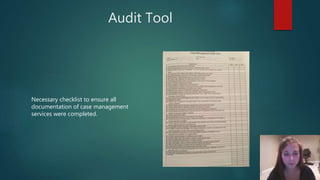
Audit Tool
Necessary checklist to ensure all
documentation of case management
services were completed.
Reports: information gathered
 Initial interview
 Progress Reports
 Medical History Documentation
 Communications log
 Client Consistency
 Medical Case Report
Reports
 Generic information
 Patient documents
 Opinions/suggestions
 At least once a month
 All communication/service
 No emphasis on cost
Progress Reports
REFERENCES
 Mullhay, C. (2017). The Case Manager’s Handbook. Burlington, MA: Jones
& Bartlett Learning. Pgs 60-67, 93-95
 N.a. (2015). Comprehensive Case Management for Substance
Abuse Treatment. Center for Substance Abuse Treatment.
https://store.samhsa.gov/shin/content/SMA15-4215/SMA15-
4215.pdf

Substance abuse case management

  • 1.
    Case Management: Substance Abuse KRISTENBOSCH MCMG 401 PROFESSOR ROBINSON 06/03/18
  • 2.
    Substance Abuse CaseManagers: What do they do?  Provide on-going support  Comprehensive plan  Accurate documentation  Conduct crisis interventions as needed  Corrective action revision as necessary  “Reporting”
  • 3.
    Referrals  Case ManagementIdentification Worksheet  Tally case management indicators  Patient information  Insurance  Acceptance/denial  Red flags list
  • 4.
    Case Management Intervention When identified for case management services  Diagnosis  Reasons  Insurance  Goals  Claims examiner
  • 5.
    Audit Tool Necessary checklistto ensure all documentation of case management services were completed.
  • 6.
    Reports: information gathered Initial interview  Progress Reports  Medical History Documentation  Communications log  Client Consistency  Medical Case Report
  • 7.
    Reports  Generic information Patient documents  Opinions/suggestions  At least once a month  All communication/service  No emphasis on cost Progress Reports
  • 8.
    REFERENCES  Mullhay, C.(2017). The Case Manager’s Handbook. Burlington, MA: Jones & Bartlett Learning. Pgs 60-67, 93-95  N.a. (2015). Comprehensive Case Management for Substance Abuse Treatment. Center for Substance Abuse Treatment. https://store.samhsa.gov/shin/content/SMA15-4215/SMA15- 4215.pdf

Editor's Notes

  • #3 Substance Abuse Case management is a branch or area that Case Managers can specialize in. Inside of this branch, it is the case manager’s duty to provide ongoing support to their clients – meeting with them every step of the way, serving them with whatever resources that will help curve their abusive tendencies towards healthier habits and helping themselves. Case management is one of eight counseling skills identified by National Association of Alcoholism and Drug abuse Counselors and one of five performance Domains developed in the role Delineation Study (N.a. 2015). In these specific cases,treatment plans vary from client to client, as no to cases are ever similar. And client’s needs rarely fit neatly into any given step during the planning process. It is the Case manager’s job to see the plan through, span to their clients needs, and structure the program alongside the client (N.a., 2015). Because substance abuse alters various aspects of a client’s life – treatments must be centered around motivation, encouragement, appropriate treatments, and support. Many organizations or services simply are not equipped with the skills to address the social, emotional, and addiction issues like Case Management specialist are. As in all case management areas, accurate documentation throughout the entire treatment process is required. In cases regarding substance abuse clients, there are also times where a case manager will have to access situations and determine if crisis interventions are needed (resulting in a discontinuance of case management services and referring to more intensive treatment programs). These changes to the plan are known as Corrective action revisions (Mullahy, 2017). And finally, as with every branch of case management – case reports build the structure of the treatment plans. In substance abuse, these reports trigger acceptance into case management programs and services, they guide the client and every healthcare professional involved in the treatment plan towards the client’s end goal, and they keep accurate documentation of everything that happens from the time the client is referred to a case manager to the time a case is closed.
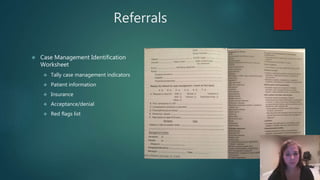
  • #4 Prior to being accepted, Clients must be referred to a Case Management agency in order to be reviewed by a manager. This step is important because, as it shows on the example provided, it provides the first contact a between the case management provider and the client. Demographics are gathered, case management indicators are tallied, the type of coverage a potential client has, and most importantly – it is where the tallies are utilized against the red flags list. Acceptance or a denial of service is taken into consideration here – based on the results of the red flag list. On the list – the reviewer will find clearly find substance abuse is absolutely a red flag.
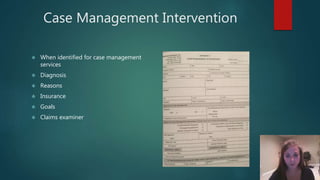
  • #5 The intervention report is a document that is generated after the acceptance of a new client. This is important to the treatment plan because a diagnosis is given about the status of the client. In cases of substance abuse – the degree of addiction, the type or form, and the health of the client should be noted here as well. Reasoning for referral to services, insurance information and the goals of the client are also recorded. This information is important to the process because Case Managers can utilize the information documented to assist in building a treatment plan and for providing a direction to move in.
  • #6 The audit tool is a useful documentation that allows Case managers to check their own documentation as they go – it provides and ‘Audit’ checklist that covers every form of documentation, type of communication, and reporting that should be done as the treatment plan is underway. Case Managers can utilize this information to measure the progress of the plan, to ensure that they are documenting all information incase of liability issues, and to provide information on areas that they need to improve in, be it communication, reporting, or in providing appropriate services to their clients. For case managers with substance abuse clients, this audit will also help piece together a “road map” of their addiction – what services lead to positive results and what services are recommended to negate negative results.
  • #7 And finally, reporting. The main responsibility of a case manager is to provide the best quality service to their client. This goal is heavily influenced by the Case manager’s ability to document and file reports on the entirety of the client’s treatment plan, every step of the way. The most common reports are the initial interview – where the relationship between the case manager and client begins. Incredibly important patient demographic information is gathered and documented here. Results of every service provided as the plan progresses are to be documented, medical history information and client’s support systems, the consistency a client has to show up to treatment, etc. Seeing as how no two substance abuse cases are alike, various types of information related to the client’s treatment must be gathered and developed into reports. A compilation of all this documentation and reporting is called the Medical Case Report. This is an incredibly useful source of information on the client, their treatment, and most importantly – their results. All medical staff involved in the treatment plan utilize this information to determine the future treatment for the client.
  • #8 One of the more important types of reports are the progress reports. These are done at least once a month (Mullahy, 2017) and report how the patient is responding to treatments, their results, communication between the client and every professional they encounter. One important aspect of these reports is to remember that the emphasis must not be placed on the cost of treatments for that month, but the quality of services the client has received. In substance abuse cases, these reports can suggest further treatments in order to aid the client achieve their end goal.