SUBJECT-VERB
AGREEMENT/CONCORD
SIMPLE AND COMPLETE SUBJECT,RULES
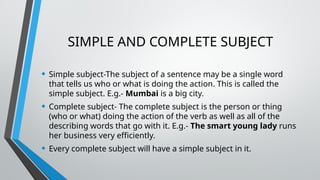
SIMPLE AND COMPLETE SUBJECT
• Simple subject-The subject of a sentence may be a single word
that tells us who or what is doing the action. This is called the
simple subject. E.g.- Mumbai is a big city.
• Complete subject- The complete subject is the person or thing
(who or what) doing the action of the verb as well as all of the
describing words that go with it. E.g.- The smart young lady runs
her business very efficiently.
• Every complete subject will have a simple subject in it.
RULES OF SUBJECT-VERB AGREEMENT
RULE-1
• The verb must agree with its subject in person and number.
• E.g.- I play chess.
• They play chess.
• He plays chess.
RULE-2
• When the subject of a sentence is composed of two or more singular
nouns or pronouns connected by and, we use a plural verb.
• E.g.- Raja and his friend jog in the park everyday.
• However, if the two singular nouns refer to the same person or thing
or to a single idea, we use the singular verb.
• E.g.- Bread and milk is the only food he can eat.
• The activist and patriot is on a hunger strike.
RULE-2
• NOTE: In such cases, the article is used only once before the first noun or
pronoun. If we wish to refer to two separate people, we would use the article
before each noun and the verb would be plural.
• E.g.- The activist and the patriot are on a hunger strike.
• The rice and the curry are to be served separately.
• To get the agreement right, a simple rule we can follow is to replace the
compound subject with a personal pronoun and then make sure the verb
agrees with the pronoun.
• E.g.- Raja and his friend jog in the park every evening.- Raja and his friend- They
• Hence, They jog…
TEST YOURSELF
• In the following sentences, underline the correct verb:
1. Rashi and Preeti _____ (be) students.
2. Angry Tom and naughty Jerry ____ (be) my favorite cartoons characters.
3. Gopal and I _____ (be) watching a movie.
4. The producer and director of the film _____ (be) also its writer.
5. The rising and setting of the sun ____ (cause) day and night.
6. Sodium and Chlorine _____(be) the components of salt.
7. My sister and brother also _____(study) in this school.
8. Knowledge and wisdom _____ (be) equally important for success.
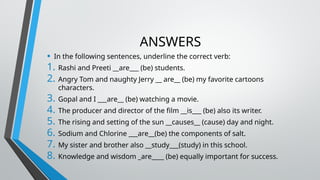
ANSWERS
• In the following sentences, underline the correct verb:
1. Rashi and Preeti __are___ (be) students.
2. Angry Tom and naughty Jerry __ are__ (be) my favorite cartoons
characters.
3. Gopal and I ___are__ (be) watching a movie.
4. The producer and director of the film __is___ (be) also its writer.
5. The rising and setting of the sun __causes__ (cause) day and night.
6. Sodium and Chlorine ___are__(be) the components of salt.
7. My sister and brother also __study___(study) in this school.
8. Knowledge and wisdom _are____ (be) equally important for success.
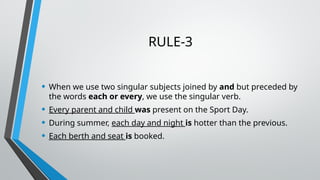
RULE-3
• When we use two singular subjects joined by and but preceded by
the words each or every, we use the singular verb.
• Every parent and child was present on the Sport Day.
• During summer, each day and night is hotter than the previous.
• Each berth and seat is booked.
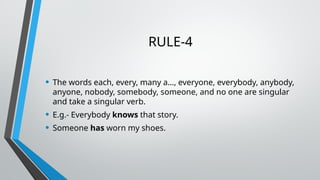
RULE-4
• The words each, every, many a…, everyone, everybody, anybody,
anyone, nobody, somebody, someone, and no one are singular
and take a singular verb.
• E.g.- Everybody knows that story.
• Someone has worn my shoes.
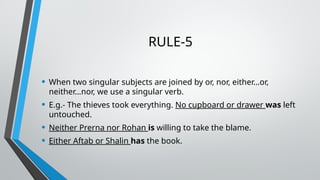
RULE-5
• When two singular subjects are joined by or, nor, either…or,
neither…nor, we use a singular verb.
• E.g.- The thieves took everything. No cupboard or drawer was left
untouched.
• Neither Prerna nor Rohan is willing to take the blame.
• Either Aftab or Shalin has the book.
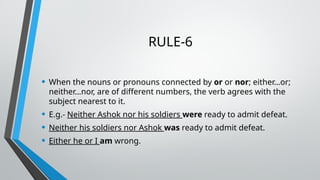
RULE-6
• When the nouns or pronouns connected by or or nor; either…or;
neither…nor, are of different numbers, the verb agrees with the
subject nearest to it.
• E.g.- Neither Ashok nor his soldiers were ready to admit defeat.
• Neither his soldiers nor Ashok was ready to admit defeat.
• Either he or I am wrong.
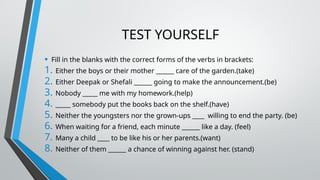
TEST YOURSELF
• Fill in the blanks with the correct forms of the verbs in brackets:
1. Either the boys or their mother ______ care of the garden.(take)
2. Either Deepak or Shefali ______ going to make the announcement.(be)
3. Nobody _____ me with my homework.(help)
4. _____ somebody put the books back on the shelf.(have)
5. Neither the youngsters nor the grown-ups ____ willing to end the party. (be)
6. When waiting for a friend, each minute ______ like a day. (feel)
7. Many a child ____ to be like his or her parents.(want)
8. Neither of them ______ a chance of winning against her. (stand)
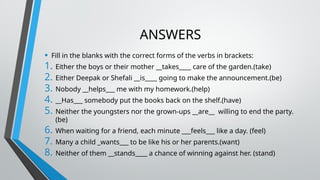
ANSWERS
• Fill in the blanks with the correct forms of the verbs in brackets:
1. Either the boys or their mother __takes____ care of the garden.(take)
2. Either Deepak or Shefali __is____ going to make the announcement.(be)
3. Nobody __helps___ me with my homework.(help)
4. __Has___ somebody put the books back on the shelf.(have)
5. Neither the youngsters nor the grown-ups __are__ willing to end the party.
(be)
6. When waiting for a friend, each minute ___feels___ like a day. (feel)
7. Many a child _wants___ to be like his or her parents.(want)
8. Neither of them __stands____ a chance of winning against her. (stand)
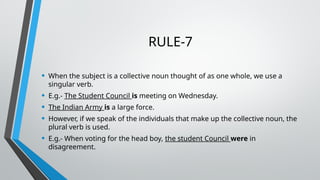
RULE-7
• When the subject is a collective noun thought of as one whole, we use a
singular verb.
• E.g.- The Student Council is meeting on Wednesday.
• The Indian Army is a large force.
• However, if we speak of the individuals that make up the collective noun, the
plural verb is used.
• E.g.- When voting for the head boy, the student Council were in
disagreement.
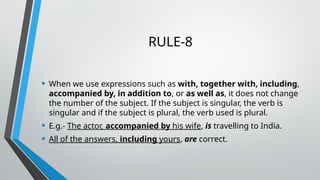
RULE-8
• When we use expressions such as with, together with, including,
accompanied by, in addition to, or as well as, it does not change
the number of the subject. If the subject is singular, the verb is
singular and if the subject is plural, the verb used is plural.
• E.g.- The actor, accompanied by his wife, is travelling to India.
• All of the answers, including yours, are correct.
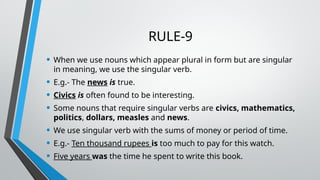
RULE-9
• When we use nouns which appear plural in form but are singular
in meaning, we use the singular verb.
• E.g.- The news is true.
• Civics is often found to be interesting.
• Some nouns that require singular verbs are civics, mathematics,
politics, dollars, measles and news.
• We use singular verb with the sums of money or period of time.
• E.g.- Ten thousand rupees is too much to pay for this watch.
• Five years was the time he spent to write this book.
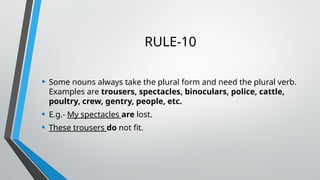
RULE-10
• Some nouns always take the plural form and need the plural verb.
Examples are trousers, spectacles, binoculars, police, cattle,
poultry, crew, gentry, people, etc.
• E.g.- My spectacles are lost.
• These trousers do not fit.
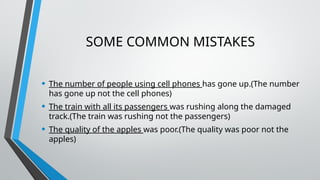
SOME COMMON MISTAKES
• The number of people using cell phones has gone up.(The number
has gone up not the cell phones)
• The train with all its passengers was rushing along the damaged
track.(The train was rushing not the passengers)
• The quality of the apples was poor.(The quality was poor not the
apples)
TEST YOURSELF
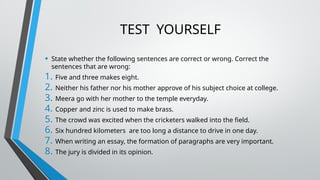
• State whether the following sentences are correct or wrong. Correct the
sentences that are wrong:
1. Five and three makes eight.
2. Neither his father nor his mother approve of his subject choice at college.
3. Meera go with her mother to the temple everyday.
4. Copper and zinc is used to make brass.
5. The crowd was excited when the cricketers walked into the field.
6. Six hundred kilometers are too long a distance to drive in one day.
7. When writing an essay, the formation of paragraphs are very important.
8. The jury is divided in its opinion.
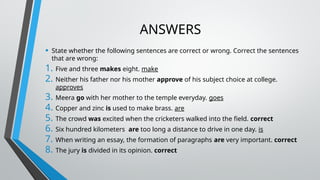
ANSWERS
• State whether the following sentences are correct or wrong. Correct the sentences
that are wrong:
1. Five and three makes eight. make
2. Neither his father nor his mother approve of his subject choice at college.
approves
3. Meera go with her mother to the temple everyday. goes
4. Copper and zinc is used to make brass. are
5. The crowd was excited when the cricketers walked into the field. correct
6. Six hundred kilometers are too long a distance to drive in one day. is
7. When writing an essay, the formation of paragraphs are very important. correct
8. The jury is divided in its opinion. correct

SUBJECT-VERB AGREEMENT.pptx...............

  • 1.
  • 2.
    SIMPLE AND COMPLETESUBJECT • Simple subject-The subject of a sentence may be a single word that tells us who or what is doing the action. This is called the simple subject. E.g.- Mumbai is a big city. • Complete subject- The complete subject is the person or thing (who or what) doing the action of the verb as well as all of the describing words that go with it. E.g.- The smart young lady runs her business very efficiently. • Every complete subject will have a simple subject in it.
  • 3.
    RULES OF SUBJECT-VERBAGREEMENT RULE-1 • The verb must agree with its subject in person and number. • E.g.- I play chess. • They play chess. • He plays chess.
  • 4.
    RULE-2 • When thesubject of a sentence is composed of two or more singular nouns or pronouns connected by and, we use a plural verb. • E.g.- Raja and his friend jog in the park everyday. • However, if the two singular nouns refer to the same person or thing or to a single idea, we use the singular verb. • E.g.- Bread and milk is the only food he can eat. • The activist and patriot is on a hunger strike.
  • 5.
    RULE-2 • NOTE: Insuch cases, the article is used only once before the first noun or pronoun. If we wish to refer to two separate people, we would use the article before each noun and the verb would be plural. • E.g.- The activist and the patriot are on a hunger strike. • The rice and the curry are to be served separately. • To get the agreement right, a simple rule we can follow is to replace the compound subject with a personal pronoun and then make sure the verb agrees with the pronoun. • E.g.- Raja and his friend jog in the park every evening.- Raja and his friend- They • Hence, They jog…
  • 6.
    TEST YOURSELF • Inthe following sentences, underline the correct verb: 1. Rashi and Preeti _____ (be) students. 2. Angry Tom and naughty Jerry ____ (be) my favorite cartoons characters. 3. Gopal and I _____ (be) watching a movie. 4. The producer and director of the film _____ (be) also its writer. 5. The rising and setting of the sun ____ (cause) day and night. 6. Sodium and Chlorine _____(be) the components of salt. 7. My sister and brother also _____(study) in this school. 8. Knowledge and wisdom _____ (be) equally important for success.
  • 7.
    ANSWERS • In thefollowing sentences, underline the correct verb: 1. Rashi and Preeti __are___ (be) students. 2. Angry Tom and naughty Jerry __ are__ (be) my favorite cartoons characters. 3. Gopal and I ___are__ (be) watching a movie. 4. The producer and director of the film __is___ (be) also its writer. 5. The rising and setting of the sun __causes__ (cause) day and night. 6. Sodium and Chlorine ___are__(be) the components of salt. 7. My sister and brother also __study___(study) in this school. 8. Knowledge and wisdom _are____ (be) equally important for success.
  • 8.
    RULE-3 • When weuse two singular subjects joined by and but preceded by the words each or every, we use the singular verb. • Every parent and child was present on the Sport Day. • During summer, each day and night is hotter than the previous. • Each berth and seat is booked.
  • 9.
    RULE-4 • The wordseach, every, many a…, everyone, everybody, anybody, anyone, nobody, somebody, someone, and no one are singular and take a singular verb. • E.g.- Everybody knows that story. • Someone has worn my shoes.
  • 10.
    RULE-5 • When twosingular subjects are joined by or, nor, either…or, neither…nor, we use a singular verb. • E.g.- The thieves took everything. No cupboard or drawer was left untouched. • Neither Prerna nor Rohan is willing to take the blame. • Either Aftab or Shalin has the book.
  • 11.
    RULE-6 • When thenouns or pronouns connected by or or nor; either…or; neither…nor, are of different numbers, the verb agrees with the subject nearest to it. • E.g.- Neither Ashok nor his soldiers were ready to admit defeat. • Neither his soldiers nor Ashok was ready to admit defeat. • Either he or I am wrong.
  • 12.
    TEST YOURSELF • Fillin the blanks with the correct forms of the verbs in brackets: 1. Either the boys or their mother ______ care of the garden.(take) 2. Either Deepak or Shefali ______ going to make the announcement.(be) 3. Nobody _____ me with my homework.(help) 4. _____ somebody put the books back on the shelf.(have) 5. Neither the youngsters nor the grown-ups ____ willing to end the party. (be) 6. When waiting for a friend, each minute ______ like a day. (feel) 7. Many a child ____ to be like his or her parents.(want) 8. Neither of them ______ a chance of winning against her. (stand)
  • 13.
    ANSWERS • Fill inthe blanks with the correct forms of the verbs in brackets: 1. Either the boys or their mother __takes____ care of the garden.(take) 2. Either Deepak or Shefali __is____ going to make the announcement.(be) 3. Nobody __helps___ me with my homework.(help) 4. __Has___ somebody put the books back on the shelf.(have) 5. Neither the youngsters nor the grown-ups __are__ willing to end the party. (be) 6. When waiting for a friend, each minute ___feels___ like a day. (feel) 7. Many a child _wants___ to be like his or her parents.(want) 8. Neither of them __stands____ a chance of winning against her. (stand)
  • 14.
    RULE-7 • When thesubject is a collective noun thought of as one whole, we use a singular verb. • E.g.- The Student Council is meeting on Wednesday. • The Indian Army is a large force. • However, if we speak of the individuals that make up the collective noun, the plural verb is used. • E.g.- When voting for the head boy, the student Council were in disagreement.
  • 15.
    RULE-8 • When weuse expressions such as with, together with, including, accompanied by, in addition to, or as well as, it does not change the number of the subject. If the subject is singular, the verb is singular and if the subject is plural, the verb used is plural. • E.g.- The actor, accompanied by his wife, is travelling to India. • All of the answers, including yours, are correct.
  • 16.
    RULE-9 • When weuse nouns which appear plural in form but are singular in meaning, we use the singular verb. • E.g.- The news is true. • Civics is often found to be interesting. • Some nouns that require singular verbs are civics, mathematics, politics, dollars, measles and news. • We use singular verb with the sums of money or period of time. • E.g.- Ten thousand rupees is too much to pay for this watch. • Five years was the time he spent to write this book.
  • 17.
    RULE-10 • Some nounsalways take the plural form and need the plural verb. Examples are trousers, spectacles, binoculars, police, cattle, poultry, crew, gentry, people, etc. • E.g.- My spectacles are lost. • These trousers do not fit.
  • 18.
    SOME COMMON MISTAKES •The number of people using cell phones has gone up.(The number has gone up not the cell phones) • The train with all its passengers was rushing along the damaged track.(The train was rushing not the passengers) • The quality of the apples was poor.(The quality was poor not the apples)
  • 19.
    TEST YOURSELF • Statewhether the following sentences are correct or wrong. Correct the sentences that are wrong: 1. Five and three makes eight. 2. Neither his father nor his mother approve of his subject choice at college. 3. Meera go with her mother to the temple everyday. 4. Copper and zinc is used to make brass. 5. The crowd was excited when the cricketers walked into the field. 6. Six hundred kilometers are too long a distance to drive in one day. 7. When writing an essay, the formation of paragraphs are very important. 8. The jury is divided in its opinion.
  • 20.
    ANSWERS • State whetherthe following sentences are correct or wrong. Correct the sentences that are wrong: 1. Five and three makes eight. make 2. Neither his father nor his mother approve of his subject choice at college. approves 3. Meera go with her mother to the temple everyday. goes 4. Copper and zinc is used to make brass. are 5. The crowd was excited when the cricketers walked into the field. correct 6. Six hundred kilometers are too long a distance to drive in one day. is 7. When writing an essay, the formation of paragraphs are very important. correct 8. The jury is divided in its opinion. correct