Negotiating Subcontractor Clauses
May 19, 2016| Presented by:
Ryan J. Hatton
Consulting Services provided through PH Health Strategies, LLC, an affiliate of Peterson Habicht, PA.
WEB: PetersonHabicht.com PHONE: 612.836.5500 © 2016 Peterson Habicht, PA. All Rights Reserved.
2
Introduction
Reading and understanding subcontract
agreements is essential to avoid unfair risk
allocation in the contracting process.
Understanding how to win the “battle of the
forms” is critical ensuring fair contracting.
Negotiating away killer provisions is important to manage risk and
provide fair and competitive pricing.
3
Purpose of Contracting
1. Formalize relationship
2. Define scope of work
3. Define compensation methodology
4. Allocate risk
5. Set the rules of the relationship
6. Reference guide in times of trouble
4
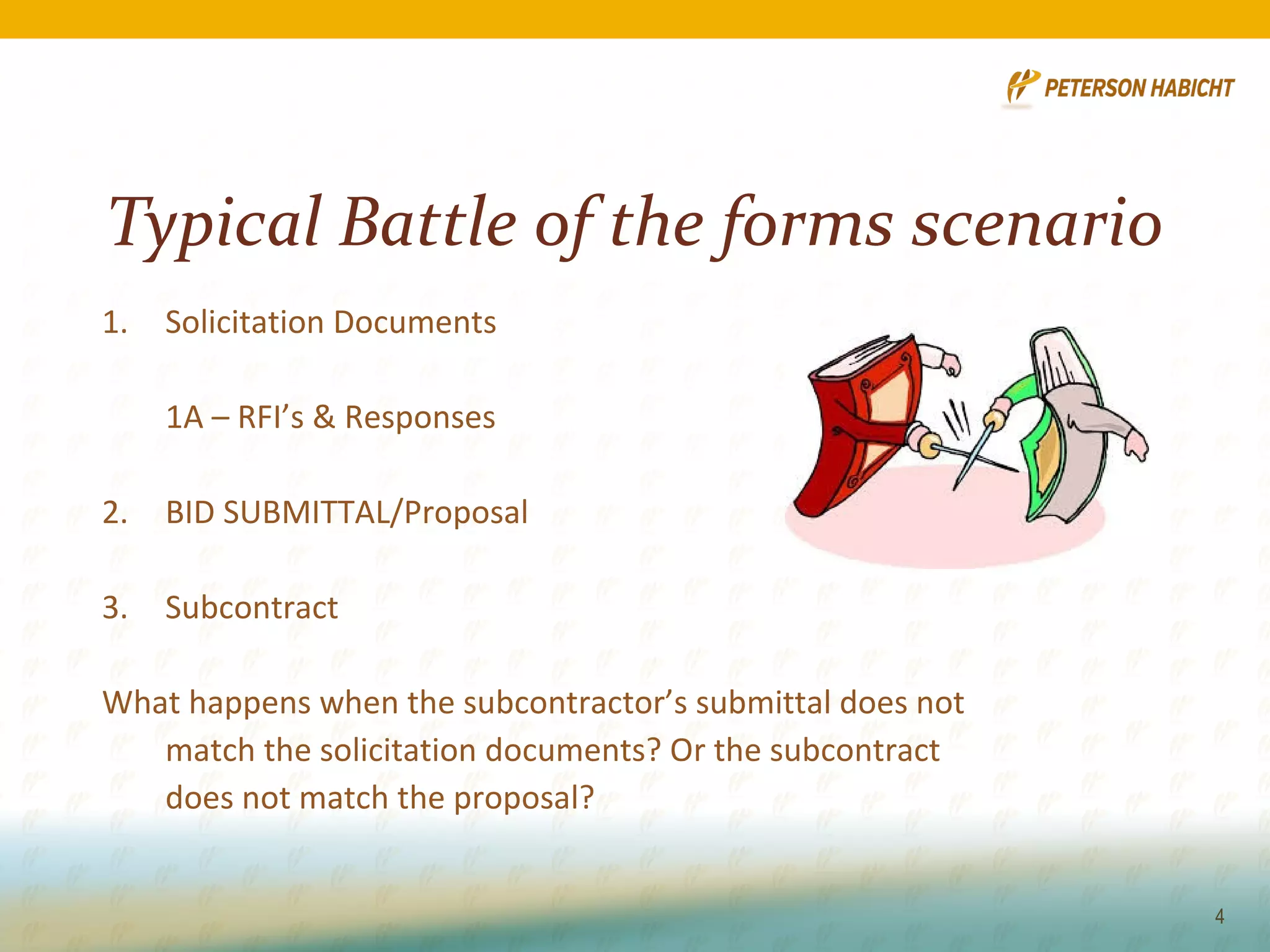
Typical Battle of the forms scenario
1. Solicitation Documents
1A – RFI’s & Responses
2. BID SUBMITTAL/Proposal
3. Subcontract
What happens when the subcontractor’s submittal does not
match the solicitation documents? Or the subcontract
does not match the proposal?
5
Common law
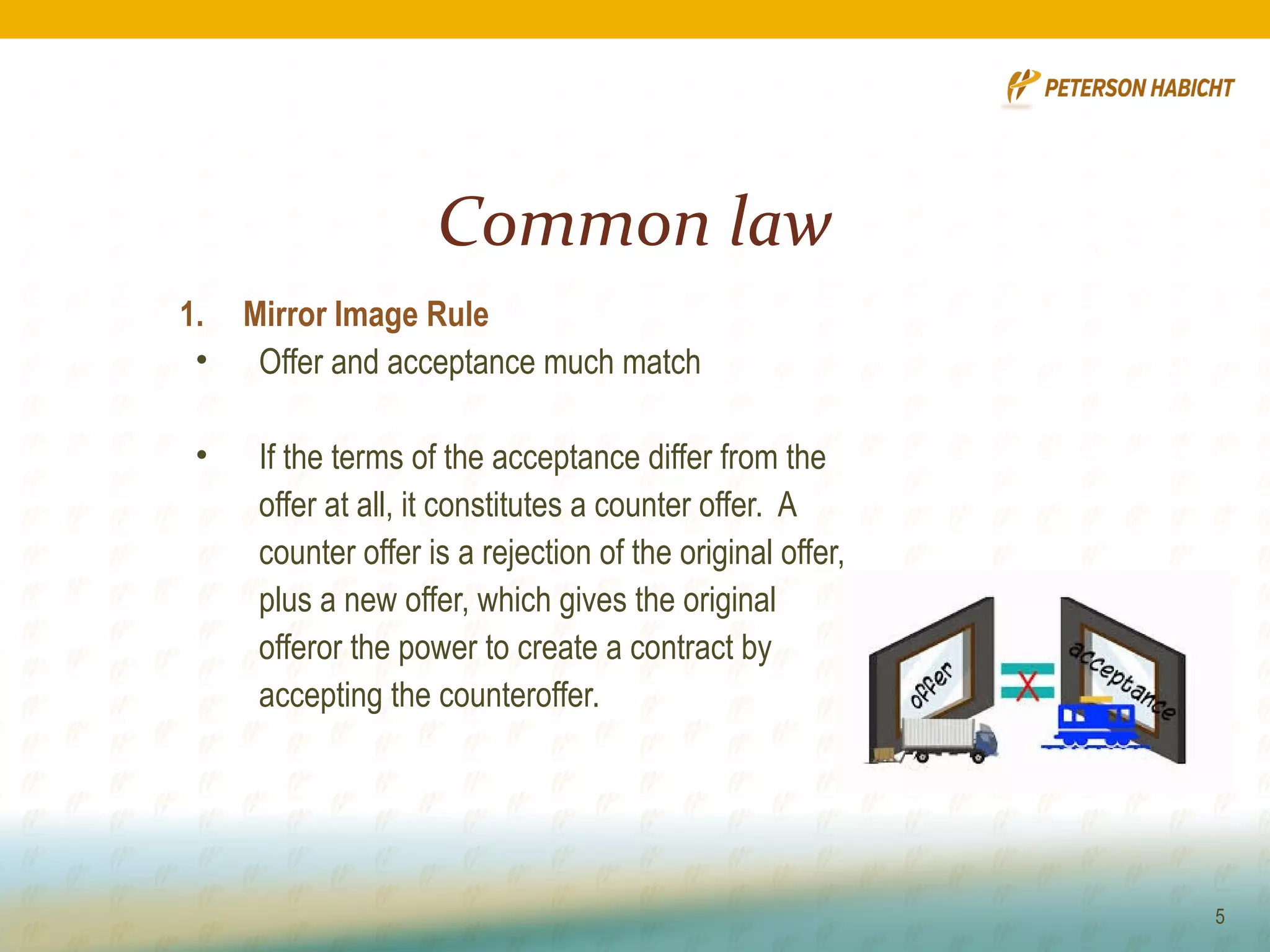
1. Mirror Image Rule
• Offer and acceptance much match
• If the terms of the acceptance differ from the
offer at all, it constitutes a counter offer. A
counter offer is a rejection of the original offer,
plus a new offer, which gives the original
offeror the power to create a contract by
accepting the counteroffer.
6
Common law cont.
• Last Shot Rule
• Buyer issues purchase order – terms (offer)
•Seller responds by sending acceptance with seller’s
standard terms and conditions of sale (which do not
match the buyer’s terms on the purchase order)
(counteroffer?)
•No contract….
•But if buyer sends payment, it functions as acceptance by
performance of all of Seller’s terms.
• Executed subcontract – Last shot???
7
Subcontract Forms
No such thing as a “Standard” subcontract form. Two sources
of subcontract forms:
1. Those sponsored by associations in the industry
• AIA A401 (designed to interact with AIA A201), general
conditions for prime contract between Owner and GC
• AGC 650 and AGC 655 designed to interact with AIA
A201 as well as AGC 200.
• AGC documents are weighted in favor of the GC.
8
Subcontract Forms
2. The most onerous risk shifting to subcontractors is found
in proprietary forms of the individual general contractors.
3. Heavily revised association sponsored documents are
essentially proprietary forms, and require vigilance
during the review process.
9
Tips for Contract Review
• Working knowledge of association sponsored forms
• History with contracting partner
• Identify and check for conflicts between contract documents
• Pay particular attention to modifications to association
sponsored forms
10
Tips for Bid Proposal
1. State the terms and conditions of your bid.
•Reference plan date, sections bid, addendums & RFI’s, if any
2. Insurance amount assumed for pricing
3. Any alternatives
4. Specific exclusions
5. Include:
•Payment terms
•Retainage
•Indemnity limitation
•Warranty disclaimer
11
Tips for Subcontract Review
1. Subcontract documents
• Require the bid proposal, including all terms, conditions and
addenda to be identified as part of the subcontract documents.
• Conflict among documents – state the subcontractor’s bid proposal
language shall control in the event of a conflict among the
subcontract documents.
•
(Failing to include this can cause the subcontractor to lose the
battle of the forms due to the last shot doctrine.)
12
Flow Through Clauses
 AKA “flow-down”, “pass-through” or “conduit” clauses –
transfer responsibility for the project from the GC to the sub.
 Should be ok with agreeing to assume the GC’s
responsibilities owed to the owner with respect to the specific
work of the subcontractor.
 Often “flow-through” clauses go much further, and simply
incorporate all of the prime contract documents into the
subcontract.
 Subcontractor assumes toward GC all of the obligations the
GC assumes toward the owner. Absurd!
13
Flow Through Clauses (cont.)
 Best option to delete in entirety.
 Middle ground: agree to transfer of the prime contract
obligations limited, to the obligations pertaining to the
plans and specifications that pertain to the
subcontractor’s work.
 Excluded from the transfer of obligations: insurance,
indemnity, payment, and warranties.
14
Payment Clauses
Two primary different payment clauses in Minnesota: (1) pay – when –
paid and (2) contingent payment (aka pay if paid)
1. GC will pay sub within certain time (10 days) after GC receives
payment from owner – considered a “pay when paid” clause and
does not shift the risk of owner insolvency to subcontractor.
2. If clause clearly establishes the receipt by the GC of payment from
the owner is a condition precedent to GC’s obligation to pay
subcontractor, the sub bears the risk of owner insolvency.
15
Payment Clauses (cont.)
When faced with a contingent payment clause, attempt to eliminate
the “condition precedent” nature of the clause.
A pay when pay clause entitles the subcontractor to payment within
a reasonable time in the event the owner fails to pay the GC
and the reason for the nonpayment is not the fault of the
subcontractor.
16
Right to Stop Work for Nonpayment
Under Common law, one has a legally justifiable excuse to refuse to
continue performance of a contract when the other party materially
breaches.
Clauses that limit a subcontractors right to suspend work due to non-
payment should be stricken, particularly where a contingent payment
clause is included.
17
Indemnity
Three types of indemnity provisions:
1. Limited – imposes liability only to the extent of the sub’s own
fault or negligence
2. Intermediate – sub assumes all liability except for the sole
negligence of the GC
3. Broad form – imposes the entire risk of loss on sub, even for
the sole negligence of the GC
** Indemnity provision availability has been regulated by Minnesota
statutes.
18
Indemnity
Add the following to any indemnity provision: The defense and
indemnity obligations of this subcontract are limited to the extent of
the defense and indemnity provided by the insurance the
subcontractor is required to provide by this subcontract.
The clear intent is that the subcontractor does not agree to accept any
contractual liability that expands its common law obligations,
beyond that for which the subcontractor has purchased insurance.
19
Timing of Performance
 Subcontract pricing based upon sub’s costs on a project – labor
expense is a major component.
 Based upon assumptions of industry standard time durations to
perform various activities, that work will be performed in a certain
sequence, and that GC will coordinate the project so that other
trades will not obstruct or interfere with sub’s work.
 Subcontract clauses that require the subcontractor to not only
follow the GC’s schedule, but also any amendments or changes to
that schedule are unfair.
20
Timing of Performance
 Insist that Sub be given right to provide input to sequences and
durations of the various work.
 Subcontractor only required to follow mutually agreeable schedules,
and that all of the GC’s schedules must be reasonable.
21
No Damage for Delay
GC’s often attempt to provide an extension of time as the sole remedy for
delays, and state that subcontractor shall not be entitled to any
increase in the Subcontract price or to damages or additional
compensation as a consequence of such delays…
Best option is to strike the clause entirely.
Fall back position is to negotiate revisions that incorporate the concept of
“reasonableness”
22
Termination for Convenience
These clauses permit the owner/GC to terminate the contract/subcontract
without incurring liability for paying lost profits.
To prevent terminated subcontractor from being left in a pinch due to
ordering expensive equipment/materials that cannot be utilized
elsewhere, a clause should be inserted that makes the terminating party
responsible for all cancellation charges and all consequential damages
caused by the termination (“non-cancelable materials and equipment
which were ordered in good faith in anticipation of use on the project)
23
Liquidating Clause
Dispute resolution clause designed to insulate the GC from inconsistent
results. Require subcontractor to make claims in the same manner
and time periods required of the GC in the prime contract.
Typically state that the GC is bound to the subcontractor in the same
manner that the owner is bound to the GC. And provide that the GC
can never be liable to the sub for more than the owner is liable to the
GC.
Problem: does not recognize that the GC may be responsible for the
subcontractor’s damages and losses.
24
Liquidating Clause
Do not contractually agree to be bound by a proceeding which the
subcontractor is not a formal party.
If forced to accept a liquidating clause, negotiate the following:
1. Right to assert subcontractor claims against the owner in GC’s name
2. Right to accept or reject settlements
3. Not be bound by decisions in proceedings where sub is not a party
4. Be alert to any cost sharing formula
5. Avoid releasing GC from claims caused by the GC, or the acts of the
owner or architect
6. Insist on right to be present at all settlement negotiations
25
Good for the Goose
Be sure to have formal subcontracts with flow down provisions with
all subordinate tier subcontractors and suppliers.
26
Ryan J. Hatton
612.836.5504
33 S 6th Street, Suite 3900
Minneapolis, MN 55402
Phone: 612.836.5500
Fax: 612.836.5599
Or visit our website: PetersonHabicht.com
WE’D LIKE TO GET INTO YOUR BUSINESS.

Subcontract Clauses.PPTX

  • 1.
    Negotiating Subcontractor Clauses May19, 2016| Presented by: Ryan J. Hatton Consulting Services provided through PH Health Strategies, LLC, an affiliate of Peterson Habicht, PA. WEB: PetersonHabicht.com PHONE: 612.836.5500 © 2016 Peterson Habicht, PA. All Rights Reserved.
  • 2.
    2 Introduction Reading and understandingsubcontract agreements is essential to avoid unfair risk allocation in the contracting process. Understanding how to win the “battle of the forms” is critical ensuring fair contracting. Negotiating away killer provisions is important to manage risk and provide fair and competitive pricing.
  • 3.
    3 Purpose of Contracting 1.Formalize relationship 2. Define scope of work 3. Define compensation methodology 4. Allocate risk 5. Set the rules of the relationship 6. Reference guide in times of trouble
  • 4.
    4 Typical Battle ofthe forms scenario 1. Solicitation Documents 1A – RFI’s & Responses 2. BID SUBMITTAL/Proposal 3. Subcontract What happens when the subcontractor’s submittal does not match the solicitation documents? Or the subcontract does not match the proposal?
  • 5.
    5 Common law 1. MirrorImage Rule • Offer and acceptance much match • If the terms of the acceptance differ from the offer at all, it constitutes a counter offer. A counter offer is a rejection of the original offer, plus a new offer, which gives the original offeror the power to create a contract by accepting the counteroffer.
  • 6.
    6 Common law cont. •Last Shot Rule • Buyer issues purchase order – terms (offer) •Seller responds by sending acceptance with seller’s standard terms and conditions of sale (which do not match the buyer’s terms on the purchase order) (counteroffer?) •No contract…. •But if buyer sends payment, it functions as acceptance by performance of all of Seller’s terms. • Executed subcontract – Last shot???
  • 7.
    7 Subcontract Forms No suchthing as a “Standard” subcontract form. Two sources of subcontract forms: 1. Those sponsored by associations in the industry • AIA A401 (designed to interact with AIA A201), general conditions for prime contract between Owner and GC • AGC 650 and AGC 655 designed to interact with AIA A201 as well as AGC 200. • AGC documents are weighted in favor of the GC.
  • 8.
    8 Subcontract Forms 2. Themost onerous risk shifting to subcontractors is found in proprietary forms of the individual general contractors. 3. Heavily revised association sponsored documents are essentially proprietary forms, and require vigilance during the review process.
  • 9.
    9 Tips for ContractReview • Working knowledge of association sponsored forms • History with contracting partner • Identify and check for conflicts between contract documents • Pay particular attention to modifications to association sponsored forms
  • 10.
    10 Tips for BidProposal 1. State the terms and conditions of your bid. •Reference plan date, sections bid, addendums & RFI’s, if any 2. Insurance amount assumed for pricing 3. Any alternatives 4. Specific exclusions 5. Include: •Payment terms •Retainage •Indemnity limitation •Warranty disclaimer
  • 11.
    11 Tips for SubcontractReview 1. Subcontract documents • Require the bid proposal, including all terms, conditions and addenda to be identified as part of the subcontract documents. • Conflict among documents – state the subcontractor’s bid proposal language shall control in the event of a conflict among the subcontract documents. • (Failing to include this can cause the subcontractor to lose the battle of the forms due to the last shot doctrine.)
  • 12.
    12 Flow Through Clauses AKA “flow-down”, “pass-through” or “conduit” clauses – transfer responsibility for the project from the GC to the sub.  Should be ok with agreeing to assume the GC’s responsibilities owed to the owner with respect to the specific work of the subcontractor.  Often “flow-through” clauses go much further, and simply incorporate all of the prime contract documents into the subcontract.  Subcontractor assumes toward GC all of the obligations the GC assumes toward the owner. Absurd!
  • 13.
    13 Flow Through Clauses(cont.)  Best option to delete in entirety.  Middle ground: agree to transfer of the prime contract obligations limited, to the obligations pertaining to the plans and specifications that pertain to the subcontractor’s work.  Excluded from the transfer of obligations: insurance, indemnity, payment, and warranties.
  • 14.
    14 Payment Clauses Two primarydifferent payment clauses in Minnesota: (1) pay – when – paid and (2) contingent payment (aka pay if paid) 1. GC will pay sub within certain time (10 days) after GC receives payment from owner – considered a “pay when paid” clause and does not shift the risk of owner insolvency to subcontractor. 2. If clause clearly establishes the receipt by the GC of payment from the owner is a condition precedent to GC’s obligation to pay subcontractor, the sub bears the risk of owner insolvency.
  • 15.
    15 Payment Clauses (cont.) Whenfaced with a contingent payment clause, attempt to eliminate the “condition precedent” nature of the clause. A pay when pay clause entitles the subcontractor to payment within a reasonable time in the event the owner fails to pay the GC and the reason for the nonpayment is not the fault of the subcontractor.
  • 16.
    16 Right to StopWork for Nonpayment Under Common law, one has a legally justifiable excuse to refuse to continue performance of a contract when the other party materially breaches. Clauses that limit a subcontractors right to suspend work due to non- payment should be stricken, particularly where a contingent payment clause is included.
  • 17.
    17 Indemnity Three types ofindemnity provisions: 1. Limited – imposes liability only to the extent of the sub’s own fault or negligence 2. Intermediate – sub assumes all liability except for the sole negligence of the GC 3. Broad form – imposes the entire risk of loss on sub, even for the sole negligence of the GC ** Indemnity provision availability has been regulated by Minnesota statutes.
  • 18.
    18 Indemnity Add the followingto any indemnity provision: The defense and indemnity obligations of this subcontract are limited to the extent of the defense and indemnity provided by the insurance the subcontractor is required to provide by this subcontract. The clear intent is that the subcontractor does not agree to accept any contractual liability that expands its common law obligations, beyond that for which the subcontractor has purchased insurance.
  • 19.
    19 Timing of Performance Subcontract pricing based upon sub’s costs on a project – labor expense is a major component.  Based upon assumptions of industry standard time durations to perform various activities, that work will be performed in a certain sequence, and that GC will coordinate the project so that other trades will not obstruct or interfere with sub’s work.  Subcontract clauses that require the subcontractor to not only follow the GC’s schedule, but also any amendments or changes to that schedule are unfair.
  • 20.
    20 Timing of Performance Insist that Sub be given right to provide input to sequences and durations of the various work.  Subcontractor only required to follow mutually agreeable schedules, and that all of the GC’s schedules must be reasonable.
  • 21.
    21 No Damage forDelay GC’s often attempt to provide an extension of time as the sole remedy for delays, and state that subcontractor shall not be entitled to any increase in the Subcontract price or to damages or additional compensation as a consequence of such delays… Best option is to strike the clause entirely. Fall back position is to negotiate revisions that incorporate the concept of “reasonableness”
  • 22.
    22 Termination for Convenience Theseclauses permit the owner/GC to terminate the contract/subcontract without incurring liability for paying lost profits. To prevent terminated subcontractor from being left in a pinch due to ordering expensive equipment/materials that cannot be utilized elsewhere, a clause should be inserted that makes the terminating party responsible for all cancellation charges and all consequential damages caused by the termination (“non-cancelable materials and equipment which were ordered in good faith in anticipation of use on the project)
  • 23.
    23 Liquidating Clause Dispute resolutionclause designed to insulate the GC from inconsistent results. Require subcontractor to make claims in the same manner and time periods required of the GC in the prime contract. Typically state that the GC is bound to the subcontractor in the same manner that the owner is bound to the GC. And provide that the GC can never be liable to the sub for more than the owner is liable to the GC. Problem: does not recognize that the GC may be responsible for the subcontractor’s damages and losses.
  • 24.
    24 Liquidating Clause Do notcontractually agree to be bound by a proceeding which the subcontractor is not a formal party. If forced to accept a liquidating clause, negotiate the following: 1. Right to assert subcontractor claims against the owner in GC’s name 2. Right to accept or reject settlements 3. Not be bound by decisions in proceedings where sub is not a party 4. Be alert to any cost sharing formula 5. Avoid releasing GC from claims caused by the GC, or the acts of the owner or architect 6. Insist on right to be present at all settlement negotiations
  • 25.
    25 Good for theGoose Be sure to have formal subcontracts with flow down provisions with all subordinate tier subcontractors and suppliers.
  • 26.
    26 Ryan J. Hatton 612.836.5504 33S 6th Street, Suite 3900 Minneapolis, MN 55402 Phone: 612.836.5500 Fax: 612.836.5599 Or visit our website: PetersonHabicht.com WE’D LIKE TO GET INTO YOUR BUSINESS.