IIT Kharagpur
Advance Technology Development Center
Study of EV Reference Model Simulation
Presented By
Mohd Ali Shamsi (24AT62R02)
Himanshu Sinha ( 24AT62R06)
Abhishek Saini (24AT62R07)
Muhammed Shabin (24AT62R08)
Submitted as for fulfillment of
Assignment of PADC
INDEX
• Study of EV Reference Model Simulation
• Environment Subsystem
• Longitudinal Driver
• Controller
• Vehicle Control Unit
• Battery Management System
• Vehicle Model
• Simulation results
Intro to the Model
What is it for ?
This a full EV simulation model which is used for
a) Powertrain Matching Analysis
b) Control and Diagnostic algorithm design
c) HIL Testing
1
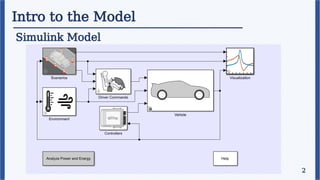
Intro to the Model
Simulink Model
2
Environment
Description
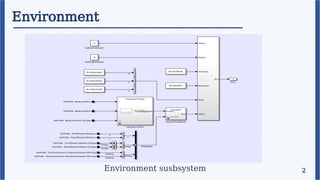
The environment subsystem creates environment variables, including
road grade, wind velocity and atmospheric temperature and pressure.
Role of Environment –
• Resistive forces on the vehicle are dependent on the air speed (drag force), gradient, as well as the road
conditions (rolling resistance).
• The performance of the engine (for Hybrid Vehicles) and the thermal control system is dependent on the
atmospheric temperature and pressure.
2
Environment
2
Environment susbsystem
Scenarios
2
Description
The Scenarios block implements the Drive Cycle Source block to generate
a standard longitudinal drive cycle. Along with that, it allows for the input
of external driver reference and/or command signals.
Drive Cycle Source –
The drive cycle creates a standardized reference signal of speed and acceleration of
the vehicle over time. Its major objective is to stimulate real world driving patterns
for the testing of the vehicles. This helps in tuning the vehicle to optimize
performance.
Scenarios
2
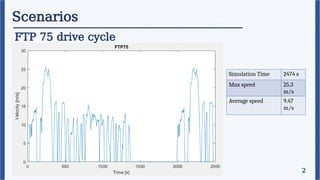
FTP 75 drive cycle
Simulation Time 2474 s
Max speed 25.3
m/s
Average speed 9.47
m/s
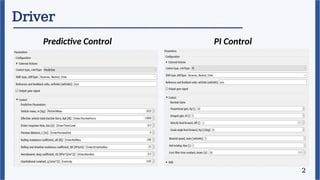
Driver
2
Description
This block generates the drive cycle tracking
commands. It takes the reference of the drive
cycle and takes the feedback vehicle speed
and environment condition and
correspondingly generates the vehicle driving
commands.
Longitudinal Driver
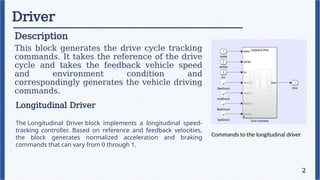
The Longitudinal Driver block implements a longitudinal speed-
tracking controller. Based on reference and feedback velocities,
the block generates normalized acceleration and braking
commands that can vary from 0 through 1.
Commands to the longitudinal driver
Driver
2
Predictive Control PI Control
Controller
Description
The Controller block contain several modules like BMS,
VCU, Braking Controller etc.
This block generates the control signal to get the desired
output from the vehicle/plant.
2
Controller
Vehicle Control Unit (VCU) - Controls the power train of the vehicle
2
Major Functions
• Receives the traction/braking commands from the pedals
• Uses BMS data to estimate the limiting current
• Receives machine speed and vehicle feedback
• Calculates required torque for driving/regenerative braking
• Calculates the mechanical braking to be applied at the wheels
Depending on the vehicle components this subsystem changes as well
Requirements in this model-
• To take in account of the Battery management system
• Provide torque command for the DC-DC converter to drive the
single motor driving the front axle
Controller
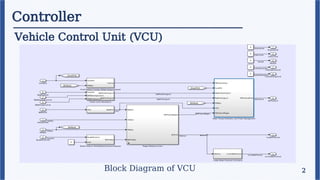
Vehicle Control Unit (VCU)
2
Block Diagram of VCU
Controller
Vehicle Control Unit (VCU) – Pedal to Torque
Request
2
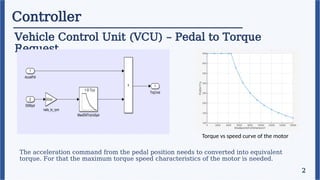
The acceleration command from the pedal position needs to converted into equivalent
torque. For that the maximum torque speed characteristics of the motor is needed.
Torque vs speed curve of the motor
Controller
Vehicle Control Unit (VCU) – Power Limit
Estimation
2
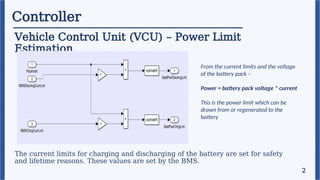
The current limits for charging and discharging of the battery are set for safety
and lifetime reasons. These values are set by the BMS.
From the current limits and the voltage
of the battery pack –
Power = battery pack voltage * current
This is the power limit which can be
drawn from or regenerated to the
battery
Controller
Vehicle Control Unit (VCU) – Brake Pedal to total
Braking
2
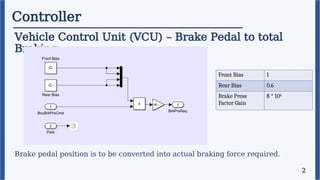
Brake pedal position is to be converted into actual braking force required.
Front Bias 1
Rear Bias 0.6
Brake Press
Factor Gain
8 * 106
Controller
Vehicle Control Unit (VCU) – Regenerative
Braking Control
2
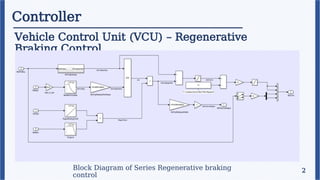
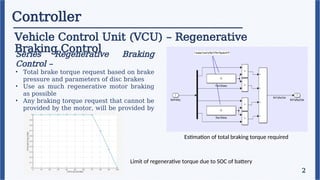
Block Diagram of Series Regenerative braking
control
Controller
Vehicle Control Unit (VCU) – Regenerative
Braking Control
2
Series Regenerative Braking
Control –
• Total brake torque request based on brake
pressure and parameters of disc brakes
• Use as much regenerative motor braking
as possible
• Any braking torque request that cannot be
provided by the motor, will be provided by
the friction brakes
Estimation of total braking torque required
Limit of regenerative torque due to SOC of battery
Controller
Vehicle Control Unit (VCU) – Power Management
2
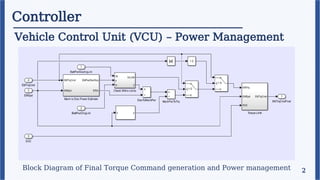
Block Diagram of Final Torque Command generation and Power management
Controller
Vehicle Control Unit (VCU) – Power Management
2
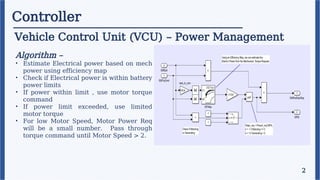
Algorithm –
• Estimate Electrical power based on mech
power using efficiency map
• Check if Electrical power is within battery
power limits
• If power within limit , use motor torque
command
• If power limit exceeded, use limited
motor torque
• For low Motor Speed, Motor Power Req
will be a small number. Pass through
torque command until Motor Speed > 2.
Controller
Battery Management System (BMS)
2
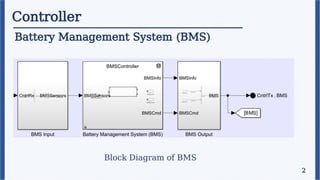
Block Diagram of BMS
Controller
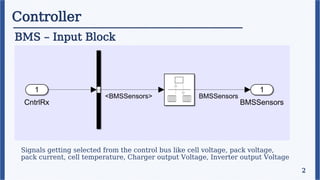
BMS – Input Block
2
Signals getting selected from the control bus like cell voltage, pack voltage,
pack current, cell temperature, Charger output Voltage, Inverter output Voltage
Controller
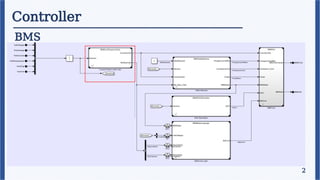
BMS
2
Signals getting selected from the control bus like cell voltage, pack voltage,
pack current, cell temperature, Charger output Voltage, Inverter output Voltage
Controller
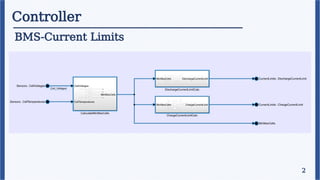
BMS-Current Limits
2
Controller
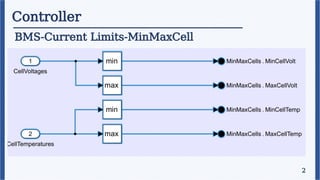
BMS-Current Limits-MinMaxCell
2
Controller
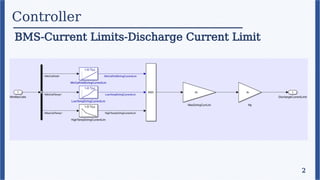
BMS-Current Limits-Discharge Current Limit
2
Controller
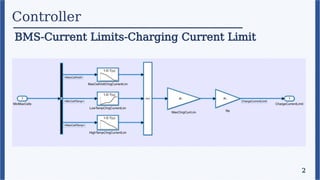
BMS-Current Limits-Charging Current Limit
2
Controller
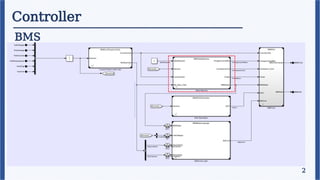
BMS
2
Signals getting selected from the control bus like cell voltage, pack voltage,
pack current, cell temperature, Charger output Voltage, Inverter output Voltage
Controller
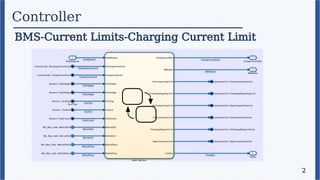
BMS-Current Limits-Charging Current Limit
2
THANK
YOU
2

Study of EV reference Model of Simulink2

  • 1.
    IIT Kharagpur Advance TechnologyDevelopment Center Study of EV Reference Model Simulation Presented By Mohd Ali Shamsi (24AT62R02) Himanshu Sinha ( 24AT62R06) Abhishek Saini (24AT62R07) Muhammed Shabin (24AT62R08) Submitted as for fulfillment of Assignment of PADC
  • 2.
    INDEX • Study ofEV Reference Model Simulation • Environment Subsystem • Longitudinal Driver • Controller • Vehicle Control Unit • Battery Management System • Vehicle Model • Simulation results
  • 3.
    Intro to theModel What is it for ? This a full EV simulation model which is used for a) Powertrain Matching Analysis b) Control and Diagnostic algorithm design c) HIL Testing 1
  • 4.
    Intro to theModel Simulink Model 2
  • 5.
    Environment Description The environment subsystemcreates environment variables, including road grade, wind velocity and atmospheric temperature and pressure. Role of Environment – • Resistive forces on the vehicle are dependent on the air speed (drag force), gradient, as well as the road conditions (rolling resistance). • The performance of the engine (for Hybrid Vehicles) and the thermal control system is dependent on the atmospheric temperature and pressure. 2
  • 6.
  • 7.
    Scenarios 2 Description The Scenarios blockimplements the Drive Cycle Source block to generate a standard longitudinal drive cycle. Along with that, it allows for the input of external driver reference and/or command signals. Drive Cycle Source – The drive cycle creates a standardized reference signal of speed and acceleration of the vehicle over time. Its major objective is to stimulate real world driving patterns for the testing of the vehicles. This helps in tuning the vehicle to optimize performance.
  • 8.
    Scenarios 2 FTP 75 drivecycle Simulation Time 2474 s Max speed 25.3 m/s Average speed 9.47 m/s
  • 9.
    Driver 2 Description This block generatesthe drive cycle tracking commands. It takes the reference of the drive cycle and takes the feedback vehicle speed and environment condition and correspondingly generates the vehicle driving commands. Longitudinal Driver The Longitudinal Driver block implements a longitudinal speed- tracking controller. Based on reference and feedback velocities, the block generates normalized acceleration and braking commands that can vary from 0 through 1. Commands to the longitudinal driver
  • 10.
  • 11.
    Controller Description The Controller blockcontain several modules like BMS, VCU, Braking Controller etc. This block generates the control signal to get the desired output from the vehicle/plant. 2
  • 12.
    Controller Vehicle Control Unit(VCU) - Controls the power train of the vehicle 2 Major Functions • Receives the traction/braking commands from the pedals • Uses BMS data to estimate the limiting current • Receives machine speed and vehicle feedback • Calculates required torque for driving/regenerative braking • Calculates the mechanical braking to be applied at the wheels Depending on the vehicle components this subsystem changes as well Requirements in this model- • To take in account of the Battery management system • Provide torque command for the DC-DC converter to drive the single motor driving the front axle
  • 13.
    Controller Vehicle Control Unit(VCU) 2 Block Diagram of VCU
  • 14.
    Controller Vehicle Control Unit(VCU) – Pedal to Torque Request 2 The acceleration command from the pedal position needs to converted into equivalent torque. For that the maximum torque speed characteristics of the motor is needed. Torque vs speed curve of the motor
  • 15.
    Controller Vehicle Control Unit(VCU) – Power Limit Estimation 2 The current limits for charging and discharging of the battery are set for safety and lifetime reasons. These values are set by the BMS. From the current limits and the voltage of the battery pack – Power = battery pack voltage * current This is the power limit which can be drawn from or regenerated to the battery
  • 16.
    Controller Vehicle Control Unit(VCU) – Brake Pedal to total Braking 2 Brake pedal position is to be converted into actual braking force required. Front Bias 1 Rear Bias 0.6 Brake Press Factor Gain 8 * 106
  • 17.
    Controller Vehicle Control Unit(VCU) – Regenerative Braking Control 2 Block Diagram of Series Regenerative braking control
  • 18.
    Controller Vehicle Control Unit(VCU) – Regenerative Braking Control 2 Series Regenerative Braking Control – • Total brake torque request based on brake pressure and parameters of disc brakes • Use as much regenerative motor braking as possible • Any braking torque request that cannot be provided by the motor, will be provided by the friction brakes Estimation of total braking torque required Limit of regenerative torque due to SOC of battery
  • 19.
    Controller Vehicle Control Unit(VCU) – Power Management 2 Block Diagram of Final Torque Command generation and Power management
  • 20.
    Controller Vehicle Control Unit(VCU) – Power Management 2 Algorithm – • Estimate Electrical power based on mech power using efficiency map • Check if Electrical power is within battery power limits • If power within limit , use motor torque command • If power limit exceeded, use limited motor torque • For low Motor Speed, Motor Power Req will be a small number. Pass through torque command until Motor Speed > 2.
  • 21.
    Controller Battery Management System(BMS) 2 Block Diagram of BMS
  • 22.
    Controller BMS – InputBlock 2 Signals getting selected from the control bus like cell voltage, pack voltage, pack current, cell temperature, Charger output Voltage, Inverter output Voltage
  • 23.
    Controller BMS 2 Signals getting selectedfrom the control bus like cell voltage, pack voltage, pack current, cell temperature, Charger output Voltage, Inverter output Voltage
  • 24.
  • 25.
  • 26.
  • 27.
  • 28.
    Controller BMS 2 Signals getting selectedfrom the control bus like cell voltage, pack voltage, pack current, cell temperature, Charger output Voltage, Inverter output Voltage
  • 29.
  • 30.